Marine Panel: Existing Platforms Need Better Employment to Address Global Logistics Challenges

A CH-53K King Stallion helicopter, left, flies over the Chesapeake Bay after successfully connecting with a funnel-shaped drogue towed behind a KC-130J tanker aircraft during aerial refueling wake testing. Lt. Gen. Edward Banta, Deputy Commandant for Installations and Logistics, noted the Marines would need to improve their use of C-130J transports; CH-53K helicopters; and developing unmanned aerial, surface and subsurface systems to address logistics challenges as the threat of a conflict in the Indo-Pacific grows. U.S. NAVY / Erik Hildebrandt

WASHINGTON — The emerging difficult security environment, particularly with the growing threat from China in the Indo-Pacific theater, has placed greater importance on global logistics and created new challenges on how to sustain the deployed forces, a panel of senior Marine officers said May 10.

Improving global logistics in this new operating situation will require better knowledge of “what we have, where we have it and how best to support the Marines” operating across the vast distances of the Pacific, said Lt. Gen. Edward Banta, deputy commandant for Installations and Logistics. Meeting the requirements to sustain the deployed forces also will require reducing their demands for support, including the need for energy and information bandwidth, Banta said at the Modern Day Marine exposition at the Walter E. Washington Convention Center.

Meeting the need to sustain Marine forces in a potentially contested environment will require better employment of existing support platforms, such as the C-130J transports and CH-53K helicopters as well as developing unmanned aerial, surface and subsurface systems, he said.

Maj. Gen. Joseph Shrader, commanding general, Marine Corps Logistics Command, said the new challenges will require “extending the reach” of the U.S. based logistics installations, such as the depots at Barstow, California, and Albany, Georgia. That could include moving some of the depot capabilities to the operational levels, while modernizing the depots by “deciding what we need and getting rid of the rest.”

Schrader and other officer on the panel also stressed the demand to create greater security for the energy and communications requirements for all the Marine installation. To do that, the Corps has experimented with moving some of its installations off the commercial energy grid and will do more of that in the future, they said. They also are making concerted efforts to improve cybersecurity at the domestic installations and overseas bases.

The panel members echoed the statement by Marine Corps Commandant Gen. David Berger that better and more secure logistics was essential to the existence of the “stand-in forces,” which could be relatively small and mobile units operating on islands or isolated land positions within the enemy’s fire engagement zone. Those operations on what are called Expeditionary Advanced Bases, are among the concepts being developed under Berger’s Force 2030 reorganization drive

Brig. Gen. Adam Chalkly, assistant deputy commandant for Installations and Logistics also pointed out that 30 years of uncontested lines of global support is ending and the security of the forward-deployed operational and logistical support installations is no longer ensure, which puts new demands on the entire sustainment system.

CNO, Italian Defense Chief of Staff Meet, Discuss Maritime Strategy and Partnership

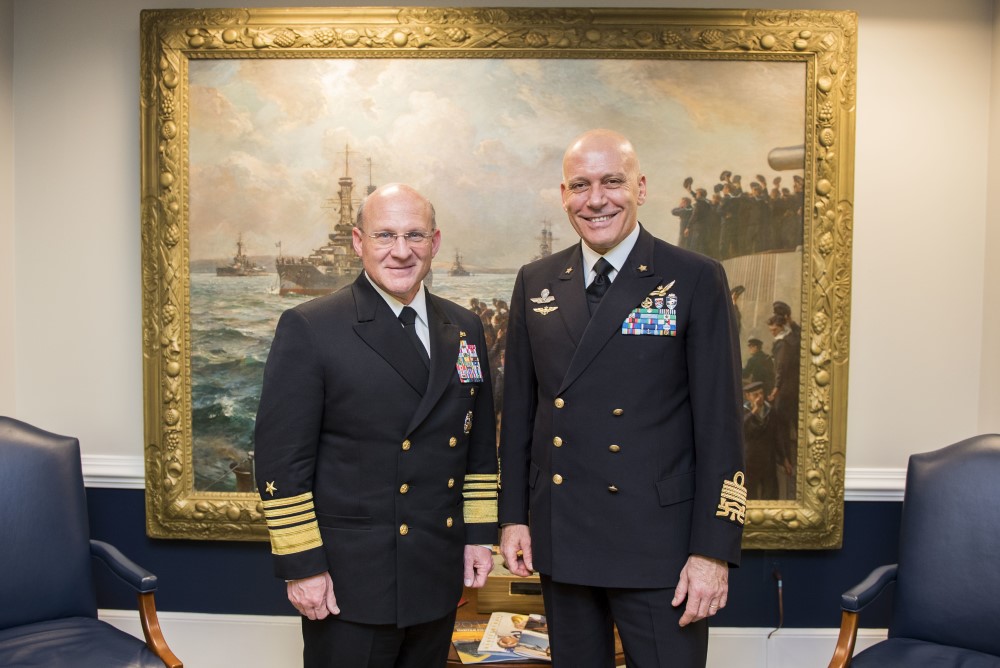
Chief of Naval Operations Adm. Mike Gilday, left, is shown hosting then-Chief of the Italian Navy Adm. Giuseppe Cavo Dragone at the Pentagon in this February 2020 picture. U.S. NAVY / Mass Communication Specialist 1st Class Raymond D. Diaz III

WASHINGTON — U.S. Chief of Naval Operations Adm. Mike Gilday met with the Italian Chief of Defense Staff Adm. Giuseppe Cavo Dragone at the Pentagon May 10, the CNO’s Public Affairs Office said in a release.

Gilday and Cavo Dragone discussed the long-lasting and vital maritime partnership between Italy and the United States, as well as the importance of global security.

“The very nature of our operating environment requires common values and a collective alliance,” said Gilday. “You have been a strong partner and gracious host to U.S. naval forces and our joint efforts in Europe. Working together is critical to regional security and stability.”

“We are ready to make further commitments in all domains, in what we consider an important portion of allied areas of responsibility, namely the wider Mediterranean region,” said Cavo Dragone.

Gilday and Cavo Dragone also spoke about strategic competition, China and Russia.

They both affirmed the close relationship of the U.S. and Italian navies and expressed appreciation for their partnership as NATO allies and as friends.

The U.S. and the Italian navy regularly operate together around the globe. In addition to conducting real-world tri-carrier operations, earlier this year the two navies also participated in exercises and activities such as Neptune Strike 2022, Obangame Express, and assorted bilateral drills. These exercises highlight NATO’s ability to integrate high-end maritime warfare capabilities to support the defense of the alliance.

Italy hosts American Sailors at Naval Support Activity (NSA) Naples, Naval Air Station Sigonella and NSA Naples Detachment Gaeta.

Gilday previously met with Cavo Dragone in February 2020 and October 2021, when he served as the chief of the Italian navy.


BAE Systems Testing ACV for Marine Corps Recon Program

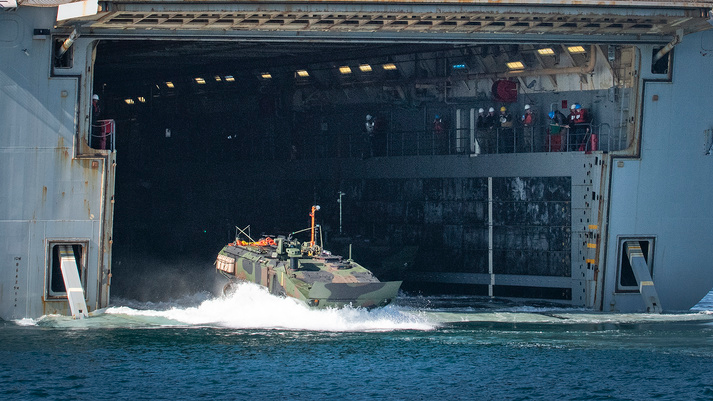
BAE Systems is proposing the Marine Corps use its Amphibious Combat Vehicle for the Advanced Reconnaissance Vehicle program. BAE Systems

WASHINGTON – BAE Systems is offering the Marine Corps an alternative to its proposal to produce a new-start platform for the Advanced Reconnaissance Vehicle program by demonstrating a new version of its Amphibious Combat Vehicle, which is currently operational.

“We like to believe there is an advantage in a proven platform,” that has great land and water mobility and significant survivability, BAE representative Mark Brinkman said May 10. The advantages of adapting the ACV for the recon requirement include a single established parts supply line, a single school house for vehicle drivers and maintenance personnel, and an active production line, he said.

Brinkman discussed the BAE proposal next to a basic ACV that has been modified with an assortment of sensors and defensive systems required for the reconnaissance vehicle, on display at the Modern Day Marine exposition at the Walter E. Washington Convention Center.

The demonstration vehicle had optical and infrared sensors, a small tethered unmanned aerial vehicle, the ability to carry and command and control a larger class-two UAV, and counter-UAV systems. The modified ACV would support a vehicle commander, a driver and five sensor operators, each with a multi-function operating station, Brinkman said.

The Advanced Reconnaissance Vehicle program would replace the existing Light Armor Vehicle, which functions as a scout and troop support platform, but is nearing its end-of-service life. The Marine Corps has given contracts to General Dynamics Land Systems and Textron Systems to develop prototypes for the ARV. But BAE, on its own initiative, will test a modified ACV this summer, provide it for Marine testing and then submit a detailed proposal next year, Brinkman said.

A potential drawback for the BAE proposal is the Marines’ requirement for a vehicle weight limit of 37,000 pounds, set to allow four vehicles to be carried on an LCAC ship-to-shore connector. The BAE ACV weighs about 35 tons – 70,000 pounds.

Brinkman said the ACV’s weight is offset by its “ability to swim” from ship to shore, reducing the need for a connector, like the LCAC. 

But that could minimize the standoff distance for the amphibious shipping as the ACV swims at about 7 knots, compared to the 30-knot water speed of the LCAC.


Coast Guard Offloads $5.6 Million in Seized Cocaine in San Juan, Puerto Rico

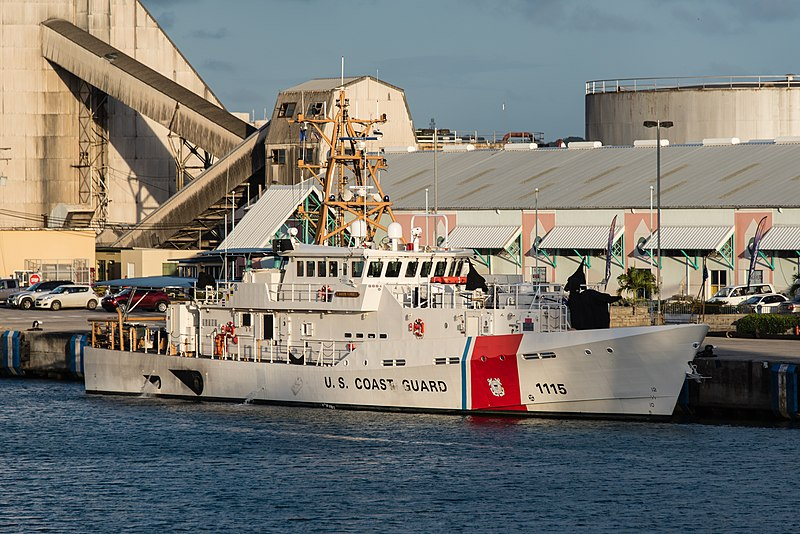
USCGC Joseph Napier, shown here in the Port of Bridgetown, Barbados.

SAN JUAN, Puerto Rico — The crew of the Coast Guard Cutter Joseph Napier and Caribbean Corridor Strike Force agents offloaded 626 pounds of seized cocaine Monday in San Juan, Puerto Rico, the Coast Guard 7th District said in a May 10 release. 

The offload of contraband resulted from a go-fast vessel interdiction April 28, 2022, in Mona Passage waters near the Dominican Republic. 

The interdiction is the result of multi-agency efforts involving the Caribbean Border Interagency Group and the Caribbean Corridor Strike Force. The seized cocaine has an estimated wholesale value of approximately $5.6 million dollars. 

During the morning of April 28, the crew of a Coast Guard HC-27J Spartan aircraft detected a suspect vessel north of Mona Island, Puerto Rico. Coast Guard watchstanders in Sector San Juan diverted the cutter Joseph Napier that arrived on scene with the suspect vessel. Upon detecting the presence of the Coast Guard cutter, the occupants of the suspect vessel were observed jettisoning multiple bales of suspected contraband into the water and attempting to flee the area toward Dominican Republic territorial waters. Once in Dominican Republic waters, the crew of a Dominican Republic navy vessel interdicted the suspect vessel and apprehended three Dominican Republic nationals who were aboard. Meanwhile, the crew of the cutter Joseph Napier recovered 11 bales of the jettisoned suspected contraband, which tested positive for cocaine.   

“Safeguarding the nation’s southernmost maritime border is among our top priorities,” said Capt. Gregory H. Magee, Coast Guard Sector San Juan commander. “You can expect to see many more of these interdictions from the Coast Guard, federal and local law enforcement, and from our Dominican Republic Navy partners as we work together to stop drug smuggling go-fast vessels at sea and prevent them from making landfall in Puerto Rico.” 

Special Agents supporting the Caribbean Corridor Strike Force are leading the investigation into this case.   

Cutter Joseph Napier is a 154-foot fast response cutter that is homeported in San Juan, Puerto Rico.  


Marine Corps Force Design Update Adjusts MV-22 Squadron Force Levels 

An MV-22B Osprey assigned to the Aviation Combat Element from Special Purpose Marine Air-Ground Task Force-Crisis Response-Africa 20.2, Marine Forces Europe and Africa, conducts deck landing qualifications aboard the amphibious assault ship USS Bataan (LHD 5), June 28, 2020. U.S. Marine Corps / Cpl. Tanner Seims

ARLINGTON, Va. — The Marine Corps’ Force Design 2030 annual report has announced adjustments in the force levels of its Marine medium tiltrotor (VMM) squadrons that fly the MV-22B Osprey assault transport aircraft.  

“We originally planned to divest three MV-22 medium tiltrotor squadrons from the Active Component, which would have resulted in a total of 14 squadrons of 12 aircraft each,” said the report, released May 9 by Marine Corps Commandant Gen. David H. Berger. “However, detailed analysis demonstrated that 16 squadrons of 10 aircraft each better satisfies joint force requirements and better supports service needs to organize, train and equip. In particular, this force structure simplifies the formation of a Marine Expeditionary Unit’s aviation combat element.” 

“Quite frankly, it was personnel-driven,” said Lt. Gen. Karsten S. Heckl, deputy commandant for combat development and integration, Headquarters, U.S. Marine Corps, and commanding general, Marine Corps Combat Development Command, Marine Corps Base Quantico, Virginia, speaking May 6 to reporters and amplifying the Corps’ reasoning for the change in VMM squadron aircraft complement.  

“There were many external factors to that primary factor of personnel,” Heckl said. “So, there a few levers the commandant can pull on to generate resources. The conclusion that the Headquarters, Marine Corps, staff came to was that manpower was the most appropriate because we were over-sized, we were at an unsustainable number, so that was the logical choice to make.” 

Heckl said the squadron size of 10 MV-22Bs would give the Corps the flexibility to add more F-35B Lightning II strike fighters to the ACE if it so chose. Currently the ACE typically deploys with six F-35B Lightning II strike fighters or AV-8B Harrier II attack aircraft.  

“Right now, the MEUs are going out — and it depends whether it’s 10 or 12 V-22s when the [MEUs] go out [on deployment],” he said. When we start making every deployment with [F-35Bs] and the possibility that the numbers [of F-35Bs] that would go out — those numbers changing — the 10- [V-22s per squadron] makes all the sense in the world. 

“Quite frankly, when you take into the equation the attrition rate, pipeline aircraft, training aircraft, the numbers work out pretty well,” he said.  

The Marine Corps has cut or is cutting four MV-22B squadrons. The stand-up of VMM-212 was canceled in fiscal 2019. VMM-264 and VMM-166 were deactivated in fiscal 2020 and 2021, respectively. VMM-164 will be deactivated in fiscal 2022. The remaining force will include 14 active-component fleet VMM squadrons, one active-component VMMT fleet replacement squadron and two reserve-component VMM squadrons. 

The Force Design annual report also called for an experiment in active-reserve integration of a reserve VMM squadron. The commandant directed the Corps to “perform Active Component/Reserve Component integration proof of concept in 2d MAW [Marine Aircraft Wing] by incorporating VMM-774 into an Active Component Marine Aircraft Group in [fiscal 2023].” 

VMM-774 is based at Naval Station Norfolk, Virginia, also the base of two Navy helicopter mine-countermeasures squadrons that have been combined active-reserve squadrons. 


Naval Safety Command to Conduct No-Notice, Short-Notice Inspections 

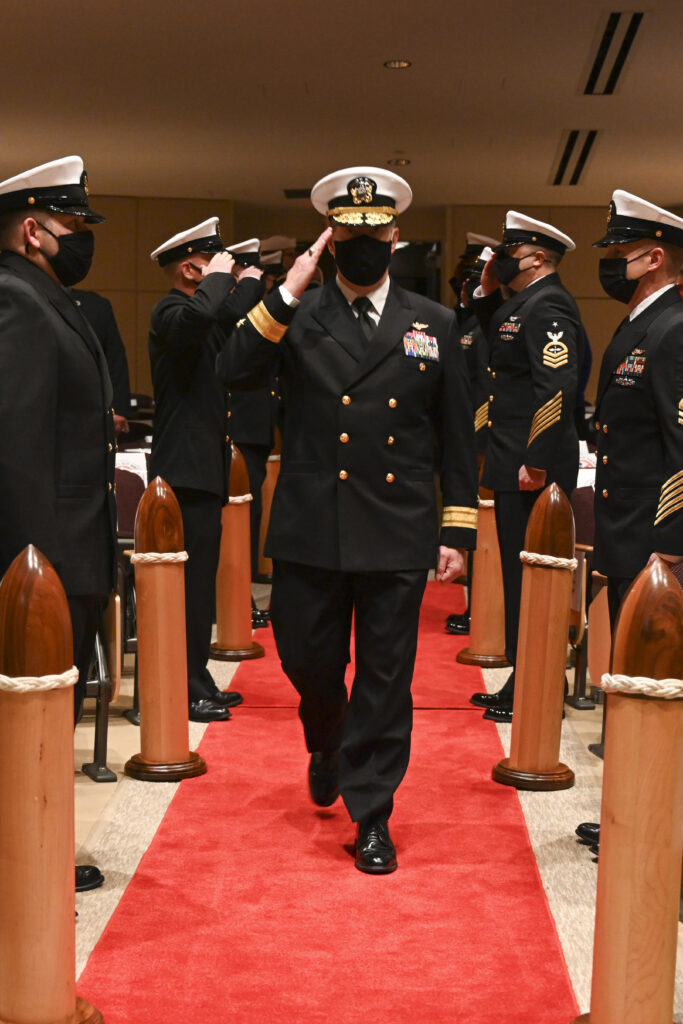
Rear Adm. Frederick R. Luchtman, commander, Naval Safety Command, salutes the sideboys during an establishment ceremony for the Naval Safety Command on Feb. 4. U.S. NAVY / Mass Communication Specialist 2nd Class (SW/AW) Weston A. Mohr

ARLINGTON, Va. — The new Naval Safety Command intends to hold no-notice and short-notice safety inspections of Navy commands to identify and understand risk and assess the safety posture of the fleet, the new command’s first commander said.   

One-star Rear Adm. Fredrick “Lucky” Luchtman, speaking May 5 in a session of the U.S. Navy Memorial’s SITREP Speaker Series, also said the new command will become a two-star billet soon, filled by a former carrier strike group or expeditionary commander, thereby giving greater perspective “on all things safety throughout the fleet.” 

The Naval Safety Command was established from the old Naval Safety Center on Feb. 7, 2022, to elevate the attention to safety, assessment of it and accountability for it in the fleet. All of the former directors of the Naval Safety Center since it was established in 1951 have been aviators, as is the first current commander of the Naval Safety Command, Luchtman. During the 1950s the mishap rate of naval aviation as it upgraded from piston-engine aircraft to jets skyrocketed and the Navy launched the center to assess the causes and propose solutions. 

Luchtman reports directly to the chief of naval operations, a reflection of the Navy’s increased emphasis on safety, especially in the wake of the fire that destroyed the amphibious assault ship USS Bonhomme Richard. 

The admiral estimates that mishaps cost the Navy $1 billion per year in loss of aircraft, steaming time for ships and personnel costs, among other costs. The year 2020 was even more costly with the loss of the Bonhomme Richard. 

The Naval Safety Command will be sending assessment teams out to the fleet to determine the effectiveness of the safety management systems. The command is developing “a cadre of professionals who can truly assess compliance.” Luchtman said one of his goals is to streamline and simplify the safety management system by identifying risk, communicating it and holding accountability at the right level.  

“The accountability piece is absolutely key,” he said. Referring the Bonhomme Richard incident, he said, “the system isn’t healthy as it could be.” 

Luchtman mentioned one demographic that has a bearing on automotive safety in the Marine Corps, a service that makes heavy use of motor transport. He said 25% of Marine Corps recruits did not have a driver’s license, a percentage far large than a generation ago. 

Luchtman’s successor will be a surface warfare officer, Rear Adm. Christopher M. Engdahl, currently commander, Expeditionary Strike Group 2 and commander, Amphibious Force, U.S. 7th Fleet.  


CNO Updates Professional Reading Program    

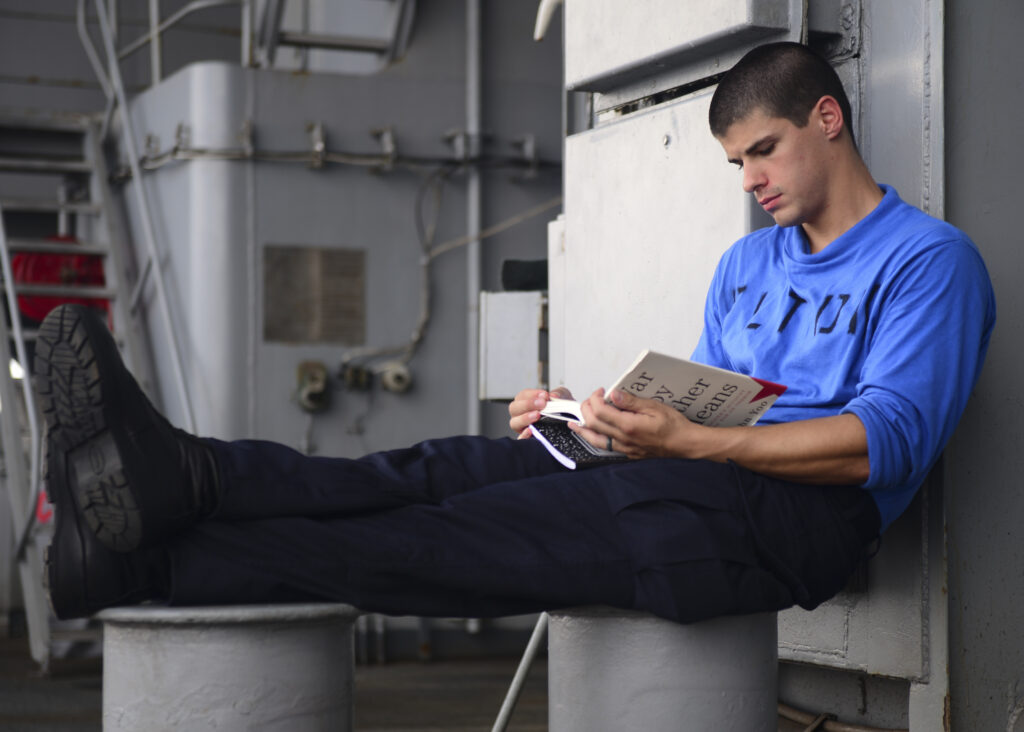
U.S. Navy Airman Benjamin Adams reads a book on the fantail of the aircraft carrier USS Nimitz (CVN 68), July 5, 2017, in the South China Sea. U.S. NAVY / Mass Communication Specialist 3rd Class Ian Kinkead

WASHINGTON — Chief of Naval Operations Adm. Mike Gilday released an update to the CNO Professional Reading Program, May 6, the CNO’s public affairs office said in a release.     

The CNO-Professional Reading Program consists of 12 books, and is a mix of writing genres including fiction, non-fiction, military, strategy, management, and technology, among others.    

“A learning mindset is essential to accelerating our warfighting advantage,” said Gilday. “A Navy that learns, adapts, and improves the fastest will be the most successful. Knowledge sharing is essential to creating a learning culture.”    

The goal of the program is to contribute to a culture dedicated to warfighting and learning, while simultaneously supporting the personal and professional development of Sailors beyond that of their primary designator or rating.    

“We are driving a fleet-wide campaign of self-improvement,” said Gilday. “We must foster an organization that supports and empowers Sailors to have an independent quest for knowledge through reading and information sharing. What you know and how fast you learn is relevant in this era of strategic competition.”   

The following books are included in the newly released update:   

  1. “To Rule the Waves” by Bruce Jones     
  2. “A Brief Guide to Maritime Strategy” by James Holmes     
  3. “China as a 21st Century Naval Power” by Michael. A. McDevitt     
  4. “Not One Inch” by Mary E. Sarotte     
  5. The Sailor’s Bookshelf: Fifty Books to Know the Sea” by Admiral James G. Stavridis    
  6. “Army of None: Autonomous Weapons and the Future of War” by Paul Scharre     
  7. “Fortune Favors Boldness” by Barry Costello     
  8. “The Last Stand of the Tin Can Sailors: The Extraordinary World War II Story of the U.S. Navy’s Finest Hour” by James Hornfischer     
  9. “World War II at Sea: A Global History” by Craig Symonds     
  10. “Ashley’s War: The Untold Story of a Team of Women Soldiers on the Special Ops Battlefield” by Gayle T. Lemmon    
  11. “Dare to Lead” by Brene Brown     
  12. “Mindset: The New Psychology of Success” by Carol Dweck   
  13. Link to CNO’s Professional Reading Program website:  https://www.navy.mil/CNO-Professional-Reading-Program/.     

Most of the books are available at no cost to Sailors in both e-Book and digital audio format from the Navy MWR digital library collection.  Eligible patrons can download the books through: https://www.navymwrdigitallibrary.org.    


Coast Guard to Commission Fast Response Cutter Pablo Valent 

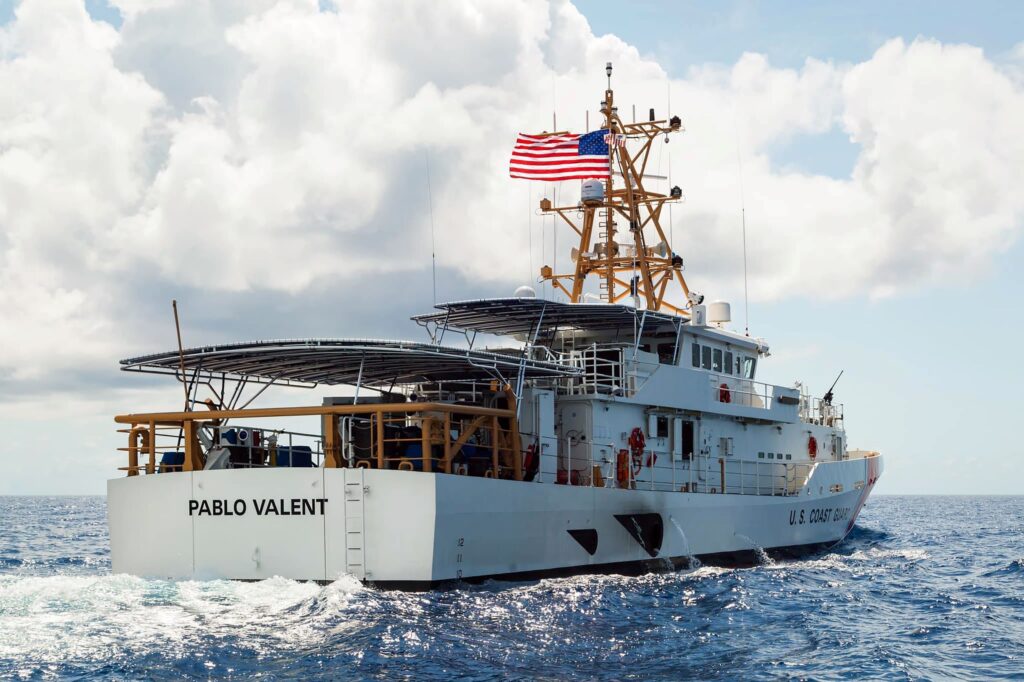
Coast Guard Cutter Pablo Valent, a 154-foot Sentinel-class vessel, is homeported at Coast Guard Sector St. Petersburg, Florida. U.S. COAST GUARD

ST. PETERSBURG, Fla. — The Coast Guard will commission the 48th Sentinel-class fast response cutter Pablo Valent (WPC 1148), into service at Coast Guard Sector St. Petersburg on May 11, the Coast Guard 7th District said May 6. 

Rear Adm. Brendan McPherson, commanding officer of the Coast Guard 7th District, will preside over the ceremony. Cecilia Guillot, Valent’s great-niece, is the ship’s sponsor.  

The cutter’s namesake Pablo Valent was originally from Corpus Christi, Texas, and joined the United States Life-Saving Service in 1912. In September 1919, Valent helped rescue the crew of the hurricane-damaged schooner Cape Horn off the coast of Texas. For his heroic efforts, Valent received the Silver Lifesaving Medal and the Grand Cross of the American Cross of Honor Society. Valent was one of the first Hispanic Americans to receive these honors.  

The Cutter Valent is the 48th FRC and is the first to be homeported in St. Petersburg with missions including search and rescue, maritime law enforcement, coastal security and living marine resources. There are 12 other FRCs in Florida, which operate throughout the Caribbean Sea. 

Sector St. Petersburg is one of the Coast Guard’s largest commands, with an area of responsibility encompassing over 400 nautical miles of coastline along Florida’s west coast. 


Navy to Christen Future Littoral Combat Ship Beloit 

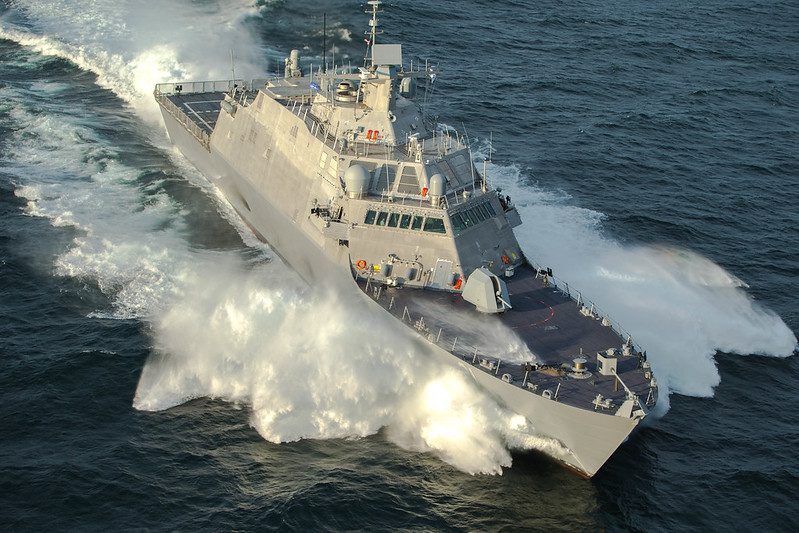
The future USS Beloit’s sister Freedom-class LCS, the USS Minneapolis-Saint Paul (LCS 21). LOCKHEED MARTIN

ARLINGTON, Va. — The Navy will christen its newest Freedom-variant littoral combat ship, the future USS Beloit (LCS 29), during a 10:00 a.m. CDT ceremony Saturday, May 7, in Marinette, Wisconsin, the Defense Department said May 6. 

The Sen. Tammy Baldwin (D-Wisconsin) will be the principal speaker. Also providing remarks are Rep. Mike Gallagher (R-Wisconsin), Vice Adm. John Fuller, Naval Inspector General, Vice Adm. Francis Morley, principal military deputy to the assistant secretary of the Navy for Research, Development, and Acquisition, Lori Curtis Luther, city manager of Beloit, Wisconsin, as well as shipbuilders Steve Allen, vice president, Small Combatants and Ship Systems, Lockheed Martin Integrated Warfare Systems and Sensors, and Mark Vandroff, CEO, Fincantieri Marinette Marine. 

In a time-honored Navy tradition, the ship’s sponsor, Beloit native and retired Army Maj. Gen. Marcia Anderson, will break a bottle of sparkling wine across the bow. 

“The future USS Beloit will be the first U.S. Navy ship honoring the proud naval contributions of Beloit, Wisconsin,” said Secretary of the Navy Carlos Del Toro. “I have no doubt the Sailors of USS Beloit will stand the watch with pride and be ready to respond to any mission, wherever, and whenever, there is a need.” 

The LCS class consists of two variants, the Freedom and the Independence, designed and built by two industry teams. Lockheed Martin leads the Freedom-variant team, or odd-numbered hulls, constructed in Marinette, Wisconsin. Austal USA leads the Independence-variant team in Mobile, Alabama, for LCS 2 and the subsequent even-numbered hulls. 

LCS 29 is the 15th Freedom-variant LCS and 29th in the LCS class. It is the first ship named in honor of the city of Beloit, Wisconsin. 


Coast Guard Cutter Cuttyhunk Decommissioned after 34 Years of Service 

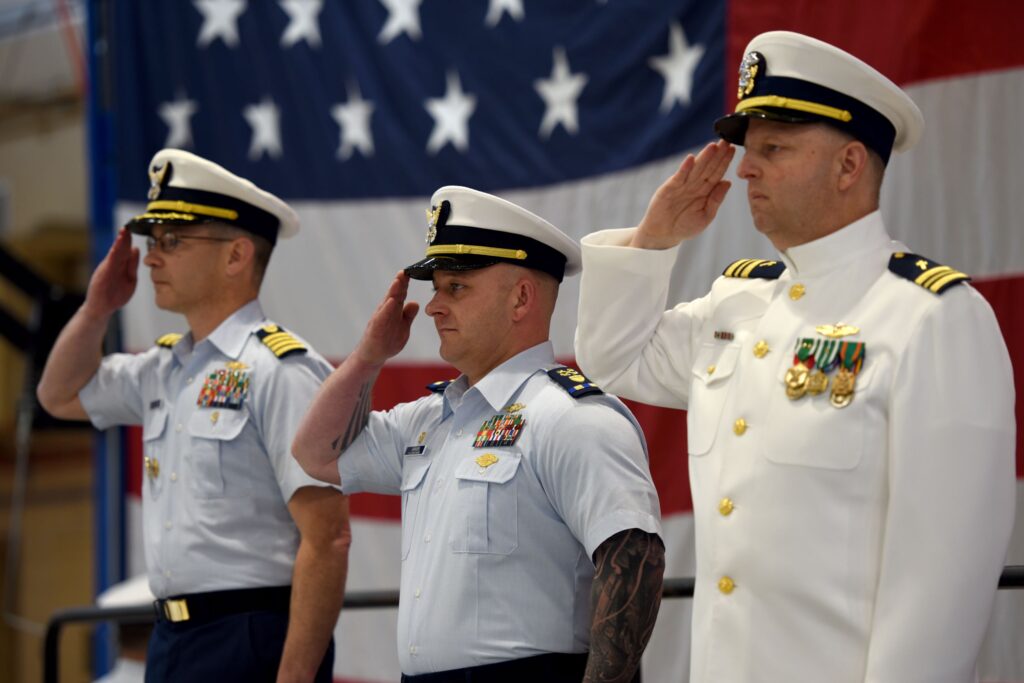
The official party renders solute during a ceremony held to decommission Coast Guard Cutter Cuttyhunk (WPB 1322) from service Thursday, May 5, at Air Station Port Angeles. Captain Mark McDonnell, District 13 Chief of Response, (left) oversaw the ceremony. U.S. COAST GUARD / Petty Officer 3rd Class Michael Clark

PORT ANGELES, Wash. — The Coast Guard decommissioned Coast Guard Cutter Cuttyhunk (WPB 1322) May 5 during a ceremony held at Air Station Port Angeles that was presided over by Capt. Mark McDonnell, 13th Coast Guard District Chief of Response. 
 
Cuttyhunk was one of the Coast Guard’s 37 remaining 110-foot Island-class patrol boats. The fleet of Island-class cutters is being replaced by 154-foot Sentinel-class cutters. 
 
Commissioned in 1988, the Cuttyhunk was the 22nd of 49 110-foot patrol boats built in support of the Coast Guard’s maritime homeland security, migrant and drug interdiction, fisheries enforcement and search and rescue missions. Cuttyhunk was built by Bollinger Shipyards in Lockport, Louisiana, and commissioned on Oct. 5. Cuttyhunk was named after Cuttyhunk Island, the site of the first English settlement in New England, located off the southern coast of Massachusetts. 
 
Over the past 34 years of service, Cuttyhunk’s crew conducted a wide range of operations. The cutter’s crews completed over 1,000 operations ranging from law enforcement boardings to search and rescue responses throughout the Pacific Northwest. Cuttyhunk assisted U.S. Naval Base Kitsap Bangor in several submarine escorts before Coast Guard Maritime Force Protection Unit Bangor was established to ensure the safe transport of Ship Submersible Ballistic Submarines. 
 
Nicknamed “The Pest of the West,” Cuttyhunk assisted in one of the largest maritime drug seizures in the Pacific Northwest, near Cape Flattery, Washington, in December of 1997. More than 3,500 pounds of marijuana, estimated at a street value of $15 million, was recovered from the OK Jedi, a 60-foot sailboat with three people onboard. 
 
“It has been an honor and privilege to serve alongside the final crew of Coast Guard Cutter Cuttyhunk,” said Chief Warrant Officer Daniel Garver, commanding officer. “During my time onboard, there have been many engineering challenges on our aging 110-foot ship, and I have witnessed the resiliency of our crew as they spent time away from families in selfless service to our country. I am grateful for the crew’s dedication which echoes the hard work put forth by our predecessors during the cutter’s 34 years of service.” 

Cuttyhunk’s crew is scheduled to transit to Ketchikan, Alaska. There, the crew will spend several weeks preparing to bring Coast Guard Cutter Anacapa (WPB 1335) south to Port Angeles. Anacapa is also a 110-foot Island-class patrol boat, and was previously stationed in Petersburg, Alaska. She will be shifting homeports to Port Angeles to serve the Pacific Northwest. The Anacapa will be arriving after completing an overhaul in Ketchikan.