Marine Corps’ New VH-92 Presidential Helicopter Achieves Initial Operational Capability
Marine Helicopter Squadron One (HMX-1) runs test flights of the new VH-92A over the south lawn of the White House on Sept. 22, 2018. U.S. MARINE CORPS / Sgt. Hunter Helis
ARLINGTON, Va. — The Marine Corps’ VH-92A presidential support helicopter has achieved initial operational capability, according to the Department of the Navy.
The VH-92A, built by Lockheed Martin, has been going through testing and crew training and achieved IOC on Dec. 28, 2021. No announcement by the program office was made at the time. The IOC was announced in the Navy Department’s budget highlights book for fiscal 2023 which was published in mid-April.
The VH-92A reaching IOC was confirmed April 26 during a hearing of the Seapower subcommittee of the Senate Armed Services Committee by Frederick Stefany, who is performing the duties of the assistant secretary of the Navy for Research, Development and Acquisition.
“We achieved IOC of the VH-92 — the presidential helicopter — and we are now starting the commissioning process with the White House to get that helicopter into the White House’s fleet,” Stefany said.
The presidential helicopter fleet is flown by Marine Helicopter Squadron One (HMX-1). Currently HMX-1 flies the VH-3D Sea King and VH-60N Black Hawk helicopters.
The fiscal 2023 budget proposal funds the VH-92A program at $45.6 million and “continues developing product improvements for incremental incorporation to the VH-92A capability baseline to include enhancements to Wide Band Line of Sight [WBLOS] communication capability, cockpit upgrades, government furnished equipment, shipboard interoperability, software upgrades and commences developing product improvements for distributed network communications and vehicle performance enhancements.”
The planned fleet of VH-92As will include 21 operational aircraft and two test aircraft. Full operational capability of the VH-92A is planned for the second quarter of fiscal 2023.
Marine Corps Deactivates Two Helo Squadrons, One Temporarily
U.S. Marines with 3D Radio Battalion prepare for transport by CH-53E Super Stallion helicopters assigned to HMH-463 at “LZ Kutree,” Hawaii, Dec. 13, 2021. U.S. MARINE CORPS / Cpl. Dalton J. Payne
ARLINGTON, Va. — The U.S. Marine Corps has deactivated two helicopter squadrons in its march toward Force Design 2030, but one of the squadrons will be reactivated later this year, the service said.
Marine Heavy Helicopter Squadron 463 (HMH-463) — a CH-53E Super Stallion squadron known as Pegasus — was deactivated on April 21 at Marine Corps Air Station Kaneohe Bay, Hawaii. The unit, which had been based in Hawaii since 1971, had been drawing down over the year and transferring its helicopters to other squadrons.
Marine Light Attack Helicopter Squadron 367 (HMLA-367) — a unit known as Scarface — had operated AH-1Z Viper and UH-1Y Venom helicopters from Kaneohe Bay since 2012. It was deactivated on April 22, also at Kaneohe Bay.
However, HMLA-367 will be reactivated later this year at Marine Corps Air Station Camp Pendleton, California, where four other HMLA squadrons are stationed with Marine Aircraft Group 39.
The two squadrons are the second and third to be deactivated as part of Force Design 2030, the Marine Corps concept to build a lighter, more agile force able to operate and survive inside an enemy’s targeting zone. An MV-22B Osprey squadron, Marine Medium Tiltrotor Squadron 166 (VMM-166), was deactivated late last year.
The Corps still maintains two MV-22B squadrons at Kaneohe Bay — VMM-268 and VMM-363 — with Marine Aircraft Group 24. The service plans to establish a new KC-130J Super Hercules squadron at Kaneohe Bay to support the mobility of Marine forces in the Pacific.
An MQ-9A Block 5 remotely piloted aircraft equipped with a Leonardo Seaspray 7500E V2 multi-mode radar. GENERAL ATOMICS AERONAUTICAL SYSTEMS
SAN DIEGO — General Atomics Aeronautical Systems Inc. has integrated the Leonardo Seaspray 7500E V2 multi-mode radar onto an MQ-9A Block 5 remotely piloted aircraft and performed its first test flight on April 14, the company said April 26. The maritime-focused radar is also being fitted for the MQ-9B SeaGuardian.
“The benefits of this Maritime Patrol Radar in the complex littoral and maritime intelligence, surveillance and reconnaissance environment will add world-class situational awareness for our RPA,” said GA-ASI Vice President of International Strategic Development Robert Schoeffling.
Designed and manufactured in Edinburgh, United Kingdom, the Leonardo 7500E V2 radar is the latest variant of the highly successful Seaspray Active Electronically Scanned Array radar family, featuring updated processor and receiver technology to meet the evolving demands of the ISR mission set. The 7500E V2 is the largest and most capable Seaspray AESA radar and enhances the operationally proven 7500E.
The Seaspray greatly enhances the capabilities of GA-ASI RPA and builds on the already close working partnership between GA-ASI and Leonardo.
“Seaspray’s long-range, wide-area maritime and ground surveillance capability makes it an ideal fit for the MQ-9A and MQ-9B,” said Tony Innes, vice president of sales, Radar and Advanced Targeting at Leonardo. The V2 offers significant range increases for certain critical modes, improved maritime detection and the ability to handle a high number of targets, while improving on its already-capable over-land mode suite.”
NRL Conducts Successful Terrestrial Microwave Power Beaming Demonstration
A demonstration using the MIT Haystack Ultrawideband Satellite Imaging Radar transmitter for higher average power. NAVAL RESEARCH LABORATORY
WASHINGTON — A team of researchers from the U.S. Naval Research Laboratory recently demonstrated the feasibility of terrestrial microwave power beaming by transmitting 1.6 kilowatts of power over 1 kilometer, the most significant power beaming demonstration in nearly 50 years, NRL said April 20.
Microwave power beaming is the efficient, point-to-point transfer of electrical energy across free space by a directive microwave beam. The project, Safe and COntinuous Power bEaming – Microwave (SCOPE-M), was funded by the Office of the Undersecretary of Defense for Research and Engineering’s Operational Energy Capability Improvement Fund and led by project principal investigator Christopher Rodenbeck, Head of the Advanced Concepts Group at NRL.
Within 12 months, NRL established the practicality of terrestrial microwave power beaming and beamed 1 kilowatt of electrical power over a distance of 1 kilometer using a 10 gigahertz microwave beam. SCOPE-M demonstrated power beaming at two locations, one at the U.S. Army Research Field at Blossom Point, Maryland, and the other at The Haystack Ultrawideband Satellite Imaging Radar transmitter at the Massachusetts Institute of Technology.
“The reason for setting those targets is to push this technology farther than has been demonstrated before,” said Paul Jaffe, power beaming and space solar lead.
“You don’t want to use too high a frequency as it can start losing power to the atmosphere,” Rodenbeck said. “10 GHz is a great choice because the component technology out there is cheap and mature. Even in heavy rainfall, loss of power is less than five percent.
”In Maryland, the team exceeded their target by 60% by beaming 1.6 kW just over 1 kilometer,” he said. “At the Massachusetts site, the team did not have the same peak power, but the average power was much higher, thereby delivering more energy. Jaffe said these demonstrations pave the way for power beaming on Earth, in space and from space to Earth using power densities within safety limits set by international standards bodies.
“As engineers, we develop systems that will not exceed those safety limits,” Jaffe said. “That means it’s safe for birds, animals, and people.”
Jaffe went on to say that during past experiments with laser power beaming using much higher power densities, the engineers were able to successfully implement interlock systems so if something approached the beam it would turn off.
“We did not have to do that with SCOPE-M because the power density was sufficiently low that it was intrinsically safe,” Jaffe said.
Brian Tierney, SCOPE-M electronics engineer, said the Department of Defense is interested in wireless power beaming, particularly wireless power beaming from space, and that a similar rectenna (rectifying antenna) array as used for SCOPE-M could be used in space. A rectenna is a special type of receiving antenna for converting electromagnetic energy into direct current electricity in wireless power transmission systems.
“Although SCOPE-M was a terrestrial power beaming link, it was a good proof of concept for a space power beaming link,” Tierney said. “The main benefit of space to Earth power beaming for the DoD is to mitigate the reliance on the fuel supply for troops, which can be vulnerable to attack.”
Besides being a DoD priority, Rodenbeck said power beaming is the ultimate green technology. Unlike other sources of clean energy, which provides intermittent and sporadic electrical power, power beamed from space to Earth can provide power continuously, 24 hours a day, seven days a week, 365 days a year.
“That is something no other form of clean energy can do today,” Rodenbeck said. “From the standpoint of technology readiness level, I feel we are very close to demonstrating a system we can truly deploy and use in a DoD application.”
Honeywell Demonstrates Alternative Navigation Capabilities in GPS-Denied Environments
Honeywell has demonstrated alternative navigation technologies to help ensure seamless navigation even when GPS signals are blocked, using aircraft including an AgustaWestland AW139 helicopter. HONEYWELL
PHOENIX — Honeywell has successfully demonstrated several advanced alternative navigation technologies intended to help ensure seamless navigation, even when GPS signals are blocked, interrupted or unavailable, Ahjay Rai of Honneywell said in an April 20 release.
Testing took place on both an Embraer E170 aircraft and an AgustaWestland AW139 helicopter.
Alternative navigation systems use sensors such as cameras, star trackers, radars and radios to augment and or aid inertial navigation systems. These systems correct inertial navigation systems in environments where global navigation satellite systems are denied.
“Our customers are seeing an increase in both intentional and unintentional navigational disruptions, including jamming for GNSS-based navigation,” said Matt Picchetti, vice president and general manager of Navigation and Sensors at Honeywell Aerospace. “There hasn’t been a single set of solutions that meet all our customers’ operational needs, so we decided to create one. Our modular and scalable alternative navigation technologies are setting a new benchmark in terms of reliability and performance in GNSS-denied environments compared with what is available in aviation today.”
Alternative navigation technologies provide position, velocity and heading information in GNSS-denied environments. The successfully demonstrated technologies onboard the E170 and AW139 include:
Vision Aided Navigation: Honeywell’s Vision Aided Navigation system achieved GPS-like performance on both the Embraer E170 and AW139 platforms during GPS-denied conditions. Additionally, the technology showed 67% improvement in GPS-denied performance compared with earlier testing last year. The system uses a live camera feed and compares it with maps to provide a passive, not jammable, and highly accurate absolute position.
Celestial Aided Navigation: Honeywell’s Celestial Aided Navigation system on the Embraer E170 achieved an accuracy of 25 meters circular error probability of 50% (CEP50). This represented a 38% improvement in GPS-denied performance compared with tests last year. Most importantly, this is the first time a Resident Space Objects-based (RSOs) navigation solution was demonstrated on an airborne platform, as most competing solutions rely only on star-based navigation. The system utilizes a star tracker to observe stars and RSOs to provide a passive, not jammable solution with GPS-like accuracy in GPS-denied or spoofed conditions.
Magnetic Anomaly Aided Navigation: Honeywell conducted the world’s first real-time magnetic anomaly-aided navigation on an airborne platform, the Embraer E170. This is a historic milestone, as almost all previous magnetic tests were done in special environments to mitigate electromagnetic noise. Honeywell demonstrated this passive, not jammable, all-weather, 24/7 technology on an embedded platform, which measures earth’s magnetic strength and compares it with magnetic maps to accurately identify the position of the vehicle.
Additionally, Honeywell demonstrated inertial navigation systems, when paired with the GPSDome (anti-jamming device), showed significant improvement in position accuracy and integrity performance in the presence of GPS jamming. The ability of GPSDome to enable tracking of GPS satellites under more aggressive jamming environments reduces performance degradations that come with GNSS-denied conditions.
Alternative navigation prototype systems will be available in 2022, with initial deliveries expected to start in 2023.
Marine Corps’ King Stallion Ready to Run
U.S. Marines with Marine Heavy Helicopter Squadron (HMH) 461 taxi in a CH-53K King Stallion after its first operational flight at Marine Corps Air Station New River, North Carolina, April 13. The flight signified the beginning of HMH-461’s modernization from the CH-53E Super Stallion to the CH-53K King Stallion. U.S. MARINE CORPS / Lance Cpl. Elias E. Pimentel III
ARLINGTON, Va. — The Marine Corps’ new CH-53K King Stallion heavy-lift helicopter achieved initial operational capability on April 22, Deputy Commandant for Aviation Lt. Gen. Mark Wise said in an April 25 release.
The first fleet CH-53K squadron, HMH-461, now has at least four CH-53Ks, the minimum number needed to reach IOC and the number needed for a detachment to deploy with a Marine Expeditionary Unit.
“In addition to meeting IOC criteria, the CH-53K successfully completed a thorough initial operational test and evaluation period that resulted in over 3,000 mishap free hours flown in various challenging environments and terrain,” the release said.
“My full confidence in the CH-53K’s ability to execute the heavy lift mission is the result of successful developmental and operational testing conducted by Air Test and Evaluation Squadron (HX) 21 and Marine Operational Test and Evaluation Squadron (VMX) 1,” Wise said in the release.
The first deployment of the CH-53K is set for 2024. The Corps plans to field 5.25 fleet HMH squadrons with CH-53Ks. Col. Jack Perrin, the CH-53K program manager, told reporters earlier this month the “.25” is an extra four aircraft for one of the squadrons, with each of the other four squadrons to be equipped with 16 helicopters. Other CH-53Ks will be assigned to a fleet replacement squadron and test squadrons, while others will be in process through the maintenance pipeline.
The Marine Corps’ seven HMH squadrons equipped with the older CH-53E in recent years have operated with only 12 helicopters instead of 16 because of attrition over the years. One CH-53E squadron was deactivated last week and two more will be deactivated in the course of the commandant’s Force Design 2030 plan.
“The success to date of the CH-53K is a reflection of the hard work and effort by the Marines, Sailors and civilians at VMX-1, H-53 Program Office [PMA-261] and Marine Heavy Helicopter Squadron [HMH] 461, and the support we have received over many years from across the Department of the Navy and our industry partners,” Wise said.
The CH-53K is capable of providing nearly three times the lift capability of the CH-53E.
“The most notable attribute of the King Stallion is its ability to maintain increased performance margins in a degraded aeronautical environment, for example at higher altitudes, hotter climates and carrying up to 27,000 [pounds] out to 110 nautical miles; whereas, the CH-53E would be limited to a 9,628-pound external load in the same environment,” the release said.
“The King Stallion boasts an engine that produces 57% more horsepower with 63% fewer parts relative to its predecessor, which translates to an expanded capability to deliver internal and external cargo loads, providing the commander a mobility and sustainment capability the MAGTF [Marine Air-Ground Task Force] has never had before.”
Supporting the Corps’ Force Design 2030, “the CH-53K will complement connectors that will enable littoral maneuver and provide logistical support to a widely disaggregated naval force.”
The Marine Corps has a requirement for 200 CH-53Ks. Full-rate production is planned for 2023. Full operational capability is scheduled for 2029.
Navy Proposes Decommissioning 6th Fleet’s Command Ship in 2026
The Egyptian navy frigate ENS Alexandria (F911) and the U.S. Navy amphibious command ship USS Mount Whitney (LCC 20) operate in the Red Sea in support of the newly established Combined Task Force 153, April 20. U.S. ARMY / Cpl. DeAndre Dawkins
ARLINGTON, Va. — The U.S. Navy has proposed in its 2023 budget to decommission the amphibious command ship USS Mount Whitney (LCC 20) during fiscal 2026.
The Mount Whitney has served as the flagship of the U.S. 6th Fleet since 2005, when it replaced the USS LaSalle (AGF 3).
The Navy is proposing the retirement of the Mount Whitney because its retirement “is mitigated by staff operating ashore,” the service said in its 2023 budget highlights book, citing a savings of $179.7 million over the Future Years Defense Plan.
The 6th Fleet staff normally is stationed ashore in Naples, Italy. The Mount Whitney is homeported in nearby Gaeta.
The Mount Whitney is a Blue Ridge-class amphibious command ship. It was commissioned on Jan. 16, 1971, and served until 2005 as the flagship of the U.S. 2nd Fleet. It underwent conversion to a Military Sealift Command ship and is operated by a hybrid Navy/Civilian Mariner crew but remains a commissioned ship under the command of a Navy captain. If retired in 2026, the ship will have served 55 years.
Currently, the Mount Whitney is deployed to the Red Sea and Gulf of Aden where it serves as the flagship of commander, Task Force 153, a new task force of the Combined Maritime Forces, an international coalition operating under commander, U.S. 5th Fleet/Naval Forces Central Command.
Marine Corps Deploys G/ATOR Radar to Support NATO Air Policing Missions
U.S. Marines with the Early Warning Control Crew, radar technicians, install the arms of the Ground/Air Task Oriental Radar (G/ATOR) in 2015 at Cannon Air Defense Complex, Yuma, Arizona. U.S. MARINE CORPS / Cpl. Summer Dowding
RAMSTEIN, Germany — The U.S. Marine Corps has deployed one of its units along with an AN/TPS-80 Ground/Air Task Oriented Radar (G/ATOR) to Lithuania for the first time to support NATO’s enduring air policing mission, NATO’s Allied Air Command Public Affairs Office said April 25.
This unit provides multi-domain command and control, air defense, air traffic control, radar surveillance and communications support. The G/ATOR allows Marines to conduct air surveillance and air domain awareness in support of NATO operations.
“This deployment highlights the expeditionary character of our Marines and the command-and-control systems they employ such as the AN/TPS-80 G/ATOR,” said Col. Michael McCarthy, commanding officer of the deployed unit. “With little notice and a light footprint we were able to seamlessly move from training in an arctic, maritime environment to the Baltics; reassuring allies and immediately contributing to USAFE [U.S. Air Forces Europe] and NATO operations.”
The Marine Corps unit deployed in support of Norwegian led Exercise Cold Response 22 before repositioning to Lithuania. They are a command-and-control unit, which provides multi-domain command and control, air defense, air traffic control, radar surveillance, and communications support. The AN/TPS-80 G/ATOR is the Marine Corps’ newest medium range multi-role radar. The radar builds an airspace picture for controllers through active scanning.
From left to right, Naval Surface Warfare Center Dahlgren Division engineers Ryan Littleton and Michael St. Vincent perform seeker calibration on the semi-active laser seeker they helped develop. The new SAL seeker is smaller and lower in cost than previous seekers and will be compatible with the future generations of guided munitions systems. U.S. NAVY
DAHLGREN, Va. — Engineers at NSWC Dahlgren Division have developed a new, lower-in-cost, semi-active laser (SAL) seeker, the division said April 25.
SAL seekers are a key enabling technology for guided munitions that allow warfighters to target stationary and moving targets in areas where GPS is unavailable. SAL seekers function in tandem with an operator that directs a pulsing, infrared laser at targets. The seeker, typically in the nose of laser-guided munitions, detects the laser energy reflecting off the target and guides the munition to the operator’s mark with high precision. This partnership assures that the correct target is engaged.
The seeker developed by engineers at Dahlgren Division is smaller, three to five times cheaper than comparable laser seekers and is based on modern electronics designs not only to ensure relevance, but also to improve performance and implement the next generation of signal processing and countermeasures. As precision weapons requirements continue to expand, the design is ready to support integration with imager systems. The upgraded terminal seekers will be instrumental in the development of future guided munition systems.
“In response to the shift in force design, warfighting function and the trends going forward, we’re technologically pivoting to stay ahead of the game,” said program manager for the Enhanced Expeditionary Engagement Capability program Luke Steelman.
Traditional SAL seeker systems use a gimbaled detector element to track the laser spot as it moves relative to the weapon. Engineers at Dahlgren were able to develop a new combination of fixed optics and software algorithms to replicate the capability without the need for those expensive and sensitive moving parts. This has not only led to a smaller and more cost-effective product, but also one that is instrumental in ensuring compatibility with the next generation of system currently under development.
What’s more, the new seeker design also includes an integrated height-of-burst sensor that is able to measure proximity to the ground and signal the weapon’s fuze to create a very precise airburst function without the need of an additional sensor on the guided munition, further saving space and reducing cost.
Dahlgren has produced more than 50 prototypes, 30 of which have been live-fire tested on multiple weapon systems — including the 81-mm Advanced Capability Extended Range Mortar — and successfully guided systems to stationary and moving targets.
Michael St. Vincent, project lead engineer, said that direct feedback from warfighters was critical to the successful development process.
“We would get feedback from warfighters — what kind of targets they are targeting, what they are like, and also what requirements they need to meet,” said St. Vincent. “If they needed more range or more field of view . . . we would do simulations and make some changes and new iterations that moved closer to what they want.”
Dahlgren has long had a hand in terminal seeker technology, but in recent years the focus of the warfighting function has moved to exceedingly longer-range engagements. These long-range engagements keep warfighters and targeting assets far away from adversaries, but often preclude the use of laser-guided munitions.
Despite increasing engagement distances, Steelman says that laser-guided munitions that use the SAL seeker will always be a mainstay in warfighters’ toolboxes for one reason: target assurance.
“If the operator is putting a dot on a target, he is telling me ‘this is your target, not the one to the left, not the one to the right, that one,’” St. Vincent noted. “Laser guidance will always provide that 99.99-percent assurance that a specific truck or boat is your target.”
USS Donald Cook Returns to Mayport after Surge Deployment
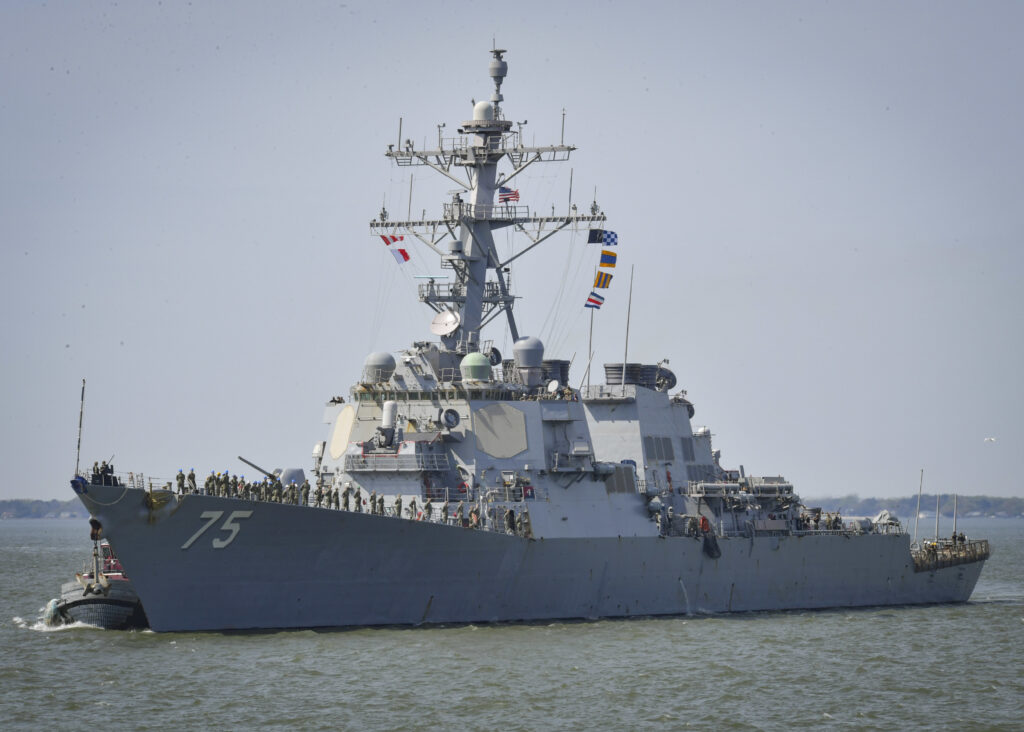
The Arleigh Burke-class guided-missile destroyer USS Donald Cook (DDG 75) arrives at Naval Station Norfolk, April 13. U.S. NAVY / Mass Communication Specialist Mass Communication Specialist 1st Class Jacob Milham
JACKSONVILLE, Fla. — The Arleigh Burke-class guided-missile destroyer USS Donald Cook (DDG 75) returned to Naval Station Mayport following a three-month deployment, April 24, the U.S. 2nd Fleet said in an April 25 release.
Donald Cook departed Naval Station Mayport in January on a short-notice deployment to operate with NATO Allies and partners in the Eastern Atlantic, North Sea and Baltic Sea.
The crew spent more than 70 days at sea and conducted three port visits in support of maritime security partnerships in Copenhagen, Denmark; Rostock, Germany; and the Isle of Portland, England.
“Visiting other counties as a representative of the United States is surreal,” said Fire Controlman (Aegis) 2nd Class Brady Itkin. “People told us how nice Americans are everywhere we went, and we were shown amazing hospitality by the civilians of other NATO countries. There’s no better feeling than making a positive impact on other people’s perspective of America.”
The ship received warfare excellence awards in communications, engineering and ship safety while underway.
“The crew put in a lot of hard work over the past year,” said Ensign Benjamin Steen, electronic warfare officer aboard Donald Cook. “This recognition is definitely a testament to all of our efforts.”
While deployed, Donald Cook participated in NATO Exercise Dynamic Guard 2022 in the North Sea. Dynamic Guard, hosted by Norway, is a biannual, multinational electronic warfare exercise series designed to provide tactical training for the NATO Response Force and NATO national units. For the first time in three years, two U.S. vessels participated to further enhance the ongoing cooperation, strength and interoperability between NATO Allies.
“The crew demonstrated their tenacity by executing multinational exercises and national tasking on short notice during this surge deployment,” said Cmdr. Matt Curnen, commanding officer of Donald Cook. “Our operations over the past few months have demonstrated our proficiency and capability as well as reaffirming our commitment to the NATO Alliance. I could not be more proud of the resiliency and professionalism the crew displayed during this deployment.”
Donald Cook is scheduled to start a major maintenance availability, its first since returning from their former homeport of Rota, Spain, in June.