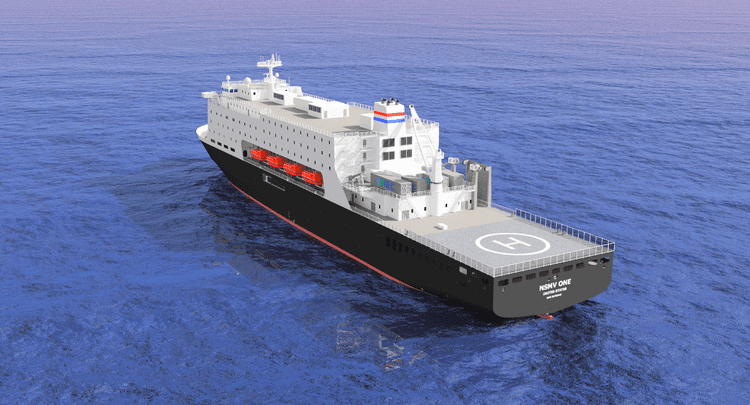
An artist’s conception of the purpose-built National Security Multi-Mission Vessel, to which the Maritime Administration (MARAD) wants to transition to replace obsolete training ships. MARAD
PHILADELPHIA — Philly Shipyard Inc. will build one additional National Security Multi-Mission Vessel, or NSMV, the fifth and final in the training ship series.
The vessel, built under an order from TOTE Services as authorized by the Maritime Administration, will replace the aging training vessel at California State University Maritime Academy in Vallejo, California.
Construction of the new vessel, NSMV 5, is expected to commence in 2023. The contractual delivery date for NSMV 5 is 2026.
The order was placed under the April 2020 contract with TOTE Services, which allows for the construction of up to five NSMVs. The initial award included the first two vessels in the NSMV program, NSMVs 1 and 2. The next two vessels in the NSMV program, NSMVs 3 and 4, were ordered in January 2021.
The award for NSMV 5 is valued at approximately $300 million, bringing the total order intake under the contract for the five-ship program to be approximately $1.5 billion.
As announced in November 2021, Philly Shipyard’s order backlog also includes a contract from Great Lakes Dredge & Dock Co. to construct one Jones Act-compliant Subsea Rock Installation Vessel, with a contract value of approximately $200 million. The SRIV will be constructed in between NSMVs 4 and 5.
“It is truly a great day for Philly Shipyard as we are now responsible for building the complete series of the NSMV program — a physical symbol of MARAD’s investment in the future of maritime education and training,” said Steinar Nerbovik, president and CEO of Philly Shipyard. “The NSMV program continues to mark a turning point in our company’s transformation to serve both commercial and government markets.”
Future APL 69 Conducts Builder’s and Acceptance Trials
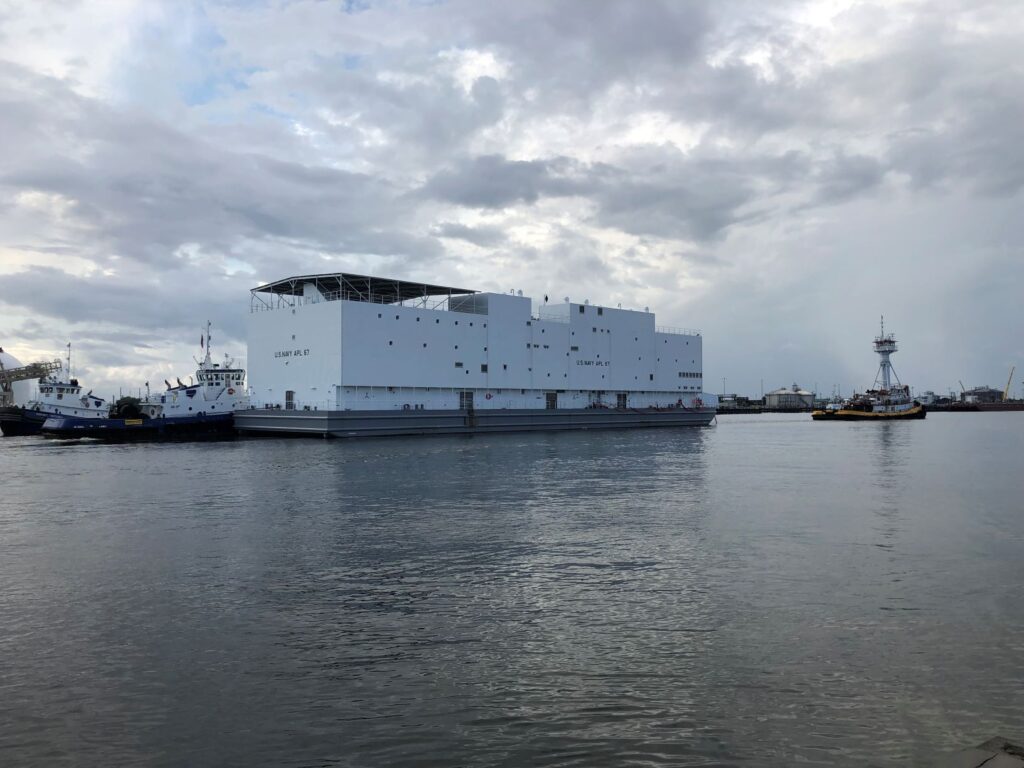
The Navy’s newest berthing barge, APL 69, recently conducted builder’s and acceptance trials in Pascagoula, Mississippi. This is a file photo of APL 67. U.S. NAVY
WASHINGTON — The Navy’s newest berthing barge, Auxiliary Personnel Lighter (APL) 69, recently conducted builder’s and acceptance trials in Pascagoula, Mississippi, Team Ships Public Affairs said in a release.
Builder’s trials consist of a series of in-port tests and demonstrations that allow the shipbuilder, VT Halter Marine, and the Navy to assess the craft’s systems to ensure installation in accordance with the original equipment manufacturer’s guidelines and that the craft design and configuration meet the contract requirements.
Acceptance trials consist of integrated testing to demonstrate the capability of the platform and installed systems across all mission areas to effectively meet its requirements. These tests and demonstrations are witnessed by the Navy’s Board of Inspection and Survey and are used to validate the quality of construction and compliance with specifications prior to delivery to the Navy.
“These vessels improve quality of life for our Sailors during ship maintenance availabilities and inter-deployment training cycles,” said Capt. Eric Felder, program manager for U.S. Navy and Foreign Military Sales Boats and Craft, Program Executive Office Ships. “We look forward to delivering more of these vessels to the fleet to provide the necessary berthing, messing, administrative, and leisure facilities to crews while their ships are undergoing maintenance.”
APLs are 82-meter-long barges that can berth up to 609 people — 72 officers and 537 enlisted personnel. Mess seating is available for 224 enlisted personnel, 28 chief petty officers and 28 officers in 20-minute intervals, allowing food service for 1,176 personnel with three meals a day.
APLs are used to house duty crews while ships are in maintenance availabilities and can be towed to new bases or shipyards to support changing fleet requirements. Additionally, they offer the potential use for humanitarian missions and other temporary assignments. APLs are equipped with offices, classrooms, washrooms, laundry facilities, a medical treatment facility, a barber shop and a fitness center.
VT Halter Marine is currently in production of two additional APLs.
Marine Corps to Use Leased Ships to Test Light Amphibious Warfare Ship Concept
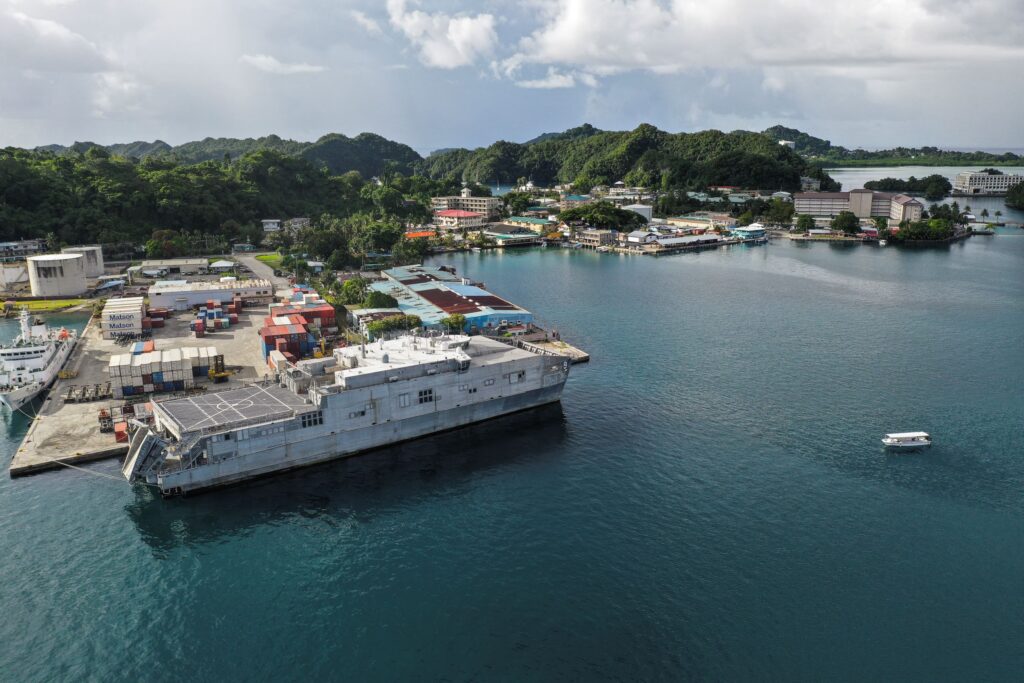
U.S. Military Sealift command’s Spearhead-class expeditionary fast transport ship, City of Bismarck, floats while docked at the Commercial Seaport of Palau in Koror, Republic of Palau, Nov. 5, 2021. Spearhead-class ships may be used to test the concept for a light amphibious warfare ship. U.S. MARINE CORPS / Cpl. Atticus Martinez
ARLINGTON, Va. — The Marine Corps plans to lease two commercial ships over the next two years to experiment with the light amphibious warfare ship concept, also now being classed as the landing ship-medium.
Brig. Gen. Mark Clingan, assistant deputy commandant for Combat Development and Integration and deputy commanding general of Marine Corps Combat Development Command, speaking April 21 in a webinar of the National Defense Industrial Association, said the Corps was planning to lease a commercial “stern[-ramp] landing vessel” by late summer or early fall [2022]” to use to test the LAW/LSM concept.
Clingan said a second vessel would be leased in fiscal 2023 for the same purpose.
The general said the Corps also was looking at using Spearhead-class expeditionary fast ships — which do not have beach landing ramps — and utility landing craft — which do — as part of the concept experimentation.
The LAW will be designed to carry 75 Marines of a Marine Littoral Regiment and land them on a shore in support of distributed maritime operations and expeditionary base operations. Clingan said the ships would be able to operate within the weapons engagement zone and be less attractive targets for enemy missiles than would a larger amphibious warfare ship.
Clingan said that with each Marine Littoral Regiment comprised of nine platoons or units of action — one on each light amphibious warfare ship — 27 LAWs would be needed to support the three MLRs. Counting extra MLRs in the maintenance pipeline, the Corps lists 35 LAWs as its probable requirement.
The Navy plans to procure the light amphibious warfare ship beginning in fiscal 2025.
Marine Corps May Keep More Tube Artillery, Osprey Squadrons in Force Design 2030
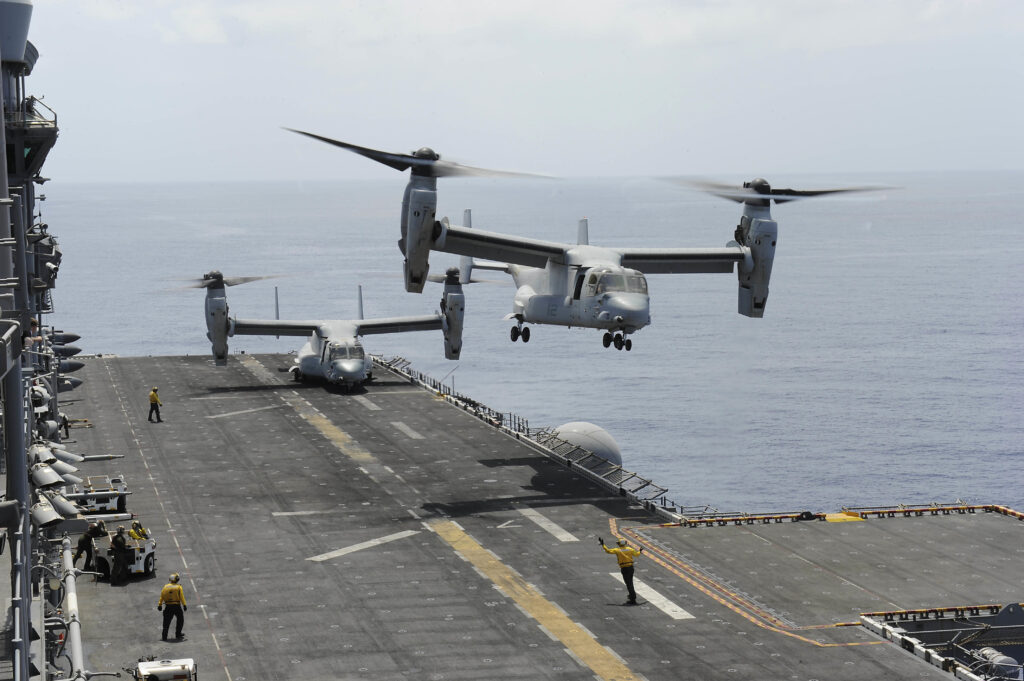
An MV-22 Osprey aircraft, assigned to Marine Medium Tiltrotor Squadron 166 (Reinforced), departs the flight deck of amphibious assault ship USS Boxer (LHD 4) in 2016. U.S. NAVY / Mass Communication Specialist 2nd Class Jose Jaen
ARLINGTON, Va. — The Marine Corps continues to tweak its Force Design 2030, adjusting the number of tube artillery batteries, the number of MV-22B squadrons, the operation of a Marine Littoral Regiment and the size of an infantry battalion.
Under Force Design 2030, the Marine Corps is divesting itself of some force structure and weapon systems and building others to reshape the Corps to be more capable of operating inside a threat zone in the current era of great power competition.
Brig. Gen. Mark Clingan, assistant deputy commandant for Combat Development and Integration and deputy commanding general of Marine Corps Combat Development Command, speaking April 21 in a webinar of the National Defense Industrial Association, said the Corps is looking at retaining more tube artillery batteries, choosing to retain seven batteries instead of five.
The tube artillery batteries operate M777 155mm howitzers.
Clingan also said the Corps will continue to field 16 Marine Medium Tilt-rotor Squadrons rather than reduce to 14 squadrons. However, the number of MV-22B Osprey aircraft in each squadron would decrease from 12 to 10 aircraft. One squadron, VMM-166, was deactivated last year.
He said the Corps’ force design plans “probably weighted too much on the Marine Littoral Regiment and did not really acknowledge that to appropriately be able do the recon/counter-recon fight is going to require the full complement and scope of the Marine Air-Ground Task Force, and so MLRs are singular units but are still going to be very much a part of reaching back and employing the resources of the entire MAGTF.
Regarding the design of the MLR, Clingan said, “we probably focused too much on lethality without taking enough look or considering specifically the requirement to ‘sense and make sense,’ the mobility and maneuverability and also the need for deception. Now we’re making refinements to that as well.
“Our initial thoughts were that MLR units would be sourced through UDP [the Unit Deployment Plan] rotation and now we’re opening the aperture and think, maybe, some PCS [permanent change of station] personnel may be more suited to the terms of the units,” he said.
The Corps has one MLR on strength, the 3rd MLR. Two more MLRs are planned in the future: the 12th and probably the 4th.
Regarding the size of an infantry battalion, “we initially thought we would be cutting that from about 896 [Marines and Sailors] down to 735,” he said. Noting the need to make the battalions more “robust and capable,” the number of personnel in a battalion “probably need to hover around numbers about 800-835 to have the capabilities it needs.”
Coast Guard Commissions 47th Sentinel-Class Fast Response Cutter
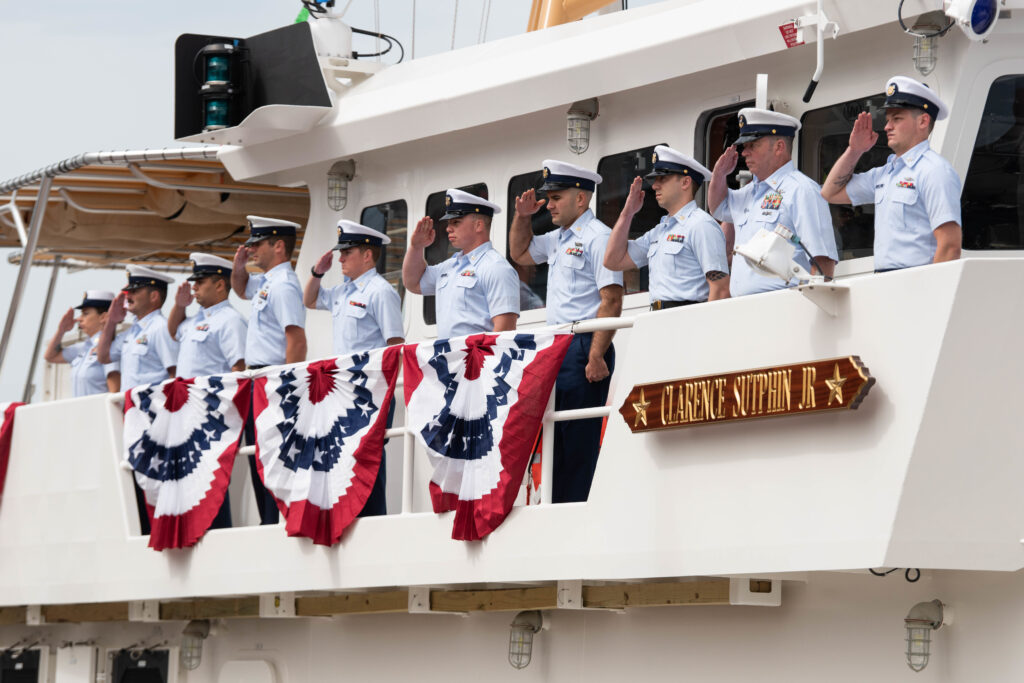
The commissioning crew of the USCGC Clarence Sutphin Jr. (WPC 1147), Patrol Forces Southwest Asia’s sixth 154-foot Sentinel-class cutter, stand at attention as the ship is placed into service at a ceremony held at the Intrepid Sea, Air and Space Museum in New York City, April 21. U.S. COAST GUARD / Petty Officer 3rd Class Ryan Schultz
PORTSMOUTH, Va. — The U.S. Coast Guard commissioned the USCGC Clarence Sutphin Jr. (WPC 1147), Patrol Forces Southwest Asia’s sixth 154-foot Sentinel-class cutter, into service at the Intrepid Sea, Air and Space Museum in New York City on April 21, the Coast Guard Atlantic Area said in a release.
Vice Adm. Steven Poulin, U.S. Coast Guard Atlantic Area commander, presided over the ceremony.
The cutter’s namesake is Boatswain’s Mate 1st Class Clarence Sutphin Jr., a New York native who served in the U.S. Coast Guard from 1941 to 1945. During this time, Sutphin served as landing craft coxswain on board the attack transport USS Leonard Wood (APA 12), a landing craft supporting our troops in North Africa and Sicily.
In November 1941, just weeks before the Japanese attack on Pearl Harbor, 18-year-old Sutphin enlisted in the United States Coast Guard. After enlisting, Sutphin attended boot camp at the Coast Guard Yard near Baltimore. He then received orders to the North Carolina coast to train in amphibious operations and landing craft, also known as Higgins Boats, landing troops in North Africa and Sicily.
When that operation was complete, the boat transited to the Pacific theater. During the Battle of Saipan in 1944, Sutphin helped oversee boat operations, including landing, loading, and salvaging landing craft as the USS Leonard Wood endured the heavy fire. During the conflict, he repeatedly risked his life to save others. He swam a towline to a landing craft stranded on a reef, saved another boat stuck on the beach under enemy fire, and came to the aid of eight Marines who a mortar round had struck. He provided first aid to the survivors and evacuated them to the nearest aid station.
Sutphin stayed aboard the Leonard Wood through May 1945 and participated in its eight primary amphibious operations. Sutphin was awarded the Bronze Star Medal for his “exceptional bravery under fire” during the Battle of Saipan.
The Clarence Sutphin Jr. was officially delivered to the U.S. Coast Guard on Jan. 6 in Key West, Florida. It is the 47th Sentinel-class fast response cutter. While the ship is commissioning in New York City, it will be homeport in Manama, Bahrain, part of U.S. Coast Guard Patrol Forces Southwest Asia.
Navy Awards Raytheon Up to $1.68B for Zumwalt DDG Engineering Services
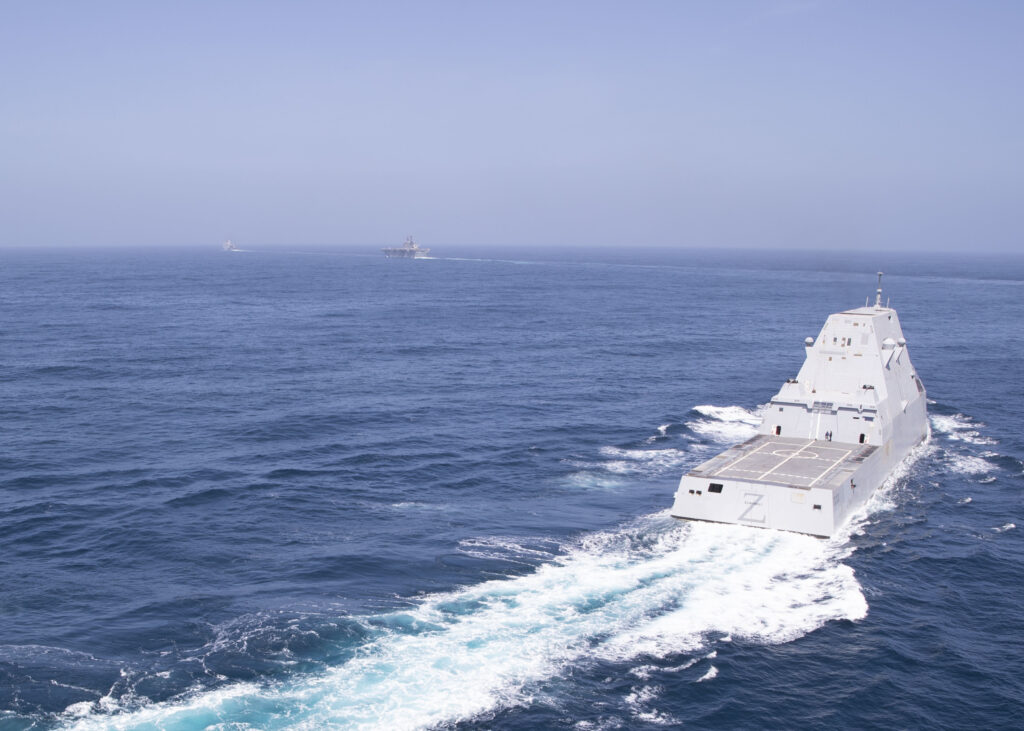
Guided-missile destroyer USS Zumwalt (DDG 1000), right, and amphibious assault ship USS Tripoli (LHA 7) sail behind amphibious transport dock USS Anchorage (LPD 23) in the Pacific Ocean, April 10. U.S. NAVY / Mass Communication Specialist 2nd Class Malcolm Kelley
TUCSON, Ariz. — The U.S. Navy awarded Raytheon Missiles & Defense an activation, sustainment and modernization contract for $483 million with options, if exercised, totaling $1.68 billion across five years, the company said April 20.
Under this contract, Raytheon Missiles & Defense will provide the U.S. Navy services and professionals to complete the activation and fleet introduction of the three Zumwalt-class destroyers, while continuing to develop technology and warfare capabilities.
“This contract underscores our role as a systems integrator, which goes beyond offering customers weapons and radars,” said Wes Kremer, president of Raytheon Missiles & Defense. “Our team provides Zumwalt destroyers extensive support, from engineering and cyber protection to software development and upgrades.”
Additional services will include design, integration, test and evaluation, system upgrade and replacement, logistics product development, configuration management and training systems.
The Zumwalt-class destroyers recently achieved initial operational capability in December 2021, with the inaugural fleet employment of USS Zumwalt scheduled for later this year.
Navy Proposes to Cut Five EA-18G Growler Electronic Attack Squadrons
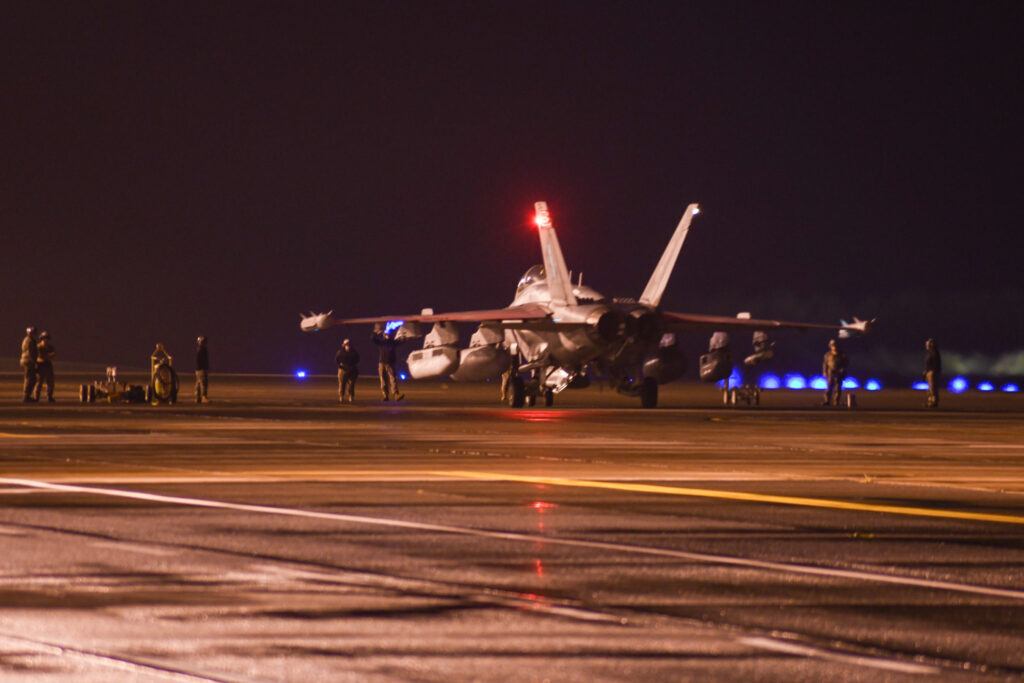
Sailors assigned to the “Lancers” of Electronic Attack Squadron (VAQ) 131 recover an EA-18G Growler during night operations in 2020. Under Navy plans, the squadron is one of several that would be deactivated. U.S. NAVY / Mass Communication Specialist Seaman Benjamin Ringers
ARLINGTON, Va. — The U.S. Navy is proposing to deactivate five electronic attack squadrons, or VAQs, that operate the Boeing EA-18G Growler electronic attack jet, roughly a third of the Defense Department’s tactical jet electronic attack force.
As laid out in the recently released Department of the Navy’s fiscal 2023 budget highlights book, the Navy proposes to deactivate its entire expeditionary VAQ force, which deploys to overseas bases to provide electronic attack capabilities to the joint force. The five expeditionary VAQ squadrons are separate from the Navy’s VAQ squadrons that deploy on aircraft carriers.
The Navy is the only provider of expeditionary electronic attack jets to the joint force. The Air Force retired its last EF-111A Raven jets in 1998 and the Marine Corps retired its last EA-6B Prowler tactical jets in 2019. The expeditionary VAQ squadrons have deployed to Southwest Asia, Japan and Italy over the years in support of U.S. and coalition forces. Last month, one squadron, VAQ-134, was deployed to the European Command as part of the build-up of forces in support NATO’s eastern flank after the Russian invasion of Ukraine.
The budget book says the five squadrons include a total of 25 EA-18Gs which would be placed in storage at the Aerospace Maintenance and Regeneration Group at Davis-Montham Air Force Base in Tucson, Arizona, half in fiscal 2024 and half in fiscal 2025. The cuts also would free up approximately 1,020 officer and enlisted personnel. The Navy estimates the savings over the Future Years Defense Plan would be 807.8 million.
The Navy’s five expeditionary VAQ squadrons are all based at Naval Air Station Whidbey Island, Washington: VAQs 131, 132, 134, 135, and 138. The Navy’s only reserve VAQ squadron, VAQ-209, also has been used in an expeditionary role.
The carrier-deployable VAQ squadrons are VAQs 130, 133, 136, 137, 139, 140, 141, and 142, with another, VAQ-144, set for establishment in October. All are based at Whidbey Island, except for VAQ-141, which is based at Marine Corps Air Station Iwakuni, Japan, as part of the forward-deployed Carrier Air Wing Five for USS Ronald Reagan.
The expeditionary VAQ squadrons are considered high-demand/high-value assets by the Joint Chiefs of Staff. The assessments of the various regional combatant commanders may be instrumental in reversing or mitigating the Navy’s proposal.
Navy’s LCS Decommissioning Proposals Would Bring Major Changes for Retained Ships
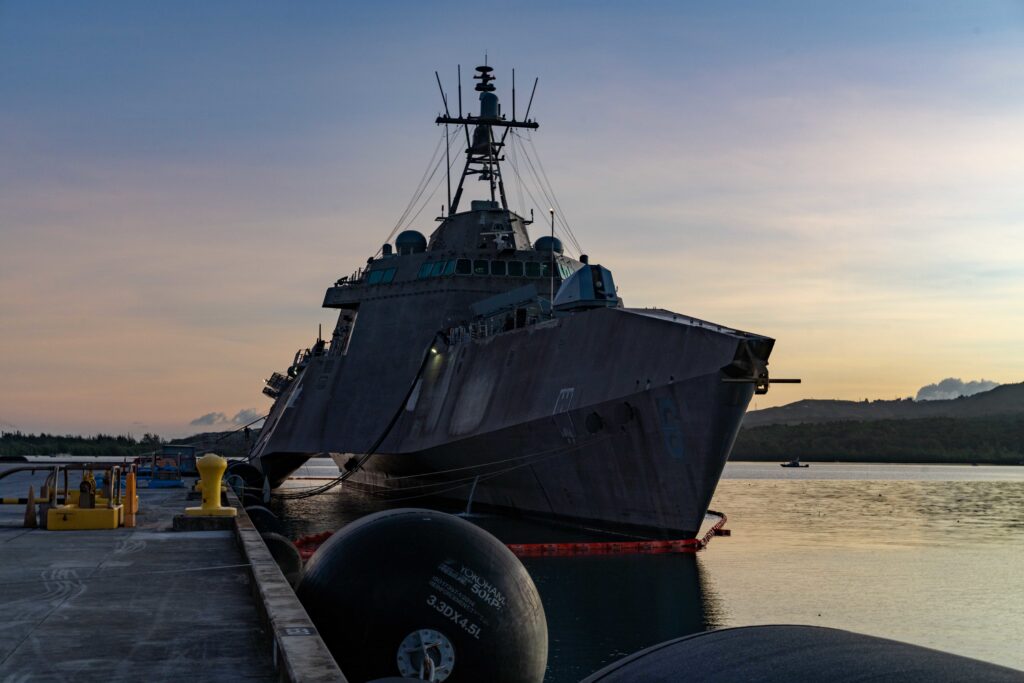
The Independence-variant littoral combat ship USS Jackson (LCS 6) pierside in Guam during routine operations in 2021. Under new Navy plans, it would be operated by a single crew in 2023 and decommissioned in 2024. U.S. NAVY / Mass Communication Specialist 3rd Class Andrew Langholf
ARLINGTON, Va. — The U.S. Navy’s 2023 budget proposal — including the Future Years Defense Plan — would result in profound changes to the missions, organization, force structure, training and crews of the Navy’s littoral combat ships in addition to the force reduction by decommissioning of many of the ships.
The LCS remaining in service would see a second order of effects that would further show a force dramatically changed from the original vision for the ships. The surface warfare mission and the mine countermeasures mission will be divided by coast instead of mixed on both.
The Freedom-class LCS would be most the most affected by the proposed budget. Including earlier decisions, the Navy would, because of fiscal constraints, decommission LCS 3, 5, 7, 9, 11, 13, 15, 17, and 19 across the FYDP. (LCS 1 was decommissioned in 2021.) Six Freedom-class ships (LCS 21, 23, 25, 27, 29, and 31) would be retained, having been or will be completed with the combining gear improvement installed.
The Independence-class LCS will not be unscathed. The Navy proposes to reduce LCS 6 and 8 to single crews (from dual Blue-Gold crews) in 2023, and then decommission the two ships in 2024. (LCS 2 was decommissioned in 2021, and LCS 4 is scheduled to be decommissioned in 2022.) A total of 15 Independence-class ships would be retained in the fleet.
All LCS assigned the surface warfare mission would be assigned single crews only. Such crews would see their manpower increased by approximately 25 Sailors each to help sustain readiness levels that a second off-hull provided.
Since the antisubmarine warfare mission package is being divested, all LCSs marked for the ASW mission will be shifted to the surface warfare or mine countermeasures mission. Because of the substantial reduction in the number of LCS planned, the ASW mission in small surface combatants will reside solely in the future Constellation-class guided-missile frigate (FFG 62), which the Navy says is a “foundational mission set for the FFG 62 program, which is a more suitable platform and Variable Depth Sonar [VDS] capability will be added to the fleet through the FFG 62 class.”
The Navy is proposing the East Coast littoral combat ships — which are of the Freedom class — be assigned only the surface warfare mission and the West Coast LCS — planned to be only Independence-class ships — be assigned only the mine countermeasure mission. As a result, there would be changes in the LCS command and support organization structure.
Accordingly, the LCS antisubmarine warfare divisions on both coasts would be disestablished in 2023 with the divestiture of the ASW mission. MCM Division 22 on the East Coast and SUW Division 11 on the West Coast also would be disestablished in 2023.
With the overall reduction in LCS ships and their crews, and a force of just 21 LCS planned (15 MCM ships and 6 SUW ships), the training infrastructure required for training would be reduced. The proposal calls for the disestablishment of LCS Training Facility Atlantic, consolidating all LCS training at LCS Training Facility Pacific.
All of these proposals will receive the scrutiny of the congressional armed services and appropriations committees.
If the total LCS changes were to be approved, the Navy estimates the savings to be $391.4 million for fiscal 2023, totaling $2.46 billion over the FYDP.
USS Hershel ‘Woody’ Williams Completes Gulf of Guinea Maritime Security Patrol
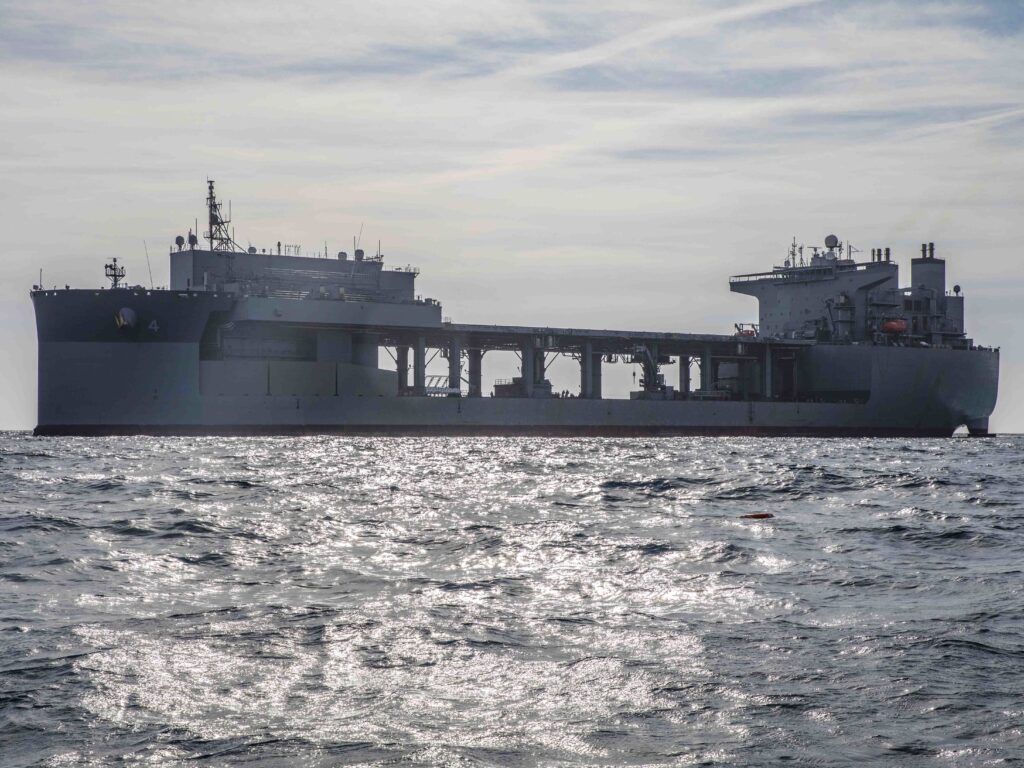
The Expeditionary Sea Base USS Hershel “Woody” Williams (ESB 4) sails the Adriatic Sea, Feb. 19. Hershel “Woody” Williams is on a scheduled deployment in the U.S. 6th Fleet area of operations in support of U.S. national interests and security in Europe and Africa. U.S. NAVY / Mass Communication Specialist 1st Class Fred Gray IV
NAVAL STATION ROTA, Spain — The Expeditionary Sea Base USS Hershel “Woody” Williams (ESB 4) arrived at Naval Station Rota, Spain, following a successful maritime security patrol in the Gulf of Guinea on April 18, 2022, said U.S. 6th Fleet Public Affairs.
From March to April, Hershel “Woody” Williams completed maritime security operations with African partners from Sierra Leone, Cabo Verde and Senegal as well as members of the U.S. Navy, Coast Guard and Marine Corps.
“The men and women that made this possible are a testament to our shared values and commitment to ensuring the safety, security, and freedom of navigation on the waters surrounding the African continent,” said Capt. Michael Concannon, commanding officer, USS Hershel “Woody” Williams.
In March, the joint U.S. and African maritime team interdicted an illegal, unregulated, and unreported fishing vessel operating in Sierra Leone’s economic exclusive zone.
In April, as part of the African Maritime Law Enforcement Partnership, the joint team, led by Cabo Verde, worked in coordination with the Maritime Analysis and Operations Centre – Narcotics, INTERPOL and Cabo Verde’s national Maritime Operations Center to conduct a compliant boarding of a Brazilian-flagged fishing vessel, which led to the seizure of approximately 6,000 kilograms of suspected cocaine with an estimated street value of more than $350 million.
“I couldn’t be more proud of the professionalism and integration of the U.S. tri-maritime services, partner nations and other supporting organizations during our maritime security operations,” Concannon said. “These maritime security events show the world that our African partners are poised and ready to strike against illicit activity.”
Hershel “Woody” Williams is the first warship permanently assigned to the U.S. Africa Command area of responsibility. The U.S. shares a common interest with African partner nations in ensuring security, safety and freedom of navigation on the waters surrounding the continent, because these waters are critical for Africa’s prosperity and access to global markets.
The ESB ship class is a highly flexible platform that may be used across a broad range of military operations. Acting as a mobile sea base, they are part of the critical access infrastructure that supports the deployment of forces and supplies to support missions assigned.
For over 70 years, U.S. 6th Fleet forces have forged strategic relationships with our allies and partners and solidified a foundation of shared values, experiences and vision aimed at preserving security and stability.
NGC to Develop Next-Gen Relay Ground Station for NIWC Pacific
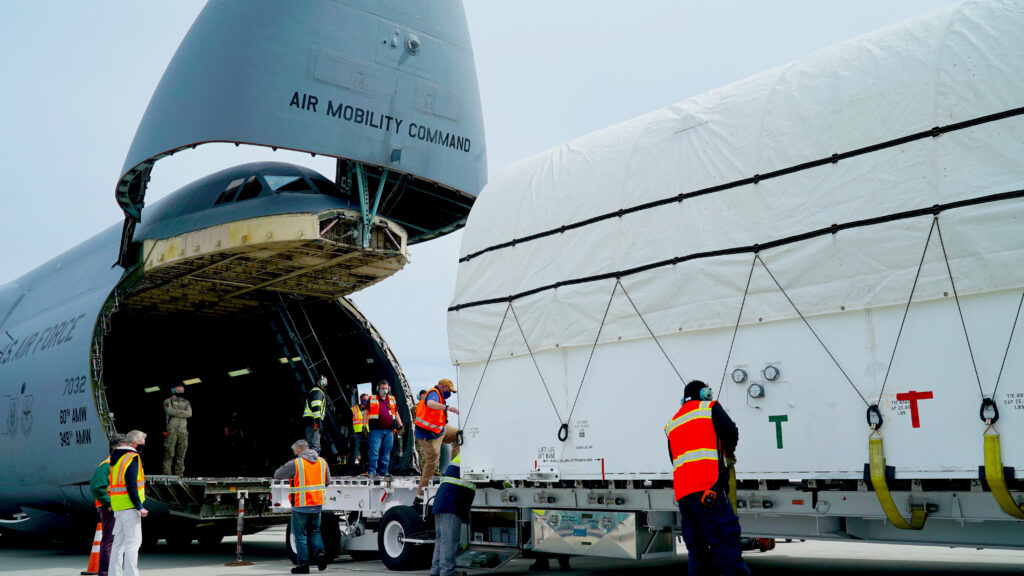
A ground crew loads the U.S. Space Force’s SBIRS GEO-5 satellite onto a C-5M Super Galaxy aircraft for transport operations at Moffett Federal Airfield, California, on March 17, 2021. U.S. SPACE FORCE / Walter Talens
BOULDER, Colo. — Northrop Grumman has been awarded a $99.6 million contract by U.S. Naval Information Warfare Center Pacific to provide mission-critical capabilities for Relay Ground Station-Asia (RGS-A), the company said April 19.
Northrop Grumman will design, develop, integrate, test and deliver the first of the next-generation relay ground stations to support legacy and future missile-launch and missile-warning detection satellites.
“The advanced technologies we bring to this mission build on our proven capabilities to provide existing and future missile warning systems that help keep our nation and its allies safe,” said Aaron Dann, vice president of strategic force programs at Northrop Grumman. “The model-based open-systems architecture provides the ability to rapidly deploy follow-on RGS systems in future locations around the world.”
The RGS-A award will help address the U.S. Space Force’s mission to revolutionize existing missile warning and missile defense systems with the Future Operationally Resilient Ground Evolution system. A key element of the FORGE architecture includes relay ground stations that support existing and new satellite constellations and the capability to handle changes in bandwidth and resiliency.
NIWC Pacific will develop six antennas for RGS-A to enable the Space Systems Command Next-Generation Space Based Infrared System (SBIRS) Ground System to operate the legacy satellites in geosynchronous orbit. The antennas will be deployed to the island of Guam and remotely monitored and operated from the United States.
Most of the work for the five-year contract will take place at Northrop Grumman’s campus in Boulder, where it just opened a 23,680-square-foot office building. Northrop Grumman has more than 2,200 employees across Colorado supporting key customers including the U.S. Space Force, Air Force, Missile Defense Agency and the intelligence community.