Navy Budget Should be Driven by Strategy, Not the Reverse, Del Toro Says
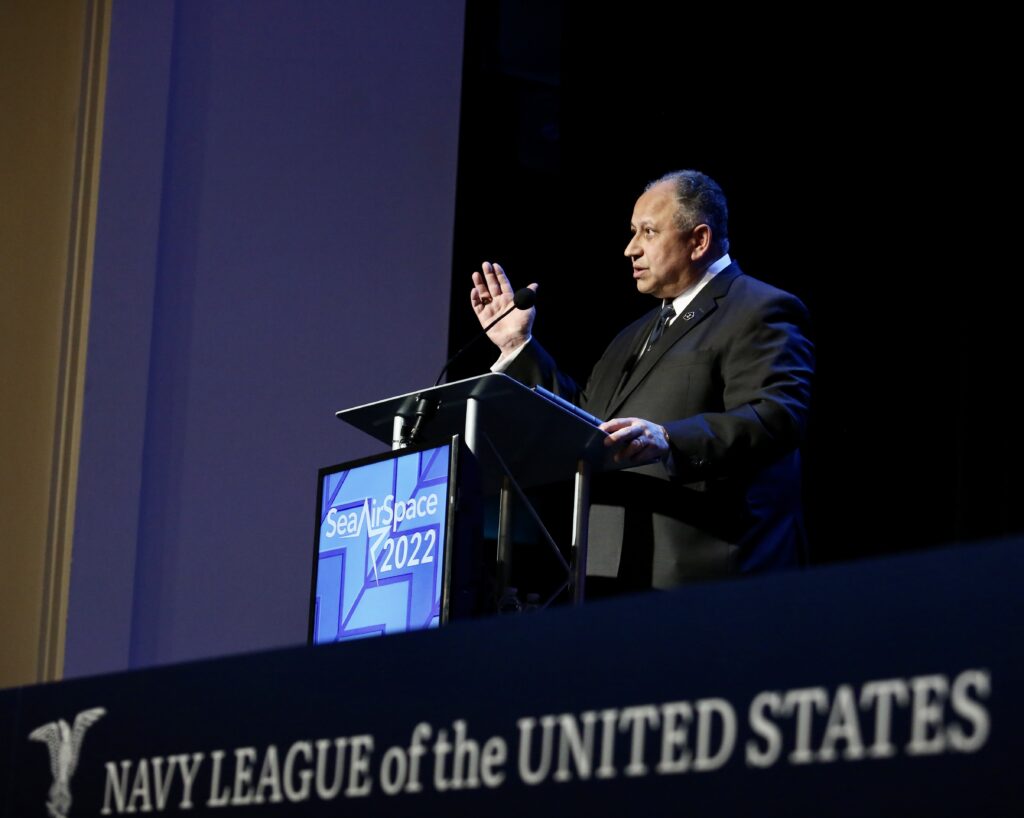
In his speech Del Toro reiterated his support for Adm. Mike Gilday’s vision for distributed maritime operations. LISA NIPP

NATIONAL HARBOR, Md. — The U.S. Navy budget “should be driven by strategy and not the strategy driven by the budget itself,” said Navy Secretary Carlos Del Toro at the April 5 luncheon keynote at Sea-Air-Space 2022. “That’s why we’ve put together a clear strategy to deliver the lethal, resilient, sustainable, survivable, agile and responsive course called for in the 2022 National Defense Strategy.”

The budget faces likely headwinds in Congress, where some lawmakers say it doesn’t do enough, but Del Toro emphasized the importance of maintaining the trust and support of American taxpayers so each dollar reaches the American warfighter in the most efficient and effective way, while also ensuring the warfighter is equipped with the most effective platforms and equipment.

Del Toro said the Navy Department’s strategy is rooted in three guiding principles. 

The first, he said, is to maintain and strengthen the nation’s maritime dominance, so forces can deter potential adversaries and fight and win if necessary. The second deals with empowering U.S. Sailors and Marines by fostering a culture of warfighting excellence founded on treating each other with dignity and respect. Del Toro said the third principle is to strengthen strategic partnerships across the Joint Force with industry and with international partners around the globe.

“It’s clear, it’s direct, it’s concise,” Del Toro said. “In order to maintain our maritime dominance, we have to be serious about building and maintaining the right capabilities to win tomorrow’s wars. The National Defense Strategy for integrated deterrence requires us to campaign forward from the South China Sea to the Arctic to the Mediterranean and to the Gulf. And that is indeed what we are doing.”

Del Toro said right now the Navy has 74 ships deployed around the globe, including four aircraft carriers and two assault ships. Furthermore, he said, every one of these ships operates as part of a fully networked, agile and survivable fleet capable of delivering coordinated, long-range fires and unmatched lethality from many points at once.

“That’s the power of distributed maritime operations,” said Del Toro. “I strongly support, let me be clear, I strongly support Adm. [Michael] Gilday’s vision for distributed maritime operations and all aspects of the Navy’s navigation plan.”

He said the Navy plans to continue progress on new programs such as the Columbia-class submarine and Constellation-class frigate, and “we will also invest in our amphibious fleet, fully funding an additional LHA and an additional LPD [landing platform/dock] this year,” Del Toro said. “These warships are vital for the organic mobility and persistence of our Marine Corps. Always in high demand as a Swiss Army knife to meet the needs of the Joint Force, the modern amphibious ready group and marine expeditionary unit are indeed the ‘911 call’ for combatant commanders in the most dynamic and volatile situations, humanitarian disasters and combat.”

Del Toro said he is intent on maintaining as much fiscal transparency as possible — something he said is informed by “an abiding respect for the American taxpayer of today and tomorrow.

“We must build and prepare the most powerful and agile force that we can in the most efficient way possible while preserving options for future leaders to adjust to a changing security environment,” Del Toro explained. “We have not always done that in our past. I don’t want tomorrow’s secretary of the Navy to have to choose between building the right capabilities or maintaining high-cost legacy platforms that don’t meet our needs today.”
Coast Guard’s Atlantic Commander Says More Attention to South Atlantic Nations Needed

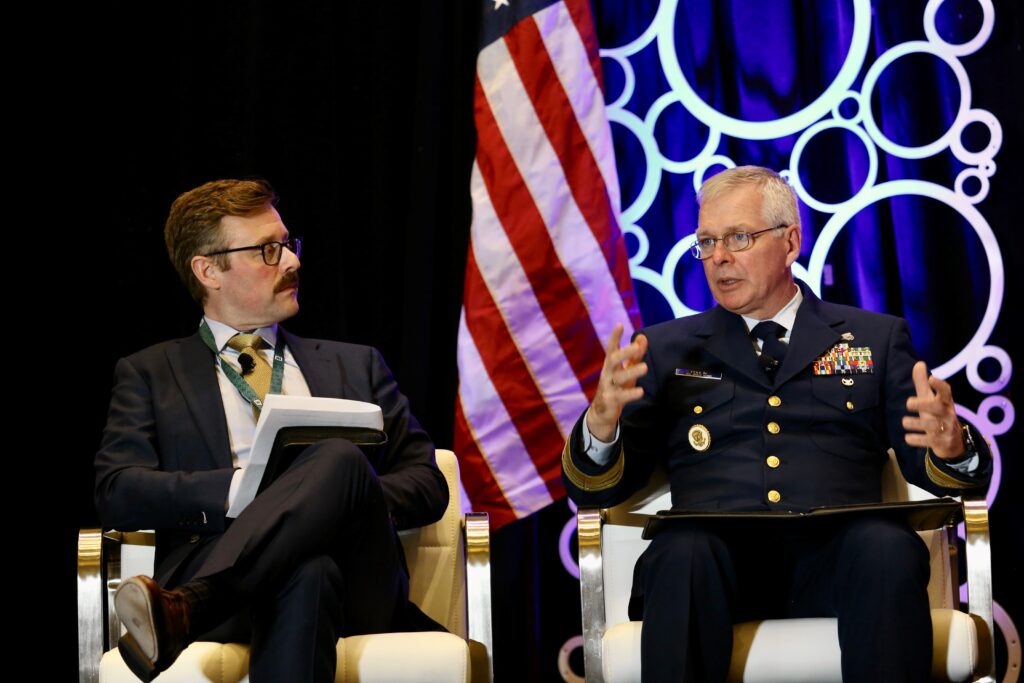
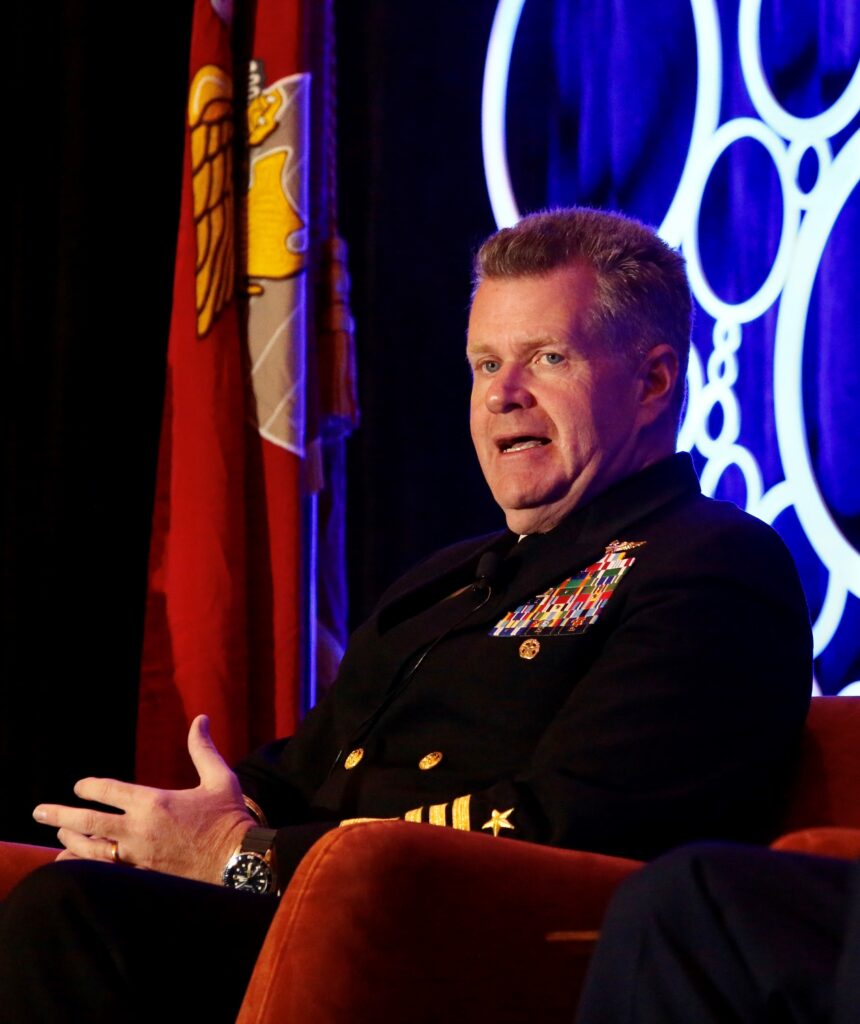
Vice Adm. Stephen Poulin discusses what the changing security environment in Europe means for the U.S. Coast Guard. LISA NIPP

NATIONAL HARBOR, Md. — The widening political and economic effects of Russia’s invasion of Ukraine may help focus attention on the strategic significance and strategic needs of the Atlantic Basin, a top U.S. Coast Guard commander says.

“The security environment in Europe has changed. I believe with that change will come a broad demand for the U.S. Coast Guard,” Vice Adm. Stephen Poulin told a panel discussion of the maritime security needs of the region April 4 at Sea-Air-Space 2022.

“Most of our Arctic partners are in the Atlantic. We have to maintain strong relationships with our European neighbors,” said Poulin, commander of the Coast Guard’s Atlantic Area. There is “a growing thirst” for U.S. Coast Guard presence “in certain parts of Europe, especially in the Mediterranean.”

There is an interconnectedness between Mediterranean security and Atlantic security, Poulin said, noting the Coast Guard has built ties with maritime services in Greece, Malta, Italy, Lebanon, Jordan, Israel, Algeria and Tunisia. Four of six Fast Response Cutters have been delivered to Bahrain, where they are based with Patrol Forces Southwest Asia, the Coast Guard’s largest unit outside of the United States. The final two FRCs are slated for delivery this summer.

The Biden Administration’s $13.8 billion fiscal 2023 Coast Guard budget includes $40 million to support maritime security issues in the Atlantic Basin, including illegal, unregulated and underreported fishing, illegal trafficking and transnational crime.

Poulin said that move would allow him to achieve more persistent engagement with all the Atlantic nations “but in particular our African partners.”

“This isn’t just about IUU fishing,” Poulin said, noting as much as 5% of illegal narcotics flow leaves South America and winds up going through Africa or Europe. There is a growing threat of armed robbery and piracy in West Africa’s Gulf of Guinea, he said, adding “that is happening where there is a growing expectation in the future of higher offshore energy production.”

Another panelist, Lyston Lea II, principal adviser to the U.S. National Maritime Intelligence Integration Office, said the prime security challenges facing the Atlantic Basin are climate change, illicit activities such as IUUF, and great power competition. Solutions, he said, include “meaningful unclassified data sharing and more partnerships between government, the private sector and allies.”

Lea, who said IUUF was a bad acronym and he prefers calling it “evil fishing,” said he was pleased to see so many policy makers taking IUUF seriously as an economic, political and environmental issue and not simply about “dead fish,” as one lawmaker told him in a contentious meeting in 2014.


CVN 78 Quietly Declared IOC in December

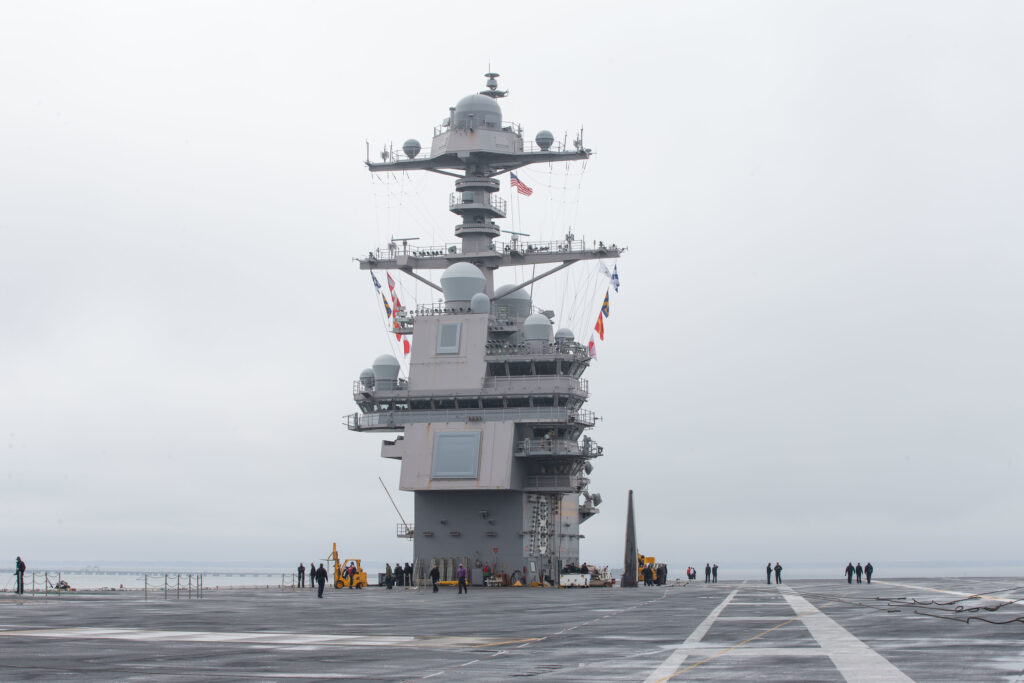
USS Gerald R. Ford (CVN 78) transits the James River after leaving Newport News Shipyard during sea and anchor, Feb. 25. U.S. NAVY / Mass Communication Specialist 3rd Class Jacob Mattingly

NATIONAL HARBOR, Md. — The lead ship in the Navy’s new fleet of aircraft carriers, the USS Gerald R. Ford (CVN 78), has achieved initial operational capability, the program manager revealed at Sea-Air-Space 2022 on April 5.

The ship actually achieved IOC in late December of 2021, but the program did not announce it at the time, said Capt. Brian Metcalf, PMS-378 program manager.

“IOC was just recently declared and set on December of 2021 with the turnover of the last elevator,” Metcalf said. “We didn’t announce it. Some people know what IOC means and some people don’t. It’s an acquisition-specific milestone. The conditions on the ship don’t really change because of IOC. So, we did not make a public announcement on it.”

The Ford is slated for its first operational deployment this fall, Metcalf said. All 11 of the advanced weapons elevators have been turned over to the crew, he said, and a total of 17,000 individual elevator cycles have been completed.


Coast Guard Adm. Linda L. Fagan Nominated to be First Woman to Serve as Commandant  

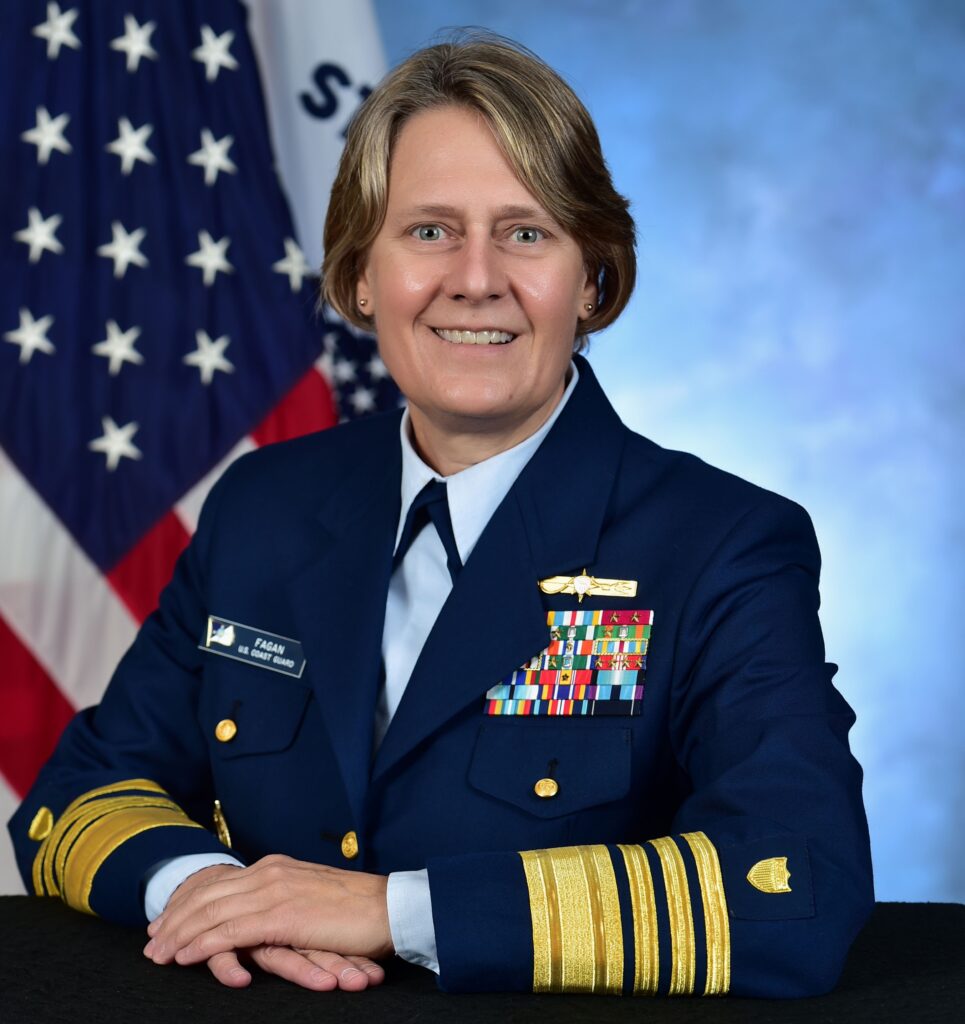
Adm. Linda L. Fagan, nominated to be the 27th Commandant of the U.S. Coast Guard. U.S. COAST GUARD

WASHINGTON, D.C. — President Joe Biden nominated Adm. Linda L. Fagan to serve as the 27th Commandant of the U.S. Coast Guard. Upon confirmation, Adm. Fagan will be the first woman to serve as commandant of the Coast Guard, the service said April 5. 

Fagan currently serves as the 32nd vice commandant, having assumed the duties on June 18, 2021. The vice commandant is the vice service chief and chief operating officer, responsible for executing the Commandant’s Strategic Intent, managing internal organizational governance, and serving as the Component Acquisition Executive. 

Previously, Fagan served as commander of the Coast Guard Pacific Area overseeing operations from the Rocky Mountains to the waters off the East Coast of Africa. Fagan is the Coast Guard’s first-ever Gold Ancient Trident, as the officer with the longest service record in the Marine Safety field. 

Pending confirmation, Fagan is expected to relieve the current commandant of the Coast Guard, Adm. Karl L. Schultz, during a change of command ceremony planned for June 1, 2022, in Washington, D.C. Schultz will retire following the change of command this summer. 

“Adm. Fagan is an exceptional senior Coast Guard officer and nominee, possessing the keen intellect, the depth of operational experience, and the well-honed leadership and managerial acumen to serve with distinction as our Service’s 27th commandant,” said Schultz. 

Fagan has selected and the president has nominated Vice Adm. Steven D. Poulin as the Coast Guard’s 33rd vice commandant. Poulin currently serves as the commander of the Coast Guard Atlantic Area and is responsible for all Coast Guard missions from the Rocky Mountains to the Persian Gulf.

Pending confirmation, Poulin is expected to relieve Fagan as vice commandant of the Coast Guard during a change of watch ceremony planned for May 24, 2022, in Washington, D.C. 


SmartPower Boosts Epirus’ Leonidas Drone-Busting Directed Energy System

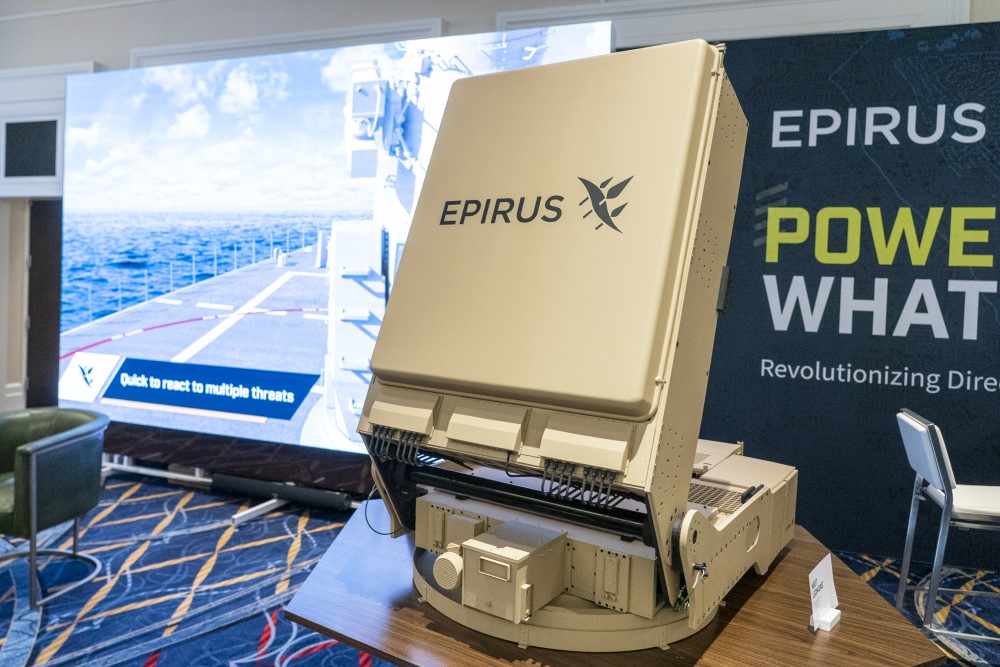
Epirus’ Leonidas directed-energy defense system, displayed in scale model form. SOLARES PHOTOGRAPHY

NATIONAL HARBOR, Md. — Epirus, a Southern California startup, has incorporated its SmartPower concept into a directed-energy system capable of disabling the electronics of threats such as drones, says Andy Lowery, the company’s chief product officer.

The company, located in the VIP Lounge near the Prince George’s Exhibit Hall, “started to take a look at embedded systems, especially when energy conversion was the process,” Lowery said. That means things like microwaves and lasers, where power is converted.

“We decided to see if we couldn’t digitize them and basically create a digital mind that controls the analog circuits that do the conversion,” he said. “We were able to very meaningfully improve the performance of those conversion circuits” while also solving heating issues that dogged earlier versions.

One result, on display in model form, is Leonidas, which the company describes as “an electronics system with the power and precision to neutralize a single [drone] system in tight, crowded spaces or disable multiple threats across a wide area.”

It’s not through traditional jamming, Lowery said, but instead “it’s literally just zapping it, like with such a high electrical field that the electronics can’t work.”

It’s also scalable, in the form of Leonidas Pod, a much smaller version that could be carried by drones and deployed from ships; that system has already had a sale.

Epirus, in existence for only about three years, is moving fast.

“We’re on our third-generation system … and we’re ready to start operationally deploying,” Lowery said. “We’ve had four to five companies express interest in being pilot customers on the defense side, looking to deploy upwards to half a dozen systems over the next 12 months or so, of the big ones.”


Working With Allies and Partners Key to Maintaining Deterrence in Indo-Pacific, Speakers Say

Adm. Samuel Paparo, commander of the U.S. Navy’s Pacific Fleet, said it’s critical to continue to build strong partnerships around the world. LISA NIPP

NATIONAL HARBOR, Md. — The U.S. military, and its allies and partners, should make sure countries that would upend the international order in regions like the Indo-Pacific pay a steep price so it’s not worth the effort, Adm. Samuel Paparo, commander of the U.S. Navy’s Pacific Fleet, said April 4.

“Everything that we do must be underpinned by a profound and real capability to bring to bear overwhelming costs that exceed that which can be gained by those who would upend the international rules-based order,” he said at a panel on the Indo-Pacific region.

He added that “deterrence is not an activity, but it is an outcome.”

Paparo reinforced the importance of allies and partners. A critical line of effort is to continue to build strong partnerships around the world, and these relationships inform the Navy’s posture and presence in the Indo-Pacific region, he said.

“There is a saying that we can judge our character by the friends that we keep. And, I along with everyone in this room, are pretty proud of the wide-ranging international solidarity of actors with whom we are allied and partnered,” Paparo said.  “… It is the fact that our allies and our partners come as they are in accordance with their sovereign desires, in accordance with the international rules-based order, and we find ways that we can team together.”

Paparo said the final line of operation and the one that “encompasses all” is the importance of communicating effectively.  He said our adversaries must know what our intentions and what our capabilities are to build that deterrent force. 

“We must be aligned along with our allies and partners, and then the American people who support us with their hard work every day, who pay the bills for the security and the well-being that the joint force and all of government delivers, must know what we’re doing,” Paparo said.

Vice Adm. Michael F. McAllister, commander of Pacific Area and U.S. Coast Guard Defense Force West, said the Coast Guard’s role underscores Paparo’s emphasis on the importance of partnerships in and around the Indo-Pacific region. He said the Coast Guard has worked successfully to contribute to regional stability and security. 

“While we are a military organization, we also act as a civilian organization, we are law enforcement authorities, regulatory authorities, and, we are good at disaster response,” McAllister said. “The types of activities that would be familiar are capacity building in the region, joint operations, shared education and training, [and] information sharing, particularly in the unclassified realm, which allows us to engage with more partners. But we are really big on trying to build those bilateral and multilateral relationships that build confidence and capacity for regions in the nation to be able to exert sovereignty in their waters as best they can.”

Representing the State Department on the panel, Camille P. Dawson, deputy assistant secretary, Office of Public Affairs and Public Diplomacy, said the recently-released Indo-Pacific Strategy is the Administration’s policy that lays out the U.S. vision for the region. That is a vision of “a free and open Indo-Pacific that is connected, prosperous, secure and resilient,” she said.

Dawson said the State Department plays a fundamental role in the implementation of virtually every aspect of the Indo-Pacfiic Strategy. She described the five key pillars of the plan, which are to advance freedom and openness; build collective capacity within and beyond the region; promote shared prosperity; bolster Indo-Pacific security; and, build regional resilience.


Navy’s MQ-4C Triton UAV Back on Track With New Capability, Planned Orders 

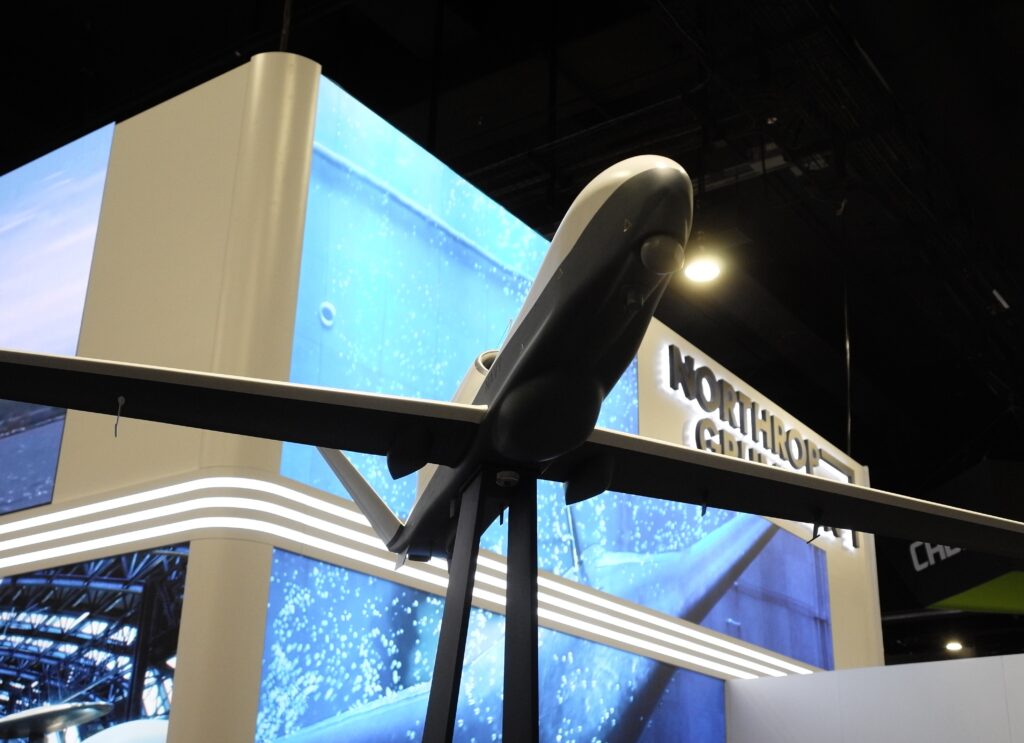
A model of the MQ-4C Triton at Northrop Grumman’s booth. Seapower

NATIONAL HARBOR, Md. — The Navy’s MQ-4C Triton high-altitude, long-endurance unmanned aerial vehicle is on track for initial operational capability with the new Integrated Functional Capability 4 (IFC-4) with a full orbit of four aircraft in fiscal 2023, a senior official said.  

Speaking April 4 to reporters in a roundtable at the Navy League’s Sea-Air Space expo, Rear Adm. Brian Corey, program executive officer for Unmanned and Strike Weapons, said IFC-4, which began flight testing in February, will give the Triton — built by Northrop Grumman (Booth 1300, Dock Space 2) — the capabilities needed to reach IOC and begin to replace the EP-3E Orion maritime reconnaissance aircraft. 

The Navy has had the MQ-4C with the baseline IFC-3 capability deployed in 2020 to the Western Pacific in an early operational capability. One aircraft assigned to Unmanned Patrol Squadron (VUP-19) remains deployed while a second has returned to the United States to give maintenance personnel more hands-on experience. 

Corey said with IFC-3 “the Navy was not ready to get the network right. We weren’t allowed to connect to the network. We’ve come a long way to an operationally relevant environment.” 

The number of planned regional orbits for the Triton originally was planned to be five, with four aircraft each. Beyond the first orbit, the future location and structure of the orbits is less defined and will be determined with regional combatant commander input.  

The Navy paused planned procurement of the MQ-4C for two years in 2021 and 2022, but the production line was sustained with an order of three Tritons for Australia and one for the U.S. Navy added in 2021 by Congress, followed by another congressional addition in 2022. The Navy has requested procurement of three Tritons for fiscal 2023. 

VUP-19, headquartered at Naval Air Station Jacksonville, Florida, moved its maintenance detachment to nearby Naval Station Mayport, Florida, last year from NAS Point Mugu, California. The future of Point Mugu as a future Triton base is yet to be determined. The second squadron, VUP-11, will be based at NAS Whidbey Island, Washington, but the location of its Tritons there or at Point Mugu or elsewhere will be decided later. 

The EP-3E aircraft has a large crew of signals intelligence analysts, and the Triton IFC-4 represents a significant change in the analysis, with onboard processing largely replaced by a wide distribution of the intelligence information across many sites of the intelligence community, Corey said. 

Corey said the RQ-4A Global Hawk Broad-Area Maritime Surveillance — Demonstration aircraft which have supported the U.S. 5th Fleet since 2009, remain in service, with Congress having funded the BAMS-D for 2022 despite the Navy’s plan to divest it. The Navy again in the 2023 budget request targets the BAMS-D for retirement, with budget pressures overcoming the utility of the aircraft. 


Defense Official: U.S. Needs to Improve Engagement With Industry, International Allies

Gabriel Perez Garces, second from left, makes a point during the Global Maritime Leadership panel on April 4. LISA NIPP

NATIONAL HARBOR, Md. — A defense official says the U.S. government needs to improve the way it works with both the defense industry and international allies to ensure U.S. allies are getting the military equipment they need.

Jed Royal, deputy director of the Defense Security Cooperation Agency, said during a panel discussion on global maritime leadership that the defense industry looks to the U.S. military as the primary customer, “as they should,” but that often means that allies and partners of the United States don’t get the prioritization for defense assets that they need.

The United States needs to find a way to take into account an ally’s needs early in the process, rather than waiting for when there’s a specific demand for missiles, aircraft, or some other defense industry product, Royal said.

“We need to think more creatively up front,” he said. “What I’m referring to here is a higher level of conversation both with allies and partners and with industry.”

Royal said it is not ideal for the defense industry to wait for the demand signal, and instead the conversation must be held well in advance of those needs arising — which in turn serves U.S. interests by ensuring strong allies, he said.

Also, while Royal argues that the United States is superior to its adversaries in terms of better systems, “where we are less competitive is how we manage our partners’ finances,” he said. “We are losing some opportunity for collective security interest by not being able to advance better terms and conditions for the purchase of U.S. equipment, so we need to be rethinking that.”

Finally, the United States also needs to think about developing capabilities that are better suited for allies’ requirements, Royal argued. The United States often buys heavy assets with long tails in sustainment, but that may not suit the needs of allies and partners, and so that needs to be factored in, he said.

“We need to establish investment opportunities and rhythms and habits of making sure the priorities of our allies and partners are at the [right] level,” he said.


Outdoor and Dock Exhibitors Offer Whatever Floats Your Boat

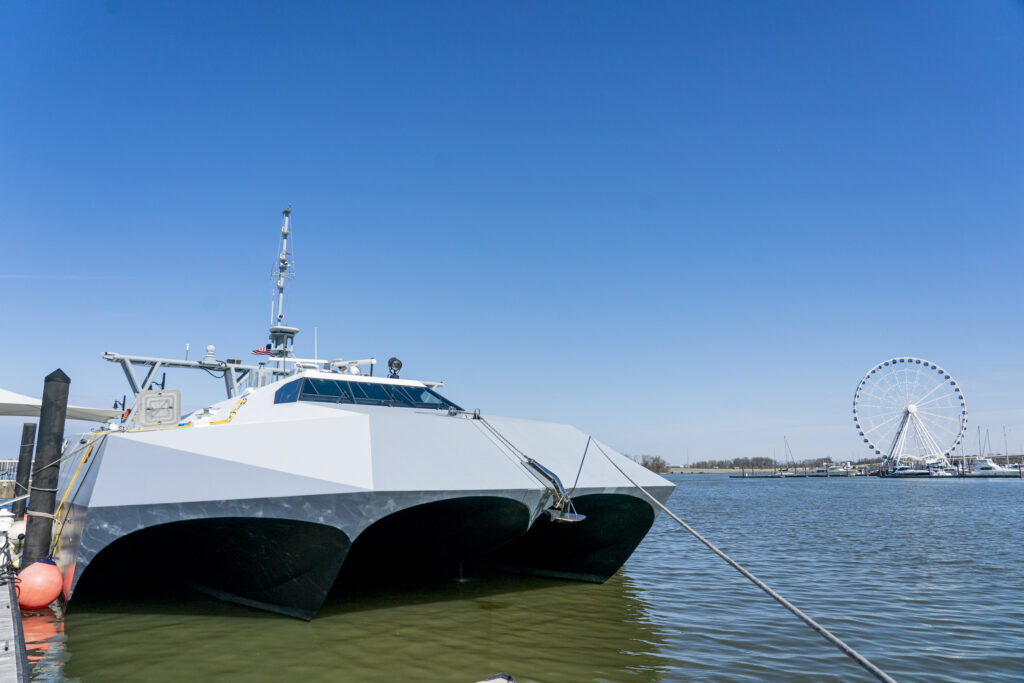
The M-80 Stiletto floating maritime experimentation platform in National Harbor. SOLARES PHOTOGRAPHY

NATIONAL HARBOR, Md. — From a Stiletto to a Rekognition Video Analyzer, outdoor and dock exhibitors are giving Sea-Air-Space attendees the opportunity to check out cutting-edge defense technology.

The carbon-fiber, 88-foot M-80 Stiletto is a floating platform devoted to maritime experimentation, with the goal of supporting the Joint Forces in countering emerging threats. Operated by Joint Prototyping & Experimentation Maritime, Stiletto allows its customers to evaluate and refine their technologies in realistic environments, using representative threats in tactics-based scenarios.

Stiletto tests about 60 to 65 different technologies every year, and more than half of its customers are small businesses, said Dennis Danko, JPEM-Stiletto joint prototyping maritime programming manager.

“We foster commercial innovation by giving small businesses and nontraditional system developers an opportunity to experiment on the water and gain a deep understanding of military missions and maritime operations,” he said.

Stiletto has the capability of working a few feet or hundreds of miles off the coast, and carries its own 11-meter rigid inflatable boat. It can also launch drones and other unmanned systems from its flight deck.

Danko said Stiletto has tested radar and cybersecurity technologies, network systems and even ergonomic seats for boats. It conducts environmental vulnerability assessments for technology systems and engineering evaluations, including various coatings to prevent marine growth.

The Rekognition Video Analyzer is part of a partnership between Amazon Web Services, Viasat and Federated Wireless.

The Viasat system can detect objects from water, piers, docks, land vehicles, paths and even clothing or other apparel, said Steve Conklin of Viasat. Amazon’s Rekognition system analyzes the data, protecting text, data and other communications. Federated Wireless provides secure 5G encryption and protection.

“We can set up in any kind of edge location or disaster environment,” Conklin said, noting that two weeks ago, the system was operational in Poland, on the front lines of the Ukraine conflict.

On Tuesday, April 5, L3Harris Technologies will give tours and rides from the dock on its autonomous boat to showcase its C5ISR-T technology.


Admiral: Navy Actively Experimenting With Cargo UAS Between Ships

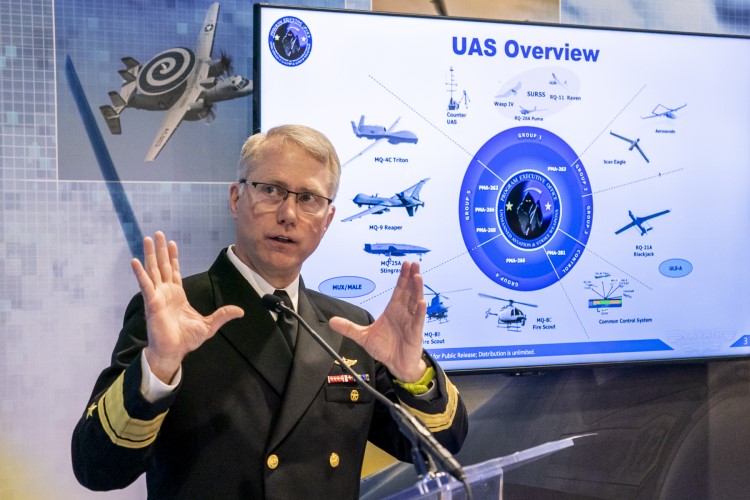
Rear Adm. Brian Corey, program executive officer for unmanned and weapons, discusses Navy UAS. SOLARES PHOTOGRAPHY

NATIONAL HARBOR, Md. — The Navy has been conducting flights between ships as part of an effort to experiment with a cargo unmanned aerial system for maritime use.

Recently, the Navy used an aerial vehicle to transport a part 200 miles between ships, said Rear Adm. Brian Corey, program executive officer for unmanned and weapons (PEO-U&W) at Naval Air Systems Command, during an address at the Navy League’s Sea-Air-Space symposium.

“That’s going to continue,” Corey said of the experiments, while noting that the question of when it could be fielded was up to Navy leadership. “It’s not a technology question, but there are some engineering choices and some work left to be done.”

The program has partnered with both the Navy and Military Sealift Command on the effort to demonstrate the capability to transport small parts ship to ship.

“We believe we could deliver those 200 miles with a relatively small, very inexpensive vehicle,” Corey said. “So that’s what we’re trying to do to enable that is to get the networks and interoperability down and get a small family of ground systems or maybe a single one — that’s unknown at this stage. And then how can we get the autonomous takeoff and landing?”

In a separate effort, the program is experimenting with a cargo UAS for the Marine Corps.

“It’s not yet come to a spot where we have decided to go forward with a program and field it,” Corey said of the Tactical Resupply Unmanned Aircraft System. “The decision will be coming before long depending on how well it works in the field.”

There are some clear advantages to such a system, he said.

“I think that’s some of the most innovative thinking we have going on right now,” he said. “Why drive down a road and potentially get an IED [improvised explosive device] … when you can fly?”