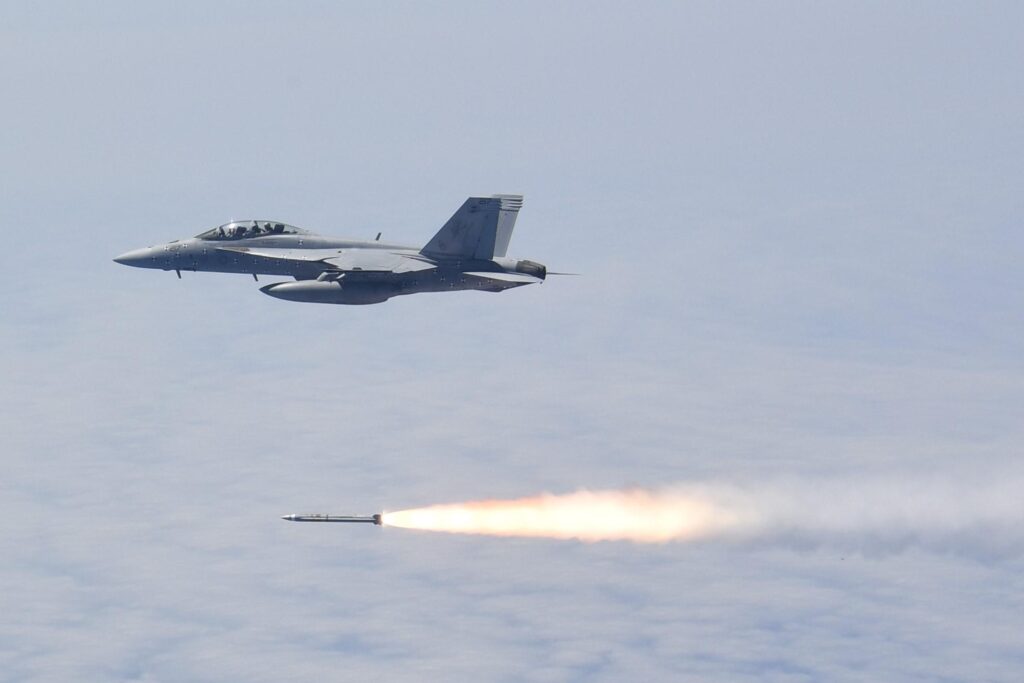
The Navy’s Advanced Anti-Radiation Guided Missile-Extended Range (AARGM-ER) completes its first live fire event July 19 off the coast of Point Mugu Sea Test Range in California. U.S. NAVY
NATIONAL HARBOR, Md.— The Navy’s Advanced Anti-Radiation Guided Missile-Extended Range (AARGM-ER) is tracking toward an initial operational capability of the fourth quarter of fiscal 2023, the Navy program manager said.
The Northrop Grumman-built AGM-84G AARGM-ER is a growth of the baseline AARGM, the AGM-84E. The improved missile, built to suppress or destroy enemy air defenses, includes a new, larger airframe housing a new solid rocket motor, a new warhead, tail control surfaces and a new control actuation system for more maneuverability, increased range and improved survivability.
The AARGM-ER is being developed to arm the F/A-8E/F Super Hornet strike fighter, the EA-18G electronic attack aircraft and the F-35 Lightning II strike fighter.
Speaking April 4 to reporters at the Navy League’s Sea-Air Space expo at National Harbor, Maryland, Capt. Alex Dutko, the program manager, also said operational testing is continuing this year and is expected to be completed in fiscal 2023, with IOC slated for the fourth quarter. Full-rate production is planned for fiscal 2025.
The AARGM-ER entered low-rate initial production during the fourth quarter of 2021, the first of two LRIP lots. The first developmental test flight was conducted in late fiscal 2021 followed by a second test flight in February 2022. A third developmental test flight will be scheduled before operational test begins.
Doug Larratt, Northrop Grumman’s AARGM-ER program director, also briefing reporters, said the production of the baseline AARGM is winding down, with deliveries continuing through fiscal 2024 to support transition to the ER version.
He said Northrop Grumman has delivered more than 11,400 AARGMs (including training missiles and spares) so far out of a program of record of 1,803 baseline AARGMs.
Russia is Acute Threat, China is Priority Threat, Speakers Say
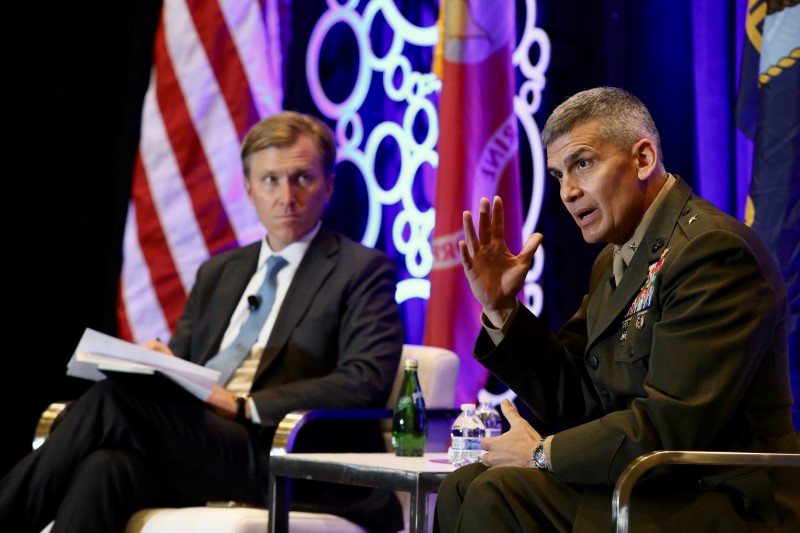
Brig. Gen. Sean Salene called the United States a “Pacific nation.” LISA NIPP
NATIONAL HARBOR, Md. — The U.S. Defense Department will continue to have a priority focus on China despite the global military community’s recent attention to the war in Ukraine, said Elbridge “Bridge” Colby, a former U.S. deputy assistant secretary of defense for strategy and force development, in a one-on-one April 4 discussion with U.S. Marine Corps Brig. Gen. Sean Salene.
“The China problem remains very grave,” said Colby. “In a lot of respects, this to me is really going to be the core of the defense strategy going forward. We see China continue to be named as the priority challenge. China is the long-term challenge, and the only one that can challenge the United States and our interests in a really sustaining and global way.”
As he prepared to introduce Salene, Colby posited questions about the concept of integrated deterrence, and asked whether the U.S. will prioritize the Indo-Pacific region and over what time period. Overall, he said the U.S. needs a sustainable Indo-Pacific strategy and must carefully consider the nature of its alliances and partnerships in the region. He said the United States must work to fully understand how to deal, for example, with countries like India, which may have a different perspective on Russia than does the U.S.
“What does it mean that Russia is an acute threat whereas China is the priority threat? How are we going to go about doing that? Or do we need to prioritize at all? Some people are saying maybe we double the defense budget and you get out of prioritization,” Colby said.
Salene, the director of the Strategy and Plans Division, Plans, Policies and Operations at Marine Corps Headquarters, said there are four overarching priorities in the National Defense Strategy, among them “first and foremost” to defend the homeland. Other priorities include deterring a strategic attack against the United States and against its allies and partners; deterring aggression from China, particularly in the Indo-Pacific, and then against the Russia challenge in Europe; and building a resilient joint force and the ecosystem that supports it inside the defense establishment.
Salene said the Indo-Pacific region is critically important to the U.S. and its partners and allies, and the U.S. is committed to helping its allies defend their own sovereignty.
“We are a Pacific nation,” Salene said. “You probably know how much trade goes though there. You probably know the value and the rise of Asia, and what it means to the development of the entire world.”
He said the most important themes going forward involve the key strategic advantages of working with allies and partners, and the “integrated nature at which we would apply all of the elements of our national power,” also known as integrated deterrence.
Congressmen: Shipyard Improvements Will Continue to Lag With Proposed Budget
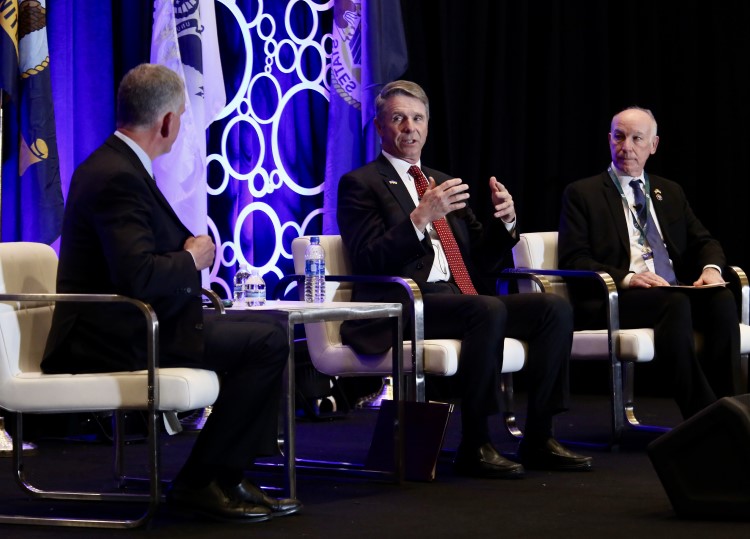
Reps. Joe Courtney and Rob Wittman, speaking at “The Future of Shipbuilding: A Congressional Discussion” panel, said it is “unacceptable” that it will take 10 years to modernize public shipyards with current budget plans. LISA NIPP
NATIONAL HARBOR, Md. — A major solution to the U.S. Navy’s chronic problems of building new ships and maintaining existing vessels is to make extensive and rapid improvements in its public shipyards and to encourage similar investments in the private yards, the bipartisan leaders of the House Armed Services Shipbuilding and Projection Forces Subcommittee said April 4.
With the level of funding to modernize the public yards in the newly released fiscal 2023 defense budget and in the long-term proposed spending, it would take 10 years to make any real improvement, subcommittee chairman Rep. Joe Courtney (D-Connecticut) and ranking member Rep. Rob Wittman (R-Virginia) said at the Navy League’s Sea-Air-Space 2022 exposition. That is unacceptable, the two lawmakers said.
Asked by the session moderator if there is a need for a new public yard, the two lawmakers were not sure if that was required, or obtainable. Improving the facilities at the public yards would also help with the growing problem of retaining the current workforce and attracting a new generation of worker, they said.
They also called for more investment in support for the shipbuilding industrial base as a whole, noting the recent addition of funds for the submarine supplier base, primarily focused on the urgent requirement to keep the Columbia-class ballistic missile subs on a tight schedule to replace the aged Ohio-class boomers.
Both men bemoaned the continuing delay in procuring replacements for the ancient sealift fleet, some ships of which are nearly World War II vintage. Wittman said that program must include new-build ships as well as converted retired commercial merchant ships. He insisted those U.S. built ships could be obtained for an acceptable price.
They also objected to the Navy budget proposal to stop construction of the San Antonio class of large amphibious ships and to delay start of the light amphibious warship program, which the Marine Corps is asking for. The Marines need both types of amphibs, they said.
Lockheed Seeks to Field Aegis Combat System Capabilities Faster Through Baseline 10
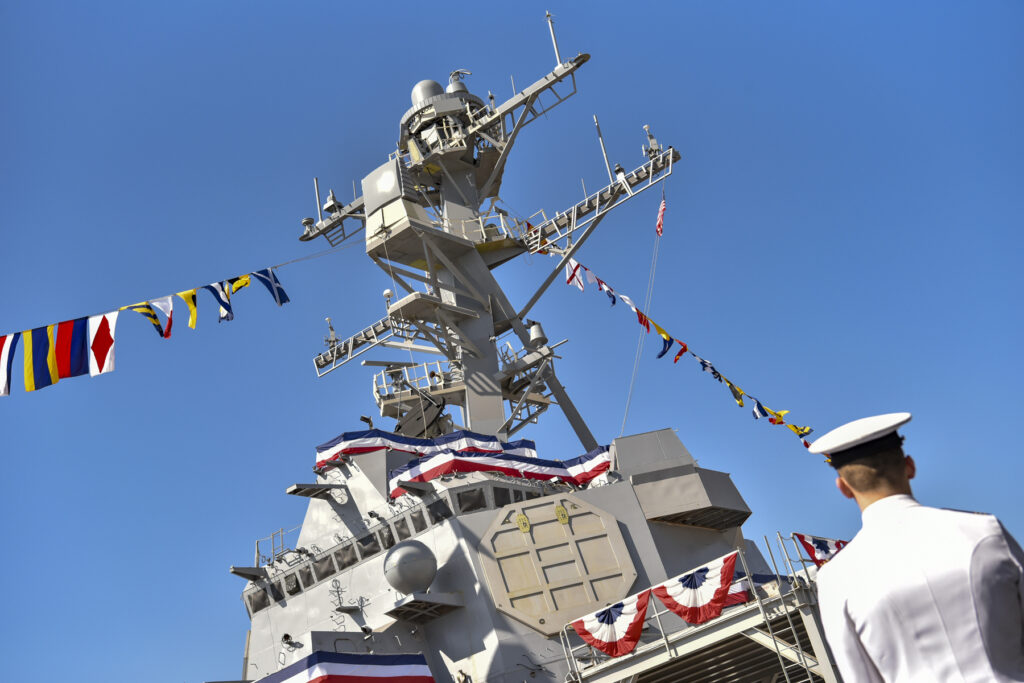
The United States Naval Academy’s Silent Drill Team performs at the christening ceremony for the future Jack H. Lucas (DDG 125) in Pascagoula, Mississippi, March 26. Lucas is the first Flight III guided-missile destroyer, and will be equipped with the most advanced technology and weapons systems. U.S. NAVY / Cmdr. Courtney Hillson
NATIONAL HARBOR, Md. — Lockheed Martin (Booth 1001) is promoting a new advancement to the Aegis Combat System that aims to increase the speed at which new upgrades can be made to the system.
Lockheed hopes to use this new architecture, known as Baseline 10, to shave months off the typical time frame to deliver a new capability to the fleet. The company says it is automating more tests to rapidly confirm software updates, calling Baseline 10 the “most comprehensive evolution of an Aegis baseline to date.”
Joe DePietro, Lockheed’s vice president and general manager of naval combat and missile defense systems, told Seapower in a phone interview that the Aegis Common Source Library makes all of this possible.
“It’s really enabled us to learn how we can transition to an integrated combat system and to deliver our system more quickly with capability to the fleet,” DePietro said.
Baseline 10 is new architecture that allows the team to push new capabilities into the library in three to four weeks instead of in three to four months in some cases.
“That allows us to always work from our most current capability,” DePietro said.
Baseline 10 will operate in much the same way as Baseline 9 did on Aegis Combat System-capable ships — such as cruisers, destroyers and littoral combat ships — it’s just that the latest version will feature a SPY-6 radar instead of a SPY-1. Under this new baseline, the team will continue to create capabilities through integration, push them into the library more quickly and, therefore, field new capabilities faster.
And it’s not just about fielding new technology, DePietro said.
“We’re also taking all of that tech that is fielded and getting them to work together,” he said, adding that these new developments will benefit not just the Aegis Combat System but related systems like Aegis Ashore.
It’s the speed at which all of this is happening that is particularly valuable, DiPietro said.
“If we keep the development pipeline going, we’re also pulling it all more quickly into the CSL [Common Source Library],” he said. “There’s development going on, and because of how we’ve set up the architecture and the pipeline, we can pull what was developed for Baseline 10 into Baseline 9. We are able to really leverage what’s going on, and you can also deploy it very quickly.”
Looking back at technologies in Baseline 7, it would take a couple of years to develop and field a new capability. Baseline 10 would rapidly accelerate that, he said.
“Recently, there was a critical need identified in operations, and we were able to take that feedback and get something back in basically less than two months,” he said. “I can do a medium-sized capability upgrade in anywhere from three to six months. And a full capability upgrade, like a new sensor or the programming of a missile, I can do that in less than a year.”
It’s not the coding or development that’s the challenge, it is having the architecture in place that allows that capability to be tested, validated and integrated more quickly, he said.
“You’ve got to get all of those pieces lined up,” DePietro said. “If you don’t have that architecture and the environment isn’t there, you’re behind the curve.”
The Arleigh Burke-class destroyer USS Jack H. Lucas (DDG-125), currently inching closer to commissioning, will be the first Baseline 10 ship, which marks a big milestone for the team and the architecture in general. The team has placed a node in Pascagoula, Mississippi, where the ship is built that can send data back to Lockheed’s labs, and then the labs can send data straight to the ship as integration efforts continue. That’s a lot easier than the old way of building physical hard drives and carrying them to the shipyard to load them up, DePietro said.
“It’s all about going faster,” he said.
HII Executive Addresses Trickle Down Effect of CRs on Defense Workforce
HII Executive Vice President and President of Ingalls Shipbuilding Kari Wilkinson addressed her company’s steadfast workforce, despite pandemic challenges. LISA NIPP
NATIONAL HARBOR, Md. — The extended continuing resolutions in place of enacted funding affect shipbuilders “much the same as our customers,” but HII deals with it by working closely with the Navy and trying to get an earlier start on programs, Kari Wilkinson, executive vice president of HII and president of Ingalls Shipbuilding, said at the April 4 lunch keynote.
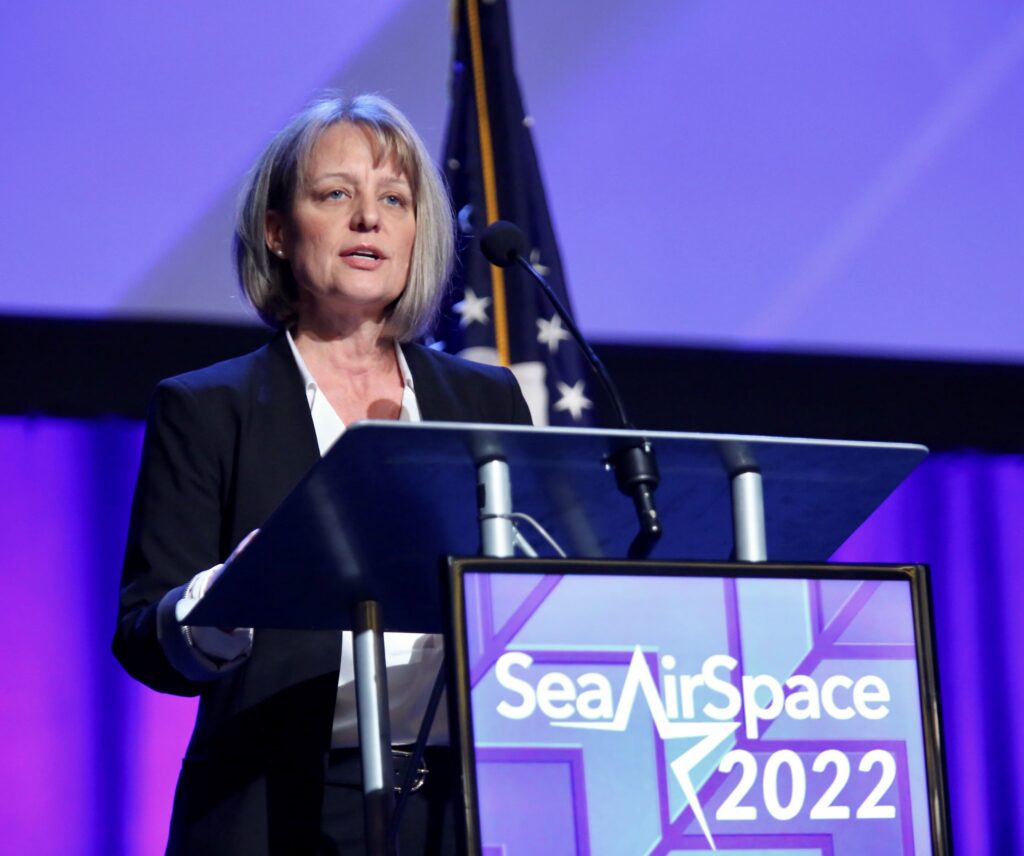
HII is the new brand name for the company formerly known as Huntington Ingalls Industries. Speaking at the Navy League’s 2022 Sea-Air-Space exposition, Wilkinson said an increasing priority for the shipbuilder is retaining its skilled work force and attracting a new generation of workers. Even through the months of pandemic restrictions when many other employees were working from home, 64,000 shipbuilders walked through the gates at HII facilities every day. “They are the best of America,” she said.
To keep that essential work force, HII is reaching out to different communities to recruit new workers. As a result, “Today, we have the most diverse work force ever,” Wilkinson said, and none of those skilled craftsmen and women are easily replaced.
The chronic problem of congressional failure to pass defense appropriations bills on time complicates the effort to keep HII’s work force, on top of the problems it creates in production efficiency and program affordability, she told the audience. Wilkinson also cited the challenges of keeping costs down when the Navy or Congress extends the time between new production of existing ship classes. In the interest of efficiency and affordability, “we like to see ships a lot closer” in start times, she told reporters after her speech.
Service Chiefs: ‘Keep Your Eye on China’
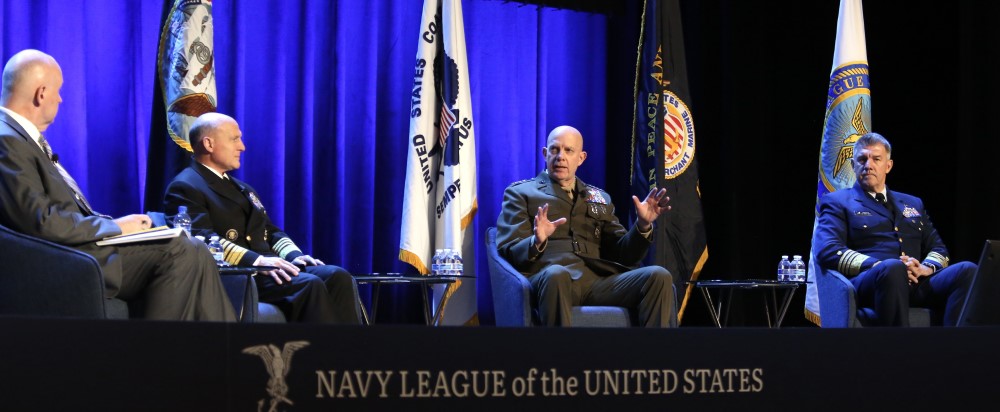
All three service chiefs discussed the newly released defense budget, which Marine Corps Commandant Gen. David Berger described as “strategy-driven.” LISA NIPP
NATIONAL HARBOR, Md. — The top leaders of the Navy and Marine Corps sought to justify their force structure decisions, arguing April 4 that it was necessary to cut some current platforms and systems to be able to buy the capabilities they believe will be needed for a likely future fight against a new peer competitor.
“I think the three of us are saying, keep your eye on China,” said Chief of Naval Operations Adm. Michael Gilday, which was echoed by Marine Corps Commandant Gen. David Berger and Coast Guard Commandant Adm. Karl Schultz in the opening session of the Navy League’s 2022 Sea-Air-Space exposition.
All three of the maritime leaders highlighted their priorities in the newly released 2023 defense budget, which Berger noted was released within days of the new National Defense Strategy and the Nuclear Posture Review.
“It’s very clear to me this is a strategy-driven budget,” Berger said. “If we need to fight in the South China Sea, the force has to be relevant.”
“In order to understand how you resource the fleet, you have to think about how you plan to use the fleet, how you will fight the fleet,” Gilday said, adding that that was done “in the content of strategy.”
The new Navy budget proposes deeper cuts in the surface fleet than previous proposals, and the Marine Corps’ funding plan continues the reductions and changes in the Corps’ forces to make it lighter and more mobile to operate in a contested littoral environment.
Gilday said the Navy needs “a more ready force rather than a less ready larger force. If you look at the budget, we’re trying to buy back a ready force,” that has ammunition in its magazines with a priority on longer range weapons.
“I personally think we are on the right path.,” he said, while acknowledging that the budget “is not popular with many in the fleet and in this room.”
If you are going to match the change in the character of warfare, Berger said, “you have to divest some resources.”
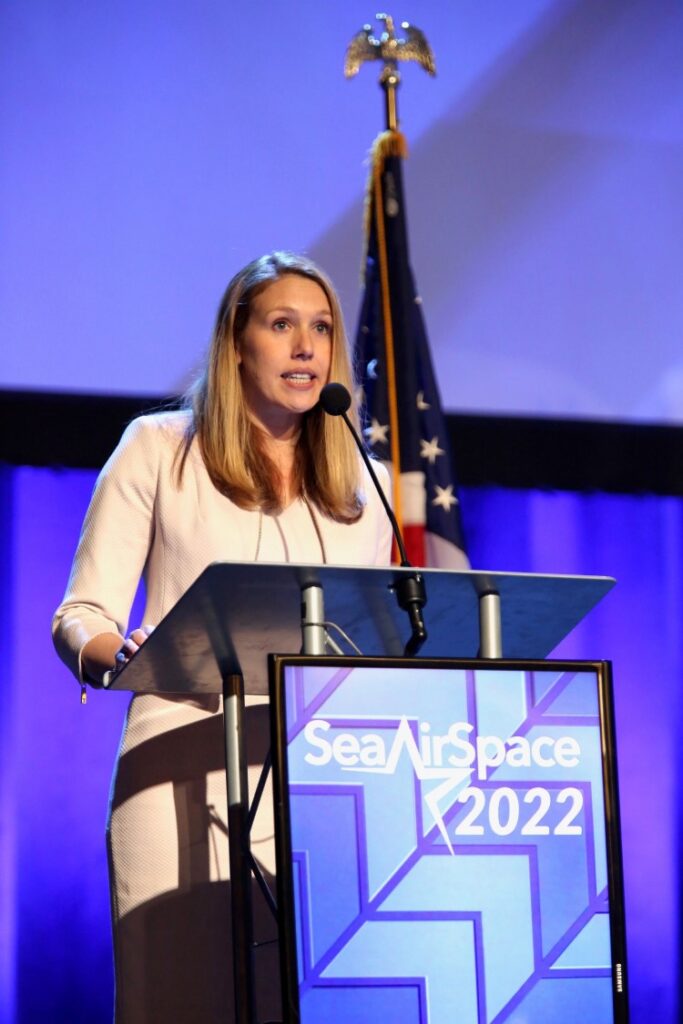
Meredith Berger, performing the duties of Undersecretary of the Navy, kicked off the opening ceremony prior to the chiefs panel on Monday. She said the Navy’s priorities “are empowering our people” with a focus on warfighting and “strengthening our maritime power.” She noted the areas the Department of Navy is operating in are changing to include the information environment and cyberspace. LISA NIPP
Schultz noted the recent signing by all three of the maritime leaders of a new maritime security strategy, which continues the growing integration of his service with the Navy and Marine Corps in the efforts to counter a stronger and more aggressive China.
Schultz said the changing national security and global economic growth has put unprecedented demands on the Coast Guard.
He emphasized the Coast Guard’s uncommonly strong shipbuilding program, which includes finishing the National Security Cutter fleet, buying more of its Offshore Security Cutters and planning a new ice breaker.
Gilday said the long-term shipbuilding program would produce increased capabilities in the surface and undersea fleets with the new models of the Arleigh Burke destroyers and Virginia-class attack submarines, the future guided missile frigates and a wide variety of unmanned surface and subsurface systems.
Admiral on EMALS and AAG Programs: ‘It Works’
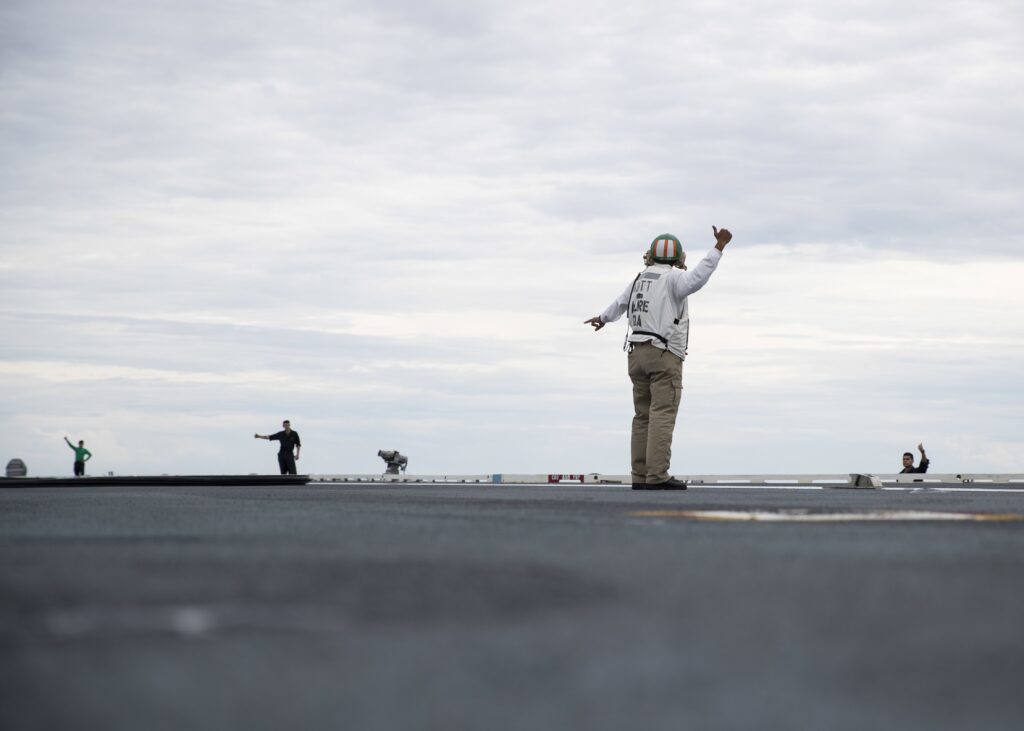
Chief Aviation Boatswain’s Mate (Equipment) Louis Mountain Jr., from Seat Pleasant, Maryland, assigned to USS Gerald R. Ford’s (CVN 78) air department, signals the EMALS to launch during no load testing on the ship’s flight deck. U.S. NAVY / Mass Communication Specialist 3rd Class Zachary Melvin
A Navy admiral says that despite reports to the contrary, the Electromagnetic Aircraft Launch System and Advanced Arresting Gear systems aboard the USS Gerald R. Ford (CVN-78) are working just fine.
Rear Adm. Shane G. Gahagan, program executive officer for tactical aircraft programs (PEO-T) at Naval Air Systems Command, said Monday, April 4 at Sea-Air-Space that the system had achieved 8,500 “cats and traps” on the Ford over the past two years.
The EMALS system has struggled with reliability issues over the years, but Gahagan insisted that it is performing well today.
“It works,” Gahagan said. “I read in the press … that it doesn’t work. It works day in and day out with cats and traps, and now it’s like every other program: How are we going to sustain it for the fight we need?”
He said the EMALS and AAG systems have a “lot of great capability” and that Sailors “love it.”
Bell Offers Manned, Unmanned Tiltrotors for Navy’s Next Rotorcraft
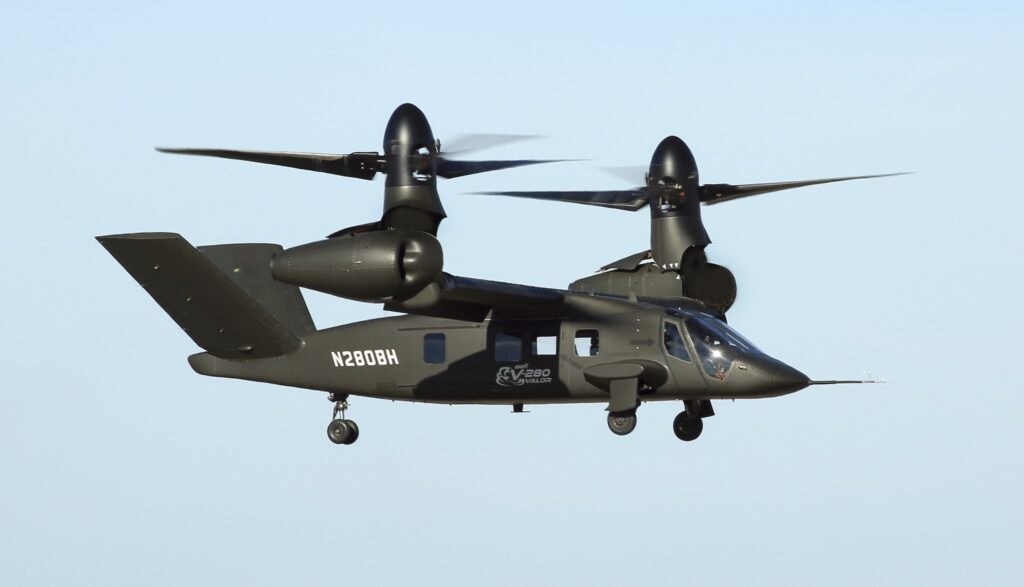
The Bell 280 Valor is currently offered as a replacement for the U.S. Army’s H-60 helicopters, and Bell proposes they would be an ideal component of the Navy’s DMO concept. Bell
NATIONAL HARBOR, Md. — Bell, a Textron company, is marketing its manned and unmanned tiltrotor aircraft to be the eventual replacements for the Navy’s MH-60R/S helicopters.
Carl Forsling, Bell’s senior manager for military sales and strategy, told Seapower April 4 at the Navy League’s Sea-Air Space expo that the Bell tiltrotors would be ideal for implementation of the Navy’s Distributed Maritime Operations concept because of their speed, range and payload.
The two tiltrotors are the versions of the unmanned Bell 247 Vigilant and the manned Bell 280 Valor.
The Valor, currently offered as a replacement for the U.S. Army’s H-60 helicopters, is larger than the 247 and is designed to carry 8-12 passengers. It has two engines, one each at the wingtips driving a tiltrotor. Unlike those on the Bell-Boeing V-22 Osprey, the engines do not pivot, simplifying the mechanics of the movement and reducing cost. The marinized Valor would have a pivoting wing like the V-22 for storage in a ship’s hangar. The aircraft would be hardened for electromagnetic protection and be marinized for corrosion control in the salt-water environment. It would assume the roles of the MH-60S, including plane guard, rescue, medical evacuation and logistics.
The marinized unmanned Vigilant would replace the MH-60Rs on surface warships such as guided-missile destroyers. The folding rotors and pivoting wing would allow storage in a warships’ small helicopter hangars. The Vigilant could be used for roles including surveillance, antisubmarine warfare, precision strike and aerial refueling.
With both aircraft replacing helicopters, the speed and range advantage would allow the tiltrotors to cover more area at a faster rate, Forsling said, while carrying heavier payloads.
Navy’s CVM-22B Aircraft Adds Medevac Speed to Carrier Strike Group
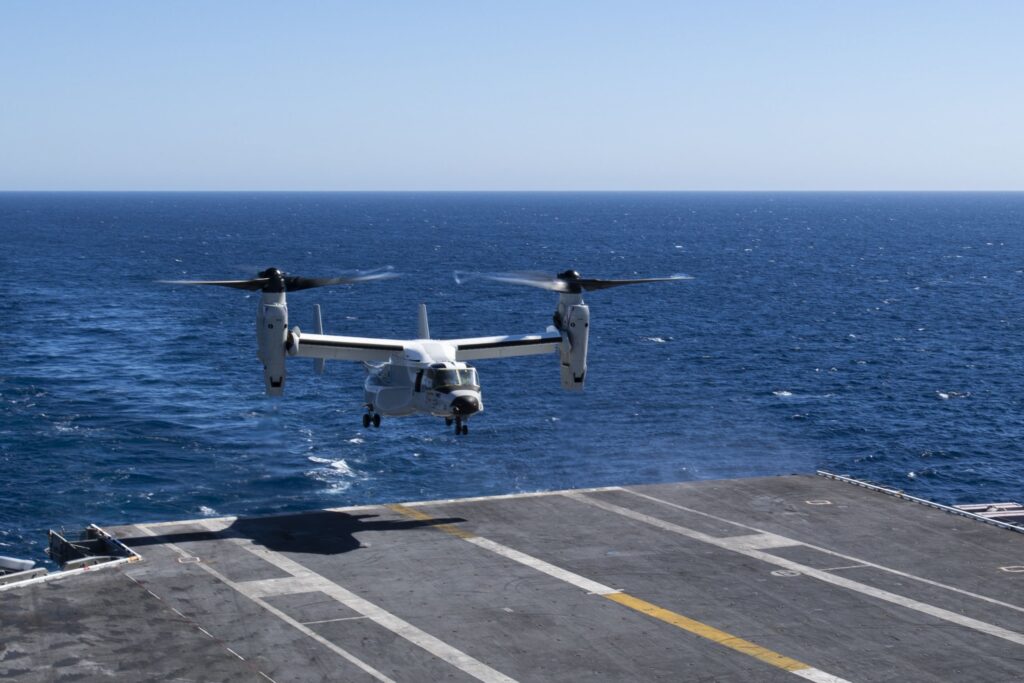
A CVM-22B Osprey, from the “Sunhawks” of fleet logistics multi-mission squadron (VRM) 50, lands on the flight deck of the aircraft carrier USS Nimitz (CVN 68). At a Sea-Air-Space briefing, the V-22 program manager discussed the aircraft’s usefulness as a medevac solution. U.S. Navy / Mass Communications Specialist 3rd Class Joseph Calabrese
NATIONAL HARBOR, Md. — The U.S. Navy’s new CMV-22B Osprey tiltrotor carrier-onboard delivery aircraft’s capabilities have been a game-changer for medical evacuation from a carrier strike group, the Navy’s V-22 program official said.
The CMV-22B, which is replacing the catapult-launched C-2A Greyhound COD aircraft in the fleet, takes off and lands vertically. It is less dependent on carrier launch-and-recover cycles and, therefore, more flexible in its ability to quickly launch from the aircraft carrier and carry a medical patient to facilities ashore.
In addition to quicker launch capability, the range of the CMV-22B — which can be refueled in flight—give it an added ability to reach land-based medical facilities from farther out.
Marine Col. Brian Taylor, the Navy’s V-22 program manager, speaking April 4 to reporters at a Naval Air Systems Command (Booth 947) briefing the Navy League’s Sea-Air Space expo at National Harbor, Maryland, spoke of a medevac from the one of the two CMV-22B detachments from that have deployed on aircraft carriers to the Indo-Pacific region so far from Fleet Logistics Multimission Squadron 30 (VRM-30). A CVM-22B launched from the carrier with a medevac patient and was able to land in a helicopter landing pad at the naval hospital in Camp Foster, Okinawa, a feat that the C-2A would not have been able to accomplish.
Taylor MV-22B integrated well with carrier operations. He also said the Marine Corps’ MV-22B Osprey has qualified to operate from the hospital ship USNS Mercy.
The Osprey is operated by the U.S. Marine Corps, Air Force, and Navy and by the Japanese Self-Defense Force.
Taylor said the Osprey is expected to be in service through 2055. It reached initial operational capability in 2007. Under current contracts, production is expected to end in late 2024. The program office is focusing on sustainment and keeping the flow of parts and other resources necessary to keep the Osprey fleet operational through its service life.
Last year the Marine Corps deactivated one MV-22B squadron — VMM-166 — as part of Commandant Gen. David Berger’s Force Design 2030 initiatives. Faced with the possibility of excess MV-22Bs in inventory, Taylor said his office is looking at inventory management of the fleet to develop a long-term plan, with an option that some Ospreys may be placed in storage, available as attrition aircraft.
Navy’s Flight I/II DDGs Get UAS Capability with Textron’s Aerosonde
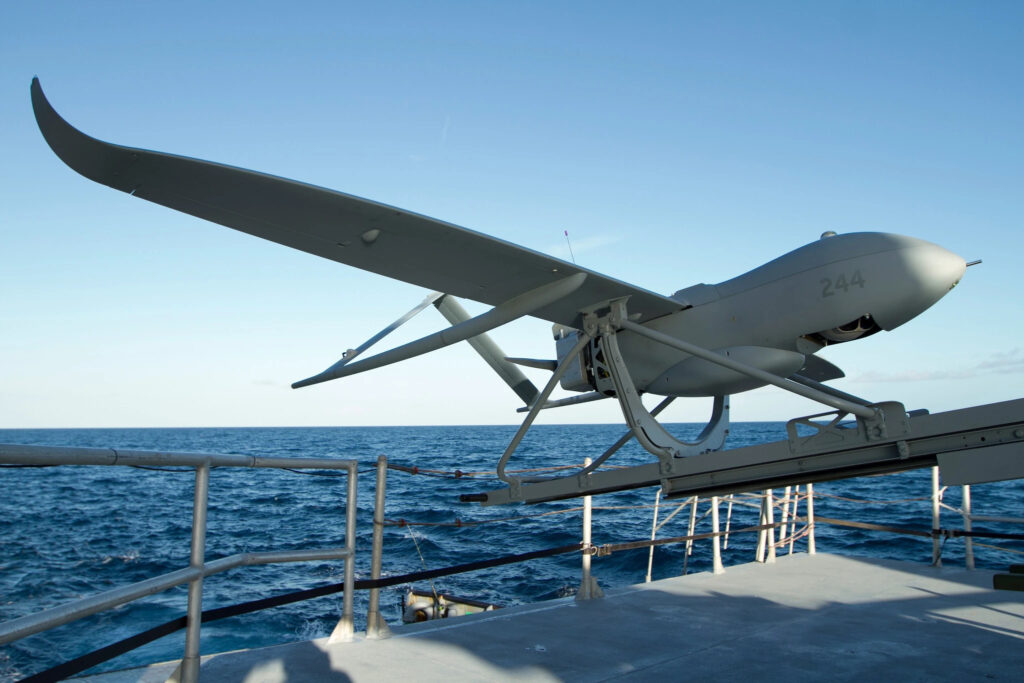
The Aerosonde UAS has been deployed on a Navy Arleigh Burke-class guided missile destroyer in the 7th Fleet. TEXTRON SYSTEMS
ARLINGTON, Va. — The Aerosonde unmanned aerial system has been deployed on a U.S. Navy Arleigh Burke-class guided-missile destroyer serving in the U.S. 7th Fleet, giving the Flight I/II DDG — which does not have the organic helicopter facilities of the Flight IIA and subsequent versions of the DDG — an organic aerial surveillance capability.
Wayne Prender, Textron Systems’ vice president for Air Systems, told Seapower March 31 the DDG — which he was not at liberty to name — deployed with an Aerosonde system on board in March. The system is being operated under a contractor-owned/contractor-operated arrangement.
Prender said a second DDG would deploy with an Aerosonde system later this year. He also said that for three years an Aerosonde system has been operational on board the Lewis B. Puller-class expeditionary sea base ship USS Hershel “Woody” Williams in support of the U.S. 2nd Fleet.
Prender said the deployments are “helping to set the calculus for real-world operations.”
The Aerosonde can carry a variety of sensors including an electro-optical camera, an Automatic Information System receiver, and other special payloads. The UAS can perform wide-area search, expanding the search horizon of the host ship. The system is fully integrated into the ship’s combat information center.
The UAS uses less fuel — about one pound per hour — than an MH-60 helicopter, which burns about 1,000 pounds per hour. The Aerosonde uses heavy fuel, the same fuel used by the ship’s turbines, so no provision for a different fuel is needed.
An Aerosonde can be operated by a team of three contractor personnel. The fixed-wing version can be launched and recovered in Sea State 4 and is recovered by a net rigged on the host ship. A vertical takeoff and landing version, which carries a lighter payload but can be launched more quickly, will be deployed on a ship later this year.