Keel Authenticated for Future USS Patrick Gallagher
The keel for the future USS Patrick Gallagher (DDG 127) was ceremonially laid at General Dynamics Bath Iron Works on March 30. GENERAL DYNAMICS BATH IRON WORKS
WASHINGTON — The keel for the future USS Patrick Gallagher (DDG 127) was ceremonially laid at General Dynamics Bath Iron Works on March 30, Team Ships Public Affairs said March 31.
The ship is named for Marine Corps Cpl. Patrick Gallagher, who received the Navy Cross for heroism during the Vietnam War when he managed to jump on and throw an enemy grenade into a river. He was killed in action just one year later. The keel laying marks the 55th anniversary of his death.
A contemporary keel laying ceremony recognizes the moment of a ship’s construction when two significant pieces of the hull structure are welded together and joined, constituting a major portion of the ship’s shape. The authentication or etching of the ship sponsors’ initials into a ceremonial keel plate will take place during the ceremony. The sponsors of DDG 127 are Gallagher’s three sisters: Teresa Keegan, Rosemarie Gallagher and Pauline Gallagher.
“The future USS Patrick Gallagher will strengthen our maritime dominance and bring proven capability to the fleet,” said Capt. Seth Miller, DDG 51 class program manager, Program Executive Office – Ships. “This ship and all who serve aboard it will be a reminder of the steadfast commitment to our country that Cpl. Gallagher exhibited.”
The final Arleigh Burke-class destroyer built in the Flight IIA configuration, DDG 127 is equipped with the Aegis Baseline 9C2 Combat System, which brings crucial Ballistic Missile Defense capabilities to the Fleet in addition to the ship’s primary missions of anti-air, anti-surface, anti-submarine, and strike warfare.
BIW is also currently in production on the future USS Carl M. Levin (DDG 120), USS John Basilone (DDG 122), USS Harvey C. Barnum Jr. (DDG 124), USS Louis H. Wilson Jr. (DDG 126), USS William Charette (DDG 130), and USS Quentin Walsh (DDG 132).
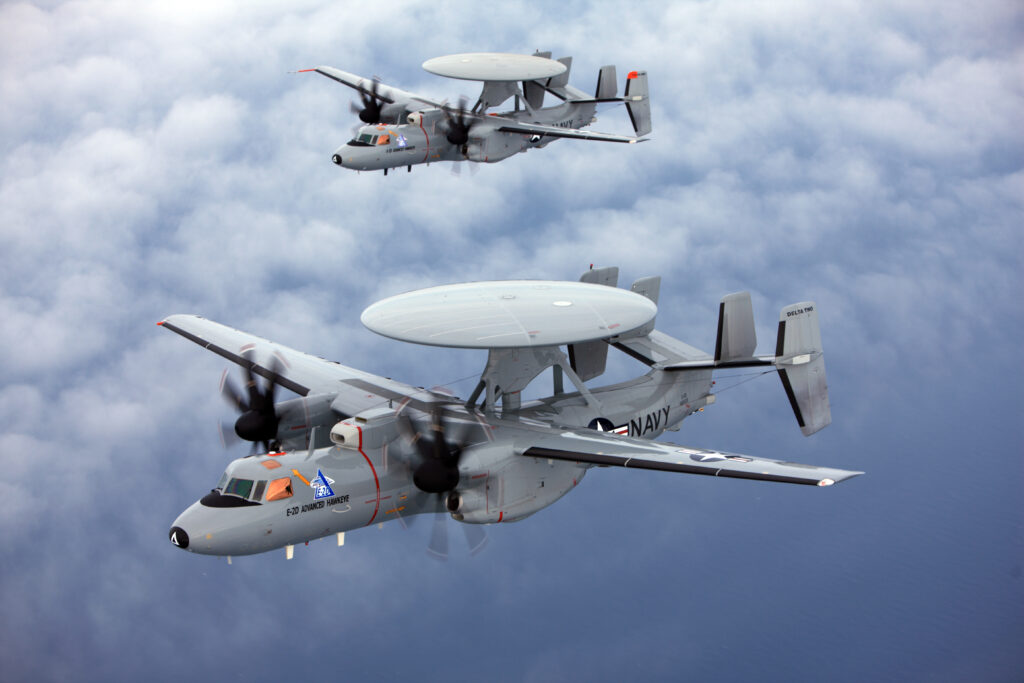
Norfolk-based E-2D Advanced Hawkeye Crashes, Two Injured, One Fatality
E-2D Advanced Hawkeye aircraft conduct a test flight near St. Augustine, Florida. U.S. NAVY
NORFOLK, Va. — A Navy E-2D Advanced Hawkeye assigned to an East Coast Airborne Command and Control Squadron (VAW) crashed in the vicinity of Wallops Island and Chincoteague, Virginia, March 30, the commander of Naval Air Force Atlantic public affairs said in a release. One crew member has died and two have been injured.
The E-2D crashed at approximately 7:30 p.m. Two crew members were rescued by Maryland State Police and transported to Wallops Island for follow-on medical treatment for non-life-threatening injuries. The names of injured crewmembers will not be released due to privacy concerns.
Unfortunately, the third crew member was found deceased in the aircraft. The Worcester County Fire Department Dive Team supported the search and recovery of the deceased. The name of the crew member killed will not be released at this time, pending primary next of kin notification.
NAVCENT Commander: Goal of 100 USVs in Area by Summer of 2023
A Saildrone Explorer unmanned surface vessel is being towed out to sea in the Arabian Gulf off Bahrain’s coast, Jan. 27. U.S. Naval Forces Central Command began operationally testing the USV as part of an initiative to integrate new unmanned systems and artificial intelligence into U.S. 5th Fleet operations. U.S. ARMY / Specialist Natianna Strachen
ARLINGTON, Va. — The commander of the U.S. 5th Fleet/Naval Forces Central Command said he is pleased with the results of the experimentation with unmanned vessels and artificial intelligence in his area of operations and predicts a significant expansion of their use in his area of responsibility in the near future.
Vice Adm. Brad Cooper, speaking March 28 in an online discussion sponsored by the Washington think tank the Middle East Institute, said his task force for unmanned vehicle experimentation, Task Force 59, “has exceeded our every expectation.”
Unmanned systems are not new to the 5th Fleet; it has operated RQ-4A Global Hawk surveillance unmanned aerial vehicles and Mk18 mine countermeasures unmanned underwater vehicles for years. But Cooper said the maturation of unmanned surface vessels is relatively new and has enabled a great expansion in their use in the role of maritime domain awareness, allowing his command to “put more eyes out on the water.”
The admiral said by linking two USVs together, they could use “artificial intelligence to map the waters around them … detecting when something is unusual — smuggling, illegal fishing, you name it, and then sending the information back to the command center.
“That process has allowed us to expand our maritime domain awareness two or three times,” he said, noting that with more nations using USVs, the maritime domain awareness in the region could expand to 30 times the coverage.
“Our goal is to have 100 of these USVs patrolling around the waters of the Middle East by the summer of 2023,” Cooper said. “It a heavily partnered effort; it would mostly be an investment by partners. … We’re going to find ourselves in a pretty good spot because the capabilities speak for themselves.”
In January and February, about 80 unmanned systems were deployed in International Maritime Exercise 2022 in scenarios ranging over the Persian Gulf, North Arabian Sea, Gulf of Oman and the Red Sea.
Task Force 59 has accrued more than 7,000 hours of operating USVs. One type of USV stayed at sea for 45 days without need of additional fuel or maintenance.
For example, TF-59 has deployed high-endurance Saildrone USVs, which were controlled from Alameda, California, to patrol the Gulf of Aqaba. In another example, MARTAC provided five of its high-speed USVs for the experiments.
Cooper said for the price of one Arleigh Burke-class guided-missile destroyer, he could buy or lease around 2,000 Saildrone USVs.
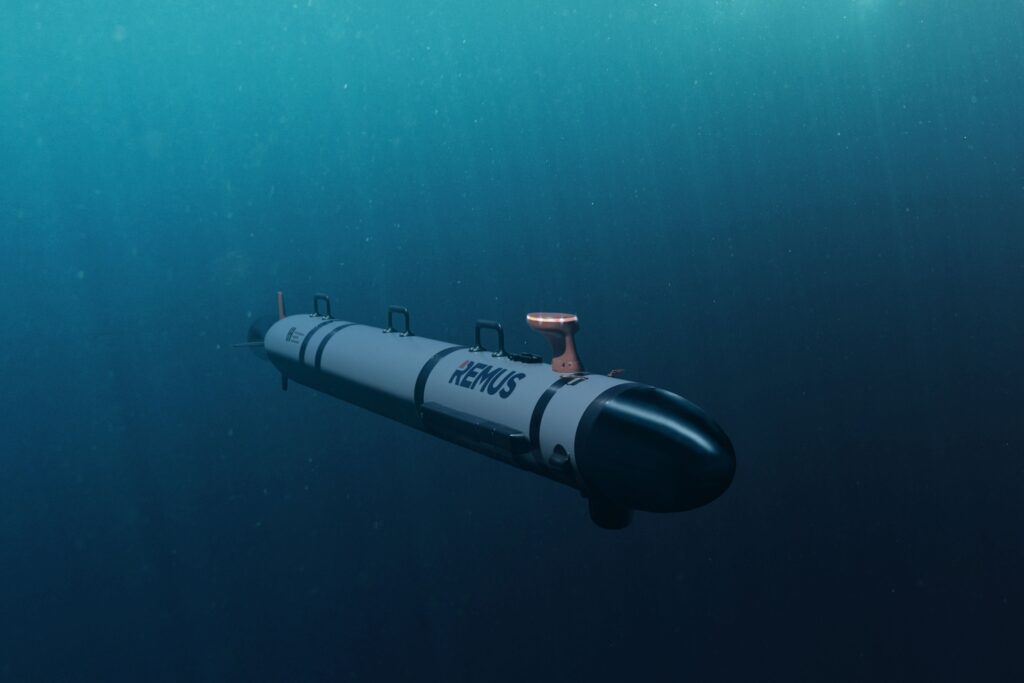
HII’s REMUS 300 Selected as Navy’s Next-Generation Small UUV
HII’s REMUS 300 unmanned underwater vehicle, selected as the U.S. Navy’s next-generation small UUV program of record. HII
MCLEAN, Va. — HII announced March 30 its advanced unmanned underwater vehicle, REMUS 300, was selected as U.S. Navy’s next generation small UUV program of record. REMUS 300 technology was designed to advance distributed maritime operations by conducting critical underwater missions.
The initial phase of the program includes the production and testing of REMUS 300 UUVs over the next year.
“HII is proud of our longstanding partnership with the U.S. Navy and now, to lead in this important direction on behalf of our customer,” said Chris Kastner, president and CEO of HII. “This program demonstrates the value of our investment in autonomous and unmanned systems, and our customer familiarity. We are confident that these technologies will both support the Navy mission and enhance effectiveness for the all-domain force.”
The vehicle incorporates advanced modularity and open architecture into a compact, man-portable design.
“REMUS UUVs have been extending the capabilities of the warfighter since they were first used in combat during Operation Iraqi Freedom in 2003,” said Duane Fotheringham, president of the unmanned systems business group in HII’s Mission Technologies division. “We’ve been enhancing, maturing and refining this technology since then, and are pleased the REMUS 300 meets needs for the Navy’s next generation UUV program.”
The SUUV program, also called Lionfish, is the next-generation Mk18 Mod 1 Swordfish program, which also utilizes HII’s REMUS technology. The selection follows a two-year rapid prototyping effort involving multiple user evaluations and spiral developments to refine the REMUS 300 design. The acquisition was facilitated by the Department of Defense’s Defense Innovation Unit and their commercial solutions opening process via the other transaction authority.
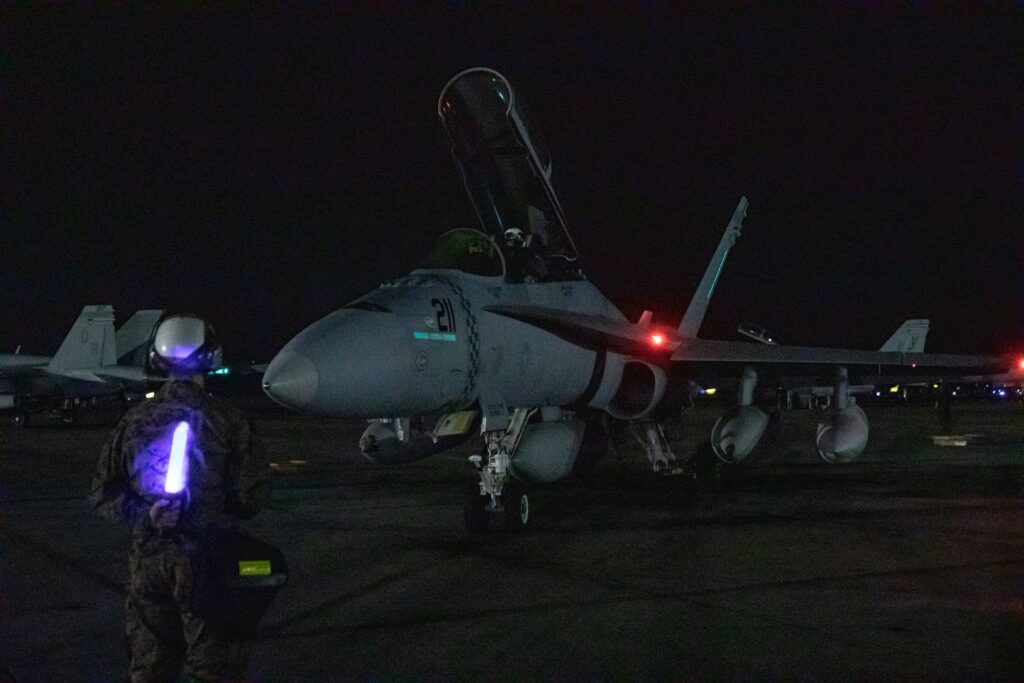
Marine Corps Hornet Squadron Repositioned to Eastern Europe
U.S. Marines with Marine Fighter Attack Squadron (VMFA) 312 assigned to 2nd Marine Aircraft Wing, II Marine Expeditionary Force, depart in F/A-18C Hornets from Marine Corps Air Station Beaufort, South Carolina, Feb. 26, to participate in Exercise Cold Response (Ex CR22) in Norway. U.S. MARINE CORPS / Cpl. Aidan Parker
ARLINGTON, Va. — The Defense Department has added another tactical jet squadron to eastern Europe to shore up U.S. European Command and possible NATO forces in the region, the Defense Department said.
Defense Department spokesman John F. Kirby told reporters March 29 that a 10-plane Marine Corps F/A-18 squadron based at Marine Corps Air Station Beaufort, South Carolina, would be dispatched to an airfield — which he did not name — in eastern Europe.
Kirby did not name the squadron but referred to the recent Exercise Cold Response in Norway, where Marine Fighter Attack Squadron 312 (VMFA-312) was deployed. It is likely that VMFA-312 was the squadron chosen. VMFA-312 operates F/A-18C/D Hornets. Other Hornet squadrons based at Beaufort include VMFA-115, VMFA(AW)-224 and VMFA(AW)-533.
Kirby also announced that “a couple of Marine C-130s” were also going to be repositioned to eastern Europe. These likely are KC-130J Super Hercules tanker/transports from Marine Aerial Refueler/Transport Squadron 252, base at MCAS Cherry Point, North Carolina.
Also deploying from Exercise Cold Response to Lithuania are Marines assigned to Marine Air Control Group 28, Kirby said.
On March 29, Kirby announced that a Navy EA-18G Growler electronic attack squadron, VAQ-134, arrived at Spangdahlem Air Base, Germany, to strengthen U.S. forces on NATO’s Eastern Flank.
Marine Corps’ Black Sheep to Ride the Lightning
An AV-8B Harrier and an F-35B Lightning II are staged during the change of command and re-designation ceremony for Marine Fighter Attack Squadron 214 aboard Marine Corps Air Station Yuma, Arizona, March, 25. U.S. MARINE CORPS / Sgt. Samuel Ruiz
ARLINGTON, Va. — The Marine Corps’ famous Black Sheep squadron has a new designation as it upgrades to from its AV-8B Harrier II attack jet to its new aircraft, the Lockheed Martin F-35B Lightning II strike fighter.
Marine Attack Squadron 214 (VMA-214) — the Black Sheep — was re-designated Marine Fighter Attack Squadron 214 (VMFA-214) at Marine Corps Air Station (MCAS) Yuma, Arizona, on March 25, marking the beginning of its transition from the AV-8B to the F-35B.
VMA-214 was the last AV-8B squadron based at Yuma and based near the West Coast. Three other AV-8B squadrons — VMAs 223, 231, and 542 — remain in service at MCAS Cherry Point, North Carolina. The Harrier is scheduled to serve with the Marine Corps until fiscal 2028.
Having flown the Harrier since 1989, the Black Sheep routinely deployed six-plane detachments on board amphibious assault ships as part of the Air Combat element of a Marine Expeditionary Unit and flew combat missions in numerous operations.
The Black Sheep began as Marine Fighter Squadron 214, activated with F4F Wildcat fighters on July 1, 1942, in Hawaii. In August 1943, Maj. Gregory “Pappy” Boyington and Maj. Stan Bailey formed a group of unassigned pilots into a combat squadron with the callsign “Black Sheep” and flew their F4U-1 Corsair fighters to an outstanding record in the Solomon Islands.
The squadron has built a solid legacy with numerous aircraft types in combat in World War II, the Korean War, the Vietnam War, Somalia, Iraq and Afghanistan and many other crises. For the official history of the Black Sheep, see this link: https://www.3rdmaw.marines.mil/Units/MAG-13/VMA-214/History/
“Having previously served in VMA-214 and flown the AV-8B for many years, the Black Sheep and the Harrier hold a special place in my heart,” said Maj. Gen. Bradford J. Gering, the commanding general of 3rd Marine Aircraft Wing, in a Marine Corps release. “As 3rd MAW says a bittersweet farewell to the Harrier, we are excited to increase our number of F-35B squadrons with the re-designation of VMFA-214.”
“The re-designation of VMA-214 to VMFA-214 is the end of a legacy for the Black Sheep and Marine Aircraft Group-13,” said Lt. Col. Keith Bucklew, the outgoing commander of VMA-214. “This symbolic event finalizes the sundown for Harriers on the West Coast and closes the chapter on 58 years of attack aircraft operations for the Black Sheep.
“Finishing this mission with a successful 11th Marine Expeditionary Unit deployment is a testament to the viability and performance of the Harrier over the last 33 years and, more importantly, the talent of the Marines who managed them,” Bucklew said. “The AV-8B will be missed in the skies of Yuma, but it is time to transition to the next generation of fighter attack aircraft.”
“The F-35’s fifth-generation strike fighter capability brings more lethality and flexibility to combatant commanders than any other fighter platform,” said Lt. Col. Christopher Kelly, the commanding officer of VMFA- 214. “The STO/VL capability inherent in the F-35 B variant allows the Marine Corps to operate expeditiously and from remote locations, making the model uniquely qualified at supporting expeditionary advanced base operations.”
.
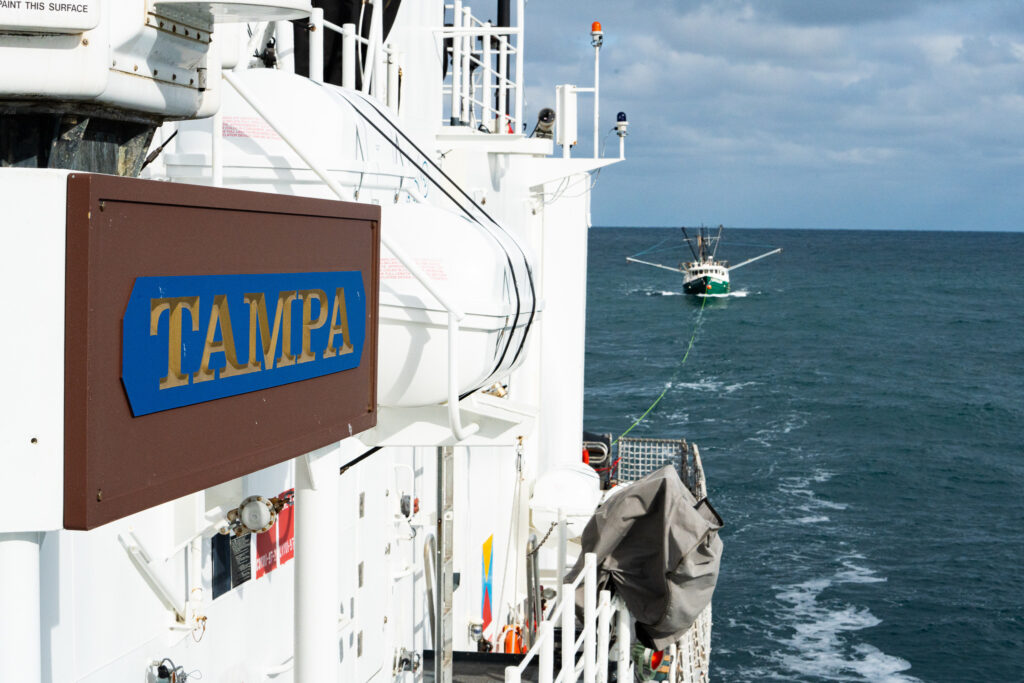
Coast Guard Cutter Tampa Returns to Homeport following 70-day Patrol
The USCGC Tampa tows the fishing vessel Jenna Lee, being towed east of Cape Cod, Feb. 6. U.S. COAST GUARD / Seaman Ryan Lloyd
PORTSMOUTH, Va. — The crew of the U.S. Coast Guard Cutter Tampa returned to their homeport in Portsmouth, Virginia, March 26, after a 70-day patrol in the North Atlantic Ocean, the Coast Guard Atlantic Area said March 29.
Throughout the patrol, Tampa’s crew conducted search and rescue, law enforcement and living marine resources missions. The Tampa boarded 26 vessels to ensure that commercial vessels were adhering to mandates regarding catch size, catch amount, gear type and catch area. In addition, boarding teams found eight violations while inspecting the vessel’s safety equipment for compliance and recommended one vessel to return to port to correct safety of life at sea regulation compliance violations.
Tampa’s crew focused on mainly on scallop, sole, cod, haddock, redfish, pollock and lobster populations off of the New England coast. The mission includes ensuring the country’s protected marine species are provided the protection necessary to help their populations recover to healthy and sustainable levels.
“Our crew performed admirably in trying sea-going conditions, often facing extreme weather and frigid temperatures. Their perseverance to effect mission execution was truly inspiring. We cherished the opportunity to operate in New England, working with our partners to enforce regulations that sustain fish and shellfish stocks for future generations, while keeping fishing vessel crews safe,” said Cmdr. Sky Holm, commanding officer of Tampa.
Coast Guard Cutter Tampa is a 270-foot Famous-class medium-endurance cutter homeported in Portsmouth, Virginia. The crew routinely deploys in support of counter-drug, migrant interdiction, fisheries enforcement, search and rescue and homeland security missions in support of U.S. Coast Guard operations throughout the Western Hemisphere.
Russia’s a ‘Threat,’ but China’s Still the Focus of New National Defense Strategy, 2023 Pentagon Budget
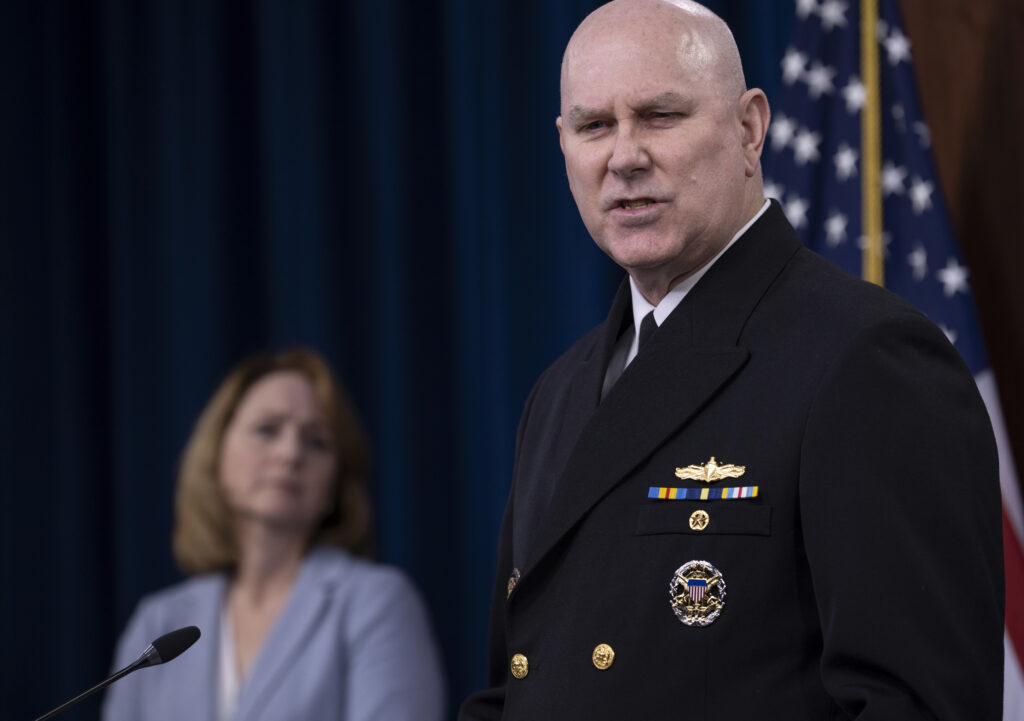
Deputy Secretary of Defense Dr. Kathleen H. Hicks and Vice Chairman of the Joint Chiefs of Staff U.S. Navy Adm. Christopher W. Grady deliver opening remarks on the President’s Fiscal Year 2023 Defense Budget, the Pentagon, Washington, D.C., March 28. DOD / Air Force Staff Sgt. Brittany A. Chase
ARLINGTON, Va. — More money for science and technology research, dealing with climate change, modernizing the nuclear triad and deterring Russia in Europe and China in the Indo-Pacific region are among the priorities outlined in President Joe Biden’s fiscal 2023 defense budget request.
The $813 billion national defense budget request released March 28 includes $773 billion for the Defense Department and more than $40 billion for defense-related activities at other agencies.
The request reflects the updated National Defense Strategy, which continues to focus on the pacing challenge of China, Defense Secretary Lloyd Austin III said in a statement accompanying the 2023 budget rollout. “It will help us prepare for other future challenges, as well, including those by climate change … North Korea, Iran and violent extremist organizations.”
While Russia’s “brutal and unprovoked” invasion of Ukraine illustrates how Moscow “poses an acute threat to the world order,” the 2022 NDS sees the People’s Republic of China “as our most consequential strategic competitor and the pacing challenge for the department,” Deputy Defense Secretary Kathleen Hicks told a March 28 livestreamed Pentagon press briefing on the budget request.
The same day, a classified version of the new strategy was delivered to Congress and a two-page unclassified fact sheet was released. It stated mutually beneficial alliances and partnerships are “critical to achieving our objectives, as the unified response to Russia’s further invasion of Ukraine has demonstrated.”
Additional Investments
The focus on China “required additional investments for both the Navy and the Air Force,” said Undersecretary of Defense Michael McCord, the department’s chief financial officer. While the U.S. Navy and Air Force are slated to receive more than $230 billion each in the 2023 funding request, the Biden administration is seeking only $173 billion for the Army.
The budget request is devoting $134.7 billion to joint force readiness: Allocating $29.4 billion to the Army, $47.4 billion to the Navy, $4.1 billion for the Marine Corps, $35.5 billion for the Air Force, $3 billion for Space Force and $9.7 billion for Special Operations Command.
The proposed budget seeks $6.1 billion for the Pacific Deterrence Initiative, including $892 million for the defense of Guam including improved missile defense, command, and control capabilities, radar capacity and new construction. The Indo-Pacific Command funding adds $133 million for other base defense enhancements throughout the region. U.S. European Command would get $4.2 billion for the European Deterrence Initiative, including $300 million in security assistance for Ukraine.
To meet new technology challenges, the Pentagon is seeking $130.1 billion for research, development, testing and evaluation — an all-time high, more than 9.5% above RTD&E funding in the enacted 2022 defense legislation — that includes artificial intelligence, machine learning and 5G wireless networks and investments in chemical production, bio-manufacturing and rare earth element supply chains.
Investments in the industrial base and supply chain include $1.3 billion to improve critical naval infrastructure through the Shipyard Infrastructure Optimization Program; $3.3 billion for microelectronics; $48 million for casting and forging; $43 million for batteries and energy storage, including establishing safety and testing capacity for future weapon systems; $605 million for kinetic capabilities, such as expanding the industrial base for hypersonic missiles and directed energy weapons.
Other plans include $543 million to strengthen the submarine industrial base through expanding sub-tier suppliers, and $207 million to train the submarine workforce.
The budget invests over $11 billion to continue modernization of cyber network defense capabilities for a more resilient Defense Department information network and defense industrial base.
For the first time, the budget is committing $3.1 billion exclusively to dealing with climate change, including $2 billion for installation resiliency and adaptation and $247 million for operational energy and buying power.
“We have to be resilient to cyber threats, we have to be resilient to climate change,” said Hicks.
The 2023 budget request seeks $34.4 billion to modernize the nuclear triad, including $6.3 billion to fully fund the Columbia-class ballistic missile submarine, the Navy’s top platform priority; $5 billion for the B-21 Raider, the Air Force’s long range strike bomber, and $3.6 billion for the next generation intercontinental ballistic missile system, the Ground Based Strategic Deterrent; and $1 billion for the Long-Range Stand-Off missile.
The 2023 request includes a 4.6% pay raise for civilian and military personnel, the largest pay raise for all Defense Department workers in 20 years.
Inflation Effects
The $773 billion 2023 budget request is a 4.1% increase, $30.7 billion, over the fiscal 2022 budget passed by Congress in December and $58 billion, or 8%, higher than the Biden administration’s initial $715 billion fiscal 2022 request. However, taking inflation into account, McCord conceded the $773 2023 request actually represents about 1.5% in real growth spending over the $742 billion enacted in the fiscal 2022 budget.
Republican lawmakers say the increased budget request does not account for record high inflation. Sen. Jim Inhofe (R-Oklahoma) and Rep. Mike Rogers (R-Alabama), the ranking members of the Senate and House Armed Services Committees, announced March 29 they have requested information on the effects of inflation on the Defense Department budget from Pentagon leadership and the military services.
Inhofe and Rogers noted that current inflation is “effectively a 5% to 8% cut to the department’s buying power, which could amount to between $20-$30 billion in unfunded costs in fiscal year 2022 alone, not to mention lost buying power in fiscal year 2021 and potential lost buying power in fiscal year 2023.”
Proposed Navy Aircraft Procurement Reduced for 2023
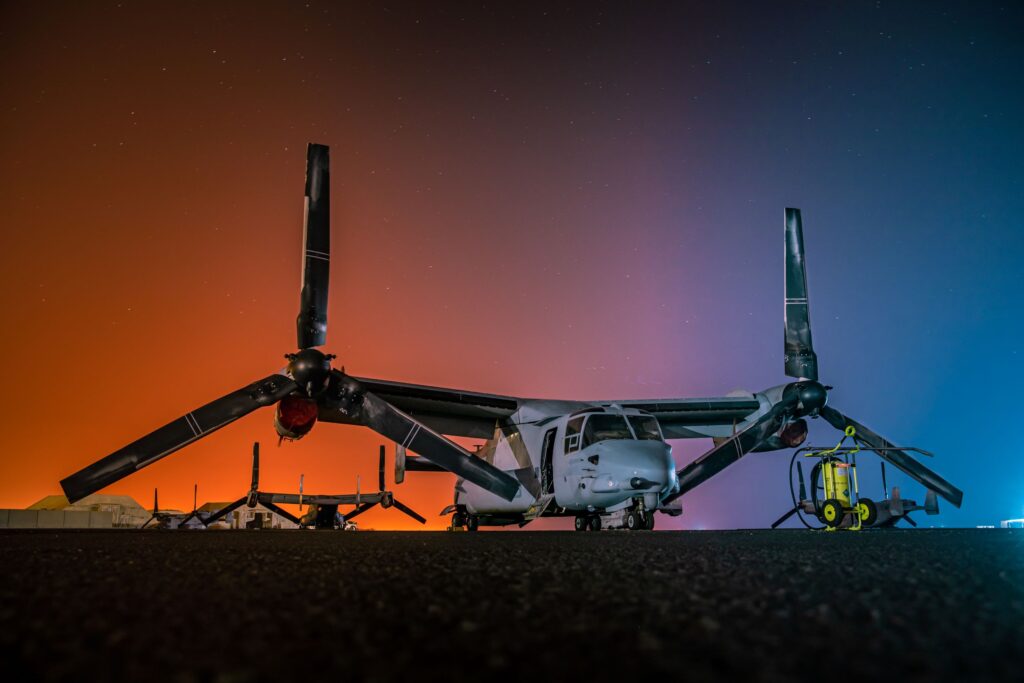
The new fiscal year will mark the sunset on new MV-22 Osprey purchases, according to new budget documents. U.S. MARINE CORPS / Lance Cpl. Andrew Skiver
ARLINGTON, Va. — The Navy plans to procure 96 aircraft in fiscal 2023, down from the 129 aircraft enacted in the fiscal 2022 appropriations law. The numbers are expected to go even lower over the years of the Future Years Defense Program.
The Department of the Navy has requested the following:
15 F-35B Lightning II strike fighters for the Marine Corps
13 F-35C Lightning II strike fighters (9 for the Navy, 4 for the Marine Corps)
5 E-2D Advanced Hawkeye command and control aircraft
5 KC-130J Super Hercules transport/refueling aircraft
Assuming 10-plane squadron strength, the planned F-35C procurement does not even fill one Navy F-35C squadron or half of a Marine Corps F-35C squadron. But F-35C procurement is planned to increase significantly starting in 2024, to 15 per year for the Navy and four per year for the Marine Corp, except for three in 2027.
The Navy — again — is planning on ending F/A-18E/F Super Hornet strike fighter procurement with the 2022 batch of 12 mandated by Congress. It remains to be seen if Congress will again keep procurement of the Super Hornet alive.
As proposed, the new fiscal year would be the last year of procurement of the E-2D and the TH-73A. No more P-8A Poseidon maritime patrol aircraft or MV-22B or CMV-22B Osprey tilt-rotor aircraft are planned.
Procurement of the KC-130J would pause or stop after two are purchased in 2024. The Navy has been hoping to replace its C-130T/KC-130T organic airlift fleet with C-130Js, but that seems far in the future if it happens.
The new fiscal year will be the first for procurement of the MQ-25A as it heads for operational capability in 2025. The 2023 budget also resumes procurement of the MQ-4C after a year gap, and more MQ-9As for the Marine Corps as it fills its unmanned squadrons with the Reaper to support expeditionary advance base operations.
The type aircraft to be procured to replace the T-44C multi-engine training aircraft has yet to be announced, but the 2023 budget plans to procure 10 Multi-Engine Training Systems, with a total of 58 in a three-year run.
The T45TS line in the Navy’s budget graph shows procurement starting in 2025. The term T45TS is familiar as T-45 Training System, of which the Boeing T-45 Goshawk aircraft is the main component. However, Seapower understands this line item to be a surrogate for a yet-to-be solution for the Navy’s need for a T-45C replacement.
New National Defense Strategy Delivered to President
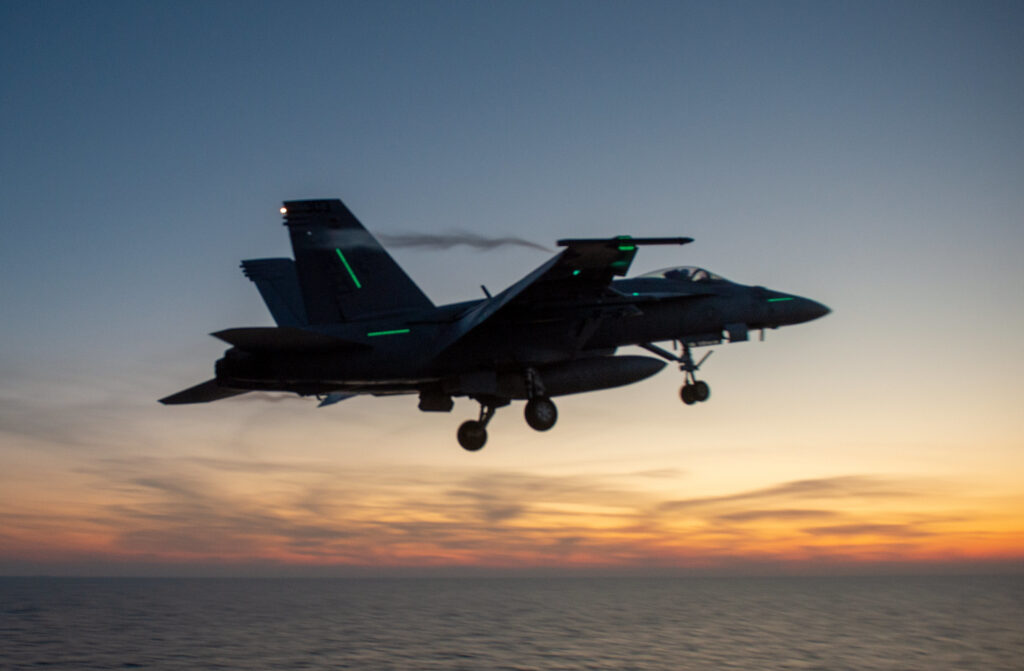
An F/A-18E Super Hornet, attached to the “Blue Blasters” of Strike Fighter Squadron (VFA) 34, launches from the flight deck the Nimitz-class aircraft carrier USS Harry S. Truman (CVN 75), Mar. 25. U.S. NAVY / Mass Communication Specialist 3rd Class Tate Cardinal
ARLINGTON, Va. — The Department of Defense delivered the new 2022 National Defense Strategy to the president March 28, the department said.
The NDS is classified, but DoD released a fact sheet to inform readers until an unclassified version is released.
“For the first time, the department conducted its strategic reviews in a fully integrated way — incorporating the Nuclear Posture Review and Missile Defense Review in the NDS — ensuring tight linkages between our strategy and our resources,” the fact sheet says. The unclassified NDS will be forthcoming.
Consistent with the president’s Interim National Security Strategic Guidance, the classified NDS sets out how the Department of Defense will contribute to advancing and safeguarding vital U.S. national interests. The defense priorities are:
Defending the homeland, paced to the growing multi-domain threat posed by China
Deterring strategic attacks against the United States, allies and partners
Deterring aggression, while being prepared to prevail in conflict when necessary, prioritizing the challenge of China in the Indo-Pacific, then the Russia challenge in Europe
Building a resilient joint force and defense ecosystem.
“The department will act urgently to sustain and strengthen deterrence, with the People’s Republic of China [PRC] as our most consequential strategic competitor and the pacing challenge for the department.
“Russia poses acute threats, as illustrated by its brutal and unprovoked invasion of Ukraine. We will collaborate with our NATO allies and partners to reinforce robust deterrence in the face of Russian aggression.
“The department will remain capable of managing other persistent threats, including those from North Korea, Iran, and violent extremist organizations.
“Changes in global climate and other dangerous transboundary threats, including pandemics, are transforming the context in which the department operates. We will adapt to these challenges, which increasingly place pressure on the joint force and the systems that support it.
“Recognizing growing kinetic and non-kinetic threats to the United States’ homeland from our strategic competitors, the department will take necessary actions to increase resilience — our ability to withstand, fight through, and recover quickly from disruption.
“Mutually beneficial alliances and partnerships are an enduring strength for the United States, and are critical to achieving our objectives, as the unified response to Russia’s further invasion of Ukraine has demonstrated. Answering this ‘call to action,’ the department will incorporate ally and partner perspectives, competencies, and advantages at every stage of defense planning.
“The Department will advance our goals through three primary ways: integrated deterrence, campaigning, and actions that build enduring advantages.
Integrated deterrence entails developing and combining our strengths to maximum effect, by working seamlessly across warfighting domains, theaters, the spectrum of conflict, other instruments of U.S. national power and our unmatched network of alliances and partnerships. Integrated deterrence is enabled by combat-credible forces, backstopped by a safe, secure, and effective nuclear deterrent.
Campaigning will strengthen deterrence and enable us to gain advantages against the full range of competitors’ coercive actions. The United States will operate forces, synchronize broader department efforts, and align department activities with other instruments of national power, to undermine acute forms of competitor coercion, complicate competitors’ military preparations and develop our own warfighting capabilities together with allies and partners.
Building enduring advantages for the future joint force involves undertaking reforms to accelerate force development, getting the technology we need more quickly, and making investments in the extraordinary people of the Department, who remain our most valuable resource.
“The department will develop, design, and manage our forces — linking our operational concepts and capabilities to achieve strategic objectives. This requires a joint force that is lethal, resilient, sustainable, survivable, agile, and responsive.”