HII Celebrates 170 Graduates of The Apprentice School
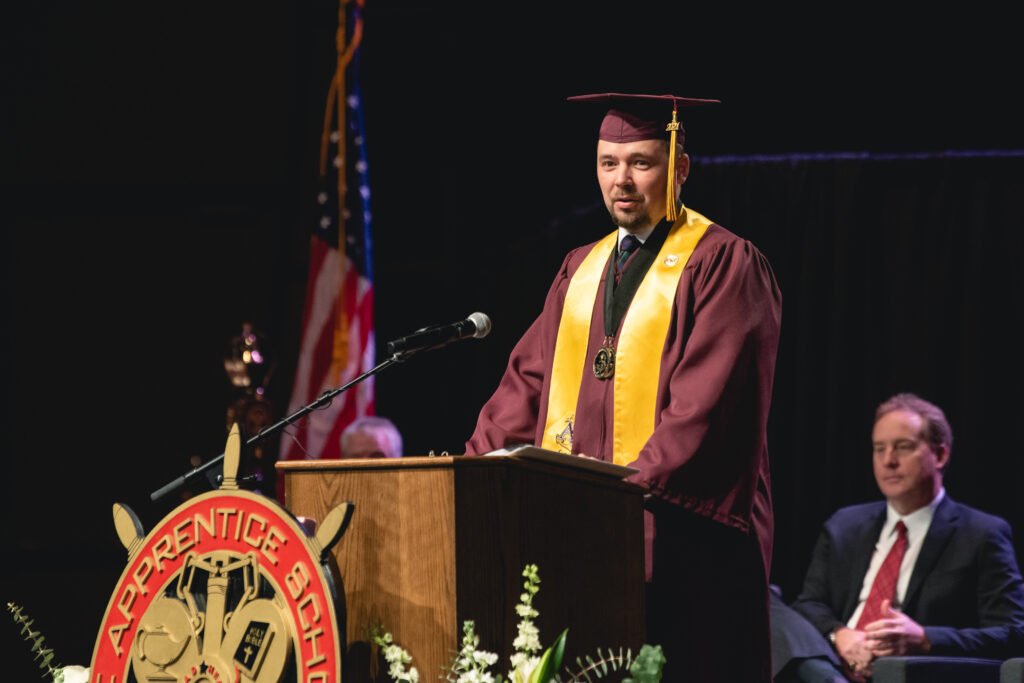
Chris Rose, recipient of the Homer L. Ferguson Award, speaks during the 2022 Apprentice School Commencement ceremony held March 12. HUNTINGTON INGALLS INDUSTRIES
NEWPORT NEWS, Va. — Global engineering and defense technologies provider Huntington Ingalls Industries hosted commencement exercises March 12 for 170 graduates of the company’s Apprentice School at Newport News Shipbuilding, the company said in a release. The ceremony was held at Liberty Live Church in Hampton.
“I want you to know how proud I am of each of you for everything that you’ve accomplished,” said Newport News Shipbuilding President Jennifer Boykin. “Today is just the next step towards your leadership role at Newport News Shipbuilding, and we and our country need you more than ever. As shipbuilders, we take on the truly unique honor of building vessels that protect our country and go into harm’s way.”
The commencement address was delivered by Karen Henneberger, program manager for New Ship Design at Naval Reactors, a joint Department of Energy and Department of Navy program. She told graduates at the heart of The Apprentice School and their development is craftsmanship, leadership and scholarship. During her address she offered a deep Naval Reactors’ perspective on each of these tenets as they relate to the graduates’ current responsibilities at Newport News Shipbuilding, and their impact beyond the shipyard gates.
Like Boykin, Henneberger, emphasized the Navy needs shipbuilders.
“We need shipbuilders more than ever. We need to find ways to put more ships to sea, to maintain our nuclear-powered submarines and aircraft carriers in more efficient ways and to deploy innovative capabilities,” she said.
Speaking next, in Apprentice School tradition, was the apprentice receiving the Homer L. Ferguson Award, which recognizes the graduate with the highest honors. This year it was Christopher S. Rose, a deck electrician who began his career in 2017 at NNS. He has supported a variety of projects in the Virginia-class program, as well as the Nimitz–class and Ford-class programs, and is currently working on USS George Washington (CVN 73).
“Always watch for your step, plan where you are going, and put the journey before the destination,” Rose said. “No matter what you’re doing, the most important step is the next one. Once you know what you need to do, it’s just a matter of logistics.”
As the event closed, Boykin reminded the graduates what they heard at the ceremony.
“Your critical role in the defense of our nation cannot be understated,” she said. “The Navy depends on us to deliver capable, reliable vessels that help keep our sailors safe. And I’m depending on you to bring your skill, your experience, your knowledge and your heart to every challenge that you face. So always do your absolute best. Never settle for good enough and always keep learning. If you do this, I know that our nation’s future will be safer and brighter.”
Coast Guard Cutters Conclude Operation Aiga in Oceania
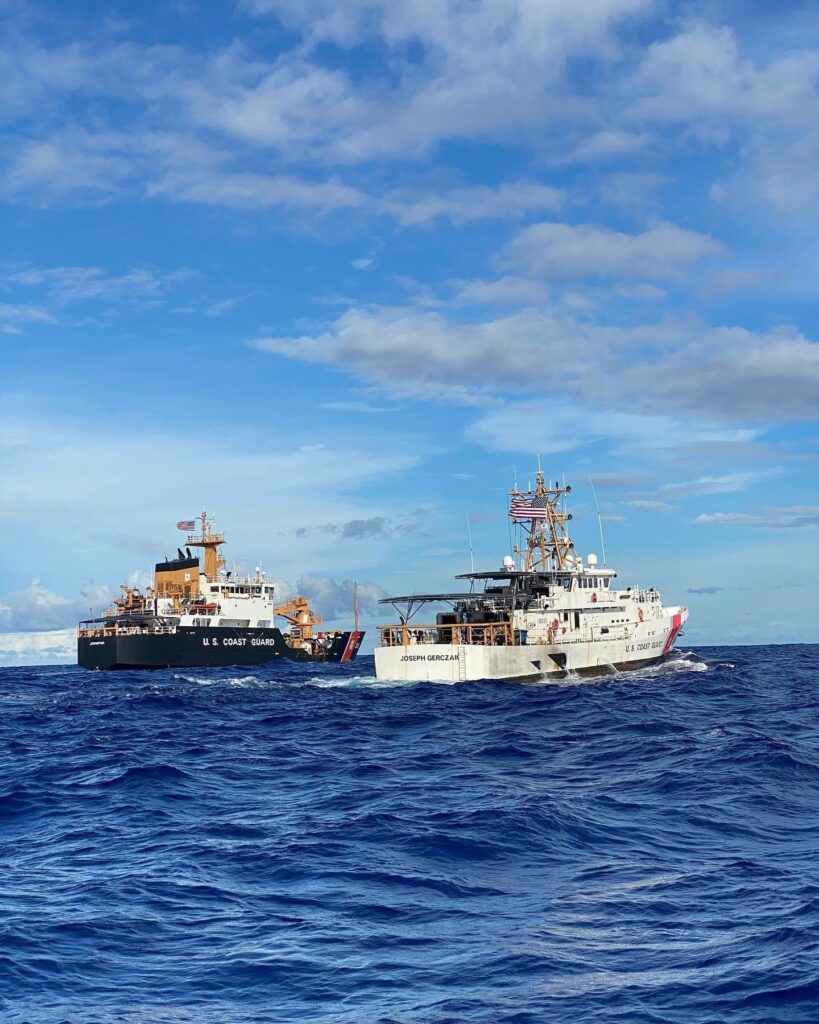
The crews of the Coast Guard Cutters Juniper and Joseph Gerczak return to Honolulu after completing a 42-day patrol in Oceania in support of Operation Aiga, March 7. U.S. COAST GUARD
HONOLULU — The crews of the Coast Guard Cutters Juniper and Joseph Gerczak returned to Honolulu March 7 after completing a 42-day patrol in Oceania in support of Operation Aiga, the Coast Guard 14th District said March 11.
Both crews deployed on a combined 14,000-mile patrol to provide maritime support and patrol coverage for Samoa and American Samoa’s exclusive economic zones as well as conducted joint-training operations with the armed forces in French Polynesia.
Operation Aiga, the Samoan word for family, is designed to integrate Coast Guard capabilities and operations with Pacific Island County partners to effectively and efficiently protect shared international interests, combat illegal, unreported and unregulated fishing and strengthen maritime governance in Oceania.
“The Coast Guard remains committed to combating IUU fishing as fish stocks remain a critical component to maritime sovereignty and resource security for many nations, especially those in the Pacific,” said Cmdr. Jeff Bryant, chief of enforcement for Coast Guard District Fourteen. “The Juniper and Joseph Gerczak were able to establish stability for our partners on the high seas and while patrolling their EEZs in support of Operation Aiga.”
While underway, both cutters conducted hoist training with French Dauphin N3 helicopter crews designed to increase interoperability on the high seas. Additionally, both cutter commanding officers met with Rear Adm. Jean-Matthieu Rey, commander of armed forces in French Polynesia, in Tahiti to discuss the importance of regional maritime security partnerships to maintain a free and open Indo-Pacific.
“We had the privilege to integrate our capabilities and strengthen existing partnerships with the French, while protecting global resources on the high seas and exclusive economic zones of our regional partners,” said Cmdr. Christopher Jasnoch, commanding officer of the Juniper. “I am extremely proud of the crew of Juniper for their hard work preparing for this patrol, resiliency in overcoming the challenges of COVID-19 and their dedication to protecting national interests in Oceania while modeling professional maritime behavior to our partners and competitors.”
Additionally, the Juniper and Joseph Gerczak crews helped fill an operational presence, conducting security patrols in Samoa’s EEZ throughout the month of February to protect fisheries and other natural resources while Samoa’s Nafanua II patrol boat was down.
The Joseph Gerczak made an inaugural visit in Pape’ete, Tahiti, marking the first time a Coast Guard fast response cutter conducted vital port calls on the island.
“Although Coast Guard missions, new cutters, and adventure make serving afloat attractive, the top incentive remains having the opportunity to serve alongside the most talented and humble men and women our country has to offer,” said Lt. Joseph Blinsky, commanding officer of the Joseph Gerczak. “Without the skill and hard work from Joseph Gerczak’s crew, our more than 2,300 NM transit to Tahiti from Honolulu would not have been possible. Coupled with first-class support from District 14, Sector Honolulu, and Juniper, made executing this expeditionary patrol a reality.”
Submarine Program ‘Alive and Well,’ Lawmakers Tell Industry Leaders
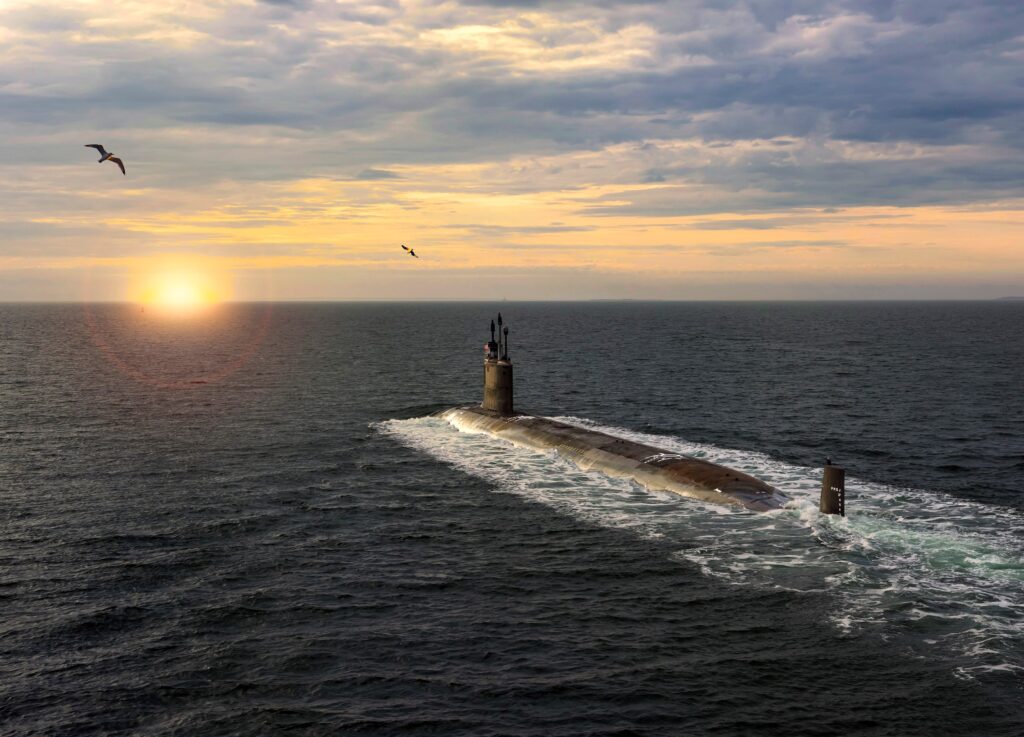
The future USS Oregon (SSN 793) heading out from Groton, Connecticut, on sea trials in December 2021. GENERAL DYNAMICS ELECTRIC BOAT
WASHINGTON, D.C. — Navy new submarine construction is on track, members of the Submarine Industrial Base Council were told by federal lawmakers during a visit to Washington.
Virginia-class submarines and the new Columbia class are moving forward, thanks in part to the efforts of the council, said Rep. Joe Courtney (D-Connecticut), chairman of the House Armed Services Committee’s Seapower and Projection Forces subcommittee and co-chair of the Submarine Caucus.
“The submarine program is alive and well. Your presence here today to make sure that Congress understands that … I think that’s a really big part of why that success is actually happening today,” Courtney said. “If you look at the momentum, in terms of both full funding for two per year for Virginia, and the eye-watering progress with Columbia.”
Courtney, whose district includes the General Dynamics Electric Boat Shipyard in Groton, Connecticut, acknowledged the progress with the fiscal year 2022 defense budget, which is going to show a 6% increase in spending. Courtney said the broad, bipartisan support the Columbia program enjoys is evident because its funding was exempted from the effects of the continuing resolution, which freezes spending at previous-year levels.
Courtney talked about the importance of maintaining a high-tempo submarine production rate, possibly going even higher. He mentioned the aspirational goal of three Virginia-class Block V submarines per year, which his committee approved.
AUKUS Opportunity
In addition to U.S. submarine programs, Courtney said the Australia-U.S.-U.K nuclear submarine program called AUKUS will also provide opportunities for American companies. By law, sharing nuclear technology with other nations must be approved by Congress, something that was done for the United Kingdom in 1958, and will be required for Australia — Courtney said he’s confident that will happen.
AUKUS will be a huge program and a boon to Australia’s industrial base, he said. But Courtney, who also chairs the Friends of Australia Caucus, said some of that capability and capacity will need to be provided here in the U.S.
“Australia is an incredible ally. But it isn’t reasonable to expect that a country of 30 million people can do it all by themselves. The spirit is there, but it’s probably a reach that they just can’t get to with their own indigenous workforce,” he said.
While the technicalities of an agreement with Australia need to be worked out, Courtney said it is his personal opinion that Australian naval officers should already be training at the Nuclear Power School in Charleston, South Carolina.
“They have good submariners, but they’re obviously familiar with diesel electrics, and they need to start getting people over to South Carolina and connected with the system,” he said. “You can’t just snap your fingers and have nuclear trained submariners.”
Courtney talked about major investments in infrastructure at Electric Boat’s shipyard in Groton and facility in Quonset Point, Rhode Island, as well as Huntington Ingalls Newport News Shipbuilding, where work is being performed on the Virginia and Columbia classes.
Courtney said he takes a keen interest in workforce development nor only because of the necessity of having a trained employment base to support submarine construction, but also because he’s on the education and labor committee. He said the current omnibus spending package will include 30% more funding for registered apprenticeships, which can support defense companies, as well as workforce development money in the defense budget on top of that.
“We’re also slated to update the large federal job training plan called the Workforce Investment Opportunity Act, WIOA. It’s a five-year reauthorization process that’s coming up this year and will support pre-apprenticeship programs,” he said. “Giving young people a pathway to a skill and a job is almost existential for our economy right now.”
Courtney said that some of the new shipyard structures literally change the local skyline. “It’s just unbelievable what’s happening. But the fact is, we need more, in my opinion.”
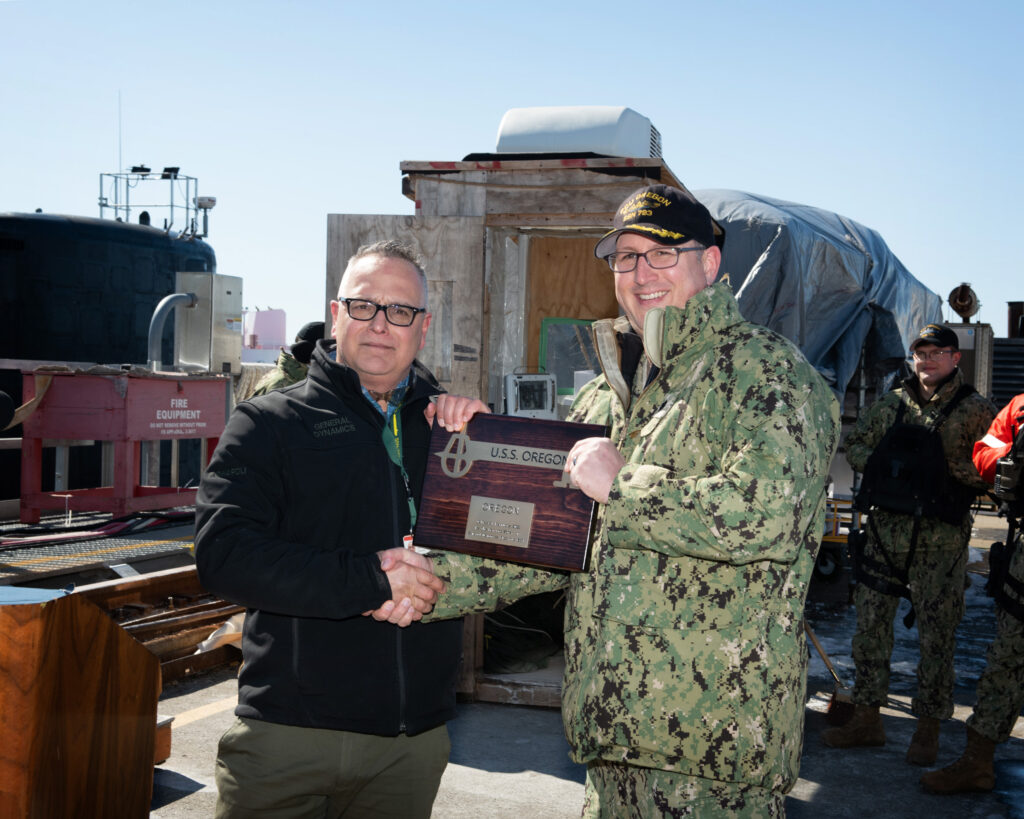
General Dynamics Electric Boat delivered the nuclear-powered attack submarine Oregon (SSN 793) to the U.S. Navy on Feb. 26. GENERAL DYNAMICS ELECTRIC BOAT
Budget Issues
Rep. Elaine Luria (D-Virginia), vice chair of the House Armed Services Committee and the Seapower and Projection Forces and Readiness subcommittees, said bureaucratic and legislative foot-dragging is having an impact on getting the defense budget completed.
Luria represents the Hampton Roads area, which conducts 25% of the shipbuilding and repair in the United States.
“It’s 42% of our local economy,” she said. “So, we’ve got to get this defense bill passed.”
She talked about hearing consistent testimony from Navy leadership about the threat, particularly from China in the Indo-Pacific region.
“In order to confront that threat, we need to grow our Navy, and the place we maintain that strategic advantage is our submarine fleet,” she said. “But the budget we got wanted to decommission more ships than we proposed to build.”
The Navy proposed decommissioning seven Ticonderoga class cruisers, which Luria said represents the loss of more than 400 vertical launch system cells that can fire Tomahawk land attack missiles.
“In an environment where we are confronting a rising and increasingly aggressive China, it made absolutely no sense,” she said.
Luria reiterated Courtney’s comments on the Columbia-class ballistic missile submarine to replace the aging Ohio-class fleet.
“We all understand that the Columbia-class submarine is the cornerstone of our national defense. As we sit today, we see the importance of that capability with the other events that are happening in the world. And we have to keep the Columbia class program on track. It’s absolutely essential.”
Luria also followed up on Courtney’s remarks about the AUKUS nuclear submarine program.
“It’s a huge opportunity. It’s also a huge risk. If you think about it, it’s a huge message to the Chinese. It’s a message to the Chinese that we are collaborating with Australia — that the U.S., Britain and Australia are cooperating, we’re building nuclear submarines, and we’re going to have this presence in the Pacific.”
Luria told the industry representatives they will be part of that effort to develop the plan and deliver support to Australia to build those submarines. The risk lies in the size of the project, she said.
“As you know, there is not the infrastructure, the training or the industrial base within Australia to just start from scratch and build a nuclear submarine program akin to what either we or the British have,” she said.
Although the U.S. is investing in infrastructure upgrades, including shipyards, Luria said the nation needs to make more investments in its public yards. She cited issues with the Norfolk Naval Shipyard where the drydocks are old and rising sea levels are affecting ship maintenance.
“The infrastructure there needs to really be brought up into the 21st century,” Luria said.
Asked about the Navy’s long-term shipbuilding plans, Luria said the service’s 30-year shipbuilding plan is usually obsolete by year five. The plan needs to be more compelling, she said.
“We need maritime strategy that lays out why we need a Navy, and this is where we need the Navy to be and be deployed,” she said.
China Deterrent
Rep. Mike Rogers (R-Alabama), the ranking Republican on the House Armed Services Committee, told the attendees about the importance of the Indo-Pacific region and the need for the nation to build a modern, credible deterrence to counter ongoing Chinese aggression.
“Effective military strength in the Indo-Pacific is essential to the security of our allies, global trade and democracy,” he said. “The strength of our Navy is central to that effort.”
Rogers said China is rapidly growing and modernizing its navy.
“Our fleet of 296 ships has already been eclipsed by the Chinese fleet of 350 ships and submarines. China is no longer far off threat; they are a pacing threat,” he said. “China is rapidly modernizing its navy, and building a fleet to project power far beyond the South China Sea. By the end of this decade, China could equal our numbers of ballistic missile submarines and have a substantial fleet of attack submarines.”
Rogers said the U.S. “must recapitalize our submarine fleet to maintain our strategic advantage, and we should be expanding and modernizing our naval capabilities.”
Unfortunately, he said, the Navy’s shipbuilding budget doesn’t come close to meeting the strategic requirements. He agrees with the assessments that the Navy needs 500 ships, both manned and unmanned vessels.
“This includes increasing our attack submarine fleet from 49 to 66, and building a ballistic missile fleet of at least 12,” he said. “Our attack submarine fleet will be on the front lines in any conflict that we have with China.
“We need to expand our industrial base to support three attack submarines per year,” Rogers said. “Doing that with multi-year construction contracts will save money and deliver the capability we need quicker. We’ve got to also fully fund the Columbia class. Columbia class is going to cost over $110 billion — and that’s a lot of money — but they are a central part of our [nuclear] triad.”
“We need this administration to publicly commit to rapidly expanding our submarine and surface fleet,” Rogers said. “And we need to see that reflected in the shipbuilding plan.”
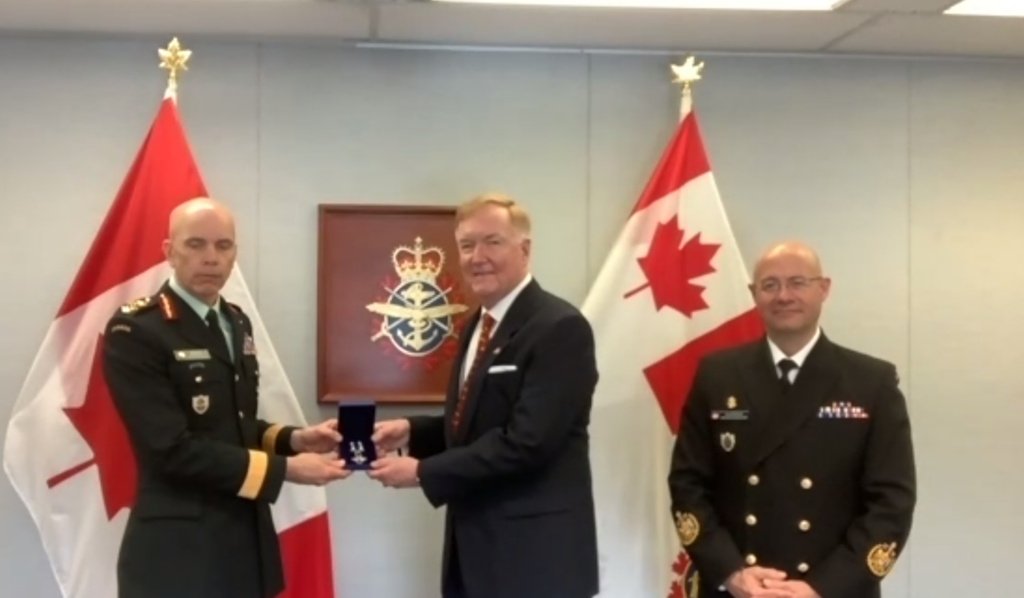
Center for Maritime Strategy Dean Foggo Accepts Canadian Meritorious Service Cross
Foggo, center, accepts the Meritorious Service Cross from the Canadian Department of National Defence.
OTTAWA, Canada — Retired four-star Navy Adm. Jamie Foggo, dean of the new Center for Maritime Strategy at the Navy League of the United States, accepted the Meritorious Service Cross from the Canadian Department of National Defence on May 11 for his work with NATO.
Foggo’s last active duty assignment included three commands with a span of control over U. S. Navy maritime and Joint NATO Forces in Europe, Africa and the Middle East.
Created by Queen Elizabeth II, Meritorious Service Decorations are an important part of the Canadian Honours System and highlight remarkable achievements accomplished over a limited period of time. Foggo was awarded the cross in 2020 for his work in planning a critical component of Canada’s commitment to NATO, and was presented it March 11 after speaking at the Ottawa Conference on Security and Defence.
During a ceremony, Foggo noted he “grew up in a Canadian forces family,” as his father and grandfather both served in Canada’s military. During his years working with NATO, Foggo noted, “Canadians were by my side.”
Foggo has been presented numerous other awards, including the Distinguished Service Medal, Defense Superior Service Medal, Legion of Merit and NATO Meritorious Service Medal. In addition, he is the recipient of the French Chevalier de l’Ordre National de Merité and the Legion d’Honneur, the Cross of Saint George (Portugal), the White Cross of the Naval Order of the Spanish Armada, the rank of Commendatore from the President of Italy and Knight of the Grand Cross of Kingdom of Two Sicilies.
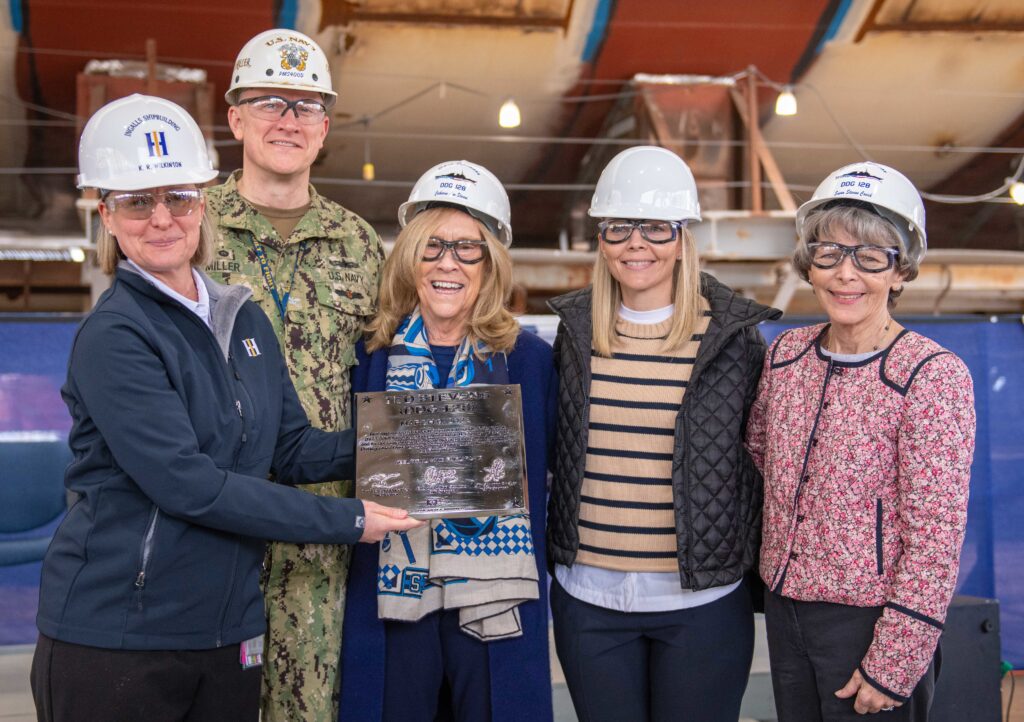
Keel Authenticated for Future Destroyer USS Ted Stevens
Ship sponsors Catherine Ann Stevens, Susan Stevens Covich and Lily Stevens Becker, Ingalls Shipbuilding President Kari Wilkinson and Capt. Seth Miller, DDG 51 class program manager, Program Executive Office Ships, at the rear, pose with the keel plate of the future USS Ted Stevens. HUNTINGTON INGALLS INDUSTRIES.
WASHINGTON — The keel of future USS Ted Stevens (DDG 128), the 78th Arleigh Burke-class guided-missile destroyer, was ceremonially laid at Huntington Ingalls Industries Ingalls Shipbuilding, March 9, Team Ships Public Affairs said in a release.
The ship is named for the late Sen. Ted Stevens from Alaska. Stevens was the longest-serving Republican U.S. senator in history at the time he left office and was the third senator to hold the title of president pro tempore emeritus. He was the president pro tempore of the United States Senate in the 108th and 109th Congresses.
The contemporary keel laying ceremony represents the joining together of a ship’s modular components at the land level. The keel is authenticated with the ship sponsors’ initials etched into a ceremonial keel plate as part of the ceremony. Sponsors of DDG 128 are Catherine Stevens, wife of the ship’s namesake, and Susan Stevens Covich and Lily Stevens Becker, daughters of the namesake.
“The Flight III upgrade fulfills a critical need for the Navy. Flight III ships like the future USS Ted Stevens will serve as a deterrent to our adversaries using the ship’s increased power projection capability as a result of the upgraded Aegis Combat System and Air and Missile Defense Radar,” said Capt. Seth Miller, DDG 51 class program manager, Program Executive Office Ships. “We are honored to have the Stevens family with us today as we mark this important milestone in building the Navy’s and the nation’s next great warship.”
The DDG 51 Flight III upgrade is centered on the AN/SPY-6(V)1 Air and Missile Defense Radar and incorporates upgrades to the electrical power and cooling capacity plus additional associated changes to provide greatly enhanced warfighting capability to the fleet. Flight III is the latest flight upgrade in the more than 30-year history of the class, building on the proud legacy of Flight I, II and IIA ships before it.
HII’s Ingalls Shipbuilding is also in production on the future USS Lenah Sutcliffe Higbee (DDG 123), USS Jack H. Lucas (DDG 125), USS Jeremiah Denton (DDG 129), and USS George M. Neal (DDG 131).
Russian Air Defenses Working Well When Operated by Ukrainians, ACC Chief Says
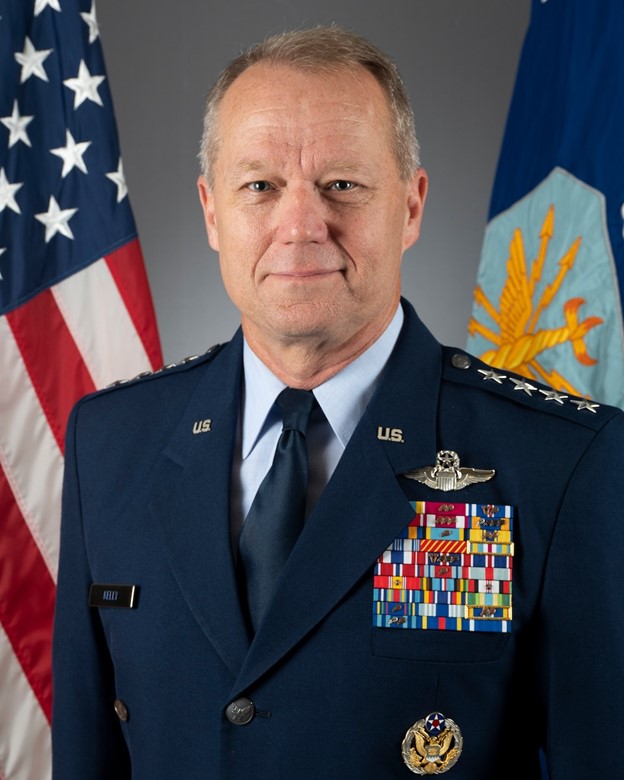
Air Force Gen. Mark D. Kelly, commander, Air Combat Command. U.S. AIR FORCE
WASHINGTON — Air Force Gen. Mark D. Kelly, who leads Air Combat Command, was asked about the capabilities of Russia’s air defense systems since the beginning of Russia’s invasion of Ukraine.
“They’re operating pretty well when they’re operated by Ukrainians,” he said.
Kelly was one of the presenters at the McAleese & Associates conference in Washington on Wednesday, March 9. Generally speaking, Kelly said Russia does not have an air base defense challenge.
“They operate on layer upon layer upon layer of S-300 and S-400 (anti-air missiles), as well as SA-23s, etcetera,” he said.
Some of these systems are operated by Ukraine. According to Kelly, “The Russian air defense units, operated by the Ukrainians, they’re pretty capable systems.”
In the current war, Kelly acknowledged Russia has faced logistics and moral challenges. Furthermore, they are not used to operating without complete air dominance.
“The Russian air force has not adapted agile combat employment for a couple of reasons. One, in my opinion they’re not capable of doing it; and two, they don’t need to,” Kelly said. “They can operate pretty safe from their main air bases with that layer of defense over them.”
“The Russians themselves, I think — and ‘think’ is a key word — they’re struggling with fighting Russian systems and they’re not adhering to Russian doctrine. And we see the challenge that they have. But we also see the challenge of what happens your joint force is organized, trained, equipped to operate with air superiority, and not remotely designed operate without air superiority, what happens when you don’t have it,” he said.
In the Q&A after his remarks, Kelly commented on the value of the F-35 Joint Strike Fighter, even after all of its weapons have been expended.
Kelly said the F-35 can do significant amount of sensing, including the ground moving target indicator capability inherent to the aircraft.
“Very often, in big ‘Red Flag’ exercises, [the F-35] will expend all its weapons, and where traditionally we would go home once we’d expended all of our weapons, the information that it puts out to the rest of the joint force is so valuable, and with its air sensing ground sensing and data linking, they like to keep it out there to contribute to the rest of the joint force,” he said.
Cost of Critical Metals for Submarine Construction Climbs During Ukraine Crisis
The Bystrinsky Mining and Concentration Plant is the largest greenfield project in the Russian metals industry. WIKIPEDIA / Andrey Kuzmin
WASHINGTON, D.C. — The availability of raw materials and components was a topic of conversation at yesterday’s Submarine Industrial Base Council congressional breakfast in Washington, D.C.
Attendees noted the pandemic’s impact on the supply chain has made just-in-time deliveries virtually impossible. In the case of specialty steel companies, the availability and prices of raw material such as nickel, especially critical for the high-quality steel used in submarine construction, has been particularly troublesome.
The London Metals Exchange, one of the oldest commodity exchanges, had to suspend trading of nickel because of heavy activity and the concern over Russia’s invasion of Ukraine. Nickel is a critical ingredient in heavy-duty vehicle batteries, stainless steel and other alloys and is vital to many defense-industry products.
Nickel is already in short supply, with inventories available on the LME being reduced by half since October. LME nickel prices more than doubled on Tuesday, March 8, to more than $100,000 per ton. The market panic caused the LME to temporarily stop posting prices for the mineral. Other exchanges have experienced similar activity.
Russia is a major supplier of nickel — about 10% of global output — and Russian company Nordickel is the world’s largest supplier of battery-grade nickel, providing 5%-20% of the world’s supply.
Prices on other commodities like copper, tin, lead and zinc are also higher this week
LME hopes to reopen trading on nickel soon. LME’s website currently states that the exchange has “been continuing to work on the evolving nickel situation, with the intention of ensuring it is able to reopen the market, with trading continuing in an orderly manner, in an appropriate timeframe.”
“The current events are unprecedented,” the LME said in a notice to members.
CNO Gilday Announces Next Master Chief Petty Officer of the Navy
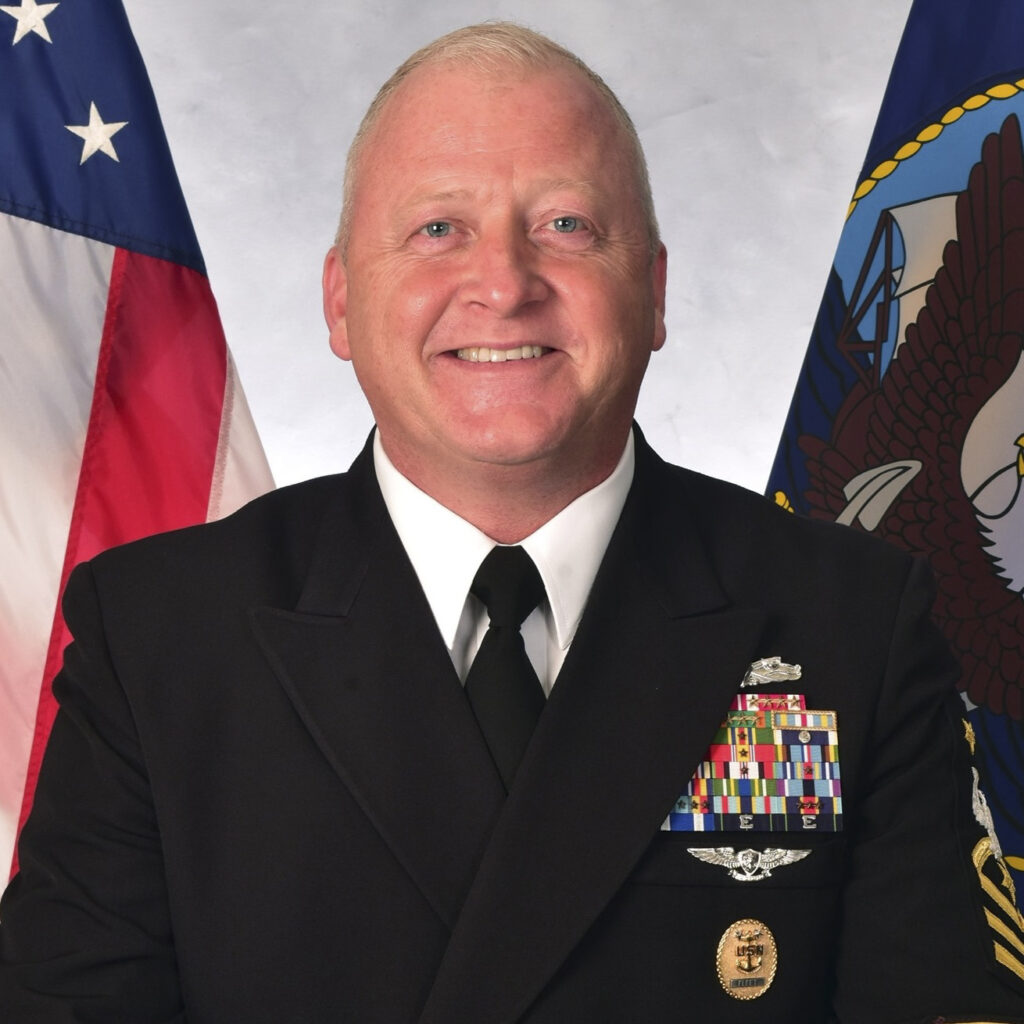
Fleet Master Chief James Honea, selected to be the 16th Master Chief Petty Officer of the Navy. U.S. NAVY
WASHINGTON — Chief of Naval Operations Adm. Mike Gilday announced his selection for the 16th Master Chief Petty Officer of the Navy, during the Navy Flag Officer & Senior Executive Service symposium at the United States Naval Academy on March 10, CNO’s Public Affairs office said in a release.
Fleet Master Chief James Honea, U.S. Indo-Pacific Command senior enlisted leader, will assume responsibilities from MCPON Russell Smith during a change of office ceremony scheduled for Sept. 8.
“I selected Fleet Master Chief Honea because he has saltwater in his veins, embodies Navy values in every fiber of his being, and is the right leader to inspire and motivate our Chiefs Mess to continue to be the best in the world,” said Gilday. “I know he and I will work together to take care of our Sailors and ensure our Navy is the most formidable across the globe.”
Honea was selected based on career performance, progression and his experience leading Sailors. According to Gilday, he is the most capable person to advocate on behalf of Sailors, the fleet, and their families.
During this time of strategic competition, Honea’s fleet experience, which spans nearly every area of responsibility, will help our people to maintain our competitive advantage.
Honea enlisted in 1987 and rose through the ranks as a Boatswain’s Mate, serving at sea aboard USS Juneau (LPD 10), USS Dubuque (LPD 8), and USS Bonhomme Richard (LHD 6). His command master chief tours include USS Gridley (DDG 1010), USS New Orleans (LPD 18), Naval Support Activity South Potomac and U.S. Naval Forces South Korea. Most recently he served as fleet master chief of U.S. Pacific Fleet.
Smith assumed duties as the 15th MCPON on August 29, 2018.
HII Appoints Dorsey as VP of Operations at Ingalls Shipbuilding
Donny Dorsey, the new vice president of operations at Huntington Ingalls Industries’ Ingalls Shipbuilding. HII
PASCAGOULA, Miss. — Global engineering and defense technologies provider Huntington Ingalls Industries has appointed Donny Dorsey as vice president of operations at HII’s Ingalls Shipbuilding division, the company said March 10.
Dorsey, formerly ship program manager for all DDG waterfront efforts at Ingalls Shipbuilding, replaces George Jones, who will retire April 1 after 37 years of service.
“George’s expertise in shipbuilding has influenced generations of shipbuilders and the capabilities of the shipyard,” said Kari Wilkinson, president of Ingalls Shipbuilding. “We are grateful for his focus on execution excellence and for shaping our ‘shipyard of the future.’ Thank you, George. As we move forward, I am confident that Donny will continue the Ingalls legacy of strong execution and will focus on strategic innovation and transformation as we look to the future.”
In Dorsey’s new position, he will oversee all manufacturing operations through delivery, across all Ingalls Shipbuilding programs. He will also be responsible for working collaboratively with union partners, cost and schedule performance, process improvements and driving production strategies.
Dorsey joined Ingalls Shipbuilding in 2000 as a robotic operations technician and spent a portion of his career focused on the Gulfport composite operations for LPD/DDG 1000 serving as quality manager, operations director and then site director. Most recently, Dorsey served in program management with a focus on the DDG 51 class where he and his team managed the installation, test and activation of multiple complex ship systems.
He holds a bachelor’s degree in management from Nicholls State University, an MBA in project management from Capella University and is a graduate of the Gulf Coast Business Council’s Masters Leadership Program.
Aquilino: Fuel Logistics to Be Dispersed in Wake of Red Hill Closure
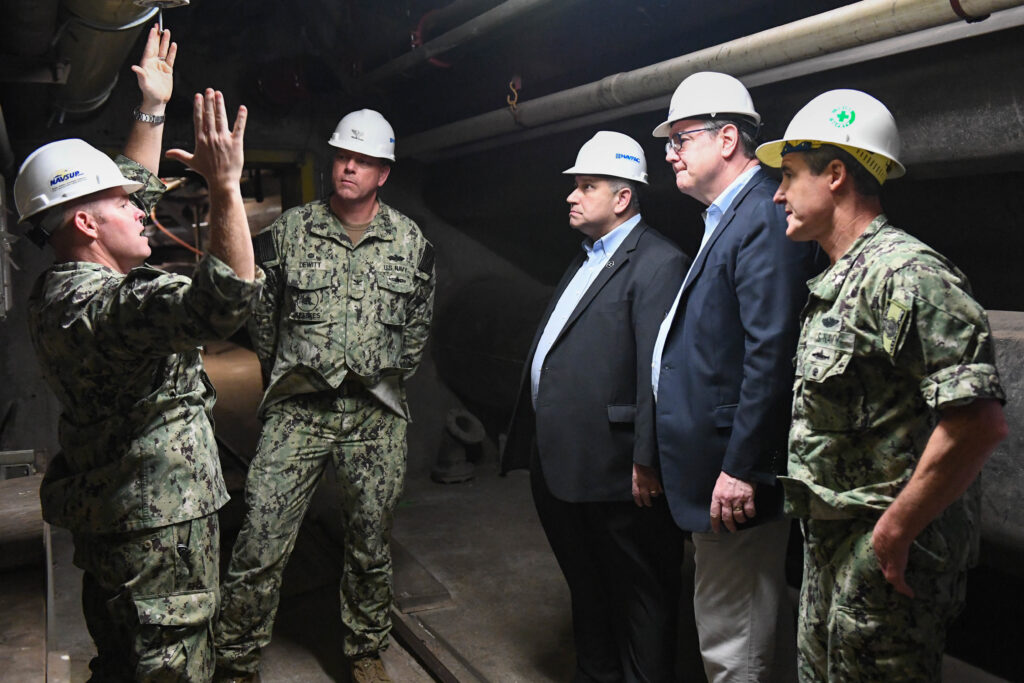
Secretary of the Navy Carlos Del Toro and General Counsel, Department of the Navy John P. “Sean” Coffey receive a brief on well operation and recovery initiatives from Capt. Burt Hornyak, commanding officer, Fleet Logistics Center Pearl Harbor during a tour of the Red Hill Well in Aiea, Hawaii, in February. U.S. NAVY / Mass Communication Specialist 2nd Class Chelsea D. Meiller
WASHINGTON — The commander of U.S. forces in the Indo-Pacific region addressed concerns from Congress about the impact of the closure of the Red Hill fuel depot in Hawaii during March 9 testimony on Capitol Hill.
Rep. Mike Rogers, ranking member of the House Armed Services Committee, said in his opening remarks that Navy Secretary Carlos Del Toro’s decision to close Red Hill was made “without laying out the resources to replace that capacity. That’s extremely short-sighted. The response from the department has been the same: the answer is just one policy announcement away. And that’s unacceptable.”
Rogers told Adm. John C. Aquilino, commander, U.S. Indo-Pacific Command, that “he wanted to hear how Indo-Pacific Command will implement new operational concepts and new systems to ensure that logistics support at new operating locations throughout the Indo-Pacific.
“But most importantly, I want to know how you intend to do that in the next five years,” Rogers said. “We all know China is not going to give us 10 to 20 years to prepare for conflict. We simply cannot procrastinate any further. The issue like Red Hill presents an opportunity to modernize beyond the World War II logistics model. But I’m deeply worried about the cycle of indecision and procrastination at the Pentagon.”
Aquilino said that as senior leadership looked at options with regard to Red Hill, three criteria had to be met: clean water for the people of Hawaii, service members and their families; meeting the war plan and warfighting requirements; and cost.
“We developed a plan that actually goes in alignment with a more distributed plan — both forward- and land-based — combined with a sea-based component to allow for a more distributed, survivable, resilient network of fuels, as well as meeting all of the security and the strategic fuel reserve requirements,” the admiral said. “I actually think that we’re going to be in a better place, and we meet all three requirements.”
Aquilino said the Department of Defense, the Environmental Protection Agency and the Hawaii Department of Health are working together toward a solution.
“We will go as fast as safe allows,” he said. “We have to make sure the facility is safe, to transfer that fuel into places that we’re going to end it, but we’re certainly not waiting. As soon as we can get it done, we’ll be ready to move, and as soon as we’re able to contract some of those other facilities, as well as the sea-based option.”
The Defense Department had announced the Red Hill facility would be closed within the year.
“That just allows us to be able to distribute that fuel with the contract requirements, the sea-based requirements, and the need to put it in the correct spots,” Aquilino said.