Marine Crew Ejects from F/A-18D Before Crash on Plantation
An F/A-18D Hornet from Marine All-Weather Fighter Attack Squadron (VMFA) 533 conducts air operations and maritime surface warfare training with the guided-missile cruiser USS Monterey (CG 61), not pictured, in 2016. U.S. NAVY / Mass Communication Specialist 2nd Class William Jenkins
ARLINGTON, Va. — A Marine Corps F/A-18D Hornet strike fighter crashed shortly near Beaufort, South Carolina on March 3, according to the 2nd Marine Aircraft Wing.
The two Marines in the crew ejected safely and incurred no injuries, the Wing said in a release, which said the crash occurred approximately 3:15 p.m.
“The aircraft crashed in an unpopulated area near Marine Corps Air Station Beaufort, South Carolina, and there was no damage to civilian property,” the Wing said.
According to television station WJCL, the Hornet crashed on the Coosaw Plantation owned by former South Carolina governor Mark Sanford.
The Hornet, assigned to the Hawks of Marine All-Weather Fighter Attack Squadron 533 (VMFA(AW)-533), a unit of Marine Aircraft Group 31. The squadron is one of four Hornet squadrons based at MCAS Beaufort.
The cause of the mishap will be investigated.
The 3rd Marines Come in First, As the First Marine Littoral Regiment
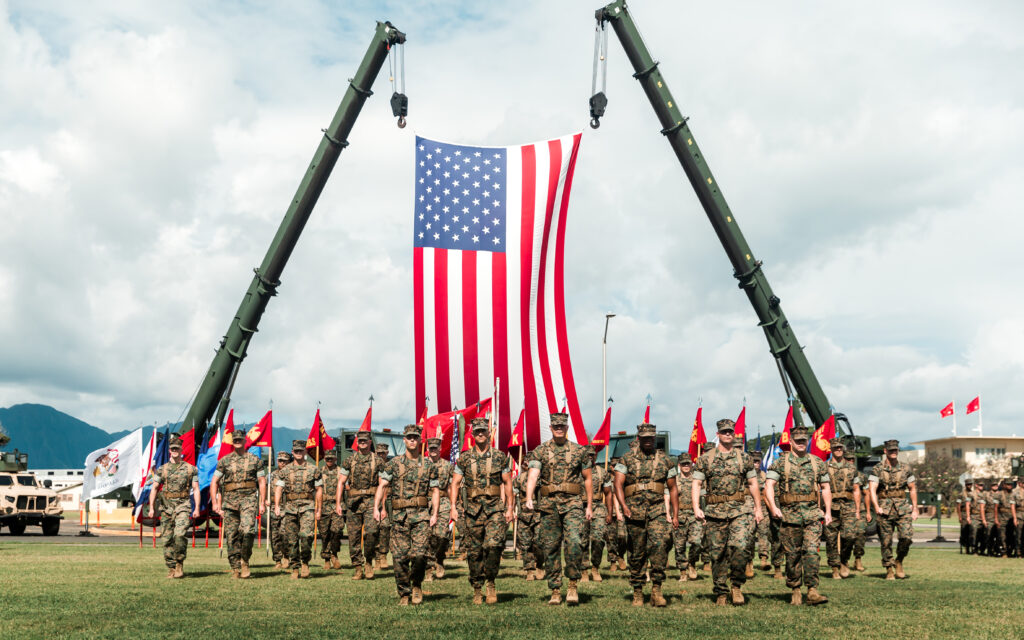
U.S. Marines with 3d Marine Littoral Regiment, 3d Marine Division march during the re-designation ceremony of 3d Marines to 3d MLR aboard Marine Corps Base Hawaii, March 3. U.S. MARINE CORPS / Cpl. Patrick King
ARLINGTON, Va. — The U.S. Marine Corps has taken another step in its ambitious force redesign to contend with near-peer militaries like China and Russia in the 21st century: Creating the first Marine Littoral Regiment.
After more than a year of planning, the 3rd Marine Regiment was redesignated the 3rd Marine Littoral Regiment in a ceremony at Marine Corps Base Hawaii, where the new regiment will continue to be headquartered.
While the 3rd MLR is not expected to be fully operationally capable for at least a year, its establishment demonstrates progress in the Marine Corps’ Force Design 2030 modernization effort, a key priority of Marine Corps Commandant David Berger’s 38th Commandant’s Planning Guidance.
“Marines on the leading edge of change is nothing new,” Maj. Gen. Jay Bargeron, commanding general of 3rd Marine Division, told attendees at the May 3 ceremony. “We are honing our capabilities to integrate and coordinate joint and combined fires and effects, extending the reach of and providing more options to our forces.”
The Marines’ evolving Expeditionary Advanced Base Operations concept envisions littoral operations by specialized mobile, low signature units within larger distributed maritime operations areas.
Marine Littoral Regiments will be uniquely designed to maneuver and persist inside a contested maritime environment. The MLR is organized, trained and equipped to support sea control and sea denial operations as part of a larger naval expeditionary force integrated with the joint force and allied and partnered forces.
Equipped with rockets, missiles and other long range fires, as well as sensors like the Ground/Air Task Oriented Radar, the MQ-9A Reaper unmanned aerial vehicle for extended range intelligence, surveillance and reconnaissance, long-range unmanned surface vessels and light amphibious warships to increase mobility in the littorals, EABO units will control access to choke points while limiting an adversary’s ability to target them.
The Marine Corps’ second in command, Assistant Commandant Gen. Eric Smith, also attended the re-designation ceremony. Before leaving Washington for Hawaii, Smith told a Feb. 28 reporters’ roundtable the Marines are “equipping, training and organizing [the MLRs] so they’re able to deploy tonight — and I mean tonight — to do what they need to do.”
The new MLR will be divided into three elements: a littoral combat team made up of a one infantry battalion equipped with a ship-killing missile battery, an anti-aircraft battalion and a combat logistics battalion. Unlike traditional Marine regiments that deployed with three large battalions, the new MLR will operate with much smaller groups, between 75 and 100 Marines, Smith said.
Plans call for two more infantry regiments, the 4th and 12th Marines to be converted to MLRs by 2030, but Smith told reporters the process could take longer than the 3rd MLR’s conversion did based on lessons learned going forward.
SCO Transfers Overlord Unmanned Surface Vessels to U.S. Navy
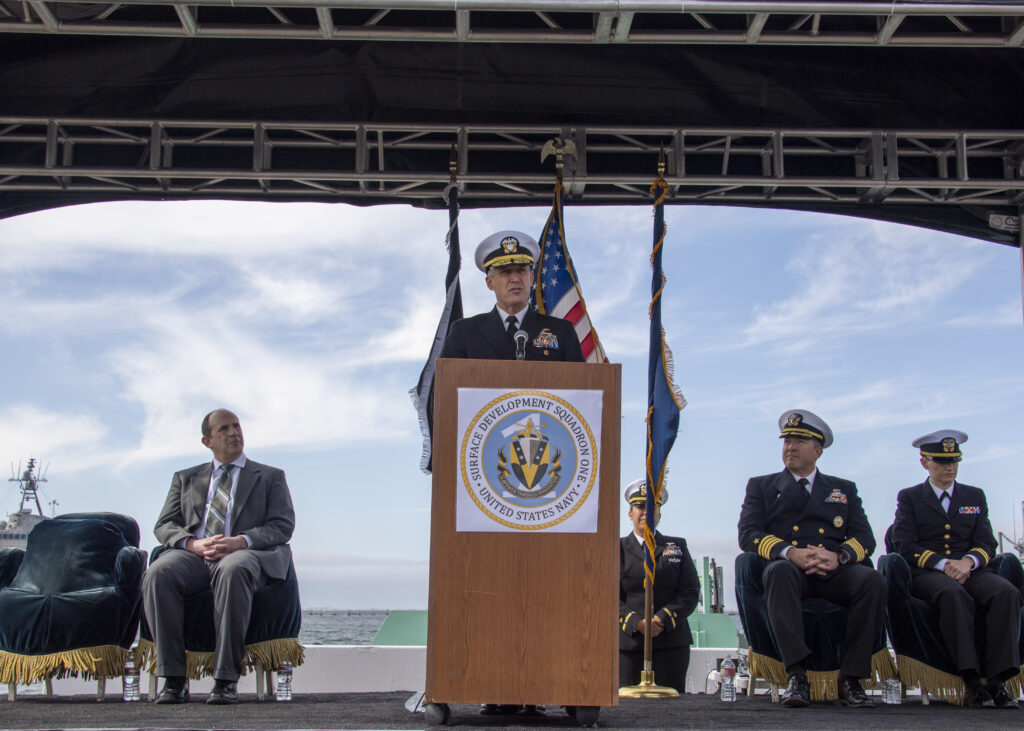
Vice Adm. Stephen Koehler, Commander, U.S. 3rd Fleet, gives remarks during the Ghost Fleet Overlord Transition Ceremony on Naval Base San Diego. U.S. NAVY / Mass Communication Specialist 2nd Class Kevin C. Leitner
SAN DIEGO — The Defense Department’s Strategic Capabilities Office officially transitioned the Ghost Fleet Overlord Program to the Navy Program Executive Office, Unmanned and Small Combatants during a ceremony at Naval Base San Diego on March 3, 2022, the PEO’s public affairs office said in a release.
Navy Vice Adm. Stephen T. Koehler, commander, U.S. 3rd Fleet, was the keynote speaker.
“The future of our fleet is a formidable manned and unmanned team,” said Koehler. “Where unmanned systems work in concert with, and enable enhanced capability of manned platforms; driving to an even more distributed and more lethal force.”
SCO initiated the Ghost Fleet Overlord Program in 2018 to accelerate the Navy’s adoption of unmanned and autonomous systems.
In partnership with the Navy, the objective of SCO’s Overlord Program was to convert large, commercially available vessels to autonomous operation. Designers installed perception and autonomy systems, automated and improved ship system reliability for extended missions and developed the command control and communications architecture.
“The Strategic Capabilities Office partnered with the Navy, Unmanned Maritime Systems [PMS 406] specifically, from the beginning of the Ghost Fleet Overlord Program,” said Jay Dryer, director, Strategic Capabilities Office. “At transition, this enables PMS 406 and the larger team of operators, warfare centers and industry to not miss a beat, continue advancing this technology, and provide a real capability sooner. This is what SCO does best: Integrate mature technologies to accelerate service priorities and create new capabilities for the warfighter.”
The program’s objective was achieved through long endurance transits and participation in fleet exercises. The fleet exercises demonstrated the feasibility of unmanned surface vessels. Specifically, the ability to host and employ modular payloads through a realistic set of concepts of operations.
SCO was well positioned to mature unmanned systems using Other Transaction Authority agreements with industry-led development teams given the increasing commercial use of autonomous technology.
SCO developed two prototype surface vessels to serve as test beds for the Navy’s Medium and Large Unmanned Surface Vessel programs of record.
During the program, Overlord USV Prototypes 1 (Nomad) and 2 (Ranger) took part in multiple fleet level exercises and demonstrations, traveled 28,982 nautical miles in autonomous mode and tested numerous payloads.
The advances achieved in autonomy, communications and payload integration by Nomad and Ranger are a catalyst for developing the Navy’s future USV programs of record, and in the acquisition of two additional Overlord USV prototypes for continued Navy experimentation and development.
The SCO-led phase of this development culminates with the transfer of Nomad and Ranger to the Navy for follow-on development and fleet experimentation. The next phase will inform the Navy’s unmanned concept development and directly support the Department’s autonomy modernization priorities and Unmanned Campaign Framework.
Navy Selects Northrop Grumman to Sustain and Modernize E-6B Mercury Aircraft
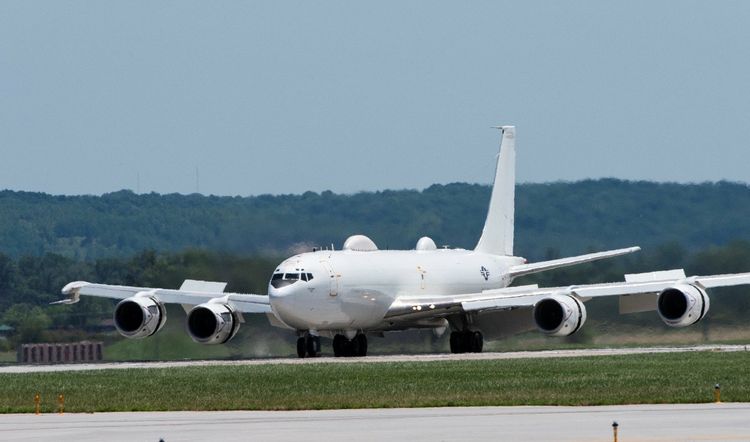
Northrop Grumman has been selected by U.S. Navy for sustainment and modernization of E-6B Mercury aircraft. U.S. AIR FORCE / Staff Sgt. Jacob Skovo
LAKE CHARLES, La. — Northrop Grumman Corp. was recently awarded the Integrated Modification and Maintenance Contract for the U.S. Navy’s E-6B Mercury aircraft, the company said March 3. The work will be performed at Northrop Grumman’s Aircraft Maintenance and Fabrication Center in Lake Charles.
“We are laser focused on providing the most relevant capabilities while improving mission readiness,” said Mary Petryszyn, corporate vice president and president of Defense Systems at Northrop Grumman. “As leaders in aircraft sustainment and modernization, the U.S. Navy’s E-6B Mercury fleet is another example of our strong partnership with the Navy in achieving those goals.”
Over the next five years, Northrop Grumman will perform modifications to the Navy’s E-6B aircraft improving command, control and communications functions that connect the national command authority with the United States’ Nuclear Triad. The company will establish a consolidated production line for core modifications required under the $111 million contract. Northrop Grumman may also take on additional, smaller modifications and select depot maintenance tasks as required.
As part of the critical Take Charge and Move Out strategic communications mission, the E-6B operates across a wide frequency spectrum to transmit and receive secure and non-secure voice and data information. The aircraft provides survivable, endurable, reliable airborne command, control, and communications in support of the president, secretary of defense, and United States Strategic Command.
CNO Gilday Honors Former CNO Adm. Thomas Hayward
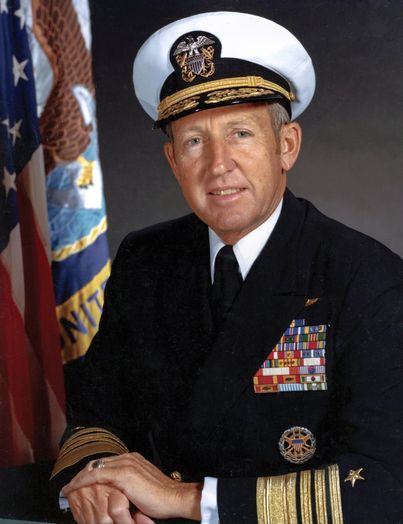
Former chief of naval operations, Adm. Thomas B. Hayward. U.S. NAVY
ARLINGTON, Va. — Former chief of naval operations Adm. Thomas B. Hayward died March 3.
CNO Adm. Mike Gilday issued the following statement on Hayward, the 21st CNO:
“Today, the Navy grieves alongside the family and friends of Adm. Thomas B. Hayward as we celebrate his legacy and service to our nation. He was a Sailor, a warfighter, a man of honor and integrity, who served as the chief of naval operations from 1978 to 1982. As CNO, he expertly led the Navy during challenging times after the end of the Vietnam War and the transition to an all-volunteer force. Facing both the 1979 Iranian hostage crisis and renewed Soviet competition in the midst of the Cold War, he rebuilt the combat readiness of the Navy through significant personnel and material investments and restored ‘Pride in the Navy.’ Focused on operational superiority, he prioritized building sophisticated capabilities to support a global, offensive-minded maritime strategy. He enlisted in the Navy during World War II and as a naval aviator flew combat missions in Korea and Vietnam. We truly lost a great leader and shipmate. We are grateful for your leadership, mentorship and commitment to our Navy and nation. Fair winds and following seas, Sir.”
Below is the biography of Hayward:
Hayward was born in Glendale, California, on May 3, 1924, the son of Mr. and Mrs. E. Payson Hayward. A native Californian, Admiral Hayward attended Glendale Junior College and Occidental College at Los Angeles, and in 1943 was appointed a Naval Aviation Cadet in the V-5 Program of the U. S. Naval Reserve. He entered the U.S. Naval Academy in 1944 on appointment from the State of California and upon graduation was commissioned Ensign in the U. S. Navy on June 6, 1947.
Following graduation from the U. S. Naval Academy, he served in the aircraft carrier USS Antietam until detached in September 1948 for flight training at Naval Air Station, Pensacola, Florida. Designated a Naval Aviator on July 26, 1950, he was assigned to Fighter Squadron 51. While with that squadron, he participated in combat operations in Korea, embarked in the carrier USS Essex (CV 9), and later in USS Valley Forge (CVA 45).
In January 1954, he reported for test pilot training at the Naval Air Test Center, Patuxent River, Maryland, and upon completion of training remained there as a test pilot and project coordinator. He next attended the Aviation Safety Officers School at tile University o£ Southern California at Los Angeles, after which he served with All-Weather Fighter Squadron Three. In August 1958 he reported for instruction at the Naval War College, Newport, Rhode Island, and in December 1959, joined Fighter Squadron 211 as executive officer. In July 1961, he became administrative aide to the secretary of the Navy. He was next attached to Fighter Squadron 103 in December 1963, serving as executive officer and later as commanding officer. In July 1965, he assumed command of Attack Carrier Air Wing 10 which was deployed to the Mediterranean aboard the carrier USS Shangri-La (CVA 38), and later to Southeast Asia in the Vietnam conflict aboard the carrier USS Intrepid. (CVS 11).
From August 1966 to August 1967, he was a student at the National War College in Washington, D.C., and in 1967 he received a Master of Science degree in international affairs from George Washington University. He was next commanding officer of the USS Graffias (AF 29) operating off the coast of Vietnam. In August 1968, he reported as executive assistant and aide to the under secretary of the Navy.
In December 1969, he assumed command of the attack carrier USS America (CVA 66), deploying to the 7th Fleet as the flagship of commander Task Force 77. Promoted to rear admiral in November 1970, he reported to Hawaii as commander, Sea Frontier and commandant of the 14th Naval District. He was assigned additional duty as commander Fleet Air, Hawaii, and commander Manned Spacecraft Recovery Forces, Pacific. He became director of the Office of Program Appraisal, Navy Department in December 1971, and on April 26, 1973, was promoted to vice admiral and reported as director, Navy Program Planning in the Office of the Chief of Naval Operations. On June 14, 1975, he assumed command of the U.S. 7th Fleet in the Western Pacific and was embarked in the guided-missile cruiser USS Oklahoma City. Promoted to the rank of admiral, he assumed duties as commander in chief, U. S. Pacific Fleet on August 12, 1976.
Hayward became the 21st chief of naval operations on July 1, 1978 and continued in this assignment until 30 June 1982. He retired from active duty on 1 July 1982.
Coast Guard Academy Cadets Prepare to Join the Fleet
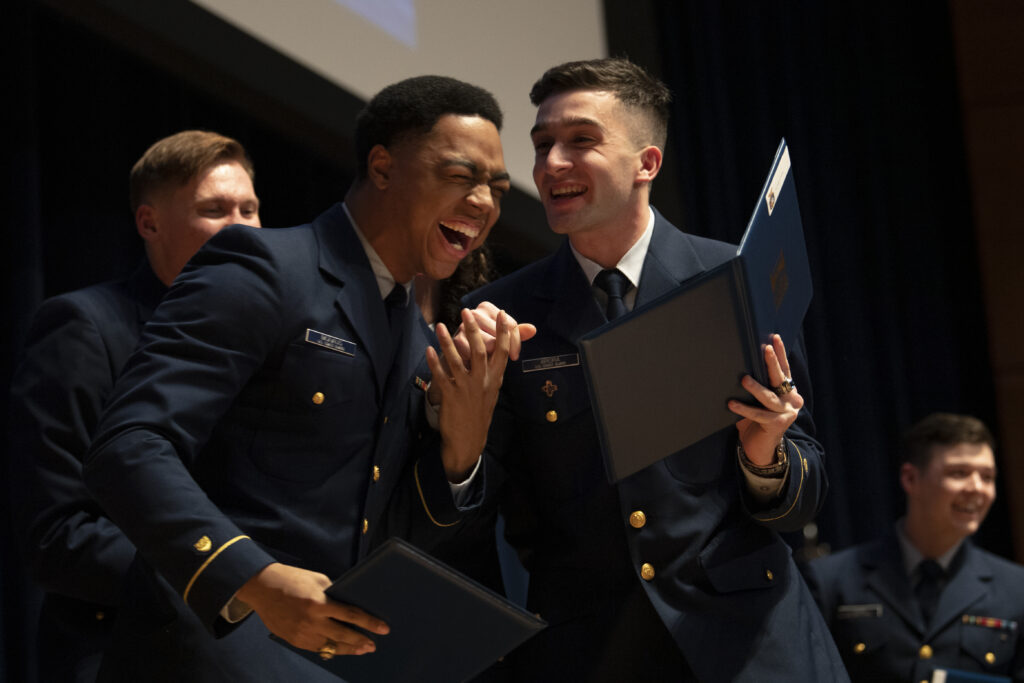
Cadets from the Class of 2022 at the U.S. Coast Guard Academy receive their first duty assignments during Billet Night, March 3, 2022. U.S. Coast Guard / Petty Officer 3rd Class Matthew Abban
NEW LONDON, Conn. — Cadets from the Class of 2022 received their first duty assignments during Billet Night at the U.S. Coast Guard Academy, March 3, the Academy said.
One of the most anticipated events of the 200-week cadet program, Billet Night is a night of energy and excitement as the cadets are less than three months away from commencement when they commission as officers in the U.S. Coast Guard on May 18, 2022.
This year’s class is made up of 257 cadets, including nine international cadets. After graduation, more than 200 newly commissioned officers will report to cutters as near as Coast Guard Cutter Eagle homeported near the Academy in New London, Connecticut, to the Coast Guard Cutter Sequoia, homeported nearly 8,000 miles away in Apra Harbor, Guam.
Twenty others will report to flight school in Pensacola, Florida, to begin pilot training before reporting to Coast Guard Air Stations across the country.
Cadets will engage in a variety of Coast Guard operations at their new units upon graduation. Coast Guard units throughout the nation routinely conduct domestic missions as well as joint exercises with partner nations in which the Coast Guard assists fellow coast guards and navies to adapt or expand their maritime security capabilities.
The remaining graduates will report to various shore units, including the first graduates of the Academy’s Cyber Systems program. The newly established Cyber Systems degree provides graduates with the skills and ability to defend cyberspace, enable operations, and protect critical maritime infrastructure.
The Coast Guard protects America’s vast Maritime Transportation System as a ready, relevant, and responsive force engaging in defense operations, maritime law enforcement, search and rescue, marine safety, and environmental protection operations.
“Every day our graduates are leading vital missions across the globe,” said Rear Adm. Bill Kelly, Coast Guard Academy superintendent. “I’m excited that the members of the class of 2022 will soon take their places in the Coast Guard fleet and join our service’s efforts to address the nation’s complex maritime challenges.”
Founded in 1876, the Coast Guard Academy is one of the five U.S. service academies that emphasizes leadership, physical fitness and professional development leading to a guaranteed job upon graduation as a commissioned officer in the U.S. Coast Guard.
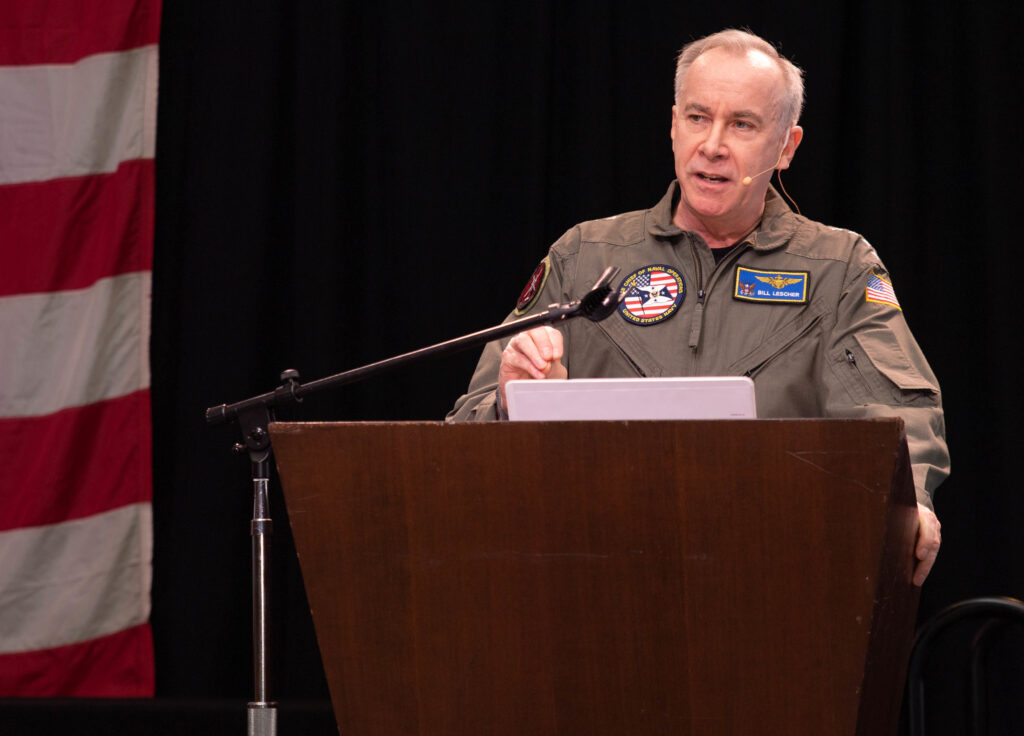
Adm. William Lescher, vice chief of naval operations, speaks to Naval Aviators at the 2021 Naval Helicopter Association Symposium. U.S. NAVY / Mass Communication Specialist 2nd Class Chelsea D. Meiller
ARLINGTON, Va. — Retention of Sailors in the fleet is going well but the demographics trend for recruiting is getting tougher, said the vice chief of naval operations, who also explained the efforts to reduce the shortage of Sailors on the Navy’s surface ships.
“We’re very focused on retention, and it’s strong right now,” said VCNO, Adm. William K. Lescher, testifying March 3 before a joint hearing of the Seapower and Projection Forces subcommittee and Readiness subcommittee of the House Armed Services Committee. “It’s at a very strong level.
“Part of the reason we’re focusing on it is because recruiting is becoming increasingly difficult for all the services and even more broadly,” Lescher said. “The last data I [saw] showed that that portion of the U.S. population that’s eligible to serve, their propensity to serve from 2018 was 13% and to 2021 is now 10%. All of the service recruiters are seeing symptoms of the ‘great resignation’ and/or a labor market that is so tough that at our new-construction shipyards, our repair shipyards, our aviation depots, all are struggling to bring in — we’re all competing for — the same talented group. So, we’re laser-focused on that.”
During the hearing, Rep. Sara Jacobs (D-California) cited a Government Accountability Office report that found the surface fleet is 15% undermanned compared with required levels, since under-manning was part of the reason for the 2017 collisions involving the destroyers USS Fitzgerald and USS John McCain.
In response, Lescher pointed out the Navy has increased its end-strength by 23,000 personnel since those incidents and is “getting very much after it [the under-manning]. Part of the reason that it remains under-manned is because we have been adding billets as well. … As we add billets to address the overwork issue and make sure the crew is sized for everything that is expected of it, we’re then chasing that with our accessions. So, we’re closing the gaps across the Navy.”
The VCNO said “the other element is strong certification and focus on the manning that we deploy our ships with. The remaining work we have to get after with a strong sense of urgency is across the full OFRP [Optimized Fleet Readiness Plan] cycle as well.”
Also testifying was Vice Adm. Roy Kitchener, commander, Naval Surface Forces, who spoke on the use of data for the last year in a program involving tracking expertise and proficiency in six shipboard rates, or Sailor job specialties, in engineering and combat systems.
“We track each individual and what their proficiency and experience are, and then we are able to put them where we think we need them,” Kitchener said. “For example, if a ship is down in a number of years of experience in an engineering work center or an Aegis fire control system, we can actually make sure we send the right person there that increases the proficiency. It’s a much better measure of fit. … Right now, it’s part of the manning process. We’re using it extensively to fill those gaps at sea … making sure that we have the right people to go there.”
Kitchener said the results to date are “very encouraging” and “it’s a metric that we’re going to continue to go after to allow us to make sure we have that manning right on the ship.”
U.S. Navy Recovers F-35C from South China Sea
An F-35C Lightning II that crashed in the South China Sea earlier this year has been recovered. U.S. NAVY
YOKOSUKA, Japan — U.S. 7th Fleet’s Task Force 75 and Naval Sea Systems Command on March 2 successfully retrieved the F-35C Lightning II aircraft which crashed earlier this year in the South China Sea, 7th Fleet Public Affairs said March 3.
The F-35C Lightning II, assigned to Carrier Air Wing 2, crashed while USS Carl Vinson (CVN 70) was conducting routine flight operations in the South China Sea on Jan. 24.
The wreckage was recovered from a depth of approximately 12,400 feet by a team from CTF 75 and the NAVSEA’s Supervisor of Salvage and Diving embarked on the diving support construction vessel Picasso.
“The task force’s expertise in rapid, scalable command, control, and communications, agile logistics, organic security, and explosive ordnance disposal was the most flexible choice for the fleet commander to respond in a timely manner,” said CTF 75 Commodore Capt. Gareth Healy.
“Ultimately, this deliberate approach resulted in the correct capabilities conducting recovery operations within 37 days of the incident. Given the unique challenges of this problem and the unique technical capabilities that NAVSEA delivered, this was an aggressive and achievable timeline.”
The aircraft was recovered using a CURV-21 remotely operated vehicle, which attached specialized rigging and lift lines to the aircraft. The ship’s crane lifting hook was then lowered to the seafloor and connected to the rigging, and then lifted the aircraft to the surface and hoisted it onboard Picasso.
The aircraft will be delivered to a nearby military installation to aid in the ongoing investigation and evaluated for potential transport to the United States.
Navy Patrol Ship USS Typhoon Decommissioned
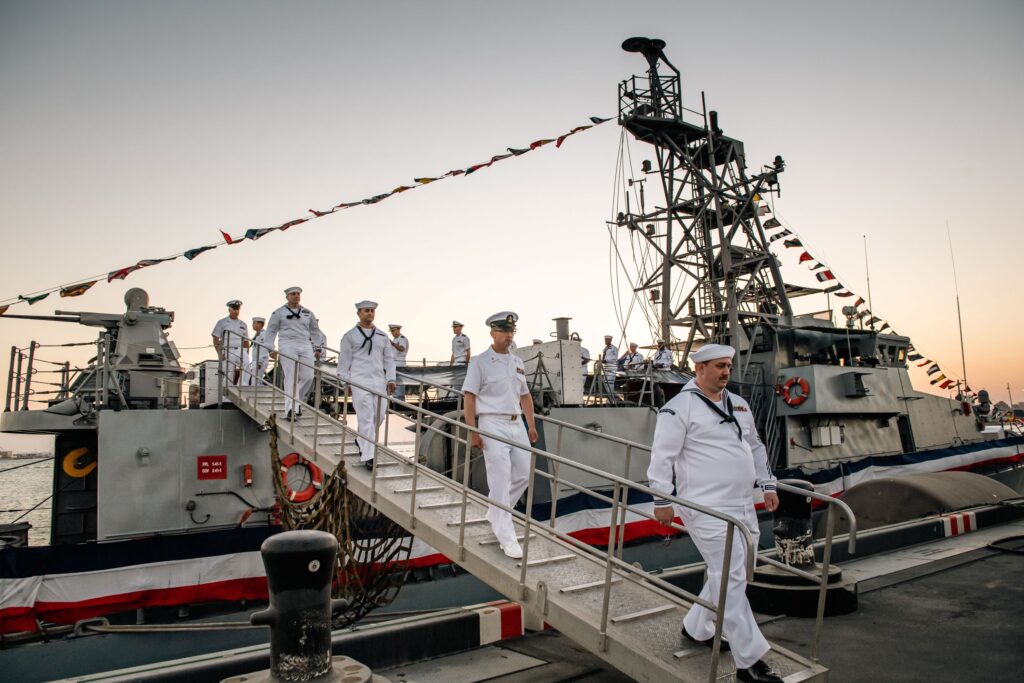
Sailors disembark patrol coastal ship USS Typhoon (PC 5) during the ship’s decommissioning ceremony at Naval Support Activity Bahrain. Typhoon commissioned in 1994 and began conducting routine coastal patrol operations under U.S. 5th Fleet in 2004. U.S. NAVY / Mass Communication Specialist 2nd Class Dawson Roth
ARLINGTON, Va. — A second Cyclone-class coastal patrol ship has been retired from the fleet in the Persian Gulf. USS Typhoon (PC 5) was decommissioned in Manama, Bahrain, on Feb. 28 after 28 years of service, a few days after its sister ship, USS Firebolt (PC 10), was decommissioned on Feb. 23.
The event drops to eight the number of Cyclone-class PCs forward deployed to the U.S. 5th Fleet. Three PCs based in the United States were decommissioned last year, leaving the rest of the class in the Persian Gulf.
The 174-foot-long, 375-ton Typhoon was built by Bollinger Shipyards in Lockport, Louisiana, and commissioned in Tampa, Florida, Feb. 12, 1994.
During the late 1990s and early 2000s, the Typhoon deployed to the Mediterranean and Baltic seas. It was forward to the 5th Fleet in 2004. In the Persian Gulf and Arabian Sea, the Typhoon conducted maritime security patrols, including anti-piracy and anti-smuggling operations, security patrols for offshore oil rigs and terminals, and shipping escort.
The Typhoon and its sister ships will be replaced in the Persian Gulf by forward-deployed littoral combat ships beginning in 2022.
Future Attack Submarine USS Oregon Delivered to U.S. Navy
The Virginia-class submarine USS Indiana (SSN 789), a sister ship to the future USS Oregon, departs Submarine Base New London in Connecticut on Jan. 7. The future USS Oregon was delivered to the Navy on Feb. 26. U.S. NAVY / John Narewski
GROTON, Conn. — The submarine force’s newest attack submarine, the future USS Oregon (SSN 793), was delivered to the U.S. Navy on Feb. 26, Team Ships Public Affairs said Feb. 28.
PCU Oregon is the 20th Virginia-class submarine that are co-produced at General Dynamics Electric Boat and Huntington Ingalls Industries – Newport News Shipbuilding through a long-standing teaming agreement. Oregon is the 11th Virginia Class delivered by GDEB and the second Block IV configured submarine.
“Oregon is in excellent condition and the captain and crew have expertly taken the ship through her paces,” said Capt. Todd Weeks, the Virginia-class program manager who rode the boat during its sea trials. Delivery of a Virginia-class submarine is the culmination of almost 10 million work hours by the shipbuilders under the exacting standards imposed by Naval Sea Systems Command and Naval Reactors under the direct oversight of the Supervisors of Shipbuilding at both company locations. “Each organization works tirelessly with the others focused on getting ships to sea as the first step in ultimately arriving at its squadron and homeport where it becomes a vital asset to the Nation.”
Virginia-class submarines are built to operate in the world’s littoral and deep waters while conducting antisubmarine warfare, anti-surface ship warfare, strike warfare, special operations forces support, intelligence, surveillance and reconnaissance, irregular warfare and mine warfare missions. Their inherent stealth, endurance, mobility and firepower directly enable them to support five of the six maritime strategy core capabilities — sea control, power projection, forward presence, maritime security and deterrence.
The submarine’s sponsor is Dana Richardson, wife of former Chief of Naval Operations Adm. John Richardson.
Oregon is the third U.S. Navy ship to honor the state. The first USS Oregon was a brigantine ship purchased in 1841 and used for exploration until 1845. The second Oregon (BB 3) was commissioned on July 15, 1896. While decommissioned in 1906, she was later recommissioned in 1911 and remained in the reserve until stricken from the Navy list in 1942.