Bell Begins Production on Czech Republic AH-1Z Helicopter
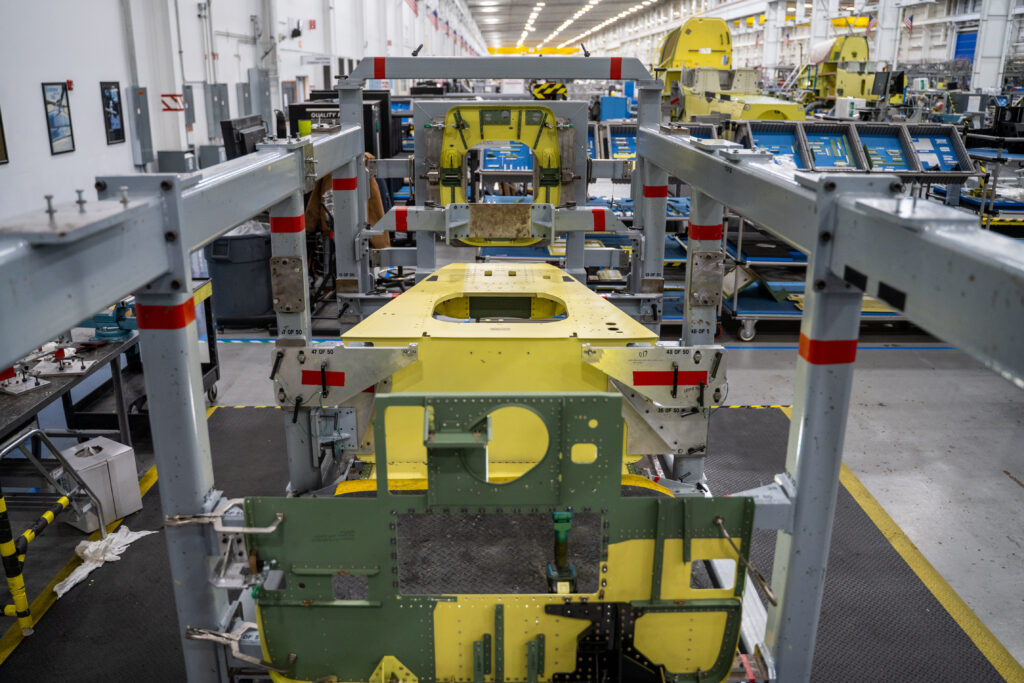
The cabin of an Czech Republic AH-1Z is loaded onto the manufacturing line at the Amarillo Assembly Center to begin production. BELL TEXTRON
AMARILLO, Texas — Bell Textron, a Textron company, has started production of the first AH-1Z Viper for the Czech Republic at Bell’s Amarillo Assembly Center, the company said Feb. 23. The production of the Viper joins UH-1Y production as part of the Czech Republic Foreign Military Sale FMS of mixed fleet aircraft.
“Bell understands what it means to execute a successful international program,” said Mike Deslatte, vice president and H-1 program director for Bell. “We understand the importance of providing the unmatched capability of the H-1 aircraft to our customers. Bell remains focused on producing exceptional combat aircraft and providing modern capabilities for the Czech Air Force as a partner in the H-1 program, along with the U.S. government.”
Bell’s work beyond aircraft manufacturing includes building a flight training device for the Czech Republic, essential to integrating the new helicopters into the Czech Armed Forces.
Bell began production on the Czech Republic UH-1Y in 2021, marking the first production for an international operator of the UH-1Y. The Czech Republic’s purchase of both the AH-1Z and UH-1Y takes full advantage of the 85% commonality between parts and enabling full mission capabilities between both aircraft.
In addition to the Czech Republic, Bell is actively producing AH-1Zs for the U.S. Marines Corps and the Kingdom of Bahrain. In total, the H-1 program is on track to produce 217 AH-1Zs and 168 UH-1Ys, with more than 100 consecutive H-1s delivered on time for the USMC and FMS customers.
CH-53K Test Team Wins DON Test and Evaluation Award
A CH-53K King Stallion aircraft undergoes night aerial refueling tests over the Chesapeake Bay in June, 2021. U.S. NAVY
PATUXENT RIVER, Md. — The CH-53K King Stallion test team, part of the Heavy Lift Program Office, PMA-261, is the recipient of the Department of the Navy Test and Evaluation Working Integrated Product Team award for 2021, Naval Air Systems Command announced Feb. 22.
The 18-person WIPT will be honored in a virtual ceremony this spring. According to the award announcement, the team “demonstrated superior performance in delivering outcomes while overcoming significant challenges in execution.”
During the past year, the CH-53K King Stallion WIPT successfully kept the program on track toward operational test in support of initial operational capability and full-rate production. That success came despite late technical discoveries, solution implementation timelines and some unresolved deficiencies.
When findings surrounding internal cargo handling in the aircraft and engine performance capabilities put program timelines at risk, the team was able to leverage the close alignment of developmental test and operational test within the WIPT to keep the program on track.
“Our team did a fantastic job collaborating and focusing efforts to bring the CH-53K to operational test, supporting the fleet’s critical need for heavy lift capability,” said Gene Clark, former assistant program manager for test and evaluation for PMA-261 in 2020 and 2021. Clark drafted the award nomination prior to moving to his current position as assistant program executive officer, Test and Evaluation for Program Executive Office – Unmanned and Weapons.
Navy Decommissions Coastal Patrol Ship USS Firebolt
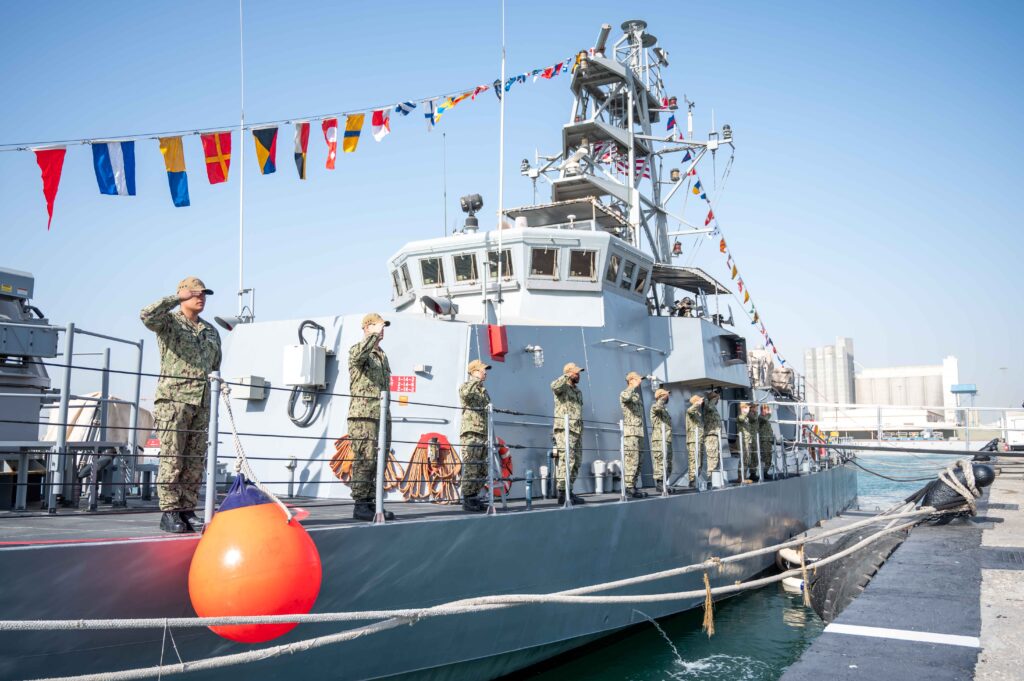
Sailors assigned to the coastal patrol ship USS Firebolt (PC 10) salute during the ship’s decommissioning ceremony, Feb. 23 at Naval Support Activity Bahrain. U.S. NAVY / Mass Communication Specialist 1st Class Mark Thomas Mahmod
BAHRAIN — The crewmembers of Cyclone-class coastal patrol ship USS Firebolt (PC 10) marked the end of the ship’s U.S. Navy service during a decommissioning ceremony Feb. 23 at Naval Support Activity Bahrain.
The nearly 27-year-old ship was one of 10 patrol craft currently forward-deployed to the Middle East in support of regional maritime security operations. Firebolt commissioned in June 1995 and began conducting routine coastal patrol operations under U.S. 5th Fleet in 2003.
“The crew is what makes Firebolt special to me,” said Senior Chief Engineman Paul Dixon, who completed two tours aboard Firebolt. “The history behind Firebolt makes everything we do more meaningful.”
Prior to operating from Bahrain, the ship helped secure New York City’s harbor immediately following the terrorist attacks in the United States on Sept. 11, 2001. Months later, Firebolt conducted coastal patrols in the Arabian Gulf during Operation Iraqi Freedom.
In 2004, two Firebolt Sailors and a Coast Guardsman were killed as Firebolt provided security for the Khawr Al Amaya Oil Terminal in the Northern Arabian Gulf. After spotting a suspicious vessel, Firebolt deployed a rigid-hull inflatable boat and the suspicious vessel exploded in an apparent suicide attack.
“We thank the hundreds who served on this great ship and honor the brave Sailors and Coast Guardsman killed in the 2004 terrorist attack at sea. Their sacrifice will never be forgotten,” said Vice Adm. Brad Cooper, commander of U.S. Naval Forces Central Command, U.S. 5th Fleet and Combined Maritime Forces.
Firebolt has conducted several major rescue operations during its storied service. In 2005, the ship’s crew rescued 89 people off the coast of Somalia after their boat sank. Additionally, Firebolt rescued an Iranian mariner from a capsized fishing vessel in 2012.
“We have so many memories here,” said Machinist’s Mate 3rd Class Pedro Benitez. “We would be here working late hours in engineering, but still smiling and joking. It’s stuff like that that’s irreplaceable.”
During the decommissioning ceremony, Lt. Cmdr. Raymond W. Miller, Firebolt’s commanding officer, expressed appreciation for his team.
“They’ve proven their dedication to mission success over and over again,” said Miller. “They’ve never let me or each other down.”
CNO Is ‘Sighted on a Bigger, More Capable Navy’
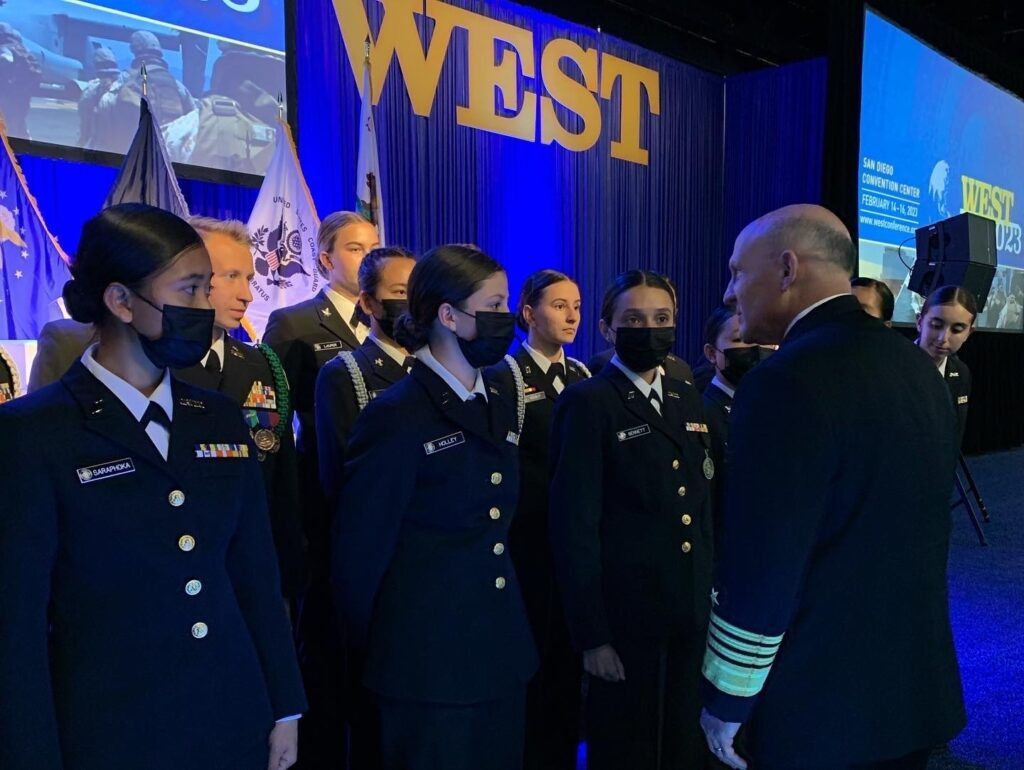
Chief of Naval Operations (CNO) Adm. Mike Gilday speaks with ROTC members during WEST 2022. U.S. NAVY / Cmdr. Courtney Hillson
ARLINGTON, Va. — Addressing the topic of future force structure after it submerged again into the depths of analysis, the Navy’s top officer laid out his views for a “bigger, more capable Navy” in the future informed by a series of exercises over the last year, estimating a requirement for a fleet of more than 500 manned and unmanned ships, including 12 aircraft carriers.
“We’re going through another force-structure assessment right now, based on the hard work we’ve done over the last five or years in really thinking about how we would fight differently in terms of in a distributed fashion, across a wide, vast ocean like the Pacific, in terms of integrating all domains simultaneously,” said Adm. Michael Gilday, speaking Feb. 18 at the West 2022 Symposium sponsored in San Diego by the U.S. Naval Institute and the Armed Forces Communications and Electronics Association.
“In thinking about what the future fleet looks like, we spent time taking a look at a couple of different force structures assessments in 2019 and 2020,” the CNO said. “The one that I base my best advice on is the one that we finished up in 2020 that we did along with the Marine Corps, but it was actually led by OSD [Office of the Secretary of Defense]. I found that to be an important stakeholder in that process because this wasn’t just Marine Corps-speak or Navy speak or Department of the Navy-speak, but it was more broadly supported by OSD.
“Based on that [and] large-scale exercises like we did last summer — leveraging live virtual construct [LVC]— based on the integrated battle problem we just did over in 5th Fleet with some 100 unmanned platforms over the past few weeks, I’ve concluded, constant with the analysis, we need a naval force of over 500 ships,” he said.
Gilday said his view on carrier aviation “remains unchanged. I think we need 12 carriers.”
The CNO also said “we need a strong amphibious force to include probably nine big-deck amphibs and another 19-20 [medium amphibious warfare ships] to support them [and] perhaps 30 or more smaller amphibious ships to leverage maritime littoral regiments — and the punch that they’re going to provide in places close inside the fight — to 60 destroyers and probably 50 frigates; 70 attack submarines; a dozen ballistic-missile submarines; to about 100 support ships. And probably, looking to the future, 150 unmanned [vessels].
“We’re doing a lot of work inside the FYDP [future years defense plan] now. I think it speaks out to the vulnerabilities that we hear called out by the Joint Staff and the chairman in his risk assessment,” Gilday said. “So, in the long term, I’m sighted on a bigger, more capable Navy. We’re working our way through that with respect to budgets but certainly not taking our eye off the ball with respect to requirements. We do think differently because the future is now in terms of bringing more capability out of the force that we have.”
U.S. Navy Reestablishes Submarine Squadron 8
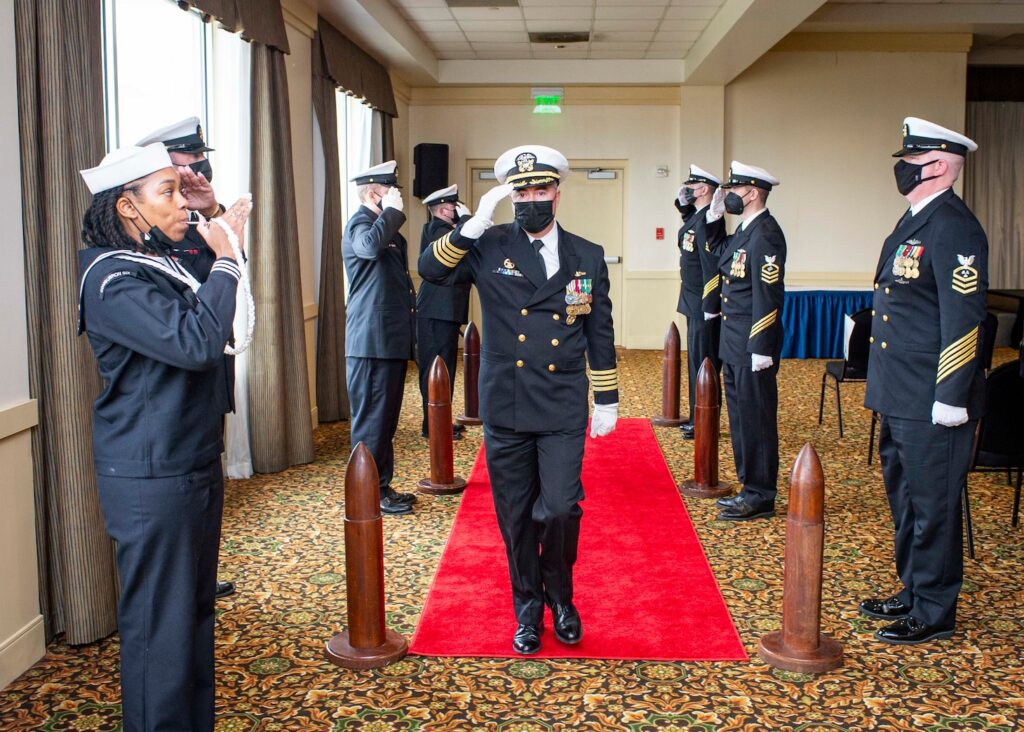
Capt. Brian Hogan, commodore, Submarine Squadron 8, renders a salute to sideboys as he departs his command’s reestablishment ceremony at Naval Station Norfolk, Friday, Feb. 18. U.S. NAVY / Mass Communication Specialist 1st Class Cameron Stoner
NORFOLK — The U.S. Navy reestablished Commander, Submarine Squadron (COMSUBRON) 8 during an official ceremony at Naval Station Norfolk, Virginia, on Friday, Feb. 18, commander, Submarine Force Atlantic said in a release.
COMSUBRON 8’s reestablishment is intended to distribute and align the responsibility for command and control of submarines assigned to Commander, Submarine Squadron 6, also based in Norfolk, during the submarines’ sustainment phase and maintenance shipyard periods.
COMSUBRON 8 was initially disestablished in a ceremony on April 28, 2011, and the squadron’s original roles and responsibilities were merged with COMSUBRON 6.
This move returns the control of new submarine construction and ongoing submarine operating maintenance schedules of Los Angeles-class attack submarines and Virginia-class submarines homeported in Norfolk to COMSUBRON 8.
COMSUBRON 6 retains the operational responsibility of preparing Norfolk-based submarine crews in all facets of operations, to include tactical and operational readiness for war, inspection and monitoring duties, nuclear and radiological safety, and the development and control of submarine operating schedules and logistical support coordination of all submarine operations in the Virginia Capes operating areas.
Vice Adm. William Houston, commander, Submarine Forces, was the keynote speaker for the establishment ceremony.
“Normally we have a change of command which can be upsetting as it means someone is moving on, but this ceremony is nothing but good news as we are reestablishing a squadron,” said Houston. “The reestablishment will give us a squadron that can concentrate on maintenance and new construction and that skillset, while we have another squadron that is focused on operational units.”
Capt. Brian Hogan took command of submarines previously under COMSUBRON 6, relieving Capt. Jason Pittman, commodore, COMSUBRON 6, of responsibility of new submarine construction and ongoing submarine operating maintenance schedules.
“I would first like to congratulate Brian on assuming command of Submarine Squadron 8,” said Pittman. “He brings to the team a wealth of invaluable experience and I cannot think of anyone more right for the job than him. It is an important day for the entire submarine force and the entire Navy. We are building a dedicated team that will lean in and learn new and innovative ways to build and repair our submarines.”
After assuming command of COMSUBRON 8, Hogan gave remarks on reestablishing the squadron.
“Submarine Squadron 8 was established back in the 1940s, so we are simply restoring Submarine Force normalcy by reestablishing it here today,” said Hogan. “This time around, Squadron 8 is focused on shipyard readiness. It is difficult to transition a submarine and its crew into the shipyard and back out as the boat and crew both transform themselves for operational readiness. It is important we get these transitions right, and it is now our job to do it successfully.”
COMSUBRON 8 will step in to provide administrative, manning, logistical, training, operational planning and readiness support for Los Angeles-class attack and Virginia-class fast attack submarine during periods of maintenance and improvement.
Fast-attack submarines are multi-mission platforms enabling five of the six Navy maritime strategy core capabilities — sea control, power projection, forward presence, maritime security and deterrence. They are designed to excel in anti-submarine warfare, anti-ship warfare, strike warfare, special operations, intelligence, surveillance and reconnaissance, irregular warfare and mine warfare. Fast-attack submarines project power ashore with special operations forces and Tomahawk cruise missiles in the prevention or preparation of regional crises.
Mississippi, Maine Delegations Urge Support for Destroyers in Navy’s Next Budget
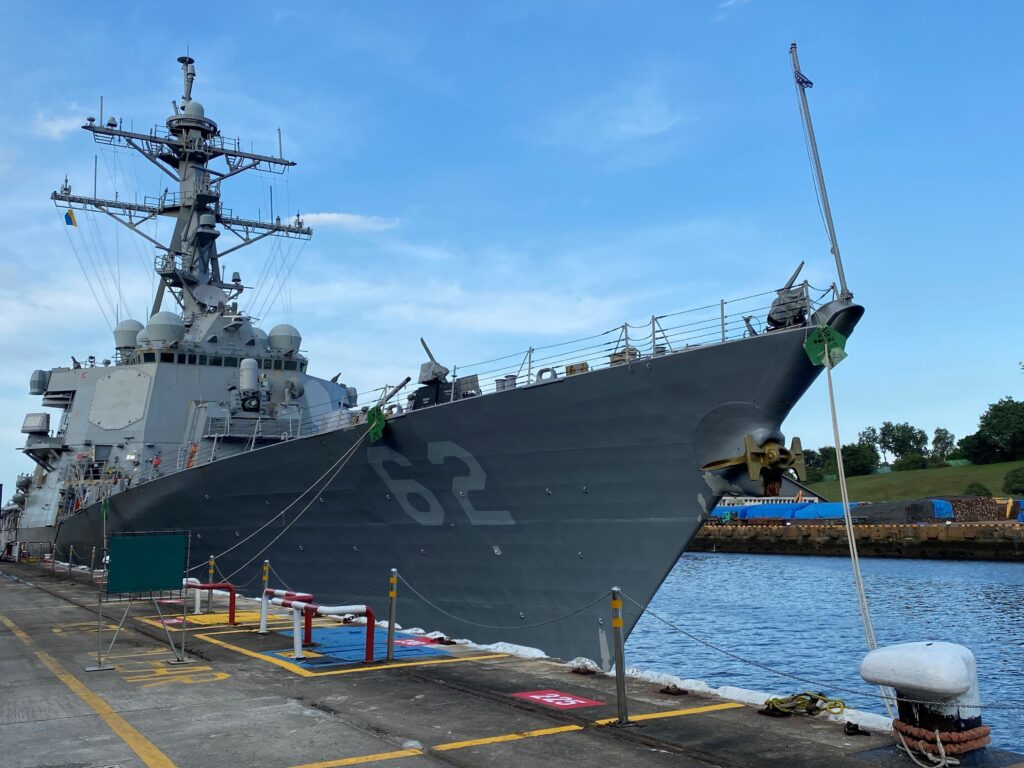
The Arleigh Burke-class destroyer USS Fitzgerald (DDG 62) makes a brief stop for logistics in Singapore Feb. 18. Lawmakers from Mississippi and Maine would like to see three more destroyers of the class included in the fiscal 2023 defense budget. U.S. NAVY / Leslie Hull-Ryde
WASHINGTON — U.S. Sens. Roger Wicker and Cindy Hyde-Smith, and Representatives Steven Palazzo and Trent Kelly, all Republicans from Mississippi, joined lawmakers from the Maine congressional delegation in a letter urging Secretary of the Navy Carlos Del Toro to include funding for three Arleigh Burke-class destroyers in the fiscal 2023 budget, Wicker’s office said in a release.
“As you work to finalize the Department of the Navy’s [fiscal] 2023 budget, we write to respectfully request support for a robust shipbuilding budget, and to include the procurement of three Arleigh Burke-class destroyers,” began the lawmakers. “We urge the Navy to develop a multi-year procurement program of 15 destroyers which maximizes the procured number of ships under the contract, with the understanding that if adequately funded, the industrial base can support at least three ships per year.”
The lawmakers highlighted the importance of Arleigh Burke-class ships to national defense — including their value in countering the growing threat of China — and the impact of the shipbuilding efforts on Mississippi and Maine communities. These ships are currently built at Ingalls Shipbuilding in Mississippi and Bath Iron Works in Maine.
“Furthermore, to address the growing threat of China and its increasing fleet size, hedge against a belligerent Russia and assure allies, we urge you to mature and submit the department’s acquisition plan for the next large surface combatant,” continued the lawmakers. “A strategy closely tied to the industrial base and with extensive oversight will help prevent the issues of cost increases, program delays and end-product reliability issues seen in other ship classes.
“These issues are imperative to maintaining our National Defense Strategy and advantage in the maritime commons, and sustaining our military-industrial base,” the lawmakers concluded.
In addition to the Mississippi lawmakers, the letter was signed by U.S. Sens. Angus King (I-Maine), and Susan Collins (R-Maine), and Representatives Chellie Pingree and Jared Golden, both Democrats.
The Mississippi and Maine congressional delegations have long championed funding for both Ingalls Shipbuilding and Bath Iron Works. In the recent 2022 National Defense Authorization Act, the lawmakers secured authorization of $3 billion for the procurement of two Arleigh Burke-class destroyers at Ingalls Shipbuilding. Last month, Wicker, Hyde-Smith and Palazzo joined Del Toro at Ingalls Shipbuilding, where the secretary toured the facilities and saw the importance of the work being done at the shipyard.
USCGC Reliance Returns to Homeport Following 52-day Patrol
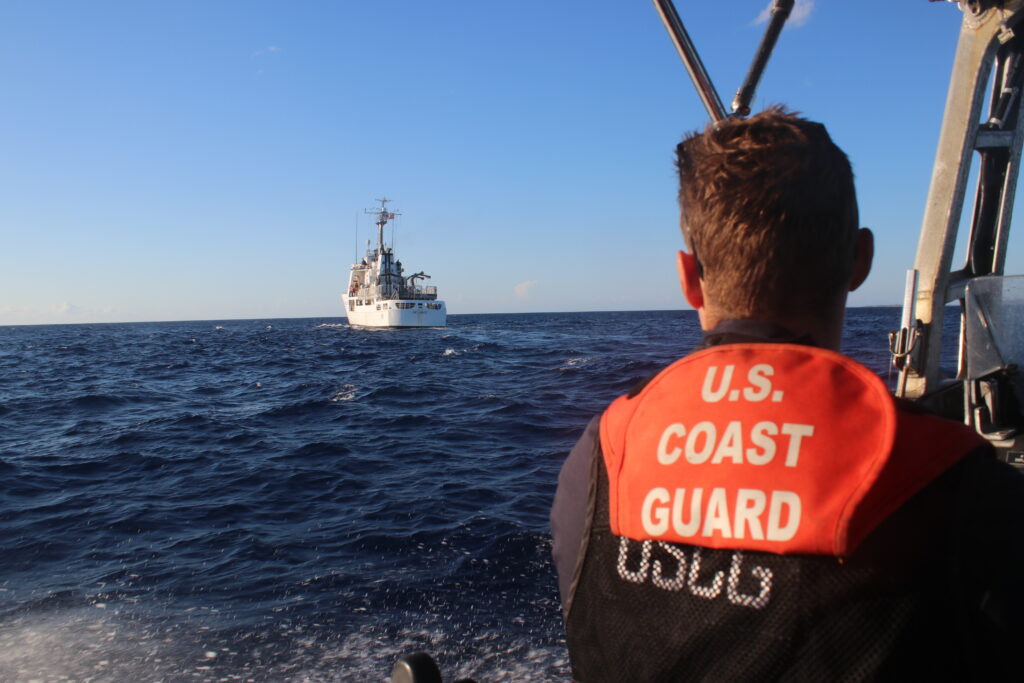
A response boat crew member steers toward the Coast Guard Cutter Reliance during a 52-day patrol in the Atlantic Ocean. U.S. COAST GUARD
PENSACOLA, Fla. — The crew of the Coast Guard Cutter Reliance (WMEC-615) returned to homeport in Pensacola, Florida, Feb. 18, following a 52-day patrol in the Caribbean Sea in support of the Coast Guard 7th District.
The Reliance crew supported the U.S. Coast Guard 7th District throughout their patrol, aiding in missions to interdict and disrupt the flow of illegal drugs and migrant trafficking while supporting national security and strengthening relationships with regional partners throughout the Caribbean.
During the patrol, the crew traveled over approximately 8,631 miles, assisted in the transference of more than 12,564 pounds of narcotics with an estimated combined street value of $250 million and intercepted 157 undocumented migrants. The cutter’s crew also transferred eight suspected narcotics smugglers from other U.S. Coast Guard cutters operating in the region.
Working jointly with the crew of U.S. Coast Guard Cutter Kathleen Moore (WPC-1109), the Reliance’s crew also rescued 191 Haitian nationals from an unseaworthy vessel off the coast of Cuba.
The patrol was critical in enhancing operational readiness through shipboard training and qualifications, resulting in the successful completion of a five day major shipboard inspection and exercise, which tested the crew’s readiness in all aspects of aviation training, equipment and capabilities.
The Reliance is a 210-foot medium-endurance cutter homeported in Pensacola with a crew of 74 personnel. The cutter’s primary missions include counter drug operations, migrant interdiction, enforcing federal fishery laws and search and rescue in support of U.S. Coast Guard operations throughout the Western Hemisphere.
NATO ASW Exercise Under Way off Sicily
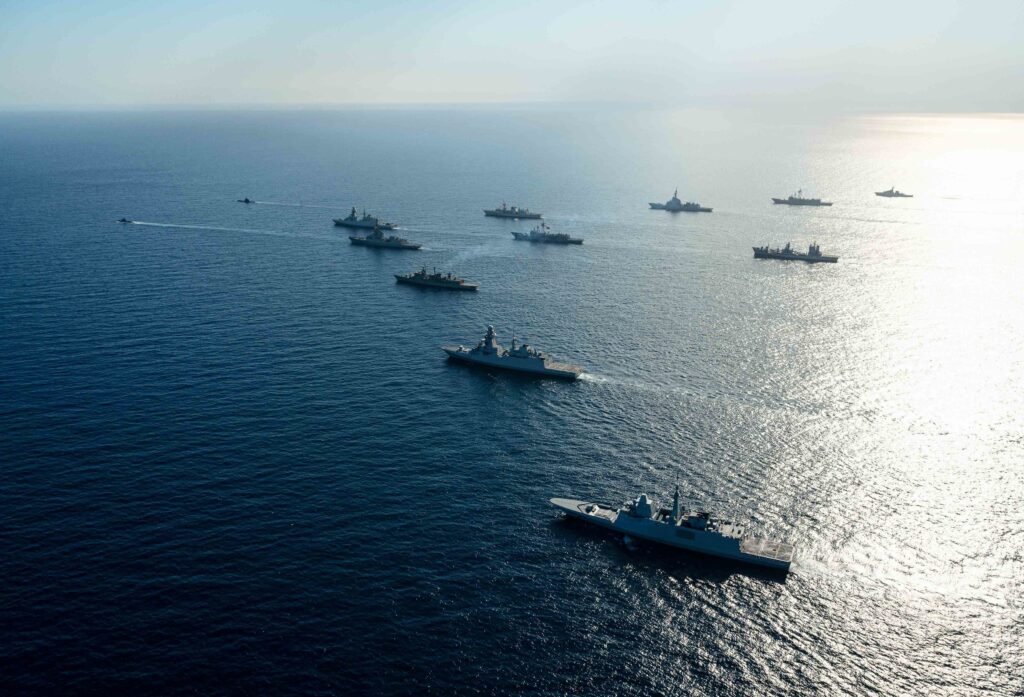
Standing NATO Maritime Group 2 ships and submarines sail in formation in the Ionian Sea off the coast of Sicily Feb. 21 during Exercise Dynamic Manta 22. NATO ALLIED MARITIME COMMAND
MEDITERRANEAN SEA — While the NATO maritime forces have had to navigate around the rocks and shoals of the global pandemic, it has not stopped them from exercising and raising their game in looking for adversary submarines in the Mediterranean.
The annual Dynamic Manta antisubmarine warfare exercises are conducted in the central Mediterranean, usually around Sicily, and takes advantage of the maritime patrol air bases at Sigonella and Catania in Italy. This year is no exception.
Ships, submarines, aircraft and personnel from nine allied nations will take part in the antisubmarine warfare and anti-surface warfare training exercises from Feb. 21 to March 4.
Submarines from France, Greece, and Italy have been joined by surface combatants from Canada, France, Greece, Italy, Spain, Turkey, the United Kingdom and the U.S. for the exercise. Maritime patrol aircraft from Canada, France, Germany, Greece, Italy, U.K. and the U.S. are supporting the simulated, multi-threat environment during the exercise.
The task group is joining up in Catania harbor. The nearby Italian naval helicopter base in Catania and U.S. Naval Air Station at Sigonella are supporting Dynamic Manta 22 operations. Logistical support is being provided from the Italian naval base at Augusta Bay.
Dynamic Manta is one of the two major antisubmarine warfare exercises led every year by NATO Maritime Command. Dynamic Manta involves NATO Standing Maritime Group Two in the Mediterranean. The other, Dynamic Mongoose, takes place in the North Atlantic in the summer, involving NATO Standing Maritime Group One.
“NATO’s maritime power lies in the ability of the standing forces to rapidly join with high readiness, high-capacity national forces to deliver effects when and where needed,” said U.S. Navy Rear Adm. Stephen Mack, commander, Submarines NATO, who is commanding Dynamic Manta 22. “Exercises like this, along with regular training between allied navy units and our multinational standing naval forces, is a force multiplier that provides a collectively trained and interoperable force, ready to work together as the maritime portion of the VJTF [Very High Joint Readiness Task Force].”
Mack added, “This exercise is a visible demonstration of the alliance’s ability to cooperate and effectively integrate. Alliance unit, solidarity, and cohesion are the core of NATO.”
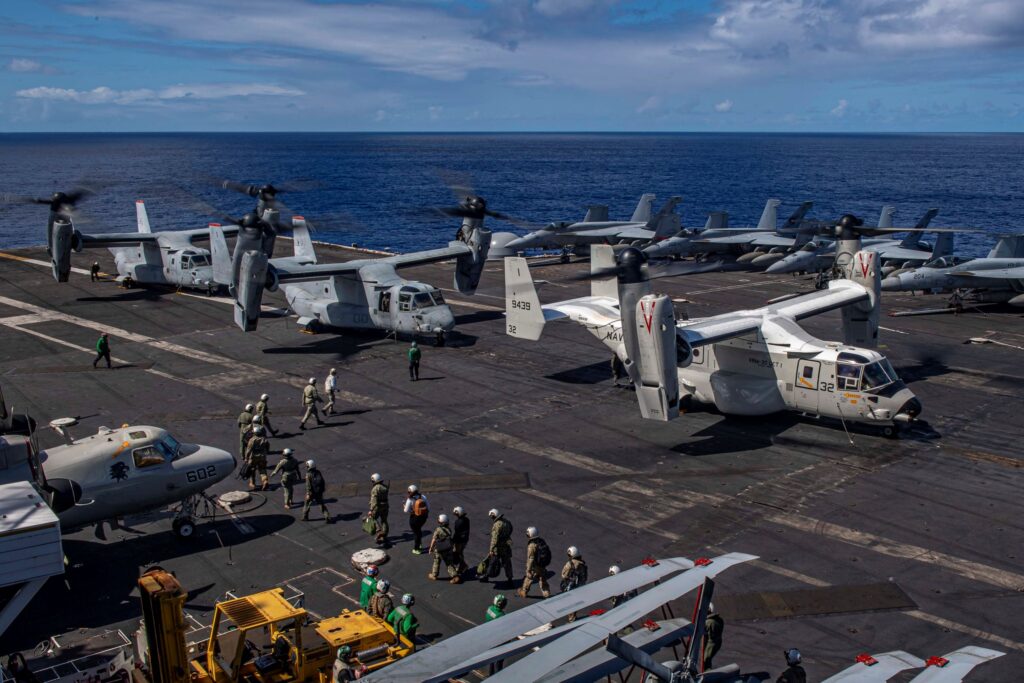
Senior military leadership cross the flight deck to depart Nimitz-class aircraft carrier USS Carl Vinson (CVN 70), Feb. 9. Vinson is currently conducting routine maritime operations in U.S. 3rd Fleet. U.S. NAVY / Mass Communication Specialist 3rd Class Megan Alexander
The Navy announced initial operational capability for the CMV-22B Osprey, confirming the platform’s operational readiness following the successful completion of its first deployment on Feb. 17, Naval Air Systems Command said Feb. 18.
The aircraft was formally declared IOC on Dec. 14, 2021, aligning with the scheduled first-quarter fiscal year requirement.
“The CMV-22’s maiden deployment with Carrier Air Wing [CVW] Two and the [USS Carl] Vinson [CVN 70] team is an operational success, giving me the confidence necessary to make the declaration,” said Rear Adm. Andrew Loiselle, director, Air Warfare Division, N98, Office of the Chief of Naval Operations. “As we continue to deliver the advanced platforms that will make up the Air Wing of the Future, the CMV-22B provides the necessary support and more to carry our future force.”
Loiselle’s designation marks a key milestone in the design, development, acquisition and testing of the CMV-22B and confirms its relevance and readiness to meet the needs of the Navy’s carrier onboard delivery mission. The aircraft transports personnel, mail, supplies and cargo from shore bases to aircraft carriers at sea, and will eventually replace the C-2A Greyhound.
“IOC designation is more than a stamp of approval,” said U.S. Marine Corps Col. Brian Taylor, V-22 Joint program manager. “It is a vote of confidence from top Navy leadership that the design, testing and production of this aircraft meet the logistical needs of the carrier air wings designated to fly the CMV-22B.”
This past summer marked the first deployment for the CMV-22B. Fleet Logistics Multi-Mission Squadron (VRM) 30 embarked on the USS Carl Vinson alongside the F-35C Lightning II and E-2D Advanced Hawkeye squadrons. The first deployed detachment has executed a mission completion rate of 98% and a mission-capable rate of 75%. The CMV-22B is a crucial element of future carrier airwings due to the cargo capacity needed to transport F-35 power modules and additional logistics support for future carrier air wing deployments with next-generation platforms.
“This aircraft went from first flight to first deployment in 19 months, a feat possible through the dedication of the Navy’s acquisition, engineering, test and operational communities, as well as industry, all working in tandem, toward a common goal,” said Taylor.
With 50% more internal fuel than the Marine Corps’ Osprey variant, CMV-22B can transport up to 6,000 pounds of cargo and personnel over a 1,150 nautical mile range. The Navy redesigned the forward sponson fuel tanks and added two wing fuel tanks to add capacity and extend the flight range.
“As our fighter/attack and surveillance aircraft expand in both capability and size to extend the range of the carrier air wing, we must also evolve our support aircraft, in tandem, to supply those platforms. The CMV-22B will transport cargo and personnel to outfit the most advanced aircraft carrier strike groups as we continue to meet the needs of our missions worldwide,” said Taylor.
The program will continue to refine and test capabilities on the aircraft, addressing the agile needs of the fleet. To date, Bell Boeing has delivered 14 aircraft with 44 on contract and full operational capability expected in 2023.
Coast Guard Cutter James offloads More than $1.06 Billion in Illegal Narcotics
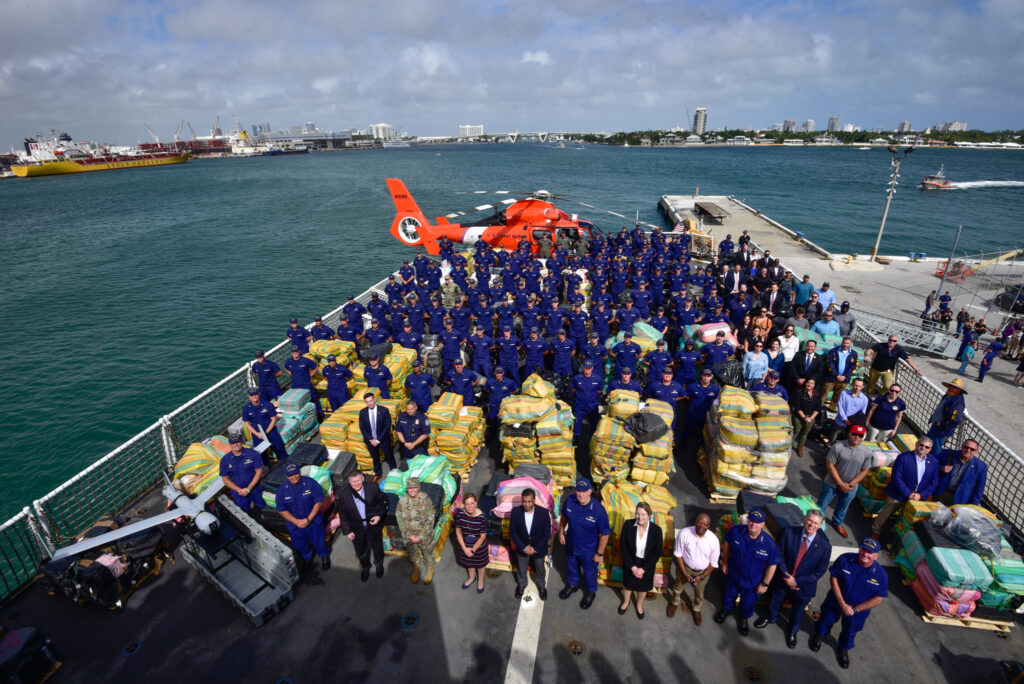
The Coast Guard Cutter James’ (WMSL 754) crew offloaded approximately 54,500 pounds of cocaine and 15,800 pounds of marijuana, worth approximately $1.06 billion, Feb. 17, in Port Everglades, Florida. U.S. COAST GUARD / Petty Officer 3rd Class Jose Hernandez
MIAMI — Coast Guard Cutter James’ crew offloaded approximately 54,500 pounds of cocaine and 15,800 pounds of marijuana worth approximately $1.06 billion on Feb. 17 at Port Everglades, Florida, the Coast Guard 7th District said in a release.
The ship’s crew set new records during their 90-day patrol for the largest single cocaine interdiction at 10,915 pounds, worth $206.4 million, and the largest single marijuana interdiction at 3,962 pounds, worth $3.59 million, the greatest amount of contraband interdicted during an Eastern Pacific patrol.
The Coast Guard’s strong international relationships, specialized capabilities and unmatched authorities, allowed for a unity of effort to disrupt transnational criminal organizations.
The drugs were interdicted in international waters of the Eastern Pacific Ocean and Caribbean Sea by crews from:
Coast Guard Station San Juan
Coast Guard Cutter James
His Netherlands Majesty’s Ship Holland
Coast Guard Cutter Stone
Coast Guard Cutter Griesser
USS Milwaukee
Coast Guard Cutter Northland
Coast Guard Cutter Diligence
Coast Guard Cutter Margaret Norvell
“The best part of my job is being able to stand here at the end of a patrol and provide visibility on the incredible efforts from crewmembers who have volunteered for the challenging and dangerous duties to keep our shores safe,” said Capt. Todd Vance, the commanding officer of the Coast Guard Cutter James. “Each interdiction is a complex evolution and no two interdictions are the same. In fact, the James’ crew conducted simultaneous interdictions of two go-fast vessels 55 miles apart this patrol, showcasing their dedication and professional execution of the counter-drug mission.”
Numerous U.S. agencies from the departments of Defense, Justice and Homeland Security cooperated in the effort to combat transnational organized crime. The Coast Guard, Navy, Customs and Border Protection, FBI, Drug Enforcement Administration and Immigration and Customs Enforcement, along with allied and international partner agencies, play a role in counter-drug operations.
The fight against drug cartels in the Eastern Pacific Ocean and the Caribbean Sea requires unity of effort in all phases from detection, monitoring and interdictions, to criminal prosecutions by international partners and U.S. Attorneys’ Offices in districts across the nation. The law enforcement phase of counter-smuggling operations in the Eastern Pacific Ocean is conducted under the authority of the Coast Guard 11th District, headquartered in Alameda, California, and the law enforcement phase of operations in the Caribbean is conducted under the authority of the Coast Guard 7th District, headquartered in Miami. The interdictions, including the actual boardings, are led and conducted by members of the U.S. Coast Guard.
The Coast Guard Cutter James is a 418-foot national security cutter homeported in Charleston, South Carolina.