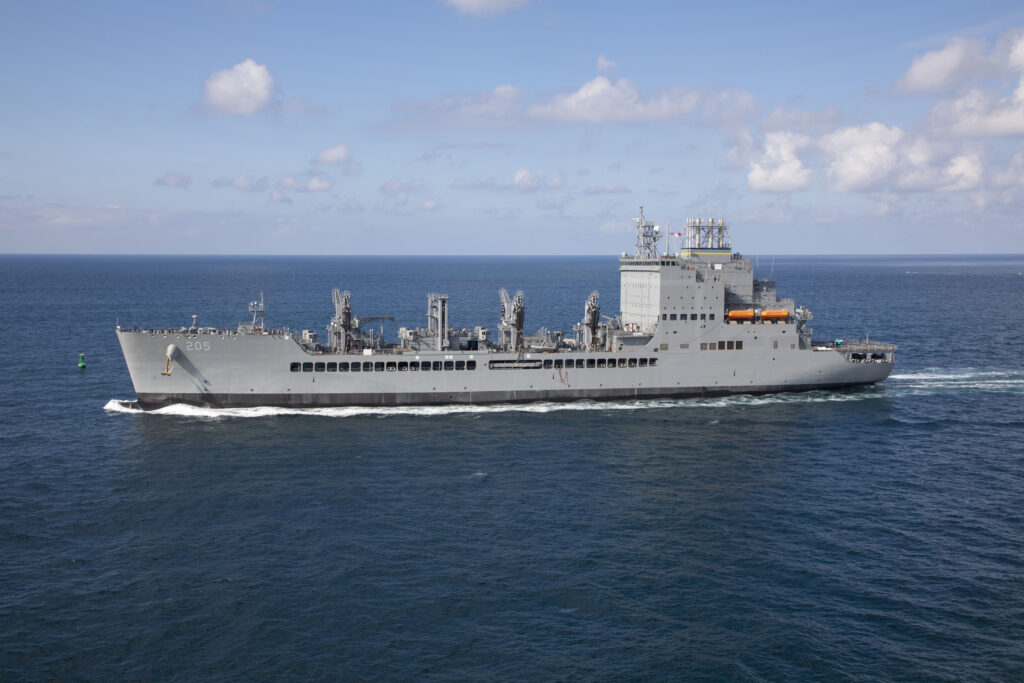
Fleet Oiler USNS John Lewis Conducts Builder’s Trials
USNS John Lewis (T-AO 205), the Navy’s lead ship of its new class of fleet replenishment oilers, conducted initial builder’s trials and returned to port on Feb. 4. GENERAL DYNAMICS NATIONAL STEEL AND SHIPBUILDING. CO.
WASHINGTON — USNS John Lewis (T-AO 205), the Navy’s lead ship of its new class of fleet replenishment oilers, conducted initial builder’s trials and returned to port on Feb. 4, Team Ships Public Affairs said in a release.
Builder’s trials consist of a series of in-port and at-sea demonstrations that allow the Navy and the shipbuilder, General Dynamics National Steel and Shipbuilding Co., to assess the ship’s systems and readiness prior to acceptance trials and delivery to the Navy.
“Ensuring readiness through sea trials is a crucial step to bringing this ship closer to fleet tasking,” said John Lighthammer, program manager at the Auxiliary and Special Mission Shipbuilding Program Office. “USNS John Lewis will provide much needed capability to the fleet as the primary fuel pipeline at sea. We are looking forward to getting the ship into the hands of Sailors and merchant mariners as another tool to support at-sea operations.”
The new John Lewis-class T-AOs will be operated by Military Sealift Command to provide diesel fuel and lubricating oil, and small quantities of fresh and frozen provisions, stores, and potable water to Navy ships at sea, and jet fuel for aircraft assigned to aircraft carriers. The new T-AOs will add capacity to the Navy’s combat logistics force and become the cornerstone of the fuel delivery system.
General Dynamics National Steel and Shipbuilding Co. is currently in production on USNS Harvey Milk (T-AO 206), USNS Earl Warren (T-AO 207) and USNS Robert F. Kennedy (T-AO 208). The future USNS Lucy Stone (T-AO 209) and USNS Sojourner Truth (T-AO 210) are under contract.
Two Sea Cadet Units Qualify for National CyberPatriot Finals
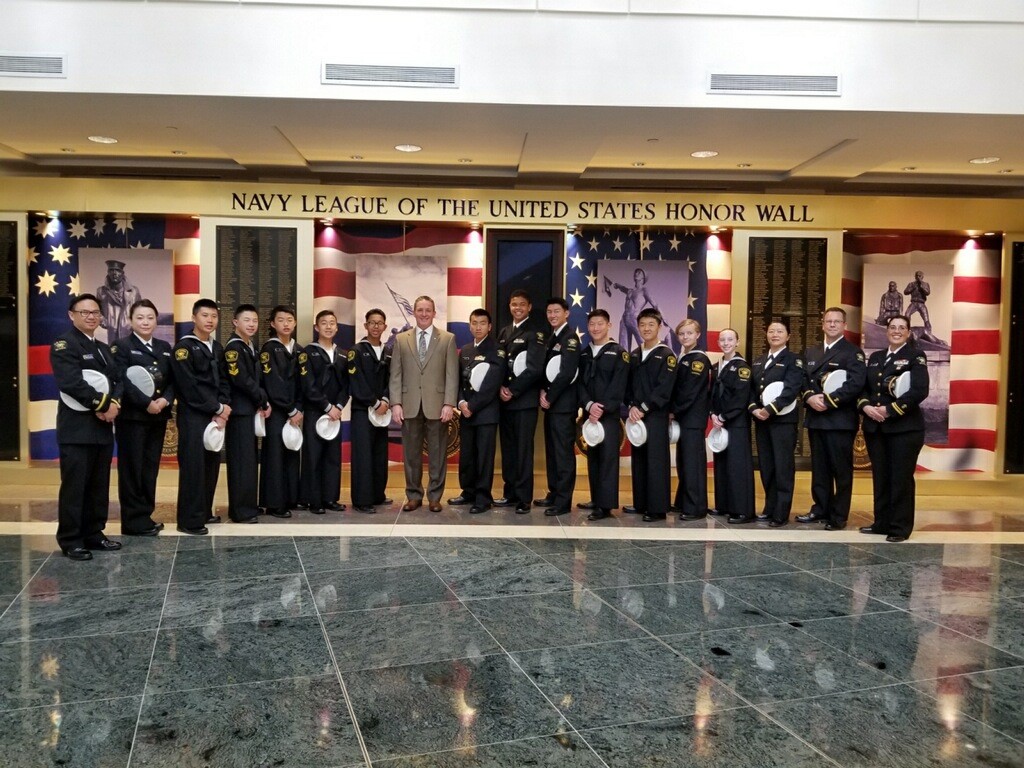
Band of the West and Sacramento Division Sea Cadets shown with Navy League CEO Mike Stevens in 2019. U.S. NAVAL SEA CADET CORPS
BETHESDA, Maryland — The U.S. Naval Sea Cadet Corps has qualified two teams to compete in the CyberPatriot National Final team competition set for March 17-21 in Bethesda, Maryland.
Sacramento Division and Band of the West Division will represent the youth organization at the All-Services Division Nationals. Both units are based in California and have years of experience competing in CyberPatriot annual competition.
Sacramento Division’s Team Spartan has competed in the All-Services Division Nationals competition five years in a row since 2018.
“I enjoy witnessing each one of my CyberPatriot members develop their skills, foster friendships, and work as a team,” said Sea Cadet Ensign Matt Foreman. “I feel like my job is to provide general direction, a safe place to compete, and the resources for them to succeed.”
Foreman added that four of the youth team members have made it to nationals four years in a row.
“This year, three of those elite members are now celebrating their fourth year in a row, which should qualify them for special recognition,” said Foreman.
Each of the Team Spartan cadets specializes in one of three platforms: Microsoft Windows, Linux, or Cisco. When he thinks of leaders and the impact they can have, he recalls the famous Gen. George S. Patton quote. “Don’t tell people how to do things, tell them what to do and let them surprise you with their results.”
In its 14th year, the CyberPatriot program has more than 5,200 teams competing, of which the Sea Cadet youth organization had nearly 20 teams enrolled. The CyberPatriot program helps direct students toward careers in cybersecurity or another computer, science, technology, engineering, and mathematics discipline.
Band of the West Division’s CyberPatriot Team Silicon Knights Team and the Sacramento Division’s Team Spartan benefit from keen experts who guide cadets, such as the instructor Lt. j.g. Ming Ikehara, who serves as a volunteer training officer and brings forth extensive knowledge and experience in cybersecurity for the Silicon Knights.
“For cadets to acquire technological skills and critical thinking to protect personal privacy to national defense is extremely essential and important,” said Ikehara. “I also volunteer to inspire girls to get into cybersecurity and engineering disciplines.”
Petty Officer 1st Class Arkin Si, team captain, Silicon Knights, emphasized the amount of time devoted to the CyberPatriot team leading up to the annual competition to the nationals.
“Our team practiced every week for an hour each time, which doesn’t include the countless hours outside of practice that members needed in order to become accustomed to the various operating systems that they were unfamiliar with, especially the strategies needed for the competition,” said Si.
The Silicon Knights have been to National Finals three previous times, in 2016, 2018 and 2020. The members join the CyberPatriot team. They practice and compete outside of their regular drill time since they represent the nation’s only Sea Cadet band.
Team Spartan is like Team Silicon Knights in the type of dedication these cadets displayed.
“Most learning took place independently via school classes, independent practice, and team collaboration,” said Foreman. “These cadets are passionate about preparing for CyberPatriot competitions. They spend countless hours preparing for each competition.”
The Sea Cadets who participate and lead the teams, such as Chief William Smith, who serves as the captain of Team Spartan, said participating in CyberPatriot has been an unforgettable experience for each of them and they are honored to represent the Sacramento Division again this year.
“CyberPatriot has provided Team Spartan the unique opportunity to broaden our cybersecurity skills through learning from real-world scenarios and threats,” Smith said. “We are very grateful for the tremendous support from Sacramento Division of the Sea Cadet Organization. The discipline, teamwork, and leadership skills we’ve trained have helped us qualify for National Finals in the past five years.”
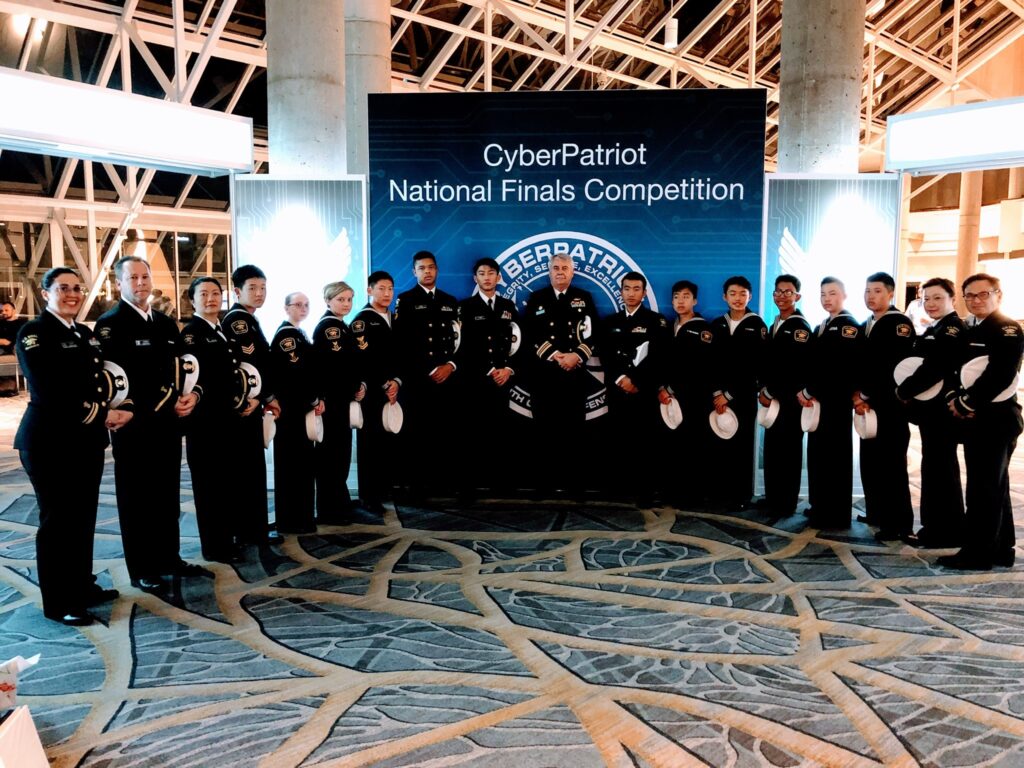
Band of the West and Sacramento Division Sea Cadet teams at the 2019 CyberPatriot finals. U.S. NAVY SEA CADET CORPS
Foreman added that new team members experience a steep learning curve, but senior team members mentor the new cadets and foster their skills.
“Overall, the success of team Spartan is not forced. Rather, it is fueled by their desire and personal interest,” said Foreman.
Ikehara said she enjoys teaching the youth about cybersecurity, and her motivation to instruct the youth centers on introducing them to cybersecurity career paths, but more importantly to training them to be vigilant cyber citizens in everyday life.
The Silicon Knights team has a better understanding of cybersecurity from participating in CyberPatriots.
“Understanding cybersecurity is crucial to ensure safety as the world moves toward automation and increases its reliance on computers. It is also important to understand how to secure a computer and ensure that it has no vulnerabilities that can be exploited,” said Si.
Each member spends at least 80 hours of instructor-led and online courses each season. Many of the cadets spend more hours on their own to study and research materials on their own.
“We have great resources to tap into and of course, it furthers esprit de corps and brings pride to our unit. We are also proud to serve and represent the NSCC on a national level,” said Lt. Cmdr. Jo-Anne Dao, commanding officer, Band of the West Division. “I always remind my cadets that this is their team, not mine. And they may take it as far as they wish, but I am here to offer support in any way or form for them to succeed. But ultimately, it is their hard work, determination, and teamwork that will get them to where they want. Great life lessons here.”
For the Silicon Knights Team, many of their youth members start as middle schoolers and continue to the high school team. In the past six years, their team has consistently achieved the Platinum tier. The unit has a second high school team, the Silicon Ensembles, which has also achieved 1st place in the state awards in season 10.
Dao emphasized the sheer level of training, commitment and talent that went into competing this year.
“The Silicon Knights must be in good standing in the Band of the West in order to even participate,” she said.
This means that in addition to the weekly drill, team members train, practice, and compete outside drill hours from November through March. This is a huge commitment from cadets and staff,” said Dao, but all that effort definitely paid off.
“For me, I am just so proud of my cadets. They come from all over the San Francisco area from different backgrounds and they all work together as a team to make it this far,” said Dao.
She added that the cadets competing in CyberPatriot are also based in Silicon Valley and from her vantage point, it is important because so many cadets have an interest in this field for future careers.
Lt. Cmdr. Jeffery Dao, who is married to Jo-Anne Dao, serves as the regional director for the U.S. Naval Sea Cadet Corps.
“We are so proud of the cadets and grateful to Lt. j.g. Ikehara for making this opportunity possible,” said Dao, who serves as the executive officer for Band of the West, was thankful to the Navy League Marin County Council for their financial support and the Navy League STEM Grant which allowed his unit to equip its cadets with the computing gear and instructional materials needed for this training. “U.S. Naval Sea Cadet Corps units should apply for STEM grants,” he said.
AARGM-ER Completes 2nd Successful Missile Live Fire Test
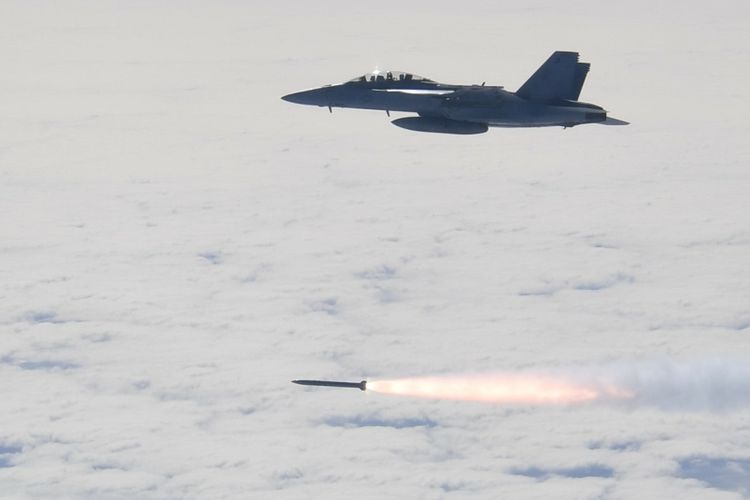
An AARGM-ER is successfully launched from a U.S. Navy F/A-18 Super Hornet during a recent test at the Point Mugu Sea Range, California. U.S. NAVY
LOS ANGELES — Northrop Grumman Corp. announced Feb. 7 the successful completion of the second flight test of its AGM-88G Advanced Anti-Radiation Guided Missile Extended Range.
The U.S. Navy launched the missile from an F/A-18 Super Hornet aircraft Jan. 21 at the Point Mugu Sea Range off the coast of southern California. The missile performed an extended range profile, engaging a land-based, emitter target staged at the range on San Nicholas Island.
“This second flight test verified AARGM-ER’s ability to detect, identify, locate and engage a land-based air defense radar system from an extended range,” said Captain A.C. Dutko, Navy Program Manager for Direct and Time Sensitive Strike (PMA-242). “Through the exceptional efforts of our government-industry team, we are another step closer to delivering capability to suppress the most advanced adversary air-defense systems without putting our warfighters in danger.”
Since achieving a milestone C decision (authorization for low-rate initial production) in September 2021, AARGM-ER prime contractor Northrop Grumman has continued to lead its industry team in developing the system. Northrop Grumman is currently under contract to deliver production units of AARGM-ER to support a 2023 initial operational capability fielding. In December 2021, Northrop Grumman received a $45.6 million contract for the second lot of AARGM-ER LRIP.
AARGM-ER leverages existing state-of-the-art AARGM sensors, electronics and digital models with the addition of a new high-performance air vehicle, solid rocket motor propulsion system and advanced warhead.
“AARGM-ER provides the U.S. Navy with the capability to stay ahead of evolving threats,” said Mary Petryszyn, corporate vice president and president of Northrop Grumman Defense Systems. “This flight test further demonstrated the critical capability of AARGM-ER to precisely engage long-range threats, while enabling launching aircrew to remain at a safe distance.”
AARGM-ER is being integrated on the Navy F/A-18E/F Super Hornet and EA-18G Growler aircraft as well as F-35A/B/C aircraft.
Commandant Sees Bigger Role for Marine Raiders in Great Power Competition
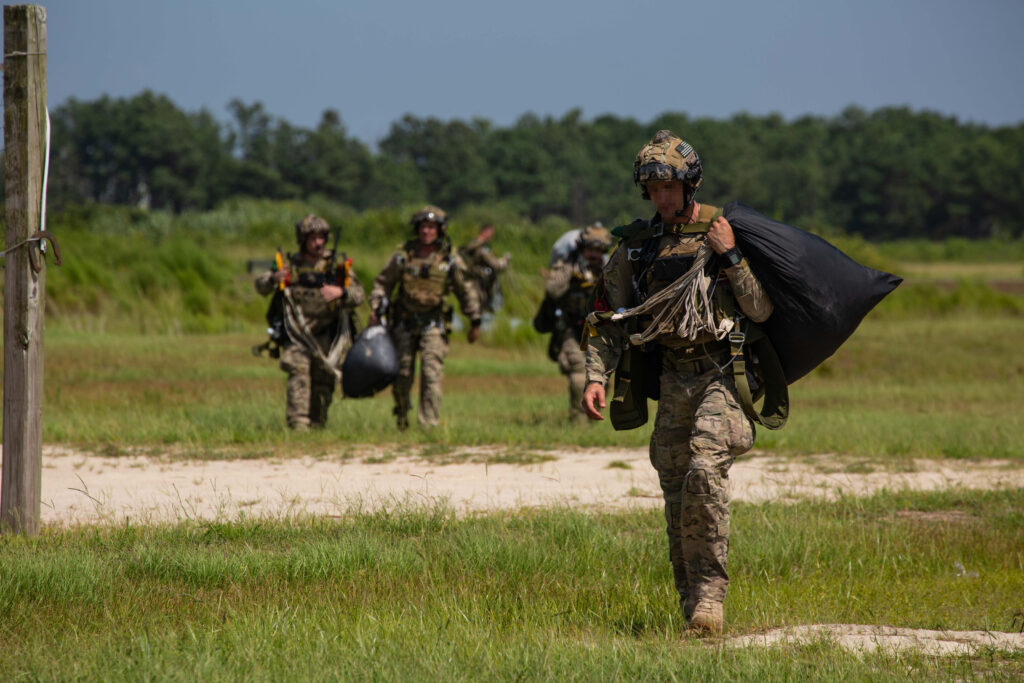
Marine Raiders rehearse advanced military free fall jumps at Camp Lejeune, N.C., Sept. 1, 2021. Military free fall sustainment training is necessary for a Marine special operations team to stay proficient and ready at all times for future operations. U.S. MARINE CORPS / Cpl. Ethan Green
ARLINGTON, Va. — Like the rest of U.S. Special Operations Command, Marine Raiders will have a bigger role to play in the military’s competition with a rising China and resurgent Russia, the Marine Corps commandant says.
After 20 years with a heavy focus on counter insurgency and counter terrorism in Iraq, Afghanistan and other flashpoints around the globe, “I do see a bigger role for them and probably an adjusted role,” Gen. David Berger said Feb. 8 at the National Defense Industrial Association’s virtual Expeditionary Warfare Conference.
“Now, how do we use special operations forces in great power competition?” Berger said, adding he thought Marine Special Operations Command would follow a similar path as the rest of the Marine Corps in the near future, “Back to naval roots. How does it support the naval expeditionary forces forward?”
Among their roles, Marine Raider units train, advise and assist friendly host nation forces, including naval and maritime military and paramilitary forces. The aim is to help local forces support their governments’ internal security and stability, counter subversion and reduce the risk of violence from internal and external threats, according to the MARSOC website.
“Their great value,” Berger said “is their persistent presence forward” as well as their deeper cultural understanding and language skills in the places they operate. “Conventional forces don’t normally have any of that. They also don’t have the finer, nuanced, higher level skills that MARSOC Marines have, and I’m not talking about kicking down a door,” he said.
Instead, he meant Raiders’ skills in collecting information and intelligence in a discreet manner while deployed far forward. “If you married that up with a higher performing infantry battalion or conventional force, you will have the best of all worlds,” he said.
In late January, Marines from the 3rd Marine Raider Battalion worked with the 8th Marine Regiment’s 1st Battalion on close-quarters battle training, including hallway and stairwell clearing procedures and sensitive site exploitation. The three-day training session at Camp Lejeune, North Carolina, sought to improve cooperation among the conventional Fleet Marine Force and Special Operations Forces.
Going forward, Berger believed MARSOC, like the entire Corps, would have to adjust their focus from 90% counterinsurgency and counter terrorism to “a much better balance of integrated deterrence, campaigning, crisis response, in other words, meeting us somewhere in the littorals, where the Corps’ skillset strength is.”
Analysts: Navy’s LAW Shipbuilding Program Must Resist Requirements Creep
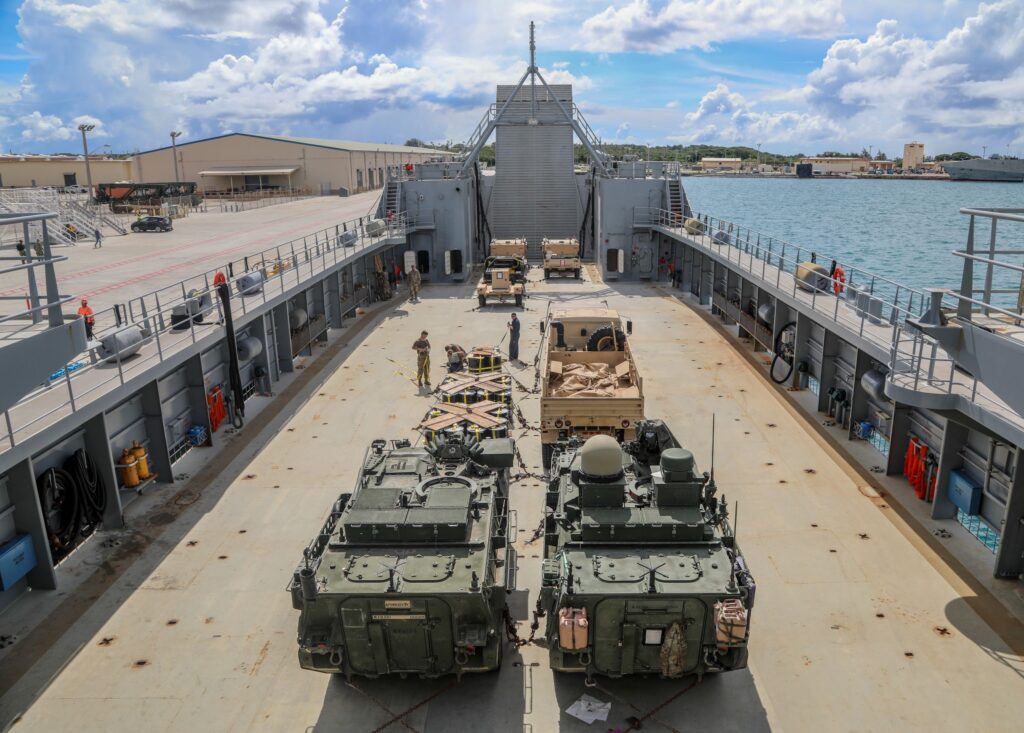
The crew of U.S. Army logistics support vessel Lt. General William B. Bunker (LSV-4), loaded equipment and supplies on LSV-4 in Guam in July 2021 for theater distribution operations in support of Defender Pacific 2021. Some call for the LSV to be used as a bridge to the Navy’s planned light amphibious warship. U.S. ARMY / Staff Sgt. Kevin Martin
ARLINGTON, Va. — The U.S. Navy’s program to build a force of light amphibious warships faces challenges, including an uncertain amphibious warfare fleet force structure requirement and a risk of requirements creep, according to analysts.
Eric Labs, senior analyst for Naval Forces and Weapons, Congressional Budget Office, and Ron O’Rourke, naval affairs analyst for the Congressional Research Service, spoke Feb. 8 at the National Defense Industrial Association’s Expeditionary Warfare Conference, addressing Navy shipbuilding plans with a focus on amphibious warfare ships.
The Navy, in response to the need of the Marine Corps for a large number of smaller amphibious warfare ships for distributed maritime operations and expeditionary advance base operations, is planning to design and build the light amphibious warship to augment the amphibious lift fleet. The LAW would be able to beach and discharge Marines and their vehicles on a shore.
Labs pointed out that the future of amphibious forces is “facing challenging times for the next five years,” and finds that there is “no natural constituency” for the LAW.
Labs said the number of LAWs needed by the fleet has not been refined. Recent shipbuilding plans, he pointed out, have variously assumed a build range of 24-35 LAWs. The requirement for large and medium-sized amphibious warfare ships — amphibious assault ships (LHA/LHDs) and amphibious transport dock ships (LPDs) — is no longer 38 ships, but over the last year variously is said to be 24 to 32 ships. The Navy has not provided to Congress a 30-year shipbuilding plan for two years.
O’Rourke warned against requirements creep that could increase the cost of the LAW program and threaten the Navy’s estimate of a LAW’s cost of $130 million to $150 million.
“The LAW represents an effort to break that price trend,” O’Rourke said.
He noted the success of the Arleigh Burke-class guided-missile destroyer (DDG) in its beginnings, when the Navy determined to build five DDGs in one fiscal year, designing ships not just with capabilities in mind but also with numbers of ships in mind, and was able to meet its goal of five in one year.
O’Rourke noted there is some pushback in Congress about the LAW concept because of concerns about the survivability of the ship and of the ability to resupply Marines inside an island chain where the Marines would be delivered.
O’Rourke also noted a suggestion as an option that a small number U.S. Army’s logistic support vessels — similar in size to that envisioned for the LAW — be used as surrogates for the LAW, as a bridge to the LAW. The Army LSVs are equipped with a bow ramp to discharge vehicles on shore.
IMSC Integrates Unmanned Vessel During IMX/CE22
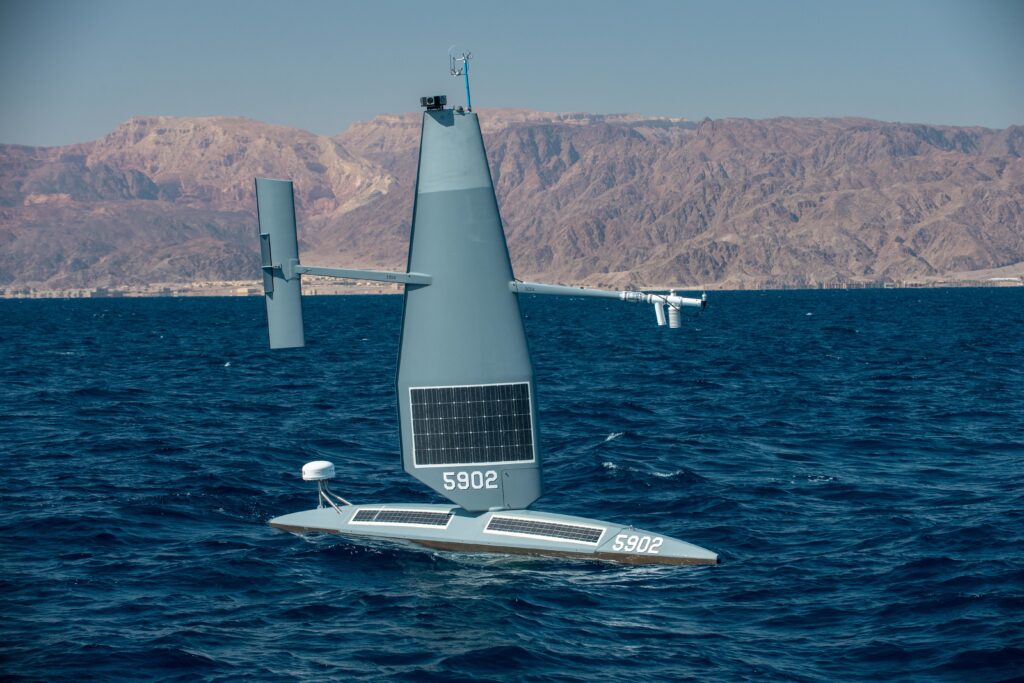
A Saildrone Explorer unmanned surface vessel sails in the Gulf of Aqaba during International Maritime Exercise/Cutlass Express 2022. U.S. NAVY / Mass Communication Specialist 2nd Class Dawson Roth
NAVAL SUPPORT ACTIVITY BAHRAIN — International Maritime Security Construct participated in unmanned integration operations in the Arabian Gulf during International Maritime Exercise/Cutlass Express 2022, Feb. 3, the Coalition Task Force Sentinel Public Affairs Office said Feb. 8.
IMSC personnel operated with two Saildrone Explorer unmanned surface vessels. The Saildrones were launched by Task Force X, a combined task force established for conducting portions of the exercise focused on unmanned systems and artificial intelligence integration.
The Saildrone Explorer is a 23-foot-long, 16-foot-tall USV reliant on wind power for propulsion. The vessel houses a package of sensors powered through solar energy for building a shared picture of the surrounding seas.
Leaders from IMSC observed the capabilities of unmanned systems deployed during operational training scenario at sea from aboard the Royal Bahrain Naval Force ship RBNS Al Muharraq.
“The exercise was a perfect demonstration of progress towards delivering a genuinely ‘digital ocean’ where navies increasingly employ a combination of manned and unmanned systems, on, above, and below the surface, to deliver unparalleled situational awareness and operational choice to the commander,” said Commodore Don Mackinnon, commander of CTF Sentinel.
CTF Sentinel is a multinational maritime effort that promotes maritime stability, ensures safe passage, and enhances freedom of navigation throughout key waterways in the Arabian Gulf, Strait of Hormuz, Gulf of Oman, Gulf of Aden, the Bab al-Mandeb and the Red Sea. The coalition is comprised of eight member nations including Albania, Kingdom of Bahrain, Republic of Estonia, Lithuania, Kingdom of Saudi Arabia, United Arab Emirates, United Kingdom and the United States.
USS O’Kane Returns Home from Deployment
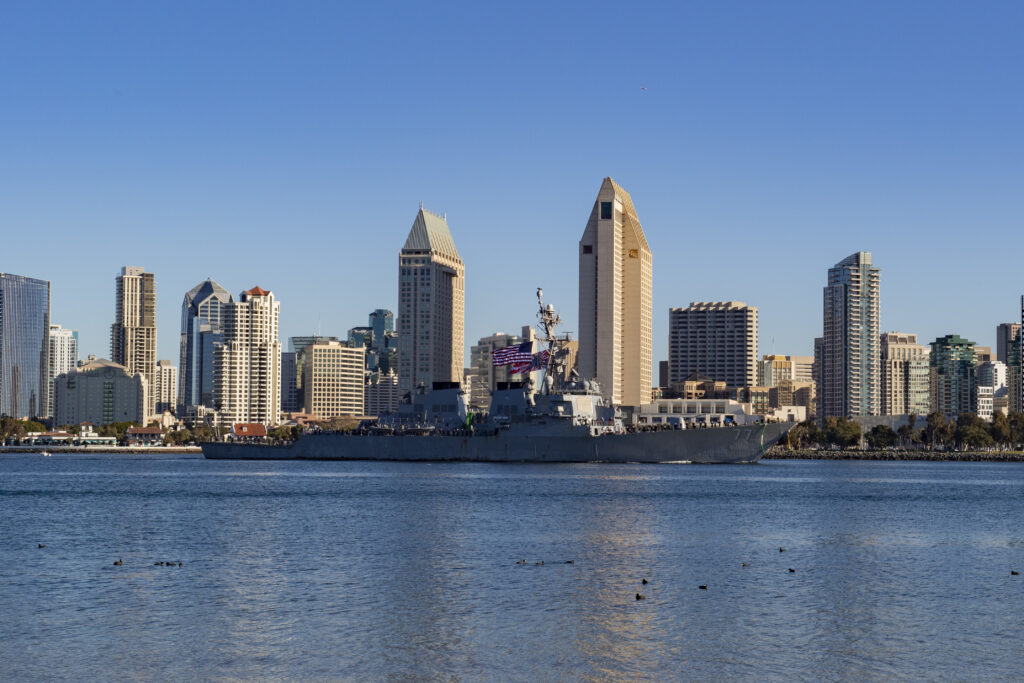
The guided-missile destroyer USS O’Kane (DDG 77) arrives returns to its homeport in San Diego. O’Kane, a part of the Carl Vinson Carrier Strike Group, returned to Naval Base San Diego Feb. 6, following an independent deployment to the U.S. 5th and 7th Fleets in support of national tasking and to ensure a free and open Indo-Pacific. U.S. NAVY / Mass Communication Specialist 2nd Class Kevin C. Leitner
SAN DIEGO — The Arleigh Burke-class guided-missile destroyer USS O’Kane (DDG 77) returned home to Naval Base San Diego on Feb. 6, completing an eight-month independent deployment to the U.S. 5th and 7th Fleet areas of operation, said U.S. 3rd Fleet public affairs.
O’Kane deployed in June 2021 in support of national tasking, serving as the ballistic missile defense commander for Carrier Strike Group 1 while operating in the U.S. 7th Fleet and the primary ballistic missile defense asset while in the U.S. 5th Fleet.
The Sailors aboard USS O’Kane lead the way in demonstrating resiliency and dedication to support the mission and each other,” said Cmdr. Michelle R. Fontenot, O’Kane’s commanding officer. “As an independent deployer serving in both the U.S. 5th and 7th Fleets, O’Kane met each mission with success.”
While operating in U.S. 5th Fleet, O’Kane escorted multiple high-value units through 30 strait transits, including the Strait of Hormuz, Bab el-Mandeb and the Suez Canal. O’Kane participated in several high-end exercises such as maritime security operations in support of the International Maritime Security Coalition, collaborating with seven partner nations for security and the free flow of commerce.
O’Kane also participated in Indigo Defender, a bilateral maritime exercise between Saudi naval forces and U.S. Naval Forces Central Command. In addition, O’Kane conducted maritime interdiction operations; board, search, and seizure operations; and operated alongside international navies, including the Egyptian naval force, Royal Saudi navy and the Indian navy.
Following Israel’s transition from the U.S. European Command theater to U.S. Central Command area of responsibility in September, O’Kane Sailors were able to enjoy a visit to Haifa, further strengthening the U.S.partnership with Israel.
O’Kane served as a key facilitator in a highly successful seizure of illicit cargo from a stateless fishing vessel during a flag verification boarding in accordance with customary international law in the North Arabian Sea on Dec. 20. O’Kane worked alongside the Cyclone-class coastal patrol ships USS Tempest (PC 2), USS Typhoon (PC 5), and the U.S. Coast Guard Advanced Interdiction Team to seize 1,400 AK-47s and 226,000 rounds of ammunition.
Upon completion of the missions in U.S. 5th Fleet, O’Kane entered U.S. 7th Fleet and took part in expeditionary strike force operations with the Wasp-class amphibious assault ship USS Essex (LHD 2) and the Nimitz-class aircraft carrier USS Carl Vinson (CVN 70). The U.S. force of more than nine ships conducted underway replenishments, including vertical and connected replenishments. O’Kane executed anti-submarine warfare operations while escorting high-value assets through the South China Sea.
“O’Kane’s tireless commitment and unparalleled performance are above reproach. I am very proud of every O’Kane Sailor and what we have accomplished as a team,” said Fontenot. “O’Kane Sailors represent the Navy’s fighting spirit and it is an honor to serve them as their commanding officer.”
Rep. Luria: Congress Needs Frank Budget Requirements from Navy — and Consequences of Not Funding Them
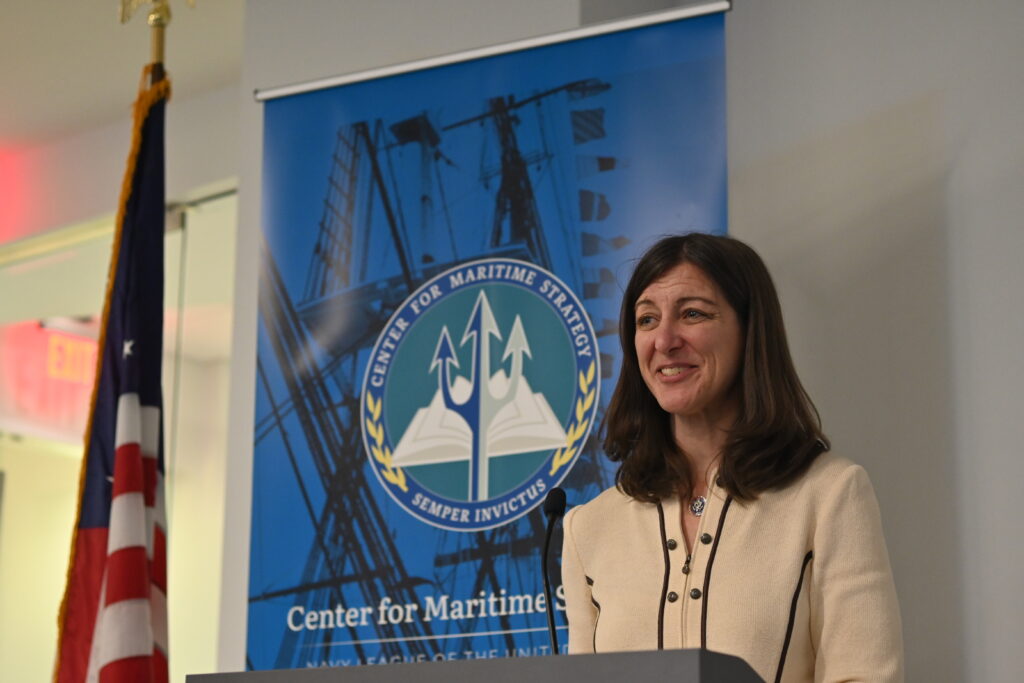
Rep. Elaine Luria (D-Virginia), speaking at the Jan. 31 ribbon cutting for the Center for Maritime Security. NAVY LEAGUE / Brett Davis
ARLINGTON, Va. — The Navy needs to be frank in telling Congress what it needs to meet its warfighting requirements in the National Defense Strategy and the consequences if requirements are not funded, the vice chair of the House Armed Services Committee said Feb. 7.
“As a member of Congress, what do we want to hear? We want the services to come to us and essentially say, ‘This is what we need, this is why, and — most of all — this is the risk of not doing it,’” said Rep. Elaine Luria, (D- Virginia), deputy chair of the HASC, in a conversation with the Hudson Institute’s Bryan Clark. “And that is a portion of what is not being communicated.
“It’s like a shell game,” Luria said. “The Navy comes to us and says, ‘We only want to build one DDG this year,’ but the other DDG is on your unfunded list?”
She said Congress needs to know the risks of not funding budget requirements.
“Then it is on Congress to make a decision about the risk of not doing those things,” she said. “It is never articulated. It shouldn’t be up to Congress to say to the Navy, ‘Hey, we really want to give you more,’” she said.
“It’s all backwards,” Luria said. “There should be a strategy, the strategy drives the requirements, the requirements drive the POM [Program Objective Memorandum], the POM [becomes] the budget.”
Luria, a retired Navy nuclear-trained surface warfare officer, said she watched recordings of the testimony before Congress during the 1980s of then-Navy Secretary John Lehman advocating his Maritime Strategy and a 600-ship Navy.
“Essentially, where the discussion led [was], ‘This is what we need — that equals 600 ships — and here’s the risk of not doing that,’” she paraphrased Lehman as saying.
“That’s not being communicated in that way [today],” noting that things like 30-year shipbuilding plans are not “put into context, what that means, what presence delivers, and what deterrence that equates to with regard to China potentially trying to take Taiwan by force. It’s not being communicated in a way that’s compelling.
“There is a lack of a maritime strategy, and it is important to understand what the strategy is,” Luria said. “I think the previous administration had a good focus on what needed to be done. … We’re kind of starting over again without really understanding what the future of the fleet looks like.”
Luria questioned the integrated deterrence concept of the current administration as not something new, but a “just the newest buzzword. Has anyone clearly defined what it is?”
The lawmaker said for deterrence, “you actually have to have deterrence — you have to have the forces.”
She has been critical of Navy plans to “divest to invest,” noting the investments are frequently short-changed, resulting, for example, in “two decades of lost shipbuilding opportunities.”
Luria affirmed that more budget resources “need go to the Navy and the Air Force because that’s the nature of the [Pacific] theater.”
HII Completes Initial Sea Trials of Virginia-class Submarine Montana
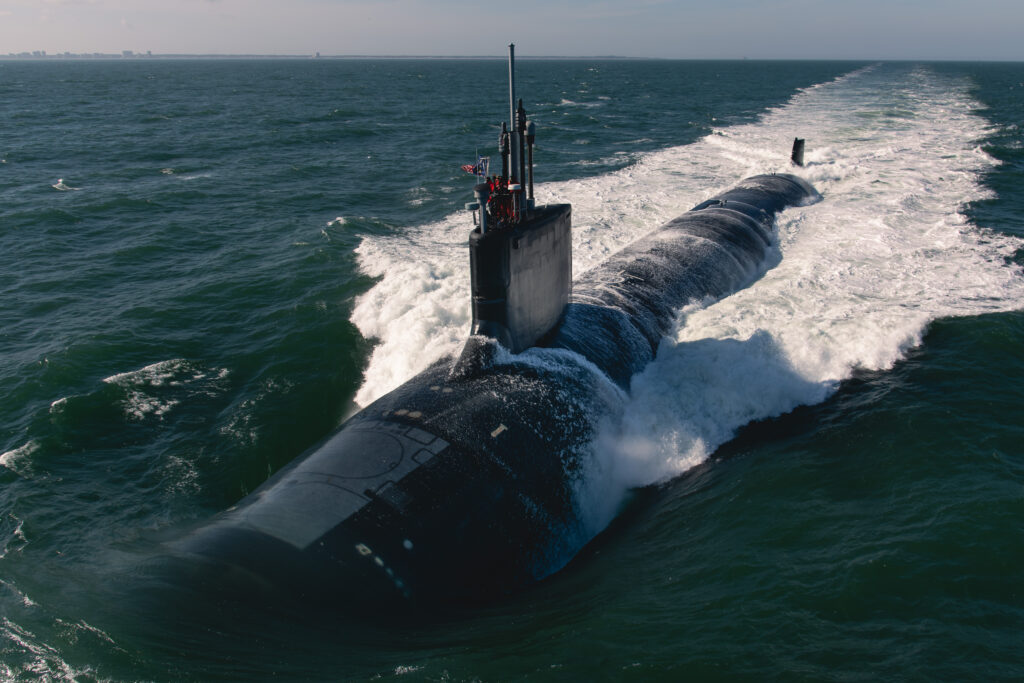
USS Montana has successfully completed sea trials, Huntington Ingalls Industries announced Feb. 7. HUNTINGTON INGALLS INDUSTRIES / Ashley Cowan
NEWPORT NEWS, Va. — Huntington Ingalls Industries announced Feb. 7 the successful completion of the initial sea trials last week of fast attack submarine USS Montana (SSN 794). The Virginia-class submarine, built at HII’s Newport News Shipbuilding division, spent several days at sea last week to test the ship’s systems and components.
Testing included submerging the submarine for the first time and high-speed maneuvers while on the surface and submerged. HII teams will continue the testing program and will deliver the boat to the U.S. Navy later this year.
“We are very proud to say the Montana and her crew performed exceptional,” said Jason Ward, Newport News Shipbuilding vice president of Virginia-class submarine construction. “Taking the ship to sea for the first time is a huge milestone for everyone involved. The crew, thousands of suppliers from around the country and shipbuilders from HII and Electric Boat can be proud the ship was successfully brought to life and will soon be part of the world’s greatest Navy.”
Construction of Montana began in 2015. The boat — the 21st Virginia-class submarine built as part of the teaming partnership with General Dynamic’s Electric Boat — was christened in September 2020.
Icebreaker Polar Star Arrives in Antarctica
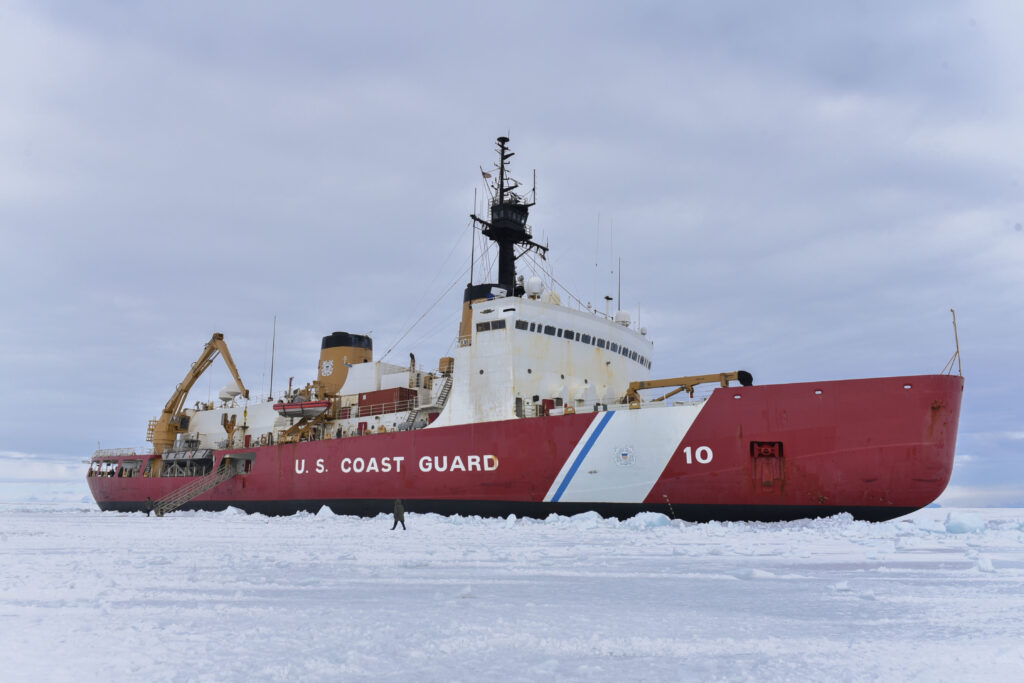
U.S. Coast Guard Cutter Polar Star sits hove-to on a cloudy day in Antarctica, Jan. 17. Polar Star is in its 25th year participating in Operation Deep Freeze, one of many operations in the Indo-Pacific region in which the U.S. military promotes security and stability across the region. U.S. COAST GUARD / Petty Officer 3rd Class Diolanda Caballero
MCMURDO STATION, Antarctica — The 157 crewmembers of the U.S. Coast Guard Cutter Polar Star (WAGB 10) arrived at McMurdo Station in Antarctica Feb. 7 following an 86-day transit from the United States and the cutter’s departure from its Seattle homeport Nov. 13, the Coast Guard Pacific Area said in a release.
This deployment marks the Polar Star’s 25th journey to Antarctica supporting Operation Deep Freeze, an annual joint military service mission to resupply the United States Antarctic stations in support of the National Science Foundation, lead agency for the United States Antarctic Program.
Each year, the crew pilots the 399-foot, 13,000-ton cutter to break a navigable channel through miles of ice, sometimes as much as 21 feet thick, to allow fuel and supply ships to reach McMurdo Station, the U.S. Antarctic Program’s logistics hub and largest station.
Polar Star reached the Ross Sea, Antarctica, Jan. 3, and commenced breaking the 37 miles of ice that extended from the ice pier in Winter Quarters Bay at McMurdo Station out to open water. Polar Star spent four weeks breaking ice and grooming the shipping channel. The crew’s efforts were aided by favorable winds and currents and by month’s end had created an open and ice-free approach for the supply vessels.
The cleared channel to McMurdo Station will enable two supply vessels, Maersk Peary and Ocean Giant, to safely offload over eight million gallons of fuel and 1,000 cargo containers. Together these two ships carry enough fuel, food, and critical supplies to sustain USAP operations throughout the year until the next sealift opportunity in the austral summer of 2023.
The cutter made international stops in Wellington and Lyttelton, New Zealand on the way to Antarctica. While in New Zealand, the crew engaged with the Royal New Zealand Navy, United States Embassy and volunteered in Christchurch at the local Society for the Prevention of Cruelty to Animals.
Polar Star will also partner with the Royal New Zealand Navy’s largest ship, Her Royal Majesty’s New Zealand Ship Aotearoa, in support of resupplying Scott Base, New Zealand’s year-round Antarctic research facility.
“It is a tremendous honor to lead the men and women of Polar Star on this important mission,” said Capt. William Woityra, commanding officer of Polar Star. “This team brought renewed energy and passion to this 46-year-old ship, and overcame significant challenges to deliver exceptional results.”
Assigned to Operation Deep Freeze each year, the icebreaker spends January and February breaking ice in Antarctica. Polar Star returns to the United States after completing the mission.
This year also marks the Polar Star’s return to Antarctica following the onset of the COVID-19 pandemic. In the 2020-2021 season, Polar Star conducted a winter Arctic deployment, during which the cutter trekked to the Arctic Circle to project constructive presence in the northern high latitudes under winter conditions and train the next generation of polar sailors. Their efforts resulted in setting a record for the furthest north any American surface vessel has been in the winter months.