Mission-aware software fuses physics-based digital twins and real-time data to anticipate risk and deliver mission success for autonomous and human decision-makers.
COLUMBIA, S.C., January 26, 2026 — Integer Technologies, a leading provider of predictive intelligence and mission-level planning for naval vessels that enables better, faster, and more responsive decision-making, today announced the launch of its DIGIT Mission Assurance Platform, engineered to secure decision advantage for autonomous and human-in-the-loop operations across the distributed maritime battlespace.
Built to thrive in denied, degraded, intermittent, and limited (DDIL) environments, DIGIT fuses high-fidelity digital twins with real-time environmental forecasting, empowering operators to assess, coordinate, and adapt mission plans at the tactical edge. By integrating real-time sensor data with physics-based models, platforms adapt automatically to evolving threats; and with persistent situational awareness, a continuous heartbeat of mission and vessel health gives operators critical state awareness for both manned and unmanned platforms even when traditional communication links are severed.
“The next generation of defense technology will be defined by software that can anticipate, not just respond,” said Duke Hartman, Integer co-founder and Chief Executive Officer. “From platform-level introspection to global fleet orchestration, DIGIT provides the software architecture to win the fight. It represents a fundamental shift toward mission-aware technology, giving operators and autonomous systems the foresight to make confident decisions to deliver successful mission outcomes.”
DIGIT is scalable, interoperable, and adaptable, with the ability to support manned and unmanned surface and underwater vehicles, including the recently announced guided missile battleship and the future frigate. From a single vessel to an entire Golden Fleet, DIGIT gives operators the ultimate decision advantage: the ability to foresee failure and adapt at machine speed. DIGIT will launch with three modules to support the warfighter’s specific mission needs:
DIGIT COMMAND – The multi-agent mission manager designed for the shore-side commander. It feeds existing command and control (C2) with a decision-support layer that compliments the power of DIGIT across an entire theater of operations.
DIGIT CORE – The introspective perception, planning, and resolution framework onboard a physical platform. DIGIT CORE delivers high-fidelity control over internal systems, enabling a level of precision that enhances human decision-making and platform responsiveness. This includes integrating real-time data with onboard modeling and simulation to continuously assess a craft’s propulsion and power systems, identify anomalies, and recommend corrective actions, expanding beyond traditional health monitoring to provide predictive, mission-level planning.
DIGIT UxV – The dynamic mission planning layer for unmanned underwater vehicles (UUVs) and unmanned surface vehicles (USVs), engineered to transform autonomous platforms from simple executors into resilient, adaptive, and mission-aware agents, even when communications become difficult or impossible. DIGIT UxV models the interaction between the platform and the environment, providing the decision advantage necessary for mission success.
“DIGIT was purpose-built for mission assurance,” said Josh Knight, Ph.D., Integer co-founder and Chief Operating Officer. “It’s not just about monitoring systems; it’s about understanding how changes impact the entire mission. Our DIGIT software provides that operational context, allowing teams to adapt quickly and preserve mission effectiveness under real-world constraints.”
Integer’s DIGIT is currently supporting U.S. Navy UxV efforts, including mission assurance work for the Metron-developed Lancet™ long-range, multi-mission unmanned undersea vehicle. For more information about DIGIT, visit www.integer-tech.com/digit or email [email protected].
Shore Boss Assesses Readiness, Quality of Life at NSA Singapore
From Commander, Navy Installations Command Public Affairs, 23 January 2026
SINGAPORE — Vice Adm. Scott Gray, commander, Navy Installations Command (CNIC), visited Naval Support Activity (NSA) Singapore Jan. 23, 2026, continuing a series of engagements across the Indo-Pacific focused on strengthening shore readiness and operational support to the fleet.
The visit supported a broader effort to evaluate how Navy installations enable global power projection, sustain forward forces and remove friction for operational commanders.
While in Singapore, Gray met with Rear Adm. Todd Cimicata, commander, Logistics Group Western Pacific and Task Force 73, and Capt. Silas Bouyer, commanding officer, Singapore Area Coordinator (SAC), to discuss installation capabilities, regional logistics posture and infrastructure priorities.
“NSA Singapore is one of those places where the mission never slows down, and the margin for error is small,” said Gray. “I’m here to see firsthand what our teams need to keep ships moving, keep Sailors supported and keep the fleet ready to respond at speed.”
Gray toured key areas of the installation, including SAC unaccompanied housing facilities, which primarily house junior enlisted Sailors when they are ashore. As part of the Secretary of War’s Barracks Task Force initiative and the Navy’s “Sailors First” principle, CNIC continues to drive improvements in barracks safety, habitability and cleanliness across the shore enterprise.
“If a Sailor can’t rest, reset and feel good about where they live, it shows up in the mission,” said Gray. “These walkthroughs are about spotting real issues, holding ourselves accountable and making sure our standards match what our people deserve.”
Gray also visited Changi Naval Base, where he toured the pier complex, ship repair facilities and Destroyer Squadron 7 spaces. The discussions centered on the strategic value of forward-positioned logistics and maintenance hubs in sustaining naval forces throughout the Indo-Pacific.
“When maintenance, parts, fuel and people come together seamlessly overseas, commanders gain options and flexibility,” said Gray. “That advantage only exists if we continue to invest, modernize and operate with urgency and discipline.”
CNIC enables and sustains naval forces from the shore by designing and delivering integrated shore capabilities to the fleet, fighter and family. Gray oversees 10 Navy regions and 70 installations worldwide.
CNFJ/RJ’s primary responsibility is to provide shore readiness to the fleet, liaise with the Japanese government and strengthen ties with the Japan Maritime Self-Defense Force. Navy Region Japan manages installations in Atsugi, Misawa, Okinawa, Sasebo, Yokosuka, Diego Garcia and Singapore.
U.S. Coast Guard Cutter Polar Star Marks 50 years of Service, Begins Operation Deep Freeze 2026
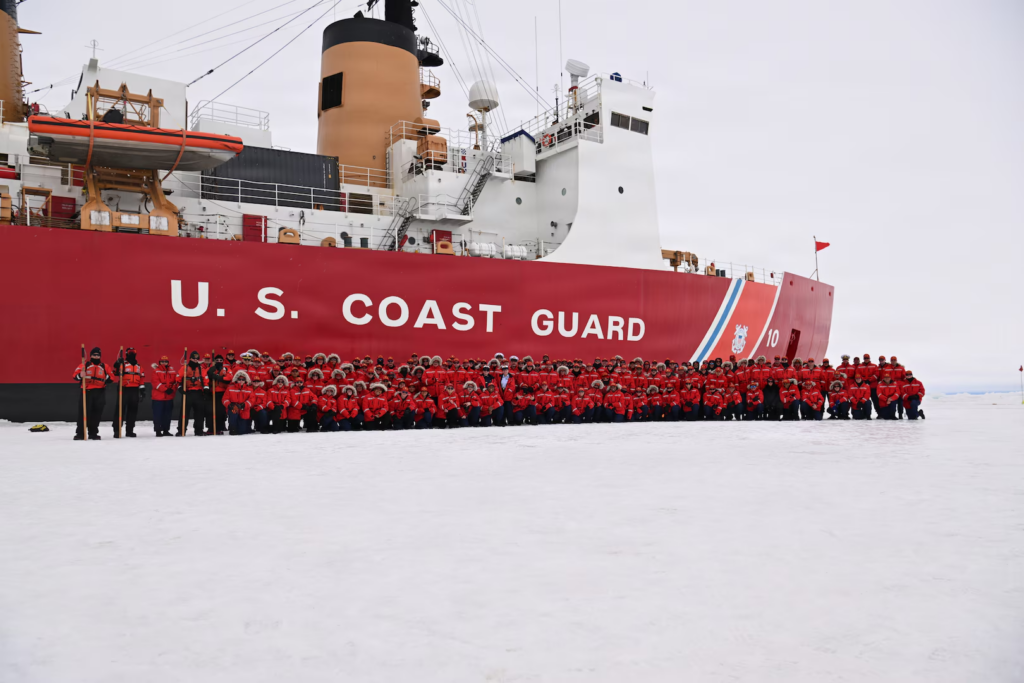
https://www.news.uscg.mil/Press-Releases/Article/4385905/us-coast-guard-cutter-polar-star-marks-50-years-of-service-begins-operation-dee/Caption: USCGC Polar Star (WAGB 10) crew members pose for a group photo while the cutter sits hove-to in the Ross Sea during Operation Deep Freeze 2026, Jan. 12, 2026. The cutter turned 50 years old on Jan. 17, 2026 amid Operation Deep Freeze, which is a joint service, inter-agency support operation for the National Science Foundation that manages the United States Antarctic Program. (U.S. Coast Guard photo by Petty Officer 2nd Class Christopher Bokum)
From U.S. Coast Guard Pacific Area, Jan. 23, 2026
SOUTHERN OCEAN — The U.S. Coast Guard Cutter Polar Star (WAGB 10) began icebreaking operations in the Southern Ocean in support of Operation Deep Freeze 2026 and marked its 50th year of commissioned service Saturday by freeing and escorting a cruise ship trapped in pack ice.
The Australian-owned cruise ship Scenic Eclipse II contacted Polar Star at approximately 11 p.m., local time Friday after becoming beset in pack ice roughly eight nautical miles from McMurdo Sound. Polar Star’s crew conducted two close passes to break the vessel free, then escorted it approximately four nautical miles to open water.
Polar Star departed Seattle in November for its 29th deployment to Antarctica in support of Operation Deep Freeze.
Operation Deep Freeze provides logistical support for the U.S. Antarctic Program, which is managed by the National Science Foundation. The mission includes strategic and tactical airlift, airdrop, aeromedical evacuation, search and rescue, sealift, seaport access, bulk fuel supply, cargo handling, and other transportation requirements. These efforts enable critical scientific research in one of the most remote regions on Earth.
Commissioned Jan. 17, 1976, Polar Star is the nation’s only active heavy icebreaker and has served as a cornerstone of U.S. presence in the polar regions. For five decades, the cutter has executed missions ranging from Antarctic resupply and search and rescue to environmental protection and national defense.
As the cutter transits the Southern Ocean en route to Antarctica, its crew reflects on a half-century of service defined by resilience, adaptability and dedication.
“I am constantly amazed at this crew’s tremendous energy and enthusiasm,” said Capt. Jeff Rasnake, Polar Star’s commanding officer. “Despite the many challenges associated with getting and keeping this ship on mission, they remain eternally positive and committed to meeting the high standards we’ve set for ourselves.”
Throughout its service life, Polar Star has completed dozens of Operation Deep Freeze missions and numerous Arctic deployments, defending U.S. sovereignty, securing critical shipping lanes, protecting energy and mineral resources, and countering our adversaries’ presence in the polar regions. Despite its age, the cutter continues to demonstrate unmatched heavy icebreaking capability, routinely operating in conditions few vessels can navigate.
“At 50 years old, Polar Star remains the world’s most capable non-nuclear icebreaker,” said Cmdr. Samuel Blase, Polar Star’s executive officer. “That’s a testament to the crews that have maintained it over the decades. With years of service left to give, Polar Star will continue to guide the way in the high latitudes well into the future.”
As the cutter undertakes another demanding deployment, its 50th anniversary underscores both the ship’s enduring capabilities and the professionalism of its crew.
“While the term ‘historic’ has lost meaning through overuse, there is no doubt that this is an amazing ship,” said Rasnake. “Polar Star’s 50 years of service in the polar regions puts it in the discussion with other great Coast Guard icebreakers such as USCGC Glacier, whose record of Operation Deep Freeze deployments Polar Star matches this year.”
As Polar Star presses south through freezing seas and thickening ice, the crew carries forward a proud tradition of service. The 50th anniversary serves as both a celebration of the past and a reminder of the cutter’s ongoing role at the forefront of U.S. polar operations.
CTF 68 Builds Maritime Advantage with NATO Allies During Exercise Freezing Winds 2025
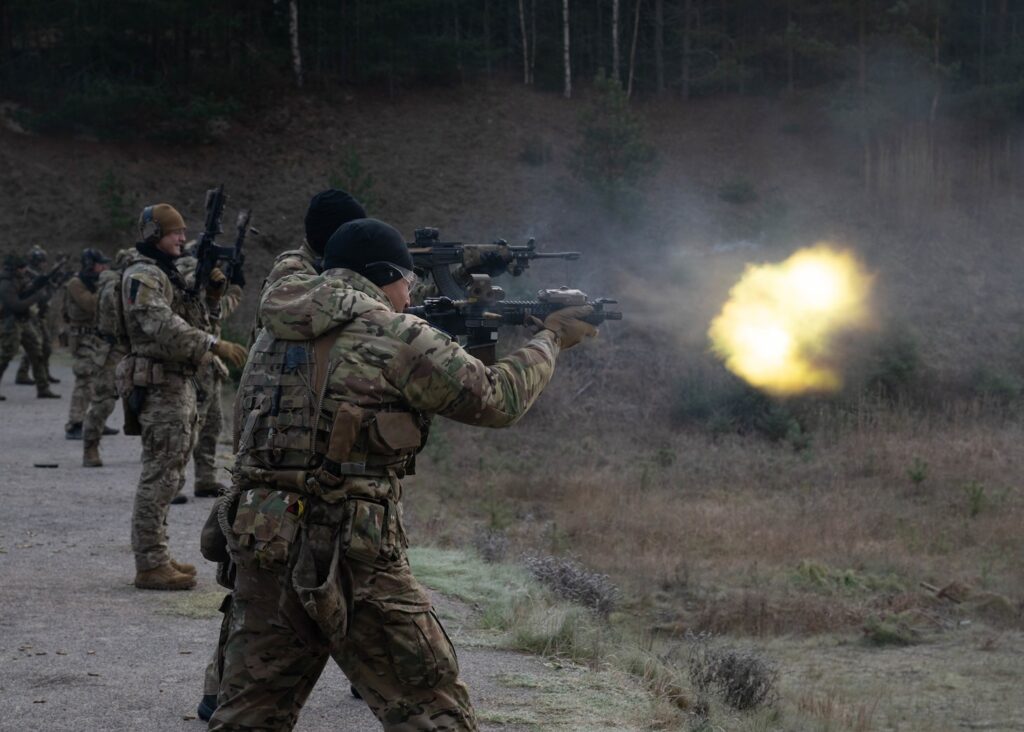
UPINNIEMI, Finland (Nov. 25, 2025) U.S. Navy explosive ordnance disposal technicians from Explosive Ordnance Disposal Mobile 8, Commander Task Group 68.1, and Finnish Navy sailors conduct a live-fire exercise as a part of Freezing Winds 25 in Upinniemi, Finland, Nov. 25, 2025. (U.S. Navy Photo by MC2 Juan J. Ruiz-Lazcano)
BALTIC SEA – U.S. Navy expeditionary forces assigned to Commander, Naval Expeditionary Combat Forces Europe-Africa/Commander, Task Force 68 (CTF 68) recently concluded operations in support of Exercise Freezing Winds 2025, a Finnish-led multinational training event designed to bolster collective readiness, interoperability, and security across the North Baltic Sea.
Operating in concert with NATO Allies and U.S. Marines from Marine Rotational Force – Europe, CTF 68 contributed command and control, explosive ordnance disposal, and maritime logistics support across multiple domains. The exercise served as a proving ground for joint force operations in cold-weather environments and underscored the U.S. Navy’s commitment to enhancing allied maritime security throughout the Baltic region.
“Operating alongside our NATO Allies and U.S. Marines in the challenging conditions of the Baltic Sea sharpens our readiness and reinforces our shared commitment to collective defense,” said Capt. Jeremy Wheat, commodore of Task Force 68. “This exercise strengthens our ability to respond as a unified force, no matter the environment or mission.”
A key focus during Freezing Winds was improving freedom of movement in contested environments, which was made possible in part by the efforts of explosive ordnance disposal technicians from Explosive Ordnance Disposal Mobile Unit (EODMU) 8, assigned to Task Group 68.1. Their role involved simulated route clearance, underwater searches, and demolition operations near critical infrastructure and maritime logistics nodes. All of which were part of scenarios designed to test real-world response to sea mines and unexploded ordnance in congested littorals.
“Our role during Freezing Winds was to ensure freedom of movement by mitigating explosive threats along resupply corridors and maritime infrastructure, especially in areas affected by simulated mining and unexploded ordnance,” said Lt. Luke Robertson, platoon officer-in-charge from TG 68.1. “Training with NATO Allies in these conditions enhances our ability to operate forward and respond to real-world threats in complex environments.”
To support these clearance efforts and maintain the tempo of operations, logistics teams from Navy Cargo Handling Battalion (NCHB) 5, assigned to Task Group 68.5, provided the connective tissue needed to move fuel, cargo, and personnel across the battlespace. Supporting the combined force, TG 68.5 conducted cargo handling, aerial port coordination, and fuel delivery under freezing conditions proving the battalion’s capacity to sustain forward-deployed operations in the High North.
“Our mission was to provide combat service support by moving fuel, cargo, and munitions anywhere they’re needed from high-latitude airfields to expeditionary seaports,” said Lt. Michael Flickinger, TG 68.5 site officer-in-charge. “The environment was challenging, but working side-by-side with Finnish and U.S. Marine logistics teams allowed us to validate scalable, mobile support concepts.”
Exercise Freezing Winds 2025 also contributed to NATO’s broader effort to boost defense readiness across the Baltic Sea, a vital region for global commerce and energy transit. The inclusion of expeditionary units from CTF 68 added a crucial logistics and access-focused dimension to high-end naval and amphibious training.
“The ability of our expeditionary units to integrate into Allied operations, as demonstrated in Freezing Winds, is what makes CTF 68 so unique,” Wheat added. “We bring scalable, responsive capability that extends the reach and impact of the entire naval force.”
Wheat said that in an era marked by renewed focus on strategic deterrence in the High North, exercises like Freezing Winds enabled CTF 68 to contribute directly to integrated defense posture and the Alliance’s maritime advantage.
Exercise Freezing Winds 2025 demonstrated the value of persistent, forward-deployed presence and reinforced the importance of logistics, access, and integration as enablers of joint and allied maritime advantage. “Through exercises like Freezing Winds, CTF 68 continues to maintain a persistent, forward-deployed presence delivering scalable expeditionary capabilities that advance Alliance readiness and regional stability,” said Wheat.
Commander, Task Force 68 commands all Navy Expeditionary Combat Forces in Europe and Africa and provides critical capabilities including logistics, explosive ordnance disposal, maritime engineering, port operations, and expeditionary security in support of U.S. 6th Fleet and NATO objectives.
HII Marks One Year of Newport News Shipbuilding Charleston Operations
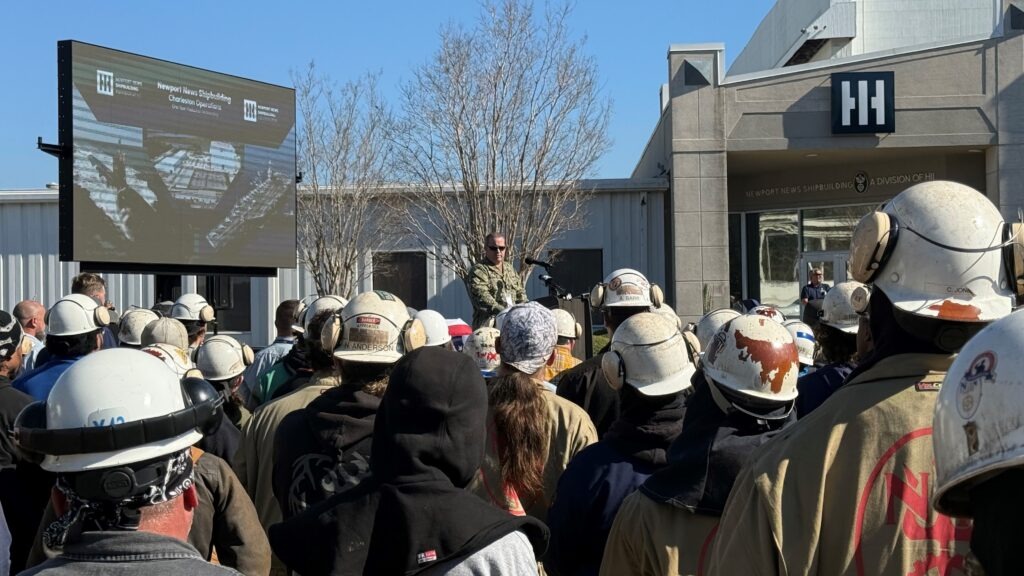
GOOSE CREEK, S.C., Jan. 22, 2026 (GLOBE NEWSWIRE) — HII (NYSE: HII) today marked one year of Newport News Shipbuilding (NNS) Charleston Operations in Goose Creek. The company hosted community and Navy leaders at the facility and a town hall event for all NNS Charleston Operations shipbuilders.
“Today, we celebrate our teammates here in South Carolina for the incredible difference you are making and will continue to make,” NNS President Kari Wilkinson said. “Whether you work in South Carolina or Virginia, we are one team on an important mission with the power to change the course of history — one component, one unit, one module, one boat or one ship at a time.”
Since the asset acquisition closing in January 2025, NNS has continued to ramp up production at this important facility in support of its U.S. Navy programs. The South Carolina team was able to deliver its first unit within the first 40 days as NNS Charleston Operations, and has exceeded production targets for 2025.
“You are crucial as we continue to ramp up submarine and carrier shipbuilding,” Rear Adm. Jonathan Rucker, program executive officer, attack submarines, told shipbuilders at the town hall. “Part of increasing shipbuilding is what we call distributed shipbuilding or outsourcing, (which means) leveraging the people here and those around the country to be able to increase our capacity to build the submarines and aircraft carriers and ships that our nation needs. I can’t thank you enough for what you do day in and day out.”
NNS Charleston Operations is located on 45 acres along the Cooper River with more than 480,000 square feet of covered manufacturing space. It is strategically located within South Carolina’s rapidly growing maritime ecosystem, having both barge and rail access, capacity to expand, and growing access to the highly skilled maritime trades workforce.
The work underway in South Carolina is part of HII’s distributed shipbuilding initiative to increase shipbuilding throughput and meet the increased demand for ships. In addition to NNS Charleston Operations, HII is partnering with 23 shipyards and fabricators beyond the company’s traditional labor market. HII also forged partnerships with international manufacturers to explore meaningful ways to expand capacity, including evaluation of adding an additional shipyard in the U.S.
Exercise Phoenix Express 2026 Concludes in Tunisia
TUNIS, Tunisia – Eight partner nations concluded the 20th iteration of exercise Phoenix Express, led by U.S. 6th Fleet, sponsored by U.S. Africa Command, and hosted by Tunisia in Tunis, Jan. 20-23, 2026.
This year’s iteration focused on improving maritime domain awareness and executing Visit, Board, Search, and Seizure (VBSS) missions through a tabletop exercise that simulated human trafficking, narcotics smuggling, and weapons proliferation across the Southern Mediterranean.
Phoenix Express is a multinational maritime exercise designed to strengthen combined warfighting readiness and lethality in maritime security operations by improving regional cooperation, maritime domain awareness, information-sharing practices, and tactical interdiction expertise.
“The 20th iteration of exercise Phoenix Express underscores our enduring commitment with North African and European maritime partners,” said Vice Adm. J.T. Anderson, commander, U.S. 6th Fleet. “By training side-by-side, we sharpen our collective warfighting readiness and enhance our ability to plan, coordinate, and command maritime security operations. This exercise builds the operational independence of our African partners. Safeguarding a stable maritime environment in Africa is a shared strategic interest that protects our homelands and deters threats against regional stability.”
The tabletop exercise showcased partner warfighting capabilities through an integrated maritime operations center. The scenario enhanced participants’ ability to detect, track, and classify maritime traffic, increased proficiency in operational-level planning and decision making for interdiction operations, strengthened coordination mechanisms among naval, air, and coalition partners, and improved information-sharing procedures.
“Exercises like Phoenix Express build on more than two centuries of U.S.–Tunisia partnership in maritime security,” said Bill Bazzi, U.S. Ambassador to Tunisia. “We are proud to stand with Tunisia and our partners in Africa and Europe to support a secure and stable maritime environment in the Mediterranean and beyond.
Participating nations in Phoenix Express include Algeria, Belgium, Egypt, Georgia, Italy, Morocco, Tunisia, and the United States.
Phoenix Express is one of three regional maritime exercises under U.S. Naval Forces Africa as part of a comprehensive strategy to provide collaborative opportunities amongst African forces and international partners in order to address maritime security concerns.
U.S. 6th Fleet, headquartered in Naples, Italy, conducts the full spectrum of joint and naval operations, often in concert with allied and interagency partners, in order to advance U.S. national interests and security and stability in Europe and Africa.
For over 80 years, U.S. Naval Forces Europe and Africa (NAVEUR/NAVAF) has forged strategic relationships with allies and partners, leveraging a foundation of shared values to preserve security and stability. Headquartered in Naples, Italy, NAVEUR/NAVAF operates U.S. naval forces in the U.S. European Command and U.S. Africa Command areas of responsibility.
Leonardo DRS Opens Advanced Naval Power and Propulsion Facility in Charleston, South Carolina
Investment Underscores Continued Commitment to Support U.S. Navy and Defense Industrial Base
ARLINGTON, VA, January 23, 2026 ̶ Leonardo DRS, Inc. (NASDAQ: DRS) today announced the official opening of its new, state-of-the-art naval power and propulsion manufacturing and testing facility in the Charleston, South Carolina region. The more than 140,000-square-foot facility is a major investment to expand domestic production capacity in support of U.S. Navy submarine and shipbuilding programs, including systems for the Columbia-class ballistic missile submarine program.
The purpose-built facility provides advanced manufacturing, final assembly, integration, and testing space dedicated to large components for Leonardo DRS’s naval electric power and propulsion systems. In addition to electric propulsion and power generation systems, the site supports naval steam turbine system design, manufacturing, and testing.
“This strategic investment is a national asset and represents our commitment to supporting the U.S. Navy’s efforts to increase production capacity across the submarine and shipbuilding industrial base,” said Jon Miller, senior vice president and general manager of the Leonardo DRS Naval Power Systems business unit. “This advanced multi-purpose facility enables us to increase production capacity, streamline our production processes, and rapidly respond to evolving fleet requirements.”
John Baylouny, president and CEO of Leonardo DRS, added: “The Department of War has been clear about the need to strengthen and expand the defense industrial base, and this investment answers that call. By increasing capacity and modernizing our manufacturing infrastructure, we are ensuring the U.S. military has reliable access to the critical capabilities it needs, when and where they are needed.”
As the Navy fields more power-intensive weapons, sensors, and computing systems, scalable integrated power architectures are essential to mission success. The Charleston facility positions Leonardo DRS to deliver those architectures at scale and with the schedule reliability required for next-generation surface combatants and submarines.
HII Completes Builder’s Sea Trials for USS Zumwalt
From HII
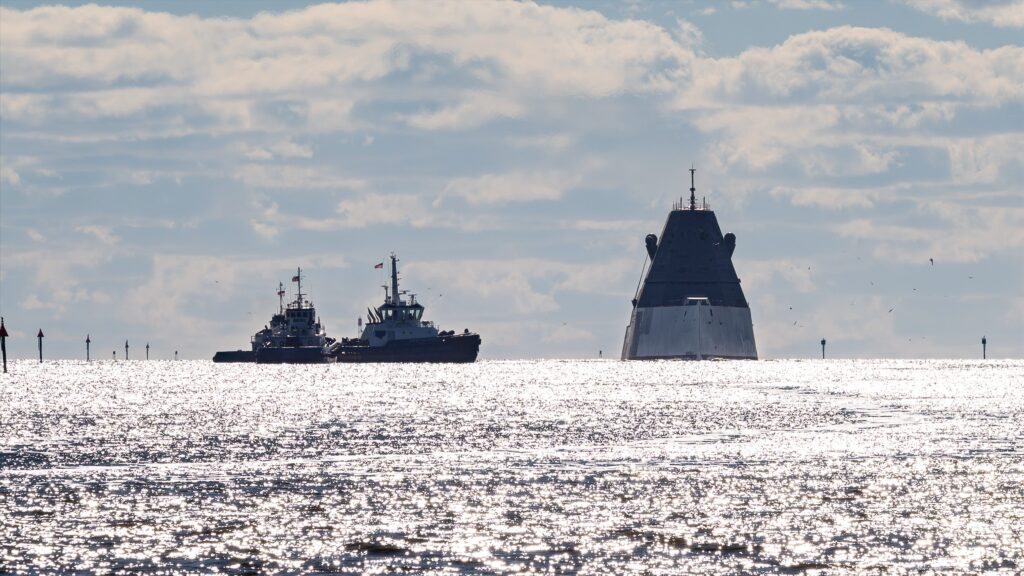
PASCAGOULA, Miss., Jan. 21, 2026 (GLOBE NEWSWIRE) — HII’s (NYSE: HII) Ingalls Shipbuilding division successfully completed builder’s sea trials for USS Zumwalt (DDG 1000). The Ingalls and Navy team conducted a comprehensive series of at-sea tests following an extensive modernization availability as the Navy’s first Conventional Prompt Strike (CPS) platform.
“We have achieved a pivotal milestone with our Navy and industry partners to advance this complex modernization work that will set a precedent for the Zumwalt class,” said Brian Blanchette, Ingalls Shipbuilding president. “I’m very proud of the team effort and their critical role to advance the U.S. Navy’s first warship with hypersonic capabilities.”
USS Zumwalt, the lead ship of the Zumwalt-class destroyers, arrived at the Pascagoula shipyard in August 2023 for modernization. Shortly after arrival, the ship was moved onto land where the Ingalls team completed major technology upgrades. This included integrating the Conventional Prompt Strike (CPS) weapon system and replacing the original twin 155mm Advanced Gun Systems with new missile tubes. In December 2024, USS Zumwalt was undocked and underwent further preparations for operational readiness.
Additionally, USS Lyndon B. Johnson (DDG 1002) is also undergoing CPS weapon system integration at Ingalls and USS Michael Monsoor (DDG 1001) is scheduled to receive the CPS system during a future availability.
Zumwalt-class destroyers feature a state-of-the-art electric propulsion system, wave-piercing tumblehome hull, stealth design and is equipped with the most advanced warfighting technology and weaponry. These ships will be capable of performing a range of deterrence, power projection, sea control, and command and control missions while allowing Navy to evolve with new systems and missions.
NAWCAD WOLF innovation ensures radar system readiness
Innovation at the Naval Aviation Warfare Center Aircraft Division Webster Outlying Field (NAWCAD WOLF) Air Traffic Control and Landing Systems (ATC&LS) division is saving time and money for the warfighter by providing organic sustainment services for the Navy’s primary Shipboard ATC air surveillance radar system, the AN/SPN-43C, in support of the Naval Air Traffic Management Systems Program Office (PMA-213).
From Naval air Warfare Center Aircraft Division, St. Inigoes, Md., Jan. 22, 2026
Innovation at the Naval Aviation Warfare Center Aircraft Division Webster Outlying Field (NAWCAD WOLF) Air Traffic Control and Landing Systems (ATC&LS) division is saving time and money for the warfighter by providing organic sustainment services for the Navy’s primary Shipboard ATC air surveillance radar system, the AN/SPN-43C, in support of the Naval Air Traffic Management Systems Program Office (PMA-213).
Faced with diminishing support from the original equipment manufacturer for the aging AN/SPN-43 radar system—a cornerstone of U.S. Navy aircraft carrier operations since the 1960s—NAWCAD WOLF developed advanced in-house capabilities to repair and overhaul critical components. These efforts have addressed obsolescence challenges head-on, keeping the radar system reliable and effective in supporting complex flight operations.
“Ensuring the operational readiness of our critical systems is a top priority for the Navy, and the AN/SPN-43 radar system is no exception,” said Capt. Walter Massenburg, PMA-213 program manager. “The innovative efforts of NAWCAD WOLF exemplify the dedication and ingenuity required to sustain mission-critical capabilities in the face of obsolescence challenges. Their proactive approach not only extends the service life of this essential system but also reinforces the Navy’s commitment to maintaining mission readiness and operational excellence.”
A key element of NAWCAD WOLF’s initiative is the complete overhaul of the AN/SPN-43C pedestal and antenna assembly—a critical subsystem responsible for the precise rotation and stabilization of the radar antenna. Historically a major source of system downtime and maintenance challenges, the pedestal underwent a transformative process involving full disassembly, detailed inspections, repair or replacement of worn components, and reassembly, followed by rigorous testing to ensure peak performance. This proactive maintenance strategy has extended the service life of the AN/SPN-43C, reduced catastrophic failures within the pedestal by 70 percent, and significantly improved system reliability while lowering maintenance costs.
“We continuously refine our processes to increase project efficiency with testing and minimizing outsourcing while developing methods to keep repairs organic,” said AN/SPN-43C government project lead, Tom Ackerson. “With our government team providing organic in-service engineering support, we keep both the repair time and cost low.”
NAWCAD WOLF also acquired, at no cost, data rights for vital radar receiver components, enabling the team to independently manufacture, repair and modify these parts. This capability mitigates the risk of obsolescence and ensures a reliable supply of spare components, further enhancing the system’s sustainability.
Today, NAWCAD WOLF performs the majority of all repair and overhaul activities for the AN/SPN-43C organically, in-house. This capability reduces reliance on external vendors, shortens turnaround times, and provides greater control over quality and cost.
“The ATC&LS division serves as organic repair depot for 92 items in support of the AN/SPN-43C radar,” said NAWCAD WOLF executive director, Blaine Summers. “The ability to repair these items versus procuring new items provides a great cost savings to PMA-213 and the Navy.”
By sustaining the AN/SPN-43C’s operational readiness, NAWCAD WOLF ensures the system remains effective until its planned replacement, the AN/SPN-50, is fully fielded in the coming years.