Rep. Gallagher: Navy Must be Ready to Counter China if Taiwan Is Attacked
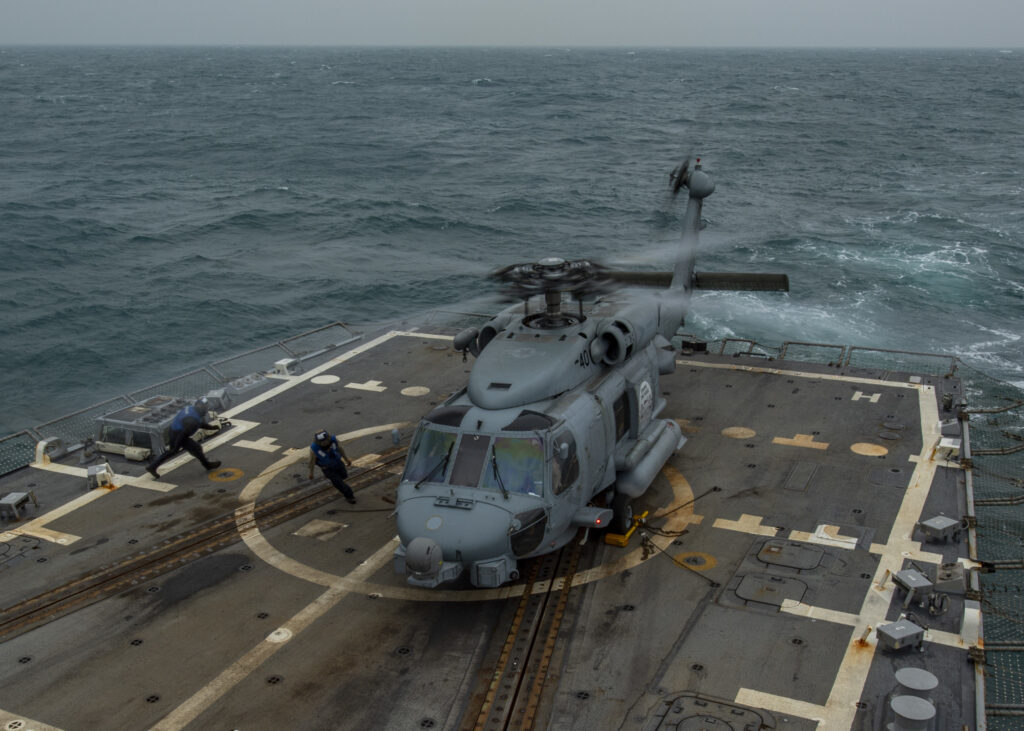
U.S. Navy Boatswain’s Mate 3rd Class Nicholas Rodriguez, right, and Boatswain’s Mate Seaman Tony Williams move in to remove chocks and chains from an MH-60R Sea Hawk on the flight deck of the USS John Finn (DDG 113) March 10, 2021, in the Taiwan Strait. U.S. NAVY / Mass Communication Specialist 3rd Class Jason Waite

ARLINGTON, Va. — A member of Congress on the House Armed Services Committee said the Navy must be ready by 2025 to counter a Chinese invasion of Taiwan. 

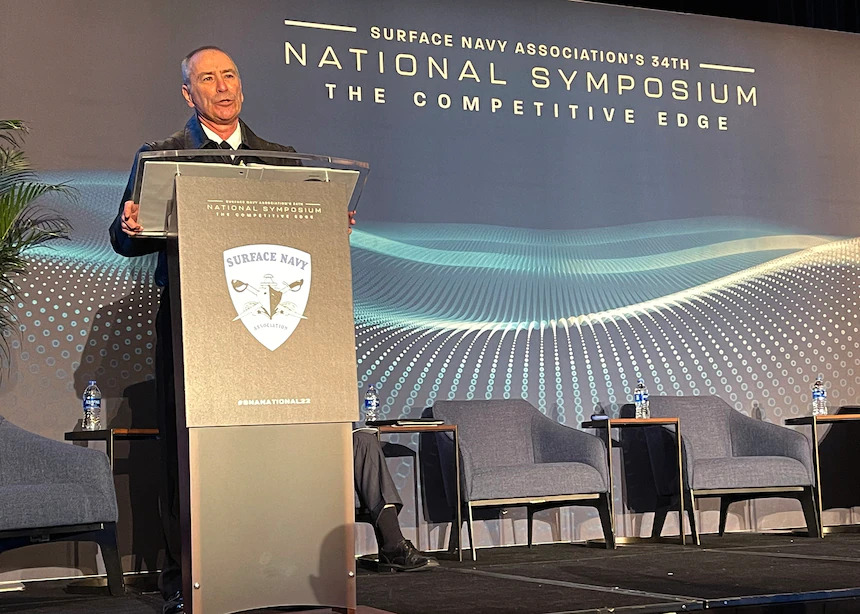
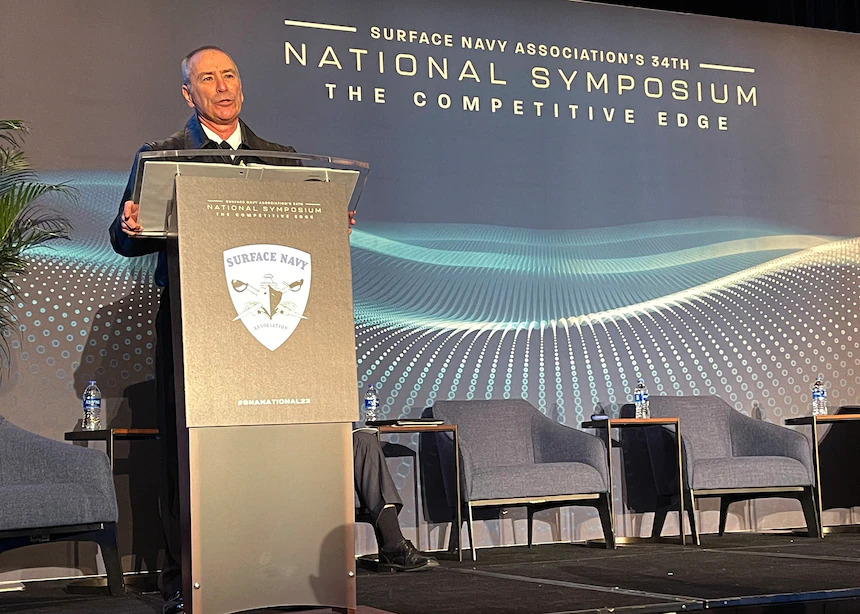
Citing the assertion of former commander of Indo-Pacific Command, Adm. Phil Davidson, that China could move against Taiwan by 2025, Rep. Mike Gallagher (R-Wisconsin), speaking Jan 12 at the Surface Navy Association’s annual symposium in Arlington, said the Unites States “must prepare for the reality that war that starts in the territorial waters around Taiwan may not stay there.” 

Gallagher was critical of the concept of integrated deterrence in that it fosters a false hope that soft power can deter a determined enemy. 

“My concern is that integrated deterrence is the latest in a series of Pentagon buzzwords that ultimately serve as a smoke screen for dis-investing in defense and making do with a force that is too small to meet global requirements,” he said. “This jargon provides pseudo-intellectual cover for political leadership that is too weak or too distracted to give the military what it needs to execute its missions and to make hard choice between military services that might actually free up resources for the main effort: deterring China from invading Taiwan.”  

He praised his colleague Rep. Elaine Luria (D-Virginia), also speaking at the symposium, for her “tracing the historical pattern of these calls for ‘divesting to invest.’” 

“What we need to integrate into deterrence is more conventional hard power: more ships, more long-range missiles, more long-range bombers in the Indo-Pacific, things that will make the PLA [People’s Liberation Army] think twice,” he said. 

“Betting on tomorrow’s transformative technology probably makes less sense than fielding reliable technologies that work today,” he said.  

Gallagher offered a few suggested initiatives to improve the Navy’s position versus China: 

  • Using American territories such as Guam, Wake, and Midway to host long-range anti-air and anti-surface weapons and intelligence, surveillance and reconnaissance assets or serve as logistics nodes. 
  • Hardening existing defenses in the island chains. 
  • “Creatively use existing platforms and systems so they can better contribute to the 2025 near-term fight.” 
  • Building a larger Navy, though he noted that ships authorized this year are not likely to be ready for combat by 2025. 

He warned that the current unavailability of the Red Hill fuel farm in Hawaii was “unacceptable” and must be restored to operation. He termed it as “the beating heart of America’s Pacific posture.” 

Gallagher — in whose district some littoral combat ships and frigates are built — listed some near-term initiatives that could improve the Navy’s posture in the Pacific. 

  • Use littoral combat ships as stop-gap craft to enable distributed operations until the light amphibious warship comes on line. 
  • Put Marine anti-ship missiles on board littoral combat ships for expeditionary operations. 
  • Use the LCS as “mother ship for unmanned swarms” and as a command-and-control node. 
  • Use cruisers and early DDGs slated for retirement as missile barges and as missile-defense ships for harbors to keep valuable VLS [vertical launch system] cells “in the game” or for conventional prompt strike 

Gallagher also said the Navy needs to move out on the DDG(X) next-generation destroyer and the Department of the Navy should commit to building two large surface combatants per year for 10 years. 

He asserted that the only short war for Taiwan would be a Chinese victory. 

“So, if we’re going to win, we have to buy time to mass assets in the region while denying a Chinese invasion,” he said. “I’m concerned that our planning has not caught up to that reality.” 

He advocates the re-establishment of U.S. Taiwan Defense Command to “fully integrate wartime planning with Taiwan.” 


USCG Commandant: COVID, Design Complexity Added Construction Delays to Polar Security Cutter

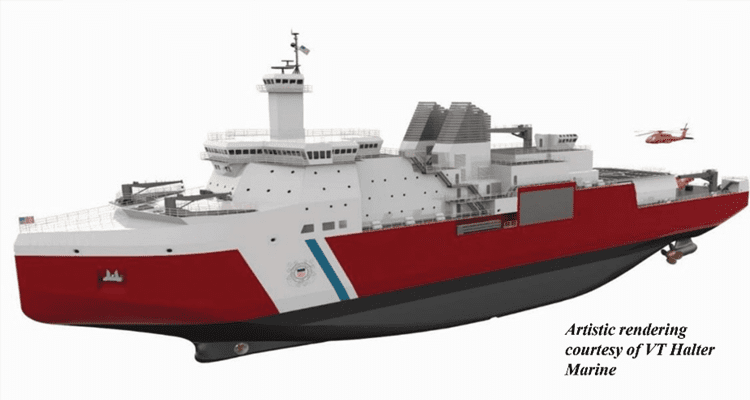
A rendering of the U.S. Coast Guard’s forthcoming Polar Security Cutter. U.S. COAST GUARD

ARLINGTON, Va. — The coronavirus pandemic and the complexity of building the first U.S. heavy ice breaker in nearly 40 years were among the reasons for another year’s delay in the expected delivery of the Polar Security Cutter, Coast Guard Commandant Adm. Karl Schultz said Jan. 12.

“We have publicly stated that the delivery date for Polar Security Cutter number one is going to be May 2025, so it slipped about a year,” Schultz told an audience at the Surface Navy Association’s annual symposium in Arlington. Originally, officials thought the PSC program of record for three heavy ice breakers, with two already fully funded, would begin rolling vessels starting in 2023.

“It’s just a complex thing. COVID really layered in some challenges there,” Schultz said, adding that the United States hasn’t built a heavy ice breaker “in the better part of four-plus decades.“ He noted the new vessel requires “complex steel work that shipyards don’t necessarily do every day.” There also were some issues with international partnerships.

The operational U.S. polar icebreaking fleet currently consists of one heavy polar icebreaker, Polar Star, built in 1976, and one medium polar icebreaker, Healy, which is also used for polar research.

“It’s tough to be an Arctic nation when you have one heavy [ice] breaker that’s almost 50 years old and one medium breaker that’s really science,” Schultz said.

Since the 2013 U.S. National Strategy for the Arctic Region described the United States as “an Arctic Nation with broad and fundamental interests,” the Coast Guard, Navy and other armed services have developed strategies for operating in the northern polar region. Melting sea ice has turned the top of the world into a potential economic, diplomatic and military flash point as sea lanes have opened up  increased commercial sea lanes in summer to large cargo ships, fishing fleets, oil and gas exploration and tourism.

“I think the goal right now would be to continue to work with the Navy Integrated Project Office, continue to work with the shipbuilder, finish up the complex, detailed design and start cutting steel here in 2022,” Schultz said, adding ”I think if we stay at that track line, I am guardedly optimistic we’ll take delivery of that ship in 2025 and be off to the races.”

In the meantime, Schultz said the Coast Guard has been sending its larger cutters into the high latitudes to participate in exercises with partners like France, Canada, Denmark and the United Kingdom.

“It’s one of those places where very few of the Arctic nations, outside of Russia have a whole lot of capacity, Schultz said, noting that Russia currently holds the chairmanship of both the Arctic Council and the Arctic Coast Guard organization.


Heliborne Electronic Warfare Pod Set for Delivery to Navy in Summer 2022

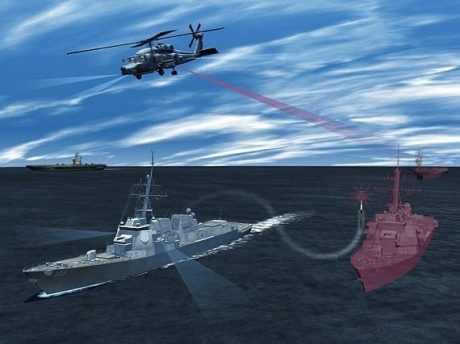
An artist’s conception of the AOEWS at work. LOCKHEED MARTIN

ARLINGTON, Va. — Lockheed Martin expects to deliver the first production pods of a heliborne electronic warfare system to the Navy this summer. 

Joe Ottaviano, director, Maritime & Air Cyber/Electronic Warfare for Lockheed Martin, told reporters Jan. 11 at the Surface Navy Association’s annual symposium in Arlington that Lockheed Martin has completed flight testing of the Advanced Off-Board Electronic Warfare (AOEW) System and expects to deliver the first low-rate initial production examples to the Navy in July or August 2022. 

The ALQ-248 AOEW is a self-contained pod designed to be taken aloft by an MH-60R or MH-60S Seahawk helicopter and serve as an offboard electronic attack system to counter anti-ship cruise missiles. The AOEW will be able to detect an incoming missile, evaluate its direction and use radio frequency countermeasures to deter the missile.  

The pod can be attached to either side of the helicopter, which provides power and mobility for the pod, but the pod’s operation is independent of the helicopter crew and linked to the SLQ-32(V)6 shipboard electronic warfare system. The AOEW can work independently or with the ship’s onboard electronic surveillance sensor, SEWIP Block 2, to detect an incoming missile and then evaluate where it is going. 

The AOEW will be linked in the future to the SLQ-32(V)7 with the Block III version improvements of the Surface Electronic Warfare Improvement Program.  

In September 2021, the Naval Sea Systems Command awarded to Lockheed Martin Rotary and Mission Systems, Liverpool, New York, a $17.8 million firm-fixed-price contract modifications exercise options for AOEW LRIP units.  

The Navy initially ordered four engineering and manufacturing development models for evaluation that were delivered by early 2020. 


UK Royal Navy takes NATO Response Force Helm, with Carrier as Flagship

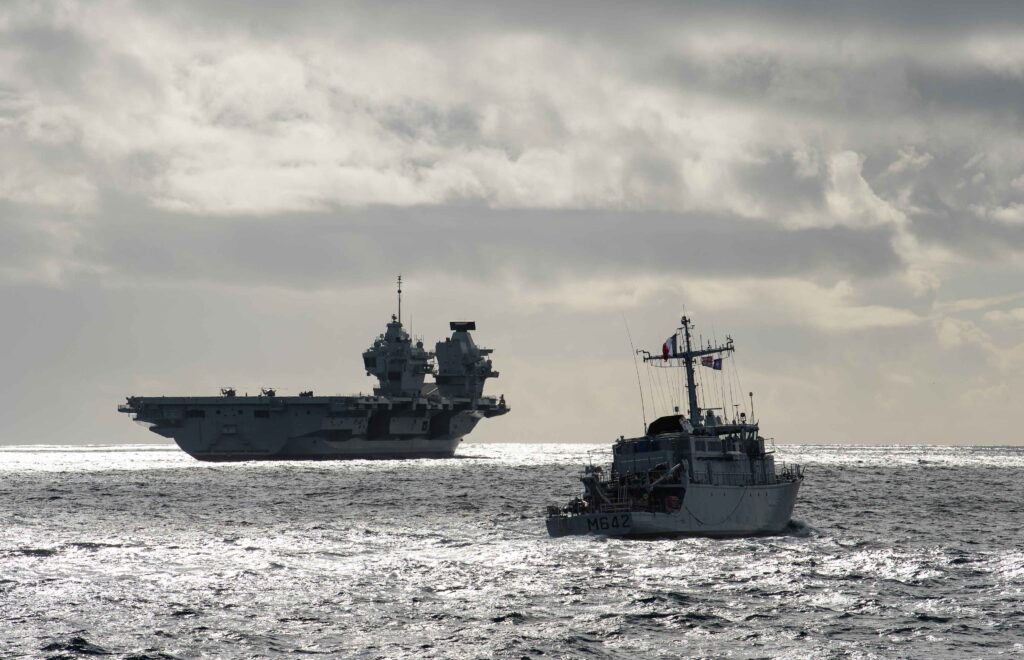
The UK Royal Navy aircraft carrier HMS Prince of Wales is pictured at sea, working with NATO task groups, during the alliance’s Dynamic Mariner exercise off the United Kingdom in late September 2021. The exercise was part of the certification process for the U.K. taking command of the NATO Response Force (Maritime) for 2022. NATO MARITIME COMMAND

The UK Royal Navy has taken command of the NATO Response Force (Maritime) task force, with a transfer-of-command ceremony held onboard the U.K. aircraft carrier HMS Prince of Wales at HM Naval Base Portsmouth, U.K. on Jan. 11.

NRF-M command rotates annually and the U.K. has handed over from the French navy. Under Rear Adm. Michael Utley, commander, U.K. Strike Force and NATO high-readiness maritime force commander, the U.K. will have the helm for 2022, with Prince of Wales as flagship in the role of afloat command platform.

In the ceremony onboard the carrier, the ship’s commanding officer, Capt. Steve Higham said as Prince of Wales begins its service life, it was “entirely fitting that we start that journey as a NATO aircraft carrier.” During 2022, Prince of Wales will lead maritime task groups across the Euro-Atlantic theatre, including in the Arctic and the Mediterranean. The carrier will also remain at very high readiness to respond as required to contingency operations.

Sister carrier HMS Queen Elizabeth deployed to the Indo-Pacific during its own inaugural deployment, between May and December 2021.

“If [that] deployment was a manifestation of our Prime Minister’s ‘Global Britain’ vision, then Prince of Wales’ year as a NATO command platform is a clear statement of intent by our government of the U.K.’s equally important and steadfast commitment to NATO,” Higham said. The U.K. is resolute and enduring in its commitment to security, stability, and peace in the Euro-Atlantic theater, he added.

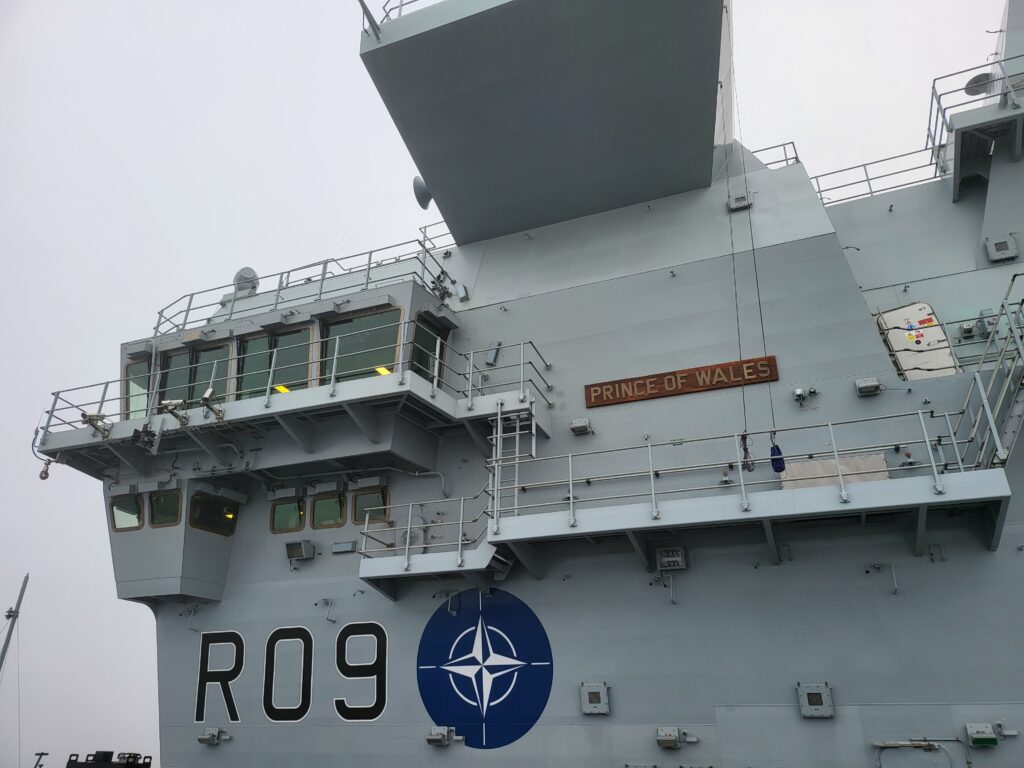
Prince of Wales is pictured carrying the NATO roundel. The carrier will operate as flagship and afloat command platform for NRF-M. LEE WILLETT

Integrating U.K. carrier strike capability with NATO, the carrier and its multinational battle staff will work with ships, aircraft, submarines and drones from allies and partners, the CO said.

In a media briefing onboard Prince of Wales prior to the ceremony, Higham said, in the context of challenges posed by potential adversaries, “the great advantage for us is that we will be working with partners and allies from across the NATO alliance, and that strength in depth is what gives us the real edge.”

The carrier will embark airwing and other capabilities as required for specific operations.

“My job as the CO of Prince of Wales, as the flag captain, is to make sure this deck is ready to receive helicopters, aircraft and drones from across the NATO alliance, and be ready to work alongside ships and submarines from our partners and allies,” he said. The job of a command platform is to be flexible and ready to respond, he added.

Higham noted that the ship had received an uplift in command-and-control capability to enable interoperability with NATO partners.

The 65,000-ton carrier was commissioned in December 2019, was declared fully operational on Sept. 30, 2021, and spent much of 2021 in operational generation for the very-high-readiness role as Naval Response Force -Maritime flagship.


HII Achieves Significant Light-Off Milestone aboard First Flight III DDG

Ingalls Shipbuilding electrician Joe Ditsworth and electrical foreman Lisa Avery initiate light-off of the Aegis Combat System aboard Jack H. Lucas (DDG 125) in the ship’s combat information center. INGALLS SHIPBUILDING / Luis Solis

PASCAGOULA, Miss. — Huntington Ingalls Industries’ Ingalls Shipbuilding division recently achieved the Aegis light-off milestone on the Navy’s first Flight III Arleigh Burke-class guided missile destroyer Jack H. Lucas (DDG 125), the company said Jan. 12.

This milestone marks the beginning of combat system testing as shipbuilders ready the ship for propulsion tests and eventually sea trials. 

“I am again very proud of our DDG 51 team and the work they have done,” said Kari Wilkinson, Ingalls Shipbuilding president. “Not only have they completed a significant program milestone aboard the first Flight III destroyer, but they have done so in the face of a pandemic. This team continues to prove it’s as strong as the ships it builds.” 

The Flight III upgrade incorporates a number of design modifications that collectively provide significantly enhanced capability. Aegis light-off is an important milestone for integrating and activating all of the new electric plant equipment and combat systems. 

“Through perseverance, a good plan, execution of that plan and relentless follow up, our shipbuilders have reached ALO,” said Jeff J. Davis, DDG 125 construction manager. “There is a huge collaboration effort between Ingalls, the Navy, industry partners and multiple other contractors.” 

Arleigh Burke-class destroyers are highly capable, multi-mission ships and can conduct a variety of operations, from peacetime presence and crisis management to sea control and power projection, all in support of the United States military strategy. Guided missile destroyers are capable of simultaneously fighting air, surface and subsurface battles. The ship contains a myriad of offensive and defensive weapons designed to support maritime defense needs well into the 21st century. 


CNO to Elevate Navy Safety Center to a Two-Star Command

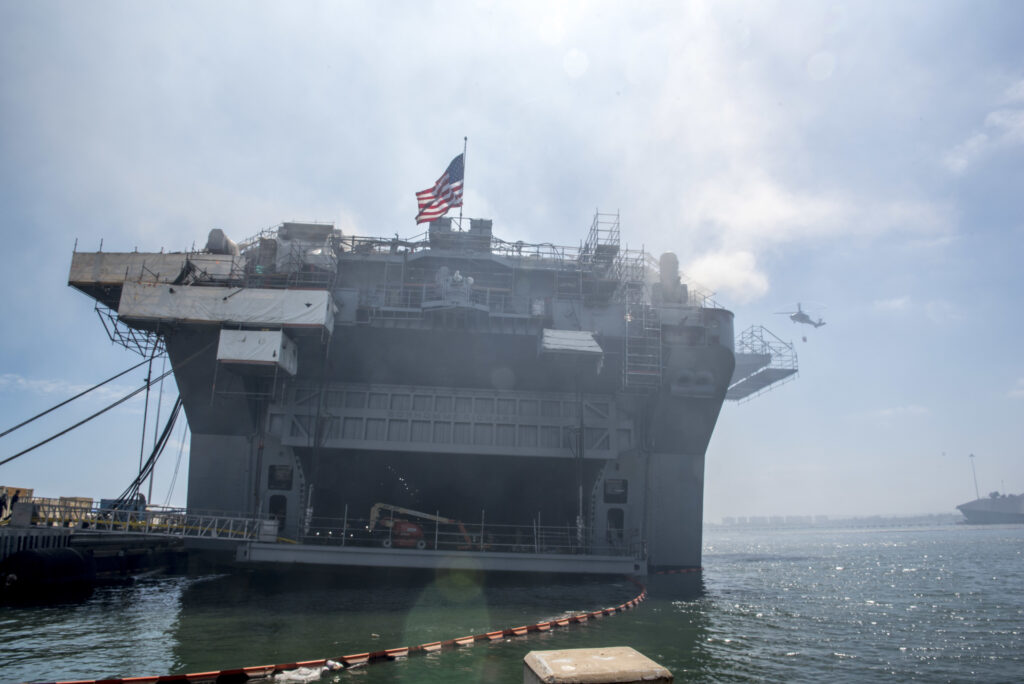
A helicopter from Helicopter Sea Combat Squadron 3 combats a fire aboard the amphibious assault ship USS Bonhomme Richard (LHD 6). U.S. NAVY / Mass Communication Specialist 1st Class David Mora Jr.

ARLINGTON, Va. — The chief of naval operations is increasing the focus of the Navy on safety in its operations by elevating the Naval Safety Center to a full command. 

CNO Adm. Michael Gilday, speaking Jan. 11 to an audience at the Surface Navy Association’s annual symposium in Arlington, said the Naval Safety Center in Norfolk, Virginia, would be redesignated the Navy Safety Command and its commander would be a two-star admiral with experience as a carrier strike group commander. 

“That command will evaluate how the entire Navy — from the fleet commander down — manage safety and risk, and it will grade how effectively commands are self-assessing performance,” the CNO said. 

The commander of the Navy Safety Command would report directly to the CNO. 

Gilday said he considered the Navy’s Board of Inspection and Survey as a model for the Naval Safety Command and how it will perform. 

The Navy has suffered a number of high-profile collisions at sea in recent years, most notably the 2017 collisions of the Arleigh Burke-class guided-missile destroyers USS Fitzgerald and USS John McCain with merchant ships, resulting in the deaths of 17 Sailors. The amphibious assault ship US Bonhomme Richard was damaged beyond economical repair in 2020 by a fire while pierside.   

Gilday noted in his speech that the fleet had suffered “14 other major fire events in the past 12 years.”  


Kitchener: SWO Retention on An Upward Trend

Vice Adm. Roy Kitchener, speaking at the Surface Navy Association’s annual symposium. U.S. NAVY

ARLINGTON, Va. — The retention of surface warfare officers is improving, the U.S. Navy’s “surface boss” said, one metric that affirms the Navy’s efforts to assess its readiness and to take action to address the challenges.  

“Within the wardroom, SWO retention continues on an upward trend, a 5% increase over the past five years, exceeding or remaining on par with the aviation and submarine communities,” said Vice Adm. Roy Kitchener, speaking Jan. 11 to an audience at the Surface Navy Association’s annual symposium in Arlington, Virginia. 

“While a positive indication, there’s still a lot of work to do, and we’re really not satisfied where we are,” Kitchener said. 

“We’ll be looking at the entire career spectrum through an analytical lens to determine what our officer retention goal should be,” he said. “We need to think differently about how we manage retention. I would submit that past retention policies may not help us retain the best talent as we move into the future.”  

Kitchener said the Navy is looking at how other services and other high-performing organizations “manage their talent pool.”  

He also said the Navy will look at important factors such as childcare and family planning. 

“We’re also devoting resources to retention in a number of ways throughout the SWO career path with increased compensation, diverse education opportunities, tours within industry, and additional flexibility in their career path,” he said. “We have a lot of work to do in this area, but we are committed to the task.”   


CNO Gilday Issues New ‘Charge of Command’ to Commanders

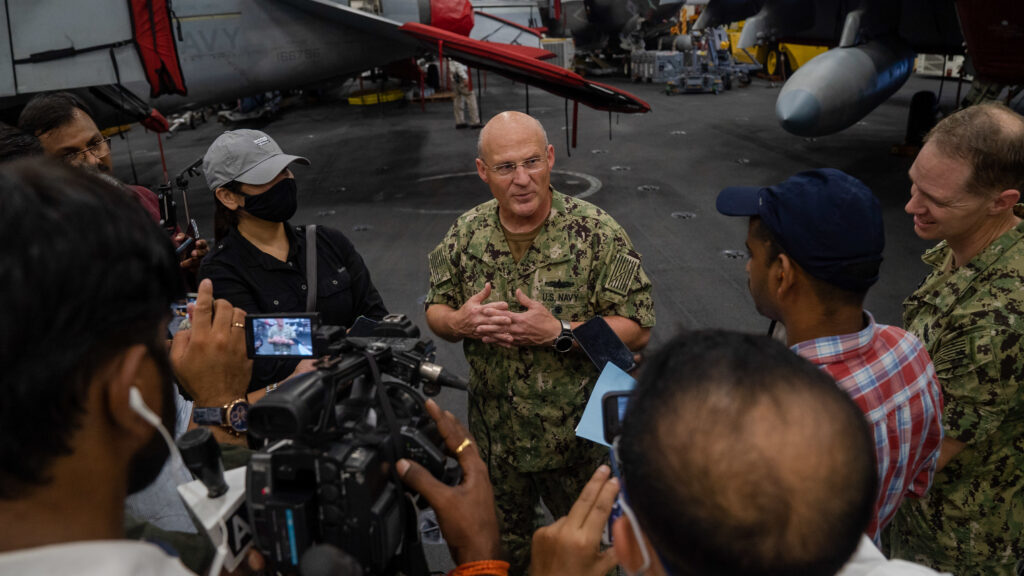
Adm. Mike Gilday, Chief of Naval Operations, addresses media in the hangar bay of Nimitz-class aircraft carrier USS Carl Vinson (CVN 70) as part of maritime exercise Malabar 2021, Oct. 14, 2021. U.S. NAVY / Mass Communication Specialist Seaman Emily Claire Bennett

WASHINGTON — Chief of Naval Operations Adm. Mike Gilday issued a new “charge of command” to commanders Jan. 10, the CNO’s public affairs said in a release.  

The document highlights and lays out CNO’s expectations for commanders at every level and focuses on several key topics, including professional competency, integrity, character and preparing for and leading in combat.    

“The responsibility of command is absolute, and we take our commanding officers’ performance very seriously,” said Gilday. “We place a great amount of trust and confidence in our commanding officers, rely on them to manage risk, make decisions, and communicate openly and honestly, especially in crisis.” 

Gilday said his expectation is that leaders use the charge as a foundational point for conversations about standards of performance. 

“Above all, command, whether at sea or ashore, is fundamentally about preparing for and leading in combat,” the charge reads. “Never lose sight of this — seize absolute ownership of your assigned mission, and all that goes into its accomplishment. When called upon to sail into harm’s way, you and your team must be ready. Your command’s mission is absolutely essential to the Navy’s ability to fight and win. Imbue this belief in your team.”  

Gilday also stressed the need for commanders to set the example for their Sailors.   

“As the commander, you are the example your team reflects,” the charge reads. “Embody humility, selflessness, and complete transparency. Acknowledge the value of every Sailor and civilian. Take care of them and their families. Embrace diversity of thought and background. Foster inclusion and connectedness. Always do the right thing, especially when it is hard. In doing these things, keep close watch on your own mental, physical, and emotional health, and the health of those you lead.” 

The last charge of command was issued by former CNO Adm. John Richardson in 2018. 

The charge of command can be viewed here: https://go.usa.gov/xt2hP


Commander, Naval Surface Force Releases Force Alignment Document

Vice Adm. Roy Kitchener released a new surface force alignment document, “Surface Warfare: The Competitive Edge,” on Jan. 11. U.S. NAVY

ARLINGTON, Va. — Vice Adm. Roy Kitchener, commander of Naval Surface Forces released “Surface Warfare: The Competitive Edge,” at the Surface Navy Association National Conference, Jan 11, the Navy said in a release. 

The document was designed to better align the surface force in the face of increasing technological complexity and rising strategic challenges. 

In the paper, Kitchener cites the strategic importance of the surface force to America’s forward-deployed conventional deterrence posture, a posture that depends on surface ships creating “…numerous operational dilemmas arising from present, powerful, networked, interoperable forces.” 

“The surface force and the surface warfare enterprise must better align in order to get in front of the challenges we face — challenges stemming from serious strategic competition and the complexity of the force we are becoming,” said Kitchener. 

Citing five main lines of operation along which the surface force must plan, Kitchener pointed to the coming decade as one of unprecedented complexity, in which 10 new or modified platforms will either join the fleet or begin production. Adding to this complexity will be the fielding of a new fleet radar, (the SPY-6 family), a new electronic warfare system (SEWIP Block III) and a new computer program that integrates them, Aegis Baseline 10. 

“This document directs action to lead the target, thereby providing our ships and crews with the tools they need,” said Kitchener. “Together, we will remove obstacles and break through barriers that impede our success.” 

The five lines of effort in the document (develop the leader, warrior, mariner, and manager; deliver more, ready ships; achieve excellence in fleet introduction; create clear and innovative operational concepts; and establish infrastructure for the future force) are each assigned to responsible flag officers, called LOE owners, for action, and include specific tasks with deadlines for completion. 

Kitchener will lead these efforts and require periodic updates, as well as provide the surface warfare community with regular updates.  

The Five Lines of Effort 

· Develop the leader, warrior, mariner, and manager: LOE owner is commander, Naval Surface Forces. “The surface force builds leaders, warriors, mariners, and managers, and each of these roles requires training, education and mentoring. While we continue to field increasingly sophisticated technology, the human element remains central.”

· Produce more ready ships: LOE owner is commander, Naval Surface Forces. “The essence of this LOE is to force new thinking about the force we have and consider ways of getting more out of it by planning, maintaining, and operating it more wisely.”

· Achieve excellence in fleet introduction: LOE owner is commander, Naval Surface Forces Atlantic. This LOE focuses on improving surface force performance in platform and capability introduction by applying lessons learned from both the successes and the challenges of the past 50 years. 

· Create clear and innovative operational concepts: LOE owner: Commander, Surface and Mine Warfare Development Command. This LOE tasks SMWDC with developing the people, the concepts and the facilities necessary to derive and provide innovative warfighting concepts to accompany new platforms and capabilities. 

· Establish infrastructure for the future force: LOE owners are OPNAV N95/96. This LOE focuses on the command and control infrastructure of surface forces, the physical infrastructure of surface forces, and the land-based, developmental infrastructure necessary to support Surface Force development. 

Highlights of ‘The Competitive Edge’ 

· Recognizes both the complexity of platforms and capabilities entering the force in the next decade and the strategic challenges those platforms and capabilities are addressing. 

· Assigns responsible parties with required dates of accomplishment. 

· Strengthens force emphasis on data analytics. 

· Considers the introduction of warfare tactics instructors to program offices to ensure tight coupling of concepts with acquisition. 

· Requires OPNAV N96 to produce an integrated combat system campaign plan and PEO IWS to produce an integrated combat system roadmap. The roadmap will have at least a 10-year horizon. 

· Considers the return of fleet introduction teams to enhance transition of new platforms to the force. 

· Assigns SMWDC to develop a capability introduction road map for Maritime Strike Tomahawk, as part of a larger emphasis on SMWDC growing into the center of warfighting innovation, experimentation and virtual warfighting. 

· Requires a 10-year roadmap for class-specific land-based facilities and infrastructure requirements to reduce technical risk in capability introduction. 


Bollinger to Build Pontoon Launcher for General Dynamics Electric Boat

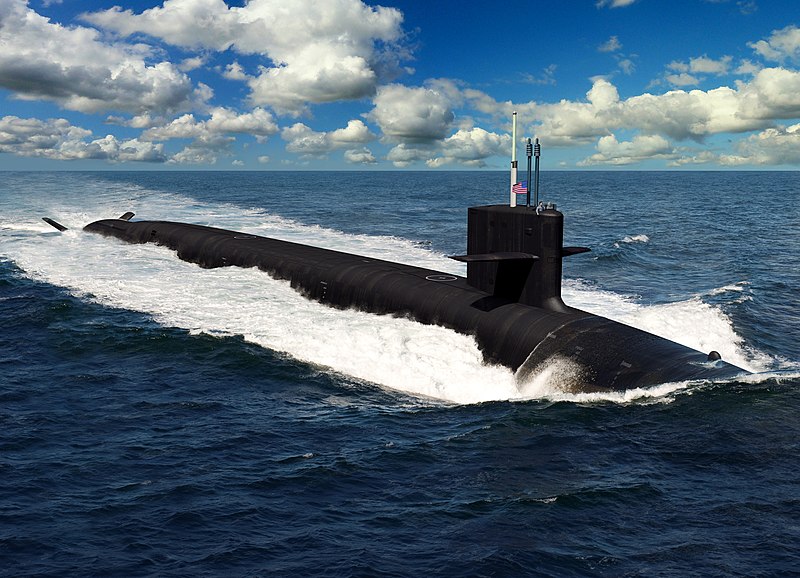
An artist’s rendering of the future U.S. Navy Columbia-class ballistic missile submarines. U.S. NAVY

LOCKPORT, La. — Bollinger Shipyards LLC will construct a new pontoon launcher for General Dynamics Electric Boat to support the construction and launching of the United States’ Columbia-class ballistic-missile submarines (SSBNs), which will replace the aging Ohio-class of SSBNs and is a top strategic defense priority for the United States. 

“Bollinger Shipyards is excited to expand our ongoing relationship with Electric Boat and to continue to support the capitalization and infrastructure improvements that Electric Boat has undertaken in reshaping and modernizing its Groton shipyard,” said Bollinger Shipyards President and CEO Ben Bordelon. “We’re honored to have been selected to build this pontoon launcher with the quality craftsmanship of the hardworking men and women of Bollinger Shipyard and we continue to be laser-focused and committed to being a leader in pushing our industry forward and ensuring that the U.S. Industrial Base is fully self-sufficient.” 

“Electric Boat continues to expand and upgrade its infrastructure to support construction of the Columbia class, the nation’s top strategic defense priority,” said Joe Drake, vice president, Real Estate and Facilities, General Dynamics Electric Boat. “Our partnership with Bollinger is an important part of that strategy.” 

The concept and contract design for the 496-foot-by-95 foot pontoon launcher was performed by the Bristol Harbor Group in Rhode Island. The detail design engineering will be performed at the Bollinger facility in Lockport, Louisiana. The launcher is scheduled to be delivered to Electric Boat’s Groton, Connecticut, shipyard in 2024.  

Electric Boat is the prime contractor on the design and build of the of the Columbia-class SSBN. 

This is Bollinger Shipyards’ third contract awarded with Electric Boat. In late 2019, Bollinger Shipyards was selected to construct the ocean transport barge for Electric Boat, which was delivered in 2021 and in late 2020, Bollinger was selected to construct a floating dry dock, all of which support the construction and maintenance of the Columbia-class SSBN.