Bollinger Delivers Ocean Transport Barge for Columbia SSBN to Electric Boat
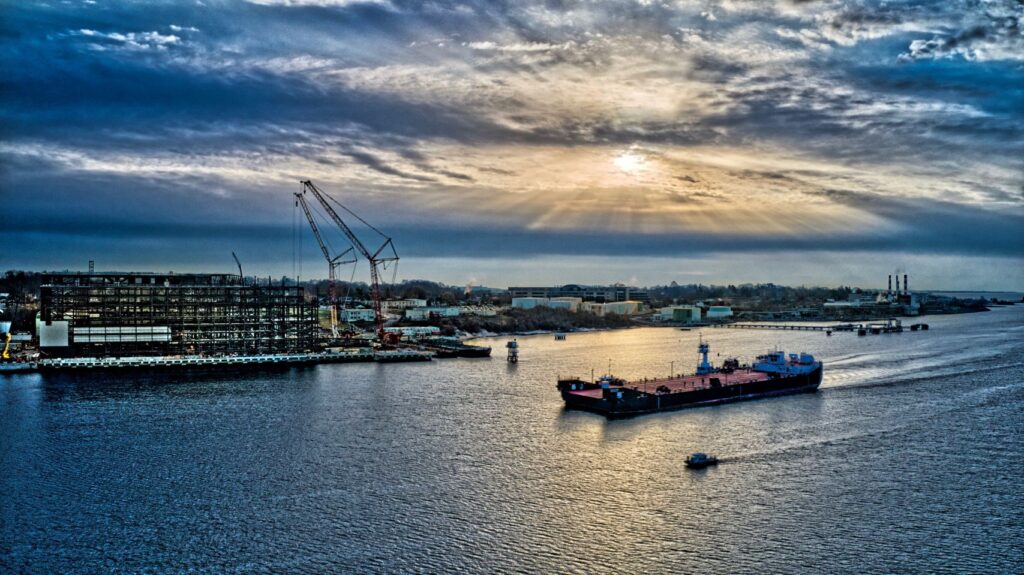
OTB Holland arrives in Groton, Connecticut. BOLLINGER SHIPYARDS

LOCKPORT, La. — Bollinger Shipyards LLC has delivered the Ocean Transport Barge Holland to General Dynamics-Electric Boat’s Groton Shipyard, Bollinger said Dec. 13. 

The Holland will support the construction and maintenance of the United States’ Columbia-class ballistic-missile submarines and Virginia-class fast attack submarines. General Dynamics Electric Boat is the prime contractor on the design and build of the Columbia-class submarine (SSBN), which will replace the aging Ohio-class SSBNs and is a top strategic defense priority for the United States. 

“Bollinger is proud to partner with General Dynamics Electric Boat in support of the U.S. Navy and one of the top strategic priorities of our Nation,” said Bollinger President and CEO Ben Bordelon. “Being able to deliver OTB Holland on time and on budget is a testament to the strength, commitment and resilience of the men and women of the Bollinger workforce, especially following the significant damage sustained to our shipyards and communities following Hurricane Ida earlier this year. Bollinger looks forward to continuing to help meet the expanding needs of the United States’ Navy and supporting efforts to modernize our nation’s fleet.” 

“We are happy to welcome Holland to her new home in the Groton shipyard,” said Kevin Graney, President, General Dynamics Electric Boat. “Our fellow shipbuilders at Bollinger have delivered a terrific asset, on time and on budget. Holland will play an important role in the construction of the Columbia class of submarines, which will carry nearly 70% of the nation’s nuclear arsenal.” 

In November 2019, General Dynamics Electric Boat selected Bollinger to construct the Holland, a 400-foot by 100-foot Ocean Transport Barge. The concept and contract design was performed by the Bristol Harbor Group in Rhode Island, while Bollinger performed the detail design engineering at its Lockport, Louisiana facility and construction at the Bollinger Marine Fabrication facility in Amelia, Louisiana. 

The Columbia class is now being built at Electric Boat’s Quonset Point, Rhode Island, manufacturing facility. Skilled tradespeople will construct and outfit Columbia modules at Quonset Point which will then be transported by the Holland barge to the company’s final test and assembly facility in Groton. The first Columbia module is expected to arrive in Groton in 2023. 


U.S. Navy Establishes Submarine Squadron Two at Portsmouth Naval Shipyard

The first 13 personnel assigned to Submarine Squadron 2 pose for a photograph outside their command building on the day of the unit’s establishment Friday, Dec. 10. U.S. NAVY / Chief Petty Officer Joshua Karsten

KITTERY, Maine — The U.S. Navy established Commander, Submarine Squadron 2 in an official ceremony Friday, Dec. 10, at Portsmouth Naval Shipyard in Kittery, Maine, Submarine Readiness Squadron 32 said in a release. 

The move revives a tradition tied to the original Submarine Squadron 2, which was established in New London, Connecticut, in the late 1930s. In 1941, the Navy sent SUBRON 2 to the Pacific, where it operated during World War II. 
 
After the war, in October 1945, the squadron was back in New London, where it garnered the nickname “The Armada” because of the wide range of submarines under its oversight. 
 
The squadron oversaw some of the first and last built in the Los Angeles class fast attack submarines as well as the Navy’s only nuclear-powered deep submersible research vessel, NR-1. The first nuclear powered submarine, USS Nautilus (SSN 571) was one of nearly 100 submarines assigned to the squadron during its history as well. 
 
Among the submarines assigned to the squadron over the years were the “Fleet Boats” Grouper (SS 214), Flying Fish (SS 229), Finback (SS 230), and Raton (SS 270); diesel submarines Atule (SS 403), Quillback (SS 424) and Sarda (SS 488); and the support ship Chewink (ASR 3). 
 
The most recent previous iteration of Submarine Squadron 2 was disestablished in a ceremony in Groton, Connecticut, Jan. 13, 2012. 
 
Rear Adm. Michael Holland, now chief of staff for U.S. Northern Command, was the commodore of Submarine Squadron 2 at the time of its disestablishment. Holland returned as the keynote speaker for the establishment ceremony Friday. 
 
“The new establishment of Submarine Squadron 2 builds on a proud tradition dating back to the second World War,” said Vice Adm. William Houston, commander, U.S. Naval Submarine Forces, Submarine Force Atlantic and Allied Submarine Command. “Over seven decades in operation, this squadron wrote a history of innovation, flexibility and a fierce dedication to mission accomplishment. Now, Squadron 2 will come back with a new home and a vital new role to play, ensuring the readiness of our fast attack submarines as they complete periods of maintenance at Portsmouth Naval Shipyard and return to the fleet for deployment.” 
 
Capt. Daniel J. Reiss takes over as the commanding officer of the newly reestablished squadron, while Capt. Henry M. Roenke steps into the role of deputy commanding officer for readiness. Master Chief Petty Officer Frederick J. Richter is the command master chief, the senior enlisted service person at the squadron. 
 
Squadron 2 will step in to provide administrative, manning, logistical, training, operational planning and readiness support for Los Angeles- and Virginia-class fast attack submarines homeported at Portsmouth Naval Shipyard during periods of maintenance and improvement. 
 
Since 2012, Submarine Squadrons 12 and 4 provided operational oversight of submarines at Portsmouth Naval Shipyard from their location more than 150 miles away, at Naval Submarine Base New London, in Connecticut. 
 
Capt. Matthew Boland, commanding officer of Submarine Squadron 12, was on hand at the Friday event to ceremonially relinquish oversight of the submarines currently homeported at PNSY. 
 
“I’m honored and excited to help restore this storied squadron name alongside these dedicated submarine crews and the talented and hardworking team at Portsmouth Naval Shipyard,” said Reiss. “Squadrons 12 and 4 did incredible work supporting the shipyard submarines over the last decade. And now, there is benefit to having a dedicated squadron staff on-site, focused on the unique needs of crews in this stage of their readiness cycle. These Portsmouth-based submarine crews face different challenges than those in Groton, and my team is energized to face those challenges with them. We look forward to getting these crews and their boats back in the fight, stronger and tougher than when they arrived.” 


Schultz: Two FRCs Soon to Depart for Basing in Persian Gulf

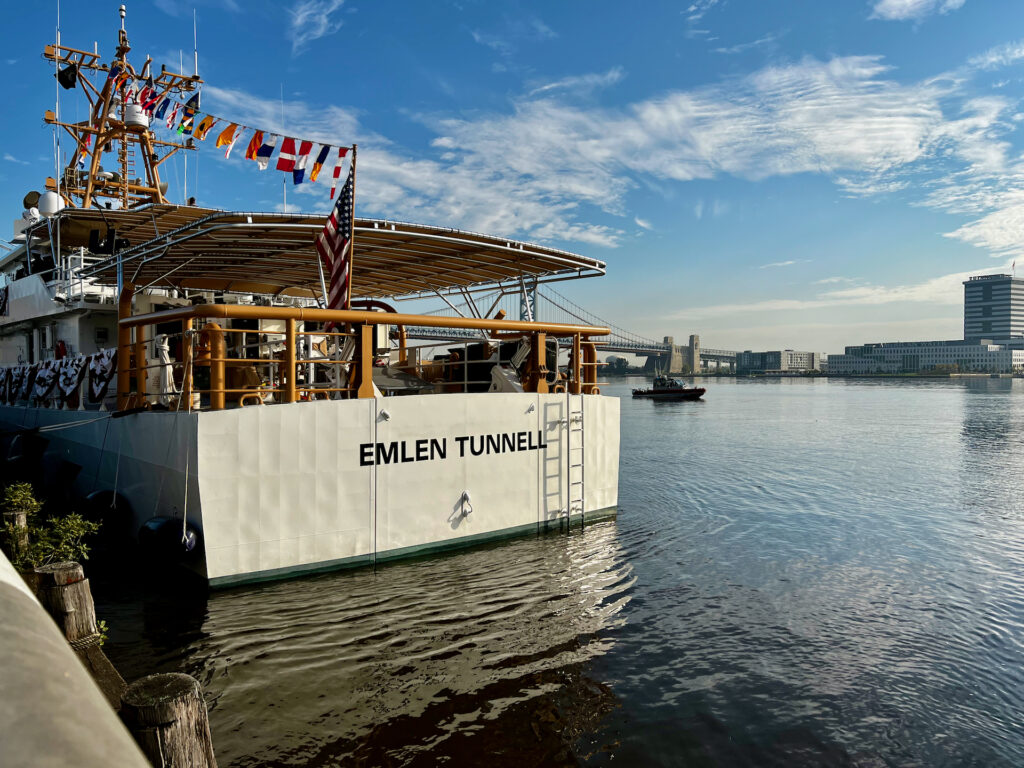
The U.S. Coast Guard commissioned the USCGC Emlen Tunnell (WPC 1145), Patrol Forces Southwest Asia’s fourth 154-foot Sentinel-class cutter, into service at Penn’s Landing in Philadelphia on Oct. 15. The ship will soon be bound for basing in Bahrain along with the USGCG Glenn Harris (WPF 1144). U.S. COAST GUARD / Clinton Muir

ARLINGTON, Va. — The second pair of Sentinel fast-response cutters are soon to depart U.S. waters on a voyage across the Atlantic Ocean bound for permanent basing in the Persian Gulf.

Coast Guard Commandant Karl Schultz, speaking Dec. 8 at a Navy League Special Topic Breakfast, said the two 154-foot-long FRCs will be escorted across the ocean by the USCGC Thetis (WMEC 910), a Famous-class medium-endurance cutter that was topping off with fuel in Puerto Rico. Schultz said that after the escort mission the Thetis will be operating off Africa.

The two FRCs, USCGC Glenn Harris (WPC 1144) and USCGC Emlen Tunnell (WPC 1145), will replace two of the four remaining Island-class 110-foot-long patrol boats in Patrol Forces Southwest Asia at their base in Bahrain.

Earlier this year, the first two FRCs assigned to the Persian Gulf, USCGC Charles Moulthrope (WPC 1141) and USCGC Robert Goldman (WPC 1142), were escorted across the Atlantic by the national security cutter USCGC Hamilton (WMSL 753).

The first two FRCs in the Gulf replaced the Island-class patrol boats USCGC Adak (WPB 1333) and USCGC Aquidneck (WPB 1309), which were decommissioned on June 15 for transfer to Indonesia.

Patrol Forces Southwest Asia conducts maritime security patrols in the Persian Gulf in concert with the U.S. 5th Fleet and other allies and partners

The voyage to Bahrain from the U.S. East Coast covers 9,000 nautical miles.


Coast Guard Offloads More than $148 Million of Illegal Narcotics in Miami

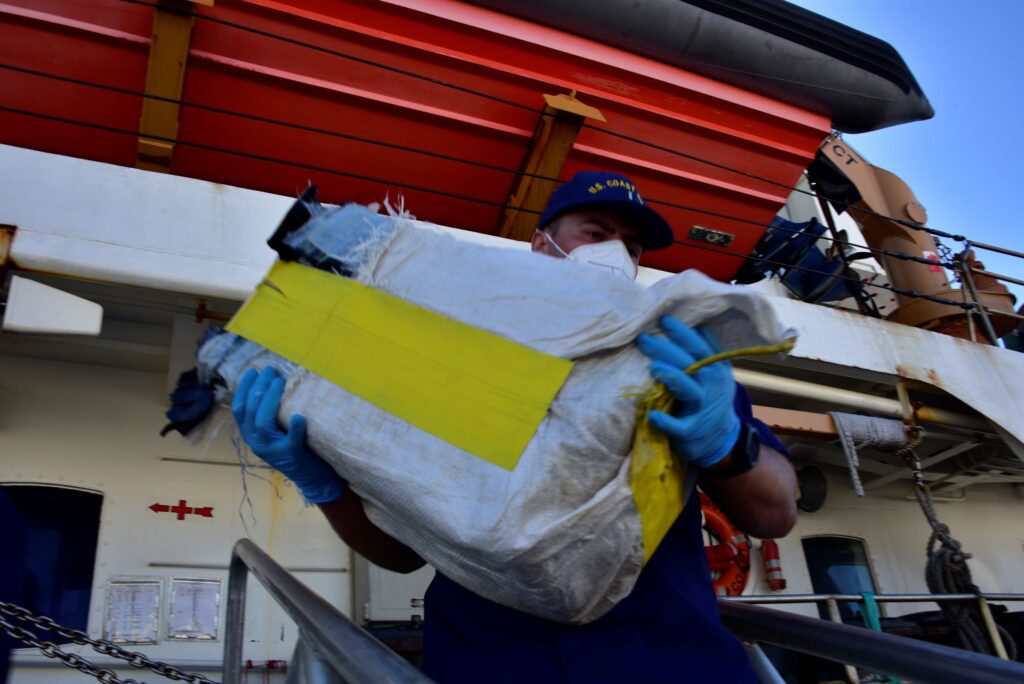
A crew member of the Coast Guard Cutter Dauntless offloads a bale of illegal narcotics at Base Miami Beach, Florida, Dec. 7. The contraband was seized by members of the Royal Fleet Auxiliary Wave Knight and the His Netherlands Majesty’s Ship Holland during three separate interdictions in the Caribbean Sea. U.S. COAST GUARD / Petty Officer 3rd Class Brian Zimmerman

MIAMI — Coast Guard Cutter Dauntless’ crew offloaded more than $148 million of illegal narcotics at Base Miami Beach, Dec. 7, from three separate interdictions in the Caribbean Sea in the past two weeks, the Coast Guard 7th District said Dec. 9. 

Following the three interdictions, nine suspected drug smugglers with Dominican Republic and Colombian nationalities were apprehended. The Royal Fleet Auxiliary Wave Knight crew seized approximately 1,200 pounds of cocaine, and Coast Guard Cutter William Trump and the His Netherlands Majesty’s Ship Hollands’ crew seized approximately 6,700 pounds of cocaine in two interdictions. 

The U.S. Attorney’s Offices for the District of Puerto Rico, Southern District of Florida and the Eastern District of Virginia are prosecuting these cases. 

“These successful interdictions are the result of professional partnerships between the Coast Guard, RFA Wave Knight, and HNLMS Holland crews,” said Hansel Pintos, 7th District spokesperson. “The Coast Guard’s strong international partnerships, counter threats in the maritime domain, protect each of our countries from transnational organized crime, and work to stabilize and promote good governance in the region.” 

This effort is part of an Organized Crime Drug Enforcement Task Forces operation. OCDETF identifies, disrupts and dismantles the highest-level criminal organizations that threaten the United States using a prosecutor-led, intelligence-driven, multi-agency approach. 

The fight against drug cartels in the Caribbean Sea requires unity of effort in all phases from detection, monitoring and interdictions, to criminal prosecutions by international partners and U.S. Attorneys’ Offices in districts across the nation. 

During at-sea interdictions, a suspect vessel is initially detected and monitored by allied, military or law enforcement personnel coordinated by Joint Interagency Task Force-South based in Key West, Florida. The law enforcement phase of operations in the Caribbean Sea is conducted under the authority of the Seventh Coast Guard District, headquartered in Miami. The interdictions, including the actual boardings, are led and conducted by members of the U.S. Coast Guard. 


Coast Guard Cutter Completes Operation Blue Pacific Patrol in Oceania

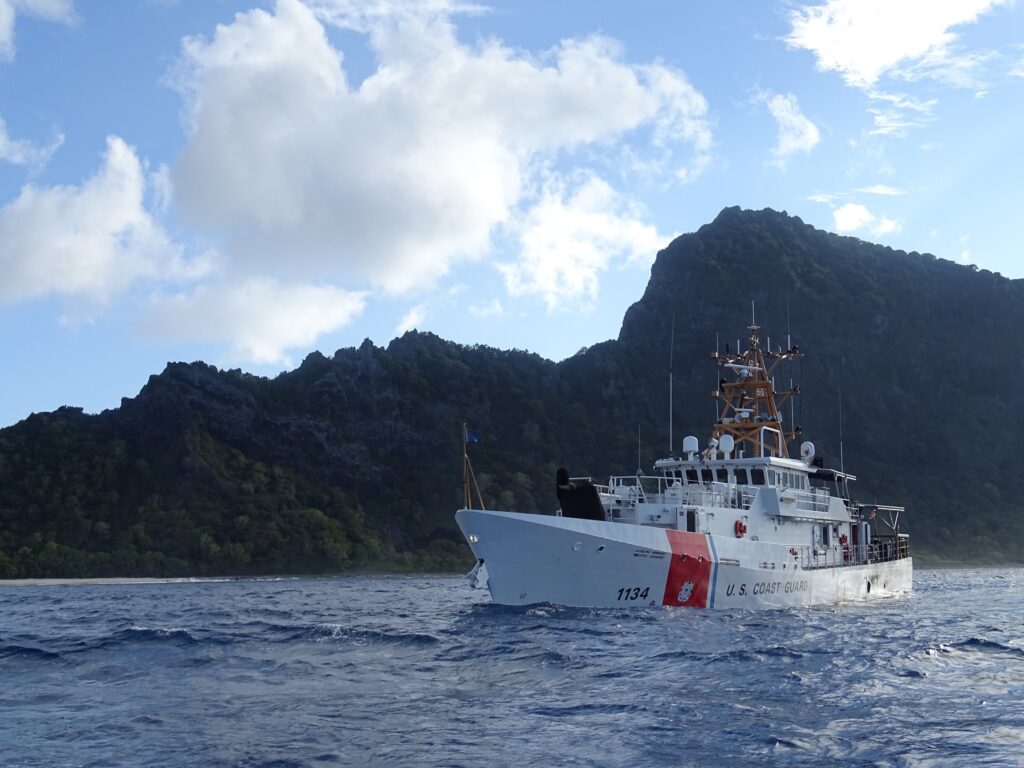
The Coast Guard Cutter William Hart participates in the Pacific Islands Forum Fisheries Agency’s Operation Kurukuru off American Samoa, Oct. 29. U.S. COAST GUARD

HONOLULU — The crew of the Coast Guard Cutter William Hart completed its 39-day patrol over 7,000 nautical miles in Oceania in support of the Coast Guard’s Operation Blue Pacific, last week, said the Coast Guard 14th District. 
 
Operation Blue Pacific is an overarching multi-mission Coast Guard endeavor promoting security, safety, sovereignty and economic prosperity in Oceania while strengthening relationships between our partners in the region. 
 
“This patrol had multiple goals, which really displayed the adaptability of our crew,” said Lt. Cmdr. Cynthia Travers, the commanding officer of the William Hart. “While we continued to support international efforts to combat illegal, unreported, and unregulated fishing in the region, we’ve also worked with our partners including New Zealand’s National Maritime Coordination Centre, the nation of Samoa, the National Park Service, and the National Oceanic and Atmospheric Administration on a number of joint endeavors.” 
 
In November, the crew of the William Hart, one of the Coast Guard’s new Fast Response Cutters, participated in the Pacific Islands Forum Fisheries Agency’s Operation Kurukuru, an annual coordinated maritime surveillance operation with the goal of combating IUU fishing. 
 
IUU fishing presents a direct threat to the efforts of Pacific Island countries and territories to conserve fish stocks, an important renewable resource in the region. 
 
Following the successful conclusion of Operation Kurukuru, the William Hart’s crew continued to patrol the exclusive economic zones of the United States, Samoa, Tonga, Kiribati and Fiji to prevent illicit maritime activity. 
 
Upon request from NOAA, the crew visited Fagatele Bay in the National Marine Sanctuary of American Samoa, using the cutter’s small boat to ensure there was no fishing or activity which would damage the coral within the United States’ largest national marine sanctuary. 
 
The crew of the William Hart also supported a National Park Service boat during a transit between Tutuila Island and the Manu’a Islands, providing search and rescue coverage. 
 
The cutter’s crew then departed for Fiji’s EEZ, where they supported New Zealand’s NMCC by locating an adrift Deep-ocean Assessment and Reporting of Tsunamis buoy and reporting the buoy’s condition to Headquarters Joint Forces New Zealand and other stakeholders. 
 
DART buoys are real-time monitoring systems strategically deployed throughout the Pacific to provide important tsunami forecasting data to researchers. 
 
“These expeditionary patrols are important to the continued stability and prosperity of Oceania,” said Lt. Cmdr. Jessica Conway, a Coast Guard 14th District operations planner. “Partnerships are key to promoting a free and open Indo-Pacific. Operation Blue Pacific allows us to coordinate with regional partners and most effectively employ our assets towards shared goals.” 


USFFC Holds Change of Command, Welcomes 43rd Commander

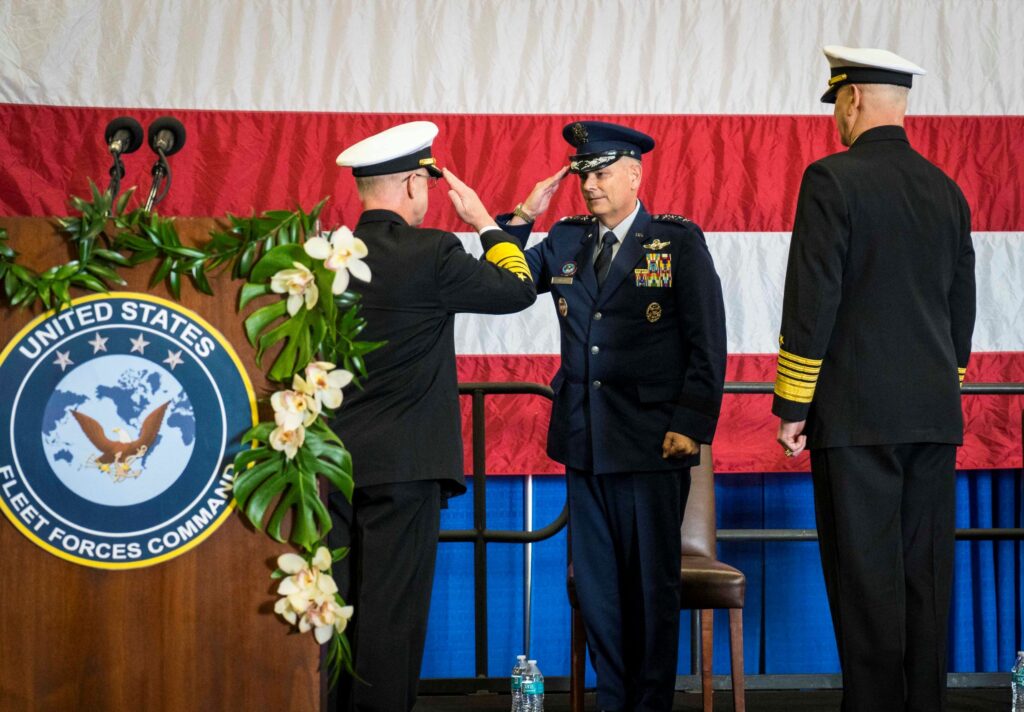
Adm. Christopher W. Grady, left, is relieved as commander, U.S. Fleet Forces Command by Adm. Daryl Caudle during the USFFC change of command ceremony aboard USS George H. W. Bush (CVN 77), Dec. 7. U.S. NAVY / Mass Communication Specialist 3rd Class Bryan Valek

NORFOLK — Adm. Christopher Grady was relieved by Adm. Daryl Caudle as commander, U.S. Fleet Forces in a ceremony aboard aircraft carrier USS George H. W. Bush (CVN 77) at Naval Station Norfolk, Virginia, Dec. 7, the command said. 

Dozens of civilian and military guests gathered to bid fair winds and following seas to Grady as he departs after more than three years in command, and to welcome Caudle as the new commander. Speakers included commander, U.S. Strategic Command Adm. Charles Richard and commander, U.S. Northern Command Gen. Glen VanHerck. 

Richard presided over the ceremony and said, “Adm. Grady’s leadership and innovation have brought to bear the full capability of the U.S. Navy in support of deterring our adversaries and assuring our allies and partners like never before. His visionary strategic approach is exactly what we need as we posture the joint force to meet today’s global challenges. I have full confidence that Adm. Caudle will pick up the ball and move it down the field.” 
   
“As the commander of Naval Forces Northern Command, Adm. Grady remained laser focused on the persistent proximate threats and the homeland defense challenges our nation faces during this period of increased global strategic competition with peers and near peers,” said VanHerck. “Adm. Grady’s numerous command tours have defined the standard across the fleet and throughout the Department of Defense for operational capability, mission success and a relentless approach to readiness.” 
   
Grady has been nominated by the White House to serve as the next vice chairman of the Joint Chiefs of Staff. Grady expressed his immense appreciation and pride to the Fleet Forces staff for the accomplishments they achieved under his charge. 
   
“Fleet Forces command is involved in nearly every aspect of the force-force generation, force development, force employment and in generating readiness to provide combatant commanders the resources that they need to defend our national interests at home and abroad,” said Grady. “Truly, the actions of every service member, government civilian, and contractor here at Fleet Forces, and across the waterfront, have played a critical role in supremely preparing the Navy and, to fight and win in today’s strategic environment.” 
   
Caudle joins the USFFC team after wrapping up his tour as the commander, U.S. Submarine Force, U.S. Atlantic Fleet. Caudle is the 43rd commander of USFFC. 
   
“Admiral Grady’s warfighting vision at Fleet Forces transformed our approach to fleet readiness, operationalized our team to support two combatant commanders and protected our homeland in the maritime domain,” said Caudle. “I’m truly honored to continue to build on the successes of the Fleet Forces team, continuing to ensure our fleet is ready to bring lethality and integrated deterrence anytime, anywhere across the globe.” 


USS Daniel Inouye Commissioned at Pearl Harbor

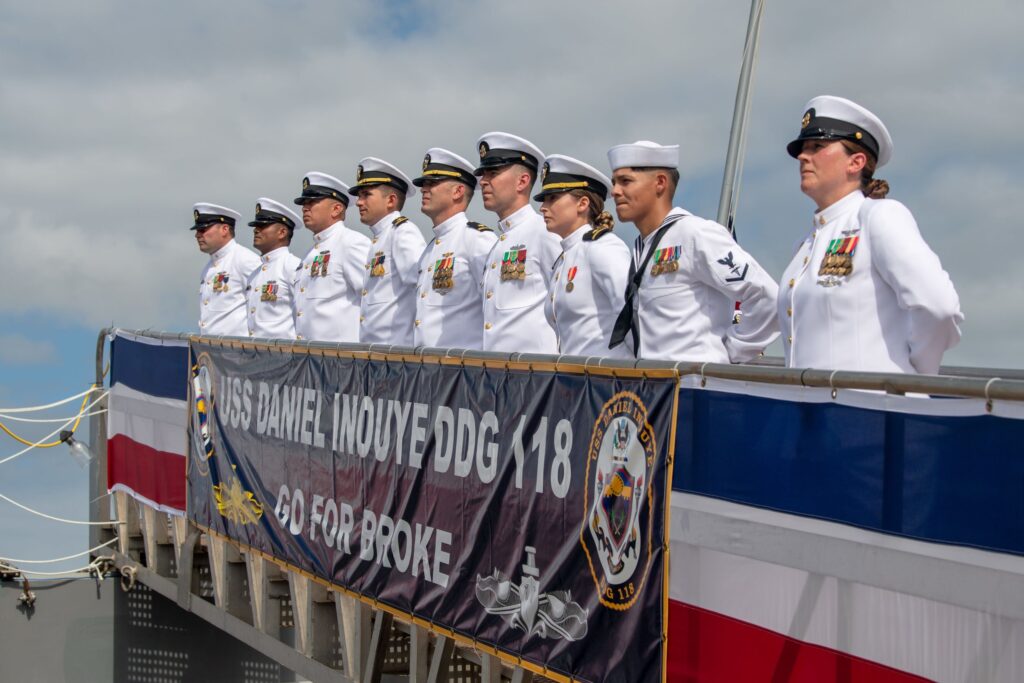
The U.S. Navy commissioned its newest guided-missile destroyer, USS Daniel Inouye (DDG 118), Dec. 8, at Joint Base Pearl Harbor-Hickam. U.S. NAVY

PEARL HARBOR, Hawaii — The U.S. Navy commissioned its newest guided-missile destroyer, USS Daniel Inouye (DDG 118), Dec. 8 at Joint Base Pearl Harbor-Hickam, according to U.S. Pacific Fleet Public Affairs. 

More than 1,000 guests including service members, veterans, and their families witnessed as the Navy’s 69th Arleigh Burke-class guided-missile destroyer joined the fleet. 
 
The ship honors the local hero and statesman, Sen. Daniel K. Inouye, a U.S. senator from Hawaii who served in Congress from 1962 until his death in 2012. During World War II, Inouye served in the U.S. Army’s 442nd Regimental Combat Team, one of the most decorated military units in U.S. history. For his combat heroism, which cost him his right arm, Inouye was awarded the Medal of Honor. 

Guest speakers for the included David Ige, governor of Hawaii, Secretary of the Navy Carlos Del Toro, and Adm. Samuel Paparo, commander, U.S. Pacific Fleet. Paparo and Del Toro spoke about the Inouye’s capabilities as a warfighting vessel in the Pacific fleet.
 
“This ship, the USS Daniel Inouye, will join the U.S. Pacific Fleet and the Indo-Pacom joint team,” said Paparo. “This ship and its crew are ready to assume its critical mission: The defense and safeguarding of the well-being and interests of our nation.” 
 
“As a former destroyer captain, I know firsthand about the ability, versatility and distributive power this ship will add to our deterrent capabilities,” said Del Toro. “There is absolutely no more of a fitting name for this ship than Sen. Inouye.” 
 
Prior to her passing on April 7, 2020, Inouye’s wife, Irene Hirano Inouye, executed her duties as the ship’s sponsor by establishing a strong bond with the crew during traditional shipbuilding milestones at Bath Iron Works. At the keel laying in 2018, she welded her initials into the keel of the ship. In 2019, she broke a bottle of champagne on the bow in a christening ceremony bestowing the name on the ship. During a “mast stepping” ceremony, she placed items special to the senator in the ship’s mast. 
 
During the ceremony, the senator’s granddaughter and ceremonial maid of honor, 11-year-old Maggie Inouye, gave the traditional order, “Man our ship and bring her to life!” 
 
After reporting the ship ready for duty, the ship’s commanding officer, Cmdr. DonAnn Gilmore recognized her crew’s hard work. 
 
“No captain could ask for more. You have embodied the motto ‘go for broke’ at every challenge,” said Gilmore. “I have to look no further than the rails of the ship behind me to renew my faith in humanity and to maintain my confidence in our country’s future.” 
 
The commissioning ceremony coincided with 80th Anniversary of Pearl Harbor Remembrance commemoration events and caps a weeklong series of events celebrating the ship and its namesake. On December 7, 1941, Inouye was a 17-year-old senior at Honolulu’s McKinley High School, and rushed to a Red Cross aid station to help civilians and Sailors wounded in the attack. 
 
USS Daniel Inouye, the first U.S. warship to bear its name, is nearly 510 feet in length and has a navigational draft of 33 feet.


GA-ASI Announces New Mojave STOL UAS

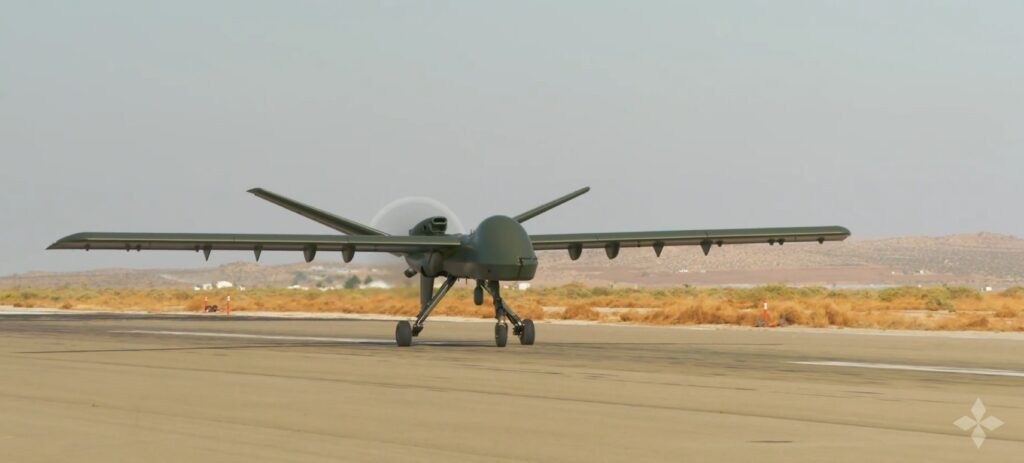
The new short takeoff and landing Mojave UAS. GENERAL ATOMICS AERONAUTICAL SYSTEMS

SAN DIEGO — General Atomics Aeronautical Systems Inc. is unveiling the new unmanned aircraft system Mojave, named for one of the harshest and most austere areas the world, where deadly rattlesnakes and horned lizards adapt to survive the extreme forces of nature, the company said Dec. 9. 

Mojave is based on the avionics and flight control systems of MQ-9 Reaper and MQ-1C Gray Eagle-ER but is focused on short-takeoff and landing capabilities and increased firepower. It features enlarged wings with high-lift devices, and a 450-HP turboprop engine.  

Mojave provides options for forward-basing operations without the need for typical airport runways or infrastructure. It can land and takeoff from unimproved surfaces while also retaining significant advantages in endurance and persistence over manned aircraft. These innovations make Mojave the perfect UAS to perform armed overwatch, attack and armed reconnaissance missions, the company said. 

 A prototype aircraft first flew this summer and is continuing to demonstrate exceptional short-field performance and other unique qualities.  

“We’re proud to bring these extraordinary capabilities to our Predator line of UAS,” said GA-ASI CEO Linden Blue. “We are providing the ground force with a long-endurance, armed overwatch UAS that can quickly reload weapons at austere sites, located close to the conflict zone. This revolutionary design, based on seven million flight hours of UAS experience, increases expeditionary employment options, making Mojave a real game changer.”  

STOL capability increases the number of employment options available to Mojave, potentially including aircraft carrier-based options, unlocking naval missions or sea-based support for special operations forces. 

Payload capacity is 3,600 pounds and Mojave can carry up to 16 Hellfire or equivalent missiles. Mojave can be equipped with a sensor suite including electro-optical/infrared, synthetic aperture radar and ground moving target indicator and signal intelligence to support land or maritime missions.  


Navy Award SAIC $1.1 Billion Mk48 Torpedo Production contract

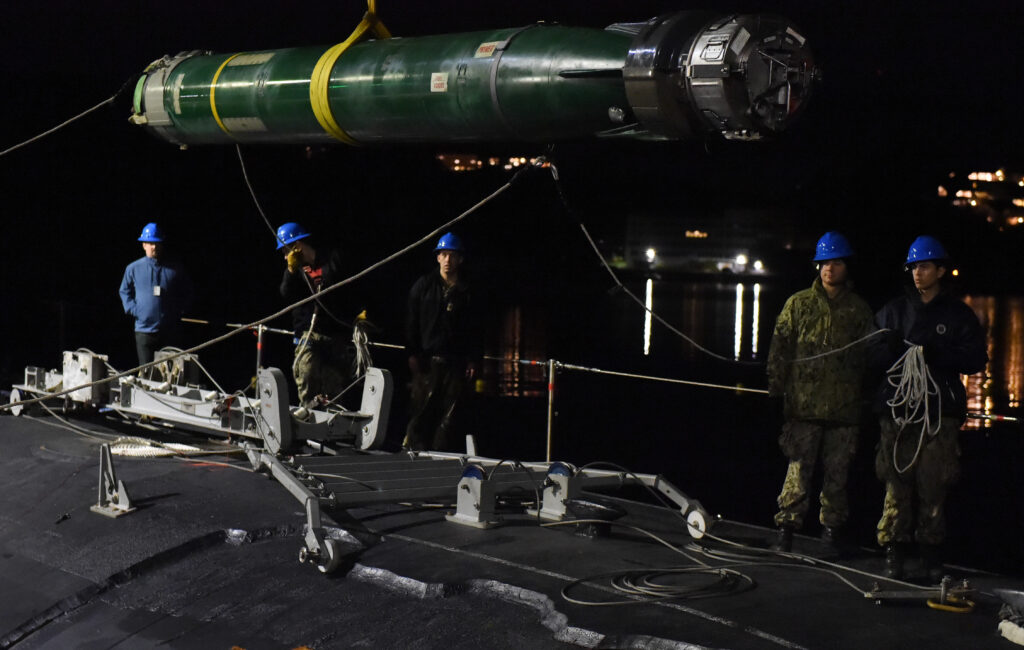
Sailors assigned to the Virginia-class, nuclear-powered, fast-attack submarine USS Minnesota (SSN 783) guide an MK-48 Advanced Capability torpedo during an expeditionary ordnance onload at the Haakonsvern Naval Base in Bergen, Norway, Oct. 18, 2019. U.S. NAVY / Chief Mass Communication Specialist Travis Simmons

RESTON, Va. — Science Applications International Corp. has been awarded a $1.1 billion contract to produce, assemble, test and deliver the U.S. Navy’s Mk48 Mod 7 torpedo afterbody tailcones and Mk29 Mod 0 warshot fuel tanks, the company said Dec. 6.  

Under the contract from the Program Executive Officer, Undersea Warfare Systems, Undersea Weapons Program Office (PMS 404), SAIC will provide all necessary facilities, resources and management necessary to meet the contract’s integration, production, test and delivery requirements. The afterbody tailcone is the section of torpedo containing propulsion and navigations systems, with 26 major sub-assemblies requiring the integration of greater than 500 pieces and parts in each. 

“SAIC is proud of our expanded work on integration, production, assembly, test and delivery contracts that support the Mk48 heavyweight torpedo system for the U.S. Navy,” said Bob Genter, president of SAIC’s Defense and Civilian Sector. “We are confident that our proven performance on the Mk48 will continue to provide the Navy with the sea-dominance weapon it requires.” 


Royal Australian Navy Awards ScanEagle Contract Extension to Insitu Pacific

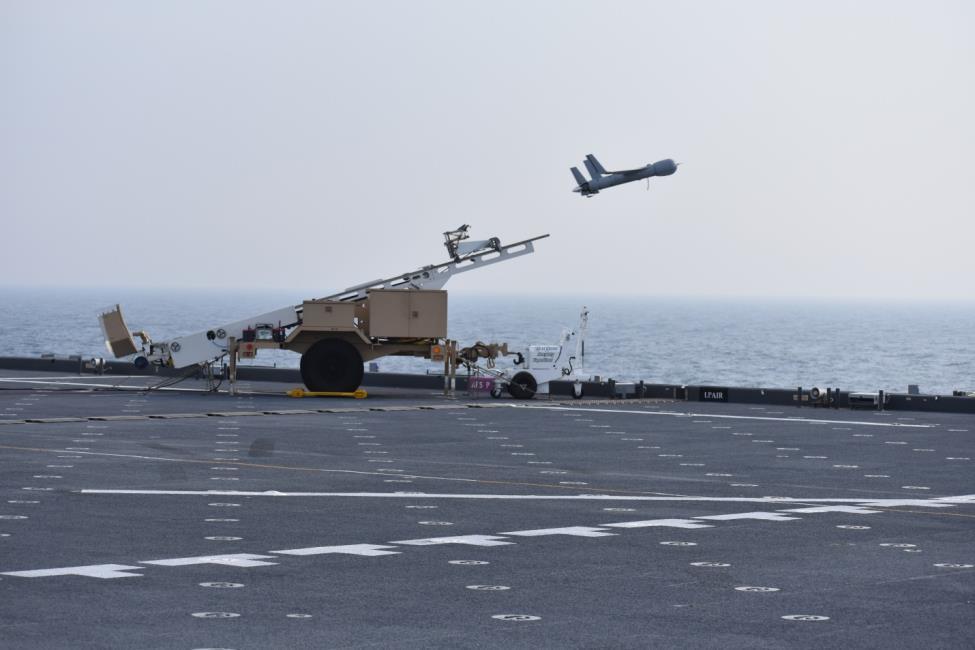
A ScanEagle is launched during a Strait of Hormuz transit aboard USS Lewis B. Puller (ESB 3) in 2018. U.S. NAVY / Chief Logistics Specialist Brandon Cummings

BRISBANE, Australia — Insitu Pacific has been awarded a three-year contract extension by the Royal Australian Navy for the sustainment of its ScanEagle unmanned aircraft, the company said Dec. 6. 

The extension allows the Australian navy to continue to experiment and develop knowledge using the ScanEagle maritime UAS, leveraging the foundation capability developed during embarked operations on HMAS Newcastle in the Gulf of Oman in 2017. 

“Insitu Pacific is proud to continue to support [the Royal Australian Navy] in their ongoing [unmanned aircraft] experimentation and testing work over the next three years,” said Andrew Duggan, managing director of Insitu Pacific. “This contract extension provides us with an opportunity to deepen our existing sovereign capability and supply chains in Australia, and partner with RAN to offer up new capabilities for testing in the coming years.” 

ScanEagle has been in service with the Australian navy for experimentation and testing since 2014. 

The navy operates several ScanEagle systems at 822X Squadron in Nowra, and the contract extension enables continuation of MUAS training, tactics development and payload evaluation activities.