INS Vela is commission in Mumbai Nov. 25. INDIAN NAVY
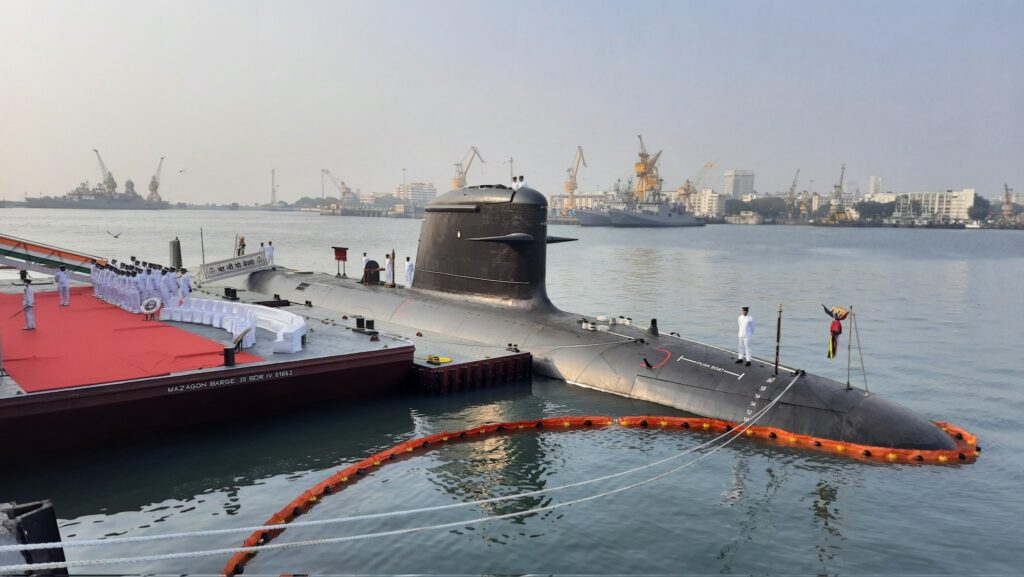
MUMBAI — India commissioned its newest surface combatant, the 7400-ton guided missile destroyer INS Visakhapatnam (D61), Nov. 21, and its newest submarine, INS Vela (S24), Nov. 25, both in Mumbai.
Visakhapatnam is the lead ship in a class of four stealth guided-missile destroyers under Project 15B. The second ship is scheduled for commissioning in 2023, followed by the third and fourth ships in 2025.
The Visakhapatnam was designed by the Indian navy’s Directorate of Naval Design and constructed by Mazagon Dock Ltd. in Mumbai using indigenously sourced steel.
Vela, a 1,700-ton Scorpene-class air independent propulsion diesel submarine, was also built by Magazon Dock Ltd. in collaboration with the Naval Group in France. It is the fourth in a series of the six Scorpene-class submarines being constructed in India for the Indian navy. The navy operates or is building both attack and ballistic missile submarines.
While many navies are building frigates, the number of navies acquiring destroyers is relatively small.
The DDGs represent an evolutionary development for the Indian navy, starting with the 6,200-ton, three-ship Project 15 Delhi class and the three ships of the 7,400-ton Project 15A Kolkata class.
The Delhi-class was influenced by Russian weapons and combat systems, whereas the newer ships feature western and indigenous systems. The Kolkata class added the supersonic BrahMos anti-ship and land-attack missile. The P15B ships are about the same size as the P15As, but with more advanced systems from Russian, western and indigenous sources. They also have a reduced radar cross section. According to India’s Ministry of Defence, the overall indigenous content of the project is about 75%.
“Today, as INS Visakhapatnam manufactured by MDSL is successfully commissioned, there is no doubt that in the coming times, we will be shipbuilding not only for our own needs, but also for the needs of the entire world. I’m confident that INS Visakhapatnam will live up to her name and strengthen our maritime security,” Minister of Defence Rajnath Singh said at the commissioning ceremony.
The defense minister said the Indian navy has an important role to keep the oceans open, safe and secure. “Challenges such as piracy, terrorism, illegal smuggling of arms and narcotics, human trafficking, illegal fishing and damage to the environment are equally responsible for affecting the maritime domain. Therefore, the role of the Indian navy becomes very important in the entire Indo-Pacific region,” Singh said.
MQ-25 Conducts Ground Testing at Chambers Field
The U.S. Navy and Boeing conducted ground testing of the MQ-25 Stingray at Chambers Field onboard Naval Station Norfolk, Virginia. The MQ-25 Stingray is an unmanned aerial refueling aircraft. U.S. NAVY / Mass Communication Specialist 2nd Class Sam Jenkins
NORFOLK, Va. — The U.S. Navy and Boeing are completing ground tests of the MQ-25 Stingray test asset at Chambers Field onboard Naval Station Norfolk, Virginia, the Navy said Nov. 22.
“The Stingray is the future of naval aviation. It is the first aircraft carrier-based unmanned air vehicle,” said Rear Adm. John Meier, Commander, Naval Air Force Atlantic. “The ground testing is another step toward the teaming of manned and unmanned aircraft platforms. Integrating platforms like the MQ-25 into the air wing will increase their lethality and reach.”
The MQ-25 Stingray introduces unmanned aerial refueling and intelligence, surveillance and reconnaissance capabilities to the air wing that will extend the range, operational capacity and lethality of the Carrier Air Wing and Carrier Strike Group.
“What we are doing today is deck handling,” said Rick Schramm, the technical lead engineer material review board. “We have a system installed on the airplane that allows the aircraft to be engines up, power running and taxing by controllers on the deck.”
Schramm described that they are using painted lines to section areas of the flight deck to test how the MQ-25 would be able to maneuver on board an aircraft carrier.
The MQ-25 is the first move toward the Navy’s strategic vision of unified, interoperable networks and systems architecture. It is paving the way for future unmanned systems to be introduced to the air wing and aircraft carrier environment.
Chief Aviation Machinist Mate Michael Solle said the capabilities of the MQ-25 will allow the F/A-18 to return to its primary mission set as well as extend its strike range and enhance maneuverability.
The Boeing-owned MQ-25 recently completed its first aerial refueling of an F-35C Lightning II aircraft, marking the third refueling flight evolution for the test aircraft as a whole. Once operational, MQ-25 will refuel every receiver-capable carrier-based aircraft.
The MQ-25 is intended to be one of the Navy’s fastest major defense acquisition programs to reach initial operational capability.
ONR Chief Unveils New Vision to Reimagine Naval Power
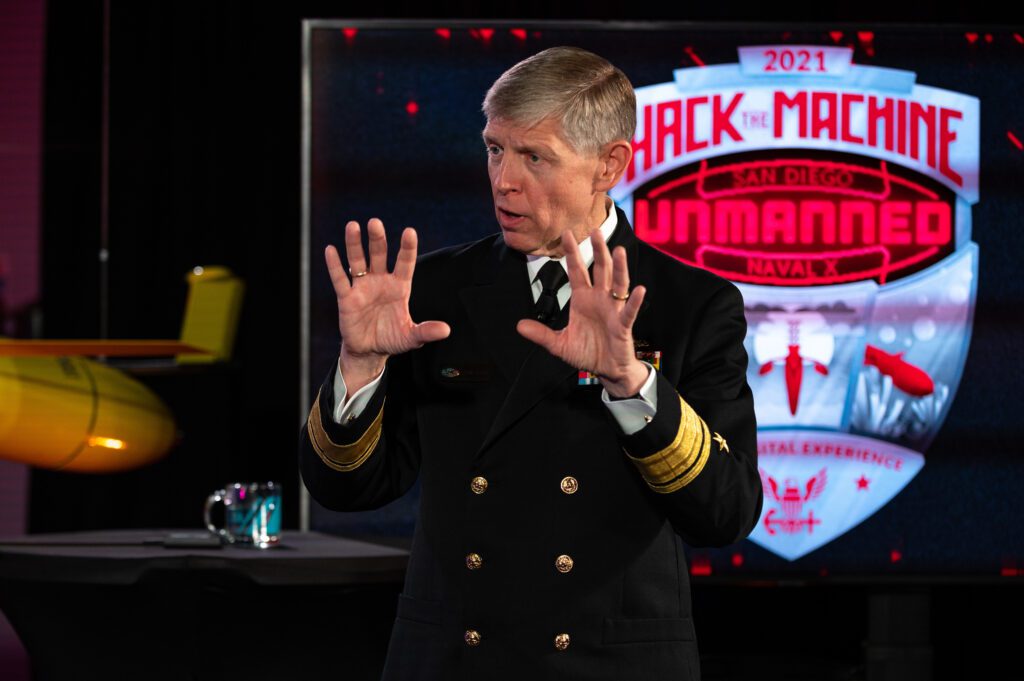
Rear Adm. Lorin Selby, chief of naval research, delivers remarks at the HACKtheMACHINE Unmanned competition in Alexandria, Virginia, Nov. 17. HACKtheMACHINE Unmanned is the first in a series of public-facing technology challenges aimed at accelerating discovery and teambuilding between the DoN, industry and academia for the creation of groundbreaking unmanned and autonomous systems. U.S. NAVY / Michael Walls
ARLINGTON, Va. — Declaring “Our time to innovate is now,” Chief of Naval Research (CNR) Rear Adm. Lorin C. Selby last week introduced a new vision for future naval power, one based on faster development of unmanned, autonomous systems, vibrant partnerships with industry and academia and reimagined naval formations.
“I think this decade, the 2020s, will have special significance for our nation and our role in leading the world,” Selby told a nationwide audience during the HACKtheMACHINE Unmanned event. “What can we do today that can deliver measurable results in two years, that leads to deployed capabilities at scale in five years, to fully realize that reimagined future?”
Small, Agile, Many
A critical important component of future naval success, he said, is incorporating advanced cyberphysical technologies found in the “small, the agile, and the many” — small unmanned, autonomous platforms that have the agility to be built and adapted quickly, in large numbers, and at far lower costs compared to larger platforms. These unmanned air, surface and subsurface vehicles will carry an array of sensors and modern payloads, and perform multiple missions.
“The small, the agile and the many have the strong potential to define the future in a world where the large and the complex are either too expensive to generate in mass, or potentially too vulnerable to put at risk,” he said.
“We are talking about how to iterate at scale and at speed. How to take things that meet operational needs and making them part of the force structure, deploying them in novel naval formations” that will “confuse and confound the tasks our adversaries must consider.”
One of the advantages of the small, agile and many platforms in this new formation is that Selby believes they can be built relatively inexpensively compared to existing force structure. This makes them more attritable in high-end conflict — in other words, if they are shot down or otherwise put out of action, American forces will have dozens, even thousands, of backups in place. Having large numbers of advanced but inexpensive platforms in the fleet to counter an adversary’s expensive platforms could play an important role in deterring aggressive actions.
Selby gave his remarks during a keynote address at the HACKtheMACHINE Unmanned competition, held virtually Nov. 16-19. This event, which is expanding to multiple cities across the country, is a public-facing technology challenge aimed at accelerating discovery and team building between the Department of the Navy, industry and academia.
The ultimate goal of such events, Selby said, is to create new ways of doing business for autonomous and software-based systems. Comparing this moment in history to the dawn of the industrial revolution, when technological advances drove massive change, he noted that today, “data is the new oil, and software is the new steel.”
Sponsored by ONR, in conjunction with Program Executive Office (PEO) C41, PEO Integrated Warfare Systems, PEO Unmanned and Small Combatants, the Navy’s Cybersecurity Office (PMW-130) and industry partners like Fathom5 and Booz Allen Hamilton, HACKtheMACHINE Unmanned is one of the ways ONR is working to support the Navy’s 2021 Unmanned Task Force and integrate unmanned and autonomous technology at scale.
A Strategic Hedge
Selby emphasized the importance of America’s current naval force structure needing a “strategic hedge.” He noted that in World War II, the Navy was primarily invested in battleships as the nucleus of combat power for any future conflict. However, the Navy and the nation had a “hedge” investment in aircraft carrier and submarine force structure. Ultimately the hedge proved crucial to victory — far different from the beginning of the war, when battleships were seen by many as the key.
The small, the agile and the many represent a viable hedge to support the large and the complex platforms that comprise the backbone of today’s force structure. Rapid development of unmanned, autonomous systems provides the technological drive to create a hedge option for the 21st century Navy and Marine Corps. Developing this strategic hedge at ONR is one of many ways the organization helps the Navy and Marine Corps adapt to potential futures.
Finally, the CNR stressed the importance of moving from the current requirements-driven acquisition process — a successful process for large platforms, but one not rooted in speed — to a “problem-driven” process, where the Naval Research Enterprise asks operators and commanders what problems they are facing, and rapidly creates solutions to solve their problems.
That approach has already begun. ONR provided dozens of unmanned platforms and sensors used in last April’s Integrated Battle Problem 2021, which focused on a PACFLEET battle problem. In 2022, those efforts will continue, including partnering with SOUTHCOM to deliver new tools for drug interdiction efforts.
Navy and Port of Hueneme Help Relieve U.S. Supply-Chain Congestion
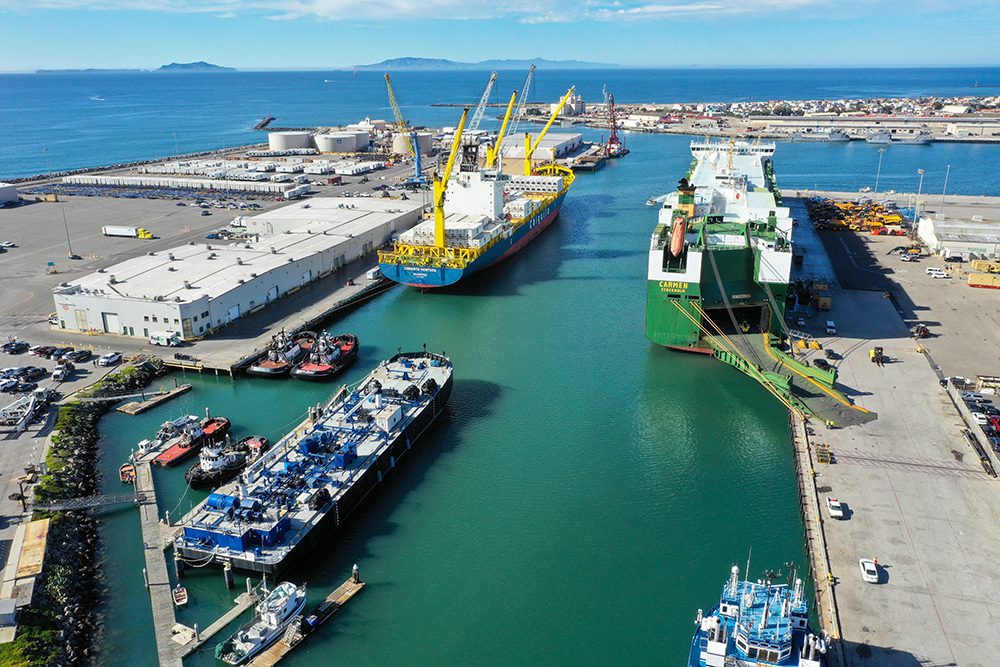
The U.S. Navy in partnership with the Oxnard Harbor District is providing resources onboard Port Hueneme in direct support of decreasing port congestion in Los Angeles County and reducing the national supply-chain shortage, Nov. 22, 2021. U.S. NAVY
PORT HUENEME, Calif. — The U.S. Navy in partnership with the Oxnard Harbor District (OHD) is providing resources onboard Port Hueneme in direct support of decreasing port congestion in Los Angeles County and reducing the national supply-chain shortage, Nov. 22, 2021.
A standing Joint Use Agreement (JUA) with Naval Base Ventura County and OHD, allows the Navy to support commercial supply chain logistics when activated.
“Naval Base Ventura County recently welcomed a large cargo vessel,” said Daniel J. Herrera, assistant program director for port operations, NBVC. “Ports of America already off-loaded a large number of 40-foot containers into lot 22 onboard Port Hueneme, which is merchandise expected to have direct impact with helping to support holiday supply demands.”
The Department of the Navy entered into a JUA in 2002 with the OHD, replacing the 1994 memorandum of understanding, authorizing commercial use of Wharf 3 onboard NBVC, including approximately 21 acres of contiguous land, buildings 546 and 548, and if available, up to an additional 10 acres of industrial land located outside of the Wharf 3 area.
Jason Hodge, President of the OHD which owns the Port of Hueneme, said commercial business at the port has increased significantly over the past year and when it comes to moving cargo, the Port’s flexible “can do” attitude is similar to the Navy Seabees’ “Can Do” motto of completing a task no matter the condition or situation.
“The port appreciates the partnership with NBVC and locating additional space to accommodate excess holiday shipments coming through the port,” Hodge said. “We are delighted to come together to meet the challenge of providing a solution to help keep essential goods moving. Our long-standing history of partnership continues with this call-to-action to address the national supply chain challenge.”
The JUA was activated in November as a resource to help reduce the shipping congestion affecting Los Angeles County’s major ports and contributing to the national supply crisis. Vessels would arrive into the port to unload a portion of their containers before continuing on to Los Angeles County or chose to unload all their containers at the Port of Hueneme to avoid the backlog of ships farther south.
BAE Systems Launches Next-Gen Power and Propulsion System to Help Operators Reach Zero Emissions
BAE SYSTEMS
ENDICOTT, N.Y. — Nov. 23, 2021 — BAE Systems, a leader in electric propulsion, has launched its next-generation power and propulsion system for the marine market. The HybriGen Power and Propulsion system is a flexible solution to help operators reach zero emissions — improving electrical efficiency and vessel range, increasing propulsion power, and simplifying installation.
The HybriGen Power and Propulsion system uses smaller and lighter components for vessels, building on the company’s 25 years of experience in electric propulsion systems. Its modular accessory power system and modular power control system allow for a scalable, tailor-made solution to fit the specific power and propulsion requirements of a range of vessels, from sailboats and tugs to passenger ferries.
“Our investment in this next-generation technology will provide marine operators with cutting-edge capabilities to create clean transportation,” said Steve Trichka, vice president and general manager of Power & Propulsion Solutions at BAE Systems. “Using a modular design, we can customize our solution to meet the exact needs of each customer, simplifying the installation and improving system reliability. The increased propulsion power and electrical efficiency mean our customers can now accelerate their journey to zero emissions.”
BAE Systems’ electric propulsion technology supports low and zero emission applications with proven controls and components that are available in multiple system configurations.
BAE Systems has more than 14,000 power and propulsion systems in markets around the globe. Each year, those systems contribute to a cleaner world by saving more than 30 million gallons of fuel and eliminating 335,000 tons of carbon dioxide each year — the equivalent of taking 59,000 cars off the road or planting 4.5 million trees.
Work on the HybriGen Power and Propulsion System will be conducted at the company’s facility in Endicott, New York.
U.S. Navy, Jordan Partner on New Unmanned Systems Integration
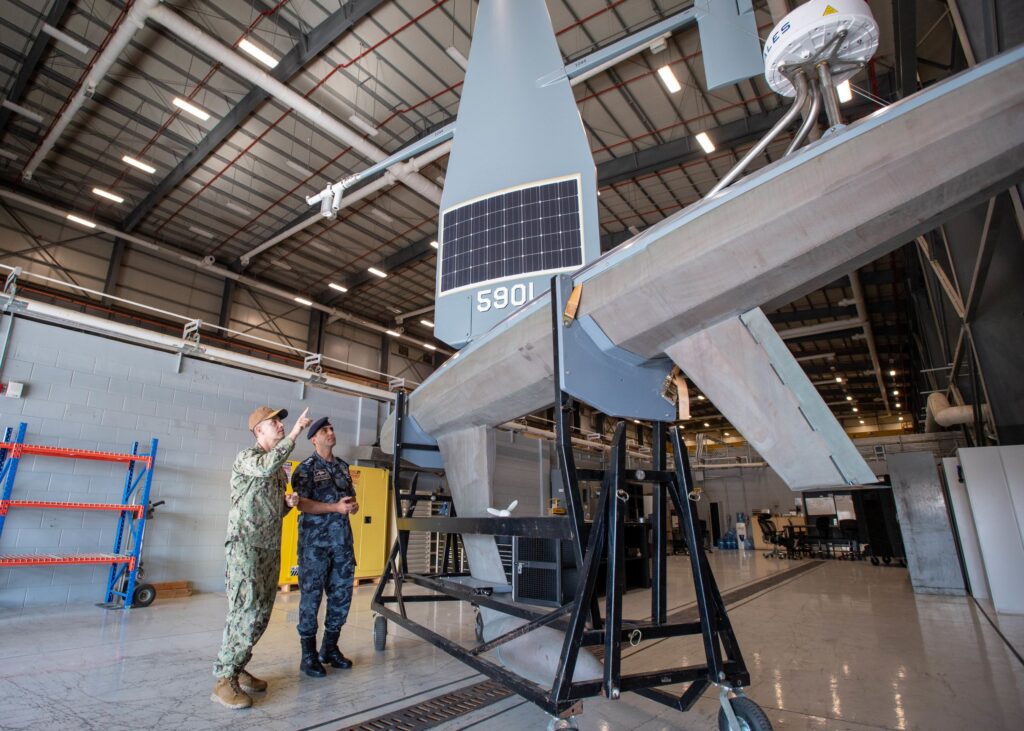
Vice Adm. Brad Cooper, commander of U.S. Naval Forces Central Command, U.S. 5th Fleet and Combined Maritime Forces, left, and Col. Hisham Khaleel Aljarrah, commander of the Royal Jordanian Naval Force, examine Task Force 59’s new Saildrone Explorer unmanned surface vessel at Naval Support Activity Bahrain, Nov. 18. U.S. NAVY / Mass Communication Specialist 2nd Class Mark Thomas Mahmod
MANAMA, Bahrain — U.S. Naval Forces Central Command (NAVCENT) briefed the head of Jordan’s navy on U.S. 5th Fleet efforts to integrate new unmanned systems during a visit to U.S. Naval Support Activity Bahrain, Nov. 18, NAVCENT said in a release.
Personnel from NAVCENT’s Task Force 59 briefed Col. Hisham Khaleel Aljarrah, commander of the Royal Jordanian Naval Force, alongside Vice Adm. Brad Cooper, commander of NAVCENT, U.S. 5th Fleet and Combined Maritime Forces on the task force’s new Saildrone Explorer unmanned surface vessel (USV).
The visit signaled U.S. 5th Fleet’s commitment to partnering with Jordan after establishing the new unmanned task force in September to focus U.S. 5th Fleet efforts on unmanned systems and artificial intelligence integration.
The Royal Jordanian naval base in Aqaba, Jordan will become a joint hub for Saildrone USV operations in the Red Sea next month. The United States and Jordan share a strong bilateral partnership in maintaining regional maritime security and stability.
“This is a major step in our effort to integrate new unmanned systems with our regional partners,” said Cooper. “Our strong partnership with Jordan will help accelerate new system development and integration to enhance maritime domain awareness and strengthen deterrence.”
The Saildrone Explorer is a 23-foot-long, 16-foot-tall USV reliant on wind power for propulsion. The vessel houses a package of sensors powered through solar energy for monitoring the maritime environment.
“We are working harder and smarter to achieve maritime security, in all domains — surface, subsurface, and over the sea,” said Hisham. “The Red Sea will witness a significant increase in monitoring and power projection to maintain stability and security within international waters”
The Middle East region’s unique geography, climate, and strategic importance offer an ideal environment for unmanned innovation through multilateral collaboration. The area includes the world’s largest standing maritime partnership, Arabian Gulf, Red Sea, Gulf of Oman and parts of the Indian Ocean.
MDA Selects Raytheon as One Co. to Develop First Counter-Hypersonic Interceptor
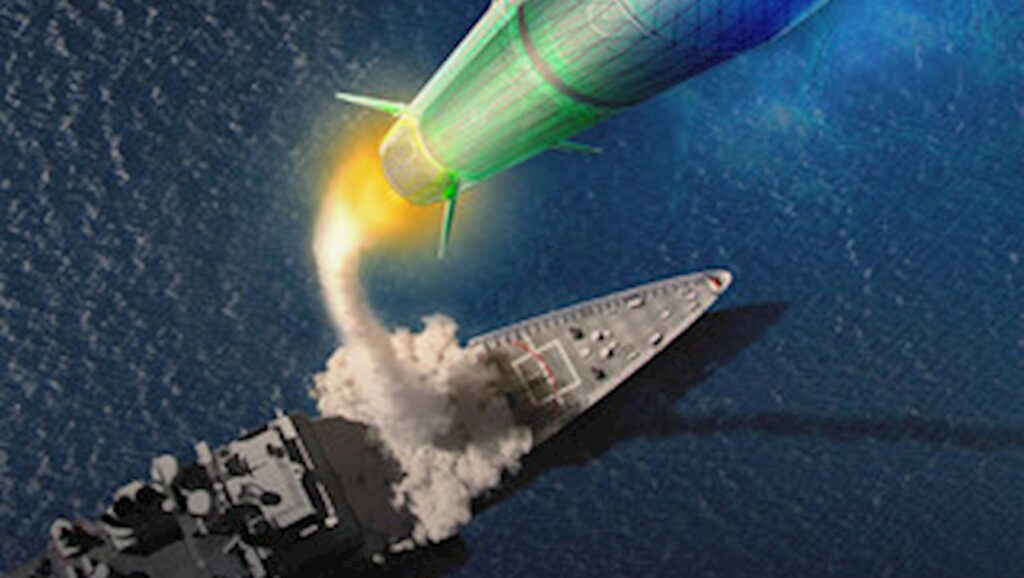
Raytheon Missiles & Defense’s artistic rendering of a GPI conceptual design. RAYTHEON MISSILES & DEFENSE
TUCSON, Ariz. — Raytheon Missiles & Defense, a Raytheon Technologies business, has been selected by the Missile Defense Agency (MDA) as one of the companies to develop and test the first interceptor specifically designed to defeat hypersonic threats, the company said Nov. 19.
The weapon, called Glide Phase Interceptor (GPI), is intended to defeat a new generation of hypersonic missiles, weapons that travel more than five times the speed of sound and maneuver rapidly in flight.
“Raytheon Technologies systems are the cornerstone of today’s ballistic missile defenses. We’re building on that knowledge to advance the missile defense system for future threats,” said Tay Fitzgerald, vice president of Strategic Missile Defense. “GPI’s speed, ability to withstand extreme heat, and maneuverability will make it the first missile designed to engage this advanced threat.”
GPI will intercept hypersonic weapons in the glide phase of flight, which occurs once a missile has re-entered Earth’s atmosphere and is manuevering toward its target. The initial development phase will focus on reducing technical risk, rapidly developing technology, and demonstrating the ability to intercept a hypersonic threat.
Developed on behalf of the MDA, GPI will be integrated into the U.S. Navy’s Aegis Weapon System, a ship- and shore-based defense system.
Raytheon Technologies’ missile defense portfolio combines sensors, interceptors and command and control networks to track and defeat a wide range of threats. Today, the company is responsible for portions of nearly every air and missile defense system deployed by the U.S. and its allies.
HII Awarded Additional $113.6 Million for Advance Procurement for LHA 9
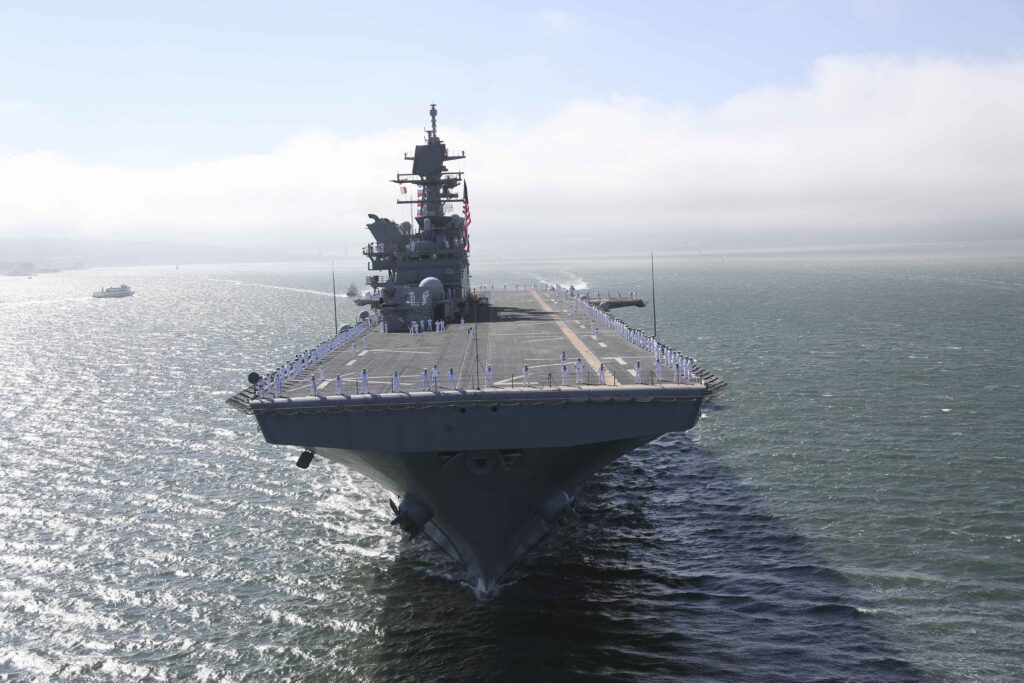
Sailors aboard amphibious assault ship USS Tripoli (LHA 7) man the rails on the ship’s flight deck as the ship prepares to pull into San Francisco in support of San Francisco Fleet Week, Sept. 11. Huntington Ingalls Industries has received a contract modification to enable long-lead material and advanced procurement activities for amphibious assualt ship LHA 9. U.S. NAVY / Mass Communication Specialist 3rd Class Erica Higa
PASCAGOULA, Miss. — Huntington Ingalls Industries’ Ingalls Shipbuilding division has received a contract modification from the U.S. Navy for $113.6 million to enable long-lead-time material and advance procurement activities for amphibious assault ship LHA 9, the company said Nov. 19. This modification brings the total advance funding for LHA 9 to $651 million.
“We appreciate the partnership we have with the Navy and their continued commitment to this important ship,” Ingalls Shipbuilding President Kari Wilkinson said. “Not only will it provide capability to our Navy fleet, but it also sustains hundreds of jobs across the country within our vast network of suppliers in support of construction.”
LHAs are the centerpiece of the Navy amphibious ready groups and Marine Corps air ground task forces. In addition to being lethal, mobile and agile maintenance and logistics facilities, LHAs are top-of-the-line medical facilities with full operating suites and triage capabilities.
Ingalls is the sole builder of large-deck amphibious ships for the Navy. The shipyard delivered its first amphibious assault ship, the Iwo Jima-class USS Tripoli(LPH 10), in 1966. Ingalls has since built five Tarawa-class (LHA 1) ships, eight Wasp-class (LHD 1) ships and the first in the new America class of amphibious assault ships (LHA 6) in 2014. The second ship in the America class, USS Tripoli(LHA 7), was delivered to the Navy in early 2020. Bougainville(LHA 8) is under construction.
Aegis Ashore in Poland on Target for 2022
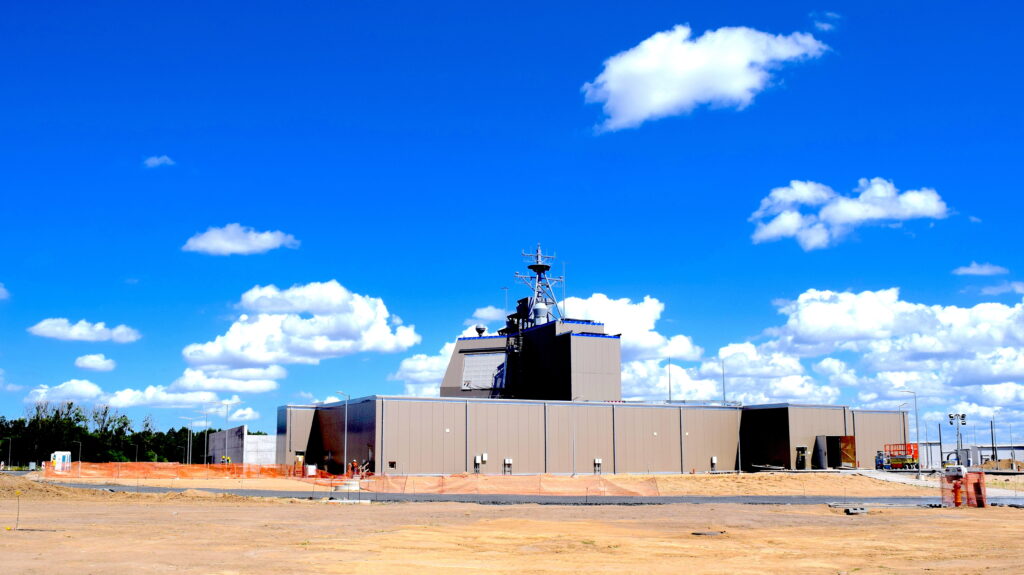
The new Naval Support Facility in Redzikowo, Poland, will be home to the Aegis Ashore Ballistic Missile Defense System(AABMDS) mission in the coming years and is expected to be completed sometime in late 2020. U.S. NAVY / Lt. Amy Forsythe
ARLINGTON, Va. — The Aegis Ashore capability planned for Poland is moving ahead to be operational by the end of next year, the program executive officer for Aegis Ballistic Missile Defense said Nov. 19.
The Aegis Combat System was originally designed as a shipboard system to track and destroy incoming enemy targets, but the system has also been deployed for use on land as “Aegis Ashore.”
Already an Aegis Ashore capability is up and running in Deveselu, Romania, about 90 miles from Bucharest. The site, under the control of NATO, has been in operation for more than five years now.
A site similar to the one in Romania is also planned for Redzikowo, Poland, near the Baltic Sea. But that site has been delayed due to construction issues, although efforts are now underway to get the site operational by the end of next year.
“My part, which is to install the Aegis Weapon System, has been delayed as we work the military construction with our contractors,” said Rear Adm. Tom Druggan during a discussion on Thursday at the Center for Strategic and International Studies in Washington, D.C. “We are behind, given the original schedule, no question about that. The good news is we’re getting the quality we want for a facility that’s going to be there 50 to 75 years, and we now have the right management in place in order to move ahead and complete this.”
Over the summer, Druggan said, the Aegis system in Poland was pulled out of storage there and assembled to test its operations.
“We … put the whole weapon system together with the exception of the antennas,” he said. “We energized it. And the equipment had been in the containers for a while. We found some issues — good news is we fixed them. And then we did an upgrade, which is saving time from a future availability. So that system is actually our most upgraded system today, ready to be installed.”
In an unusual move, Druggan said, the Aegis Ashore capability in Poland is now being set up as the infrastructure on the ground to support it becomes available. He said antennas for the AN/SPY radar system have already been set up.
“We’re installing the backbone of the radar behind it,” he said. “We’ve installed some systems. And we’re going to keep installing our pieces in parallel to the commissioning of all the industrial equipment, power, cooling, ventilation, that’s going on, on the construction side.”
Normally, he said, installing an Aegis system wouldn’t happen until all the supporting construction was complete.
“I made the decision long ago that we were not going to wait,” he said. “We were going to do what we could, when we could, based on the conditions within the deckhouse. That has proved to be a successful strategy. And now we’ve got good momentum.”
Druggan said he expects the Aegis Ashore site in Poland to be operational by the end of 2022, and at that point the transition of the system can happen first to the Navy, then to U.S. European Command, and finally to NATO.
Icebreaker Returns Home following Northwest Passage Transit, Arctic Research Missions, Circumnavigation of North America
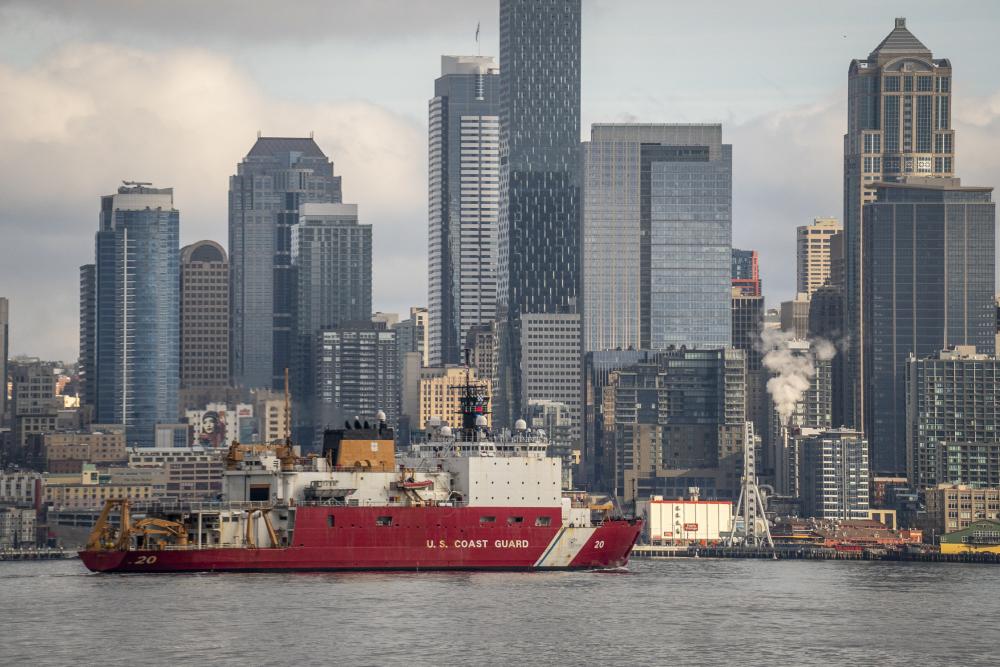
Coast Guard Cutter Healy (WAGB 20) transits Elliott Bay off Seattle Nov. 20 as it returns to its homeport after a 133-day deployment in which the crew circumnavigated North America via the Northwest Passage. The deployment involved both military and scientific operations. JAMES BRADY
SEATTLE — The crew of U.S. Coast Guard Cutter Healy (WAGB 20) returned to their Seattle homeport Saturday following a 22,000-mile, 133-day deployment circumnavigating North America, the Coast Guard Pacific Area said Nov. 20.
The crew aboard Healy, a 420-foot medium icebreaker, provided U.S. surface presence in the Arctic, supported high-latitude oceanographic research missions, participated in an international search-and-rescue exercise and engaged in passing exercises with surface vessels from the U.S. Navy, Canadian navy and Mexican navy.
Healy’s crew hosted members of the international science community and institutions from the U.S., Canada, Norway and Denmark who conducted oceanographic research throughout the Arctic, including the Northwest Passage and within Baffin Bay, to monitor environmental change.
Healy crewmembers also facilitated 430 over-the-side casts of various scientific instruments including a conductivity, temperature and depth array that requires the cutter to station keep as wire lowers and recovers the instrument from below the surface. Additionally, Healy mapped over 20,000-square kilometers of the seafloor, including 12,000-square kilometers of previously unmapped regions, throughout the patrol.
Healy transited north of Canada via the Northwest Passage, where the crew rendezvoused with members of the Canadian Coast Guard and Canadian Rangers for a search-and-rescue exercise. The crew transited south of Mexico via the Panama Canal on their way home. Healy’s deployment supported the Coast Guard’s Arctic strategy while providing critical training opportunities for future icebreaker sailors.
“Healy’s crew demonstrated their tremendous dedication to duty while carrying out the Coast Guard’s Arctic mission, operating in some of the harshest regions in the world,” said Coast Guard Cutter Healy’s Commanding Officer Capt. Kenneth Boda. “They assisted teams of scientists in gathering invaluable data and information throughout the deployment. This research will be shared with laboratories, universities and institutions around the world to support research focused on the changing Arctic environment.”
While transiting down the east coast of the United States and back up the west coast of Mexico, Healy engaged in multiple outreach events including passing exercises, professional exchanges and embarking distinguished visitors to bolster relations with other nations.
Healy deploys annually to the Arctic in support of oceanographic research and Operation Arctic Shield, the Service’s annual operation to execute U.S. Coast Guard missions, enhance maritime domain awareness, strengthen partnerships, and build preparedness, prevention, and response capabilities across the Arctic domain.
Commissioned in 2000, Healy is one of two active polar icebreakers in the Coast Guard’s fleet. Healy is capable of breaking four feet of ice continuously and up to eight feet of ice while backing and ramming.
The U.S. Coast Guard is recapitalizing its polar icebreaker fleet to ensure continued access to the Polar Regions and protect the country’s economic, commercial, environmental, and national security interests. The Coast Guard and U.S. Navy, through an integrated program office, on April 23, 2019, awarded VT Halter Marine Inc., of Pascagoula, Mississippi, a fixed-price incentive contract for the detail, design and construction of the lead Polar security cutter with contract delivery planned for 2025.