Navy to Christen Future Littoral Combat Ship Marinette
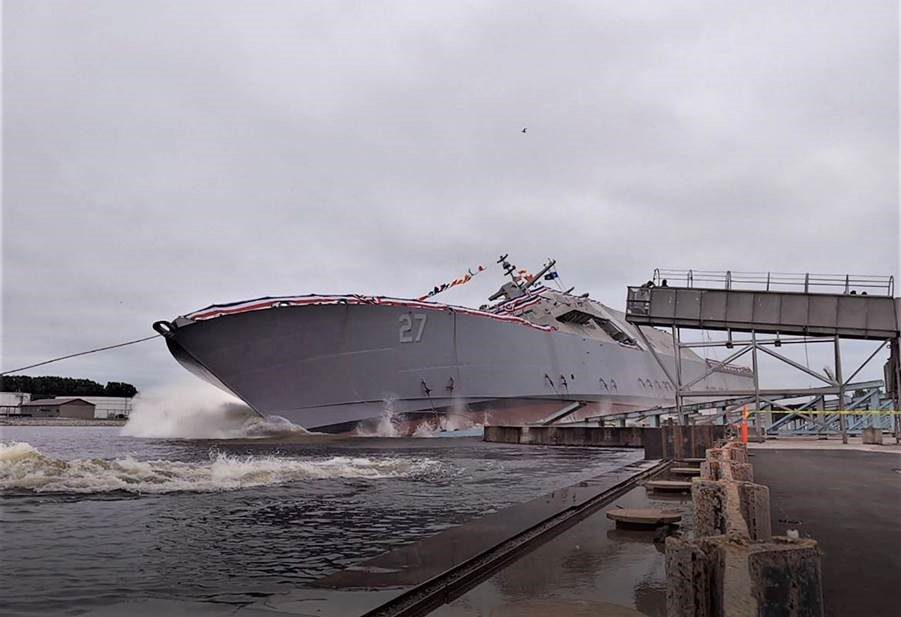
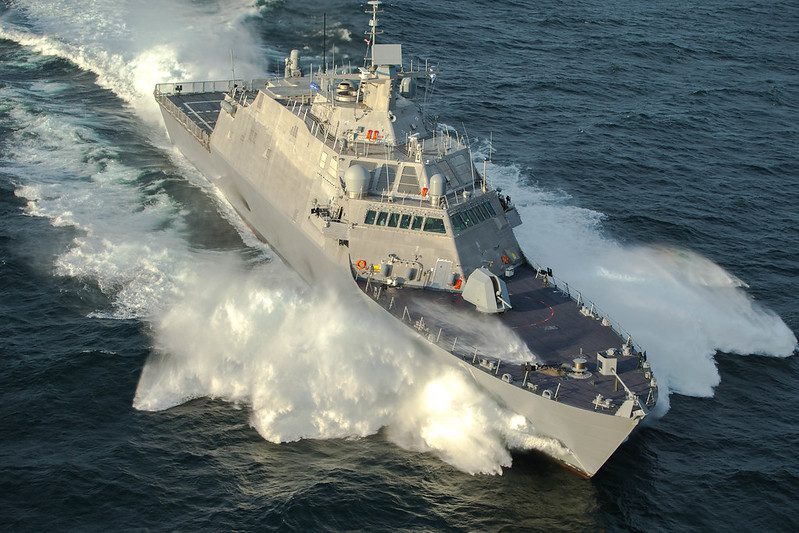
The Navy will christen the future USS Marinette (LCS 25) on Nov. 20. Shown here is the future USS Nantucket, christened Aug. 7. LOCKHEED MARTIN
ARLINGTON, Va.—The Navy will christen the future USS Marinette (LCS 25) as the newest Freedom-variant littoral combat ship (LCS) during a 10:00 a.m. CST ceremony Saturday, Nov. 20, in Marinette, Wisconsin, the Defense Department said Nov. 19.
The principal speaker is Meredith Berger, performing the duties of the under secretary of the Navy. Additional speakers include Vice Adm. William Galinis, commander, Naval Sea Systems Command; Rear Adm. Casey Moton, program executive officer for Unmanned and Small Combatants; Steve Genisot, mayor of Marinette, Wisconsin; and shipbuilders Steve Allen, Lockheed Martin vice president of Small Combatants and Ship Systems, and Dario Deste, president and CEO of Fincantieri Marine Group. The ship’s sponsor, former Michigan governor Jennifer M. Granholm, will break a bottle of sparkling wine across the bow in a time-honored Navy tradition.
“The future USS Marinette will be the second U.S. Navy ship honoring the important naval heritage and shipbuilding history the city of Marinette is known for,” said Secretary of the Navy Carlos Del Toro. “I have no doubt the Sailors of USS Marinette [LCS 25] will carry on the proud legacy from generations past and will stand ready to respond to any mission, wherever, and whenever, there is a need.”
LCS is a fast, agile, mission-focused platform designed to operate in near-shore environments, winning against 21st-century coastal threats. The platform is capable of supporting forward presence, maritime security, sea control and deterrence.
The LCS class consists of two variants, the Freedom and the Independence, designed and built by two industry teams. Lockheed Martin leads the Freedom variant team, or odd-numbered hulls, in Marinette, Wisconsin. Austal USA leads the Independence variant team in Mobile, Alabama for LCS 6 and the subsequent even-numbered hulls.
LCS 25 is the 13th Freedom-variant LCS and 25th in the LCS class. It is the second ship named in honor of the city of Marinette, Wisconsin. The first Marinette (YTB-791), a Natick-class large fleet tugboat, was launched in 1967 and performed miscellaneous tugging services in the 5th Naval District, headquartered at Norfolk, Virginia.
Navy Accepts Delivery of Future LCS USS Minneapolis-Saint Paul
The U.S. Navy accepted delivery of the future USS Minneapolis-Saint Paul (LCS 21) Nov. 18. LOCKHEED MARTIN
MARINETTE, WIS. – The Navy accepted delivery of the future USS Minneapolis-Saint Paul (LCS 21) at the Fincantieri Marinette Marine (FMM) shipyard Nov. 18, Program Executive Office – Unmanned and Small Combatants (PEO USC) Public Affairs said in a release.
The future USS Minneapolis-Saint Paul is the 11th Freedom-variant LCS designed by the Lockheed Martin-led industry team at Fincantieri Marinette Marine, Marinette, Wisconsin. Delivery marks the official transfer of the ship from the shipbuilder, part of a Lockheed-Martin-led team to the Navy.
“Today marks a significant shipbuilding milestone in the life of the future USS Minneapolis-Saint Paul, an exceptional ship which will conduct operations around the globe,” said LCS program manager Capt. Mike Taylor. “I look forward to seeing Minneapolis-Saint Paul join her sister ships with 100 percent of propulsion power available for unrestricted use.”
LCS 21 was accepted after rigorous testing of a combining gear modification that will allow for unrestricted operations, addressing a class-wide flaw that was discovered as the Fleet deployed these ships in greater numbers. LCS 21 is the first Freedom-variant ship to receive the fix.
The future USS Minneapolis-Saint Paul is the second naval ship to honor Minnesota’s Twin Cities although each city has been honored twice before. The first US Navy warship named Minneapolis-Saint Paul was a Los Angeles-class submarine launched in 1983 who took part in Operation Desert Shield/Desert Storm. USS Minneapolis-Saint Paul (SSN 708) was the first submarine to carry Tomahawk missiles specifically designed for use in strikes against Iraq during the Gulf War. Having served for over two decades with distinction, the submarine Minneapolis-Saint Paul was decommissioned in 2007.
Several more Freedom variant ships are under construction at Fincantieri Marinette Marine Corp. in Marinette, Wisconsin. Pending successful at-sea testing of its combining gear modification, Cooperstown (LCS 23) is planned to deliver in January 2022. Additional ships in various stages of construction include Marinette (LCS 25), Nantucket (LCS 27), Beloit (LCS 29) and Cleveland (LCS 31).
The Littoral Combat Ship (LCS) is a fast, agile, mission-focused platform designed to operate in near-shore environments, winning against 21st-century coastal threats. The LCS is capable of supporting forward presence, maritime security, sea control, and deterrence.
Rear Adm. Pappano: Supply Chain Fragility is No. 1 Risk to Columbia SSBN Program
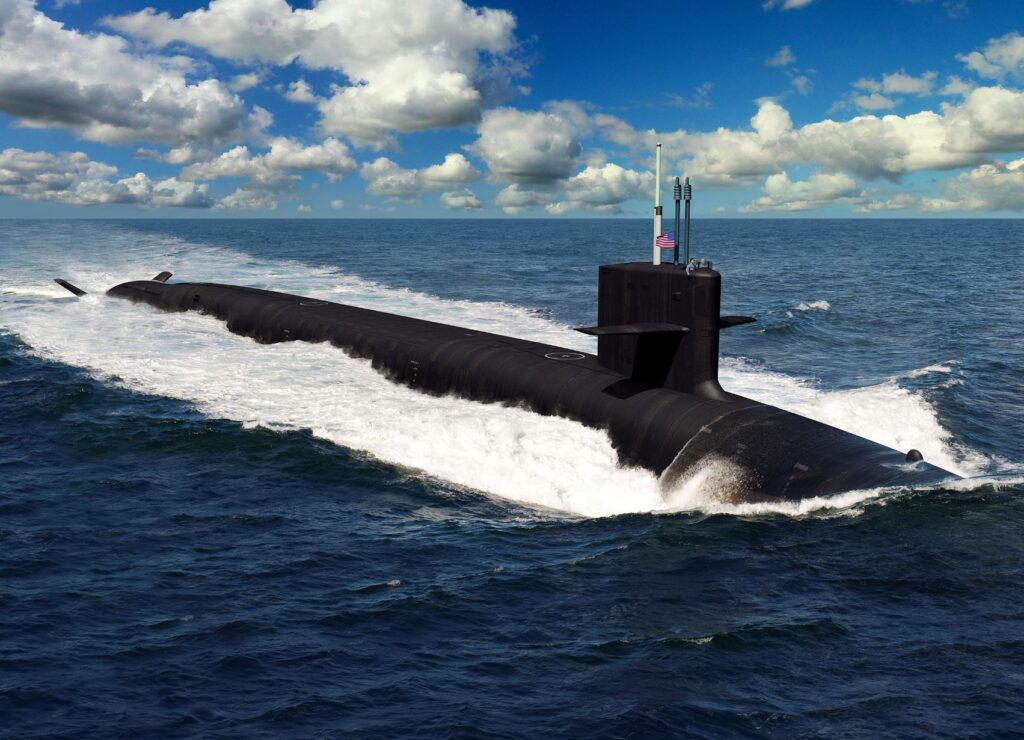
An artist’s rendering of the future U.S. Navy Columbia-class ballistic missile submarines. U.S. NAVY
ARLINGTON, Va. — The admiral in charge of building the Navy’s next-generation ballistic-missile submarine (SSBN) said the fragility of the submarine industrial base supply chain is the main risk to the Columbia SSBN going on patrol on time in October 2030.
“The supply chain is the No. 1 risk to Columbia and 1 + 2,” said Rear Adm. Scott Pappano, program executive officer for Strategic Submarines, speaking Nov. 18 at the Naval Submarine League’s annual symposium in Arlington.
The “1+2” refers to the current submarine building load of one Columbia-class SSBN and two Virginia-class attack submarines (SSNs) per year.
Pappano also said because the Columbia-class SSBN is the Navy’s No.1 procurement priority, any schedule adjustment to the submarine programs would be borne by the Virginia-class SSNs before it would affect Columbia.
The admiral noted that in the post-Cold War period the submarine industrial base had 17,000 suppliers, a number that has declined to 5,000 today. He said the fragility is greatest with components such as castings, fittings, valves and electrical equipment.
Pappano said the Navy needs some sort of tripwire to warn the service when a supplier is faltering.
PEO Submarines soon is standing up a new directorate, PMS-396, to manage sustainment of in-service SSBNs.
He said there is no margin in the build schedule, so the Navy is not going to sponsor competitions for many components and systems already proven but will leave some room for competition.
The admiral also said that the Ohio-class SSBNs — designed for 30-year careers and extended to 42 years — may be extended even longer on an individual basis.
“Individual extensions are being looked at for targeted work,” he said.
The admiral also said that the patrol and refit cycles of the Ohio class may be adjusted “to better maximize” their service until the boats are retired in the late 2030s.
Pappano also stressed that the shore infrastructure that supports the SSBN force — such as the Trident Refit Facilities — needs attention if it is to last through the 2080s to service the Columbia SSBN force for its entire life.
Rear Adm. Perry: First New-Production Mark 48 Torpedoes Set for 2022 Delivery
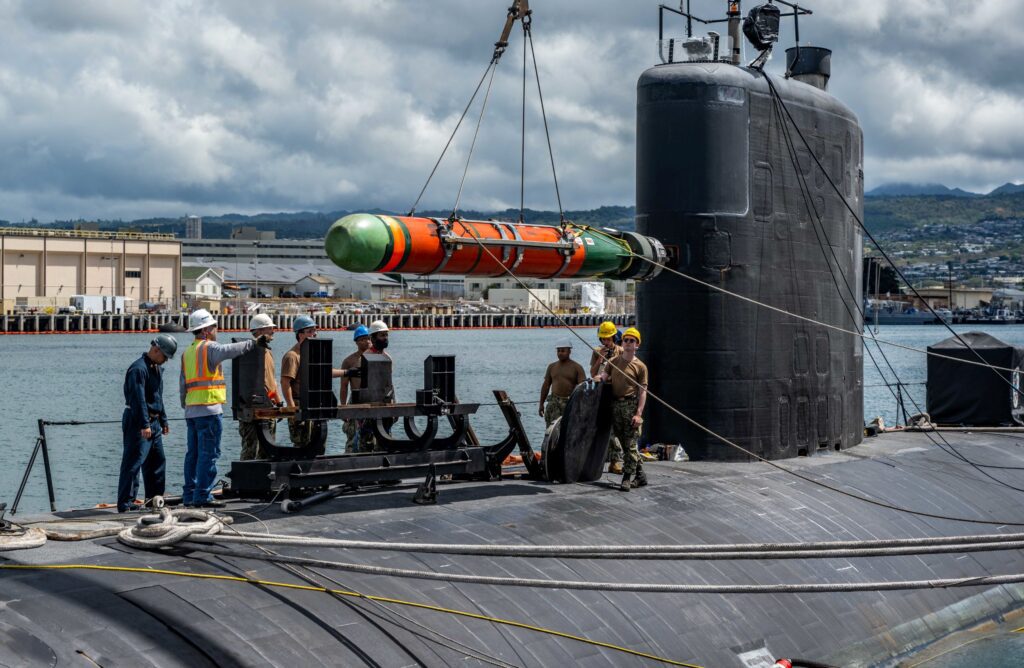
Sailors assigned to the Los Angeles-class fast-attack submarine USS Columbia (SSN 771) load a Mark 48 advanced capability torpedo for Exercise Agile Dagger 2021. U.S. NAVY / Mass Communication Specialist 1st Class Michael B. Zingaro
ARLINGTON, Va. — The first of a new-production batch of heavy-weight torpedoes (HWTs) is slated for delivery to the U.S. Navy fleet beginning in fiscal 2022, the Navy’s submarine resource sponsor said.
Rear Adm. Doug Perry, director of Undersea Warfare Programs speaking Nov. 18 at the Naval Submarine League’s annual symposium in Arlington, said the Mark 48 HWT was last delivered in 1996, but that it has been incrementally upgraded ever since to the Advanced Capability (ADCAP) standard. However, new production was needed to build up the Navy’s inventory to meet potential warfighting needs.
“The heavy-weight torpedo will remain the weapon of choice for the submarine for the foreseeable future, primarily due to its intended stealth, its destructive effectiveness in the battlespace, and [is] pretty difficult to defend against.”
Perry also noted that the HWT sustains the stealth of the launch platform, the submarine.
The Navy restarted the ADCAP production in 2016, with the program bearing fruit this year.
Perry said the Navy is focusing on capacity in parallel with improvements for the torpedoes, including in sensor capability and in defeating countermeasures.
The modernization upgrades over the last two decades primarily have been focused on software algorithms and processing, he said.
“We’re past time about introducing some game-changing capability into this mainstay weapon,” Perry said. “We’re introducing significant range increase through the re-introduction of a proven engine that can give us longer legs, much longer than the average ADCAP.
With the combination of some longer legs, some better sonar and processing and a digital backbone vice analog, it will enable us to have a one-shot, one-kill ADCAP into the next decade against those key platforms that the submarine force will be responsible to ‘service’.”
Vice Adm. Wolfe: Hypersonic Weapon Load for Zumwalt DDGs Under Study
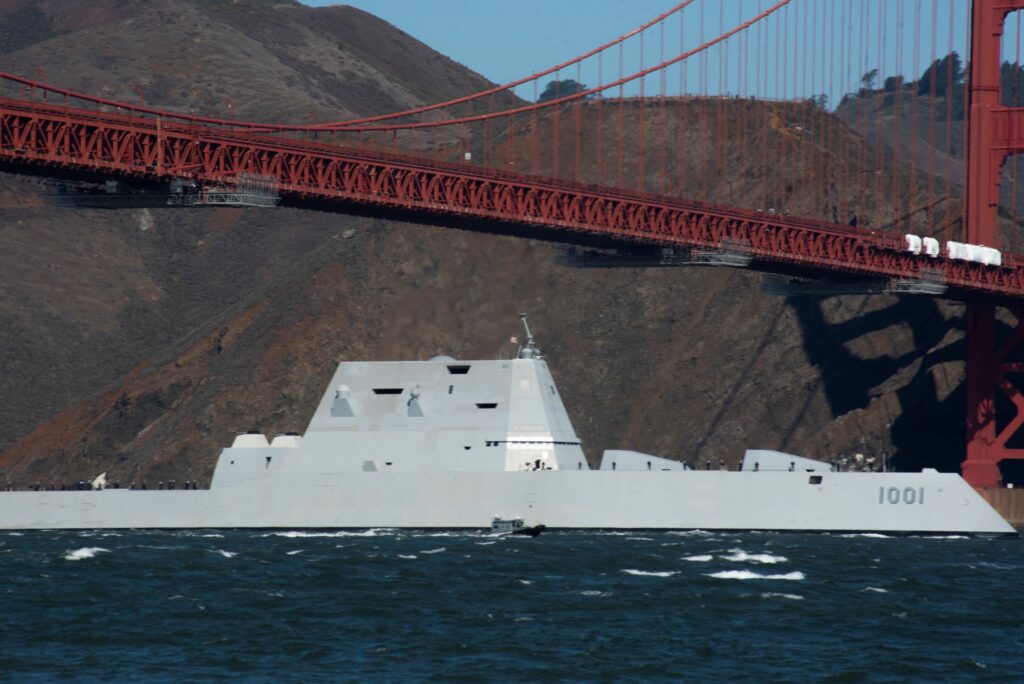
The Zumwalt-class guided-missile destroyer USS Michael Monsoor (DDG 1001) transits under the Golden Gate Bridge during San Francisco Fleet Week 2021. U.S. NAVY / Mass Communication Specialist 2nd Class Hector Carrera
ARLINGTON, Va. — With the Zumwalt-class destroyer set to be the first ship to be armed with the Conventional Prompt Strike (CPS) hypersonic missiles, the Navy is studying the parameters for the weapon load-out for the ships, a senior Navy admiral said.
Vice Adm. Johnny Wolfe, director, Strategic Systems Program, speaking Nov. 18 at the Naval Submarine League’s annual symposium in Arlington, said the CPS “will be the primary weapon system” on the Zumwalt DDGs.
The Zumwalt is equipped with 20 four-call Mk57 peripheral vertical launch systems which can launch Tomahawk, Standard, Evolved SeaSparrow and Vertical-Launch Anti-Submarine Rockets. The ship is expected to be fitted with separate launchers for the CPS. The two Advanced Gun Systems on the ship — which are inactive because of lack of an affordable munition — may be removed to make room for CPS launchers.
The Navy originally had planned to deploy the CPS on the Ohio-class guided-missile submarines (SSGNs), but the delay in funding for an underwater launch test facility for the missiles pushed development into the future such that, with the Navy’s plan to decommission the SSGNs in the mid-2020s, Wolfe said it made more sense to skip the SSGNs as a platform. The underwater launch test facility development will be restarted in 2022.
The Block V Virginia-class attack submarine (SSN) equipped with the Virginia Payload Module will be the second platform to be armed with hypersonic missiles.
“What we’re doing is trying to leverage Zumwalt — even though it is a surface platform,” Wolfe said. “A lot of things that we’re going to test on Zumwalt are still going to be applicable on Virginia [SSN] and we’re looking at how we can get that learning to get to that platform sooner.”
Wolfe said, “We’ve been hitting our milestones” toward fielding all-up rounds for the Army in 2023 and the Navy in its Zumwalt DDGs in 2025.
Two tests of all-up rounds for the Army will be tested in fiscal 2022 and he said the Navy will start ramping up to five Advanced Payload Modules which will go into the Zumwalts and then go into the Virginia SSN.
Wolfe said the Navy has been including CPS equipment in sounding rocket sorties from NASA’s facility in Wallops Island, Virginia, along with payloads from other users to advance technology maturation.
The hypersonics program so far has had three successful rocket motor tests and the first slug test, the latter demonstrating the ability to eject-test in a cold launch.
Boeing Delivers First P-8A Poseidon to Norway
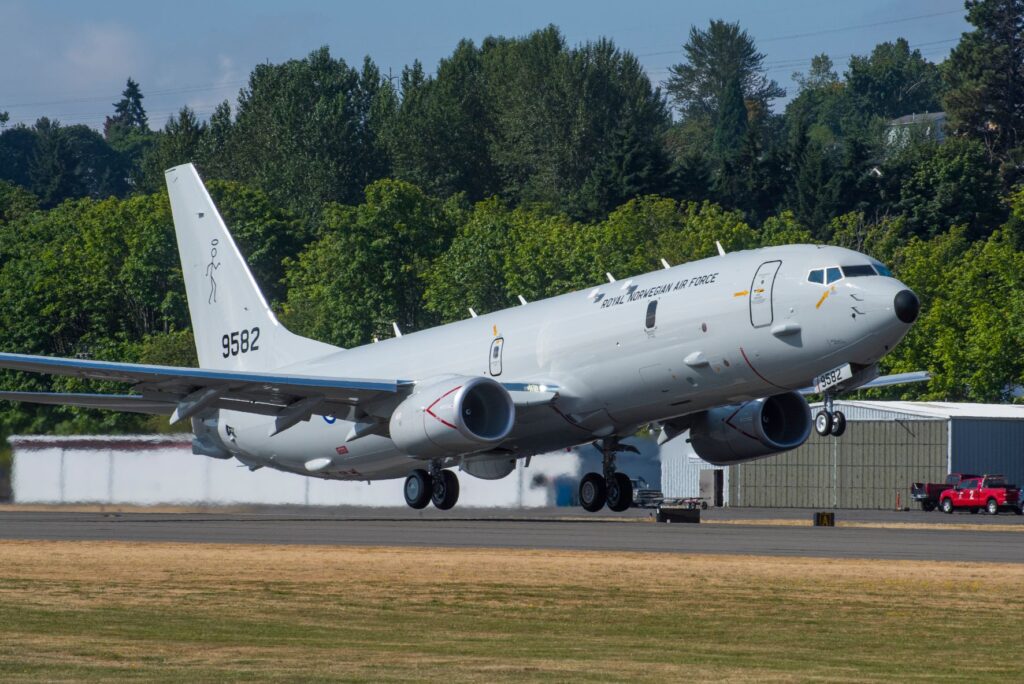
The first of five P-8A Poseidon aircraft bound for Norway had its first flight Aug. 9. THE BOEING CO.
SEATTLE — The Norwegian Defence Materiel Agency (NDMA) accepted on Nov. 18 the first of five Boeing P-8A Poseidon maritime patrol aircraft that will be operated by the Royal Norwegian Air Force (RNoAF), the company said in a release.
“Norway is responsible for large maritime areas in a strategically important part of the world, and the new P-8A Poseidon will represent a tremendous improvement in our ability to both protect our sovereignty and understand developments in these areas. Today’s delivery of our first P-8A is an important milestone in the modernization of Norway’s maritime patrol aircraft capability,” said Mette Sørfonden, director general of the Norwegian Defence Materiel Agency. “I’m very pleased that the NDMA will soon be able to provide the Norwegian Armed Forces with a whole new generation of aircraft that will play an important role in preserving our national security for many years to come.”
Norway’s first P-8A aircraft, named Vingtor, was delivered to the NDMA during a ceremony at the Museum of Flight in Seattle, Washington. The milestone comes four years after the NDMA entered into an agreement with the U.S. Navy for the P-8A, and two years before the new aircraft are scheduled to begin taking over maritime patrol duties in Norway’s high north.
“We’re honored to provide this unmatched, multimission maritime patrol capability to Norway,” said Stu Voboril, vice president and program manager, P-8 Programs. “Norway joins seven other global customers that have selected or already operate the P-8 and benefit greatly from its long-range maritime surveillance and anti-submarine warfare capabilities. We look forward to enhancing our continued and enduring partnership with the U.S. Navy and the Royal Norwegian Air Force, and supporting the future fleet’s sustainment and training needs.”
Norway’s four remaining aircraft are all in advanced stages of production and will be delivered to the NDMA in 2022. The five P-8As will replace the RNoAF current fleet of six P-3 Orions and two DA-20 Jet Falcons and will be operated by 333 Squadron at Evenes Air Station.
Norwegian companies Nammo, Kongsberg Defence & Aerospace, Andoya Space and Berget currently have agreements with Boeing that are part of a tailored industrial cooperation plan related to Norway’s acquisition of five P-8A aircraft. Boeing continues to work with the NDMA and Norwegian industry to expand that plan and support economic growth throughout Norway.
The delivery to Norway also marks the 142nd P-8 aircraft delivered to global customers, including the U.S. Navy, the Royal Australian Air Force, the Indian Navy and the United Kingdom’s Royal Air Force. First deliveries to New Zealand, Korea and Germany will take place in 2022, 2023 and 2024 respectively.
To date, the global operating P-8 fleet has amassed more than 400,000 mishap-free flight hours. The P-8 is a long-range anti-submarine warfare, anti-surface warfare, intelligence, surveillance and reconnaissance aircraft capable of broad-area, maritime and littoral operations. In addition, the P-8 performs humanitarian and search and rescue missions around the globe.
Vice Adm. Houston: Sub Force Approaching Inflection Point of 50 SSNs
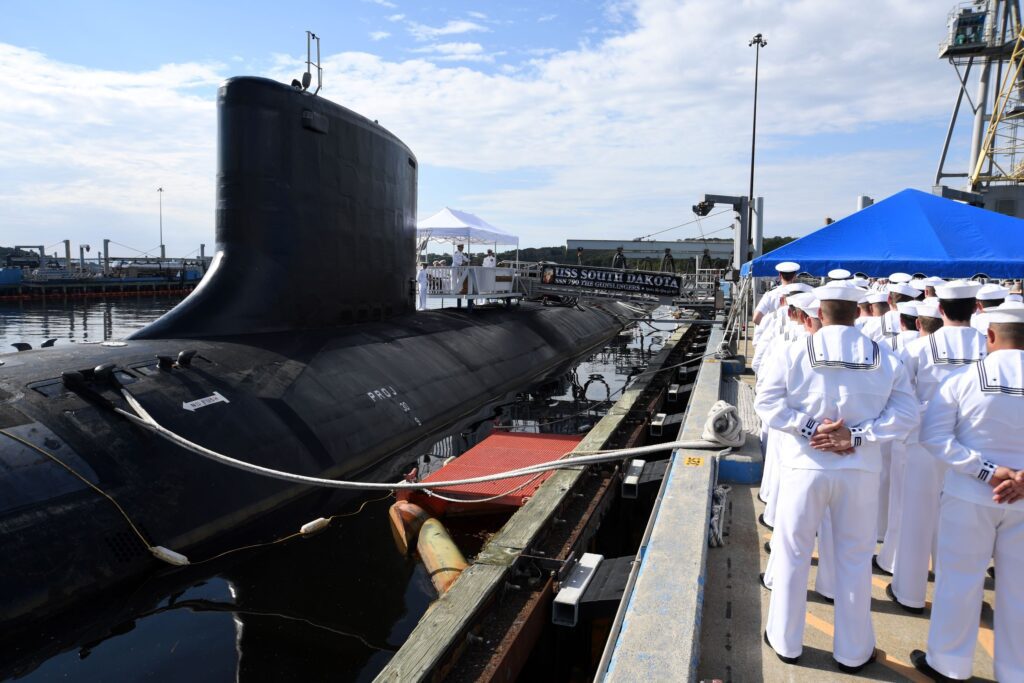
The crew of the Virginia-class submarine USS South Dakota (SSN 790) stand at parade rest during a change-of-command ceremony onboard Naval Submarine Base New London in Groton, Connecticut, Sept. 27. U.S. NAVY / Chief Petty Officer Joshua Karsten
ARLINGTON, Va. — The decline in the number of the Navy’s attack submarines (SSNs) is leveling out sooner than was feared just a few years ago, made possible by the decision to extend the service lives of some older SSNs.
Previously, the force level of SSNs was predicted to decline to a “trough” of 41 SSNs in the mid-2020s before the number would start to increase as the building of two Virginia-class SSNs per year hit its stride.
With 50 submarines “we are at that inflection point right now,” said Vice Adm. Bill Houston, commander, Naval Submarine Forces, speaking Nov. 17 at the Naval Submarine League’s annual symposium in Arlington. “We are actually very stable right now [at 50] and we’re starting to increase our numbers.
“How are we doing that? Through an awful lot of hard work by those people who came before me and whose shoulders we’re standing on right now; tremendous hard work from the shipbuilders and tremendous from the Navy, from the Department of Defense and from our overall government,” Houston said.
An important initiative is the service life extension of several Los Angeles-class SSNs.
“There is additional margin in the Los Angeles class,” he said. “We actually have reactor cores available which will refuel and extend a significant number of Los Angeles-class submarines.”
Houston was not specific in the number of Los Angles-class SSNs submarines that will go through life extensions. The Navy previously has mentioned consideration of extending the service lives of five to seven boats.
“We found that on most of our Los Angeles [SSNs] had significant hull margins, so we were able to extend them, and they had the fuel to go longer,” he said. “There are several Los Angeles’s that we will physically refuel and add years on them. Just due to the absolutely incredible job we did when we built the Los Angeles and the Ohio [SSBN and SSGN] that we could extend those ships as long as we can.”
Adm. Caldwell: ‘It’s a Great Time to Be a Submariner’
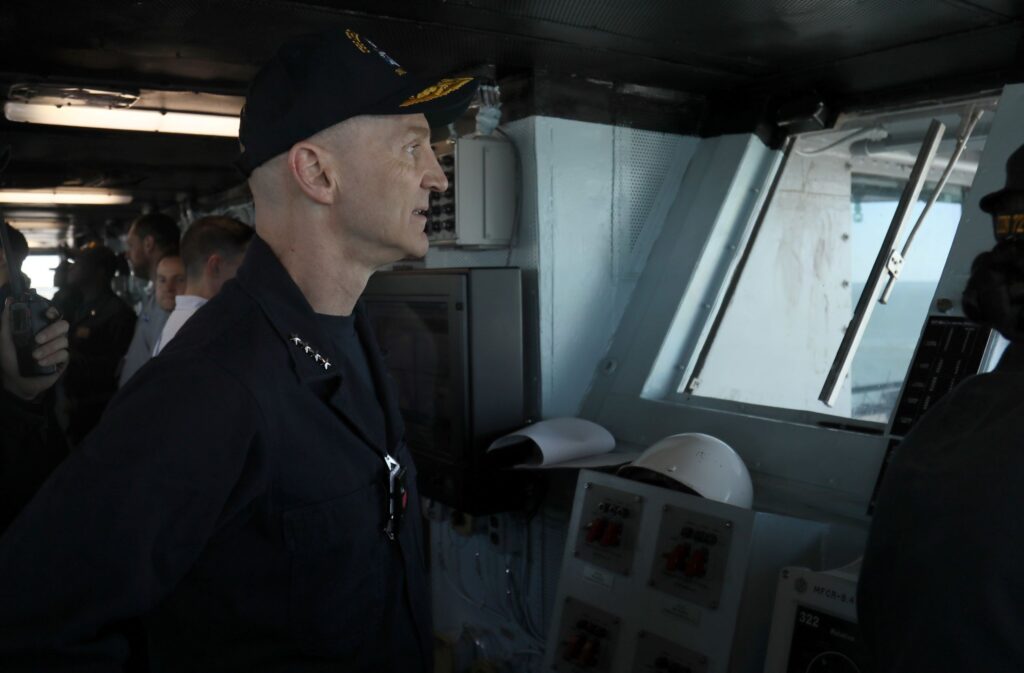
Adm. Frank Caldwell observes Nimitz-class aircraft carrier USS Abraham Lincoln (CVN 72) getting underway on the bridge in this 2017 photo. U.S. NAVY / Mass Communication Specialist 1st Class Josue L. Escobosa
ARLINGTON, Va. — The director of the U.S. Navy’s Nuclear Propulsion Program told an audience of active-duty and retired submariners that the current era of great power competition is highly demanding of the submarine force but is an exciting time as the challenges are met.
“Our submarines are consistently in high demand,” said Adm. Frank Caldwell, director, Navy Nuclear Propulsion Program, speaking Nov. 17 at the Naval Submarine League’s annual symposium in Arlington. “We are always improving our game, our team, our platforms. … It’s a great time to be a submariner.”
Caldwell noted that while the United States faced a formidable adversary during the Cold War — the Soviet Union — it now faces two nuclear-capable competitors: Russia and China. He said that the U.S. Navy’s attack submarines and guided missiles are deployed forward daily.
He especially praised the wisdom of the conversion of four Ohio-class ballistic-missile submarines (SSBNs) into guided-missile submarines (SSGNs), each able to deploy with up to 154 Tomahawk cruise missiles and with special operations forces.
“We can’t keep these platforms at sea enough,” he said of the Ohio-class SSGNs, calling their development in the 2000s a “monumental decision.”
The SSGNs are slated for retirement in the mid-2020s, and their missile capacity will be replaced by Block V Virginia-class submarines equipped with the Virginia Payload Module.
Caldwell noted the new strike weapons entering the submarine force’s arsenal in the next few years, including the Maritime Strike Tomahawk, the Conventional Prompt Strike hypersonic weapon, and the return of the submarine-launched Harpoon cruise missile.
Seabed warfare also is a capability being sought by the submarine force, he said, with an emphasis on unmanned vehicles.
Caldwell said the submarine force is focusing on all methods of transferring data on and off the ship to be networked with the fleet, including incorporating machine learning and artificial intelligence, to enable faster decision-making.
“Just as we pursue acoustic superiority, we are pursuing decision superiority,” he said.
He also noted that the United States currently is building submarines at the highest rate since the 1990s.
Electric drive will be returning to the submarine force with the Columbia-class SSBN. Caldwell said that every electric drive train bound for a Columbia-class SSBN will be thoroughly tested at a land-based test site in Philadelphia and then shipped to Electric Boat in Groton, Connecticut for installation in their respective hulls.
Caldwell briefly addressed the recent AUKUS agreement between Australia, the United States and the United Kingdom, which plans to build a nuclear-powered submarine force for Australia.
The U.S. Navy stands ready to support the historic announcement, but Caldwell stressed the importance of wise stewardship, looking at various options, and the importance of trust in the endeavor. He also said the Navy must be sure not to let AUKUS slow its own efforts.
“We have an already busy enterprise,” he said, noting that it is important for the Navy to remain focused.
Moran: China Way Ahead of US on AI Data
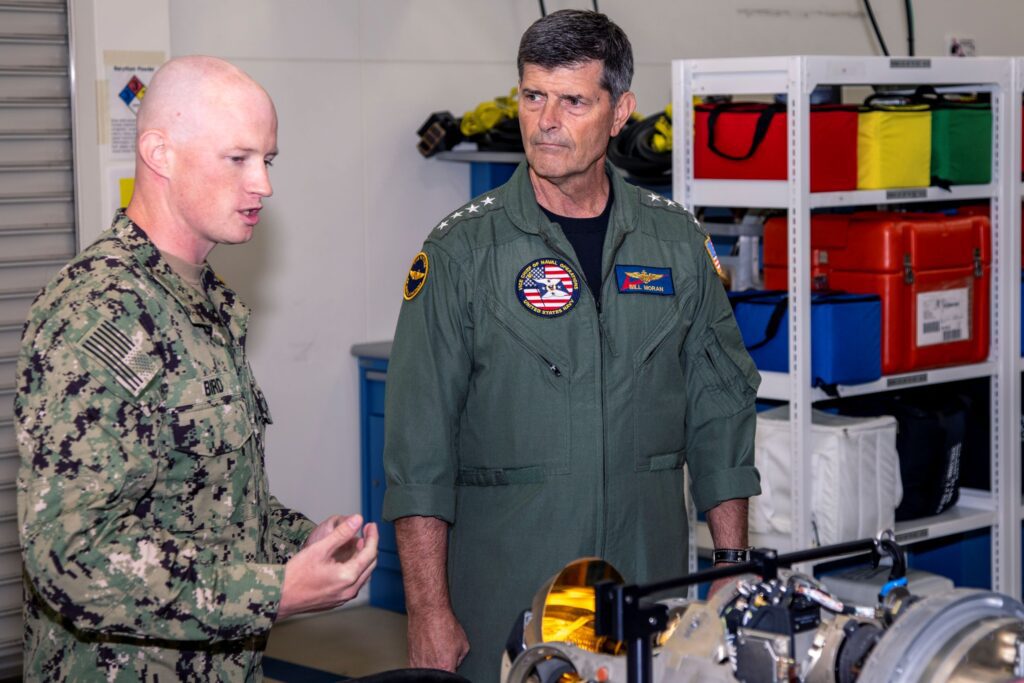
Retired U.S. Navy Adm. William Moran, then vice chief of naval operations, visits Aircraft Intermediate Maintenance Detachment Iwakuni at Marine Corps Air Station Iwakuni, Japan, Sept. 12, 2018. U.S. MARINE CORPS / Lance Cpl. Stephen Campbell
ARLINGTON, Va. — The United States still has an edge in two aspects of artificial intelligence (AI), but the People’s Republic of China is ahead on a third aspect and rapidly closing on the other two, a retired Navy admiral said.
Speaking on AI in a Nov. 16 webinar — hosted by the Navy League of the United States and sponsored by Deloitte — was retired Adm. William Moran, former vice chief of naval operations and currently a strategic advisor for several companies, a board member at the US Naval Institute and as the founder and president of WFM Advisors LLC.
Moran considered three legs of AI in his assessment: quality of data; AI expertise; and domain expertise.
“You add those things together and that’s where the magic happens,” he said.
The admiral said that much available data has to be refined, a time-consuming task that requires a large investment in personnel to convert stove-piped data in stove-piped systems to be useful across networks.
The United States — inside the U.S. Navy and outside — is flush with AI expertise, Moran said.
“We ae the best in the world in developing algorithms and developing AI capability,” he said.
But even more so, the Navy is vastly endowed with domain expertise.
“From a DoD [Department of Defense] perspective, we are so far ahead of the Chinese, in my opinion,” he said. “ASW [anti-submarine warfare], ASUW [anti-surface warfare], even — to some extent — cyber, we’re way ahead on domain expertise.
Moran said that on the aspect of data, “China is way ahead of us, because they can put raw manpower and unlimited resources towards data and they’ve done that for quite some time … and they don’t have a lot of the roadblocks to obtaining that data, not worried about the security pieces that we rightfully have in front of mind, whether it’s on the operational or tactical edge or the operational management structure.”
He said that China is going to close gaps quickly in AI and domain expertise.
“They’re in a race to get there sooner than we do,” he said.
“You’ve got to get the domain folks in with the software engineers that are writing the code, with the data that’s high quality, and it can happen pretty quickly. … You just have to commit and get after it.”
Naval Surface Warfare Center Implements Navy Continuous Training Environment Tool for Live Virtual Constructive Training
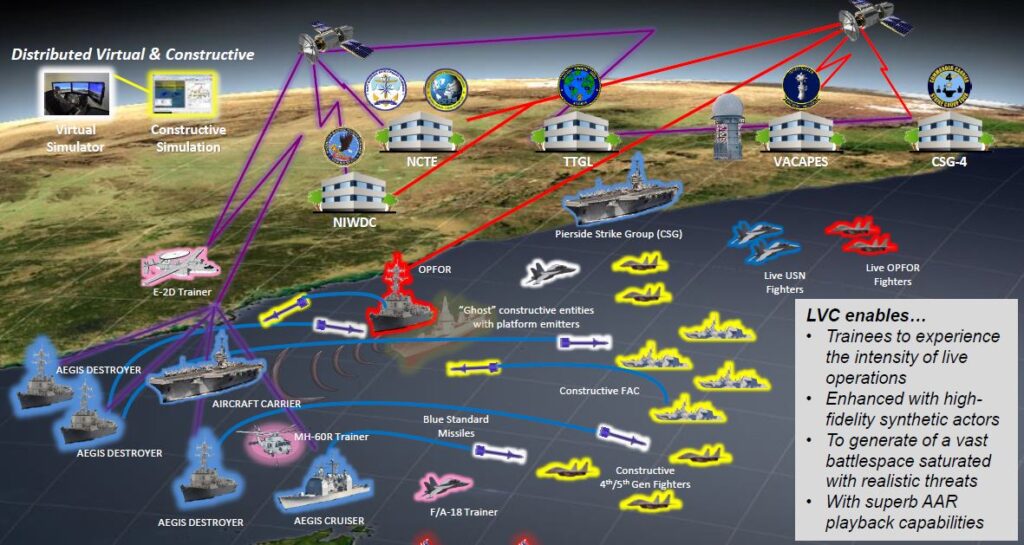
The Navy Continuous Training Environment (NCTE) enables live virtual constructive (LVC) training with live and synthetic systems around the globe. The Navy recently utilized NCTE during the Large-Scale Exercise 2021 to execute LVC events with forces from across the United States Fleet Forces Command, U.S. Pacific Fleet and U.S. Naval Forces Europe-Africa. The above graph show how the program communicates using networks, simulations, simulation routing equipment, data translation devices and live training range systems used to create a realistic LVC training environment. RON KETER
To meet the goal of digital transformation that seeks to eliminate onboard technical assists to ships by 2030 and advance the Navy’s training capabilities, Naval Surface Warfare Center, Port Hueneme Division has connected to the Navy Continuous Training Environment (NCTE).
Connectivity with NCTE enables warfighters to conduct live virtual constructive (LVC) training with live and synthetic systems around the globe. NSWC Corona Division in Corona, California, develops, manages, operates and maintains the NCTE on behalf of Commander, U.S. Fleet Forces Command and Commander, Pacific Fleet.
The NCTE consists of networks, simulations, simulation routing equipment, data translation devices and live training range systems used together to create a realistic LVC training environment.
“The ability to properly train or conduct training on a simulated threat that has the actual capability of the real threat, provides us with some knowledge of what our weapons can and cannot do,” said William Gieri, NSWC PHD Surface Warfare Engineering Facility (SWEF) manager. “It also provides training to fleet operations on what its people can expect in terms of how our systems would react to various threats.”
NCTE enables sailors to experience an integrated and secure training environment that can generate a variety of situations that might not be available in a live exercise but should be expected at sea, including scenarios with multiple ships and aircraft, according to Gieri.
“Instead of having real-life aircraft like commercial airlines, we can put simulated aircraft up there flying commercial routes and also aircraft from hostile countries that gives operators on the ship a much more realistic threat environment they’re more likely to encounter in various areas of the world they couldn’t otherwise experience in a sterile fleet environment or in an ocean where they don’t have aircraft routes,” Gieri said.
Gieri said he saw the tremendous potential to improve the command’s capabilities by connecting to NCTE. While NCTE was developed specifically for conducting fleet training, the command is exploring options to support events such as Combat Systems Ship Qualification Trials (CSSQT) and Combat System Assessment Team (CSAT) events using the NCTE capability.
“With the CSSQT events that we conduct, we can’t always provide real-world threats to the ships conducting them, so we are exploring using the NCTE and its capabilities to augment physical targets that we throw at the ships,” Gieri said.
Recently, USS Fitzgerald (DDG 62) was the first ship to visit NSWC PHD that participated in the Single Ship Synthetic Training, using NCTE to develop and deliver a complex scenario of multiple anti-ship cruise missile vignettes to help DDG 62’s training requirements.
And, the Navy recently used NCTE during the Large-Scale Exercise (LSE) 2021 to execute LVC events with forces from across the United States Fleet Forces Command, U.S. Pacific Fleet, and U.S. Naval Forces Europe-Africa. LSE 2021 was a globally integrated exercise that spanned multiple fleets across 17 different time zones connected using NCTE — executing new warfighting concepts and technology.
NSWC PHD’s use of NCTE is in the early stages, according to Gieri, and the team is learning what its full potential is and the different ways it can be used in training the warfighter and supporting the fleet.
“If you do the crawl, walk and run phase, you can throw simple threats at somebody, and once they become proficient at simple threats, you can throw more complex scenarios at them — much like you’d expect in the real world,” Gieri said. “So, it gives them the ability to learn from past experiences and become more proficient than if they were in an actual hostile engagement.”
In addition to providing enhanced training, NCTE is a cost-effective way to conduct complex training scenarios.
Sailors can also learn, while in a LVC training environment, how to tell the difference between a threat and a non-threat, as well as see how current weapons and combat systems may react to a potential threat.
“You can also recreate past scenarios, with different combat system baselines, which NSWC PHD is working toward right now with virtual test beds in the SWEF, so you can have a crew sitting at a combat information center with a combat system it has on its ship and see what real ships are doing on the range and see how that crew would react,” Gieri said.
Kanoko Esheim, NSWC PHD LVC lead, worked alongside Gieri to connect SWEF to NCTE.
“By coupling NCTE integrating architecture with the other digital transformation initiatives that are underway, the command is determined to activate a modernized capability to enhance the toolkit and workforce development activities,” Esheim said.
Gieri added that his team is exploring different ways the Navy can use the NCTE.
“We are working toward that end right now,” Gieri said. “We haven’t gotten there yet, but that’s the next generation, which is how to bring a land-based test site and marry it with a ship at sea to look at different combat systems and evaluate older or future combat systems with the combat systems on a ship on a training range.”
While NCTE was developed primarily for fleet training purposes, NSWC PHD is also exploring options for using it to support CSATs and CSSQTs.
“We’re working on use cases [that outline the purpose and likely uses] and presenting them to Pacific Surface Fleet leadership to see if there’s any buy-in or if the leaders can support that,” Gieri said. “This first test with NCTE during a CSAT at the end of September will be a proof-of-concept to evaluate if NCTE can be used in a CSAT environment.”