Partnerships Key to Confronting Adversaries, Harker Says

Acting Secretary of the Navy Thomas Harker addressing Sea-Air-Space 2021 on Aug. 4. NAVY LEAGUE / Lisa Nipp

NATIONAL HARBOR, MD. — That Sea-Air-Space 2021 was able to be held this year shows the power of partnerships, acting Secretary of the Navy Thomas Harker said Aug. 4.

“The fact that we’re able to gather today is a testament to the power of partnership — pharmaceutical companies, scientists, government researchers, military and civilian leaders — all working together to develop the vaccine,” Harker said. “That’s how we must confront all of our adversaries. Together.” 

Future military planning requires a transparent understanding of needs and limitations, Harker said, adding that such an approach will protect the supply chain while strengthening small-business opportunities. 

“Keep challenging the Navy and Marine Corps to innovate and transform,” Harker said. “That’s how we keep the faith with the American taxpayers and our oversight partners on the Hill. Every dollar is a strategic asset that must be maximized.” 

The decision-making process for the coming budget has been tough, Harker said, acknowledging that costs associated with personnel, maintenance and recapitalization efforts have exceeded the rate of inflation. As a result, investment planning by vital industrial-base partners will be affected. 

“We refuse to create a hollow force. We will not leave holes in units and create a force that leaves our Sailors and Marines without proper training,” Harker said, citing the lessons learned from the separate collision incidents involving the destroyers Fitzgerald and McCain. 

The two incidents occurred because Sailors and Marines were asked to do more with less, Harker said. 

“One-time fixes aren’t enough,” Harker said. “We have to make changes, putting controls in place to prevent future events. We’re putting procedures in place to ensure that we don’t return to bad habits of the past.”

The acting secretary highlighted efforts to improve a moribund auditing process, after independent government assessments revealed discrepancies and shortcomings he said must be addressed. 

Harker called for a “get real, get better approach, demanding rigorous self-assessment, strong characterization of current performance, detailed analysis based on accountability and the opportunity to implement needed improvements.”

Citing personal experience, Harker reiterated the Defense Department’s stance that mental-health counseling must be destigmatized and treated equally with any other form of health care treatment. He also reiterated the overall commitment to rid the ranks of sexual harassment and assault.

“Data shows that a command that tolerates harassment and destructive behaviors increases the risk of sexual assault,” Harker said. “We’ve distributed a watch list which has the top five signals of risk for sexual assault, to assist commanders in both the Navy and Marine Corps to identify warning signs and signals so they can take action to improve their command.” 


High-Powered Lasers Boost Anti-Ship Cruise Missile Capability

NATIONAL HARBOR, Md. — The Navy is making considerable progress in the drive to field a high-energy laser system that can meet the demand for a directed energy system capable of defeating anti-ship cruise missiles called for in Chief of Naval Operations Adm. Michael Gilday’s 2021 Navigation Plan, Christopher Lloyd, distinguished scientist for Laser Weapon Lethality at Naval Surface Warfare Center, Dahlgren Division, Dahlgren, Virginia, said Wednesday.

After at-sea trials of a 30-kilowatt laser aboard the USS Ponce in 2014-2017, a “150-kilowatt class” system was tested on the USS Portland, a new amphibious transport dock, including the destruction of an unmanned aerial vehicle target May 16, Lloyd said at a Navy League Sea-Air-Space expo briefing.

“We think we’re getting to the point where we can actually start building these,” Lloyd said. “No one thinks directed energy can solve all problems, but it’s another tool we can use.” A big advantage of a laser weapon, particularly in the key mission of killing anti-ship missiles, is expanding a surface combatant’s magazine and replacing expensive missiles, “which puts us on the right side of the cost curve” against cheap enemy weapons, he said.

Although much of the attention on high-powered lasers is on their role as a weapon, Lloyd said Sailors involved in the tests on Ponce said it was a better sensor than other systems they had.

The laser “enables real-time combat identification and intent determination,” according to a data sheet Lloyd presented. It also provides speed of light delivery, precision engagement and graduated effect. “We want to be able to scale it up,” for different missions and effects, he added. “Bottom line, it addresses mission gaps we have.”

Although Lloyd would not say how powerful the laser tested on Portland was, he said “it looks like we have a glide slope for 300 kilowatts.”

Tests on Ponce and Portland used separate batteries to power the lasers, which requires gaps in firing to allow battery recharging. Dahlgren experts are working, along with others, to develop more powerful and higher capacity batteries to alleviate that problem, but also look to the greater integrated electrical power systems being developed in surface combatants as primary or backup power for the lasers, he said.

Dahlgren also is working on other high-energy systems, including a “dazzler” that can provide non-lethal crowd control, Lloyd said.


IUU Replacing Piracy as Top Global Maritime Security Threat

Illegal, unreported and unregulated fishing has both economic and security ramifications. NAVY LEAGUE / Lisa Nipp

NATIONAL HARBOR, Md. – The ramifications of illegal, unreported and unregulated (IUU) fishing are readily apparent on nations whose economies depend on fishing, but the practice has an impact on U.S. national security as well, a panel of experts said Aug. 4 at Sea-Air-Space 2021.

Moderator Whitley Saumweber, who directs the Stephenson Ocean Security Project, described a scenario in which 90% of the world’s fish stocks are either at or above sustainable capacity while demand continues to increase. 

“This combines with increasing global competition, particularly from China, which uses its fishing fleets both as a source of economic and food security but also as a way to project soft power on the globe,” Saumweber said. 

Coast Guard Vice Commandant Adm. Linda Fagan said illegal fishing is replacing piracy as the top global maritime security threat facing the nation. 

“It’s a sovereignty issue, it’s a maritime security issue and it jeopardizes nations’ economic food security,” Fagan said. “It weakens the global rules-based order that we all rely on for our standard of living.”

Tackling IUU, Fagan said, will require both experienced leadership and close work in both building new partnerships and fostering existing one around the globe. 

“We recently had the Mohawk, a 270-foot cutter, with another nation’s coast guard on board enforcing fisheries rules,” Fagan said. “It’s those types of partnerships where we provide an asset and the other nation provides their expertise and authority to get after the threat.”

Navy Rear Adm. Heidi Berg, the former Director 12 at U.S. Africa Command, said IUU fishing drew considerable attention during her tenure because of the challenges it created in other areas. She specifically cited the effects caused by China’s growing presence and activity. 

“In the Gulf of Guinea, [China] is now devasting those economies,” Berg said. “They engender corruption. They continue to act to support authoritarian regimes that can ensure their continued access.”

Other crimes, such as weapons and drug trafficking, are on the increase as a direct result, Berg said. Terrorist organizations such as al Qaida and the Taliban are gaining influence as well, she added. 

Constance Arvis, the acting deputy secretary of state for oceans, fisheries and polar affairs, said the State Department is actively working with other agencies and 69 international partners on a “groundbreaking treaty” called the Port State Measures Agreement.

“We are seeking to build a clean value chain of seafood that only accepts authorized catch from authorized vessels,” Arvis said. “If a port state believes that a vessel that wishes to come in has in fact engaged in IUU fishing, it can be denied port services and entry. Information is going to be shared with other ports to make clear that no IUU fishing enters the international market.”

The Defense Innovation Unit is actively seeking ideas from academia, government and industry by which new technologies such as artificial intelligence and machine learning could help foster better enforcement of fishing regulations and quash IUU fishing in the process. 

“We have no pride in where the solution comes from. But it is critical that when we get things to work, we find out [if] we can use the types of data here — space-based SAR [synthetic aperture radar] — to accurately identify activity that’s indicative of IUU fishing and vessels that may be doing it,” said Jared Dunnmon, the unit’s director of artificial intelligence. 

Dunnmon said that the unit is conducting a prize challenge for innovators to submit ideas for countering IUU.

“The challenge is open to anyone,” Dunnmon said. “It launches this month, and we’ll run it for about three months.”


AI Could Hammer Out Issues Plaguing Shipbuilding Supply Chain After COVID-19

Rear Adm. Douglas Schofield stated the Coast Guard’s top priorities for shipbuilding sustainment include life-cycle engagement with industry. NAVY LEAGUE / Lisa Nipp

NATIONAL HARBOR, Md. — A key to alleviating the chronic challenge of better maintainability and sustainability of increasingly complex naval ships is earlier and constant collaboration between the services acquisition officials and industry, starting with upfront dialogue on requirements for new systems, a panel of service and industry leaders said Wednesday.

Those problems have been acerbated by the COVID-19 pandemic’s impact on the shipbuilding work force and supply chain, the lack of clarity in the Navy’s future shipbuilding plan, the cybersecurity threat and the reoccurring budget uncertainty, the panel members agreed. But help may be in sight with the push for artificial intelligence, which could improve predictability of component failures and demand for spare parts, the leaders told a Navy League Sea-Air-Space expo forum.

“Success for us is working with our industry partners,” looking for feedback, starting with setting requirements for new programs and “getting it right up front,” said Tom Rivers, executive director Amphibious, Auxiliary and Sealift programs at PEO Ships.

Among the top priorities for the Coast Guard is interoperability and “life-cycle engagement with industry and our sister services,” said Rear Adm. Douglas Schofield, Assistant Commandant for Acquisition.

Improving efficiency and savings depends “a lot on collaboration and feedback with the services,” said Larry Ryder, vice president Business Development and External Affairs, Austal USA. “We have put forward ideas that can reduce cost, increase reliability. But we need to work with the services.”

To avoid logjams in major maintenance, “we need industry to tell us where those tricky spots are. … Tell us up front so we knew” how to schedule the work, Rivers said. If they get “feedback up front from industry” where they expect problems, ‘we’ll change our requirements.

 “New programs have a lot of requirements” and we need to “work with industry from the start to get right, Rivers said. “We really need to build ships faster.”

Rivers said the Navy also is making internal change, including adopting a plan for data analysis of systems and creating a “war room” that will provide focus and contact with industry partners. And they are designing for maintainability and flexibility in new ships. “We’ve never done that before.”

The Navy major new start is the DDGX, the next-generation major surface combatant, Rivers said. It will draw heavily on technologies and lessons learned from the Arleigh Burke DDG-51 program, he said. His office is engaged in developing the new light amphibious ship to meet the Marine Corps’ need for a cheaper, more mobile platform for its distributed operations in contested littoral. And to alleviate a serious lack of dry dock capacity on the Pacific coast, Rivers said the Navy will put out a contract this year for a new dry dock.

The three officials agreed that there are concerns with the fragility of the shipbuilding and repair industrial base, with major problems with the second- and third-tier suppliers, some of whom went out of business because of a slowdown in orders during the pandemic. Ryder said industry needs greater stability in demand from the services in order to build and retain a work force.

Schofield raised the new threat of cyberattacks, saying the Coast Guard is working with its service partners and industry on cybersecurity, “making sure industry can facilitate security,” a concern echoed by the other two speakers.


New Ship-to-Ship Cargo UAS Could Become Program of Record Soon

The Skyways UAV, taking off from aircraft carrier USS Gerald Ford. SKYWAYS

NATIONAL HARBOR, Md. — Naval Air Systems Command is testing out a new unmanned cargo delivery platform that can transport small amounts of cargo between Navy ships, and a NAVAIR official said Wednesday he expects it to become a program of record soon.

A team at NAVAIR was able to take the Skyways unmanned aerial vehicle and demonstrate it aboard the aircraft carrier USS Gerald Ford (CVN-78) after just a few months, and the Navy is highly interested in going beyond that, Tony Schmidt, director of rapid prototyping, experimentation, and demonstration, said at the Navy League’s Sea-Air-Space expo in National Harbor, Maryland.

Schmidt said his team was initially approached by Military Sealift Command, who had discovered that about 80% of the parts they were transporting by helicopter were less than 10 pounds.

“So we said let’s see if we can use a Group 2 or 3 UAS to transfer parts back and forth,” Schmidt said.

Despite having very little money or resources, Schimdt’s team met with industry to identify possible solutions and settled on the Skyways UAV. They delivered the prototype in October 2020. Once Rear Adm. John Meier, commander of Naval Air Force Atlantic, caught wind of the program, he asked them to deliver the aircraft for testing aboard CVN-78 just three months later.

Meier said the team missed that deadline by only a week. “Pretty awesome,” he said.

Interest in the effort only grew after that. In July, the team took the UAV on a ship-to-ship mission from the USS Bainbridge (DDG-96) to the USNS Joshua Humphreys (T-AO-188). In recent weeks, they’ve been in conversations with Navy officials and Schmidt said he is “pretty sure it’s going to get picked up as a program of record.”

While the new program won’t necessarily use the Skyways drone, it will take lessons from it. The team is looking at a delta wing design instead of a standard wing size, and they will experiment to see what works best in a carrier environment, as well as determine how to extend the range of the aircraft.


Navy Must ‘Expand Our Operational Reach’ Through Tactical ISR

Vice Adm. Scott Conn, deputy chief of naval operations for warfighting requirements and capabilities says the Navy is facing challenges in finding a tactial ISR advantage. NAVY LEAGUE / Lisa Nipp

NATIONAL HARBOR, Md. — The Navy no longer has a monopoly on key technologies as it did at the end of the Cold War and now must turn to tactical intelligence, surveillance and reconnaissance to gain an advantage over adversaries, a top Navy official said Wednesday.

The key challenge the Navy faces in the coming years is finding that advantage at the tactical level with communications and unmanned assets, Vice Adm. Scott Conn, deputy chief of naval operations for warfighting requirements and capabilities (N9), said during a panel discussion at the Navy League’s Sea-Air-Space expo in National Harbor, Maryland.

“When I say the tactical level, I’m talking at the numbered fleet level, at the task force level, at the task group level,” Conn said. “The world is a different place. At the end of the Cold War, there was an anomaly in history that the U.S. had a monopoly on the key critical technologies, and that’s no longer the case.”

This is particularly true in the areas of range and precision of strike weapons, he said.

“Because of that, we need to expand our operational reach — our ability to sense, make sense and act,” Conn said.

Part of accomplishing that is through better communication and initiatives like Project Overmatch, and another part is using unmanned systems in the air, on the surface and in the sea to identify warfighting advantages at the tactical level.

It is of critical importance for the Navy to master these areas, Conn added.

“This is not about in times of crisis, competing — this is about winning,” he said.


Strategic Sealift Must Prepare for Contested Oceans, Panelists Said

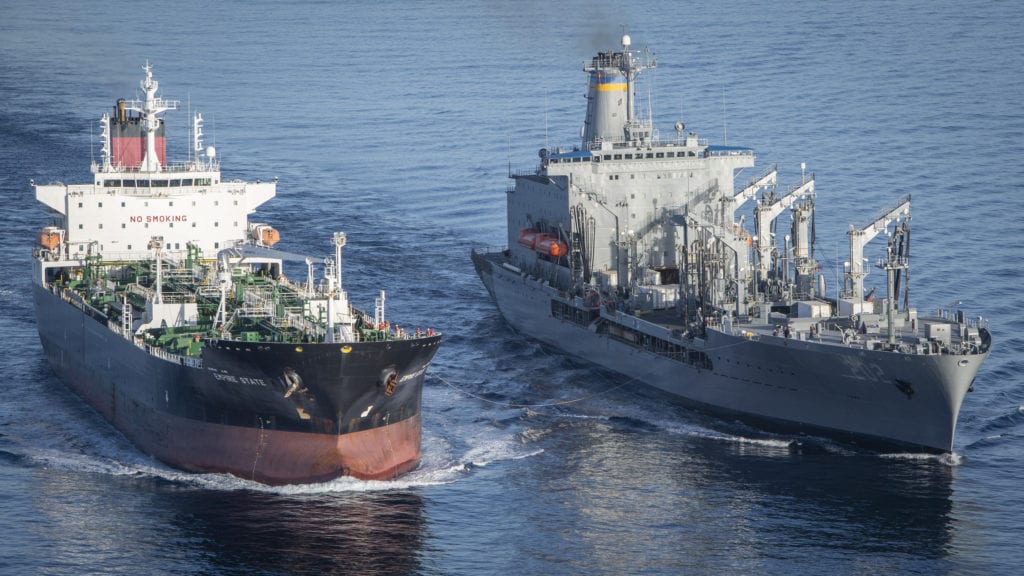
The Henry J. Kaiser-class underway replenishment oiler USNS Yukon (T-AO-202), right, prepares to conduct a consolidated loading with the commercial tanker MT Empire State. U.S. Navy / Mass Communication Specialist 1st Class Patrick W. Menah Jr.

NATIONAL HARBOR, Md. — The nation’s sealift components are used to operating in peaceful seas and permissive environments but must prepare now for times when control of the seas is not assured, a panel of maritime leaders said.

Speaking Aug. 4 at the Navy League’s Sea-Air-Space expo at National Harbor, Maryland, were Douglas Harrington, deputy associate administrator for Federal Sealift at the Maritime Administration (MARAD); Christopher Thayer, director, Maritime Operations, Military Sealift Command (MSC); and Adam Peterson, of the government business development team at APL. The panel was moderated by Erica Plath, director, Strategic Mobility/Combat Logistics, Division, Office of the Chief of Naval Operations, U.S. Navy.

Thayer pointed out that sealift “capability today is far more than it was in 1990” when large numbers of sealift ships were activated for Operation Desert Storm. He said that sealift was again at an inflection point, with the Navy’ preparation for distributed maritime operations in contested environments.

He said that, during distributed operations, the nation’s maritime logistics forces may not always have escorts or overwatch and must “be prepared to operate and evade the enemy.”

Thayer also stressed the need for counter-UAS systems, anti-jam capabilities for GPS, the need for cybersecurity and the ability to operate under emissions control.

Communications is “a huge vulnerability,” Thayer said, noting that mobile communications capabilities are being deployed on some ships with tactical advisers.

Harrington also stressed the need for improved, more resilient communications capabilities for MARAD’s Ready Reserve Force (RRF). He noted the current reliance on satellite communications and the effect on morale that emissions control would have on the crews. 

To adapt to providing logistics in a contested environment, Thayer said that MSC was working on concepts such as re-loading missiles in vertical launch cells while ships are underway, underway replenishment using unmanned aerial vehicles and refueling the combat logistics ships from commercial ships using modular CONSOL (consolidated cargo replenishment) adapter kits.

Harrington discussed the need for recapitalization of the RRF MARAD’s Ready Reserve Force and new, comprehensive strategy for equipping strategic sealift with new technology and regulations. He noted the increasing size and weight of defense cargoes. He advocated building increased resilience as well as cybersecurity.

He also said the government must “recall and re-focus on naval operations in a contested environment.”

Peterson pointed out the dramatic decline of the U.S.-flag merchant marine since 1960, now less than 0.5% of the 43,000 ships (displacing 1,000 or more gross weight tons) in international trade. He stressed that the government needs to develop more incentives to keep commercial vessels available in peacetime and war.

Harrington praised the “significant period of recapitalization,” which includes the construction of first of five National Security Multi-Mission Vessels, which will replace older ships and train mariners with modern technology now found on many merchant ships.

Asked about the Navy’s plans to operate autonomous unmanned ships in its fleet, Thayer noted that it is “hard to refuel an autonomous ship at sea.”


Coast Guard Rings in Birthday at Sea-Air-Space

Coast Guard and Navy League officials celebrate the service’s 231st birthday on Aug. 4. NAVY LEAGUE

NATIONAL HARBOR, Md. — The U.S. Coast Guard celebrated its 231st birthday on Aug. 4 and Commandant Adm. Karl Schultz and service officials said it is increasing cooperation with international partners, working with industry on energy projects such as wind farms and making changes to increase diversity and guard retention.

“I think it’s an exciting time for us,” Schultz said, telling the audience at Sea-Air-Space 2021, “let us figure out where we can team up with you.”

Ann Castiglione-Cataldo, director of international affairs and foreign policy, said the service is working to build capable partnerships around the world to tackle such issues as illegal, unreported, and unregulated fishing and climate change.

“All coast guards are grappling with this,” she said.

Rear Adm. John Mauger, assistant commandant for prevention policy, said his office is working to maintain safe use of the waterways for all users, which includes working with states and localities on installing coastal wind farms and assisting with commercial space launch operations.

There are currently only five wind turbines active off of Rhode Island and two in Virginia, Mauger said, but many more projects are in the works, and the service is advising on their location to help maintain access to waterways.

Commercial space launches are also coming to the fore. The Coast Guard helps keep waterways clear near launch sites. In the old NASA days, that just meant monitoring areas in Florida and Texas, but commercial space launches can occur from many more places, including floating platforms.

The Coast Guard has had issues with retaining female Coast Guard personnel, said Michel Godfrey, the director of civilian human resources, diversity and leadership. At one point, retention rates past the 15-year mark for women lagged behind men by 10%, but recent efforts have cut that to 3%.

One such effort is the parental leave program, which pulls in Coast Guard reservists to temporarily replace service members on maternity leave.

“They come back and they are a stronger member of the Coast Guard,” Godfrey said.

Schultz said, “Talent management is where we win or lose in the Coast Guard.”

After the presentation, Navy League National President David Reilly and CEO Mike Stevens presented Schultz with the Admiral Arleigh Burke Leadership Award, the Navy League’s highest honor. He then celebrated the Coast Guard’s founding by Alexander Hamilton with a cake.


Navy Plans 2nd Order for Next-Generation Jammer-Mid-Band in 2022

An EA-18G Growler from Air Test and Evaluation Squadron (VX) 23, located at Naval Air Station Patuxent River, Maryland, conducts a Next Generation Jammer Mid-Band (NGJ-MB) flight test over Southern Maryland recently. U.S. NAVY / Steve Wolff

NATIONAL HARBOR, Md. — The U.S. Navy plans to order a second Low-Rate Initial Production lot of the ALQ-249 Next-Generation Jammer-Mid-Band (NGJ-MB) in 2022, a Navy official said.

Capt. Michael Orr, the Navy’s program manager for speaking at the Navy League’s Sea-Air-Space Expo in National Harbor, Maryland, said the Navy plans to order five shipsets of the NGJ-MB in fiscal 2022. One shipset includes two jamming pods for an EA-18G Growler electronic attack aircraft.

The NGJ is a program to augment and eventually replace the ALQ-99 jamming pod, which first was deployed in 1971 on EA-6B Prowler aircraft in 1971 for combat in the Vietnam War.

The Navy ordered three shipsets of NGJ-MB on July 2 under Low-Rate Initial Production Lot 2.

The NGJ-MB, designed and built by Raytheon, is the first of three planned increments of the jammer. The NGJ-Low Band, designed by L3Harris, entered Engineering and Manufacturing Development in December 2020. The Navy ordered four test articles and eight operational prototypes. The NGL-LB shipset will consist of one pod. The selection of L3Harris for the program currently is under protest.

NGJ-High Band is still in concept development.

Orr said the NGJ-MB has completed 145 test flights and more than 3,000 hours of testing in an anechoic chamber and in laboratories.

The Royal Australian Air Force, which also flies EA-18Gs, has been a cooperative partner in the NGJ-MB and -LB development since June 2020.

Orr said the Navy will continue to upgrade the antennas and transmitters of the ALQ-99 pods. He said that, in his opinion, the ALQ-99 will continue to serve through the life of the EA-18G.


Navy Aims at Goal to Improve E-2D Mission-Capable Readiness

The E-2D has 11 major mission systems to be maintained in operating condition for the aircraft to reach full mission capability, according to Capt. Pete Arrobio, the Navy’s E-2D program manager. NORTHROP GRUMMAN

NATIONAL HARBOR, Md. — The Navy is only weeks away from its goal to achieve a mission-capable rate for its E-2D Advanced Hawkeye carrier-based command and control aircraft of 28 aircraft, a Navy program official said.

The Navy also is aiming for 22 of those 28 E-2Ds hitting and sustaining full mission capability by Sept. 1, said Capt. Pete Arrobio, the Navy’s E-2D program manager, speaking Aug. 3 at the Navy League’s Sea-Air-Space Expo at National Harbor, Maryland.

Attaining full mission capability is no small task. Arrobio pointed out that the E-2D has 11 major mission systems to be maintained in operating condition for the aircraft to reach full mission capability.

Arrobio said the Navy has a detailed plan to add and improve capability to the E-2D fleet over time. He stressed the need in the future to move faster in upgrading the aircraft software and systems to keep them relevant to high-level warfare. Future needs include cyber hardening; connectivity to the joint all-domain command and control environment; sensor improvement; more space, weight and power capacity; improved reliability of components; and integration of artificial intelligence and machine learning where appropriate.

Northrop Grumman has delivered 48 E-2Ds to the Navy so far, out of 52 ordered so far. The U.S. Navy’s program of record calls for 86 E-2Ds. The aircraft delivered so far equip five airborne command and control (VAW) squadrons and one fleet replacement squadron, with the fleet squadrons deploying with five aircraft each. Two of those VAW squadrons have completed transition to an aerial refueling capability. Four fleet squadrons are still equipped with the E-2C Hawkeye.

Three of nine ordered by Japan have been delivered. France has signed a letter of agreement to procure three E-2Ds to replace its E-2Cs. Taiwan and Egypt, which operate E-2Cs, also are potential customers for the E-2D.

There are 26 E-2Cs remaining in the U.S. Navy’s inventory and they are scheduled for phase out by 2026. Japan, France, Taiwan and Egypt operate a total of 28 E-2Cs, which Arrobio’s office helps to sustain with program support.