Raytheon Anticipates 5-Year Production Contract for SPY-6 Radar and Variants

The SPY-6 demo array was introduced at Sea-Air-Space 2019. RAYTHEON

NATIONAL HARBOR, Md. — Raytheon is expecting a five-year contract from the Naval Sea Systems Command for hardware production and sustainment of all variants of the SPY-6 shipboard radar, a company official said.

Raytheon anticipates the contract award in September 2021 which will cover up to 59 radars, said Scott Spence, director of Naval Radars for Raytheon, speaking to Seapower Aug. 3 at the Navy League’s Sea-Air-Space Expo at National Harbor, Maryland.

Raytheon now is in full-rate production of the SPY-6 family of radars, building at a rate of one per month, Spence said.

The company has been able to sustain a solid rate of production despite the COVID pandemic. Mike Mills, Raytheon’s SPY-6 program director, said the company delivered 12 SPY-6 arrays in a 13-month period. 

Raytheon has delivered the first two shipsets of the SPY-6(V)1 Air and Missile Defense Radar (AMDR), one for the first Flight III Arleigh Burke-class guided-missile destroyer, the future USS Jack H. Lucas (DDG 125) and the second, DDG 128. Spence said the company is starting deliver of parts for a third DDG.

Delivery of the first production SPY-6(V)2 rotating Enterprise Air-Search Radars (EASR) is planned Nimitz-class aircraft carriers, the future America-class amphibious assault ship USS Bougainville (LHA 8) and the future San Antonio-class amphibious platform dock ship USS Richard M. McCool Jr. (LPD 29). Installation on the latter two ships will be made post-construction, Spence said.

The fixed-face EASR, the SPY-6(V)3, is in the engineering development phase for the future Gerald R. Ford-class aircraft carrier USS John F. Kennedy (CVN 79) and subsequent carriers of that class. It also will be the EASR for the new Constellation-class guided-missile frigate.

Spence also said the expected contract will cover backfit of some Flight IIA Arleigh Burke DDG with the fixed-face SPY-6(V)4 version during the ships’ mid-life upgrades. The company already submitted the technical data package for the back-fit to the Navy.

The SPY-6 is scheduled to achieve Initial Operational Capability on the Jack H. Lucas in 2024, according to Spence.


USMC Force Changes ‘Wicked Hard,’ but Essential, Lt. Gen. Smith Says

Lt. Gen. Eric Smith discusses U.S. Marine Corps force design changes at Sea-Air-Space 2021. NAVY LEAGUE / Lisa Nipp

NATIONAL HARBOR, Md. – The Marine Corps’ drastic changes in force size, composition and weapons to meet the emerging threats, primarily from China, is going to be “wicked hard,” but the Corps’ top officer driving those changes said it is both essential and achievable.

“We have to find out how to go after a pacing threat that is moving. How a small force can hold something at risk. … We have divested what we can divest. We will produce the force we need by 2030,” Lt. Gen. Eric Smith, commanding general Marine Corps Combat Development Command and Deputy Commandant for Combat Development and Integration, said Aug. 3.

Smith added that the Marines’ effort to rebuild a smaller, more mobile but lethal force by the date set by Gen. David Berger, the Marine Corps Commandant, will depend on “stable funding.” A continuing resolution on defense funding, which is expected, “is a gift to an adversary,” he told Sea-Air-Space 2021.

Smith and the Marine Corps headquarters are rapidly shedding legacy systems, including the M-1 Abrams main battle tanks, much of its tube artillery and other heavy weapons to produce a much lighter force capable of sending small units into dispersed locations, most likely in western Pacific littoral regions, to counter China’s area-denial, anti-access capabilities that could nullify the Navy’s power projection efforts.

“The Corps’ purpose is to support the naval forces efforts,” Smith said. “It’s all about supporting the naval force in a conflict with a major adversary.”

Under intense questioning by moderator Dakota Wood, a retired Marine officer now a senior military analyst with the Heritage Foundation, Smith rejected the idea the Corps is sacrificing heavy systems, such as tanks, that would be useful in other parts of the world to focus solely on the Indo-Pacific theater and China. Smith noted recent experiments that used a mobile rocket artillery system mounted on a Humvee to hit distant targets.

“I can recreate the ability to kill armor,” he said. But “we have to get it there … we have to move things,” he said.

Challenged on how the Marines would support their dispersed light forces in a contested area, Smith said, “the first thing about having the logistical enterprise able to support you is need less. Why do I need water in the Indo-Pac theater?”

Smith was supported in his confidence in the Corps’ dramatic redesign efforts by William Williford, executive director of the Marine Corps Systems Command, which is fielding the new weapons and systems needed for the new force, and by Scott Lacy, executive director of the Marine Corps Warfighting Laboratory, which is running extensive wargames and experiments to develop and test the new formations and gear.

“Starting with the individual Marine, we are putting resources out there to make the Marine more lethal.” Wilford said.

“Don’t bet against us. If there is a concern it’s that the adversary will move faster than us,” Lacy said.

Smith also rejected Wood’s challenge the Corps is putting pressure on the other services to make up for the Marines’ cut in heavy forces, stating the Navy is all in on this and the Corps is working closely with the Army and Air Force to develop and field the right equipment. He also denied the Marines are sacrificing their ability to deal with current threats.

“You have to be able to fight today. I think we’re capable of doing that today,” he said, and noted that he and at least 14 other Marine generals, including Berger, “have skin in the game” by having sons currently serving in the Marines.


Dickinson Details Tenets of Responsible Space Behavior in Domain That Shares Similarities to the Sea

Gen. James Dickinson compares harsh domains of the sea and space in his keynote address on Aug. 3. NAVY LEAGUE / Lisa Nipp

Space and the sea perhaps would seem at first blush to be very different and disparate operating environments. Army Gen. James H. Dickinson, the man in charge of U.S. Space Command, believes otherwise.

At a luncheon and then a media roundtable at the Navy League’s Sea-Air-Space expo at National Harbor, Maryland, on Aug. 3, Dickinson pointed out that both environments are the harshest in which to operate. Further, both the sea and space are becoming increasingly more contested by potential adversaries.

“We each share a vast area. In the maritime domain, it’s 10,000 miles across the Pacific Ocean,” Dickinson said. “For us, it’s out to the moon and beyond. Both are concerned with respective domains that are very vast, and very difficult, complex and unforgiving.” 

As the head of the nation’s newest unified combatant command, Dickinson’s job is to use the trained men and women sent to him by the Army, Navy, Air Force, Marine Corps and newly created Space Force for operational reasons in the space domain. 

“They all bring their own capabilities to the command, which we use for daily operations,” Dickinson said. 

Success hinges upon an understanding of the specific challenges space poses, Dickinson said. Space debris, whether old junk or the remnants of a Chinese satellite they deliberately destroyed a little more than a decade ago, is a prime example. 

“There are still remnants of that in lower orbit, and we’ll have that effect for years to come,” Dickinson said. “What’s important about the low Earth orbit is that’s where we do things with human spaceflight. The International Space Station is in low Earth orbit. When you talk about risk to human life, you have it when you have that type of activity going on.”

Space Force Guardians under Dickinson’s command at Vandenberg Air Force Base, California, have a primary mission of tracking and mitigating such debris. The command then provides relevant information to governmental agencies and public entities that share an interest in knowing about what threats their space assets are facing. Dickinson compares the mission to that of the Federal Aviation Administration, which tracks and manages the safety of thousands of flights each day. 

“It’s an exciting time to be in the space enterprise. There’s no lack of energy,” Dickinson said. “People want to come work for us.” 

In the immediate future, Dickinson will tackle the job Defense Secretary Lloyd J. Austin III bestowed upon him with the July issuance of five tenets of responsible space behavior, which would apply to operations, fielding acquisition and every other related aspect: One, operate in, from, to and through space with due regard to others and in a professional manner; two, limit the generation of long-lived space debris; three, avoid the creation of harmful interference; four, maintain safe separation and safe trajectory; and, five, communicate and make notifications to enhance the safety and stability of the domain.

Noting that the directive is part of a government-wide effort to address conduct in space both in the U.S. and among partner nations, Dickinson expressed hope that an international agreement to support it. 

“In the meantime, just think about how much we can learn from our Navy teammates in this regard — how we assess behavior and respond when adversaries fall short of the standards,” Dickinson said, “with the power from a position of strength to compel seafaring operations to operate within those rules.”


Navy Decision Approving Production Decision of AARGM-ER Expected Soon

The Advanced Anti-Radiation Guided Missile – Extended Range (AARGM-ER) could soon have low-rate initial production approved. NORTHROP GRUMMAN

NATIONAL HARBOR, Md. — The U.S. Navy expects to make a decision soon approving low-rate initial production of the Advanced Anti-Radiation Guided Missile – Extended Range (AARGM-ER), built by Northrop Grumman, expects to make a decision approving low-rate initial production soon, a program official said.

The milestone to approve proceeding to LRIP is “expected within weeks,” said Mike Overs, the Navy’s deputy program manager for Direct and Time-Sensitive Strike, speaking Aug. 3 at the Navy League’s Sea-Air-Space Expo at National Harbor, Maryland.

The AGM-84G AARGM-ER is a development of the AGM-84E AARGM that has been in service since 2012 with the role of destruction of enemy ground-based air defenses. The ER missile is considerably different in planform and appearance than the basic AARGM. The ER version is slightly shorter — 160 inches versus 14 inches — than the basic AARGM but has a larger diameter (11.5 inches versus 10 inches) and is controlled by its tailfins rather than fins at the mid-body. The ER features a new rocket motor that takes up more of the length of the missile and is equipped with a new warhead.

The aerodynamic characteristics of the ER plus its larger motor give the missile “twice the tactical range in the same amount of time,” Overs said. 

The development of the AARGM-ER was in part in response to the need to accommodate the missile in the weapons bay of the Air Force F-35A and Navy F-35C Lightning II strike fighter. The Marine Corps F-35B, which has a smaller weapons bay, will be able to carry the AARGM-ER on a wing station.

The AARGM-ER completed on July 19 its first developmental test shot, of which Overs said, “met all objectives.”

A total of 15 to 17 developmental test shots are planned.

Initial Operational Capability of the AARGM-ER is planned on the F/A-18E/F Super Hornet strike fighter and EA-18G Growler by the end of fiscal 2023.

Italy, Australia and Germany are equipped with the AARGM and are potential customers for the AARGM-ER, as is any nation operating the F-35.

Over said that there is a Joint Capabilities Technology Demonstration of a surface-launched version of the AARGM-ER planned for 2022, with the idea for use by the Army, Marine Corps or surface Navy.


CH-53K Program ‘Actively Working With Israel’ to Send 18 Helos by Mid-2020s

U.S. Marine Corps Maj. Gen. Michael S. Cederholm flies the CH-53K “King Stallion” at Marine Corps Base Camp Lejeune, North Carolina, June 12, 2021. U.S. MARINE CORPS / Cpl. Yuritzy Gomez

NATIONAL HARBOR, Md. — The U.S. government has approved a sale of 18 CH-53K heavy-lift helicopters to Israel, and the program hopes to get them to Israel by the mid-2020s, according to an official.

The U.S. State Department cleared the $3.4 billion sale just a few days ago. Col. Jack Perrin, program manager for H-53 helicopters (PMA-261), said Tuesday during the Navy League’s Sea-Air-Space expo in National Harbor, Maryland, that while it depends on the eventual contract with Israel, “I believe it’ll be the 2025-26 timeframe before they actually get delivered to Israel.

“But again the schedule is in flux until we get on contract,” Perrin added. “We are actively working with Israel on defining that and getting us all to an agreeable place.”

The helicopters will replace some of Israel’s fleet of CH-53D Yasur aircraft, some of which are up to 50 years old. The contract covers 12 CH-53Ks with an option for six more.

Bill Falk, manager of the CH-53K helicopter program at Sikorsky, said he was “very excited” that Israel had selected the CH-53K.

Asked whether the country could buy more, Perrin said the buy was limited to 18, but Israel can always request more.

“If they would like more, we’d have to go back and talk to Congress about allowing them to purchase more,” Perrin said.

Some lawmakers have bristled at the sale of arms to Israel after the country’s bombardment of Gaza and settlements in the West Bank. Multiple Democrats tried unsuccessfully to block an arms sale to Israel back in May that included Joint Direct Attack Munitions (JDAMs), which may have been used in strikes on targets in Gaza in May that resulted in the deaths of around 200 Palestinians over the course of a week, according to reports.

Israel’s fleet of CH-53Ds are used for long-range heavy assault and insertion of special operations teams, among other missions.


UISS Should Achieve IOC by Summer’s End: Official

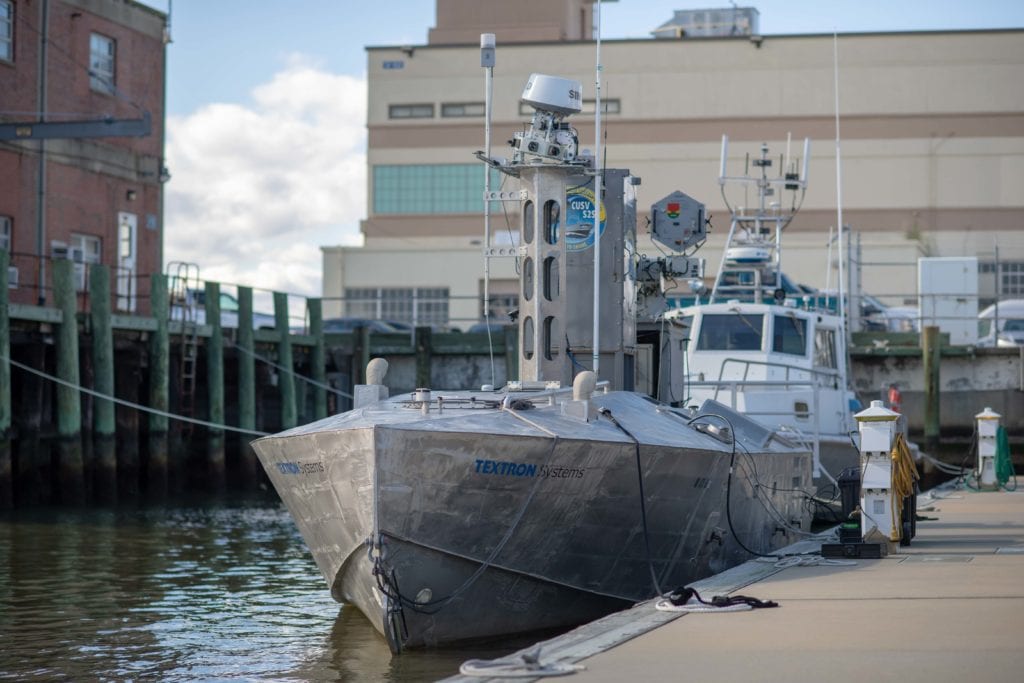
A developmental, early variant of the Common Unmanned Surface Vehicle (CUSV) autonomously conducts maneuvers on the Elizabeth River during its demonstration during Citadel Shield-Solid Curtain 2020 at Naval Station Norfolk. U.S. NAVY / Mass Communication Specialist 2nd Class Grant G. Grady

NATIONAL HARBOR, Md. — The Navy has wrapped up initial operational test and evaluation (IOT&E) for the Unmanned Influence Sweep System (UISS) and expects the platform to be ready for fielding by the end of this summer, according to an official.

Capt. Godfrey Weekes, program manager for Littoral Combat Ship mission modules (PMS-420), said Tuesday at the Navy League’s Sea-Air-Space expo in National Harbor, Maryland, that initial operational capability (IOC) for the platform is the fourth quarter of fiscal 2021, which ends Sept. 30, 2021.

The UISS platform is designed for the LCS’s mine countermeasures mission package (MCM). It “consists of a mine countermeasures unmanned surface vehicle (USV) and a towed minesweeping payload for influence sweeping of magnetic, acoustic and magnetic/acoustic combination mine types,” according to a Navy statement.

The UISS’s Minehunt USV is currently in contractor verification testing. Low-rate initial production of that platform should begin sometime in late fiscal 2022, Weekes said.

The MCM mission package itself is scheduled to achieve IOC in the fourth quarter of fiscal 2022.


IBM Leverages Hybrid Clouds and AI to Enable New Technology

Ray Spicer, shown here in IBM’s space in the Maryland pre-function lobby, says the company is focusing on hybrid cloud computing and AI. NAVY LEAGUE

IBM is leveraging hybrid cloud computing and AI — what it calls augmented intelligence — to create new technology systems, such as its Mayflower unmanned surface vehicle, capable of making its own decisions while far from port.

Ray Spicer, a retired U.S. Navy rear admiral who is now vice president of defense and intelligence at IBM, says “hybrid cloud and AI is where the company is really focused these days, very heavily.”

Rather than concentrating data into one large cloud, IBM is able to work with various types of clouds, whether they are personal or public, small or massive.

“Having all those clouds being able to uplink together is the way to go,” Spicer said.

A hybrid cloud scenario allows the company to “containerize” apps that can pluck the data they need from a cloud where it resides, which “allows you to move the workloads to the data” rather than the other way around.

An example is the computing system Watson, which famously won on “Jeopardy!” in 2011. It has only gotten smarter since then and has been broken into component segments aimed at different markets, from financial operations to customer service to health care.

This sort of flexibility contributed to Mayflower, which leveraged technology from other industries. For example, software aimed at enabling rapid fraud detection can also be used to help Mayflower make rapid decisions on the high seas.

This sort of AI is helpful for things like collision regulations, or colregs, the rules of the sea, Spicer said. Sailors forget them from time to time and have to be retrained, but “you teach AI one time, and it doesn’t forget.”


After 3 Explosive Events of its Shock Trial, USS Gerald R. Ford Will be on Track for Operational Tasking in 2022, NAVSEA Says

USS Gerald R. Ford (CVN 78) successfully completed the second of three scheduled explosive events for full ship shock trials (FSST), July 16, 2021. U.S. NAVY / Mass Communications Specialist Seaman Jackson Adkins

NATIONAL HARBOR, Md. — With a third and final Explosive Event of a Full Ship Shock Trial (FSST) to go, and after an analysis and repairs if needed, the U.S. Navy’s newest aircraft carrier, USS Gerald R. Ford (CVN 78), will be ready for operational tasking by 2022, according to a Program Executive Office – Carriers official.

Upon completion of the last Explosive Event later this summer, Ford will enter a planned incremental availability for six months of modernization, maintenance and repairs prior to its operational use.

The Ford, the first of a new super carrier class, currently cannot accommodate the Navy’s carrier-based F-35C Lightning II joint strike fighter without upgrades. The Navy plans to complete the upgrades for the F-35C before the carrier is scheduled to operate with the aircraft.

Last year, the Navy announced F-35C modifications to the future USS John F. Kennedy (CVN 79), the second Ford-class carrier, under a contract employing a single-phase acquisition strategy, instead of the originally planned two-phase strategy.

The Navy previously planned to build CVN 79 in two phases, putting the ship’s combat systems in “at the last minute to avoid obsolescence,” said Kevin Cormier, deputy program manager, PEO Aircraft Carriers told an exposition floor briefing at the Navy League’s Sea-Air-Space Expo in National Harbor, Maryland, Aug. 3. 

After considering the combat systems’ delivery schedule, however, “the Navy made a decision that it was more prudent” to deliver a whole ship in 2024, Cormier said. “Right now, we are on track for 2024 delivery with the new Enterprise Air Surveillance Radar (EASR) and new Joint Strike Fighter models.”

Cormier said the next Ford-class carrier, CVN 80, is about 10% complete with keel laying expected in February 2022. CVN 80, slated to be the future USS Enterprise, is part of a two-ship one buy Cormier said saved taxpayers $4 billion. The next Ford carrier, CVN 81, is “tracking for a 2032 delivery,” he said.


FRCs Gets Hornets Back in Action Quickly, Now Turning Attention to Other Aircraft

An F/A-18 Hornet assigned to the Gladiators of Strike Fighter Attack Squadron (VFA) 106 prepares to launch from the flight deck of the aircraft carrier USS Theodore Roosevelt (CVN 71) in this 2014 photo. U.S. NAVY

NATIONAL HARBOR, Md. – Intense and extended efforts by the command of naval aviation’s Fleet Readiness Centers have cut the time to get F/A-18 Hornet fighters out of maintenance and back to the flight line by half.

Those efforts are now are being used to do the same with other Navy aircraft, and to reduce the cost of those updates and maintenance, officials at the command said Aug. 3.

The series of reforms to accelerate the turn-around of aircraft were driven by the chronic shortfall of tactical planes, particularly fighter jets, a decade ago. The program also stemmed from the revised National Defense Strategy, which turned the military’s focus to the return of great power competition due to rising threats from China and Russia, Rear Adm. Joseph Hornbuckle, Fleet Readiness Centers commander, told a Navy League Sea-Air-Space 2021 briefing.

The initial effort was focused on the F/A-18, the key to the carrier air wings’ strike capabilities. By applying industry best practices, largely copied from the airlines, FRCs were able to cut the typical 120 to 150 day average turnaround time in half, said Roy Harris, the command’s executive director.

The command established an operations center that looked at all elements of FRC’s operations and prioritized allocation of resources, Harris said. A key element of the reforms was setting targets for the centers to meet important milestones in the repair and maintenance process and pushing the centers to meet those goals, Hornbuckle said.

One of its early achievements was meeting the chief of naval operations’ goal of putting 341 mission-capable Hornets on the flight line. The effort then turned to the EF-18G Growler electronic warfare aircraft and now is extending to other Navy aircraft, including E-2C Hawkeyes and H-60 helicopters.

The reform efforts now are focusing not only on producing “mission-capable aircraft quicker, but also at the lowest possible cost,” Hornbuckle said. 

FRC operates nine readiness centers and 25 other tenant sites and employs nearly 22,000 individuals, Navy, civilians and contractors, Hornbuckle said. It annually works on 300 aircraft and 150,000 aviation components.

As with most naval systems, a major problem for FRC is fighting corrosion, which “can eat our lunch,” Harris said. They are working to collect data on the problem to find the most effective and efficient solutions.


Coast Guard Sees Many Uses for Unmanned Systems in the Arctic Environment

Coast Guard Cutter Healy deckhands prepare to lower an unmanned underwater vehicle, operated by the Woods Hole Oceanographic Institute, into the Beaufort Sea during a simulated spilled oil response and recovery exercise, Sept. 10, 2013. WHOI scientists used the UUV to monitor ice conditions from below during the simulated exercise. U.S. COAST GUARD / Petty Officer 3rd Class Grant DeVuyst

NATIONAL HARBOR, Md. — First sought to extend the reach of Coast Guard cutters in the Pacific Ocean, the service is exploring the use of unmanned aerial, surface, and undersea systems in the harsh and distant environs of the Arctic.

“Numerous types of platforms could be extremely valuable in the Arctic,” U.S. Coast Guard Capt. Thom Remmers told a, exposition floor briefing Aug. 2 at the Navy League’s Sea-Air-Space expo in National Harbor, Maryland.

Remmers, the Unmanned Cross-Functional team lead for the Coast Guard’s Directorate for Capabilities (CG-7), said underwater vehicles could “very easily and capably look for environmental spills.”

The Coast Guard partnered with Woods Hole Oceanographic Institution in Massachusetts to operate a 250-lb. long-range autonomous underwater vehicle (LRAUV), Polaris, developed by the institute for just purpose, he said. “It demonstrated a search for oil spills under the ice in the Arctic,” he added.

Remmers said the Coast Guard has also deployed unmanned aerial vehicles on some icebreakers, like the Coast Guard Cutter Healy, “primarily by tactical commanders to look for ice floes,” he added.

“Those types of needs are not unique to the Arctic,” Remmers said, “but they’re much more valuable when you start looking at access in that region.” Unmanned systems could also provide “a long-range persistent MDA [maritime domain awareness] type of capability that we need up there,” he said.