Navy Closing Capability Gaps in Joint Communications

Defense and industry officials, including Rear Adm. Douglas Small, second from left, discuss joint command and control. NAVY LEAGUE / Lisa Nipp

NATIONAL HARBOR, Md. – As the entire Department of Defense modernizes technology to enable commands, warfighters and autonomous systems to communicate with each other under the most trying of circumstances, significant questions remain. 

“We’re really about closing capability gaps and building the right resourcing requirement plans [to do so],” said Kelly McCool, acting director of the Navy Digital Warfare Office, speaking during a July 2 panel discussion on netted battlespace at the Navy League’s Sea-Air-Space 2021 in National Harbor, Maryland.

Joining McCool on the panel were Naval Warfare Systems Command commander Rear Adm. Douglas Small, Northrop Grumman chief technology officer Scott Stapp and L3 Harris Technologies chief technology officer Ross Niebergall. Patrick Tucker, technical editor at Defense One, moderated the discussion, which addressed the Navy’s role in improving JADC2 (joint all-domain command and control). 

Small said the Navy has a long history of expertise in connecting disparate sensors, weapons and command and decision systems. The current climate, he believes, is an expansion of this traditional role. 

“We’re talking about contested environments,” Small said. “How do you get that information to the right place in a contested environment, where every aspect of how you fight is being challenged?”

Stapp pointed out that JADC2, as its name suggests, must be applied across all services and domains as well. 

“It’s how you move that data into all those critical platforms,” Stapp said. “As a company, we are focusing on the integration of new and unique ways — multi-domain and multi-service.”

Niebergall discussed the need to take all the data generated by stand-alone systems and use it as a strategic asset. “We need to put it together into a collection that we can operate on, make sure it’s available everywhere, is secure, accurate and can be disseminated everywhere.” 

 The Navy is accustomed to operating in disconnected environments, Small said, providing commanders with information they need at the time they must make decisions.

“There are certainly areas where we can do a lot better — and we are,” Small said. “It’s more how you take that [data] from a naval platform and expand it out to the joint force.”


Newport News Shipbuilding Part of 4th Industrial Revolution

Newport News Shipbuilding contractor Andrew Blair, from Birmingham, Alabama, cuts into the deck aboard the aircraft carrier USS John C. Stennis (CVN 74), in Newport News, Virginia, June 17, 2021. U.S. NAVY / Mass Communication Specialist Seaman Thomas Willis

NATIONAL HARBOR, Md. — The advances in shipbuilding technology and investments in facilities, training and tools is helping Newport News Shipbuilding (NNS) — a Huntington Ingalls Industries (Booth 1323) sector — keep up with the demands of the present and prepare for the future, according to its president.

“We are busier than we have been in my 34 years [with NNS], said NNS President Jennifer Boykin, speaking to reporters Aug. 2 at the Navy League’s Sea-Air-Space Expo in National Harbor, Maryland.

NNS currently is building or overhauling 34 ships, including 27 at the shipyard in Newport News, Virginia, and 14 elsewhere at other sites.

That capacity is enabled by new technology, including additive manufacturing, laser scanning, augmented reality, 5G shipyard connectivity and data analytics.

Boykin said NNS has the capability to use additive manufacturing to produce components of more than 600 pounds. The capability is awaiting certification from the U.S. Navy to use on its ships.

She also pointed out that the third Gerald R. Ford-class aircraft carrier, the future USS Enterprise (CVN 80), is the first aircraft carrier being built by workers using digital tablets.

With these new technologies, Boykin noted that “many refer to this as the Fourth Industrial Revolution.”

NNS has invested $1.9 billion in physical plant infrastructure since 2016. Those funds have been devoted to submarine facility expansion, a joint manufacturing and assembly facility, a new 310-ton crane replacement, machine shops, foundry and steel fabrication improvements, new automation, and digital infrastructure throughout the shipyard.

NNS builds nuclear-powered ships including Ford-class aircraft carriers and — teamed with General Dynamics Electric Boat (Booth 1023) — Virginia-class attack submarines and Columbia-class ballistic-missile submarines. NNS also conducts refueling and complex overhauls of Nimitz-class aircraft carriers and depot-level maintenance and refueling of some Los Angeles-class attack submarines.

The shipyard is on track to deliver two Virginia-class submarines and re-deliver the Los Angeles-class attack submarine USS Helena to the fleet in 2021.

Asked about what would be needed in terms of shipyard investment to increase capacity to build three Virginia-class submarines per year if so funded, Boykin said significant investment across the submarine construction enterprise — including the supply chain — would be required.


Gilday: Large Scale Exercise 2021 Will Provide ‘Path to the Future’ for U.S. Navy

Gilday, second from left, appeared on the Tri-Service Maritime Leadership panel that kicked off Sea-Air-Space 2021. NAVY LEAGUE / Lisa Nipp

NATIONAL HARBOR, Md. — The Navy’s massive Large Scale Exercise 2021 kicks off this week and the sea service’s top officer said Monday the exercise represents a “path to the future” for the service.

It’s the “biggest exercise we’ve done in a generation,” and the Navy will benefit from its lessons for years to come, Chief of Naval Operations Adm. Michael Gilday said while speaking at the Navy League’s Sea-Air-Space Expo in National Harbor, Maryland.

The exercise will involve 25,000 sailors and Marines and will span 17 time zones in the Pacific Ocean, Atlantic Ocean, and Mediterranean Sea. The exercise begins Aug. 3 and will finish on Aug. 16.

While the Navy plans to test warfighting concepts like it would with any exercise, one of the main purposes of the event is to put Sailors and Marines in a two-week live virtual constructive exercise, Gilday said.

“At an individual level, it allows sailors and combatant commanders” to experiment with warfighting concepts and generate lessons learned, he said.

“That’s the key to this,” he said. “It’s to take this warfighting concept, which is quite frankly going to be foundational to everything that we buy, everything we invest in, and it’s going to inform how we’re going to fight.”

The exercise provides a rare opportunity where service members can train together regardless of their role.

“We think this constructive training is really a path to the future for us,” Gilday said. “You can imagine that sailors and lieutenant commanders and their COs can conduct integrated training — air wing and submarines and surface ships and cyber units. Any time they want thousands of repetitions, we can learn from that, and bring back those lessons to how we fight.”


Navy Conducts First MQ-4C Triton Test Flight with Multi-Intelligence Upgrade

A Northrop Grumman Corp.-built MQ-4C Triton took to the skies for the first time in the highly upgraded multi-intelligence configuration known as integrated functional capability four (IFC-4). U.S. NAVY

PATUXENT RIVER, Md. — The Navy conducted its first test flight of the MQ-4C Triton in its upgraded hardware and software configuration July 29 at NAS Patuxent River, beginning the next phase of the unmanned aircraft’s development, the Naval Air Systems Command said in a July 29 release. 

The MQ-4C Triton flew in its new configuration, known as Integrated Functional Capability (IFC)-4, which will bring an enhanced multi-mission sensor capability as part of the Navy’s Maritime Intelligence, Surveillance, Reconnaissance and Targeting (MISR&T) transition plan. 

Triton’s Integrated Test Team (ITT) comprised of the U.S. Navy, Australian cooperative partners, and government/industry teams completed a functional check flight and initial aeromechanical test points, demonstrating stability and control of the MQ-4C after a 30-month modification period.   

“Today’s flight is a significant milestone for the program and a testament to the resolve of the entire ITT, their hard work, and passion for test execution and program success,” said Capt. Dan Mackin, Persistent Maritime Unmanned Aircraft Systems program manager. “This flight proves that the program is making significant progress toward Triton’s advanced multi-intelligence upgrade and it brings us closer to achieving the initial operational capability (IOC) milestone.”  

Multiple Triton assets have been modified into the IFC-4 configuration in support of IOC in 2023.  A single test asset is in the current IFC-3 configuration to support sustainment of deployed systems as well as risk reduction for IFC-4.  

Currently, two MQ-4C Triton aircraft in the baseline configuration known as IFC-3 are forward deployed to 7th Fleet in support of early operational capability (EOC) and Commander Task Force (CTF)-72 tasking. VUP-19 will operate Triton to further develop the concept of operations and fleet learning associated with operating a high-altitude, long-endurance system in the maritime domain. 

“The MQ-4C Triton has already had a tremendous positive impact on operations in [U.S. Indo-Pacific Command] and will continue to provide unprecedented maritime intelligence, surveillance and reconnaissance capabilities which are especially critical to national interests with the increased focus in the Pacific,” Mackin said. 

Triton is the first high-altitude, long-endurance aircraft that can conduct persistent Intelligence, Surveillance and Reconnaissance (ISR) missions to complement the P-8 in the maritime domain. The Navy plans to deploy Triton to five orbits worldwide.  


USS Independence First LCS to Be Decommissioned

The crew of USS Independence (LCS 2), the lead ship of the Independence-variant Littoral Combat Ship, recognized more than a decade of naval service during a decommissioning ceremony at Naval Base San Diego, July 29. U.S. NAVY

SAN DIEGO — The crew of USS Independence (LCS 2), the lead ship of the Independence-variant Littoral Combat Ship, recognized more than a decade of naval service during a decommissioning ceremony at Naval Base San Diego, July 29, commander, Littoral Combat Ship Squadron One, said in a July 30 release. 

Due to public health and safety restrictions on large public events resulting from the novel coronavirus (COVID-19) pandemic, the ceremony was a private event celebrated alongside ship plankowners and former crew members. 

During the ceremony, keynote speaker, Vice Adm. Roy Kitchener, Commander, Naval Surface Force, U.S. Pacific Fleet, wished the crew of Independence fair winds and following seas as they said farewell to their ship. 

“The Independence crew shouldered a heavy responsibility. Since the ship’s introduction into the fleet we asked her to serve for a specific purpose; to test emerging equipment and concepts,” said Kitchener. “The crew accomplished that and so much more. Without their efforts and experiences, the ship class would not be where it is today with six ships deployed throughout the world. Those improvements, made largely in part due to this crew’s experience and input, will continue to carry the LCS class into the future.” 

The commissioning commanding officer of USS Independence gold crew, Capt. Michael Riley said it was the Sailors who rose to the occasion that made Independence prosperous. 

“What made Independence successful wasn’t the program managers, industry professionals or even her two captains. It was the officers, chiefs and Sailors of the blue and gold crews that made it operational. They shouldered the burden of shifting programmatic guidance, incomplete documentation or one-of-a-kind systems, and got it to sea,” said Riley. “They were honest in pointing out when system performances or operational processes failed to live up to their expectations. At the same time, they discovered hidden capabilities in the ship, repurposing equipment and systems to suit the situation.” 

Independence maintained a crew of nine officers and 41 enlisted Sailors. The ship was built in Mobile, Alabama, by Austal USA and commissioned Jan. 16, 2010. 

Independence is the sixth ship to carry the name, recognizing the cornerstone of our nation’s foundation for which so many Americans have fought and died. The first Independence was a 10-gun sloop that served during the American Revolution. The second Independence, the first ship of the line in the Navy, was launched in 1814 as a 74-gun ship, but later refitted to a 54-gun frigate. The third Independence served with the Naval Overseas Transportation Service (NOTS) following the end of World War I. The fourth Independence (CVL 22), a small aircraft carrier commissioned in 1943, earned eight battle stars during World War II. The fifth Independence (CV 62) was an aircraft carrier commissioned in 1959 and decommissioned in 1998. 

Independence has been a test and training ship and was key in developing the operational concepts foundational to the current configuration and deployment of LCS today. The decommissioning of LCS 2 supports department-wide business process reform initiatives to free up time, resources, and manpower in support of increased lethality. The LCS remains a fast, agile, and networked surface combatant, designed to operate in near-shore environments, while capable of open-ocean tasking and winning against 21st-century coastal threats. 

The LCS class consists of two variants, the Freedom variant and the Independence variant, designed and built by two industry teams. The Freedom variant team is led by Lockheed Martin and is a steel monohull design constructed in the Fincantieri Marinette Marine Corporation’s shipyard in Marinette, Wisconsin. The Independence variant is an aluminum trimaran design originally built by an industry team led by General Dynamics Bath Iron Works for LCS 2 and LCS 4. Currently, Independence variant LCS are constructed by Austal USA in the company’s Mobile, Alabama shipyard. 

LCS are outfitted with mission packages (made up of mission systems and support equipment) that deploy manned and unmanned vehicles and sensors in support of mine countermeasures, anti-submarine warfare or surface warfare missions. 

After the decommissioning of Independence, 22 littoral combat ships remain in service to the fleet. 


Lockheed Martin’s HELIOS Shipboard Laser Being Tested at Wallops Island

Artist’s rendering of Lockheed Martin’s HELIOS system. LOCKHEED MARTIN

ARLINGTON, Va. — The shipboard laser weapon system built for the U. S. Navy by Lockheed Martin is being tested at Wallops Island, Virginia, a company official said. 

The first High-Energy Laser with Integrated Optical-dazzler and Surveillance, or HELIOS, was delivered to the Navy in January 2021 and was shipped to the Navy’s test site at Wallops Island.  

The HELIOS is being test-fired and real-world test data from the weapon is being collected to confirm the models, said Jon Rambeau, vice president and general manager for Integrated Warfare Systems & Sensors at Lockheed Martin. 

The single 60-kilowatt HELIOS unit is scheduled to be installed on the Flight IIA Arleigh Burke-class guided missile destroyer USS Preble in line with its deployment schedule, Rambeau said. 

Lockheed Martin built one HELIOS under the Navy contract, which has options for multiple units. 

Rambeau said the HELIOS, which is fully integrated into the Aegis Combat System, has the potential to be a significant counter to anti-ship cruise missiles. The weapon is scalable with additional of fiber-optic laser modules. The HELIOS is adaptable to the Ship Self-Defense System (SSDS) on aircraft carriers and most amphibious warfare ships.   


Future Maritime Center of Excellence to Transform Coast Guard Academy Waterfront

The U.S. Coast Guard Academy is situated along the Thames River in New London, Connecticut. U.S. COAST GUARD

NEW LONDON, Conn. — A more than $23 million project is now underway at the U.S. Coast Guard Academy that will transform the waterfront area of the 90-year-old campus, the academy’s public affairs office said in a July 29 release.  

The future Maritime Center of Excellence (MCOE) will enhance the waterfront facilities at the Academy by offering interactive and high-tech classrooms for a variety of educational and leadership development courses.   

The 20,000 square foot structure will be the Academy’s first Leadership in Energy and Environmental Design (LEED) certified building and will highlight the unique waterfront leadership programs and nationally prominent intercollegiate sailing program. 

In a twist on the traditional groundbreaking ceremony, leaders signed a ceremonial steel beam which will be used in the construction of the future center during a July 29 event to commemorate the start of the project.    

Present at the event were Rear Adm. Bill Kelly, superintendent of the Coast Guard Academy, retired Coast Guard Capt. Andrea Marcille, president of the U.S. Coast Guard Academy Alumni Association and retired Coast Guard Vice Adm. Manson Brown, chair of the Alumni Association Board of Directors.   

The modern design of the MCOE includes ambitious sustainability design goals in line with coordinated climate resiliency efforts across the service, and one of several lines of effort that the Department of Homeland Security and its component agencies have taken to address the dangers posed by global climate change.  

The construction is targeting LEED Gold certification. LEED certification involves a set of rating systems for the design, construction, operation, and maintenance of modern buildings to achieve sustainability and resource efficiency goals.   

“This LEED certified, multi-purpose facility will serve as gathering spot for cadets and officer candidates from across our great nation,” said Rear Adm. Kelly. “It will be a space where young women and men can gather to learn and grow and I am certain it will serve as a facility that will enhance an appreciation for the water and all its power and beauty and ultimately it will help us instill a liking for the sea and its lore.” 

The interior spaces of the future center have been designed with access to daylight, and natural ventilation to minimize reliance on artificial lighting and air conditioning. Double-height spaces for vessel maintenance, office space, and an atrium will provide natural ventilation. Other sustainability goals include the exploration of ground-source heating and cooling, solar panels, and rainwater harvesting. The building exterior will also feature durable, resilient materials that are easily maintained. 

With a curvilinear vaulted roof, wooden decks, and true north orientation the building is designed to highlight the waterfront landscape. The new facility will also feature interactive and high-tech classrooms such as the Science and Engineering Innovation Laboratory designed to encourage collaboration in areas of digital processing, robotics, alternative fuels and emissions, and environmental and coastal resiliency among others.  

This represents a significant step forward as the Academy works to recapitalize 1930’s infrastructure and build modernized training and education venues to deliver the knowledge, skills, experience and values necessary to develop the future Coast Guard workforce. 


Navy Christens Future USS Hyman G. Rickover

The Navy’s newest Virginia-class attack submarine, future USS Hyman G. Rickover (SSN 795), was christened during a ceremony at General Dynamics’ Electric Boat shipyard facility in Groton, Connecticut, July 31. U.S. NAVY

GROTON, Connecticut – The Navy’s newest Virginia-class attack submarine, future USS Hyman G. Rickover (SSN 795), was christened during a ceremony at General Dynamics’ Electric Boat shipyard facility in Groton, Connecticut, July 31, the U.S. Navy said in a release.

“This submarine is a fitting tribute to Admiral Rickover, who truly transformed our Navy,” said Adm. James Caldwell, director, Naval Nuclear Propulsion Program, during his remarks at the celebration.

Caldwell credited Rickover — who served for 63 years in the Navy and is credited with spurring the service to adopt nuclear propulsion after World War II — with not only technological advances but cultural ones. He lauded Rickover’s legendary work ethic, frankness, attention to detail and commitment to excellence, which he said has since permeated throughout the Navy.

“It’s really great to see this ship come together, and to see so many people here to celebrate the christening of the Hyman G. Rickover and honor the Hyman G. Rickover legacy,” said Cmdr. Thomas Niebel, commanding officer of the newly christened submarine.

The Honorable James F. Geurts, performing the duties of Under Secretary of the Navy, told those in attendance that the construction of the future USS Hyman G. Rickover is a testament to the dedication of America’s shipbuilders and sailors.

“We did not close a shipyard, public or private, for one day during the pandemic,” Geurts said. “The sustained commitment to excellence displayed by this workforce shows in the construction of this boat and adheres to the culture of excellence promoted by Hyman G. Rickover.

“It’s not just a matter of having the world’s best ships,” he continued, “you have to have the world’s best Sailors to maintain the world’s best Navy, and we have both.”

Darleen Greenert, the submarine’s sponsor, a Navy veteran, and wife of former Chief of Naval Operations Jonathan Greenert, highlighted the sacrifice of military families during her remarks, and remembered the late Eleonore Rickover, the namesake admiral’s wife.

“She set the bar [for ship sponsors],” Greenert said of Eleonore Rickover, who was the sponsor for a previous Los Angeles-class submarine to bear the Hyman G. Rickover name, SSN 709. “She loved her crew.”

The first Hyman G. Rickover was commissioned at Submarine Base, New London, in Groton, on July 21, 1984. SSN 709 and its crew deployed 12 times until its decommissioning in December 2007. Over the years, its decorations included the Atlantic Fleet Golden Anchor Award, Submarine Squadron Eight’s anti-submarine warfare white “A” and engineering red “E” awards and the prestigious Sixth Fleet “Hook ‘Em” award for anti-submarine warfare excellence.

Greenert asked family members of the crew of the future USS Hyman G. Rickover to stand together when her daughter, Matron of Honor Sarah Greenert McNichol, broke the ceremonial bottle of sparkling wine across the bow.

Other speakers at the ceremony included Electric Boat President Kevin Graney, Newport News Shipbuilding President Jennifer Boykin, U.S. Rep. Joe Courtney, D-CT and U.S. Rep. Jim Langevin, D-RI.

Rickover will eventually joint the fleet with a displacement of 7,835 tons, crew of 132, and a weapons payload of 12 vertical launch systems and four torpedo tubes.

Fast-attack submarines like Rickover are multi-mission platforms enabling five of the six Navy maritime strategy core capabilities — sea control, power projection, forward presence, maritime security, and deterrence. The submarine is designed to excel in anti-submarine warfare; anti-ship warfare; strike warfare; special operations; intelligence, surveillance, and reconnaissance; irregular warfare; and mine warfare – from open ocean anti-submarine warfare to intelligence, surveillance and reconnaissance, to projecting power ashore with Special Operation Forces and Tomahawk cruise missiles in the prevention or preparation of regional crises.


Navy Charges Crew Member for Bonhomme Richard Fire

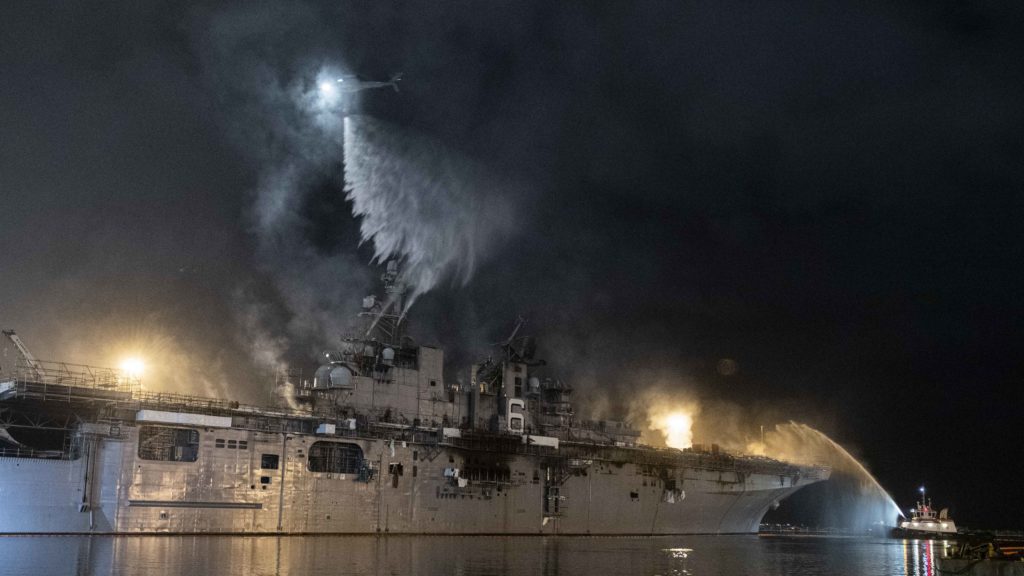
A helicopter from Helicopter Sea Combat Squadron (HSC) 3 combats a fire aboard the amphibious assault ship USS Bonhomme Richard (LHD 6) at Naval Base San Diego, July 14, 2020. U.S. NAVY / Mass Communication Specialist 3rd Class Garrett LaBarge

ARLINGTON, Va. — The U.S. Navy has brought charges against a Sailor who was a crew member of the amphibious assault ship USS Bonhomme Richard for starting the fire that resulted in the devastation of the ship, the U.S. 3rd Fleet said in a July 29 release. 

“On July 29, charges under the Uniform Code of Military Justice [UCMJ] were brought forth against a Navy Sailor in response to evidence found during the criminal investigation into the fire started on USS Bonhomme Richard (LHD 6) on July 12, 2020,” said Cmdr. Sean Robertson, U.S. 3rd Fleet spokesperson. “Evidence collected during the investigation is sufficient to direct a preliminary hearing in accordance with due process under the military justice system. The Sailor was a member of Bonhomme Richard’s crew at the time and is accused of starting the fire.  

“Vice Adm. Steve Koehler, commander, U.S. 3rd Fleet is considering court-martial charges and has directed a preliminary hearing at which an impartial hearing officer will make determinations and recommendations required by the UCMJ prior to any further trial proceedings — including whether or not there is probable cause to believe an offense has been committed and to offer a recommendation as to the disposition of the case.” 

The Bonhomme Richard was pierside at the naval base in San Diego going through modernization when a fire started and spread through much of the ship over a period of days. The Navy considered several options to repair the ship, possibly in another role, but the service decided to decommission and scrap it. 

“Following an extensive material assessment in which various courses of action were considered and evaluated, we came to the conclusion that it is not fiscally responsible to restore her, then-Navy Secretary Kenneth Braithwaite said in a Nov. 30 release. 


Lockheed Martin Delivers 100th SEWIP 2, Starts Deliveries of SEWIP Lite to Navy

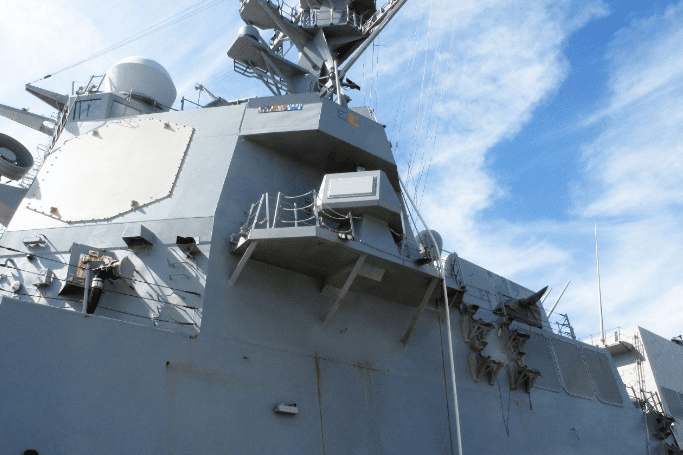
Lockheed Martin is now delivering the Surface Electronic Warfare Improvement Program (SEWIP) Lite as SWEIP Block 2 deliveries reach 100. LOCKHEED MARTIN

ARLINGTON, Va. — Lockheed Martin’s deliveries of electronic warfare capabilities to U.S. Navy now include Surface Warfare Electronic Warfare Improvement Program (SEWIP) Lite as deliveries of (SEWIP) Block 2 reaches 100, a company official said. 

SEWIP Lite is a scaled version of SEWIP Block 2 designed for installation on smaller warships such as the Navy’s littoral combat ships (LCSs) and the Coast Guard’s new offshore patrol cutters now under construction. SEWIP Lite operates with the same hardware software and same inboard processing as SEWIP Block 2. 

“SEWIP Lite now is in production” said Joe Ottaviano, director for Maritime and Air Cyber/Electronic Warfare at Lockheed Martin Rotary and Mission Systems, in an interview with Seapower. “We’ve delivered several of those already. Some are on the way for installation on LCS.”  

Ottaviano said that some international customers have expressed an interest in SEWIP Lite, designed for ships smaller than an Arleigh Burke-class destroyer which have size, weight, and space limitations. Block 2 currently is planned for the Constellation-class frigate. 

The SLQ-32(V)6 SEWIP Block 2, including SEWIP Lite, is being installed on all active U.S. Navy surface combatants. Block 2 is in its second five-year full-rate production run. 

“We’re going through tech refresh now,” Ottaviano said. “A lot of the open-architecture things we had put in place over the years is allowing us to tech refresh SEWIP, our submarine programs, our airborne programs at a pretty rapid pace, every couple of years without causing a huge development cycle.” 

Lockheed Martin is continuing to work with the Navy as they integrate the [electronic attack] Block 3 portion into [SEWIP]. Block 3 is a Northrop Grumman program. 

“Block 2 brings the foundation of the Navy’s EW battle management — the displays, integration, the sharing of EW information across the fleet, and providing the enterprise protection,” Ottaviano said. “It actually cues Block 3 and helps drive its response.” 

He said the SEWIP is now tightly integrated into the Aegis Combat System.  

“Now we can do everything we need to do passively,” he said.