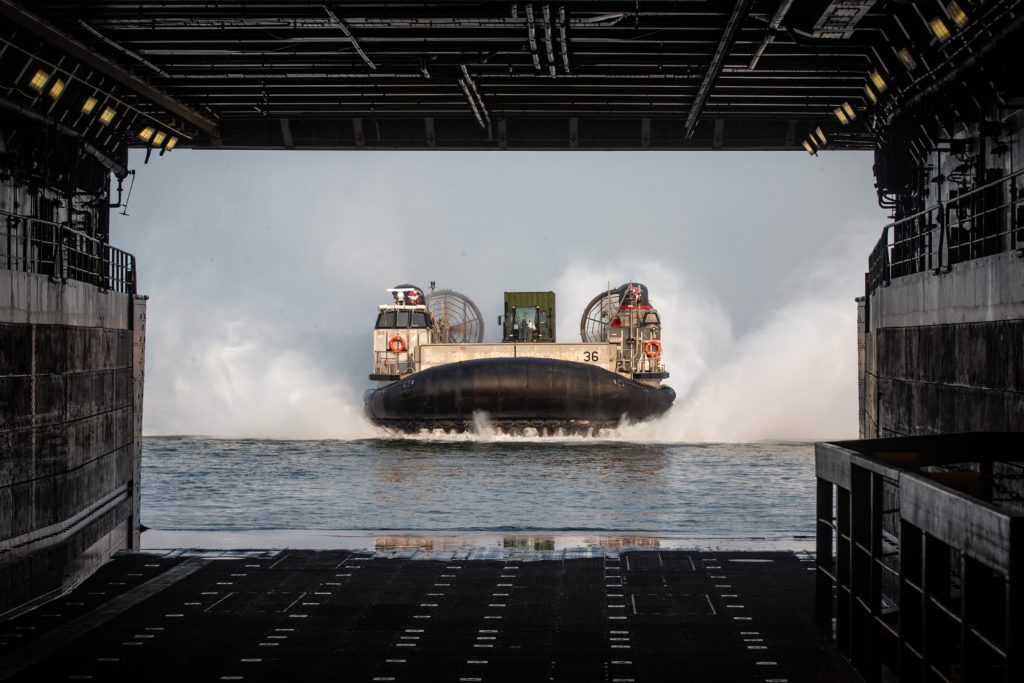
A U.S. Navy landing craft, air cushion is marshaled into the USS Arlington (LPD-24) carrying tactical vehicles during Defense Support of Civil Authorities (DSCA) mission rehearsals at Naval Base Norfolk, Virginia, July 21, 2021. Under a new program office shift, PMS 300 will assume duties for boats and craft and PMS 325 will focus on larger platforms. U.S. MARINE CORPS / Lance Cpl. Scott Jenkins
The Naval Sea Systems Command Program Executive Office Ships (PEO Ships) is establishing a new program office to distribute the support ships, boats and craft responsibilities of PMS 325. PMS 325 currently manages acquisition and life-cycle support for auxiliary ships, boats, service craft and targets, special mission ships and foreign military sales. PMS 300 will assume the duties for boats and craft, while 325 will focus on the larger platforms.
According to NAVSEA spokesman Alan Baribeau, PEO Ships continually assesses and where necessary adjusts program office resources to ensure they are best aligned to efficiently and effectively deliver capability to requirements.
“The PMS 325 portfolio has grown significantly over time and based on forecasted workload has reached the point where splitting into two separate, focused program offices is prudent,” Baribeau said. “PMS 300 is being established as the USN & FMS Boats and Craft Program Office; it will oversee FMS, boats & combatant craft and service craft/targets. PMS 325 will be renamed the Auxiliary and Special Mission Shipbuilding Program Office and will oversee auxiliary ships and special mission ships including Next Generation Logistics Ship (NGLS), the Navy Cable Ship (T-ARC(X)) Program to replace the Navy’s only undersea cable installation and repair ship, and the ), and new TAGOS(X) Ocean Surveillance Shipbuilding Program.”
U.S. Coast Guard Commissions 3 Fast Response Cutters in Guam
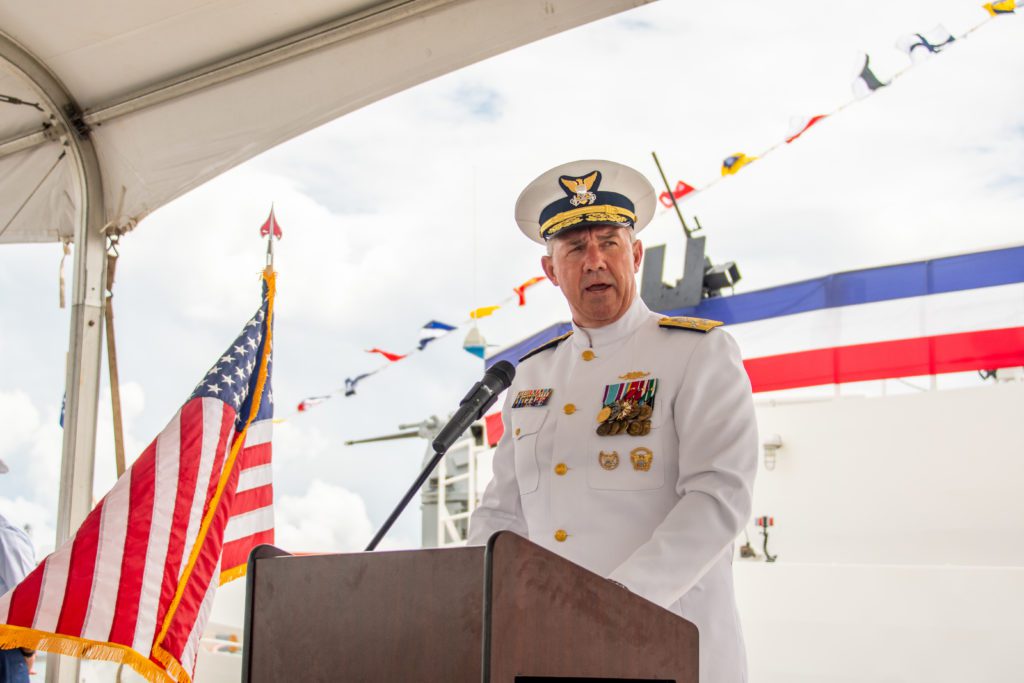
Adm. Karl Schultz, the commandant of the Coast Guard, speaks during a rare triple-commissioning ceremony at Coast Guard Sector Guam July 29, 2021. During the ceremony, Coast Guard Cutters Myrtle Hazard, Oliver Henry and Fredrick Hatch were commissioned. U.S. COAST GUARD / Petty Officer 1st Class Travis Magee
SANTA RITA, Guam — The Coast Guard’s three newest Fast Response Cutters were commissioned July 29 during a ceremony presided over by Adm. Karl Schultz, the Coast Guard’s commandant, the Coast Guard 14th District said in a release.
The Coast Guard Cutters Myrtle Hazard (WPC 1139), Oliver Henry (WPC 1140) and Frederick Hatch (WPC 1143) were commissioned during a rare triple-commissioning ceremony at their new homeport at Coast Guard Forces Micronesia Sector Guam.
“The triple commissioning of Coast Guard Cutters Myrtle Hazard, Oliver Henry, and Frederick Hatch signals our dedication to regional partners and the growing maritime demand in the region,” said Capt. Nick Simmons, commander, Coast Guard Forces Micronesia Sector Guam. “It was an honor to celebrate this historic event with the crews, families and sponsors for each cutters’ namesake.”
Like the 30-year-old Island-class patrol boats before them, they will support the people of Guam, the Commonwealth of the Northern Mariana Islands, and our international partners throughout Oceania. The FRCs represent the Coast Guard’s commitment to modernizing service assets to address the increasingly complex global Maritime Transportation System.
The Coast Guard already has a well-established presence within the region due to its bilateral shiprider agreements with Pacific Island Forum countries. These shiprider agreements allow partnering nations’ defense and law enforcement officers to go aboard Coast Guard vessels to observe, board and search vessels suspected of violating laws or regulations within their exclusive economic zones.
By embarking shipriders, Coast Guard crews are able to support allies in the region and work towards expanding security by addressing regional challenges to peace, prosperity, and social inclusion. The retention of crewmembers from these invaluable missions means the lessons learned from joint operations will carry over to the new FRCs, ensuring goodwill developed by past Coast Guard assets will remain applicable.
“These initiatives cultivate relationships and they solve practical problems,” said Schultz. “In this way the Coast Guard’s distinct contributions to maritime government are built on people-to-people relationships.”
Named after Coast Guard enlisted heroes, FRCs are equipped with advanced command, control, communications, computers, intelligence, surveillance, and reconnaissance systems and boast a greater range and endurance. At 154-feet long, they reach speeds of over 28 knots covering a distance of 2,500 nautical miles over a five-day patrol. They are armed with a stabilized 25-mm machine gun mount and four crew-served .50-caliber machine guns.
These advanced capabilities greatly improve the Coast Guard’s ability to conduct missions ranging from search and rescue to national defense while also contributing to joint operations between the United States and its regional partners as they work towards common goals such as the prevention of illegal, unreported and unregulated fishing.
“The people of Guam, the Commonwealth of the Northern Mariana Islands and Micronesia can rest assured that these multi-mission platforms stand ready to support our partners throughout the region,” said Simmons.
Each FRC has a standard 24-person crew. This brings over 70 new Coast Guard members to Guam, along with their family members. Prior to the FRCs’ arrival, the Coast Guard presence on Guam was composed of approximately 250 active-duty personnel and 40 reservists.
Coast Guard Breaks Ground on New Cutter Support facility at Base Los Angeles/Long Beach
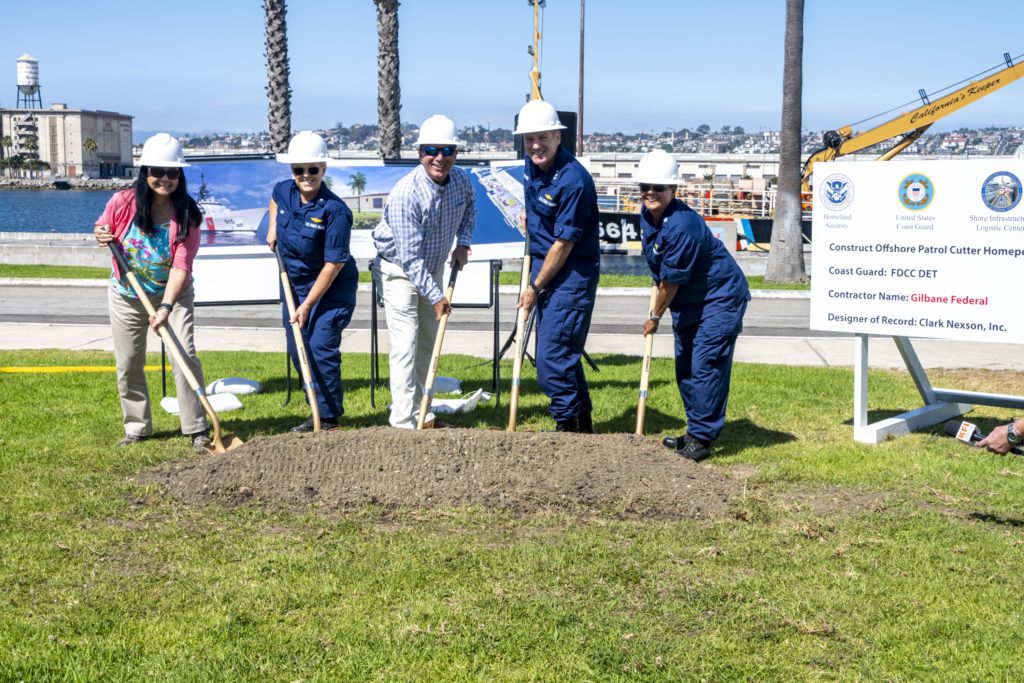
Debra Chinn, a member of the Coast Guard Facility Design and Construction Center, Rear Adm. Carola List, the Coast Guard Assistant Commandant for Engineering and Logistics, Robert Pitcock, a project executive for Gilbane, Vice Adm. Michael McAllister, the Coast Guard Pacific Area commander, and Capt. Lisa Sharkey, Coast Guard Base Los Angeles/Long Beach commanding officer, participate in a ground breaking ceremony for a new cutter support facility at Base Los Angeles/Long Beach, July 28, 2021. U.S. COAST GUARD / Petty Officer 1st Class Richard W. Brahm
SAN PEDRO, Calif. — The Coast Guard broke ground Wednesday on a new facility at Base Los Angeles/Long Beach in San Pedro that will be home to the service’s newest additions to its fleet, the Coast Guard 11th District said in a July 28 release.
Located at 1001 S. Seaside Avenue, the new $35 million, 11,500 square-foot Naval Engineering Department facility is scheduled to be an extension to the existing Maintenance Augmentation Team (MAT) building that will support the Coast Guard’s first two offshore patrol cutters.
The 360-foot Coast Guard Cutter Argus (WMSM 915) and Coast Guard Cutter Chase (WMSM 916) are under construction and expected to arrive in late 2022/early 2023. The offshore patrol cutters will join the four 154-foot fast response cutters — Forrest Rednour, Robert Ward, Terrell Horne, and Benjamin Bottoms — and the 175-foot buoy tender, the Coast Guard Cutter George Cobb (WLM 564), currently stationed at Base LA/LB.
Once completed in October 2022, the facility will accommodate approximately 60 personnel who will provide maintenance, weapon, and naval engineering support for the fast response and offshore patrol cutters. In addition to the building, a new 257-foot pier extension is scheduled to be built to make room for the Chase. Improvements are also slated for the existing Electronics Support Detachment and warehouse on the base.
“Every Coast Guard mission starts and ends at a base. This new cutter support facility will enhance the capabilities of future Coast Guard cutters to meet critical mission needs in a demanding and constantly evolving maritime environment,” said Vice Adm. Michael F. McAllister, commander U.S. Coast Guard Pacific Area. “The Coast Guard’s first two offshore patrol cutters will be homeported at Base Los Angeles-Long Beach and this facility will provide the operational support needed to ensure future Coast Guard crews can accomplish their mission successfully.”
With the addition of the two new offshore patrol cutters, the base will require more space and staff to support the growing fleet. Personnel at Base LA/LB nearly doubled since 2018.
The offshore patrol cutters are the newest vessels in the Coast Guard’s fleet. The state-of-the-art ships are scheduled to replace the service’s 270-foot and 210-foot medium-endurance cutters and will be used to patrol the open ocean in the most demanding maritime environments.
Lawmakers Leery of Navy’s Still-Vague Mission Plans for New Unmanned Systems
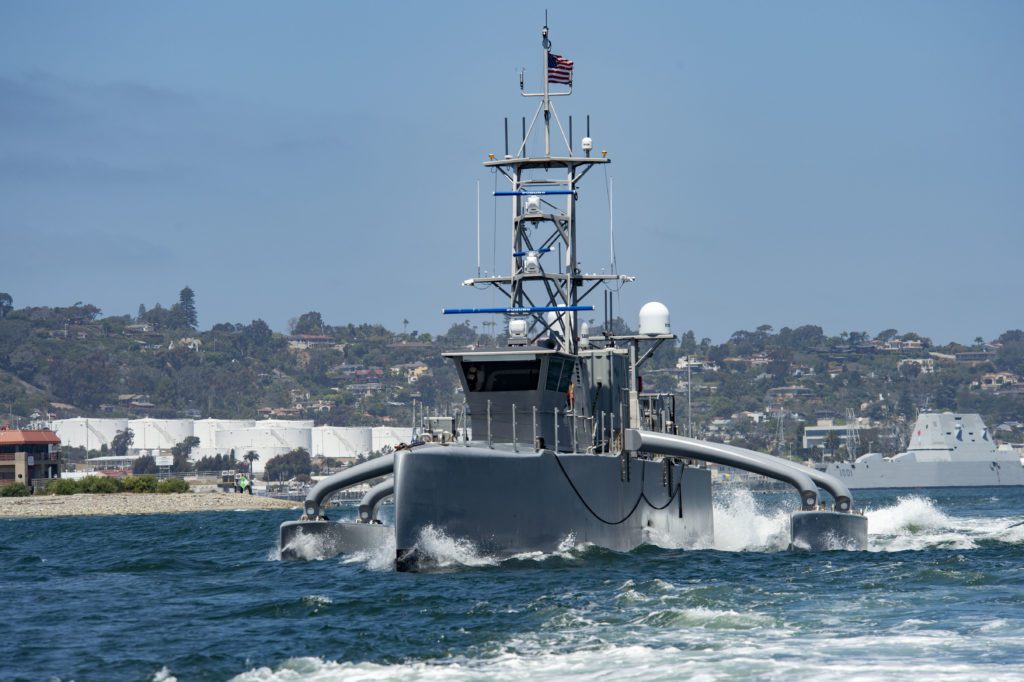
The Seahawk medium displacement unmanned surface vessel launches for the U.S. Pacific Fleet’s Unmanned Systems Integrated Battle Problem 21 (UxS IBP 21), April 20. UxS IBP 21 integrates manned and unmanned capabilities into operational scenarios to generate warfighting advantages. U.S. NAVY / Mass Communication Specialist 2nd Class Thomas Gooley
ARLINGTON, Va. — Two senior House Armed Services Committee members, who strongly support U.S. Navy plans to acquire a wide range of unmanned air and maritime systems to enhance the size of the fleet, say they still have concerns about how undefined the mission remains.
Appearing at a virtual unmanned defense systems conference sponsored by the Association for Unmanned Vehicle Systems International (AUVSI) on July 27, both Reps. Joe Courtney (D-Connecticut), and Jim Langevin (D-Rhode Island), agreed that unmanned surface and undersea vessels will have a key role confronting the pacing threat of China across the vast distances of the Indo-Pacific region.
“These systems will be the key to a distributed force that moves away from exquisite, expensive platforms — which are high value targets — and towards a more modular and nimble fleet that can, hopefully, plan to overwhelm the adversary,” said Langevin, who chairs the HASC’s Intelligence, Emerging Threats and Capabilities subcommittee.
Having unmanned platforms ranging in size from small to extra-large vessels that reduce the risk to Sailors in a contested environment, and handle jobs that don’t require human presence, “is just a really smart investment moving forward,” said Courtney, chairman of the HASC Seapower and Projection Forces subcommittee.
However, “we’ve been wrestling with the issue of what is the future fleet size for the Navy and what’s the fleet architecture look like,” Courtney said, adding that the Biden administration’s first Navy budget had no FYDP [future years defense plan] and the shipbuilding plan had only ranges of vessels, not specific numbers. He acknowledged the White House will have more time and experience by next year’s budget, adding that will be the one to watch.
“We really do need some clarity about just where are we going,” Courtney said, recalling the HASC’s “traumatic experiences” in the past with unique new platforms that were funded in a hurry, like the littoral combat ship, but “didn’t pan out as well as the Navy or Congress hoped.”
Langevin, whose subcommittee Courtney described as “the tip of the spear for a lot of these questions,” said he was concerned the Navy and other services could become over-reliant on unmanned systems.
“They can be a great component, but I’m still very cautious — recognizing that our enemies and adversaries understand where we’re going with new technologies. They’re going to invest in and try to create asymmetric systems that will interfere with those capabilities and take them out,” with less compunction than they might for a manned vessel in a non-war situation, he said.
“The other thing that we have to ensure is, as we get more and more into the 21st century and make use of machine learning and artificial intelligence, we absolutely have to ensure the integrity of the data decisions are based on and also, that there’s always a human in the loop,” Langevin said, adding, “We have to make sure that we understand the decision-making process by making sure that when it comes to carrying out kinetic effects, we don’t delegate too much in terms of AI decision-making.”
Northrop Grumman Preparing Response to RFP for Navy’s Very Light-Weight Torpedo Program
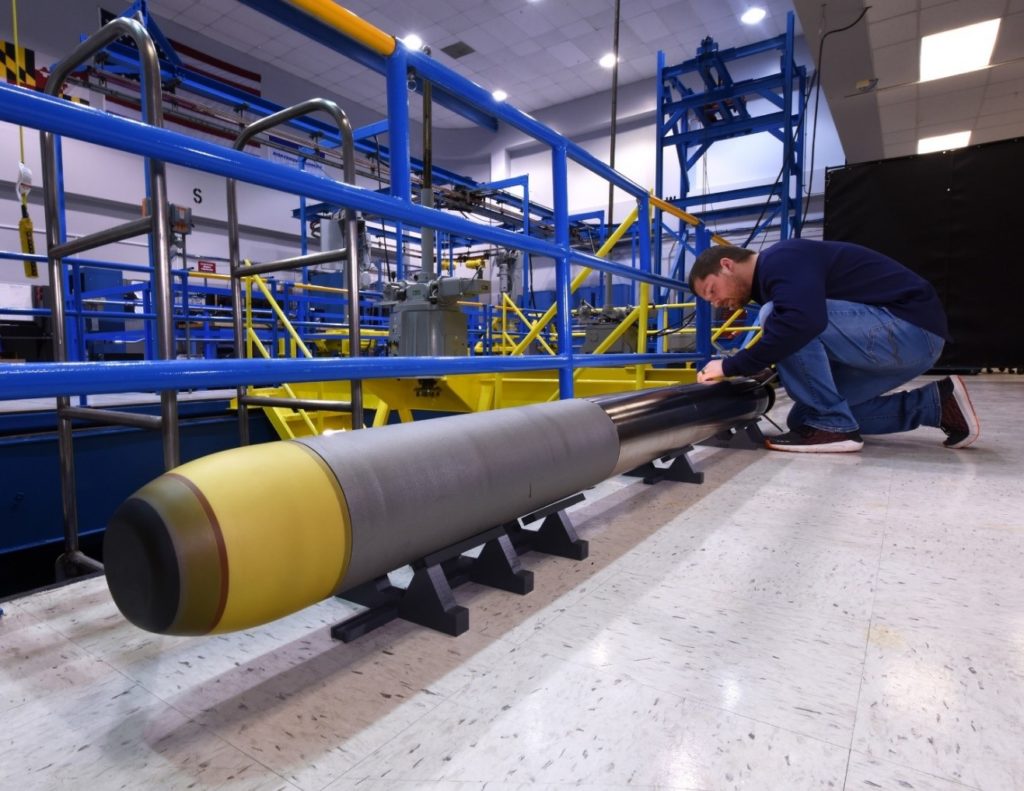
The U.S. Navy is expected to issue a request for proposals soon for the Very Light-Weight Torpedo. NORTHROP GRUMMAN
ARLINGTON, Va. — Northrop Grumman expects the U.S. Navy to issue a Request for Proposals in August or September for the Very Light-Weight Torpedo (VWLT) Program, company officials said.
The Navy’s VLWT program RFP was delayed from an expected January issuance, now expected to be issued this summer. Northrop Grumman has used the delay to refine its planned manufacturing processes, adapt robotics to the processes, and press for ways to reduce manufacturing cost.
The RFP will be for taking the non-production-designed VLWT prototype — designed by Penn State Applied Physics Lab (APL) — into a production design. and develop it as an All-Up Round it to be suitable for manufacturing. Other Transactional Authority will be used to deploy the torpedo to the fleet.
APL developed the Counter Anti-torpedo Torpedo (CAT), a defensive weapon for use by aircraft carriers to defeat incoming submarine-launched anti-ship torpedoes. Five aircraft carriers were fitted with CAT launchers. The Cat was the first new-design U.S torpedo since the 1980s with the development of the Mk54 Lightweight Torpedo.
Early in the CAT design process, its potential as a multi-mission torpedo was noticed, said David Portner, Northrop Grumman’s senior program manager for undersea weapons, in a July 28 interview with Seapower magazine.
The offensive variant that will be the subject of the RFP, the Compact Rapid Attack Weapon (CRAW), involved a software change to make the CAT into an anti-submarine weapon, Portner said.
The hardware-enabled, software-defined VLWT would be equipped with advanced electronics and processing power, with the software enabling the same weapon to serve in an offensive or defensive role.
The nine-foot-long VWLT is one third of the size of the Mk54 — the Navy’s most advanced light-weight torpedo — and weighs just over 200 pounds, compared with the 608-pound Mk54. With this weight advantage, a platform can carry more torpedoes or carry the same number at longer ranges and give the platform more endurance. The VLWT could be carried by surface, airborne, and undersea platforms, manned and unmanned.
The Mk54 is known to carry a 96.8-pound warhead. Portner said he was not at liberty to discuss the size of the VWLT’s warhead, but he said its power has everything to do with the warhead’s design, which he said will give it lethality against modern submarines.
Portner said the VLWT could be carried by such anti-submarine aircraft as P-8A maritime patrol aircraft, MH-60R helicopters and MQ-8 Fire Scout unmanned aerial vehicles.
During an Advanced Naval Technology Exercise in 2018, Northrop Grumman demonstrated the deployment of a VLWT from a surrogate helicopter simulating a Fire Scout.
The torpedo is fitted with a parachute to reduce the shock of impact with the water. The VLWT also could be fitted with a glide wing kit similar to the one on Boeing’s HAAWC (High-Altitude Anti-submarine Weapon Concept), which is in development to extend the launch range and altitude as well as precision guidance for the Mk54 torpedo.
Portner said the VLWT also could be deployed from a vessel such as a littoral combat ship by way of an unmanned surface vehicle or unmanned underwater vehicle. He said the light weight of the CRAW, compared with the MK54, would enable a platform to carry more weapons the same distance or the same number of weapons to a greater range or endurance.
Portner said in a December interview the Navy already has demonstrated that the legacy Surface Vessel Torpedo Tubes that fire Mk46 and Mk54 light-weight torpedoes could be fitted with internal sleeves to accommodate the smaller-diameter VLWT, but a new launcher could be developed to house a larger number of VLWTs. He also said one or more VLWTs could be fitted to an Anti-Submarine Rocket in place of a MK54 torpedo if the Navy decided to do proceed with that.
MARAD Awards Vessel Acquisition Management Contract to Crowley
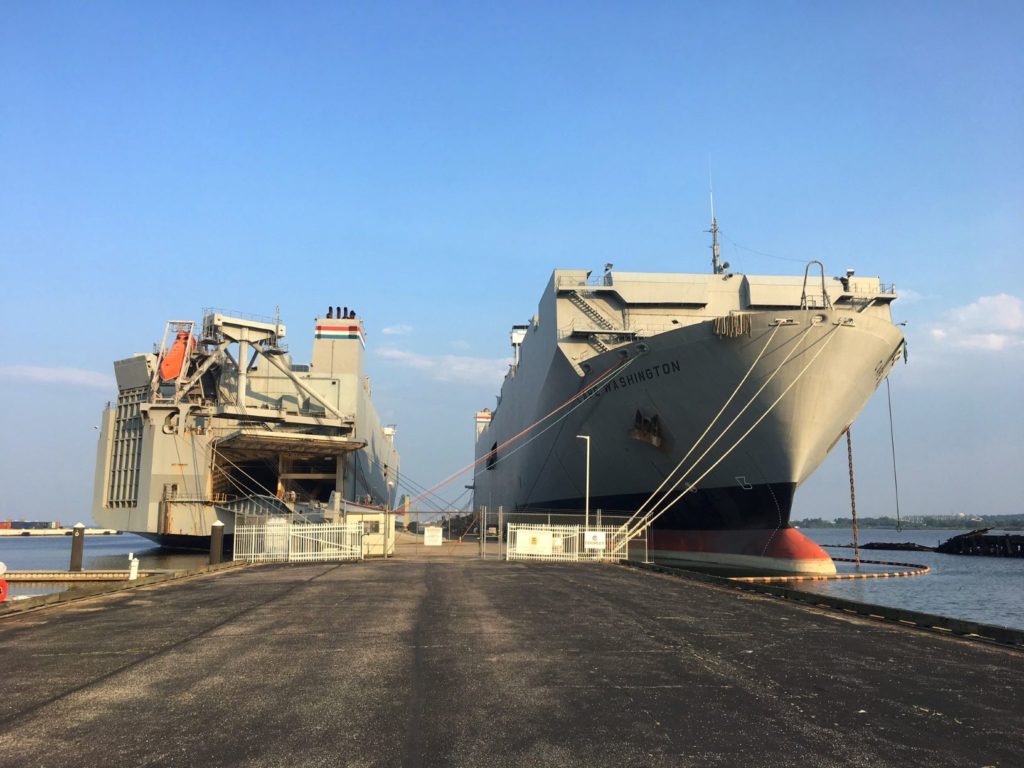
MARAD has awarded Crowley Maritime Corp.’s Solutions business unit a $638 million contract for vessel acquisition management. CROWLEY MARITIME CORP.
JACKSONVILLE, Fla. – Crowley Maritime Corp.’s Solutions business unit has been awarded a multi-year, $638 million contract for vessel acquisition management (VAM) by the U.S. Maritime Administration (MARAD), the company said in a July 28 release.
Crowley’s strategic acquisition and vessel management service will assist MARAD in the enhancement of the Ready Reserve Force, helping reduce the overall age of the fleet and increase ship reliability. The fleet executes U.S. Department of Defense sealifts.
To carry out the contract, Crowley will use a new, proprietary information technology system to assess, research and make purchasing recommendations. Once the vessels are acquired, Crowley will oversee any required reflagging, reclassification, modification and maintenance to ensure they are fit for service in compliance with U.S. Coast Guard, American Bureau of Shipping, and Defense Department requirements. After ships enter the fleet, Crowley will maintain and operate the vessels on behalf of MARAD.
“A successful VAM program is important to the U.S. as a maritime nation, the maritime industry and Crowley as we mutually invest in the strength of our nation,” said Mike Golonka, vice president, government ship management in Crowley Solutions. “We want to share our innovative, successful approach to vessel ownership and lifecycle engineering with the U.S. government.”
Building on over 20 years of experience managing MARAD and other government and Navy vessels, Crowley will use the web-based platform to perform data analysis of the lifecycle of vessels and their components. The SHIPFAX platform will provide data-driven recommendations based on essential service requirements, as well as important factors to successfully manage and operate vessels.
Crowley will execute the contract with Stena Line, Serco and LCE (Life Cycle Engineering), who bring specialized and unique experiences and services in acquisitions, naval ship architecture, engineering and applied technology.
Coast Guard Cutter Dependable Returns Home Following 29-day Patrol
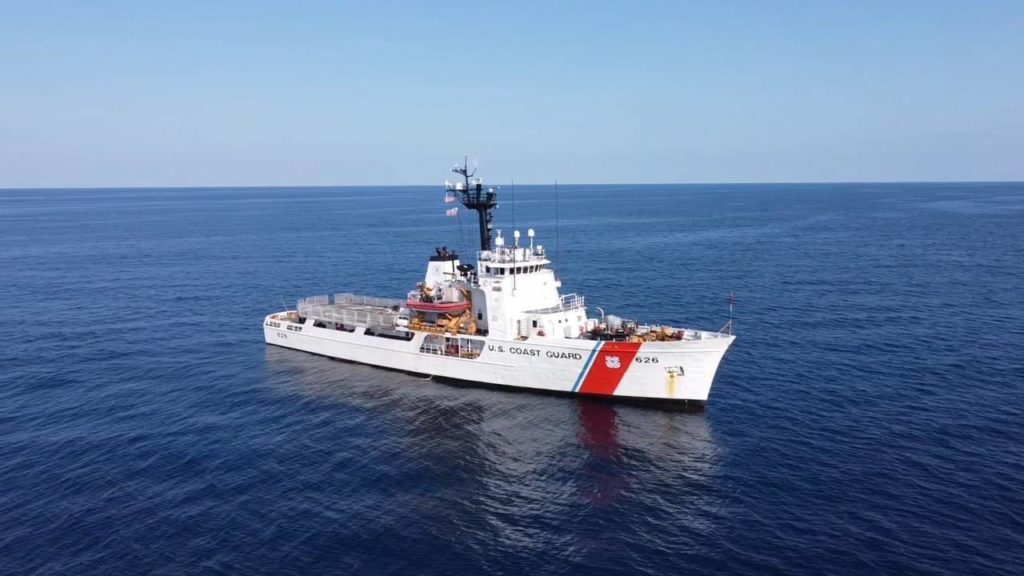
The Crew of Coast Guard Cutter Dependable returned to their homeport in Virginia Beach, Virginia, after a 29-day patrol in the north-eastern coast of the United States, July 27, 2021. The Virginia Beach-based 210-foot Reliance Class Medium Endurance Cutter contains a permanent crew complement of 75 personnel. U.S. COAST GUARD
VIRGINIA BEACH, Va. — The crew of Coast Guard Cutter Dependable returned to their homeport in Virginia Beach after a 29-day patrol in the north-eastern coast of the United States, July 27, the Coast Guard 5th District said in a July 28 release.
Throughout the patrol, the Dependable’s crew conducted over 15 living marine resource boardings resulting in violations ranging from commercial fishing vessel safety discrepancies to various fishing violations. Living marine resource enforcement patrols are vital to the continued sustainability and safety of the multi-billion-dollar U.S. seafood industry, as well as safeguarding marine protected species.
The Dependable’s crew focused on the Coast Guard’s living marine resource enforcement mission, inspecting federally managed fishing vessels’ catch, gear, and lifesaving equipment to ensure compliance with laws and regulations and ensure safety of life at sea.
“I am very proud of the crew of the Dependable, especially considering a significant portion of the crew just reported aboard this summer,” said Cmdr. Joshua Burch, commanding officer of the Dependable. “They displayed exceptional professionalism and adaptability in performing our primary mission of enforcing federal safety regulations within the commercial fishing fleet and protecting our nation’s valuable natural marine resources. We continue to play a critical role in sustaining a healthy domestic fisheries industry and fostering that important relationship with the maritime community.”
The Dependable is a 210-foot medium-endurance cutter that routinely deploys in support of counter-drug, alien migrant interdiction, fisheries, search and rescue and homeland security missions.
Russia’s Increasing Aggression in Black Sea Region Disturbs U.S. Naval Commander
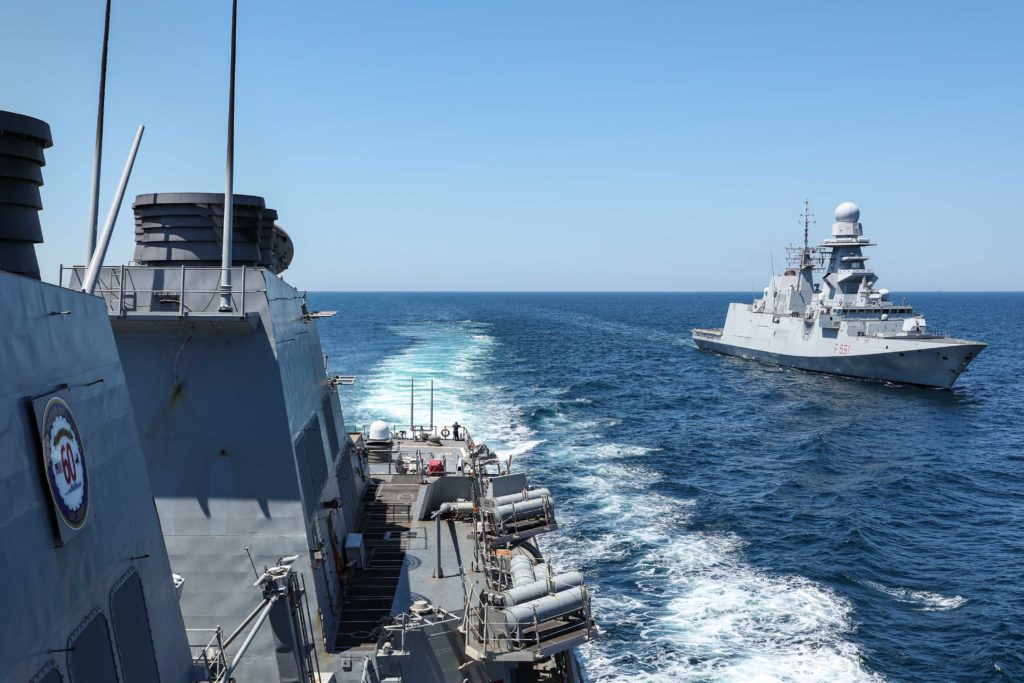
The Italian frigate Virginio Fasan (F 591) approaches the Arleigh Burke-class guided-missile destroyer USS Ross (DDG 71) for a replenishment-at-sea approach drill in the Black Sea during the Bulgarian-led Exercise Breeze, July 15, 2021. U.S. NAVY / Mass Communication Specialist 2nd Class Claire DuBois
ARLINGTON, Va. — Russia’s aggressive behavior during a recent multinational exercise in the Black Sea, hosted by the United States and Ukraine, underscores Moscow’s increasingly provocative actions in the air and at sea, says the commander of U.S. Naval Forces in Europe and Africa.
For nearly a decade, a resurgent Russia has mounted a huge military buildup in the North Atlantic, the Eastern Mediterranean, the Arctic and the Black Sea. “They want to be in control of those waters, for their own exclusive use,” said Adm. Robert Burke, adding “We can’t cede that to the Russians.”
Noting that Russian aircraft overflew U.S. Navy ships at dangerously low altitudes during the recently ended Exercise Sea Breeze 21, Burke said they were creating a tactical risk that could morph into a strategic issue. “And that’s a big concern with this increasing aggressiveness,” he said, adding “We’re not going to flinch and we’re not going to take the bait.”
Sea Breeze, a long-standing exercise in the Black Sea to enhance interoperability and capability among participating forces in the region, has grown from eight participants in 1997 to 32 this year. The 2021 exercise included 5,000 personnel, 32 ships and 40 aircraft supplied by from 17 NATO members, U.S. allies like Australia, and partner nations like Sweden and Senegal.
The admiral praised U.S. and allied commanders for their controlled reaction to Russian belligerence. “When a strike aircraft overflies a destroyer at 100 feet altitude, right over top, our COs are making a judgment call of whether that strike fighter is on an attack profile or not,” said Burke, who is also commander of Allied Joint Forces Command Naples. “It could be argued that they’re baiting us into shooting first. We’re not going to do that first without provocation, but I’m also not going to ask my commanding officers to take the first shot on the chin,” he added without elaboration.
When officials notified Russian authorities about their plans three weeks before Sea Breeze 21 began, the Russians reacted by closing off half of the western part of the Black Sea and announcing their own ship bombing exercise. “If it wasn’t so threatening, it would be laughable,” Burke told a livestreamed edition of the United States Navy Memorial’s SITREP speakers series July 20.
Such “extreme bullying” at other times has led some smaller nations to avoid those areas, “which is exactly the behavior the Russians are seeking.” Burke said. China acted similarly in the South China Sea, he said, building “stationary aircraft carriers” on coral islands where ownership is disputed by neighboring countries. Elsewhere, he said, the Chinese Communist Party’s Belt and Road Initiative is seeking to expand its influence through infrastructure projects — with financial strings attached — in 52 of Africa’s 54 nations, while Chinese entities hold a controlling interest in 15 European ports.
USS Ross Completes 11th Patrol in U.S. 6th Fleet, Returns to Rota, Spain
The Arleigh Burke-class guided-missile destroyer USS Ross (DDG 71) returned to Naval Station Rota, Spain, following completion of its 11th Forward-Deployed Naval Forces (FDNF) patrol in the U.S. Sixth Fleet area of operations, July 26, 2021. U.S. NAVY
ROTA, Spain – The Arleigh Burke-class guided-missile destroyer USS Ross (DDG 71) returned to Naval Station Rota, Spain, following completion of its 11th Forward-Deployed Naval Forces (FDNF) patrol in the U.S. 6th Fleet area of operations, July 26, 2021, Mass Communication Specialist 2nd Class Claire DuBois of the U.S. 6th Fleet said in a July 27 release.
Ross departed Rota on April 9, marking the beginning of patrol 11 to conduct naval operations in the U.S. 6th Fleet area of operations in support of U.S. national security interests in Europe and Africa.
Patrol 11 began with Ross’s participation in Fleet Operational Sea Training (FOST), a two-week British-led exercise designed to evaluate and increase the warfighting abilities of any allied navies who participate. During FOST, Ross Sailors participated in multiple general quarters drills, man-overboard drills, combat simulations, and other training scenarios.
After FOST, Ross moved on to the North Sea, and then on to the Hebrides Range to take part in Exercise At-Sea Demo/Formidable Shield (ASD/FS) in early June. During ASD/FS, Ross fired an SM-2 missile at an air target simulating incoming fire, proving the ship’s ability to conduct ballistic-missile defense.
“Our Sailors have met every challenge to meet mission and successfully complete patrol,” said Cmdr. John D. John, commanding officer of Ross. “I’m excited to get everyone home safe so we can reconnect with our loved ones.”
After successful completion of ASD/FS, Ross moved south and joined the Moroccan-led exercise African Lion. This included multiple surface navigation exercises, as well as several weapon shoots with participating ships.
Following African Lion, Ross transited to the Mediterranean Sea, and made a stop in Souda Bay, Greece. In Greece, Sailors had a few days to experience their first liberty port since the COVID-19 pandemic began, exploring the area while adhering to local COVID-19 safety restrictions.
“I’m grateful for the opportunity to see the world again and experience different cultures,” said Quartermaster 2nd Class Zach Lober, “It was one of the reasons I joined the Navy, so I’m happy to have that part of the experience back.”
In late June, Ross departed Greece and transited to the Black Sea, making a stop in Odesa, Ukraine to mark the beginning of its participation in Exercise Sea Breeze.
During Sea Breeze, Ross conducted surface navigation exercises, weapon shoot evolutions, and many other exercises with participating ships from 30 countries. Ross Sailors spent the Fourth of July in port, celebrating Independence Day and recognizing Ukranian Navy Day with other Sea Breeze participants. Ross also had the opportunity to host Ukrainian President Volodymyr Zelenksy aboard the ship for a tour.
“It was an honor to pipe the president of Ukraine on board,” said Boatswain’s Mate 3rd Class Sean Van Horn, who was part of the receiving line. “It was a once in a lifetime opportunity, and I am privileged to have done it.”
After Sea Breeze, Ross moved on to Varna, Bulgaria, to begin participating in the Bulgarian-led exercise Breeze. During Breeze, Ross was able to take part in various exercises, including surface navigation, with 13 other NATO Allies and partners.
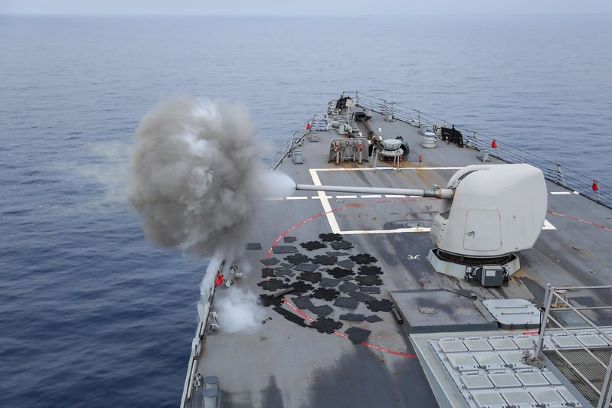
Following Breeze, Ross transited back to the Mediterranean Sea, beginning its journey back to Rota for the end of patrol. During this time, Ross conducted qualifications, firing its Mark 45 5-inch gun and crew-served weapons, and held a “steel beach” picnic on the ship’s flight deck.
Ross, forward-deployed to Rota, Spain, operates in support of U.S. national security interests in the Sixth Fleet area of operations.
Four U.S. Navy destroyers are based in Rota, Spain, and assigned to Commander, Task Force 65 in support of NATO’s Integrated Air Missile Defense architecture. These Forward-Deployed Naval Forces-Europe ships have the flexibility to operate throughout the waters of Europe and Africa, from Cape of Good Hope to the Arctic Circle, demonstrating their mastery of the maritime domain.
Coast Guard Repatriates 27 Migrants to Cuba
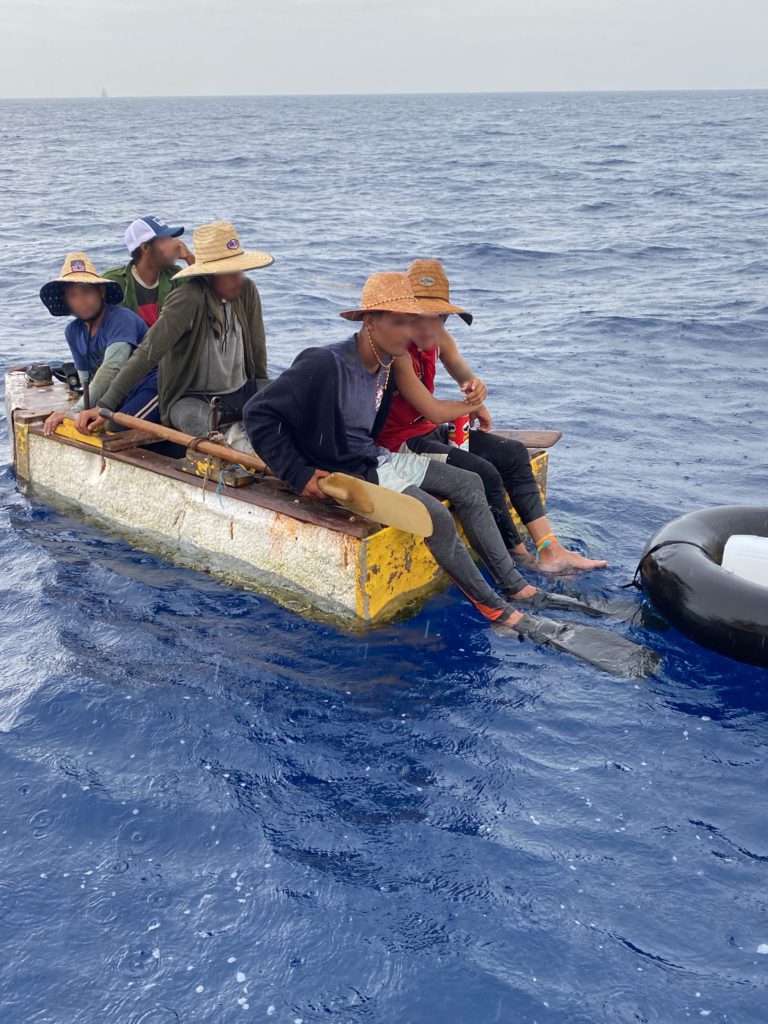
Five Cuban migrants aboard a makeshift vessel approximately 15 miles off the coast of Islamorada, Florida, July 24, 2021. Coast Guard Cutter Charles Sexton’s crew repatriated 27 Cubans to Cuba, Tuesday, following two interdictions off Florida’s coast. U.S. COAST GUARD
MIAMI — Coast Guard Cutter Charles Sexton’s crew repatriated 27 Cubans to Cuba, July 27, following two interdictions off Florida’s coast, the Coast Guard 7th District said in a release.
In the first interdiction, a good Samaritan reported a 21-foot vessel with 22 people aboard, approximately seven miles south of Key West to Coast Guard Sector Key West watchstanders at approximately 3:45 p.m., July 23. They were brought aboard Coast Guard Cutter William Trump and transferred to the Charles Sexton and reported in good health.
In the second interdiction, Coast Guard Station Islamorada reported a makeshift raft with five people aboard, approximately 15 miles offshore of Islamorada to Sector Key West watchstanders at approximately 4 p.m., July 24. A Station Islamorada boat crew picked up the five people and transferred them to the Charles Sexton. They were reported in good health.
“Taking to the seas on unsafe vessels is dangerous and can result in loss of life,” said Capt. Adam Chamie, Coast Guard Sector Key West Commander. “We request all mariners to report any possible migrant voyages to help prevent loss of life at sea.”
Since Oct. 1, 2020, Coast Guard crews have interdicted 595 Cubans compared to:
5,396 Cuban Migrants in Fiscal Year 2016
1,468 Cuban Migrants in Fiscal Year 2017
259 Cuban Migrants in Fiscal Year 2018
313 Cuban Migrants in Fiscal Year 2019
49 Cuban Migrants in Fiscal Year 2020
Once aboard a Coast Guard cutter, all migrants receive food, water, shelter and basic medical attention.