Logos Technologies Successfully Flight Tests SPRITE Multi-Sensor Pod for ONR
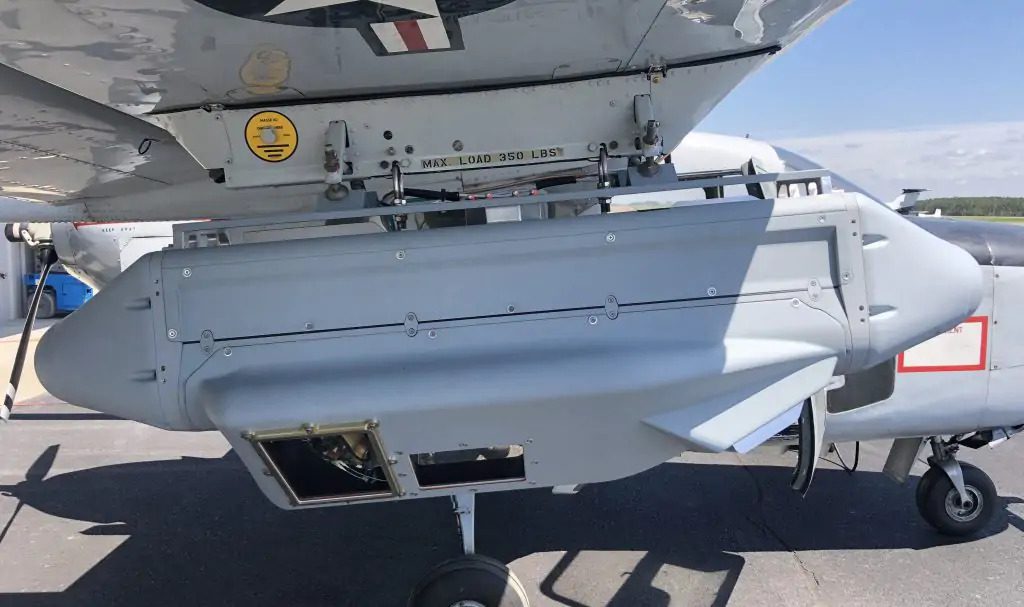
Logos Technologies’ SPRITE pod. LOGOS TECHNOLOGIES
FAIRFAX, Va. — Logos Technologies LLC announced July 27 that, with the successful test flight of the Spectral and Reconnaissance Imaging for Tactical Exploitation (SPRITE) pod earlier this year, has met all the goals of its five-year contract with the Office of Naval Research.
A U.S. military version of the company’s platform-agnostic Multi-Modal Sensor Pod (MMSP), SPRITE was flown on a manned Cessna 337 Super Skymaster.
“We had SPRITE flying between four and five hours a day for a whole week,” said Chris Stellman, lead principal scientist and program manager for Logos Technologies. “We were able to use SPRITE’s sensor modalities to detect signatures of interest, process that data on the fly, and stream it down in real time to users on the ground.
The SPRITE pod houses an ultra-light Logos Technologies RedKite WAMI sensor, a high-definition spotter camera, and commercial shortwave infrared hyperspectral sensor. In addition, SPRITE contained a palm-sized Multi-Modal Edge Processor (MMEP), also developed by Logos Technologies, to process the deluge of raw data being produced by all three sensors, in real time, and cross cue between the sensors.
The MMEP is the brains of the SPRITE pod,” Stellman said. “It’s what makes data actionable to the warfighter and searchable to the analyst.”
Though the Office of Naval Research contract required a specific set of sensors, the MMSP is very flexible regarding the payloads it can house. For example, instead of a hyperspectral sensor, it could include LIDAR or a signals intelligence package, depending on customer need.
Cutter Harriet Lane Interdicts $16 million Worth of Illicit Drugs
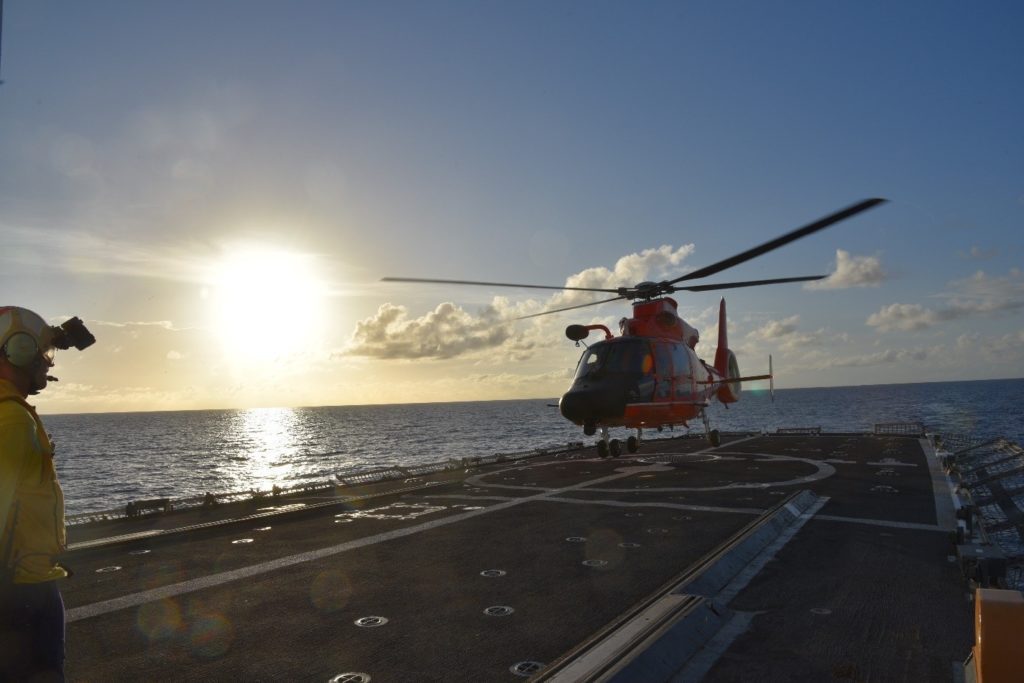
Crewmembers from the Coast Guard Cutter Harriet Lane conduct sunset flight operations with an MH-65 Dolphin aircrew from Coast Guard Air Station Miami in the Caribbean Sea. U.S. COAST GUARD
PORTSMOUTH, Va. — The Coast Guard Cutter Harriet Lane returned to its homeport in Portsmouth, Virginia, after a 72-day patrol in the Caribbean Sea, July 25, the Coast Guard 5th District said in a July 27 release.
The Harriet Lane’s crew performed counter-drug and migrant interdiction operations in support of the Coast Guard 7th District and Joint Interagency Task Force-South.
Throughout the patrol, the crew of the Harriet Lane worked in conjunction with a diverse array of U.S. and foreign military assets to conduct vital training and perform its assigned law enforcement mission, which included interdicting one go-fast vessel carrying approximately 882 pounds of suspected cocaine with an estimated street value of $16 million.
The interdiction was conducted jointly with USS Wichita (LCS 13). Harriet Lane’s crew assumed tactical control of Wichita’s helicopter, which employed airborne use of force executed by a trained Coast Guard crew member. The helicopter disabled the vessel and vectored in Harriet Lane’s small boat with embarked boarding team. Harriet Lane crews also conducted multiple at sea transfers of suspected illegal narcotics and drug-smugglers with the Dutch Navy aboard HNLMS Holland and facilitated the at-sea interdiction of a suspected drug smuggling vessel by the French frigate Ventôse.
In addition to operations, the Harriet Lane crew conducted a towing exercise with the USS Wichita, taking the 378-foot littoral combat ship in tow. During the evolution both vessels exchanged crew members of various rates and rank to provide exposure and promote professional development. This exercise provided invaluable training for both crews and strengthened the special relationships amongst the seagoing services. The crew of Harriet Lane hosted Consul General Allen Greenberg, the U.S. Consul General for Curacao and U.S. Chief of Mission for the former Dutch Antilles. Amidst operations, joint military training and acts of diplomacy, the cutter crew also completed aviation, damage control, seamanship and navigation training to maintain operational readiness and prepare for future multi-mission patrols.
“I am tremendously humbled to have completed my first patrol aboard Harriet Lane with this fine crew of maritime professionals,” said Cmdr. Ben Goff, commanding officer of the Harriet Lane “Throughout, we showcased a diversity of talent unique to the world’s best Coast Guard. I am extremely proud of the crew for their unwavering flexibility and selfless service amidst a variety of scheduling changes and mission challenges. Likewise, it was a true privilege to conduct operations and training with our U.S., Dutch and French navy partners.”
Harriet Lane is a 270-foot medium-endurance cutter responsible for a variety of Coast Guard missions, including search and rescue, enforcement of laws and treaties, maritime defense, and protection of the marine environment.
Coast Guard Breaks Ground on New Air Station in Ventura
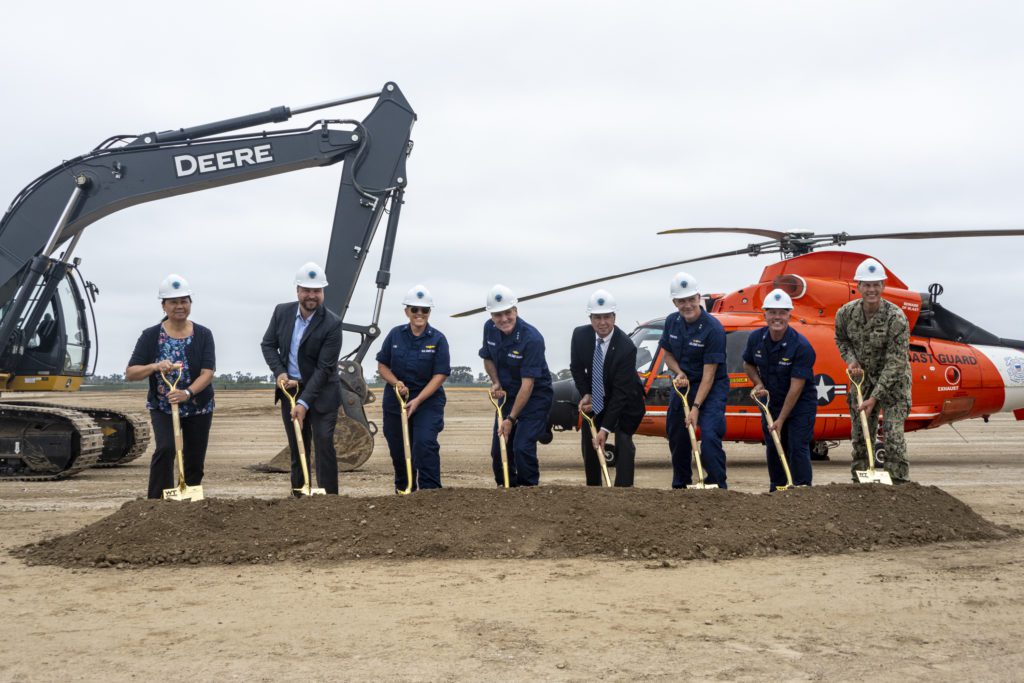
Debra Chinn, a member of the Coast Guard Facility Design and Construction Center, Joe Bissaillon, the Architect and Project Manager for Woolpert, Rear Adm. Carola List, the Coast Guard Assistant Commandant for Engineering and Logistics, Vice Adm. Michael McAllister, the Coast Guard Pacific Area commander, Sam Abutaleb, the Vice President of Whiting-Turner Construction, Rear Adm. Brian Penoyer, District 11 commander, Capt. Thomas Cooper, Coast Guard Air Station San Francisco commanding officer, and Capt. Kirk Lagerquist, the chief staff officers for Naval Base Ventura County, participate in a ground breaking ceremony for the Coast Guard Air Station Ventura, July 27, 2021. U.S. COAST GUARD / Petty Officer 1st Class Richard W. Brahm
SAN PEDRO, Calif. — The Coast Guard helicopter crews flying out of rented space at the naval base at Point Mugu will finally get a permanent home as ground broke July 27 for their new facility, the Coast Guard 11th District said in a release.
The $53 million Coast Guard Air Station Ventura is scheduled to include a 48,000 square-foot hangar and a 12,200 square-foot administration and berthing facility at Naval Base Ventura County in Point Mugu.
Four MH-65 Dolphin helicopters and 82 personnel are slated to be stationed at the air station when it opens for operations in August 2023.
“We’re excited to break ground to re-establish a permanent air station,” said Vice Adm. Michael F. McAllister, commander U.S. Coast Guard Pacific Area. “The new air station in Ventura will enhance critical mission capabilities, allowing us to better serve this critical area.”
Previously, the Coast Guard operated Air Station Los Angeles out of the Los Angeles International Airport for more than five decades until it lost its lease in May 2016. The Coast Guard officially closed the air station and shifted aviation operations to a Forward Operating Base (FOB) located at Naval Base Ventura County supported by Coast Guard Air Station San Francisco. The Point Mugu FOB operates out of a leased hangar facility and leased berthing space from the Navy. Currently, 13 permanent service members and approximately 11 rotating crewmembers from San Francisco fly two MH-65 Dolphin helicopters out of Point Mugu.
Coast Guard operations are scheduled to shift from the FOB to the new facilities of Air Station Ventura upon the facility’s completion.
The air station’s area of responsibility covers 350 nautical miles and stretches from Dana Point to Morro Bay, including the Channel Islands. Missions include 24/7 emergency response, search and rescue, drug and migrant interdiction, law enforcement, and marine and waterways conservation and protection.
MDA Test Intercepts Target with SM-6 Missiles
The U.S. Missile Defense Agency, in cooperation with the U.S. Navy, conducted Flight Test Aegis Weapon System 33 in the broad ocean area northwest of Hawaii, July 24. U.S. NAVY
WASHINGTON — The U.S. Missile Defense Agency, in cooperation with the U.S. Navy, conducted Flight Test Aegis Weapon System 33 in the broad ocean area northwest of Hawaii, July 24, the agency said in a release.
The objective of FTM-33 was to intercept a raid of two Short-Range Ballistic Missile targets with four Standard Missile-6 Dual II missiles.
Based on initial observations, one target was successfully intercepted. At this time, destruction of the second target cannot be confirmed.
FTM-33 was the most complex mission executed by MDA (a raid of two test targets and two SM-6 Dual II salvos consisting of four missiles). It was the third flight test of an Aegis BMD-equipped vessel using the SM-6 Dual II missile.
FTM-33, originally scheduled for December 2020, was delayed due to restrictions in personnel and equipment movement intended to reduce the spread of COVID-19.
Program officials will continue to evaluate system performance based upon data obtained during the test.
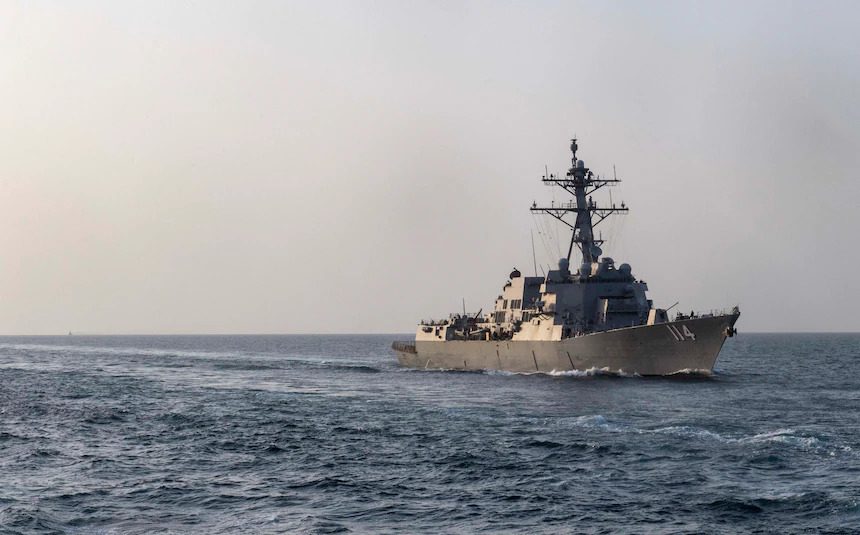
The firing ship for the test was the USS Ralph Johnson (DDG 114).
The SM-6 Dual II missile is designed for use in the terminal phase of a short-to- medium-range ballistic missile trajectory.
USS Mustin Returns to San Diego after 15 Years of Service in Japan
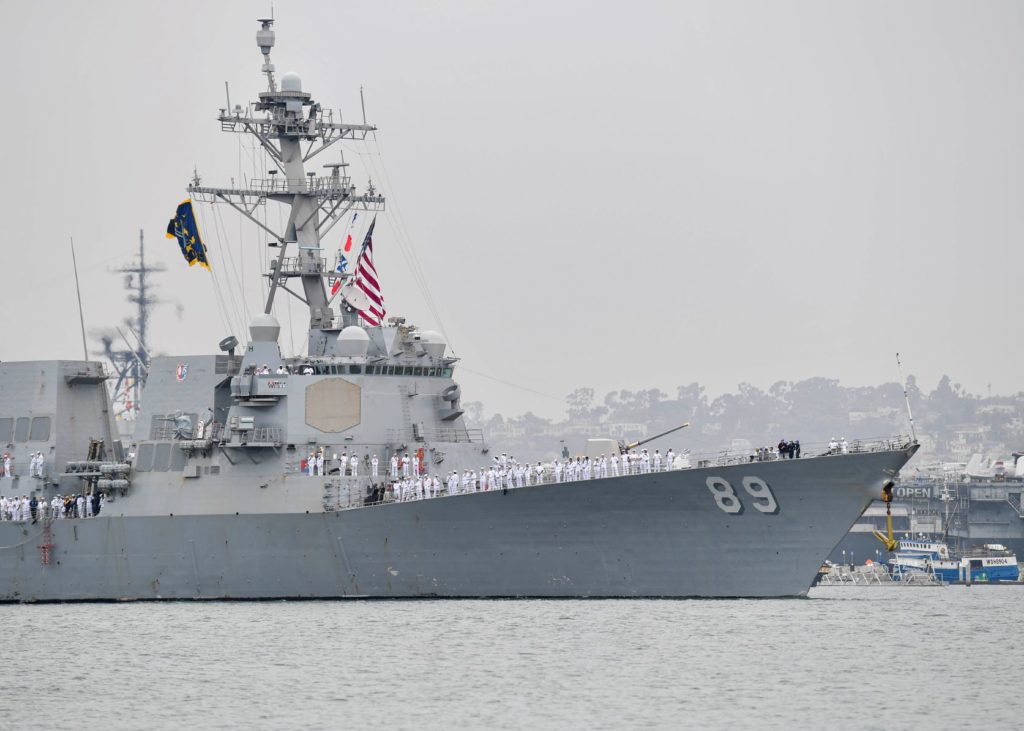
Arleigh Burke-class guided-missile destroyer USS Mustin (DDG 89) returned to San Diego, July 22, after 15 years serving in the Forward Deployed Naval Forces in Japan. U.S. NAVY
SAN DIEGO — Arleigh Burke-class guided-missile destroyer USS Mustin (DDG 89) returned to San Diego, July 22, after 15 years serving in the Forward Deployed Naval Forces (FDNF) in Japan, commander, Naval Surface Forces, U.S. Pacific Fleet, said in a July 23 release.
Mustin executed a change of station to the United States to conduct a planned depot modernization period and will be replaced by Arleigh Burke-class guided-missile destroyer USS Ralph Johnson (DDG 114), which will depart its homeport of Everett, Washington.
“Planned maintenance availabilities like these are critical to ensuring ships are maintained and equipped to perform combat-ready tasking when called upon and achieve their expected service life,” said Cmdr. Robert Briggs, commanding officer of USS Mustin.
Mustin arrived in Yokosuka, Japan in July 2006 and has participated in multiple humanitarian efforts in the Indo-Pacific region while assigned as a FDNF ship. In 2008, as part of USS Essex Amphibious Ready Group, Mustin provided aid to Myanmar in response to Cyclone Nargis. The ship earned the Humanitarian Service Medal for response to the 2011 Tohoku earthquake and tsunami as well as Typhoon Haiyan. Also in 2011, at the request of the government of Thailand, Mustin provided aerial surveillance support following flooding.
While taking precautions against COVID-19 at the onset of the global pandemic, Mustin successfully participated in a number of training exercises and operations including Integrated Ship and Air Team Training, Surface Warfare Advanced Tactical Training, Freedom of Navigation Operations, and carrier strike force operations with USS Ronald Reagan (CVN 76) and USS Nimitz (CVN 68).
“I couldn’t be more proud of Mustin’s accomplishments,” said Briggs. “As we transition into the maintenance phase over the following months, the crew is focused on upgrading the combat systems and engineering plant, and eventually returning this warship back to sea.”
Commissioned in San Diego nearly 18 years ago on July 26, 2003, Mustin spent three years assigned to Destroyer Squadron 23 as part of U.S. 3rd Fleet before joining the FDNF as part of Destroyer Squadron 15 based out of Yokosuka, Japan, with U.S. 7th Fleet.
Forward deployed naval forces improve the ability for the U.S. to protect interests while reassuring their friends and allies in the region of their commitment to peace, stability, and prosperity with unfettered access to the sea lanes for all nations in the Pacific.
Sea-Air-Space 2021 Prequel: Post-Columbia Sub Construction Capacity Will Help Relieve SSN Shortage
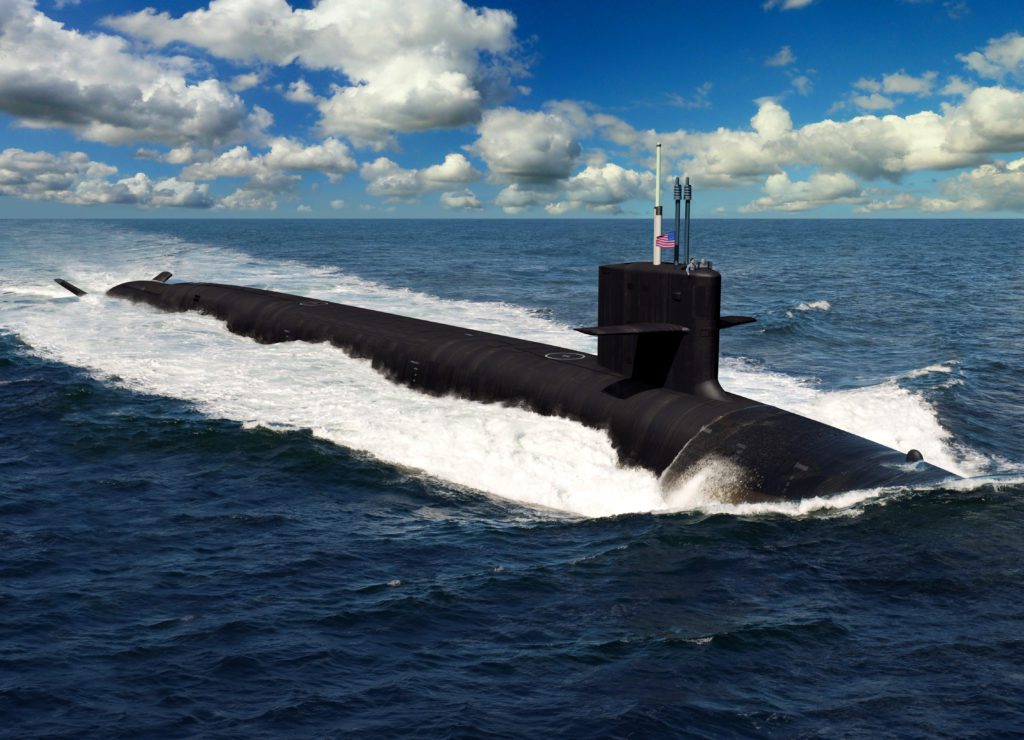
An artist’s rendering of the future Columbia-class ballistic missile submarines. U.S. NAVY
ARLINGTON, Va. — The nation’s submarine construction capacity built up for the Columbia-class ballistic-missile submarine (SSBN) program eventually will help the U.S. Navy to increase production of attack submarines (SSNs) to alleviate a shortage of attack boats, according to Navy and shipbuilding officials.
Under current planning, the Navy’s force structure studies have shown a need 70 SSN. The service currently fields about 50 SSNs, which are heavily used by regional combatant commanders, being only able to meet about 50% of their deployment requirements.
The Navy is building two Virginia-class attack submarines per year, and soon both, in the Block V version, will be equipped with the Virginia Payload Module, which will add cruise missile capacity and hypersonic missile capability to the force, among other payloads.
The Navy would like to procure three SSNs per year but currently is constrained by budget capacity to two per year while the Columbia-class SSBN is under construction. The Columbia program is a once-in-a-generation recapitalization program for the nation’s strategic deterrent force.
“We’re working very closely with industry to make sure we’re making the right long-term decisions, said Rear Adm. Bill Houston, director, Undersea Warfare, Division, Office of the Chief of Naval Operations, who has been selected to be the Navy’s next commander, Submarine Forces, speaking in a pre-recorded webinar of the Navy League’s Sea-Air-Space Prequel.
“We also have to look at it from a budget aspect [and] maintenance capability,” Houston said. “What our concern is that if you go to three [SSNs] per year in trying to peak out [the submarine force] with Virginia — with a 33-year life of ship — when you start building three per year, you’re ending up with a force structure of 99. So, as we’re reconstituting Columbia, and building two Virginias per year, when [construction of] the last Columbia hull commences in ’35, we’re going to have significant capacity then. So, we have the capability to go to three per year right now. The issue is that we’ve got Columbia under construction, so we’re just doing that balancing right now. Working with industry right now to make sure that stability that’s out there for [submarine builders], we’re trying to avoid those peak/troughs.
“As part of our private [shipyard submarine maintenance] plan, that workforce is highly skilled and we can’t go from periods when we have the private industry doing maintenance and then it’s not doing maintenance, because that is a fragile skillset,” he said.
Houston pointed out that stability in work orders is key to shipyard health and performance.
“We’re capable of going to three Virginias [per year] right now, [but] it would impact Columbia, so we’re concentrating on doing the Columbia and two Virginias per year,” he said. “We’re looking [at] how we can get up to three, but we’re sure that when that last Columbia hull is under construction, we’re going to have significant capacity.”
Houston noted that a Block V Virginia SSN displaces 10,000 tons submerged, equating to about half that of the Columbia SSBN, so every Columbia equates to two Virginia SSNs in displacement. Accordingly, with one Columbia and two Block V Virginias under construction, “we’re essentially building the equivalent of four Virginias,” he said.
“So, the capacity is there,” he said. “It’s more about the stability and avoiding the peaks and troughs.”
“I think our industrial base is somewhat fragile as we’ve gone from low-rate production in the 90s to now a two-per-year Virginia, a two-plus-one Virginia and Columbia,” said Kevin Graney, president of General Dynamics Electric Boat, whose company, teamed with Huntington Ingalls Newport News Shipbuilding, is building the Columbia-class SSBN. “That’s requiring us to bring in an awful lot of new suppliers across the industrial base in order to support that.”
Graney also said Electric Boat has been investing in additional facilities including construction halls and laid-out space in Groton, Connecticut, and Quonset Point, Rhode Island; upgrading a floating drydock from which the Columbia will be launched; and purchasing a new transport barge. The company has invested “about $250 million in training programs over the last five years and we’re developing active learning shipyards within the shipyards that have proven effective in improving our proficiency.”
HII Authenticates Keel of National Security Cutter Calhoun
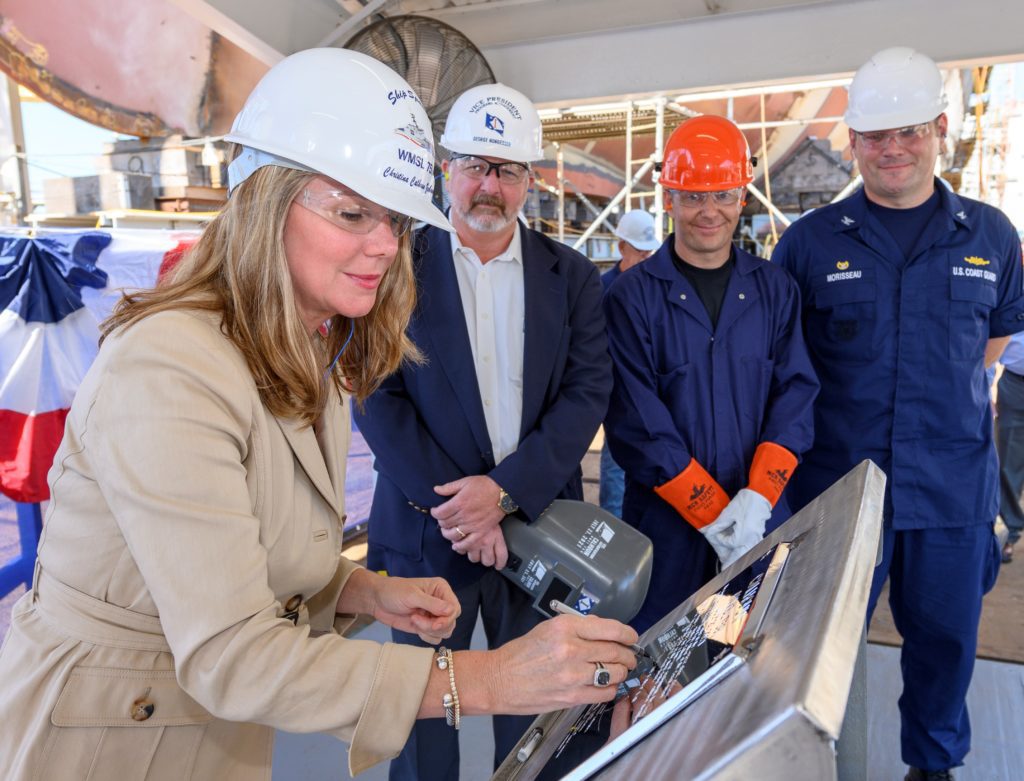
Ship sponsor Christina Calhoun Zubowicz writes her initials onto a steel plate that will be welded inside Calhoun (WMSL 759), the national security cutter named in honor of her grandfather, Charles L. Calhoun. Pictured with Zubowicz are (left to right) George Nungesser, Ingalls Shipbuilding vice president of program management; Christopher Tanner, a structural welder at Ingalls; and Capt. Peter Morisseau, commanding officer, U.S. Coast Guard Project Resident Office Gulf Coast. HUNTINGTON INGALLS INDUSTRIES / Lance Davis
PASCAGOULA, Miss. — Huntington Ingalls Industries’ Ingalls Shipbuilding division ceremonially authenticated the keel of Legend-class national security cutter Calhoun (WMSL 759) July 23, the company said in a release.
The keel authentication, initially planned for 2020, was postponed due to the COVID-19 pandemic.
“This is a very special keel authentication ceremony for a multitude of reasons,” said George Nungesser, Ingalls’ vice president of program management. “While we were able to work steadily and safely though the pandemic, visitation to the shipyard made commemorating major shipbuilding milestones a challenge. We are proud to be able to celebrate our talented shipbuilders and their successes today during this ceremonial keel laying.”
Calhoun recently reached the halfway point of its construction. Ingalls is the builder-of-record for the Legend-class NSC program and has delivered nine national security cutters with two more under construction.
NSC 10 is named for Charles L. Calhoun, the first master chief petty officer of the Coast Guard. He served in the U.S. Navy for three years during World War II and was honorably discharged as a torpedoman second class in February 1946. Seven months later, he enlisted in the Coast Guard and held various leadership positions over the course of 14 years. He served as master chief petty officer of the Coast Guard from Aug. 27, 1969, until Aug. 1, 1973.
The sponsor of NSC 10 is Christina Calhoun Zubowicz, the granddaughter of Charles L. Calhoun.
“I want to thank the entire United States Coast Guard for this opportunity and recognize their fervent efforts in protecting America’s economic, national and border security,” Zubowicz said. “May abundant divine protection, luck and blessings surround the ship: and the men and women — the shipbuilders, in crafting the new innovative national security cutter, Calhoun.”
The Legend-class NSC is the most technologically advanced ship in the Coast Guard’s fleet, which enables it to meet the high demands required for maritime and homeland security, law enforcement, marine safety, environmental protection and national defense missions. NSCs are 418 feet long with a top speed of 28 knots, a range of 12,000 miles, an endurance of 60 days and a crew of 120.
Navy Orders Quickstrike-Extended Range Glide Kits for Sea Mines
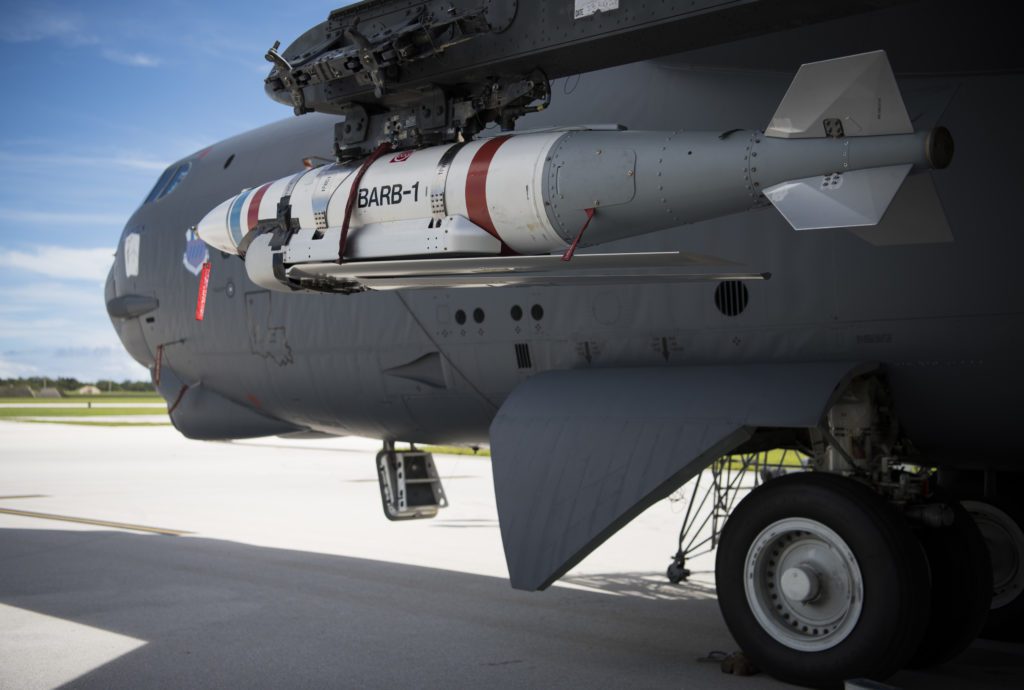
A Quick Strike extended range mine hangs from a B-52 on Andersen Air Force Base, Guam, as part of Valiant Shield 18, Sept. 16, 2018. U.S. AIR FORCE / Senior Airman Zachary Bumpus
ARLINGTON, Va. — The U.S. Navy has awarded Boeing a contract for the design and production of wing glide kits for Quickstrike-Extended Range (QS-ER) aerial-delivered sea mines.
The Naval Sea Systems Command awarded the $58.3 million contract to Boeing for the design and production of non-functional wing glide kits, glide kit prototypes articles and glide kit shipping containers, according to a 20 July Defense Department announcement.
The banded-on kits will be designed to convert Quickstrike aerial-delivered sea mines into Quickstrike-Extended Range variants. Upon launch, the wings of kits extend and provide a glide capability to the mines that extend their drop range and provide a protective standoff range from enemy defenses to the launching aircraft. The mines will be able to glide approximately 40 nautical miles from the launching aircraft when dropped from 35,000 feet.
In addition to the wing kits, the QS-ER will be equipped with the precision-guidance kit used by the Joint Direct-Attack Munition. The QS-ER also is equipped with sensors — including acoustic, magnetic and seismic — to detect passing ships and submarines.
Both the Navy and Air Force have aircraft that can deliver mines, including the F/A-18E/F Super Hornet strike fighter and B-52 Stratofortress heavy bomber. The mine-delivery capability is expected to extend to the Navy’s P-8A Poseidon maritime patrol aircraft, which has replaced the mining-capable P-3 Orion.
U.S. interest in offensive mining has increased in recent years in the era of great power competition and the increasing naval capabilities of China and Russia.
Navy’s APL 67 Sails Away from Pascagoula, Bound for Japan Base
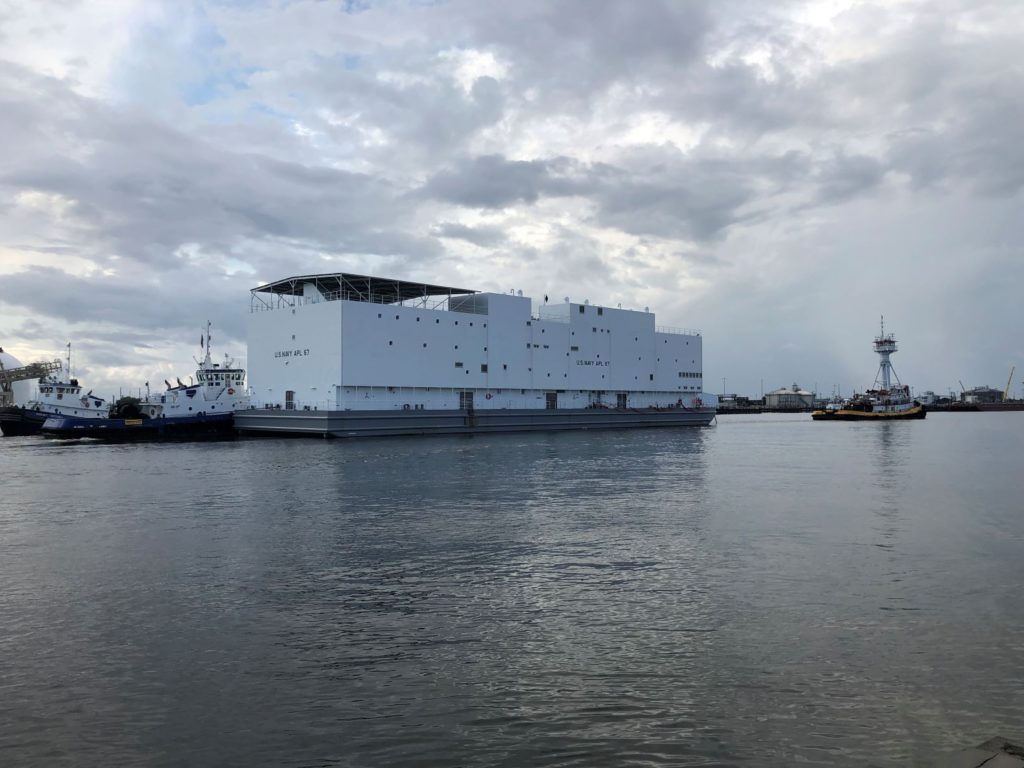
The Navy’s newest berthing barge, Auxiliary Personnel Lighter (APL) 67 sailed away from VT Halter Marine’s shipyard this week en route to Naval Base San Diego. APL 67 will eventually be delivered to Yokosuka, Japan. NAVAL SEA SYSTEMS COMMAND
PASCAGOULA, Miss. – The Navy’s newest berthing barge, Auxiliary Personnel Lighter (APL) 67 sailed away from VT Halter Marine’s shipyard this week en route to Naval Base San Diego, the Program Executive Office–Ships said in a July 21 release. APL 67 will eventually be delivered to Yokosuka, Japan.
APLs are 82-meter-long barges that can berth up to 611 people, 74 officers and 537 enlisted personnel. Mess seating is available for 224 enlisted personnel and 28 officers in 20-minute intervals, allowing food service for 1,130 personnel to have three meals a day.
APLs are equipped with offices, classrooms, washrooms, laundry facilities, a medical treatment facility, a barber shop and a fitness center.
“The modern APLs make the lives of our Sailors easier while their ships are in port for maintenance or training events.” John Lighthammer, acting program manager, Support Ships, Boats and Craft, Program Executive Office Ships. “We look forward to continuing to get these vessels delivered to the fleet to provide support while our Sailors focus on mission.”
VT Halter Marine is in production on APL 68 and three other APLs.
Surface Boss: Navy Considering Light Amphibious Warships for Junior Officer Command
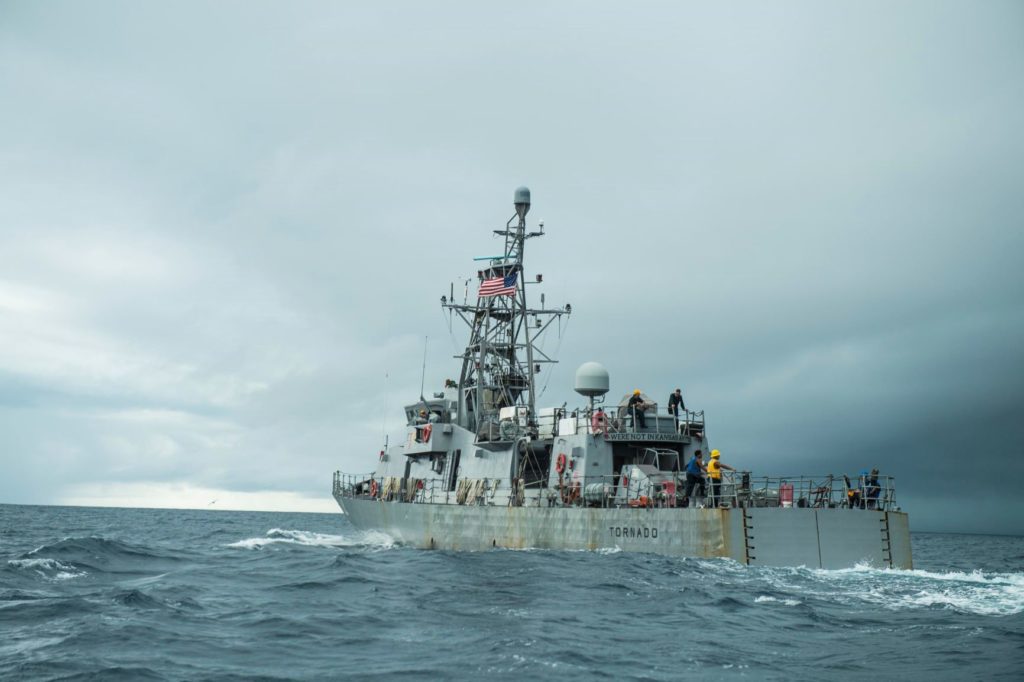
The Cyclone-class coastal patrol ship USS Tornado (PC 14) conducts a man overboard drill Sept. 16, 2020. U.S. NAVY / Mass Communication Specialist 3rd Class Dan Serianni
ARLINGTON, Va. — With the Navy planning on decommissioning its remaining Cyclone-class coastal patrol ships over the next two years, the opportunities for junior officers to command ships early in their careers are drying up. A new ship now being planned for the fleet may provide a solution to the problem.
Most Navy warships — destroyers, littoral combat ships (LCSs), amphibious transport dock ships and dock landing ships — are commanded by surface warfare officers with the rank of commander. The forthcoming Constellation-class frigate likely will be the same. Cruisers are commanded by captains who previously have commanded a smaller ship.
In an earlier era, such as World War II, many small warships, such as destroyer escorts, were skippered by lieutenant commanders. Antelope-class patrol gunboats during the Vietnam War were commanded by lieutenants. Today the Coast Guard has many ocean-going cutters, such as Sentinel-class fast response cutters, that give lieutenants early command experience. Command at sea for a junior officer has been shown to produce a more mature, experienced mariner accustomed to facing hard decisions that require sound judgement.
Vice Adm. Roy Kitchener, commander, Naval Surface Forces, was speaking July 22 to reporters at a media roundtable when asked about the diminishing opportunities for lieutenants and lieutenant commanders to gain experience in command of a ship.
“I think about that a lot,” Kitchener said. “I’m a big believer in early command opportunity if you’re truly trying to develop good COs [commanding officers] at the O-5, O-6 [commander, captain] level. It really gives them a broader understanding of the force.
“One of the things we’re looking at right now, tracking pretty closely, is the Marine Corps’ initiative for the LAW, the Light Amphibious Warship,” he said. “I see that as perfect opportunity for early command for our future officers. I think that’s a great mission for them. Right now, I think on that we’re on track.”
Kitchener said he has “looked a little bit at about LCS, but not where I want to talk about my thoughts on it, but I do think the LAW is something perfectly suited for [early command].”