Sea-Air-Space 2021 Prequel: Next-Gen Attack Sub Will Be Ultimate Apex Predator, Admiral Says
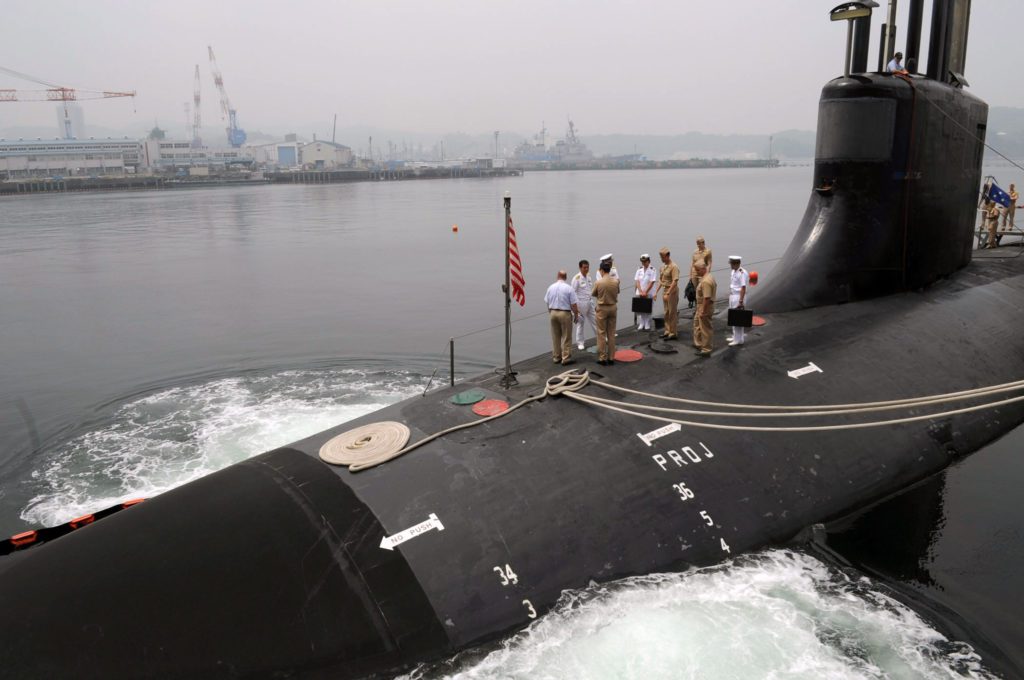
USS Seawolf, shown here in Japan in 2009. The Navy aims to combine the Seawolf-class’s speed and payload, Virginia-class acoustics and sensors and Columbia-class longevity into the next-generation nuclear-powered attack submarine, the SSNX. U.S. NAVY / Lt. Cmdr. Greg Kuntz
ARLINGTON, Va. — The U.S. Navy’s next-generation nuclear-powered attack submarine, SSNX, will combine the best technologies and capabilities from earlier submarines to produce the finest hunter the world’s oceans have ever seen, according to the service.
“We’re looking at the ultimate apex predator for the maritime domain,” said Rear Adm. Bill Houston, director, Undersea Warfare, Division, Office of the Chief of Naval Operations, who has been selected to be the Navy’s next commander, Submarine Forces, speaking in a pre-recorded webinar of the Navy League’s Sea-Air-Space Prequel.
Houston said the SSNX has “got to be faster, carry a significant punch, a bigger payload, a larger salvo rate. It’s got to have acoustic superiority and simultaneously we’re going to work on operational availability with respect to maintenance and life of the ship.
“We’re taking what we already know how to do and combining it together,” he said.
The Seawolf-class SSN, which entered service in the late 1990s, “has incredible speed and payload,” he said. “We’re going to take that Seawolf trait of payload and speed; we’re going to take Virginia class acoustics and sensors; and then we’re going to take Columbia’s [nuclear-powered ballistic-missile submarine, or SSBN] operational availability and life of ship.
“We’re going to put that all together [for SSNX] — the apex predator — because it really needs to be ready for major combat operations,” he said. “It’s going to need to be able to go behind enemy lines and deliver that punch that is going to really establish our primacy. It needs to be able to deny an adversary’s ability to operate in their bastion regions.”
Houston said that the Navy is “confident we’re going to be able to do that because we’ve already built that on those platforms. We know how to do that. We just have to mesh it together with one platform. The systems we have, with electronic design, the tools, the stuff that we’ve already developed, we’re going to capitalize on that.”
The admiral explained that the SSNX is timed to capitalize on the ‘very robust” design team for the Columbia-class SSBN when that program is ramping down amid production of the SSBNs.
“We’ll be ramping up in SSNX because we’ll have the design and the RDT&E [research, development, test and evaluation] done,” Houston said. “It takes a significant amount of time and effort for that RDT&E to develop this apex predator. That’s what we’re going to do over the next decade working on the systems for SSNX. We’re very confident we can get there. It’s a daunting task, but the team is more than capable of doing it.”
Sea-Air-Space 2021 Prequel: Sea Services Can Provide Great Opportunities, but More Work is Needed to Ensure Diversity, Speakers Say
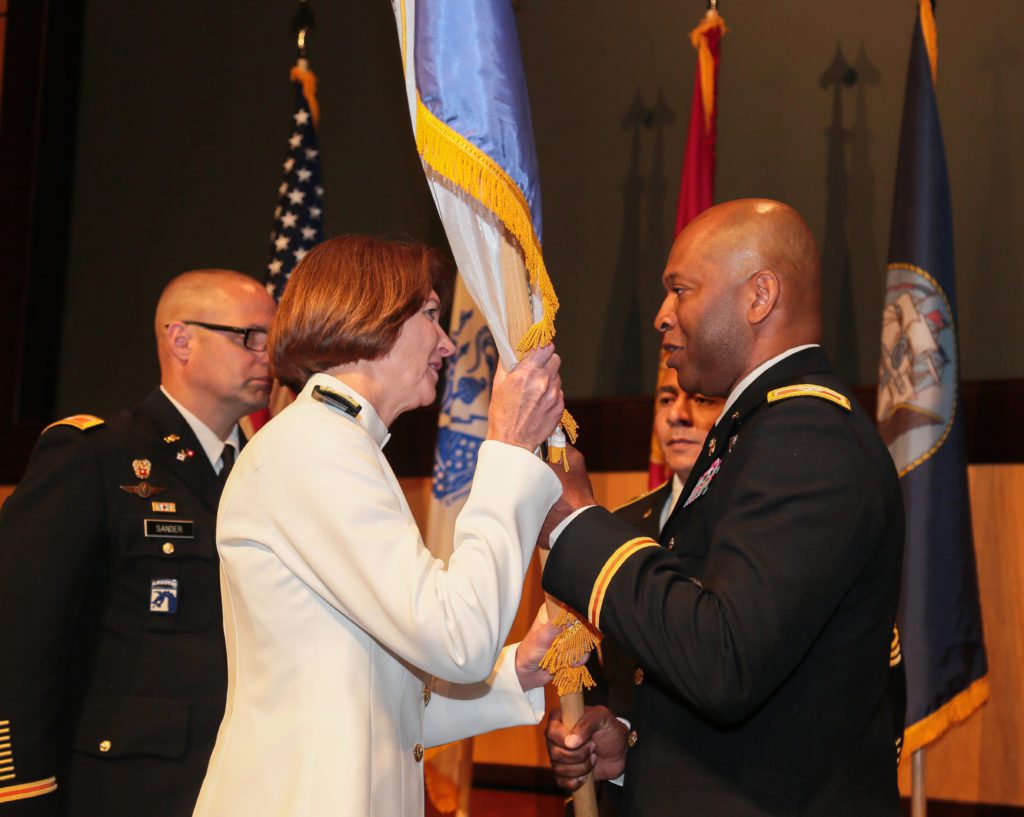
Outgoing Defense Information Systems Agency (DISA) Central Field Command, commander, U.S. Army Col. Corey L. Brumsey, passes the command flag to director, DISA and Commander, Joint Force Headquarters – Department of Defense Information Network, U.S. Navy Vice Adm. Nancy A. Norton, during a change of command ceremony at U.S. Central Command Headquarters, June 28, 2019. U.S. CENTRAL COMMAND PUBLIC AFFAIRS / Tom Gagnier
Three top female service officials said the sea services and military can provide great opportunities for women and minorities, but more work needs to be done to encourage those people to join the armed forces and help them meet their goals once inside.
“I think it’s really important for us to recognize the value and significance of the leadership opportunities that we get in the military and in the Department of Defense as civilians, at a much more junior age, much younger than our civilian counterparts ever would,” said Vice Adm. Nancy Norton, who retired as vice director of the Defense Information Systems Agency and commander of the Joint Force Heaquarters Department of Defense Information Network after a 34-year career.
“What we want to do, as women, is be great leaders, just like any man or woman in the military, and look for opportunities to better enable men and women across the board in all leadership opportunities,” she said.
Norton spoke on the “Women and Warfare” session as part of the Sea-Air-Space 2021 Prequel, along with Rear Adm. Melissa Bert, judge advocate general for the U.S. Coast Guard, and Col. Kelly Frushour, deputy director of the Communications Directorate at Marine Corps headquarters.
All the women said they weren’t expecting to make a career of it when they joined the military, but once inside what kept them going were the opportunities and the people.
“I never actually made a conscious decision to stay in the Navy, I just kept doing things that I loved, and the Navy kept giving me opportunities to do new things and to see new places, to go places I would never have had the opportunity to experience,” Norton said.
Bert joined the Coast Guard at a time when it was only 10 percent female and did two tours on ships where she was the only woman on board. That helped her decide she didn’t want a seagoing career, so the Coast Guard sent her to law school.
“Through a lot of great friends and mentors and coaches, I just stayed with it, and it’s been fun. My closest friends are in the Coast Guard and I met my husband, who is not in the Coast Guard, but I met him through the coast guard, so it’s just a second family to me, that’s why I stayed,” Bert said. “It wasn’t even the mission as much as the people.”
Frushour said she was an Air Force brat who attended a “hail and farwell” ceremony at the U.S. embassy in Norway, her father’s last posting, for a departing Marine and his replacement.
For the new arrival, “it didn’t seem like a start over for him, it seemed like he had moved into a new family, into a new group of friends. As a military brat who had grown up all over the place, that really stayed with me. What a great thing, to be able to join an organization that is doing good work, to be able to serve my country, be able to travel, and wherever you go, you’re just joining friends and family that are already there.”
Norton said the military really is a meritocracy, and “frankly, one of the reasons I’ve loved being in the military is from the time I started I’ve always felt like the military has led society in diversity and equality in many, many ways … If you work hard and are dedicated to the people and the mission, you can be successful, and I think it’s important that we in the military, and those of us who are retired and continue to influence the Department of Defense, continue to make it a leader in our social change and social justice across the board.”
However, changes still need to be made, Bert said.
“We still have model, because it was formed by men, we have a model that is for a stay at home person, whether it’s a husband or wife, who’s raising the kids, we don’t really acknowledge that having a family is part of most people’s lives,” Bert said. “It should not be a choice … either six years at sea as a SWO [surface warfare officer] and then deciding, I can’t have this lifestyle, or just moving all the time.”
That model is “a great way to drive out really talented people, not just women. It’s not a lifestyle choice [where] we’re going to get the best in American society. … We need to start listening to women and underrepresented minorities and look at ways we can change.”
Sea-Air-Space 2021 Prequel: Lawmakers, Analyst Say Navy Needs a Battle Force Ready for 2025, Not 2045
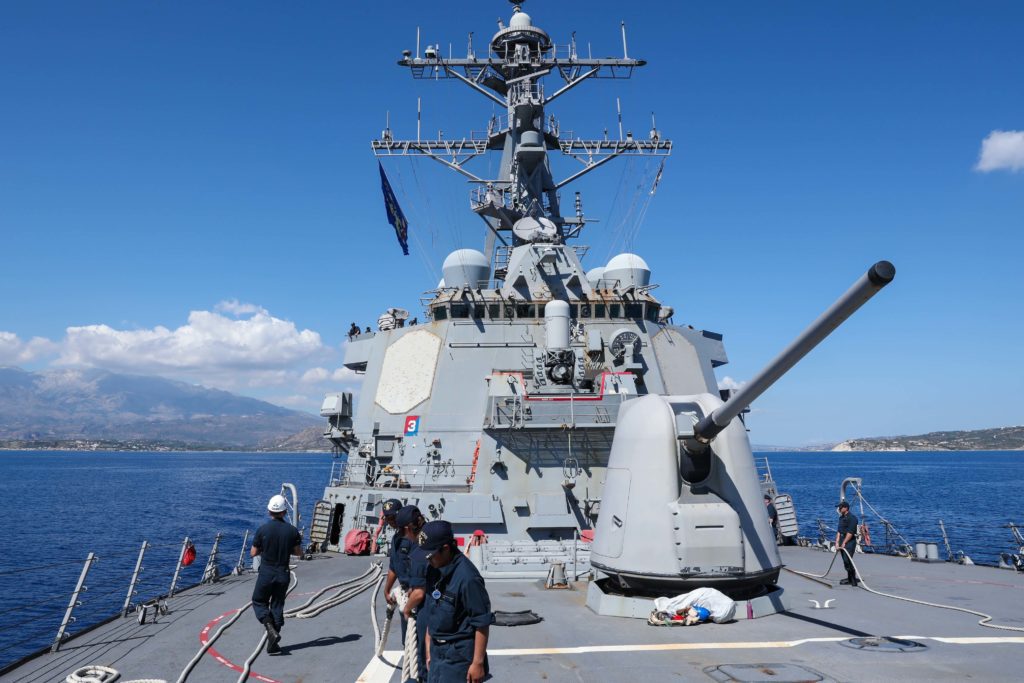
Sailors assigned to the Arleigh Burke-class guided-missile destroyer USS Ross (DDG 71) stow lines as the ship leaves port in Souda Bay, Greece, July 19, 2021. U.S. NAVY / Mass Communication Specialist 2nd Class Claire DuBois
ARLINGTON, Va. — The U.S. Navy urgently needs to modernize its battle force in order to meet the near-term challenges of China and Russia if it is to continue to dominate the maritime domain and protect the freedom of the seas, two Congress members and a naval analyst said.
“We as a nation must become a sea power again,” said Dr. Jerry Hendrix, a retired Navy captain, former director of Navy History and Heritage Command, and now vice president of the Telamus Group, speaking in a pre-recorded webinar of the Navy League’s Sea-Air Space Prequel event. “We’re facing a rising global competition right now. This [2022] budget quite frankly in reading of it, is just unserious. It’s unserious in that amount that was funded there and it’s as unserious in the terms of cutting back forces just as we should be adding forces, trying to keep the defense industrial base primed and, in fact, expanding. So, when we actually cut back on the number of surface combatants we’re building, we’re sending a mixed signal to the industrial base when we ought to be singing as a chorus right now about what is needed.”
Hendrix said the U.S. government “seems to be leaning toward a budget that is purely focused on 10 to 15 years out when, in fact, we’ve just had a significant warning from an outgoing retiring four-star [Adm. Phil Davidson, former commander, Indo-Pacific Command] that really the threat can exist six years from now. So, how are we going to meet that near-term threat? That calls for us to be looking at how we modernize and extend the lives of the platforms we have now, which is what we are not doing as a Navy or Department of Defense.”
Rep. Mike Gallagher (R-Wisconsin), a member of the House Armed Services Committee, also speaking in the webinar, said the Navy needs to “build a battle force for 2025, not 2045. As Adm. Davidson has warned, we may have six years or less before the PRC [Peoples Republic of China] takes action against Taiwan. We could have just years to prepare for a war that could decide the course of the 21st century, and that war would be waged, first and foremost, by the sea services. So, we can’t pay lip service to the idea of naval supremacy anymore, we have to earn it. We have to do better if we want to avert disaster and — make no mistake — that is where our present course leads us. We have to act with sense of urgency to advocate for, to build, and resource American seapower before it’s too late.”
Gallagher said Congress needs “to be honest with the American people about the stakes, what it’s going to cost, and the hard choices we have to make. If we fail to reverse the current trends, we’re going to wake up one day and we will either have lost a war or thrown Taiwan under the bus and, in so doing, destroyed American military deterrence in the process.”
“We need to take swift action to improve our fleet architecture to respond to the threats that China poses today,” said Rep. Elaine Luria (D-Virginia), vice chair of the House Armed Services Committee, also speaking at the webinar, noting the need to ready the battle force for 2025, not just 2045.
“The position we find ourselves in is no fault of today’s naval leadership. We’ve really lost a generation of shipbuilding — ship classes that haven’t been built to the same quantity or capability that was initially intended. There is a bigger debate going on in Congress about what the future Navy, the future force structure looks like, and I, myself, was quite disappointed with this [2022] budget from the Navy that in fact did not grow the fleet … and proposed to decommission more ships than it was going to build” in 2022.
Sea-Air-Space 2021 Prequel: CNO Describes the Fleet of 2025
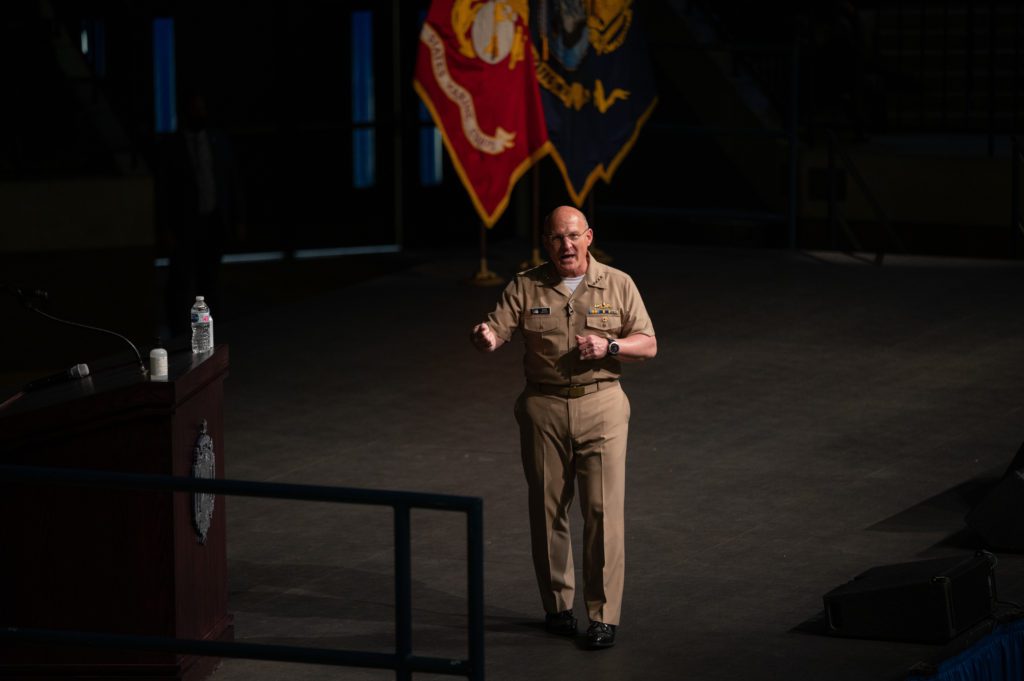
Chief of Naval Operations (CNO) Adm. Mike Gilday speaks to 1st Class midshipmen during his visit to the U.S. Naval Academy in April. U.S. NAVY / Midshipman 1st Class Tommy Brophy
ARLINGTON, Va. — The Navy’s top officer has described what he sees the U.S. Fleet will look like in 2025, a benchmark which he says the Navy will have made investments so that the fleet will have made notable strides with fielding increased combat capability.
CNO Adm. Michael Gilday, speaking in a prerecorded webinar of the Navy League’s Sea-Air-Space Prequel, listed some of the major platforms and weapons that will make the fleet more capable by 2025:
Under the sea:
“All of our Block III and IV [Virginia-class attack submarines] should be delivered by 2025 with an undersea weapon that is more lethal and has greater range.”
On the sea:
“We [will be] just on the cusp of delivering our first Constellation-class frigate.”
“We will be delivering the [Arleigh Burke-class] Flight III DDGs in earnest.”
“We are investing in a longer-range weapon, the Maritime Strike Tomahawk that gives us range and speed to reach out and touch an adversary.”
“We believe that we will be delivering the Zumwalt-class destroyers with a hypersonic missile capability.”
In the air:
“We’ll have half of our [carrier] air wings [with] a fourth- and fifth-generation mix [of strike fighters], which analysis has shown to be quite effective against our adversaries. Tied in with that is a longer-range air-to-surface missile that gives us greater reach and greater punch.”
“Our P-8s [maritime patrol reconnaissance aircraft] we are investing in with an upgrade.”
“All of that is coming into play by 2025,” the admiral noted. “So, we do have an investment strategy that incrementally gets us to a more capable, lethal fleet — not necessarily a bigger fleet — unless we saw a rise in the [budget] topline.”
NSWC Taps VTG to Equip More Ships with Counter-UAS Laser
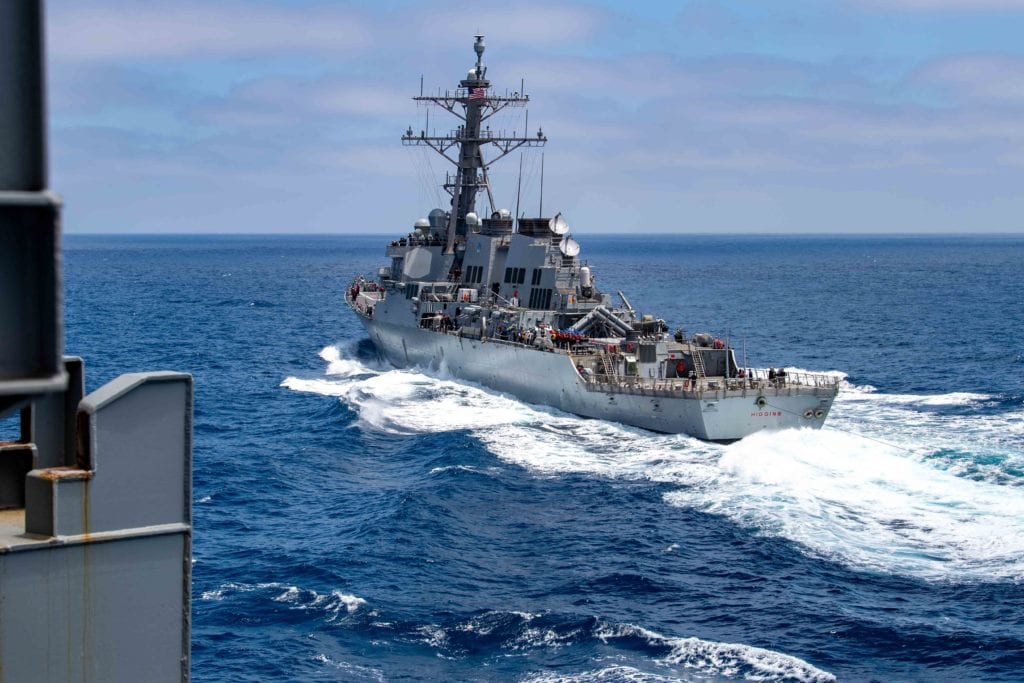
The Arleigh Burke-class guided-missile destroyer USS Higgins (DDG 76) steers away from Nimitz-class aircraft carrier USS Carl Vinson (CVN 70) following a replenishment-at-sea, July 20, 2021. VTG will equip more such ships with anti-unmanned aircraft laser systems. U.S. NAVY / Mass Communication Specialist Seaman Sophia Simons
CHANTILLY, Va., July 21, 2021 — VTG has been selected by the Naval Surface Warfare Center, Port Hueneme Division, to equip more ships in the U.S. fleet with an innovative laser designed to counter threats from unmanned aerial systems.
Under the prime, single-award contract, VTG will install and integrate the AN/SEQ-4 Optical Dazzler Interdictor, Navy (ODIN), a directed energy weapon, aboard five U.S. Navy Arleigh Burke-class destroyers.
“Our team is honored to support NSWC-PHD in integrating this innovative defensive technology into the fleet. The ODIN laser represents a significant advancement for the Navy in addressing asymmetric threats and protecting our sailors,” said John Hassoun, VTG president and CEO. “Delivering next-generation capabilities to our warfighters is something we’re passionate about. VTG’s depth of expertise with ODIN, together with our skilled fleet modernization team, cutting-edge manufacturing and prototyping capabilities, and long-term legacy of support to the Navy, makes us uniquely qualified to perform this mission critical work.”
In 2020, VTG successfully integrated the ODIN laser aboard the USS Stockdale (DDG 106) and USS Spruance (DDG 111) through a separate sole-source contract, completing both projects on time and on budget, and setting the standard for future directed energy weapon installations aboard U.S. Navy ships.
ODIN is used to counter adversary UAS-mounted intelligence, surveillance and reconnaissance capabilities. This laser for the optical dazzling of adversaries’ long-range and very long-range surveillance systems is being developed and built by the government at NSWC Dahlgren Division, and rapidly fielded to meet an urgent fleet need. The ODIN laser will be employed on surface combatants to counter asymmetric threats and to provide a scalable response for escalation of force.
Over the past decade, VTG has modernized 240 different surface ships, aircraft carriers and submarines. With a record of exceptional quality, uncompromising safety, and on-time and on-budget delivery, VTG ensures that our sailors have a competitive advantage over near-peer adversaries now and in the future.
DCNO Crites: Inflation in Shipbuilding Costs a Challenge for Navy Fleet Expansion
Sunrise over the Pearl Harbor Naval Shipyard and Intermediate Maintenance Facility, Feb. 11, 2021. U.S. NAVY / Public Affairs Specialist Dave Amodo
WASHINGTON — The Navy’s expansion to a larger fleet is hampered not only by the flat topline of the fiscal 2022 budget but also inflation in the costs and complexity of shipbuilding, a senior Navy admiral said.
As the Navy works to tailor its battle fleet to meet the challenges of the era of great power competition and divest some platforms that are aging out or needed less in terms of priorities, it also faces costs exceeding inflation that put pressure on the shipbuilding budget.
While the U.S. Navy proposes retirement of 15 battle force ships in fiscal 2022, it proposes to fund only eight battle force ships in that year, a setback in terms of growing the fleet to a congressionally mandated level of 355 ships.
“What we’ve seen over the last 10 or 11 years is essentially a flat budget, said Vice Adm. Randy Crites, deputy chief of naval operations for Integration of Capabilities and Resources, testifying July 21 during a hearing of the defense subcommittee of the Senate Appropriations Committee. “We have not kept pace with inflation. Back in 2010 we had about 280 battle force ships. We declined as we went through sequestration down to 271 and we built our way out of that up to about 297 today. That occurred as a result of a number of reform efforts and divestitures that we did inside the service.
“That challenge that we’re facing now is that the good ideas, the [divestiture of] things that we don’t need to bring to the future fight, we’re starting to run out of that,” Crites said. “So, we’re challenged as we see labor costs far exceeding inflation; the cost and complexity of the work we’re trying to do; and materials we’re trying to buy all outpacing inflation. Yet we need to balance within the program that we have.”
Crites said the Navy’s current priorities have not changed.
“The No.1 priority is to bring in Columbia [ballistic-missile submarine. No. 2 is to ensure that we have a ready force; No. 3 is to make sure that we’re bringing the capabilities that we need; and No. 4 has been capacity that we can afford,” he said.
Sea-Air-Space 2021 Prequel: Law Of Sea Convention Could be Negotiated to Overcome Constitutional Objections, Analyst Says
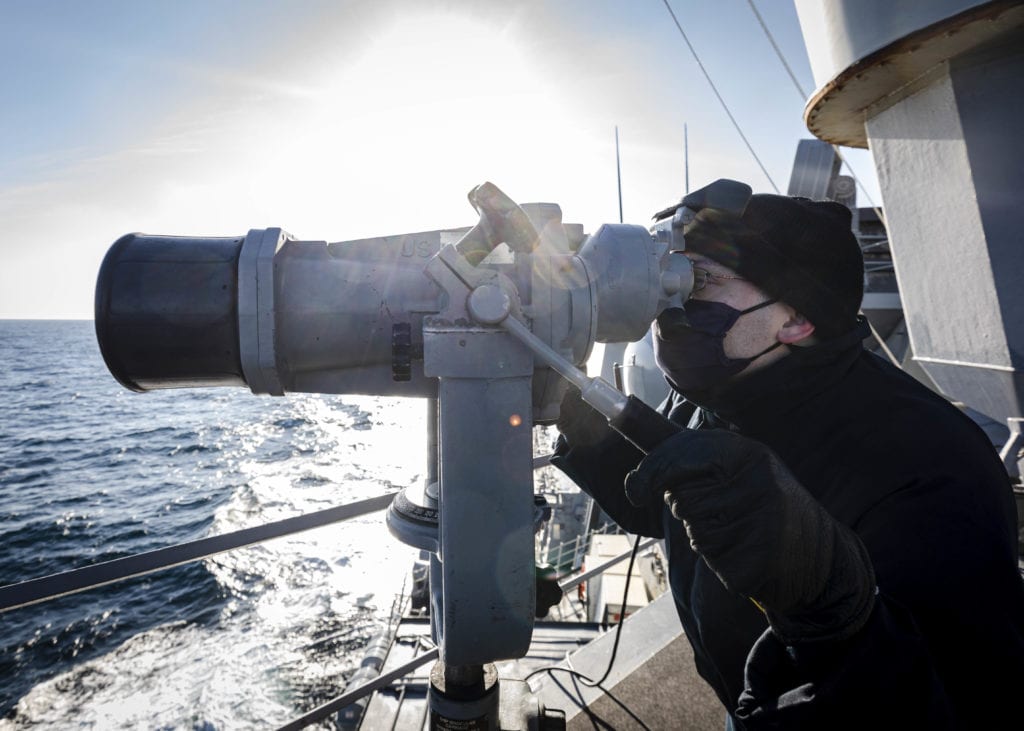
Ensign James Bateman, from Huntsville, Alabama, scans the horizon utilizing the “big eyes” while standing watch on the on the bridge wing as the guided-missile destroyer USS John S. McCain (DDG 56) conducts freedom of navigation (FON) operations in late 2020. U.S. NAVY / Communication Specialist 2nd Class Markus Castaneda
ARLINGTON, Va. — The United Nations Convention on the Law of the Sea (UNCLOS) could be ratified by the U.S. Senate if a few objections were addressed, a naval analyst said.
Speaking 20 July in a webinar of the Navy League’s Sea-Air-Space Prequel, Marine Corps Col. James McGinley, a retired naval aviator and a lawyer, said that the UNCLOS could be challenged on constitutional grounds that it could negate the right of the U.S Senate to provide “advice and consent.”
The UNCLOS, signed by 168 nations, governs a wide array of maritime issues including economic, military, commerce, mining interests. It has yet to be ratified by the Senate, where it last was given a hearing in 2012.
“The United States was a huge part of the formation of UNCLOS back in the ‘80s,” he said. “The United States signed [in 1994] but did not ratify,” said retired Adm. Jonathan Greenert, former chief of naval operations, also speaking in the webinar.
Speaking of the example of Arctic energy exploration and seabed mining, retired Adm. Paul Zukunft, former commandant of the Coast Guard, said during the webinar, “We have a right to this, yet we haven’t signed onto the ground rules to lay claim what is rightfully ours.”
Zukunft also pointed to the absurdity of the Chinese “Nine-Dash Line,” which the Chinese Communist Party uses to claim most of the South China Sea as its territorial waters.
“If you use that same [justification], then Denmark and Leif Ericsson should probably claim the United States EEZ [Exclusive Economic Zone],” Zukunft said. “We don’t have a voice at that forum because we have not ratified the Law of the Sea convention. We’re trying to resolve this with Freedom of Navigation [FON] exercises but at the end of the day, the fact that we don’t have a voice at the table for this aspect of maritime governance, all we can do is sit back and watch, and try to counterbalance using economic or military leverage to correct that behavior.”
The admiral said the Coast Guard has 65 bilateral agreements with other nations “that allow us to board vessels of those signatory nations — whether it’s a fishing violation, [an] encounter [with] drug movement, or even the potential of a weapon of mass destruction in the maritime domain — [the Coast Guard is authorized to] stop, apprehend, search those vessels on behalf of those flag nations.”
FON “doesn’t represent a policy,” Greenert said. “It is nothing more than a statement by us concerning free passage in certain straits or waters of the world.
“What’s happening right now is China is showing some real mischief and it goes beyond some of the seabed issues and Nine Dash Line issues,” he said. “China is starting to reinterpret UNCLOS. They’re pushing things around within the convention. Frankly, in my view, they need to be confronting by another leader. For example, China is working to change the definition of ‘high sea’ to their advantage. China is working to put the [EEZs] per UNCLOS to be controlled by the littoral nation. They have 28 land-locked countries in the United Nations on board in this endeavor.”
Greenert said that if this provision were adopted, military operations would need permission of the littoral nation.
McGinley spoke about the legal logjam of UNCLOS in the U.S. Senate.
“As it exists today, there has been such consistent resistance to ratification,” he said. “We’re now pushing half century. A lot of the original thinking on this was in 1956. There are parts of [UNCLOS] that are extraordinarily helpful to the U.S. and to our interests, but I worry that the poison pills that are buried in this thing — over 208 pages — are enough to keep us from success.”
McGinley suggested two approaches to achieve ratification.
“One would be a hard pivot and talk to the key opposition folks in the Senate and say, ‘Here’s what we need. What works for you?’ and then start with a fresh piece of paper with regard to — not to the entire globe — but to the key maritime partners as well as some of the other maritime nations we think would be most important to success,” he said.
“A second would be to take a radically different approach in the Senate,” he continued. “Part of the problem is Articles 309 and 310. The Constitution’s Article 2 Section 2 gives us advice and consent for our Senate. Part of what happens under the RUDS [Reservations, Understandings and Declarations] in any treaty is the ability for our Senate to say, ‘When we look at these words, we understand to mean this. Here is a statement of what we agree to,’ or, ‘here are our reservations; we don’t agree to these particular articles, but we do agree to these other articles.’”
McGinley explained the poison pills in the treaty.
“This is an odd treaty in that it purports to take away the constitutional right of the U.S. Senate to provide its advice and consent. … It is so significant that a ratification could actually face a successful constitutional challenge,” he said. “A fresh piece of paper would go beyond that, but if the Senate wanted to go forward with it, they ought to do it very publicly … that we are specifically rebuking 309 and 310, and then take a very tight look at Article 82 — which is a real significant transfer of the American families’ money — and also look at Article 144 — which is a straight-up transfer of technology. Almost all of this was negotiated at a time when we did not have the technological capability, so when those pills were put in, they were thought of as worthless and so far in the future it wouldn’t matter. Now those are real, and they are significant. They’re part of what makes this treaty harder to pass with each passing year.”
McGinley explained why the United States has been able to set a good example despite lack of ratification.
“My hat is off to the [U.S.] Navy, which I’ve watched out in the 5th Fleet with extraordinary seamanship,” he said. “It is that professionalism that has developed international customary law to the point that, even though we are not parties to this treaty, we actually exemplify — through our own conduct, and over time we have developed — norms.”
McGinley noted that in 2016 China said it would ignore binding arbitration from the verdicts from the court of arbitration about one of the islands in the South China Sea.
“It’s as if they have never signed the treaty,” he said. “So, it comes down to non-parties behaving as if they were parties and parties behaving as if they had never signed it. … The U.S. Navy’s professionalism still sets the standard and is developing navigational norms and customary international law as a result of their professionalism.”
Navy Awards Teledyne Contract for Autonomous Underwater Vehicles
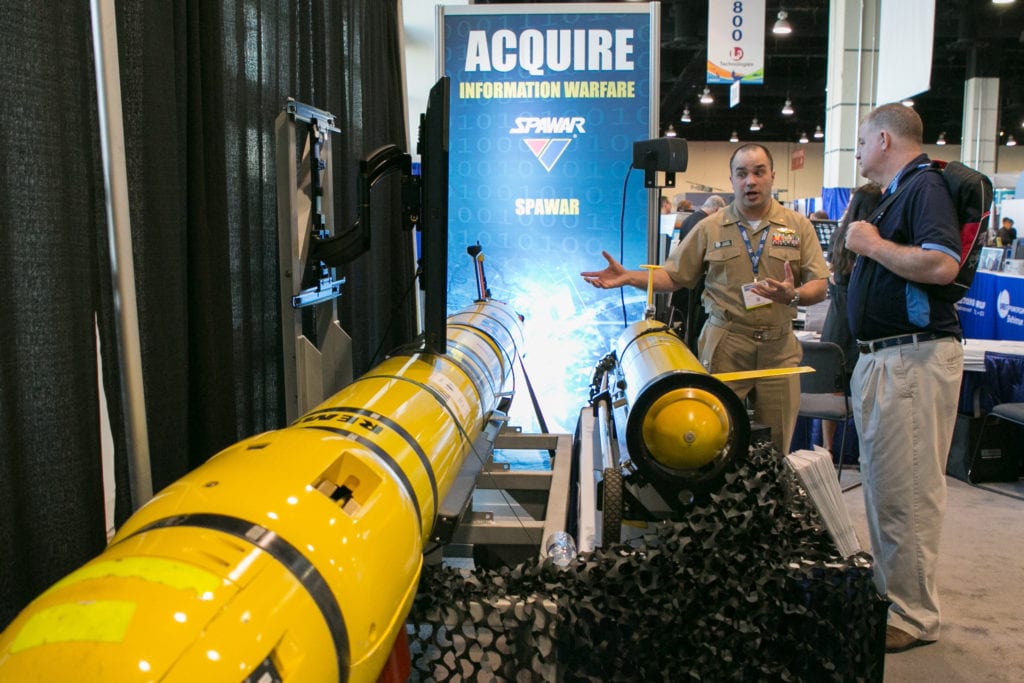
Littoral Battlespace Sensing Unmanned Underwater Vehicles (LBS-UUV) on display at the Navy League’s Sea-Air-Space conference and exhibition in 2017. The LBS-UUV is made up of two vehicle types, a glider and an autonomous undersea vehicle. U.S. NAVY / Krishna M. Jackson
THOUSAND OAKS, Calif. — Teledyne Technologies Inc.’s subsidiary, Teledyne Brown Engineering Inc., has been awarded an indefinite-quantity/indefinite-delivery contract with a maximum base value of $27.4 million from the U.S. Navy for the Littoral Battlespace Sensing-Glider (LBS-G) program, the company said in a July 19 release.
The contract, awarded under full and open competition, includes a single five-year ordering period and five one-year option periods. The option periods, if exercised, have a ceiling value of $39.2 million.
Teledyne Slocum gliders are long-endurance, buoyancy-driven autonomous underwater vehicles (AUVs) that provide a highly persistent means to sample and characterize the ocean water column properties. They can do this at spatial and temporal resolutions not possible using other vessels or tactical units alone. The AUVs host a range of oceanographic sensors to support antisubmarine warfare, mine countermeasures and Naval Special Warfare mission areas.
Teledyne Brown Engineering and sister company, Teledyne Webb Research, will perform the design, development, fabrication, production, test, and support of the LBS-G systems. Under a previous contract awarded in 2009, Teledyne delivered 203 gliders to the U.S. Navy.
“We are pleased to announce the continuation of Teledyne’s successful partnership with the Naval Information Warfare Systems Command to deliver this capability,” stated Jan Hess, president of Teledyne’s Engineered System Segment and Teledyne Brown Engineering. “We look forward to supporting the Navy and assisting with its awareness and understanding of the ocean’s conditions.”
Teledyne Slocum gliders provide the U.S. Navy the capability to conduct persistent sampling of large ocean areas for long periods of time. They also allow focused sampling to obtain extremely high-resolution data within a smaller, tactically significant operating area. The LBS-G System, part of the LBS Unmanned Undersea Vehicles program, is part of a solution to close critical capability gaps allowing the U.S. Navy to characterize adequately and persistently the physical ocean environment on tactical and strategic scales in a battlespace.
Sea-Air-Space 2021 Prequel: Cooperation is Key for Maintaining Maritime Security, International Navy Chiefs Say
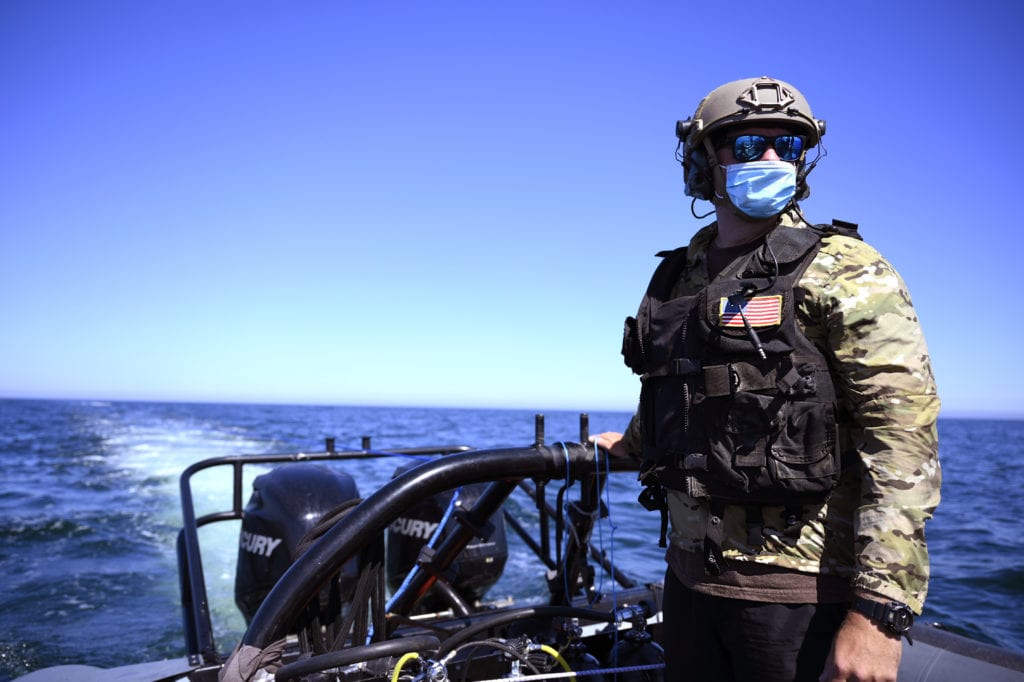
A member of Explosive Ordnance Disposal Mobile Unit (EODMU) 8, performs mine recovery training as part of BALTOPS 50. The 50th BALTOPS represents a continuous, steady commitment to reinforcing interoperability in the Alliance and providing collective maritime security in the Baltic Sea. U.S. NAVY / Mass Communication Specialist 1st Class Christopher Hurd
Top officials from several allied navies said cooperation and collaboration is one key way to bolster their capability in tough budget times.
U.S. Navy Rear Adm. Francis D. Morley, director of the Navy International Programs Office, led a Sea-Air-Space 2021 Prequel virtual session in July with international heads of navy, including speakers from the United Kingdom, Sweden, Spain and Japan.
Vice Adm. Nick Hine, second Sea Lord of the Royal Navy, said where possible, allies should move beyond interoperability and embrace interchangeability.
That is “not about individual naval units working together operationally, indeed tactically, but a strategic conversation about how we consider our entire approach to collaboration. This is about using our collective resource better to be more productive and deliver better security outcomes,” Hine said. “We have started that journey, but to be truly interchangeable with our allies, we must align strategic visions, cohere our planning and resources, jointly plan and execute operationally and technically, not only acting together but acting as one.”
That could include common doctrines, systems architecture, supply chains, data sharing as well as “common platforms and weapon systems that can be jointly developed and delivered to sovereign units,” he said.
As an example, he cited the U.K.’s Carrier Strike Group 21, led by the aircraft carrier HMS Queen Elizabeth, that has U.S. Marine Corps, Royal Navy and Royal Air Force F-35 pilots “flying and fighting together,” as the recently did in strikes against Daesh, the terrorist group also known as ISIS.
Another example he cited is the London Tech Bridge, an incubator which highlights American and British technology and rapidly exploits it.
“Even if we are unable to achieved interchangeability in full, the ambition and the drive towards it will strengthen interoperability between allied navies,” Hine said.
Rear Adm. Ignacio Villanueva Serrano, force commander of the Spanish navy, said a medium-sized navy such as his own needs to enhance several capabilities to stay relevant, including leveraging space as an extension of the air and sea, new “connectors and vectors for seapower projection” and unmanned systems, all of which, “one way or another, will be required in the new security and defense environment.”
Serrano and Hine both noted that technology is becoming more widely available across the board, to large navies and small actors alike.
The current environment is “marked by a struggle for technological superiority and easy access by all to emerging and advanced technologies, where it can be difficult to gain advantage in direct confrontation,” Serrano said. “In this context, the use of hybrid strategies will prevail and opposing actors will try to act at the limit of international legality, covered by fake news to manipulate public opinion and provoking critical doubts on the use of all military forces and capability.”
Navies such as those of Spain and Sweden need to modernize and beef up their capabilities, said Serrano and Rear Adm. Ewa Skoog Haslum, chief of navy for the Swedish Navy, the first woman to lead a branch of the country’s armed forces.
“Interoperability requires us to find both technology solutions and the continued develop of sharing recognized maritime picture with our different partners,” she said. “Together, we are not only stronger, but better.”
She cited the recent Baltic Operations (BALTOPS) exercise, which celebrated its 50th anniversary this year and included 16 NATO nations and two partner nations, including Sweden.
Sweden is embarking on a military buildup that will see mid-life updates on corvettes, including adding electronic warfare suites and air defense missiles, four new surface combatants, with two arriving by 2030, operationalizing a fifth new submarine and re-establishing a marine regiment on the country’s west coast, among other changes.
Next year will mark the 500th birthday of the Royal Swedish Navy, she noted, and a new defense resolution gives a clear growth goal for 2025 and beyond, “and we are now eager to grow.”
Spain wants to lean in to new credible landing forces and littoral strike capabilities, Serrano said, using short takeoff and landing aircraft and small landing platforms, as well as underwater vehicles for mine detection and unmanned surface vehicles for force protection.
“In our navy, we are aiming for those systems and concepts,” he said.
In a pre-taped segment, Adm. Hiroshi Yamamura, chief of staff of the Japanese Maritime Self Defense, said the Indo-Pacific region is “vitally important for our security.” To that end, the Japanese defense ministry recently unveiled a “free and open Indo-Pacific vision” to enforce regional prosperity and security in the Indian Ocean and Pacific Ocean.
It would do this through defense cooperation and exchange activities and through active engagement in the region in cooperation with partner countries, Yamamura said.
Yamamura noted the many challenges in the region, from more assertive and aggressive actions by China and Russia to ongoing tensions in the Middle East to a “still unpredictable” North Korea.
As an “overreaching capability” to help counter these threats and defend Japan’s surrounding waters and territories, Yamamura said Japan will bolster its information warfare capability and its strategic communications.
“I am confident that the backbone of global security is to maintain the international maritime order of the world,” he said. “Cooperation and exchanges with neighbor partners are more effective that promoting efforts on our own.”
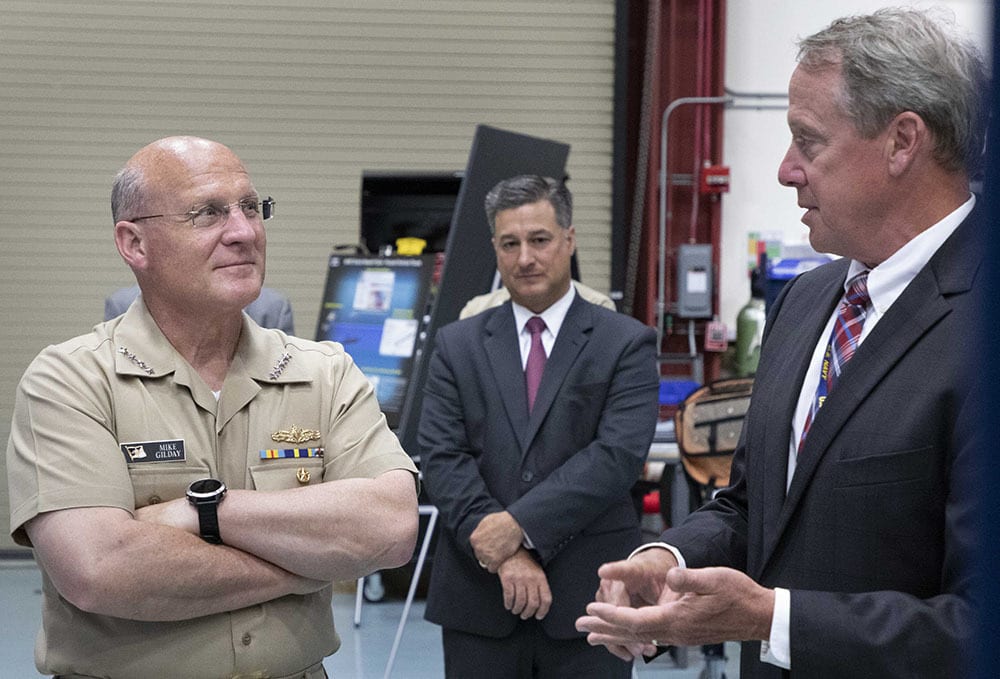
Chief of Naval Operations Adm. Mike Gilday (from left) speaks with Naval Undersea Warfare Center Headquarters Director of Undersea Warfare Eugene Hackney Jr. as Christopher DelMastro, head, Division Newport’s Platform and Payload Integration Department, listens, during a visit to the Division on June 28, 2021. U.S. NAVY
ARLINGTON, Va.—The U.S. Navy’s 2022 budget proposal to decommission seven guided-missile cruisers is not just based on the age and material condition of the ships. According to the chief of naval operations (CNO), the lethality of the cruisers’ combat system is lagging behind the developing threat capabilities.
CNO Adm. Michael Gilday, speaking in a prerecorded webinar of the Navy League’s Sea-Air-Space Prequel, noted that the seven Ticonderoga-class cruisers are equipped with the SPY-1A or early SPY-1B radars, which are the oldest radars that are the main sensor of the Aegis Combat System. The SPY-1A is an analog system, increasingly anachronistic in the Digital Age.
The radars “are approaching obsolescence … and they have difficulty actually seeing the threat, based on the speed and the profiles that we see threat missiles flying at these days.”
Gilday said the cost to own and operate the seven CGs over the five-year Future Years Defense Plan would come to $5 billion.
“These ships on average right now are 32 years old,” he said. “We are seeing cracks. We are seeing challenges in the material condition of these ships that are, to a certain degree, unpredictable. So, they’re ‘unknown unknown.’ When we tried to deploy a ship most recently [USS Vella Gulf] and had to bring it back twice because of fuel tank cracks, is an example of something we just couldn’t predict that we have to react to, and it does have an impact on reliability. We need to be able to provide the secretary of defense reliable assets that they can count on to do the nation’s business.”
The CNO said the above factors “really came into play from a realistic standpoint in terms of making the argument for the best of those cruisers. The cost alone with respect to cruiser modernization is running tens of millions of dollars above what we had originally estimated, largely due to the unknowns that come into play with hulls that are over three decades old.”
The seven cruisers marked for decommissioning are USS San Jacinto (CG 56), USS Lake Champlain (CG 57), USS Monterey (CG 61), USS Hue City (CG 66), USS Anzio (CG 68), USS Vella Gulf (CG 72), and USS Port Royal (CG 73).