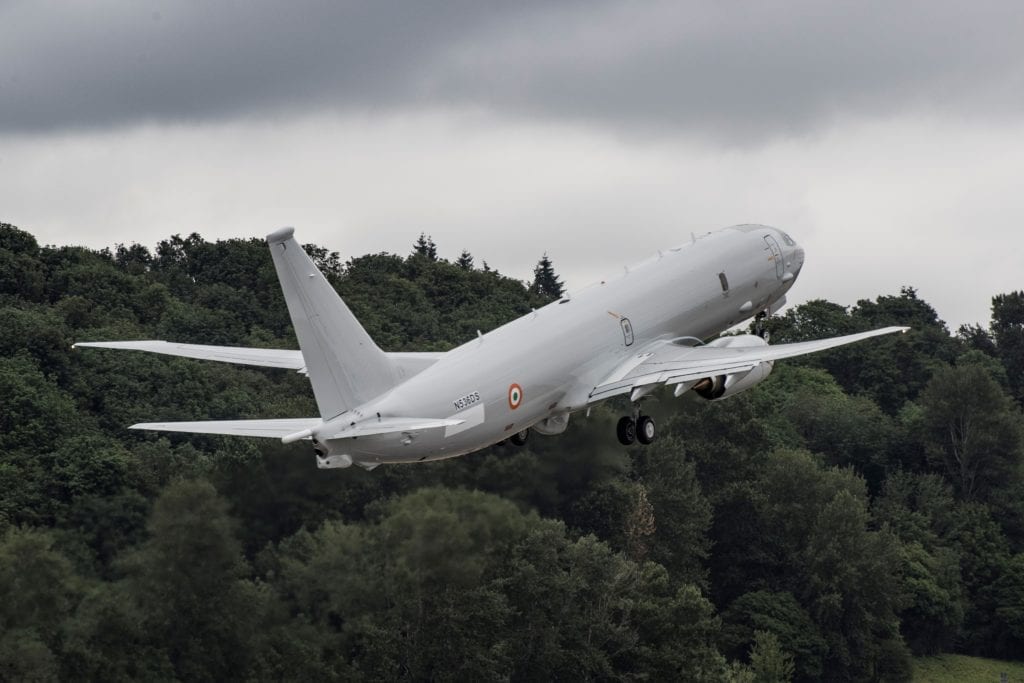
Boeing has delivered the Indian navy’s 10th P-8I long-range maritime patrol aircraft. BOEING
NEW DELHI, INDIA — Boeing is continuing to expand the Indian navy’s long-range maritime reconnaissance antisubmarine warfare capabilities with the delivery of the country’s 10th P-8I. The patrol aircraft is an integral part of the Indian navy’s fleet and has surpassed 30,000 flight hours since it was inducted in 2013.
This is the second aircraft to be delivered under an option contract for four additional aircraft that the Indian Ministry of Defence awarded in 2016. The Indian navy was the first international customer for the P-8, which is also operated by the U.S. Navy, the Royal Australian Air Force and the United Kingdom’s Royal Air Force.
In addition to unmatched maritime reconnaissance and antisubmarine warfare capabilities, the P-8I has been deployed to assist during disaster relief and humanitarian missions.
Boeing supports India’s growing P-8I fleet by providing training of Indian navy flight crews, spare parts, ground support equipment and field service representative support. Boeing’s integrated logistics support has enabled a high state of fleet readiness at the lowest possible cost.
Boeing is currently completing construction on the Training Support & Data Handling Centre at INS Rajali, Arakkonam, Tamil Nadu and a secondary maintenance training center at the Naval Institute of Aeronautical Technology, Kochi, Kerala, as part of a training and support package contract signed in 2019. This new indigenous, ground-based training will allow Indian Navy crew to increase mission proficiency in a shorter time while reducing on-aircraft training time resulting in increased aircraft availability.
SECNAV Nominee Calls Chinese Adventurism His Main Threat Concern
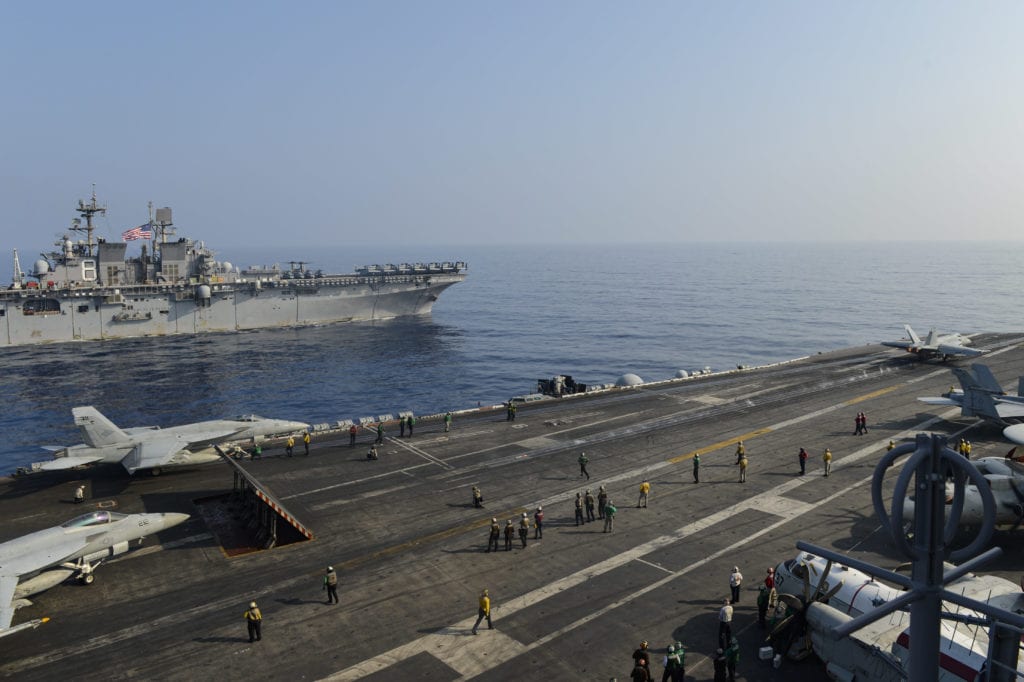
The Theodore Roosevelt Carrier Strike Group transits in formation with the Makin Island Amphibious Ready Group in the South China Sea April 9, 2021. The Theodore Roosevelt Carrier Strike Group, Makin Island Amphibious Ready Group and the Ticonderoga-class guided-missile cruiser USS Port Royal (CG 73) are conducting expeditionary strike force operations during their deployments to the 7th Fleet area of operations. U.S. NAVY / Mass Communication Specialist Seaman Faith McCollum
ARLINGTON, Va. — Former U.S. Navy surface warfare officer Carlos Del Toro, the Biden administration’s choice to be the next secretary of the Navy, told a Senate hearing July 13 that he will be “exclusively focused on the China threat.”
At a confirmation hearing before the Senate Armed Services Committee with four other nominees for senior Pentagon posts, Del Toro, a U.S. Naval Academy graduate and former destroyer commander, was quizzed on several topics from lagging shipbuilding plans and aging shipyards to the challenge of projecting power in the Arctic without sufficient deep water ports, sturdy-hulled Navy ships or Coast Guard ice breakers to operate in the far north.
However, several Republican lawmakers, who view the Navy’s $211.7 billion fiscal 2022 budget — with $22.6 billion for shipbuilding, a 3% reduction from $23.3 billion in 2021 — as too little to maintain Navy readiness, zeroed in on the People’s Republic of China and the challenge it presents as a pacing competitor and a threat to Taiwan.
Noting China’s “global adventurism” presented both a national security threat and an economic threat, Del Toro said it was “incredibly important to defend Taiwan, in every way,” adding that a comprehensive approach should be taken to provide Taiwan with “as much self-defense measures as humanly possible.”
Asked by Sen. Rick Scott of Florida about Indo-Pacific wargame scenarios indicating the United States and its allies would not be able to defend Taiwan, Del Toro noted that as a graduate of the Naval War College as well as Annapolis he was well acquainted with war gaming programs but has not been privy to recent classified studies. However, if confirmed as Navy secretary, Del Toro said he intended “to dive into that immediately, so I can better understand that threat and match that threat.”
Del Toro added, “I’m going to be exclusively focused on the China threat and exclusively focused on moving our maritime strategy forward in order to protect Taiwan and all of our national security interests in the Indo-Pacific theater.”
Both Democrats and Republicans were concerned about the fiscal 2022 plans to decommission 15 ships, including four littoral combat ships and seven Ticonderoga-class guided missile cruisers, while requesting funds to build just one destroyer. Sen. Roger Wicker (R-Mississippi) noted those changes would drop the fleet size to 290 ships, below the 355-ship fleet mandated by 2018 legislation.
Del Toro said he fully supported the 355-ship goal, and with the shift to “a more dominant maritime strategy in the Indo-Pacific” to deter China, the Navy and Marine Corps will need more resources to field “the combat effectiveness we will need.” He committed to working to make that case with Defense Secretary Lloyd Austin and the White House in developing the Navy’s fiscal 2023 budget request.
SASC Chairman Jack Reed (D-Rhode Island) noted at the hearing’s start that “deferred ship maintenance, reduced steaming and flying hours, and cancelled training and deployments have created serious readiness problems,” and “cost overruns and delays in schedules have plagued both public and private shipyards.”
Citing his experience in the Navy and a small business owner for 17 years, Del Toro said he understood the responsibility of the Navy secretary “to ensure the return on investment that American taxpayers make in supporting our Navy.”
It was “incredibly important to ensure, that requirement creeps don’t interfere with the continuing cost of projects,” he said, adding that having the right program managers in place and the right oversight from their leadership to ensure projects stay on track was a key element as well as paying immediate attention when challenging problems are first identified and taking necessary actions to correct them.
“It takes a team to make that happen, they have to have the support from their senior leadership and the military as well for it to be an effective solution,” he said.
AeroVironment Selected by USSOCOM for ISR Services Under Mid-Endurance UAS IV Program
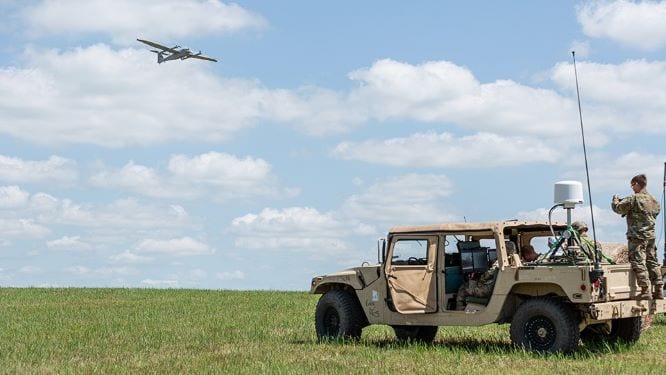
JUMP 20 is a VTOL, fixed-wing unmanned aircraft system that can be deployed quickly and requires no launch equipment or runway. AEROVIRONMENT
ARLINGTON, Va., July 13, 2021 – AeroVironment Inc. was awarded a competitive task order valued at approximately $22 million on May 21 from the U.S. Special Operations Command (USSOCOM) for ISR services using JUMP 20 medium unmanned aircraft systems (MEUAS) at an undisclosed customer location, the company said in a July 13 release.
The ISR services include the first satcom-enabled unmanned aircraft system for beyond line-of-sight operations as part of the existing indefinite delivery, indefinite quantity MEUAS IV contract. The task order specifies a 12-month period of performance and multiple follow-on option years for ISR services.
“The JUMP 20 delivers an unmatched level of versatility, with runway and infrastructure independence, multiple payload configurations, class-leading endurance and a track record of reliability and ruggedness,” said Gorik Hossepian, AeroVironment vice president and product line general manager for medium UAS. “The inclusion of a satcom payload adds beyond-line-of-sight operation to the JUMP 20, providing our customer with expanded reach and situational awareness, and representing another game-changing, market-leading capability.”
The AeroVironment JUMP 20 is the first fixed-wing unmanned aircraft system capable of vertical takeoff and landing to be deployed extensively in support of U.S. military forces. Ideal for multi-mission operations, JUMP 20 delivers 14-plus hours of endurance, a standard operational range of 185 kilometers (115 miles) and is runway independent. The system can be set up and operational in less than 60 minutes without the need for launch or recovery equipment and has a useable payload capacity of up to 30 pounds. The JUMP 20 also features a common autopilot and ground control system architecture providing a highly customizable, modular platform which can be custom configured to meet operational or customer requirements.
Exercise Sea Breeze 2021 Comes to a Close in Black Sea
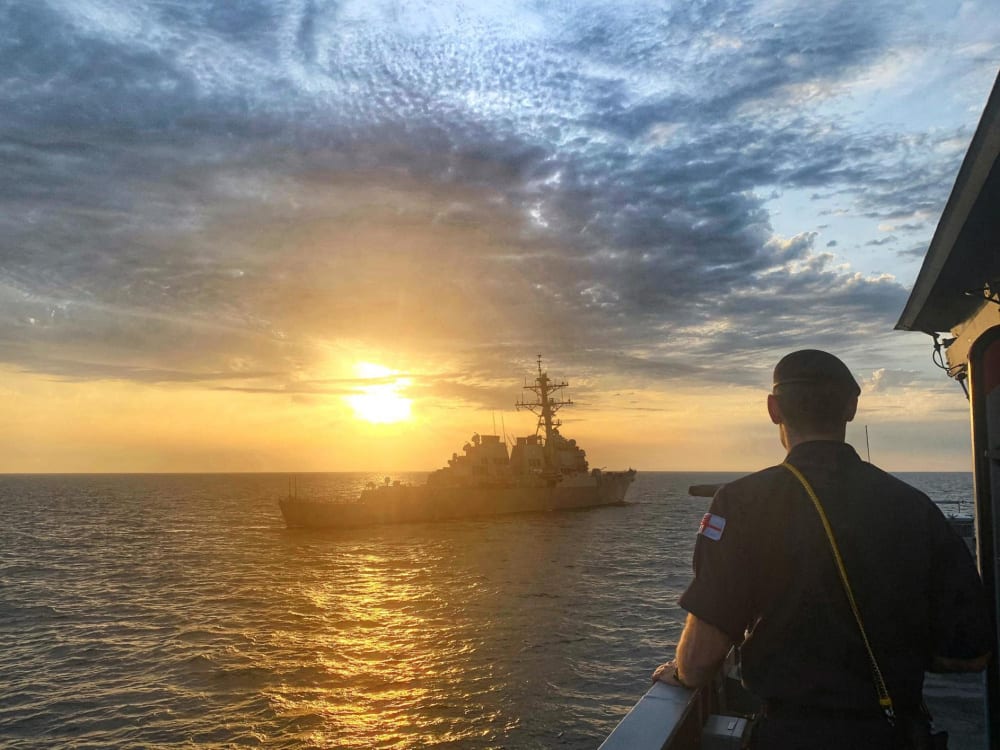
The Arleigh Burke-class guided-missile destroyer USS Ross (DDG 71) from the topside of the Royal Navy HMS Trent (P224) Odesa, Ukraine during Exercise Sea Breeze 2021, July 2, 2021. U.K. ROYAL NAVY / HMS Trent
The U.S. and Ukrainian navies wrapped up Exercise Sea Breeze 2021 July 10 in the Black Sea region.
“We’ve had the largest Sea Breeze since we began over 20 years ago,” said Capt. Stuart Bauman, the Sea Breeze 21 exercise director on the U.S. side during a press conference on Friday. “We’ve had the participation of 30 nations including observers and mentors; more than 5,000 Sailors, Soldiers, and Airmen; more than 40 aircraft participate; 32 ships and just a great amount of cooperation and partnership between all of the nations.”
Bauman said there was great participation from both NATO and non-NATO participants across a wide variety all around the globe, including Asia, Africa, North America, Europe, and the Middle East. “We had great participation from a wide variety of countries. We had folks come in to be mentors with the Ukrainian forces, we had teams participating in our diving exercises as well as being observers and across all of the different air, land, and maritime components.”
Participating Sea Breeze 21 nations included Albania, Australia, Brazil, Bulgaria, Canada, Denmark, Egypt, Estonia, France, Georgia, Greece, Israel, Italy, Japan, Latvia, Lithuania, Moldova, Morocco, Norway, Pakistan, Poland, Romania, Senegal, Spain, South Korea, Sweden, Tunisia, Turkey, Ukraine, United Arab Emirates, United Kingdom and the United States.
“The level of cooperation and integration is at its highest level that we’ve seen, and the Ukrainians are very capable as well as all of the partners that have joined in,” Bauman said. “And we’ve covered everything from maritime components to air, to land to special operations.”
Bauman said the forces took part in sea, air and land warfighting scenarios. “We had quite a bit of interoperability between many different nations across all of the domains of warfare, and they’ve all done an outstanding job.”
Cmdr. John D. John, commanding officer of Rota, Spain-based USS Ross (DG-71), said he and his crew were part of a five-ship battle group that incorporated a Ukrainian vessel, Hryhoriy Kuropiatnykov, the Bulgarian ship Bodry, the British ship Trent, and Romanian ship Macellariu. “Our mission has been to promote interoperability and enhance warfighting readiness for our collective of the Black Sea region to ensure safety and prosperity in this region for allies and partners.”
John said Sea Breeze enhances combat readiness amongst participating NATO and allied partner nations to rapidly respond to any threats. “I believe that we proved that our ability to seamlessly operate together to maintain a stable and prosperous Black Sea region sends a message to the world that we are committed to enhancing stability and deterring aggression. No nation can confront today’s challenges alone, and the Black Sea is no different. While it may be smaller than other international bodies of water, it’s still quite large and provides an appropriate area for nations to come together to learn from each other, strengthen relationships, and also contribute to each other to ensure the continued success of the longstanding alliance with NATO and our partner nations.”
John said the exercise took place in international waters in the Black Sea, and therefore there was the opportunity for both non-participating units and civilian vessels to be in and around the exercise area. “From all accounts, all vessels and aircraft participated or conducted themselves in accordance with international law and maritime regulations and with due regard for safety.”
“As professional mariners, regardless of what nation, safety at sea is paramount for all vessels,” John said. “There were at least two interactions over bridge-to-bridge VHF radio communication where both a non-participating unit and a participating unit communicated with each other effectively and professionally to ensure safe navigation of the exercise area. All of those communications were conducted in a routine and professional manner.”
U.S. Marine Corps Lieutenant Colonel Mastin Robeson, Jr., the commander of 1st Battalion, 6th Marines, was speaking from Oleshky Sands in Kherson Oblast, Ukraine, collocated with the 88th Marine Infantry Battalion as well as the 1st Separate Battalion, Airborne Marines. “I’ve got with me approximately 400 Marines from across the 2nd Marine Expeditionary Force, also known as II MEF. And our mission was to deploy from Camp LeJeune, North Carolina to Oleshky Sands to conduct training with other nation forces, to include Ukrainian marines, Georgian soldiers, as well as Moldovan forces.”
Robeson said the exercise consisted of multiple phases. “The first phase was an opportunity to really get familiar with the other services that we were working with from other nations. We had a transition period on the 4th of July where we paused to celebrate Naval Forces Day for the Ukraine and, of course, Independence Day for the United States, and then we moved into a final exercise.”
“The exercise has been a great experience for the Marines from 1st Battalion, 6th Marines and those from II MEF that accompanied us out here. The opportunity to operate in an expeditionary environment where we’re living in tents and out training with partner forces who maintaining stability in the Black Sea is a great win for us and I think a great win for the partners we worked with. We found that our partner forces are professionals, skilled, and have a lot of pride in what they do. We had the chance to work with equipment and folks we don’t work with every day,” said Robeson. “It was a great opportunity to exchange esprit de corps between the nations. And for the record, we had a lot of rain out here the whole way through it.”
A chart showing how international participation in Sea Breeze has increased over the years.
During the exercise, U.S., Ukrainian, Canadian, Polish and Georgian divers worked together to remove a civilian vessel that sunk in 2016 that was blocking a portion of the Odessa Port pier. Officials said the cooperative dive and salvage operation demonstrated the tangible lasting impacts the partnerships between participants as well as increasing port access and maritime safety.
During the press conference, reporters asked Bauman if Sea Breeze was a sign of increased NATO or American deployments in the Black Sea in the future. “Sea Breeze is just one of many exercises that we conduct both around the world and in Europe and the Black Sea region,” he said. “We do very regular deployments with a variety of partner countries, and we will continue to do so to strengthen and stabilize the region.”
Bauman said Russia should not be alarmed by the Sea Breeze maneuvers. “We have been performing and executing Sea Breeze for many years, all the way back to 1997, and so we have a long history of establishing what our cadence is and the types of activities that we perform, and even well beyond that just a general level of professionalism and being able to conduct military exercises safely and without provocation. We are very transparent in our intentions as well as providing boundaries on where we will be and when we will be there. All of our partners have a very high level of professionalism such that we minimize any provocation and operate only in accordance with those well-established conventions in international waters and air space. In fact, all vessels, both civilian and military, that were operating in the exercise area conducted themselves with professionalism in accordance with international law and maritime regulations with the most due regard for safety at sea, he said. “There was no interference at all.”
According to Bauman, most ships that participated in Sea Breeze will also be participating in Breeze, a Bulgarian-led exercise. “They will be remaining in the Black Sea for a period of time, but obviously not to exceed the time limits of the Montreux Convention.”
Coast Guard Offloads $15 million in Seized Cocaine
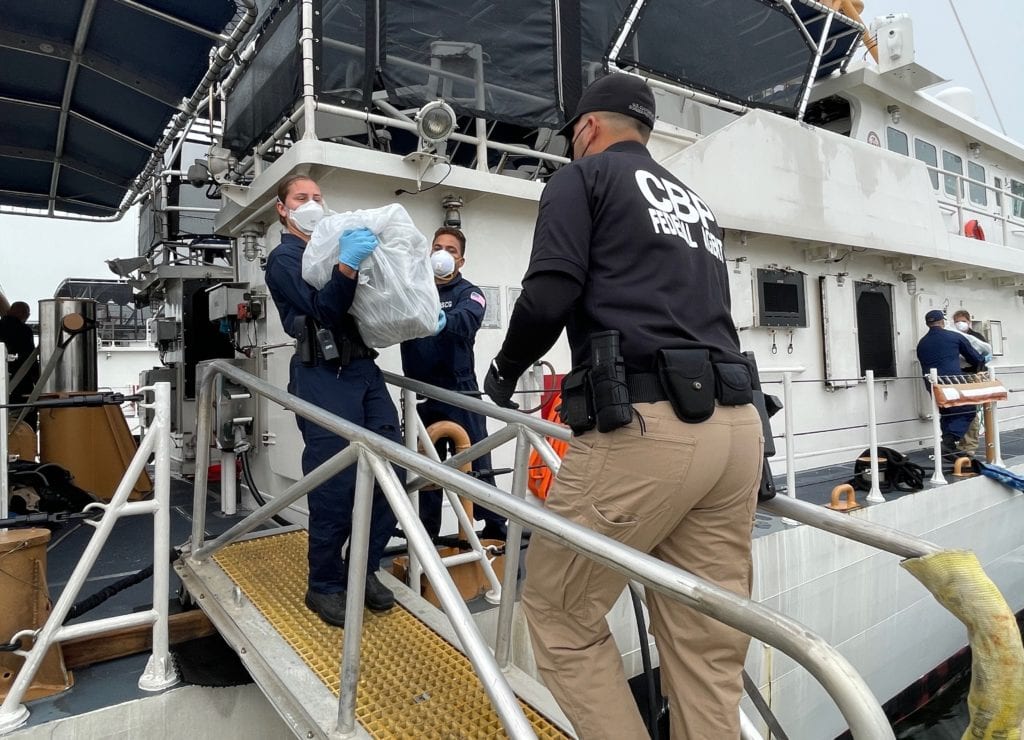
The crew of the Coast Guard Joseph Tezanos offloads nearly $15 million in cocaine and transfers custody of two suspected smugglers at Coast Guard Base San Juan July 12, 2021. U.S. COAST GUARD
SAN JUAN, Puerto Rico — The Coast Guard Cutter Joseph Tezanos crew offloaded nearly $15 million in seized cocaine and transferred custody of two male smugglers at Coast Guard Base San Juan Monday, following the interdiction of a go-fast vessel in Mona Passage waters near Mona Island, Puerto Rico, the Coast Guard7th District said in a July 13 release.
The interdiction resulted from multi-agency efforts in support of U.S. Southern Command’s enhanced counter-narcotics operations in the Western Hemisphere and coordination with the Caribbean Corridor Strike Force (CCSF). The United States Attorney’s Office for the District of Puerto Rico is leading the prosecution for this case.
During a routine patrol July 11, a Customs and Border Protection (CBP) Air and Marine Operations (AMO) Multi-Role Enforcement Aircraft (MEA) aircrew detected two men aboard a go-fast vessel suspected of drug trafficking. Coast Guard Cutter Joseph Tezanos, operating in the vicinity with a CBP AMO Officer onboard, diverted and responded in hot pursuit to interdict the suspect vessel.
Shortly thereafter, cutter Joseph Tezanos arrived on scene and interdicted the go-fast vessel with the assistance of the cutter’s small boat.
The crew of cutter Joseph Tezanos embarked the suspected smugglers and located loose packages aboard the 24-foot go-fast vessel, and they also recovered packages from the water that were jettisoned from the go-fast vessel. In total, the crew of Joseph Tezanos seized 502 packages of cocaine with a combined weight of approximately 1,104 pounds.
“I directly attribute the success of this interdiction to the close interoperability that the Coast Guard has with CBP and my crew’s phenomenal performance during the pursuit, boarding and towing of the go-fast vessel,” said Lt. Anthony Orr, Cutter Joseph Tezanos commanding officer. “It was a pleasure to work with the crew of the CBP aircraft, who vectored the cutter to intercept the go-fast vessel. Having a CBP Air and Marine Operations pilot onboard the cutter during the case proved very fruitful as the crew and pilot shared best practices, which can only help in future joint cases. As Joseph Tezanos completes her patrol, we return home with the pride that half a metric ton of cocaine will not make it to the streets. ”
“The Caribbean Air and Marine Branch values its partnerships that result in successful seizures like this one,” said Hector Rojas, Director of the Caribbean Air and Marine Branch. “Our agents will continue to use our advanced aeronautical and maritime capabilities to detect and interdict smuggling attempts throughout our coastal borders.”
Cutter Joseph Tezanos is a 154-foot fast response cutter homeported in San Juan, Puerto Rico.
General Atomics Continues On-Time Delivery of EMALS, AAG for CVN 79, CVN 80
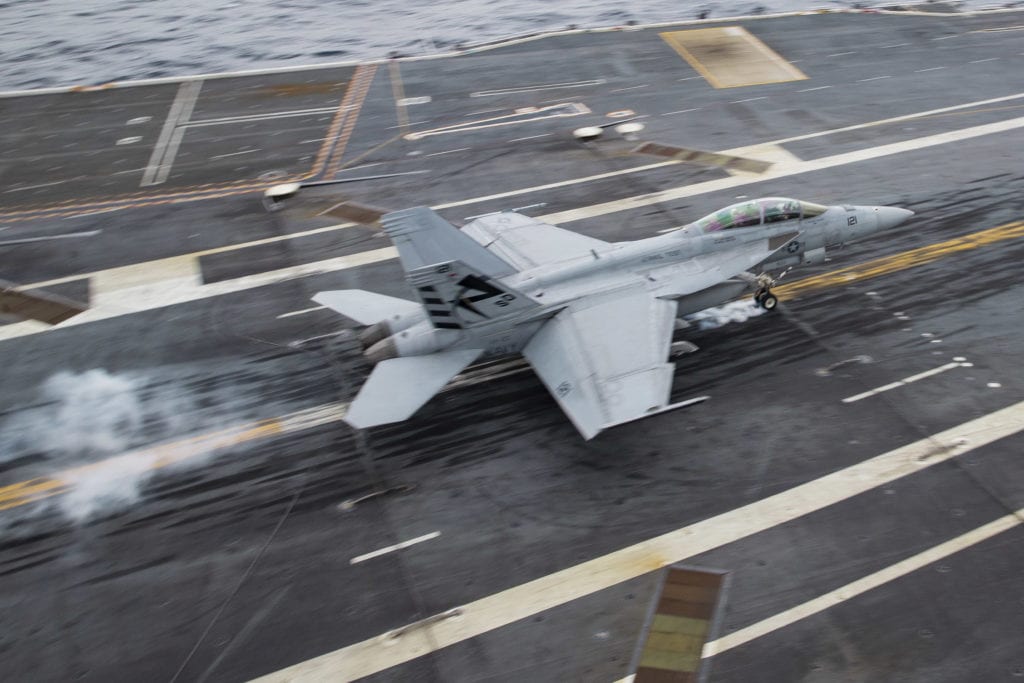
An F/A-18F Super Hornet, assigned to Air Test and Evaluation Squadron (VX) 23, lands on USS Gerald R. Ford’s (CVN 78) flight deck. Ford was conducting Aircraft Compatibility Testing to further test its Electromagnetic Aircraft Launch Systems and Advanced Arresting Gear. U.S. NAVY / Mass Communication Specialist Seaman Jesus O. Aguiar
SAN DIEGO — General Atomics Electromagnetic Systems (GA-EMS) announced July 12 it continues on-time delivery of the Electromagnetic Aircraft Launch System (EMALS) and Advanced Arresting Gear (AAG) for installation on the future Gerald R. Ford-class aircraft carriers USS John F Kennedy (CVN 79) and USS Enterprise (CVN 80). GA-EMS’ EMALS and AAG installed aboard USS Gerald R. Ford (CVN 78) recently completed successful at-sea operational testing during an 18-month Post Delivery Trial and Test (PDT&T) period.
“The effects of the pandemic during the past year have presented everyone with some incredible challenges, and we are proud of our team’s dedication and focus on delivering EMALS and AAG equipment for Ford-class carriers even under the most difficult of circumstances,” said Scott Forney, president of GA-EMS. “Under multiple contracts with the Navy, we continue to support CVN 78 sustainment requirements, and deliver EMALS and AAG for the next two Ford-class carriers now under construction, CVN 79 and CVN 80.”
“Multiple contract awards help us efficiently maximize manufacturing plans to ensure there are no gaps in production and we are able to maintain a stable supply chain and workforce to meet the deliverables schedule,” continued Forney. “We’ve delivered 97% of EMALS and AAG equipment for CVN 79, meeting the installation schedule. We also remain on track to support the CVN 80 construction schedule, having built, tested and delivered more than 25% of EMALS and AAG CVN 80 equipment to date. With that said, we remain poised to provide these same critical technologies as the Navy determines the EMALS and AAG contract and schedule requirements for the fourth Ford-class aircraft carrier, USS Doris Miller (CVN 81).”
GA-EMS recently announced that EMALS and AAG aboard CVN 78 achieved 8,157 successful aircraft launches and recoveries during the ship’s Independent Steaming Events. Over 400 pilots, including new student aviators, achieved their initial carrier qualifications or recertified their proficiency using EMALS and AAG. Both systems successfully completed Aircraft Compatibility Testing, which confirms the ability to launch and recover aircraft in the current naval air wing. The systems also provide greater flexibility over legacy systems to accommodate the future air wing, including both manned and unmanned aircraft.
U.S., U.K., Dutch Naval Forces Conduct Joint Exercise in Gulf of Aden
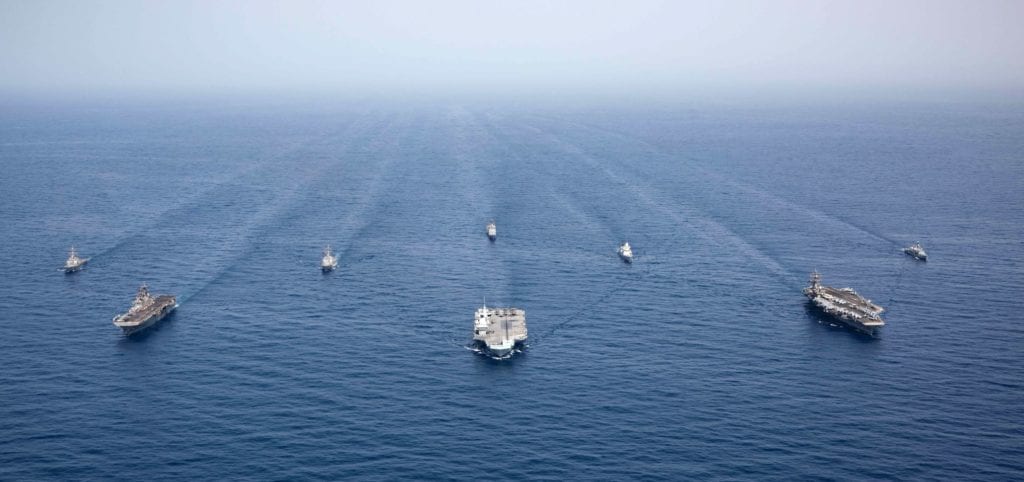
The combined, bilateral surface, air and sub-surface exercise was designed to enhance U.K., Dutch and U.S. maritime interoperability and demonstrate naval integration through a series of training scenarios. U.S. NAVY
GULF OF ADEN — The Queen Elizabeth (U.K.) and Ronald Reagan carrier strike groups (CSG), alongside the Iwo Jima amphibious ready group (ARG), conducted a large-scale joint interoperability exercise in the Gulf of Aden, July 12, Task Force 50 Public Affairs said in a release.
The combined, bilateral surface, air and sub-surface exercise was designed to enhance UK, Dutch and U.S. maritime interoperability and demonstrate naval integration through a series of training scenarios.
“Our team was proud to operate alongside the U.K. Carrier Strike Group during this unique opportunity to hone the full scope of our mutual capabilities,” said Rear Adm. Will Pennington, commander, Ronald Reagan CSG and Task Force 50. “By operating together at sea, we deepen our coalition partnerships and extend our global reach throughout the region’s critical waterways.”
Participating forces focused on the full spectrum of maritime warfare operations, practicing anti-air warfare, anti-surface warfare, and anti-submarine warfare tactics and procedures.
The crews exercised their abilities to conduct precision maneuvering, hunt simulated enemy submarines, provide layered defense against simulated air and surface threats, and conduct long range maritime strikes against simulated adversarial forces.
“The aircraft carrier is the ultimate expression of global maritime power,” said Commodore Steve Moorhouse, commander, United Kingdom Carrier Strike Group. “Queen Elizabeth, Ronald Reagan and Iwo Jima symbolize the might of the U.S. and UK partnership, and the ease with which our naval and air forces can combine here in the Gulf of Aden, or anywhere else in the world.”
This also marks the second time this year the Iwo Jima ARG has operated alongside the U.K. carrier strike group, following an exercise off the coast of Scotland in May.
“The Iwo Jima ARG remains in a high state of readiness to support our partners and allies as an effective amphibious force,” said Capt. Darren Nelson, commodore, Amphibious Squadron Four. “Operating with the Ronald Reagan and UK carrier strike groups allows us to better address common threats to regional security.”
Participating units included aircraft carrier HMS Queen Elizabeth (R 08) with embarked F-35B Lightning II Joint Strike Fighters from Royal Air Force 617 Squadron and U.S. Marine Corps Fighter Attack Squadron (VMFA) 211; aircraft carrier USS Ronald Reagan (CVN 76) with embarked Carrier Air Wing (CVW) 5 and Destroyer Squadron 15; amphibious assault ship USS Iwo Jima (LHD 7) and embarked 24th Marine Expeditionary Unit, anti-submarine frigate HMS Richmond (F 239); Dutch frigate HNLMS Evertsen (F 805); guided-missile destroyers USS The Sullivans (DDG 68) and USS Halsey (DDG 97); and guided-missile cruiser USS Shiloh (CG 67).
The Ronald Reagan CSG and Iwo Jima ARG are deployed to the U.S. 5th Fleet area of operations in support of naval operations to ensure maritime stability and security in the Central Region, connecting the Mediterranean and the Pacific through the western Indian Ocean and three strategic choke points.
Bollinger Christens Ocean Transport Barge Holland to Support Columbia SSBN Construction for General Dynamics Electric Boat
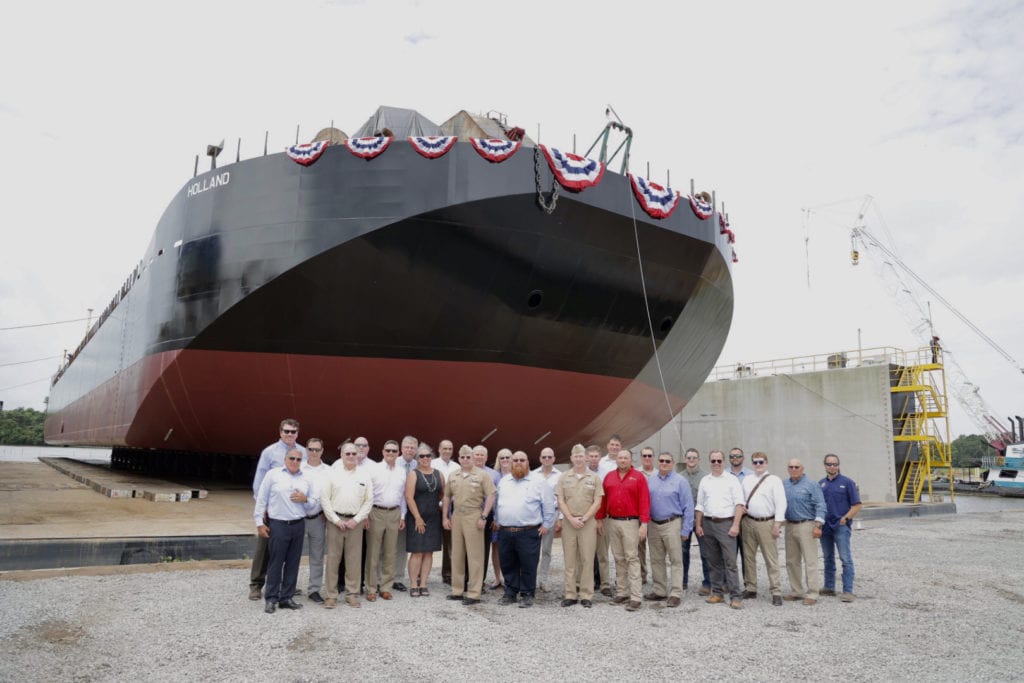
The Holland, a new ocean transport barge for General Dynamics Electric Boat. BOLLINGER SHIPYARDS
LOCKPORT, La. — Bollinger Shipyards LLC on Saturday, July 10, christened the Holland, an ocean transport barge for General Dynamics Electric Boat, Bollinger said in a release.
The Holland will support the construction and maintenance of the United States’ Columbia-class ballistic-missile submarines (SSBNs) and Virginia-class fast attack submarines. General Dynamics Electric Boat is the prime contractor on the design and build of the Columbia-class submarine, which will replace the aging Ohio-class SSBNs.
“Bollinger Shipyards is pleased to partner with General Dynamics Electric Boat to help meet the expanding needs of the United States’ Navy,” said Bollinger President and CEO Ben Bordelon. “We believe that in order to build 21st century American vessels, it requires 21st century American tools and equipment manufactured right here in the United States. The Bollinger management team and our skilled workforce are proud and look forward to continue supporting the efforts to modernize our Nation’s fleet.”
“The men and women of Electric Boat are proud of our long history in providing the world’s finest submarines to our Navy and our Nation,” said Kevin Graney, president, General Dynamics Electric Boat. “The Holland will play an integral role in our mission to design and deliver the Columbia class, the nation’s top strategic defense priority. It embodies the spirit of submarine designer John Holland, whose innovation, determination and commitment to excellence laid the foundation for modern submarine construction. We are thankful for the hard work and dedication of our fellow American shipbuilders at Bollinger that made today, and the continuing defense of our nation possible.”
”The recapitalization of the sea based strategic deterrent capability, the Columbia Class, is our Navy’s highest acquisition priority,” added Capt. Jon Rucker, program manager of the Columbia-class submarine program. “The Holland is an integral enabler in support of the construction and on time delivery of the Columbia Class to maintain the nation’s strategic deterrence capability. We recognize and appreciate the Bollinger team’s efforts to construct and deliver the Holland to support the Navy.”
In November 2019, General Dynamics Electric Boat selected Bollinger to construct the Holland, a 400-foot x 100-foot ocean transport barge. The concept and contract design was performed by the Bristol Harbor Group in Rhode Island, while Bollinger performed the detail design engineering at its Lockport, LA facility and construction at the Bollinger Marine Fabrication facility in Amelia, Louisiana.
Coast Guard Repatriates 23 Migrants to Cuba
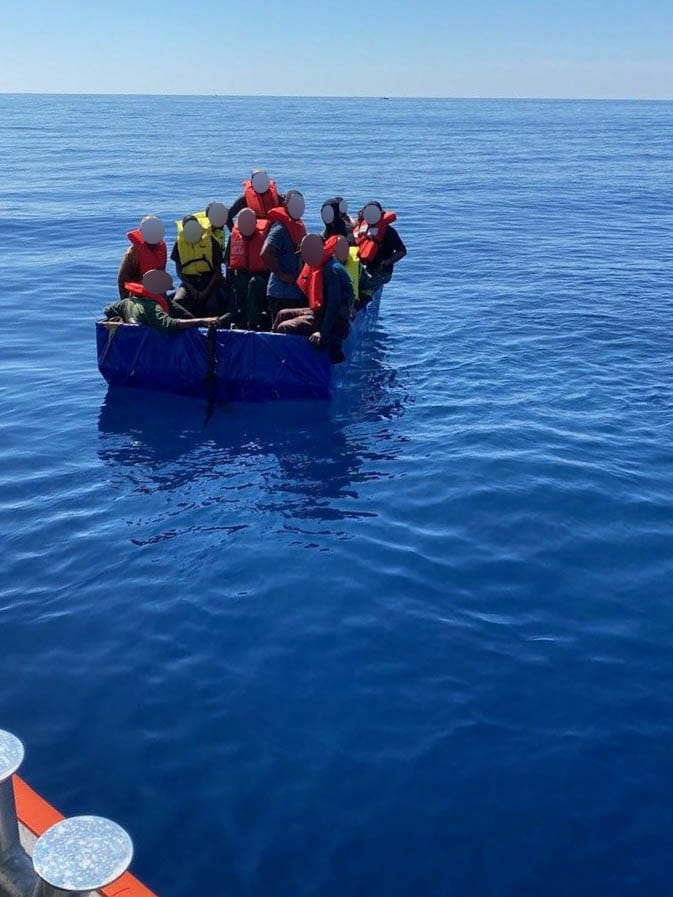
A Coast Guard Station Marathon boatcrew locates 15 migrants aboard a sailing vessel near Big Pine Key, Florida on July 3, 2021. Coast Guard Cutter Kathleen Moore’s crew repatriated 15 Cubans to Cuba, July 10, 2021. U.S. COAST GUARD
MIAMI — Coast Guard Cutter Kathleen Moore’s crew repatriated 23 Cubans to Cuba Saturday following an interdiction approximately 15 miles south of Big Pine Key and a search and rescue mission off the coast of Key West, the Coast Guard 7th District said in a July 10 release.
A good Samaritan reported a vessel with 15 people aboard to Coast Guard Sector Key West watchstanders at 10 a.m. Saturday. A Station Key West law enforcement crew arrived on scene and brought the migrants aboard. They are reported in good health.
“Navigating the Florida Straits on a good day is difficult and unpredictable in rustic vessels,” said Lt. Cmdr. Mario Gil, Coast Guard Liaison Officer, Cuba. “Daring these voyages during hurricane force winds and seas are treacherous and lives have a greater risk of being lost.”
Since Oct, 1, 2020, Coast Guard crews have interdicted 554 Cubans compared to:
5,396 Cuban Migrants in Fiscal Year 2016 1,468 Cuban Migrants in Fiscal Year 2017 259 Cuban Migrants in Fiscal Year 2018 313 Cuban Migrants in Fiscal Year 2019 49 Cuban Migrants in Fiscal Year 2020
Once aboard a Coast Guard cutter, all migrants receive food, water, shelter and basic medical attention. Throughout the interdiction, Coast Guard crew members were equipped with personal protective equipment to minimize potential exposure to any possible case of COVID-19.
Navy Details 2022 Ship Retirement Schedule
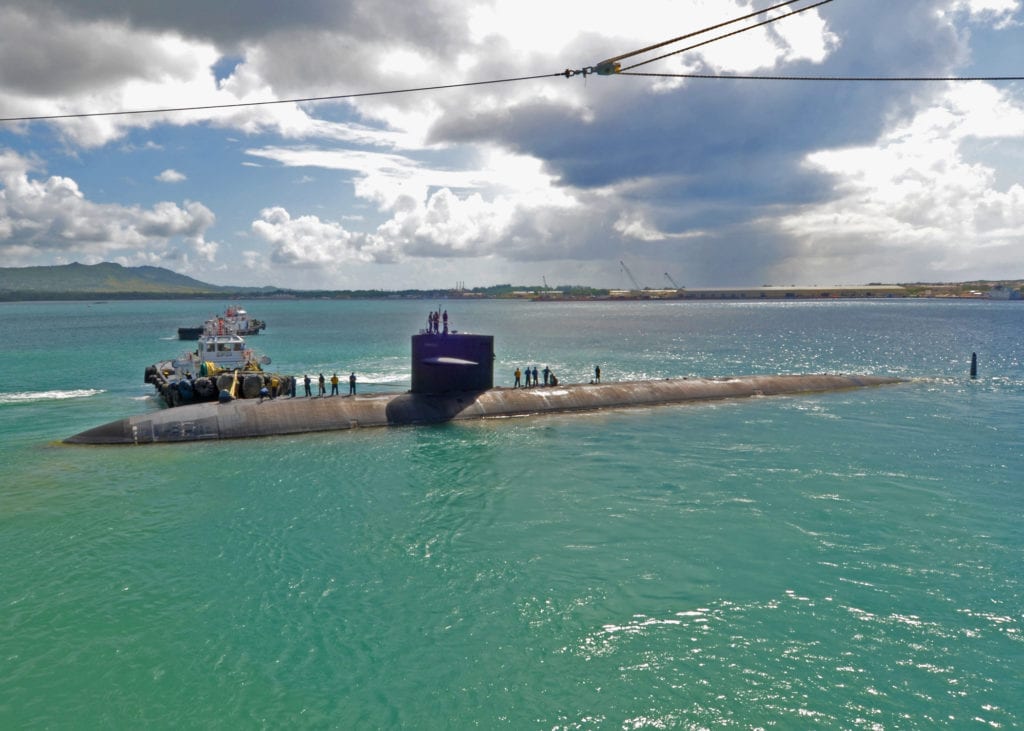
The Los Angeles-class attack submarine USS Oklahoma City (SSN 723), shown here in 2012, has been listed for recycling according to the Navy’s planned ship retirement schedule for fiscal 2022. U.S. NAVY / Mass Communication Specialist Seaman Chris Salisbury
ARLINGTON, Va. — The U.S. Navy has determined its planned ship retirement schedule for fiscal 2022. The list includes 22 ships, including 15 battle force ships.
In a July 2 administrative message, the Office of the Chief of Naval Operations announced the plans to decommission 19 ship ships from the fleet and remove from service three ships from the Military Sealift Command.
The list includes two Los Angeles-class attack submarines (SSNs); seven Ticonderoga-class guided-missile cruisers (CGs); five Cyclone-class coastal patrol ships (PCs) and four littoral combat ships (LCSs) — three Freedom-class and one Independence-class LCS. The PCs are forward deployed to the Persian Gulf; they are not considered battle force ships.
The Navy is proposing to retire seven Ticonderoga-class CGs during fiscal 2022, including two — USS Hue City and USS Anzio — which were not previously planned for retirement. The material condition of the cruisers’ hull and mechanical systems has attracted considerable concern while the cost of keeping the cruisers in service has risen.
Vice Adm. Jim Kilby, deputy chief of naval operations for Warfighting Requirements and Capabilities, testified June 17 before the Seapower and Projection Forces subcommittee of the House Armed Services Committee that retaining the seven CGs would cost roughly $5 billion across the Future Years Defense Plan. Retaining the ships for two years would cost more than $2.87 billion. He said the cost to modernize Hue City and Anzio alone would cost approximately $1.5 billion.
Extending the service lives of the cruisers “is costing more than we thought it would be,” he said. “Initially it was $2.4 billion, but we’re adding a lot of money to do that.”
The proposed cruiser retirements have been criticized by some in Congress as antithetical to growing the fleet to meet the demands of great power competition.
The decommissioning of some littoral combat ships also has attracted congressional attention, given that they are relatively new ships.
Congressional mark-ups of defense bills may challenge some of the proposed retirements.
The ships to be retired and the dates in 2022 by which they scheduled for retirement are listed below:
Ship Name Projected Inactivation Inactive Status
(All dates in 2022 except where noted)
USS Tempest (PC 2) March 29 Foreign Military Sales
USS Typhoon (PC5) March 14 Foreign Military Sales
USS Squall (PC 7) April 10 Foreign Military Sales
USS Firebolt (PC 10) March 1 Foreign Military Sales
USS Whirlwind (PC 11) April 24 Foreign Military Sales
USS San Jacinto (CG 56) Sept. 30 Reserve
USS Lake Champlain (CG 57) March 31 Reserve
USS Monterey (CG 61) Feb. 22 Reserve
USS Hue City (CG 66) March 31 Reserve
USS Anzio (CG 68) March 31 Reserve
USS Vella Gulf (CG 72) Feb. 18 Reserve
USS Port Royal (CG 73) March 31 Reserve
USS Fort Worth (LCS 3 March 31 Reserve
USS Coronado (LCS 4) March 31 Reserve
USS Detroit (LCS 7) March 31 Reserve
USS Little Rock (LCS 9) March 31 Reserve
USS Whidbey Island (LSD 41) April 30 Reserve
USS Providence (SSN 719) Dec. 2 (2021) Recycle
USS Oklahoma City (SSN 723) June 21 Recycle
USNS Apache (T-ATF 172) June 30 Disposal
USNS 1st LT Harry L. Martin (T-AK 2015) Dec. 30 Disposal
USNS LCPL Roy M. Wheat (T-AK 3016) Dec. 31 Disposal