Indonesian Navy Finds Broken Hull on Bottom, Declares Submarine KRI Nanggala Lost
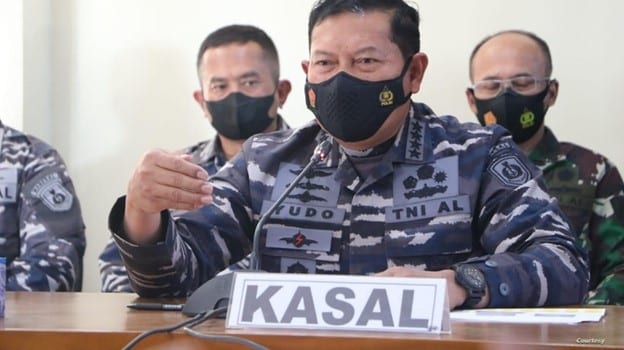
Navy Chief Yudo Margono talks to the media on the retrieval of items from the missing KRI Nanggala sub, at Ngurah Rai Military Air Base in Bali, Indonesia, April 24, 2021. INDONESIAN MILITARY / VOICE OF AMERICA

The Indonesian navy has changed that status of its submarine, KRI Nanggala (402), and her crew of 53, from “sub miss” to “sub sunk.”

Indonesian authorities said the damaged submarine has been located. 

“The KRI Nanggala is divided into three parts, the hull of the ship, the stern of the ship, and the main parts are all separated, with the main part found cracked,” said Indonesian navy Chief of Staff Yudo Margono.

“We received underwater pictures that are confirmed as the parts of the submarine, including its rear vertical rudder, anchors, outer pressure body, embossed dive rudder and other ship parts,” said military chief Hadi Tjahjanto, speaking to the media in Bali on Sunday.

KRI Nanggala went missing during a torpedo firing exercise on Wednesday in waters between Bali and Java, Indonesia.  A massive search effort was conducted by the navy, known officially as the Tentara Nasional Indonesia-Angkatan Laut (TNI-AL). Other nations, including the U.S., dispatched ships, aircraft, personnel to help in the search and rescue of the crew.

Aircraft searching the area noted an oil slick was which was suspected to have come from the submarine. “That oil spill location is the last time we had contact with the submarine,” Indonesian navy spokesman First Adm. Julius Widjojono said.

In addition to the oil slick, confirming the likelihood that the submarine broke apart was the retrieval of several items that were shown to journalists. A container of grease used for periscopes, part of a torpedo launcher, part of a metal tube, prayer mats and fuel were recovered were about two miles from the where the submarine commenced its dive before it went missing. Later a life vest from the sub was found. The water at the location where the floating debris was found is 2,788 feet.

There were no reports of loud underwater noises that would point to an explosion, but Margono said the heavy pressure on the vessel probably caused the hull to lose integrity, permitting some items to escape and rise to the surface.

“With the authentic evidence we found believed to be from the submarine, we have now moved from the ‘sub miss’ phase to ‘sub sunk,’” Margono said at a press conference. 

Margono later said sonar detected a submarine-like object at 850 meters (2,790 feet), far below the Nanggala’s safe operating depth.

“It can be stated that the KRI Nanggala has sunk and all of its crew have died,” military chief Marshal Hadi Tjahjanto told reporters.
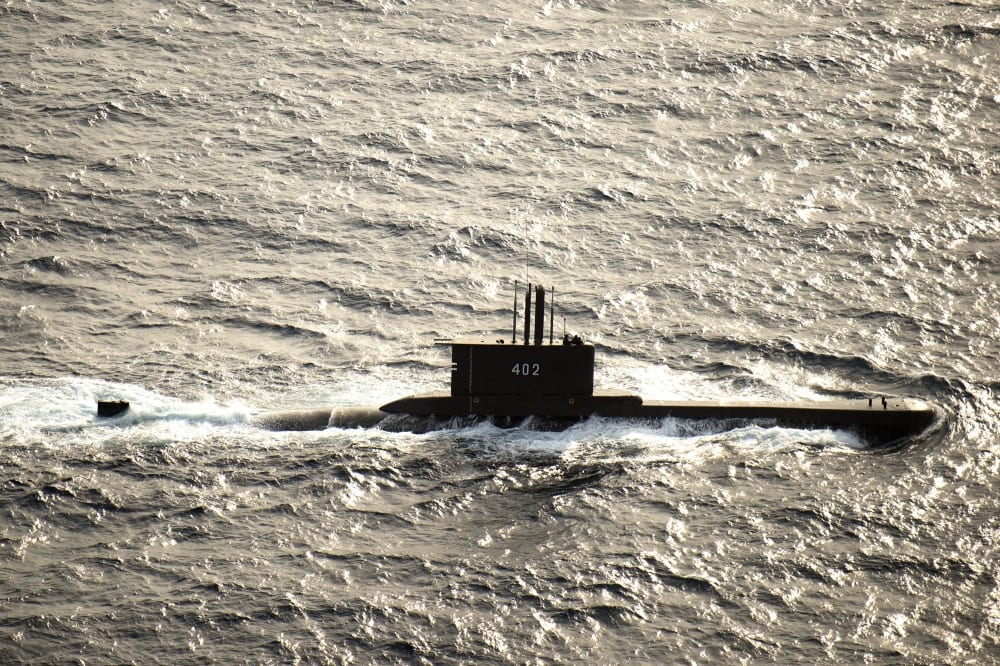
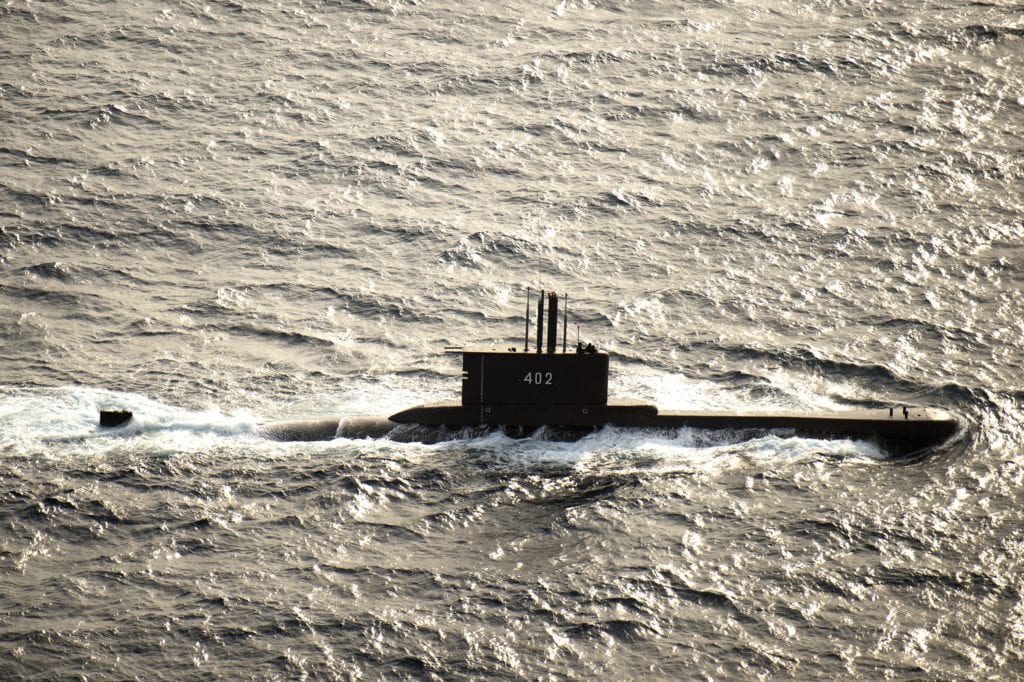
The Indonesian submarine KRI Nanggala (402) participates in Cooperation Afloat Readiness and Training (CABAT) in 2015. U.S. NAVY / Mass Communication Specialist 3rd Class Alonzo M. Archer

Although initial reports stated the submarine was last reported at a location north of Bali, a later statement from the Indonesian Ministry of Defense said the sub was lost in the Bali Strait, between the islands of Java and Bali that connects to the Indian Ocean to the south and Bali Sea to the north.

The search effort was coordinated from the naval base at Banyuwangi, on the eastern tip of Java, the most populated of Indonesia’s 17,000 islands.

Earlier in the search effort, an Indonesian ship, KRI Rimau, detected a very strong magnetic signature, in an area consistent with the submarine’s last known position, later confirmed by survey ship, KRI Riguel.

Before the submarine was confirmed sunk, a number of nations sent help or offered to support the search effort. Singapore, Malaysia and India dispatched submarine rescue ships and two Australian warships sailed to join the search efforts.

“HMA Ships Ballarat and Sirius, both presently at sea on separate regional deployments, are making best speed for the search area,” said a Friday press release from Australia’s defense department.

Rear Adm. Mark Hammond, of the Australian task force, added that his thoughts were with the submariners of KRI Nanggala, their families and the Indonesian people. “As always, we stand ready to assist our fellow mariners in the Indonesian navy,” he said.

The U.S. Navy sent a P-8 Poseidon maritime patrol aircraft to support the effort.

“It’s a sophisticated platform that could be helpful in leading the Indonesian government to a better idea of the location,” said Pentagon spokesman John Kirby.

Secretary of Defense Lloyd J. Austin III spoke with Indonesian Defense Minister Prabowo Subianto to inform him that the aircraft was coming and provide any additional assistance that might be needed, Kirby told reporters.

In addition to the P-8, the U.S. sent three C-17 aircraft carrying boats and underwater search and rescue equipment from Dover Air Base on Friday.

Indonesian President Joko “Jokowi” Widodo directed that the search and rescue efforts for Nanggala and crew was a national priority. “To the families of the crew, I understand your feeling right now. However, the government has done and will continue to do its utmost to search and rescue all crew on board,” he said while the search was underway.

“I am deeply saddened to learn the Indonesian submarine lost at sea earlier this week is now believed sunk. Our thoughts and prayers are with the Indonesian navy, their Sailors and all those families who lost loved ones,” said Chief of Naval Operations, Adm. Mike Gilday. “As Sailors, we share a love for the sea and have a bond of fellowship with all who sail on it. We have a respect for its dangers and also understand the importance of the worlds’ oceans to our collective way of life.

“No doubt, Indonesia is a good friend and partner. Despite this tragic loss, it is my hope that we will continue to operate together in support of a free and open Indo-Pacific,” Gilday said.

The mission now changes from rescue to recovery.


Coast Guard Repatriates 18 Migrants to the Dominican Republic

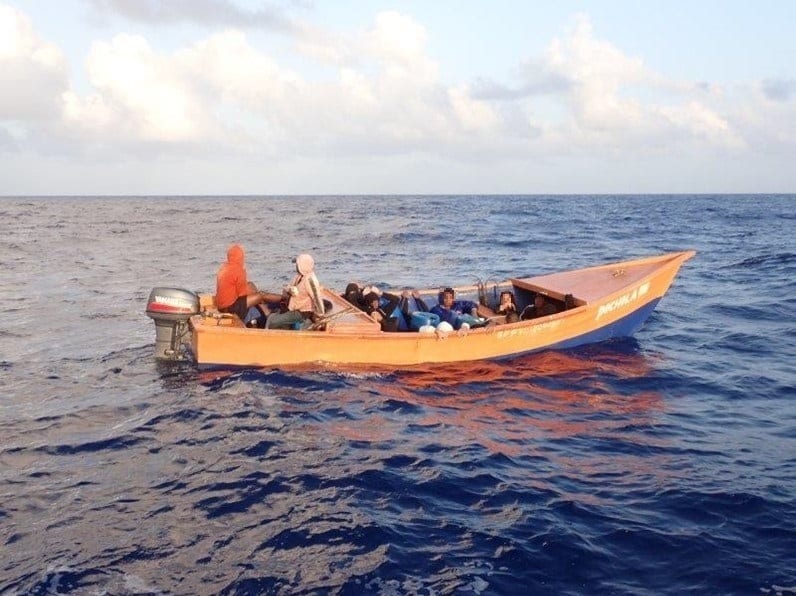
A makeshift vessel, with 18 migrants aboard interdicted in Mona Passage waters by the crew of the Coast Guard Cutter Joseph Tezanos April 20, 2021. The migrants, 17 men and a woman, who claimed to be Dominican Republic nationals, were repatriated to a Dominican Republic Navy vessel just off the Dominican Republic April 22, 2021. U.S. COAST GUARD

SAN JUAN, Puerto Rico — The Coast Guard Joseph Tezanos crew repatriated 18 migrants to a Dominican Republic Navy vessel April 22, following the interdiction of migrant voyage in Mona Passage waters between the Dominican Republic and Puerto Rico, the Coast Guard 7th District said in an April 22 release. 

The migrant group consists of 17 men and a woman, who claimed to be Dominican Republic nationals. 

The interdiction is the result of ongoing efforts by Caribbean Border Interagency Group (CBIG) partner agencies to combat illegal migrant smuggling. 

The aircrew of a Customs and Border Protection maritime patrol aircraft detected the illegal voyage on April 20; a grossly overloaded 25-foot makeshift vessel in waters northwest of Aguadilla, Puerto Rico. The Coast Guard Cutter Joseph Tezanos responded and, with the assistance of the cutter’s small boat, stopped the migrant vessel. The Joseph Tezanos crew embarked the migrants due to safety of life at sea concerns and destroyed the makeshift vessel as a hazard to navigation. 

Prior to embarking, the Joseph Tezanos crew provided the migrants with lifejackets.  Once aboard the cutter, the migrants received food, water and basic medical attention. 

“These 18 migrants are among the hundreds of others who risk their lives yearly to enter Puerto Rico illegally on makeshift grossly overloaded vessels,” said Lt. Anthony Orr, Coast Guard Cutter Joseph Tezanos commanding officer. “I could not be prouder of my crew for working efficiently and tirelessly to care for these migrants and ensure their safe repatriation.  The success of this operation was due to the impeccable teamwork that we had with CBP, Coast Guard Air Station Borinquen, and Sector San Juan’s Command Center and Enforcement Division.” 

Cutter Joseph Tezanos is a 154-foot fast response cutter homeported in San Juan, Puerto Rico. 


Unmanned Capabilities Front and Center During Naval Exercise

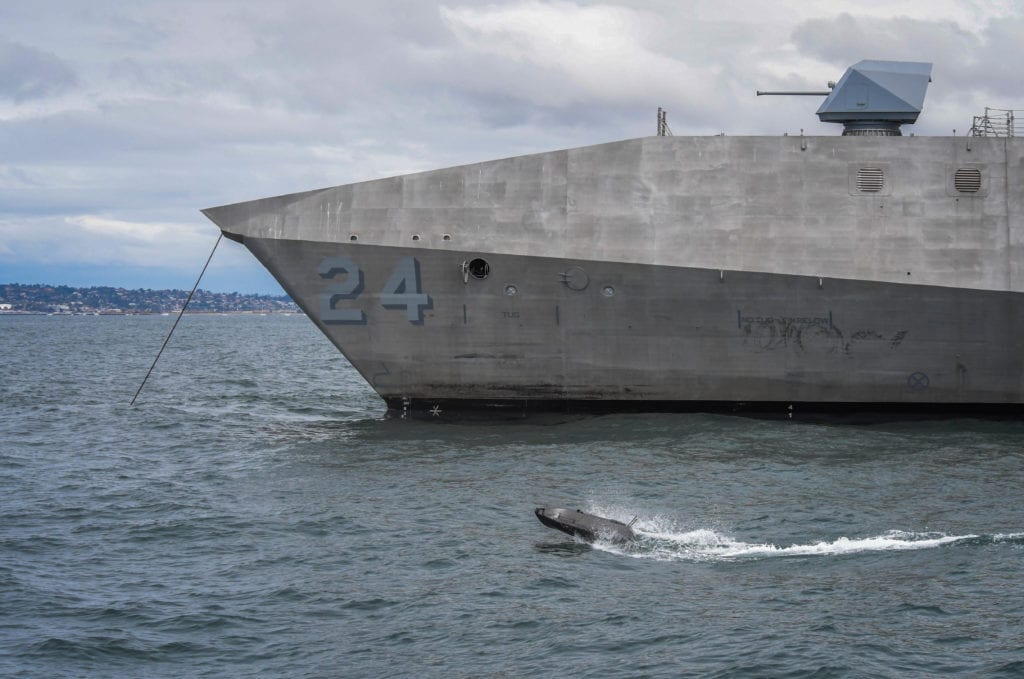
An ADARO unmanned system interacts with the Navy’s newest Independence-variant littoral combat ship USS Oakland (LCS 24) during U.S. Pacific Fleet’s Unmanned Integrated Battle Problem (UxS IBP) 21. UxS IBP 21 integrates manned and unmanned capabilities into challenging operational scenarios to generate warfighting advantages. U.S. NAVY / Mass Communication Specialist 2nd Class Alex Perlman

ARLINGTON, Va. — Chief of Naval Research Rear Adm. Lorin Selby declared “the state of our naval unmanned capabilities is truly unmatched,” and vowed continued support for the nation’s ongoing transition to a hybrid manned-unmanned force in the future, the Office of Naval Research (ONR) Corporate Strategic Communications said in an April 22 release. 

Speaking during a visit to San Diego for the U.S. Pacific Fleet-led Unmanned Integrated Battle Problem 21 (IBP21), Selby said the exercise, which puts into operation different unmanned vehicles “Above the sea, on the sea and below the sea,” demonstrates that America’s growing focus on autonomous capabilities is showing impressive results. 

“We are not yet where we want to be,” said Selby, “but we are getting closer. As our potential adversaries go all-in on unmanned platforms, we must and will maintain a dominant force that can meet and defeat any challenge.” 

During the exercise, a large number of multi-domain unmanned platforms — including unmanned aerial, surface and underwater vehicles (UAVs, USVs and UUVs, respectively) — are being put into real-world, “blue-water” environments, working in sync with manned platforms in actual combat drills designed to support Pacific Fleet objectives in the Indo-Pacific region. 

Many of the platforms in IBP21 are supported by the Naval Research Enterprise (NRE), which Selby commands. Comprising the ONR; the Naval Research Laboratory; and the Office of Naval Research Global (ONR Global), the NRE is tasked with providing the capabilities and long-term vision ensuring U.S. naval dominance today and into the future. 

While many platforms in IBP21 are classified, officials are highlighting the Medium Displacement Unmanned Surface Vehicles (MDUSV) Sea Hunter and its new sister craft, Sea Hawk, as well as a long-endurance UAVs, all of which can be used for surveillance, anti-submarine warfare and other missions. 

Sea Hunter is already a proven player in the Navy’s unmanned portfolio. In 2019, the vessel completed an autonomous trip from San Diego to Pearl Harbor, a distance of over 2,000 nautical miles, and returned, demonstrating credible and relevant naval capability. 

Both MDUSVs can host multiple payloads and perform multiple missions to support Sailor and Marine objectives, and both are seen as game-changers.  

Indeed, the performance of many new unmanned technologies are leading the Navy and Marine Corps to rethink concepts of operations, as noted in the widely publicized naval document “Unmanned Campaign Framework,” recently released by the Department of the Navy.  

The Unmanned Campaign Framework notes autonomy will complement, not replace, manned assets, and will provide warfighters far more options in combat.   

Dr. Marcus Tepaske, who leads ONR Global’s Experimentation and Analysis program and is coordinating many platforms in use during IBP21, confirmed naval unmanned capabilities are accelerating. He said these kinds of large-scale exercises are essential to ensure what works in theory will work in the fleet. 

“The best test you can put a technology through is one where the warfighters get to work with it,” Tepaske said. “Real-world applications are messier, dirtier, wetter and absolutely more beneficial than anything we can test in a lab. “Getting the warfighters’ feedback on using these unmanned systems will be one real measure of success for IBP21.” 

Coordinating multi-domain manned and unmanned teaming efforts with so many different systems is in itself a daunting challenge. That job is being led by Pacific Fleet crews aboard USS Michael Monsoor (DDG-1001), one of three Zumwalt-class guided missile destroyers with unique advanced capabilities for command and control.  

Ultimately, experts say, autonomous systems are here to stay. 

Dr. Jason Stack, ONR’s technical director and autonomy lead, is encouraged by the forward thinking and real-world forward movement represented by IBP21. Intelligent autonomous systems, he said, will be an essential part of the Navy and Marine Corps in the near term.  

“When you read the Unmanned Campaign Framework, the serious challenge we face from well-funded, highly-motivated, competitive naval forces around the world — all accelerating their autonomous capabilities — is clear,” he said. 

Stack noted that the U.S. and allied partners have a more robust commitment to the ethical use of unmanned systems and artificial intelligence when compared to some other nations.   

“Our goal is to operationally integrate and continuously improve the types of intelligent and autonomous technologies that Pacific Fleet is testing right now,” he said. “We will do this ethically and responsibly by always ensuring our Sailors and Marines can exercise the appropriate levels of human judgement over our machines. This will be our enduring competitive advantage.”  

The IBP21 exercise is the initial step in the Navy’s commitment to operational experimentation with autonomous systems in the fleet. Following its completion, the Navy and Marine Corps will assess what worked, what didn’t, and how to accelerate unmanned capabilities for the fleet and force. 


Logos Technologies Successfully Tests WAMI Sensor on RQ-21A Blackjack

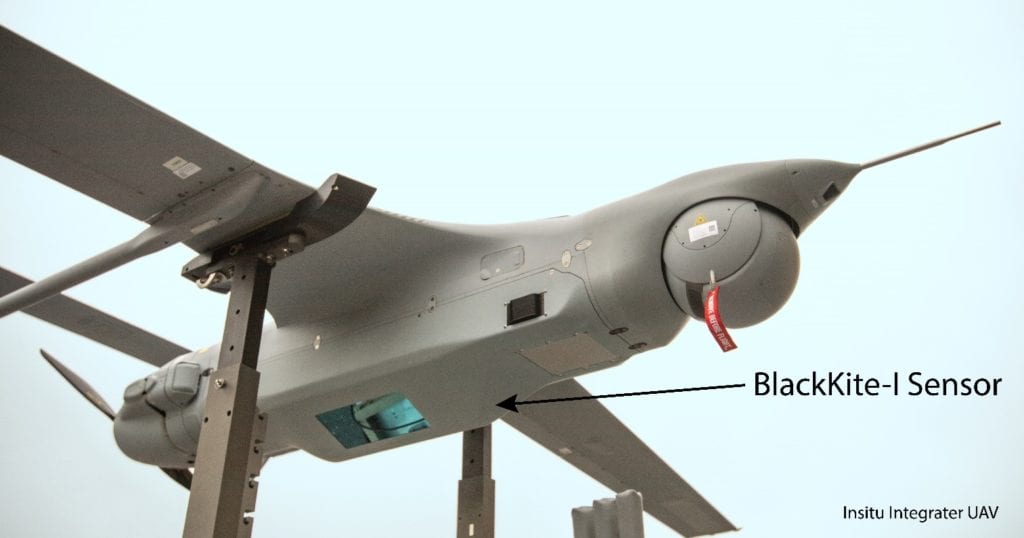
The BlackKite-I sensor on an Insitu Integrator unmanned aircraft system. LOGOS TECHNOLOGIES

FAIRFAX, Va. — Logos Technologies LLC successfully flew its wide-area motion imagery (WAMI) sensor aboard an RQ-21A Blackjack unmanned aircraft at a test range in Boardman, Oregon, the company said in an April 22 release. 

The two-week-long test — which included preparatory groundwork in Bingen, Washington — comes on the heels of a $5.3 million contract the U.S. Naval Air Systems Command had recently awarded to Logos, to develop more WAMI sensors for Navy and Marine users. 

“We are very excited by our recent test aboard the RQ-21A Blackjack,” said Doug Rombough, vice president for Business Development at Logos Technologies. “Our ongoing effort to develop an ultra-light WAMI capability for the Blackjack and other small, tactical unmanned aircraft is clearly paying off.” 

Logos has created a U.S. military version of BlackKite, currently called Cardcounter, an ultra-light (26 pounds) infrared WAMI system developed by Logos. Despite its low SWaP, BlackKite can detect and track in real time every significant target moving within a city-sized area, giving tactical operators a powerful, hereto unheard of, capability. 

In addition, thanks to the WAMI system’s multi-modal edge processor — which can store six or more hours of mission data — users on the ground can also access recorded imagery for on-the-fly forensic analysis. 

“No military in the world has anything like the Logos WAMI sensor on their tactical unmanned aircraft,” said Rombough. “This WAMI system views and records the entire area and can stream multiple real-time and recorded video ‘chip-outs’ down to handheld devices.” 

Logos was first tasked with converting their BlackKite system to meet government requirements in September 2019, with two units being produced for the U.S. Naval Air Systems Command. The follow-on $5.3 million development contract and March test flight are part of the same effort.  

“In total, we will be producing four modular WAMI systems for the Navy,” Rombough said, “with the hope that this will open the door for a wider U.S. military adoption of WAMI, both for the Blackjack and other Group 3 unmanned aircraft.” 


NSWCDD Engineers Expand to Impact Navy Vertical Launch System Capabilities

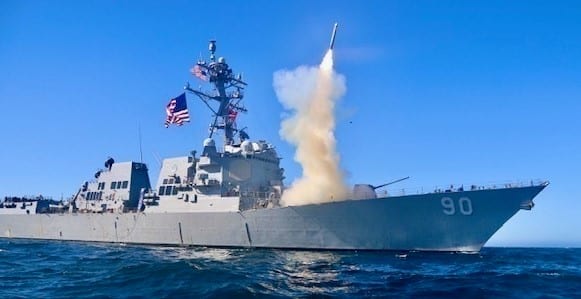
he guided-missile destroyer USS Chafee (DDG 90) launches a Block V Tomahawk, the weapon’s newest variant, during a three day missile exercise. This event marked the first time a Block V Tomahawk missile was operationally tested, marking the Navy’s transition to a more advanced capability for the fleet. Block V includes an upgrade that will enhance navigation performance and provide robust and reliable communications. U.S. NAVY / Ensign Sean Ianno

DAHLGREN. Va. — Scientists and engineers at Naval Surface Warfare Center Dahlgren Division (NSWCDD) are developing and delivering upgrades to the Navy’s Vertical Launch Systems (VLS), improving the fleet’s anti-air, ship self-defense, ballistic-missile defense and land-attack capabilities despite the COVID-19 pandemic, the NSWCDD said in an April 23 release.  

What’s more, NSWCDD hired new software and test engineers to support the continuous increase in VLS upgrades since the command’s maximum telework policy took effect in March 2020.  

“As the Vertical Launch System grows into other platforms, it has created more work opportunities in our branch,” said Felix Lopez, NSWCDD Maritime Weapons & Launcher Systems Integration branch head. “As a result, we knew we had to grow the team.”  

New work opportunities within the branch include supporting capability upgrades as well as the continued authorization and certification of the Mk41 and Mk57 VLS for shipboard test events and tactical operations.  

Lisa Haas, an NSWCDD engineer and the acting certification official for MK 41 and MK 57 VLS, said she has never seen the branch and its VLS programs busier in her 31 years at NSWCDD.  

“Over the last three years, we have had more changes going into our programs, more capability upgrades than we have ever had, and it’s impacting more pieces of our system than ever,” said Haas.  

The Mk41 is a highly adaptable canister launching system capable of dispatching missiles for every threat in naval warfare. The system’s adaptability enables myriad upgrades, earning its place as one of the fleet’s most significant defense capabilities.  

These upgrades keep NSWCDD — the sole Certification Agent and Technical Direction Agent — busy.  

Some recent projects included upgrades to Mk41 to support the launch of Standard Missile, Evolved Sea Sparrow Missile and Tomahawk Missile variants. The recent upgrades in support of the Tomahawk Weapon System were so comprehensive that every ship in the U.S. Navy equipped with the Mk41 VLS is a candidate to receive the Tomahawk capability upgrades.  

To keep up with these sweeping changes that affect such a large part of the fleet, Lopez said the team was due for a hiring effort when he came aboard as branch head in 2019.  

“We had an issue with increasing tasking while our staffing remained about the same. This triggered hiring left and right,” said Lopez, who brought on several software and test engineers in the last year. “It’s been a challenge, but we’re doing quite well. Every time you get new personnel, you have to train them. The subject matter experts have to continue doing their job, but they also have to allocate time to train new personnel and they’ve been very effective at that.”  

Haas, one such VLS expert on the team, said the pandemic-driven telework presented challenging but navigable obstacles in training the new recruits.  

“It’s been more challenging to train new folks because they can’t be embedded in the middle of our large technical group with all the knowledge right there for them,” said Haas. “But we can get them approved to be on base a little more often so that we can directly interface with them. It’s very important to get new folks [on base] so that they can begin to feel part of the team and get that sense of loyalty that you get when you work with a team and a sense of pride in what you’re doing.”  

This sense of pride that comes along with working in VLS is apparent in talking to Haas and Lopez. Both reference the spirited atmosphere surrounding the team and are quick to praise both the new recruits and the seasoned professionals that have been working with VLS at Dahlgren for years.  

“A lot of folks in our group have been around a long time – they are very knowledgeable, capable and proactive,” said Haas. “They know what the job is and they get it done.”  

When getting the job done means supporting a substantial percentage of our warfighters’ naval defense capability, it takes a dedicated and multidisciplinary team of experts. From software engineers and computer scientists to mechanical engineers and safety professionals, the team at NSWCDD continues to support the fleet’s capabilities while collaborating effectively to meet the needs of the U.S. Navy.  

“VLS works together as a team very well,” said Haas after rifling off more than a handful of names of teammates and partners that led to the branch’s success in the last three years. “It’s absolutely amazing the engineering that goes into the system, how it all works together and works together rather well. It’s impressive.” 


Navy to Christen Guided-Missile Destroyer Lenah Sutcliffe Higbee

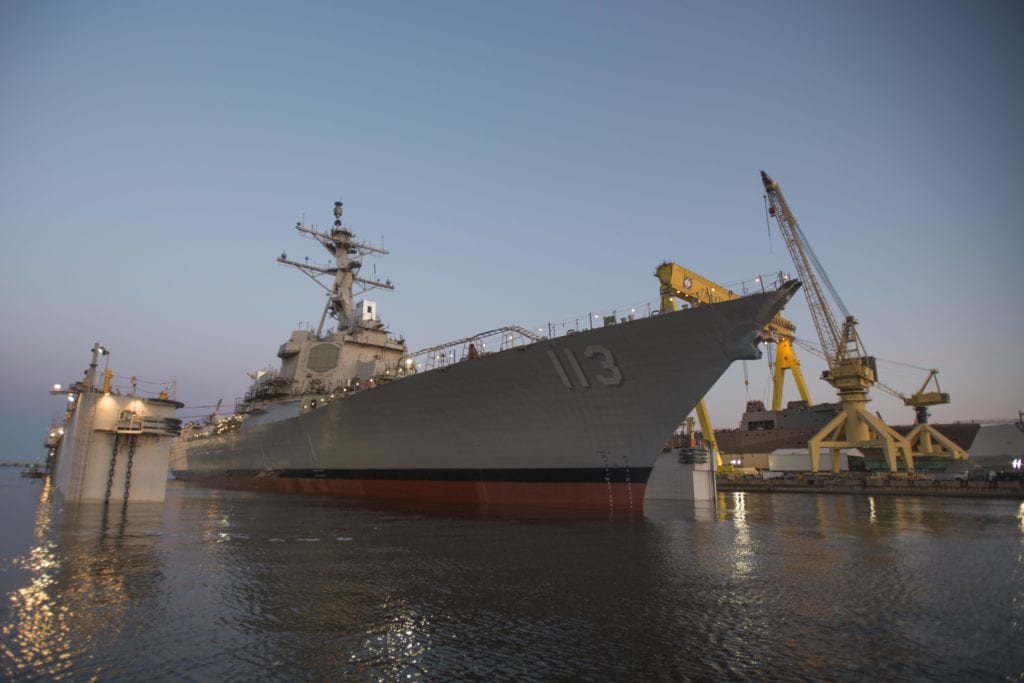
The Navy will christen its newest Arleigh Burke-class guided-missile destroyer, the future USS Lena Sutcliffe Higbee (DDG 123), on April 24. It is a FLight IIA destroyer, similar to the USS John Finn, the first Flight IIA Arleigh Burke class (DDG 51) ship, shown here. HUNTINGTON INGALLS INDUSTRIES

ARLINGTON, Va. — The U.S. Navy will christen its newest Arleigh Burke-class guided missile destroyer, the future USS Lenah Sutcliffe Higbee (DDG 123), during a 6:30 p.m. CDT ceremony Saturday, April 24, in Pascagoula, Mississippi, the service said in an April 23 release. 

The ship’s namesake, Lenah Sutcliffe Higbee, served as the second superintendent of the Navy Nurse Corps in 1911, and was also the first living woman recipient of the Navy Cross. When she entered naval service in 1908, she was one of the first 20 women, known as the “Sacred Twenty,” to join the newly established Navy Nurse Corps and contributed her nursing skills to the Navy during the First World War. This is the second ship named after Higbee. The first, USS Higbee (DD 806), was the first combat warship named after a female member of the U.S. Navy. 

Ray Mabus, 75th secretary of the Navy, will deliver the christening ceremony’s principal address. Jay Stefany, acting assistant secretary of the Navy (Research, Development and Acquisition) and Rear Adm. Cynthia Kuehner, commander, Naval Medical Forces Support Command, will also provide remarks. In a time-honored Navy tradition, the ship’s sponsors, Louisa Dixon, Virginia Munford and R. Pickett Wilson, will christen the ship by breaking a bottle of sparkling wine across the bow. 

“The future USS Lenah Sutcliffe Higbee will serve for decades as a reminder of Ms. Higbee’s service to our nation and her unwavering support of a strong and healthy Navy and Marine Corps team,” said Acting Secretary of the Navy Thomas Harker. “This ship honors not only her service but that of all of our Navy nurses who support the strength and wellbeing of our service members and their families.” 

The ship will be the 73rd Arleigh Burke-class destroyer and one of 20 currently under contract for the DDG 51 program. The ship is configured as a Flight IIA destroyer, which enables power projection and delivers quick reaction time, high firepower, and increased electronic countermeasures capability for anti-air warfare. The future USS Lenah Sutcliffe Higbee will be 509.5 feet long and 59 feet wide, with a displacement of 9,496 tons. It will be homeported in San Diego. 


STATCOM Chief Defends Low-Yield Warhead on Submarine-Launched Ballistic Missiles

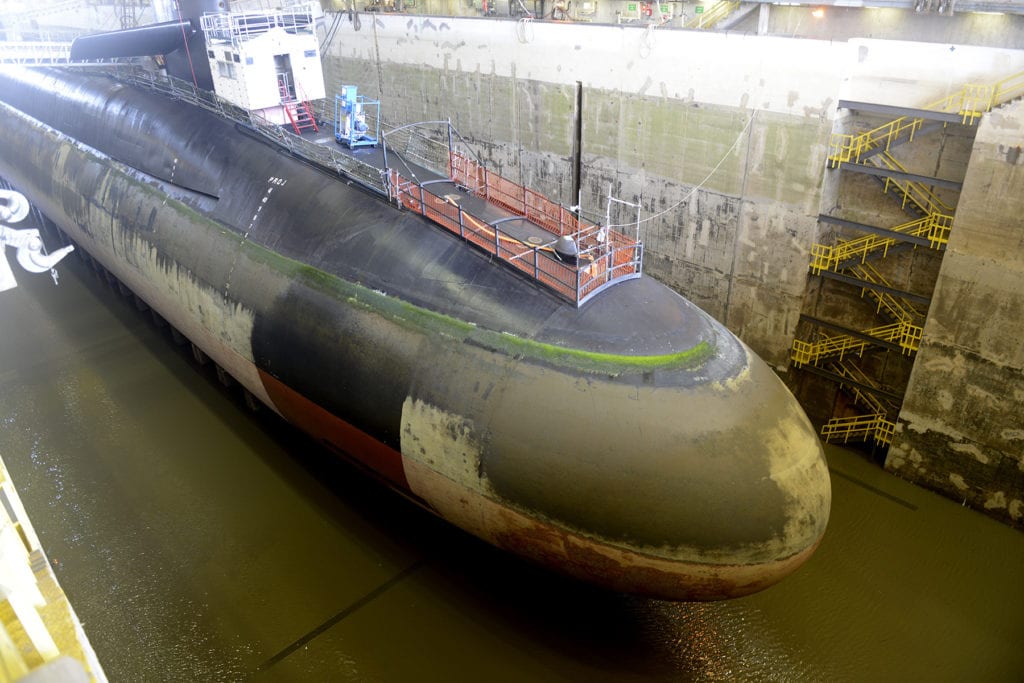
The Ohio-class ballistic-missile submarine USS Tennessee (SSBN 734) (Blue) arrives at the Trident Refit Facility (TRF) dry dock berthing at Naval Submarine Base Kings Bay, Ga., for a planned maintenance period, August 13. Tennessee is one of five ballistic-missile submarines stationed at the base and is capable of carrying up to 20 submarine-launched ballistic missiles with multiple warheads. U.S. NAVY / Mass Communication Specialist 1st Class Ashley Berumen

ARLINGTON, Va. — The commander of the nation’s strategic deterrent forces again defended the low-yield nuclear warhead that the Navy has deployed at sea on Trident submarine-launched ballistic missiles on board ballistic-missile submarines (SSBNs). This time he cited analysis to support the deployment. 

Adm. Charles A. Richard, commander, U.S. Strategic Command (STRATCOM), testified April 22 before the Strategic Forces subcommittee of the House Armed Services Committee (HASC) on the status of the nation’s strategic forces. 

“Within the last year, STRATCOM started formally measuring risk of strategic deterrence failure,” Richard said. “This is a formal risk assessment designed to make sure that we are analytically rigorous in all the things that we do, acknowledging that this is fundamentally trying to measure a subjective process, the decision making of another country. Our assessment is that the deployment of a low-yield [warhead] improved the risk of strategic deterrence, i.e., it lowered it because of the deterrent effect it achieved.”   

The submarine-launched low-yield warhead became a requirement noted in the 2018 Nuclear Posture Review. The result was the W76-2 warhead, which was deployed in 2019 on the tips of some Trident submarine-launched ballistic missiles carried by Ohio-class SSBNs.    

With the change in presidential administrations and the leadership of the Congress, critics, including HASC Chairman Adam Smith, D-Washington, have been bolder in expressing long-held opposition to the W76-2 low yield warhead as de-stabilizing to the nuclear balance.  

In hearings this week before subcommittees of the Senate and House armed forces committees and in a Pentagon news conference, Richard noted that this era was the first in which the United States was faced with deterring two peer competitors — Russia and China. He termed China as the greatest strategic threat to the United States, but that Russia was the greatest nuclear threat to the United States. 

He said the United States requires the total capacity of the nuclear triad — intercontinental ballistic missiles, bombers and submarine-launched ballistic missiles — to maintain strategic deterrence. 


Rescue Effort Underway for KRI Nanggala: Indonesian Submarine, Crew of 53, Missing Off Bali

KRI Nanggala in the Java Sea in 2015. WIKIPEDIA

The Indonesian Navy has confirmed that one of its submarines, KRI Nanggala (402), and its crew of 53, is missing.
Reports quoting Indonesian defense officials say KRI Nanggala was participating in scheduled naval exercises about 60 miles north of the island of Bali when it submerged in waters about 2,300 feet deep. Nanggala had requested and received clearance to dive to conduct a live-torpedo firing drill. When communications were lost, the navy immediately commenced a search with ships and aircraft.

International media quoted Adm. Yudo Margono, the chief of staff of the Tentara Nasional Indonesia-Angkatan Laut (TNI-AL), saying that Nanggala had fired two torpedoes during the exercise. He said the crew had enough oxygen to support the crew for 72 hours.

Tentara Nasional Indonesia-Angkatan Laut (TNI-AL), which translates to “Indonesian National Military-Naval Force,” commissioned ships have the prefix KRI, which means Kapal Republik Indonesia or “Republic of Indonesia Ship.”

“It is true that the KRI Nanggala-402 lost contact since early this morning around 3:00 a.m. [Wednesday local time],” said 1st Adm. Julius Widjojono.

A TNI statement said: “It is possible that during static diving, a blackout occurred so control was lost and emergency procedures cannot be carried out and the ship falls to a depth of 600-700 meters (about 2,000 to 2,300 feet).”

“We know the area but it’s quite deep,” Widjojono told reporters.

However, Widjojono told the independent Indonesian TV network, KompasTV, that the diesel-electric submarine was built to sustain pressure at a maximum depth of around 250 to 500 meters (820 to 1,640 feet). “Anything more than that can be pretty fatal,” he said.

Searchers noted an oil slick near where Nanggala submerged, which may have come from the missing submarine.
Indonesia has requested support from several nations, including Singapore, Australia and Malaysia. The United States, Germany, France, Turkey, India and have also offered to help search for the missing submarine.

“It’s very distressing for families and particularly for the Indonesian navy,” said Australian Foreign Minister Marise Payne. “We have indicated that we will help in any way we can. We operate very different submarines from this one, but the Australian Defence Force and our Australian Defence organisation will work with defence operations in Indonesia to determine what we may be able to do. We will go to the support of our neighbour in any way we can.”

Singapore has dispatched M/V Swift Rescue, a commercial ship under charter to the Republic of Singapore Navy carrying sophisticated submarine rescue equipment, including a Deep-Submergence Rescue Vessel (DSRV), hyperbaric chamber and a medical team.

The TNI operates five submarines. Nanggala is one of two 1,300-ton,195-foot Cakra-class boats were built in Germany by Howaldtswerke, commissioned in the Indonesian Navy in 1981. The two Type 209 submarines have undergone periodic refits.

Indonesia has three newer Type 209 submarines from South Korea, with the first being commissioned in 2017. The newest, KTI Alugoro, built at DSME in South Korea and the government-owned PT PAL in Indonesia, was commissioned last month on March 21. Three more boats are on order, to be completed at PT PAL.

The International Submarine Escape and Rescue Liaison Office (ISMERLO) sent an alert stating that it had been notified of the missing submarine and was standing by to support any response.

ISMERLO was established in 2003 by NATO and the Submarine Escape and Rescue Working Group to coordinate international submarine search and rescue operations.

ISMERLO’s international team of submarine escape and rescue are based at COMSUBNATO, part of the NATO Allied Maritime Command at Northwood, U.K., and on call 24/7/365.

“We have a wide variety of open communications capabilities to respond to a crisis,” said Italian Navy Cmdr. Gennaro Vitagliano, head of the ISMRERLO Branch at COMSUBNATO. “We are free to talk to everybody, because we are talking about saving lives at sea.”

Vitagliano said there are 41 member nations who operate submarines, including Indonesia. The only two nations that have submarines and are not members of ISMERLO are Iran and North Korea. “The rest of the world is fully involved with ISMERLO. Each nation has their points of contact and they are always accessible. We are a worldwide network to save lives at sea. We train and operate to a common standard, as set forth in A/MTP-57, the Submarine Search and Rescue Manual, or Global SUBSAR Manual. Our organization and our system must be functional, tested and ready at all times. We conduct periodic exercises, and when we do, we can identify shortfalls is our rescue plans and procedures. Our goal is to minimize time to first rescue.”


NSWC Dahlgren Tests G/ATOR System Capabilities for U.S. Marine Corps

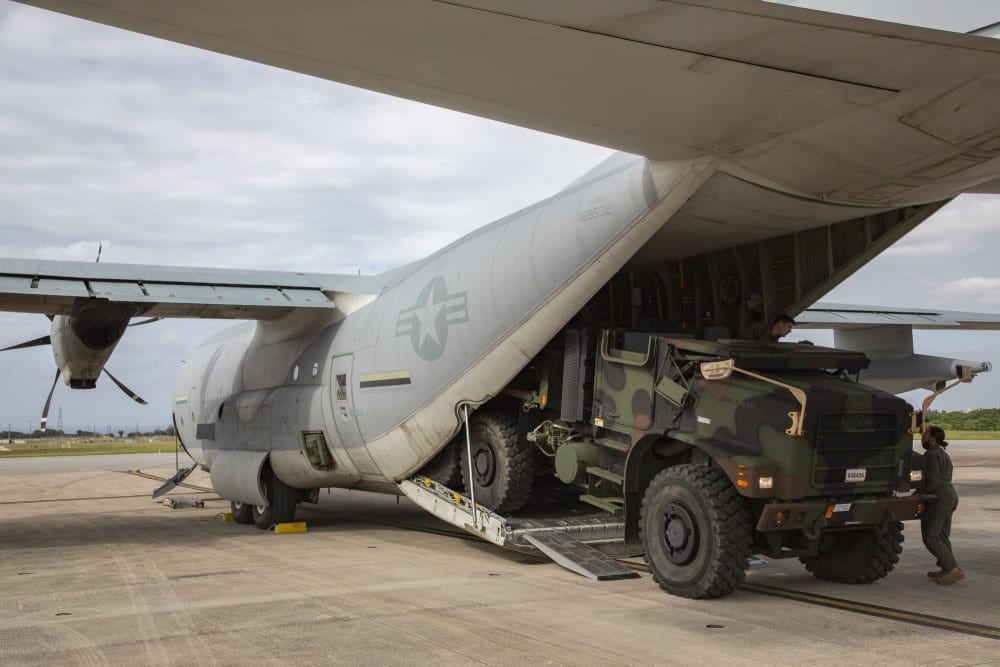
U.S. Marines with Marine Aerial Refueler Transport Squadron 152 (VMGR-152) and Marine Air Control Group 18 (MACG-18) conduct load operations at Marine Corps Air Station Futenma, Okinawa, Japan, Nov. 9, 2020. This is the first time VMGR-152 and MACG-18 have worked together to load an AN/TPS-80 Ground/Air Task Oriented Radar system onto a KC-130J Super Hercules aircraft. U.S. MARINE CORPS / Lance Cpl. Dalton J. Payne

DAHLGREN, Va. — Navy engineer Danny Mudd looked forward to the arrival of a new U.S. Marine Corps radar system after working on the program for years. When the AN/TPS-80 Ground/Air Task-Oriented Radar (G/ATOR) system – a mobile unit designed to be stationed anywhere while providing air surveillance and ground weapons locating capabilities — arrived at Naval Surface Warfare Center Dahlgren Division (NSWCDD), Mudd and his team were ready to provide five weeks of test and evaluation, the NSWCDD said in release.  

“It’s exciting to be able to test an actual system when you’ve been working on it for years,” said Mudd, G/ATOR program team lead and radar operations manager for the Sensor Software Engineering Branch at NSWCDD. “Having the radar in our backyard is a game changer and makes you really appreciate the work that we’ve done here and continue to do.”  

Mudd and his team manage the lab productivity that maintains and updates the test assets with the branch’s software support activity lead, Bradley Payne, who provides software development for the G/ATOR system.  

“We provide government support to the program office, located in Quantico, and develop test procedures for the radar system,” said Bill Shea, G/ATOR technical program manager in the NSWCDD Sensor Software Engineering Branch. “Our G/ATOR team has supported this program for well over 10 years.”  

Shea and his team collaborate with other naval warfare centers, the primary contractor Northrop Grumman and several branches across Dahlgren.  

Before participating in integrated field tests, a new version of G/ATOR was brought to NSWCDD to perform interoperability testing with other systems. Shea and his team prepared for the G/ATOR’s testing schedule by verifying the command’s infrastructure functionality, including power accessibility, radar data recording abilities and data analysis capabilities.  

“Having a tactical radar at Dahlgren for our engineering team to utilize, allows the team to develop expert knowledge of the radar’s functionality and capability,” said Shea. “In collaboration across the warfare center and the contractor, the G/ATOR team achieved that ability to field test, collect data and verify theories to improve the radar’s performance and support the warfighter.”  

Within the first week of the G/ATOR system’s arrival, command, senior leadership and essential team leads conducted walkthroughs of safety protocols and complete range safety validations before live testing.  

For many team members supporting the G/ATOR project, the opportunity to work directly with the system and have accessibility to calculate theories proved beneficial for the warfare center. 

“Many people working on the radar program have only seen the G/ATOR in pictures since one wasn’t available until this test event,” said Shea. “The opportunity to engage with the unit at Dahlgren helps software developers understand some of the interfaces they’re building. They can see firsthand how the software is being used.”  

Through collaborative efforts within the department and other divisions across NSWCDD, the G/ATOR team performed central testing evaluations that verified the radar systems detection functionalities and software capabilities. During the test schedule, the G/ATOR team conducted evaluations around the clock during the workweek.  

Dahlgren’s G/ATOR team is already planning to expand the sustainment of software capabilities for the G/ATOR system through integrated test evaluations. 


Bollinger Shipyards Delivers Coast Guard’s 44th FRC

https://vimeo.com/534477581

LOCKPORT, La. — Bollinger Shipyards LLC has delivered the USCGC Glenn Harris to the U.S. Coast Guard in Key West, Florida, the company said in an April 22 release. This is the 167th vessel Bollinger has delivered to the U.S. Coast Guard over a 35-year period and the 44th fast response cutter (FRC) delivered under the current program.

The Glenn Harris is the third of six FRCs to be home-ported in Manama, Bahrain, which will replace the aging 110-foot Island-class Patrol Boats, built by Bollinger Shipyards 30 years ago, supporting the Patrol Forces Southwest Asia (PATFORSWA), the U.S. Coast Guard’s largest overseas presence outside the United States. 

“Bollinger is proud to continue enhancing and supporting the U.S. Coast Guard’s operational presence and ensuring it remains the preferred partner around the world,” said Bollinger President and Chief Executive Ben Bordelon. “It is our top priority to ensure that the brave men and women of the Coast Guard stationed in PATFORSWA have the most state-of-the-art, advanced vessels as they work to build and maintain the necessary regional alliances to ensure maritime security in the region. Building ships for the Coast Guard provides critical assets to bolster our national security and advance America’s interests, both at home and abroad.” 

Earlier this year at the commissioning ceremony of the USCGC Charles Moulthrope, U.S. Coast Guard Commandant Adm. Karl Schultz lauded the “enhanced seakeeping” capabilities of the PATFORSWA-bound FRCs, saying “these ships are truly going to be game changing in their new theater of operations” and “offer increased opportunities for integrated joint operations with our Navy and Marine Corps colleagues” as the Coast Guard seeks to be part of the whole-of-government solution set in the region. 

PATFORSWA is composed of six cutters, shoreside support personnel and the Maritime Engagement Team. The unit’s mission is to train, organize, equip, support and deploy combat-ready Coast Guard Forces in support of U.S. Central Command and national security objectives. PATFORSWA works with Naval Forces Central Command in furthering their goals to conduct persistent maritime operations to forward U.S. interests, deter and counter disruptive countries, defeat violent extremism and strengthen partner nations’ maritime capabilities in order to promote a secure maritime environment. 

Earlier this week, Bollinger announced the acquisition of Gulf Island Fabrication Inc.’s Terrebonne Parish shipyard facilities, expanding the company’s new construction and repair capacity and capabilities to better serve its key defense and commercial customers. The acquisition increases the shipyard’s growing new construction and repair portfolio. Gulf Island had been building the Towing, Salvage and Rescue Ships (T-ATS) for the U.S. Navy and Regional Class Research Vessels for the National Science Foundation and Oregon State University. These projects conveyed with the transaction. 

The crew of the Coast Guard Cutter Glenn Harris, a pre-commissioned 154-foot Fast Response Cutter, pulls a person from the water April 13, 2021, after a 175-foot commercial lift boat capsized 8 miles south of Grand Isle, Louisiana. The Coast Guard and multiple good Samaritan vessels responded to the capsized vessel and searched for multiple missing people in the water. U.S. COAST GUARD / Coast Guard Cutter Glenn Harris

Each FRC is named for an enlisted Coast Guard hero who distinguished themselves in the line of duty. Surfman Glen Harris piloted the first wave of landing craft on Tulagi Island in the Pacific Theater during World War II, and also made a landing against a Japanese force on Guadalcanal Island.  Harris was awarded a Silver Star medal by Adm. Chester Nimitz for his heroic combat actions. 

The FRC is an operational “game changer,” according to senior Coast Guard officials. FRCs are consistently being deployed in support of the full range of missions within the United States Coast Guard and other branches of our armed services.  This is due to its exceptional performance, expanded operational reach and capabilities, and ability to transform and adapt to the mission. FRCs have conducted operations as far as the Marshall Islands—a 4,400 nautical mile trip from their homeport. Measuring in at 154 feet, FRCs have a flank speed of 28 knots, state of the art C4ISR suite (command, control, communications, computers, intelligence, surveillance and reconnaissance) and stern launch and recovery ramp for a 26-foot, over-the-horizon interceptor cutter boat.