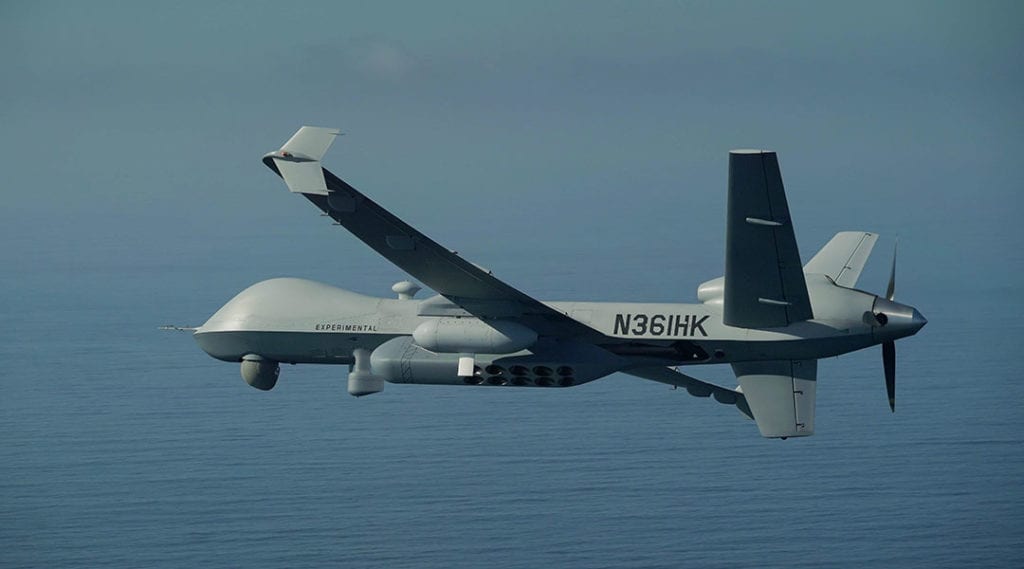
An unmanned MQ-9B Sea Guardian operated in conjunction with a guided-missile cruiser, executing long-range, over-the-horizon targeting, during the Unmanned Systems Integrated Battle Problem 21. GA-ASI
SAN DIEGO — The U.S. Navy demonstrated the successful integration of an unmanned maritime surveillance aircraft system with manned capabilities during the Unmanned Systems Integrated Battle Problem 21 (UxS IBP 21) off the coast of San Diego, April 21, U.S. 3rd Fleet Public Affairs said in a release.
The unmanned MQ-9B Sea Guardian operated in conjunction with a guided-missile cruiser, executing long-range, over-the-horizon targeting. Using sonobuoys and other assets, the Sea Guardian identified contacts and reported locations remotely to the commander on board the cruiser.
“The integration between unmanned and manned capabilities shown today provides an operations approach to strengthening our manned unmanned teaming,” said Rear Adm. James A. Aiken, UxS IBP 21 tactical commander. “Putting our newest technology into our Sailors’ hands directly enhances our fleet.”
Operational synchronization between unmanned capabilities and traditional manned naval assets ensures the Navy maintains its technological and warfighting advantage. Sea Guardian enhances the Navy’s antisubmarine and anti-surface warfare capabilities, among many others.
UxS IBP 21 is a U.S. Pacific Fleet exercise, executed by U.S. 3rd Fleet, designed to integrate manned and unmanned capabilities into operational scenarios to generate warfighting advantages. The week-long event involves surface, subsurface and aerial unmanned assets, operating with littoral combat ships, guided-missile destroyers, guided-missile cruisers, submarines and helicopter squadrons.
Pentagon IT Challenge: Introducing New Technology, While Still Using Legacy Systems
Sailors simulate the navigation of a littoral combat ship inside Integrated Tactical Team Trainer 2 at the Center for Surface Combat Systems LCS Training Facility, April 6, 2021. In 2007 the LTF became the first surface warfare training facility to provide integrated bridge and combat systems tactical-scenario training for Sailors assigned to a littoral combat ship. U.S. NAVY / Mass Communication Specialist 2nd Class Kevin C. Leitner
ARLINGTON, Va. — As the U.S. Defense Department races to develop a 21st century systems of systems linking all services, commanders, platforms and personnel, two top Pentagon officials say the challenge won’t be just acquiring new technology, but getting rid of the old 20th century stuff.
The Defense Department’s Joint All-Domain Command and Control (JADC2) strategy aims to connect sensors from all of the military services — Air Force, Army, Marine Corps, Navy and Space Force — into a single network to share intelligence, surveillance and reconnaissance (ISR) data to enable faster decision making. The change is needed because in a digital-driven world, decisions in future conflicts with degraded environments will have to be made swiftly, perhaps within seconds, say Pentagon officials.
An unclassified version of the strategy for public release is still awaiting approval by Defense Secretary Lloyd Austin and other leaders, Marine Corps Lt. Gen. Dennis Crall, the chief information officer for the Joint Chiefs of Staff (J6), told the virtual C4ISRNET conference April 21. Crall, who is overseeing JADC2, said Army Gen. Mark Milley, the chairman of the Joint Chiefs, and Deputy Defense Secretary Kathleen Hicks have already been briefed on the document. “We’re making some final revisions on that draft and it should move quickly” from Milley to Hicks and then on to Austin, he said, possibly “in days.”
The massive shift to artificial intelligence and machine learning across the department presents a test for a decades-old, platform-centric culture, Crall said. “The biggest challenge is our own history,” he added, noting that once legacy platforms and technologies are rolling, “it is incredibly difficult” to bring the new thing on-board.
“Then you have a resource problem. You’ve got to keep the legacy alive while you’re on-boarding the very thing you’re trying to do,” Crall said, adding that there comes a curve in the cost continuum where “it’s the most expensive to operate during that transition.” How funding streams are made available should get a hard look, the general said. “We need to collapse those things that are both expensive and not delivering results.”
In the conference’s last session, Vice Adm. Jeffrey Trussler, the director of Naval Intelligence, made a similar point about Project Overmatch, the Navy’s plan to develop a new fleet architecture using artificial intelligence and manned/unmanned teaming to enable Distributed Maritime Operations.
“The Navy is a platform-centric service, big capital ships and submarines. That’s what we do, and it enables us to operate around the world 24/7/365,” Trussler said. “As we’ve gotten into the Information Age in the 21st century, the Navy has discovered, as have all the services, we ought to be able to connect those sensors and pass data seamlessly among each other.
“It’s not really a technological problem we have,” Trussler said, “our challenge in that technology is the legacy platforms and systems we have now,” and replacing them across a 298-ship Navy with software-defined radios and other digital systems.
Navy Orders LRASM Integration into P-8 Aircraft
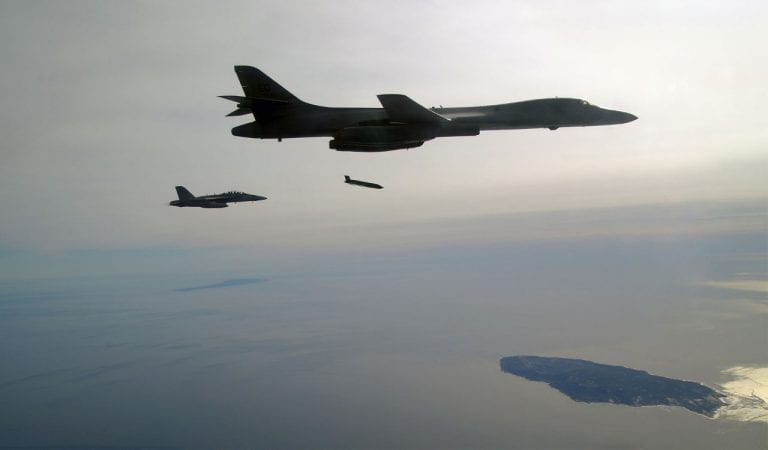
An LRASM being dropped from a B-1B Lancer bomber. LOCKHEED MARTIN
ARLINGGTON, Va. — The Navy has awarded a contract to Boeing to integrate the AGM-158C Long-Range Anti-Ship Missile (LRASM) into the P-8A Poseidon maritime patrol reconnaissance aircraft.
The Naval Air Systems Command awarded Boeing a $74 million cost-plus-fixed-fee order for “the design, development, and test of software and ancillary hardware necessary for the integration of the Long-Range Anti-Ship Missile onto the P-8A aircraft for the Navy,” an April 21 Defense Department contract announcement said.
The LRASM, a derivative of the Air Force’s AGM-158B Joint Air-to-Surface Strike Missile-Extended Range cruise missile, fills an air-launch capability gap and provides flexible, long-range, advanced anti-surface capability against high-threat maritime targets. The weapon reduces dependency on intelligence, surveillance and reconnaissance platforms, network links and GPS navigation in electronic warfare environments. Semi-autonomous guidance algorithms will allow it to use less-precise target cueing data to pinpoint specific targets in the contested domain.
The P-8A currently can be armed with AGM-84 Harpoon cruise missiles and Mk54 antisubmarine torpedoes. The addition of the LRASM will expand its anti-surface capability in terms of range and ability to operate in a GPS-denied environment.
Work on the order is expected to be completed in October 2024.
Coast Guard Cutter Tampa Offloads $94.6M in Cocaine in Miami
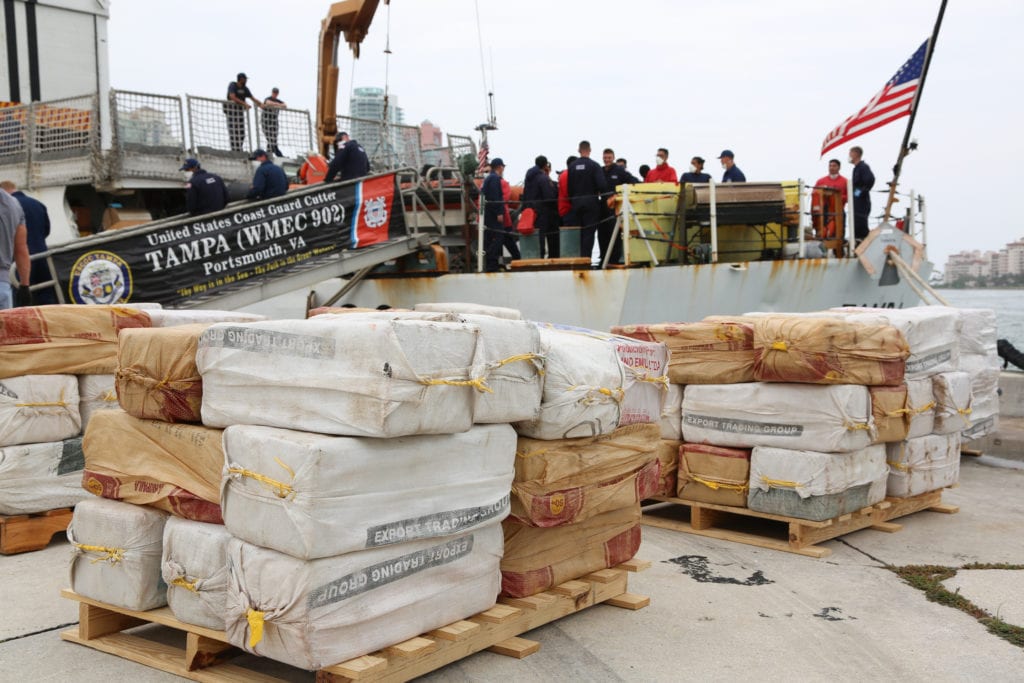
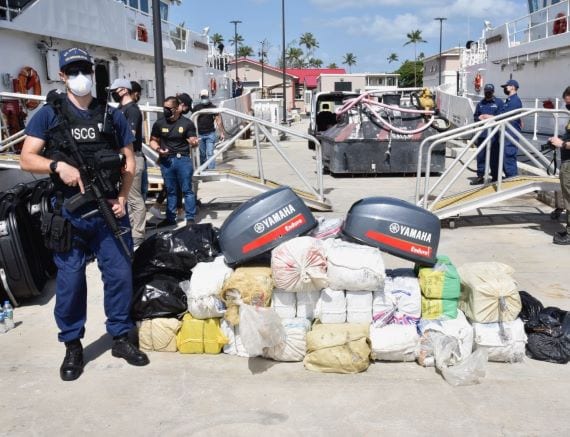
Coast Guard Cutter Tampa crew offloads approximately 5,500 pounds of cocaine, worth an estimated $94.6 million, at Base Miami Beach, Miami, Florida, April 20, 2021. On April 9, a maritime patrol flight spotted a vessel, and a Tampa law enforcement team interdicted a low profile vesseloff the coast of Punta Gallinas, Colombia. U.S. COAST GUARD / Chief Petty Officer Charly Tautfest
MIAMI — Coast Guard Cutter Tampa’s crew offloaded approximately 5,500 pounds of cocaine, worth an estimated $94.6 million, in Miami, April 20, after interdicting a low-profile vessel off the coast of Punta Gallinas, Colombia, the Coast Guard 7th District said in a release.
A maritime patrol flight spotted the vessel on April 9, and a law enforcement team from the cutter detained three suspects and discovered 87 bales of cocaine. The vessel was destroyed as a hazard to navigation and the suspects are reported to be in good health.
“This event is the perfect example of numerous key partners unifying our efforts to counter transnational criminal organizations who look to exploit the maritime environment,” said Lt. Cmdr. Jason Neiman, Seventh District public affairs officer. “By strengthening partnerships, we counter threats together.”
The interdiction was the result of multi-agency efforts in support of U.S. Southern Command’s enhanced counter-narcotics operations in the Western Hemisphere, the Organized Crime Drug Enforcement Task Force and High Intensity Drug Trafficking Area programs, and the Caribbean Corridor Strike Force.
Once aboard a Coast Guard cutter, all suspects receive food, water, shelter and basic medical attention. Throughout the interdiction, Coast Guard crew members were equipped with personal protective equipment to minimize potential exposure to any possible case of COVID-19. There were no suspects in these cases reported to have any COVID-19 related symptoms.
Philippines Looks to Bolster Fleet with Retired Patrol Coastal Boats
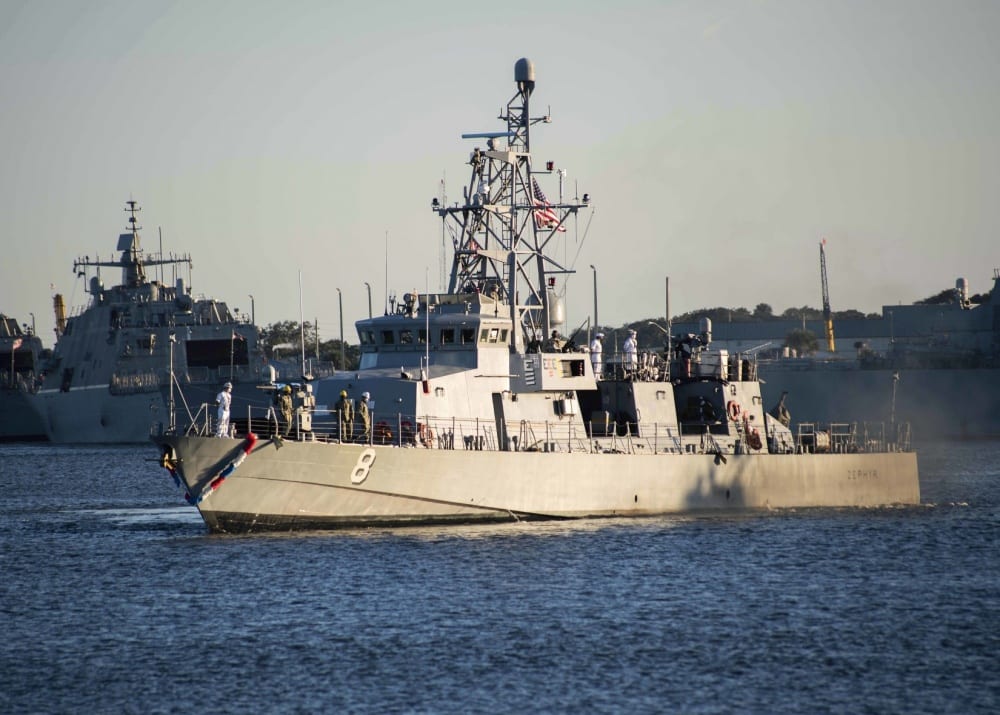
The Cyclone-class coastal patrol ship USS Zephyr (PC 8), shown here returning to Naval Station Mayport after a 2016 deployment to the U.S. 4th Fleet area of operations in support of Joint Interagency Task Force South’s mission, which included counter illicit drug trafficking in the Caribbean. U.S. NAVY / Mass Communication Specialist 1st Class Brian G. Reynolds
As the U.S. Navy divests itself of its Cyclone-class of Patrol Coastal (PC) boats, the Philippine navy (PN) has said the PCs would be welcome in its fleet.
In a statement, PN chief Vice Adm. Giovanni Carlo Bacordo said, “The PN has manifested its interest in the decommissioned Cyclone-class patrol vessels [CCPVs] of the U.S. Navy as a stop-gap to the decommissioned legacy PN ships. As to how many, that depends on the seaworthiness and efficiency of the CCPVs that will be offered, and this will be determined by the PN Joint Visual Inspection Team.
“We have manifested our interest with JUSMAG [Joint U.S. Military Assistance Group] and U.S. INDOPACOM,” the Indo-Pacific Command, he added.
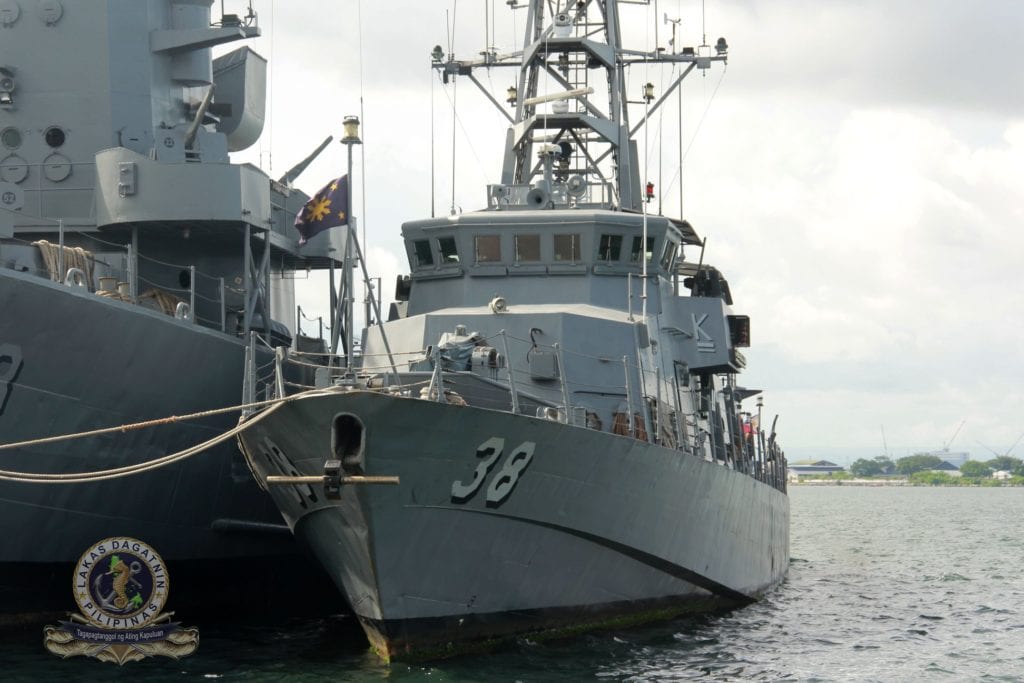
At present, the PN has one Cyclone-class patrol vessel in its service, the BRP General Mariano Alvarez (PS 38), formerly the ex-USS Cyclone (PC 1), which was transferred to the PN in 2004.
Of the 14 ships in the class, four were loaned to the Coast Guard but later returned. The lead ship, Cyclone, then was transferred to the Philippines in 2004.
Three of the remaining 13 USN PCs were recently decommissioned. Ten more remain in service in Bahrain as part of the U.S. 5th Fleet. Of the three retired ships, the U.S. Navy said one would be made available for foreign military sale, but the other two would be scrapped.
USS Zephyr (PC-8), USS Shamal (PC-13) and USS Tornado (PC-14) were decommissioned in March. All three ships were based in Mayport, Florida, where they supported the U.S. 4th Fleet with counter-drug trafficking and illegal migration patrols in the Eastern Pacific, off Central America and in the Caribbean.
“These three warships have served our Navy and our country well,” said Capt. Mike Meyer, commander, Naval Surface Squadron Fourteen. “Each of them has operated well past their designed service life, with their crews contributing demonstrably to meeting our national objectives.”
The Navy said Zephyr and Shamal would be scrapped, while Tornado would be considered for possible foreign military sale.
BRP General Mariano Alvarez (PS38) at Naval Base Cavite, Philippines, in 2019. DEFENSE OF THE REPUBLIC OF THE PHILIPPINES
According to a USN release, the decision to decommission these three ships stems from the fact they all exceeded their designed service life. “Based on the rising cost of modernization efforts, the Navy will receive a better return by decommissioning and freeing up funds to invest in other platforms,” the statement said.
The PCs were specifically tailored to support Special Operations Forces insertion and extraction and related duties. In that role, however, the PCs were too large for covert missions, but too small to effectively serve as surface combatants. So, the Navy planned to divest itself of the class, transferring the lead ship to the Philippines, and loaning three more to the Coast Guard. Events surrounding 9/11, however, made clear the need for ships able to operate in littoral waters.
PCs have four diesel engines and four screws, capable of speeds up to 35 knots. They have a range of 2,000 to 2,500 nautical miles and an endurance of 10 days.
For their size, they are well armed. The U.S. ships were upgraded with remotely-operated stabilized 25 mm guns, and carried unmanned aircraft for surveillance and monitoring of boarding parties. Griffin missiles were installed on 5th Fleet ships to be used against surface threats.
And unlike many patrol vessels, PCs look like a surface combatant. “We’ve got a beautiful silhouette coming over the horizon with the sun in the background,” said Lt. Cmdr. Roger Young, who commanded officer of USS Firebolt (PC 10) in 2018. “I mean, you say, ‘that’s a warship.’”
Increased interoperability
The top military officer in the Indo-Pacific theater said the U.S. is committed to its Philippine ally and treaty partner. That means a more capable navy.
In Congressional testimony, Commander of U.S. Indo-Pacific Command Adm. Phil Davidson said his command is focused on strengthening allies and partners.
“The United States’ network of allies and partners is our principal advantage against any adversary. USINDOPACOM depends upon the collective capabilities of our allies and partners to address the challenges to a Free and Open Indo-Pacific,” Davidson said. “Through increased interoperability, information-sharing, and expanded access across the region, we will present a compatible and interoperable coalition to our adversaries in crisis and armed conflict. Terrorism continues to pose a security challenge in the Philippines, and USINDOPACOM is committed to helping the Philippines ensure that the southern Philippines does not become a safe-haven for terrorists that would threaten the entire region. I am also focused on helping to develop the territorial defense capability of the Armed Forces Philippines and look forward to re-engaging with the Philippines National Police Maritime Group to continue improving their ability to protect their sovereign interests.”
PN modernization
The PCs were designed for a 15-year life service. But Zephyr, for example, served for 26 years.
While the PCs are more than two decades old, they are decades newer than a pair of recently deactivated ships in the PN, the 221-foot BRP Quezon (the former USS Vigilance (AM-324),) and 185-foot BRP Pangasinan (formerly USS PCE 891). Both ships were commissioned in the U.S. Navy in 1944. Quezon was commissioned in the PN in 1967, and served for 53 of years with the Philippine Navy. Transferred from the U.S. to the Philippines in 1948, Pangasinan had 72 years of service with the Philippine navy when she was decommissioned.
Even as older ships are retired, the PCs would be among the newer and more capable ships in the PN.
“This makes sense for the Philippine navy,” said retired Capt. Brian Buzzell, who is very familiar with the Philippine navy and the regional security issues. “They have had the lead boat for years. The issue will be what armaments will come with the boats.”
Buzzell notes that China has been ratcheting up the pressure on the Philippine government to accept their incursions into their economic zones. “The Cyclone-class PC would be a perfect vessel to patrol the disputed fishing areas,” he said. “Additionally, the PCs would complement the two new South Korean frigates.”
The PN recently added two new Jose Rizal-class frigates built in South Korea, the BRP Jose Rizal (FF 150), commissioned in 2020; and BRP Antonio Luna (FF 151), commissioned at Subic Bay in March of this year.
Houston Nominated for Vice Adm., commander, Naval Submarine Forces
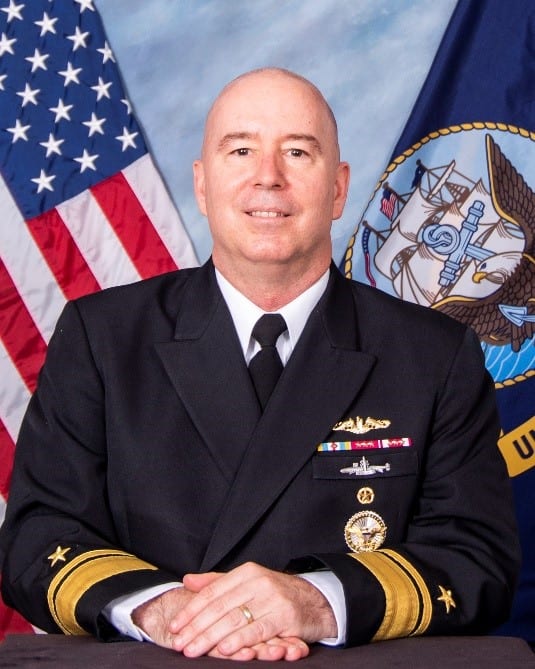
Rear Adm. William J. Houston, nominated for appointment to vice admiral and assigned as commander, Naval Submarine Forces, commander, Submarine Force, U.S. Atlantic Fleet, and commander, Allied Submarine Command, Norfolk, Virginia. U.S. NAVY
ARLINGTON, Va. — Secretary of Defense Lloyd J. Austin III announced April 21 that the president has nominated Navy Rear Adm. William J. Houston for appointment to the grade of vice admiral, and assignment as commander, Naval Submarine Forces; commander, Submarine Force, U.S. Atlantic Fleet; and commander, Allied Submarine Command, Norfolk, Virginia.
Houston is currently serving as director, Undersea Warfare Division, N97, Office of the Chief of Naval Operations, Washington, D.C.
Rear Adm. Houston is a native of Buffalo, New York, and graduated from the University of Notre Dame in May 1990 with a bachelor of science in electrical engineering and was commissioned via the Navy Reserve Officer Training Corps (NROTC) program. He holds a master’s of business administration from the College of William and Mary.
His sea tours include division officer assignments on USS Phoenix (SSN 702), engineer officer onboard USS Hampton (SSN 767), and executive officer onboard USS Tennessee (SSBN 734) Blue. He commanded USS Hampton (SSN 767) in San Diego and was commodore of Submarine Squadron 20 in Kings Bay, Georgia.
His staff assignments include flag lieutenant for Commander Submarine Force, U.S. Atlantic Fleet; the Atlantic Fleet Nuclear Propulsion Examining Board; special assistant to the Director of Naval Reactors for Personnel and Policy; deputy commander for Submarine Squadron 20; the principal director for Nuclear Matters within the Office of the Secretary of Defense; the submarine and nuclear community manager, Military Personnel Plans and Policy (N133) and division director of Submarine and Nuclear Propulsion Distribution, Navy Personnel Command (PERS-42).
His first flag assignment was deputy director for Strategic Targeting and Nuclear Mission Planning (J5N) United States Strategic Command. Following this, he served as director of operations, Naval Forces Europe-Africa; deputy commander, U.S. 6th Fleet, and commander, Submarine Group Eight.
Coast Guard Offloads Nearly $20 million in Seized Cocaine in San Juan, Puerto Rico
The Coast Guard Cutter Richard Dixon crew offloaded nearly $20 million in seized cocaine at Coast Guard Base San Juan on April 20. U.S. COAST GUARD
SAN JUAN, Puerto Rico — The Coast Guard Cutter Richard Dixon crew offloaded nearly $20 million in seized cocaine at Coast Guard Base San Juan on April 20, following the interdiction of a suspected drug smuggling vessel, approximately 45 nautical miles north of Aguadilla, Puerto Rico, the Coast Guard 7th District said in an April 21 release.
A Customs and Border Protection Caribbean Air and Marine Branch maritime patrol aircraft crew detected a vessel on April 17 with three people aboard suspected of drug trafficking. The Coast Guard Cutter Paul Clark and a Coast Guard MH-60 helicopter responded to intercept the vessel.
The Coast Guard Jayhawk aircrew successfully stopped the vessel. Following the interdiction, it was discovered one of the suspected smugglers was injured and needed to be medevaced. A Coast Guard Air Station Borinquen MH-65 Dolphin aircrew transported the person to a hospital in Puerto Rico to receive further medical care.
The Paul Clark crew embarked the two remaining suspected smugglers and recovered close to 18 bales, which weighed approximately 1,052 pounds and tested positive for cocaine.
The three suspects are two men and a woman, Dominican Republic nationals, who are facing possible federal prosecution on drug trafficking criminal charges. Department of Justice partners in the U.S. Attorney’s Office for the District of Puerto Rico are leading prosecution efforts in this case.
“Stopping illegal drug trafficking vessels like the one interdicted Saturday is inherently dangerous and involves a high level of skill and risk,” said Capt. Gregory H. Magee, Commander of U.S. Coast Guard Sector San Juan. “These vessels represent a serious threat to the Caribbean region. The professionalism of the interdicting crews and strong partnerships with federal, local and regional law enforcement led to the apprehension of three smugglers and seizure of a major drug shipment in our shared resolve to protect the people of Puerto Rico and the U.S. Virgin Islands from this threat.”
The interdiction resulted from multi-agency efforts in support of U.S. Southern Command’s enhanced counter-narcotics operations in the Western Hemisphere, the Organized Crime Drug-Enforcement Task Force and High-Intensity Drug-Trafficking Area programs and the DEA Caribbean Division Financial Investigative Team.
“This Organized Crime Drug Enforcement Task Force investigation is one of several cases targeting transnational criminal organizations operating out of South America, Dominican Republic, and Puerto Rico,” said A.J. Collazo, DEA Caribbean Division special agent in charge. “DEA will continue to work alongside other federal agencies as more seizures like this one can be expected.”
Cutters Paul Clark and Richard Dixon are 154-foot fast response cutters respectively homeported in Miami and San Juan, Puerto Rico.
Italian Aircraft Carrier ITS Cavour Departs Norfolk, Completing F-35B Certification
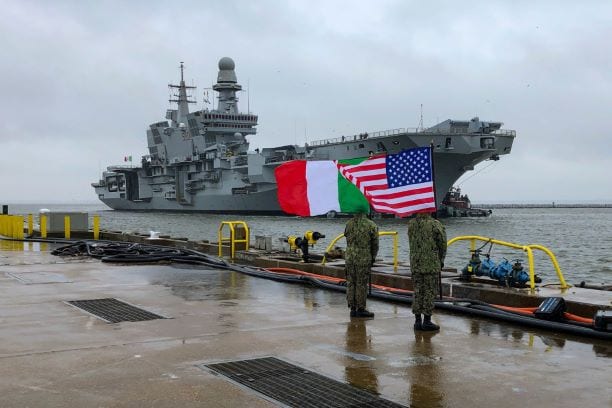
U.S. Sailors, assigned to the aircraft carrier USS John C. Stennis (CVN 74), greet the Italian navy flagship, aircraft carrier ITS Cavour (CVH 550), as it arrives at Naval Station Norfolk, Virginia, Feb. 13, 2021. The Cavour’s visit is part of a series of operations alongside U.S. military assets to attain the Italian navy’s “ready for operations” certification to safely land and launch F-35B aircraft, U.S. 2nd Fleet exercises operational authorities over assigned ships, and landing forces on the East Coast and the Atlantic. U.S. NAVY
NORFOLK, Va. — The Italian navy flagship, the aircraft carrier ITS Cavour (CVH 550), departed Naval Station Norfolk April 16 after Joint Force operations with U.S. military forces in the Atlantic Ocean, the U.S. 2nd Fleet Public Affairs said in an April 21 release.
ITS Cavour participated in a sequence of operations with U.S. assets and the F-35 Joint Program Office has delivered a flight clearance recommendation to the Italian navy for the safe operation of fifth generation F-35B fighter aircraft.
“I am very proud for the success of ITS Cavour’s ‘Ready for Operations’ campaign,” said Italian navy Capt. Giancarlo Ciappina, commanding officer of ITS Cavour. “Our allies will soon perceive the Italian navy and the Italian armed forces as a whole, as enhanced cooperative partners thanks to the strategic enabler that the fifth-generation aircraft carrier capability would represent, in either specific maritime or wider joint operations.”
An F-35 Joint Program Office (JPO) test team embarked on ITS Cavour to conduct sea trials, a series of tests and functional activities to create a safe flight operating envelope for the short-takeoff-and-vertical-landing (STOVL) variant of the aircraft aboard the recently upgraded ship.
The F-35 Pax River Integrated Test Force (ITF) team from Naval Air Station Patuxent River, Maryland, includes almost 200 people with the engineering and test pilot expertise and experience to conduct F-35B envelope expansion flight test, two specially instrumented developmental flight test aircraft, and support equipment.
During the sea trials, two F-35Bs of the ITF were embarked aboard Cavour and carried out more than 50 flight missions in challenging weather conditions sea states, a night session, around 120 vertical landings, 115 short takeoffs with the aid of the ski jump, and two vertical takeoffs. These activities were followed by a sufficient amount of data analysis, yielding the information telling the U.S. Marine Corps and the Italian navy how to safely conduct F-35B flight operations on Cavour.
“It was a privilege to work alongside our Italian counterparts while they certified their flagship to launch and recover the cutting-edge F-35B,” said Vice Adm. Andrew Lewis, commander, U.S. 2nd Fleet. “I look forward to continuing to build upon our trans-Atlantic bridge, enhancing our collective capabilities and strengthening partnerships with our NATO allies.”
In coordination with the Italian navy, U.S. Marine Corps MV-22s conducted shipboard landing qualifications on the deck of the Italian Carrier ITS Cavour.
Also while operating in the western Atlantic, ITS Cavour collaborated with the Arleigh Burke-class guided-missile destroyer USS Stout (DDG 55). They conducted a three-day interoperability exercise with support from Carrier Air Wing Seven and Patrol and Reconnaissance Wing 11. ITS Cavour also conducted dual-carrier operations alongside USS Gerald R. Ford (CVN 78), marking the first time a Gerald R. Ford-class and Italian carrier operated jointly.
ITS Cavour departed Norfolk after disembarking the ITF personnel prior to completing the necessary preparation to undertake the last phases of the ready for operations campaign before returning to Italy. Cavour was also greeted by a performance by the U.S. Fleet Forces band as an expression of goodwill between the U.S. and Italian navies.
For decades, the bond between Europe and North America has made NATO the strongest alliance in history. Conducting training and exercises alongside allies and partners increases our collective capacity and capabilities as well as increased interoperability with the U.S. forces.
Future USS Mobile Set for Namesake City Commissioning
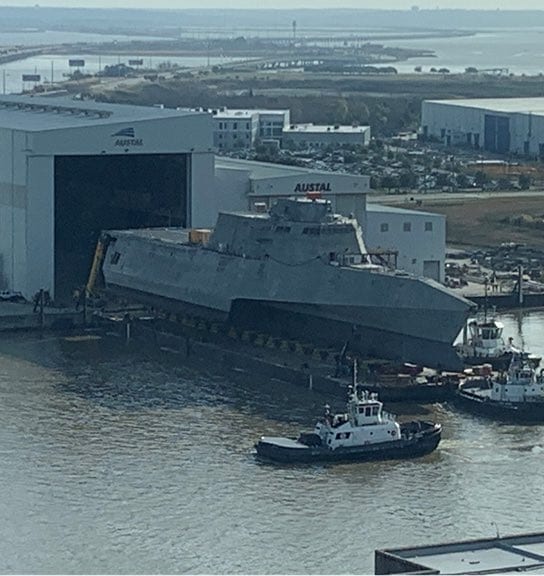
The future USS Mobile (LCS 26) moves from its construction bay to the Mobile River in this 2020 photograph. OFFICE OF BRADLEY BYRNE / Wikipedia
MOBILE, Alabama – The future USS Mobile (LCS 26), the U.S. Navy’s newest Independence-variant littoral combat ship (LCS), will be commissioned May 22, 2021 at 10:00 a.m. (CT) in Mobile, Alabama, the U.S. Naval Surface Force, U.S. Pacific Fleet said in an Apr. 21 release.
Due to ongoing public health and safety concerns related to the COVID-19 pandemic, the ceremony will take place in compliance with Department of Defense, Centers for Disease Control, state public health, state, and local government guidelines and restrictions. The event will be livestreamed to offer maximum viewing by the general public.
“The Mobile crew worked hard to prepare their ship for this moment, and they will continue to see the fruits of their labor as they train and operate at sea,” said Vice Adm. Roy Kitchener, commander, Naval Surface Force, U.S. Pacific Fleet. “We are refining the LCS class lethality and global sustainment infrastructure to better harness the versatility these ships bring to the surface force. Mobile is entering the fleet at a prime time in the LCS progression, as we implement lessons learned from other LCS deployers.”
Rebecca Byrne, president and CEO of The Community Foundation of South Alabama and wife of former U.S. Rep. Bradley Byrne, R-Alabama, is the ship’s sponsor. As a former chairman of the Downtown Mobile Alliance and former executive director of United Way of Baldwin County, Rebecca has long served her community through civic, cultural, and church leadership roles.
Highlighting the commissioning is a time-honored Navy tradition where Rebecca will give the first order to, “man our ship and bring her to life.”
Mobile’s commanding officer, Cmdr. Christopher W. Wolff, a graduate of Carnegie Mellon University, the University of Oklahoma, and the U.S. Naval War College, has deployed five times on five different ships. The third-generation naval officer leads a crew of 70 officers and enlisted Sailors.
USS Mobile was built in Mobile, Alabama, by Austal USA and was launched on January 11, 2020. The future USS Mobile is the fifth Navy ship to honor the city of Mobile, which has a rich historical relationship with the Navy.
The first Mobile was a Confederate, government-operated, side-wheel steamer operating as a blockade runner and captured in New Orleans in April 1862 by U.S. forces. Commissioned as USS Tennessee, the ship was later renamed Mobile. Commissioned in March 1919, the second Mobile, a Hamburg Amerika Lines passenger liner operating between Germany and the U.S. until the outbreak of World War I, was taken over by the Allied Maritime Council and assigned to the United States after the Armistice. USS Mobile (CL 63) participated in numerous Pacific Theater campaigns during World War II. Commissioned on March 24, 1943, the cruiser received 11 battle stars for the ship’s time in service and was decommissioned in May 1947. The fourth Mobile (LKA 115) was an amphibious cargo ship serving from September 1969 until decommissioning in February 1994.
LCS is a highly maneuverable, lethal and adaptable ship designed to support focused mine countermeasures, anti-submarine, and surface warfare missions. The Independence-variant LCS integrates new technology and capability to affordably support current and future missions, from deep water to the littorals.
LCS is now the second-largest surface ship class in production, behind the Navy’s DDG 51 Arleigh Burke-class destroyer program. USS Mobile will be homeported at Naval Base San Diego, California.
HII Awarded $107M Advance Procurement Contract for LHA 9
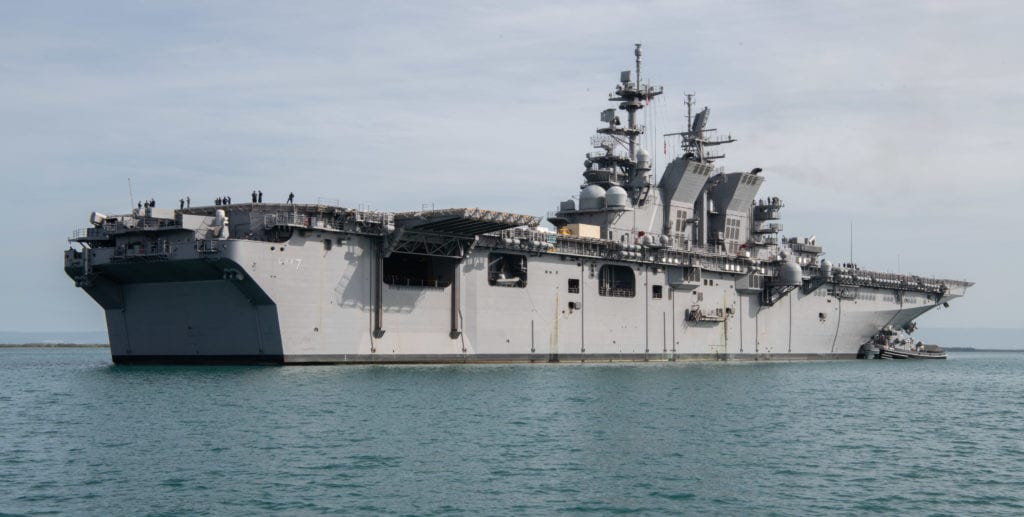
USS Tripoli (LHA 7), the second America-class amphibious assault ship, transits toward Naval Station Guantanamo Bay, Aug. 3, 2020. Huntington Ingalls Industries’ Ingalls Shipbuilding division has been awarded a $107 million contract modification for the LHA 9. U.S. NAVY / Mass Communication Specialist 3rd Class Annaliss Candelaria
PASCAGOULA, Miss. — Huntington Ingalls Industries’ Ingalls Shipbuilding division has received a contract modification from the U.S. Navy for $107 million to provide long-lead-time material and advance procurement activities for amphibious assault ship LHA 9, the company said in an April 19 release.
“The amphibious warship production line is a critical component of our nation’s defense industrial base,” Ingalls Shipbuilding President Kari Wilkinson said. “This funding will strengthen our suppliers and sustain jobs across the country in support of LHA 9 construction.”
Ingalls is the sole builder of large-deck amphibious ships for the Navy. The shipyard delivered its first amphibious assault ship, the Iwo Jima-class USS Tripoli (LPH 10), in 1966. Ingalls has since built five Tarawa-class (LHA 1) ships, eight Wasp-class (LHD 1) ships and the first in the new America class of amphibious assault ships (LHA 6) in 2014. The second ship in the America class, USS Tripoli (LHA 7), was delivered to the Navy in early 2020. Bougainville (LHA 8) is under construction.