Former SECNAV Braithwaite Continues to Advocate for U.S. 1st Fleet for Indo-Pac
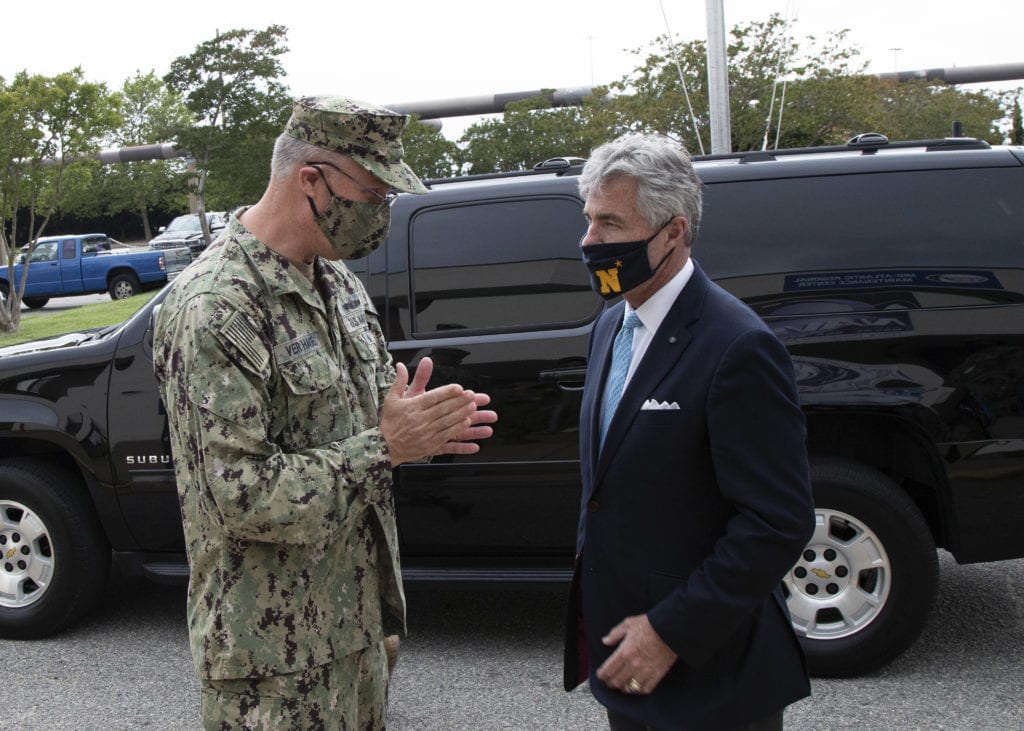
Commander, Navy Regional Maintenance Center Rear Adm. Eric Ver Hage greets then-Secretary of the Navy Kenneth Braithwaite as he arrives to tour the Mid-Atlantic Regional Maintenance Center Production Facility in 2020. U.S. NAVY / Hendrick L. Dickson

ARLINGTON, Va. — Three months after leaving office, the former secretary of the Navy is continuing to advocate for the re-establishment of a U.S 1st Fleet in the Southwestern Pacific and Indian Ocean and recommends the new fleet be expeditionary and sea-based. 

Kenneth J. Braithwaite, the 77th secretary of the Navy and a retired admiral in the Navy Reserve, discussed the concept with Brent Sadler of the Heritage Foundation in an April 14 webinar, hoping the idea “will continue to extraction.” 

While Navy Secretary, Braithwaite said he concluded that the expanse of the Western Pacific and Indian Oceans was too great for a single numbered fleet, the Japan-based U.S. 7th Fleet.  

“One numbered fleet can’t double down on all of the emerging challenges in that part of the world,” he said, noting a “real void” in the South China Sea and the Indian Ocean. 

He took note of the increased tensions with China in the South China Sea and the increased U.S. cooperation with India as demanding a more focused attention. 

“We needed more emphasis in places where we are being challenged the most,” Braithwaite said. “I thought about the structure of the Navy and what had worked historically for the Navy may not work in the future.”  

The actual intersections of the areas of responsibility (AORs) of the U.S. 3rd and 7th Fleets and the proposed U.S. 1st Fleet would be determined in the process, but Braithwaite said that “in the past most of our numbered fleets were at sea [and] operated aboard a flagship. I think that’s a concept we need to embrace again, especially as we enter this new period of great power competition. I think it need to be expeditionary and I think it needs to be sea-based.” 

Braithwaite pointed out that his announcement of the concept of the 1st Fleet came on the eve of a trip to the Western Pacific. 

“The idea seems to be one that many others, if they hadn’t been thinking specifically about the structure and the resurrection of the 1st Fleet, it was one that did meet with positive perspective once I had the opportunity to have those conversations with the [defense ministers] of those nations that would be impacted by it. That would include India, Singapore and Japan. All embraced the idea.” 

Braithwaite said the 1st Fleet could be equipped with guided-missile destroyers, guided-missile frigates, littoral combat ships and expeditionary fast transports, operating as a squadron based in Singapore. He also said Coast Guard cutters could add capability to the proposed fleet. 

“We do need a bigger Navy,” he said. “Ninety percent of trade moves across the sea lanes of the world, and as such, we need to make sure, as the predominant naval force, that they remain free.” 

The status of the 1st Fleet concept within the new presidential is not yet known. President Joseph Biden has yet to nominate a new secretary of the Navy. 

“One thing the Navy doesn’t do well is embrace change,” he said. I had to build up support from within, get people to think again about what might be possible. … It is a concept that has found some support.” 

“I hope that my successor embraces [the 1st Fleet concept] as well once he is announced and confirmed,” he said.    


US, Japan Navy Chiefs Discuss Maritime Security, Continued Cooperation

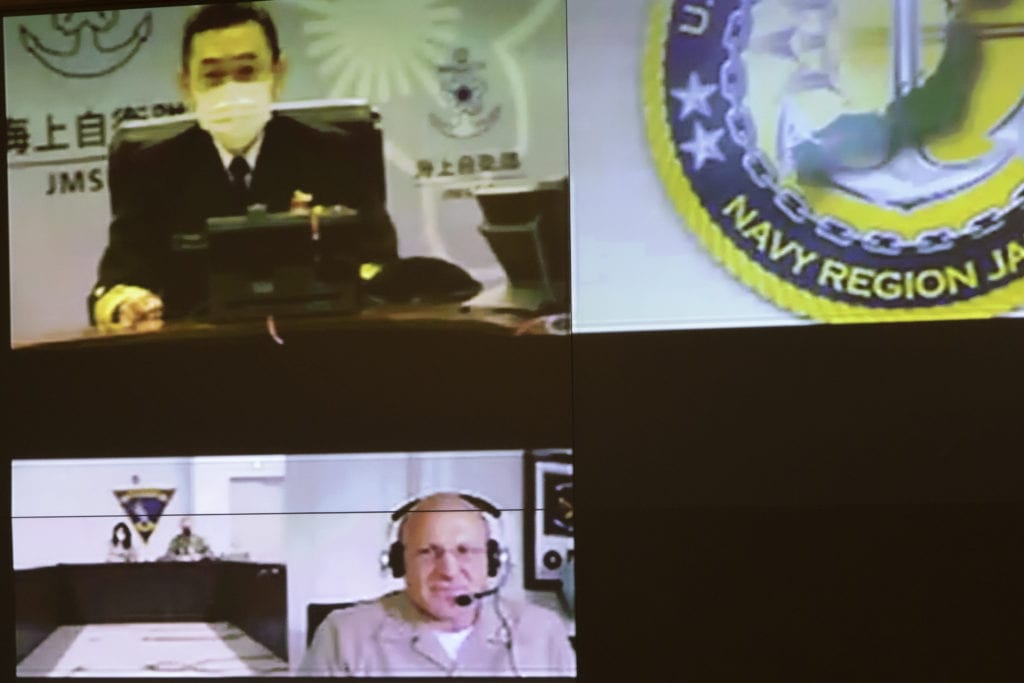
Chief of Naval Operations (CNO) Adm. Mike Gilday speaks with Japan Chief of Staff Adm. Hiroshi Yamamura during a video teleconference. The two leaders discussed recent operations across the globe and ways to strengthen the two navies’ interoperability. U.S. NAVY / Chief Mass Communication Specialist Nick Brown

WASHINGTON – U.S. Navy Chief of Naval Operations (CNO) Adm. Mike Gilday conducted a video teleconference with Japan Chief of Staff Adm. Hiroshi Yamamura April 13, Chief of Naval Operations Public Affairs said in a release. 

The two leaders discussed recent operations across the globe and ways to strengthen the two navies’ interoperability.  

“The alliance between the U.S. and Japan is a cornerstone of security and stability in a free and open Indo-Pacific,” said Gilday. “Adm. Yamamura and I remain committed to strengthening the bonds of our navies’ cooperation and friendship, and we stand ready, together.” 

Gilday also thanked Yamamura for the Japan Maritime Self-Defense Force’s (JMSDF) continued support of U.S. Navy forces in the region. 

“The discussion today with Adm. Gilday to promote naval cooperation and enhance alliance capabilities for deterrence and effective response is of great significance,” said Yamamura. “The JMSDF and the U.S. Navy will continue to closely work together for a free and open Indo-Pacific.” 

Japanese and U.S. Navy forces frequently operate together. The most recent was a joint participation in French-led exercise La Perouse in the Bay of Bengal. Other recent events include operations between JMSDF JS Kongo (DDG 173) and USS Blue Ridge (LCC 19), and the addition of a Japanese liaison officer at Logistics Group Western Pacific/Task Force 73, working directly with the staff’s replenishment officer to help enhance interchangeability and combined logistics operations.  


Coast Guard Repatriates 14 Migrants to Cuba

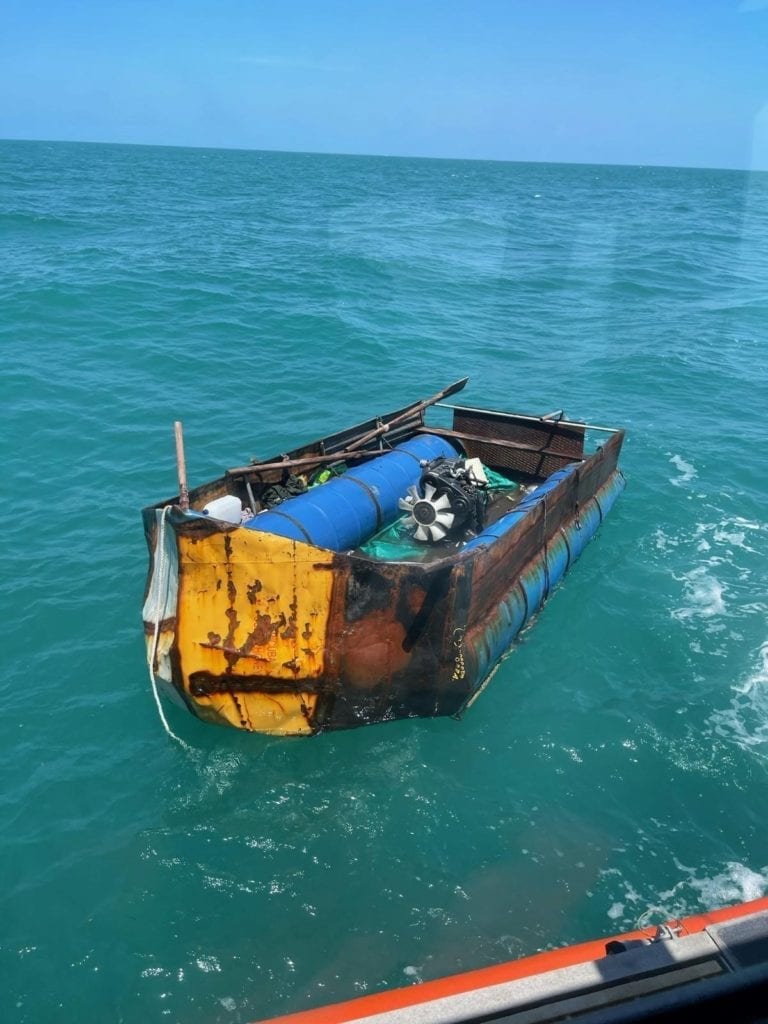
Coast Guard crews took 14 migrants off a rustic vessel, April 10, 2021, due to safety of life at sea concerns off Key West, Florida. They were repatriated to Cuba on April 13, 2021. U.S. COAST GUARD

MIAMI — Coast Guard Cutter Raymond Evans’ crew repatriated 14 Cuban migrants to Cuba April 13, the Coast Guard 7th District said in a release.  

A good Samaritan reported the rustic vessel with 14 people aboard to Coast Guard Sector Key West watchstanders Saturday approximately 35 miles northwest of Key West.  

Station Key West rescue crews arrived on scene to find the people showing signs of dehydration and being sunburnt. They were taken off their vessel due to safety of life at sea concerns.  

“The Florida Straits are unpredictable,” said Coast Guard Liaison Officer Lt. Cmdr. Mario Gil, U.S. Embassy Havana. “It is not safe to take to the seas in makeshift vessels that aren’t seaworthy.” 

Since Oct. 1, 2020, Coast Guard crews have interdicted 166 Cubans compared to fiscal year 2019, Oct. 1, 2018 – Sept. 30, 2019, where crews interdicted 314 Cubans. 

Once aboard a Coast Guard cutter, all migrants receive food, water, shelter and basic medical attention. Throughout the interdiction, Coast Guard crew members were equipped with personal protective equipment to minimize potential exposure to any possible case of COVID-19. There were no migrants in these cases reported to have any COVID-19 related symptoms. 


Coast Guard Cutter Forward Returns Home after Drug-Busting Patrol

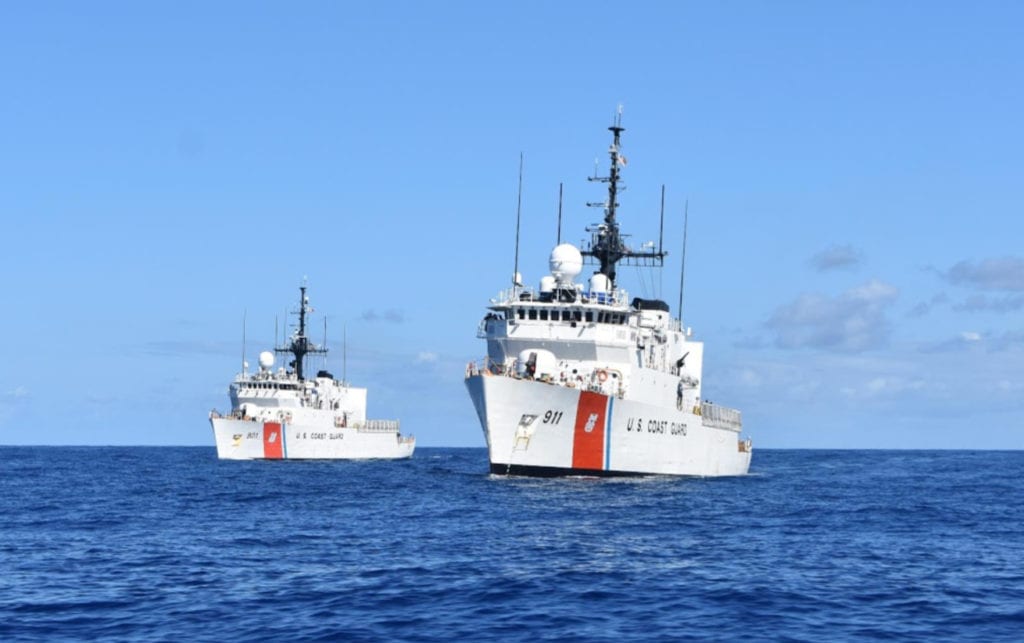
Coast Guard Cutter Forward and Coast Guard Cutter Bear, homeported in Portsmouth, Virginia, finish an at-sea transfer while underway on a two-month patrol. Coast Guard Cutter Forward returned to homeport on April 10, 2021. U.S. COAST GUARD

PORTSMOUTH, Va. — The Coast Guard Cutter Forward (WMEC 911) returned to its homeport in Portsmouth April 12 after a two-month patrol in the Eastern Pacific Ocean, working to suppress and eradicate the movement of illegal drugs in the region, the Coast Guard 5th District said in an April 13 release. 

The crew of the Forward worked in conjunction with U.S. Customs and Border Protection (CBP) Air and Marine Operations (AMO) and the Canadian Navy to execute the mission, resulting in the seizure of 6,800 pounds of cocaine, 5,300 pounds of marijuana, two pounds of methamphetamine and the detainment of 14 suspected drug smugglers. 

“These deployments highlight our successful interoperability with multiple domestic and international partners all committed to curbing the flow of illegal drugs to our borders,” said Lt. Vincent Zieser, the operations officer and lead coordinator aboard the Forward. “We certainly enjoyed their support and teamwork.” 

U.S. Southern Command began what was then known as Enhanced Counter-Narcotics Operations in the Western Hemisphere to increase drug traffic disruption on April 1, 2020. This counter Transnational Criminal Organizations operational approach, which is now enduring, supports objectives to degrade the capabilities of TCOs and ultimately save lives. With increased presence, collaborative efforts have bolstered support to U.S. and partner nations’ law enforcement agencies by sharing information and intelligence. Key partners have been involved in over 60% of drug disruptions since April 2020, an increase of 50% from 2019. By strengthening partnerships, we maximize regional coverage and increase effectiveness. 

There are numerous U.S. agencies from the Departments of Defense, Justice and Homeland Security cooperated in the effort to combat transnational organized crime. The Coast Guard, Navy, Customs and Border Protection, FBI, Drug Enforcement Administration, and Immigration and Customs Enforcement, along with allied and international partner agencies, play a role in counter-drug operations. 

The fight against drug cartels in the Eastern Pacific Ocean requires unity of effort in all phases from detection, monitoring and interdictions, to criminal prosecutions by international partners and U.S. Attorneys’ Offices in districts across the nation. The law enforcement phase of counter-smuggling operations in the Eastern Pacific Ocean is conducted under the authority of the 11th Coast Guard District, headquartered in Alameda. The interdictions, including the actual boardings, are led and conducted by members of the U.S. Coast Guard 

The Forward is a 270-foot medium-endurance cutter homeported in Portsmouth. The cutter’s primary mission includes search and rescue, illegal drug interdictions, alien migrant interdictions, ensuring safety of life at sea and enforcing international and domestic maritime laws. 


Rigorous Systems Engineering Vital for Ensuring USV Reliability, Admiral Says

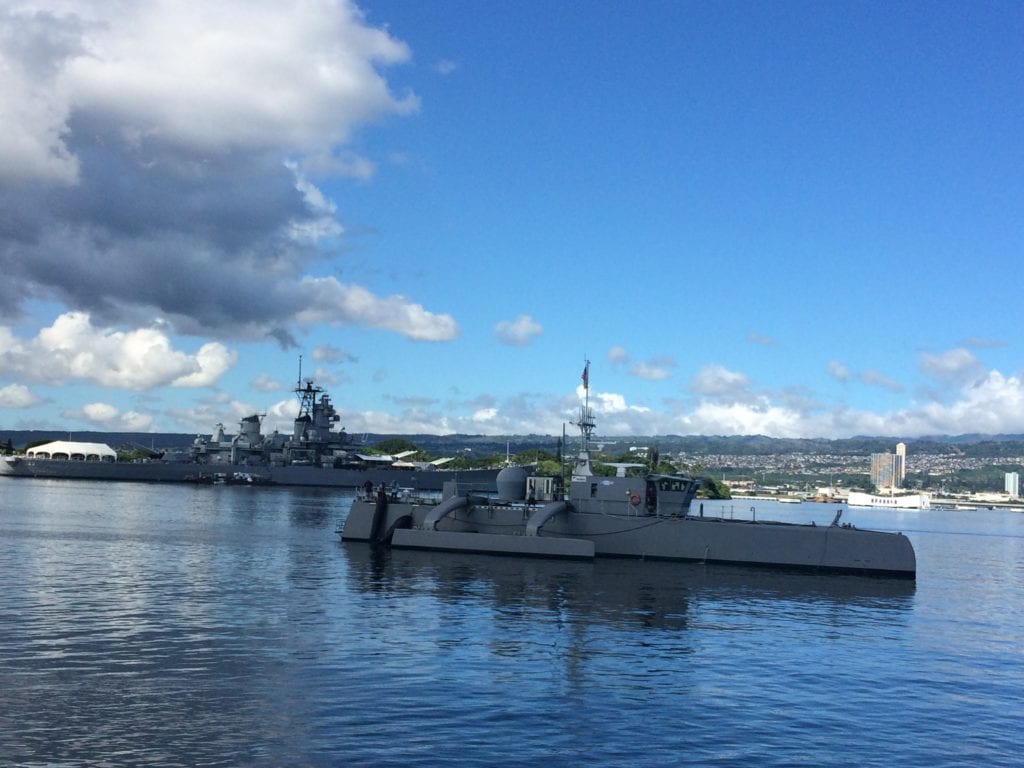
Sea Hunter, an entirely new class of unmanned sea surface vehicle developed in partnership between the Office of Naval Research (ONR) and the Defense Advanced Research Projects Agency (DARPA), recently completed an autonomous sail from San Diego to Hawaii and back — the first ship ever to do so autonomously. Sea Hunter is part of ONR’s Medium Displacement Unmanned Surface Vehicle (MDUSV) project, a forerunner of the Medium Unmanned Surface Vessel program. U.S. NAVY

ARLINGTON, VA. — The Navy plans to use extensive land-site testing for components and systems of the Medium Unmanned Surface Vessel (MUSV) in order to wring out risk in developing and integrating systems, the admiral in charge of developing unmanned vessels said. 

The Navy is committed to addressing the congressional concerns about, for example, the reliability of machinery of USVs, “to make sure that we go in this measured way of rigorous systems engineering approach,” said Rear Adm. Casey Moton, program executive officer, Unmanned and Small Combatants, speaking April 13 in an Unmanned Systems Defense webinar of the Association of Unmanned Vehicle Systems International.  

“Along with our prototypes that are out testing now, we’ve been maturing our execution plans,” Moton said, noting that the program engineers are “working on hybrid reliability and hull, mechanical and electrical [HM&E] equipment. 

“We are now going to do our testing at sea, but we are going to do land-based testing of our HM&E equipment for a Medium USV and we’re getting plans ready for Large USV and all of those aspects,” he said. 

Moton said a second pillar of the programs is for C4I [command, control, communications, computers and intelligence], “making sure that we carefully test the C4I system that is going to allow our unmanned vessels to be a part of this hybrid fleet. A lot of that is about [Project] Overmatch, but also be a principal component of Overmatch.” 

A third pillar of the unmanned systems focus is combat systems, adapting them for use on autonomous vessels. Weapons firing will always be performed by a human in the loop, he said. 

A fourth pillar, a common control system, is maturing and is to be something that can be designed once and then scaled up for fleet use. 

“Our initial prototypes were systems that we bought from industry,” Moton said. “We are all the time maturing that into a common system that is going to go in our program of record.” 

The fifth pillar is perception. “We have a very rigorous plan we’re already executing with our prototypes, testing out the perception systems … and the autonomy we need to do.” he said.    

The sixth pillar is prototyping.  

“We’re getting after the sea-based testing and land-based testing, that particularly has been a concern of Congress, and as we go forward, we’re going to articulate that more clearly, but, in each one of these, we’re going very carefully, doing the building blocks, in a good systems engineering manner,” he said.  

“We’re solving it [any given technological challenge] once. We’re going to scale it up like the framework [Unmanned Campaign Plan] talks about, [so that] we’re not having to learn the same lessons over and over again. Even though we have a set number of prototypes, we are developing systems that are going to apply across the fleet.”      


U.S. Navy Orders 12 MH-60R Helicopters for South Korean Navy

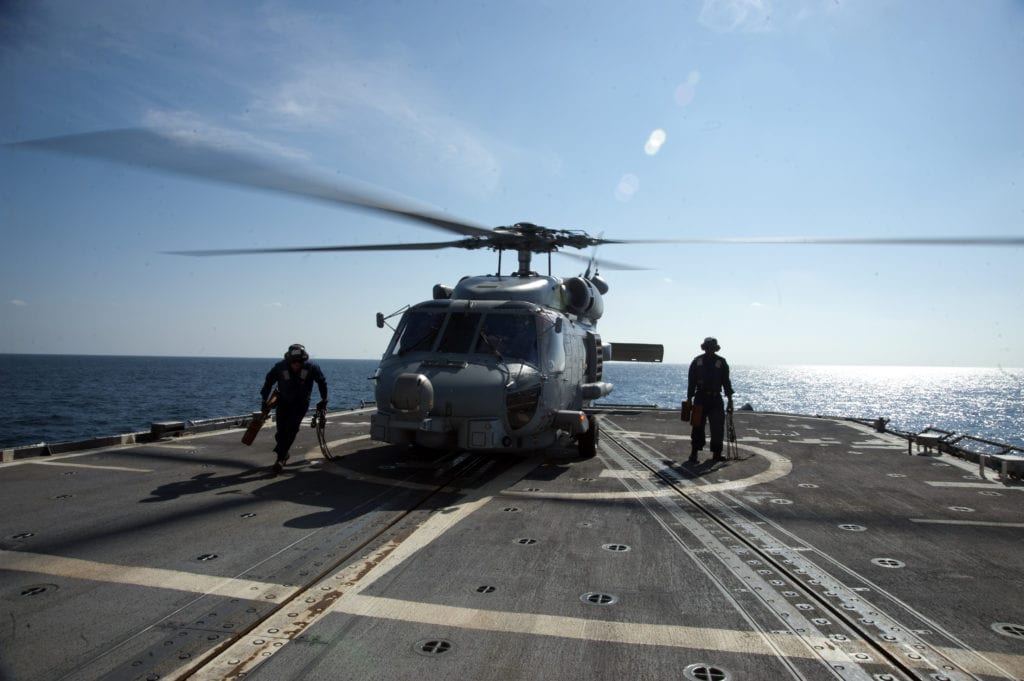
An MH-60R Seahawk helicopter assigned to Helicopter Maritime Strike (HSM) 74, on the flight deck of the guided missile cruiser USS Gettysburg (CG 64) Nov. 24, 2013, in the Gulf of Oman. U.S. NAVY / Mass Communication Specialist 3rd Class Lorenzo J. Burleson

ARLINGTON, Va. — The U.S. Navy has ordered 12 MH-60R Seahawk helicopters from Lockheed Martin for the South Korean navy through Foreign Military Sales program. 

The Naval Air Systems Command awarded Lockheed Martin a $447.2 million firm fixed-price order for the production and delivery of 12 MH-60R aircraft for the government of the Republic of Korea, an April 12 Defense Department announcement said.  

The sale of MH-60Rs to South Korea was approved by the U.S. State Department in August 2020. The sale “will improve the Republic of Korea Navy’s capability to perform anti-surface and antisubmarine warfare missions, along with the ability to perform secondary missions including vertical replenishment, search and rescue, and communications relay,” the release said. “The Republic of Korea will use the enhanced capability as a deterrent to regional threats and to strengthen its homeland defense. The Republic of Korea will have no difficulty absorbing these helicopters and support into its armed forces.” 

In addition to the U.S. Navy, the MH-60R has been operated or ordered by six other nations: Australia (24), Denmark (9), Saudi Arabia (10), India (24), Greece (4) and South Korea (12). 


Saildrone USVs to Collect Data on Gulf Stream

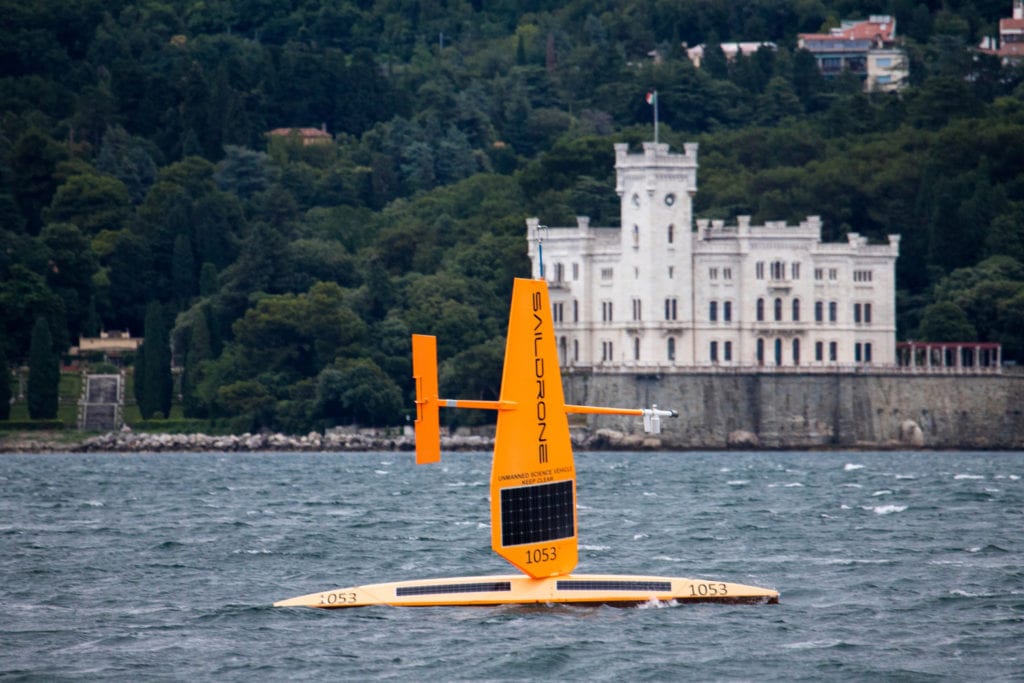
A Saildrone craft near Miramare Castle in Trieste, Italy, following a 2010-2020 Atlantic-to-Mediterranean mission. NATIONAL INSTITUTE OF OCEANOGRAPHY AND APPLIED GEOPHYSICS

ARLINGTON, Va. — Saildrone Inc., an operator of ocean-going unmanned surface vessels (USVs), has been selected by Google to collect oceanographic data on the Gulf Stream. 

“Saildrone has been selected to receive a grant of over €$1 million ($1.2 million USD) from the Google.org Impact Challenge on Climate to collect data in the Gulf Stream that has the potential to transform weather forecasting and our ability to create more accurate global carbon budgets,” Saildrone spokeswoman Susan Ryan said in a statement to Seapower

“The Gulf Stream region has a significant impact on weather and climate in Europe and around the globe but is undersampled due to the violent seas and harsh weather in the region,” Ryan said. “These treacherous conditions make it too dangerous to send research ships and crew into the area for extended periods, especially in winter. It is shocking that 70% of the world is covered by oceans, yet only 2% of the ocean has been sampled for critical ocean data.” 

“Saildrone is a company building and operating unmanned surface vehicles that are powered primarily by solar energy, with wind being the primary propellent for the craft,” said Ron Tremain, Saildrone’s vice president for Maritime Domain Awareness during an earlier interview with Seapower

The Gulf Stream expedition will be conducted by several of Saildrone Explorers, which are 23 feet long and typically proceed at four knots by sail.  

The carbon-fiber sail on each is more like a wing than a sail, but it is a sail that can be controlled mechanically and with the wind. Depending on which direction we want it to sail, the operator can make adjustments to increase the speed, decrease the speed, change course direction as needed, Tremain said. 

The Explorer, the smallest of Saildrone’s USVs, are fitted with an advanced sensor suite of atmospheric and oceanographic sensors, combined with radar, the Automatic Information System, and a set of electro-optical cameras. 

Saildrone will launch six Explorer USVs to spend up to a year continuously collecting critical data in the Gulf Stream while creating no environmental footprint, Ryan said. This mission will collect critical data at a resolution that has not been possible previously, yielding new insights into the transport of heat and carbon around our oceans.  


Clock Ticking for Strategy to Maintain U.S. Global Lead in Artificial Intelligence

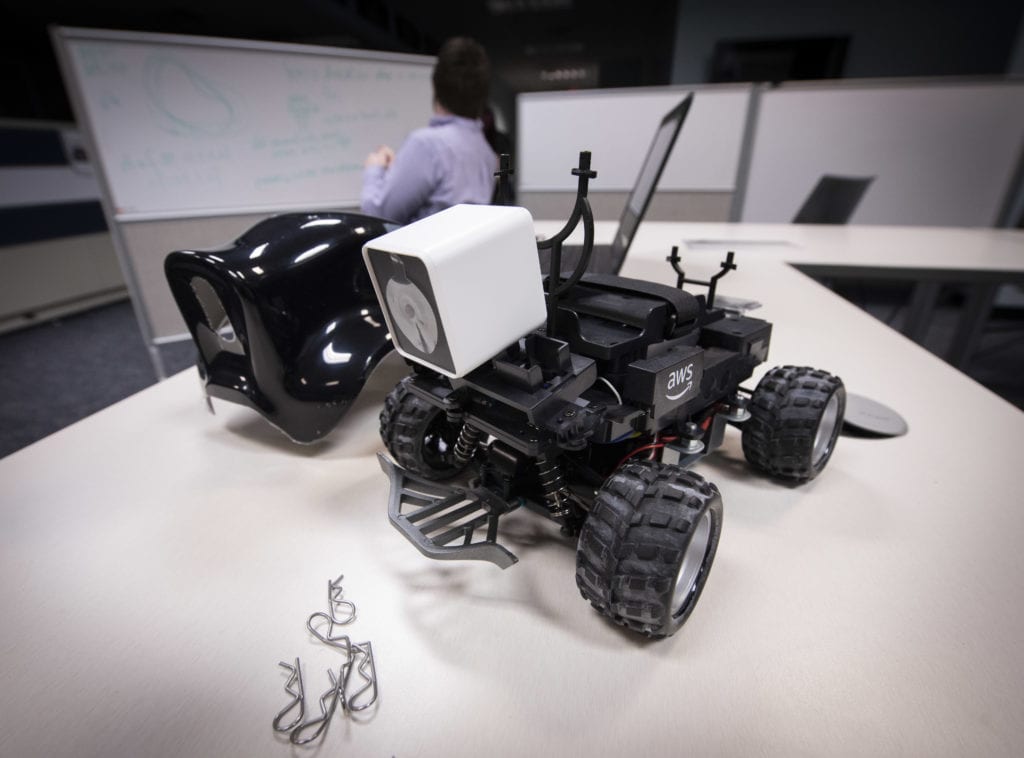
Naval Information Warfare Center (NIWC) Atlantic’s Amazon Web Services (AWS) DeepRacer vehicle is opened up for maintenance and a last minute check before being shipped off to participate in the First Annual virtual Army-Navy AWS DeepRacer Challenge. The challenge is centered around racing autonomous vehicles. U.S. NAVY / Joe Bullinger

ARLINGTON, Va. — U.S. technological advantages over great power competitor China could be lost in less than 10 years without a robust and comprehensive artificial intelligence (AI) security strategy, according to the findings of an independent government commission.

“For the first time since World War II, the United States’ technological predominance — which undergirds both our economic and military competitiveness — is under severe threat by the People’s Republic of China,” Robert Work, vice chairman of the National Security Commission on Artificial Intelligence, told a live-streamed Pentagon press briefing April 9 on the commission’s final report.

And the most important technology “that the United States must master is artificial intelligence and all of its associated technologies,” Work added. Likening artificial intelligence to how harnessing electricity opened up a field of fields, Work said AI would affect quantum computing, healthcare, finance and military competition.

Work, who served as deputy secretary of defense in the Obama and Trump administrations, stressed the immediate and long-term risks. He noted China has advantages in data collection, with no privacy restraints like Western democracies have, as well as applications and integration of AI. The United States has advantages in talent, hardware and algorithms.

“Although the Chinese are really pushing hard [on algorithms] and we think they could catch up with us within five to 10 years,” he cautioned. However, overall, Work explained, “we do not believe China is ahead right now in AI.”

But that could change, said Marine Corps Lt. Gen. Michael S. Groen, director of the Joint Artificial Intelligence Center.

“China’s declared intent is to be globally dominant in AI by 2030,” he told reporters. JAIC’s mission is to transform to accelerate the delivery and adoption of AI to achieve mission impact at scale across the Defense Department. He said there was positive momentum toward implementation of AI at scale. “We certainly have a long way to go, but you can see the needle trending positive.”

The Chinese “are far more organized for competition and have a strategy to win the competition,” backed by a lot of resources, Work added. By contrast, the United States is not organized to win the competition for AI dominance. “We do not have a strategy to win the competition,” Work said, adding “We do not have the resources to implement a strategy — even if we had one.”

That’s where the commission’s recommendations come in. They include setting up a steering committee of emerging technology, consisting of the deputy defense secretary, the vice chairman of the Joint Chiefs and the principal deputy director of national intelligence to coordinate all AI activities between the intelligence community and the Pentagon.

Other recommendations include establishing a dedicated AI fund to assist small innovative AI companies bridge the gap between initial research funding and program acquisition; creating a Defense Department digital corps, modeled on the Medical Corps, to identify and utilize digital-savvy warfighters and leaders; and boosting science and technology research and development to 3.4% of the defense budget and spend $8 billion on AI annually.

Groen described the massive NSCAI report as a “760-page to-do list.” With tightened future defense budgets expected, “the productivity gains and the efficiency gains that AI can bring to the department becomes an economics necessity.”  


Bahrain Delegation Commemorates Production of Its First AH-1Z Helicopter

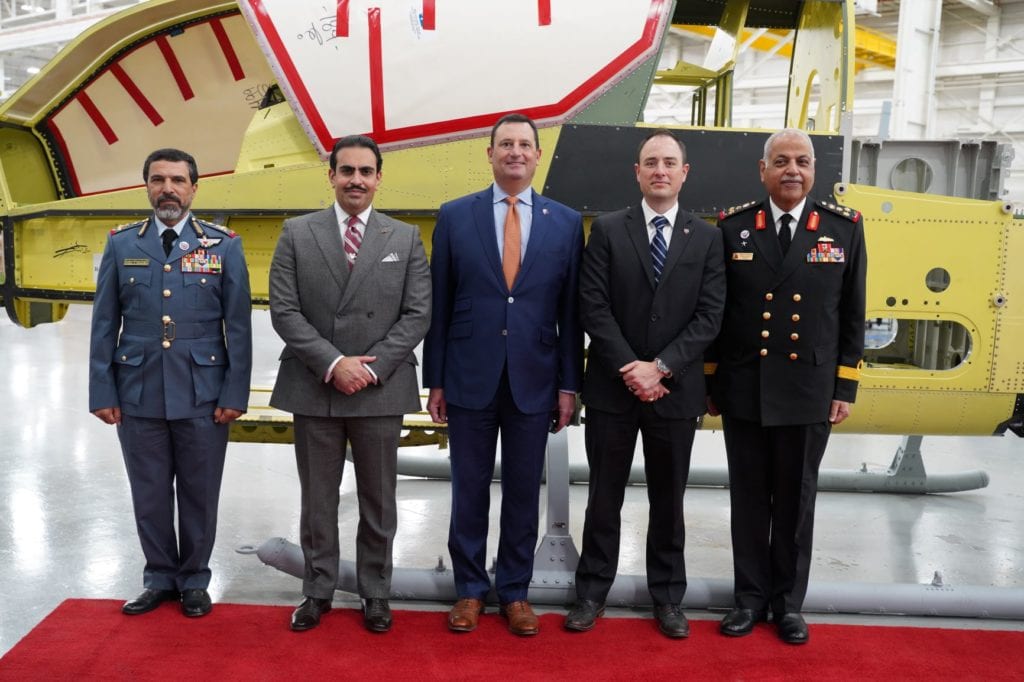
Brig. Gen. Faisal Al Kaabi, Bahrain Ambassador to the U.S. H.E. Shaikh Abdulla Al Khalifa, Bell Executive Vice President, Military Business, Vince Tobin, Bell Vice President and H-1 Program Director Michael Deslatte and Bahrain Defense Attaché to the U.S., Commodore Adm. Jasim Al Jowder, pose in front of an AH-1Z Viper during an aircraft frame signing ceremony at Bell’s Amarillo assembly center on 31 March 2021. BELL

AMARILLO, Texas — Bell hosted a delegation from the Kingdom of Bahrain to mark the start of production of AH-1Z Viper attack helicopters built as part of the Foreign Military Sales (FMS) program, the company said in an April 12 release. Delegates toured the Bell Amarillo production facility to observe the production line and ceremoniously sign the aircraft’s frame destined to join the Bahrain Air Force. 

“We are honored to host the Kingdom of Bahrain and share this milestone in production for the AH-1Z,” said Mike Deslatte, Bell H-1 vice president and program director. “Today’s ceremony marks a new milestone in bringing the advanced capabilities of the Viper a step closer to the Kingdom of Bahrain.”  

Bell designed the AH-1Z Viper to meet the modern battlefield’s expeditionary requirements across the full spectrum of military operations. The Viper routinely maintains a high operational tempo from forward operating facilities by minimizing its logistical footprint without losing warfighting capabilities. 

“Today also signifies the dedication of thousands of Bell and Team Viper employees around the world who are proud to support our international partner,” said Deslatte.  

The Department of Defense awarded Bell a contract to manufacture and deliver 12 Lot-16 AH-1Z aircraft to the Kingdom of Bahrain. Bell projects production deliveries to begin in late 2021. 


NAWCAD Team Brings First-of-its-Kind P-8A Decoy Prototype to Test

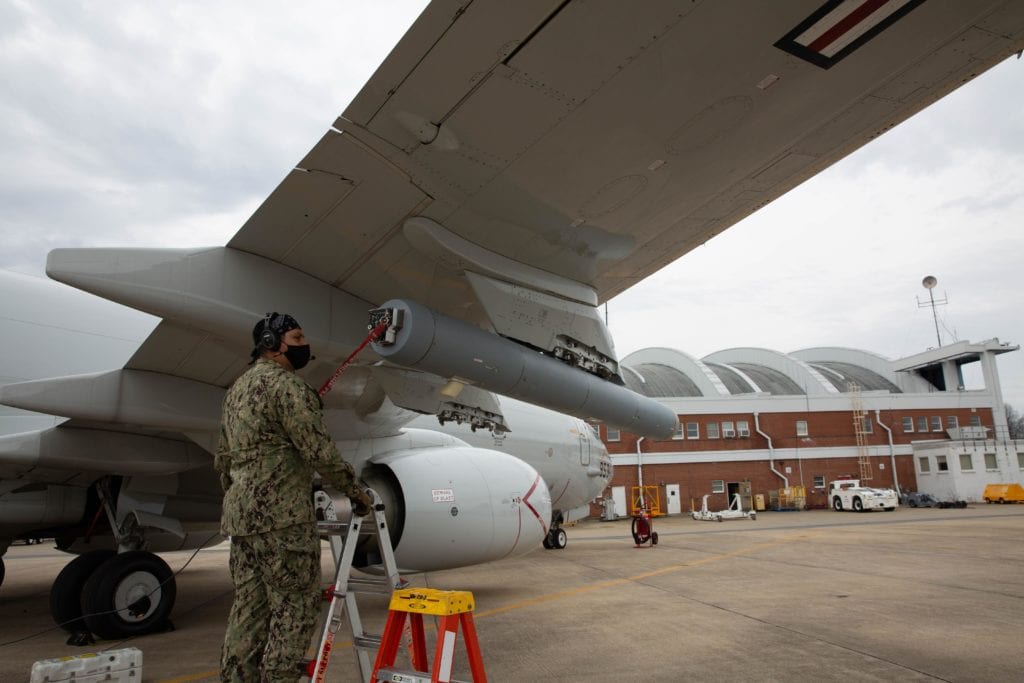
A member of Air Test and Evaluation Squadron (VX) 20 puts a pod-mounted radio frequency countermeasure system on a P-8A Poseidon, March 12. The pod successfully competed an air worthiness test at the Naval Air Warfare Center Aircraft Division (NAWCAD) Atlantic Test Ranges. U.S. NAVY

PATUXENT RIVER, Md. — An Air Test and Evaluation Squadron (VX) 20 P-8A Poseidon successfully completed an airworthiness test of a pod-mounted radio frequency countermeasure (RFCM) prototype at the Naval Air Warfare Center Aircraft Division (NAWCAD) Atlantic Test Ranges, March 12, the Naval Air Systems Command said in an April 9 release. 

The first-of-its-kind radio frequency defense decoy could allow the P-8A to thwart enemy radio frequency missile attacks. 

 “This has the potential to be a game-changer for protecting the warfighter,” said Capt. Eric Gardner, program manager for the Maritime Patrol and Reconnaissance Aircraft Program Office (PMA-290). “We continue to look for ways to enhance capabilities that allow the fleet to be successful.”  

Getting the pod into testing, in just over a year, took a complete team effort. 

Constantly looking for upgrades to the P-8A, PMA-290 set out to find a solution to a potential threat from surface-to-air radio frequency missiles. 

Outlining their needs and running lead on the project, PMA-290 brought in the Advanced Tactical Aircraft Protection Systems Program Office (PMA-272), the Rapid Prototyping, Experimentation & Demonstration (RPED) team, and the NAWCAD Aircraft Prototype Systems Division (APSD) to get the ball rolling. 

The RPED team supported APSD in designing the RFCM pod, which integrated the proven AN/ALE-55 Fiber Optic Towed Decoy from PMA-272 into a shell. The team developed the shell design based on the certified AGM-84 Harpoon missile, and then incorporated unique tracks and housing to fit and deploy the decoy. 

By employing the assistant secretary of the Navy for research, development and acquisition’s delegation of other transactions authority (OTA) for prototype projects, PMA-290 and NAWCAD were able to complete a one-of-a-kind contract with BAE Systems to develop the RFCM pod’s additional internal equipment suite. The OTA, a non-Federal Acquisition Regulation contracting approach, could potentially allow this critical self-protection technology to transition from prototype to fleet capability in much less time than a traditional effort. 

APSD and BAE leveraged the established AN/ALE-55 electrical design to accommodate the suite’s installation. 

“A lot of the challenge and effort went into designing, to our best estimates, for what BAE was expected to put in the pod,” said Michael Hansell, the leading APSD engineer for the project. “We had to adapt and redesign rapidly. We worked as fast as possible to support PMA-290 and RPED to make sure we could pivot and adjust to meet established timelines.” 

Constant tweaks were needed as the teams continued to hone in on a capable design. 

“Michael Hansell and his team’s flexibility and willingness to go above and beyond, to work through issues and prepare for BAE, was key in getting [the pod design and build] done in a timely manner,” said James Sherman, the APSD project lead. 

The Naval Innovative Science & Engineering (NISE) program funded the project, which provided the means to conceptualize, prototype, build, and test this new capability for the Navy. 

This funding accelerated the design and manufacturing cycle for the prototype to just under six months. The expedited developmental process supports the rapid prototyping of new and developing technologies and provides the resources to find solutions and incorporate improvements to fill capability gaps in the fleet faster. 

The teams were also able to use PMA-272’s F/A-18 lab equipment to speed up the timeline. 

All this teamwork culminated in the successful airworthiness test with VX-20. 

 “This shows that when we identify a need and work rapidly as a team we can bring a viable solution to test that has the ability to greatly impact the warfighter,” said Lt. Cmdr. Mike Marschall, PMA-290 weapons and rapid capabilities co-team lead. 

Following the test, the pod went to Naval Air Weapons Station China Lake, California, where it successfully completed effectiveness testing, March 21-26. It will now continue to be tested at a system level leading to platform integration through planned capability fielding phases.