Rite-Solutions Included in First Missile Defense Agency SHIELD Contract Award
From Rite-Solutions
MIDDLETOWN, R.I. (December 12, 2025)—Rite-Solutions was awarded the Missile Defense Agency (MDA) Scalable Homeland Innovative Enterprise Layered Defense (SHIELD) contract on December 5th.
The 10-year, $151 billion MDA SHIELD contract is a multiple-award, Indefinite Delivery Indefinite Quantity (IDIQ) contract aimed at developing an advanced, multi-domain defense system capable of detecting, tracking, intercepting, and neutralizing threats to the United States and its forces across the air, missile, space, cyber, and hybrid domains.
“This marks the first time Rite-Solutions was awarded a contract with the Missile Defense Agency,” says Laurie Carter, Executive Vice President of Business Development. “We are excited to expand the agencies we serve and are thrilled to be a part of the reputable pool of SHIELD awardees.”
Rite-Solutions will support MDA’s goal of improving the speed and agility with which innovative capabilities are rapidly delivered to the warfighter. The scope of work encompasses four primary work areas (Research & Development, Engineering & Production, Operations & Support, and Analysis & IT Services) and includes early science, disruptive technology, production, sustainment, modernization, and facilities work.
“This new vehicle allows us to develop systems that help the MDA counter ballistic, hypersonic, and cruise missile threats,” adds Rite-Solutions CEO and Co-Founder, Joe Marino. “It’s a perfect opportunity to apply our innovative capabilities in areas such as AI, digital and model-based systems engineering, agile processes, and open systems architecture.”
HII Marks Oklahoma Construction Milestone at Newport News Shipbuilding
From HII
NEWPORT NEWS, Va., Dec. 16, 2025 (GLOBE NEWSWIRE) — HII (NYSE: HII) announced today that its Newport News Shipbuilding division has reached a significant construction milestone for Virginia-class submarine Oklahoma (SSN 802).
Oklahoma is now “pressure hull complete,” which signifies all of the hull sections have joined to form a single, watertight unit.
“Achieving pressure hull complete on Oklahoma highlights our commitment to accelerating production and delivering unmatched capability to our Navy customer,” said Jason Ward, NNS vice president of new construction submarine programs. “Our dedicated shipbuilders, Navy teammates and suppliers from across the country, are working hand-in-hand to bring Oklahoma to life.”
Oklahoma is the 29th Virginia-class fast attack submarine, the first of Block V and the 14th to be delivered by NNS.
The ship’s sponsor is Mary “Molly” Slavonic, an Oklahoma native. Slavonic has long supported both the state of Oklahoma and the Navy. She worked alongside her husband, former acting Under Secretary of the Navy Greg Slavonic, in building the USS Oklahoma (BB 37) Memorial in Pearl Harbor, Hawaii, to honor the 429 sailors and Marines who died aboard the battleship during the Dec. 7, 1941 attack on Pearl Harbor.
NNS designs and builds nuclear-powered submarines for the U.S. Navy. The advanced capabilities of Virginia-class submarines increase firepower, maneuverability and stealth.
Navy Renews HawkEye 360 Contract to Advance Indo-Pacific Maritime Domain Awareness
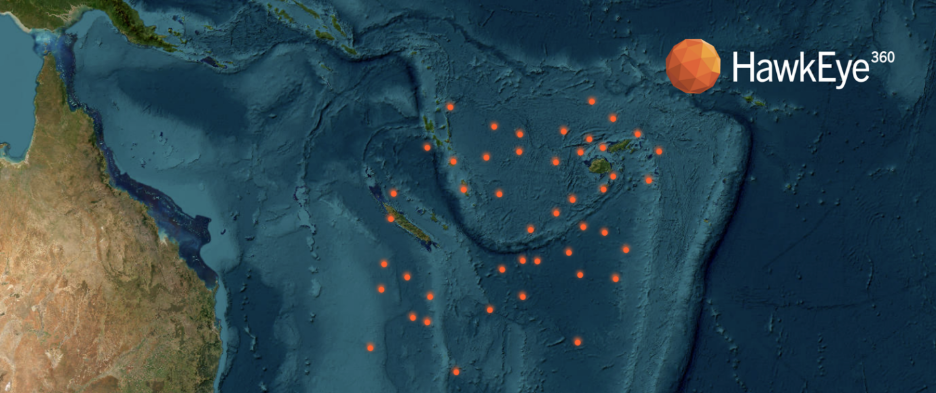
Herndon, VA, (December 9, 2025) – HawkEye 360, the global leader in signals intelligence data and analytics, today announced that the US Navy has renewed its contract with the company for a fourth consecutive year under the Indo-Pacific Partnership for Maritime Domain Awareness (IPMDA) initiative. The $98.8 million firm-fixed-price, indefinite-delivery/indefinite-quantity (IDIQ) contract extends the U.S. Navy’s access to HawkEye 360’s commercial radio frequency (RF) data and analytics for vessel detection and monitoring over key areas of interest throughout the Pacific.
“This renewal represents a vote of confidence in the partnership between the U.S. Navy and HawkEye 360 and an investment in future innovative solutions,“ affirms Andy Charles, General Manager for the Department of War, HawkEye 360. “With the pace at which commercial companies can move, especially one so mission-focused as HawkEye 360, this action welcomes a host of technological advancements through IPMDA to drive information sharing and Coalition command and control to the speed of modern warfare.”
HawkEye 360’s RF signals intelligence supports the Department of Defense’s efforts to identify and characterize vessel behavior, detect illicit maritime activity, and share insights with allied partners to promote regional stability. The company’s data is integrated into operational tools that help users gain a more complete picture of vessel movement and maritime dynamics over vast ocean areas.
“Our ongoing partnership with the US Navy represents a shared commitment to advancing maritime domain awareness and supporting the missions of our partners across the Indo-Pacific,” said James G. McAden, General Manager, Asia Pacific, HawkEye 360. “We’re proud to be entering our fourth year of collaboration, delivering advanced RF data and analytics that strengthen situational awareness and decision-making for maritime security operations.”
HawkEye 360’s constellation detects, characterizes, and geolocates RF signals from ships and other emitters worldwide, creating a powerful data layer that complements existing maritime information sources. When combined with other data streams, HawkEye 360’s signals intelligence helps defense and intel users identify potential “dark vessels,” uncover patterns of activity, and build a consistent, shared operating picture across the region.
Coast Guard Cutter Active Crew Offloads $203M in Cocaine in San Diego
Crew members of the U.S. Coast Guard Cutter Active (WMEC 618) stand at parade rest on the flight deck of the cutter in San Diego, Dec. 15, 2025. The Active’s crew offloaded drugs interdicted in the Eastern Pacific Ocean during counter-narcotic patrols, seizing 27,551 pounds of cocaine worth $203.9 million in value. (U.S. Coast Guard photo by Petty Officer 3rd Class Chris Sappey)
From U.S. Coast Guard Southwest District Public Affairs, Dec. 15, 2025
SAN DIEGO — The crew of USCGC Active (WMEC 618) offloaded approximately 27,551 pounds of cocaine, with an estimated value of $203.9 million, in San Diego, Monday.
This offload resulted from three separate interdictions of suspected drug-smuggling vessels in international waters off the coasts of Mexico, Central America, and South America. Two of the three interdictions were conducted by Active crew members and one by the U.S. Coast Guard Cutter Munro crew members.
“I could not be prouder of this crew,” said Cmdr. Earl Potter, commanding officer of the Coast Guard Cutter Active. “Their determination, resilience, and professionalism make it possible to complete these dynamic and dangerous missions at sea. The conditions are tough, hours are long, and demands are high, but this team always maintains focus. The crew’s commitment to protecting our nation and keeping drugs off our streets is what defines the Active’s legacy.”
The interdictions were conducted as part of Operation Pacific Viper, a Coast Guard surge effort aimed at disrupting transnational criminal organizations and reducing the flow of illegal narcotics into the United States. These operations play a key role in protecting U.S. communities from the effects of cocaine and synthetic drugs, such as fentanyl.
“The Coast Guard is escalating the fight against narco-terrorism and trans-national criminal organizations flooding our nation with deadly drugs,” said Rear Adm. Jeffrey Novak, deputy commander, Coast Guard Pacific Area and commander, Coast Guard Southwest District. “By continuing to surge resources to the Eastern Pacific Ocean in coordination with international and interagency partners and allies, our maritime fighting force is making historic strides toward dismantling the smuggling networks that threaten the safety and security of the American people.”
Active is a 210-foot medium-endurance cutter homeported in Port Angeles, Washington. Equipped with two small boats, the cutter supports missions across the Eastern Pacific, including search and rescue, counter-narcotics operations, living marine resources, and homeland defense.
USSOCOM Upgrades Personal Diver Equipment
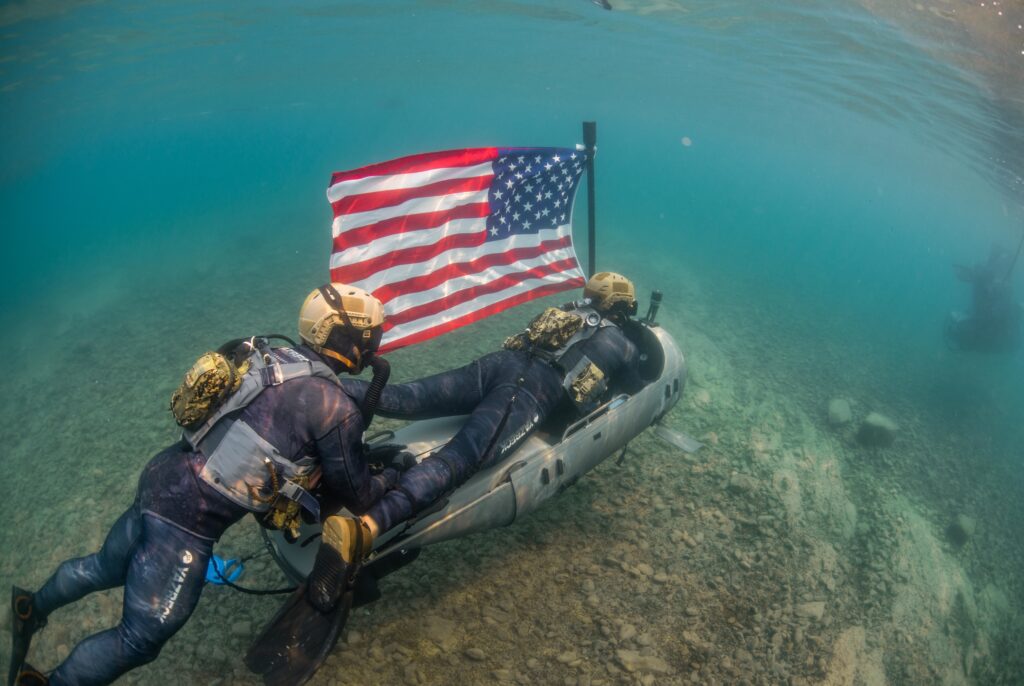
Sailors assigned to various Naval Special Warfare commands operate a Diver Propulsion Device during high-altitude dive training in 2022. Photo credit: U.S. Navy | Mass Communication Specialist 2nd Class Alex Perlman
U.S. Special Operations Command is upgrading its Special Operations Forces’ personal diving equipment.
“Technology for the combat diver has advanced significantly and SOF continues to enhance diver capabilities to maintain an agile and lethal combat diving force,” Lieutenant Commander Kassie Collins of USSOCOM said in response to a question from Seapower.
The SOF Combat Diver program (under U.S. Special Operations Command PEO Maritime) consists of maritime environmental protection (free diver heating and cooling, full face masks, and chemical, biological, radiological, and explosive protection), life-support systems (underwater breathing apparatus, treatment systems, and decompression systems), diver navigation (handheld digital navigation and integrated navigation), diver propulsion (collective, hands-free), underwater communication (acoustic, optical, and diver-to-host) and signature management (equipment signature reductions and signature detection), Collins said.
“Early wins for the SOF Combat Diver program include digitizing legacy navigation and equipping energized propulsion devices in lieu of fins. As a result, the program has been able to rapidly accelerate development and fielding of navigation and propulsion devices. The SOF Combat Diver program also continuously evaluates battery technology to ensure safety and maximize endurance. Currently, this program does not have a requirement for drones or AI [artificial intelligence].”
Because many USSOCOM programs are generally classified, USSOCOM didn’t provide equipment specifics to the categories.
For Diver Propulsion, a search of SAM.gov., the official U.S. federal government contracting website did provide some details. In the summer of 2025, the Naval Special Warfare Center was looking into acquiring the Patriot3 Brand Jetboots V6 Diver Propulsion Device, essentially a low-noise, low-weight brushless motor ducted thruster propeller strapped to a diver’s thighs. The hands-free Jetboots provide 40 pounds of thrust and increase a special operations diver speed by around four knots at a depth of 300 feet and a range of a dozen miles on two batteries, or one to six hours of battery life.
TheWarZone website reported U.S. Navy SEALs having Jetboots since July 2020, but Jetboots was conceptualized and patented in 2013, so USSOCOM could be seeking supply support and maintenance in addition to new Jetboot replacements. A $10 million dollar contract was awarded to Patriot3 Inc. that runs through 2027.
For Diver Navigation, USSOCOM is working with Safety and Security International (SSI) regarding its Tactical Diver Readiness Assembly. This increases special operations divers’ situational awareness and rapid deployment in maritime and expeditionary environments by combining the functions and features of a mission critical multi-function dive watch with a modular load carriage and safety components to provide advanced underwater navigation instrumentation and real-time dive diagnostics in MOLLE-compatible pouches.
The navigation devices can be made digitalized, smaller and lighter, while still incorporating GPS features, real-time diving diagnostics, and advanced underwater navigation instruments.
Further investigation into SAM.gov. yields a request for information on underwater communications technologies that are not radio frequency based, as well as for power sources focused on power-harvesting technologies instead of batteries or connected power sources. The current status of USSOCOM’s underwater communications technologies and novel power sources is unknown.
The 2019 USSOCOM RFI also seeks improvements in human performance in harsh maritime conditions for extended operating periods “with or without personal protective equipment,” to:
Reduce the potential of musculoskeletal injuries related to combat diving
In just 45 days, Northrop Grumman paired the AN/AQS-24 minehunting system withan unmanned surface vehicle
PANAMA CITY, Fla. – Dec. 15, 2025 – (PHOTO RELEASE) Northrop Grumman Corporation (NYSE: NOC) successfully demonstrated the integration of its proven AN/AQS-24 minehunting system with a Mine Countermeasures Unmanned Surface Vehicle (MCM USV), addressing the U.S. Navy’s growing need for an uncrewed, towed MCM solution. Just 45 days after signing a contract with the Navy, Northrop Grumman began open-water testing in Panama City to demonstrate the high-performing, helicopter-towed AN/AQS-24 can effectively pair with a MCM USV. The U.S. Navy confirmed that the AN/AQS-24 meets all primary government objectives for a safer and more efficient mine-hunting capability.
Coast Guard Cutter Harriet Lane Returns Home Following 81-day Patrol in Oceania
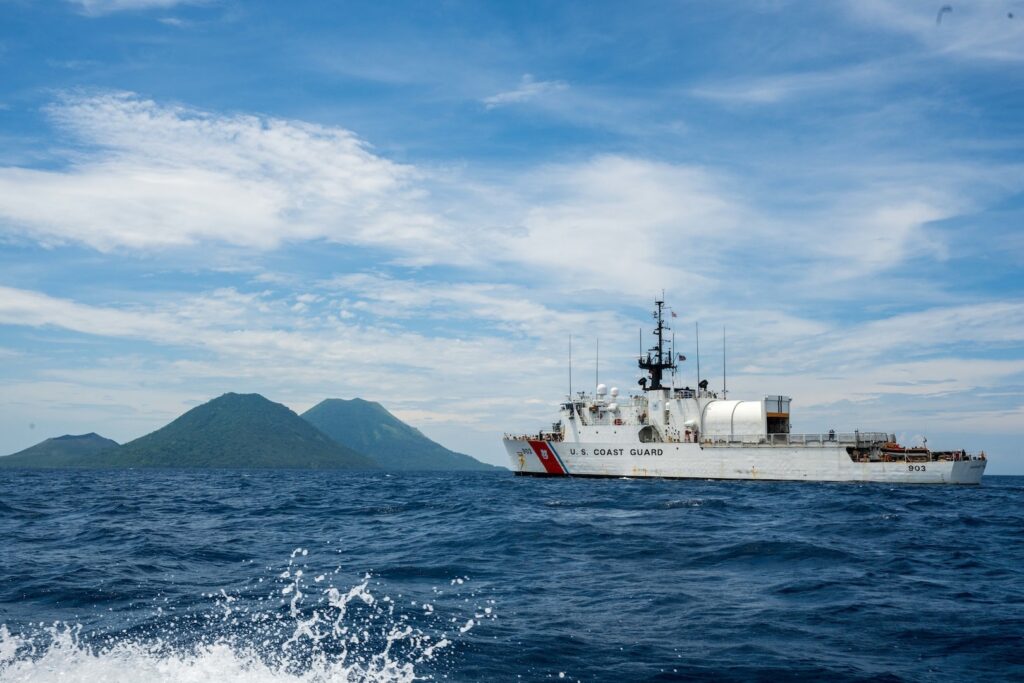
The medium endurance cutter USCGC Harriet Lane (WMEC 903) transits offshore Rabaul, Papua New Guinea, Oct. 26, 2025. Commissioned in 1984, the Harriet Lane is a 270-foot cutter homeported in Honolulu to support Coast Guard missions in the Pacific region. (U.S. Coast Guard Photo by Petty Officer 3rd Class Austin Wiley)
HONOLULU – The crew of USCGC Harriet Lane (WMEC 903) returned to Honolulu Saturday following an 81-day patrol in support of Coast Guard Oceania District’s Operation Blue Pacific.
The Harriet Lane crew departed Joint Base Pearl Harbor-Hickam in September to conduct joint operations and territorial integrity missions across Oceania. Patrolling more than 16,000 nautical miles throughout Oceania to include the Republic of the Marshall Islands, Papua New Guinea, Vanuatu, Tonga, and American Samoa, the cutter’s crew worked alongside interagency and Pacific Island partners to deter transnational criminal organization activities, facilitate the flow of commerce, and protect critical ocean resources.
“This patrol was a resounding success for the crew of Harriet Lane and reinforced the Coast Guard’s commitment as a trusted partner across Oceania,” said Cmdr. Justin Matejka, commanding officer, Harriet Lane. “It was a pleasure to partner with the many professional officers from multiple Pacific Island Countries to combat illegal, unreported, and unregulated fishing and transnational criminal organization activity. I am proud of the crew’s incredible commitment to operational success and look forward to being a part of Harriet Lane’s growing impact across the region.”
The Harriet Lane crew exercised partnerships with the Marshall Islands, Papua New Guinea, Vanuatu, and Tonga through bilateral maritime law enforcement agreements, professional exchanges, and domestic federal maritime law enforcement operations. In total, the Harriet Lane crew and Pacific Island enforcement officers conducted 31 boardings of fishing vessels, resulting in 20 potential violations.
The crew conducted 15 additional high seas boarding and inspections on commercial fishing vessels, resulting in 2 potential violations of conservation and management measures under the Western and Central Fisheries Commission.
Enhancing diplomatic relationships within the Pacific Quadrilateral Defence Coordinating Group, the Harriet Lane crew also integrated Royal New Zealand Navy sea riders for a portion of the patrol.
Harriet Lane’s visit to Tonga included strategic discussions with Defense and Foreign Minister, Crown Prince Tupouto’a ‘Ulukalala, focusing on enhancing bilateral cooperation to address maritime security threats and counter illegal, unreported, and unregulated fishing activity in the region.
Commissioned in 1984, Harriet Lane is a 270-foot medium endurance cutter homeported in Honolulu to support Coast Guard missions in the Pacific region. The service’s medium endurance cutter fleet supports a variety of Coast Guard missions including search and rescue, law enforcement, maritime defense, and protection of the marine environment.
AeroVironment Awarded $4.8M Contract for U.S. Coast Guard ROVs
POTTSTOWN, Pa. – December 11, 2025— AeroVironment, Inc. (“AV”) (NASDAQ: AVAV), a leading provider of underwater robotic systems, today announced it has been awarded a $4.8 million United States Coast Guard contract through its wholly owned subsidiary, VideoRay, to deliver Mission Specialist Defender remotely operated vehicles (ROVs) as part of the Service’s Force Design 2028 modernization initiative.
The Defender will enhance the Coast Guard’s maritime response capabilities by enabling rapid underwater inspections, pier inspections, hull assessments, subsurface infrastructure surveys, disaster response and search and rescue operations in challenging environments—reducing diver risk while increasing mission safety, operational efficiency, and fleet readiness.
“The selection of the Mission Specialist Defender reinforces our ability to deliver proven technology to address the most demanding defense and security missions,” said Chris Gibson, Chief Executive Officer at VideoRay. “Customers have come to depend on VideoRay when failure is not an option. As AV’s maritime pillar, we’re proud to contribute to the organization’s all-domain uncrewed systems strategy to ensure the safety and security of our forces.”
As part of Force Design 2028, the Coast Guard established the Robotics and Autonomous Systems (RAS) Program Executive Office to rapidly integrate unmanned and robotic technologies across all missions, including investments in robotics and autonomous systems designed to build a more agile, technology-enabled, and globally ready force for the evolving maritime domain.
AV’s $4.8 million award—the largest award of the $11 million executed in fiscal year 2025 for rapid autonomous fleet upgrades—will strengthen Coast Guard operations with proven, advanced maritime robotics. The selection of the Mission Specialist Defender builds on the company’s expanding track record with U.S. and allied defense customers, including the Navy’s Maritime Expeditionary Standoff Response (MESR) program.
“These unmanned systems provide increased domain awareness, mitigating risk and enhancing mission success as the Coast Guard continues to operate in hazardous environments,” said Anthony Antognoli, the Coast Guard’s first RAS program executive officer, in a separate release issued by the U.S. Coast Guard in September 2025. “The Coast Guard’s mission demands agility, awareness and adaptability. Robotics and autonomous systems deliver all three, enabling us to respond faster, operate smarter and extend our reach where it matters most. We are not waiting for the future to arrive. We are delivering it to the fleet today.”
Built on a modular, open-architecture design, the Mission Specialist Defender allows operators to easily integrate advanced sensors, manipulators, and specialized payloads. This flexibility ensures adaptability to evolving mission requirements, while field-swappable modules enable on-site maintenance and repairs—minimizing downtime and maintaining operational tempo.
Will deliver more than 600 Rogue 1™ reusable loitering munition systems that enable small units to directly engage enemy targets beyond line of sight
Highly accurate loitering munition features mission-specific payload options, boosting warfighter efficiency and effectiveness
BOSTON ― December 5, 2025 ― Teledyne FLIR Defense, part of Teledyne Technologies Incorporated (NYSE:TDY), announced that it has been awarded a $42.5 million contract by the U.S. Marine Corps Systems Command for Delivery Order 3 of its Organic Precision Fires-Light (OPF-L) program.
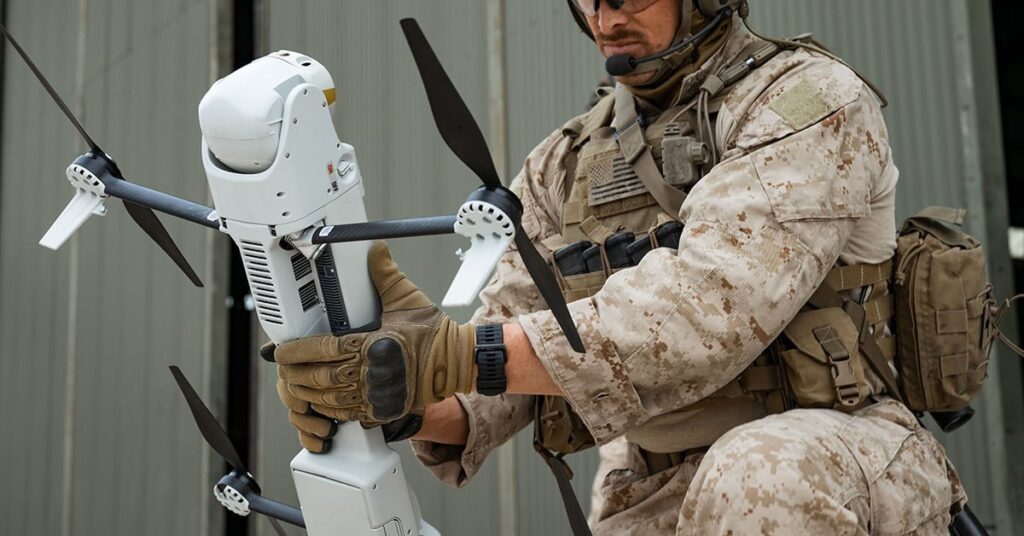
Teledyne FLIR Defense will deliver more than 600 of its advanced Rogue 1™ lethal loitering munition systems, along with ground control stations and training kits, for fielding to Marine Corps units starting this summer.
Organic Precision Fires-Light is a program designed to provide rifle squads and platoons with a man-packable “organic, loitering, precision strike capability to engage the enemy beyond the line of sight.”
Teledyne FLIR’s Rogue 1 has proven highly successful in multiple exercises against moving and stationary armor, soft-skinned vehicles, and dismounted targets. Operators can attach modular, mission-specific payloads with lethal effects designed for distinct target types. An advanced fuzing system on Rogue 1 allows the aircraft to be safely returned to the operator and reused when targets are disengaged or missions aborted, which lightens the pack load for Marines while increasing their tactical effectiveness.
Rogue 1 also features advanced electro-optical and FLIR Boson® 640+ thermal cameras to deliver day/night long-range reconnaissance and surveillance. Plus, a novel coupling between sensors and warhead in the gimballed payload enables extremely precise targeting.
“The accuracy and modularity of the Rogue 1 platform will enhance Marine lethality against whatever threats they may encounter in future conflicts,” said Dr. JihFen Lei, president of Teledyne FLIR Defense. “We’re honored to support the OPF-L program and will continue to work with the Marine Corps to quickly field technology innovations they need to win on the battlefield.”
“While Teledyne provides a broad range of unmanned air, ground, and subsea systems, this award represents our first production rate contract in the loitering munition market, following the initial test and evaluation contract in 2024,” said George Bobb, president and chief executive officer of Teledyne Technologies.
Visit us online to learn more about the wide range of FLIR Defense loitering munitions, unmanned aerial systems and advanced payload options.
Coast Guard Cutter James Conducts Counter-Drug Patrol in Eastern Pacific Ocean
From U.S. Coast Guard Southeast District, Dec. 12, 2025
NORTH CHARLESTON, S.C. — The crew of the U.S. Coast Guard Cutter James (WMSL 754) returned to their home port in Charleston, Wednesday, following a 92-day deployment conducting counter-narcotics operations in the Eastern Pacific Ocean in support of Operation Pacific Viper.
During the patrol, the James crew interdicted over 46,500 pounds of narcotics valued at nearly $350 million. The James crew conducted nine interdictions and detained 33 suspected drug traffickers. The patrol focused on disrupting illegal narcotics smuggling in collaboration with international partners.
The James crew worked alongside international partners including Costa Rica, Ecuador, Mexico, and Colombia. The collaboration included multiple partner nation transfers.
To support maritime governance and strengthen international relations, the James crew transferred 22 detainees pier side in Manta, Ecuador, prior to a visit from Department of Homeland Security Secretary Kristi Noem.
The James crew worked with the Costa Rican coast guard and national police to transfer two Colombian detainees and offload approximately 9,500 pounds of cocaine in Golfito, Costa Rica. During the visit, James hosted Costa Rican Minister of Security Mario Zamora Cordero.
“I am exceptionally thankful and proud of this crew’s dedication,” said Capt. Thomas Rodzewicz, commanding officer of the James. “Time away from family and missed holidays is never a small sacrifice, but the crew’s time and commitment to combatting narco-terrorism and protecting our nation from illicit drugs crossing our borders are highlighted by the success of this patrol.”
The James crew offloaded more than 26,000 pounds of cocaine and 500 pounds of marijuana in Port Everglades, Florida, Monday, before heading home.
Since 2017, Coast Guard Cutter James crewmembers have interdicted 104 shipments totaling 285,140 pounds of cocaine worth $2.11 billion wholesale and 34,539 pounds of marijuana worth $27.8 million wholesale.
James is one of four 418-foot Legend-class national security cutters homeported in Charleston under U.S. Coast Guard Atlantic Area Command. The cutter’s primary missions are counter-drug operations and defense readiness.
Detecting and interdicting narco-terrorism on the high seas involves significant interagency and international coordination. U.S. Southern Command’s Joint Interagency Task Force-South, based in Key West, Florida, detects and monitors both aerial and maritime transit of illegal drugs. Once interdiction becomes imminent, the law enforcement phase of the operation begins, and control of the operation shifts to the U.S. Coast Guard throughout the interdiction and apprehension. Interdictions in the Eastern Pacific Ocean are performed by members of the U.S. Coast Guard under the authority and control of the Coast Guard’s Southwest District, headquartered in Alameda, California.
The Coast Guard is the United States’ lead federal agency for maritime drug interdiction.