Italian Navy Commissions New Logistics Support Ship
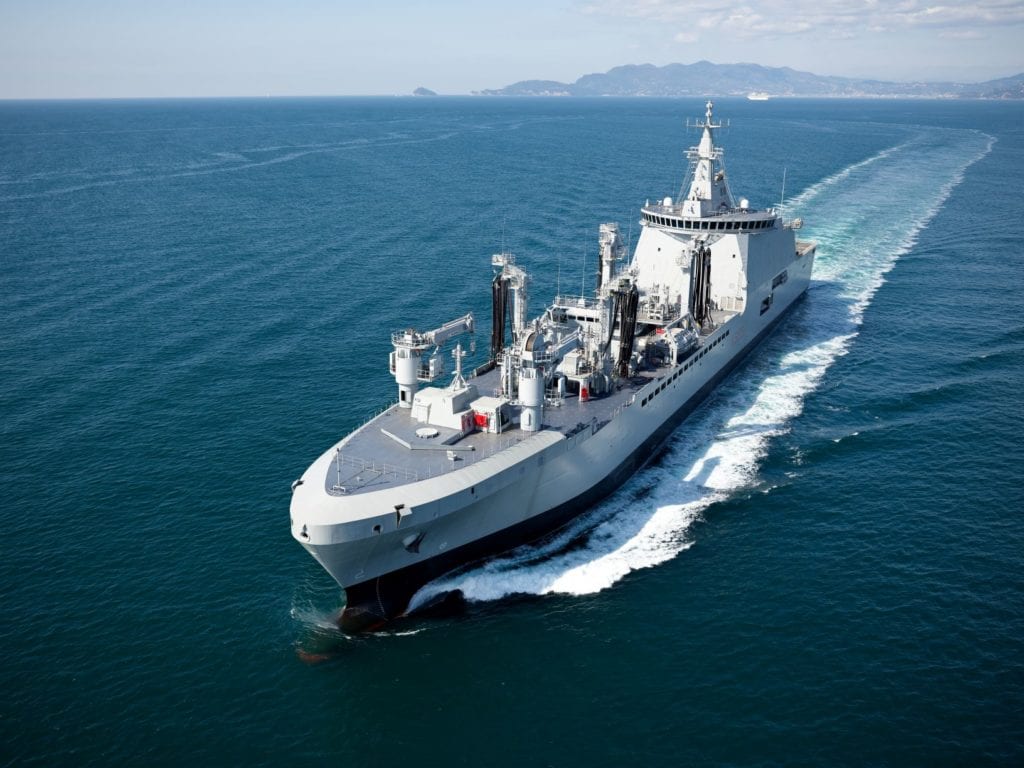
The Italian navy’s newest logistics support ship, the ITS Vulcano. Fincantieri S.p.A.
The Italian navy commissioned its newest logistics support ship (LSS), the ITS Vulcano (A5335) at a ceremony at the Fincantieri Naval Integrated shipyard in Muggiano, Italy.
The 633-foot (193 meter), 27,200-ton LSS can replenish a surface ship task group and transfer cargo to other auxiliary vessels, including diesel fuel, jet fuel, fresh water (including the ability to produce fresh water), spare parts, food and ammunitions, as well as perform maintenance and repairs at sea repairs for other vessels with integrated maintenance workshops. Vulcan replaces ITS Stromboli, and carries significantly more fuel and JP5.
The ship has a crew of 235, including troops, special teams and medical personnel. The LSS has can carry eight 20-foot container living modules or other modular units.
According to a statement from Fincantieri, the LSS is a dual-use vessel, meaning it can be used for traditional replenishment of underway naval forces with four alongside refueling rigs and one astern refueling station, or support humanitarian assistance, disaster relief and other civil purposes. Vulcano’s hospital is equipped with surgical rooms, radiology and analysis rooms, a dental facility, and hospital beds for up to 17 seriously injured patients as well as an additional eight patients in the clinic area.
The statement also says the LSS has a reduced environmental impact thanks to a state-of-the-art CODLAD propulsion system which generates lower levels of pollution emissions. The ship can shift between a high-powered diesel for speeds up to approximately of about 20 knots, and electric motors using diesel generators for slower speeds (around 10 knots).
Vulcano was fabricated in three different Fincantieri yards. The forward section of the vessel was built at Castellammare di Stabia Shipyard in Naples, while the aft section was built in the Riva Trigoso shipyard. The sections were assembled at the yard in Muggiano, near La Spezia, where the ship underwent harbor and sea trials for final delivery.
The Vulcano project is the basis of the “Flotte Logistique” program, which includes the construction of four LSS for the French navy through an Italo-French consortium between Chantiers de l’Atlantique and Naval Group under the Italian-French LSS program led by OCCAR, the Organisation for Joint Armament Cooperation. The construction of the forward sections of these ships has been commissioned to Fincantieri, which last month has laid the keel of the first vessel at its shipyard in Castellammare di Stabia in Naples.
In addition to the LSS, the Fincantieri’s Muggiano shipyard is also building the Landing Helicopter Dock Trieste, due to be delivered next year, as well as seven Multipurpose Offshore Patrol Ships, which will begin entering the fleet beginning this year.
Coast Guard Cutter Douglas Munro Returns Home from Final patrol
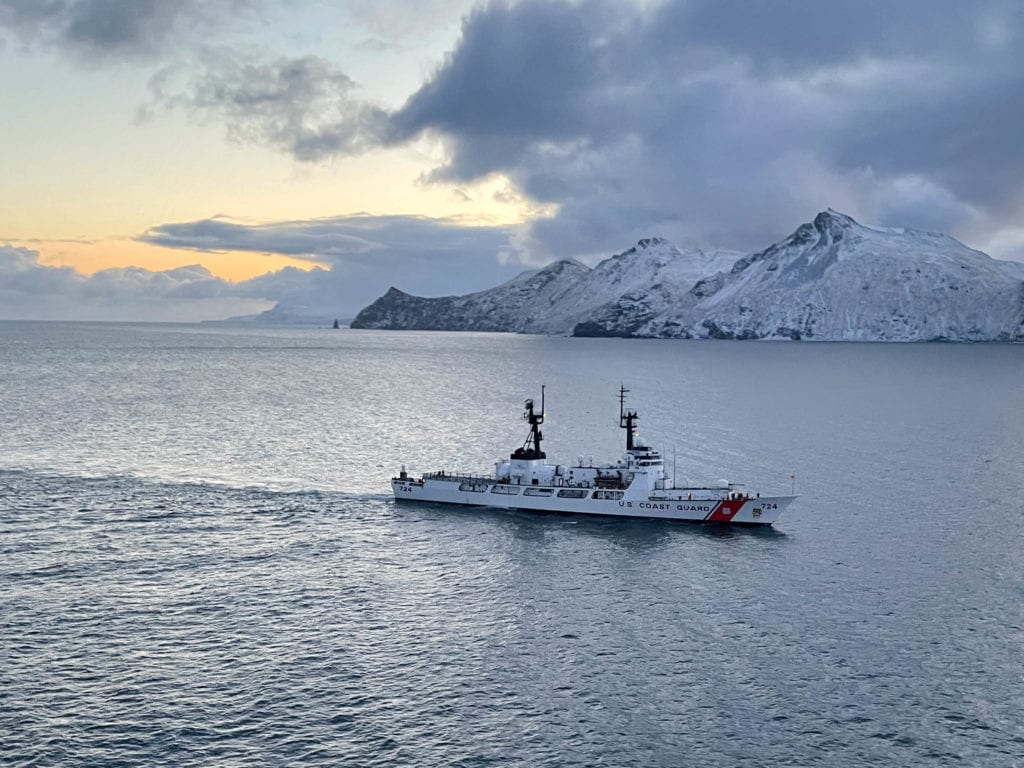
The Coast Guard Cutter Douglas Munro (WHEC 724) is pictured during their last Bering Sea patrol, in which the crew conducted boarding evolutions of the fishing fleet and were available to respond to search and rescue cases in March 2021. The Douglas Munro is the last operational 378-foot Secretary class cutter and will officially be decommissioned on April 24, 2021. U.S. Coast Guard courtesy photo.
KODIAK, Alaska — The crew aboard Coast Guard Cutter Douglas Munro, the service’s last operational 378-foot, high endurance cutter, returned home to Kodiak, Alaska, on March 13, following a 49-day deployment in the Bering Sea, the Coast Guard 17th District said in a March 17 release.
While deployed, the crew of the Douglas Munro and its embarked MH-65 helicopter aviation detachment from Air Station Kodiak safeguarded the $13.9 billion Alaskan fishing industry and provided search and rescue coverage in an area spanning 890,000 square miles. The crew conducted multiple fisheries boardings, ensuring compliance with commercial fishing vessel regulations that ensure crew safety and the sustainability of fish stocks.
In addition to the operational challenges the crew faced in the Bering Sea, the COVID-19 pandemic required the crew to abide by strict health protection precautions and COVID testing regimens prior to the start of their deployment. While making a logistics stop in Dutch Harbor the crew received their first doses of the COVID-19 vaccinations.
“This has been an extremely exciting and rewarding patrol as it is the end of an era for not only this cutter, but also for all the 378s that have served the Coast Guard since 1967,” said Capt. Riley Gatewood, the Douglas Munro’s commanding officer. “The legacy of Signalman First Class Douglas Munro lives on due to the hard work put forth by the many crew members who spent time away from loved ones to accomplish Coast Guard missions aboard Douglas Munro. It is a great honor and privilege to serve as Commanding Officer of the Coast Guard’s last 378-foot, high endurance cutter.”
Commissioned Sept. 27, 1971, Douglas Munro was named in honor of Signalman First Class Douglas A. Munro, the U.S. Coast Guard’s only Medal of Honor recipient, killed during the Guadalcanal Campaign of World War II on that same date in 1942. The ship is scheduled to be decommissioned later this year. Douglas Munro’s legacy will continue with the National Security Class Cutter, Coast Guard Cutter Munro, homeported in Alameda, California.
Cutter Valiant Returns Home after 26-Day Law-Enforcement Patrol
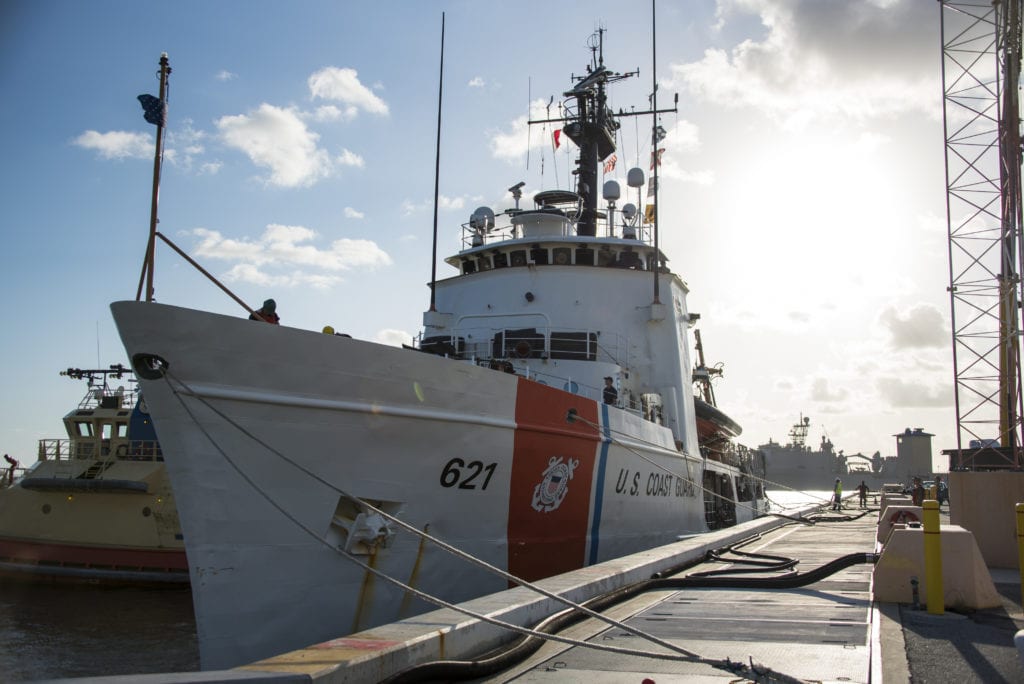
The Coast Guard Cutter Valiant crew returns to homeport Wednesday, Oct. 3, 2018, at Naval Station Mayport, Florida. The Valiant crew returned to homeport after a six-week counter-drug patrol in the Caribbean. U.S. Coast Guard / Petty Officer 3rd Class Ryan Dickinson
JACKSONVILLE, Fla.— The USCGC Valiant (WMEC-621) crew returned home to Naval Station Mayport March 16 after completing a 26-day patrol conducting law enforcement operations in the Caribbean Sea, the Coast Guard 7th District said in a release.
Coast Guard Cutter Valiant patrolled over 4,600 nautical miles in the Caribbean Sea, conducting counter-narcotics operations in support of Joint Interagency Task Force South (JIATF-S), Coast Guard District 7 and Coast Guard Sector San Juan, Puerto Rico.
While preparing for flight operations training with Coast Guard Air Station Borinquen, Puerto Rico, Valiant received information about a potential target of interest in the Mona Pass from a maritime patrol aircraft. Valiant shifted gears from training to law enforcement and interdicted a 16-foot go-fast style vessel, seizing over 520 pounds of cocaine, valued at over $8.8 million, and apprehending three suspected narcotics traffickers.
Valiant also partnered with the USS Wichita (LCS 13), to safely transfer nine suspected narcotics traffickers and 132 additional pounds of cocaine for prosecution in the United States. The joint team ensured the safe transfer of all suspected traffickers, evidence, and narcotics to the United States for future prosecution.
Valiant’s patrol started with a training availability cycle. However, the COVID-19 pandemic continued to present challenges including limited port calls and the need to completely isolate for 14 days to ensure the crew’s health and safety before getting underway after several COVID-19 positive cases. Additionally, Valiant had to overcome a variety of mechanical issues. However, by partnering with Coast Guard maintenance support teams stationed in San Juan, Puerto Rico and deployable technical experts, Valiant’s team of technical experts was able to execute repairs and continue on the mission.
“This was an extremely challenging patrol for team Valiant and I could not be more proud of the entire crew to overcome every obstacle and ultimately have several operational successes,” said Cmdr. Jeff Payne, Valiant’s commanding officer. “Our friends and families back home also deserve much of the credit for our success. While only underway for 26 days, Valiant’s patrol truly started on 25 January when we began the training cycle. That was followed by a variety of mechanical and pandemic issues requiring both the crew and our families to constantly adjust and find solutions. However, we overcame each challenge, teamed with our Department of Defense counterparts, and ultimately executed textbook missions protecting our shores and nation.”
The Valiant is a multi-mission 210-foot medium-endurance cutter. Missions include search and rescue, maritime law enforcement, marine environmental protection, homeland security and national defense operations.
With Scant ISR Resources, SOUTHCOM Turns to ISR, Machine Learning
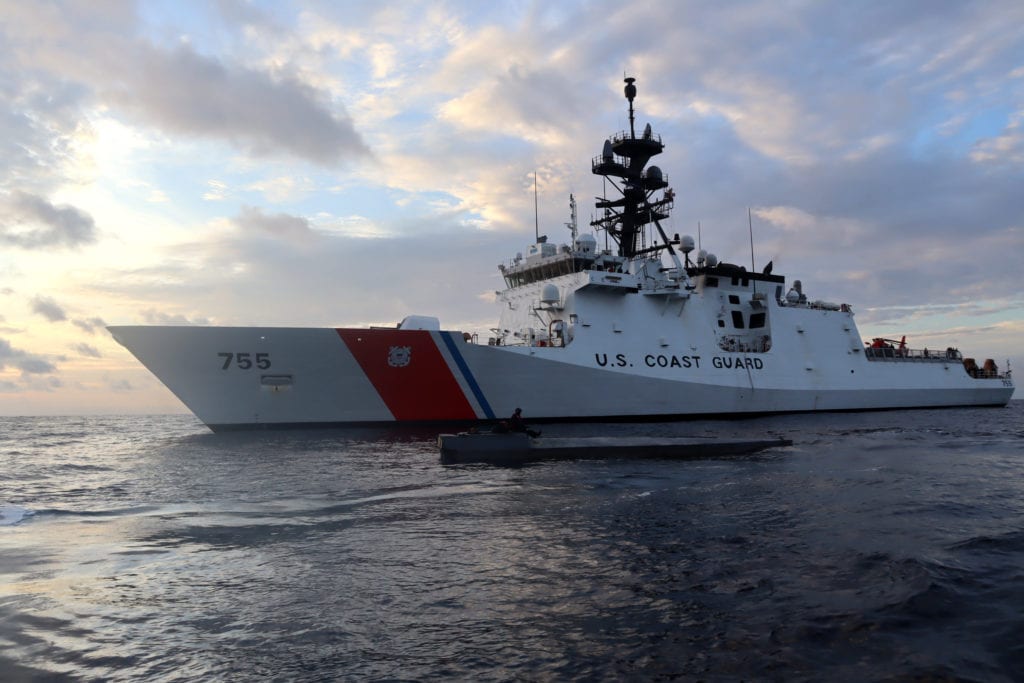
A Coast Guard Cutter Munro (WMSL 755) boarding team member sits atop an interdicted low-profile vessel in the Eastern Pacific Ocean after crews seized 3,439 pounds of cocaine from the LPV, Jan. 27, 2021. Munro is one of two California-based cutters whose crews interdicted a combined three suspected drug smuggling vessels in the Eastern Pacific Ocean between Jan. 26 and Feb. 1 resulting in the seizure of more than 9,000 pounds of cocaine worth an estimated $156 million. U.S. Southern Command is looking to combine analytics, AI and machine learning to close the ISR gap in the battle against transnational criminal organizations. U.S. Coast Guard
ARLINGTON, Va. — U.S. Southern Command is turning to artificial intelligence and machine learning to compensate for underfunded intelligence, surveillance and reconnaissance (ISR) capabilities to monitor international criminals and great power competitors in Latin America.
SOUTHCOM accounts for less than 1% of Defense Department ISR resources to counter external state actors, like Russia and China, and transnational criminal organizations in the region, the combatant command’s chief, Navy Adm Craig S. Faller, told a Senate Armed Services Committee hearing March 16.
“Intelligence drives everything. That allows us to have the domain awareness,” Faller said, “so we can then inform our other interagency partners of what the threats are up to.” He and another witness at the hearing, Air Force Gen. Glen Van Herk, commander of U.S. Northern Command, identified China and Russia as the two biggest threats to stability in the Hemisphere.
Faller singled out China as the main threat to U.S. interest in Latin America. “The intervention goes well beyond economic influence, [China’s] outlook with over 40 ports in progress, significant loans that are used as political leverage and predatory practices demonstrated in illegal, unreported, and unregulated fishing are weakening democratic institutions and leveraging the future of this Hemisphere. We have seen many of these same tactics in Asia and Africa over the last few decades,” he said.
The admiral went into greater detail at a Pentagon press briefing later in the day, calling those tactics “a very insidious move for global economic dominance.”
Regarding ISR limitations in the face of growing threats, from regional and international extremist groups and drug cartels, Faller said intel wasn’t limited to “big wing stuff” like P-8 maritime patrol aircraft and MQ-9 drones. SOUTHCOM has turned to what he called “21st century tradecraft,” non-traditional ISR that leverages analytics with “AI and machine learning for all the data out there that’s available in open source.”
He said two pilot programs, if converted to programs of record or based more broadly, “show great promise.” The Technical Network Analysis Cell provides actionable intelligence, in cooperation with law enforcement partners, that is shared with partner nations and interagency partners leading to disruption of criminal activities. The Asymmetric Target Acquisition Center, run by Special Operations Command South, supports law enforcement efforts to counter transnational crime organizations.
Navy, Marine Corps Release Unmanned Campaign Plan
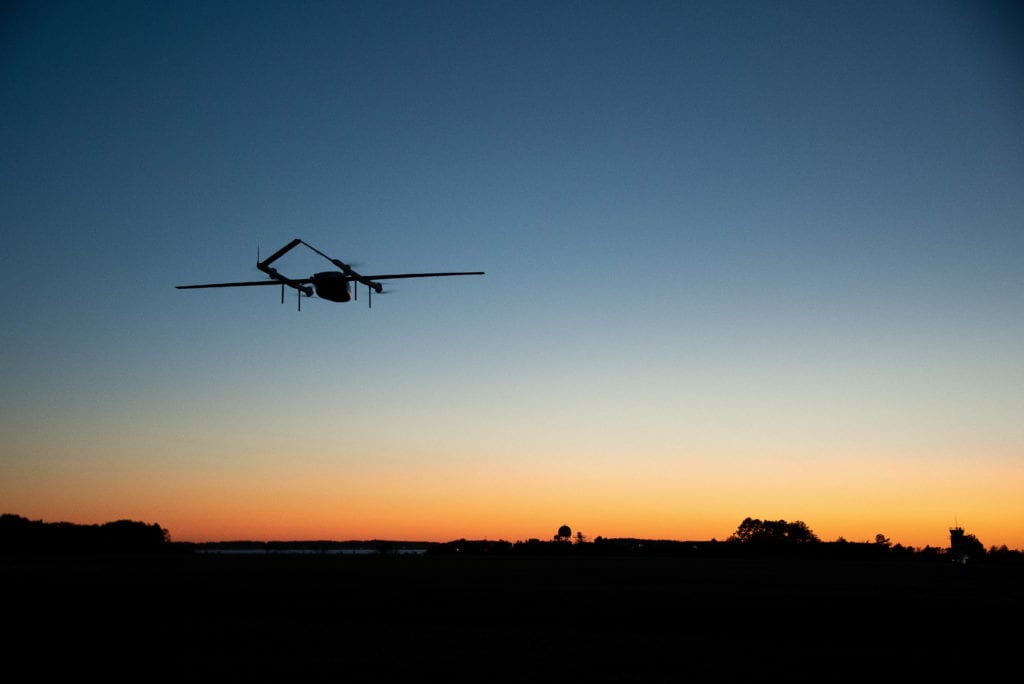
An autonomous vehicle dubbed Blue Water Maritime Logistics UAS flies over Unmanned Air Test and Evaluation (UX) 24 during a demonstration flight at Naval Air Station Patuxent River November 4, 2020. U.S. Navy
WASHINGTON, D.C. — The U.S. Navy and Marine Corps released on March 16 the Unmanned Campaign framework, which presents their strategy for making unmanned systems a trusted and integral part of warfighting.
Through a capabilities-based approach, the services seek to build a future where unmanned systems are at the front lines of U.S. competitive advantage.
The framework has five goals: Advance manned-unmanned teaming effects within the full range of naval and joint operations; build a digital infrastructure that integrates and adopts unmanned capabilities at speed and scale; incentivize rapid incremental development and testing cycles for unmanned systems; disaggregate common problems, solve once, and scale solutions across platforms and domains; create a capability-centric approach for unmanned contributions (platforms, systems, subsystems) to the force.
The framework provides a strategy for integrating these systems to provide lethal, survivable, and scalable effects supporting the future maritime mission. The Navy and Marine Corps are developing detailed technology maturation and acquisition roadmaps within a separate classified plan of action and milestones. The objective is to innovate quickly to provide solutions for complex problems of current and future conflicts.
The path forward requires a holistic approach to developing and deploying unmanned systems, ensuring individual technologies can operate within a broader architecture of networked warfighting systems, supported by the right people, policies, operational concepts, and other enablers.
The campaign framework focuses on how the Navy and Marine Corps will reduce risk and identify performance requirements. Using dedicated prototypes for each unmanned system and developing capability in this manner standardizes autonomy, command and control, payload interfaces, and networks.
“The Navy and Marine Corps unmanned campaign plan serves as a roadmap for how we will realize a future where unmanned systems serve as an integral part of the Navy’s warfighting team in support of distributed maritime operations,” said Vice Adm. Jim Kilby, deputy chief of naval operations for warfighting requirements and capabilities. “The plan lays out how we will scale tested and proven systems as well as develop the core technologies required to successfully integrate unmanned systems into the fleet.”
The framework provides guidance for the services to pursue an agile and aggressive approach to develop the core technologies required to successfully integrate unmanned systems into the Navy’s future force structure. The services must invest in the networks, control systems, infrastructure, interfaces, artificial intelligence, and data required to support unmanned systems to succeed.
“The Navy and Marine Corps unmanned campaign plan will guide our naval research and development investments, and through the acquisition process, we will collaborate with our industry partners to design, build, field and sustain manned and unmanned teaming throughout the fleet,” said Frederick J. Stefany, acting assistant secretary of the Navy for research, development and acquisition. “It also sets the framework to enable the Department of the Navy to accelerate, deliver and scale valuable manned and unmanned capabilities.”
Today’s global security environment has seen a return to great power competition. This shift has placed the Navy at an inflection point where a traditional force structure will not be enough in the face of new warfighting demands. Autonomous systems are not a replacement, but provide additional capacity and capability to the combatant force and allow commanders to accept risk where they couldn’t before.
“A family of unmanned systems is critical to the employment of our force during distributed maritime operations. The goal is for us to be able to persist inside the weapons engagement zone of any adversary, to create problems and challenges, to make that adversary change their behavior or course of action they intend to pursue. These systems will be prevalent in all mediums: surface, subsurface, ground and air. Manned/unmanned teaming increases our lethality while allowing us to accept less risk in certain situations. Coordinating our efforts as a naval force will expedite the concept development and material solutions for our Marines and Sailors,” said Lt. Gen. Eric Smith, commanding general of Marine Corps Combat Development Command and deputy commandant for combat development and integration.
The Unmanned Campaign Plan is comprised of the Unmanned Campaign Framework and a classified Unmanned Plan of Actions and Milestones.
Ex-Navy Helos Providing Folding Rotors, Tails for Cutter-Deploying H-60 Helos
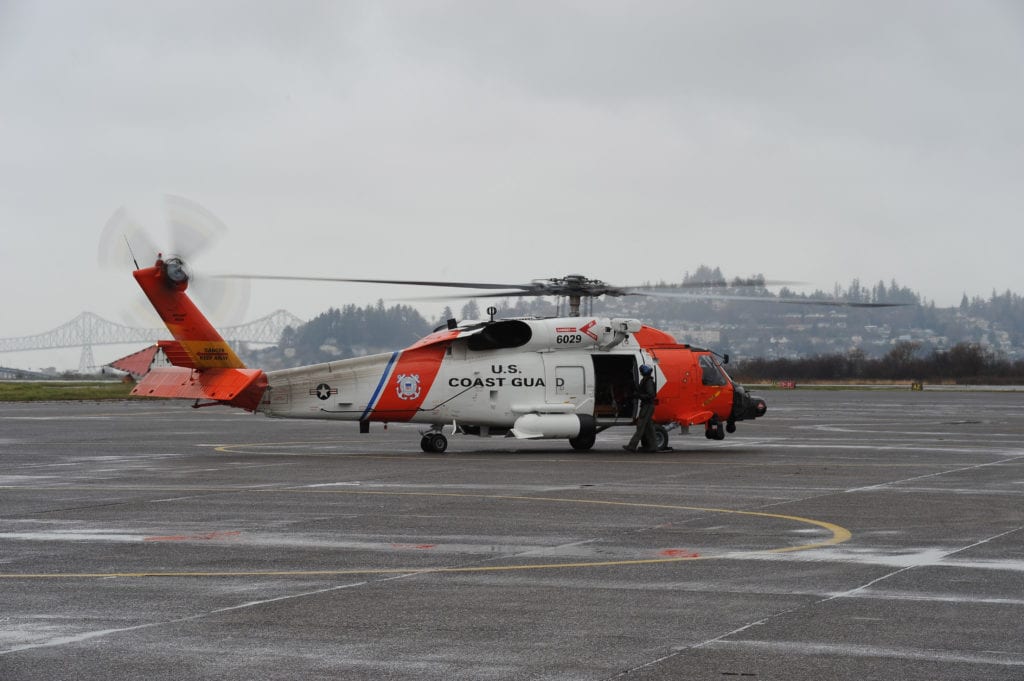
A crew prepares to power down a Coast Guard MH-60T Jayhawk helicopter after landing at Sector Columbia River, Oregon, in 2012. The service is shifting the focus of some of its MH-60T fleet to use on board its large cutters. U.S. Coast Guard / Petty Officer 3rd Class Nate Littlejohn
ARLINGTON, Va. — The U.S. Coast Guard is shifting the focus of some of its MH-60T Jayhawk helicopter fleet to use on board its large cutters and is using components from some ex-U.S. Navy H-60 Seahawk helicopters to make that possible.
The Coast Guard operates a fleet of 45 Sikorsky-built MH-60Ts from eight air stations for medium-range missions that include search, rescue, drug interdiction and law enforcement. They can operate from the decks of the service’s larger cutters but because they do not have folding tail rotors and tail booms, they cannot be hangered inside the superstructure of the larger cutters, such as the Legend-class national security cutters, future Argus-class offshore patrol cutters and the future class of Polar Security Cutters.
In his March 11 State-of-the-Coast Guard address, Coast Guard Commandant Adm. Karl Schultz said the service will convert some MH-60Ts with folding rotors and tail booms to enable them to operate from the larger cutters and give the cutters a longer reach with their embarked helicopters. Currently the Coast Guard deploys the smaller MH-65D/E Dolphin helicopters on its larger cutters.
“Two weeks ago, in Elizabeth City, North Carolina, I observed our first MH-60T Jayhawk outfitted with Blade-fold/ Tail-fold capability that will enable deployment aboard National Security Cutters, and our future Polar Security and Offshore Patrol Cutters,” Schultz said.
The commandant noted the range and endurance of the MH-60T would serve well on a polar security deployment to Antarctica, particularly for treaty inspections.
The Coast Guard has long used parts and structures from ex-Navy H-60 helicopters to help sustain its MH-60T fleet and even be rebuilt into MH-60Ts. Beginning in 2005, the Coast Guard Air Logistics Center (ALC) has converted six ex-Navy SH-60Fs to MH-60Ts. The ALC also has “overhauled and modified another SH-60F hull and four HH-60Hs (by July 2020) as part of the plan to retain the aircraft and extend the service life,” said Tom Kaminski, an expert on Coast Guard aviation. “They also are reactivating the mechanisms that permit the tail to be folded.
“The service acquired 65 retired SH-60F and HH-60Hs from the U.S. Navy and a number of the Seahawk airframes were stripped by the ALC in preparation for conversion, ” Kaminski said. “The plan is for a mix of reworked low-time hulls and the new production hulls from Sikorsky.”
Schultz also said in his address that MH-60Ts will replace MH-65s at two air stations.
“This year we will transition Air Station Borinquen in Puerto Rico from a Dolphin to Jayhawk unit, adding additional reach and contingency response capability to the Eastern Caribbean, not to mention a likely land-based Aviation Use of Force capability,” he said. “Air Station New Orleans will be the next to transition.”
State Dept. Approves $1.8B Sale of P-8A Patrol Aircraft to Germany
A P-8A Poseidon maritime patrol aircraft assigned to the “Grey Knights” of Patrol Squadron (VP) 46, sits on the flight line, Jan. 7, 2021. Germany is seeking a foreign military sale of five such aircraft worth nearly $1.8 billion. U.S. Navy / Mass Communication Specialist 2nd Class Austin Ingram
WASHINGTON — The State Department has approved a possible foreign military sale to Germany of P-8A aircraft and associated support and related equipment, for an estimated cost of $1.77 billion, the Defense Security Cooperation Agency said in a March 12 release.
Germany has requested five P-8As aircraft and their associated mission systems and avionics. The sale also would include “aircraft spares; spare engine; support equipment; operational support systems; training; training devices; maintenance trainer/classrooms; publications; software; engineering technical assistance; logistics technical assistance; country liaison officer support; contractor engineering technical services; repair and return; transportation; aircraft ferry; and other associated training and support; and other related elements of logistics and program support,” the release said.
The proposed sale will improve Germany’s capability to meet current and future threats by providing critical capabilities to coalition maritime operations. Germany currently operates the Lockheed P-3C Orion, but that aircraft is reaching end-of-life and will retire in 2024. Germany plans to replace it with the P-8A Poseidon. The proposed sale will allow Germany to modernize and sustain its maritime surveillance aircraft capability for the next 30 years.
The prime contractor will be the Boeing Co., Seattle, Washington.
Coast Guard, Navy Help Rescue Cold-Stunned Turtles, Return Them to Warmer Waters
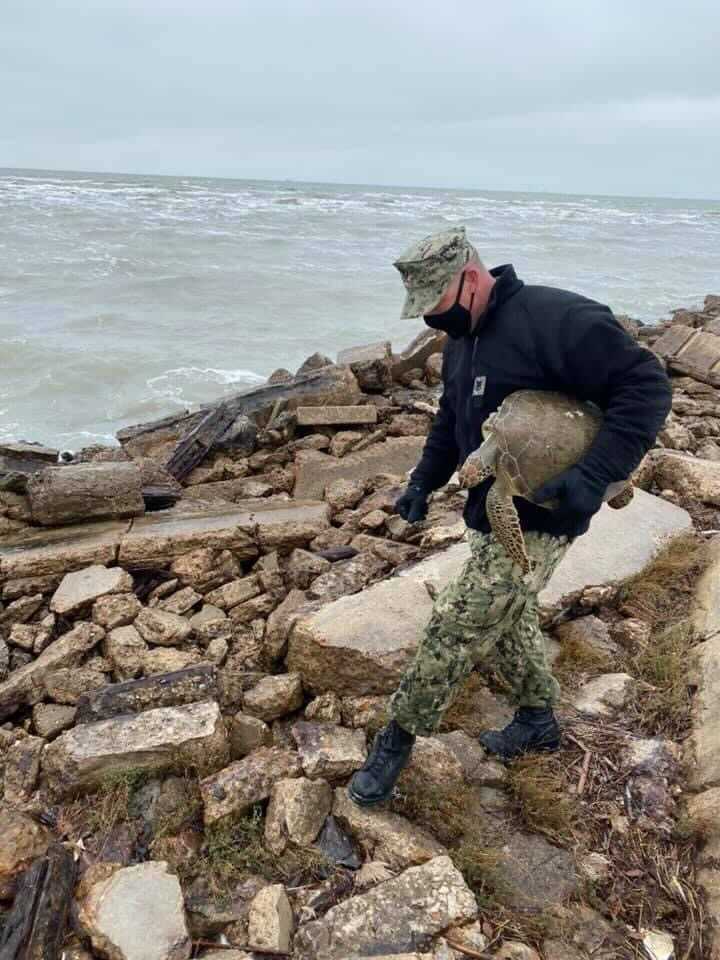
Command Master Chief Eric Kinnaman rescues a cold-stunned green sea turtle from the waterfront at Naval Air Station (NAS) Corpus Christi. Sailors, civilians and family members worked with the Texas Parks and Wildlife department and the National Park Service to transport the turtles to safety. The NAS Corpus Christi environmental team lead the multi-agency wildlife protection effort and rescued more than 600 turtles. U.S. Navy / Capt. Christopher Jason
Texas recently experienced record-breaking cold temperatures, causing the largest cold-stunning event for sea turtles in the state’s history. As the water temperate dropped to the mid-30s Fahrenheit, thousands of turtles were found stranded on beaches or floating in the water.
In the shallow bays and inlets of the Laguna Madre next to Padre Island, water temperatures can change rapidly. As reptiles, turtles are cold-blooded and cannot regulate their body temperature. Cold-stunned turtles experience hypothermia when the sea water drops to about 50°F or below, and become lethargic and unable to swim.
According to Sea Turtle Inc., a non-profit organization on South Padre Island, “cold-stun events happen when the water gets too cold for sea turtles to maintain their body temperature. As a result, the turtles are awake but unable to move or swim. If not rescued, while they are awake and alive, the turtles will drown from being unable to lift their head to draw their breath.”
Fortunately, the Coast Guard and Navy were ready, willing and able to join in the effort with a team of organizations to help the turtles.
A consortium of organizations including the Turtle Survival Alliance, Sea Turtles, Inc., the Gladys Porter Zoo in Brownsville, the Texas Sealife Center, Texas Department of Parks and Wildlife and the National Park Service make up the South Padre Island Sea Turtle Stranding and Salvage Network, which works to rescue and care for cold-stunned turtles. While the area has experienced cold weather before, the February 2021 cold weather event was unprecedented. With 7,000 or more turtles knocked out by the frigid waters, ranging in size from a few pounds to more than 400 pounds. The rescuers were overwhelmed.
Active-duty Sailors, Marines and Coast Guardsmen pitched in, including student pilots for Naval Air Station Corpus Christi. Volunteers also included Navy civilian employees, retirees, spouses and family members.
NAS Corpus Christi and Coast Guard Sector Corpus Christi, like many military installations, are used to encountering wildlife suffering from severe weather. But this 2021 event has resulted in thousands of turtles stupefied by the cold. It is remarkable that so few of them died, but without the intervention of the Navy, Coast Guard and others, the toll would have been much higher.
Capt. Christopher Jason, the commanding officer of Naval Air Station Corpus Christi, used his kayak to paddle out to the turtles and pull them out of the water. Turtles were kept in a hanger and later moved to a Defense Logistics Agency temperature-controlled warehouse to recover.
The rescues started with a base resident wanting to help a couple of injured birds. It turned into a large-scale operation involving dozens of volunteers rescuing more than 1,200 threatened sea turtles, at the same time as many of those volunteers did not have heat or water because of the unusually cold winter storm.
“The scale of the effort was unprecedented,” said Biji Pandisseril, NASCC environmental director. “Usually, about 20 to 30 turtles are rescued here after a cold snap.”
U.S. Coast Guard Rescue swimmers from Air Station Corpus Christi swam through rough and cold water to reach turtles far away from the shore. Petty Officer 3rd Class Will Groskritz and Petty Officer 2nd Class Russell Grizzard brought 60 turtles to safety in one day. The next day, Grizzard and Petty Officer 1st Class Rob Rendon saved another 40 to 50 turtles.
Responding to cold stun events is one of Sea Turtle Inc.’s ongoing rescue and rehabilitation efforts. For example, Sea Turtle Inc. has released over 55,000 sea turtle hatchlings into the Gulf of Mexico, and each year helps with any cold-stunned turtles that are found. But, with more recued turtles coming in the Sea Turtle Inc.’s facility could handle. The rescued turtle filled the facility to capacity, with many turtles placed in children’s play pools. A makeshift rescue center was established at the South Padre Island Convention Center and Visitors Bureau.
In addition to the turtles being affected by the cold, their rescuers also had to contend with power outages and water shortages of their own as the cold snap surprised Texans.
Aerospace Company SpaceX donated a large power generator from their Boca Chica launch facility in Brownsville to provide electricity to the Sea Turtles Inc. facility, which already had hatchlings and other turtles being cared for. The power helped to keep the water in facility’s tanks warm enough for the turtles to survive.
“This event had the potential to be devastating to both the sea turtle population and our hospital and residents. We prepare for cold stun events, but to respond as efficiently as we have although the additional challenge of no power speaks volumes about the passion and commitment of the Sea Turtle Inc staff and the Rio Grande Valley community,” said Wendy Knight, executive director of Sea Turtle Inc.
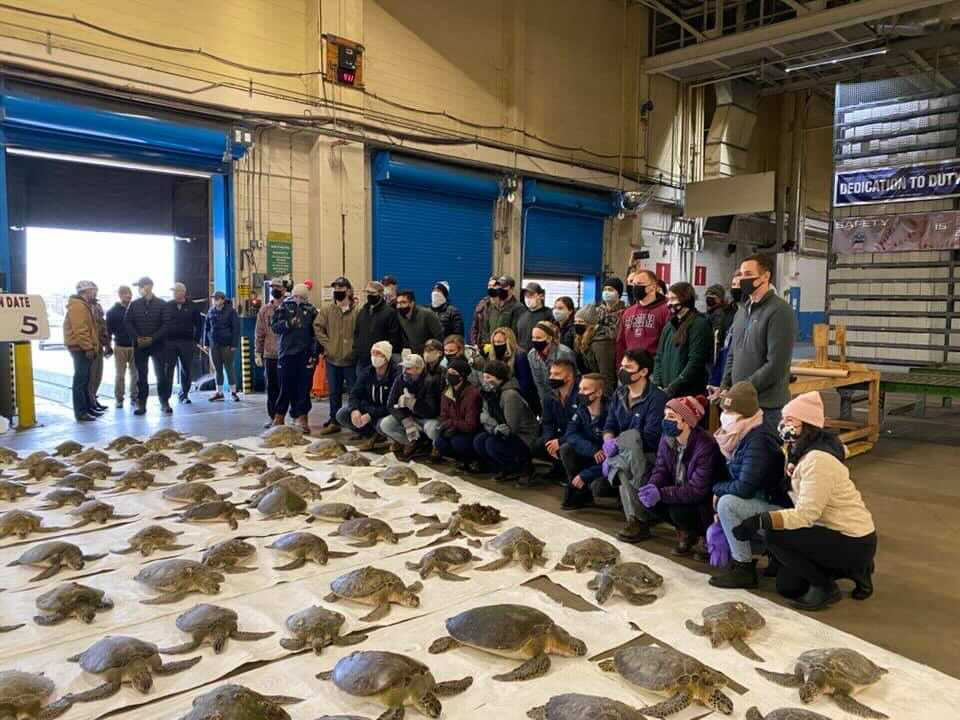
Volunteers pose with rescued green sea turtles at Naval Air Station (NAS) Corpus Christi, Texas. Sailors, civilians and family members worked with the Texas Parks and Wildlife department and the National Park Service to transport the turtles to safety. U.S. Navy
Unique ecosystem
Dr. Donna Shaver, chief of the division of sea turtle science and recovery with the National Park Service at Padre Island National Seashore, is the Texas coordinator of the Sea Turtle Stranding and Salvage Network.
Shaver and her team were not completely unprepared. Back in October, Shaver, along with Texas State Aquarium and U.S. Coast Guard representatives, held a tabletop exercise to discuss what the response to a mass cold-stunning event such as this would look like. Because of the planning and preparation of that exercise, rescue, rehabilitation, and release of these animals was swift and effective.
Shaver said the February cold snap was the coldest event since 1895, when a cold-stunning event was thought to have decimated the Green Sea Turtle population in Texas. She called it the “perfect storm” for cold study.
Shaver explained that the Laguna Madre, the salt water lagoon between mainland Texas and Padre Island, with lush sea grasses and algae, is a prime habitat for the juvenile green turtles, which represent the vast majority of the cold-stunned turtles.
Once-numerous, the green sea turtle is today a threatened species in Texas. Considered a delicacy, there was once a large commercial fishery harvesting turtles in the area. “This used to be a thriving population in Texas until it was decimated in the late 1800s. It’s rebuilding, but now needs our help with these rescues,” Shaver said.
At about 125 miles long, Laguna Madre is one of the few hypersaline lagoon systems in the world, meaning it is saltier than most seawater. There isn’t much inflow of fresh water or rainwater, and circulation with the Gulf of Mexico is limited. Laguna Madre is one of the most productive estuarine systems and a valuable habitat for wildlife. It is protected by Padre Island, the longest stretch of undeveloped barrier island in the world, and there are only a few channels that allow access to open water. The precipitous decline of the temperatures, how long it stayed cold, and the depth of the cold water spelled trouble for the trapped turtles.
The water temperature can change temperature rapidly, and sea turtles swimming in Laguna Madre may not have had enough time to swim out of to the deeper, warmer waters of the Gulf of Mexico before becoming cold stunned.
Rehabilitation is fairly straight forward, Shaver said. “The first step is to bring in them in out of the elements and gradually warm up — but not too quickly — and then determine which ones are still alive, because we can’t tell for many of these turtles.”
“When they start to move around, we can put them in the water, let them expel some gas, and give them a swim test. Then we wait until the Gulf of Mexico waters when the waters are warm enough so we can release them there,” Shaver said. “We don’t want to release them back into the Laguna Madre, because they could become cold-stunned again.”
“Working with our partners in the Texas State Aquarium and Texas Game Wardens to release these animals back into the wild is a surreal experience,” said Coast Guard Ensign Austin Sawicki. “Getting to play a small part in keeping the green sea turtle population safe is a very rewarding experience.”
Coast Guard Sector Corpus Christi and Station Port Aransas crewmembers assisted partner organizations to release the rehabilitated sea turtles back into the Gulf of Mexico in areas where the water was at least 55 degrees Fahrenheit were selected.
Double-Pumped Carrier Deployments Are Not Surges, Lawmaker Says
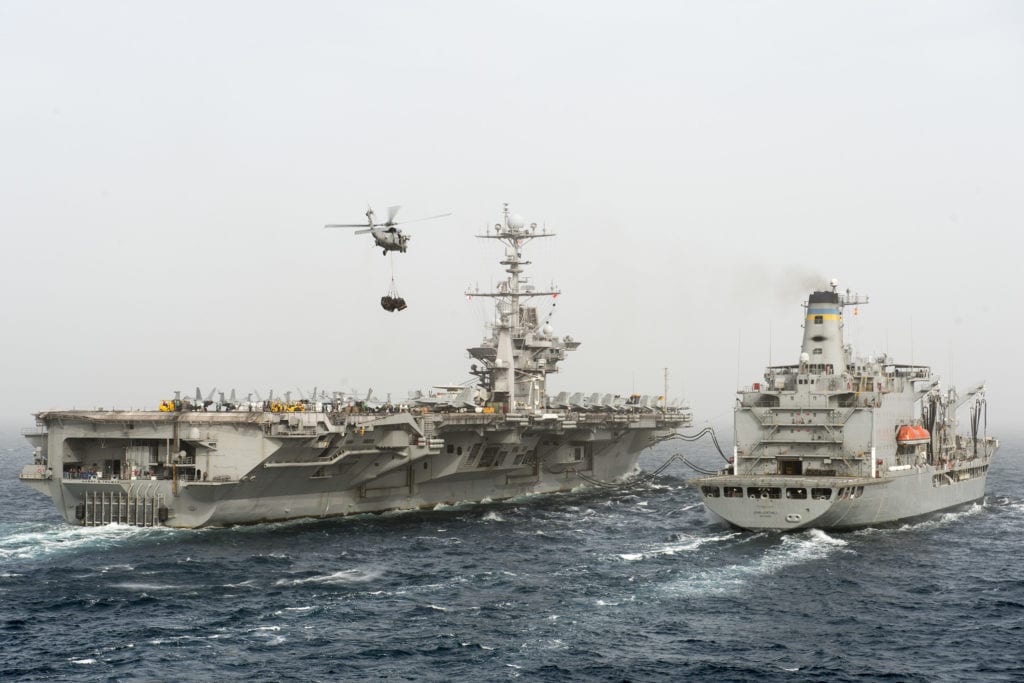
Aircraft carrier USS Harry S. Truman (CVN 75) performs a replenishment-at-sea with fleet replenishment oiler USNS John Lenthall (T-AO 189). The carrier is one of several to have had “double pumped” deployments in recent years. U.S. Navy / Mass Communication Specialist 3rd Class Jacob Richardson
ARLINGTON, Va. — The Navy’s recent practice of sending nuclear-powered aircraft carriers (CVNs) on back-to-back deployments — termed “double-pumped” — is not an example of a surge capability, a member of Congress said.
“Surge is additional capability to respond in a time of crisis or for an unplanned operation,” said Elaine Luria, D- Virginia, vice chair of the House Armed Services Committee, speaking March 15 in a webinar sponsored by the Hudson Institute. “What we are doing now is we are double-deploying — I won’t even call it surging — double deploying these ships to fill a gap for other ships that should have been doing routine deployments at that time but are delayed in maintenance.”
Under the Navy’s Optimized Fleet Optimization Plan, a carrier is planned to make one scheduled deployment in a 36-month cycle and be available for a surge deployment later in the cycle.
At least three CVNs — USS Harry S. Truman, USS Dwight D. Eisenhower and USS Theodore Roosevelt — each have made double-pumped deployments in recent years, Luria said.
Luria attributed the double-pumped deployments to a shortage of maintenance capacity in the Navy’s shipyards, where most maintenance of nuclear-powered ships and submarines takes place.
She cited the current case of the USS George H.W. Bush, which has been in a maintenance availability for 27 months — more than 2.5 times the planned time — and still is not ready to sail.
“That lengthening of that availability came about because of the capacity at [Norfolk Naval Shipyard], and there were decisions made that there were other priorities that need to be clocked up,” she said.
The shortage of maintenance capacity has caused the Navy to contract out nuclear submarine maintenance availabilities to Newport News Shipbuilding, for example.
“When did we get to this point where we really couldn’t keep up with carrier maintenance?” she asked rhetorically. “When you look at the point at where we got to all nuclear carriers — when we got rid of [oil-fired carriers] Kitty Hawk, Kennedy and Independence — we had less [maintenance capacity and fewer yards for in-depth maintenance on nuclear carriers.] If we’re operating an all-nuclear fleet, we need to have the ability to maintain those carriers.”
Luria said the Navy’s Shipyard Integrated Optimization Plan, designed to upgrade the Navy’s shipyards over a 20-year period, which she said, “is way too long of a period for that and I think we should make that investment for those upgrades to our shipyards to be made more quickly.”
She also said that Norfolk Naval Shipyard also needs upgrades just to perform routine maintenance on the Navy’s newest class of aircraft carrier, USS Gerald R. Ford.
U.S. Navy Asserts Freedom to Navigate in International Waters
The Arleigh Burke-class guided-missile destroyer USS John Finn (DDG 113) transits the Taiwan Strait March 10, 2021. John Finn, part of the Theodore Roosevelt Carrier Strike Group, is on a scheduled deployment to the U.S. 7th Fleet area of operations. U.S. Navy / Mass Communication Specialist 3rd Class Jason Waite
The U.S. Navy continues to assert its right to operate freely in international waters with yet another Taiwan Strait transit, following several recent freedom of navigation operations (FONOPS) in the South China Sea, particularly in the vicinity of the Spratly and Paracel Islands.
The Arleigh Burke-class guided missile destroyer USS John Finn (DDG 113) conducted a routine Taiwan Strait transit March 10 (local time) in accordance with international law.
According to a statement from the U.S. 7th Fleet, the ship’s transit through the Taiwan Strait “demonstrates the U.S. commitment to a free and open Indo-Pacific. The United States military will continue to fly, sail, and operate anywhere international law allows.”
China’s People’s Liberation Army officials said the USS John Finn transit was a provocation intended to undermine regional and cross-strait stability.
The John Finn transit isn’t the only one in recent weeks. The Arleigh Burke-class guided missile destroyer USS Curtis Wilbur (DDG 54) conducted a routine Taiwan Strait transit Feb. 24 in accordance with international law. On Feb. 17, USS Russell (DDG 59) “asserted navigational rights and freedoms in the Spratly Islands, consistent with international law.” And on Feb. 5, USS John S. McCain (DDG 56) asserted navigational rights and freedoms in the vicinity of the Paracel Islands, consistent with international law.
Each of these transits occurred in areas where nations have disputed claims regarding sovereignty.
“A Taiwan Strait transit is not a freedom of navigation operation. Freedom of navigation operations challenge excessive maritime claims, while Taiwan Strait transits simply exercise the rights of all ships to pass through an international waterway, said Lt. Mark Langford, deputy public affairs officer for the U.S. 7th Fleet.
According to statements from the 7th Fleet, the FONOP “upheld the rights, freedoms and lawful uses of the sea recognized in international law by challenging the unlawful restrictions on innocent passage imposed by China, Taiwan, and Vietnam and also by challenging China’s excessive straight baseline claims enclosing the Paracel Islands.”
The statement said China, Vietnam, Taiwan, Malaysia, Brunei and the Philippines each claim sovereignty over some or all of the Spratly Islands. China, Vietnam, and Taiwan require either permission or advance notification before a foreign military vessel engages in “innocent passage” through the territorial sea.
The 7th Fleet statement says, “Under international law as reflected in the Law of the Sea Convention, the ships of all states — including their warships — enjoy the right of innocent passage through the territorial sea. The unilateral imposition of any authorization or advance-notification requirement for innocent passage is not permitted by international law. By engaging in innocent passage without giving prior notification to or asking permission from any of the claimants, the United States challenged these unlawful restrictions imposed by China, Taiwan, and Vietnam. The United States demonstrated that innocent passage may not be subject to such restrictions.”
The 7th Fleet statement said U.S. forces have operated in the South China Sea on a daily basis, and have done so for more than a century. “They routinely operate in close coordination with like-minded allies and partners who share our commitment to uphold a free and open international order that promotes security and prosperity. All of our operations are designed to be conducted professionally and in accordance with international law and demonstrate that the United States will fly, sail, and operate wherever international law allows — regardless of the location of excessive maritime claims and regardless of current events.”
The Department of Defense’s annual Freedom of Navigation Fiscal Year 2020 Report to Congress, released March 10, said during the period from Oct. 1, 2019, through Sept. 30, 2020, U.S. forces operationally challenged 28 different excessive maritime claims made by 19 different claimants throughout the world.