Navy Details Revised 2021 Ship Decommissioning Schedule
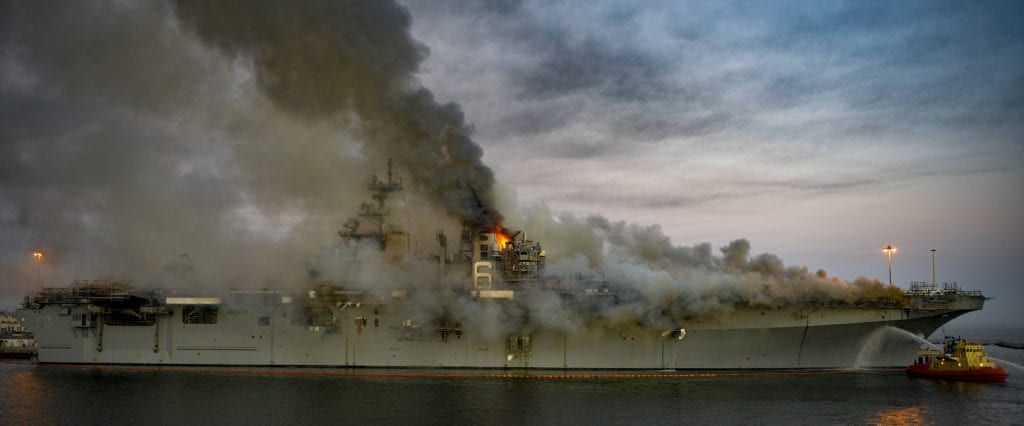
USS Bonhomme Richard (LHD 6), due to be dismantled after its devastating fire in 2020. U.S. Navy / Mass Communication Specialist 2nd Class Austin Haist
ARLINGTON, Va. — The U.S. Navy has revised its ship decommissioning schedule for fiscal 2021, including the date for the Wasp-class amphibious assault ship USS Bonhomme Richard, severely damaged by fire in 2020. The list also included the first two littoral combat ships.
In an Feb. 12 administrative message, the Office of the Chief of Naval Operations announced the plans to decommission seven ships from the fleet and remove from service one ship from the Military Sealift Command.
The ships to be retired and their 2021 retirement dates are listed below:
Ship Name Projected Inactivation Date Post Inactive Status
USS Zephyr (PC 8) March 2 Dismantle
USS Shamal (PC 13) Feb. 25 Dismantle
USS Tornado (PC 14) March 4 Foreign Military Sales
USS Fort McHenry (LSD 43) Apr. 16 Reserve
USS Freedom (LCS 1) Sept. 30 Reserve
USS Independence (LCS 2) July 31 Reserve
USS Bonhomme Richard (LHD 6) April 15 Dismantle
USNS Sioux (T-ATF 171) Sept. 30 Foreign Military Sale
The first two littoral combat ships are considered experimental and are of an earlier configuration than later production ships. They will be placed in a preserved status for re-activation if needed, as will the USS Fort McHenry.
The three Cyclone-class coastal patrol ships are the only ones of the class not based in the Persian Gulf.
The Navy also plans to retire 48 more ships during fiscal 2022-2026.
Winston S. Churchill Seizes Illicit Weapons from Two Dhows off Somalia
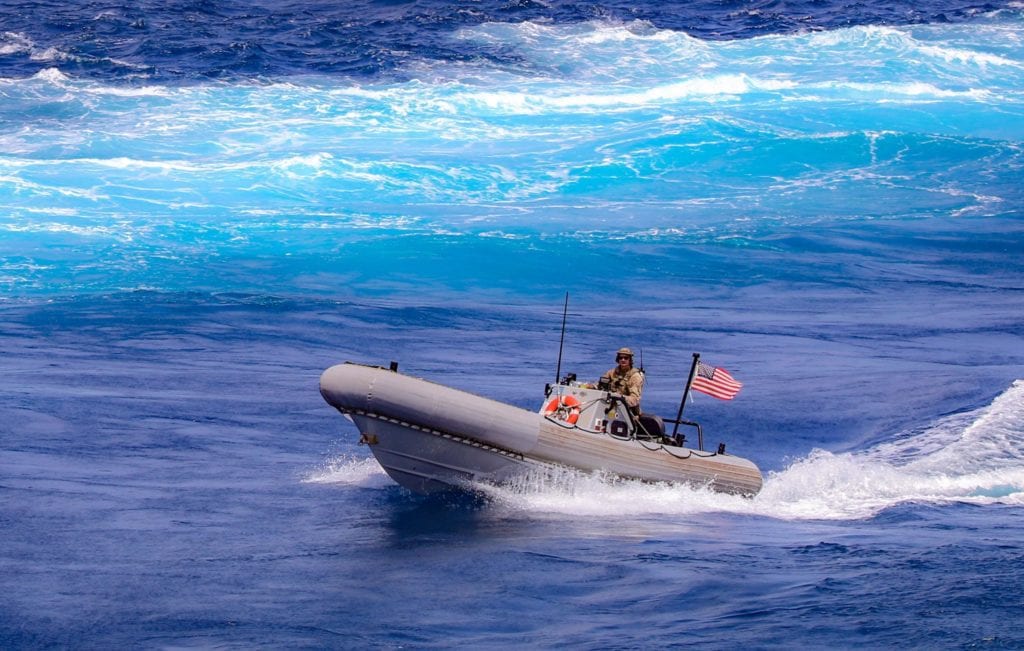
A Sailor assigned to the guided-missile destroyer USS Winston S. Churchill (DDG 81), in accordance with international law, boarded a stateless dhow off the coast of Somalia and interdicted an illicit shipment of weapons and weapon components, Feb. 12. U.S. Navy / Mass Communication Specialist 3rd Class Louis Thompson Staats IV
INDIAN OCEAN – The guided-missile destroyer USS Winston S. Churchill (DDG 81) seized illicit shipments of weapons and weapons components from two stateless dhows during a maritime security operation in international waters off the coast of Somalia, Feb. 11-12, U.S. Naval Forces Central Command / U.S. 5th Fleet Public Affairs said in a Feb. 16 release.
Churchill’s Visit, Board, Search, and Seizure (VBSS) team and embarked joint service Advanced Interdiction Team (AIT) discovered the illicit cargo during a flag verification boarding conducted in accordance with international law and in international waters.
The cache of weapons consisted of thousands of AK-47 assault rifles, light machine guns, heavy sniper rifles, rocket-propelled grenade launchers, and crew served weapons. Other weapon components included barrels, stocks, optical scopes and weapon systems.
The original source of the weapons has not yet been identified. Churchill located the dhows and provided more than 40 hours of over watch and security for the ship and its boarding teams throughout the two-day operation.
The dhow crews were provided food and water before being released.
“We are proud of the combined efforts of the AIT and Churchill crew members for executing dynamic and demanding boardings,” said Lt. Travis Dopp, assistant AIT leader aboard Churchill. “We are proud to have a positive impact on the safety and security of coalition forces by interdicting shipments of lethal aid.”
The seizure of the illicit weapons by Churchill was conducted as part of the U.S. Navy’s regular maritime security operations in the region. These routine patrols are performed to ensure the free flow of commerce for legitimate traffic and to disrupt the transport of illicit cargo that often funds terrorism and unlawful activity.
“This joint team [Army, Navy and Coast Guard] on board Churchill came together to successfully execute this operation over the course of two days in the Indian Ocean. These operations prevent nefarious actors from illegally spreading their lethal aid,” said Cdr. Timothy Shanley, commanding officer of Churchill.
Winston S. Churchill departed Norfolk, Virginia, Aug. 10 for a regularly-scheduled deployment to maintain maritime security and ensure the freedom of navigation in critical waterways.
U.S. 5th Fleet, headquartered in Manama, Bahrain, conducts joint and naval operations in order to support regional allies and partners and U.S. national security interests in the Middle East.
Cutter Mohawk Returns to Key West after Interdicting $69 Million in Drugs
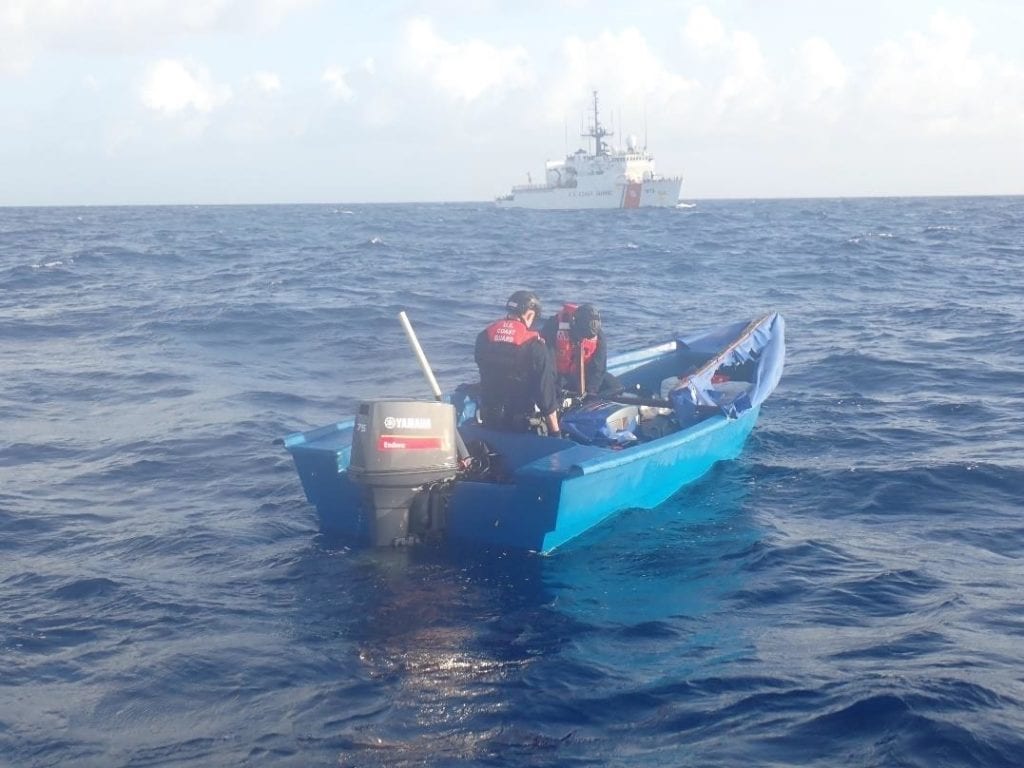
Coast Guard Cutter Mohawk (WMEC 913) crewmembers interdicted a 25-foot vessel with two suspected smugglers and over 660 pounds of cocaine in Caribbean waters Jan. 24, 2021. U.S. Coast Guard
KEY WEST, Fla. — Coast Guard Cutter Mohawk’s (WMEC 913) crew returned home to Key West Feb. 12 after a 59-day patrol in the Caribbean Sea.
The crew interdicted four drug vessels, detained five suspected drug smugglers and seized approximately 4,000 pounds of cocaine with a street value of approximately $69 million.
“These interdictions reflect teamwork and the unwavering resolve between the Coast Guard, federal law enforcement, Department of Defense, and our international partners to protect the region against the scourge of transnational criminal organizations,” said Cmdr. James L. Jarnac, Coast Guard Cutter Mohawk commanding officer. “The crew of Mohawk demonstrated remarkable enthusiasm and commitment during the execution of our missions over the last eight weeks, and it remains my pleasure to serve with and for them.”
During the patrol, Mohawk’s crew worked with multiple interagency and international maritime patrol aircraft and surface assets to counter transnational criminal organizations and hinder the illicit flow of drugs, people, and other dangerous cargo into the United States. This includes joint operations with the Dominican Republic navy, and Panamanian law enforcement officers, which further strengthened foreign partnerships and to detect, deter, and interdict vessels engaged in illegal, unreported, and unregulated fishing within the Exclusive Economic Zone of Panama.
Coast Guard Cutter Mohawk is a 270-foot medium-endurance cutter with a crew complement of 80.
Fairbanks Morse Opens Mayport Facility to Support Navy, Coast Guard
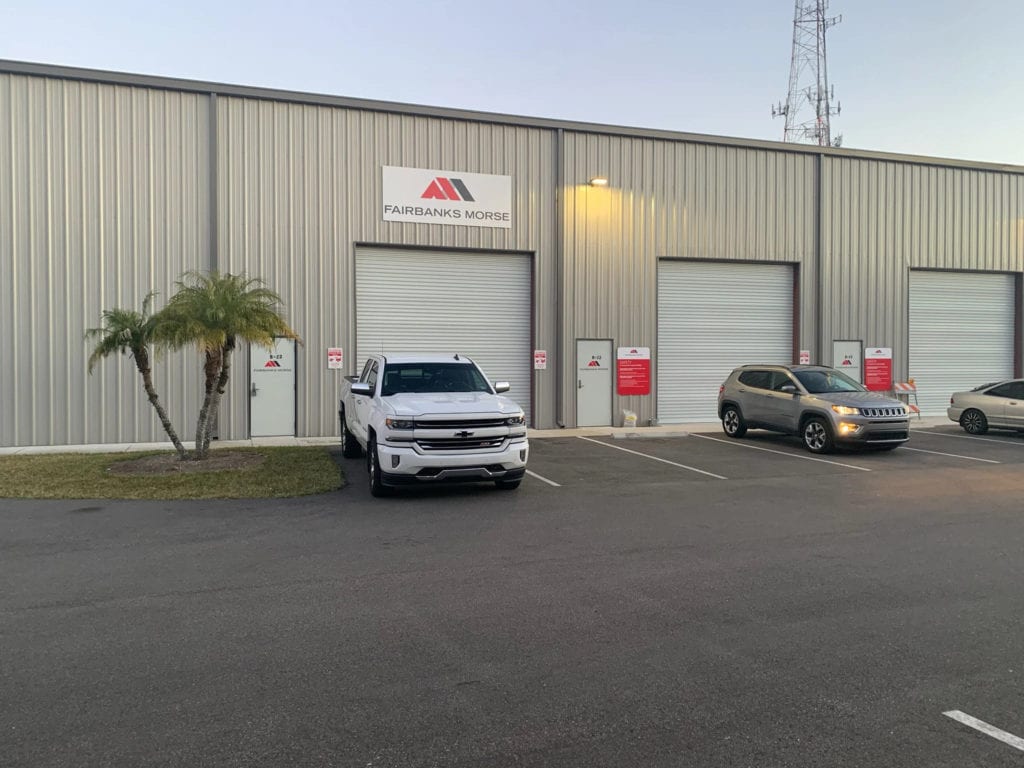
Fairbanks Morse’s new Mayport Service Center in Jacksonville Beach, Florida. Fairbanks Morse
BELOIT, Wis. and JACKSONVILLE BEACH, Fla. — Fairbanks Morse, a portfolio company of Arcline Investment Management, announced the opening of its 8,000-square-foot Mayport Service Center at 950 10th Street, Building B in Jacksonville Beach, Florida, the company said in a Feb. 16 release.
The facility represents a $350,000 investment in the community and places Fairbanks Morse in closer proximity to core customers such as Mayport Naval Station, Naval Submarine Base Kings Bay, and other U.S. Navy and U.S. Coast Guard installations.
“The opening of our Mayport Service Center is another step that Fairbanks Morse is taking to fulfill its promise to deliver world-class service to our customers,” said George Whittier, CEO of Fairbanks Morse. “From this facility, we are stocking a wide range of inventory to make parts available when and where our customers need them. This is just the beginning of our broader plan for a geographic expansion that extends our aftermarket services to help customers meet their mission-critical power needs.”
The Mayport Service Center will be staffed with factory certified, OEM [original equipment manufacturer] technicians to provide local engine, motor and controls maintenance and repair services to improve performance and reliability. Fairbanks Morse’s OEM technicians undergo rigorous qualifications to meet the company’s high standards for delivering best-in-class support.
A wide range of Fairbanks Morse engine and Ward Leonard motor and controls inventory will be available at the Mayport Service Center to reduce the amount of time for installation, repair and maintenance services. The move is part of the company’s renewed emphasis on expediting aftermarket services to military and commercial maritime customers across the nation.
Italian Navy Aircraft Carrier Arrives at Norfolk for F-35B Certification
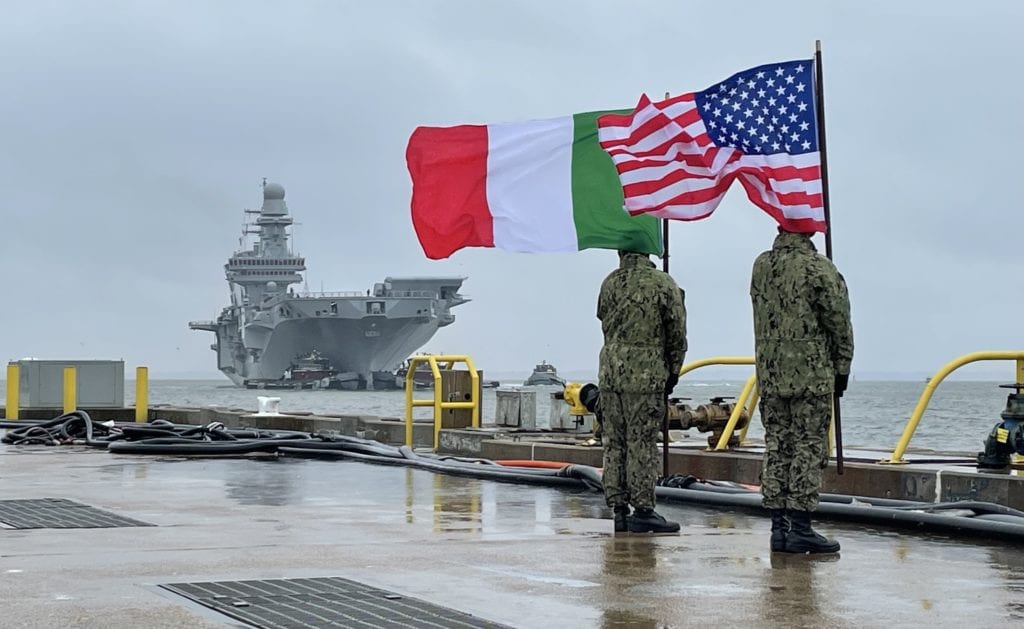
Italian navy flagship, the aircraft carrier ITS Cavour (CVH 550), arrives at Naval Station Norfolk, Virginia, Feb 13. The Cavour’s visit is part of a series of operations alongside U.S. military assets to attain the Italian navy’s “ready for operations” certification to safely land and launch F-35B aircraft. U.S. Navy / Capt. Cassidy Norman
NORFOLK, Va. — The Italian navy flagship, the aircraft carrier ITS Cavour (CVH 550), arrived at Naval Station Norfolk, Virginia, Feb. 13 for a series of operations alongside U.S. military assets to attain the Italian navy’s “ready for operations” certification to safely land and launch F-35B aircraft, the U.S. 2nd Fleet said in a release.
While in the Western Atlantic, Cavour will be embarked by an F-35 Joint Program Office test team to conduct sea trials, a series of tests and functional activities to create a safe flight operating envelope for the short takeoff and vertical landing (STOVL) variant of the fifth-generation aircraft aboard the recently upgraded ship.
This carrier-based flight test and other actions with U.S. 2nd Fleet ships and aircraft improve interoperability and strengthen the relationship between two NATO Allies.
“Operating in the Western Atlantic with our NATO allies presents a mutually beneficial opportunity to enhance both of our navies’ capabilities,” said Vice Adm. Andrew Lewis, commander of U.S. 2nd Fleet. “Supporting our Italian allies in certification of their aircraft carrier increases our collective experience in safety and combat abilities. We are stronger together.”
While crossing the Atlantic from Italy, ITS Cavour was met by the Arleigh-Burke class guided-missile destroyer USS Stout (DDG 55) and conducted a three-day interoperability exercise with support from Carrier Air Wing (CVW) 7 and Patrol and Reconnaissance Wing (CPRW) 11. Specific events included integrated ship maneuvering, low-slow-flyer detect-to-engage, anti-surface warfare serials with P-8 participation, air defense/air intercept control event with F/A-18 participation, and C5I interoperability events in the Western Atlantic 10-12 Feb.
“We are deeply grateful for the warm welcome received by the U.S. Navy 2nd Fleet upon our arrival in the Western Atlantic waters,” said Capt. Giancarlo Ciappina, commanding officer of ITS Cavour. “My officers and the whole crew were impressed for the professionalism and seamanship shown during these three days of training by the crews of USS Stout, CVW-7 and CPRW-11. We consider a real privilege having the opportunity to sail and exercise alongside our closest allies and friends and we are very proud to share with the USN Community such important certification deployment, which will provide ITS Cavour and the Italian naval aviation with the fifth-generation air combat capability of the Joint Strike Fighter.”
Upon arriving in Norfolk, ITS Cavour was hosted by USS John. C. Stennis (CVN 74). Stennis is coordinating and providing all pier services required by Cavour, to include refueling, diving operations, equipment and personnel on load, security, and contingency medical functions.
“We couldn’t be more excited to host our Italian ally,” said Capt. Cassidy Norman, Stennis’ commanding officer. “The Stennis team fully understands the importance of building trust and cooperation by supporting Cavour’s certification with the newest multi-role combat aircraft, the F-35. We are happy to see our Italian naval aviation counterparts dramatically increase their operational capability, strengthening our collective capability.”
The F-35 Pax River Integrated Test Force (ITF) team from Naval Air Station Patuxent River, Maryland. NAS PAX River comprises almost 200 people with the engineering and test pilot expertise and experience to conduct F-35B envelope expansion flight test, two specially instrumented developmental flight test aircraft, and support equipment.
“Italy is a critically important Cooperative Program Partner in the F-35 enterprise,” said Andrew Maack, F-35 Pax River ITF chief test engineer and site director.
“We are excited to get underway with the sailors of Cavour and honored to contribute to the aircraft carrier achieving the Italian navy’s strategic goal of it being ready for operations,” Maack said. “We look forward to a phenomenally successful shipboard detachment.”
For decades, the bond between Europe and North America has made NATO the strongest alliance in history. Conducting training and exercises alongside allies and partners increases our collective capacity and capabilities as well as increased interoperability with the U.S. Forces.
U.S. 2nd Fleet exercises operational authority over assigned ships, aircraft, and landing forces on the East Coast and the Atlantic.
Coast Guard Cutter Polar Star Collects High-Latitude Data of Remote Arctic Region
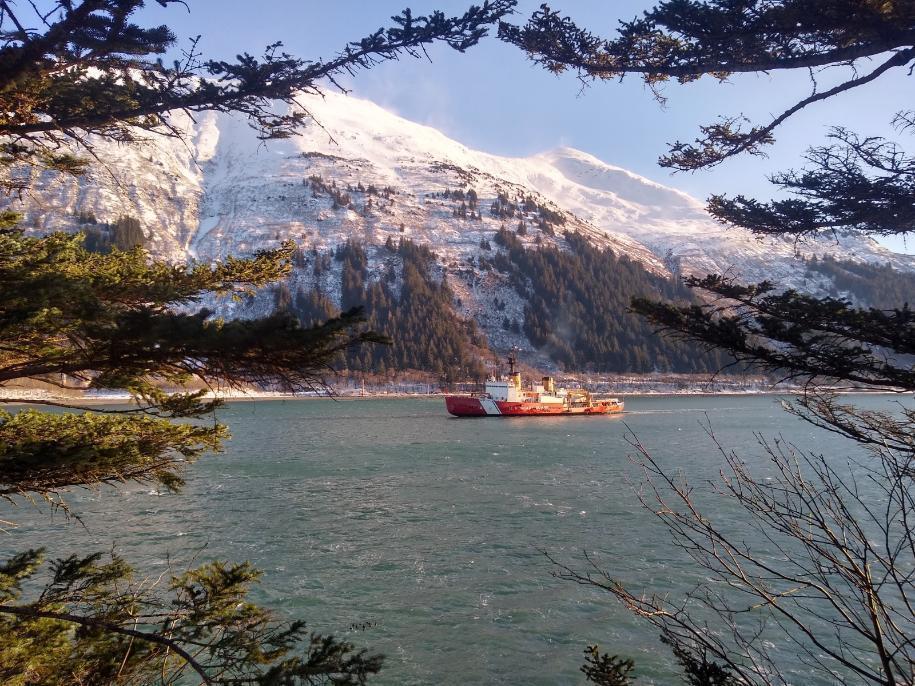
U.S. Coast Guard Cutter Polar Star transits the Gastineau Channel to moor up in Juneau, Alaska, on Feb. 12, 2021, as the crew nears the end of their months-long Arctic deployment. U.S. Coast Guard / Senior Chief Petty Officer Trevor Bannerman
JUNEAU, Alaska — The Seattle-based Coast Guard Cutter Polar Star (WAGB 10) arrived in Juneau, Alaska on Feb. 12, for a logistics stop as the crew nears the end of their months-long Arctic deployment conducting scientific research and protecting the nation’s maritime sovereignty and security throughout the polar region, the Coast Guard 17th District said in a release.
“The Arctic is cold, dark, and difficult to navigate in the winter,” said Capt. Bill Woityra, the Polar Star’s commanding officer. “Deploying with researchers and scientists aboard has aided in the development, understanding and pursuit of technologies that will mitigate risks and enable future mission performance so that looking forward, the Coast Guard can safely operate continually and effectively in this remote environment.”
Working aboard Polar Star, Shalane Regan, a member of the Coast Guard Research and Development Center (RDC), teamed up with Lt. Lydia Ames, a NOAA Corps officer, to assist CRREL researchers by deploying buoys onto the ice where they will, over time, collect and transmit information about ice flow to help fill in data gaps for higher-latitude oceans.
The Polar Star crew also aided in a research project concerning water flow regimes in the Arctic, specifically the Chukchi Sea, a study developed by Dr. Robert Pickart of WHOI. The data collected during Polar Star’s patrol will be used to develop a more complete understanding of the hydrology of the dynamic region.
To support Dr. Pickart’s research, WHOI provided 120 Expendable Conductivity-Temperature-Depth (XCTD) instruments to measure temperature and salinity. These profiles of the water column will give a better picture of what water and nutrient flow look like in the Arctic winter. Polar Star crew members deployed the probes every 12 hours when above 65 degrees north.
Additionally, Regan, a mechanical engineer and researcher with the RDC Surface Branch, worked with other scientists and researchers on board to find ways to operate most effectively in the frigid Arctic environment.
For technology, Regan brought a 3-D printer and remotely operated vehicle aboard Polar Star to evaluate how the systems would react to the Arctic climate and ship life.
“I used the 3-D printer to complete many small projects that resulted in large lifestyle improvements for the crew,” said Regan. “Most importantly, the knowledge I was able to gather about larger issues the crew faces, for example, visibility issues due to frost accumulation on the bridge windows, I can take home for my team to develop solutions that will create a better-equipped, mission-ready fleet.”
Another big item the RDC team is focusing on is underway connectivity, specifically in the Arctic region.
To better understand high latitude communications, The Mobile User Objective System (MUOS) was installed on Polar Star to test its abilities at high latitudes in the harsh Arctic winter conditions. Developed for the U.S. Navy by Lockheed Martin, the MUOS is an ultra-high frequency satellite communications system that provides secure connections for mobile forces.
“Looking towards the future, all signs point toward the Coast Guard deploying more platforms to the Arctic, more often and during different seasons of the year,” said Woityra. “The Coast Guard is robustly proficient at summer-time Arctic operations, while winter presents an entirely new set of challenges. Polar Star’s winter Arctic deployment has served to better understand and prepare for the challenges of operating in such a harsh and unforgiving environment.”
MARAD Announces Comment Period for Future Use of the Historic Vessel NS Savannah
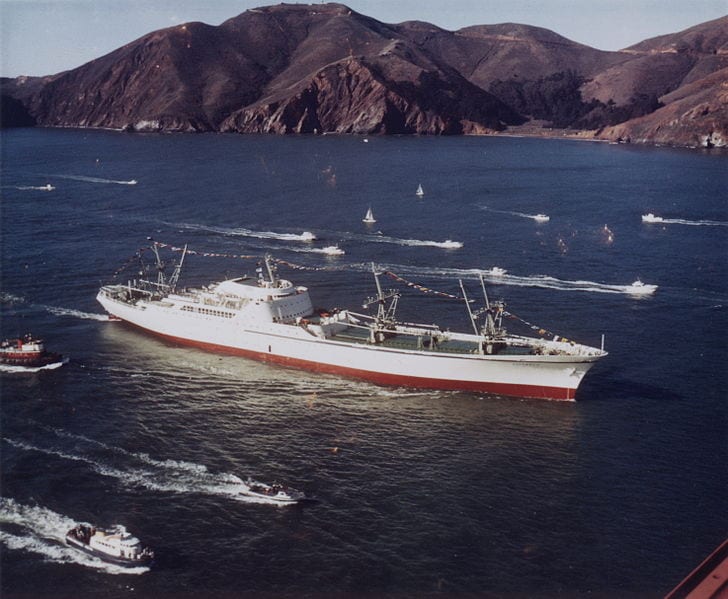
NS (Nuclear Ship) Savannah, the first commercial nuclear power cargo vessel, en route to the World’s Fair in Seattle in 1962. Wikipedia / U.S. government
The N.S. Savannah was the world’s first nuclear-powered merchant ship. It operated from 1962 to 1971, when it was inactivated. It currently is moored in Baltimore.
Under the authority of the National Historic Preservation Act (NHPA), MARAD is engaged in formal consultations with federal, state, and organizational stakeholders, and expects to enter into a Programmatic Agreement with those stakeholders in the next few months. The agreement includes a stipulation that details how MARAD will consider future uses for the vessel after its nuclear power plant is fully decommissioned.
Comments can be submitted electronically online through the Federal eRulemaking Portal at www.regulations.gov under docket number MARAD-2020-0133. Alternatively, comments may be mailed to the following address: U.S. Department of Transportation, Docket Management Facility, West Building, Ground Floor, Room W12-140, 1200 New Jersey Avenue, SE, Washington, DC 20590. In person submissions are being accepted in accordance with social distancing protocols in place.
All submissions to the docket will be posted without change to www.regulations.gov and will include any personal information you provide.
CAE and Pinnacle Solutions Prepare to Deliver LCS Simulators to U.S. Navy
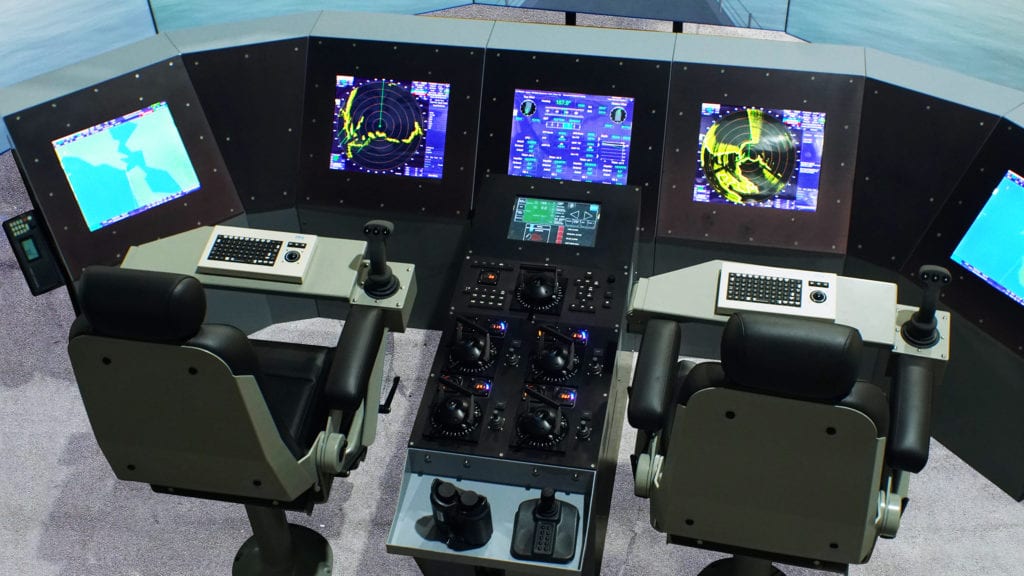
Two Littoral Combat Ship Bridge Part-Task Trainers representing the General Dynamics Independence variant will be delivered to the Navy’s Surface Warfare Schools Command in Newport, Rhode Island. CAE
TAMPA, Fla.—The joint venture CAE USA and Pinnacle Solutions, Xebec, will be delivering the first three Littoral Combat Ship (LCS) Bridge Part-Task Trainers (BPTTs) to the U.S. Navy, CAE said in a Feb. 9 release.
The new LCS BPTTs recently completed factory acceptance testing at CAE’s facility in Tampa, Florida and will now be packed and shipped to the Navy’s Surface Warfare Schools Command (SWSC) in Newport, Rhode Island. The SWSC is the Navy’s center of excellence for surface warfare where training for officers and Sailors who will serve on the Navy’s surface combatants is delivered.
“The Navy is focused on navigation and seamanship training and these littoral combat ship simulators will greatly assist in this endeavor,” said Michael Beard, program manager, U.S. Navy LCS Training Systems for CAE. “The more training our officers and Sailors receive ashore, the better prepared they will be at sea in real life situations.”
CAE is featured a video demonstration of the LCS bridge simulators in the Innovation Hub as part of the CAE OneWorld virtual conference and tradeshow. CAE OneWorld 2021 will be available online for the next month.
Included in the initial delivery to the SWSC in Newport will be two LCS BPTTs for the LCS 2 Independence variant manufactured by General Dynamics and Austal USA, and one LCS BPTT for the LCS 1 Freedom variant manufactured by Lockheed Martin. The three LCS BPTTs will undergo site acceptance testing once installed in Newport and are expected to be ready for training by the end of April. Xebec is under contract to deliver four additional LCS BPTTs which will be delivered to the LCS training facilities located in San Diego, California and Mayport, Florida.
“The fidelity and flexibility of the littoral combat ship simulators we have developed will allow the Navy to deliver most of the personnel qualification standards training in a simulation-based environment,” said Ray Duquette, president and general manager, CAE USA. “This means when sailors get to their assigned ship they will be better prepared for the navigation and operational assignments required.”
The LCS BPTTs are being developed by Xebec, a joint venture of CAE USA and Pinnacle Solutions established under the U.S. Small Business Administration’s Mentor-Protégé program.
“We were pleased to establish the Xebec joint venture with CAE and the collaboration has resulted in a very successful littoral combat ship simulator program for the Navy,” said Mike Durant, Pinnacle’s president and CEO. “We look forward to continuing deliveries of the LCS simulators to the Navy and to future pursuits with CAE through the Xebec joint venture.”
Xerox and Naval Postgraduate School Collaborate on 3-D Printing Research
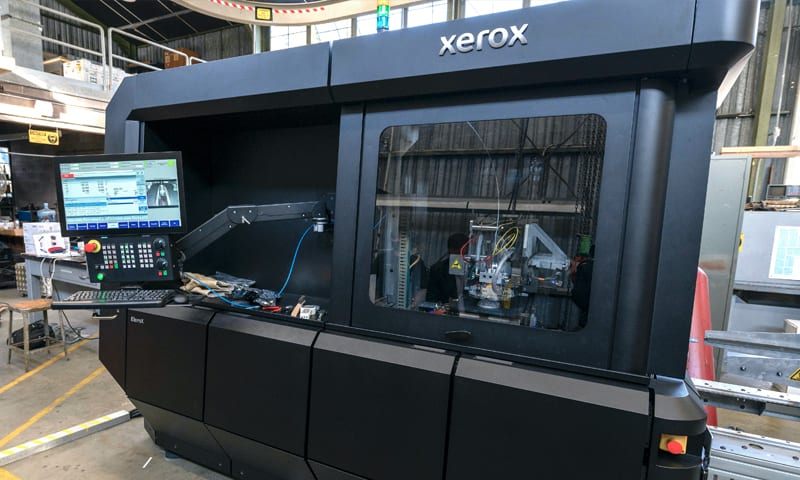
At the cutting-edge of additive manufacturing technology, this new Xerox ElemX 3-D Liquid Metal Printer is now operational in NPS’ Large Experiment Annex on campus. Naval Postgraduate School
NORWALK, Conn. & MONTEREY, Calif. — Xerox and the Naval Postgraduate School (NPS) have formed a strategic collaboration focused on advancing additive manufacturing research, specifically 3-D printing, which has the potential to dramatically transform the way the military supplies its forward-deployed forces, Xerox and NPS said in a joint release.
As part of a Collaborative Research and Development Agreement (CRADA), NPS was the first to receive an installation of the Xerox ElemX Liquid Metal Printer on the university campus in December. The Xerox system will provide NPS faculty and students with hands-on exploration of new ways the technology can deliver on-demand 3-D printing of metal parts and equipment.
“The military supply chain is among the most complex in the world, and NPS understands first-hand the challenges manufacturers must address,” said Xerox Chief Technology Officer Naresh Shanker. “This collaboration will aid NPS in pushing adoption of 3-D printing throughout the U.S. Navy, and will provide Xerox valuable information to help deliver supply chain flexibility and resiliency to future customers.”
With access to the latest additive manufacturing equipment, NPS faculty and students will use the ElemX printer to conduct thesis research to develop new capabilities for the Navy and Marine Corps.
“As the Department of the Navy’s applied research university, NPS combines student operational experience with education and research to deliver innovative capabilities and develop innovative leaders with the knowhow to use them,” said NPS President Ann Rondeau, a retired vice admiral. “This collaborative research effort with Xerox and the use of their 3-D printing innovations is a great example of how NPS uniquely prepares our military students to examine novel approaches to create, make, prototype and manufacture capability wherever they are.”
“From the age of sail to the nuclear era, Sailors have been fixing things at sea so they can complete the mission,” Rondeau continued. “This partnership is about the strategic ability of the Navy to have Sailors on ships with the capability through creativity and technology to advance their operations at sea. Through collaboration, NPS and Xerox are helping build a Navy for the 21st Century.”
The Xerox ElemX printer uses cost-effective aluminum wire to fabricate end-use parts that can withstand the rigors of operational demands. This ability to produce reliable replacement parts on-demand reduces the dependency on complex global supply chains for deployed forces and also addresses the hidden costs of traditional manufacturing.
“The NPS Alumni Association and Foundation supported bringing the ElemX liquid metal printer to NPS because it will enable soldiers, sailors, airmen, and marines to solve their problems where they are, when problems occur,” noted retired U.S. Marine Corps Col. Todd Lyons, vice president of the NPS Alumni Association and Foundation. “By providing the right digital tools and the liquid metal printer, all of a sudden we’ve helped transform not just the supply chain, but how the Department of Defense (DoD) thinks operationally about supplying war.”
“This is one way to bend the cost curve so that the DoD is not spending a thousand dollars for every dollar that a peer competitor spends,” he added.
“Global supply chains leave industries like aerospace, automotive, heavy equipment, and oil and gas vulnerable to external risks,” said Tali Rosman, vice president and general manager, 3D Printing, Xerox. “Our goal is to integrate localized 3D printing into their operations, and the real-time feedback from NPS gives us actionable data to continuously improve the ElemX.”
Northrop Grumman to Develop Advanced Air-to-Air Missile Engagement Concept
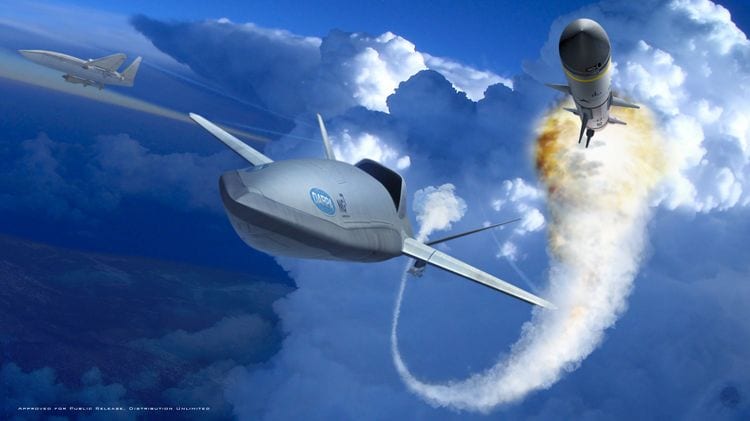
An artist’s conception of the LongShot advanced weapons concept. Northrop Grumman
REDONDO BEACH, Calif. — Northrop Grumman Corp. has been awarded a contract by the U.S. Defense Advanced Research Project Agency (DARPA) Tactical Technology Office to develop an advanced technology weapon concept designed to significantly increase engagement range and weapon effectiveness of U.S. forces against adversary air threats, the company said in a Feb. 10 release.
“Our collaboration with DARPA is the critical first step in the development of innovative operational concepts and solutions that will enhance our warfighter’s combat capability against a rapidly growing threat,” said Jaime Engdahl, program director, kinetic weapons and emerging capabilities, Northrop Grumman. “The LongShot program enables us to combine our digital engineering skillset with our extensive knowledge in advanced technology weapons, autonomous systems and strike platforms to increase weapon range and effectiveness.”
Spurred by rapid technological advancements and an ever more dangerous and disruptive battlefield, DARPA’s LongShot program will explore new lethal engagement concepts by leveraging multi-modal propulsion, weapon systems that can be operationally deployed from existing fighters or bombers.
DARPA’s advanced aerospace systems activities are focused on utilizing high pay-off opportunities to provide revolutionary new system capabilities, as opposed to incremental or evolutionary advancements, in order to achieve undeterrable air presence at dramatically reduced costs.
The LongShot program enables Northrop Grumman to combine its expertise in weapon system design, survivability, autonomy, advanced mission systems and rapid prototyping to deliver advanced solutions that help to maintain a competitive military advantage in highly contested environments.