NAVAIR Orders Five VH-92 Presidential Helicopters from Sikorsky
Marine Helicopter Squadron (HMX) 1 conducts test flights of the new VH-92A helicopter over the South Lawn of the White House, Sept. 22, 2018, in Washington, D.C. U.S. Marine Corps / Sgt. Hunter Helis
ARLINGTON, Va. — Naval Air Systems Command has awarded Sikorsky a third production contract to build five VH-92A helicopters for the U.S. Marine Corps.
The Naval Air Systems Command awarded Sikorsky Aircraft Corp. — a Lockheed Martin company — a $478.6 million firm-fixed-price contract modification to build five Low-Rate Initial Production Lot III VH-92As, according to a Feb. 5 Defense Department announcement. The award also includes orders for “interim contractor support, two cabin interior reconfiguration kits, support equipment, initial spares and system parts replenishment,” the release said. Work on the contract is expected to be completed by December 2023.
The VH-92A was selected in 2014 to provide transport for the president of the United States, the vice president and other high-level government officials. The helicopter will replace the 19 VH-3D Sea King and VH-60N “White Hawk” helicopters operated by Marine Helicopter Squadron One. The Corps plans to acquire a total of 23 VH-92As, 21 for operations and two for testing. The May 2014 engineering and manufacturing development contract procured two test aircraft and four production aircraft. Six VH-92As were ordered in June 2019, followed by six more in February 2020.
The presidential helicopter fleet is operated by Marine Helicopter Squadron One, based at Marine Corps Air Station Quantico, Virginia, with a detachment at Joint Base Anacostia-Bolling in Washington.
“Government testing to validate system performance and prepare for Initial Operational Test and Evaluation is progressing on schedule and will support an Initial Operational Capability (IOC) planned for July 2021,” a Navy spokeswoman said. “The VH-92A will enter service post IOC at the determination of the White House Military Office.”
Marine Corps Adds 5th F-35B Squadron to its Force
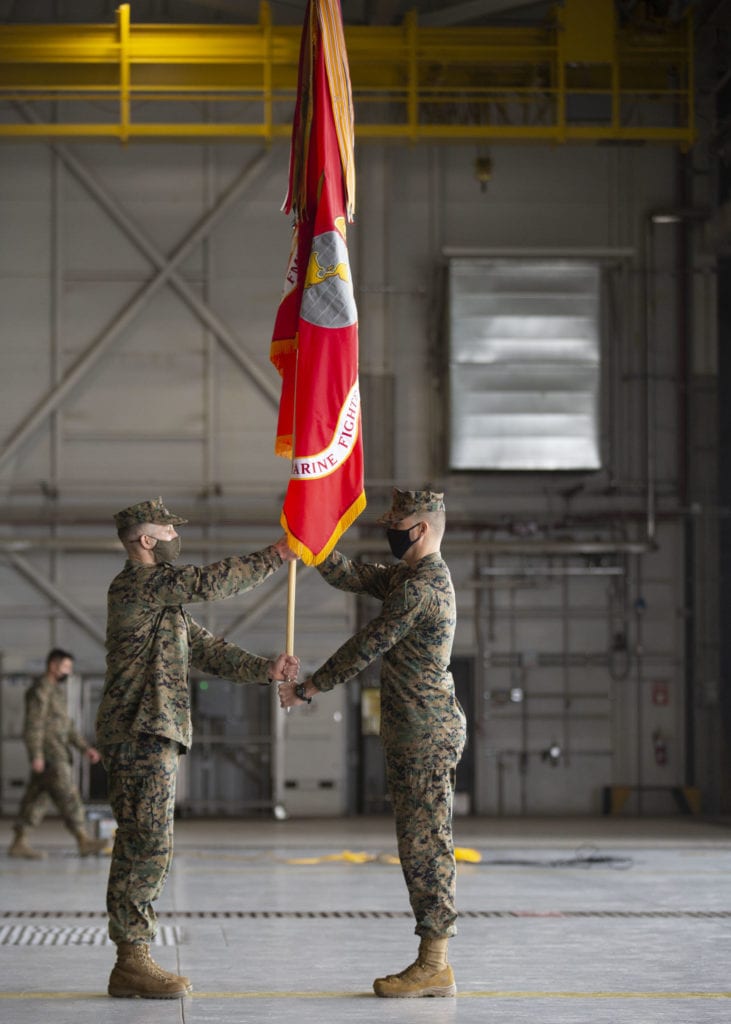
U.S. Marine Corps Lt. Col. Alexander Goodno, the incoming commanding officer, left, and Sgt. Maj. Collin Barry, the incoming sergeant major, with Marine Fighter Attack Squadron (VMFA) 225, Marine Aircraft Group 13, 3rd Marine Aircraft Wing, exchange the organizational colors during the redesignation and assumption of command ceremony at Marine Corps Air Station Yuma, Ariz., Jan. 29, 2021. U.S. Marine Corps / Lance Cpl. Juan Anaya
ARLINGTON, Va. — The Marine Corps is converting a fifth squadron to the F-35B Lightning II strike fighter.
In a Jan. 29 ceremony at Marine Corps Air Station (MCAS) Yuma, Arizona, the “Vikings” of Marine All-Weather Fighter Attack Squadron 225 (VMFA(AW)-225) were re-designated Marine Fighter Attack Squadron 225 (VMFA-225) as they engaged in the process of learning to operate and maintain the F-35B version of the Lightning II, according to a release from the 3rd Marine Aircraft Wing.
The squadron retired its last F/A-18D Hornet strike fighter a year ago, on Jan. 23, 2020.
VMFA-225 follow VMFAs 121, 211, 122, and 242 as the Corps’ fifth operational F-35B squadron. VMFA-225 moved from MCAS Miramar, California, to MCAS Yuma, Arizona, to join 211 and 122, both of which have flown combat missions in the Middle East. VMFAs 212 and 242 are based at MCAS Iwakuni, Japan.
“It’s an exciting day for [VMFA-225],” said Lt. Col. Alexander Goodno, the commanding officer of VMFA-225, in the release. “We will grow over the next 18 to 24 months to a full, combat-ready, capable squadron and be ready to do the nation’s bid in the war.”
“We have aircraft afloat right now from VMFA-122; we’re flying combat missions,” said Col. Benjamin Hutchins, commanding officer of Marine Aircraft Group 13, in the release. “We have VMFA-211 getting ready to deploy on [HMS Queen Elizabeth]. This is a busy business, this is our nation’s business, this is our Corps’ business.”
The Corps’ single F-35C squadron, VMFA-314, is scheduled to be ready for a deployment on the USS Carl Vinson in early fiscal 2022.
Lockheed Martin’s SPY-7 Radar Is Going to Sea
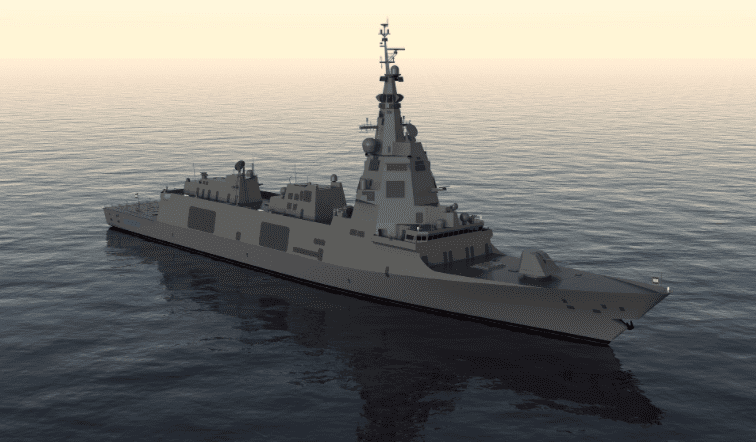
An artist’s rendering of a Spanishfuture F-110 frigate equipped with AN/SPY-7(V)2. Navantia
ARLINGTON, Va. — Lockheed Martin’s new SPY-7 radar will be sailing to sea on the ships of three navies as the company highlights the radar’s capabilities for application to other navies, including the U.S. Navy.
The SPY-7, which uses gallium nitride modules, initially was developed for the Navy’s Air and Missile Defense Radar competition. It was adapted into the Long-Range Discrimination Radar (LRDR) procured by the U.S. Missile Defense Agency (MDA) as a sensor of the Ground-Based Midcourse Defense system. Being installed at Clear Air Force Station in Alaska, the LRDR is designed to discriminate between incoming warheads and decoys.
The core building blocks [of the LRDR] are the same core building blocks in SPY-7,” said Jon P. Rambeau, vice president and general manager, Integrated Systems & Sensors, Lockheed Rotary and Mission Systems, during a Feb. 2 interview with Seapower. “[SPY-7] is a modular radar that allows us to build different configurations for both land-based and sea-based applications.”
The SPY-7 has been selected by the Spanish navy to integrate it with the Aegis Combat System on its F110 frigates. The Canadian navy is procuring the radar to install it on its new Halifax-class surface combatant.
Japan had selected the SPY-7 for its two planned Aegis Ashore ballistic-missile defense sites, but when the plans were cancelled in part out of concern for missile debris falling on populated areas, Japan shifted to a plan to deploy the SPY-7 on some future, unspecified sea-based BMD platform. Japan already has BMD capabilities in its Kongo-class guided-missile destroyers with Aegis systems using the SPY-1 radar.
Japan, which already has placed an order for the SPY-7, “is going through a process now to determine exactly what that platform is going to look like,” Rambeau said. “We are pleased with the progress that the technology has made, and we’re starting to see some uptake both here in the U.S. as well as abroad.”
“SPY-7 is part of the Aegis common source library (CSL) and the interfaces are understood,” said Patrick W. McNally, director of communications for Integrated Warfare Systems & Sensors, in a statement to Seapower. “For Japan, we have completed the first of three releases which were recently demonstrated to MDA. Starting from the CSL, with over one million lines of code, Japan will be receiving the best of both Baseline 9 and 10 [Aegis software].”
The U.S. Navy is considering backfitting some Flight IIA Arleigh Burke-class guided-missile destroyers with a radar more modern than the SPY-1, and Lockheed is keeping a watch on developments in the event the SPY-7 could complete in the program if it comes to pass.
Rambeau said his company also “has some more affordable options available to upgrade some of the SPY-1 arrays to provide improved sensitivity and improved resistance to electronic attack and we think we can do that at a fraction of the cost of a wholesale replacement, so we’ve put forth a couple of options for upgrades to SPY-1 to both MDA and the Navy.”
CGC Steadfast Returns Home after 45-Day Counter-Narcotics Patrol
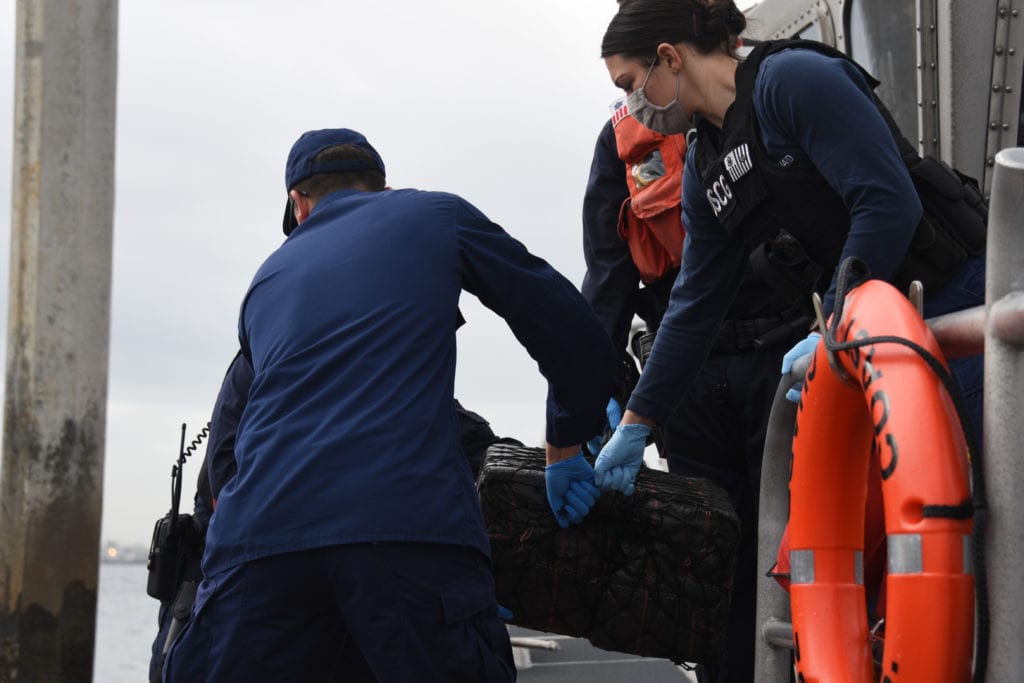
U.S. Coast Guard members conduct drug offload in San Diego, Jan. 22. The drugs were offloaded after Coast Guard Cutter Steadfast interdicted 1,675 pounds of cocaine, worth more than $28 million. U.S. Coast Guard / Petty Officer 3rd Class Alex Gray
ASTORIA, Ore. — The Coast Guard Cutter Steadfast returned to its homeport of Astoria, Oregon, Jan. 30 following a 45-day counter-narcotics patrol, where the crew transited more than 10,000 miles conducting law enforcement operations in the Eastern Pacific Ocean, the Coast Guard 13th District said in a Feb. 4 release.
During the deployment, the Steadfast’s crew interdicted four vessels suspected of smuggling illicit narcotics. Steadfast boarding teams discovered and seized 1,675 pounds of cocaine, worth more than $28 million, and detained seven suspected narco-traffickers.
Steadfast also completed biennial Aviation Standardization Training, certifying the cutter for Aerial Use of Force, and served as a training platform for tactical law enforcement units from Maritime Security Response Team-West.
The Steadfast crew celebrated Christmas and rang in the New Year while on patrol. The Steadfast’s ombudsman coordinated gifts and a compilation video with holiday wishes from crewmembers’ families. Crewmembers were surprised on Christmas morning when Santa visited and shared the personalized messages and gifts.
“The Steadfast crew, families, and friends really came together to keep spirits high while deployed over the holidays,” said Cmdr. Craig Allen, Jr., commanding officer of the Steadfast. “During the patrol, the crew displayed superb skill and professionalism in achieving a perfect detection-to-interdiction record, thus ensuring the holidays were considerably less jolly for narco-traffickers.”
To ensure the safety of Steadfast’s crew during the COVID-19 global pandemic, the crew conducted pre-deployment COVID-19 testing, followed by a 14-day monitoring period.
Throughout their patrol, Steadfast’s crew maintained strict health precautions during all interactions with the public, including wearing face coverings at all times and undergoing intensive health screenings prior to each boarding.
The Steadfast is a 210-foot medium-endurance cutter homeported in Astoria.
Besides Supplying Food, Fuel and Equipment, Logistics Could Confuse an Adversary, Pentagon Planner Suggests
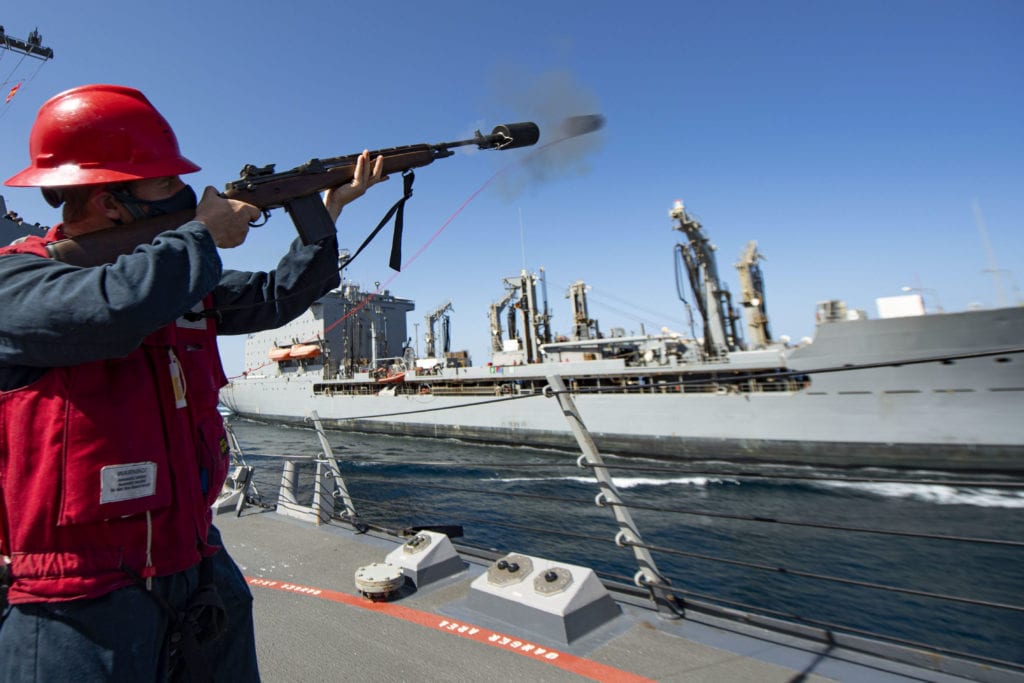
Gunner’s Mate 3rd Class Gage Duncan, from Cardington, Ohio, fires a shot line from the deck of the guided-missile destroyer USS Sterett (DDG 104) to the fleet replenishment oiler USNS Leroy Grumman (T-AO 195) during a replenishment-at-sea. U.S. Navy / Mass Communication Specialist Seaman Drace Wilson
ARLINGTON, Va. — Supporting United States forces in the vast and likely contested areas of great power competition will be an enormous challenge, but a top Defense Department planner says using logistics “as a warfighting function” could throw adversaries off balance.
Logistics isn’t just about planes, ships and trucks carrying stuff, Marine Corps Maj. Gen. David Maxwell, the Pentagon’s vice director for logistics (J4) told a virtual defense industry conference Feb. 3. “In fact, I would offer that we really need to be thinking about employing logistics as a warfighting function,” he said.
“The military challenge for logistics,” Maxwell told the Defense Industrial Association’s Expeditionary Warfare Conference, “is that under all domain persistent attack, we have to be able to rapidly aggregate and deploy forces worldwide and support those forces potentially over vast distances, through contested domains and most likely over a protracted time frame.”
That’s going to be a tall order, compared to the decades after the Cold War, when the maritime environment was largely uncontested.
“Logistics support, something we’ve taken for granted for quite a while, is no longer a given,” Maxwell said, adding that in a contested environment the integration of logistics, operations and command and control is more critical than ever, but “our ways of doing it are no longer adequate.”
U.S. strategy calls for a geographically distributed force across the Pacific to confound and deter adversaries armed with increasingly formidable air and sea denial capabilities. In addition to reducing the signatures of supply vessels, greater use of autonomous vehicles, artificial intelligence, machine learning and better training the troops who will use those digital tools, Maxwell said logistics, itself, should be added to the commander’s toolbox.
He suggested logistics could be used as a reconnaissance or counter reconnaissance tool “to probe and identify” competitors’ surface areas. “Would a commander intentionally use logistics movement as a signaling activity to assess adversary reactions as either a deterrent or an indication of escalation?” he asked. He also suggested a commander could conceal logistics activities “in order to deceive the adversary and retain an element of surprise.”
Those actions “have the potential to either deter or deny adversary objectives if we employ them intentionally,” Maxwell said.
New PTDO Under Secretary of the Navy Designated
James F. “Hondo” Geurts. U.S. Navy
ARLINGTON, Va. — Acting Secretary of the Navy Thomas Harker has designated James F. “Hondo” Geurts as PTDO (performing the duties of) under secretary of the Navy, the Navy announced in a Feb. 4 release.
Prior to this selection, Geurts served as the eighth assistant secretary of the Navy for Research, Development and Acquisition (ASN RD&A), from December 2017 to January 2021. As ASN RD&A, he served as the Navy’s acquisition executive, with oversight of an annual budget in excess of $100 billion and responsible for equipping Sailors and Marines with platforms, systems and technologies around the globe in defense of the nation.
“I’ve worked with Hondo for a number of years and know he will bring a wealth of insight and leadership derived from 34 years of DoD experience to this position,” said Harker. “His stellar knowledge of acquisition efforts, experience driving positive change, and commitment to naval innovation will be a strong asset in this position, where he will continue to reinforce a clear understanding of the needs, requirements and capabilities of our Navy and Marine Corps.”
In performing the duties of the under secretary of the Navy, in addition to serving as the deputy and principal assistant to the SECNAV, Geurts will serve as the chief operating officer and chief management officer for the Department of the Navy. Additionally, he will oversee intelligence activities, intelligence-related activities, special access programs, critical infrastructure, and sensitive activities within the department.
“Having supported the military, both in and out of uniform, for the majority of my life, I know that when we are empowered and focused on the mission we can accomplish amazing things,” said Geurts. “I look forward to continuing to work with a great team of professionals as we spearhead efforts in support of the finest Navy and Marine Corps in the world.”
Geurts previously served as the acquisition executive, U.S. Special Operations Command, at MacDill Air Force Base, Florida, where he was responsible for all special operations forces acquisition, technology and logistics. Prior to being selected for Senior Executive Service, Geurts began his career as an Air Force officer. He served as an acquisition program manager with engineering and program management leadership positions in numerous weapon systems, including intercontinental ballistic missiles, surveillance platforms, tactical fighter aircraft, advanced avionics systems, stealth cruise missiles, training systems and manned and unmanned special operations aircraft.
He has over 30 years of joint acquisition experience and served in all levels of acquisition leadership positions including acquisition executive, program executive officer and program manager of major defense acquisition programs.
Geurts is a distinguished 1987 Reserve Officers’ Training Corps graduate from Lehigh University where he received a Bachelor of Science in Electrical Engineering. He holds a Master of Science in Electrical Engineering from Air Force Institute of Technology, Wright-Patterson AFB and in National Security Resourcing from Industrial College of the Armed Forces, National Defense University, Washington, D.C. Geurts also attended executive leadership and international studies programs at Harvard Kennedy School and George Washington Elliot School.
Nimitz Carrier Group Sails into Indo-Pacific Command
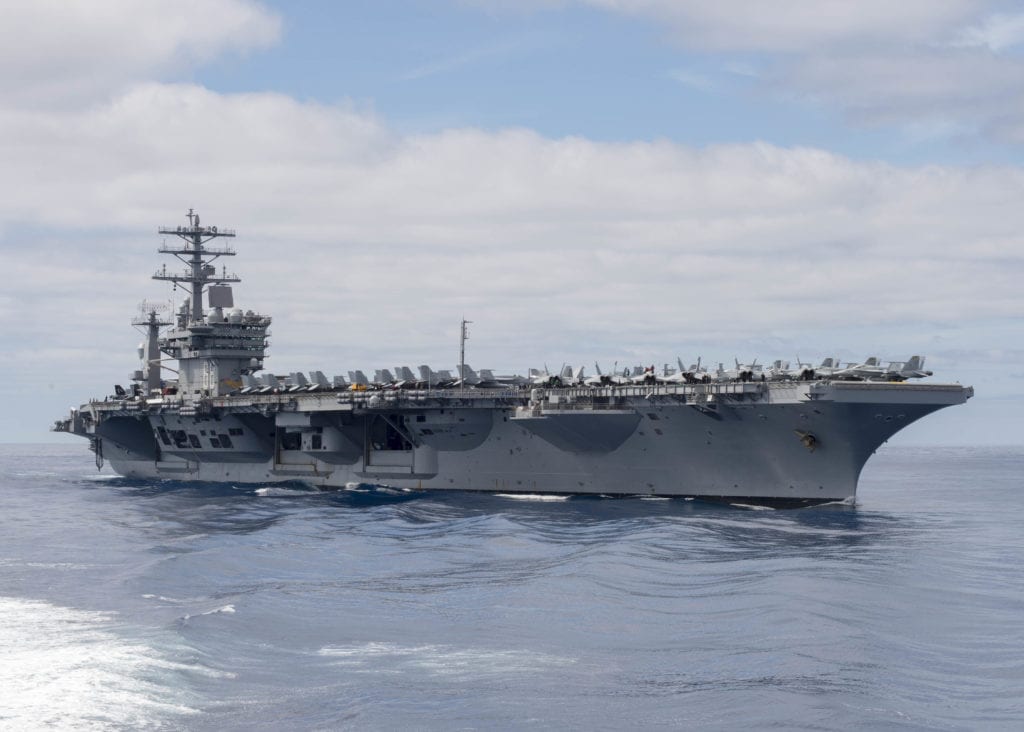
The aircraft carrier USS Nimitz (CVN 68) transits alongside the Arleigh Burke-class guided-missile destroyer USS Pinckney (DDG 91) after a replenishment-at-sea in this 2017 photo. U.S. Navy / Mass Communication Specialist 2nd Class Craig Z. Rodarte
ARLINGTON, Va. — The USS Nimitz Carrier Strike Group is departing the Central Command area of responsibility and moving into the U.S. Indo-Pacific region, Pentagon Press Secretary John F. Kirby announced Feb. 4.
“We want to thank all the men and women aboard the ships in that strike crew and the squadrons who supported Central Command now for more than 270 days, ensuring our national security and deterring conflict in a very critical region of the world,” Kirby said.
The carrier is homeported in Bremerton, Washington. It is now in the 7th Fleet area of responsibility and can be called upon for operations, training or humanitarian exercises there.
The Nimitz’s departure means there is no U.S. carrier operating in the Central Command area of operations. Kirby said Secretary of Defense Lloyd J. Austin III believes America has “a robust presence in the Middle East.” U.S. service members are based in many nations in the Persian Gulf and there is more than enough airpower to counter any adversary.
Kirby said Austin has constant discussions with U.S. Central Command commander Marine Corps Gen. Frank McKenzie, as well as other combatant commanders. Austin must balance requirements from various parts of the world, and the United States doesn’t have an unlimited number of aircraft carriers.
These decisions are carefully weighed, the press secretary said. “Every decision that we make with military forces — air, ground or naval — and certainly, decisions that you make with respect to a capital asset, like an aircraft carrier and its associated, supporting Strike Group is a decision driven by a frank assessment of the threats in the area, and also a frank consideration of the capabilities themselves,” Kirby said. “So, absolutely, the secretary was mindful of the larger geostrategic picture when he approved the movement of the Carrier Strike Group from the Central Command area responsibility.”
Also playing into the decision is the length of the deployment for the Nimitz sailors and their families. The Nimitz and supporting ships have been deployed longer than is typically required. Austin and CentCom and Navy officials must consider the wear and tear on the sailors, the ships and the aircraft.
Navy Seeking Innovation in New Places Despite Challenges, ONR Director Says
Anne Sandel, executive director, Office of Naval Research. U.S. Navy / John F. Williams
While there is a new administration and leadership, the Office of Naval Research’s executive director said she does not expect any major changes in the Department of the Navy’s priorities, and the acquisition team will continue to be focused on delivering and sustaining lethal capability, increasing agility, driving affordability and developing a work force to compete and win.
Anne Sandel, also the acting principal civilian deputy to the assistant secretary of the Navy for research, development and acquisition, spoke at the National Defense Industrial Association’ s Expeditionary Warfare Conference, which took place virtually Feb. 2 and 3.
Sandel said the Navy acquisition and research and development enterprise, like everyone else, was challenged by the global pandemic during 2020. COVID 19 had a big impact on the work environment. But, she said, through adaptation and process, the Navy has continued to execute.
“We’ve leapfrogged ahead to embrace that virtual and electronic environment,” Sandel said. “Our outreach, communication and our collaboration has actually increased. Although people like to be in room with one another, I have seen much more collaboration across the board, whether it’s Navy, Marine Corps, or any of our industry partners or allies. We are able to reach out on a moment’s notice and do what we’re doing today with one another. Many times, it’s a force multiplier, because we can include people who personally would not have been available because of travel, cost or schedule demands. Today, they can log on, be part of a phone call, and be there instantaneously. It’s multiplied our ability to communicate and move forward in a format that is unusual for those of us who grew up in an industrial infrastructure. We’ve had to transcend that with the acquisition, design, engineering and construction efforts. It’s improved our processes.”
Sandel has a long career in shipbuilding, maintenance and repair, but in her current role, she has a view of the many evolving technologies and concepts to address current and future warfighting requirements across all of the warfare domains.
In her job at ONR, Sandel said she came to better appreciate just how much of ONR’s portfolio is focused on the expeditionary mission and in support of Marines. In fact, the vice chief of naval research is a Marine who also commands the Marine Corps Warfighting Laboratory.
“We are very closely aligned with the Marine Corp and the expeditionary portfolio,” she said.
Leveraging innovation
Sandel talked about finding and leveraging innovation. The NavalX organization, established by then-Assistant Secretary of the Navy for Research, Development and Acquisition James Guerts, focuses on embracing non-traditional agility methods across the DON workforce, and linking up isolated or disparate pockets of excellence and subject matter experts. As a part of NavalX, the Navy established storefront “TechBridge” offices — “agility cells” to broaden the network to help the Navy and Marine Corps learn and act faster in key locations.
The TechBridge storefront concept applies both internally within the Department of the Navy, but also externally, with other federal, state, regional and local government organizations, academia, nonprofits, trade and professional organizations and industry.
“Think of NavalX as the ‘network,’ and the TechBridges as the nodes on the network,” Sandel said.
While she said the Navy is committed to developing and supporting America’s industrial base, she also is looking at capabilities that are available on the global market, including government-to-government and international commercial collaboration.
Sandel said Rear Adm. Lorin Selby, the Chief of Naval Research, has an international component to his job, and ONR Global has offices around the world to connect with academia, industry and governments to share developing technologies. The first TechBridge outside the U.S. has been established in the U.K., collocated with ONR Global at Northwood, to help make connections and find innovative technologies.
Another way to accelerate getting technology into the hands of warfighters is through experimentation. The Navy and Marine Corps are planning an ambitious array of exercises in the months and years ahead, including Trident Warrior, RIMPAC, Sea Dragon, Bold Alligator, Valiant Shield, Valiant Blitz, Large Scale Exercise 2020, to name a few, along with Advanced Naval Technology Exercises (ANTX) and Joint Interagency Field Exercises.
Originally planned for 2020, the Navy is looking to leverage Large Scale Exercise 2021 to operationalize concepts like Distributed Maritime Operations (DMO), Expeditionary Advanced Base Operations (EABO), and Littoral Operations in a Contested Environment (LOCE), naval operational architecture, and command and control in a contested environment to develop and test alternative warfare concepts.
“We’re putting tools and kit in the hands of the actual operators, experiment with it, and give us feedback directly,” she said.
Sandel discussed some of the ways the Navy in general, and ONR specifically, can move quickly to find, develop and field new technology. She pointed to ONR’s TechSolutions program as an example of how ONR can act promptly on ideas from deckplate Sailors or Marines to improve mission effectiveness. TechSolutions has resources to rapidly address suggestions and ideas from the fleet, investigate available technologies, and deliver prototype solutions.
She also recognized the importance of small business, such as those participating in the Small Business Innovation Research (SBIR) program. “During my tenure at ONR, and now at the enterprise level, I have seen how we have been able to leap forward greater agility using the SBIR funding than I was aware of in all my years in the engineering and acquisition organizations. I knew they were there, and how to get innovation from small companies that couldn’t compete as primes, but I’ve learned that they’re more agile than I recognized, The SBIR program, the way its architected and funded, has the agility to take innovative technologies and leapfrog forward,” she said.
DLA Awards Crowley Fuel Delivery Contract to Remote Aleutian Air Station
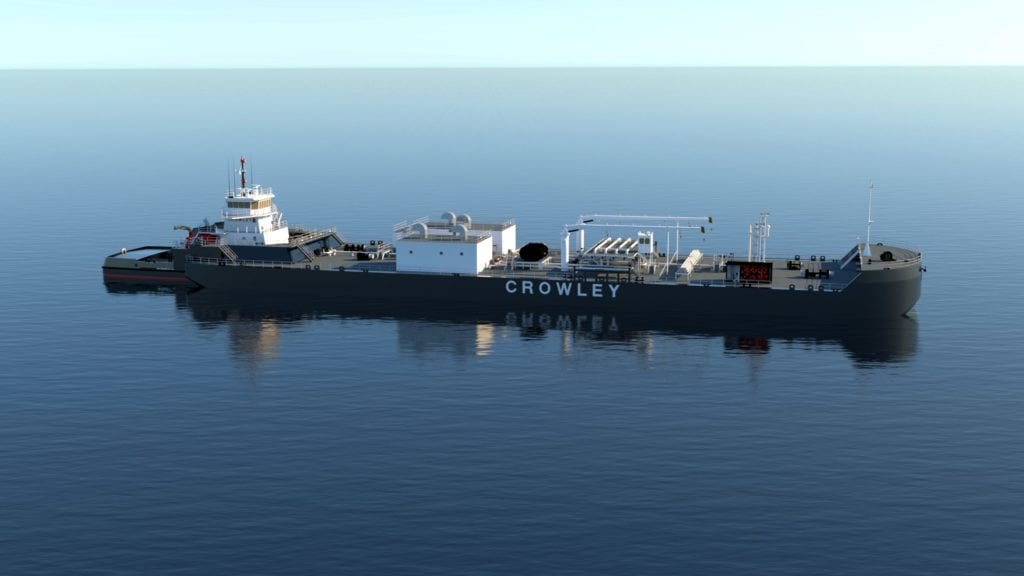
Crowley will provide transformational improvements and cost efficiencies through the utilization of the company’s new, purpose-built articulated tug-barge. Crowley
ANCHORAGE, Alaska — Crowley Solutions has been awarded the five-year contract to deliver military specification fuel to the Eareckson Air Station located on the remote Aleutian Island of Shemya, Alaska, the company said in a Feb. 1 release.
Under the U.S. Defense Logistics Agency-Energy contract, beginning in 2021, Crowley will provide lightering and transportation of 4 million gallons of fuel annually for the radar and aircraft refueling station and its 180 military, contractors and civilians who operate it.
Crowley has consistently transported and delivered the fuel since 1956 to the base 1,200 miles from Anchorage in the remote western reaches of the Aleutian Island archipelago. The U.S. government has counted on the company’s experience and innovative logistics capabilities in remote and austere environments, including a unique over-the-shore evolution successfully developed and executed by Crowley in 2020 as featured in this video. However, under the new contract term, Crowley will provide transformational improvements and cost efficiencies through the utilization of the company’s new, purpose-built articulated tug-barge (ATB) in a joint service by Solutions and Crowley Fuels, the company’s Alaska-based fuel transportation and distribution business unit.
The 55,000-barrel capacity (2.3 million-gallon) ATB Aurora/Qamun will serve the air station and Crowley’s customers throughout western Alaska and the Arctic. The 410-foot ATB is specifically designed to meet Ice Class and Polar Code requirements in order to safely and effectively operate in Western Alaska year-round.
“Crowley’s record of dependability and high performance will add a new chapter under this contract when Aurora/Qamun enters service to the government and military,” said Sean Thomas, vice president for Crowley Solutions. “It is an honor to continue serving our warfighters by safely providing value through a resilient and dependable supply chain whenever and wherever they need fuel.”
“We appreciate the confidence the government continues to show in Crowley,” said Rick Meidel, vice president and general manager, Crowley Fuels. “The new contract award reflects the proficiency and skill of the dedicated men and women of Crowley Fuels, and the strong collaboration by the Fuels and Solutions teams.”
The ATB, which was designed by Crowley Engineering Services powered by subsidiary Jensen Maritime, is undergoing its final outfitting prior to entering service this year. The tug is being constructed by Master Boat Builders of Bayou La Batre, Alabama. The barge is being built by Gunderson Marine LLC, a wholly owned subsidiary of the Greenbrier Companies Inc., in Portland, Oregon.
USS Philippine Sea Interdicts Over $2.8 Million of Heroin in North Arabian Sea
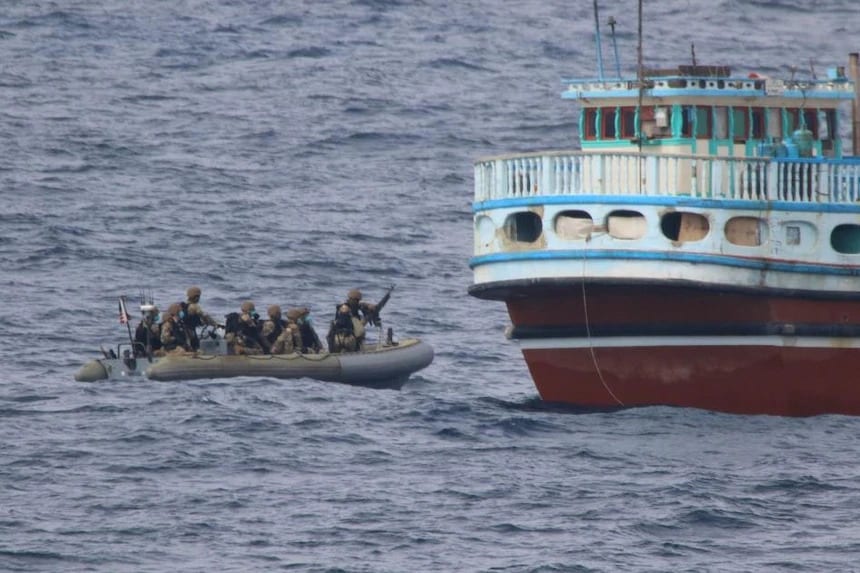
Sailors assigned to the visit, board, search and seizure Sailors team of the guided-missile cruiser USS Philippine Sea (CG 58) board a dhow suspected of carrying narcotics in the international waters of the north Arabian Sea, Jan. 31, 2021. U.S. Navy
BAHRAIN — The guided-missile cruiser USS Philippine Sea (CG 58), deployed to U.S. Fifth Fleet and operating in support of the Combined Maritime Forces (CMF), interdicted a shipment of more than 600 pounds (275 kilograms) of suspected narcotics from a dhow in the international waters of the North Arabian Sea, Jan. 30, the CMF said in a Feb. 2 release.
Seven bags of suspected narcotics were seized and tested, resulting in a seizure of approximately 600 pounds (275 kilograms) of suspected heroin, worth $2.89 million wholesale. This seizure, conducted in direct support of CMF’s Combined Task Force (CTF) 150, marks the seventh CMF drug seizure since October 2020.
To mitigate the risk of contracting and spreading COVID-19, the boarding team undertook carefully executed precautionary measures during and after the boarding, to include decontamination of all seized contraband.
CTF-150 conducts maritime security operations outside the Arabian Gulf to disrupt criminal and terrorist organizations, ensuring legitimate commercial shipping can transit the region, free from non-state threats. CTF-150 is currently commanded by the Royal Canadian Navy, now leading the task force for a fifth time.