CNO Releases Navigation Plan 2021

Chief of Naval Operations Adm. Mike Gilday, shown here at the Naval Postgraduate School in December, has released his Navigation Plan to the fleet. U.S. Navy / Javier Chagoya

WASHINGTON — Chief of Naval Operations (CNO) Adm. Mike Gilday announced the release of his Navigation Plan to the fleet during virtual remarks at the Surface Navy Association Symposium Jan. 11. 
 
“America is a maritime nation — our security and stability depend on the seas,” Gilday said. “The U.S. Navy is America’s away team, and alongside our allies and partners, we defend freedom, preserve economic prosperity, and keep the seas open and free. Today, we are engaged in a long-term competition. China and Russia are rapidly modernizing their militaries to challenge the international order that has benefited so many for so long. To defend our nation and interests around the globe, we must be prepared to flawlessly execute our Navy’s timeless roles of sea control and power projection. Joining with the Marine Corps and Coast Guard, we will generate decisive integrated all-domain naval power. There is no time to waste; our actions in this decade will set the maritime balance of power for the rest of the century.” 

This Navigation Plan nests under the recently-released Tri-Service Maritime Strategy and outlines how the U.S. Navy will grow its naval power to control the seas and project power across all domains, both now and in the future. It builds off the progress made under FRAGO and lays out what must be done this decade to deliver the naval power America needs to compete and win. This will be done by focusing on four key areas: 

  • SailorsDevelop a Seasoned Team of Naval Warriors 
    Objective: A dominant naval force that can outthink and outfight any adversary. Our Sailors will remain the best trained and educated force in the world. We will cultivate a culture of warfighting excellence rooted in our core values. 
  • Readiness: Deliver a More Ready Fleet 
    Objective: A Navy that is manned, trained, and equipped to deploy forward and win in day-to-day competition, in crisis, and in conflict. We will consistently deliver maintenance on-time and in full, refurbish our critical readiness infrastructure, master all-domain fleet operations, and exercise with like-minded navies to enhance our collective strength. 
  • Capabilities: Delivering a More Lethal, Better-Connected Fleet 
    Objective: A Navy capable of projecting synchronized lethal and non-lethal effects across all domains. We will deploy the Naval Operational Architecture by the middle of this decade; an array of counter-C5ISRT capabilities; weapons of increasing range and speed; and a directed-energy system capable of defeating anti-ship cruise missiles. 
  • CapacityDeliver a Larger, Hybrid Fleet 
    Objective: A larger, hybrid fleet of manned and unmanned platforms — under, on, and above the sea — that meets the strategic and operational demands of our force. We will deliver the Columbia-class program on time; incorporate unmanned systems into the fleet; expand our undersea advantage, and field the platforms necessary for Distributed Maritime Operations. 

“For 245 years, in both calm and rough waters, our Navy has stood the watch to protect the homeland, preserve freedom of the seas, and defend our way of life,” Gilday said. “The decisions and investments we make this decade will set the maritime balance of power for the rest of this century. We can accept nothing less than success. I am counting on you to take in all lines and get us where we need to go — and to do so at a flank bell.” 

To read CNO’s Navigation Plan in its entirety, click here

To download a one-page infographic, click here


Lockheed Martin Delivers HELIOS Laser Weapon System to Navy for Testing

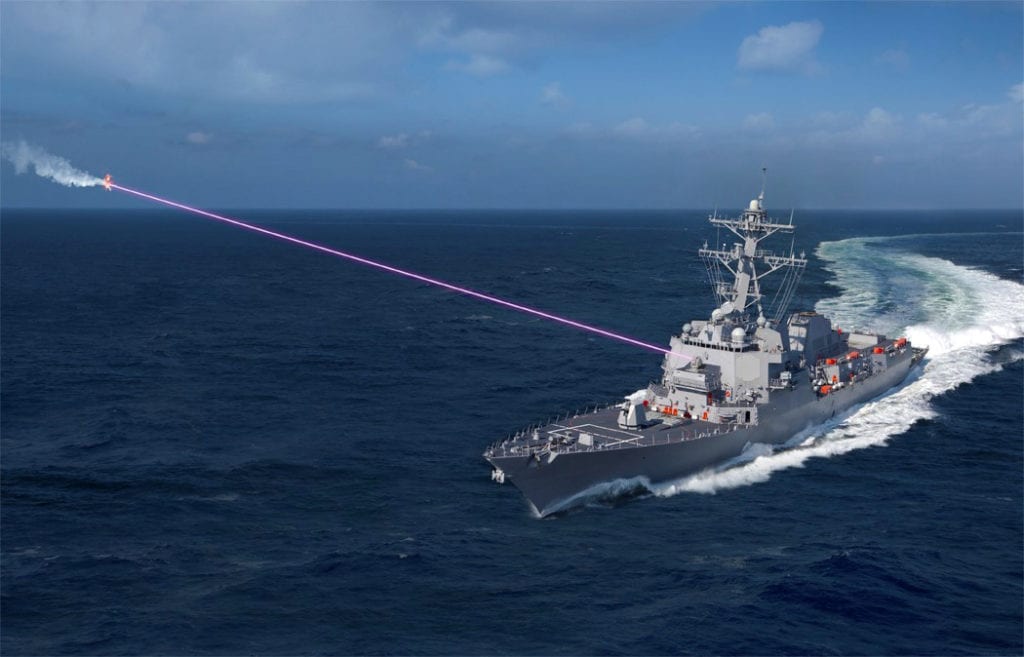
An artist’s rendering of Lockheed Martin’s HELIOS system. Lockheed Martin.

MOORESTOWN, N.J. — This year, the U.S. Navy will field the first acquisition program to deploy the High Energy Laser with Integrated Optical-dazzler and Surveillance, or HELIOS, a laser weapon system with high-energy fiber lasers for permanent fielding by the U.S. Department of Defense.

HELIOS will initially be integrated on a West Coast-based Flight IIA Arleigh Burke-class guided missile destroyer with the Aegis Combat System, but can be adapted to other types of ships and combat systems, says Lockheed Martin, which was awarded the HELIOS contract in 2018.

HELIOS is the first increment of the Surface Navy Laser Weapon System. The initial system features a laser of around 60 kilowatts to counter fast inshore attack craft or unmanned aircraft.

Increment two will boost the laser power to around 300 kilowatts, company business development analyst Kris Biggs said Jan. 13 in a presentation at the Surface Navy Association’s virtual annual conference, although he noted specifications haven’t been released to industry. Increment three will build off HELIOS “with an expected focus on even higher energy laser levels,” Biggs said.

Lockheed Martin completed the Critical Design Review and Navy Factory Qualification Test milestones for the system in 2020.  


New Pentagon Counter Drone Strategy: Unify Solutions Search, Avoid Duplicated Efforts

1st Lt. Taylor Barefoot, a low altitude air defense officer with Marine Medium Tiltrotor Squadron 163 (Reinforced), 11th Marine Expeditionary Unit, programs a counter-unmanned aircraft system on a Light Marine Air Defense Integrated System (LMADIS) during a predeployment training exercise at Marine Corps Air Ground Combat Center Twentynine Palms, Calif., Nov. 13, 2018. U.S. Marine Corps / Lance Cpl. Dalton S. Swanbeck

ARLINGTON, Va. — The Defense Department’s new strategy to thwart attacks and spying by small unmanned aircraft systems calls for protecting the force at home as well as overseas, while coordinating technology development across the services to avoid redundant programs that waste time and money.

In development since November 2019, when the Army was picked to unify counter-UAS efforts across the services, the strategy addresses both the potential threats from foreign adversaries and the hazards posed by reckless drone operators domestically.

The Army, Navy, Air Force and Marine Corps have all been developing systems to detect, deter, disable or destroy enemy drones. However, as the worldwide use and misuse of small, unmanned aircraft has grown exponentially, a coordinated effort to counter the risk — not only with technology but other solutions like doctrine, training and policy changes [ was needed, according to the report outlining the new strategy.

Most current solutions aim to sever the link between a remotely piloted drone and its operator, Army Major Gen. Sean Gainey, the director of the Pentagon’s Counter-UAS Office (JCO), told an online discussion of the new strategy Jan. 8 at the Center for Strategic and International Studies, Washington think tank.

“But where we see the threat going in the future,“ Gainey said, is toward “autonomous, massing swarming capability, [drones] integrating AI [artificial Intelligence] and potentially leveraging 5G” cell phone technology.   

The JCO will create integrated plans, technology, training concepts and doctrine that focus “appropriate resources on countering the UAS threat, while minimizing unnecessary duplication and redundancy,” said Gainey.

In addition to coordinating countermeasure steps across the U.S. military and with allies and partner nations, the Pentagon is also coordinating domestic efforts with the departments of Justice and Homeland Security, which includes the U.S. Coast Guard.

The widening use of small drones by non-state actors and terrorists has led some to call small UAS “the new IEDs” (improvised explosive devices).  Mindful of the expanding commercial use of small unmanned aircraft, Nicole M. Thomas, the JCO’s division chief for strategy and policy, noted “there are legitimate uses of drones,” although incompetent or deliberate misuse of a UAS could be a hazard.

Thomas said the JCO is completing details of the implementation plan, expected to be released by the end of January. “Those will all be action plans of things we’re going to do to make the strategy a reality,” she added.

In mid-January, the JCO will invite industry to demonstrate their “low collateral effectors,” non-lethal, low collateral damage capabilities, including jammers, at a common test range during the first week of April “and we’ll select the best ones, and move forward with that as the joint solution” Gainey said.


Raytheon to Deliver New Submarine Communications System

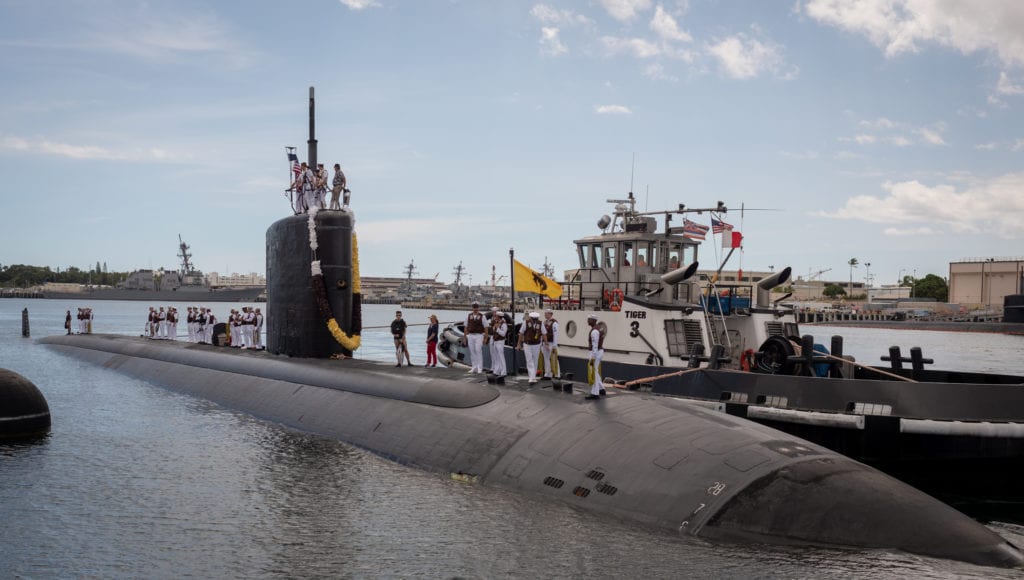
The Los Angeles-Class fast-attack submarine USS Cheyenne (SSN 773) and its crew arrive at Joint Base Pearl Harbor-Hickam, after completing their latest deployment, April 26, 2019. Raytheon Intelligence & Space has been awarded a $90 million contractor for Submarine High-Data Rate antenna systems. U.S. Navy / Mass Communication Specialist 1st Class Daniel Hinton

ARLINGTON, Va. — Raytheon Intelligence & Space, a Raytheon Technologies business, was awarded a $90 million contract by the U.S. Navy for 23 Submarine High-Data Rate antenna systems, the company said in a Jan. 11 release. Contracted in 2020, the work is expected to be completed on the new antennas by January 2024. 

The SubHDR system is used to provide submarines with high-capacity communications. The system vastly improves a submarine’s mission capability and the quality of life for sailors by affording them high-data rate communications with the world outside of the sub without sacrificing the submarine’s stealth. 

“Connecting people securely is essential to the success of any operation,” said Denis Donohue, vice president, Communications and Airspace Modernization Systems for Raytheon Intelligence & Space.

“The SubHDR system provides secure connectivity for submarines that supports mission-critical information delivery to the right people at the right time.” 

SubHDR links submariners to the Global Broadcast Service, the Milstar satellite constellation and the Defense Satellite Communications System, via a unique mast antenna that connects them to the above-sea world.  

The SubHDR System gives submarines high-data rate, multi-band SATCOM capability. Operating via military satellites, SubHDR enables underwater forces to be full participants in coordinated fleet battle group and joint task force network centric operations. The mast-mounted SATCOM system transmits secure wideband multimedia, secure and non-secure internet access, voice and data traffic, imagery and video teleconferencing. 


On First Voyage, USCGC Stone Crew Interdicts Narcotics in Caribbean

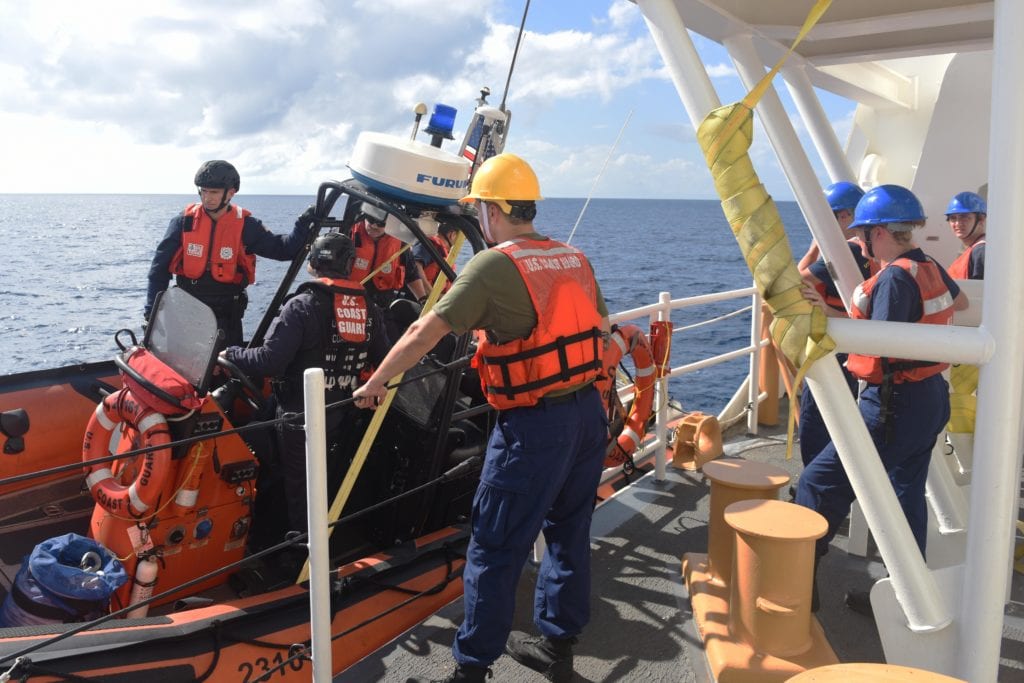
The crew on the USCGC Stone (WMSL 758) prepare to launch one of the ship’s small boats in the Caribbean Sea on Jan. 6, 2021. The Stone sent a boarding team on the boat to intercept a vessel suspected of engaging in illegal activity. U.S. Coast Guard / Petty Officer 3rd Class John Hightower

PORTSMOUTH, Va. — While in transit to conduct joint operations off the coast of Guyana as part of Operation Southern Cross, USCGC Stone (WMSL 758) encountered and interdicted a suspected narcotic trafficking vessel south of the Dominican Republic Jan. 7, the Coast Guard Atlantic Area said in a Jan. 11 release.   
   
Having stopped the illicit activity, Stone handed off the case to the USCGC Raymond Evans (WPC 1110), a fast response cutter from Key West, Florida, and continued its patrol south.  
   
Early on Jan. 7, acting on information from a maritime patrol aircraft, the Stone crew approached the vessel of interest and exercised U.S. Coast Guard authorities to stop their transit and interdict illicit maritime trade.  
   
The USCGC Raymond Evans arrived on the scene shortly after. A Coast Guard boarding team from the Raymond Evans conducted a law enforcement boarding, testing packages found aboard the vessel, revealing bales of cocaine estimated at 2,148.5 pounds (970 kilograms) total.  
 
Stone’s crew remained on scene during the search of the vessel to assist if need. Following the boarding, the Raymond Evans crew took possession of the contraband and detained the four suspected narcotics trafficking vessel members. They are working with the U.S. Coast Guard 7th District and Department of Justice on the next steps.  

“I’m very proud of the crew for completing this evolution safely and making an immediate impact on our first patrol,” said Capt. Adam Morrison, commanding officer of USCGC Stone (WMSL 758). “This case illustrates that Stone is a competent partner, and our crew is ready for the front-lines. We look forward to our upcoming engagements, first with Guyana.” 
   
Vice Adm. Steven Poulin, commander of U.S. Coast Guard Atlantic Area, said USCGC Stone “is a highly-capable multipurpose platform and ready to conduct missions to save lives, support lawful activities on the high seas, and highlight and build Coast Guard partnerships with other nations.

“I am not surprised that Stone interdicted drug smugglers – it is what the captain, crew, and every U.S. Coast Guard member is prepared to do every day underway.  Stone’s crew is exhibiting the highest professional competence, reinforcing that Stone is well-suited to help our partners in the South Atlantic expose and address illicit activities in the maritime domain. These transnational criminal activities – be it illegal fishing or the trafficking of people, drugs, money, etc.  – challenge global security, and only together can we combat these threats.” 

“Our teammates aboard USCGC Stone are helping keep our shared neighborhood, the Western Hemisphere, safe, successfully stopping illicit narcotics smuggling, while continuing their equally important mission to counter predatory and irresponsible IUU fishing, a growing threat to our partner nations’ sovereignty and our collective regional security,” said Rear Adm. Andrew J. Tiongson, director of operations, U.S. Southern Command. 

Operation Southern Cross is a multi-month deployment to the South Atlantic countering illegal, unregulated, and unreported fishing while strengthening relationships for maritime sovereignty and security throughout the region.  


Environmental Changes in the Arctic Seen Having Strategic Implications for US and Partner Nations

The crew of the Seawolf-class fast-attack submarine USS Connecticut (SSN 22) enjoys ice liberty after surfacing in the Arctic Circle during Ice Exercise (ICEX) 2020 in this May, 2020, photo. ICEX 2020 is a biennial submarine exercise which promotes interoperability between allies and partners to maintain operational readiness and regional stability, while improving capabilities to operate in the Arctic environment. U.S. Navy / Mass Communication Specialist 1st Class Michael B. Zingaro

A Jan. 6, 2021, report from the Congressional Research Service on changes in the Arctic says the diminishment of Arctic sea ice has led to increased human activities in the region and heightened interest in, and concerns about, the Arctic’s future.

Accessibility to the region has increased interest in tourism, mineral extraction, fishing and commerce.  An open Arctic means during some times of the year, ships can cut about 40% of the time it takes to pass from Asia to Europe, cutting time and costs to ship goods. The resurgence of Russia’s military, which has a significant presence in the Russian Arctic, and especially the growing numbers and quality of Russian submarines, means the region’s strategic importance has also increased.

And, of course, the scientific community wants to understand the environmental changes and all of the implications.

“Record low extents of Arctic sea ice over the past decade have focused scientific and policy attention on links to global climate change and projected ice-free seasons in the Arctic within decades,” the CRS report says. “These changes have potential consequences for weather in the United States, access to mineral and biological resources in the Arctic, the economies and cultures of peoples in the region, and national security.”

Broadly speaking, the report states physical changes in the Arctic include warming ocean, soil, and air temperatures; melting permafrost; shifting vegetation and animal abundances; and altered characteristics of Arctic cyclones. All these changes are expected to affect traditional livelihoods and cultures in the region and survival of polar bear and other animal populations, and raise risks of pollution, food supply, safety, cultural losses, and national security. Moreover, linkages (“teleconnections”) between warming Arctic conditions and extreme events in the mid-latitude continents are increasingly evident, identified in such extreme events as the heat waves and fires in Russia in 2010; severe winters in the eastern United States and Europe in 2009/2010 and in Europe in 2011/2012; and Indian summer monsoons and droughts. Hence, changing climate in the Arctic suggests important implications both locally and across the hemisphere.

Due to observed and projected climate change, scientists have concluded the Arctic will have changed from an ice-covered environment to a recurrent ice-free ocean (in summers) as soon as the late 2030s. The character of ice cover is expected to change as well, with the ice being thinner, more fragile, and more regionally variable. The variability in recent years of both ice quantity and location could be expected to continue.

While it will still be a cold and inhospitable place, these changes will appear to be a warm welcome to increased human activity. Concerns about these concerns are shared by America’s allies, including NATO.

Great power competition

In testimony before Congress, Chief of Naval Operations Adm. Mike Gilday said the Arctic “has become an emerging area of great power competition,” and the sea services are seeking to “better understand the Navy and Marine Corps’ role in protecting the Arctic homeland, safeguarding the Arctic region’s global commons.”

With the return of great power competition, the Department of Defense and the Coast Guard (part of the Department of Homeland Security) are devoting increased attention to the Arctic in their planning and operations, the CRS report noted. “DoD as a whole, as well as the Navy and Marine Corps, the Air Force, and the Coast Guard individually, have issued Arctic strategy documents in recent years, and the Army reportedly is planning to issue one.”

The newly released Navy-Marine Corps Arctic Strategy looks at the Arctic as part of the great power competition maneuver space. “Without sustained American naval presence and partnerships in the Arctic region, peace and prosperity will be increasingly challenged by Russia and China, whose interests and values differ dramatically from ours,” it says.

Navy Secretary Kenneth Braithwaite said the Navy remains committed to protecting the Arctic environment and ensuring naval forces do their part to help preserve it. The Navy, he said, will be “operating again in a more permanent manner above the Arctic Circle.”

The CRS report points to remarks made by Secretary of State Michael Pompeo from a May 2019 Arctic Council meeting where he praised international cooperation in the Arctic, but specifically called out Russia and China for their lack of transparency and self-serving activities.

“Just because the Artic is a place of wilderness does not mean it should become a place of lawlessness,” Pompeo said.

According to the report, some observers believe the U.S.-led international order in general may be eroding or collapsing, and the nature of the international order that could emerge in its wake is uncertain, with significant implications for the Arctic.

China’s growing activities in the Arctic may also reflect a view that as a major world power, China should, like other major world powers, be active in the polar regions for conducting research and other purposes.

Asserting sovereignty in the U.S. Arctic requires presence, and maritime presence requires ships. While The Coast Guard is building new multi-mission, heavy icebreakers called Polar Security Cutters, the Coast Guard currently has few ice-capable vessels, and the Navy has none.


Navy Envisions Containerized Weapon System to Arm Amphibious Ships

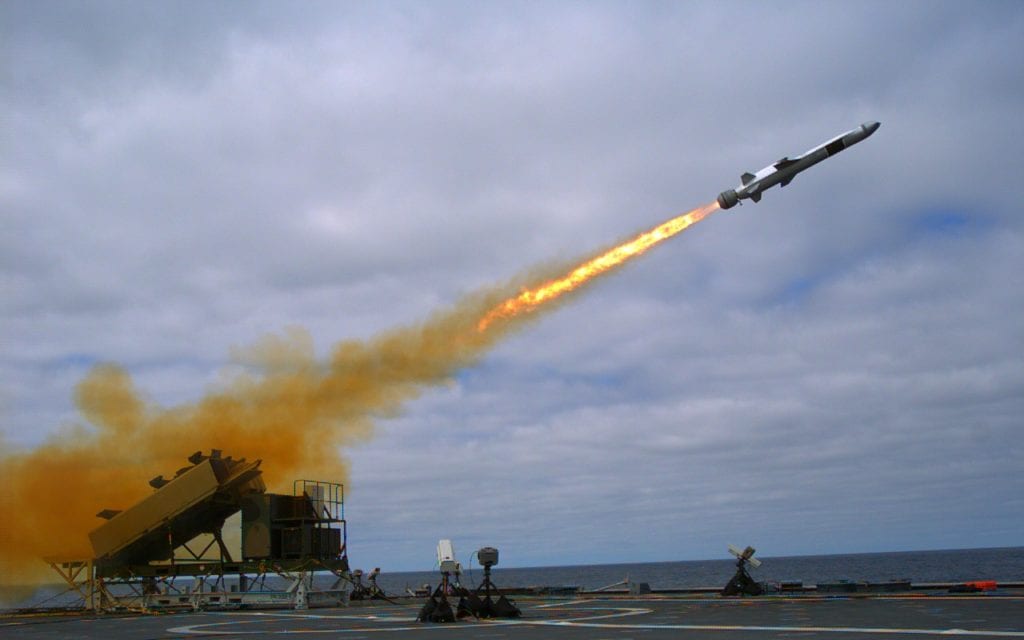
A Naval Strike Missile is launched from the littoral combat ship USS Coronado (LCS 4) during missile testing operations off the coast of Southern California in this 2014 photo. the NSM is a candidate to increase the lethality of U.S. Navy amphibious warfare ships. U.S. Navy / Mass Communication Specialist 2nd Class Zachary D. Bell

ARLINGTON, Va. — The U.S. Marine Corps general in charge of the U.S. Navy’s expeditionary warfare directorate said the Navy is looking at options to increase the lethality of its amphibious warfare ships with a containerized weapon system. A demonstration of this capability may occur after a year of development. 

Speaking to reporters on Jan. 8, MGen Tracy W. King, director of expeditionary warfare in the Office of the Chief of Naval Operations, did not specify which types of missile could or would arm an amphibious warfare [L-class] ship, but a leading candidate is the RGM-184 Naval Strike Missile (NSM) — built by a Raytheon-Kongsberg partnership, being installed on littoral combat ships and the Constellation-class guided-missile frigate. 

“We have these magnificent 600-foot-long, highly survivable, highly LPD 17s,” King said. “The LPDs need the ability to reach out and defend themselves and sink another ship. It’s not from the aspect of using them as a strike platform; it will drastically increase their survivability if the enemy has to honor that threat. My intent is to ensure that my desire to increase lethality of LPDs doesn’t interfere with [Director of Surface Warfare Rear Adm. Paul] Schlise’s efforts to increase lethality on LCSs.  

“We’re working with Raytheon and other partners to see if they can increase production to get it [the Naval Strike Missile] out there. I suspect what you will see in the next year that we will probably test-fire a system off of an L-class ship and let the fleet play around with it, build up the doctrine on how we will use it and to confirm or deny whether it is worth the expense, which we think it is. We need the operators to confirm that.” 

King said that Vice Adm. James W. Kilby, deputy chief of naval operations for warfighting requirements and capabilities, has him conducting a formal analysis and running some excursions on what the war games would tell us about lethality, and survivability and would the enemy actually honor it. He would than show empirical data to the fleet commanders. 

“It’s a legitimate concern [about] putting these very rare systems on an L-class ship instead of another kind of warship,” King said. “We’re going to do it cautiously. My prediction is that we will have one within the next 12 months. We will let the fleet play around with it probably a year or so and then decide how we’re going to field it.” 

King said a likely solution is a containerized weapon system that the Marine Corps will be using. 

“When we jump on aboard a ship, that [weapon system] becomes available to the ship’s captain,” he said. “So maybe we don’t need to install launchers and NSMs. Maybe the Marine Corps EABO [Expeditionary Advance Base Operations] forces serve as the main battery when we are moving out. To me that just makes sense. We give the latitude and flexibility to the ship’s captain to use those assets when he needs to.” 

King acknowledged the concern of some in the Marine Corps that the missiles could be expended in combat at sea before the Marines reach their destination. 

“I am a little bit dismissive of that complaint because the ship’s got to get there first,” he said. “So, I think you’re going to see us deploying containerized weapon systems that we can use wherever we want to use them.” 


CAE USA Awarded Navy Contract to Provide T-44C Aircrew Training Services

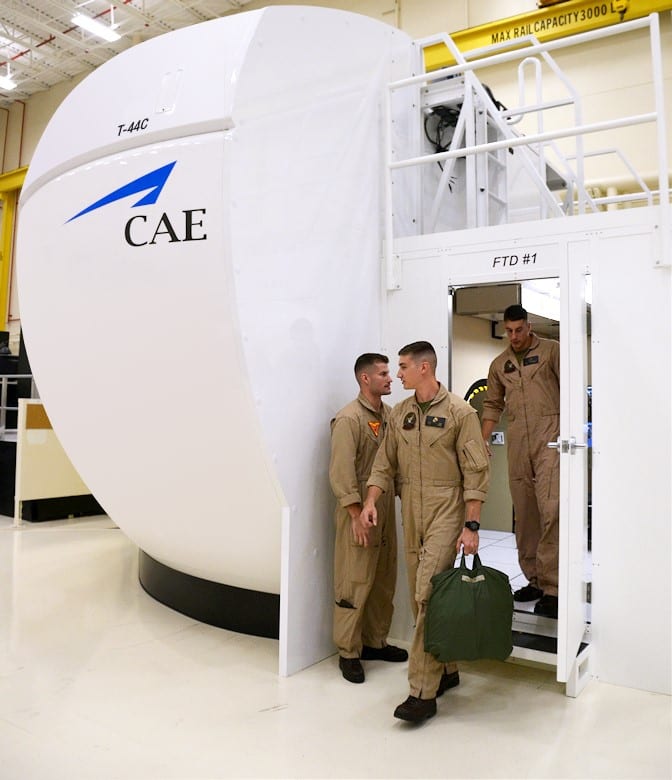
CAE USA will continue providing T-44C aircrew training to the U.S. Navy at NAS Corpus Christi, Texas. CAE USA

TAMPA, Fla. — CAE USA has been awarded a U.S. Navy contract to continue providing comprehensive T-44C Pegasus aircrew training services at Naval Air Station (NAS) Corpus Christi in Texas, the company said in Jan. 7 release. 

Awarded as a base one-year contract with additional one-year options through mid-2027, the contract is valued at more than $70 million. CAE USA provides T-44C aircrew training services to the Chief of Naval Air Training (CNATRA) under a contractor-owned, contractor-operated training program.  The T-44C is the Navy’s variant of the King Air aircraft used for intermediate and advanced multi-engine pilot training. 

“We started delivering T-44C aircrew training to the Navy in 2013 and are honored the Navy has selected CAE USA to continue providing the essential training services for CNATRA’s multi-engine training pipeline,” said Ray Duquette, president and general manager, CAE USA. 

CAE USA provides qualified instructors who deliver all the required T-44C classroom and simulator training at NAS Corpus Christi. CAE owns, operates and maintains a suite of T-44C training devices that are used extensively as part of the T-44C training syllabus. CAE is also introducing new virtual reality trainers based on the Microsoft HoloLens that will be used for T-44C familiarization and procedural training tasks. This will enable more student throughput by freeing the T-44C training devices and aircraft for more advanced training. In total, more than 400 U.S. Navy, Marine Corps, and international students train annually on the T-44C at NAS Corpus Christi. 

“The Navy T-44C aircrew training program is a great example of how CAE partners with our military customers to introduce digital innovations such as virtual reality technologies that help contribute to more efficient and effective training,” said Dan Gelston, group president, Defense & Security, CAE. 

The T-44C aircrew training program falls under the responsibility of CNATRA, which oversees the Naval Air Training Command and the training of all naval aviators and naval flight officers. 


Halter Marine Upgrades Launch Way in preparation for Polar Security Cutter

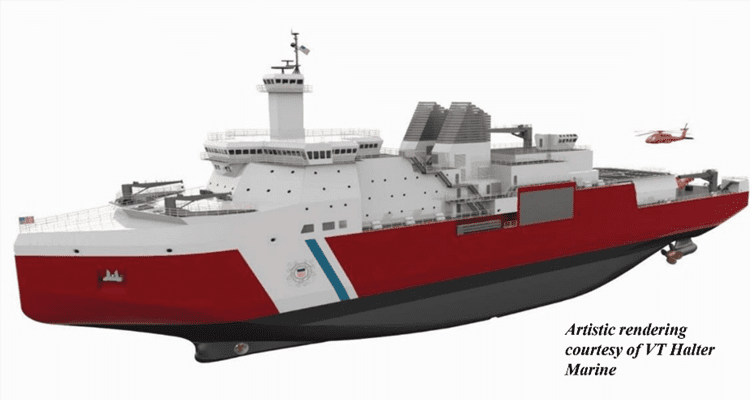
A rendering of the U.S. Coast Guard’s forthcoming Polar Security Cutter. U.S. Coast Guard

PASCAGOULA, Miss. — The U.S Coast Guard’s Polar Security Cutter (PSC) is rapidly progressing through the detailed design phase, and Halter Marine is actively preparing for its construction, the company said in a Jan. 6 release.  

In July 2021, Halter Marine will complete upgrades to the launch way area where the PSC will be constructed. The 460-foot icebreaker is the heaviest vessel per foot of length that Halter Marine has constructed at its Pascagoula, Mississippi, shipyard. The launch way has been fortified to accommodate the PSC’s 19,000-ton launch weight.  

The Crowley Taino and El Coqui were the heaviest vessels previously to launch from the company’s dock. These two vessels are 720 feet in length, providing a greater distance to leverage their weight. 

“Based on weight per foot, the PSC outweighs those vessels,” said Bob Merchent, president and CEO of Halter Marine. “The PSC needs 22 tons of capacity per linear foot of rail line, and we have designed the new launch way to accommodate 27 tons per linear foot. We are preparing for our newest vessel while also looking forward to future, larger vessels.”  

The upgrade project began in July by removing 11 launch way rail lines. Next, crews dug 1,283 holes that were filled with grout and concrete to serve as new piles. These piles will transfer the PSC’s heavy load to a deeper level than previously possible.  

“Each drilled hole is 110 feet long, and we are pouring 27 miles of piles,” said Kevin Amis, executive vice president of operations for Halter Marine. “We are completing this project with a perfect safety record. I’m proud of the women and men at Halter Marine and Malouf Construction for accomplishing this invaluable project with a true focus on safety.”  

The launch way upgrade project is funded with a generous grant from the Mississippi Development Authority (MDA).  

“We appreciate the continued support of the MDA along with our federal, state and local officials,” Merchent said. “We are thankful for that, and we are all proud to support the men and women of the U.S. Coast Guard by providing them with better capabilities to operate in the Arctic.” 


France to Procure E-2D Advanced Hawkeye Aircraft from U.S. Navy

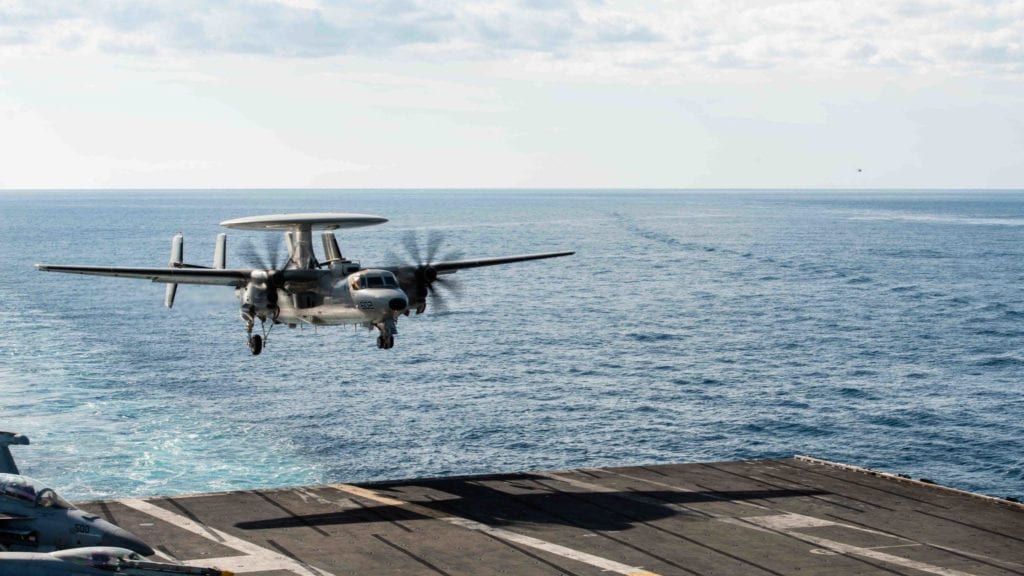
In December, France signed a Letter of Offer and Acceptance to procure three E-2D Advanced Hawkeye aircraft from the U.S. Navy like the one pictured in this October, 2020 photo. U.S. Navy

PATUXENT RIVER, Md.—France became the second international customer of the E-2D Advanced Hawkeye (AHE), Dec. 2, with a signed Letter of Offer and Acceptance to procure three E-2D aircraft from the U.S. Navy, for a maximum value of $2 billion, Naval Air Systems Command said in a Jan. 5 release. 

“The E-2/C-2 program office is looking forward to continuing a longstanding partnership with France and beginning a new chapter with the E-2D,” said Capt. Pete Arrobio, program manager of the E-2/C-2 Airborne Command & Control Systems Program Office (PMA-231). “This procurement will increase interoperability among the U.S. Fleet and international partners.” 

The three E-2Ds are scheduled to be delivered by 2028 and will replace the three existing E-2C Hawkeyes of the French navy, Marine Nationale. 

The E-2D AHE, produced by Northrop Grumman, represents a two-generation leap in technology compared to its predecessor, the E-2C Hawkeye. The aircraft features a state-of-the-art radar and upgraded aircraft systems that improve supportability and increase readiness. The centerpiece of the E-2D AHE is the APY-9 radar system, designed specifically to provide enhanced surveillance detection and tracking capability against advanced threat aircraft and cruise missile systems in the overland, littoral, and open ocean environments. With the addition of aerial refueling capabilities, the E-2D remains the most advanced command and control platform in the world. 

The French navy becomes the second international customer of the E-2D Advanced Hawkeye. The Japan Air Self Defense Force has purchased 13 E-2D aircraft to date.