Boeing Delivers 100th P-8A Poseidon Built for the U.S. Navy
The 100th P-8A Poseidon built for the U.S. Navy departs. Boeing Co.
SEATTLE — The U.S. Navy received its 100th P-8A aircraft from Boeing on May 14 as the global fleet, which also includes the Indian navy and the Australian and U.K. air forces, approaches 300,000 flight hours of hunting submarines and providing aerial reconnaissance capabilities around the world, the company said in a release.
“We’re honored by the Navy’s faith and confidence in our employees and the P-8 system,” said Stu Voboril, vice president and program manager. “Our focus has been, and will be, on delivering the world’s best maritime patrol aircraft, bar none.”
The P-8 is a long-range multimission maritime patrol aircraft capable of broad-area, maritime and coastal operations. A military derivative of the Boeing 737 next-generation airplane, the P-8 combines performance and reliability with an advanced mission system that ensures maximum interoperability in the battle space.
This is the 94th mission-capable airplane to enter the Navy fleet, with six additional jets used as engineering manufacturing development test aircraft. The 100th fully operational delivery is scheduled for later this year. Boeing has also delivered 12 jets to the Royal Australian Air Force, two to the U.K.’s Royal Air Force and eight P-8Is to the Indian navy. Multiple U.S. Navy squadrons have deployed with the P-8A Poseidon, and the Indian navy and Royal Australian Air Force are conducting missions with the P-8 as well.
Navy Awards Boeing $3.1 Billion for Harpoon, SLAM-ER Missile Systems
Harpoon Block II features an autonomous, all-weather, over-the-horizon strike capability for both anti-ship and land-strike missions. These weapons can be launched from aircraft, ships, subs or by mobile coastal defense vehicles. Boeing
ARLINGTON, Va. — The U.S. Navy has awarded Boeing two contracts totaling $3.1 billion for Harpoon and Standoff Land-Attack Missile-Expanded Response (SLAM ER) cruise missile systems, weapon systems in support of foreign military sales (FMS) to seven U.S. allies and partners.
Naval Air Systems Command (NAVAIR) awarded a $1.97 billion firm-fixed-price contract to provide nonrecurring engineering for obsolescence redesign of the SLAM-ER plus the production and delivery of 650 SLAM-ER missiles for Saudi Arabia, the Defense Department said in a release. Work is expected to be complete by December 2028.
Boeing last delivered the SLAM-ER weapon system in 2008, the company said in a release.
NAVAIR also awarded to Boeing a $657 million firm-fixed-price contract modification for the procurement and delivery of 467 Harpoon full-rate production Lot 91 Block II missiles and support equipment. The order includes 402 Block II missiles and support equipment for Saudi Arabia; 53 Block II missiles and support equipment for Qatar; eight Block II missiles and support equipment for the government of Thailand; four Block II missiles and support equipment for the government of Brazil; and support equipment for Japan, the Netherlands, India and Korea, the Pentagon said. Work is expected to be complete by December 2026.
“We are pleased to continue our long legacy of partnering with the Navy to build weapons that defend America and its international partners,” said Cindy Gruensfelder, vice president of Boeing Weapons said. “These awards will not only extend production of the Harpoon program through 2026, they will also restart the production line for SLAM-ER and ensure deliveries through 2028.”
Boeing said it began in October to build a new 35,000-square-foot manufacturing facility “to support increased production for the Harpoon and SLAM ER programs.”
Construction of the new facility is expected to be complete next year.
Navy Establishes 6 More Tech Bridge Collaborations
James F. Geurts (center), assistant secretary of the Navy for research, development and acquisition (ASN RDA), shown here in 2019 announcing the Department of Navy’s plan to rapidly expand its collaboration capabilities through the creation of Tech Bridges. U.S. NAVY / Bobby Cummings
ARLINGTON, Va. — The Navy secretariat has doubled the number of Naval-X “Tech Bridge” sites on its network of collaborative alliances, the Navy’s top acquisition and research official announced.
James F. Geurts, assistant secretary of the Navy for research, development and acquisition, said in a May 12 video conference with reporters that the six tech bridge sites established last year have been beneficial to the Navy and Marine Corps, and he is doubling the number of tech bridges that will foster the collaboration of the Navy Department with industry, academia, scientific laboratories, and other organizations and individuals in developing technical solutions.
“There are a lot of great activities going across the Navy and Marine Corps team, but we wanted an easy way to connect everybody up so we could accelerate our learning, better connect folks with ideas to solutions and folks with solutions to the folks that could put those into use,” Geurts said. “Our focus continues to be how do we support Sailors and Marines down-range, how do we increase our speed, how do we learn from each other and [reach] network-type speed as opposed to individual speed.”
Geurts said the Navy Department did its best year ever in fiscal 2019 of “putting dollars on contract,” including the largest total small business awards, $16 billion, or 18% of the awards, and is engaging with small businesses to get five times the speed and 10 times the number of performers.
“Think of this Naval-X Tech Bridge as this underlying network, which facilitates all that,” he said. “It’s not an activity unto itself as much as connecting everybody together so that we can speed discovery all the way through deployment and focus on all phases of support, not just early R&D [research and development] but all the way through sustainment.”
“What we have seen in the last nine months is $45 million obligated through programs that were identified through the tech bridges through existing programs, largely through SBIR [Small Business Innovation Research program] as well as a lot of rapid prototyping authorities used through ONR [Office of Naval Research],” said Cmdr. Sam Gray, Tech Bridge director, also speaking at the teleconference.
“Additionally, we were able to leverage the tech bridge network [in the current pandemic] in just a month focused on COVID efforts,” Gray said. “Tech Bridge has met on a daily and then weekly basis to connect all the teams together to find out how people were using their manufacturing capability, how were they able to get things on contract, how they were able to work with FEMA [Federal Emergency Management Agency] representatives to get things approved for medical use.”
The six new tech bridges are:
Central Coast, centered at the Naval Postgraduate School (NPS), Monterey, California. Its focus is to connect faculty and students to provide a variety of potential partners across all applied warfighting domains, with particular focus on cyber, space and oceanographic capabilities. The NPS has cleared airspace for unmanned aerial systems testing.
Inland Empire, centered on Naval Surface Warfare Center Corona, California. Its focus is on data analytics and visualization; networks and data environments, including live virtual constructive training environment; and measurement technology.
Ventura, with the Naval Surface Warfare Center Port Hueneme Division, Naval Air Station Point Mugu, and San Nicholas Island, all in Ventura County, California. It focuses on unmanned system development, additive manufacturing, advanced material characterization and testing, and soon to include a mixed-reality environment.
Southern Maryland, centered on Naval Air Warfare Center Aircraft Division at Naval Air Station Patuxent River, Maryland, along with the Naval Surface Warfare Center in Indianhead, Maryland. It focuses on unmanned aviation, autonomous systems, modeling and simulation, and live virtual constructive environments.
Mid-Atlantic, centered on commander, U.S. 2nd Fleet, in Norfolk, Virginia, with the Naval Information Warfare Center Hampton Roads and two Naval Surface Warfare Center detachments. Its focus is on tying the fleet to the larger Tech Bridge network, with emphasis on cyber, unmanned systems, robotics, artificial intelligence, machine learning, advanced communications and command and control, additive manufacturing.
National Capital Region, centered on Naval Surface Warfare Center Carderock Division, Maryland, teamed with Naval Surface Warfare Center Dahlgren, Virginia and Indian EOD Technology Division, and the Marine Corps Warfighting Laboratory, Quantico, Virginia. Their focus is on data-driven decision making.
CNO Gilday Self-Quarantines as COVID-19 Precaution
CNO Adm. Mike Gilday (center), acting Navy Secretary James McPherson (right) and Master Chief Petty Officer of the Navy Russell Smith (left) visited Recruit Training Command in Great Lakes, Illinois, on May 7 to observe operations during the COVID-19 pandemic. U.S. Navy/Communication Specialist 1st Class Spencer Fling
ARLINGTON, Va. — The Navy’s top officer has self-quarantined himself after coming in contact with a family member who tested positive for COVID-19, the Defense Department announced.
Chief of Naval Operations Adm. Michael Gilday “had contact with a COVID-positive family member and, although testing negative, will be quarantining this week,” U.S. Army Lt. Col. Chris Mitchell, a Defense Department spokesman, said on May 11.
Gilday is personally following guidance he issued to the Navy as a whole on May 6: “Each of us must continue to practice and follow all public health measures necessary to minimize risk to our force and our families. Take responsibility. Show courage in speaking up if you see shipmates falling short. We have obligations for operational readiness and stringent requirements for health protection measures.”
Below are more excerpts from the CNO’s May 6 message to the fleet:
“Each of us must continue to practice and follow all public health measures necessary to minimize risk to our force and our families.”
Gilday, in May 6 guidance to the fleet
“As we continue to learn about this virus and how to mitigate its risk, the widespread public health measures you are actively practicing — physical distancing, face coverings, minimizing group events, frequent hand-washing, sound sanitation practices, a questioning attitude on how we are feeling — must be our new normal. We must harden our Navy by continuing to focus on the health and safety of our forces and our families. The health and safety of our Sailors and their families is, and must continue to be, our No. 1 priority. Fleet operations depend on it.
“As the forward deployed force of our country, we have a duty to ensure we are ready to respond. We cannot simply take a knee or keep everyone in port until this enemy is defeated. We are America’s away team. The uncertainty caused by COVID-19 makes our mission of protecting America at sea more important than ever. That is why the U.S. Navy continues to operate forward every day.”
“When we entered this pandemic, we quickly closed down services to minimize interactions and the spread of the disease. We will need to take a measured approach to opening up these services to prevent a recurrence of the disease.
“I expect local commanders to understand area conditions and to communicate prudent expectations and guidance up and down the chain of command. I trust our Sailors to follow these guidelines.”
Special Correspondent John M. Doyle contributed to this report.
Submarine USS Boise Set for Long-Delayed Overhaul
The Los Angeles-class attack submarine USS Boise enters Souda Bay, Greece, during a scheduled port visit in 2014. U.S. Navy/Mass Communication Specialist 2nd Class Jeffrey M. Richardson
ARLINGTON, Va. — The attack submarine USS Boise has arrived at Huntington Ingalls Industries’ Newport News Shipbuilding division in Newport News, Virginia, to prepare for its long-delayed overhaul, Naval Sea Systems Command said in a May 8 release.
The Boise was shifted from Naval Station Norfolk, Virginia, “to begin pre-maintenance ‘smart start’ activities in preparation for the submarine’s engineered overhaul (EOH),” Bill Couch, a NAVSEA spokesman, said in the release.
“An EOH is a major multiyear overhaul near the midpoint of a submarine’s service life to perform necessary repairs, maintenance and modernization, to certify the submarine for unrestricted operations and to ensure the submarine is operating at full technical capacity and mission capability,” Couch said.
The Los Angeles-class attack submarine had been scheduled for an overhaul in 2013, but the work was delayed because of the work backlog at the Navy’s four shipyards that are certified to overhaul nuclear-powered vessels, the Government Accountability Office said in a November 2018 report.
The Boise completed its most recent deployment in 2015 and had been tied up at Naval Station Norfolk since. It was no longer able to conduct operations by mid-2016 and lost its dive certification in February 2017. The backlog led the Navy to award, in October 2017, a contract to Newport News Shipbuilding, one of two U.S. submarine builders, to overhaul nuclear-powered submarines in addition to its normal work of building submarines.
The delays in depot-level maintenance cause not only backlogs in the work itself but result in loss of hundreds or even thousands of days in service and reduced availability of attack subs for deployments in support of the requirements of combatant commanders.
SECNAV Nominee Commits to Advancing Navy’s Arctic Presence
Kenneth J. Braithwaite, U.S. ambassador to Norway and the nominee to become the next Navy secretary, in 2018. During his Senate Armed Services Committee confirmation hearing on May 7, Braithwaite spoke of the importance of the U.S. foothold in the Arctic to counter “Great Power Competitors” China and Russia. U.S Navy/Mass Communication Specialist 1st Class Theron J. Godbold
WASHINGTON — The nominee to become the next Navy secretary spoke at his confirmation hearing on May 7 of the Arctic’s importance to national defense and international commerce and of rising Chinese efforts to influence the region. He also committed his advocacy to increasing U.S. Navy presence in the region to counter both “Great Power Competitors” China and Russia.
“The Chinese and the Russians are everywhere, especially the Chinese,” Kenneth J. Braithwaite, the current U.S. ambassador to Norway and nominee to become the 77th Navy secretary, said during his confirmation hearing before the Senate Armed Services Committee.
“You would be alarmed at the amount of Chinese activity off the coast of Norway in the high north. We need to be vigilant to that to understand why.”
As a former Navy P-3 patrol plane commander who operated from the Aleutian Islands and as ambassador to Norway, NATO’s gatekeeper to the North Atlantic, Braithwaite is no novice to the region and its growing importance.
“Russia’s hope is to be relevant again on the world stage, where we all come to understand that China wants to be dominant on that same world stage,” Braithwaite said. “They have really pressed hard on Norway to be part of that calculus.”
He pointed out that the cost of commerce from China to European markets would be cut by half if goods were transported by the Northern Sea Route across the top of Russia to Kirkenes, the northernmost Norwegian port.
“China has launched a charm campaign to try to win Norway over,” Braithwaite said. “After in 2010 trying to force them to withdraw the Nobel Peace Prize to a Chinese dissident, Liu Xiaobo, the Norwegians stood up to the Chinese and [the Norwegians] suffered for that economically. But China now recognizes the importance of Kirkenes [and] securing a terminus on the Northern Sea Route, and they are up there trying to win over the people of northern Norway.”
Braithwaite said the U.S. Navy is at the vanguard countering Chinese hegemony in the Arctic, saying the Navy “provides some of the only capabilities to be able to do power projection in that part of the world.”
He noted the current presence of three Navy destroyers operating the Barents Sea along with ships of the U.K. Royal Navy and the Royal Norwegian Navy.
Braithwaite also told Sen. Dan Sullivan (R-Alaska) that he would be a strong advocate for a strategic Arctic port large enough to handle destroyers and icebreakers. The nearest such port is Anchorage, Alaska, which is 1,500 miles from the Arctic Circle, Sullivan added.
“The great news is the United States Navy has been up there for many, many years,” Braithwaite said. “You may not see them, but they’re up there. As it begins to become more navigable on the surface, we also need to make sure that our presence is noted.”
“We continue to need to be vigilant,” he added. “We continue to need to be present. That requires an adequate-size Navy to be there.”
“It will be a priority of mine.”
‘Culture Trumps Everything,’ SECNAV Nominee Says
Sailors assigned to the USS Theodore Roosevelt return on May 2 after the ship was cleaned following an outbreak of COVID-19 that infected hundreds of crew, hospitalized some and killed one Sailor. Navy Secretary nominee Kenneth J. Braithwaite on May 7 cited the Roosevelt crisis as a failing of Navy leadership. U.S. Navy/Mass Communication Specialist Seaman Alexander Williams/Released)
WASHINGTON — The nominee to be the next Navy secretary said the sea service needs a course correction to restore the culture of leadership and accountability that has suffered in recent controversies, saying that “culture trumps everything.”
“It saddens me to say: the Department of the Navy is in troubled waters due to many factors, primarily the failure of leadership,” Kenneth J. Braithwaite, the U.S. ambassador to Norway and the president’s nominee to be the 77th Navy secretary, said during testimony May 7 at his confirmation hearing before the Senate Armed Services Committee.
Braithwaite said failings over the past few years — such as the “Fat Leonard” scandal, the fatal at-sea collisions in 2017, recent judicial missteps and the COVID-19 crisis aboard the USS Theodore Roosevelt — were “indicative of a breakdown in the trust of those leading the service.”
Lessons he said he took from his earlier experience as a naval aviator that the Navy Department is “resilient” and that “it all starts with culture.”
“Successful organizations have a strong culture, which always starts with leadership,” he said. “Culture is one thing that creates for an organization a sense of belonging, a sense of good order and discipline.”
“It is my No. 1 priority, if I’m confirmed, to restore the appropriate culture in the United States Navy,” Braithwaite said. “A culture exists; I won’t say it’s been broken; I think it’s been tarnished.”
He stressed the importance of empowering people up and done the chain of command and that he would not intervene in the chain of command.
Burke Leads List as Navy Resumes Flag Officer Announcements
Vice Chief of Naval Operations Adm. Robert Burke at an event in New York City in September. Burke is set for reappointment to admiral and assignment as commander, U.S. Naval Forces Europe and U.S. Naval Forces Africa, among other duties. Vice Adm. William K. Lescher has been tapped to rise to admiral and as Burke’s successor as VCNO. U.S. Navy/Mass Communication Specialist 1st Class Sarah Villegas
ARLINGTON, Va. — The Defense Department has announced some Navy flag officer nominations, resuming a practice that had been suspended for about a year for cybersecurity reasons.
Such lists of names are routinely provided to Congress, but their public announcement had been suspended by previous Chief of Naval Operations Adm. John M. Richardson. A reversion to a previous policy was made evident May 6 when Defense Secretary Mark Esper made some announcements of senior Navy officer reassignments.
Current CNO Adm. Mike Gilday reportedly made the decision to resume announcements is response to a query from Sen. Elizabeth Warren (D-Mass). The Marine Corps had been making at least some announcements in the interim.
These Navy officers have been nominated to their respective positions:
Adm. Robert P. Burke for reappointment to the rank of admiral and assignment as commander, U.S. Naval Forces Europe; commander, U.S. Naval Forces Africa; and commander, Allied Joint Forces Command, Naples, Italy. Burke serves as vice chief of naval operations, directly under Gilday.
Vice Adm. William K. Lescher for appointment to the rank of admiral and assignment as the new vice CNO, succeeding Burke. Lescher is serving as deputy chief of naval operations for integration of capabilities and resources (N8), Office of the Chief of Naval Operations, Washington, D.C.
Vice Adm. Lisa M. Franchetti for reappointment to the rank of vice admiral and assignment as deputy chief of naval operations for warfighting development, N7, Office of the Chief of Naval Operations, Washington, D.C. Franchetti is commander of the 6th Fleet. She is also commander, Task Force 6; Striking and Support Forces NATO, deputy commander; U.S. Naval Forces Europe, deputy commander; U.S. Naval Forces Africa, and Joint Force Maritime Component commander Europe, Naples, Italy.
Rear Adm. Eugene H. Black III for appointment to the rank of vice admiral and assignment as commander, 6th Fleet; commander, Task Force 6; commander, Striking and Support Forces NATO; deputy commander, U.S. Naval Forces Europe; deputy commander, U.S. Naval Forces Africa; and Joint Force Maritime Component commander Europe, Naples, Italy. Black is serving as director, Surface Warfare Division, N96, Office of the Chief of Naval Operations, Washington, D.C.
Rear Adm. Randy B. Crites for appointment to the rank of vice admiral and assignment as deputy chief of naval operations for integration of capabilities and resources (N8), Office of the Chief of Naval Operations, Washington, D.C. Crites is serving as deputy assistant secretary of the Navy for budget (FMB), and director, Fiscal Management Division (N82), Office of the Chief of Naval Operations, Washington, D.C.
Rear Adm. Yancy B. Lindsey for appointment to the rank of vice admiral and assignment as commander, Navy Installations Command, Washington, D.C. Lindsey is serving as commander, Navy Region Europe, Africa, Southwest Asia; and commander, Maritime Air Forces, Naples, Italy.
Rear Adm. Kenneth R. Whitesell for appointment to the rank of vice admiral and assignment as commander, Naval Air Forces; and commander, Naval Air Force, U.S. Pacific Fleet, San Diego. Whitesell is serving as deputy commander, U.S. Pacific Fleet, in Pearl Harbor, Hawaii.
Reserve Rear Adm. John B. Mustin for appointment to the rank of vice admiral and assignment as chief of Navy Reserve, Washington, D.C. Mustin is serving as commander, Expeditionary Strike Group 2, Norfolk, Virginia.
Rear Adm. (lower half) Stephen D. Barnett is serving as commander, Navy Region Northwest, Silverdale, Washington. Barnett previously served as deputy commander, Navy Installations Command, Washington, D.C.
Rear Adm. (lower half) Christopher S. Gray will be assigned as commander, Navy Region Europe, Africa, Central; and as commander, Maritime Air Forces, Naples, Italy. Gray previously served as commander, Navy Region Northwest, Silverdale.
Rear Adm. (lower half) John E. Gumbleton is serving as deputy assistant secretary of the Navy for budget (FMB); and director, Fiscal Management Division, N82, Office of the Chief of Naval Operations, Washington, D.C. Gumbleton previously served as commander, Expeditionary Strike Group 3, San Diego.
Rear Adm. (lower half) Brendan R. McLane will be assigned as commander, Carrier Strike Group 10, Norfolk. McLane previously served as commander, Navy Recruiting Command, Millington, Tennessee.
Rear Adm. (lower half) Paul J. Schlise will be assigned as director, Surface Warfare Division, N96, Office of the Chief of Naval Operations, Washington, D.C. Schlise is serving as commander, Carrier Strike Group 10, Norfolk.
Rear Adm. (lower half) Philip E. Sobeck is serving as commander, Expeditionary Strike Group 3, San Diego. Sobeck previously served as director, 21st Century Sailor Office, N17, Office of the Chief of Naval Operations, Arlington, Virginia.
Rear Adm. (lower half) Dennis Velez is serving as commander, Navy Recruiting Command, Millington. Velez previously served as senior military assistant, Office of the Secretary of the Navy, Washington, D.C.
Capt. Putnam H. Browne, selected for promotion to rear admiral (lower half), is serving as director, 21st Century Sailor Office, N17, Office of the Chief of Naval Operations, Arlington. Browne previously served as executive assistant to the assistant secretary of the Navy for manpower and reserve affairs, Washington, D.C.
These Marine officers have been nominated to their respective positions:
Lt. Gen. Lewis A. Craparotta, for appointment to the rank of lieutenant general and assignment as commanding general, Training and Education Command. Craparotta is serving as the commander, U.S. Marine Corps Forces Pacific, and commanding general, Fleet Marine Corps Forces Pacific, at Camp Smith, Hawaii.
Lt. Gen. Steven R. Rudder, for appointment to the rank of lieutenant general and assignment as commander, U.S. Marine Corps Forces Pacific and commanding general, Fleet Marine Corps Forces Pacific. Rudder is serving as the deputy commandant for aviation, U.S. Marine Corps, Washington, D.C.
Maj. Gen. Dennis A. Crall, for appointment to the rank of lieutenant general and assignment as director for command, control, communications and computers (C4)/cyber; and chief information officer, J-6, Joint Staff. Crall is serving as the senior military adviser for cyber to the undersecretary of defense for policy, Washington, D.C.
Maj. Gen. Karsten S. Heckl, for appointment to the rank of lieutenant general and assignment as commanding general, I Marine Expeditionary Force. Heckl is serving as the commanding general, 2nd Marine Aircraft Wing, Cherry Point, North Carolina.
Maj. Gen. David A. Ottignon, for appointment to the rank of lieutenant general and assignment as deputy commandant for manpower and reserve affairs. Ottignon is serving as the director, Manpower Management Division, Headquarters, U.S. Marine Corps, Quantico, Virginia.
Maj. Gen. Mark R. Wise, for appointment to the rank of lieutenant general and assignment as deputy commandant for aviation, U.S. Marine Corps. Wise is serving as the deputy commanding general, Marine Corps Combat Development Command, and as assistant deputy commandant for combat development and integration, Quantico.
Col. Adam L. Chalkley for appointment to the rank of brigadier general. Chalkley is serving as the chief of staff, 2nd Marine Logistics Group, Camp Lejeune, North Carolina.
Col. Kyle B. Ellison for appointment to the rank of brigadier general. Ellison is serving as the director, Expeditionary Warfare School, Marine Corps Base Quantico.
Col. Phillip N. Frietze for appointment to the rank of brigadier general. Frietze is serving as the deputy director, Capabilities Development Directorate, Department of Combat Development and Integration, Marine Corps Base Quantico.
Col. Peter D. Huntley for appointment to the rank of brigadier general. Huntley is serving as the deputy commander, U.S. Marine Corps Forces Special Operations Command, Camp Lejeune, North Carolina.
Col. Julie L. Nethercot for appointment to the rank of brigadier general. Nethercot is serving as the director, Commander’s Action Group, U.S. Northern Command, Colorado Springs, Colorado.
Col. Forrest C. Poole III for appointment to the rank of brigadier general. Poole is serving as the executive assistant to the deputy commandant, installations and logistics, Headquarters, U.S. Marine Corps, Washington, D.C.
Col. Ryan S. Rideout for appointment to the rank of brigadier general. Rideout is serving as the chief of staff, U.S. Marine Corps Forces Command, Norfolk.
Future ‘Workhorse’ Frigate Will Operate Range of Manned, Unmanned Aircraft
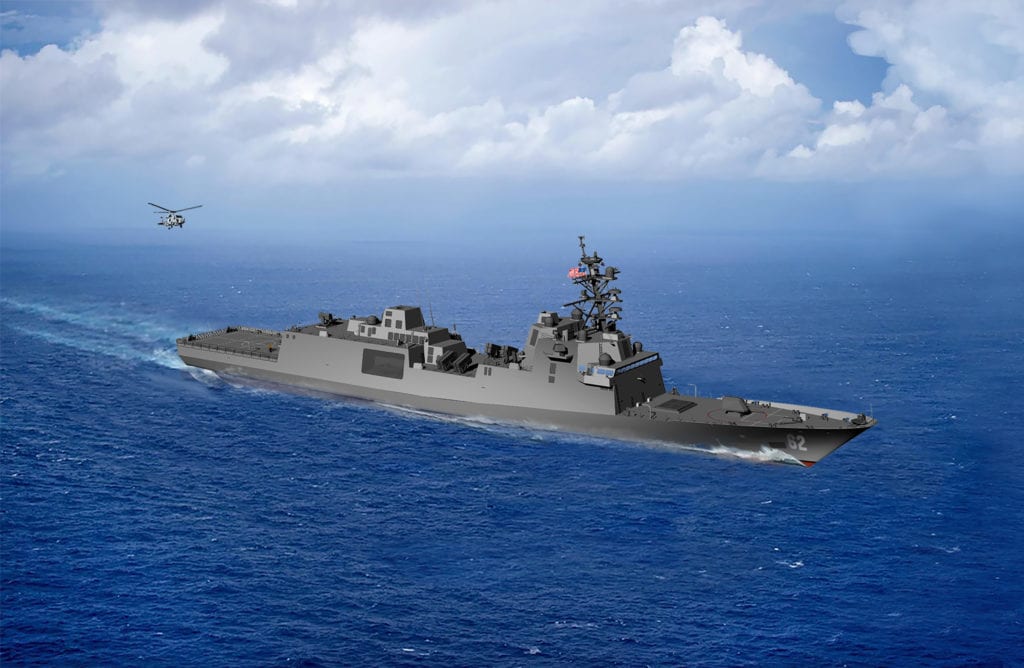
An artist’s conception of the next-generation small surface combatant, the guided-missile frigate, FFG(X). U.S. Navy
ARLINGTON, Va. — The new frigate being designed and built for the U.S. Navy will operate manned and unmanned helicopters from its flight deck and will be able to add new weapon and aviation capabilities as those systems are developed.
The Navy announced on April 30 that it had awarded a detailed design and construction contract to Marinette Marine of Marinette, Wisconsin, to build the FFG(X) based on Fincantieri’s FREMM frigate design that is in service with the Italian and French navies. Marinette Marine is a Fincantieri company.
“This is going to be a real workhorse for the United States Navy supporting distributed maritime operations in the future,” said Vice Adm. Jim Kilby, the Navy’s deputy chief of naval operations for warfighting requirements and capabilities, speaking April 30 during the teleconference for the contract award.
“So, we are super excited about this ship, and I can’t think of a better asset to a strike group or strike group commander to give them the flexibility to do what we need to do in the future.”
Kilby said the frigate “has a requirement for a helo and an unmanned air vehicle but that is not dependent on the landing spot for either one of those. So conceivably, if procured, it could be two helos.”
“This is going to be a real workhorse for the United States Navy supporting distributed maritime operations in the future.”
Vice Adm. Jim Kilby
James F. Geurts, the Navy’s assistant secretary for research, development and acquisition, who also spoke during the teleconference, emphasized service-life allowance and flexibility in the frigate’s future.
Geurts said that growth capability was an important element of the source selection and requirements as the program moves forward.
“That was a design criterion, so we are looking to the future to be able to accommodate all our air vehicles and unmanned vehicles to make this ship what I would call a medium, multimission combatant [so] it can meet all spectrums of potential conflict,” Kilby said.
The FFG(X) will represent a substantial growth in lethality over the Navy’s previous guided-missile frigates, the Oliver Hazard Perry class. The last of those ships was decommissioned in 2015, but the Perry class could accommodate two H-60 anti-submarine helicopters or one H-60 and at least one MQ-8B Fire Scout vertical takeoff unmanned aerial vehicle.
“Understanding how fast the threat is advancing means this service-life allowance requirement is so important for us,” Kilby said. “We did not want to define discretely where we’re going in the future so having some margin to include things such as directed energy [weapons] and other systems is why that’s so important.”
“We have an extensive laser [science and technology] program in the Navy,” he added. “We definitely view it as a requirement for the future as we move into a realm where we want to have our launchers be reserved for offensive weapons and our point-defense systems be rechargeable magazines and the availability for us to sustain them for long periods of time.”
Kilby also said of the new frigate, “Though it’s classified as a small surface combatant, [the FFX(X)] really falls nicely in between our small surface combatants and our large surface combatants, and I see it doing multiple things.”
Geurts: COVID-19 Crisis Offers Opportunity to Strengthen Acquisition, Sustainment
James F. Geurts, assistant secretary of the Navy for research, development and acquisition, during a 2019 technical conference. For a Navy League webinar on May 4, Geurts said acquisition and sustainment could emerge stronger from the COVID-19 crisis and that metrics are already ahead this fiscal year despite most of his workforce being on telework. U.S. Navy/John F. Williams
ARLINGTON, Va. — A top U.S. Navy official said acquisition and sustainment could emerge stronger, having withstood disruptions during the COVID-19 crisis.
Speaking May 4 as part of a Navy League webinar sponsored by IBM for small businesses in the defense industry, James F. Geurts, assistant secretary of the Navy for research, development and acquisition, said he views the pandemic as a crucible, where there will be some delays in production and maintenance, but also as an opportunity to strengthen the system.
“What new opportunities does that enable for us to leverage?” Geurts asked. “If you would have asked me four months ago, ‘Could the team go 95%-plus telework, increase contract awards 33%, do so with 10% less contracts, and at the same time get their distance learning up by 65%, I would have laughed a little bit. And we’ve [achieved those metrics] in the last seven weeks.”
“I don’t see it as much as a disruption to our future plans … as an accelerant to our future plans,” Geurts added. “The goal for us is, how do we come out of this stronger than we were, and how do we work now to increase the speed by which we come out of this.”
Geurts cited the late April award of the FFG(X) frigate contract to Marinette Marine three months ahead of schedule, which brought the total of Navy contract awards $25 billion ahead of the same point last fiscal year. By his recollection, this fiscal year is the first where all financial benchmarks have been exceeded.
“If you would have asked me four months ago, ‘Could the team go 95%-plus telework, increase contract awards 33%, do so with 10% less contracts, and at the same time get their distance learning up by 65%, I would have laughed a little bit.”
James F. Geurts
“So, I don’t view it as much as a delay as an accelerant,” he said. “We will continue to adapt as the warfighter requires. I don’t see us having to adapt our programs in a major way. We’re going to have to figure out how to capture in a bottle all the great things that have occurred in the last seven or eight weeks where we’ve gained this operational effectiveness and be thoughtful of where we’re going to have to manage risk downstream. But in terms of drastic changes to programs or schedules, I don’t see that.”
Geurts said the biggest collective challenge will be how to operate if the virus lingers for a long time.
“We need to create a system that is resilient to disruptions,” he said. “I’m actually very optimistic that this has been a good learning method for us as an enterprise. It’s tremendously painful, horrible to see what is happening at the human element, and I don’t want to downplay any of that at the individual level or at the national level.
“What it has done is helped shine some spotlights on where we probably were not as aggressive as we needed to be and where we’ve got an opportunity to be more effective. We’ve got to be able to ride through disruption. That’s what our Sailors, Marines and our nation expect of us, and that’s where we’ve got to be focused.”