Defense Secretary Mark Esper prepares to participate in a Brookings Institution webinar on May 4. Defense Department/Marvin Lynchard
ARLINGTON, Va. — The nation’s top defense official said the U.S. armed forces need to shed some legacy forces for a more modern force, one that includes more modern naval forces.
“We need a larger, more capable Navy that can implement distributed lethality across the seven seas,” Defense Secretary Mark Esper said, speaking May 4 in a webcast hosted by the Brookings Institution, a Washington think tank. “The Marines are doing some really innovative things with regard to how they are adjusting their force.”
Esper said the Defense Department needs 3% to 5% annual real growth year-over-year in the budget topline to increase readiness and support the National Defense Strategy.
Noting the probability of flat defense budgets and given the national debt and COVID-19 virus effects on the gross domestic product, Esper said he is worried that the “massive infusion of dollars into the economy … may throw us off that course … and lead to smaller defense budgets in the future.”
“We need a larger, more capable Navy that can implement distributed lethality across the seven seas. The Marines are doing some really innovative things with regard to how they are adjusting their force.”
Defense Secretary Mark Esper
He said that the Defense Department is at a critical juncture with the “Great Power Competition” against China and Russia.
“That means shedding the legacy force and moving to a more modern force,” Esper said, noting that a modern force would include completely revitalized strategic forces — including all three legs of the nuclear triad (bombers, intercontinental ballistic missiles and submarine-launched ballistic missiles) — “but also investing a lot of money into [artificial intelligence], into hypersonics, into our space capabilities, cyber, into directed energy.”
He said that the Air-Land Battle Concept has been replaced by the Joint Warfighting Concept “that will make sure we’re fighting in all domains as a coherent, cohesive joint force. We have new plans to reach out to our allies and partners and make sure they are well-integrated into all of our efforts.”
The secretary emphasized readiness concepts underway, including immediate-reaction forces and contingency-reaction forces as well as dynamic force employment and “moving toward operational deployments rather than permanently deployed forces.”
“That said, we do need that topline growth, and if we don’t [get it], we’re just going to have to accelerate that shedding of the legacy force and turning those dollars back into building the force we need in the future.”
Esper: ‘The Safest Place Is on a Deployed Navy Ship’
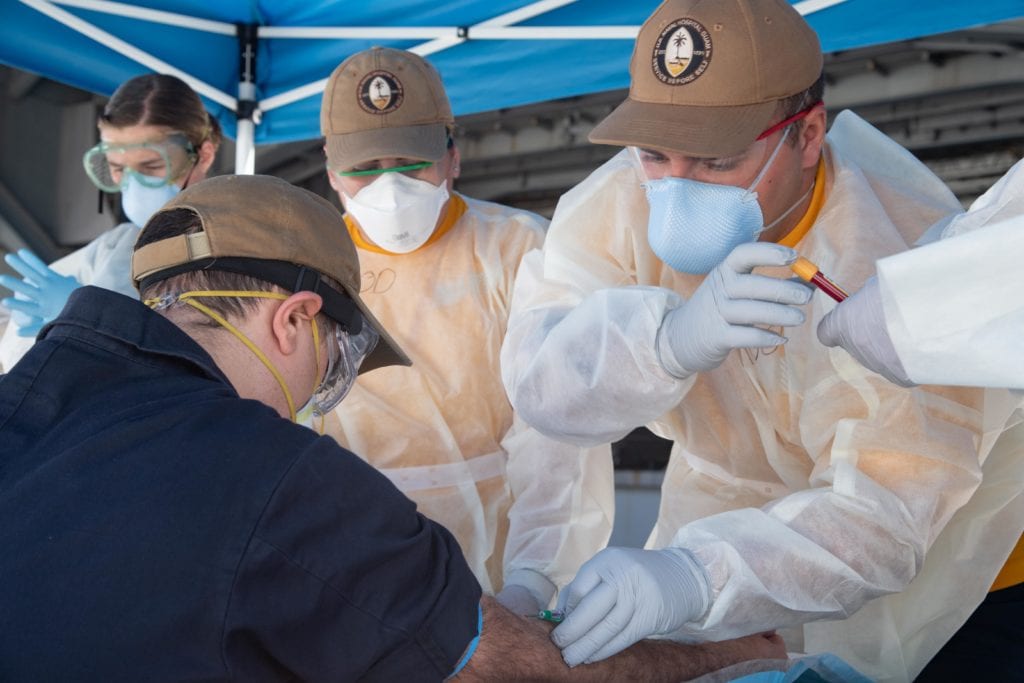
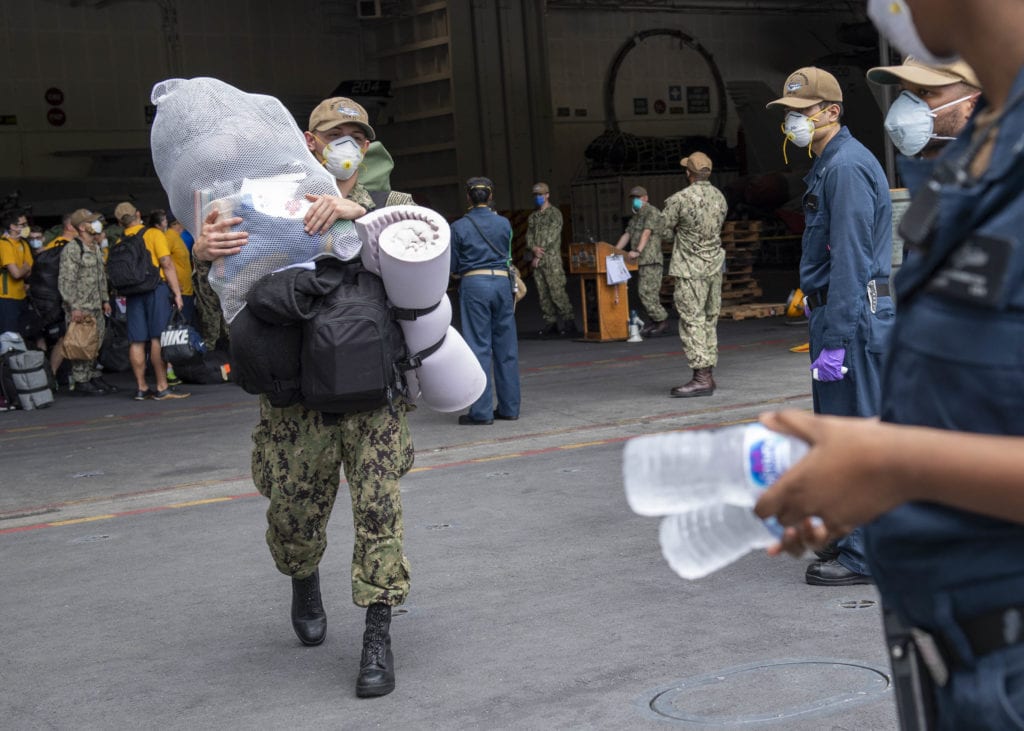
Hospital Corpsman 2nd Class Shane Miller (left) and Hospital Corpsman 2nd Class Austin Kelly draw blood from a Sailor assigned to the guided-missile destroyer USS Kidd after its arrival in San Diego as part of the Navy’s response to the COVID-19 outbreak on board the ship. U.S. Navy/Mass Communication Specialist 2nd Class Alex Corona
ARLINGTON, Va. — The secretary of defense noted May 4 that — with a couple of notable exceptions — the U.S. Navy’s ships at sea remain unaffected by the spread of the COVID-19 pandemic.
“The statistics show that the safest place to be is on a deployed Navy ship compared to one that’s in port,” Defense Secretary Mark Esper said, speaking during a webcast sponsored by the Brookings Institution, a Washington think tank. “Of the 90-plus ships at sea, we only have two that have been affected.”
The Navy has suffered significant outbreaks of the novel coronavirus on the Nimitz-class aircraft carrier USS Theodore Roosevelt and the Arleigh Burke-class guided-missile destroyer USS Kidd. A Sailor off the Roosevelt died from COVID-19 complications in mid-April.
The cause of the transmission of the virus to the crews of both ships is unknown. The Theodore Roosevelt made a port call to Vietnam soon before Sailors began showing signs of illness. Another possibility: the virus was brought aboard by aircrews and passengers returning to the carrier.
“We’re not sure where [the USS Kidd] picked [the virus] up,” Esper said. “It may have been through a counter-drug operation.”
Esper said that “two ships out of 94 is a pretty good record. The Navy has taken a lot of good practices. They’ve learned from the Teddy Roosevelt. Before a ship is deployed it goes through multiple tests of its Sailors. They are quarantined for a couple of weeks. And, of course, we don’t bring a ship back in if it’s being replaced by one that’s going out. So, we’re being very careful of that.”
“The statistics show that the safest place to be is on a deployed Navy ship compared to one that’s in port.”
Defense Secretary Mark Esper, during a May 4 webinar
The service is keeping the aircraft carrier USS Harry S. Truman away from port following a major deployment to avoid the pandemic.
“We have had ships that have been portside that have had Sailors infected but that’s not unlike what you might see at an Army base or an Air Force base where you have Sailors out in the community who may get infected by the virus,” Esper said. “Before they go to sea, we bring them in, we test, we quarantine, and we make adjustments to make sure our ships get out on time.”
Lessons Learned From Teddy Roosevelt Outbreak Help Ease COVID-19 Impact on USS Kidd
A Sailor salutes the national ensign as he disembarks the USS Kidd at Naval Base San Diego on April 28 as part of the Navy’s response to the COVID-19 outbreak on board the guided-missile destroyer. While in San Diego, the Navy will provide medical care for the crew and clean and disinfect the Kidd. U.S. Navy/Mass Communication Specialist 2nd Class Alex Corona
ARLINGTON, Va. — The safe return to port of the guided-missile destroyer USS Kidd — with none of its crew needing hospitalization after a COVID-19 outbreak at sea — is due largely to lessons learned from the spread of the virus more than a month ago aboard the aircraft carrier USS Theodore Roosevelt that turned deadly, according to a Defense Department spokesman.
The Arleigh-Burke class destroyer Kidd was participating in counter-narcotics operations in the U.S. Southern Command area of responsibility in the Pacific Ocean when several of its Sailors began exhibiting flu-like symptoms in late April.
One Sailor aboard the Kidd was evacuated to the U.S. mainland for testing on April 22 after experiencing shortness of breath. The commander of the U.S. Pacific Fleet redirected the amphibious assault ship USS Makin Island — which is equipped with an intensive care unit, ventilators and additional testing capability — to rendezvous with the Kidd. Even before that, an eight-member medical team flew out to the Kidd on a helicopter and began testing the crew for symptoms of the virus. As of April 25, 33 Sailors aboard the Kidd had tested positive for it.
“The effort by the captain and the crew of the Kidd, the Makin Island and the rest of the medical team should be lauded for what they did and how they were able to get that ship back to port and how they were able to get the crew off,” Pentagon spokesman Jonathan Rath Hoffman told a press briefing on May 1. “Right now, there’s a large number of sick but, fortunately, none are hospitalized, and we’re going to continue to hope that everybody recovers quickly.”
The USS Kidd arrives in San Diego on April 28. U.S. Navy/Mass Communication Specialist 2nd Class Alex Millar
The Kidd reached San Diego, not its homeport, on April 28. After testing 100% of the more than 300 crew members, the U.S. Navy said 78 active COVID-19 cases were detected. None of the Kidd’s crew is hospitalized, according to the Navy.
All crew members will complete at least 14 days in quarantine or isolation and must achieve two negative tests for the virus before returning to the ship. Medical professionals, chaplains, a resiliency counselor and a psychologist are supporting the Sailors in isolation and quarantine.
While in San Diego, the USS Kidd will undergo a deep cleaning that balances decontamination with preventing damage to the ship’s systems. It is not known how COVID-19 made its way onto the destroyer.
“Fortunately, we are able to take many of the lessons learned from the Theodore Roosevelt and apply them to the Kidd so that we were able to address the outbreak — obviously, a very different ship, a different size.”
Pentagon spokesman Jonathan Rath Hoffman
“Fortunately, we are able to take many of the lessons learned from the Theodore Roosevelt and apply them to the Kidd so that we were able to address the outbreak — obviously, a very different ship, a different size — but was able to address it rapidly in a way that we were able to get the ship to port,” Hoffman said.
The Theodore Roosevelt, which also was at sea when COVID-19 broke out, is still sidelined in Guam, more than a month after the first Sailors there were diagnosed.
As case numbers spiked, the carrier’s captain sent a lengthy e-mail, which was leaked to a newspaper, complaining that the evacuation of the 4,000-plus Sailors of the Roosevelt was occurring too slowly, endangering the crew. This led then-acting Navy Secretary Thomas Modly to relieve the skipper, Capt. Brett Crozier, of his command. The ensuing controversy and a speech highly critical of Crozier that Modly delivered a few days later to the Roosevelt’s crew sparked Modly’s resignation on April 7.
The Roosevelt’s entire crew has been tested for COVID-19, the Navy said in its May 1 update. There are 1,102 active cases left from the carrier — an increase due to exit testing of Sailors who are asymptomatic, the Navy said, adding that 53 Sailors have recovered after completing at least 14 days in isolation and clearing two successive tests with negative results.
Three Sailors are being treated in U.S. Naval Hospital Guam for COVID-19 symptoms. None of those crew members are in the intensive care unit. A Roosevelt Sailor did die in mid-April from COVID-19 complications.
Hospital Corpsman 2nd Class Shane Miller (left) and Hospital Corpsman 2nd Class Austin Kelly draw blood for COVID-19 testing from a Sailor assigned to the USS Kidd after its arrival in San Diego on April 28. U.S. Navy/Mass Communication Specialist 2nd Class Alex Corona
Geurts: Urgency, Discipline Hallmarks of Frigate Selection Process
Marinette Marine will base the FFG(X) guided-missile frigate on Fincantieri’s FREMM frigate, which is in service with the Italian and French navies.
ARLINGTON, Va. — The U.S. Navy’s top acquisition official praised the government team that selected and the industry teams that submitted proposals for the design of the Navy’s next-generation small combatant, the FFG(X) guided-missile frigate, the first of which is scheduled to be delivered in 2026. Design of the frigate has begun three months ahead of schedule.
The Navy announced on April 30 that it had awarded a detailed design and construction contract to Marinette Marine, a Fincantieri company based in Marinette, Wisconsin.
Marinette is building the Freedom-class littoral combat ships for Lockheed Martin and will turn to building the new frigate that will be based on the Fincantieri FREMM frigate, which is in service with the Italian and French navies.
“I am very proud of the hard work from the requirements, acquisition and shipbuilder teams that participated in the full and open competition, enabling the Navy to make this important decision today,” said James F. Geurts, assistant secretary of the Navy for research, development and acquisition, in the Navy’s April 30 announcement.
“Throughout this process, the government team and our industry partners have all executed with a sense of urgency and discipline, delivering this contract award three months ahead of schedule. The team’s intense focus on cost, acquisition and technical rigor enabled the government to deliver the best value for our taxpayers as we deliver a highly capable next-generation frigate to our warfighters.”
“The parent design really set us up well here.”
Rear Adm. Casey Moton, program executive officer for unmanned and small combatants
Geurts noted in a May 1 teleconference with reporters that the selection of the frigate design three months ahead of schedule was accomplished despite the impact of the COVID-19 pandemic on the Navy and stressed again that the decision was made with “a sense of urgency but also a sense of discipline.”
He said that by “integrating the requirements, acquisition planning and conceptual design we were able to reduce the span time by six years as compared to traditional shipbuilding programs. … It’s the best I’ve seen in the Navy thus far at integrating all of our teams together and it’s a model we are building on for future programs.”
The detail design and construction (DD&C) contract awards $795.1 million for the design and construction of the lead ship plus nine separately priced options for up to nine more ships. The contract also provides for “post-delivery availability support, engineering and class services, crew familiarization, training equipment, and provisioned item orders,” the April 30 Defense Department contract announcement said.
The price of the lead ship, including the design cost, is marked as $1.281 billion, which includes the $795 million for the shipbuilder’s design and construction, with the remainder for government-furnished equipment (GFE) and other items and services.
The Navy has a cost objective for the follow-on ships of $800 million each and a threshold of $950 million. According to a Navy independent cost estimate, the follow-on ships will cost $781 million (in constant 2018 dollars) on average. If all options are exercised, the contract’s cumulative value for the 10 frigates would be $5.58 billion. The Navy has a requirement for 10 more small surface combatants but has not yet settled on an acquisition strategy for the second set of 10, Geurts said.
He said that by selecting a proven hull and adding a proven combat system, weapons and sensors, the Navy was able to keep the cost under the objective cost per platform cap of $950 million (in fiscal 2018 dollars).
“The Navy conducted this competition using a tradeoff process to determine the proposal representing the best value, based on the evaluation of non-price factors in conjunction with price,” the contract announcement said.
“The Navy made the best value determination by considering the relative importance of evaluation factors as set forth in the solicitation, where the non-price factors of design and design maturity and objective performance (to achieve warfighting capability) were approximately equal and each more important than remaining factors.”
Construction of the first frigate is scheduled for no later than April 2022, with delivery set for 2026. Initial operational capability is slated for 2029 or 2030 and full operational capability scheduled for 2031 or 2032. The contract calls for final work to be complete by 2035.
Rear Adm. Casey Moton, program executive officer for unmanned and small combatants, who also spoke at the teleconference, said the maturity of the selected design “was one of the non-price factors” that influenced the decision.
“The parent design really set us up well here,” Moton said of the nondevelopmental FREMM design that was selected.
He also cited the work that Fincantieri put into and will put into the Marinette shipyard as another non-price factor that was weighed in the selection decision.
Moton also said he was very comfortable with how the plan for acquisition and integration of government-furnished equipment was proceeding and that the GFE “will be ready on time.”
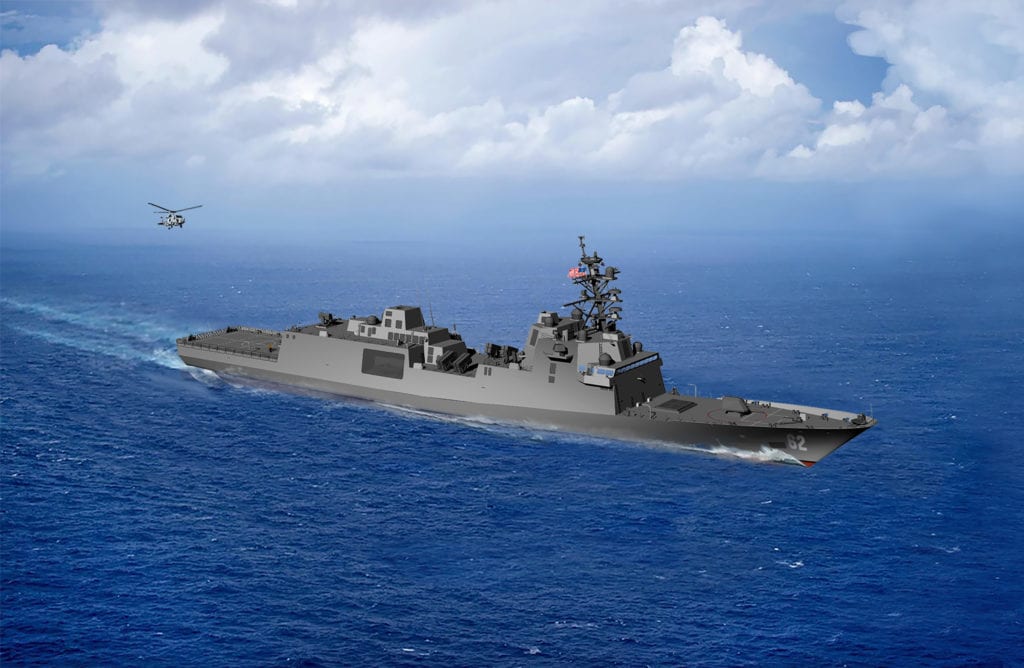
An artist’s conception of the next-generation small surface combatant, the guided-missile frigate (FFG(X). U.S. Navy
WASHINGTON — Marinette Marine has won a coveted contract from the U.S. Navy to design and produce the next-generation small surface combatant, the guided-missile frigate (FFG(X), the public affairs office of the Navy’s Program Executive Office-Unmanned and Small Combatants said in an April 30 release.
The Marinette Marine deal is good for detail design and construction (DD&C) of up to 10 guided-missile frigates, consisting of one base ship and nine option ships.
The FFG(X) will have multimission capability to conduct air warfare, anti-submarine warfare, surface warfare, electronic warfare and information operations.
“The Navy’s Guided-Missile Frigate (FFG(X)) will be an important part of our future fleet,” said Chief of Naval Operations, Adm. Mike Gilday. “FFG(X) is the evolution of the Navy’s small surface combatant with increased lethality, survivability and improved capability to support the National Defense Strategy across the full range of military operations. It will no doubt help us conduct distributed maritime operations more effectively, and improve our ability to fight both in contested blue-water and littoral environments.”
The new ship will include an Enterprise Air Surveillance Radar (EASR) radar, Baseline Ten (BL10) AEGIS Combat System, a Mk41 Vertical Launch System (VLS), communications systems, Mk57 Gun Weapon System (GWS) countermeasures and added capability in the EW/IO area with design flexibility for future growth.
“I am very proud of the hard work from the requirements, acquisition and shipbuilder teams that participated in the full and open competition, enabling the Navy to make this important decision today,” said James Geurts, assistant secretary of the Navy for research, development and acquisition.
“Throughout this process, the government team and our industry partners have all executed with a sense of urgency and discipline, delivering this contract award three months ahead of schedule. The team’s intense focus on cost, acquisition and technical rigor enabled the government to deliver the best value for our taxpayers as we deliver a highly capable next-generation frigate to our warfighters.”
The acquisition process for FFG(X) began in 2017. Since then, the Navy has worked with industry to balance cost and capability. The Navy released the FFG(X) DD&C request for proposals to industry last June. Technical proposals were received in August and cost proposals were received the following month. A full and open competition took place with multiple offers received.
DoD’s Lord: Potential for 3-Month Slowdown in Defense Acquisition
Ellen M. Lord, deputy secretary of defense for acquisition and sustainment, told reporters on April 30 that the COVID-19 pandemic might cause a three-month slowdown in procurement and sustainment. National Defense Industrial Association via YouTube
ARLINGTON, Va. — The Defense Department’s top acquisition official said the department is working closely with the industrial base to mitigate the effects of the COVID-19 pandemic but said there is the potential for a three-month slowdown in procurement and sustainment.
“We continue to assess the impact of a potential three-month slowdown to many programs due to COVID-19,” said Ellen M. Lord, deputy secretary of defense for acquisition and sustainment, speaking April 30 at the Pentagon to reporters.
“I intentionally used the word slowdown and impact and not saying the word ‘delay,’ which carries a very different connotation,” Lord added. “We have seen inefficiencies across many programs. COVID-19 is temporarily shutting down defense manufacturing facilities and production lines, disrupting supply chains and distressing the financial stability of the companies DoD relies on to protect the nation. DoD continues to partner with industry to do everything possible to keep programs on schedule and to minimize the cost and schedule impacts.”
Lord praised the work of the Defense Contracting Management Agency (DCMA) and Defense Logistics Agency (DLA) in tracking the status of companies up and down the defense supply chain.
“Out of the 10,509 companies DCMA tracks, 93 are closed, down 13 from last week, with 141 companies having closed and reopened, up very significantly 73 from last week’s number of 68,” she said. “This is the first time we have seen reopening numbers larger than the number of closures.
“Out of the 11,413 companies DLA tracks, 437 are closed with 237 having closed and re-opened, almost 100 companies from last week.”
Lord noted that “while we have seen minor improvements, we continue to see the greatest impacts in the aviation supply chain, shipbuilding and small space launch [companies].”
Lord said her office’s policy team led by Jen Santos is “leading multiple industry calls making calls every week with 18 industrial associations.”
“Tim Harrington, director of Defense Pricing and Contracting, has issued 22 defense pricing and cost memos, aggressively responding to industry needs and impacts. The memos include guidance for increased telecommuting, increased progress payment rates, acquisition timeline impacts, reimbursement for those prevented from working, and more,” she said.
Lord gave an update on the $3 billion of increased cash flow due to increased progress payment rates, noting that this week the Defense Department processed more than $1.2 billion in invoices at the higher progress payment rate.
“We have spoken with each of our major prime companies, and they have each confirmed their detailed plans to work with their supply chains to accelerate payments and to identify distressed companies and small businesses,” she said. “I want to particularly commend Lockheed Martin, who publicly committed to accelerating $450 million to their supply chain.”
Lord said that her acquisition and sustainment team “remains focused on partnering with industry to maintain readiness and drive modernization.”
Hospital Ship Comfort Departs NYC, Prepared for Future COVID-19 Response
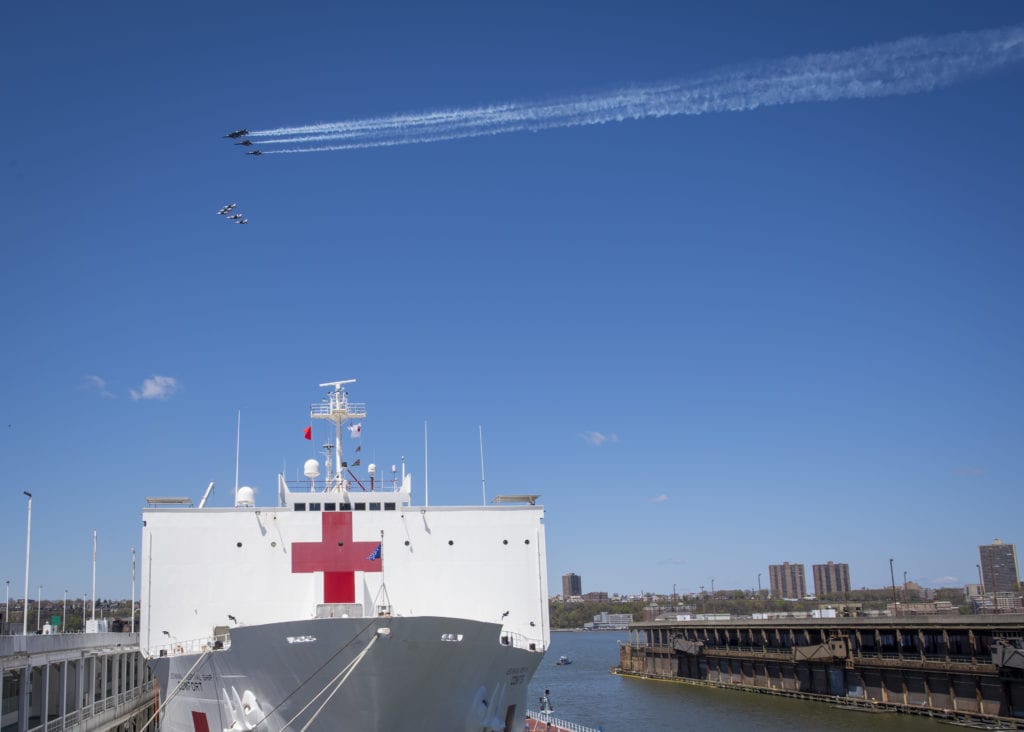
The Navy’s Blue Angels and the U.S. Air Force Thunderbirds fly over the hospital ship USNS Comfort on April 28 to honor frontline COVID-19 relief workers with formations over New York City, Newark and Trenton, New Jersey, and Philadelphia. The Comfort left New York on its return to Norfolk, Virginia, on April 30. U.S. Navy/Mass Communication Specialist 1st Class Kleynia R. McKnight
NEW YORK — The hospital ship USNS Comfort departed New York City on April 30 after supporting the Pentagon’s COVID-19 response assistance to New York and New Jersey residents during the novel coronavirus outbreak, according to a U.S. 2nd Fleet news release.
The Comfort has been at Pier 90 in New York City for a month, providing relief to a health care system stressed by the surge of COVID-19 patients. Even as the ship departs New York, the Comfort and its embarked medical task force remain prepared for future tasking. The U.S. Navy, along with other U.S. Northern Command-dedicated forces, remains engaged throughout the nation in support of the broader COVID-19 response.
“USNS Comfort arrived in New York City to provide relief to frontline health care providers, and each patient who was brought aboard ensured one more bed was available in a local hospital,” said Vice Adm. Andrew Lewis, commander of the 2nd Fleet and Maritime Component Element-East. “While the ship is departing New York City, make no mistake, the fight is not over, and we stand ready to support the response to COVID-19 in whatever capacity we are needed.”
Comfort, which arrived in New York City March 30, was originally tasked with providing care to non-COVID patients, bringing the first aboard on April 1. It quickly became apparent that to be of help to the city, the Comfort needed to treat all patients, regardless of their COVID status.
On April 6, after being directed to accept COVID-positive patients and following a thorough assessment of the existing design of the ship, Military Sealift Command civil service mariners physically separated the hospital from the rest of the ship by cordoning off doors and ladder wells on the main deck, reconfiguring the ship to admit and treat all patients.
“This amazing crew of over 1,200 people treated 182 patients, of which approximately 70% were afflicted by COVID-19,” said Capt. Patrick Amersbach, commander of the Comfort’s medical treatment facility. “We were dedicated to providing the highest quality of care to each person who arrived to our hospital.”
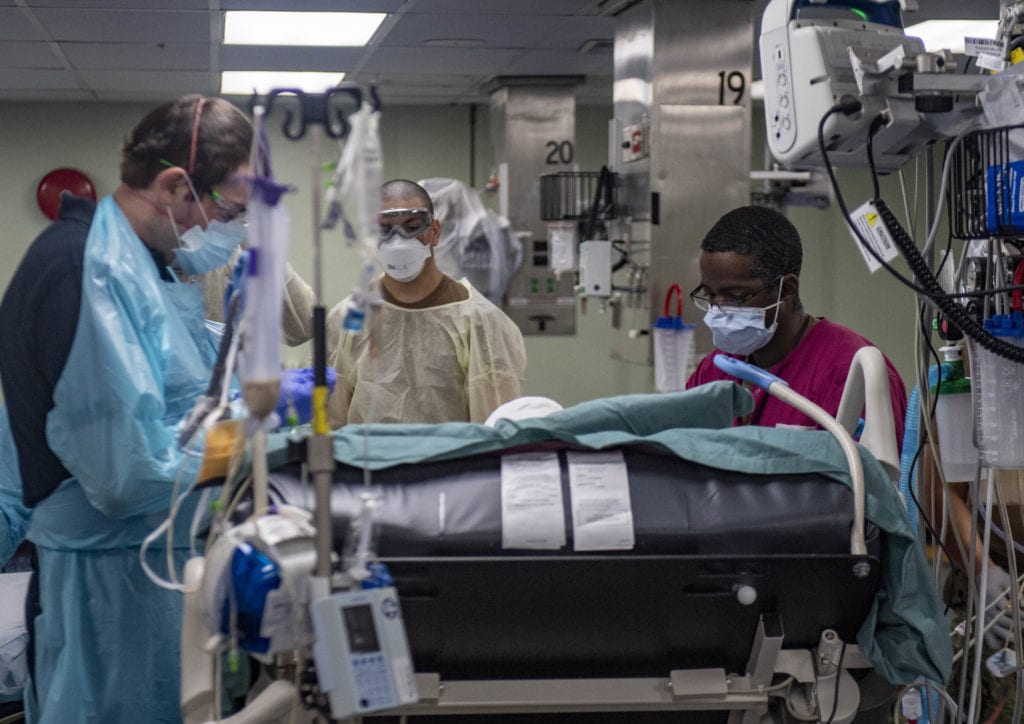
In the Comfort’s intensive care units, critical care nurses and respiratory technicians worked together to provide constant care to many complex, high-acuity COVID-19 patients. Many of these patients suffered from rapid, multi-system organ failure that required them to be put on ventilators.
Sailors transport the last patient off the Comfort on April 28 for relocation to a local hospital for follow-up care. U.S. Navy/Mass Communication Specialist 1st Class Scott Bigley
“It is truly an honor and I am humbled to lead a team of world-class medical professionals,” Amersbach said. “We came together from different units across the nation and were able to quickly adapt to the rapidly changing environment.”
More than 110 surgical procedures such as appendectomies, bronchoscopies, chest tube insertions, laparoscopic procedures and tracheotomies were performed aboard. Additionally, the Comfort’s radiology technicians performed more than 540 X-rays and CT-scans, while the pharmacy department prepared more than 1,300 intravenous and oral medications for patients aboard. The ship’s supply department ensured the distribution of ample personal protective equipment (PPE) for all personnel, which were procured via a robust logistics system.
“While the ship is departing New York City, make no mistake, the fight is not over, and we stand ready to support the response to COVID-19 in whatever capacity we are needed.”
Vice Adm. Andrew Lewis, commander of the U.S. 2nd Fleet
“The success of this mission in New York City hinged on coordination with FEMA, state and local officials and the partnership between Comfort, the Javits [convention center] and hospitals across New York and New Jersey,” said Capt. Joseph O’Brien, mission commander of Task Force New York.
“We all worked towards the common goal of ensuring that every patient who required care was able to receive it. The Comfort team is proud to help during these unprecedented times.”
The Comfort is scheduled to return to Naval Station Norfolk, Virginia, where the ship will return to a “Ready 5” status to remain ready for tasking for COVID-19 operations in support of the Federal Emergency Management Agency.
The Comfort departs New York Harbor on April 30 after a month of treating patients in New York and New Jersey. U.S. Navy/Mass Communication Specialist 3rd Class Brendan Fitzgerald
Pacific Fleet to Host At-Sea-Only RIMPAC Exercise in August
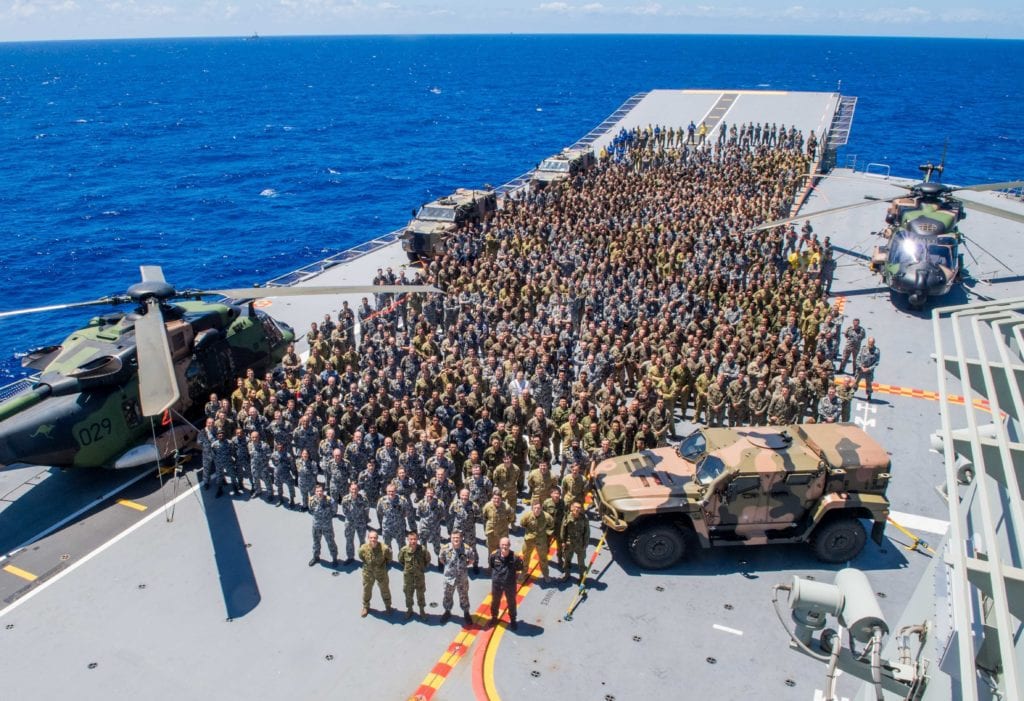
Military members from the Royal Australian Navy, Australian army, U.S. Marines, Sri Lankan navy and marines, Royal Malaysian Army, His Majesty’s Armed Forces of Brunei, the Japan Ground Self-Defense Force and the New Zealand army gather for a group photo on the flight deck of the landing helicopter dock ship HMAS Adelaide during the last RIMPAC two years ago. U.S. Navy/Mass Communication Specialist 2nd Class Kelsey J. Hockenberger
PEARL HARBOR, Hawaii — The U.S. Navy will sponsor the 27th Rim of the Pacific exercise, from Aug. 17 to Aug. 31, the U.S. Pacific Fleet said in a release.
Hosted by the commander, U.S. Pacific Fleet, this biennial maritime exercise will be an at-sea-only event in light of COVID-19 concerns. The theme of RIMPAC 2020 is “Capable, Adaptive, Partners.”
The at-sea-only construct for RIMPAC 2020 was developed to ensure the safety of all forces participating by minimizing shore-based contingents. Commander, U.S. Pacific Fleet crafted the modified RIMPAC plan as a way to conduct a meaningful exercise with maximum training value and minimum risk to the force, allies and partners, and the people of Hawaii.
The world’s largest international maritime exercise, RIMPAC is designed to foster and sustain cooperative relationships, critical to ensuring the safety of sea lanes and security in support of a free and open Indo-Pacific region.
The exercise, which takes place in the waters surrounding the Hawaiian Islands, is a training platform designed to enhance interoperability and strategic maritime partnerships. In 2018, during the last RIMPAC, 26 nations participated in and around Hawaii.
“In these challenging times, it is more important than ever that our maritime forces work together to protect vital shipping lanes and ensure freedom of navigation through international waters,” said Adm. John Aquilino, commander, U.S. Pacific Fleet. “And we will operate safely, using prudent mitigation measures.”
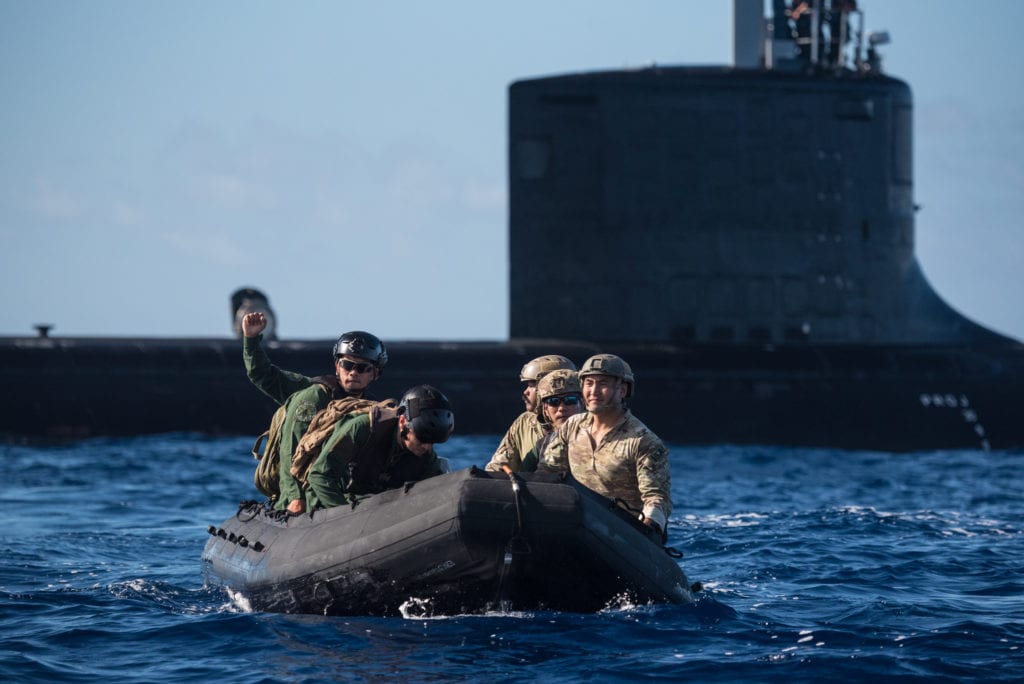
Multinational special operations forces participate in a submarine insertion exercise with the Virginia-class fast-attack submarine USS Hawaii and combat rubber raiding craft off the coast of Oahu, Hawaii, during RIMPAC 2018. U.S. Navy/Mass Communication Specialist 1st Class Daniel Hinton
As the U.S. Navy continues to limit the spread of COVID-19, RIMPAC 2020 is not scheduled to include social events ashore. Joint Base Pearl Harbor-Hickam will be accessible for logistics support, with a minimal footprint of staff ashore for command and control, logistics and other support functions.
This year’s exercise will include multinational anti-submarine warfare, maritime intercept operations and live-fire training events, among other cooperative training opportunities. Continued planning will remain flexible as Navy leaders monitor and assess evolving circumstances.
“We remain committed to and capable of safeguarding allies and partners throughout the Indo-Pacific region,” Aquilino said. “The flexible approach to RIMPAC 2020 strikes the right balance between combatting future adversaries and the COVID-19 threat.”
RIMPAC 2020 will be led by the commander of the U.S. 3rd Fleet, Vice Adm. Scott D. Conn.
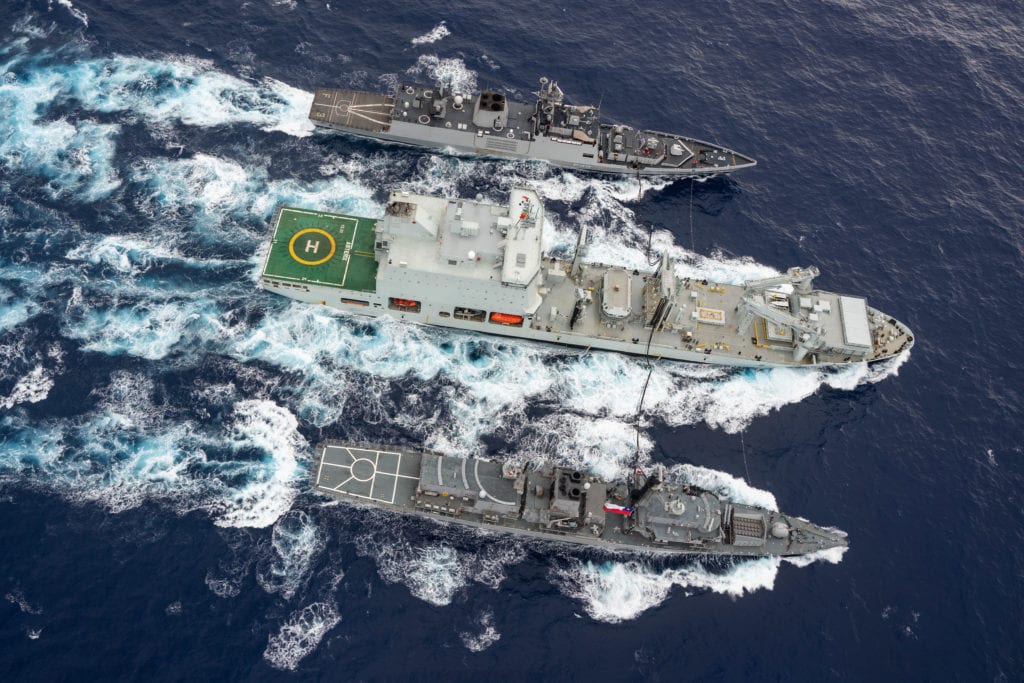
The Chilean navy frigate CNS Almirante Lynch and the Indian navy stealth multi-role frigate INS Sahyadri perform a replenishment-at-sea with the Royal Canadian Navy supply ship MV Asterix off the coast of Hawaii during RIMPAC 2018. Twenty-five nations, 46 ships, five submarines and about 200 aircraft and 25,000 personnel participated. U.S. Navy/Mass Communication Specialist 1st Class Arthurgwain L. Marquez
Navy Opens Deeper Inquiry Into Theodore Roosevelt; Move Delays Decision on Captain’s Reinstatement
Navy Hospitalman Rudy Flores (right), assigned to Naval Hospital Guam, takes a blood sample on April 23 from Mass Communication Specialist 1st Class Christopher Liaghat, a crewman assigned to the USS Theodore Roosevelt, as part of an investigation of the COVID-19 outbreak there. U.S. Navy/Mass Communication Specialist Seaman Kaylianna Genier
ARLINGTON, Va. — Acting U.S. Navy Secretary James McPherson has directed Chief of Naval Operations Adm. Mike Gilday to conduct a second deeper investigation of the events surrounding the COVID-19 outbreak on the aircraft carrier USS Theodore Roosevelt that has claimed the life of a Roosevelt Sailor, hospitalized others and infected hundreds more.
The results of a first preliminary investigation were forwarded last week by Gilday to McPherson, who took them under review. McPherson is a retired Navy flag officer in the Judge Advocate General Corps.
“Following [discussion with Gilday], I have unanswered questions that the preliminary inquiry has identified and that can only be answered by a deeper review,” McPherson said in an April 29 statement.
“This investigation will build on the good work of the initial inquiry to provide a more fulsome understanding of the sequence of events, actions and decisions of the chain of command surrounding the COVID-19 outbreak aboard USS Theodore Roosevelt.”
Vice Chief of Naval Operations Adm. Robert Burke will be in charge of the second investigation, which is expected to wrap up by May 27, unless an extension is granted, according to an April 30 statement from Cmdr. Nate Christensen, a spokesman for Gilday. From there, Gilday is expected to review the results and issue any recommendations.
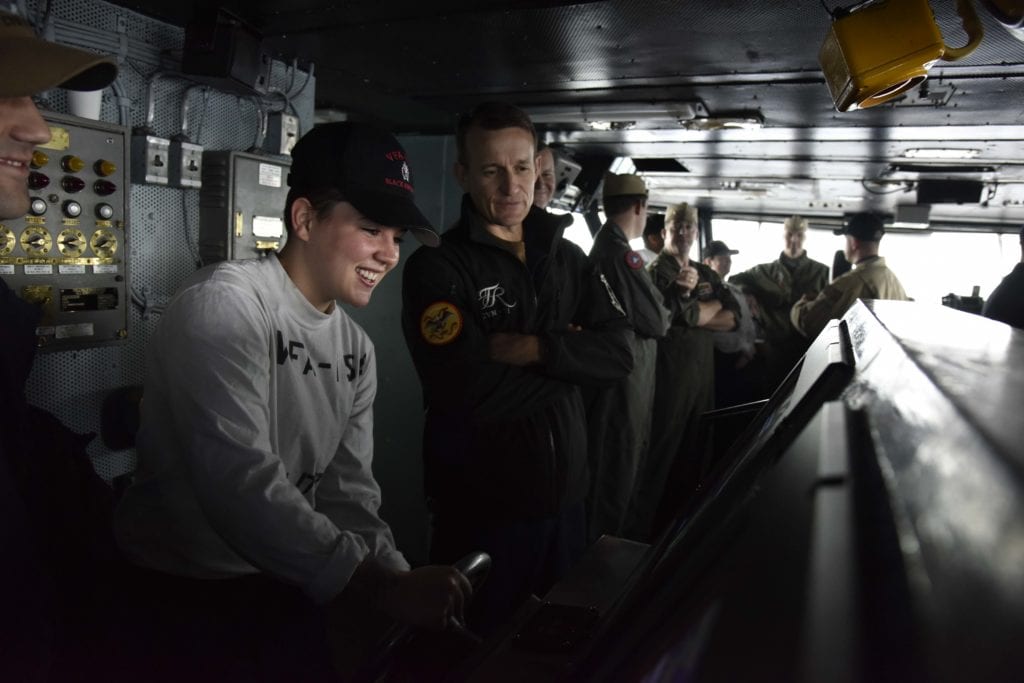
Capt. Brett Crozier (center), at the time commanding officer of the USS Theodore Roosevelt, in February instructs Information Systems Technician 3rd Class Eden Betzler on how to steer the ship. U.S. Navy/Mass Communication Specialist 2nd Class Pyoung K. Yi
The Navy reported as of April 25 that the entire crew of the Theodore Roosevelt had been tested for the virus, resulting in 4,105 negatives but 833 positives — including the carrier’s former commanding officer, Capt. Brett Crozier.
Of the total cases, 112 Sailors had recovered and 4,273 Sailors from the Roosevelt had been moved ashore. Also, as of April 25, two of the ship’s Sailors were in U.S. Naval Hospital Guam under treatment for COVID-19 symptoms. Another Sailor died from complications of the infection, the Navy announced on April 13.
The Theodore Roosevelt’s public affairs office announced April 29 that the ship was preparing to return to sea following a bow-to-stern cleaning process. The crew members that were quarantined ashore are beginning to move back on board.
“This investigation will build on the good work of the initial inquiry to provide a more fulsome understanding of the sequence of events, actions and decisions of the chain of command surrounding the COVID-19 outbreak aboard USS Theodore Roosevelt.”
Acting Navy Secretary James McPherson
Since March 27, the Roosevelt has been sidelined in Apra Harbor, Guam. Crozier was relieved of his command on April 2 by then-acting Navy Secretary Thomas Modly after fallout from a letter written by the captain to his chain of command leaked to a San Francisco newspaper. A few days later, Modly flew to Guam to visit the ship and address the crew, but he stepped down on April 7 after his address — which was highly critical of Crozier — generated many calls for Modly’s resignation.
According to several press reports, Gilday recommended Crozier’s reinstatement to McPherson. Defense Secretary Mark Esper received a verbal update from Gilday on April 24. Another report said that U.S. Army Gen. Mark Milley, chairman of the Joint Chiefs of Staff, recommended the more extensive investigation.
Gilday had directed Burke to probe the circumstances and climate of the entire Pacific Fleet “to help determine what may have contributed to a breakdown in the chain of command,” Modly said April 2, the day he relieved Crozier as commander of the ship only months after Crozier had assumed command.
A day earlier, at a press briefing on the Roosevelt virus outbreak, Gilday spoke of “a potential comms breakdown, wherever it occurred. We’re not looking to shoot the messenger here, we want to get this right.”
Deputy Editor Scott Achelpohl and Seapower Correspondent John M. Doyle contributed to this report.
U.S. Navy Airman Andrue Barraza departs the Theodore Roosevelt on April 25 for quarantine after completing essential watch-standing duties. U.S. Navy/Mass Communication Specialist 1st Class Chris Liaghat
Geurts: Third Zumwalt DDG Will Be Commissioned After Combat Systems Activation
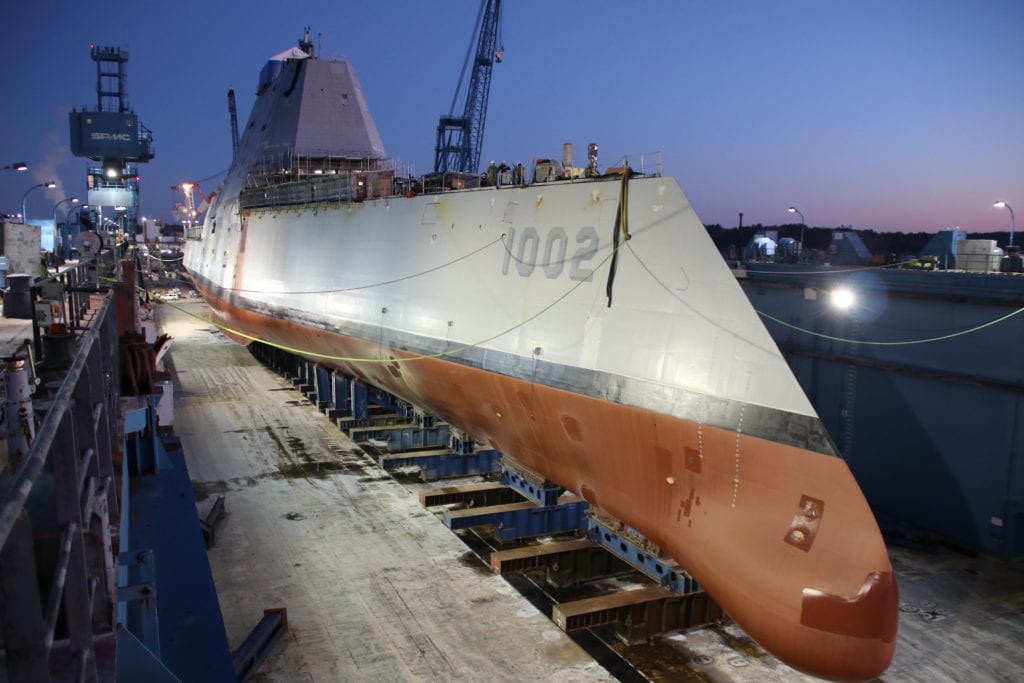
The USS Lyndon B. Johnson is made ready before flooding of the dry dock at General Dynamic-Bath Iron Works shipyard and subsequent launching of the third Zumwalt-class destroyer in 2018. U.S. Navy via General Dynamics-Bath Iron Works
ARLINGTON, Va. — The U.S. Navy’s third Zumwalt-class guided-missile destroyer will be commissioned after its combat systems are fully installed and activated, rather than going through a two-part delivery, the Navy’s top acquisition official said.
The future USS Lyndon B. Johnson (DDG 1002), under construction at the Bath Iron Works shipyard in Bath, Maine, will not be commissioned until after its combat systems are installed, unlike the process used for its two predecessors, USS Zumwalt (DDG 1000) and Michael Monsoor (DDG 1001), said James F. Geurts, assistant secretary of the Navy for research, development and acquisition, speaking to reporters in an April 28 teleconference.
In the case of the first two of the class, the ships’ hulls were completed and put through trials and then delivered to the Navy before their combat systems were installed. The Zumwalt was commissioned — in a status the Navy calls In Commission, Special — in Baltimore and then proceeded to San Diego for installation and activation of its combat systems. It was delivered to the Navy on April 24 and will begin at-sea testing of its systems preparing for its initial operational test and evaluation and its 2021 initial operational capability milestone.
The USS Michael Monsoor similarly was commissioned on Jan. 26, 2019, and proceeded to San Diego for its combat systems installation, which was completed in March.
The Lyndon B. Johnson is 93% complete, Geurts said, but will not be delivered and commissioned until its combat systems are installed. Since the combat systems activation will be conducted in San Diego, it will need to proceed there in a status other than as a commissioned ship.
“We did change to a single-phased delivery for that ship, and so we are adjusting that ship’s future plans based on all the learning we’ve had on DDG 1000 and DDG 1001,” Geurts said.
“I’m personally not a fan of two-phased delivery,” he said. “I can understand why we do them. In certain cases, I think they’re also problematic because you end up delivering the ship more than once and you can get into a delayed test-maintain-fix cycle.”