Navy Provides Medical Care to Infected Sailors of USS Kidd, Will Disinfect Ship
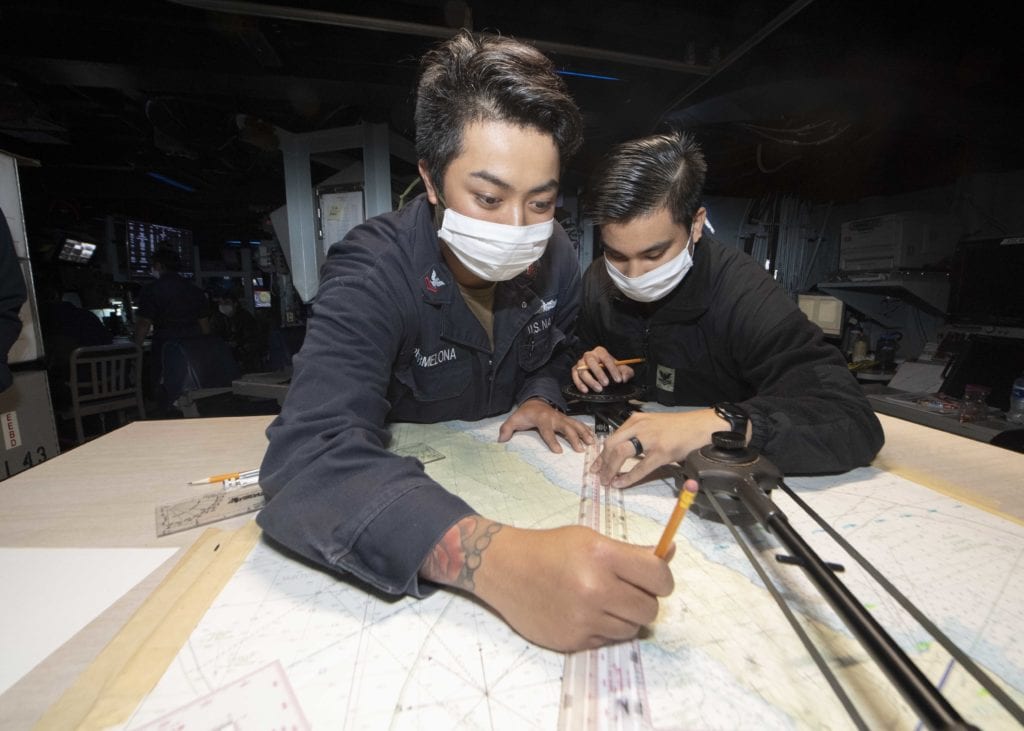
Operations Specialist 2nd Class Yves Permelona (left) and Operations Specialist 2nd Class June Canuel practice plotting courses during training aboard the USS Kidd, which is headed to San Diego for medical care for crew members and cleaning and disinfecting of the ship. Several Sailors there have tested positive for COVID-19. U.S. Navy/Mass Communication Specialist 3rd Class Brandie Nuzzi

SAN DIEGO — As part of the U.S. Navy’s response to the COVID-19 outbreak on board the guided-missile destroyer USS Kidd, the ship was to arrive at Naval Base San Diego on April 28 for medical care for its Sailors and for cleaning and disinfecting of the ship, according to Naval Surface Forces public affairs. 

“Sailors have called San Diego home for many years, and we’re especially thankful for that relationship now,” said Vice Adm. Richard Brown, commander of Naval Surface Forces. “Taking care of our Sailors and cleaning this ship is a team effort, and we’re fortunate that the partnership between the Navy and the city of San Diego is allowing us to focus on that mission.”

See: Decision on Crozier’s Fate Next in the Hands of Pentagon Officials 

See: Military Consumers React to Life During Pandemic

USS Kidd was at sea participating in counter-narcotics operations in the U.S. Southern Command area of responsibility when several of its Sailors began exhibiting flu-like symptoms. 

One Sailor was evacuated to the U.S. on April 22 after experiencing shortness of breath. The commander of the U.S. Pacific Fleet redirected the amphibious assault ship USS Makin Island — with its medical facility, including an intensive care unit, ventilators and additional testing capability — to rendezvous with the Kidd. 

“Taking care of our Sailors and cleaning this ship is a team effort, and we’re fortunate that the partnership between the Navy and the city of San Diego is allowing us to focus on that mission.”

Vice Adm. Richard Brown, commander of Naval Surface Forces

On April 23, eight medical personnel arrived on board the Kidd with equipment to begin testing the crew for COVID-19. As of April 25, 33 Sailors there had tested positive for the virus, the Navy reported. 

The Kidd’s executive officer, Cmdr. Matt Noland, released a letter via social media to friends and family on April 24. In it, Noland wrote, “The Navy pulled out all the stops — specialist doctors have already arrived from the United States to test and help care for our shipmates.” 

As Navy leadership solidified plans to return the ship to port, Sailors who warranted closer observation were transported from the Kidd to the Makin Island out of caution. An additional Sailor was medically evacuated to the United States. Meanwhile, the ship’s crew began intensive cleaning efforts while still underway. 
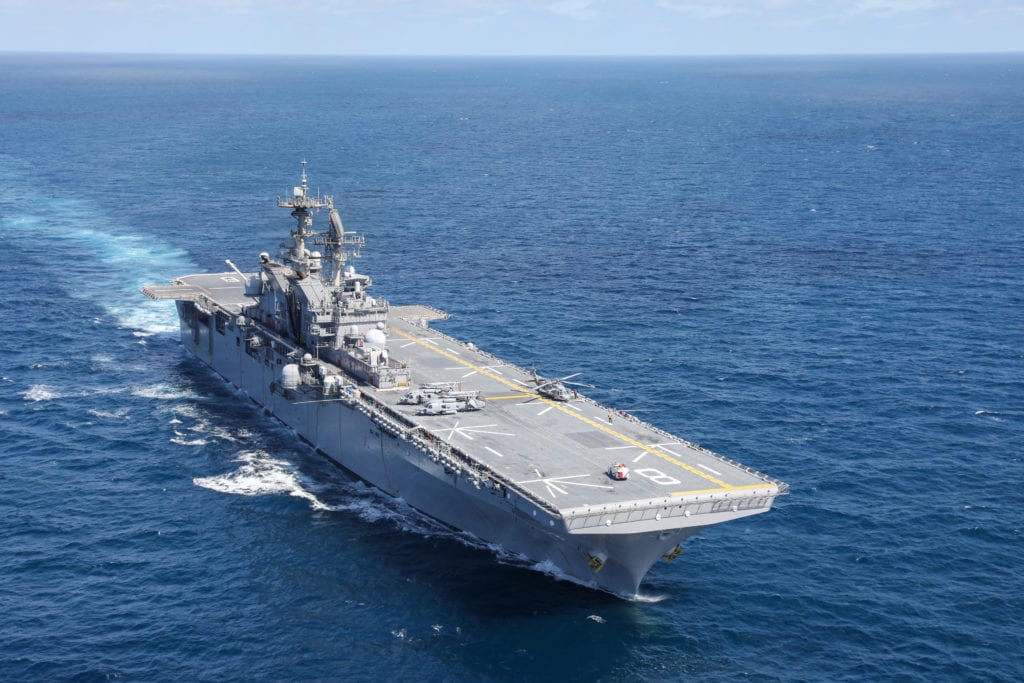
The amphibious assault ship USS Makin Island and its medical facilities and testing capabilities were diverted from routine operations in the eastern Pacific to rendezvous with the USS Kidd. U.S. Navy/Mass Communication Specialist 3rd Class Jacob D. Bergh

All Sailors will be isolated off the ship with twice-daily medical screenings. Crew members who have tested negative will quarantine for a period of observation, to include daily visits from military health professionals. 

A small contingent of Sailors who have tested negative will remain on the ship for essential services and deep cleaning. These Sailors will be outfitted with appropriate personal protective equipment (PPE) and will maintain social distancing, in accordance with U.S. Centers for Disease Control (CDC) guidance. 

“San Diego may not be USS Kidd’s home port, but we are definitely being made to feel at home,” said Cmdr. Nathan Wemett, commanding officer of the Naval Station Everett, Washington-based ship. “I am personally grateful to know that we have such a strong bond with our Navy communities. It’s the strength of those bonds that helps us work together in challenging situations.” 

While in San Diego, the Kidd will undergo a deep cleaning that balances decontamination with preventing damage to the ship’s systems. The cleaning process begins with spaces being vacated for seven days — four days longer than the minimum recommended by the CDC. The ship will be cleansed room-by-room, with access to each space restricted. The process is expected to take about two weeks, at which time Sailors who are confirmed to be healthy will return to the Kidd and Sailors moving off the ship will go into isolation. 

The Navy is providing a resiliency counselor, team of chaplains and psychologist for Sailors in isolation and quarantine. The Navy has also established a 24-hour roving patrol to ensure that Sailors who are sequestered off the ship are adhering to all public health and safety policies, the Navy said. 

USS Kidd Sailors have been told to immediately report any flu-like symptoms — a lesson learned from the USS Theodore Roosevelt and its Sailors, all of whom are now housed in Guam. 

As of April 25, the entire crew of the Roosevelt had been tested for the virus, with 833 total positive and 4,105 negative results, the Navy reported. A small number of results were pending. Of the total cases, 112 Sailors have recovered and 4,273 Sailors have moved ashore, the Navy said. 

Also, as of April 25, two assigned to the Roosevelt were in U.S. Naval Hospital Guam under treatment for COVID-19 symptoms. One Sailor from the Roosevelt died there earlier this month from complications of the infection, the Navy reported.


Decision on Crozier’s Fate Next in the Hands of Pentagon Officials

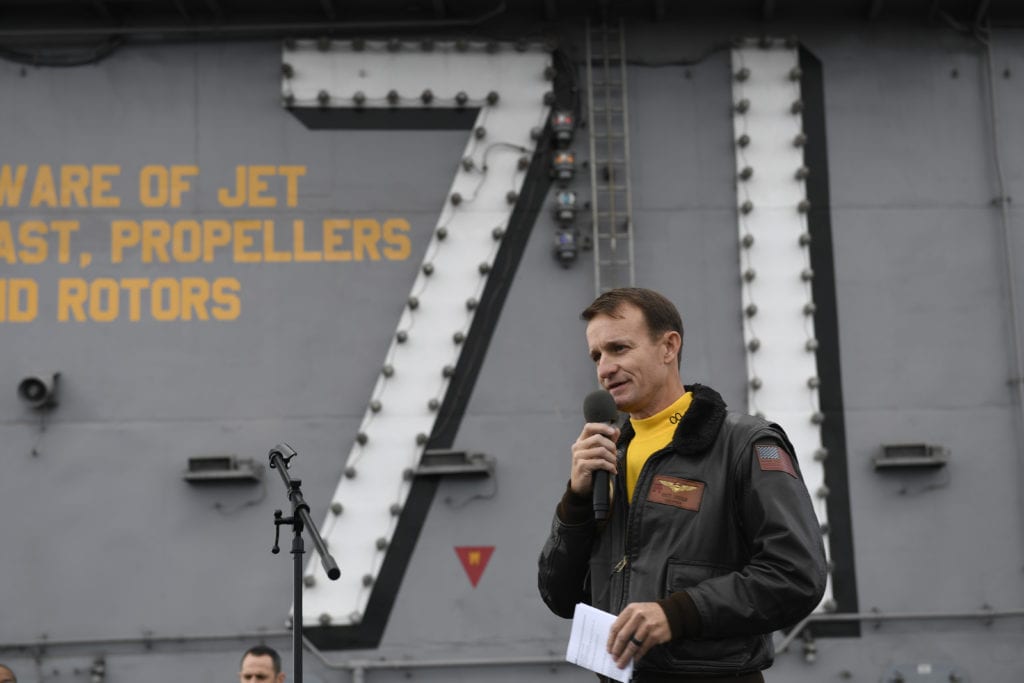
Capt. Brett Crozier, then-commanding officer of the aircraft carrier USS Theodore Roosevelt, addresses his crew during an all-hands call on the ship’s flight deck last November. U.S. Navy/Mass Communication Specialist 3rd Class Nicholas Huynh

ARLINGTON, Va. — Defense Department officials are reportedly split on reinstatement of Capt. Brett Crozier following his ouster as commander of the aircraft carrier USS Theodore Roosevelt earlier this month by then-Navy Secretary Thomas Modly.

After the end of a preliminary investigation into Crozier’s dismissal, top U.S. Navy officials announced April 24 that a recommendation on Crozier’s fate had been delivered to Modly’s replacement, acting Navy Secretary James McPherson, and that McPherson was still in talks with Defense Secretary Mark Esper on the question of restoring Crozier to his previous position.

See: Navy Provides Medical Care to Infected Sailors of USS Kidd, Will Disinfect Ship

See: Military Consumers React to Life During Pandemic

However, several media outlets have reported April 24 and since that McPherson and Chief of Naval Operations Adm. Mike Gilday recommended that Crozier be restored to his former command.

Another outlet said Chairman of the Joint Chiefs of Staff U.S. Army Gen. Mark Milley wanted to pump the brakes and recommended a longer and more detailed investigation before Crozier’s status is determined.

Rep. Adam Smith (D-Wash.), chairman of the House Armed Services Committee, emphatically weighed in April 24 in favor of Crozier’s reinstatement. “The secretary of defense needs to reinstate Capt. Brett Crozier as commanding officer of the USS Theodore Roosevelt,” Smith said in his statement.

Roosevelt Sailors stand by to depart the ship for quarantine after completing watch-standing duties on April 25. Upon arriving in Guam on March 27, the ship established an emergency command center, initiated a roving and deep cleaning team and started educating the crew on social distancing and protective procedures and behaviors. U.S. Navy/Mass Communication Specialist 1st Class Chris Liaghat

The Navy was less committal, at least publicly, that day — so a final decision may take days or weeks longer. President Trump may also reportedly weigh in.

“This afternoon, Secretary Esper received a verbal update from the acting secretary of the Navy and the chief of naval operations on the Navy’s preliminary inquiry into the COVID-19 outbreak on the [Roosevelt],” Jonathan Rath Hoffman, public affairs assistant to Esper, said April 24.

“After the secretary receives a written copy of the completed inquiry, he intends to thoroughly review the report and will meet again with Navy leadership to discuss next steps. He remains focused on and committed to restoring the full health of the crew and getting the ship at sea again soon.”

Gilday directed Vice Chief of Naval Operations Adm. Robert Burke to investigate the circumstances and climate of the entire Pacific Fleet “to help determine what may have contributed to a breakdown in the chain of command,” Modly said April 2, the day he announced that Crozier was relieved of his command.

A day earlier, at a press briefing on the Roosevelt virus outbreak, Gilday spoke of “a potential comms breakdown, wherever it occurred,” adding “we’re not looking to shoot the messenger here, we want to get this right.”

Crozier was fired by Modly after a March 30 letter the captain wrote to top Navy officers and fellow naval aviators leaked to a San Francisco newspaper, the San Francisco Chronicle, which published a story the next day. The publication of the letter sparked an outcry and worldwide media attention over Crozier’s actions and the fate of the carrier’s crew.

“The secretary of defense needs to reinstate Capt. Brett Crozier as commanding officer of the USS Theodore Roosevelt.”

Rep. Adam Smith, House Armed Services Committee chairman

A week later, Modly added fuel to the fire with a profanity-laced speech criticizing Crozier in front of the nuclear carrier’s crew that went viral on social media. Modly had to resign the next day, April 7, in the wake of the expanding controversy.

At the time Crozier wrote his letter, three Sailors on the Theodore Roosevelt had tested positive for COVID-19, but many more were later found to be infected after the carrier made a scheduled port visit to Guam. As of April 25, the Navy reported that the entire crew had been tested for the virus, with 833 total positive and 4,105 negative results. A small number of results were pending, the Navy added. Of the total cases, 112 Sailors have recovered and 4,273 Sailors have moved ashore.

Two Sailors assigned to the Roosevelt were in U.S. Naval Hospital Guam under treatment for COVID-19 symptoms. None of those hospitalized for the virus was in the intensive care unit. However, one Sailor from the Roosevelt did die there earlier this month from complications of the infection, the Navy reported.
In his letter, the captain wrote that he believed the carrier had inadequate space to isolate or quarantine Sailors. He also pleaded for faster intervention from his superiors to assist his crew. “We are not at war. Sailors do not need to die,” Crozier wrote. “If we do not act now, we are failing to properly take care of our most trusted asset — our Sailors.”

He was hailed as a hero by his crew — who were seen on video cheering him on during his departure from the ship in Guam — as well as some in and out of the military, while others criticized him for circumventing the Navy’s chain of command.

“What we’ve learned from the TR is very informative,” Hoffman said April 24 of the rapid rise of COVID-19 cases on the carrier.

That has led to a priority-based, tiered system of testing starting with critical national capabilities, like strategic nuclear deterrent units, working its way through fielded forces around the world, forward-deployed and redeploying forces and the rest of the force.

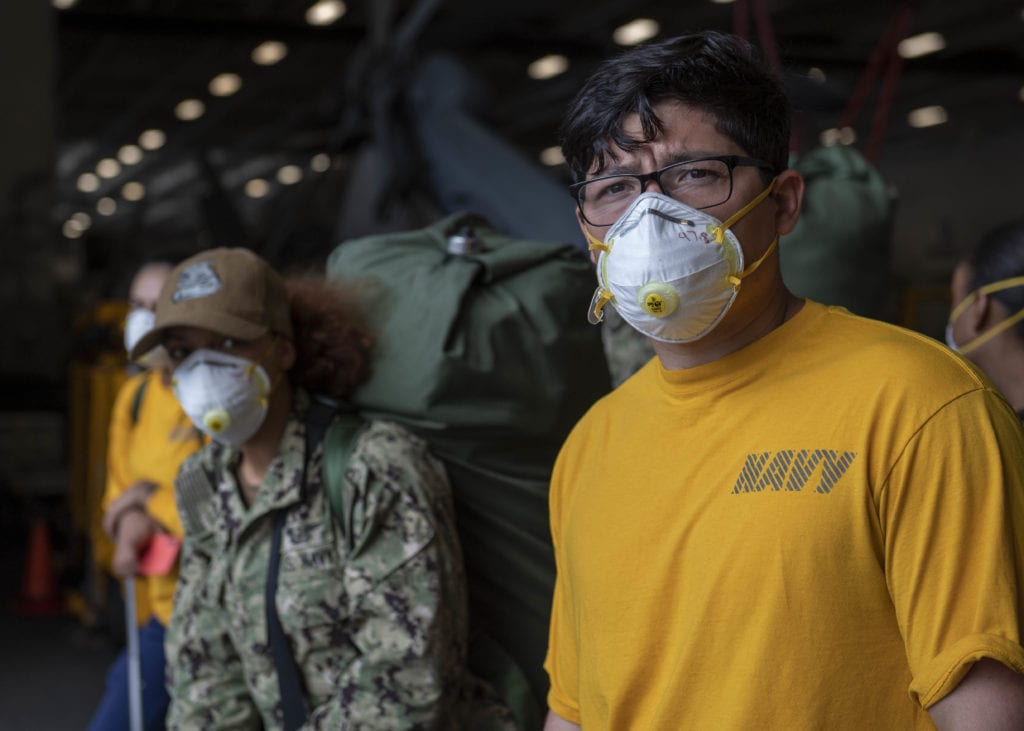
Meanwhile, an embarked medical team continues testing aboard the guided missile destroyer USS Kidd in the eastern Pacific, where 33 Sailors have tested positive for COVID-19. Two Sailors have been medically evacuated to the United States. Sailors aboard the Kidd are wearing PPE and N95 masks. The amphibious ship USS Makin Island, with a fleet surgical team, ICU capacity and ventilators and additional testing capability, is en route to rendezvous with the Kidd in case medical support is required at sea.

The Navy continues to lead all armed services with 1,659 cases of the novel coronavirus, followed by the Army with 995, the National Guard with 792, the Air Force with 347 and the Marine Corps with 304, according to the latest data released by the Defense Department on April 27. There have been only two deaths among military personnel.

Seapower Correspondent John M. Doyle contributed to this report.


Navy Awards Orders 9th Full-Rate Production Lot of AARGMs

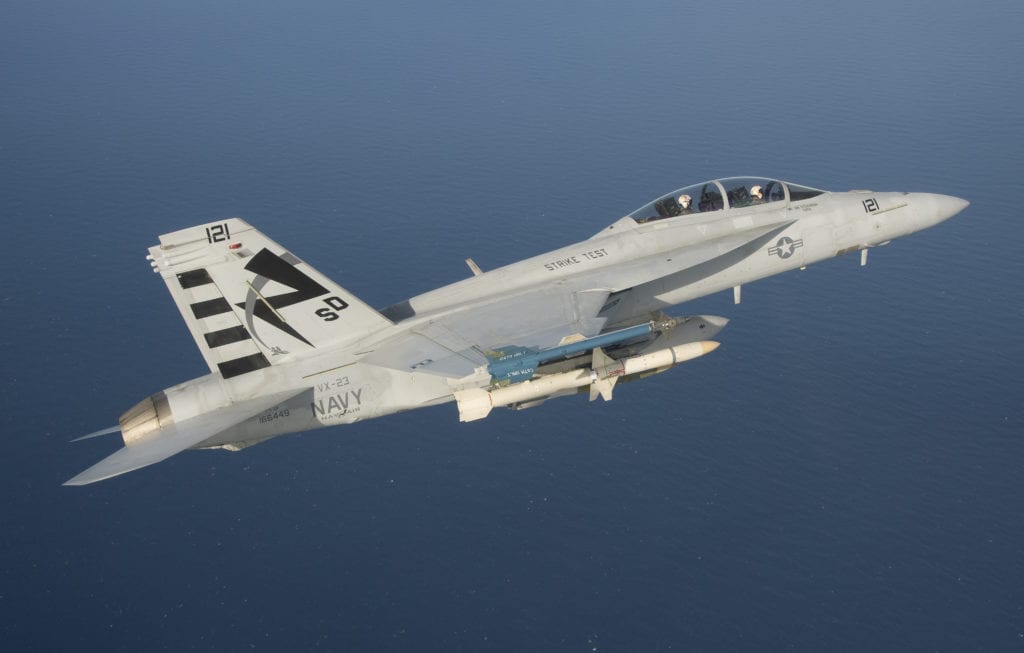
A 2012 photo of an F/A-18F Super Hornet assigned to the Salty Dogs of Air Test and Evaluation Squadron (VX) 23 conducting a captive carry flight test of an AGM-88E Advanced Anti-Radiation Guided Missile at Naval Air Station Patuxent River, Maryland. U.S. Navy / Greg L. Davis

LOS ANGELES — The U.S. Navy has awarded Northrop Grumman Corp. $165 million for Lot 9 full-rate production (FRP) of the AGM-88E Advanced Anti-Radiation Guided Missile (AARGM), the company said in an April 23 release. Assets will include all-up round missiles and captive air training missiles for the U.S. Navy and foreign military sales. 

“AARGM provides the U.S. Navy and allies unmatched protection to detect and defeat surface-to-air-threats regardless of threat tactics and capabilities,” said Gordon Turner, vice president, advanced weapons, Northrop Grumman. 

Northrop Grumman’s AARGM is a supersonic, air-launched tactical missile system, upgrading legacy AGM-88 HARM systems with advanced capability to perform suppression and destruction of enemy air defense missions. AARGM is the most advanced system for pilots against today’s modern surface-to-air threats, according to the company. It is able to engage land- and sea-based air-defense threats, as well as striking, time-sensitive targets. 

AARGM is a U.S. Navy and Italian air force international cooperative major defense acquisition program with the U.S. Navy as the executive agent. AARGM is currently deployed and supporting operational requirements for the U.S. Navy and U.S. Marine Corps. The missile is integrated into the weapons systems on the FA-18C/D Hornet, FA-18E/F Super Hornet, EA-18G Growler aircraft and the Tornado Electronic Combat and Reconnaissance aircraft utilized by the Italian air force. 


General Atomics’ EMALS and AAG Support Successful Ford Flight Deck Certification

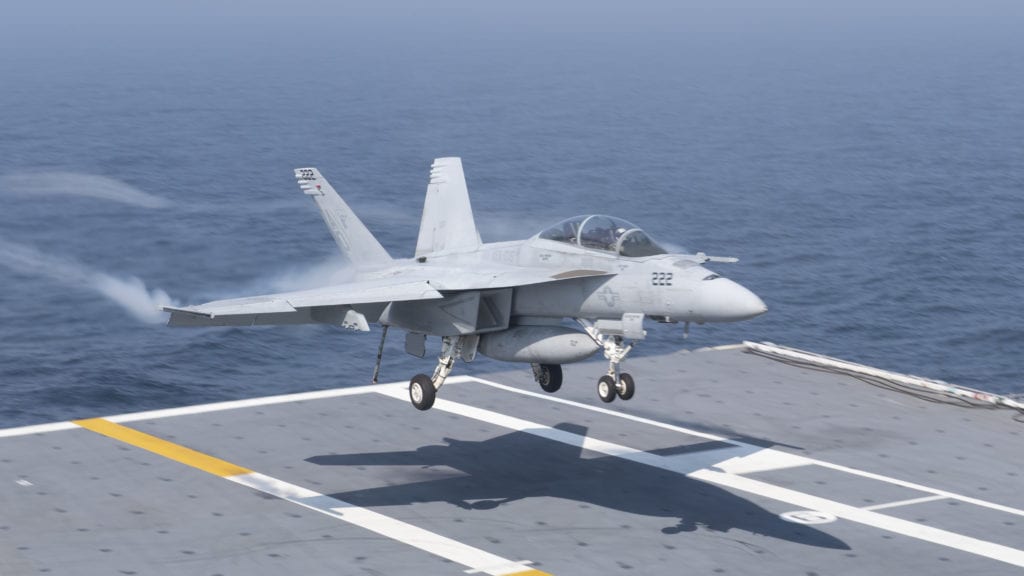
An F/A-18F Super Hornet, attached to the “Gladiators” of Strike Fighter Squadron (VFA) 106, lands on the flight deck of the aircraft carrier USS Gerald R. Ford (CVN 78) during flight operations, March 28, 2020. Ford is underway in the Atlantic Ocean conducting carrier qualifications. U.S. NAVY / Mass Communication Specialist Seaman Apprentice Sawyer Connally

SAN DIEGO — General Atomics Electromagnetic Systems (GA-EMS) announced April 23 that successful USS Gerald R. Ford (CVN 78) Flight Deck Certification (FDC) has been completed with the support of the electromagnetic aircraft launch system (EMALS) and advanced arresting gear (AAG) system. The number of aircraft to have landed and taken off from CVN 78 now totals more than 2,000. CVN 78 used fleet squadrons from Carrier Air Wing Eight, as well as pilots from Strike Fighter Squadron 106 and Carrier Airborne Early Warning Squadron 120 to obtain hundreds of sorties over a two-week period with all arrested landings and catapult launches completed safely.  

“We continue to see EMALS and AAG perform according to specifications to execute cats and traps with the objective of reaching the robust evolution rates necessary for combat,” stated Scott Forney, president of GA-EMS. “We are working closely with the Navy and CVN 78 crew to ensure operational performance is achieved. We remain extremely proud of our team, the squadrons’ pilots and the ship’s crew for all their hard work and dedication and look forward to continuing success as CVN 78 undergoes these continued at sea periods.” 

FDC is a qualification of the ship’s various aviation systems and includes the crews’ qualification to operate the numerous systems. FDC was completed March 20 following day and night launch and recovery exercises with F/A-18E/F Super Hornets. FDC is intended to qualify and prove ship and crew capabilities under operational conditions that can occur while on deployment. 

On Jan. 31, CVN 78 completed aircraft compatibility testing, a significant milestone that exhibited EMALS and AAG’s ability to launch and recover five types of aircraft in varying configurations — four of which for the first time. CVN 78 proved to accommodate the current naval air wing, including F/A-18E/F Super Hornet, E-2D Advanced Hawkeye, C-2A Greyhound, EA-18G Growler and T-45C Goshawk aircraft.  

GA-EMS is delivering EMALS and AAG for the future USS John F. Kennedy (CVN 79) and USS Enterprise (CVN 80).  


Senate Bill Would Fund Second Virginia-Class Sub in 2021

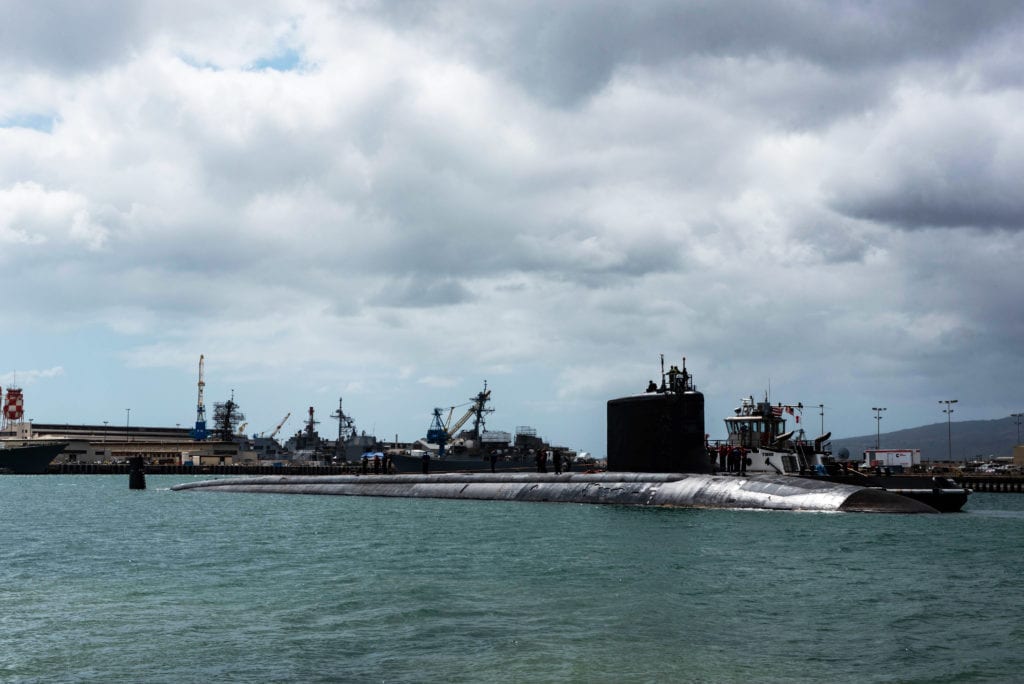
The Virginia-class fast-attack submarine USS North Carolina departs Joint Base Pearl Harbor-Hickam on March 25 for a regularly-scheduled deployment. A member of the Senate Armed Services Committee has introduced a $43 billion bill that would fund, among other things, a second Virginia-class sub in fiscal year 2021. U.S. Navy/Mass Communication Specialist 1st Class Michael B. Zingaro

ARLINGTON, Va. — A member of the Senate Armed Services Committee has introduced a $43 billion bill to strengthen U.S. forces in the Indo-Pacific to counter Chinese competition and that would fund, among other things, some of the U.S. Navy’s priorities on its unfunded list, including a second Virginia-class attack submarine. 

Sen. Tom Cotton (R-Ark.) introduced the Forging Operational Resistance to Chinese Expansion (FORCE) Act on April 22, which his office said is a “critical investment in the United States’ ability to compete with China.” 

The bill would include “$6.1 billion to regain the advantage in the Indo-Pacific region; $9.2 billion in capability increases for Great Power Competition; $11 billion for mitigating coronavirus impacts to procurement programs; $3.3 billion for mitigating coronavirus impacts to [the] defense industrial base; $1.5 billion for hospital ship recapitalization; [and] $12.0 billion to enhance national resilience and critical infrastructure.” 

The bill would provide $3.9 billion to upgrade naval lethality, a summary of the bill said, including funds for:  

  • A second fiscal 2021 Virginia-class submarine. 
  • Virginia-class submarine industrial base expansion. 
  • Subsea and seabed warfare capability for the Virginia class.   
  • Advanced procurement for the Columbia-class ballistic-missile submarine 
  • Additional Naval Strike Missiles and their launchers. 
  • Integration of the long-range air-to-surface missiles on all combat aircraft. 
  • Additional sonobuoys for anti-submarine warfare. 
  • Marine Corps modernization, including ground-based anti-ship missiles. 

The bill also would fund adding hypersonic weapons on compatible fighter aircraft and accelerating development of directed energy weapons and cyber offensive and defensive capabilities. 

Also provided in the bill would be $4.88 billion to the Navy and Marine Corps to “provide emergency aid for those programs that are most vulnerable” to mitigate the effects of the COVID-19 pandemic, including funds for shipbuilding and conversion; the Columbia-class submarine industrial base; aircraft procurement; operations and maintenance; and research, development, test and evaluation.  

Cotton’s bill also specifically provides “funding for the Navy to replace the [hospital ships] USNS Comfort and USNS Mercy with new American-built vessels. This would be an opportunity to provide American jobs and grow the American industrial base for the future,” the bill summary said. 

The summary of the bill can be found here.


Pentagon Plans Testing, Screening, Manufacturing Push in COVID-19 Battle

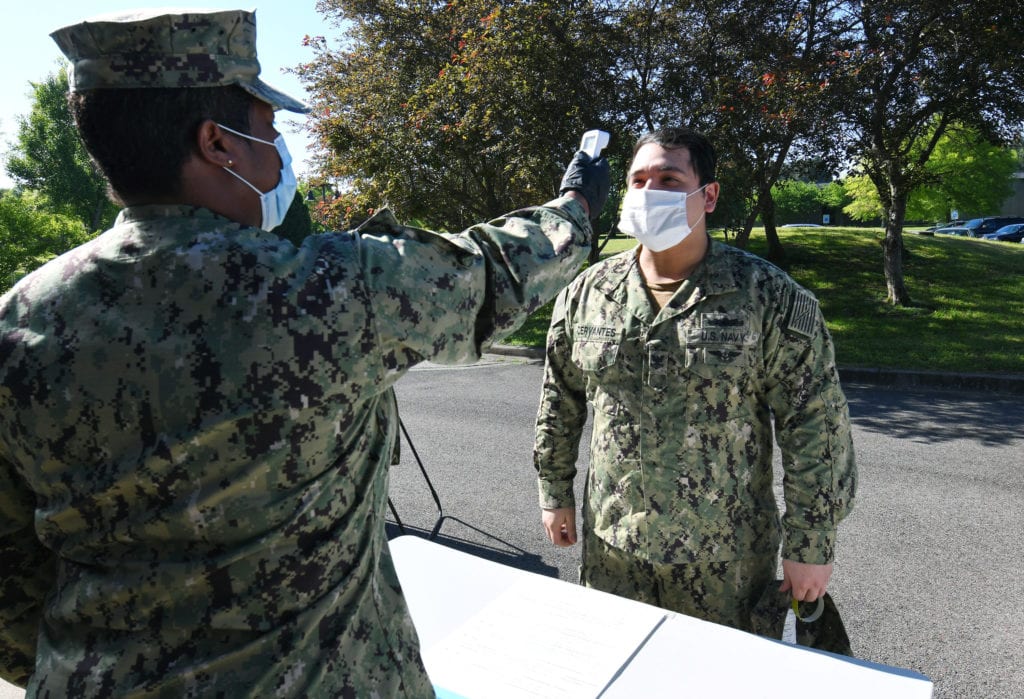
Master Chief Personnel Specialist Nikita Maher (left) uses a touchless thermometer on Personnel Specialist 2nd Class Francisco Cervantes at an entrance checkpoint of Goetsch Hall at Navy Personnel Command in Millington, Tennessee. U.S. Navy/Chief Mass Communication Specialist Michael Russell

ARLINGTON, Va. — The Defense Department is rolling out new strategies for screening the force for the novel coronavirus to halt the spread, spot those needing medical treatment early and still enable the military to fulfill its mission, according to two top Pentagon officials.

“As we learn more about the virus, we will continue to evolve our approach,” Deputy Defense Secretary David Norquist told a Pentagon press briefing that was live-streamed on April 22.

He noted that hundreds of thousands of active-duty and civilian personnel are teleworking. However, for thousands more who cannot practice social distancing because they work in constrained spaces like new recruits in training or Sailors and Marines on ships or submarines at sea, there is a new general process to screen for COVID-19.

For those groups, the first of four containment steps is screening with the use of questionnaires and thermometers to identify at-risk individuals. Next comes 14 to 21 days of quarantine, depending on a unit’s risk tolerance, to identify those who are infected but not yet showing symptoms. A third step calls for conducting swab tests and temperature checks, prior to leaving quarantine, to identify those who have since become infected but remain asymptomatic. Finally, as a unit moves to its mission, Norquist said, “we’ll keep this group together but limit its outside interaction to prevent the introduction of infection.”

“As we learn more about the virus, we will continue to evolve our approach.”

Deputy Defense Secretary David Norquist

Procedures like face coverings, hand washing, maintaining clean workspaces and continued monitoring will all still apply as units move forward while therapeutic treatments and vaccines are still being developed, he said.

COVID-19 had infected more than 802,000 people in the U.S. and had killed 44,575 as of April 21, according to the U.S. Centers for Disease Control and Prevention. The Pentagon reported on April 22 that 3,578 cases of COVID-19 have been detected among U.S. military and civilian personnel, dependents and contractors; 25 have of those have died. The U.S. Navy continues to have the largest number of cases — 1,298 — compared to 841 for the Army, 337 for the Air Force, 259 for the Marine Corps and 713 for the National Guard.

Meanwhile, under the authorities granted by the Defense Production Act, the government is moving to increase production of critical N95 masks to 39 million in the next 90 days and to 141 million over the next six months, Norquist said. The Pentagon is working with vendors to increase swab production from three million a month to 20 million, also boosting production of personal protective equipment for medical personnel, reagents for testing kits and active pharmaceutical ingredients.

As testing supplies become more prevalent, testing will be conducted through a priority-based, tiered system recently approved by Defense Secretary Mark Esper, Air Force Gen. John Hyten, the vice chairman of the Joint Chiefs of Staff, told the press briefing.

Tier 1 will focus on critical national capabilities, like strategic nuclear deterrent units. Tier 2 will focus on engaged, fielded forces around the world. Tier 3 is for forward-deployed and redeploying forces and Tier 4 includes the remainder of the military.

Hyten was asked if he thought it was unwise for the Army Corps of Engineers to continue building treatment facilities, with hundreds of beds, in big city convention centers, even as existing ones are under-used.

“For gosh sakes, no! That’s what I want to see,” he said. If the beds are all filled, that means local hospitals have been overwhelmed. “You always want to have excess capacity, not too little capacity,” he added.


Trump Authorizes Navy to Fire on Harassing Iranian Craft

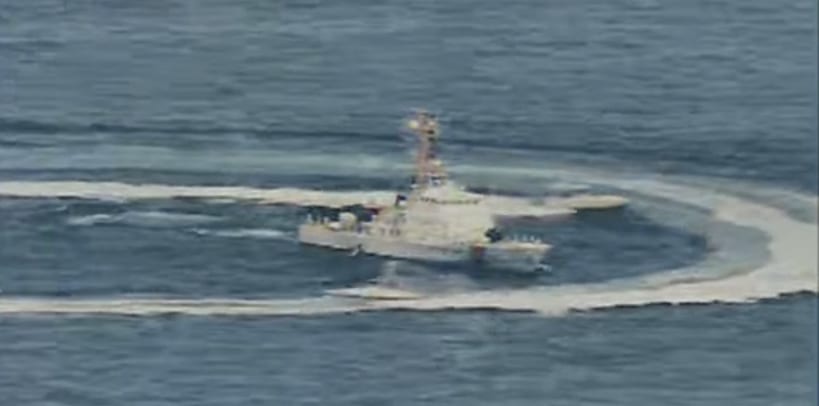
Iranian vessels harass a U.S. ship by crossing its bow and stern. U.S. forces are conducting joint interoperability operations in the U.S. 5th Fleet area of operations in the northern Persian Gulf. U.S. Navy

ARLINGTON, Va. — President Trump has authorized the U.S. Navy to fire on Iranian boats that harass American ships, following a recent episode where armed Iranian craft came dangerously close to and harassed Navy and U.S. Coast Guard vessels engaged in an exercise in the northern Persian Gulf.  

“I have instructed the United States Navy to shoot down and destroy any and all Iranian gunboats if they harass our ships at sea,” Trump said in an April 22 tweet. 

Under routine rules of engagement, U.S. ships are inherently authorized to fire in self-defense, but this new authority gives the ships’ commanders permission to fire if they are being harassed by the Iranian craft. 

“If we see a hostile act, if we see hostile intent, we have the right to respond up to and including lethal force and, if it happens in the Gulf, if it happens in any way, we will respond with overwhelming lethal force, if necessary, to defend ourselves. It’s really that simple.”

Air Force Gen. John Hyten, vice chairman of the Joint Chiefs of Staff

“On April 15, 11 Iranian Islamic Revolutionary Guard Corps Navy (IRGCN) vessels repeatedly conducted dangerous and harassing approaches of the USS Lewis B. Puller, USS Paul Hamilton, USS Firebolt, USS Sirocco, USCGC Wrangell and USCGC Maui while the U.S. vessels were conducting joint integration operations with U.S. Army AH-64E Apache attack helicopters in the international waters of the North Arabian Gulf,” the U.S. 5th Fleet said in a release. 

“The IRGCN vessels repeatedly crossed the bows and sterns of the U.S. vessels at extremely close range and high speeds, including multiple crossings of the Puller with a 50-yard closest point of approach and within 10 yards of Maui’s bow,” the release added. 

“The U.S. crews issued multiple warnings via bridge-to-bridge radio, five short blasts from the ships’ horns and long-range acoustic noise maker devices but received no response from the IRGCN. After approximately one hour, the IRGCN vessels responded to the bridge-to-bridge radio queries, then maneuvered away from the U.S. ships and opened distance between them.”  

The Iranians occasionally have used their small, fast, armed and highly maneuverable boats in swarms to harass naval and merchant ships in the Persian Gulf and last year captured merchant ships flagged in the United Kingdom and other nations. 

Many U.S. ships are armed with Mk38 25 mm chain guns and M2 .50-caliber machine guns — in addition to larger-caliber guns on some ships — for countering fast attack craft, while many helicopters based on U.S. ships are armed with Hellfire and Advanced Precision Kill Weapon System guided missiles that are effective against such craft. 

In January 2016, Iranian boats seized two U.S. Navy riverine command boats and detained the crews after the U.S. boats strayed into Iranian waters off Farsi Island in the Persian Gulf. The crews and boats later were released. 

“The IRGCN’s dangerous and provocative actions increased the risk of miscalculation and collision, were not in accordance with the internationally recognized Convention on the International Regulations for Preventing Collisions at Sea ‘rules of the road’ or internationally recognized maritime customs and were not in accordance with the obligation under international law to act with due regard for the safety of other vessels in the area,” according to the 5th Fleet release. 

Questioned at an April 22 Pentagon news conference, Deputy Defense Secretary David L. Norquist said that “all of our ships retain the right of self-defense and people need to very careful in their interactions to understand the inherent right of self-defense.” 

“Every capability that we deploy — every ship that deploys into harm’s way — has the inherent right of self-defense, as the secretary just described,” said Air Force Gen. John Hyten, vice chairman of the Joint Chiefs of Staff, who also spoke at the news conference. 

“What that means: if we see a hostile act, if we see hostile intent, we have the right to respond up to and including lethal force and, if it happens in the Gulf, if it happens in any way, we will respond with overwhelming lethal force, if necessary, to defend ourselves. It’s really that simple. Nobody should doubt that the commanders have the authority right now to respond to any hostile act or hostile intent.” 

“I like that the president warned an adversary,” Hyten said. “That’s what he’s doing — he’s providing a warning. ‘If you want to go down that path, we will come, and we will come large, so don’t go down that path.’ He’s saying it in clear, certain terms. We understand that direction, and every commander that is deployed has the ability to execute that.” 

Norquist said he thought the intent of the president’s tweet was clear. “When you talk about harassment, you’re talking about actions designed to provoke, actions designed to threaten. It’s a very clear message that the Iranians should understand.” 

Hyten added: “You can’t let a fast boat get into a position where they can threaten your ship. We have very specific guidance on how we can use lethal force.”


Navy Cybersecurity Director: ‘No Relaxation of Defenses’ During Telework Time

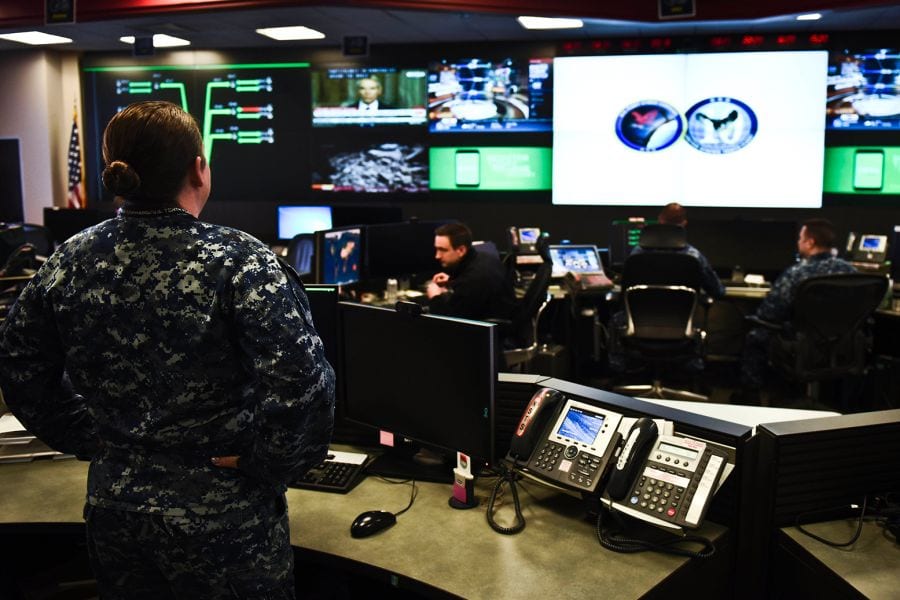
Sailors stand watch in the Fleet Operations Center at the headquarters of U.S. Fleet Cyber Command. U.S. Navy

ARLINGTON, Va. — The U.S. Navy is maintaining a vigilant cyber watch over its data networks as it balances network security and protecting the health of its Sailors amid the COVID-19 pandemic, a Navy admiral said. 

“We’re trying to balance two different priorities,” Rear Adm. Kathleen Creighton, director of cybersecurity in the Office of the Chief of Naval Operations, said during an April 17 webcast that was part of the Navy League’s Sea-Air-Space 2020: Virtual Edition. “One is keeping our Sailors and civilians safe and to enable them to work remotely and second is to ensure operational readiness.” 

To register and then watch this Sea-Air-Space 2020: Virtual Edition webinar live online, click here.

Creighton said the Navy has had to go through a big cultural shift from working in offices to “ensuring as many people as possible can work from home remotely.” 

She said that, in addition to Defense Department partners, the Navy’s industry partners had taken a “first responder-type approach to helping the Navy” by adding infrastructure to handle the ballooning demand for secure telework. 

“We’re trying to balance two different priorities. One is keeping our Sailors and civilians safe and to enable them to work remotely and second is to ensure operational readiness.”

Rear Adm. Katherine Creighton

The admiral cited the need for significant expansion of capacity, the need to maximize collaboration capabilities, and determination of any need to change cybersecurity policy “to ensure we can take advantage of remote telework options.” 

She said that “on any given day probably only a few thousand people accessed the Navy’s network remotely … before COVID-19. Now, we are seeing upwards of 150,000 or more people accessing the network remotely.” 

The great increase in telework required an expansion in capacity requirement for laptop computers, mobile phones, iPads and the VPN servers that they connect to as well as an expansion of Microsoft Outlook 365 use. Circuitry also had to be added to handle the increased use of devices as well as more people manning the help desk for the network. 

Creighton said the Navy “has been on a road to modernize and to start using more collaboration capabilities, and this crisis has pushed us to roll those out faster. We’re using some temporary capabilities, and we’re looking to accelerate our permanent capabilities.” 

She said the Navy is discovering where the bottlenecks in the network are and fixing them on a piece-by-piece basis. In addition to expanded circuitry, the Navy has been cleaning up user accounts and increasing licenses. 

“Every time we increased the capacity, it was used. It filled right up,” she said. “So, the Navy is taking working from home very seriously, trying to protect our Sailors and civilians.” 

“Our adversaries in cyberspace know we were doing business differently, so they are responding in kind,” she said, “so we have made sure that anything we have done has not relaxed our cybersecurity standards.” 

“There has been no relaxation of any defenses,” she said. “We are securely connecting with that same network from home.” 

Creighton said a temporary cloud is being set up to handle a faster roll-out of Office 365. 

Looking to the future after the COVID-19 pandemic, Creighton said she believes “there would be a desire to continue a greater level of telework than we saw in the past, so we need to be sure that our network has the capacity to do that, that we have the procedures in place to do it, but most importantly we’re able to do it securely to protect our information and our people’s identity and other things we value as a Navy.” 


Marine Cyber Official: ‘Our Networks Are Resilient’ in COVID-19 Environment

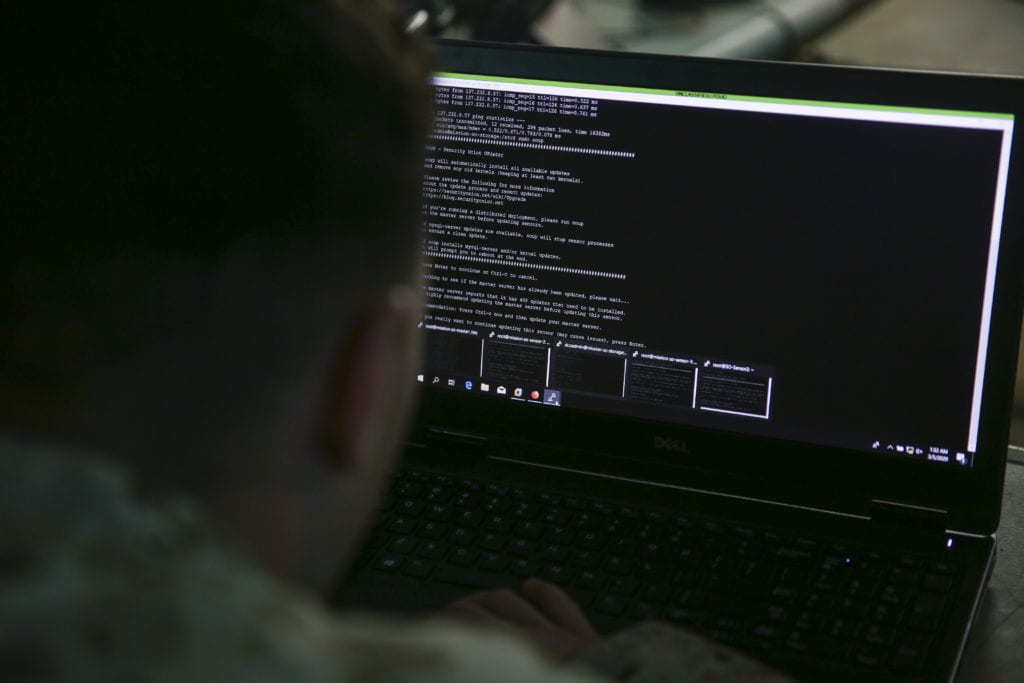
A U.S. Marine assess data during an exercise, Native Fury 20, in the United Arab Emirates on March 5. U.S. Marine Corps/Sgt. Alexis Flores

ARLINGTON, Va. — The U.S. Marine Corps’ cyber networks are being defended and upgraded even as the COVID-19 pandemic forces ad hoc adaptation in their operation, a senior Marine Corps official said. 

“Our networks are good, and they are operating at a good capacity and are resilient,” said Gregg Kendrick, executive director of Marine Corps Forces Cyberspace Command, speaking April 17 in a webcast for Navy League’s Sea-Air-Space 2020: Virtual Edition. 

To register and then watch this Sea-Air-Space 2020: Virtual Edition webinar live online, click here. 

“We’re pleased with our effective efforts in our ability to support the force as it has gone to ad hoc telework or alternate work sites and maintain our capacity and, more importantly, our operational capability to support our warfighters and our commanders that are out there deployed in harm’s way.”  

Kendrick said the Corps is monitoring its networks differently in the current environment. 

“We do look at our virtual private networks and then we look at our physical and transport layer, our network stack from Layer 1 to Layer 4, so from that perspective we’re focused on those types of metrics and really watching our latency,” he said. 

“So, we are very focused on the security. Every decision we have made in regards to supporting the ad hoc telework option has really [been] focused. We’ve had a fundamental security look, and we’ve really looked at our modernization efforts to ensure that we are aware of any of the advanced persistent threats and/or capabilities that are out there to ensure that we have a good, resilient as well as available network.” 

“We’re pleased with our effective efforts in our ability to support the force as it has gone to ad hoc telework or alternate work sites and maintain our capacity.”

Gregg Kendrick, Marine Corps Forces Cyberspace Command

Kendrick said his force is looking at “which applications are in use the most, which are stressed the most at the highest capacity, what exactly are our latent measures, … and our overall bandwidth [including] by bandwidth region. Everything [security metrics] is funneled through our enterprise security desk so that we can rapidly pull metrics and shift resources as needed to support our Marine warfighters.” 

He said Cyberspace Command is starting to see trends in the pandemic environment, “but we are definitely waiting for this to evolve and then we will be able to draw conclusions, but at the same time we don’t want to let a trend propagate to a point where we have to go into a different work cycle.” 

“The bad guys are always looking at what we’re doing, and they are looking to do harm,” Kendrick said. “We protect our workforce. We secure, operate and defend the Marine Corps enterprise networks.” 

Kendrick said that through the Corp’s new command-and-control network structure the service is bringing a “unity of command that provides a much clearer readiness picture of our network, our resiliency picture, and then a better overall visualization of the data flow from the end points all the way to the data centers and then back out where they need to go.” 

The executive director said the Corps is adopting Microsoft Office 365 to achieve a more efficient capability combined with a hybrid cloud architecture, aiming for higher velocity. 

“In the end state the adversary gets a vote,” he said. “They move at speed unconstrained by rules of engagement or the laws of nation states. We need to implement the best infrastructure, the best applications, the best operational processes as efficiently as possible so that we can modernize, provide the best capability to the warfighter, at the same time ensuring security from adversary actions and resiliency across the networks.”


Space, the Hostile Frontier: Panel Explores Defense of Earth Orbit

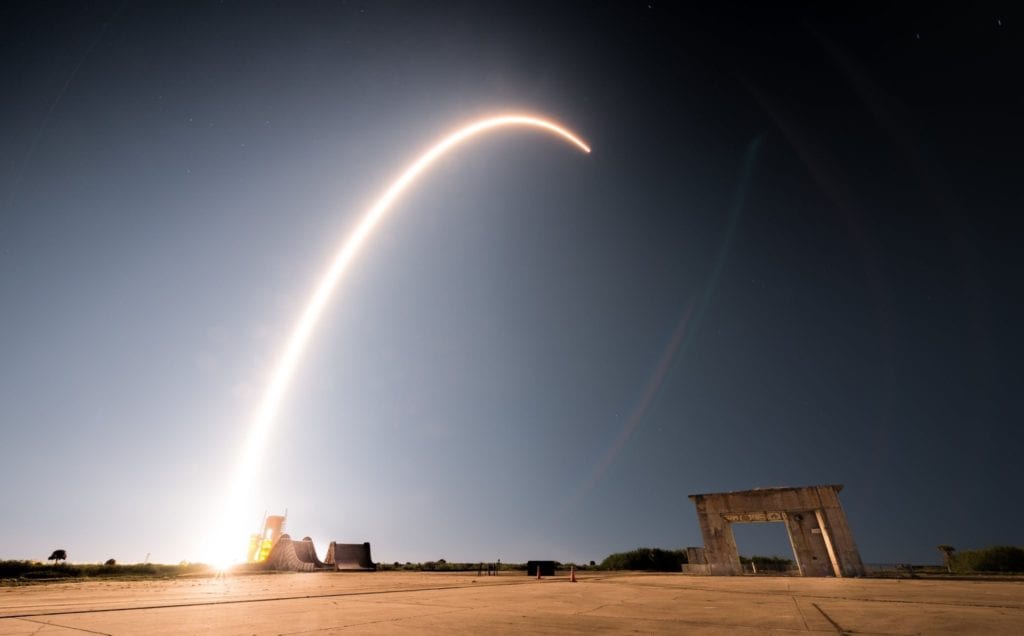
A Falcon 9 rocket launches on Jan. 6 at Cape Canaveral Air Force Station, Florida. The rocket, carrying an installment of Starlink satellites, was the first official launch of the U.S. Space Force. U.S. Air Force/Joshua Conti

Space is not benign — no longer just the domain of unmanned scientific probes and occupied by astronauts in capsules or space stations exploring and conducting research, panelists stressed during a webcast that was aired on April 16 as part of the Navy League’s Sea-Air-Space 2020: Virtual Edition. 

“Space, internationally, is very important to our way of life. It’s of strategic importance. We see our adversaries starting to weaponize space,” said Rear Adm. Marcus Hitchcock, director of strategy, plans and policy at U.S. Space Command, the unified combatant command responsible for American military operations in outer space.

To register and then watch this Sea-Air-Space 2020: Virtual Edition webinar live online, click here. 

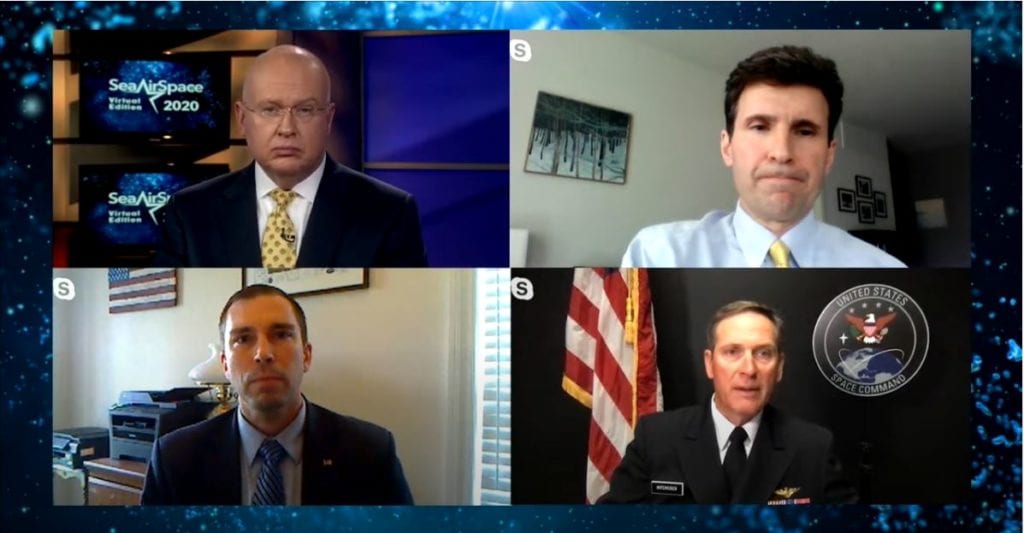
Other guests in the panel discussion, which was moderated by Francis Rose, included Derek Tournear, director of the Space Development Agency, and Christian Zur, executive director of the Procurement and Space Industry Council of the U.S. Chamber of Commerce. 

“We’ve seen a massive explosion in everything space, at the national level and in our military,” Hitchcock observed, noting the establishment last year of the newest branch of the military, the U.S. Space Force. “Every morning we leap out of bed and we come in and stand the watch to maintain our space domain.” 

The discussion during the webinar for the Navy League’s Sea-Air-Space 2020: Virtual Edition included (clockwise) moderator Francis Rose, Christian Zur, executive director of the Procurement and Space Industry Council of the U.S. Chamber of Commerce, Derek Tournear, director of the Space Development Agency, and Adm. Marcus Hitchcock, director of strategy, plans and policy at U.S. Space Command.

The admiral observed that space has already seen its share of incidents, such as the 2017 launch of a missile by the People’s Republican of China, a “Great Power Competitor” along with Russia, that shot down a satellite in low-earth orbit. “This is a very real example of our adversaries or potential adversaries developing counter-space offensive weapons that can test our supremacy.” 

A satellite recently launched by Russia also is believed to have the capability to damage or disable U.S. Military assets in orbit, Hitchcock added. 

To maintain America’s strategic high ground in space, Tournear said the U.S. needs to maintain its technological advantage but speed up the frequency of its launches of defense assets. 

“Space, internationally, is very important to our way of life. It’s of strategic importance. We see our adversaries starting to weaponize space.”

Adm. Marcus Hitchcock, U.S. Space Command

“In the last National Defense Strategy, it basically said we have the new technology, we have the best digital base, but we do not have the speed, and our adversaries are able to get capabilities in orbit in three- to five-year timeframes at the longest. At the shortest, we can do it in 10 years [but] usually it’s closer to 15.” 

It’s the mission of the Space Development Agency to field U.S. capabilities to orbit faster, he added. 

Moderator Rose observed that the NASA-based model had “flipped over the past few years,” where instead of U.S. efforts in space being led by the vaunted civilian government agency, space efforts are being pioneered by private industry — scientific and commercial endeavors but most especially defense applications. 

Tournear countered that this development has led to companies building “hundreds of thousands” of satellites, commoditizing them and getting them to orbit quickly. “No longer does the government need to lead to make sure we develop the best technology,” he said. “We need to make sure we can get technology up there every two years.” 

Zur picked up the discussion from private industry’s perspective. 

He said the pairing of industry and defense technology for space started early, in the 1950s. Once the Defense Department started seeking technology for space, notably computer chips, costs per chip started going down. That trend has stretched into today, Zur said. 

Rose touched on the responsibility that commercial industry and governments hold to mind how they maintain low-earth orbit. Zur talked about space debris but also private industry’s role as caretaker. 

“While I could argue that there aren’t really enduring procedures that are accepted among all the players, and in large part militaries around the world have different objectives, we in the U.S. have kind of taken the lead in the commercial use of space. These norms and procedures have to be established, not only from a regulation standpoint, it’s simply best business practices. We’re just at the beginning stages of this.” 

Hitchcock agreed with Rose that it’s important for U.S. Space Command to know what commercial assets are in orbit, where they are and what function they are serving. The U.S. is “getting better at looking up and understanding what is in space,” he added. 

He described a new radar that recently went active that can map and track assets of all kinds — U.S. governmental, foreign and commercial. Older tracking counted some 25,000 objects in orbit, only 2,000 of which were actual satellites or other platforms, he said. “The rest of it was debris, trash. We think our understanding of what’s up there will increase tenfold as this ‘space fence’ comes online, and we might see as many as 250,000 different objects up there.”