Remote Maintenance System Kits on Track to Fleet Deployment

Raquel Parker, a logistics management specialist with Naval Surface Warfare Center, Port Hueneme Division’s logistics outfitting branch, packs Augmented Reality Maintenance System (ARMS) kits for shipment to the U.S. Navy’s Aegis Ashore Missile Defense sites in Poland and Romania, Aug. 14. Though not part of her regular tasking, Parker was asked to assist with procuring and assembling the kit items, as well as shipping them to all forward-deployed naval forces before the end of the fiscal year. 

Story by Teri Carnicelli, Sept. 9, 2025 

OXNARD, Calif. – Naval Surface Warfare Center, Port Hueneme Division’s (NSWC PHD) Augmented Reality Maintenance System (ARMS) team sent out more than 20 ARMS kits to the fleet in August, putting it closer to meeting command leadership’s goal of ARMS on every deployed ship. 
 
“Our highest priority, based on feedback from (Commanding Officer) Capt. (Tony) Holmes, is to make sure that every deploying ship in the fleet pulls away from the pier with ARMS capability,” said Matt Cole, NSWC PHD ARMS project lead. “So far, we have been accomplishing that by targeting deploying carrier strike groups like the USS Nimitz (CVN 68) and USS Gerald R. Ford (CVN 78) groups. But our current round of fielding is rolling out capability to all our forward-deployed naval forces (FDNF) ships in places like Rota, Spain, and Yokosuka, Japan.” 
 
The ARMS kits left the command in mid-August, heading to more than a dozen FDNF ships in the 6th and 7th Fleets. Additional kits were sent to the Navy’s Aegis Ashore Missile Defense sites in Poland and Romania for installation before the end of the calendar year. 
 
According to Chris Black, NSWC PHD rapid prototyping experimentation and demonstration lead, the command also sent kits to the Iwo Jima Amphibious Ready Group and its lead ship USS Iwo Jima (LHD 7). 
 
Using the ARMS kit, shipboard maintainers can contact a shore-based subject matter expert (SME) in real time with audio, video and text chat so the remote expert can see and hear what the Sailor is experiencing. 
 
“We anticipate funding from Commander, Naval Air Force, U.S. Pacific Fleet (CNAP) and Commander, Naval Surface Force, U.S. Pacific Fleet (SURFPAC), and we will meet the end-of-month deadline to have ARMS on all FDNF ships,” said Black, who is overseeing the deployment of the ARMS kits. 
 
“The ARMS team is actively working toward getting program sponsorship, but while the program is still in the development phase, we are receiving funding from the various type commanders like CNAP and SURFPAC that eagerly want this technology aboard their ships,” he added. 
 
Cole said that the ARMS team’s intent is to reach 100% of those set to deploy, or already deployed by the first quarter of next fiscal year. 
 
“We also want to push our installations on ships a little earlier in the deployment cycle so Sailors can train with ARMS before they deploy,” Cole said. 
 
Collaborative efforts 
 
ARMS team members also continue to collaborate with other systems commands (SYSCOMs) involved in developing and deploying ARMS, including Naval Air Systems Command (NAVAIR) and Naval Information Warfare Systems Command (NAVWAR). NAVAIR developed the software that NSWC PHD combined with commercial off-the-shelf hardware to create and ultimately field ARMS. 
 
Representatives of both SYSCOMs attended a three-day meeting in July that the command hosted to discuss the overall ARMS fielding strategy, network integration requirements, metrics capturing, sponsorship options and more. 
 
“The metrics that we are getting from Sailors and SMEs are going back to us as well as the NAVAIR software developers to improve the hardware and total kit,” said computer scientist Nick Bernstein, ARMS engineering lead. 
 
So far, metrics from nine ARMS-assisted shipboard maintenance events have been collected, showing a 92% reduction in SME time by using ARMS and a 94% cost avoidance, versus traditional shipboard support. 
 
“Part of the discussion was focused on programmatics — how are we capturing metrics to tell the story of ARMS’ impact, and how we can improve what we’re capturing,” Bernstein said. 
 
Those metrics and feedback also fed into the development of the next version of the ARMS kit, he said. 
 
“We dug into requirements and use cases that each SYSCOM would like to prioritize as capabilities in the next version of the kit,” Bernstein said. 
 
Using the feedback received, the ARMS team ranked priorities for software and hardware development over the next six months. 
 
During the meeting, members of the command’s waterfront logistics division briefed the group on the logistical aspects of procuring, assembling and deploying the kits. 
 
“Big picture, the goal of this meeting was to unite all the stakeholders on the requirements of the system and resources for the short-term and long-term plans for this program,” Bernstein said. 
 
“Building these cross-organizational relationships will be key to help the program succeed as we all communicate a bit better and have a more common understanding,” he added. 
 
Long-term sustainment 
 
All three SYSCOMs, including Naval Sea Systems Command, have also been working toward developing an estimated program cost, with a range between barebones support and full-court press to field across the fleet over the next few years, until a formal Program Objective Memorandum dedicates program funding to ARMS, Bernstein said. 
 
“We discussed who our potential sponsors are and which SYSCOM makes the most sense as the primary ARMS home,” he said. “There are still some open questions from this portion of the meeting, but we captured the plans for what’s next.” 
 
Finding a permanent sponsor is just one goal of the long-term sustainment plan for ARMS, according to Cole. What started as a Naval Innovation Science and Engineering-funded research project under NSWC PHD’s Office of Technology has now grown into a full-blown program with several areas of command support. 
 
“We have been building out the team into multiple technical swim lanes, with different departments leading the development of ARMS and overseeing fielding and product support,” Cole said. 
 
In addition to the departments, Cole said the ARMS team has worked closely with the command’s Office of Engineering and the Fleet Readiness Office to set up an operations team to respond to day-to-day fleet support demands for ARMS. 
 
“Every one of these teams also includes important contributions from our partners in NAVAIR and NAVWAR,” Cole said. “These improvements to our team structure and bench strength will be key as we take ARMS from a success story in rapid technology transition to a success story in long-term fleet capability.” 
 
Looking ahead, the team is already developing the next versions of the ARMS kit, due in large part to fleet and SYSCOM feedback. 
 
“This major version upgrade will bring important software fixes and hardware improvements, as well as several highly requested features like multi-way calling and greater portability,” Cole said. 
 
“Our goal is to have these improvements out in the early part of next calendar year,” he said. “We’re tremendously grateful to the many dozens of people across NSWC PHD and external commands who have pulled out all the stops to help us accelerate (ARMS’) capability to the fleet.” 


Leonardo DRS Launches New AI-Enabled Rugged Smart Displays

New Product Line Expands Company’s Advanced Tactical Computing Portfolio 

From Leonardo DRS 

ARLINGTON, Va., Sept. 8, 2025  ̶   Leonardo DRS, Inc. (NASDAQ: DRS) announced today the launch of its new product line of high-performance AI-enabled Ground Vehicle Architecture Smart Display systems called Rugged Smart Displays – Ground (RSD-G).  The next-generation, tactical computing systems are designed to set a new standard for ruggedness, performance, and connectivity over existing tactical smart display systems used in ground combat vehicles. 

The new modular RSD-G systems bring the latest in advanced combat smart display technology.  By integrating Intel Core™ i7 extended temperature processors with embedded AI capability, users have significant advantages in performance, autonomy, and responsiveness on the battlefield.  The displays combine advanced computing technology with high-resolution, multi-function displays in four sizes, enabling military customers to modernize with common computing architecture across platforms. 

At the heart of the RSD-G family is the embedded powerful AI capability designed to quickly analyze data from various vehicle-based sensors (cameras, radar, thermal imaging, and more), and combine it into a single comprehensive view for operators.  By quickly providing reliable real-time situational awareness, users are able to make faster and more informed decisions during stressful combat scenarios. 

“We are excited to launch this cutting-edge family of rugged smart displays designed to provide our military and allied forces with a decisive advantage in today’s complex battlespace,” said Denny Crumley, senior vice president and general manager of the Leonardo DRS Land Electronics business unit.  “And by meeting the growing demand for AI-enabled, modular architectures for ground combat vehicles with this capability, we have proudly reinforced our position as industry leader in mission computing technology.” 

Network computing and integration is a key strategic focus for Leonardo DRS as it continues to be the leading provider of advanced C5I technologies with the U.S. military, the U.K. Ministry of Defense, and allied militaries around the world.  These capabilities are enabling increased data and communications needed for situational awareness in multi-domain battlefield operations. The company is investing in the future of C5 through the development of next-generation battle management systems, AI processing solutions and advanced C5ISR/EW Modular Open Suite of Standards/ Sensor Open System Architecture aligned mounted systems – all aimed at enabling future network and platform processing to improve sensor fusion, situational awareness, and reduce the cognitive burden for commanders and crews. 


Fighter Jet Services Contract Provides Airborne Threat Training 

Fighter Jet Services contract provides fleet support using contractor-owned and operated high subsonic and supersonic fighter aircraft for a variety of airborne threat simulations for both U.S. Navy and U.S. Marine Corps aviators. 

Release From Naval Air Systems Command

NAS PATUXENT RIVED, Md. — The U.S. Navy awarded a $554 million indefinite delivery/indefinite quantity contract to Airborne Tactical Advantage Company (ATAC) in late July to provide naval aviators with training support services under the Fleet Fighter Jet Services. 

“The Fighter Jet Services contract represents a critical investment in the readiness and capability of our fleet air training and certification programs,” said Capt. Jason Pettitt, Adversary and Specialized Aircraft Program Office (PMA-226) and AV-8B Harrier Program Office (PMA-257) program manager. “By leveraging contracted air services (CAS), we are able to provide our aircraft squadrons and shipboard operators with advanced training to counter emerging airborne threats, including electronic warfare operations.” 

The contract provides approximately 6,500-7,000 flight hours per year of fleet support using contractor-owned and operated high subsonic and supersonic fighter aircraft – Mirage F1, F-21 Kfir and Mk.58 Hawker Hunter – for flying a variety of airborne threat simulations for both U.S. Navy and U.S. Marine Corps aviators. This includes simulating threat aircraft capabilities in an electronic combat environment, integrating as part of aggressor force in support of adversary air requirements. 

Using the CAS approach enhances the effectiveness of aircrew and operators while preserving the fatigue life of operational F/A-18 and EA-18 aircraft. 

“The FJS contract underscores our commitment to maintaining a highly trained and mission-ready force while achieving significant cost savings for the Navy and the nation,” Pettitt said. 

Through the CAS, ATAC is responsible for operating and maintaining tactically relevant aircraft along with associated systems required to interface with other supporting platforms and ground force personnel. 

The contract runs through 2030. 


Thales, HII Partner to Develop Advanced Autonomous Undersea Mine Countermeasures

Release From HII
 

LONDON, Sept. 09, 2025 (GLOBE NEWSWIRE) — HII (NYSE: HII) and Thales today announced the successful integration and field exercise of the Thales SAMDIS1 600 sonar with HII’s next generation REMUS 620 medium unmanned underwater vehicle (UUV). 

The integration demonstrates the seamless compatibility of Thales’ world-leading multi-aspect synthetic aperture SAMDIS 600 sonar with HII’s highly modular, long-endurance REMUS 620 UUV. Together, the systems deliver advanced autonomous mine detection, classification, and imaging, offering naval forces and partners around the world enhanced capability for undersea security, mine countermeasures, and subsea infrastructure monitoring. 

The exercise, completed at the end of August at the HII Pocasset facility (Massachusetts, USA), marks a major milestone in advancing autonomous undersea mine countermeasure capabilities. 

An image accompanying this release is available at: http://hii.com/news/thales-and-hii-partners-to-develop-advanced-autonomous-undersea-mine-countermeasure-capabilities

“Teaming the Thales’ advanced SAMDIS 600 sensor in the REMUS 620 underscores the power of collaboration in driving innovation for our customers,” said Duane Fotheringham, president of Mission Technologies’ Unmanned Systems business group. “This milestone demonstrates not only the adaptability of the REMUS 620 but also the strength of industry partnerships in delivering next-generation, interoperable solutions that enhance undersea dominance for NATO and allied forces.” 

“SAMDIS empowers missions with enhanced efficiency and effectiveness, serving as a crucial enabler for precise acoustic identification through its multi-aspect and high-resolution SAS capabilities. This achievement is the result of a strong working relationship with HII, demonstrating the strength of industry collaboration in delivering advanced solutions for the benefit of our users’ missions,” said Paul Armstrong, managing director, Underwater Systems, Thales in the United Kingdom. 

HII and Thales’ collaboration builds on decades of leadership in unmanned and underwater systems. Thales is the world’s leading exporter of naval sonar systems, while HII’s REMUS UUV family has become the benchmark for modular, reliable, and mission-ready autonomous undersea vehicles. 


Ford Carrier Strike Group Operates in the High North with NATO Allies 

From U.S. 6th Fleet Public Affairs, Sept. 8, 2025 

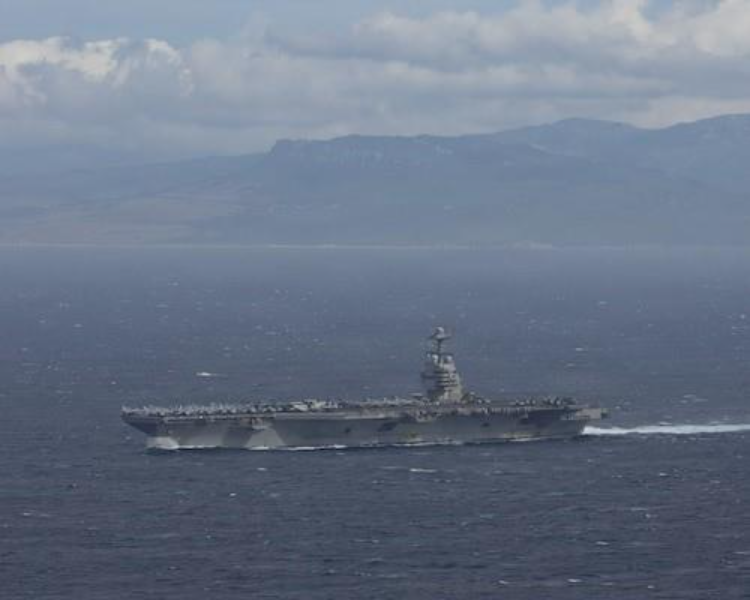
The USS Gerald R. Ford Carrier Strike Group (GRF CSG) led an allied maritime force with Allied Maritime Command (MARCOM) and NATO Allies Norway, Germany and France to conduct routine operations in the High North region from Aug. 23-Sept. 8, 2025. 

The USS Gerald R. Ford Carrier Strike Group (GRF CSG) led an allied maritime force with Allied Maritime Command (MARCOM) and NATO Allies Norway, Germany and France to conduct routine operations in the High North region from Aug. 23-Sept. 8, 2025. 

The High North is a critical region for the U.S. and NATO Alliance to stand together in support of a safe, stable and secure Euro-Atlantic region by enhancing military capabilities, readiness and interoperability. 

“What we’re doing is a building block on the last three years of our U.S. Carrier Strike Groups’ work off the coast of Norway and in the High North seas with the Royal Norwegian Navy. This consistent teamwork has fostered a strong and enduring relationship between our two navies,” said Rear Adm. Paul Lanzilotta, commander of Carrier Strike Group Twelve. “Our mutual understanding of each other’s naval priorities, perspectives, and methods ensures efficient and effective work whenever we operate together. We are extremely fortunate to continue to build on this steadfast U.S.-Norwegian naval relationship to defend against threats to maritime security.” 

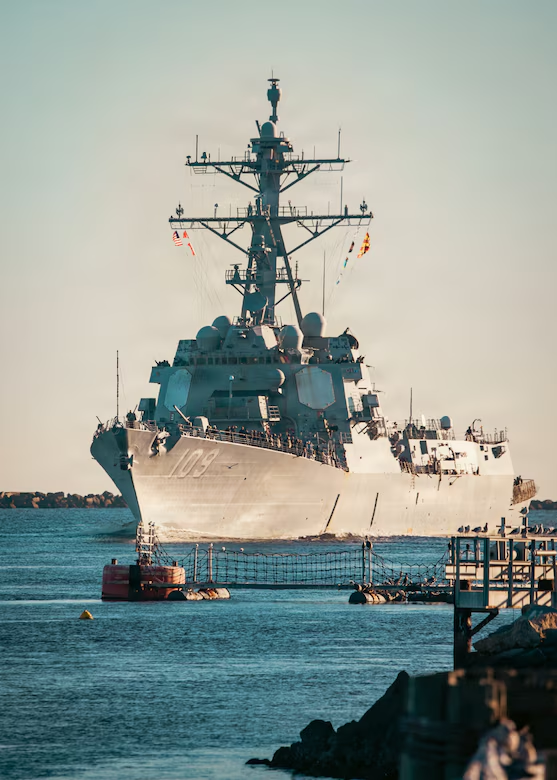
A surface action group (SAG), led by USS Bainbridge (DDG 96) and USS Mahan (DDG 72), was joined by Royal Norwegian Navy HNoMS Thor Heyerdahl (F 314) and French Navy FS Aquitaine (D 650) operating under national authorities and FGS Hamburg (F220) operating under MAROM Standing NATO Maritime Group 1. 

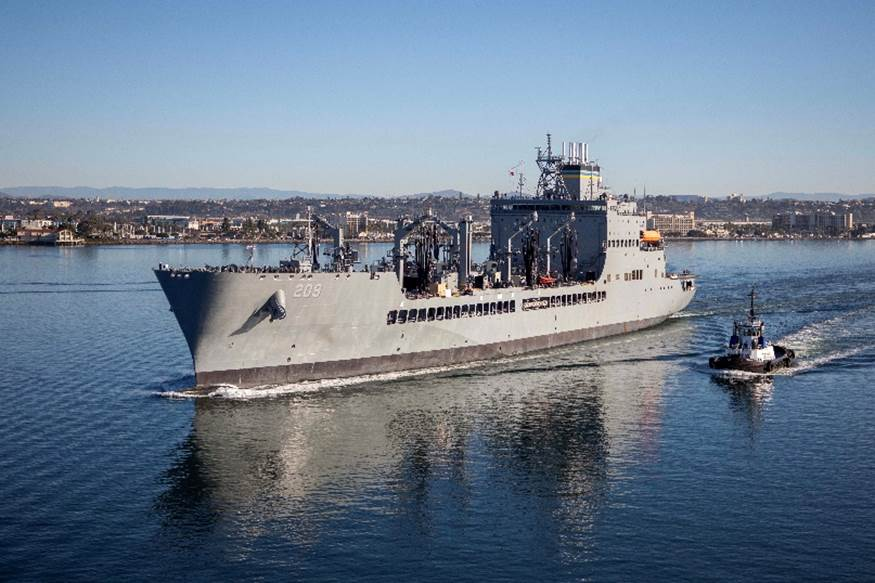
The SAG transited Southeast of Svalbard off the Northern coast of Norway and conducted various operations supported by coalition auxiliary ships USNS William McLean (T-AKE 12), HNoMS Maud (A 530) and FS Somme (A 631). 

“We are thrilled to work alongside our friends and Allies as we take on the challenge of ensuring peace and freedom are shared by all traversing our waterways,” said Royal Norwegian Navy Cmdr. Lars Ole Hoknes, commander of Thor Heyerdahl. “The Norwegian Sea and the areas surrounding it must remain free, no matter the cost.” 

Additionally, the USS Gerald R. Ford (CVN 78) and USS Winston S. Churchill (DDG 81) conducted flight operations and strike exercises in the Norwegian Sea in collaboration with the Royal Norwegian Air Force. 

In July 2024, the Department of Defense released the 2024 DoD Arctic Strategy, the fourth iteration for the Department, which outlines the United States’ commitment to preserving the Arctic as a secure and stable region with Allies and partners. 

The allied maritime force’s operations, led by GRF CSG, are a testament to this commitment, advancing the strategy’s lines of effort to enhance maritime domain awareness and the ability to campaign in the Arctic. The strategy builds upon the 2022 National Security Strategy, the 2022 National Defense Strategy, and the 2022 National Strategy for the Arctic Region. 

The GRF CSG continues to support U.S. 6th Fleet’s maritime operations and theater security cooperation missions, working alongside Allies and partners to deter aggression, preserve economic prosperity and keep the seas free and open. 

Carrier Strike Group Twelve is on a scheduled deployment to the U.S. 6th Fleet area of operations to support the warfighting effectiveness, lethality, and readiness of U.S. Naval Forces Europe-Africa, and defend U.S., Allied and partner interests in the region. For more than 80 years, U.S. Naval Forces Europe-U.S. Naval Forces Africa has forged strategic relationships with our Allies and partners, leveraging a foundation of shared values to preserve security and stability. You can find more information on DVIDS at https://www.dvidshub.net/unit/CVN78


First Four Naval Aviators to Graduate from T-54A METS Program at Training Air Wing Four 

The first four newly winged naval aviators to graduate from from the T-54A METS Program pose for a photo during their winging ceremony at Naval Air Station Corpus Christi, Sept. 5, 2025. The winging ceremony is a time-honored tradition where new naval aviators receive their Wings of Gold. (U.S. Navy photo by Lt. j.g. Alan Wang)  

From the Chief of Naval Air Training Public Affairs   

CORPUS CHRISTI, Texas–Chief of Naval Air Training (CNATRA) celebrated a significant achievement this week as the first four student naval aviators from Training Air Wing FOUR (TW-4) successfully completed their multi-engine training in the Navy’s new T-54A “Multi-Engine Training System” (METS), known as the Marlin II. 
 
The U.S. Navy declared initial operational capability for the T-54A in May 2024, giving future naval aviators a modern platform to prepare them for the advanced aircraft they will fly in the fleet. These graduates represent the inaugural class of the Navy’s upgraded advanced training pipeline, designed to replace the long-serving T-44C Pegasus after over 40 years of service. 
 
“This is a proud moment for TW-4 and the entire naval aviation community,” said Capt. Paul Penn, Commodore of TW-4. “These students embody the future of our multi-engine fleet, and their success reflects years of careful planning, testing, and teamwork to ensure the T-54A delivers world-class aviators.” 
 
Based on the King Air 260 platform, the T-54A introduces advanced avionics, digital displays, and enhanced safety systems to the Navy’s undergraduate multi-engine syllabus. Integrated with a comprehensive suite of high-fidelity simulators and a redesigned curriculum under the METS program, students now train on systems and procedures more closely aligned with fleet aircraft they will go on to fly, such as the P-8A Poseidon, E-6B Mercury and C-130J Hercules. 
 
With the first four graduates now moving on to their fleet replacement squadrons, TW-4 is ready to expand T-54 training for more naval aviators in the years ahead. The program plans to ramp up as additional aircraft and simulators are delivered, aiming for full operational capability soon. 
 
“The METS program is about more than just a new aircraft,” Penn emphasized. “It’s about equipping our students with the skills they need to excel in a complex, demanding operational environment. Today’s milestone confirms we are on the right track.” 
 
For the new winged pilots, this achievement is not only a personal milestone but a significant contribution to the Navy’s operational readiness and warfighting advantage across the fleet. 
 
Headquartered at Naval Air Station Corpus Christi, Texas, the Chief of Naval Air Training (CNATRA) oversees five training air wings and 17 training squadrons across Florida, Mississippi, and Texas. These squadrons conduct primary, intermediate, and advanced flight training for student naval aviators, naval flight officers, and air vehicle pilots. CNATRA remains steadfast in its mission to train, mentor, and deliver the highest quality naval aviators prepared to win in competition, crisis, and conflict. 


Raytheon Awarded $205M for Continued Production of Phalanx Close-In Weapon System 

From RTX, Sept. 8, 2025  

System remains an integral part of ship self-defense for U.S. Navy 

LOUISVILLE, Ky., Sept. 8, 2025 /PRNewswire/ — Raytheon, an RTX (NYSE: RTX) business, has been awarded a $205 million contract from the U.S. Navy for continued production of the Phalanx Close-In Weapon System (CIWS). 

As part of the contract, Raytheon will provide upgrades, conversions, overhauls, and related equipment. 

“Phalanx is our Navy’s last line of defense, expertly designed to protect our sailors from the threats they face every day,” said Barbara Borgonovi, president of Naval Power at Raytheon. “Securing this contract underscores the trust the U.S. Navy places in an absolutely critical system.” 

The Phalanx weapon system is a rapid-fire, computer-controlled, radar-guided gun that can defeat anti-ship missiles and other close-in threats that may penetrate preceding layers of defense. It is installed on all U.S. Navy surface combatant ship classes and on those of 24 allied nations. 

In January 2024, Phalanx was deployed by the USS Gravely to destroy a Houthi missile in the Red Sea just moments before impact, saving the lives of over 300 sailors onboard. 

Work on this contract will take place in Louisville, Ky. and other U.S. sites through 2029. 


USS St. Louis (LCS 19) Crew Completes Self-Sufficient Repair While Deployed 

USS St. Louis (LCS 19)

by LCSRON TWO Public Affairs, Aug 21, 2025 

TAMPA BAY, FLORIDA – Sailors aboard the Freedom-variant littoral combat ship USS St. Louis (LCS 19) recently completed an at-sea Main Propulsion Diesel Engine repair, enabling the ship to remain on mission. This self-sufficient repair, a task previously requiring contractor assistance, marks another milestone in the Navy’s effort to strengthen crew-led maintenance and improve operational readiness of the LCS fleet. 
 
The St. Louis’ engineering department dedicated several hours conducting repairs and operational testing, ultimately resulting in the ship being able to meet mission requirements. Additionally, the warship’s supply department played a crucial role, ensuring the rapid delivery of required equipment to the enginemen, facilitating the timely completion of the repairs. 
  
“I am beyond proud of all the hard work the St. Louis team has demonstrated over the past few weeks. They have shown exceptional professional curiosity, truly embodying becoming masters of their equipment,” said Lt. Cmdr. Jasmine Hilton, chief engineer of St. Louis. “The LCS community as a whole has been working to build on enlisted technical expertise over the years, and these Sailors have proven that it can be done.” 
  
The deployed repair underscores a two-year push to increase LCS self-sufficiency by training Sailors to perform more maintenance and repairs at the point of need.  Alongside enhanced training, the Navy has strategically positioned high-demand spare parts onboard. This allows crews to restore full operational capability more quickly. This approach is improving the reliability of critical systems and extending the operational endurance of deployed LCS warships. 
  
“The engineering team has proven that with the right parts and tools, our Sailors have the technical knowledge and skills to maintain our equipment without dependence on off-hull support,” said Cmdr. Lee Shewmake, commanding officer of St. Louis. “That allows them not only to conduct preventive work but also corrective maintenance when needed. The Freedom-variant class was originally designed to utilize contractors and off-ship personnel to conduct routine repairs and maintenance throughout the ship.” 
 
The milestone aboard St. Louis highlights both the adaptability of the platform but also the broader LCS sustainment effort. By empowering crews to take ownership of repairs at sea, the Navy is reducing reliance on shore-based support and ensuring ships remain combat ready throughout deployment. 
 
“This is just the most recent example in a two-year community effort to improve self-sufficiency across Freedom-variant LCS warships.  Every Freedom deployer over the last two years has delivered increased operational availability and capability from the previous one,” said Capt. Mark Haney, commodore of Littoral Combat Ship Squadron Two. “At every iteration we are delivering a more capable warship to Fleet Commanders to conduct missions they are ideally suited for, like the two Freedom LCS currently in 2nd and 4th Fleet, while freeing up other Navy surface assets for key missions across the globe.” 
 
St. Louis, along with an embarked Coast Guard Law Enforcement Detachment, is deployed in the U.S. Second Fleet area of operations to support counter-illicit drug trafficking and participate in exercises and exchanges with partner nations. 


Coast Guard Exercises Options on $3 Billion Offshore Patrol Cutter Contract

Release From Austal USA

Mobile, Ala. – The U.S. Coast Guard exercised options worth $314 million to Austal USA for the Offshore Patrol Cutter (OPC) program.  The contract options provide Austal USA approval to order long lead time materials (LLTM) for another 3 OPCs, Austal USA’s 4th, 5th, and 6th cutters.  Funds have also been provided for logistic supply items for two OPCs.  The original contract was awarded to Austal USA in June 2022 included detail design and construction for up to 11 OPCs with a potential value of $3.3 billion. To date, 2 of 11 OPCs in the contract have been awarded to Austal USA.   

“We are pleased to receive these contract options for long lead-time materials in support of the U.S. Coast Guard’s OPC program,” commented Austal USA President Michelle Kruger. “These early awards speak to the strong partnership that has developed between the Coast Guard and Austal USA teams.  We look forward to continuing to strengthen our partnership and deliver these much-needed cutters.” 

Work on Austal USA’s first OPC, Pickering (WMSMS 919), is well underway with the keel laying planned for December.  Construction began on Icarus (WMSMS 920) in early August. 

The 360-foot OPC will support the national security strategy for maintaining the nation’s economic, social, environmental and military security mission areas. The OPC will typically conduct its primary missions beyond 12 nautical miles from shore and will be employed anywhere the national interests require the Coast Guard’s unique blend of authorities and capabilities. OPC will provide the majority of the Coast Guard’s offshore presence conducting a variety of missions including law enforcement, drug and migrant interdiction, and search and rescue.   

With a range of 10,200 nautical miles at 14 knots and a 60-day endurance period, each OPC will be capable of deploying independently or as part of task groups, serving as a mobile command and control platform for surge operations such as hurricane response, mass migration incidents and other events. The cutters will also support Arctic objectives by helping regulate and protect emerging commerce and energy exploration in Alaska. 


GA-ASI’S MQ-9B SeaGuardian Showcased in NAS Whidbey Island Open House 

Release From GA-ASI

SAN DIEGO – Sept. 4, 2025 – General Atomics Aeronautical Systems, Inc. (GA-ASI) deployed an Anti-Submarine Warfare (ASW)-configured MQ-9B SeaGuardian® Unmanned Aircraft System (UAS) to Naval Air Station Whidbey Island (NASWI), Washington, to support its Open House event on August 23.  

The naval air station’s Open House showcased cutting-edge naval aviation capabilities as well as some vintage platforms from the past. At the request of NASWI leadership, GA-ASI provided its MQ-9B SeaGuardian to give public and military attendees an up-close look at a multi-mission Group 5 UAS, the largest and most capable type, and a glimpse into the future. 

Whidbey Island has been a base for MQ-9B SeaGuardian’s mission capabilities as part of several Navy exercises, including Northern Edge and Integrated Battle Problem 2023, and supported the aircraft carrier pre-deployment workups. However, during all of these events, the MQ-9B never landed at Whidbey Island. It was instead controlled and its data processed remotely from the naval air station while the aircraft flew in Hawaiian, Southern California, and Alaskan airspace. Crews fly GA-ASI’s aircraft via satellite link, which means they can be sited anywhere, even thousands of miles away from where the aircraft is flying. The MQ-9B is visiting now for the Open House to let sailors and the public see the platform that will be operated remotely from Whidbey Island in an upcoming Commander, U.S. Pacific Fleet Operational Evaluation deployment to the Indo-Pacific Command’s Area of Responsibility (AOR) in early 2026.  

Utilizing its advanced onboard Detect and Avoid System, the MQ-9B was able to launch from its flight facility near Palmdale, California, and fly to Whidbey Island without the normal special handling required for UAS. Effectively, it was able to operate in the national airspace like any other piloted aircraft.   

In addition to spotlighting the aircraft’s ASW payloads, GA-ASI was able to demonstrate autonomous landing and takeoff capability and showcase onboard signals intelligence and maritime radar packages. The MQ-9B SeaGuardian was also configured with additional hardpoint pylons to showcase its external carriage capability, including multiple stations supporting various payloads and weapons. 

“I’m pleased to support the Navy’s continuing public engagement efforts with our MQ-9B and appreciate NAS Whidbey leadership’s ongoing support of SeaGuardian operations. I look forward to continuing to work together as we demonstrate the capability of this multi-faceted UAS and fill critical capability gaps,” said GA-ASI President David R. Alexander.  

Leading this event was Naval Air Warfare Center Aircraft Division (NAWCAD) AIRWorks, which plays a key role in overseeing and supporting the development of the MQ-9B SeaGuardian. AIRWorks has partnered with GA-ASI in multiple ASW and Intelligence, Surveillance, Reconnaissance, and Targeting demonstrations, including the Rim of the Pacific (RIMPAC) exercise in July 2024. NAWCAD AIRWorks is also the Lead Systems Integrator and Program Manager for the Navy Operational Evaluation of MQ-9B in 2026. 

With strong demand already in place from customers around the world, GA-ASI anticipates growing interest in the MQ-9B SeaGuardian given its record of delivering high-end maritime capabilities at a significantly lower cost than traditional manned maritime platforms.