HII Wins LCS Planning Yard Contract Worth a Possible $931.7 Million
HII’s Ingalls Shipbuilding division in Pascagoula, Mississippi. Lance Davis/Huntington Ingalls
PASCAGOULA, Mississippi — Huntington Ingalls Industries’ Ingalls
Shipbuilding division has been awarded a cost-plus-award-fee contract with a
potential total value of $931.7 million for planning yard services in support
of in-service littoral combat ships (LCS), the company said in a May 1 release.
The contract, which includes options over a six-year period, also provides work
packages for HII’s Technical Solutions division.
“Ingalls Shipbuilding will build on 35 years of planning
yard experience to join our Technical Solutions division in fully supporting
this life-cycle work on the LCS program,” Ingalls Shipbuilding President Brian
Cuccias said. “Our talented shipbuilding team has the resources and program
management experience necessary to ensure the post-delivery work on the LCS
program meets the requirements and missions of our U.S. Navy customers.”
“Our talented shipbuilding team has the resources and program management experience necessary to ensure the post-delivery work on the LCS program meets the requirements and missions of our U.S. Navy customers.”
Ingalls Shipbuilding President Brian Cuccias
The planning yard design services contract will provide
the LCS program with post-delivery life-cycle support, which includes fleet
modernization program planning, design engineering and modeling, logistics
support, long-lead-time material support, and preventative and planned
maintenance system item development and scheduling. Unique to this planning
yard effort is the requirement to manage the scheduling of all planned,
continuous and emergent maintenance and associated availabilities.
Most
of the work will be accomplished in Pascagoula and Hampton, Virginia, by
designers, engineers, logisticians, planners, program managers and a variety of
additional subject matter experts. Ingalls and Technical Solutions will also
provide waterfront support in the LCS homeports.
DARPA Director Praises Navy’s Aggressive Use of Autonomous Sea Hunter
Sea Hunter is moored at Joint Base Pearl Harbor-Hickam, Hawaii. The director of DARPA on May 1 praised the Navy’s aggressive use of the unmanned surface vessel. Mass Communication Specialist 1st Class Nathan Laird
The director of the nation’s premier government innovation
organization is excited about the U.S. Navy’s aggressive use of an unmanned
surface vessel to experiment with the military applications of advanced
automation and artificial intelligence.
“The most exciting thing I’m really happy with the Navy right now
is what they’re doing with the Sea Hunter, which is an autonomous 132-foot
surface ship that DARPA demonstrated a couple years ago,” Steven H. Walker,
director of the Defense Advanced Research Projects Agency, told a Defense
Writers breakfast on May 1. “The Navy
has really taken that and is using it and experimenting with it.”
Walker cited Sea Hunter’s voyage last fall from San Diego to
Hawaii and back with no humans on board to control it, “which I think
demonstrates the autonomous capability we put into that program.”
“They’re really interested in how that helps them with their
distributed lethality program,” and using Sea Hunter as “the basis for their
medium-size and large-size unmanned surface vessels. I’m really excited about
where they’re taking that system.”
The Navy is projecting unmanned vessels as a key element of its
future combat fleet and has proposed buying 10 “large” unmanned ships over the
next five years. It has not defined the size and capabilities of those vessels.
Although the Navy has not indicated whether it plans to test
weapons on Sea Hunter, the likelihood that some of its future unmanned vessels
will be armed raises the controversial issue of what control humans will have
over weapon employment by autonomous platforms.
Sea Hunter completes an autonomous sail from San Diego to Hawaii and back — the first ship ever to do so autonomously. U.S. Navy photo
DARPA, which is pursuing advances in artificial intelligence (AI),
studies the ethical issue of weaponized unmanned systems.
“I think it’s still important to have that lethal decision rest
with the human,” Walker said. But, he noted, “Sea Hunter has a lot of potential
uses that don’t involve weaponizing it,” such as mine countermeasures and as a
sensor.
“The key to autonomy, particularly in the ocean, is getting out
and experimenting, testing how these things work,” which was why he was so
pleased with the Navy’s use of Sea Hunter.
Much of Walker’s discussion with defense reporters focused on
DARPA’s work on AI, which it has been doing for 50 years.
“Sea Hunter has a lot of potential uses that don’t involve weaponizing it.”
DARPA director Steven H. Walker
“We’re pretty excited, not only by the latest advances in machine
learning, but moving into what we call the third wave [of AI] — how humans and
machines become partners. Not just using machines as tools but as partners,” he
said. “If we actually can build this team, you can think about all sorts of
things that warfighters could do more effectively in a time of war.”
Walker also discussed DARPA’s work developing more powerful lasers
in smaller packages and in moving hypersonic technology into useable weapon
systems.
Having demonstrated solid state lasers, which while fairly
powerful were “still pretty big,” DARPA is focusing now on fiber lasers, which
have the promise of even greater power in much smaller packages. Walker said he
expected to fully demonstrate a high-powered fiber laser by the end of the
year.
He said the first military application for those more powerful
lasers “comes in ships and ground vehicles, where weight and size are not as
big an issue. I think we’re still a ways away from putting these things on
airplanes.”
One of DARPA’s highest priorities is advancing hypersonic
technology, which Walker said the United States led the world, but which “some
of our adversaries” have turned into capabilities. Hypersonic generally is described
as Mach 5 or faster. China and Russia have demonstrated different forms of
hypersonic aircraft.
DARPA is working on two applications of hypersonic — a boost-glide
missile, which is rocket-propelled to a high altitude then glides at hypersonic
speeds to a target, and a propelled system that may use a rocket to get to
hypersonic velocity then maintains that speed with some form of air-breathing
engine, such as a scramjet.
He expected to fly each of those systems late this year or early
in 2020.
“The advantage of
hypersonics is not only the speed but the range and maneuverability,” Walker
said.
Lockheed Develops Rack to Make F-35A/C a Six-Shooter
Marines prepare F-35B Lightning II aircraft on the flight deck of the amphibious assault ship USS Wasp. The F-35B can’t accommodate the new Sidekick weapons rack, as its weapons bay is too small, but the F-35C, the Navy’s variant of the joint strike fighter, can. Mass Communication Specialist 3rd Class Benjamin F. Davella III
ARLINGTON,
Va. — The builder of the F-35 Lightning II joint strike fighter has designed a
new weapons rack to enable the aircraft to carry two more missiles internally.
The new rack,
called Sidekick, enables each of the two weapons bays of the Air Force F-35A
and Navy carrier-capable F-35C to carry three AIM-120 Advanced Medium-Range
Air-to-Air Missile (AMRAAM) instead of the current two, for a total of six internally
carried AMRAAMs.
Speaking May
1 to reporters at a Lockheed Martin media briefing, a company F-35 test pilot,
Tony ‘Brick’ Wilson, said the rack was developed entirely with company internal
research and development funds.
“The extra missiles add a little weight but are not adding extra drag.”
Tony ‘Brick’ Wilson, F-35 TEST PILOT
The rack is
not compatible with the vertical lift Marine Corps F-35B version, which has
smaller weapons bay.
The F-35 can
carry more AMRAAMs on external pylons, but Wilson pointed out that carrying two
more internally preserves the stealth characteristics of the F-35.
“The extra
missiles add a little weight but are not adding extra drag,” Wilson said.
Wilson also said the F-35 has the external structural capacity for hypersonic weapons should that be required in the future.
He also said
the company, working with the Air Force Research Lab, has developed and installed
on the F-35A — six years ahead of schedule — the Auto Ground Collision
Avoidance System (AGCAS).
The AGCAS has
“saved eight pilots’ lives,” Wilson said.
He
said the AGCAS will be installed later on the F-35B and on the F-35C in 2021.
Navy Leaders to Meet May 16 to Assess Sub Construction Delays, Columbia Class Schedule, Secretary Tells House Panel
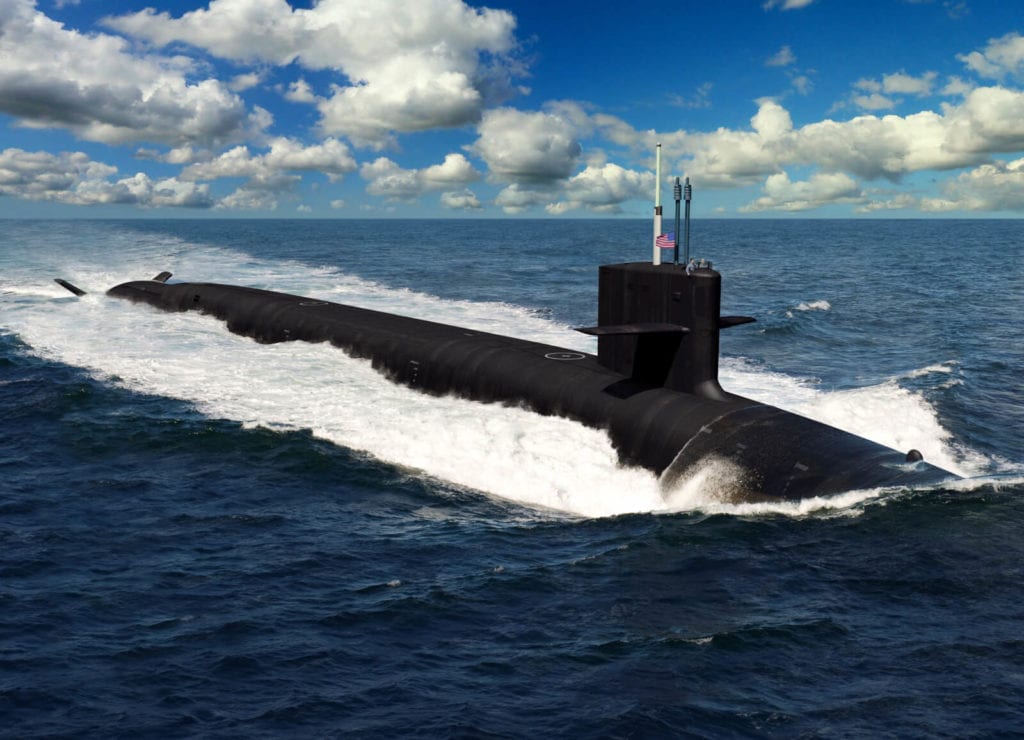
An artist rendering of the future Columbia-class ballistic missile submarine. U.S. Navy leaders will meet with industry officials in May to examine how they can add more space in the tight schedule to build the first of the Columbia-class ballistic missile submarines, Navy Secretary Richard V. Spencer said. U.S. Navy illustration.
U.S. Navy leaders will meet with industry officials in May
to examine how they can improve the increasingly challenged submarine
production program and try adding more space in the tight schedule to build the
first of the Columbia-class ballistic missile submarines, Navy Secretary
Richard V. Spencer said April 30.
The Navy would like to increase the production of its
Virginia-class attack submarines from two a year to three to stop the decline
in the already inadequate number of attack boats. But that pace is hampered by
the fact that the two shipyards building those boats also are responsible for
getting the Columbia class into service by 2031, when the Navy’s Ohio-class
boomers will be unable to continue their crucial strategic deterrence patrols,
Spencer said.
“We do have concerns,” Spencer told the House Appropriations
Defense Subcommittee. To address those issues, the Navy will sit down with
industry leaders May 16 to assess the sub construction yards and the supply
chain and seek to “build in margin where we can” for the Columbia-class
schedule.
“If we do not, it will run off the rails,” Spencer said in
response to questions from the panel responsible for providing the money the
Navy Department will need for all its programs.
In addition to the questions the appropriators had about the
Columbia class, the Navy’s self-declared No. 1 procurement priority, the
subcommittee’s chairman, Rep. Pete Visclosky (D-Indiana), hounded the Navy
leaders on the chronic problems in submarine maintenance and acceptance of new
warships with multiple material problems.
Visclosky pointed out that three of the older Los Angeles
class attack submarines — Boise, Columbus and Hartford — are no longer
certified to submerge because they have not received maintenance that is
overdue. He emphasized that Boise was scheduled to go into the repair yard in
2013 but still is waiting for an opening.
And Visclosky was particularly troubled by the Navy failing
to request funds to repair the three inoperable submarines in its regular
fiscal 2020 budget request but added them to the unfunded requirements list.
Spencer and Chief of Naval Operations Adm. John M.
Richardson conceded they were having trouble getting submarines into required
maintenance, which was aggravating the inability to meet combatant commanders’
requests for the attack boats, with some reports putting the shortfall as high
as 50 percent.
The two Navy leaders argued that the submarine maintenance
problem stemmed from the sharp reduction in funding during the years when the
Budget Control Act forced sequestration.
But Visclosky replied that “sequestration happened some time
ago” and Congress “provided a lot of money” the last two years.
Spencer said the shipyards cut their skilled work force
during the lean years and are now working to replace those workers and improve
their aged facilities. He and Richardson emphasized the Navy’s program to
modernize the government-owned shipyards and to incentivize the private yards
to also update and expand.
Visclosky also demanded the Navy provide details on the
problem highlighted in a recent Government Accountability Office report showing
a long list of new ships the Navy has accepted from the builders with a range
of deficiencies. He stressed the aircraft carrier Gerald R. Ford (CVN-78), the
first in its class of aircraft carriers, is not expected to be operational
until 2023, nearly five years later than expected because of numerous
construction deficiencies.
The chairman wanted to know how the cost of correcting those
flaws was divided between the Navy and its contractors, noting that GAO
indicated the government has been paying 96 percent. Spencer promised to
provide the data.
Australia to Purchase Second Triton UAV
CANBERRA, Australia —The Australian government has agreed to purchase a second MQ-4C Triton, Northrop Grumman Corp., manufacturer of the aircraft, said in a release.
Australia’s 2016 Defence White Paper identified the requirement for seven high-altitude, long-endurance Triton unmanned aircraft. Northrop Grumman will deliver the Triton through a cooperative program with the U.S. Navy.
“Northrop Grumman is excited to develop this unrivaled capability for the Royal Australian Air Force,” said Doug Shaffer, vice president and program manager for the Triton at the company. “Triton will provide the Australian Defence Force a high-altitude, long-endurance system for intelligence, reconnaissance and broad-area surveillance missions to enhance the security of Australia’s borders.”
Defence Minister Christopher Pyne identified “people smuggling and the exploitation of our natural resources” as threats that Triton’s capabilities can help to address.
Minister for Defence Industry Linda Reynolds identified the opportunities this program will create for Australian industry and said that “there will be significant opportunity for Australian industry to share in billions of dollars of system maintenance and network management functions.”
Northrop Grumman is committed to developing a sovereign defense capability for Australia through industrial partnership and participation, direct investment and technology transfer, the company said.
USS America, USS New Orleans to Forward Deploy to Japan; USS Stethem, USS Wasp to Return to U.S.
PEARL HARBOR (Jan. 23, 2018) The amphibious assault ship USS America (LHA 6) and its amphibious ready group (ARG) are moored at Joint Base Pearl Harbor-Hickam.
SASEBO, Japan — The Navy announced that the amphibious assault ship USS America (LHA 6) and landing platform dock USS New Orleans (LPD 18) will become part of the U.S. 7th Fleet forward-deployed forces in Sasebo, Japan, the commander, Naval Forces Japan Public Affairs, said in a release.
The guided-missile destroyer USS Stethem (DDG 63) will shift its homeport to San Diego for its midlife modernization and the amphibious assault ship USS Wasp (LHD 1) will shift its homeport to Norfolk, Virginia, to undergo scheduled maintenance.
America is capable of supporting the F-35B Lightning II, the Marine Corps vertical-lift variant of the Joint Strike Fighter, as part of an embarked U.S. Marine Corps Air Combat Element.
The United States values Japan’s contributions to the peace, security and stability of the Indo-Pacific and its long-term commitment and hospitality in hosting U.S. forces forward deployed there. These forces, along with their counterparts in the Japan Self-Defense Forces, make up the core capabilities needed by the alliance to meet our common strategic objectives.
The security environment in the Indo-Pacific requires that the Navy station the most capable ships forward. This posture allows the most rapid response times possible for maritime and joint forces and brings our most capable ships with the greatest amount of striking power and operational capability to bear in the timeliest manner.
Maintaining a forward-deployed force capability supports the U.S. commitment to the defense of Japan and the security and stability of the vital Indo-Pacific region.
America will provide the Marine Corps with a means of combat operations utilizing the F-35B fighter. New Orleans is capable of ship-to-shore movement by tilt-rotor and helicopter. In addition to combat operations, both ships can conduct humanitarian-assistance operations.
Black to Become 19th Sergeant Major of the Marine Corps
Sgt. Maj. Troy E. Black has been selected to be the 19th Sergeant Major of the Marine Corps, the Corps announced in a release.
Black is the current Sergeant Major of Manpower and Reserve Affairs and will replace the current Sergeant Major of the Marine Corps, Sgt. Maj. Ronald L. Green, during a post and relief ceremony later this year.
Following the ceremony, Green will retire after 35 years of service.
Since his enlistment in 1988, Black has, among other billets, served as Sergeant Major of Officer Candidates School, the 11th Marine Expeditionary Unit, and 1st Marine Logistics Group. He has deployed extensively, including in support of Operation Desert Storm/Desert Shield, Operation Iraqi Freedom, and Operation Enduring Freedom as well as numerous MEU and Fleet Anti-Terrorism Security Team Company deployments.
His personal awards include the Legion of Merit with Gold Star, Bronze Star with Combat Distinguishing Device, Meritorious Service Medal with two Gold Stars, Navy and Marine Corps Commendation Medal with Combat Distinguishing Device and three Gold Stars, Navy and Marine Corps Achievement Medal with Gold Star and the Combat Action Ribbon with two Gold Stars.
The post of Sergeant Major of the Marine Corps was established in 1957 as the senior enlisted adviser to the commandant of the Marine Corps, the first such post in any of the branches of U.S. military. The Sergeant Major of the Marine Corps is selected by the commandant and typically serves a four-year term.
Navy to Christen High-Speed Transport Vessel Guam
WASHINGTON — The Navy will christen its newest high-speed transport vessel, the future USNS Guam (T-HST 1), during a 10 a.m. Japan Standard Time ceremony Saturday, April 27, in Okinawa, Japan, the Navy’s Office of Information said in a release.
USNS Guam is named to honor the long-standing historical and military relationship between Guam and the United States. She will be the fourth ship to bear the name Guam.
Ambassador Extraordinary and Plenipotentiary of the United States of America to the Republic of Korea Harry B. Harris Jr. will be the principal speaker, and Bruni Bradley, a 25-year Navy veteran and wife of Harris, will serve as the ship’s sponsor. In a time-honored Navy tradition, she will christen the ship by breaking a bottle of sparkling wine across the bow.
“This ship honors the island of Guam and the important contributions Guamanians have made to our nation and our Navy and Marine Corps team,” Navy Secretary Richard V. Spencer said. “For decades to come, USNS Guam and its crew will carry on the Guamanian tradition of service by providing our commanders with much needed high-speed sealift mobility and agility.”
Long before Guam joined the U.S. as a territory, the island had a military relationship with the United States. The long-standing historical and military relationship began in 1898, when the U.S. acquired the island from Spain as a result of the Treaty of Paris that ended the Spanish-American War. Shortly after the attack on Pearl Harbor, the Japanese captured Guam, and they occupied it until U.S. troops retook the island July 21, 1944, commemorated in Guam every year as “Liberation Day.” Guam continues to host many critical U.S. military installations.
USNS Guam is an aluminum catamaran designed to be fast, flexible and maneuverable, even in austere port conditions, making the vessel ideal for transporting troops and equipment quickly. USNS Guam’s 25,000-square-foot mission-bay areas can be quickly reconfigured for any cargo requirement, from supporting disaster relief to transporting troops and equipment.
The ship is preceded in service by the patrol gunboat USS Guam (PG 43), which was renamed Wake in 1941 and captured by the Japanese later that year, the Alaska-class large cruiser USS Guam (CB 2) in service 1944-1947, and the Iwo Jima-class amphibious assault ship USS Guam (LPH 9) in service 1965-1998.
Navy to Christen Guided-Missile Destroyer Lyndon B. Johnson
WASHINGTON (April 16, 2012) An artist rendering of the Zumwalt-class guided-missile destroyer USS Lyndon B. Johnson (DDG 1002). (U.S. Navy photo illustration by Lt. Shawn Eklund/Released)
WASHINGTON — The U.S. Navy will christen its newest Zumwalt-class guided missile destroyer, the future USS Lyndon B. Johnson (DDG 1002), during a 10 a.m. EST ceremony Saturday, April 27, at General Dynamics-Bath Iron Works shipyard in Bath, Maine, the Navy’s Office of Information said in a release.
The third ship in the Zumwalt class, DDG 1002 is named in honor of late President Lyndon B. Johnson, who served in office from 1963 to 1969 and will be the first ship to bear his name.
Lynda Johnson Robb and Luci Johnson, the two daughters of the former president, will serve as the ship’s sponsors. In a time-honored Navy tradition, the sisters will christen the ship by breaking a bottle of sparkling wine across the bow. Robb will also serve as the principal speaker.
“The future USS Lyndon B. Johnson will serve for decades as a reminder of President Johnson’s service to our nation and support of a strong Navy and Marine Corps team,” Navy Secretary Richard V. Spencer said. “This ship honors not only President Johnson’s service, but also the service of our industry partners who are vital in making the Navy the nation needs.”
Johnson served as a U.S. Navy Reserve officer before being called to active duty after the attack on Pearl Harbor. He requested a combat assignment and served in the Pacific theater. After returning from active duty, Johnson reported to Navy leaders and Congress what he believed were deplorable living conditions for the warfighters. He continued to fight for better standards for all military members.
Johnson’s time as president was marked by the passage of programs that greatly influenced and affected education, health care and civil rights for generations to come. He signed the Civil Rights Act of 1964 into law, enacting comprehensive provisions protecting the right to vote and prohibiting racial discrimination by employers. His work on civil rights continued with the passage of the Voting Rights Act, which guaranteed voting rights for all people, regardless of race.
The multimission Zumwalt-class destroyers will be capable of performing a range of deterrence, power projection, sea control, and command and control missions while allowing the Navy to evolve with new systems and missions. Zumwalt ships are 610 feet long, have a beam of 80.7 feet, displace almost 16,000 tons and can reach 30 knots.
Lack of Well Deck Seen as a Wash for LHA USS America
PACIFIC OCEAN (Feb. 1, 2018) An MV-22 Osprey helicopter assigned to Marine Medium Tiltrotor Squadron (VMM) 161 (Reinforced) aboard the amphibious assault ship USS America (LHA 6) lands on the flight deck.
ARLINGTON, Va.— The transfer of the new amphibious assault ship USS America to the Forward-Deployed Naval Force (FDNF) next fiscal year will bring a change in capabilities to the 7th Fleet’s amphibious ready group, but the Marines that will go on patrol on America will be able to adjust to the changes and maintain a similar level of combat capability.
America (LHA 6) is scheduled to replace USS Wasp (LHD 1) as the “bog-deck” amphib deployed to Sasebo, Japan. The major difference in the two ships is that America lacks a well deck, a feature on all earlier LHAs and LHDs that can float landing craft and amphibious assault vehicles.
The America and its soon-to-be commissioned sister ship Tripoli were designed to be more aviation-centric. The trend was reversed with the third ship of the class, the future Bougainville, which will have a well deck.
The Marine Expeditionary Unit (MEU), the 31st MEU, which deploys on the ships of the Sasebo-based amphibious ships, differs from other MEUs in that it does not include M1A1 tanks in its load-out.
“I do not possess tanks, because we don’t have tanks on Okinawa,” said Col. Robert Brodie, commander of the 31st MEU, speaking April 23 to the Potomac Institute in Arlington of the 31st MEU’s patrol in the Western Pacific in early 2019.
With somewhat of a lighter load, the 31st MEU will have less of a problem handling the unit’s equipment of the America-centric amphibious ready group (ARG).
Brodie said his staff already is looking at the optimum way to configure the MEU’s equipment load-out to best operate from the America. The ship’s lack of a well deck means that three fewer landing craft — LCACs or LCUs — would be carried by the ships of the ARG.
Brodie is optimistic that the increased aviation capacity of the America could make up for the loss of a well deck. The America would more easily accommodate 12 MV-22B Osprey tiltrotor aircraft rather than the 10 that the Wasp typically carried. The two additional Ospreys would add to the overall airlift capability that could make up for some of the loss of lift by landing craft, especially without the requirement to accommodate tanks.
The America’s increased aviation capacity also would enable the America to deploy with perhaps as many as eight F-35C Lightning II strike fighters instead of six as on the Wasp. The additional MV-22Bs also would make the eventual installation of an aerial refueling hose on one or more of the MV-22Bs a plus for the range and endurance of the F-35.
The air combat element of the 31st MEU also normally deploys with four CH-53E Super Stallion heavy-lift helicopters on board the Wasp, in addition to the three Navy MH-60S armed helicopters. The four AH-1Z Viper attack helicopters and three UH-1Y Venom utility helicopters are normally staged on the amphibious platform dock ship and dock landing ship of the ARG.