Department of the Navy Names New Service Acquisition Executive 

From the Navy Office of Information, May 26, 2026 

ARLINGTON, Va. — Acting Secretary of the Navy Hung Cao announced today that William F. Mahan, a member of the Senior Executive Service, is now performing the duties of Assistant Secretary of the Navy for Research, Development and Acquisition. In this capacity, Mahan will serve as the senior acquisition executive for both the Navy and Marine Corps. 

Mahan, a former submarine officer and a 2003 graduate of the United States Naval Academy, also brings a wealth of industry experience to the role. He was the founder and Chief Executive Officer of a defense engineering firm that supported the Department of War with expertise in systems engineering and integration, rapid prototyping, flight testing, and acquisition management. 

“Restoring our maritime dominance requires bold leadership in warfighting acquisition,” Cao said. “Will Mahan is a proven leader who will help the Navy deliver the Golden Fleet to ensure our Sailors and Marines have what they need to fight and win when the nation calls.” 

Jason L. Potter, who had been performing the duties of the assistant secretary since July 2025, returns to his original role as the Principal Civilian Deputy ASN RDA. 

“Jason provided vital leadership over the past year, including the establishment of Portfolio Acquisition Executives and getting an ambitious, yet achievable shipbuilding plan over the finish line,” Cao added. “I am incredibly grateful for his steady hand and unflinching commitment to the mission, and we are extremely fortunate to retain his expertise in our acquisition leadership team.” 

Mahan assumes stewardship of the Department of the Navy’s warfighting acquisition efforts as the department undergoes foundational acquisition reforms, shifting from a compliance-based bureaucracy to a more agile, warfighter-focused organization. At the same time, the Department of the Navy is making investments with industry to invigorate the maritime industrial base and build historic numbers of ships for the Navy and Marine Corps. The recently unveiled U.S. Navy Shipbuilding Plan calls for generational investments in both manned and unmanned ships, including surface combatants, submarines, aircraft carriers, amphibious ships, and auxiliary and combat logistics ships. 


U.S. Blockade of Iran Reaches Milestone of Redirecting 100 Ships 

From U.S. Central Command, May 23, 2026 

TAMPA, Fla. — U.S. Central Command (CENTCOM) forces reached the milestone of redirecting 100 commercial vessels, May 23, while enforcing a maritime blockade against Iran. 
 
American forces began implementing the blockade April 13 against commercial ships entering and exiting Iranian ports, in accordance with a presidential proclamation. Over the past six weeks, more than 15,000 Soldiers, Sailors, Marines and Airmen have redirected 100 vessels, disabled four, and allowed 26 humanitarian aid ships to pass. 
 
“Our service members are doing extraordinary work,” said Adm. Brad Cooper, CENTCOM commander. “They have been highly effective by executing the mission with precision and professionalism, allowing zero trade into and out of Iranian ports which has squeezed Iran economically.” 
 
More than U.S. 200 aircraft and warships are supporting the mission, including the Abraham Lincoln Carrier Strike Group, George H.W. Bush Carrier Strike Group, Tripoli Amphibious Ready Group/31st Marine Expeditionary Unit, and multiple guided-missile destroyers. 
 
The blockade is being enforced against vessels of all nations entering or departing Iranian ports and coastal areas, including all Iranian ports on the Arabian Gulf and Gulf of Oman. 


Coast Guard Cutter Waesche Returns to Alameda After Successful 113-Day Patrol

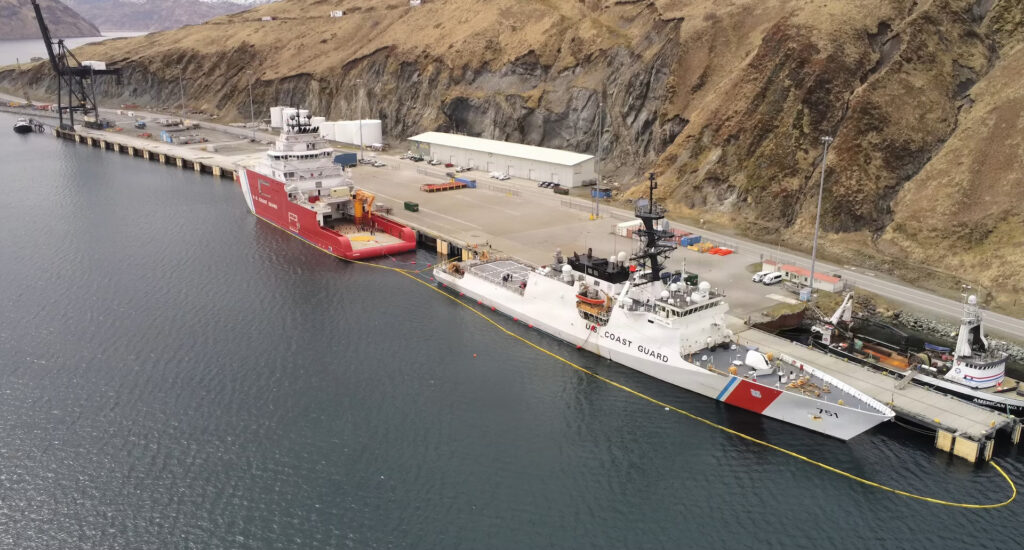
 USCGC Storis (WAGB 21) and USCGC Waesche (WMSL 751) conduct a proof‑of‑concept fueling‑at‑sea evolution while moored in Dutch Harbor, Alaska, May 1, 2026. The evolution marked a successful operation as first of its kind with a new Polar Asset. (U.S. Coast Guard photo via shipboard drone by Lt. j.g. Genzo Matua Gonzales) May 22, 2026 

From U.S. Coast Guard Arctic District, May 22, 2026 

ALAMEDA, Calif. – The crew of U.S. Coast Guard Cutter Waesche (WMSL 751) returned to their homeport in Alameda Friday after concluding a 113-day patrol in the Bering Sea. The cutter traveled 18,685 nautical miles conducting a broad range of operations including maritime law enforcement, search and rescue and the integration of new capabilities, all while projecting U.S. presence in the high north environment.  

The Waesche crew rescued five mariners from the fishing vessel Ocean Bay after it ran aground and began taking on water near Umnak Island, Alaska. The cutter provided on scene support while an Air Station Kodiak MH-60T Jayhawk helicopter crew hoisted the fishermen to safety. Additionally, the Waesche provided communications and oversight during the aerial rescue of two hikers stranded in the Dutch Harbor mountains.  

The primary mission of the patrol was protecting the U.S. commercial fishing fleet, securing, controlling, and defending U.S. borders and maritime approaches. Waesche’s crew conducted 15 boardings, discovering 11 violations.   

The deployment also highlighted the Coast Guard’s commitment to joint operations and technological advancements in the Arctic. The crew conducted deck landing qualifications for more than 64 flight hours with pilots from Air Station Kodiak and the Alaska Air National Guard’s 210th Rescue Squadron. This patrol also saw the initial integration of the V-BAT unmanned aircraft system (UAS), a remote surveillance drone capable of vertical takeoff and landing, which provides persistent airborne surveillance to support a wide range of Coast Guard missions from a smaller footprint.  

In a demonstration of the service’s capability to sustain forces in the high north, Waesche conducted the first-ever fueling at sea exercise with the Coast Guard Cutter Storis (WAGB 21) in Dutch Harbor, Alaska. The exercise proved Storis’s unique ability to extend asset time on station and deliver fuel direct to another cutter, maximizing the nation’s operational footprint. The two cutters also engaged in a passing exercise, maneuvering in close formation to hone visual communication and ship handling skills.  

“The Bering Sea is one of the most challenging areas that the Coast Guard operates in, especially during the winter,” says Capt. Tyson Scofield, commanding officer of Waesche. “I am extremely proud of the grit and devotion to duty that the crew displayed by rising to the challenges of sub-freezing temperatures, equipment casualties and a government shutdown to successfully execute a myriad of missions and provide sovereign presence in this challenging environment.”   

Waesche is a 418-foot National Security Cutter with a top speed of 28 knots, a range of 12,000 nautical miles, and a permanent crew of 120. She is equipped with a 4,000 square-foot flight deck and hangars capable of housing two multi-mission helicopters.  


U.S. Coast Guard Commissions 62nd Fast Response Cutter Honoring 9/11 Hero

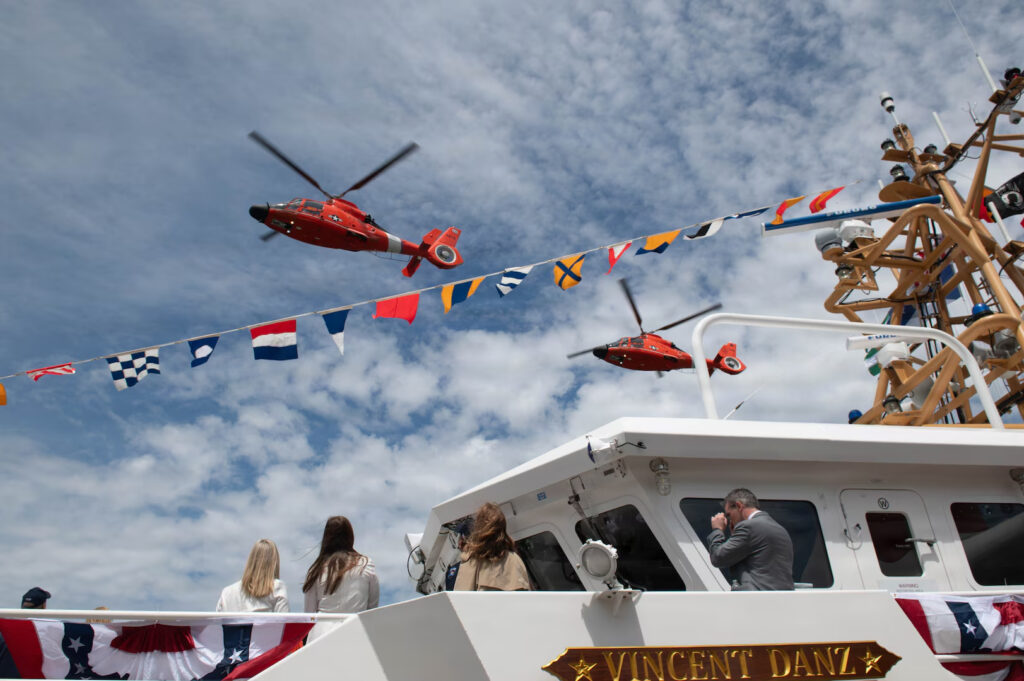
Two U.S. Coast Guard MH-65 Dolphin helicopters fly over the Coast Guard Cutter Vincent Danz (WPC 1162) following the cutter’s commissioning ceremony in New York City, May 22, 2026. The Vincent Danz is the 62nd Fast Response Cutter and honors Petty Officer 2nd Class Vincent Danz, a New York City police officer and Coast Guard reservist who died responding to the September 11, 2001, attacks. (U.S. Coast Guard photo by Marco A. Gutierrez Rosales)

From U.S. Coast Guard Forces Micronesia, May 22, 2026 

NEW YORK — The U.S. Coast Guard commissioned its newest Fast Response Cutter, USCGC Vincent Danz (WPC 1162), for official entry into its service fleet during a ceremony held in New York City on Friday. 
 
The Vice Commandant of the Coast Guard, Vice Adm. Thomas Allan, presided over the ceremony. Members of the Danz family were also in attendance, including the cutter’s sponsor, Ms. Angela Donohue, widow of the late Vincent Danz. 
 
“Vincent Danz’s legacy will live on not only through his family and his brothers and sisters in the NYPD, but through the Coast Guard crew who will breathe life into this cutter today,” said Adm. Tom Allan. “The Coast Guard Cutter Vincent Danz will perform the Coast Guard’s vital work across Oceania—projecting U.S. presence, countering illicit maritime activity, and strengthening our international partnerships.” 
 
The Vincent Danz is the 62nd Sentinel-class Fast Response Cutter in the service and the fourth of five FRCs to be homeported in Guam with U.S. Coast Guard Forces Micronesia/Sector Guam. The crew of the Vincent Danz will primarily serve U.S. and mutual interests in Oceania with an emphasis on the Micronesia and Melanesian sub-regions, conducting maritime security operations, combating illegal activity, supporting search and rescue missions, and strengthening partnerships with Pacific Island nations and Allies. The cutter is a multi-mission platform. 
 
The cutter’s namesake, Vincent Danz, was serving in the New York City Police Department, Emergency Services Unit, ESU Truck 3, when he responded to the World Trade Center as part of a massive emergency response and was killed when the World Trade Center collapsed. He was posthumously awarded the New York City Police Department’s Medal of Honor for his heroic deeds. He was a veteran of the United States Marine Corps and joined the New York City Police Department in 1987, while continuing to serve in the U.S. Coast Guard Reserve as a Port Security Specialist 2nd Class. 
 
As a U.S. Coast Guard reservist, Danz understood the meaning of service to country and community. His courage in the face of unimaginable danger and his dedication to saving others made him a hero not only to New York City but to the nation. This cutter honors his memory and the legacy of all first responders who gave their lives on Sept. 11, 2001. 
 
The Vincent Danz will join the Myrtle Hazard (WPC 1139), Oliver Henry (WPC 1140), and Frederick Hatch (WPC 1143), all of which were commissioned in Guam. Since their 2021 commissioning, Guam’s FRC crews have distinguished themselves across the region, most recently responding to the impacts of Super Typhoon Sinlaku on communities in the Marianas. USCGC Myrtle Hazard’s crew became the first to operationalize the bilateral maritime law enforcement agreement with Papua New Guinea, conducting joint patrols and boardings in 2023. USCGC Oliver Henry’s crew saved around a dozen mariners in the Federated States of Micronesia, delivered humanitarian assistance during the Yap drought, and towed the 500-ton yacht Black Pearl to the Republic of Palau, rescuing 11 people in 2024. USCGC Frederick Hatch became the first FRC to visit several Pacific ports, including Tacloban, Philippines, for the 80th anniversary of the Battle of Leyte Gulf, and the crew operationalized the enhanced bilateral agreement with Palau in 2024. 
 
The U.S. Coast Guard ordered a series of new FRCs to replace the 1980s-era Island-class 110-foot patrol boats. Using the $25 billion provided by the historic Fiscal Year 2025 budget reconciliation, which includes $1 billion for additional FRCs, the Coast Guard has already ordered over $13 billion in new fleet assets and capabilities. This rapid investment demonstrates the Coast Guard’s commitment to modernizing acquisition, delivering next-generation technology, and revitalizing American shipbuilding. 
 
The FRCs feature advanced command, control, communications, computers, intelligence, surveillance, and reconnaissance equipment, as well as over-the-horizon cutter boat deployment capability, enhancing the Service’s ability to control, secure, and defend U.S. borders and maritime approaches. These new assets and capabilities continue the U.S. Coast Guard’s modernization, through which the Service is transforming into a more agile, capable, and responsive fighting force. 
 
The commissioning ceremony is a traditional milestone in a cutter’s life, marking its entry into active service and signifying its readiness to conduct operations. 


Secretary of War Announces New Flag Officer Nominations 

From the Department of War, May 22, 2026 

Secretary of War Pete Hegseth announced May 22 that the president has made the following nominations: 

Navy Captain Stephen W. Aldridge for appointment to the grade of rear admiral (lower half). Aldridge is currently serving as deputy director, Politico Military Affairs – Asia, Joint Staff, Pentagon, Washington, D.C.    

Navy Captain Joseph A. Baggett for appointment to the grade of rear admiral (lower half). Baggett is currently serving as commanding officer, Surface Warfare Officer School Command, Newport, Rhode Island.       

Navy Captain Sean P. Barbabella for appointment to the grade of rear admiral (lower half). Barbabella is currently serving as the physician to the President of the United States of America, White House, Washington, D.C. 

Navy Captain Thomas T. Bodine for appointment to the grade of rear admiral (lower half). Bodine is currently serving as chief of staff, Naval Air Forces/Naval Air Force, U.S. Pacific Fleet, San Diego, California.    

Navy Captain Matthew L. Bolls for appointment to the grade of rear admiral (lower half). Bolls is currently serving as executive officer to the Director, Defense Logistics Agency, Fort Belvoir, Virginia.     

Navy Captain Jeffrey P. Buschmann for appointment to the grade of rear admiral (lower half). Buschmann is currently serving as information warfare commander, Carrier Strike Group TEN, Norfolk, Virginia.       

Navy Captain Michael S. Carl for appointment to the grade of rear admiral (lower half). Carl is currently serving as executive assistant to the Deputy Chief of Naval Operations for Fleet Readiness and Logistics, N4, Office of the Chief of Naval Operations, Pentagon, Washington, D.C.     

Navy Robert R. Christian for appointment to the grade of rear admiral (lower half). Christian is currently serving as fleet chaplain, U.S. Fleet Forces Command, Norfolk, Virginia.      

Navy Captain David S. Cox for appointment to the grade of rear admiral (lower half). Cox is currently serving as chief of staff, Submarine Force, U.S. Pacific Fleet, Pearl Harbor, Hawaii. 

Navy Captain John D. Craddock for appointment to the grade of rear admiral (lower half). Craddock is currently serving as director, Submarine Officer Career Management and Distribution Division (PERS-42), Navy Personnel Command, Millington, Tennessee.    

Navy Captain Christopher D. Eng for appointment to the grade of rear admiral (lower half). Eng is currently serving as executive assistant to the Deputy Chief of Naval Operations for Information Warfare, N2, Office of the Chief of Naval Operations, Pentagon, Washington, D.C.     

Navy Captain William D. Gallagher for appointment to the grade of rear admiral (lower half). Gallagher is currently serving as director, Legislative Affairs, U.S. Special Operations Command Detachment, Washington, D.C.    

Navy Captain Eric M. Gardner for appointment to the grade of rear admiral (lower half). Gardner is currently serving as vice commander, Naval Air Systems Command, Patuxent River, Maryland.     

Navy Captain Christopher F. Hill for appointment to the grade of rear admiral (lower half). Hill is currently serving as chief of staff, Naval Air Force Atlantic, Norfolk, Virginia.    

Navy Captain Jeffrey W. Hill for appointment to the grade of rear admiral (lower half). Hill is currently serving as chief of staff, Navy Installations Command, Washington Navy Yard, Washington, D.C. 

Navy Captain Jeffrey Juergens for appointment to the grade of rear admiral (lower half). Juergens is currently serving as executive assistant to the Director, Naval Nuclear Propulsion Program, Department of the Navy/ Department of Energy, Washington Navy Yard, Washington, D.C.    

Navy Captain Thomas M. Ogden for appointment to the grade of rear admiral (lower half). Ogden is currently serving as executive assistant to the Commander, U.S. Pacific Fleet, Pearl Harbor, Hawaii.    

Navy Captain Eric J. Rozek for appointment to the grade of rear admiral (lower half). Rozek is currently serving as executive assistant to the Deputy Chief of Naval Operations, Integration of Capabilities and Resources, N8, Office of the Chief of Naval Operations, Pentagon, Washington, D.C.    

Navy Captain William A. Shafer for appointment to the grade of rear admiral (lower half). Shafer is currently serving as commodore, Naval Special Warfare Development Group, Virginia Beach, Virginia.     

Navy Captain Ryan Stormer for appointment to the grade of rear admiral (lower half). Stormer is currently serving as deputy lead special trial counsel, Office of Special Trial Counsel, Washington, D.C.     

Navy Captain Aaron J. Taylor for appointment to the grade of rear admiral (lower half). Taylor is currently serving as director for Operations, U.S. Pacific Fleet, Pearl Harbor, Hawaii. 

Navy Captain Clifford W. Toraason for appointment to the grade of rear admiral (lower half). Toraason is currently serving as executive assistant to the Commander, U.S. Indo-Pacific Command, Camp H.M. Smith, Hawaii. 


USS Roosevelt Departs Rota, Spain, for Patrol

From U.S. 6th Fleet Public Affairs

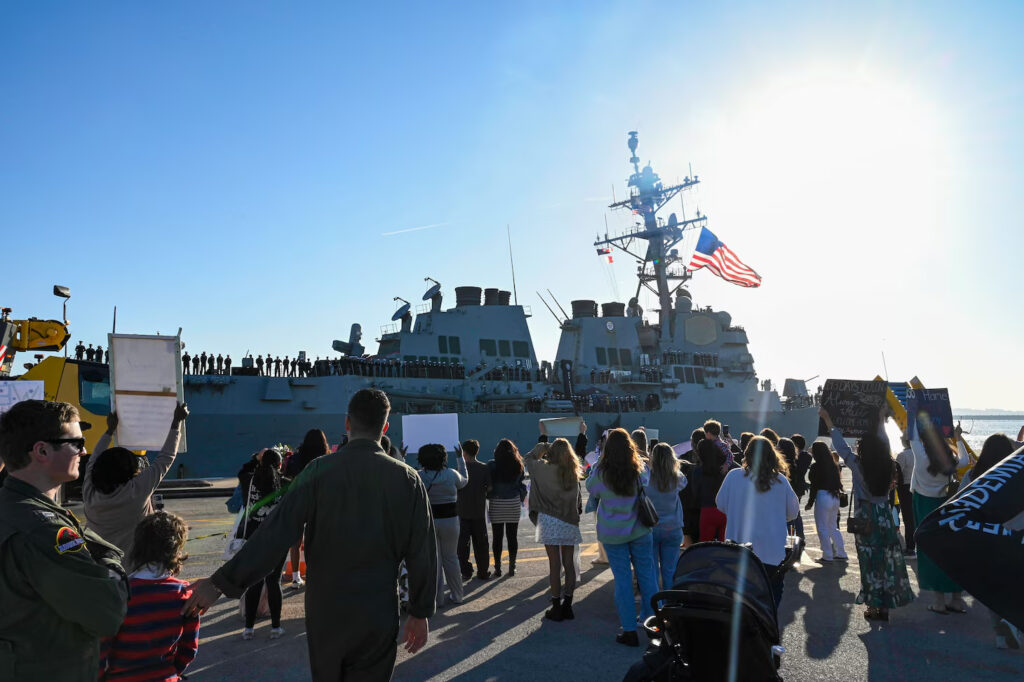
ROTA, Spain – The Arleigh Burke-class guided-missile destroyer USS Roosevelt (DDG 80) departed its homeport of Rota, Spain, to execute its ninth Forward-Deployed Naval Forces-Europe (FDNF-E) patrol, May 22, 2026.

Roosevelt, named after U.S. President Franklin D. Roosevelt and his wife Eleanor, is one of five U.S. Navy destroyers based in Rota, Spain and assigned to Commander, Task Force 65 in support of NATO’s Integrated Air Missile Defense architecture. These FDNF-E ships have the flexibility to operate throughout the waters of Europe and Africa, from the Cape of Good Hope to the Arctic Circle, demonstrating their mastery of the maritime domain.

“Throughout the past seven weeks, this crew has trained hard, prepared relentlessly, and proven that we are ready for whatever our next mission demands,” says Cmdr. R. J. DaPrato, commanding officer, USS Roosevelt. “It is an honor to stand shoulder to shoulder with these sailors as we head to sea and continue the legacy of excellence that this ship has earned.” 

Roosevelt returned from a six-and-a-half-month patrol on March 27, 2026. During the patrol, the ship operated in the 5th and 6th fleet Area of Operations. For the past seven weeks, the crew has been working diligently to prepare for the patrol, focusing on maintenance and training. Roosevelt is scheduled to conduct operations and exercises as directed by U.S. European Command (EUCOM) and C6F, including working directly alongside allies and partners throughout the Mediterranean Sea and Eastern Atlantic Ocean.

U.S. 6th Fleet, headquartered in Naples, Italy, conducts the full spectrum of joint and naval operations, often in concert with allied and interagency partners, in order to advance U.S. national interests and security and stability in Europe and Africa.


RTX’s Raytheon selected by DARPA to advance composable solid rocket motor technology

From RTX

Effort aims to deliver more flexible, scalable missile propulsion across weapon systems

ARLINGTON, Va. (May 26, 2026) — Raytheon, an RTX (NYSE: RTX) business, in collaboration with Northrop Grumman, has been awarded a phase two contract from the Defense Advanced Research Projects Agency (DARPA) Burn n’ Go program to continue the development of a new solid rocket motor (SRM) design. This new capability will decouple post-manufactured motors from traditional, single-use designs, enabling a composable motor capable of meeting multiple mission needs by adjusting thrust on demand.

The award follows a highly accelerated, seven-month phase one effort in which Raytheon and Northrop Grumman demonstrated the feasibility of this new propulsion approach. The technology is intended to support a wider range of missions and weapon systems by giving the military more options from a common, single-use motor design. Under the phase two contract, Raytheon’s Advanced Technology team will further mature and scale its solution, followed by a series of demonstrations to show how it performs in increasingly realistic rocket motor configurations.

“Solid rocket motor production has become a critical bottleneck for many missile programs,” said Colin Whelan, president of Advanced Technology at Raytheon. “By pursuing a composable approach to how these motors are designed and built, we’re helping lay the groundwork for faster, more adaptable munitions production across multiple mission sets.” 

As prime on the contract, Raytheon is partnering with Northrop Grumman’s Allegany Ballistic Laboratory (ABL), which has extensive expertise in solid rocket motor design and manufacturing. The team also includes Luna Innovations, contributing its novel material development capabilities, to advance a solution that aligns with DARPA’s vision for more flexible, scalable missile propulsion.

This collaborative approach builds on the Advanced Technology team’s broader composable weapons strategy, which is focused on reducing cycle time, lowering costs and accelerating missile development.


Blue Ops Building V7 Combat USVs for Undisclosed Customers

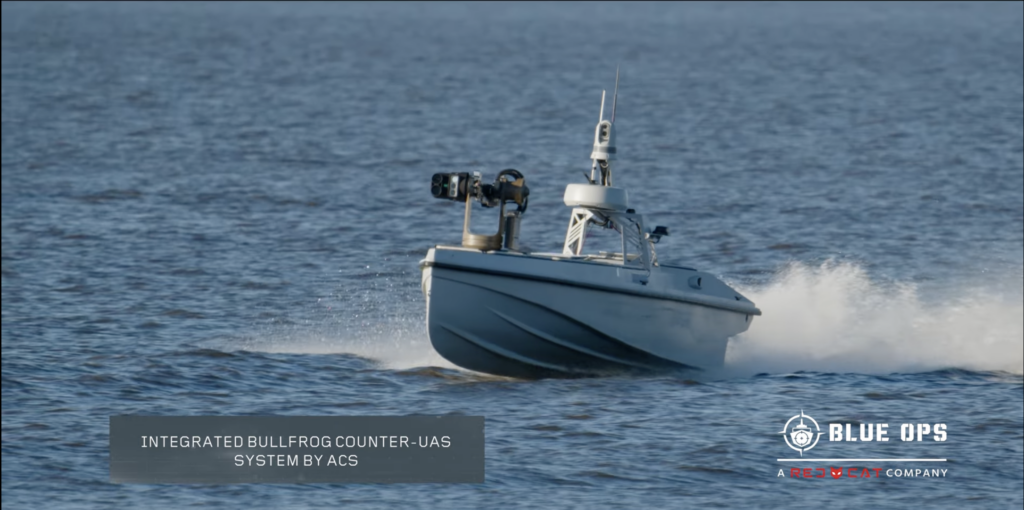
Blue Ops Inc. Marine’s Variant 7 uncrewed surface vessel is capable of a variety of missions, the company says. Photo credit: Blue Ops Inc. Marine

ARLINGTON, Va. — Blue Ops Inc. Marine, a division of Red Cat Holdings, is building its newest combat semi-autonomous uncrewed surface vessel (USV) in the United States for a set of undisclosed customers.

The Blue Ops Variant 7 (V7) is capable of a variety of missions, including kamikaze strike, anti-USV, counter-UAS, anti-helicopter, launching precision munitions, said Barry Hinckley, president of Blue Ops Marine, in an interview with Seapower.

The V7 can carry an 1,800-pound shaped-charge warhead for a kamikaze mission. For the counter-UAS mission, the V7 is armed with the Bullfrog, a .50-caliber machine gun that has demonstrated that “with 5 shots it can take down a 9-inch UAV going 100 miles per hour at 500 meters,” Hinckley said.

 The company is testing launching Red Cat’s ISR UAVs from the V7.

“You can project our boat 800 miles at 40 knots and then launch a UAV to go out 30 kilometers,” Hinckley said.

Introducing the Variant 7, an advanced unmanned surface vessel designed for extended range, endurance, and increased payload capacity. Built on operational insights and powered by Blue Ops’ open MOSA architecture with proprietary semi-autonomous command and control, the Variant 7 supports mission-adaptable operations, including integrated UAV launch and recovery. The Variant 7 enhances flexibility for U.S. and allied forces across complex maritime environments.

Blue Ops’ earlier USVs have logged 10,000 combat hours of operating time in live combat missions, he said, with USVs built in Europe.

“We initially did a deal with a European company that had Ukrainian roots and we were building boats in Western Europe that were called Version 2,” he said. “We had a difference of opinion on how we would address the technology architecture. We wanted an open, modular solution, which is what our American end-users have been asking for, which is: you guys focus on building a great boat and we’ll let the technology innovation — whether its payload, sensor, communications, autonomy — [be applied as needed].  Our former European/Ukrainian partners wanted really wanted to control the tech pack from the top to bottom and have us re-sell it here. It was an amicable separation. We separated in December.”

The V7 is the only boat Blue Ops is currently building, he said.

Red Cat Holdings announced in a release last September that Blue Ops was partnering with Hogdon Shipbuilding to build the first five prototype USVs of the V7 design. Hogdon’s facilities in the Boothbay region of Maine and in Damariscotta, Maine, also provided a site for research and development for Blue Ops.

Hinckley praised the high quality and small batch production in Maine but for expansion chose the warmer clime of Valdosta, Georgia, where the V7 is now in mass production in a leased 155,000-square-foot facility.

“This boat [the V7] was an idea in August [2025],” Hinckley said. “We went into production in October; we went into the water in late December/early January. Unveiling to military officials on February 26. And to Wall Street guests on Feb. 27. With UAV payloads.”

Hinckley said Blue Ops has customers for the V7, but he declined to name them.

“We’re working with several groups right now,” he said.

Hinckley said that a single V7 costs $695,000, but with quantities more than 100 the price comes down to the mid-$500,000s; for more than 200 the price is close to $525,000.


GA-ASI Completes First Flight of MQ-9B with AEW Pods

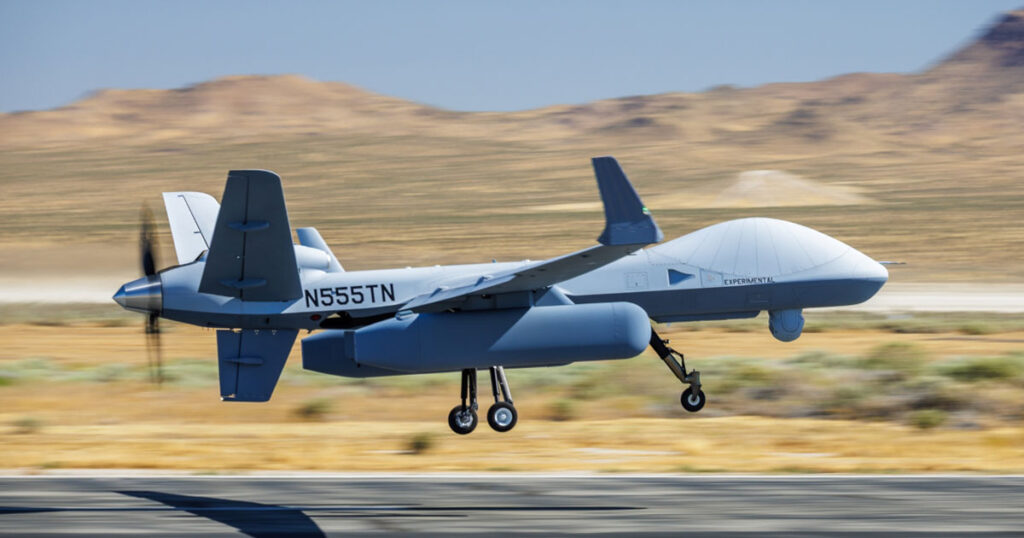
GA-ASI’s MQ-9B recently flew with Airborne Early Warning pods. Photo credit: General Atomics Aeronautical Systems.

From General Atomics Aeronautical Systems Inc.

SAN DIEGO – General Atomics Aeronautical Systems, Inc. flew its MQ-9B Remotely Piloted Aircraft for the first time with Airborne Early Warning (AEW) pods. The much-anticipated AEW capability is being provided through a partnership with Saab. Once the AEW sensor, named LoyalEye, is made available to MQ-9B operators and new customers, it will deliver persistent and cost-effective air surveillance capabilities in regions where it is currently unavailable. 

GA-ASI conducted a validation flight of MQ-9B using AEW radar pods on May 19 from GA-ASI’s Desert Horizon flight operations facility in Southern California using a company-owned aircraft. The flight signaled the first step in a development process that is expected to take several months and culminate with a full-capability demonstration later this year.

GA-ASI and Saab announced their partnership last year with the intention of bringing AEW capability to the MQ-9B platform.

MQ-9B models include the SkyGuardian and SeaGuardian, the United Kingdom’s MQ-9B variant known as Protector, and the new MQ-9B STOL (Short Takeoff and Landing) configuration currently in development for naval aircraft carriers.

“AEW for MQ-9B will offer critical aloft sensing to defend against tactical air munitions, guided missiles, drones, fighter and bomber aircraft, and other threats. Operational availability for a medium-altitude, long-endurance UAS is the highest of any military aircraft, and as an unmanned platform, its aircrews are not put into harm’s way,” said GA-ASI President David R. Alexander.

“This partnership integrates MQ-9B with LoyalEye, equipping operators with vital information for critical decision-making. LoyalEye extends the capabilities of manned systems, and it offers persistent surveillance and greater operational flexibility. This enhances situational awareness and boosts mission success,” said Carl-Johan Bergholm, Senior Vice President and Head of Business Area Surveillance at Saab.

GA-ASI and Saab’s AEW offering will span a wide range of applications, including early detection and warning, long-range detection and tracking, and simultaneous target tracking and flexible system integration — all over line-of-sight and SATCOM connectivity.


Saildrone Launches 2026 Hurricane Mission to Support NOAA Rapid Intensification Research

Image captured by Saildrone Explorer SD-1083, close to the eyewall of Hurricane Helene on Sept. 26, 2024, in wind gusts up to 84.63 knots and waves up to 16 m (52 feet). Photo credit: Saildrone

From Saildrone. May 21, 2026

ALAMEDA, Calif. — Saildrone today announced it will deploy 10 Saildrone Explorer unmanned surface vehicles (USVs) during the 2026 hurricane season to support the National Oceanic and Atmospheric Administration (NOAA) in its mission to forecast hurricanes, protect lives and property, and safeguard national and economic security.

The mission continues a multi-year collaboration between NOAA and Saildrone that began in 2021. NOAA scientists will define the operational objectives and provide mission tasking as tropical storms develop; Saildrone will operate and navigate the USVs to deliver in situ oceanographic and meteorological data in real time.

The Saildrone Explorers will be strategically positioned in the western tropical/subtropical Atlantic Ocean, Caribbean Sea, and Gulf of America from July to November. As tropical cyclones develop, Saildrone mission operators will coordinate with NOAA to position the USVs in and around storms.  

NOAA scientists at the Atlantic Oceanographic & Meteorological Laboratory (AOML) and the Pacific Marine Environmental Laboratory (PMEL) will use Saildrone data to study how exchanges of heat, moisture, and momentum between the ocean and the atmosphere influence storm intensity. Rapid intensification, defined as an increase in a hurricane’s maximum sustained winds of at least 30 knots (35 mph) in 24 hours, remains one of the most difficult hurricane behaviors to predict.

“This multi-year mission between NOAA and Saildrone is helping to improve our understanding of how hurricanes intensify, including when they strengthen rapidly before landfall,” said Greg Foltz, an oceanographer at NOAA and one of the principal investigators on the mission. “Each storm we observe gives us more data to evaluate and improve prediction models, which is critical for increasing forecast confidence, extending warning lead times, and strengthening the nation’s preparedness for high-impact weather events.”

Each Saildrone Explorer will be equipped with a suite of meteorological and oceanographic (metocean) sensors to measure wind speed and direction, air, surface, and sub-surface temperature, relative humidity, barometric pressure, salinity, and wave height and period. Additionally, two USVs will carry NOAA ASVCO2 sensors to measure carbon dioxide exchange between the ocean and the atmosphere. These observations will support NOAA’s hurricane research and modeling efforts. 

“The NOAA hurricane mission is one of Saildrone’s longest-running and most successful partnerships, and also one of the most technically demanding,” said Matt Womble, vice president of government relations at Saildrone. “This mission reinforces the value of mature, long-duration uncrewed systems for operating in environments where persistent data collection is otherwise impossible by traditional means. Better hurricane data supports better forecasts, and better forecasts strengthen national resilience—protecting lives, infrastructure, commerce, and critical operations. Saildrone is tremendously proud to continue this work with NOAA.”

Hurricanes pose a major threat to national and economic security, with impacts that can include loss of life, severe damage to homes and businesses, disruption to ports and supply chains, impacts to critical infrastructure, and interruptions to military and emergency-response operations. According to NOAA’s National Centers for Environmental Information (NCEI), between 1980 and 2004, tropical cyclones accounted for 52.9% of all billion-dollar disasters in the United States—more than wildfires, drought, flooding, freeze, severe storms, and winter storms combined. The estimated total damages (CPI-adjusted) from tropical cyclones over that time period exceed $1.5T.

Recent storms, including Hurricane Idalia in 2023, Hurricane Ian in 2022, and Hurricane Harvey in 2017, have rapidly intensified just before landfall, underscoring the need for better observations in the ocean regions where storms gain strength. NOAA aims to improve weather forecasting models, ensuring that state and local officials, and by extension the general public, receive longer lead times to prepare and evacuate accordingly. 

Saildrone has supported NOAA hurricane research across multiple seasons, deploying five USVs in 2021, seven in 2022, and 12 in both 2023 and 2024. Saildrone Explorers are multi-mission USVs, and several have been deployed on multiple hurricane missions; to date, 21 different USVs have been used in these missions. Since 2021, Saildrone has intercepted 21 named hurricanes and tropical storms on 46 occasions. In total, Explorer USVs have spent more than 2,600 days on mission supporting hurricane research. During each mission, Saildrone’s fleet has been co-located with NOAA’s aerial and sub-surface assets to form a comprehensive picture of the air and water column.    

The Saildrone Explorer is a 7-meter (23-foot) USV designed to deliver continuous metocean observations across remote and extreme environments. The USVs used for the hurricane monitoring mission are equipped with a shorter, ruggedized “hurricane” wing, designed for the extreme wind and sea state conditions inside a tropical cyclone.

In addition to the 2026 hurricane mission, Saildrone will operate more than 75 USVs globally this year, supporting national and homeland security, ocean mapping, and research.