Secretary Phelan Welcomes Under Secretary of the Navy Hung Cao
Release From SECNAV Public Affairs, Oct. 3, 2025
Today, Secretary of the Navy John C. Phelan announced a wide-ranging cross departmental portfolio for the Under Secretary of the Navy (UNSECNAV) that unifies the Department’s most consequential levers for rebuilding warrior ethos and quality of service.
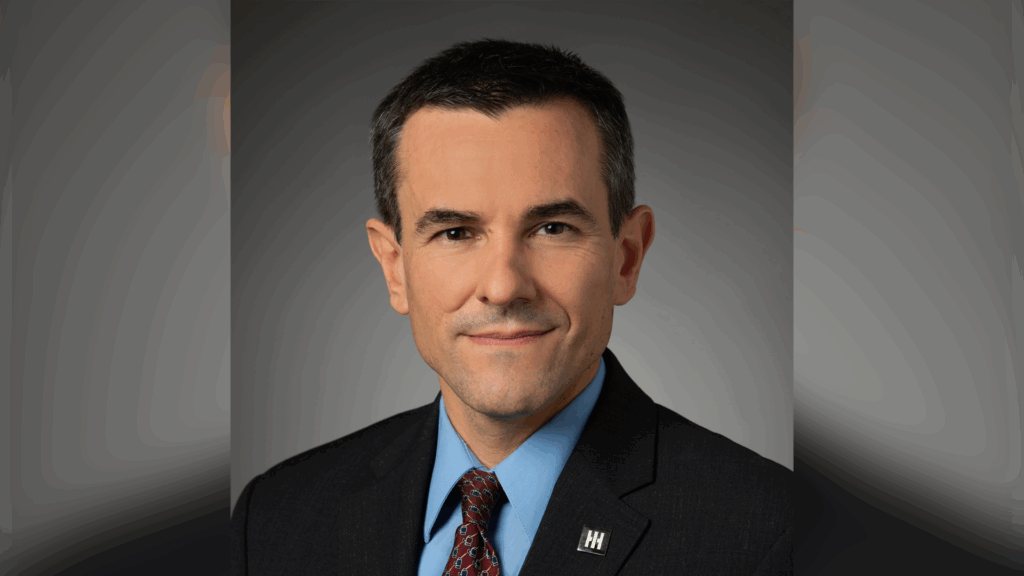
Secretary Phelan also congratulated Under Secretary of the Navy Hung Cao on his swearing-in by Secretary of War Pete Hegseth and warmly welcomed him back to the Department of the Navy.
“It is my pleasure to welcome Hung Cao to my Navy team; I look forward to having this experienced patriot lead on the highest priorities of the Secretary of War.” Secretary Phelan added, “I want to recognize with sincere gratitude, Dr. Brett Seidle, who over the past year has served as Acting Assistant Secretary of the Navy for Research, Development and Acquisition and has performed the duties of the Under Secretary of the Navy. His steady leadership in these roles has been vital to our Navy and our nation. Dr. Seidle has informed me of his intention to retire after twenty-five years of federal service following a smooth transition to Under Secretary Cao. The Department thanks him for his distinguished service and extends its best wishes for his future endeavors.”
As Secretary of War Hegseth told Flag and General Officers at Marine Corps Base Quantico earlier this week: “…at the War Department first and foremost we must restore a ruthless, dispassionate and common sense application of standards…Standards must be uniform, gender neutral and high. If not, they’re not standards. They’re just suggestions, suggestions that get our sons and daughters killed.”
“That is why I am putting my Under Secretary on the field to tackle the issues that affect the daily lives of Sailors and Marines,” said Secretary Phelan. “From his years in uniform and his record of leadership, he will cut through bureaucracy, drive real solutions and keep our people first.”
“Readiness starts at home and shows up on target,” Secretary Phelan said. “The Under Secretary’s new remit puts one quarterback and one playbook on the field to execute my gameplan for upgrading how we recruit, train, equip and take care of our people, so the Fleet stays the world’s premier, most lethal maritime force.”
“This is about speed, standards and service,” Phelan added. “When Sailors and Marines know their families are supported, housing is right, chow is quality and systems work the first time, morale rises, performance sharpens and the force delivers.”
Under the Secretary’s direction and consistent with governing statutes and the Department of the Navy priorities, the UNSECNAV will lead and synchronize the following lines of effort across the Department of the Navy:
Quality of Service: The UNSECNAV will drive rapid inspections and upgrades of family housing, recreational, healthcare and educational facilities on Navy and Marine Corps installations; tighten oversight of public-private ventures and modernize nutrition both ashore and afloat to align fueling the force with warfighter readiness.
Digital and Business Systems: As Chief Management Officer, the UNSECNAV will partner with the Department of the Navy Chief Information Officer to modernize unclassified Information Technology systems and critical Defense Business Systems. Cut downtime. Simplify processes. Get Sailors, Marines, civilians and families the tools they need fast.
Audit: The UNSECNAV will supervise the Auditor General and accelerate the Navy and Marine Corps to clean audit opinions, strengthening trust, transparency, speed of resourcing and accountability across the enterprise.
Recruiting: The UNSECNAV will visit, assess and raise Navy and Marine Corps recruiting standards, management and organization to meet and exceed end-strength. He will capitalize on the surge of Americans motivated to serve by President Trump’s call to revitalize strength and pride in our armed forces. In line with Secretary Hegseth’s charge, standards will be high, uniform and non-negotiable. They will not be suggestions. They will be the foundation of combat power.
Reserve Reform: The UNSECNAV coordinating with Assistant Secretary of the Navy for Manpower and Reserve Affairs, Chief of Naval Reserve and Deputy Commandant for Manpower and Reserve Affairs, will implement my plan for reserve reform that is already underway and produce actionable changes that integrate Reserve components as ready, lethal teammates with the active force maximizing the skills of Sailors and Marines and ensuring that reform translates into real capability.
Wellness & Suicide Prevention: The UNSECNAV will spearhead efforts across the Department to reduce mental health incidents and strengthen the performance of our force, serving as the primary representative to interagency and Department of War bodies on prevention, response and personnel readiness.
PCS, Families and Education Options: The UNSECNAV will represent the Department on the Permanent Change of Station Joint Task Force to streamline PCS orders, review on-base education and support homeschooling options so families can choose what works best for them.
Personnel Policy: The UNSECNAV will coordinate implementation of policies for service members impacted by the rescinded COVID-19 vaccine mandate and update
physical fitness standards, with a particular focus on combat units, so standards are clear, fair and combat-credible.
Guam as a Power-Projection Platform: As the Senior Defense Official for Guam, the UNSECNAV will review and assess island infrastructure and clear barriers, including energy and material challenges, so Guam delivers as a frontline power-projection platform for Indo-Pacific operations.
Standards and Warfighter Ethos: The UNSECNAV will implement Departmental direction on the elimination of divisive concepts and eradication of DEI initiatives within the Department of the Navy to keep time, talent and dollars on warfighting outcomes.
The UNSECNAV portfolio ties quality of service to combat power by design so we turn everyday friction points into force multipliers that show up on time and on target. We will fix faster, cut red tape and deliver better outcomes for families and commands. Minutes saved are minutes gained in the fight.”
“Our mission to defend the American homeland and put America first, starts in the homes of Sailors and Marines who stand the watch every day,” he continued. “When the basics work the first time, ships sail more, aircraft fly further, crews rearm and recover faster, lethality rises, risk falls and American sea power wins.”
“One Team, One Mission, One Vision is the way we operate, the way we win, the way we lead,” Secretary Phelan said. “With this move I am giving my Under Secretary the responsibility and the tools to fix what slows us down and to fuel what makes us unbeatable.”
Navy SEAL Museum Opens Showcase Location in Downtown San Diego
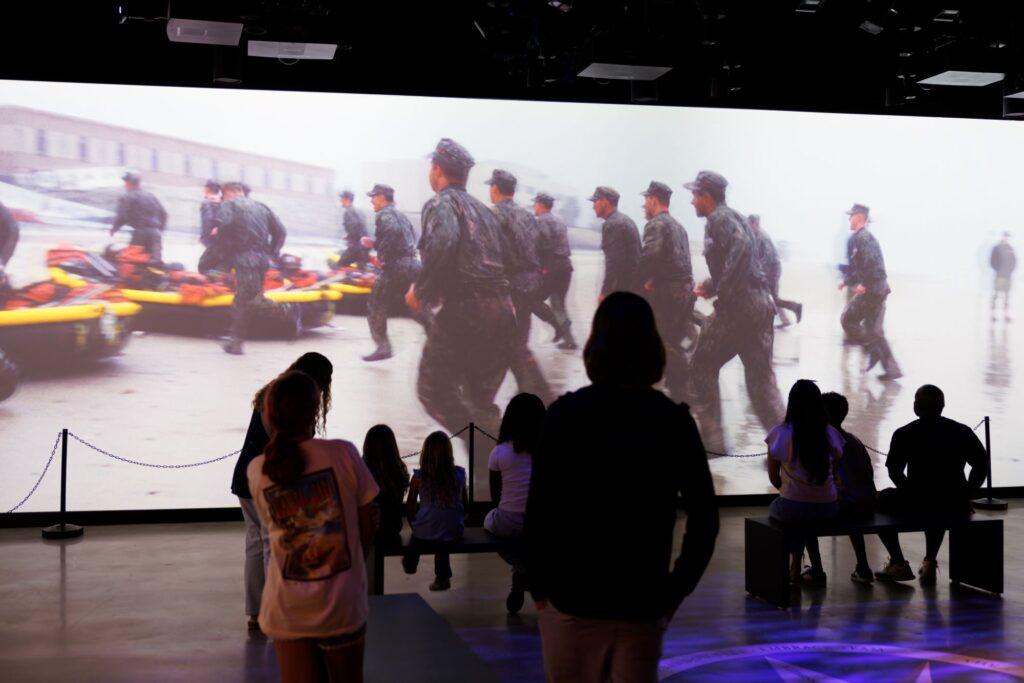
The museum lets visitors gain a better understanding of the lives and missions of Navy SEALs. Photo credit: Navy SEAL Museum San Diego.
SAN DIEGO— Seeking to inspire service and personal excellence among all visitors, the Navy SEAL Museum San Diego is opening its doors, unlocking exclusive access and insight into the world and ethos of U.S. Navy SEALs and their predecessors.
Positioned near San Diego’s waterfront at 1001 Kettner Blvd., the museum’s collection of interactive exhibits, state-of-the-art galleries, and firsthand docent accounts brings the story of Naval Special Warfare to life.
“The Navy SEAL Museum San Diego is a world-class tribute to the courage, perseverance, and dedication of these unparalleled special operators,” said Brian Drechsler, executive director of the Navy SEAL Museum San Diego, a retired U.S. Navy Captain and former Navy SEAL. “It is our honor to share this legacy, and inspire future generations to lead with integrity, serve with purpose and rise to life’s challenges.”
Building on the legacy of the existing location that opened in Fort Pierce, Florida in 1985, the Navy SEAL Museum selected San Diego for its expansion west. Central to SEAL training and home to Naval Special Warfare Command, San Diego is a heritage city for SEALs as an indelible part of their storied history. The opening of the Navy SEAL Museum’s showcase location downtown will serve as a launchpad for a larger San Diego venue in the future, for which the search is actively underway.
With an innovative blend of technology, personal narrative and historical context, the museum provides exclusive insights into the evolution, missions and mindset of the Navy SEALs. Visitors can experience an up-close look at Operation Neptune Spear, the Navy SEAL mission to neutralize Osama bin Laden, through a 3D animation narrated by retired U.S. Navy Four-Star Admiral William McRaven that walks viewers through the operation’s major steps from planning to execution.
Other exhibits include a SEAL delivery vehicle suspended above a hands-on gameplay opportunity to operate the covert submersible; a 270-degree immersive theater bringing guests into the life and service of Navy SEALs through documentary style personal accounts; artifacts and rich storytelling that bring the 80-year evolution and adaptations of Naval Special Warfare to life; and a Memorial Wall, where the fallen are never forgotten and their stories continue to inspire.
The museum includes an immersive, 3D experience. Photo credit: Navy SEAL Museum San Diego.
Visitors can also immerse themselves in the Navy SEAL Xperience, a virtual reality mission, which uses advanced VR technology to take visitors on a pulse-pounding, first-person journey into a high-stakes hostage rescue mission.
Beyond the exhibits and attractions, the docents, mostly comprised of retired and veteran SEALs and Special Warfare Combat Crewman, make each visit a deeply personal and intimate experience. By revealing untold stories and lived values of the Navy SEALs through the voices of those who have lived the legacy — docents shine a light on the resilience, sacrifice and spirit that define the Naval Special Warfare operators.
Following in the footsteps of the flagship museum in Fort Pierce, the San Diego location will extend the museum’s inspirational mission far beyond its physical space through strategic community partnerships and proven programs that will instill hope, resilience and service-minded leadership by leveraging the Navy SEALs Ethos.
Visitors can experience these real stories, missions and heroes beginning Oct. 4, 2025. Advanced bookings are encouraged, as the museum operates on a time-entry basis. Advance ticket prices are $20 for adults, with free admission for reserve and active-duty military (with ID). Visit NavySEALMuseumSD.org for details.
Navy Concludes Helicopter Aviator Training in TH-57 SeaRanger
PENSACOLA, Fla. (Feb. 23, 2017) Two U.S. Navy TH-57C Sea Ranger helicopters conduct a formation training flight over Pensacola Beach, Fla. (U.S. Navy photo by Ensign Antonio More)
By Richard R. Burgess, Senior Editor
ARLINGTON, Va. — The. U.S. Navy has retired the Bell TH-57 Sea Ranger helicopter from training naval aviators after 57 years of training Navy, Marine Corps, Coast Guard, and foreign naval aviators to fly helicopters.
The last Sea Ranger in Training Air Wing Five, TH-57C Bureau Number 162668, side number E-106, based at Naval Air Station (NAS) Whiting Field, Florida, made its last flight on Sept. 19, 2025, and was delivered to the National Naval Aviation Museum at NAS Pensacola, Florida. The helicopter was presented that day to museum director Sterling Gillum by the pilot, Commander James Gelsinon.
Another of the wing’s TH-57Cs was delivered to the USS Lexington Museum in Corpus Christi, Texas.
The TH-57 in its three versions — A, B, and C — provided flight training over the years to student rotary wing aviators by Training Air Wing Five’s Helicopter Training Squadrons HT-8, HT-18, and HT-28. The Navy procured a total of 40 TH-57As, 51 TH-57Bs, and 89 TH-57Cs.
The TH-57 is not quite gone, however, being used at NAS Patuxent River, Maryland, by an air test and evaluation squadron, HX-21.
“HX-21 still flies TH-57 for readiness flights, not testing,” said Connie Briggs, a spokeswoman for the Naval Air Systems Command. “Right now, there are no immediate plans to retire the aircraft.”
The TH-57 has been succeeded by the TH-73A Thrasher for training naval helicopter pilots at Whiting Field. The Thrasher is built by AgustaWestland Philadelphia, a Leonardo company.
HII Names Roger Kelly as Vice President of Contracts and Pricing at Newport News Shipbuilding
From HII
NEWPORT NEWS, Va., Oct. 02, 2025 (GLOBE NEWSWIRE) — HII (NYSE: HII) announced today that Roger Kelly has been promoted to vice president of contracts and pricing at its Newport News Shipbuilding division. Kelly succeeds Matt Mulherin Jr., who has been appointed vice president of supply chain and strategic sourcing at NNS.
Kelly will have overall responsibility for contracts, pricing, and export/import licensing and compliance for NNS. He will report to Don Godwin, NNS vice president of business management and chief financial officer.
“I am confident Roger has the leadership, business and technical expertise required to lead impactful contract negotiations on behalf of our team,” Godwin said. “I know he will continue to build upon Matt’s strong leadership of the contracts organization.”
Starting his career with the company in 1999 as a nuclear engineer, Kelly supported the Virginia-class submarine program. Since then, he has held positions of increasing responsibility across business management, most recently serving as director of contracts and pricing, overseeing all new construction contracts at the shipyard.
Kelly holds a bachelor’s degree in civil engineering and an MBA, both from Old Dominion University.
Sea Power: The Decisive Factor in the American Revolution
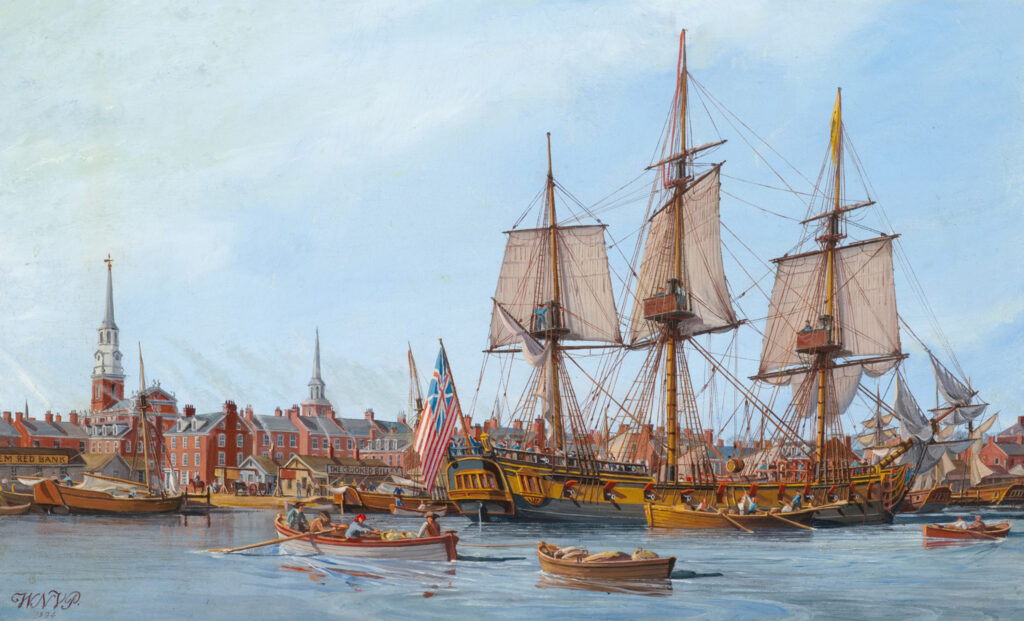
On Oct. 13, 1775, Congress authorized the outfitting of two warships and the recruiting of Sailors to create a fleet to pursue and capture British merchant vessels. The Naval Committee purchased the merchant ship Black Prince from John Barry and renamed it Alfred. The ship was placed in commission on Dec. 3, 1775. Image credit: Naval History and Heritage Command | William Nowland Powell
“The Continental Navy, with few exceptions, was a wasteful and humiliating fiasco.” So wrote Ian Toll in his introductory chapter in “Six Frigates” in his effort to set the stage for the construction of the ships that would lay the foundation for our present navy. In contrast, Tim McGrath, author of “Give Me a Fast Ship,” argues that beginning with five converted merchantmen, “America’s Sailors became formidable warriors, matching their wits, skills, and courage against the best of the British fleet.”
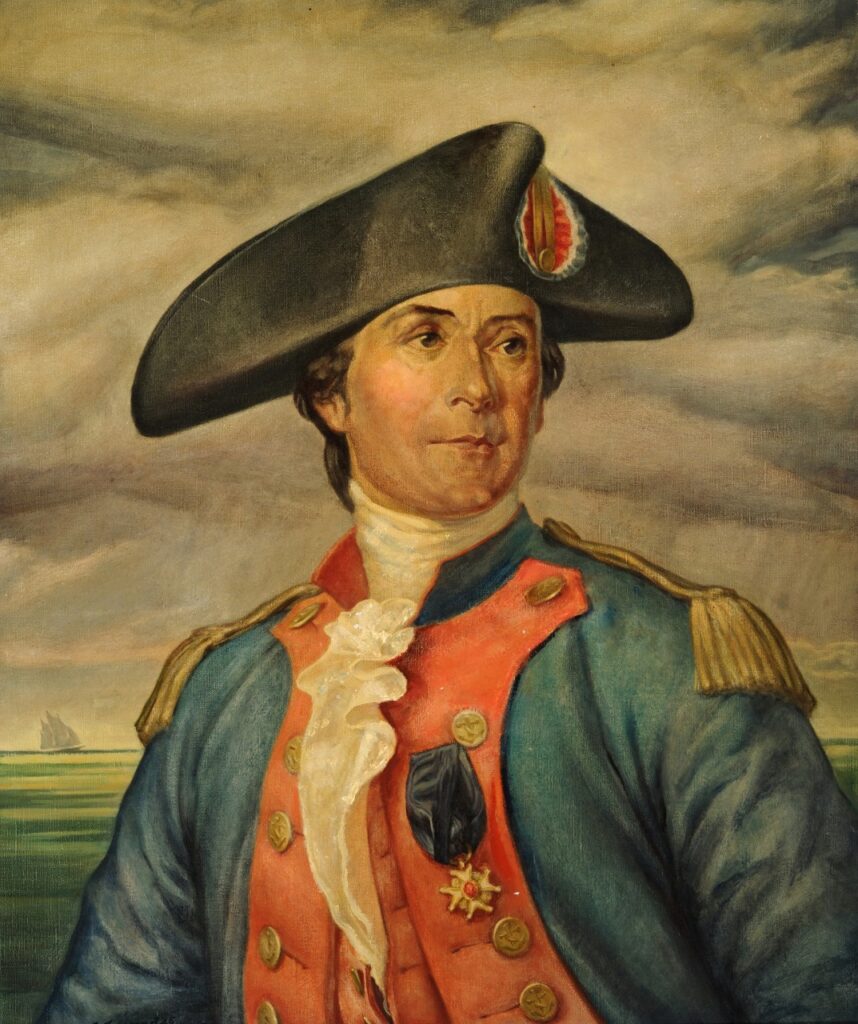
Whatever your assessment of the “Navy of the United States,” as John Paul Jones referred to it in his proposed regulations for officer uniforms, an aspect of the American Revolution that cannot be emphasized enough is the role sea power played as a determiner for the American colonies being unshackled from British rule. What started as a rebellion of the colonies against the Crown for a variety of factors, to include tariffs imposed on imported goods, grew into a global war that overtaxed the capabilities of the Royal Navy.
Ironically, sea power was one of the key factors leading to revolution. The decisive Royal Navy triumph over the French at Quiberon Bay near Saint-Nazaire on Nov. 20, 1759, during the Seven Years’ War, and British success with American colonial help in the French and Indian War (the North American component of the Seven Years’ War), which brought Canada under British rule, meant France and its allied Native American tribes no longer posed a threat that fostered colonial dependence on British armed forces. Of course, establishing Pax Britannica came at a cost, and the British sought colonial help in footing the bill.
“Taxation without representation” drove a wedge between the British Crown’s overseas subjects and the motherland, especially in New England as illustrated by the Boston Tea Party. The attempt to quell revolt by garrisoning troops in Boston would backfire in the spring of 1775 at Lexington and Concord, and soon the British found themselves in an uncomfortable situation as colonial militias formed to become an army under George Washington, who took command on July 3, 1775. Surveying the situation, Washington recognized he could change the British situation from uncomfortable to untenable by interdicting British supply ships.
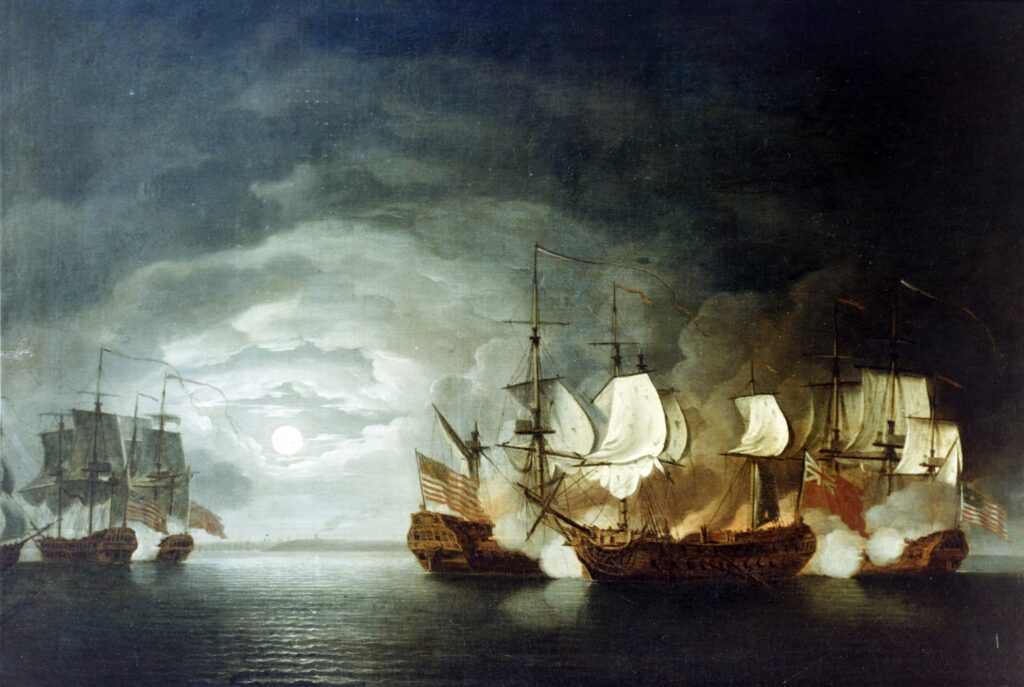
The battle between Bonhomme Richard, center, commanded by Captain John Paul Jones, and HMS Serapis off Flamborough Head, England. Image credit: Naval History and Heritage Command | Thomas Mitchell
In his assessment, he likely was inspired by a failed early-June trading mission to Machias, located northeast of present-day Bar Harbor, Maine. Hoping to exchange food for lumber, the British commander, Midshipman James Moore, would have his two cargo ships Polly and Unity seized as local Sailors, led by Jeremiah O’Brien and inspired by events at Lexington and Concord, then captured Moore’s schooner Margaretta and in doing so dispatched Moore and nine of his crew. O’Brien armed Unity with Margaretta’s guns; renamed Machias Liberty, this first American warship would immediately capture two British vessels on a surveying mission without firing a shot.
To clear the British from Boston, Washington turned to John Glover, who commanded the 21st Massachusetts Regiment from Marblehead, which was composed mostly of Sailors. In his 2021 bestseller of the same name, Patrick K. O’Donnell would dub the Marblehead men “The Indispensables,” members of whom would crew Glover’s schooner Hannah. On Sept. 7 the schooner, under the command of Nicholson Broughton, seized back an American merchantman that had been pressed into British service to deliver supplies to the British Army. Seeking to replicate Hannah’s success, additional schooners quickly claimed some 55 prizes.
Birth of the U.S. Navy and Marine Corps
The success bolstered efforts by John Adams in Philadelphia to authorize a national navy. An initial step had been taken over the summer to allow each colony to form their own fleet as they saw fit. Resistance had come from the South, which had yet to experience hostile actions from the Royal Navy. Attitudes changed as September turned to October as John Barry returned from a trip to England with newspaper accounts of the Royal Navy fitting out additional ships for duty in North America. Adams was joined in calling for the creation of a navy by Rhode Island delegate Stephen Hopkins, who learned of a bombardment conducted against Bristol. However, Samuel Chase of Maryland exclaimed, “It is the maddest idea in the world to think of building an American fleet.” Reports of additional British reinforcements en route and fear of the potential of Royal Navy men-of-war roving along the Eastern seaboard, leveling towns and villages, led Congress to act on Oct. 13, 1775, to fit out two vessels to serve in a national navy.
The fears were justified. Five days after the birth of the navy, a British squadron bombarded and then landed a raiding party to torch Falmouth in present-day Maine. That action spurred Congress to approve the acquisition of additional ships. Of course, to crew the ships, officers and enlisted Sailors, stores and supporting infrastructure were needed. Esek Hopkins, the younger brother of the Rhode Island delegate, was appointed to command America’s first naval squadron. With the Navy established, Stephen Hopkins saw the need for two battalions of Marines. Formed on Nov. 10, 1775, the Marines’ first commissioned officer would be a Quaker, Samuel Nicholas. The ship Alfred would be the first converted merchantman to be commissioned on Dec. 3, 1775. Four days later John Paul Jones received his officer commission. On Dec. 13, Congress would authorize the construction of 13 frigates to build on the number of converted merchantmen coming into service.
“It is the maddest idea in the world to think of building an American fleet.” – Samuel Chase, delegate, Continental Congress
In March 1776 the warring parties displayed aspects of sea power that factored into the course of the war. For the British, the arrival of transports meant General William Howe could extract his troops to fight another day. Meanwhile, the American squadron under Esek Hopkins headed south to the Bahamas to pull off a raid to extract arms and gunpowder. Returning from the Bahamas, the squadron experienced its first engagement with the Royal Navy in coming upon HMS Glasgow off Block Island. After Hopkins failed to exploit his numerical superiority, the British 20-gun warship was able to escape to Newport.
In the coming months, sea power would prove nearly decisive for the British. As Congress met in Philadelphia to draft the Declaration of Independence, a massive armada arrived off New York in what David Hackett Fischer declared “was the largest projection of seaborne power ever attempted by a European State.” Some 70 warships, half the order of battle for the Royal Navy, oversaw the offloading of 23,000 Redcoats and 10,000 Hessians onto Staten Island. The Royal Navy and ground forces worked in tandem to defeat Washington’s forces on Long Island.
John Paul Jones served as lieutenant on the first American Navy ship, Alfred, in 1775 and soon became captain of Providence in 1776. While operating in British territorial waters with his flagship Bonhomme Richard in 1779, Jones fought HMS Serapis and won one of the bloodiest naval battles of the American Revolution. Image credit: Naval History and Heritage Command | Arthur S. Conrad
Small craft proved to be Washington’s salvation as the Marblehead Sailors were able to extract him and some 9,000 troops from Brooklyn under cover of fog. In an attempt at asymmetric warfare, Washington approved the use of David Bushnell’s submersible Turtle, which failed early on Sept. 8, 1776, to attach an explosive to the hull of the British flagship Eagle. Dodging that bullet, a week later, the Royal Navy supported the army’s landings on Manhattan. Washington’s troops would repeatedly fail in battle, and by December they were hunkered down at Valley Forge in Pennsylvania. As documented by Fischer in “Washington’s Crossing,” it was those “Indispensable” Marblehead Sailors who crewed the boats that delivered Washington’s force across the Delaware for a successful raid on Trenton.
Sea power proved consequential during the pivotal year of 1777. Though Benedict Arnold’s gunboats were soundly defeated at the Battle of Valcour Island on Lake Champlain in October 1776, the action delayed British efforts to drive south from Canada to reach the Hudson River Valley until the following year. Eventually, British General John Burgoyne’s army would be defeated at Saratoga in October 1777. This blow came in part due to General Howe’s decision not to head north to link up with Burgoyne but rather to use sea power to transport a portion of his army up the Chesapeake Bay to offload regiments near present-day Elkton, Maryland.
Following the American defeat at Brandywine, British troops seized Philadelphia. Perhaps a motivating factor for Howe in seizing the revolutionary seat of government was not to cause the Congress to flee to York but rather to shut down a part of the infrastructure needed to sustain an American Navy. As British forces worked their way up the Delaware to open the waterway to support the new garrison in Philadelphia, they met resistance from vessels of the Continental and Pennsylvania state navies. One of the 13 authorized frigates, Delaware, would run aground and be captured. To prevent their capture, Washington ordered the scuttling of two of the other frigates trapped further upriver, Effingham and Washington. In a bombardment that would be replicated at Fort McHenry during the War of 1812, Royal Navy warships fired broadsides at Fort Mifflin. The fort would be pummeled but at a cost: The British lost HMS Augusta, a 64-gun ship-of-the-line. Credit the Army, not the Navy, for the greatest loss ever inflicted against His Majesty’s navy.
Privateers and Irregular Warfare
There is a reason Ian Toll wrote about six frigates instead of 13, as the fate of the other congressionally authorized frigates mirrored that of the three mentioned above. But elements of sea power began to work to support the newly declared United States’ effort to free itself from British rule. Privateers became the ultimate force multiplier. Congress and the individual states provided some 2,000 letters of marque to enterprising merchantmen to interdict British commerce. Motivated by prize money obtained through the sale of captured vessels and their cargoes, the privateers prowled the Atlantic in search of British merchants. Rising insurance premiums would influence British attitudes about the cost of sustaining the effort to quell the rebellion. In addition to having to divert assets to protect its merchant fleet, the Royal Navy had an even bigger challenge with the French decision to support the rebellion.
With France and eventually Spain joining the American cause, the British saw not only their other overseas possessions at risk — especially in the Caribbean, but also the homeland itself. French entry in the war and the threat of French sea power caused the British government to direct the abandonment of Philadelphia to redistribute troops to New York, Canada and the Caribbean. The veiled maritime threat had accomplished what Washington’s troops could not: the liberation of the new nation’s capital. Unfortunately, French naval deployments would not contribute toward an immediate change in the direction of the war. A potential game-changing showdown off Rhode Island on Aug. 11, 1778, between a superior French force commanded by Vice Admiral Charles-Henri d’Estaing and a British force led by Admiral William Howe was thwarted by a storm causing the two fleets to scurry to the safety of American-held Boston and British-occupied New York. However, the British would not be able to prevent the landing of French troops or block the steady stream of arms arriving from Europe.
Before the Franco-American alliance, French authorities tended to look the other way when American naval vessels fit out and operated from French ports, an arrangement that led to Lambert Wickes in Reprisal and Gustavus Conyngham in Revenge having very successful commerce-raiding deployments off the British Isles early in the conflict. With the alliance, France became an operating base for several American skippers, with the best-known being John Paul Jones — a master of what historian B.J. Armstrong has dubbed “irregular warfare” — a component of sea power that can be seen today with Navy SEALs. Having commanded Ranger in operations against his native land that included a raid on Whitehaven, Jones turned Ranger over to his First Lieutenant to take command of Duc de Duras, a merchantman of considerable size that Jones armed and transformed into the Bonhomme Richard.
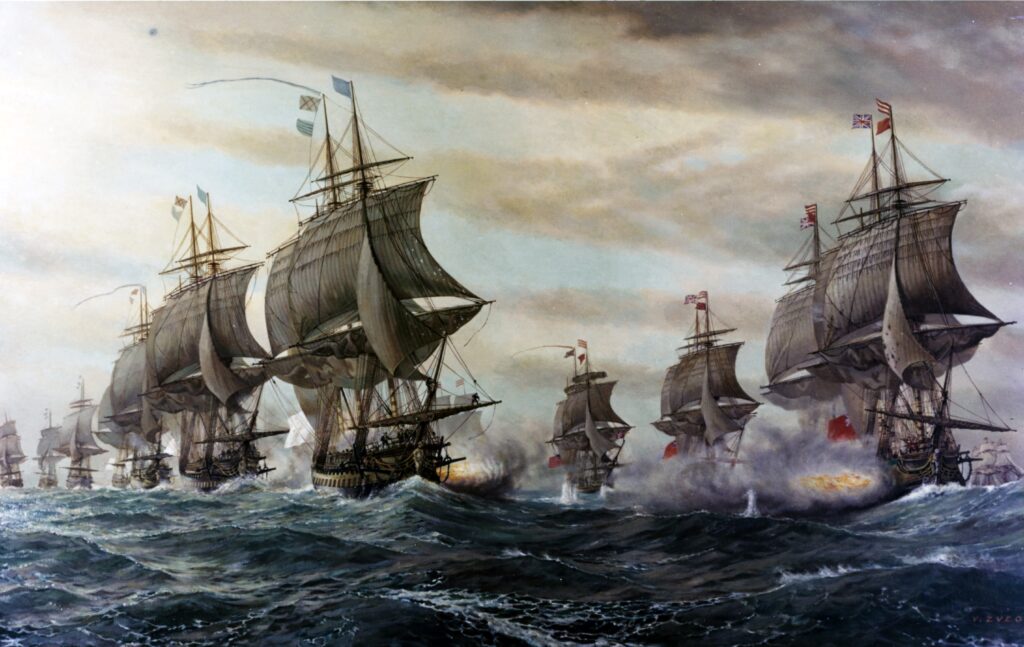
The French fleet (left), commanded by Vice Admiral the Comte de Grasse, engaging the British fleet under Rear Admiral Sir Thomas Graves off the mouth of Chesapeake Bay. Image credit: Naval History and Heritage Command | V. Zveg
Sailing out as part of a Franco-American raiding squadron, Bonhomme Richard engaged HMS Serapis off the Yorkshire coast of England on Sept. 23, 1779. With the rigging of the two ships becoming entangled and Jones losing the use of several of his guns, the American commander refused to surrender. Having “not yet begun to fight,” Bonhomme Richard’s crew boarded and seized Serapis, an outcome that would be tops on the Continental Navy’s rather limited highlight reel for the American Revolution. In contrast, a month earlier, a good portion of that navy chose to scuttle itself in the Penobscot River to avoid capture from a superior British naval force, a tragic conclusion of what may have been the young nation’s mightiest attempt to flex its sea power muscle in assembling an armada of 19 warships including the frigate Warren and 25 support ships to sail north from Boston to eliminate British footholds along the coast of present-day Maine. The disastrous Penobscot Expedition illustrated how sea power could prove decisive — unfortunately, in this case, on behalf of the British.
A few months later the British used their superior naval forces to good advantage by loading 90 transports, crewed by 5,000 Sailors, at the end of December in New York with some 8,700 troops and 396 horses to sail south past Cape Hatteras to seize Charleston. Although few horses survived the stormy journey, the troops did and were skillfully deployed by General Henry Clinton to entrap the defending American garrison. In addition to surrendering some 6,700 men, the Americans lost two more of its 13 frigates authorized by Congress.
Though the British were exploiting sea power to good effect in 1779–1780, in the end it would work to their disadvantage. Through attrition, the British did succeed in whittling the Continental Navy to just a handful of ships, with the 36-gun frigate Alliance being the most powerful warship to survive the war. A 74-gun ship-of-the-line America, completed after the battle at Yorktown, would be offered to the French as a gift for their support of American effort to achieve independence. That effort culminated with the arrival of a French fleet under the command of Vice Admiral Comte de Grasse off the mouth of Chesapeake Bay. In the Battle of the Capes, fought Sept. 5, 1781, de Grasse defeated an inferior British squadron commanded by Rear Admiral Thomas Graves, sealing the fate of General Charles Cornwallis’s troops at Yorktown.
Faced with debt, Congress would not continue to fund a navy, and with the auctioning of Alliance in August 1785, the navy that Congress created a decade earlier was no more. However, the new nation’s political leaders would quickly appreciate the consequences of their folly. In a new constitution that replaced the Articles of Confederation, in Article 1, Section 8, Congress was authorized “To raise and support armies, but no appropriation of money to that use shall be for a longer term than two years.” In contrast, the founders enshrined the need “To provide and maintain a navy.”
Dr. Winkler has been nominated to be the next Historian General of the Naval Order of the United States.This article originally appeared in the October issue of Seapower magazine.
MIB, Electric Boat, Lincoln Electric Advance Additive Manufacturing for Submarine Building
From Lincoln Electric
WASHINGTON & CLEVELAND, Sept. 30, 2025 — The U.S. Navy’s Maritime Industrial Base (MIB) Program, General Dynamics Electric Boat, and Lincoln Electric today announced an investment to accelerate the integration of additive manufacturing (AM), also known as 3D printing, into the construction of nuclear-powered submarines.
America must deliver one Columbia-class ballistic missile submarine and two Virginia-class attack submarines each year by 2028, while sustaining the current fleet. Meeting this demand requires innovative methods to increase throughput, reduce bottlenecks, and strengthen supply chains. Additive manufacturing provides critical solutions to these challenges.
Matt Sermon, executive director of the Maritime Industrial Base Program, noted, “The MIB Program is charged with strengthening and expanding the shipbuilding and repair capacity our nation needs for deterrence and warfighting. By investing in additive manufacturing at scale, we are helping ensure our industrial base has the tools, technologies, and resilience required to meet the Navy’s mission.”
Through MIB Program funding, General Dynamics Electric Boat will source critical components from Lincoln Electric’s new large-scale metal additive manufacturing capability, anchored by four state-of-the-art SculptPrint™ machines. This represents Lincoln Electric’s largest government-funded AM capital investment to date, located at its advanced Additive Solutions facility in Cleveland.
“Material availability continues to drive construction delays across the submarine enterprise,” said Ken Jeanos, vice president of supply chain, materials and logistics for General Dynamics Electric Boat. “3D-printed parts have the potential to accelerate construction and delivery of submarines to the U.S. Navy by cutting lead times for critical components.”
“This Maritime Industrial Base investment is a pivotal step to further unlock AM capabilities, enabling the defense industry to address complex supply chain challenges with innovative, efficient solutions,” added Jeanos. “This partnership expands the use of AM and other innovative technologies that Electric Boat’s engineering and procurement teams have been working on for several years.”
Steven B. Hedlund, chairman and CEO of Lincoln Electric, underscored the partnership’s impact: “This investment strengthens our partnership with Electric Boat and solidifies Lincoln Electric’s commitment to delivering transformative solutions for the defense industrial base.”
From Headquarters, U.S. Coast Guard, Sept. 30, 2025
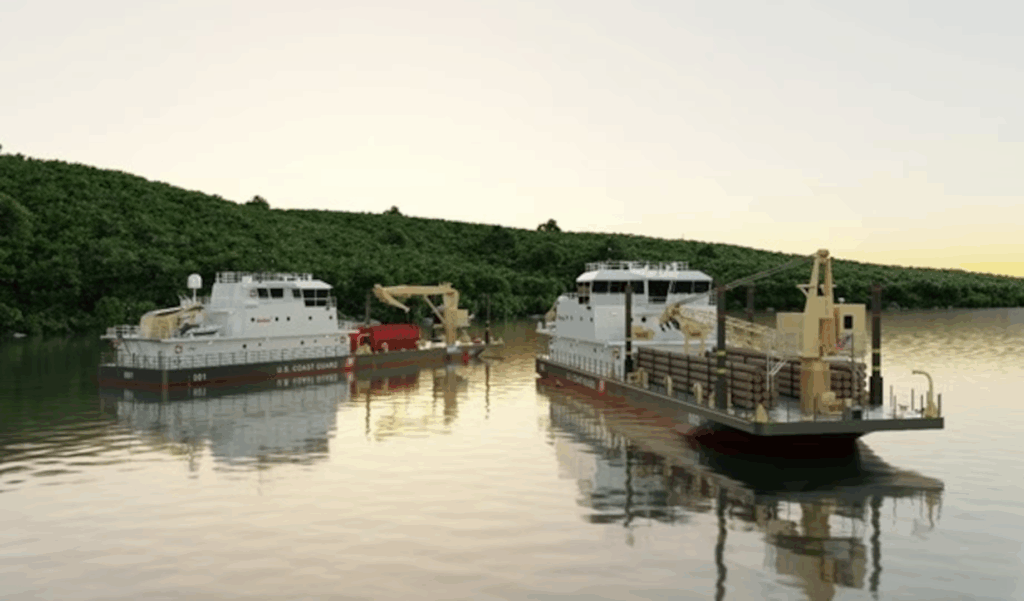
WASHINGTON—The Coast Guard is moving forward with the acquisition of the new Waterways Commerce Cutter (WCC) class, designed to replace the legacy fleet of inland tenders and facilitate commerce vital to the nation’s economic security and strategic mobility.
The service has ordered production of the first river buoy tender (WLR) and long lead time material (LLTM) for the second inland construction tender (WLIC), with construction to take place at Birdon America, Inc.’s shipyard in Bayou La Batre, Alabama.
In addition, the Coast Guard has placed an order for three sets of LLTM to support future production. The total value of the production and LLTM orders is approximately $110 million.
Funding includes $51 million provided by Public Law 119-21, the One Big Beautiful Bill Act, which covers production of the second WLIC and two sets of LLTM. The balance of the order is funded through regular appropriations.
“Our nation’s marine transportation system facilitates over $5.4 trillion in economic activity every year and supports millions of jobs throughout the United States,” said Rear Adm. Mike Campbell, the Coast Guard’s Director of Systems Integration and Chief Acquisition Officer. “Putting new waterways commerce cutters on contract ensures we have the capabilities needed to support the safe and efficient flow of commerce in our inland waterways systems.”
Inland construction tenders play a critical role in constructing, repairing, and maintaining fixed aids to navigation (ATON) along the Eastern Seaboard and Gulf Coast. These cutters are uniquely equipped to drive and remove piles, erect towers, and perform major structural modifications. Construction of the first WLIC, ordered in June 2025, is expected to be completed in 2027.
River buoy tenders service short-range ATON on the Western Rivers, setting, relocating, and recovering buoys to mark navigable channels as water levels fluctuate. They also establish and maintain fixed aids, lights, and daybeacons. Construction of the first WLR is expected to be completed in 2027. Both WLICs and WLRs are being acquired under the same contract due to their substantial design similarities.
The WCCs will replace the legacy inland tender fleet, which has an average vessel age of nearly 60 years, including ships still in service at 81 years old. The Coast Guard inland fleet maintains more than 28,200 marine aids across 12,000 miles of inland waterways, facilitating the movement of approximately 630 million tons of cargo annually.
Modernizing this fleet will bolster the Coast Guard’s capacity to control, secure and defend U.S. ports and waterways, ensuring the safe and efficient flow of commerce vital to the nation’s economic and strategic interests. This modernization is aligned with Force Design 2028, a blueprint introduced by Secretary of Homeland Security Kristi Noem to transform the Coast Guard into a more agile, capable and responsive fighting force.
Coast Guard Offloads Nearly $94.5M in Illegal Narcotics from Operation Pacific Viper
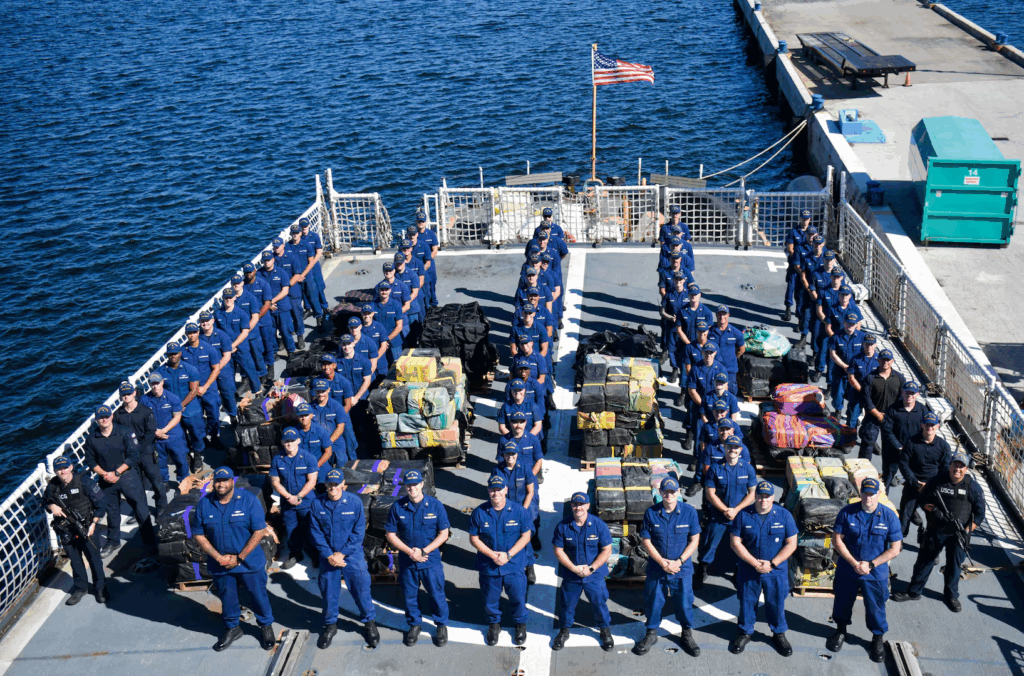
The crew of USCGC Seneca (WMEC 906) stand for a photo during a drug offload at Port Everglades in Fort Lauderdale, Florida, Sept. 30, 2025. The crew offloaded more than 12,750 pounds of cocaine and marijuana with an approximate street value of $94.5 million. (U.S. Coast Guard photo by Petty Officer 1st Class Diana Sherbs)
From U.S. Coast Guard Southeast District, Sept. 30, 2025
MIAMI – Coast Guard Cutter Seneca’s crew offloaded more than 12,750 pounds of cocaine and marijuana with an approximate street value of $94.5 million in Port Everglades, Tuesday.
Seneca was deployed in support of Operation Pacific Viper. Coast Guard crews worked alongside interagency partners to interdict illicit narcotics in the international waters in the Eastern Pacific Ocean.
Through Operation Pacific Viper, the Coast Guard is accelerating counter-drug operations in the Eastern Pacific Ocean, where significant transport of illicit narcotics continues from Central and South America. In coordination with international and interagency partners, the Coast Guard is surging additional assets—cutters, aircraft and tactical teams—to interdict, seize and disrupt transshipments of cocaine and other bulk illicit drugs. Operation Pacific Viper continues the Coast Guard’s efforts to protect the Homeland, counter narco-terrorism, disrupt foreign terrorist organizations, transnational criminal organizations and cartels seeking to produce and traffic illicit drugs into the United States. Since launching this operation in early August, the Coast Guard interdicted over 80,000 pounds of cocaine.
“I’m incredibly proud of the teamwork and adaptability displayed by my crew and our partners during this patrol to stop illicit drug flow from entering the United States,” said Capt. Lee Jones, commander, Coast Guard Cutter Seneca. “Our crews sacrifice time away from their families, and when necessary, put themselves in harm’s way to secure our borders and protect the American people.”
The following assets and crews were involved in the interdictions:
Coast Guard Cutter Venturous
Coast Guard Cutter Hamilton
Coast Guard Cutter Midgett
Coast Guard Cutter Stone
Joint Interagency Task Force-South
Coast Guard Southwest District
Coast Guard Southeast District
29 suspected smugglers were transferred to federal custody.
Detecting and interdicting narco-terrorism on the high seas involves significant interagency and international coordination. Joint Interagency Task Force-South based in Key West conducts the detection and monitoring of aerial and maritime transit of illegal drugs. Once interdiction becomes imminent, the law enforcement phase of the operation begins, and control of the operation shifts to the U.S. Coast Guard throughout the interdiction and apprehension. Interdictions in the Eastern Pacific Ocean are performed by members of the U.S. Coast Guard under the authority and control of the Coast Guard’s Southwest District, headquartered in Alameda, California.
The Coast Guard is the United States’ lead federal maritime law enforcement agency with authority to enforce national and international laws on the high seas and waters within U.S. jurisdiction. 80 percent of all U.S.-bound narcotics seizures occur at sea, underscoring the impact of Coast Guard maritime interdiction efforts.
Coast Guard Cutter Seneca is a 270-foot Famous-class medium-endurance cutter with a crew of 100 homeported in Portsmouth, Virginia.
From Naval Air Warfare Center Weapons Division, Sept. 30, 2025
CHINA LAKE, Calif. — Air Test and Evaluation Squadron (VX) 31, the Dust Devils, concluded the AV-8B Harrier’s service with a sundown ceremony Sept. 23, when the squadron flew the jet for the final time and shut it down on the China Lake flight line.
The final sortie, flown by Jim “Jimbo” Coppersmith, VX-31 technical director, brought veterans, Sailors, Marines, government civilians, industry partners and family members to the flight line to watch a traditional water salute and to say goodbye to a platform that served the fleet for more than four decades.
U.S. Marine Corps Lt. Col. Timothy “Little Buddy” Burchett, VX-31 commanding officer, described the Harrier as one of the most challenging and rewarding aircraft to fly.
“It’s the most fun airplane I’ve ever flown,” said Burchett. “There are no computers. It’s cables, pulleys and skill that keep that thing in the air.”
He called the Harrier “a uniquely Marine Corps aircraft” and praised the China Lake test team for keeping the program safe and mission capable to the finish.
“We did not coast into the finish line. It was a triumphant finish for the team partnership,” Burchett said.
Coppersmith highlighted the squadron’s role in strengthening the aircraft’s combat effectiveness and safety record through decades of testing at China Lake.
“It’s the most successful attack aircraft in Marine Corps history. No doubt about it,” he said. “We lost many great Marines along the way. Those treatments and those material fixes, the procedures we wrote, the engineering changes we made, saved lives and limbs.”
Burchett pointed to VX-31’s testing culture as a model for the entire community.
“You truly were the gold standard of testing,” he said.
Coppersmith closed his remarks by reflecting on the Harrier’s history at China Lake and the teamwork that kept it flying until the end.
“That jet right there flew its very first flight off the production line 33 years ago,” he said. “Today we completed AV-8B flight operations. We shut it down full mission capable, and it flew flawlessly. It’s a testament to what we’ve done to this aircraft as a team.”
RTX’s Raytheon Delivers 500th ESSM Block 2 to U.S. Navy
From RTX, Oct. 1, 2025
Missile provides reliable ship self-defense against air and sea-surface threats
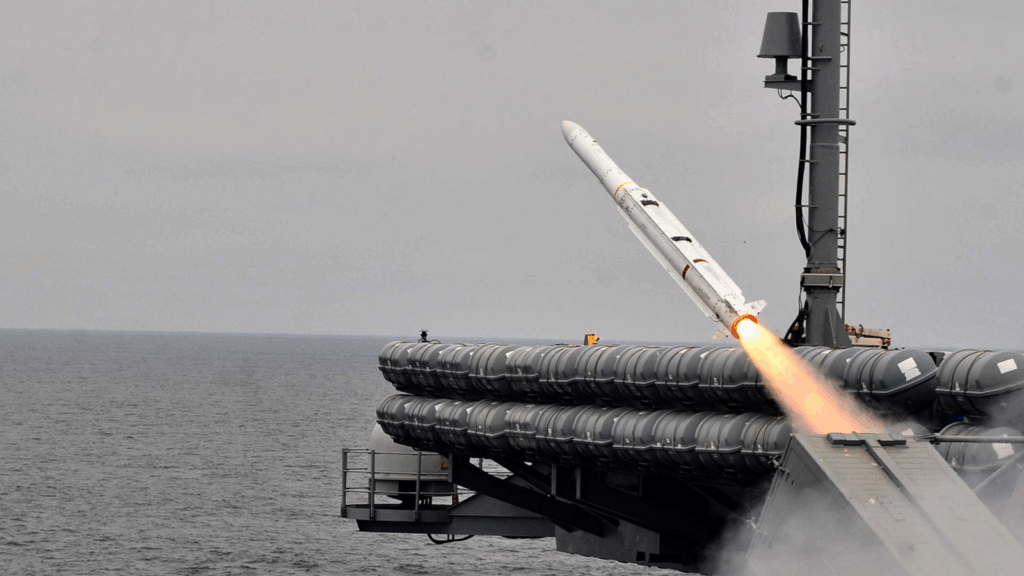
TUCSON, Ariz., Oct. 1, 2025 /PRNewswire/ – Raytheon, an RTX (NYSE: RTX) business, has delivered its 500th ESSM Block 2 missile to the U.S. Navy. The company is investing in infrastructure and material to continue deliveries, with plans to nearly double production rates by June 2026.
ESSM Block 2 is an advanced surface-to-air missile that has proven effective against a variety of air and sea-surface threats. It features an upgraded guidance system with a dual-mode active and semi-active radar seeker, increased maneuverability, and improved performance over its Block 1 predecessor.
“ESSM plays a crucial role in helping to ensure both ship self-defense and local area defense for U.S. and allied navies around the globe,” said Barbara Borgonovi, president of Naval Power at Raytheon. “The continued delivery of this capability is a testament to the strong partnerships and shared commitment among our team, our customers, and our allied nations to equip our servicemen and women with the best defense solutions.”
ESSM is managed by the NATO SEASPARROW Consortium composed of 12 nations: Australia, Belgium, Canada, Denmark, Germany, Greece, the Netherlands, Norway, Portugal, Spain, Türkiye, and the United States. The consortium is NATO’s largest and most successful cooperative weapons project and represents over 50 years of international military-industrial cooperation.