Bollinger to Lead Partnership with Allies to Deliver U.S. Coast Guard’s Arctic Security Cutter

Partnership comprises world’s premier icebreaker shipbuilders: Bollinger Shipyards, Rauma Shipyards, Seaspan Shipyards and Aker Arctic 

Plan delivers fastest schedule, lowest risk, cost certainty, and a full transition to American shipyards 

MPI design exceeds all requirements and is production ready, allowing for delivery of the first vessel within 36 months of award.

From Bollinger Shipyards, July 29, 2025 

July 29, 2025 — Lockport, La. — Bollinger Shipyards (Bollinger), Rauma Shipyards (Rauma), Seaspan Shipyards (Seaspan) and Aker Arctic (Aker) today announced the formation of a strategic partnership to deliver the lowest-risk, fastest delivery solution of best-in-class Arctic Security Cutters (ASC) to the U.S. Coast Guard. This strategic partnership represents a deliberate effort to strengthen the U.S. industrial base, expand America’s shipbuilding capacity, and equip American workers with the skills to lead in a new era of strategic competition through the transfer of knowledge, technology, and design expertise needed to build the next generation of icebreakers right here in the United States. 

Together, the four companies represent the world’s premier icebreaker shipbuilding companies. Bollinger is the largest privately-owned shipbuilder in the United States, is currently building the first heavy icebreaker in the United States in 50 years and has built and delivered nearly 200 high-performance vessels to the U.S. Coast Guard in a 40-year period. Rauma is Finland’s legendary ice-class shipyard. Seaspan Shipyards is the Canadian subsidiary of U.S. based Washington Companies and the leading icebreaker design and build shipyard currently delivering on the largest order book of ice capable vessels in the world. Aker Arctic, is a respected authority in icebreaking technology and design, having developed the majority of icebreaker designs currently in operation today. 

Fastest Path to Delivery 

The strategic partnership leverages the trilateral ICE Pact framework between the United States, Canada and Finland to answer President Trump’s call to rapidly grow a modernized U.S. icebreaking fleet, with delivery of the first vessel within 36 months of award, and ensures the ASC program is anchored in American shipbuilding and transitions quickly to full U.S. production, consistent with President Trump’s ‘America First’ priority. 

“In line with President Trump’s directive to grow and modernize America’s icebreaking fleet, Bollinger is proud to lead this partnership with a focus on speed, quality, certainty and results,” said Ben Bordelon, President and CEO of Bollinger Shipyards. “Speculative designs can derail programs, delay delivery and devastate shipyards. The Seaspan-Aker MPI design is the most mature, construction-ready design available, and we’re bringing proven capability, hard-earned lessons, and unmatched U.S. capacity to get it built. With Bollinger’s access to more than 4,000 skilled workers and over 30 facilities across the country, no one is better positioned to move fast and deliver the Arctic Security Cutter.” 

Finnish Industrial Strength for Arctic Operations 

This strategic collaboration presents a unique opportunity to apply our proven capabilities in support of the U.S. Coast Guard’s Arctic mission,” said Mika Nieminen, President and CEO of Rauma Shipyards. “We are fully prepared to begin construction immediately, leveraging a mature design and deep experience in building technically complex vessels for operation in severe winter conditions. With a fully operational production line and world-class facilities, we bring reliability and results—not projections. Beyond construction, Rauma provides added value through crew training, bridge simulator programs, and ice trials to support successful commissioning and elevate the technological and operational capabilities. Together with our partners, we offer a clear and executable path to strengthening America’s presence in the Arctic.” 

Purpose-Built Design. Mission-Ready Capability. 

The Seaspan-Aker Multi-Purpose Icebreaker (MPI) design is the optimal design to meet U.S. Coast Guard requirements as it exceeds all ASC requirements and supports all eleven statutory missions. With the ability to break four feet of ice, travel 12,000 nautical miles, and operate for over 60 days, the design is purpose-built to support the evolving mission needs of the U.S. Coast Guard in the harshest conditions. Additionally, its shared multi-mission design with the Canadian Coast Guard fleet will create the largest class of icebreaking capability in the world, optimizing interoperability and maintenance support. 

 “We are proud to collaborate with Bollinger, Rauma and Aker Arctic to share our expertise in icebreaker design and engineering with the United States — a historically and close partner with Canada in securing the Arctic,” said John McCarthy, CEO of Seaspan Shipyards. “Together, we’ve assembled the world’s foremost experts in icebreaking construction to deliver a low-risk, mission-ready solution that fully meets the U.S. Coast Guard’s requirements. Together, through the ICE Pact, we’re strengthening Arctic security and advancing the long-term capabilities of our nations’ shipbuilding industries.”  

Notably, all other proposed designs will require significant investment and corresponding ramp-up time creating a large risk for schedule, cost and delivery delay. 

“We are proud to be part of this collaboration in the development of the USCG’s Arctic Security Cutter icebreakers,” said Mika Hovilainen, CEO Aker Arctic Technology Inc. “This partnership highlights our commitment to advancing maritime security and innovation in the Arctic region. The vessel we are offering has been developed for the Canadian Coast Guard and includes specialized capabilities that are essential for fulfilling the Coast Guard’s missions. Together, we will leverage our expertise to build state-of-the-art icebreakers that meet the highest standards of mission capability and reliability.” 

The trilateral U.S.-Canada-Finland shipbuilding partnership is a direct embodiment of the ICE PACT initiative, reinforcing the commitment of all three nations to enhance Arctic security and shipbuilding expertise. This team stands uniquely aligned with national priorities to restore American maritime strength, not just through capability, but through speed and proven performance. 


USS Iwo Jima Becomes First Amphibious Ship Outfitted with USO Afloat Recharge Centers

NORFOLK (July 28, 2025) Sailors assigned to the Wasp-class amphibious assault ship USS Iwo Jima (LHD 7) and United Service Organization (USO) staff take a group photo during a ribbon cutting ceremony. The event acknowledges the grand opening of the first USO afloat recharge centers on an amphibious assault ship. (U.S. Navy photo by MC1Erickson B. Magno) 

From Petty Officer 1st Class Erickson Magno, July 29, 2025 

NORFOLK, Va.—The Wasp-class amphibious assault ship USS Iwo Jima (LHD 7) and United Service Organizations (USO) held a ribbon cutting ceremony onboard, officially opening the first ship-based USO centers on an amphibious assault ship, July 28. 

The afloat centers include many of the same amenities as a land-based center, such as comfortable seating, TVs, video and board games, and snacks. Equipping the ship with these centers creates a home away from home for Sailors and embarked Marines while on deployment. 

“Onboard Iwo Jima, we have 2,200 Sailors and Marines—warfighters who are being prepared and are ready to support our nation’s business when we deploy,” said Capt. Kathryn Wijnaldum, executive officer of Iwo Jima. “Our intent for its [centers] use is that they will provide an opportunity to support the warfighter—to help them reset, recharge, and de-stress—so that they can resume their duties that enable us to accomplish our mission and get the job done when our nation calls upon us.” 

These new ship-based centers gives the Sailors of Iwo Jima and their embarked Marine teammates from the 22nd Marine Expeditionary Unit (Special Operations Capable)—America’s premier warfighters—an alternative way to recharge and build a close-knit community with one another while serving in high-stress operational environments. 

“Thank you for the extreme cooperation of the ship and for the patience to deal with us here now on our very first gator,” said Jeff Hill, the USO’s Expeditionary Region Vice President. “To be able to serve Marines and Sailors wherever the world takes you, USO is going to be with you wherever you may go—that’s our objective.” 
 
Iwo Jima is the first amphibious assault ship to have ship-based centers, and the USO has ship-based centers on 10 aircraft carriers and five destroyers. 
 
For more than 80 years, the USO has served the men and women of the U.S. military and their families throughout their time in uniform—from shore-based assignments and continuing that tradition at sea. With multiple ships now carrying a USO presence, the organization is charting a course toward an extraordinary era of support to service members at sea. 
 
Iwo Jima is moored at Naval Station Norfolk following its return from a 4-week underway for Composite Training Unit Exercise (COMPTUEX). COMPTUEX was the final certifying event in the pre-deployment workup cycle for the ship’s company. 
 
Iwo Jima is the flagship of the Iwo Jima Amphibious Ready Group (ARG) which is capable of conducting global missions to accomplish U.S. strategic goals, deter adversaries, and ensure unimpeded commerce by keeping the high seas open and free in accordance with international law. Embarked aboard ARG shipping is the 22nd MEU (SOC) and provides a forward-deployed, flexible sea-based Marine Air Ground Task Force (MAGTF) capable of conducting amphibious operations—to include enabling the introduction of follow-on forces and designated special operations to meet Combatant Commander’s requirements. 


BlackSky Wins Next Phase of U.S. Navy Optical Inter-Satellite Link Research Contract

Contract furthers the design, development and evaluation of compatibility with Space Development Agency transport layer in support of tactical ISR missions 

From BlackSky, July 29, 2025 

HERNDON, Va. (July 28, 2025) — BlackSky Technology Inc. (NYSE: BKSY) won the next phase of a competitive U.S. Navy research contract to further develop optical inter-satellite link (OISL) terminal applications for its Gen-3 constellation. The OISL terminals are expected to increase the speed at which very high-resolution imagery and other high-volume space-based data travel directly between satellites before downlinking to ground stations. 

“This important award directly supports BlackSky’s ability to deliver timely, high-impact intelligence that drive decisions all the way to the tactical edges of the frontline,” said Brian O’Toole, BlackSky CEO. “High-speed inter-satellite communication links are a critical innovation that makes BlackSky’s commercial remote sensing services a robust and viable option for fleet-wide tactical ISR operations.” 

Under the development agreement, BlackSky will explore hardware and software design adaptations, novel operating concepts for commercial transport network nodes and establish new protocols for data movement. Future Gen-3 satellites will be equipped with optical inter-satellite link terminals compatible with both the Space Development Agency’s Transport Layer and commercial transport networks. 

“Extending our Gen-3 capabilities with optical intersatellite link terminals will give customers reliable access to real-time earth imaging capabilities across the full range of warfighting scenarios. Enhanced Gen-3 satellites are expected to deliver data to end users 10 times faster than current systems, with data volumes five times greater than existing capabilities,” said O’Toole. 

Laser-based OISLs create high-bandwidth, direct communication lines between satellites, reducing the time it takes to transmit and process data. In addition to reduced latency and decision making, OISLs can provide a more secure and resilient data transmission path, making them less susceptible to interference and jamming. 


USNS Comfort Arrives in Limón, Costa Rica for CP25

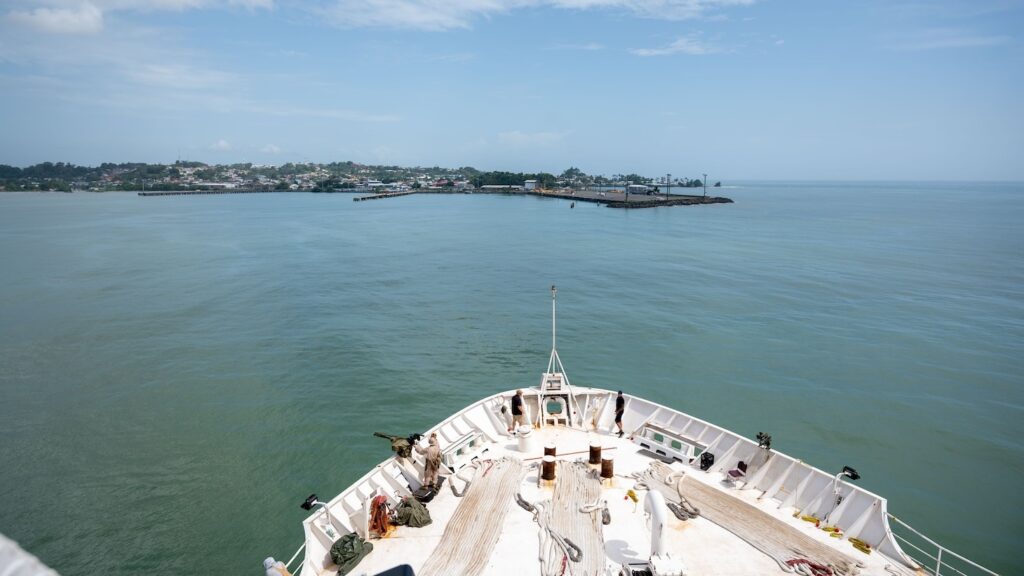
LIMÓN, Costa Rica (July 24, 2025) The Mercy-class hospital ship USNS Comfort (T-AH 20) arrives in Limón, Costa Rica during Continuing Promise 2025, July 24, 2025. Continuing Promise 2025 is the 16th iteration of the U.S. 4th Fleet/U.S. Naval Forces Southern Command-led mission since 2007, which aims to foster goodwill, strengthen existing partnerships with partner nations, and form new partnerships between host nations, non-federal entities, and international organizations. (U.S. Navy photo by MC2 Deven Fernandez) 

By U.S. Naval Forces Southern Command / U.S. 4th Fleet Public Affairs – Continuing Promise Detachment, July 24, 2025 

LIMÓN, Costa Rica  –  The Mercy-class hospital ship USNS Comfort (T-AH 20) arrived in Limón, Costa Rica, July 24, 2025, for the fifth mission stop of Continuing Promise 2025 (CP25). 

“The Continuing Promise team is excited to be here in Costa Rica and ready to bring medical aid and participate in subject matter expert exchanges and community building events alongside our Costa Rican counterparts,” said Capt. Ryan Kendall, commodore, Destroyer Squadron 40 and CP25 mission commander. “Our combined team is stronger together and we look forward to continuing to strengthen our relationships and friendships over the next week.” 

This visit marks the sixth CP mission stop to Costa Rica since its inception in 2007, and the third visit aboard Comfort in support of CP. 

“The arrival of USNS Comfort marks the beginning of the Continuing Promise 2025 mission, a mission that embodies the best of our shared values,” said Michael Flores, Chargé D’Affaires, U.S. Mission to Costa Rica. “It is a testament to the strong friendship built upon our partnership.” 

While in Costa Rica, the team will provide comprehensive medical services—including adult, pediatric, dental, optometry, and women’s health care, and perform surgeries aboard Comfort. Service members will also conduct humanitarian assistance and disaster relief training, and medical exchanges with Costa Rican professionals to strengthen maritime partnerships and enhance joint disaster response capabilities. 

“Continuing Promise 2025 has been a rewarding experience to be able to work with people from so many different countries,” said Lt. Cmdr. Laura Riebel, a physical therapist assigned to Comfort. “As a physical therapist, we have been able to help with conditions that we don’t see often and provide relief to numerous patients so far.” 

Additionally, U.S. Army veterinarians assigned to 248th Medical Detachment Veterinary Support Services will perform spay and neuter surgeries, while Seabees from Naval Mobile Construction Battalion 11 will repair two Costa Rican schools and the U.S. Fleet Forces Band “Uncharted Waters” will host performances at multiple local schools. 

“I left Costa Rica six years ago,” said Hospital Corpsman 2nd Class Veronica Hernandez Araya, assigned to Comfort. “I am grateful that I am here, grateful for this opportunity to be a part of this mission to Costa Rica.” 

Sailors from Comfort will also support the Costa Rican community through outreach events, including paint restorations and sporting activities such as basketball, cricket, and kickball. 

Lastly, for some service members, this mission represents more than professional duty—it has deeply personal connections. 

“I am excited to see my little brother, it has been a year since the last time that I saw him,” said Mass Communication Specialist 2nd Class Deven Fernandez, assigned to Comfort. “It’s an uplifting feeling when we get to help people that are close to your family and have a similar background.” 

CP25 marks the 16th mission to the region since 2007 and the eighth aboard Comfort. The mission will foster goodwill, strengthen existing partnerships with partner nations, and encourage the establishment of new partnerships among countries, non-federal entities, and international organizations. 

U.S. Naval Forces Southern Command/U.S. 4th Fleet supports U.S. Southern Command’s joint and combined military operations by employing maritime forces in cooperative maritime security operations to maintain access, enhance interoperability, and build enduring partnerships in order to enhance regional security and promote peace, stability and prosperity in the Caribbean, Central and South American region. 


U.S. Coast Guard responds to Chinese Research Vessel off Alaska 

A Coast Guard C-130J Hercules aircrew from Coast Guard Air Station Kodiak detects and responds to the China-flagged research ship Xue Long 2 on the U.S. Extended Continental Shelf (ECS) in the U.S. Arctic, approximately 290 NM north of Utqiagvik, Alaska, July 25, 2025. The C-130J aircraft was operating under Coast Guard Arctic District’s Operation Frontier Sentinel, which is designed to meet presence with presence in response to adversary activity in or near Alaskan waters. (U.S. Coast Guard photo courtesy of Air Station Kodiak)

From U.S. Coast Guard Arctic District, July 26, 2025 

JUNEAU, Alaska — The U.S. Coast Guard detected and responded to the China-flagged research ship Xue Long 2 on the U.S. Extended Continental Shelf (ECS) in the U.S. Arctic, approximately 290 NM north of Utqiagvik, Alaska, Friday. 

A Coast Guard C-130J Hercules fixed wing aircraft from Air Station Kodiak responded to the Xue Long 2, an icebreaker operated by the Polar Research Institute of China and 130 NM inside the ECS boundary. 

The U.S. has exclusive rights to conserve and manage the living and non-living resources of its ECS. 

“The U.S. Coast Guard, alongside partners and other agencies, vigilantly monitors and responds to foreign government vessel activity in and near U.S. waters to secure territorial integrity and defend sovereign interests against malign state activity,” said Rear Adm. Bob Little, Commander of the U.S. Coast Guard Arctic District. 

The C-130J aircraft was operating under Coast Guard Arctic District’s Operation Frontier Sentinel, which is designed to meet presence with presence in response to adversary activity in or near Alaskan waters. 


USS Mitscher Departs Naval Station Norfolk for Scheduled Deployment 

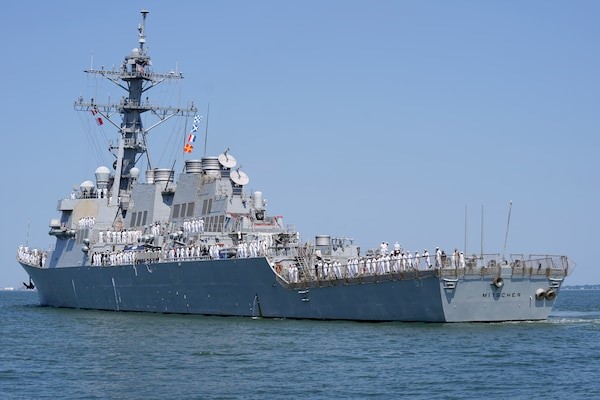
The Arleigh Burke-class guided-missile destroyer USS Mitscher (DDG 57) departs Naval Station Norfolk, July 25, for a regularly scheduled deployment as part of the Gerald R. Ford Carrier Strike Group (GRFCSG). The GRFCSG is deployed to the U.S. European Command area of responsibility to underpin American security and economic prosperity, deter adversaries, and project power on a global scale through sustained operations at sea. (U.S. Navy photo by Mass Communication Specialist 1st Class Clay M. Whaley)

From Commander, U.S. 2nd Fleet, July 28, 2025 

NORFOLK, Va. – Arleigh Burke-class guided-missile destroyer USS Mitscher (DDG 57), assigned to Destroyer Squadron Two (DESRON-2), departed Naval Station Norfolk for a regularly scheduled deployment to the U.S. European Command area of responsibility, July 25, 2025. 

Equipped with the Aegis combat system, Mitscher provides multi-mission offensive and defensive capabilities to conduct anti-air, anti-submarine and anti-surface warfare. 

“Our Sailors have trained hard and are well-prepared to go over the horizon in support of our nation’s tasking,” said Cmdr. Stephen Prugh, commanding officer of Mitscher. “Our Sailors are ready to use their knowledge and expertise in support of U.S. security, whether steaming independently or as a part of the Gerald R. Ford Carrier Strike Group.” 

USS Gerald R. Ford (CVN 78), the strike group’s flagship, as well as multiple destroyers from DESRON-2 and USS Winston S. Churchill (DDG 81), departed Naval Station Norfolk for deployment to the U.S. European Command area of operations on June 24, 2025. In addition to Mitscher, DESRON-2 includes USS Mahan (DDG 72), USS Bainbridge (DDG 96) and USS Forrest Sherman (DDG 98). 

“Mitscher is another combat-ready warship DESRON-2 brings to Fleet and Component Commanders for force employment,” said Capt. Mark Lawrence, commodore of DESRON-2. “Our forces are steadfast in their support of economic prosperity, national security and national defense, in the Atlantic Ocean and all around the globe.” 

The Gerald R. Ford Carrier Strike Group provides combatant commanders and civilian leaders with increased capacity to support U.S. security, deter adversaries and project power globally through sustained operations at sea. 

U.S. 2nd Fleet, reestablished in 2018 in response to the changing global security environment, develops and employs maritime ready forces to fight across multiple domains in the Atlantic and Arctic in order to ensure access, deter aggression and defend U.S., allied, and partner interests. 

For more U.S. 2nd Fleet news and photos, visit facebook.com/US2ndFleet, https://www.c2f.usff.navy.mil/, X – @US2ndFleet, and https://www.linkedin.com/company/commander-u-s-2nd-fleet. 


Raytheon Introduces Advanced Targeting System for U.S. Navy Helicopters 

From RTX, July 28, 2025 

Next-generation capability supports critical maritime security operations 

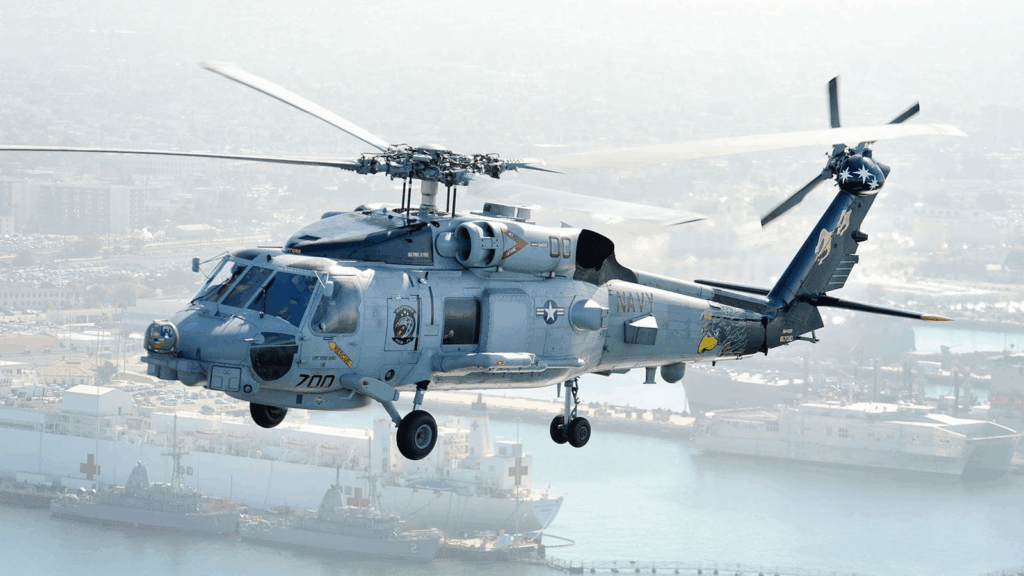
MCKINNEY, Texas, July 28, 2025 /PRNewswire/ — Raytheon, an RTX (NYSE: RTX) business launched its newest Multispectral Targeting System variant, MTS-A HD, that offers significant visual enhancements for maritime helicopter operations. 

This next-generation variant delivers improved targeting precision, imaging clarity, and expanded operational flexibility for naval helicopter platforms. Raytheon is collaborating with industry and commercial partners on the new variant to accelerate production and reduce system costs. 

“Navy helicopter pilots need the clearest possible view when flying in hostile areas,” said Bryan Rosselli, president of Advanced Products & Solutions at Raytheon. “Our new high-definition sensor system provides aircrews with superior visual capability, allowing them to make faster and more informed decisions when it matters most.” 

MTS-A HD builds on Raytheon’s proven MTS family of sensors, which are already in use on over 400 U.S. Navy helicopters. The system’s modular architecture allows for seamless integration and a cost-effective upgrade path for existing MTS users while providing enhanced capabilities. 

MTS-A HD is also attracting significant international interest spanning Australia, Denmark, Saudi Arabia, India, Norway, Greece, Spain, South Korea and emerging markets in Europe and Asia. 


Shipbuilding Investment: The Policy Proposals and Political Environment in Washington

By Luke Lorenz and Sonia Toloczko

From Seapower’s July/August Issue: Washington Report

Since American shipbuilding peaked during WWII, the production of U.S.-flagged vessels has dropped precipitously despite American imports rising at a similarly steep rate. The text of the recently introduced SHIPS for America Act of 2025 illustrates the dire state of American shipbuilding through several alarming statistics.

Although 80% of goods imported to the U.S. arrive by sea, fewer than 1.5% of the ships carrying them are American. This percentage is surprisingly low, but the number of U.S.-flagged vessels in operation is even more startling: approximately 80 American ships are engaged in international commerce. Without intervention, that figure is unlikely to see any significant increase given the weakened state of the shipbuilding industry and its infrastructure. Only a handful of U.S. shipbuilders can produce large ocean-going vessels. In 2023, these shipyards received just five orders for oceangoing ships, most of which engage in domestic trade. As it stands, American shipbuilding capacity is so diminished that even the most concerted efforts to expand it could take years to produce results. That is why Congress needs to start addressing the problem now.

Ramping up production of U.S.-flagged ships is imperative to America’s maritime security, and doing so will require the government to invest in all aspects of the shipbuilding industry. China’s shipbuilding capacity already outpaces that of the United States by an order of magnitude. Still, Congress and the president have yet to enact legislation providing the consistent funding to close that gap. Lawmakers are late to address this problem, but the political will to do so is steadily growing.

In congressional committee hearings, many lawmakers recognize the dire state of America’s shipbuilding and Merchant Marine. Speaking to Dr. Kurt Campbell in a May 15 House China Committee hearing, Rep. Ritchie Torres (D-New York) remarked that “one Chinese shipyard has more capacity than all our shipyards combined. China’s shipbuilding capacity is over 23 million deadweight tons. The United States has less than 100,000 deadweight tons. The difference is a multiple of 230.” In an April 10 Senate Armed Services INDOPACOM posture hearing, Sen. Roger Wicker (R-Mississippi) observed, “we need a drastic improvement in our shipbuilding. The risk is simply too high for us to avoid making these changes.” In nomination, posture and budget hearings across Congress, many other legislators have echoed these statements.

Two major legislative developments this Congress are indicative of the growing support for shipbuilding in Congress: the House passage of a reconciliation spending bill providing for millions in shipbuilding investment and the introduction of the bicameral and bipartisan SHIPS for America Act. This month’s Washington Report will explore the bills’ potential impact and lawmakers’ responses to them so far.

The ‘One Big Beautiful Bill Act’

Commercial and Military Shipbuilding Provisions

The House-passed reconciliation bill promises landmark investment in military and commercial shipbuilding as well as Coast Guard operations and facilities. Many shipbuilding funding allocations in the bill, or H.R.1, the “One Big Beautiful Bill Act,” align with the Navy League’s legislative recommendations. However, the Navy League advocates that Congress provide consistent funding through the annual budget process, not only reconciliation spending bills.

H.R.1 provides $2.6 billion in funding to improve military shipbuilding capacity and technology.  The bill also allocates $2.4 billion to expand and modernize the commercial shipbuilding industrial base. Most notably, Section 20002 of H.R.1, “Enhancement of Department of Defense Resources for Shipbuilding,” promises $28 billion in funding for naval ship construction, technology, maintenance and repair, and autonomous systems. Although the investment is less remarkable in comparison, it bears noting that the bill also includes $100 million for the procurement of commercial logistic ships and $700 million for the lease and purchase of ships under the National Defense Sealift Fund.

Section 20009 of the reconciliation bill, “Enhancement of Department of Defense Resources to Improve Capabilities of United States Indo-Pacific Command,” also allocates $9.7 billion for INDOPACOM operations and infrastructure. Of that funding, INDOPACOM would receive $35 million for additive manufacturing capabilities and $19 million for the development of naval small craft capabilities. Under Section 20010, “Enhancement of Department of Defense Resources for Improving the Readiness of the Armed Forces,” the DoD can expect $2 billion in funding for Navy depot and shipyard modernization and capacity enhancement, as well as $241 million for the production and integration of Marine Corps amphibious vehicles. H.R.1 would provide the DOD with $13 billion to build 16 warships. When combined with the proposed annual budget, the reconciliation bill’s passage would result in a $33.8 billion shipbuilding budget

 However, the $13 billion plus-up provided by the reconciliation bill is only for 2026, leaving $20.8 billion as the starting point for shipbuilding in 2027. H.R.1 promises the shipbuilding industry a historic one-time influx of investment. But shipbuilders and shipbuilding component manufacturers will expect demand to drop back down in 2027 when funding from the reconciliation bill ends. If the maritime industry cannot expect consistently elevated funding from an increased annual budget, manufacturers will be wary of making the long-term investments crucial to expanding American shipbuilding capacity.

Coast Guard Funding

In addition to large investments in the military and commercial shipbuilding industries, the reconciliation bill also promises $14.6 billion in funding for Coast Guard offshore patrol cutters, fast response cutters, polar security cutters, and Arctic security cutters. Section 100001, “Coast Guard Assets Necessary to Secure the Maritime Border and Interdict Migrants and Drugs,” allocates $3.2 billion for Coast Guard shoreside infrastructure, $1.3 billion for all facility depot maintenance and $180 million for autonomous maritime systems providing maritime domain awareness. The $20 billion that H.R.1 allocates to the Coast Guard mirrors the $20 billion budget recommended by the Navy League but still does not offer the commercial and military shipbuilding industries the reliable investment of an increased annual budget.

The SHIPS Act

Introduction and Impact

At the beginning of May, Sens. Mark Kelly of Arizona and Todd Young of Indiana and Reps. Trent Kelly of Missouri and John Garamendi of California reintroduced legislation colloquially referred to as the SHIPS for America Act in their respective chambers of Congress. Kelly and Young initially introduced two bills, splitting the House version of the SHIPS Act into one piece of legislation with tax policy provisions and another with the remaining proposals for increasing American shipbuilding.

The 2025 SHIPS for America Act includes the policies proposed in the original 2024 legislation, such as implementing a National Maritime Strategy under an executive branch Maritime Security Advisor and creating a 250-ship fleet of “commercially operated, U.S.-flagged, American crewed, domestically built merchant vessels” referred to as the Strategic Commercial Fleet. In addition to these original provisions, the 2025 bill has a few notable updates. For one, the original bill introduced a Maritime Security Trust Fund that would “reinvest duties and fees paid by the maritime industry into maritime security programs and infrastructure supporting maritime commerce.”

Along with those duties and fees, the updated SHIPS Act would also supply the Maritime Security Trust Fund with fines resulting from the U.S. Trade Representative’s April 2025 Section 301 investigation into China’s illegal shipbuilding trade practices. The other new provisions in the 2025 SHIPS Act similarly tighten restrictions on activity hindering the expansion of America’s shipbuilding industry.

Barriers to Passage

Although support for shipbuilding legislation is growing, the budget reconciliation bill may prevent Congress from acting on the SHIPS Act for some time. President Trump and Speaker of the House Rep. Mike Johnson (R-Louisiana) have publicly aimed to push the One Big Beautiful Bill Act through the Senate and onto the President’s desk by the Fourth of July. If the Senate passes the legislation, current speculation indicates it will likely be a revised version. Congressional Republicans may not be able to debate and vote on the revised bill in time to meet the July 4 deadline to which they previously agreed.

Whether Congress passes the reconciliation bill by Independence Day, senior lawmakers will be busy trying to finalize committee budget bills throughout July before their summer recess begins at the end of the month. With budget deadlines quickly following Congress’ return from recess in September, activity on the SHIPS Act could be stalled until mid-fall, assuming the appropriations process runs on schedule. While this timeline is entirely speculative, it illustrates how the upcoming congressional calendar could impede the timely passage of the SHIPS Act. To push the bill through Congress, advocates for its passage will need to capture lawmakers’ attention during the busiest working period of this Congress.

The State of Support

The current political climate and growing support for shipbuilding in Washington are promising indicators the SHIPS Act will continue to gain traction in Congress. Sen. Kelly, one of the bill’s original sponsors, was optimistic about its reception in Washington during an April 30 press conference. “I’m glad that my colleagues in Congress — Republicans and Democrats in both the House and the Senate — and the administration see this challenge too and are ready to do something about it,” he said.

Kelly’s observations are borne out by the number of sponsors for the 2025 SHIPS for America Act legislation. In addition to its sponsors, the 2025 bills now boast a combined total of 38 Republican and 32 Democratic co-sponsors. Supporters like Sen. Lisa Murkowski (R-Alaska) have been enthusiastic about the bills’ benefits for their states.

“Because of our vast geography, the maritime industry is uniquely vital to Alaska, with many of our coastal communities relying on a strong U.S.-flagged fleet for everything from everyday logistics, to commercial fishing and homeland defense,” Murkowski said. “I am proud to cosponsor the SHIPS Act, which advances common-sense solutions that will invest in the workforce and revitalize our nation’s shipbuilding, increasing Alaska’s resilience and security.”

Other legislators, such as Sen. John Fetterman (D-Pennsylvania), have expressed support for the bill’s international and local impacts, saying, “not only will this [bill] strengthen our national security, but it’ll also grow our local economies and support working families right here in Pennsylvania. I’m proud to support this commonsense, bipartisan legislation that will help us build more ships in America and stand up to China.”

Alongside lawmakers, several prominent maritime organizations have also publicly backed the SHIPS for America Act. Among the most notable of these supporters are several state maritime academies, USA Maritime, American Maritime Partnership, United Steelworkers, AFL-CIO, Marine Machinery Association, Transportation Institute, National Defense Transportation Association and Shipbuilders Council of America.

Still to Come

Congressional activity on the One Big Beautiful Bill Act may not indicate very much about legislators’ attitudes toward shipbuilding investment. However, the bill’s inclusion of such significant funding for the commercial maritime industry, new warships and the Coast Guard signals there may be enough political will to push shipbuilding bills, like the SHIPS for America Act, through Congress. Many members of Congress have come to understand a shipbuilding investment is a necessary element of safeguarding America’s economic and national security future. Now that lawmakers have become aware of the dire state of American shipbuilding, it remains to be seen how committed they are to improving it.

Luke Lorenz is the senior director of legislative affairs at the Navy League of the United States. A former U.S. Army officer, Luke also holds master’s degrees in political management and international political economy from the George Washington University and Johns Hopkins School of Advanced International Studies, respectively. Sonia Toloczko is legislative affairs associate at the Navy League.


Newly Modified Coast Guard Cutter Storis Prepares for Arctic Duty

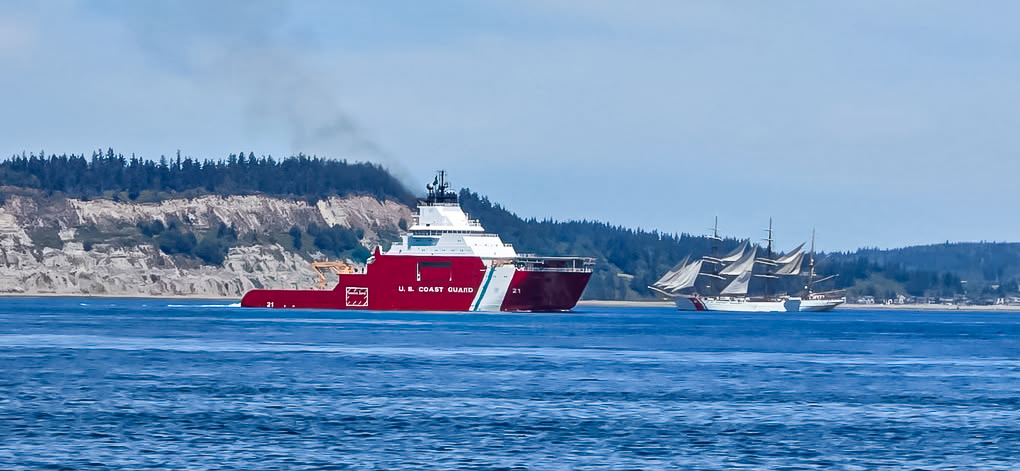
The U.S. Coast Guard Cutter Storis (WAGB 21) transits the Puget Sound near Whidbey Island and crosses paths with the Coast Guard Cutter Eagle (WIX 327), July 11, 2025. The arrival of Storis marks a milestone in the Coast Guard’s Force Design 2028 initiative and broader Arctic strategy. Photo credit: U.S. Coast Guard

The U.S. Coast Guard’s newly acquired icebreaker Storis recently arrived in Seattle to prepare for its first Arctic patrol, after a six-week voyage from Bollinger Shipyards in Mississippi.

The Coast Guard bought the M/V Aiviq (now the Storis) late last November in a $125 million deal with Offshore Surface Vessels LLC. Aiviq is a 360-foot U.S.-built vessel that has supported oil exploration in the Chukchi Sea off the coast of Alaska in the Arctic Ocean and has deployed twice to the Antarctic, according to the service.

Aiviq was built in 2012 and acquired by the Coast Guard in December 2024, making Storis 13 years old as of 2025. It’s the youngest of the icebreaking fleet; before Storis, the Coast Guard had only two active-duty icebreakers, the 26-year-old medium Arctic icebreaker Healy and the 49-year-old heavy Antarctic icebreaker, Polar Star.

The Storis (WAGB-21) is a Polar Class 3 icebreaker meant for Arctic ice patrols. Polar Class 3 denotes an icebreaker that can break about 2.5 meters (approximately 8 feet) of ice. Storis has four Caterpillar C280-12 engines producing 4,060 kilowatts each and propulsion is provided by two ducted controllable-pitch propellers and three bow thrusters and two stern thrusters. Speed is 15 knots (28 km/h; 17 mph) in the open ocean and five knots (9.3 km/h; 5.8 mph) when breaking one meter (3.2 feet) of ice. Crew size is approximately 60 officers and the crew that will be assigned in the summer of 2025.

“Storis departed Pascagoula, Mississippi on June 4 [2025] and transited the Panama Canal June 12 enroute to its future homeport of Juneau. Storis will be commissioned into service in August in Juneau,” said Lieutenant Commander Steve Roth, chief of media relations at the Coast Guard.

Seapower also asked what kinds of modifications were made to Storis.

“Prior to CGC Storis departing Mississippi, the Coast Guard installed StarShield and Coast Guard network connectivity for communications and crew safety,” Roth said. “The service also added standard Coast Guard self-defense capabilities, including a modular armory, ammunition storage, four .50 caliber machine gun mounts, and pyrotechnic lockers. Storis has not been fitted with a Mark 38 [25mm autocannon].”

StarShield is SpaceX’s military-centric satellite program that uses the Starlink satellite constellation network for secure high-bandwidth data and communications transmissions for the government, national security and the military. 

Storis will hold a commissioning ceremony in Juneau in August, where it will transition to active status before conducting an Arctic District presence patrol.

“Following that patrol, the Coast Guard will conduct further assessments of the ship to define its capability, develop operational requirements, develop program management planning (including cost, schedule, performance), and look to modify the ship to bolster the U.S. Coast Guard’s capability in the Arctic as required,” Roth said.


USS Thomas Hudner Returns from Deployment to 4th and 6th Fleets 

From U.S. 2nd Fleet, July 24, 2025 

The Arleigh Burke-class guided-missile destroyer USS Thomas Hudner (DDG 116) returned to Naval Station Mayport July 23, concluding a five-month deployment across multiple geographic theaters, including the U.S. 4th and 6th Fleet areas of operations.  

The crew departed Feb. 18, 2025, with their mission focused on strengthening international maritime security and relations with partner nations in the U.S. Southern Command area of responsibility. Shortly after arrival on station, Thomas Hudner welcomed the Honorable Pete Hegseth, Secretary of Defense, who recognized Thomas Hudner’s high-performing Sailors during his tour of Naval Support Activity (NSA) Guantanamo Bay facilities.  
 
Upon departing NSA Guantanamo Bay, Thomas Hudner conducted trilateral operations in the Caribbean Sea with the Ticonderoga-class guided-missile cruiser USS Normandy (CG 60), the United Kingdom Royal Navy River-class offshore patrol vessel HMS Medway (P 223) and the Royal Netherlands Navy Holland-class offshore patrol vessel HNLMS Groningen (P843), enhancing interoperability among Allied naval forces. Thomas Hudner also conducted freedom of navigation operations off the coast of Cuba, reinforcing the U.S. Navy’s commitment to unity, security, and stability in the Caribbean, Central and South American maritime regions. 
 
“The crew of Thomas Hudner has consistently proven their unwavering commitment in safeguarding America’s national security interests and maintaining the U.S. Navy’s maritime dominance worldwide,” said Cmdr. Cameron Ingram, commanding officer of Thomas Hudner. “I could not be more proud of my team!”  
 
Throughout their deployment in the U.S. European Command area of responsibility, Thomas Hudner’s crew trained and engaged in a variety of activities, from maritime security operations to joint exercises with Allied and partner navies in the European theater. 
 
Thomas Hudner participated in several notable exercises, including Formidable Shield 2025, executed alongside 11 NATO Allies in the North and Norwegian Seas and North Atlantic Ocean. During Formidable Shield 2025, Thomas Hudner executed joint, live-fire Integrated Air and Missile Defense (IAMD) training utilizing NATO command and control reporting structures to enhance interoperability among Allied naval forces. 
 
Thomas Hudner also conducted several port visits and collaborative operations with Norway, the United Kingdom, Spain and Greece, reinforcing the U.S. Navy’s commitment to unity, security and stability in the region. During the 81st anniversary of D-Day landings in Normandy, Thomas Hudner also had the honor of representing the U.S. Navy and hosting a reception with Adm. Stuart B. Munsch, commander, U.S. Naval Forces Europe-Africa, and various other distinguished government and military leaders in the European theater. 
 
Following operations in U.S. 6th Fleet’s northern flank, Thomas Hudner was assigned to conduct national tasking in the Eastern Mediterranean supporting Operation Cobalt Shield. Through this mission, Thomas Hudner successfully conducted maritime security operations and promoted regional stability while executing ballistic missile defense operations.  
 
Thomas Hudner served as the flagship for multiple distinguished visitors throughout her deployment, including the Honorable Pete Hegseth, U.S. Defense Secretary; Air Force Gen. Dan Caine, Chairman of the Joint Chiefs of Staff; Adm. Christopher Grady, Vice Chairman of the Joint Chiefs of Staff; Adm. Alvin Holsey, commander, U.S. Southern Command; Adm. Stuart B. Munsch, commander, U.S. Naval Forces Europe-Africa; and members of the German, French and Royal navies. 
 
“Over the course of a five-month deployment, USS Thomas Hudner and her exceptional crew exemplified the strength of American naval power and international cooperation,” said Capt. Aaron Anderson, Commander, Naval Surface Group Southeast. “Their efforts reflect the strength of our commitment to maritime security and cooperation with our Allies.” 
 
Thomas Hudner is a multi-mission air warfare, undersea warfare, naval surface fire support, surface warfare and ballistic missile defense surface combatant capable of supporting carrier battle groups and amphibious forces, operating independently, or operating as the flagship of a surface action group.  
 
U.S. 2nd Fleet, reestablished in 2018 in response to the changing global security environment, develops and employs maritime ready forces to fight across multiple domains in the Atlantic and Arctic in order to ensure access, deter aggression and defend U.S., Allied, and partner interests. 
 
For more U.S. 2nd Fleet news and photos, visit facebook.com/US2ndFleet, https://www.c2f.usff.navy.mil/, X – @US2ndFleet, and https://www.linkedin.com/company/commander-u-s-2nd-fleet.