USS Indiana Changes Homeport to Joint Base Pearl Harbor-Hickam
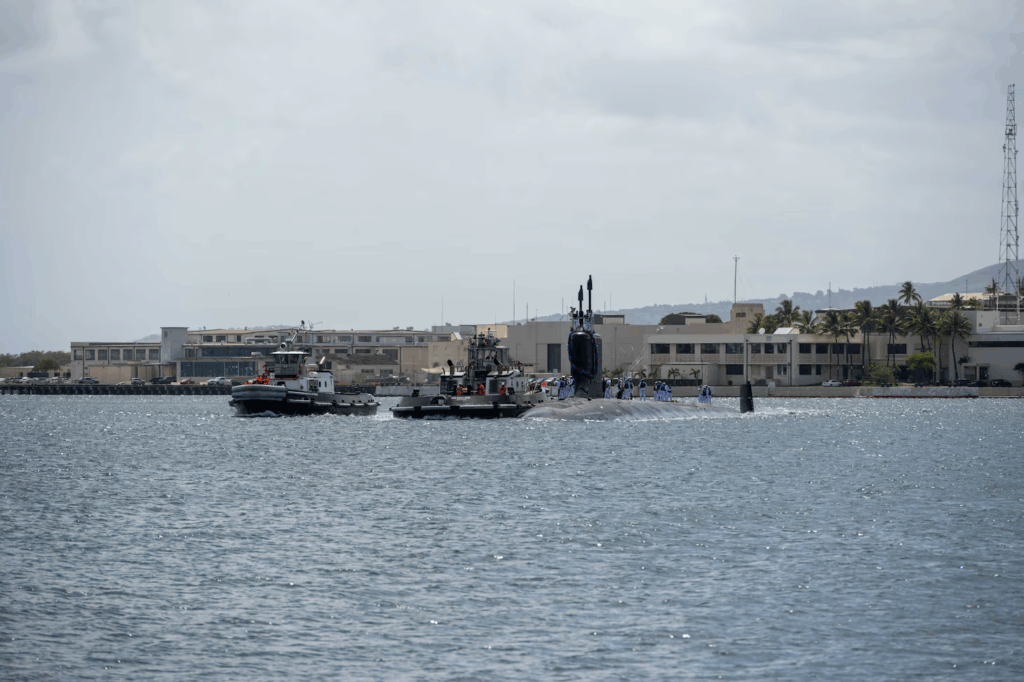
JOINT BASE PEARL HARBOR-HICKAM, Hawaii (July 22, 2025) – Virginia-class fast-attack submarine USS Indiana (SSN 789) arrives at Joint Base Pearl Harbor-Hickam during its change of homeport, July 22, 2025. (U.S. Navy photo by Mass Communication Specialist 1st Class Scott Barnes)
From MC1 Scott Barnes, Commander, Submarine Force, U.S. Pacific Fleet Public Affairs, July 22, 2025
JOINT BASE PEARL HARBOR-HICKAM – The Virginia-class fast-attack submarine USS Indiana (SSN 789) arrived at its new homeport of Joint Base Pearl Harbor-Hickam, July 22. The Indiana joined Submarine Squadron 7 as its third Virginia-class submarine after transiting from its previous homeport of Groton, Connecticut.
“The crew and I are grateful for the hospitality and warm aloha we received, both upon entering the Pacific Ocean, and arrival here in Pearl Harbor,” said Cmdr. Kyle Johnson, commanding officer of the Indiana. “We look forward to working with Submarine Squadron 7 and our Pearl Harbor partners to prepare Indiana—the ‘Battle Bass’—for any tasking, at any time, in defense of our nation.”
The Indiana previously returned from a successful six-month deployment to the U.S. European Command area of responsibility on March 27, 2025.
Rear Adm. Chris Cavanaugh, commander, Submarine Force, U.S. Pacific Fleet, welcomed the Indiana to Pearl Harbor and commented on the crew’s recent achievements. “Over the past 10 months, Indiana’s crew has expertly navigated the challenges of an operational deployment and a homeport shift,” said Cavanaugh. “Their ability to succeed is a testament to their cohesiveness and resilience. I’m excited for Indiana to join the Pacific Submarine Force and to bolster our submarine presence to maintain a secure and prosperous, free, and open Indo-Pacific.”
Capt. Corey Poorman, commander, Submarine Squadron 7, met the Indiana’s crew upon arrival to Pearl Harbor. “On behalf of the Submarine Squadron Seven Ohana, I welcome the crew and families of the Indiana to Joint Base Pearl Harbor-Hickam,” said Poorman. “We look forward to working with the Indiana crew and to provide the training and certification they need to maintain as apex predators of the Indo-Pacific.”
Commissioned on Sept. 29, 2018, the Indiana is named in honor of the state of Indiana. Holding a crew of approximately 14 officers and 120 enlisted Sailors, it is the third U.S. Navy ship to bear the name Indiana, following two earlier battleships—the first of which was commissioned in 1895.
Submarine Squadron 7 is responsible for providing training, material, and personnel readiness support to three Virginia-class submarines and four Los Angeles-class submarines.
The U.S. Pacific Fleet Submarine Force provides strategic deterrence, anti-submarine warfare, anti-surface warfare, precision land strike, intelligence, surveillance, reconnaissance, and early warning, and special warfare capabilities around the globe.
Boeing’s Redesigned Harpoon Soars During Test Mission
Launching from an F-15 jet, updated cruise missile completes initial flight test, delivers key data as production nears.
From Boeing by By Josh Roth and Junu Kim, July 23, 2025
Boeing recently completed the first developmental flight-test mission of its redesigned Harpoon cruise missile, the Harpoon Block II Update (HIIU).
Why it matters: As the program nears the start of production, the mission provided Cruise Missile Systems (CMS) teammates and the U.S. Navy with telemetry data to assess the system’s performance and progress ahead of follow-on flight tests.
Catch up quick: Boeing’s Harpoon is the most widely used, combat-proven cruise missile system in the world, able to launch from aircraft, land launch systems, surface ships and submarines.
The HIIU configuration builds upon the program’s 50-plus year legacy by addressing obsolescence items and preparing the Harpoon program to extend production amid a resurgence in global demand.
Zoom in: The HIIU was carried by an F-15SA flight-test aircraft out of Naval Air Weapons Station China Lake, California, and launched in the Point Mugu Sea Range off the Southern California coast.
Following release, the anti-ship missile successfully achieved the test objectives for the propulsion, guidance, navigation and control systems, and demonstrated desired aerodynamic performance.
What they’re saying:
Brian Schottel, HIIU program manager: “This is a significant achievement for our program and Navy counterparts, whose collaborative efforts have been essential in renewing this capability for operators.”
Joe Gentile, F-15 test engineer: “Completing this test was especially meaningful because all the teams involved — CMS, F-15 and Boeing Test & Evaluation (BT&E) along with the Navy — were able to work together and accomplish a shared mission to help the U.S. and its allies.”
The big picture: The U.S. Navy and over 30 customers worldwide use the Harpoon in support of anti-ship and land-strike missions.
What’s next: Following flight-test completion, teammates will begin production on the HIIU, with first deliveries planned for 2026.
Fairbanks Morse Defense Completes Acquisition of Rolls-Royce Naval Propulsors Business
From Fairbanks Morse Defense, July 16, 2025
Milestone event at Pascagoula foundry draws Mississippi Governor Tate Reeves and key stakeholders to mark defense industry and regional economic growth
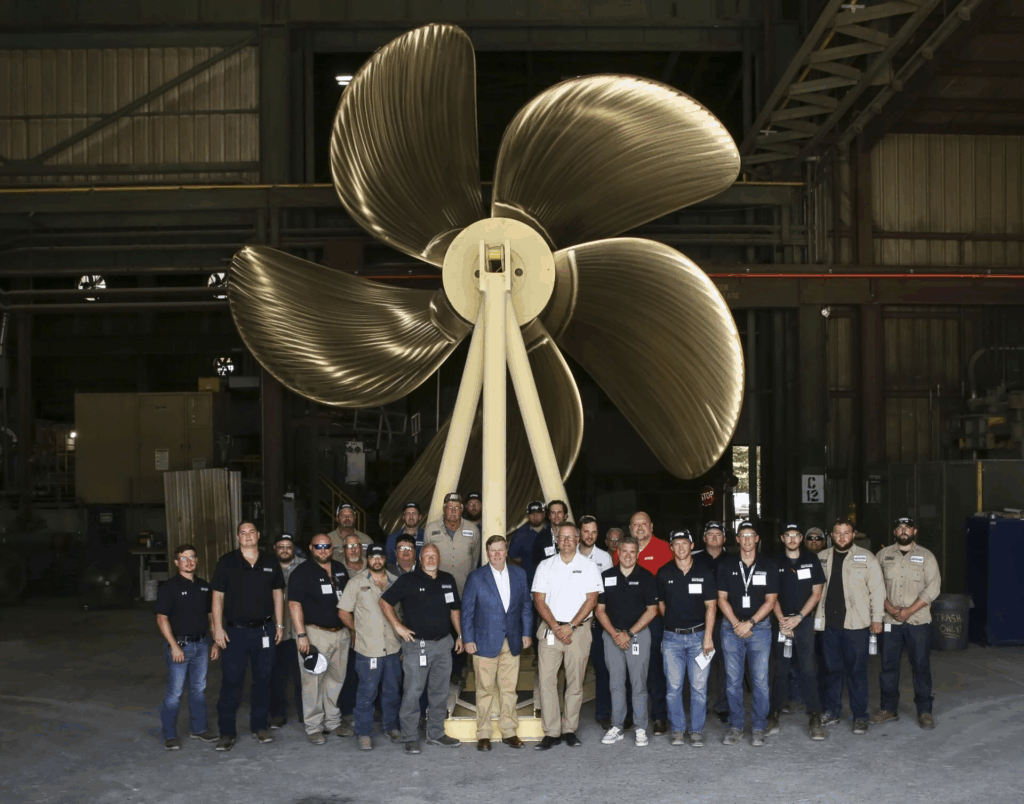
Fairbanks Morse Defense (FMD) has finalized its acquisition of the Rolls-Royce Naval Propulsors business. This milestone was celebrated at the newly acquired Pascagoula, Mississippi, foundry, where Governor Tate Reeves, Fairbanks Morse Defense CEO Steve Pykett, Jackson County Economic Development Foundation Deputy Director Mary Martha Henson, and other community and industry leaders gathered to recognize the significance of the acquisition to both national security and regional economic growth.
The Fairbanks Morse Defense Pascagoula facility is the only privately owned foundry in the United States capable of casting large Navy-standard propulsor systems, making it a critical component of the maritime defense supply chain. Now operating through a naval-focused defense contractor, the facility is being fully integrated into Fairbanks Morse Defense’s broader portfolio of naval technologies. The strategic shift is designed to boost support for the U.S. Navy through enhanced responsiveness, increased investment, and continued innovation, while also preserving skilled jobs and strengthening Mississippi’s industrial economy.
“This acquisition represents a strategic investment in sustaining the United States’ defense manufacturing capabilities and ensuring we remain prepared to meet mission-critical demands,” said Steve Pykett, CEO of Fairbanks Morse Defense. “The Pascagoula foundry, in particular, plays a vital role in supporting the Navy’s maritime dominance, and its continued operation expands our capacity to serve as a trusted partner to the U.S. military. Integrating these highly skilled workforces into Fairbanks Morse Defense strengthens our ability to deliver on our mission of supporting warfighter readiness at home and abroad.”
Event guests had a rare opportunity to tour the foundry and directly engage with leaders who are committed to advancing both national security and Mississippi’s manufacturing economy.
During his opening comments, Governor Reeves underscored the broader economic impact of the foundry on the state’s economy.
“The acquisition of the Pascagoula foundry by Fairbanks Morse Defense is a strategic win for Mississippi and our nation’s defense,” said Governor Reeves. “This move reinforces our state’s commitment to supporting the defense industrial base. Mississippi stands ready to provide the skilled workforce and robust infrastructure necessary to ensure our defense partners have the resources they need to succeed.”
Jackson County Economic Development Foundation Deputy Director, Mary Martha Henson, echoed this sentiment, emphasizing the value of local resources and community commitment.
“Fairbanks Morse Defense is joining a community that knows how to get the job done,” Henson said. “Jackson County has the infrastructure, workforce, and partnerships to help defense manufacturers thrive because we’re focused on building a regional hub that strengthens our economy and supports national security. We look forward to working with Fairbanks Morse Defense to grow local opportunity and ensure their success here on the Mississippi Gulf Coast.”
The Pascagoula site is one of several key assets included in Rolls-Royce Naval Propulsors’ business acquisition. Fairbanks Morse Defense also gains a manufacturing campus in Walpole, Massachusetts, to produce critical propulsor systems for the U.S. Navy, Coast Guard, and allied naval fleets. Additionally, Fairbanks Morse Defense is in the process of acquiring Rolls-Royce’s facility in Peterborough, Ontario, where it will support handling systems and undersea technology, including the Mission Bay Handling System used in the Global Combat Ship programs of the U.K., Canada, and Australia.
REMUS 620 Validated for Torpedo Tube Deployment
Joint Team Hits Key Milestone in Submarine-Launched UUV Ops
From HII
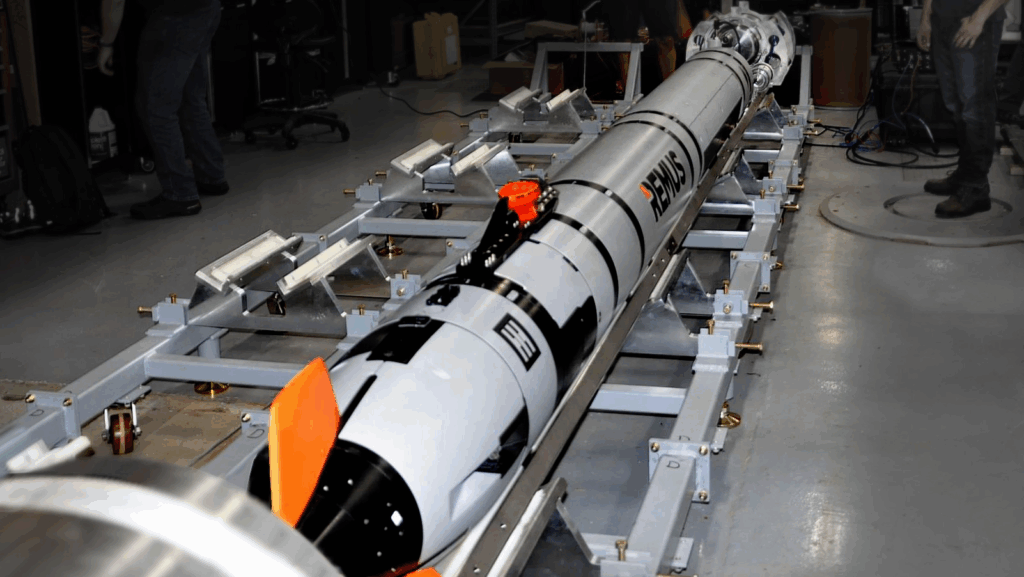
POCASSET, Mass., July 23, 2025 (GLOBE NEWSWIRE) — A joint team from HII (NYSE: HII), Woods Hole Oceanographic Institution (WHOI), and U.S. Navy’s Naval Undersea Warfare Center Division Newport (NUWCDIVNPT) recently completed a major milestone in advancing the U.S. Navy Submarine Force’s initiative to launch and recover autonomous undersea vehicles from submarine torpedo tubes.
A test by the joint team confirmed the compatibility of the REMUS 620 with the SAFECAP, Virginia-class submarine weapons handling and torpedo tube systems, and other critical interfaces.
“This clears the way for continued testing in advance of an in-water end-to-end launch and recovery at a U.S. Navy test fixture facility later this summer,” said Adrian Gonsalves, HII’s REMUS 620 product lead.
Rick Thornton, NUWCDIVNPT Code 459, stated, “Our team appreciated the early coordination with HII and WHOI. The REMUS 620 team arrived ready to go, and all events were executed safely and efficiently with good information exchange throughout. Much appreciate the full test team for its efforts.”
HII’s next-generation medium uncrewed underwater vehicle (MUUV) fitted with WHOI’s Yellow Moray docking technology, successfully completed a full end-to-end dry checkout of the Autonomous Underwater Vehicle/Shock and Fire Enclosure Capsule (AUV/SAFECAP) “All-Up Round” (AUR) in the Virginia-class Cradle Payload Integration Facility (VCCPIF) and its Mk71 torpedo tube. This follows USS Delaware (SSN 791), built by HII, successfully completing the first-ever forward-deployed launch and recovery of a UUV via submarine torpedo tube with the Yellow Moray equipped REMUS 600 UUV.
HII is expanding the U.S. Navy’s undersea dominance and range with state-of-the-art REMUS technology and delivery.
About the REMUS UUV
The REMUS UUV family delivers critical advantages across modern naval operations and the autonomous systems have been proven to operate independently or in conjunction with crewed platforms — such as Virginia-class nuclear submarines — to extend mission range, reduce detection risk, and limit personnel exposure.
The REMUS open-architecture design allows rapid payload integration, enabling mission-specific configurations and future tech insertions — key factors in maintaining operational relevance and cost efficiency over time.
To date, HII has sold more than 700 REMUS vehicles to over 30 countries, including 14 NATO members. Notably, over 90% of REMUS units delivered in the past 23 years remain in service, demonstrating platform durability and lifecycle value — both critical in defense acquisition decision-making.
USCGC Munro Returns to California Following 121-Day Bering Sea Patrol
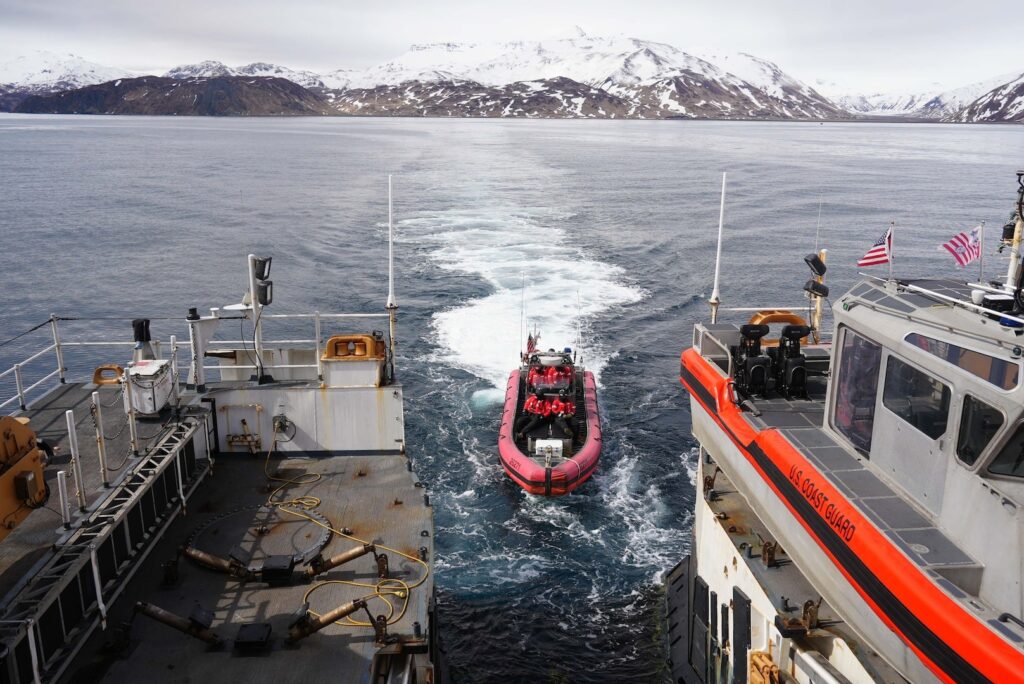
The U.S. Coast Guard Cutter Munro’s (WMSL 755) 26-foot over-the-horizon cutter boat returns to the fantail notch after conducting a boarding of a commercial fishing vessel in Dutch Harbor, Alaska May 2, 2025. Munro conducted a total of 32 boardings in the Bering Sea to preserve fisheries resources and ensure each vessel’s safety, survival, and communications gear complied with federal regulations. (U.S. Coast Guard photo by Lt. j.g. Samika Lewis)
ALAMEDA, Calif. — The crew of the U.S. Coast Guard Cutter Munro (WMSL 755) returned to their Alameda home port Wednesday following a 20,000-nautical-mile, 121-day deployment patrolling the Bering Sea.
Munro departed Alameda mid-March and operated throughout the Bering Sea during a months-long Alaska Patrol in support of the Coast Guard’s Arctic District.
The crew provided U.S. maritime presence in the region while patrolling along the maritime boundary line between the United States and Russia, supporting U.S. strategic interests in the North Pacific Ocean by promoting maritime governance and enforcing domestic fishery regulations.
Munro conducted 32 boardings of commercial fishing vessels to ensure compliance with U.S. law, preserve the integrity of U.S. fish stocks, encourage sustainable fishing practices, and maintain a level playing field within the U.S. exclusive economic zone. Exemplifying interagency coordination, Munro hosted a National Oceanic and Atmospheric Administration law enforcement officer aboard, enhancing enforcement efforts to protect the $6 billion Alaskan fishery.
Munro also served as the primary search and rescue (SAR) asset in the Bering Sea. During the patrol, the crew conducted more than 100 flight evolutions with three separate aircraft, qualifying eight pilots and increasing SAR readiness in the region. Most notably, Munro collaborated with Forward Operating Station Cold Bay, Alaska, to respond to a long-range SAR case.
During the operation, Munro served as a “lily pad,” refueling the Coast Guard helicopter at sea and maximizing its on-scene search time in the vicinity of Nunivak Island, more than 300 nautical miles from Cold Bay, for two people reportedly in the water from an overturned skiff.
The Coast Guard’s efforts to secure Arctic waterways aim to ensure American security, prosperity and freedom in the face of evolving Arctic security challenges and risks.
“Munro is happy to be home after a long and successful patrol,” said Munro’s commanding officer, Capt. Jim O’Mara. “Our job in the Bering Sea was to keep U.S. mariners safe, protect the economic integrity of the U.S. exclusive economic zone, and uphold the border control and territorial integrity of the U.S. Arctic. I can proudly say that we accomplished that mission on all fronts. We’re excited to return home to our friends and families after four months of hard work.”
Enhancing international collaborations, Munro hosted two Royal Canadian Navy exchange officers aboard for the four-month patrol. While aboard, the officers sharpened their seamanship skills, earning certifications as underway officer of the deck after an intensive qualification process that allowed them to lead the bridge team and navigate the cutter.
Commissioned in 2017, Munro is a Legend-class national security cutter named for Signalman First Class Douglas A. Munro, the only Coast Guardsman awarded the Medal of Honor for his heroic actions in 1942, sacrificing himself in the defense, rescue and evacuation of a U.S. Marine battalion from Point Cruz at Guadalcanal in the Solomon Islands.
Coast Guard Base Alameda is the home port for four national security cutters which are 418-feet long, 54-feet wide and have a 4,600-long-ton displacement. They have a top speed of 28 knots, a range of 12,000 nautical miles and can hold a crew of up to 170. Munro routinely conducts operations throughout the Pacific, where the cutter’s combination of range, speed and ability to operate in extreme weather conditions provides the mission flexibility necessary to conduct vital strategic missions.
Marine Group Boat Works Announces New Ownership of San Diego Shipyard, Los Cabos Boatyard and Global Services Superyacht Agency
Entrepreneurs back President Todd Roberts in business buyout, name him CEO, in preparation for new era growth for legacy shipyard
SAN DIEGO – Marine Group Boat Works (MGBW), a San Diego-based boatbuilding and repair company, has been purchased for an undisclosed amount by Co-Founder and President Todd Roberts, who has joined forces with entrepreneurs Chip Besse, a MGBW customer with successful investments in multiple industries, and Skye Callantine, principal of investment firm Vigeo Investments. Besse will serve as Chairman of the board while Roberts will continue to actively lead the company in his new role as CEO, with a greater focus on growth and expansion plans made possible by the new partners’ substantial investment.
The acquisition included the purchase of MGBW’s two waterfront facilities and their assets – a shipyard on San Diego Bay in Chula Vista, Calif., and a boatyard in San Jose del Cabo, Mexico. The deal also included Marine Group Global Services, the technical services arm of MGBW that provides specialized consulting and marine services worldwide. MGBW will continue to operate and manage Fifth Avenue Landing, a superyacht marina in downtown San Diego, under the Global Services division.
With roots dating back to the 1970s, the company started off as a small Chula Vista boatyard operation and was successfully relaunched 25 years ago as MGBW, a new state-of-the-art superyacht facility founded by Roberts and members of the Engel family. The company had been approached by several other potential buyers over the years, but they were never the right fit. Roberts and the Engels were committed to maintaining the integrity of the brand and protecting the legacy built over the last half-century. For them to consider a sale, they wanted MGBW to be allowed to grow and reach its potential, and not just be swallowed up by a larger firm that didn’t share their vision or commitment to the environment and their people.
“Chip and Skye are young, visionary and willing to take risks when they see opportunity. But they are also extremely selective. They only partner with companies with very healthy financials, a strong company structure and even stronger management team,” said Roberts. “My team and I have a bold vision for expanding the MGBW brand and pursuing new market segments, and our new partners share our vision. This investment represents an incredible opportunity for us to make our vision a reality. With the resources that they bring to the table, the sky is really the limit for us now.”
All 250 team members across both facilities will continue with the company, and more are expected to be added to support MGBW’s growth plans. The entire management team will also remain in place, ensuring continuity and a seamless transition.
Some of the immediate changes people will see include a complete brand refresh; new improvements to the aesthetics, security and functionality of the Chula Vista shipyard entrance (adjacent to the new Gaylord Pacific Resort); greater engagement with the superyacht industry; expansion of its Navy repair capabilities; and growth of MGBW’s construction division in support of the revival of California boatbuilding and U.S. manufacturing.
Company History & Evolution
The Engel family, starting with brothers Art, Herb and David, have operated multiple companies on the San Diego waterfront since 1977. In the early years, the shipyard in Chula Vista was originally Southwest Marine and mostly served the tuna fleet and engaged in Naval ship repair. It quickly outgrew the site and expanded into a larger San Diego facility near the Coronado Bridge while rebranding the original Chula Vista yard to South Bay Boatyard. Southwest Marine expanded to five other locations nationwide. In 1997, the Engels sold Southwest Marine and all of its shipyard facilities, except for the boatyard in Chula Vista.
In 2000, Todd Roberts, a 27-year-old California Maritime grad, was hired as vice president and tasked with shutting down what was then a financially struggling boatyard. However, he had a vision for turning the business around that included pursuing a new market with strong growth potential – large privately owned superyachts. Roberts convinced the Engels to invest $6.5 million to redevelop the facility and upgrade its equipment.
In 2006, under Roberts leadership, MGBW was founded to pursue Robert’s new vision. It has now become the largest superyacht refit facility on the West Coast. In 2010, the company opened a second multi-million-dollar boatyard and drydock storage facility in Los Cabos, Mexico. In 2024, Marine Group Global Services was launched, offering maritime consultation and a variety of ship agent and crew services that do not fit the core capabilities of a shipyard.
Following the sale of MGBW, the Engel family will continue to have a business presence on the San Diego working waterfront, maintaining ownership in its other local companies, Flagship Cruises & Events, Coronado Ferry Landing and the Fifth Avenue Landing marina (managed by MGBW).
“This year marks my 25th anniversary with the company and talk about a full-circle moment,” said Roberts. “I was originally supposed to close this place down. Instead, the Engel family took a chance on a young guy with big ideas, and together we built something special. We have come a long way, but I’d like to think we’re also just getting started. I’m incredibly grateful for the opportunity to continue the Engels’ legacy and hope to make them proud for many years to come.”
About Marine Group Boat Works
Marine Group Boat Works is a full-service maritime vessel construction and repair company with two waterfront facilities, on San Diego Bay and in Los Cabos, Mexico. Its largest shipyard in Chula Vista, Calif., encompasses 1.25 million square feet, with over 2,000 feet of dockage and a new 820-ton variable-width boat lift, rough terrain cranes, a machine shop, metal working equipment and a propeller shop. Its sister boatyard in San Jose del Cabo features over 300,000 square feet of land and water, with a 150-ton and 75-ton variable-width Travelift. Between the two facilities, MGBW employs more than 250 ABS-certified welders, shipfitters, pipefitters, mechanics, electricians, painters and other boatbuilding and repair specialists. For more information, visit www.marinegroupboatworks.com
Italian and U.S. Combined Naval Force Integrates in Mediterranean Sea
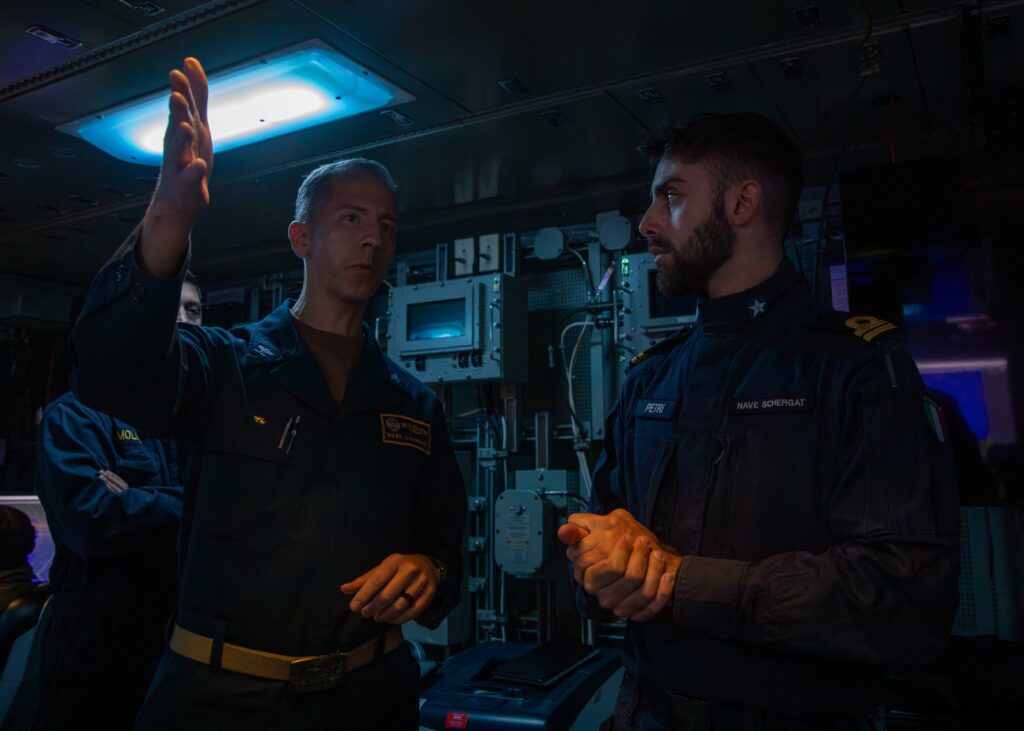
MEDITERRANEAN SEA – The first-in-class aircraft carrier USS Gerald R. Ford (CVN 78), Arleigh Burke-class guided-missile destroyers USS Winston S. Churchill (DDG 81) and USS Bainbridge (DDG 96), all assigned to Gerald R. Ford Carrier Strike Group (GRFCSG), integrated their force with Italian Navy frigate ITS Spartaco Schergat (F598) beginning July 20, 2025.
“ITS Spartaco Schergat is eager to cooperate with the Gerald R. Ford Carrier Strike Group,” said Cmdr. Michele Spada, commanding officer of Spartaco Schergat. “Interoperability activities between our units will result in an extraordinary exchange of experiences, allowing for deeper mutual understanding and strengthened trust between our crews. This strengthens both individual skills and our ability to operate as one.”
On July 19, the same members of the Gerald R. Ford Carrier Strike Group transited the Strait of Gibraltar with Spanish Armada Santa Maria-class ESPS Canarias (F86), and fast combat support ship USNS Supply (T-AOE-6),
“It is a privilege for our strike group to enter the Mediterranean Sea and immediately be met by an Italian Allied warship,” said Rear Adm. Paul Lanzilotta, commander of Carrier Strike Group Twelve. “Our transit through the Strait of Gibraltar with Spain and naval integration with Italy is just the beginning of our efforts together in deterring regional aggression and improving the lethality of our forces by raising readiness and responsiveness with our Allies and partners.”
While in the U.S. 6th Fleet area of operations, GRFCSG will continue to work alongside NATO Allies and other partners, focusing on strengthening partnerships, deepening interoperability, and supporting theater security and stability.
Built on more than seven decades of partnership and experience, NATO is the strongest military alliance in history. Carrier strike groups like Gerald R. Ford’s showcase the inherent flexibility and scalability maritime forces provide to the combined force, while reinforcing the U.S. Navy’s ironclad commitment to the stability and security of the European theater.
Gerald R. Ford, along with the nine embarked squadrons of Carrier Air Wing Eight, Destroyer Squadron Two’s Bainbridge and USS Mahan (DDG 72), and USS Winston S. Churchill (DDG 81), left Virginia in June and conducted multi-domain strike group operations in the Atlantic Ocean before transiting east.
Carrier Strike Group Twelve is on scheduled deployments in the U.S. 6th Fleet area of operations to support the warfighting effectiveness, lethality, and readiness of U.S. Naval Forces Europe-Africa, and defend U.S., Allied and partner interests in the region. For more than 80 years, U.S. Naval Forces Europe-U.S. Naval Forces Africa has forged strategic relationships with our Allies and partners, leveraging a foundation of shared values to preserve security and stability.
Hanwha Shipping Orders LNG Carrier From Hanwha Philly Shipyard
It will be the first U.S.-ordered LNG carrier since the late 1970s
HOUSTON (July 21, 2025) – Hanwha Shipping, an American subsidiary of Hanwha Ocean, announced today that it has ordered a liquefied natural gas carrier (LNG) from its affiliate, Hanwha Philly Shipyard. This new LNG carrier will be constructed with advanced technology and propulsion systems and represent the first U.S.-ordered, export-market-viable LNG carrier in almost 50 years, dating back to the late 1970s.
With this contract for one LNG carrier and an option for one additional vessel, Hanwha is bringing its LNG shipbuilding and operational know-how and expertise from Korea to America through capability and technology transfers supporting the growth of the U.S. maritime industrial base. This initiative aims to meet the growing demand for U.S. LNG carriers crewed by U.S. mariners that comply with rigorous U.S. Coast Guard standards. These ships represent a resurgence in U.S. shipbuilding capabilities, buoyed by recent U.S. trade policies that require a growing percentage of LNG exports to be transported on U.S. vessels.
“We’re excited to leverage Hanwha’s world-class shipbuilding prowess to equip American industrial partners with the skills to construct next-generation LNG carriers for the first time in nearly five decades,” said Ryan Lynch, President & CEO of Houston-based Hanwha Shipping. “Hanwha Ocean—Philly Shipyard’s Korean shipbuilding affiliate—became the world’s first shipbuilder to produce and deliver its 200th LNG carrier earlier this year. This amazing milestone reinforces Hanwha’s global leadership position in LNG carrier construction, which we are eager to replicate in the U.S.”
Under the structure of this project, Hanwha Philly Shipyard, as the U.S.-based shipyard, signs the primary shipbuilding contract with Hanwha Shipping—a Hanwha Ocean affiliate and the project’s owner—and then executes the contract as part of a joint-build model with Hanwha Ocean.
With this order, Hanwha is positioned to secure a leading technological edge and supply capability in the North American LNG carrier market. As the only company in the world with shipbuilding operations in both Korea and the United States, Hanwha plans to enhance its capability to build LNG carriers in the U.S. through a cooperative model with Hanwha Philly Shipyard.
While a significant portion of the construction will be carried out at Hanwha Ocean’s Geoje shipyard in Korea, the project will be executed as a joint-build model. Hanwha Philly Shipyard will be responsible for U.S. regulatory compliance and safety certifications, laying the foundation for a collaborative production framework. Through this model, Hanwha plans to gradually transfer its advanced shipbuilding technologies to Hanwha Philly Shipyard, enabling the latter to expand into high-value shipbuilding. This LNG carrier order marks a significant milestone in contributing to the revitalization of the U.S. shipbuilding and maritime sectors.
Hanwha Shipping plans to utilize the ordered vessels as a strategic platform to support U.S. energy security and global energy reliability. In addition to fulfilling internal group transport requirements, the vessels will play a key role in establishing the U.S.-flagged LNG fleet, reinforcing American leadership in global energy logistics, and accelerating the reindustrialization of the American maritime sector. By leveraging U.S.-sourced LNG and modern shipbuilding capacity, Hanwha aims to offer a reliable, cost-effective solution to rising global demand—particularly amid heightened geopolitical tensions and increasing pressure on energy supply chains.
Last December, Hanwha—a global conglomerate with a world-class shipbuilding arm—acquired the Philly Shipyard for $100 million. The historic shipyard has delivered more than half of the U.S.’s large commercial vessels under the Jones Act since 2000.
With the acquisition, Hanwha is focused on revitalizing the Hanwha Philly Shipyard as part of its wider goal of increasing U.S. maritime capacity and the U.S. maritime industrial base. Drawing on its decades of shipbuilding expertise and know-how, Hanwha is making significant investments in expanding Philly shipyard’s capabilities with technological advancements, workforce training and smart systems—creating significantly more onboarding capacity and thousands of new skilled manufacturing jobs in the U.S.
About Hanwha Shipping Hanwha, one of the largest South Korean conglomerates with growing investments in the U.S., added shipping to its scope of operations with the formal establishment of Hanwha Shipping in April 2024. Hanwha Shipping, a subsidiary of Hanwha Ocean, aims to take a leading position in the American shipping ecosystem by deploying next-generation digital technologies and advancing the resilience and robustness of America’s energy security and maritime industrial base.
About Hanwha Philly Shipyard Hanwha Philly Shipyard is a leading U.S. shipbuilder that has earned a reputation as a preferred provider of ocean-going merchant vessels with a track record of delivering quality ships, having delivered around 50% of all large ocean-going U.S. Jones Act commercial ships since 2000. The shipyard is part of Hanwha Group, a multinational company with a robust network of affiliates in the energy, shipbuilding, defense, aerospace, finance, and retail & services industries. For more information, visit www.hanwhaphillyshipyard.com.
U.S. Coast Guard Conducts Bilateral Maritime Law Enforcement Operations With Republic of Marshall Islands
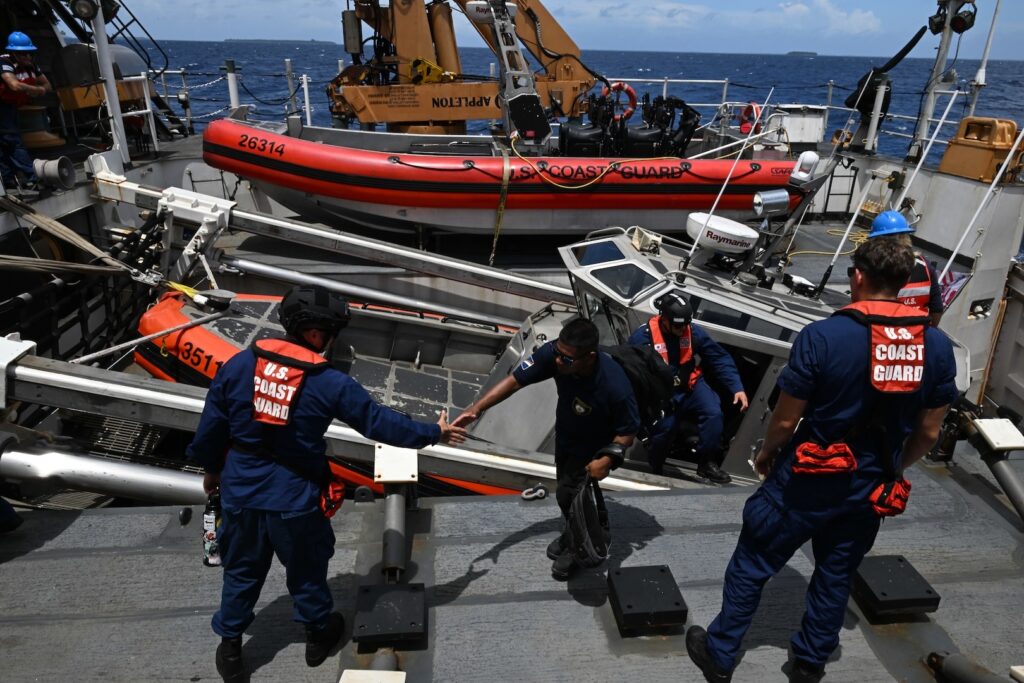
Crew members from the Legend-class U.S. Coast Guard Cutter Stratton (WMSL 752) bring Republic of the Marshall Islands (RMI) Sea Patrol Able Seaman aboard Stratton for bilateral maritime law enforcement operations in RMI waters, July 9, 2025. The U.S. Coast Guard and the RMI have long cooperated to enhance maritime security and sovereignty in the Pacific with a focus on bilateral maritime law enforcement operations that help combat maritime trafficking and safeguard fisheries for both countries. (U.S. Coast Guard photo by Petty Officer 2nd Class Kate Kilroy)
MAJURO, Republic of the Marshall Islands — The crew of national security cutter USCGC Stratton (WMSL 752) conducted at-sea boardings with the Republic of the Marshall Islands (RMI) Sea Patrol within RMI’s exclusive economic zone from July 9 to 13.
Stratton’s crew embarked three law enforcement officers from the RMI Sea Patrol, who provided a combined presence and conducted two successful maritime law enforcement boardings of commercial fishing vessels operating in the RMI EEZ. While no violations were initially reported from the boarding, potential issues with the catch emerged later and constituted further inspection from RMI.
Stratton’s shared patrol with the RMI officers emphasized collaborative efforts in maritime safety, security, and stewardship to maximize the protection of natural resources. The U.S. Coast Guard and RMI have long cooperated to enhance maritime security and sovereignty, focusing on bilateral maritime law enforcement that combats maritime trafficking and safeguards fisheries for both countries.
“It has been an honor to host members of the Sea Patrol and conduct bilateral maritime law enforcement boardings alongside our partners from the Republic of the Marshall Islands,” said Capt. Brian Krautler, the Stratton’s commanding officer. “We focused on boardings to deter, detect, and suppress illicit transnational maritime activity, specifically maritime drug trafficking, fisheries offenses, and illegal migration. Our combined operations and shared efforts enforce laws and preserve the local way of life, deepening our partnership. Standing together, we improve regional maritime governance and build a resilient future for both our nations.”
Bilateral maritime law enforcement agreements enable Pacific nations to protect their sovereignty and help ensure the safety and security of mariners and vessels of all nations conducting legal maritime operations within the nation’s EEZ. Through these agreements, the host nation makes determinations regarding targeting vessels for law enforcement boardings within its EEZ, identifies violations, and determines penalties and follow-on actions.
Stratton conducted these boardings in support of Operation Blue Pacific, the U.S. Coast Guard’s campaign throughout Oceania to maintain unrestricted, lawful access to the maritime domain for all nations, enhance maritime governance, and improve regional prosperity.
Commissioned in 2012, Stratton is one of ten Legend-class national security cutters and one of four homeported in Alameda, California. National security cutters are 418-feet long, 54-feet wide, and have a 4,600 long-ton displacement. They have a top speed of 28 knots, a range of 12,000 nautical miles, and sail with a crew of up to 170. These crews routinely conduct operations throughout the Pacific, where their combination of range, speed, and ability to operate in extreme weather provides the mission flexibility necessary to conduct vital strategic missions.
The namesake of U.S. Coast Guard Cutter Stratton is Capt. Dorothy Stratton, the first female commissioned officer in the Coast Guard. Capt. Stratton led the service’s all-female reserve force during World War II, commanding more than 10,000 personnel. The ship’s motto is “We Can’t Afford Not To.”
Coast Guard Academy Think Tank Puts Polar Issues Front and Center
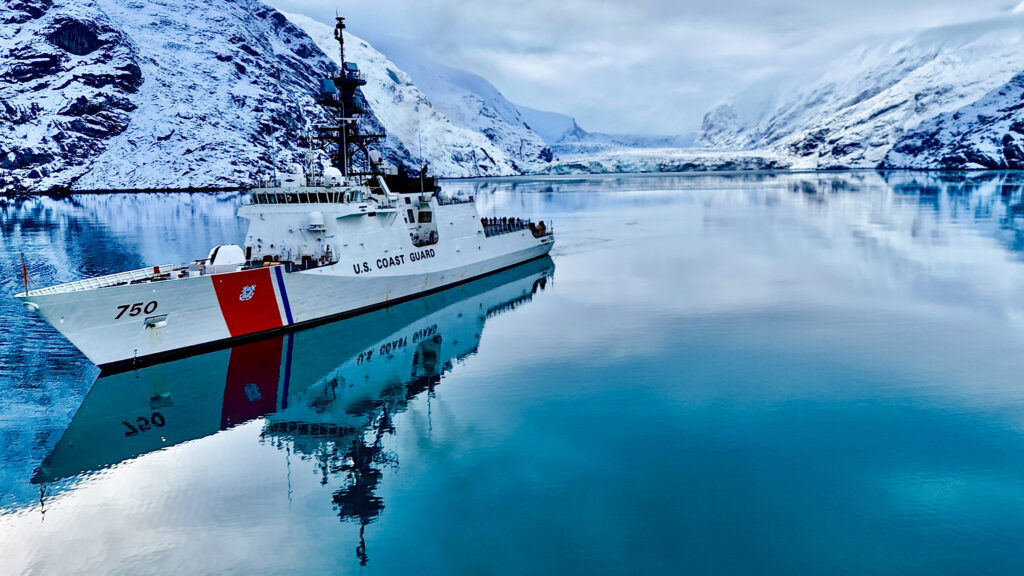
Coast Guard Cutter Bertholf (WMSL 750) transits through Glacier Bay, Alaska, Oct. 24, 2024. During the patrol, Bertholf’s crew operated as far north as the Arctic Circle, patrolling along the maritime boundary line between the United States and Russia and supporting U.S. strategic interests in the North Pacific Ocean. Photo credit: U.S. Coast Guard | Troy Spence
The Arctic is a hot topic these days. As sea ice melts, many questions surface: How should Arctic nations manage more shipping traffic while preserving the delicate environment? Can countries maintain a history of regional cooperation in this increasingly contested space?
As these and other concerns come to the fore, there’s one entity keeping all things polar on the front burner: the Center for Arctic Study and Policy, or CASP.
This tiny U.S. Coast Guard Academy office — with an annual operating budget of just $150,000 and two salaried positions — plays an outsized role in promoting knowledge of the north and south polar regions, a growing area of human interest as the environment rapidly changes.
The Arctic polar region is primarily ocean, surrounded on its edges by the eight member states of the Arctic Council: Canada; the Kingdom of Denmark, which includes Greenland and the Faroe Islands; Finland; Iceland; Norway; the Russian Federation; Sweden; and the United States, where Alaska includes a 1.5-million-square-mile exclusive economic zone in its surrounding waters.
Council decisions are achieved in agreement with six “permanent participants” that represent Aleut, Arctic Athabaskan, Gwich’in, Inuit, Saami and Russian Indigenous people, who have inhabited the Artic for millennia. About 10% of the 4 million Arctic residents are native peoples, according to the “Arctic Review,” an online publication covering polar issues.
There is a long history of international cooperation regarding Arctic scientific research and discovery and access to the region’s abundant fisheries, oil and gas assets, minerals, tourist sites and other resources. But rapid changes to the area’s physical, economic, geopolitical and technological characteristics have altered the future of polar affairs. As a result, many nations, including the United States, have intensified their focus on the region.
The U.S. Coast Guard, part of the Department of Homeland Security, underscored the region’s strategic importance in its 2023 Arctic Strategic Outlook Implementation Plan: “Global geopolitical trends combined with changes to the Arctic’s physical environment are increasing the region’s economic opportunities and strategic importance while hastening the impacts and risks to U.S. Arctic residents, commercial activity, and U.S. national security.”
In the middle of the action is CASP, the U.S. Coast Guard’s only scholarly center and internal think tank. It focuses only on the polar regions — mostly the Arctic but also Antarctica.
Widening Interest, Changing Arctic
Tony Russell, CASP’s executive director since 2022, said his personal interest in the Arctic started in 2007. He was serving as an active-duty officer in the Coast Guard and completing a master’s degree at the Marine Corps University. The Arctic, Russell thought, would be a unique thesis topic.
“That was when folks were just beginning to understand how access — physical access — was increasing via the sea ice reducing [and asking] what does that mean?” said Russell, who retired from the Coast Guard as a captain in 2020. Global attention to the region also coalesced around a 2008 U.S. Geological Survey report predicting the Arctic Circle had massive stores of undiscovered oil and gas reserves.
Then, as now, the drastic environmental changes were hard to ignore: According to the National Snow and Ice Data Center, scientists have observed a consistent decline in Arctic sea ice cover in nearly 50 years of continuous satellite monitoring — a rate of decline of more than 2% per decade. In 2025, sea ice cover is at its lowest level since recording began in 1979.
The Arctic in the past four decades has warmed three times faster than the worldwide average, according to “Arctic Climate Change Update 2024: Key Trends and Impacts — Summary for Policymakers,” a report by the Arctic Council’s Arctic Monitoring and Assessment Programme.
The evolving situation sparked new areas of concern, collaboration and potential conflict among nation-states, residents, the scientific community and industry players.
The area’s residents, land, waterways and wildlife face new threats from erosion, flooding, wildfires and greater human activity. The Arctic is at risk from more air crashes, vessel collisions and groundings. It’s also exposed to threats to subsea cables, unsafe shipping through the Russian maritime Arctic and friction from regional military exercises (involving the U.S. and its allies but also Russia and China).
“That all speaks to rising interest for U.S. national security,” Russell said.
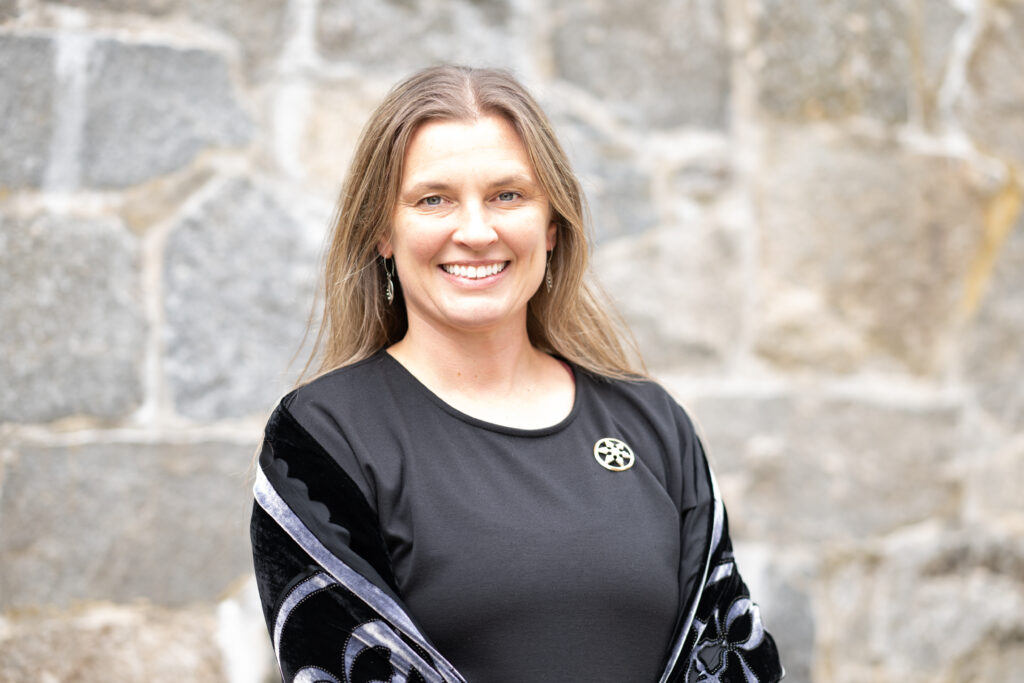
Dr. Abbie Tingstad poses for a photo at the U.S. Coast Guard Academy, Sept. 25, 2024. Tingstad is a renowned Arctic analyst, a trusted voice on the challenges posed by the changing environment in the region and also the first Visiting Research Professor at the Center for Arctic Study and Policy (CASP) at the U.S. Coast Guard Academy. Photo credit: U.S. Coast Guard | Petty Officer 2nd Class Janessa-Reyanna Warschkow
Renewing the Center’s Mission
Although CASP was founded in 2014, Russell’s tenure began as the Coast Guard Academy was relaunching and revitalizing the center, complete with new offices at the academy’s New London, Connecticut, headquarters. The center is now housed within the academy’s Office of Scholarship, Research and Innovation. Its renewed mission is focused on educating cadets, conducting research and analysis, and broadening partnerships.
At the reborn CASP, a federally funded rotating research professor position was first filled in 2023 by Arctic analyst Abbie H. Tingstad, who holds a Ph.D. and the title of visiting arctic research professor. Tingstad’s predecessors, Drs. Rebecca Pincus and Barry Zellen, were funded by Coast Guard Academy alumni donations.
In addition to overseeing a two-year research agenda, Tingstad is a sought-after expert on Arctic affairs and widely published author of Arctic peer-reviewed research, policy papers and presentations, and media commentaries. Her work has touched on topics such as the role of icebreakers in diplomacy and the effects of a poleward shift in fish stocks in the Northern Bering Sea.
Tingstad also directs CASP’s participation in international policy development for the Arctic. “For example,” Tingstad said, “we are part of a multinational network of research and educational institutions that are shaping the conversation about all the facets of Arctic security and what that means, and how it’s changing, and what it implies for governance and cooperation in the Arctic region.”
CASP is also educating the next generation of Coast Guard officers. It accepts some 18 to 20 cadets every other semester into its polar studies course, focused on U.S. and international strategies and policies in the region. In addition to studying Arctic history and policy, cadets attend expert lectures involving academia, the military, business, Indigenous communities and political spheres.
They also benefit from CASP’s reorganization, which “allowed us to increase our access to all of the academic disciplines at the academy,” Russell said. That’s important because “the challenges that the Arctic faces are definitely multidisciplinary,” he said, involving infrastructure, science, policy, business and more. “All of those things factor into what’s going on in the Arctic region.”
Each year, CASP encourages six to eight cadets to delve deeper into polar issues as Arctic scholars. Russell highlighted two cadets, among others, making important contributions to Arctic policy.
Elise Beauchemin, an Arctic scholar studying marine environmental science, completed CASP-sponsored internships last year with the University of Alaska Anchorage and at CASP. She worked with the Coast Guard Research and Development Center, the Massachusetts Institute of Technology’s Lincoln Labs, and the Navy’s Undersea Warfare Development Center. She also completed a course supporting Tingstad’s research. Beauchemin was accepted into the prestigious Fulbright U.S. Student Program and recognized by DHS Secretary Kristi Noem at the Coast Guard Academy commencement in May.
And, after completing the Arctic studies course, Emelia Campbell was one of three team members invited to partner with the Coast Guard’s Maritime Law Enforcement Fisheries Division to research implementation options for the Central Arctic Ocean Fisheries Agreement. This 10-party pact bans commercial fishing in the central Arctic Ocean for 16 years while scientists study the ecological impact. With CASP, Campbell participated in the Fridtjof Nansen Institute’s Arctic Security Conference in Oslo, Norway. In January 2025, she presented research findings at the Arctic Frontiers conference in Tromsø, Norway, and later briefed Coast Guard executives.
CASP has also sponsored cadets to attend and present at industry conferences, such as the Navy League’s Sea-Air-Space, American Society of Naval Engineers symposia and International Marine Design Conference.
The center supports summer internships for roughly eight cadets each year. “We have two cadets right now on an exchange with the Icelandic Coast Guard,” Russell said, where they’re “getting some great exposure” working with another Arctic nation partner.
Other cadets have interned at the Marine Exchange of Alaska, a nonprofit focused on preventing maritime disasters; the Arctic Domain Awareness Center, a DHS research center at the University of Alaska Anchorage; and the Defense Department’s Ted Stevens Center for Arctic Security Studies.
Promoting International Partnerships
In addition to maintaining a spirit of cooperation, CASP’s ongoing outreach and engagement with most Arctic nations and dozens of U.S. and international organizations — through cadet exchanges, tabletop exercises, policy and research development, and other areas — is yielding Arctic insights for potential action by U.S. and allied militaries, policymakers, industry groups and affected populations.
For the Coast Guard decision-makers, Russell said, CASP “helps flatten the learning curve and it helps maintain consistency and quality of information we’re using for those decisions.” And for external partners who need or want to share information with the Coast Guard, “we know who the subject matter experts are within the service that do that.”
Through its extensive partner network, CASP can foster international dialogue on issues such as illegal fishing, homeland defense, Arctic-capable shipping design, transportation safety, biodiversity preservation, ecosystem management and emergency preparedness.
For instance, CASP helps nations better prepare for Arctic emergencies, which now occur with relative frequency. That includes this year’s Bering Air Flight 445 that crashed on the sea ice on the way to Nome, Alaska, killing 10 people on board; and the 2023 grounding of a 206-person cruise ship stranded for days on Greenland’s remote East Coast.
A recent CASP-hosted tabletop exercise convened emergency response and aviation representatives from four nations and several U.S. military and federal organizations to wargame crises in remote areas of the Arctic. The exercise revealed potential gaps in training, infrastructure, communication and hardware. CASP also moderated a panel discussion on cruise ship search and rescue with the Association of Arctic Expedition Cruise Operators and maritime rescue organizations.
“At the end of the day,” Russell said, “the process is as important as the answer, and we strive to provide the kind of analytical research and defendable background knowledge that best informs polar policy choices and answers.”
Erika Fitzpatrick is an award-winning writer living in Washington, D.C. With more than 20 years of experience in public policy journalism and communications, she specializes in covering issues affecting service members, veterans and military families. This article originally appeared in the July-August issue of Seapower.