ARLINGTON, Va. — President Donald Trump has nominated
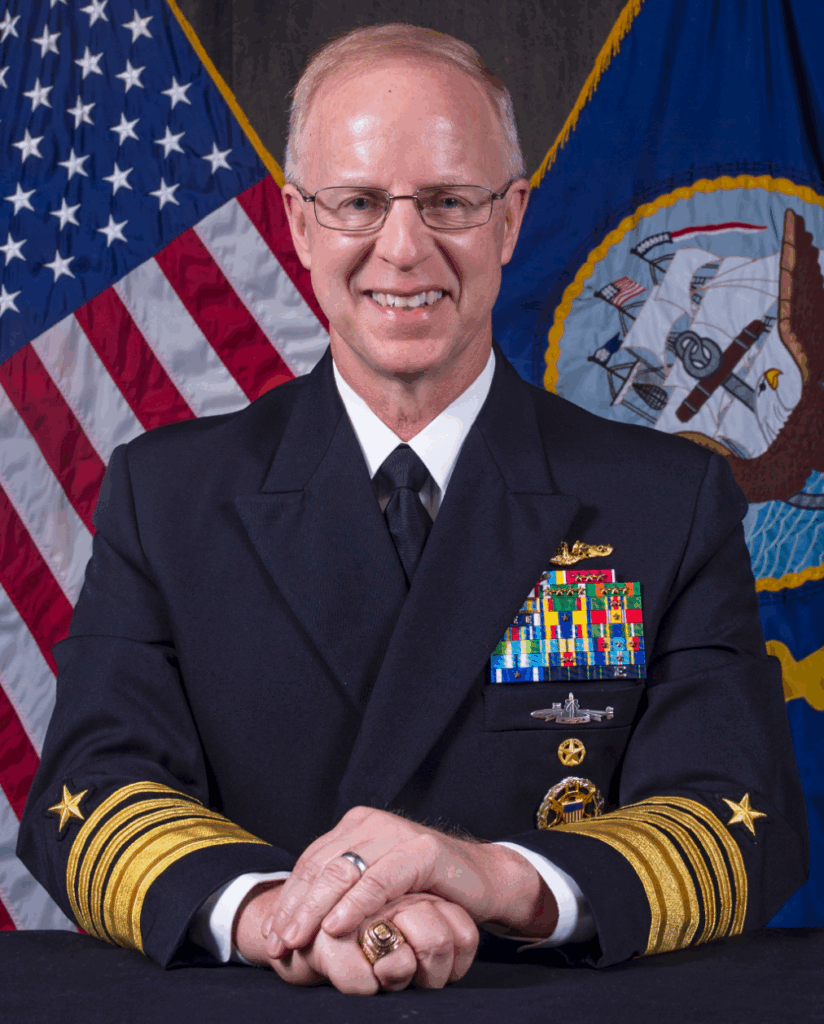
Admiral Daryl Caudle as the next chief of naval operations. Caudle, a submarine officer, currently serves as commander. U.S. Fleet Forces Command, headquartered in Norfolk, Virginia.
The nomination was received by the Senate Armed Services Committee on June 17, according to a tracker on congress.gov.
Below is the official biography of Admiral Caudle from the Navy’s website:
“Adm. Daryl Caudle is a native of Winston-Salem, North Carolina and a 1985 graduate of North Carolina State University (magna cum laude) with a degree in chemical engineering. He was then commissioned after attending Officer Candidate School in Newport, Rhode Island. Caudle holds advanced degrees from the Naval Postgraduate School, Master of Science (distinction) in Physics; from Old Dominion University, and Master of Science in Engineering Management. He also attended the School of Advanced Studies, University of Phoenix, where he obtained a Doctor of Management in Organizational Leadership with a specialization in Information Systems and Technology.
His doctoral dissertation research was conducted on military decision making uncertainty regarding the use of force in cyberspace. He is also a licensed professional engineer.
He assumed command of U.S. Fleet Forces Command; U.S. Naval Forces Northern Command; U.S. Naval Forces Strategic Command; and U.S. Strategic Command Joint Force Maritime Component Commander on December 7, 2021.
Prior to this assignment, he served as commander, Submarine Forces; commander, Submarine Force Atlantic; commander, Task Force (CTF) 114, CTF 88, and CTF 46; and commander, Allied Submarine Command.
His other flag assignments include deputy chief for security cooperation, Office of the Defense Representative, Pakistan; deputy commander, Joint Functional Component Command-Global Strike; deputy commander, U.S. 6th Fleet; director of operations U.S. Naval Forces Europe-Africa; commander, Submarine Group Eight; commander, Submarine Force, U.S. Pacific Fleet; and vice director for Strategy, Plans, and Policy on the Joint Staff (J-5) in Washington, D.C.
His early sea tours included assignments as division officer, USS George Washington Carver (SSBN 656G); engineer, USS Stonewall Jackson (SSN 634B); engineer, USS Sand Lance (SSN 660); and executive officer of USS Montpelier (SSN 765).
Caudle’s first command assignment was as commanding officer of USS Jefferson City (SSN 759). As deputy commander, Submarine Squadron 11, he served as commanding officer of USS Topeka (SSN 754) and USS Helena (SSN 725) due to emergent losses of the normally assigned commanding officers. He also commanded Submarine Squadron 3.
His tours ashore include assignments as assistant force nuclear power officer, Commander Submarine Force, U.S. Atlantic Fleet; officer-in-charge of Moored Training Ship (MTS 635); deputy commander of Submarine Squadron 11; assistant deputy director for information and cyberspace policy on the Joint Staff (J-5) in Washington, D.C.; and as chief of staff Commander Submarine Force, U.S. Pacific Fleet.
His personal decorations include the Navy Distinguished Service Medal, Defense Superior Service Medal (four awards), Legion of Merit (four Awards), Meritorious Service Medal (Three Awards), Navy and Marine Corps Commendation Medal (five Awards), and the Navy and Marine Corps Achievement Medal (four Awards).”
Austal USA Launches First Steel Ship, the Future USNS Billy Frank
MOBILE, Ala. –Austal USA successfully launched the company’s first steel ship, the future USNS Billy Frank Jr. (T-ATS 11), on June 14. Named after a native American Korean War veteran who, as an activist, fought for justice and environmental preservation in the Northwest United States, Billy Frank Jr. is a Navy Towing, Salvage and Rescue Ship – one of 3 under construction at Austal USA and the first steel product of the company’s state-of-the-art automated steel panel line.
“It was amazing to see the flawless rollout of our first steel ship,” said Harley Combs, vice president of surface ship programs. “The completion of this milestone is the result of the hard work and dedication of our talented workforce. I am so proud of all they have accomplished.”
At 3,100 metric tons, T-ATS 11 is the heaviest ship Austal USA has launched to date. The launch was executed using the proven process used to launch most of the 32 Navy ships the company has built and delivered to the Navy over the last 15 years.
T-ATS will provide ocean-going towing, salvage and rescue capabilities to support fleet operations. T-ATS will be a multi-mission common hull platform capable of towing U.S. Navy ships and will have 6,000 square feet of deck space for embarked systems. The large, unobstructed deck allows for the embarkation of a variety of stand-alone and interchangeable systems. The T-ATS platform will combine the capabilities of the retiring Rescue and Salvage Ship (T-ARS 50) and Fleet Ocean Tug (T-ATF 166) platforms. T-ATS will be able to support current missions including towing, salvage, rescue, oil spill response, humanitarian assistance, and wide-area search and surveillance. The platform also enables future rapid capability initiatives such as supporting modular payloads with hotel services and appropriate interfaces.
With the ship over 85 percent complete at the time of launch, the future USNS Billy Frank Jr. will now prepare for her next major milestone, engine light off, as she gets ready for sea trials and delivery.
NOAA Awards $95.4M Contract for Upgrades, Maintenance on NOAA’s Oscar Dyson
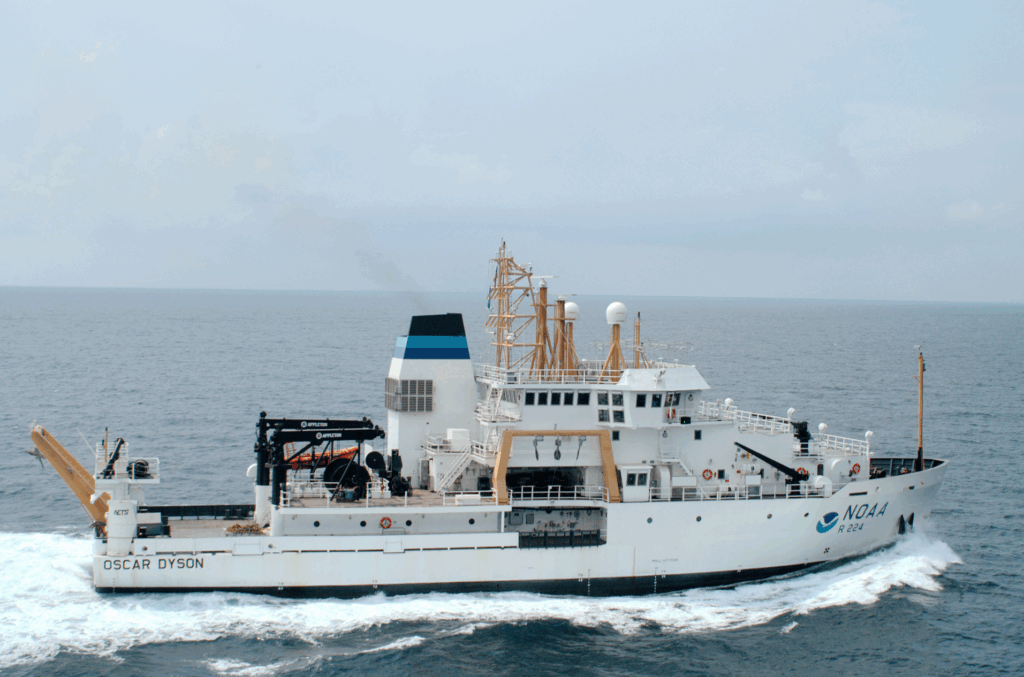
NOAA Ship Oscar Dyson working in the Bering Sea in Alaska. Credit: NOAA Marine and Aviation Operations/CDR Carl Rhodes
From Keeley Belva, NOAA, June 18, 2025
NOAA has awarded $95,408,666 to JAG Alaska, Inc. from Seward, Alaska, to complete expanded upgrades and maintenance on NOAA Ship Oscar Dyson. Following the 2026 field season, the ship will go into a year-long maintenance period.
NOAA is working to maximize the service life of each of its vessels through long-term maintenance planning and tracking. The goal of this forward-looking maintenance is to provide up-to-date, dependable vessels for NOAA’s scientists and science partners. NOAA anticipates that the Oscar Dyson will be available for service in time for the 2028 field season.
“These upgrades will help the ship continue to meet the needs of the nation in primarily Alaskan and Arctic waters well into the future,” said NOAA Corps Rear Adm. Chad Cary, director of the NOAA Commissioned Officer Corps and NOAA Marine and Aviation Operations. “Modernizing the shipboard technology will improve the Dyson’s fuel efficiency and operational safety, while ensuring that future research performed by the Dyson continues to be second to none.”
NOAA Ship Oscar Dyson was commissioned in 2005 and plays a major role in collecting data that is used to manage Alaska pollock—one of the world’s largest commercial fisheries. Replacing the propulsion system with variable speed, Tier 4 generators, quiet air conditioning motors and cutting-edge technology will equip the Dyson to continue supporting future NOAA science missions. The comprehensive maintenance will also replace pumps, fans, cranes, fire detection system and radars, as well as increase the number of single-person staterooms.
NOAA has begun modifying other ships in its fleet to backfill the Dyson during the maintenance period. NOAA Ship Bell M. Shimada will be outfitted with polar life rafts, rescue boat heaters and other adaptations necessary for work in Alaska waters. These adjustments will help to ensure that the collection of science and data in Alaska, as supported by the Dyson, will continue seamlessly.
“Great news coming out of Alaska today. Supporting small shipyards in the state is vital to our blue economy, and I am excited to see these extensive upgrades to NOAA Ship Oscar Dyson happening right in our own backyard,” said Alaska Senator Lisa Murkowski. “The mid-life renovation of this critical research vessel will allow for the collection of accurate data that will inform Alaska’s fisheries – all while putting Alaskans to work. I appreciate NOAA’s investment in Alaska and our fisheries, and look forward to seeing the Oscar Dyson back out at sea.”
“I want to thank Secretary Lutnick and Acting NOAA Administrator Laura Grimm for prioritizing the completion of the contract to maintain NOAA Ship Oscar Dyson. Homeported in Kodiak, this research vessel plays a vital role in conducting surveys of fish, mammals and other invertebrates and helps support robust and sustainable fisheries,” said Alaska Senator Dan Sullivan. “Even better, I am glad to see one of our great Alaskan shipyards will be conducting the repairs, keeping the ship close to home so that it can swiftly return to its important work once the maintenance is finished.”
NOAA Marine and Aviation Operations operates a fleet of 15 hydrographic survey, oceanographic research and fisheries survey vessels. NOAA ships operate in the U.S. and around the world. The ships are run by a combination of NOAA commissioned officers and civilian professional mariners.
Coast Guard Cutter Valiant Exits Active Duty After 57 Years of Service
Coast Guard Cutter Valiant (WMEC 621) is moored to the pier at Naval Station Mayport in Jacksonville, Florida, June 17, 2024. The cutter was honored after more than 57 years of service during a heritage recognition ceremony held in front of Coast Guard and cutter leadership, the assembled crew and former crew members, family and friends. (U.S. Coast Guard photo by Petty Officer 2nd Class Brandon Hillard)
From U.S. Coast Guard Atlantic Area, June 17, 2025
NAVAL STATION MAYPORT, Fla. — The Coast Guard held a heritage recognition ceremony, Tuesday, in Jacksonville to honor the U.S. Coast Guard Cutter Valiant (WMEC 621) and recognize its more than 57 years of exemplary service.
The ceremony was presided over by Rear Adm. Adam Chamie, assistant commandant for operations integration and response policy, Coast Guard Headquarters in Washington, D.C., and served to celebrate Valiant’s contributions to the Coast Guard and nation in the presence of cutter leadership, current and former crew members, families and friends.
In addition to Chamie, a former commanding officer of Valiant, 2014-2016, the official party included: Cmdr. Matthew Press, commanding officer of Valiant, retired Capt. Timothy Cronin, former commanding officer of Valiant, 2016-2018, Senior Chief Petty Officer Clark Lauer, command senior enlisted leader of Valiant, Lt. Cmdr. Merrill Gutowski, executive officer of Valiant and master of ceremonies, and Chaplain Duke Leon Ann’El, Fraternal Order of Police, former Valiant crew member, 2006-2007.
The event also marked the ship’s exit from active-duty service for an indeterminate time, placing it in commission, special status. The 210-foot Valiant operated as a Coast Guard Atlantic Area Command asset, based in Portsmouth, Virginia, and was most recently homeported in Mayport.
Valiant, a multi-mission cutter, was built in Lorain, Ohio by the American Shipbuilding Company and was commissioned, Nov. 3, 1967. The cutter is the 7th of 16 vessels built in the Reliance-class of medium endurance cutters that have operated in the Coast Guard’s fleet. These cutters were designed for search and rescue, law enforcement missions such as counter-drug and alien interdiction, as well as national defense and international engagement.
Valiant was named after the inspirational trait, which means to act with courage and determination. It is the first Coast Guard cutter to bear its name.
The cutter has been helmed by several notable commanding officers to include, Adm. James Loy, former commandant of the Coast Guard, 1998-2002, and Capt. John G. Witherspoon, the first African American officer to command a medium endurance cutter and for whom the annual John G. Witherspoon Inspirational Leadership Award, which recognizes the Coast Guard officer, active duty and reserve, who best exemplifies the Coast Guard’s Core Values of Honor, Respect and Devotion to Duty, is named.
Valiant spent its first 24 years in the Coast Guard Eighth District area of responsibility while being homeported in Galveston, Texas. While there, it earned its nickname, “Guardian of the Gulf,” after crews assisted in several high-profile search and rescue cases.
In 1971, Valiant provided assistance after two Venezuelan freighters collided.
In 1972, the crew of Valiant supported the International Ice Patrol and identified icebergs off the coast of Newfoundland, Canada, locating hazards to navigation in the North Atlantic Ocean.
Later in the decade, the cutter responded to a collision between a tanker and a freighter in 1979.
Valiant played a crucial role in the mass Cuban exodus of 1980 known as the Mariel Boatlift, while working alongside numerous Coast Guard cutters, small boats, aircraft, and U.S. Navy vessels.
In June of 1990, Valiant and other Coast Guard cutters responded to the 853-foot Norwegian tanker Mega Borg after a deadly explosion in the engine room led to the release of oil approximately 60 miles off the coast of Texas. Valiant’s crew persevered through complex logistical problems, mounting an effective firefighting, salvage and pollution cleanup campaign.
Between 1991 and 1994, the cutter was decommissioned for the purpose of undergoing a major maintenance availability at the Coast Guad Yard in Baltimore, Maryland, extending its service operational life through modifications and modernizations.
After Valiant was recommissioned in January of 1994, it was transferred to the Seventh Coast Guard District area of responsibility and relocated to its second home port of Miami Beach for the next 18 years.
During Operations Able Manner and Able Vigil in 1994, the crew of Valiant interdicted over 500 Haitian and Cuban migrants. And the cutter repatriated over 1,900 Haitian migrants from Guantánamo Bay, Cuba to Port-au-Prince, Haiti over the course of 11 passages during this time.
Valiant served as patrol commander during the 1996 Summer Olympics sailing events in Savannah, Georgia, where the cutter directed over 29 Coast Guard assets to help ensure security for 800 athletes representing 98 different countries.
In 1997, the cutter’s crew helped train over 500 Caribbean Coast Guard members during Operation Tradewinds. Valiant taught personnel from 12 countries in fields such as damage control, engineering and seamanship fundamentals.
In January 1999, a Valiant and Coast Guard law enforcement detachment (LEDET) 406 boarding team interdicted over 10,000 pounds of cocaine from the merchant ship Cannes.
On Nov. 7, 1999, the crew of Valiant discovered a person in the water and another on the sinking hull of a partially submerged vessel. The two were enroute to Antigua and spent over 30 hours before they were rescued.
A few days later, Valiant’s crew rendezvoused with the HMS Northumberland and an embarked U.S. Coast Guard LEDET aboard the British naval vessel to intercept over 2.5 tons of cocaine aboard the the motor vessel Adriatik. After three days of lifting 110-pound bags of sugar, the crew of Valiant uncovered the illicit narcotics.
Later in the same month, Valiant served as on-scene commander while attempting to locate two missing sailing vessels near Saba Island, Netherlands Antilles in the wake of Hurricane Lenny. Their efforts located several capsized vessels adrift in the region, but unfortunately only one survivor was found.
In 2003, the first official Department of Homeland Security secretary’s speech was given by Secretary Thomas Ridge aboard Valiant at the Port of Miami.
In 2004, Valiant conducted alien migration interdiction operations during the Haiti rebellion, repatriating 531 Haitians intercepted on boats as they fled growing violence and turmoil fueled by rebel forces.
While deployed in 2006 to the Caribbean Basin and Florida Straits, Valiant’s crew interdicted 270 aliens attempting to enter the U.S. illegally and assisted the government of the Bahamas, seizing a Dominic Republic-flagged vessel illegally fishing in Bahamian territorial seas. The 65 crew members aboard the fishing vessel Barlovento were later transferred to Bahamain officials. During the same patrol, the crew made a port of call in Miami to host a presidential visit by President George W. Bush.
The cutter interdicted nearly five tons of cocaine from four separate smuggling vessels during a 2009 patrol. The narcotics, worth over $125 million, were seized as a result of coordinated efforts between Valiant’s crew, other Coast Guard assets and U.S. Customs and Border Patrol aircraft.
The crew of Valiant responded to the Haiti Earthquake of 2010, both supporting relief efforts while countering mass migration at sea. Valiant crew members assisted the Haitian Coast Guard to repair their damaged assets and coordinated with the Haitian government and the United Nations to open Cap-Haitien as a resupply and repatriation port during the earthquake’s aftermath.
On Aug. 8, 2012, Valiant transferred to its current home port of Mayport.
In 2017, Valiant conducted a counter-drug patrol in support of Joint Interagency Task Force – South. While deployed to the coast of Central and South America, the crew seized $47 million worth of cocaine and rescued several seas turtles entangled in garbage.
In October 2019, during an Eastern Pacific patrol, the cutter interdicted a self-propelled semi-submersible, a fishing vessel and a go-fast vessel. These actions resulted in Valiant seizing 16,000 pounds of cocaine worth over $218 million.
In September 2023, Valiant’s crew encountered a man in a giant hamster wheel, known as a hydro-pod, well off the Georgia coast. The man was warned about the approaching hurricanes and urged to abandon his unsafe vessel. Despite threats of self-harm and violence, the case was eventually handed over to another Coast Guard vessel, and after three days, he was arrested.
Most recently, Valiant completed a 33-day patrol in the Caribbean Sea earlier this year where the crew conducted counter-drug operations and seized 10,000 pounds of cocaine. The crew was transferred additional contraband from interdictions made by foreign naval partners with embarked Coast Guard law enforcement detachments on board. On June 6, the crew offloaded a combined total of 17,450 pounds of cocaine and 2,585 pounds of marijuana worth $132 million at Port Everglades.
The Valiant now transitions into an inactive shipyard status as part of the Coast Guard’s efforts to modernize its cutter fleet to combat the evolving security threats in the maritime domain. Force Design 2028 is an accelerated effort to transform the Coast Guard into a more agile, capable, and responsive fighting force. By optimizing resources, enhancing workforce readiness and integrating advanced technology to ensure mission readiness, Force Design 2028 provides a bold blueprint to renew the service to be better prepared to meet the mission readiness demanded by the American public.
Once back at the Coast Guard Yard, Valiant’s current crew will transition to different units both ashore and afloat, a step taken to help ensure the Coast Guard’s ability to prioritize lifesaving missions, national security, and protection of the Maritime Transportation System with no degradation to these critical services.
“I am grateful and thankful for our team. The crew makes the cutter, and I am honored to be part of this extraordinary team,” said Cmdr. Matthew Press, commanding officer of Valiant. “I am honored to be part of Valiant’s prestigious legacy.”
Valiant is a 210-foot, Reliance-class medium endurance cutter with a crew of 64 and 12 officers. Since commissioning in 1967, Valiant has conducted search and rescue missions, counter-drug and alien interdiction operations, supported national defense, marine environmental protection and homeland security missions and participated in the International Ice Patrol.
For information on how to join the U.S. Coast Guard, visit GoCoastGuard.com to learn about active duty, reserve, officer and enlisted opportunities.
Information on how to apply to the U.S. Coast Guard Academy can be found here.
Navy Accepts Delivery of Ship-to-Shore Connector, LCAC 113
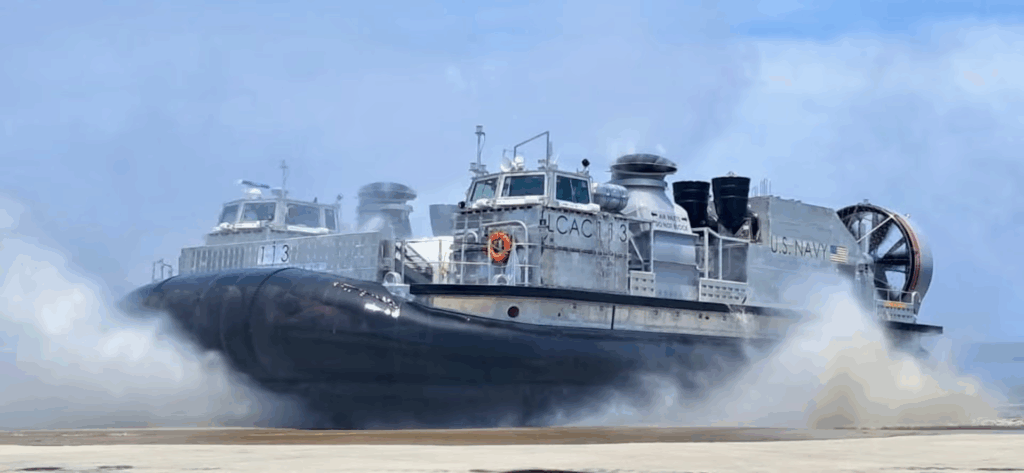
The United States Navy accepted delivery of Ship to Shore Connector (SSC), LCAC 113, from Textron Systems, June 12. The delivery of LCAC 113 comes after completion of Acceptance Trials conducted by the Navy’s Board of Inspection and Survey, which tested the readiness and capability of the craft to effectively meet its requirements.
By Team Ships Public Affairs, June 17, 2025
NEW ORLEANS– The United States Navy accepted delivery of Ship-to-Shore Connector (SSC), LCAC 113, from Textron Systems, June 12.
The delivery of LCAC 113 comes after completion of Acceptance Trials conducted by the Navy’s Board of Inspection and Survey, which tested the readiness and capability of the craft to effectively meet its requirements.
This new addition to the fleet signifies a substantial enhancement in the Navy’s amphibious capabilities, providing a vital asset for rapid deployment and logistical support.
“The successful delivery of LCAC 113 will provide the Navy and Marine Corps team with an advanced craft to increase our operational capability in amphibious warfare and maintain our operational readiness against global challenges.” said Angela Bonner, acting program manager for Amphibious Assault and Connectors Programs, Program Executive Office (PEO) Ships
LCACs are built with configurations, dimensions, and clearances similar to the legacy LCACs they replace – ensuring that this latest air cushion vehicle is fully compatible with existing, well deck-equipped amphibious ships, the Expeditionary Sea Base and the Expeditionary Transfer Dock. LCACs can carry a 60 to 75-ton payload. They primarily transport weapon systems, equipment, cargo, and assault element personnel through a wide range of conditions, including over-the-beach.
Textron Systems is currently in serial production on LCACs 114-126.
PEO Ships, one of the Department of Defense’s largest acquisition organizations, is responsible for executing the development and procurement of all destroyers, amphibious ships and craft, and auxiliary ships, including special mission ships, sealift ships and support ships.
Task Force 66 Applies Lessons Learned From Black Sea Battle Lab to Exercise BALTOPS 25
Royal Navy Archer Class P2000 patrol vessels HMS Pursuer (P273) conducts counter unmanned surface vessel operations with global autonomous reconnaissance crafts (GARC) attached to Commander, Task Force 66 during Baltic Operations (BALTOPS) 2025, June 12, 2025. (U.S. Navy photo by Mass Communication Specialist 2nd Class Christine Montgomery)
By U.S. 6th Fleet Public Affairs, June 17, 2025
UTSKA, Poland – Commander, Task Force (CTF) 66, U.S. 6th Fleet’s purpose-built all-domain task force with the mission of integrating Robotic and Autonomous Systems (RAS) into fleet operations, is participating in Baltic Operations 2025 (BALTOPS) June 5-20, 2025.
Established in 2024 to deploy and employ RAS with Navy, joint, and NATO partners, CTF 66 utilizes RAS in conjunction with conventional manned platforms and spaced-based capabilities to expand Maritime Domain Awareness (MDA), develop defense measures against adversarial use of RAS, innovate asymmetric fighting, and in the future, deliver lethal effects, if necessary.
“Task Force 66 operates through strong collaboration with U.S. Navy programs, NATO Allies, and partner nations, fostering the development and integration of cutting-edge robotic and autonomous systems,” said Rear Adm. Michael Mattis, Commander, Task Force 66. “By leveraging our collective expertise and technology, we aim to demonstrate strength and bolster maritime security not just here in the Baltic Sea, but in other maritime environments, to include the shores near the U.S. and in the Pacific Ocean.”
During BALTOPS 25, CTF 66 has employed unmanned surface vessels to simulate fast attack craft engagement on both Blue Ridge-class command and control ship USS Mount Whitney (LCC 20) and Arleigh Burke-class guided-missile destroyer USS Paul Ignatius (DDG 117) with Global Autonomous Reconnaissance Craft (GARC) and other unmanned systems. These simulations allowed the ships to practice and develop tactics, techniques, and procedures to defend against unmanned attacks in close coordination with Allied forces.
“The thing is, ‘unmanned’ isn’t completely unmanned,” added Lt. Jay Faylo, unmanned systems director for CTF 66. “There’s a lot of manpower that goes into making these systems work–maintaining the platforms, developing the software, and providing the right amount of oversight and direction during operations. Building that familiarity and those skill sets with our RAS operators is critical to ensure we can continue to evolve and adapt at the speed of the technology.”
BALTOPS 25 provides the U.S. Navy and its NATO Allies and partners an opportunity to test and refine joint warfighting capabilities in a dynamic environment. CTF 66 is also conducting training to enhance MDA in the Baltic Sea in order to counter grey zone activities in tandem with NATO’s Task Force X and leverage RAS and commercial space-based sensors to support tracking and targeting for at-sea interdictions and joint fires.
“CTF 66’s success hinges on strong collaboration with our partners to share tactics, operate together, and develop lessons learned,” said Faylo. “During this exercise, we are operating with the U.S. Marine Corps, Polish Special Operations Forces and the United Kingdom’s Royal Navy to develop procedures for resupplying land-based forces with our unmanned surface vessels, just to give one example.”
Additionally, CTF 66’s close collaboration with Ukraine provides insight into the employment of RAS in the challenging Black Sea environment against a capable and adaptive enemy. Known by its nickname the “Black Sea Battle Lab” CTF 66 has observed Ukraine employ RAS in order to secure crucial sea lanes for continued economic activity and deny the Russian Federation Navy’s use of the Black Sea to launch offensive attacks.
“The opportunity to closely observe the cycle of action-reaction-counteraction in the Black Sea is a unique advantage that allows CTF 66 to learn from real world conflict and adapt to the changing character of war,” said Mattis. “In order to keep up with these changes, we must seek out creative solutions to rapidly field and develop new technology, with a focus on software and low-cost platforms, to inform our approach to future maritime security operations.”
BALTOPS 25 is an annual maritime-focused exercise designed to enhance flexibility and interoperability among allied and partner nations. Now in its 54th iteration, the exercise strengthens regional security and demonstrates NATO’s commitment to collective defense.
Airspace around Coast Guard Cutters Now Restricted for Drones
By Richard R. Burgess, Senior Editor
ARLINGTON, Va. — The Federal Aviation Administration has declared the airspace in the vicinity of U.S. Coast Guard cutters to be restricted airspace to unmanned aerial systems (UAS).
In a June 16 directive from Coast Guard Headquarters, the commandant of the Coast Guard announced the new policy that “explicit approval is required to fly UAS in the immediate vicinity of a Cutter.”
All UAS are prohibited from flying “within a stand-off distance of 3,000 feet laterally and 1,000 feet above all Cutters operating, transiting, or at port within U.S. territorial waters,” the directive said.
The directive applies to all Coast Guard cutters greater or equal to 65 feet in length, which is the length that distinguishes a cutter from a boat.
Near Earth Autonomy Achieves First Autonomous Flight of Leonardo AW139 Helo
From Near Earth Autonomy, June 17, 2025
PITTSBURGH, Pa. – June 17, 2025: Near Earth Autonomy (Near Earth), a prime performer for the U.S. Marine Corps Aerial Logistics Connector (ALC) program, has successfully completed the first autonomous test flight of a Leonardo AW139 helicopter. This milestone demonstrates the real-world viability of scalable, uncrewed rotorcraft operating in contested environments without pilot or remote operator input, accelerating the path toward operational deployment.
Conducted in May in Phoenix, the flight marked the first time that the AW139 was
autonomously controlled by Near Earth’s onboard autonomy stack. The demonstration validated critical capabilities such as precise flight control, autonomous decision-making, and seamless integration with existing aircraft systems.
“This flight showcases Near Earth Autonomy’s leadership in developing trusted autonomy for real-world operations,” said Dr. Sanjiv Singh, CEO of Near Earth Autonomy. “By directly controlling the AW139’s flight modes with our autonomy system, we’ve shown that scalable autonomous logistics using existing platforms is not just possible, it’s happening now. This capability is essential for reducing risk to military personnel and ensuring resilient supply chains in the field.”
The ALC program, managed under a Naval Aviation Systems Consortium Other Transaction Agreement (OTA), is designed to field an autonomous aerial logistics system that enhances operational readiness and mission responsiveness. As the program progresses, future testing will expand on key autonomy features such as automated obstacle avoidance, route planning, and logistics system integration.
This achievement was made possible through Near Earth’s collaboration with Honeywell Aerospace Technologies and Leonardo. Honeywell’s AW139 served as the flight test platform and was equipped with mission-critical avionics that interfaced with Near Earth’s autonomy system. Leonardo, the aircraft manufacturer, provided vital engineering support to facilitate integration.
“This successful demonstration is a major step in creating brand new possibilities for not only the USMC, but potentially other helicopter operators as well,” said Bob Buddecke, President, Electronic Solutions, Honeywell Aerospace Technologies. “Together with Near Earth Autonomy and Leonardo, we’re showing how existing aircraft can be adapted with trusted avionics to support the next generation of defense logistics. Uncrewed aircraft will be vital in keeping service men and women safe in contested environments, and we are one step closer to realizing that vision.”
Near Earth Autonomy is developing an autonomy solution that is affordable, scalable, and certifiable, enabling rapid adaptation of crewed aircraft to uncrewed logistics roles. These capabilities are essential for meeting both current and future operational demands across the Department of Defense and beyond.
USCGC Harriet Lane Conducts Law Enforcement Operations with Cook Islands Partners
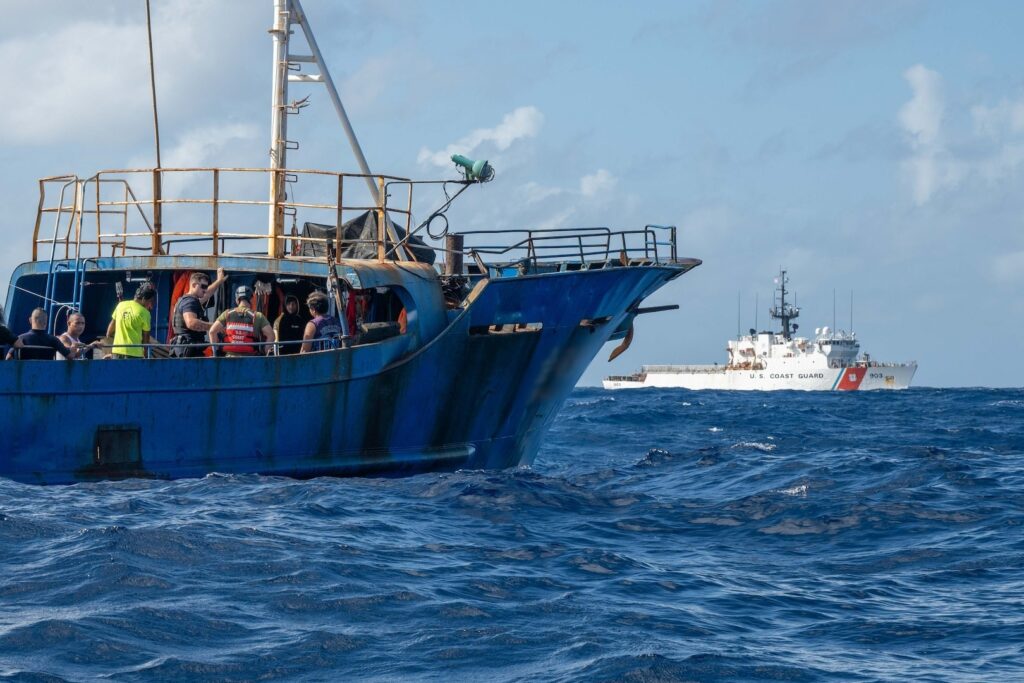
Crew members from U.S. Coast Guard Cutter Harriet Lane (WMEC 903) and Fishery Officers from the Cook Island Ministry of Marine Resources converse with crew members of a fishing vessel during an fishery inspection of the vessel June 7, 2025, in the Pacific Ocean. (U.S. Coast Guard photo by Petty Officer 3rd Class Austin Wiley)
From Coast Guard 14th District External Affairs, June 16, 2025
RAROTONGA, Cook Islands – The U.S. Coast Guard concluded bilateral maritime law enforcement operations alongside Cook Islands law enforcement partners offshore Rarotonga Friday.
The crew of Coast Guard Cutter Harriet Lane (WMEC 903) worked alongside the Cook Islands’ Ministry of Marine Resources to conduct fisheries law enforcement patrols. These mutually beneficial patrols focused on detecting and deterring illegal fishing activities while ensuring the sustainable management of marine resources within the Cook Islands’ exclusive economic zone (EEZ), which borders the EEZ of American Samoa.
“Working with the Cook Islands’ Ministry of Marine Resources has been an incredible opportunity,” said Cmdr. Nicole Tesoniero, commanding officer of the Harriet Lane. “Seeing firsthand our combined dedication to protecting marine resources and upholding laws and regulations reinforces the importance of these partnerships. We’re proud to support their efforts in ensuring a sustainable future for their waters and the wider Pacific.”
During this nine-day operation, the Harriet Lane crew and two Ministry of Marine Resources officers conducted six boardings of fishing vessels operating within the Cook Islands’ EEZ, resulting in one suspected violation. These boardings focused on verifying compliance with Cook Island fisheries regulations, including proper licensing, gear restrictions and reporting requirements. The increased presence of law enforcement activity serves as a deterrent to potential illegal fishing activities. Additionally, the Harriet Lane crew’s presence deters increasing trends of drug smuggling in the Pacific.
“As a small island and developing state like the Cook Islands, our biggest advantage and our strength is through cooperation with our partners in the Pacific when conducting fisheries boardings,” said Sai Sarau, a Cook Islands Ministry of Marine Resources Fisheries officer. “Together, we will weave a stronger Pacific community ready to face future challenges.”
These bilateral operations are conducted under the existing maritime law enforcement agreement between the U.S. and Cook Islands. These agreements allow U.S. Coast Guard personnel to work with partner nations to enforce their sovereign laws and protect shared maritime interests, contributing to a joint objective in countering malign and illegal behaviors in the Oceania region.
“This operation is an example of the enduring partnership between the United States and the Cook Islands,” said Cmdr. Nicholas Gilmore, U.S. Coast Guard Attaché to U.S. Embassy Wellington, New Zealand. “We are committed to working alongside our Cook Islands partners to promote maritime security, protect valuable marine ecosystems, and ensure a prosperous and sustainable future for the region.”
About the U.S. Coast Guard in the Pacific:
Based in Honolulu, the U.S. Coast Guard Fourteenth District continues to foster enduring partnerships with regional allies through Operation Blue Pacific, an overarching multi-mission endeavor promoting security, safety, sovereignty, and economic prosperity in Oceania. The U.S. Coast Guard remains committed to maritime security, safety and stewardship, solidifying its longstanding reputation in the Pacific as a trusted partner.
About U.S. Coast Guard Cutter Harriet Lane:
Commissioned in 1984, Harriet Lane is a 270-foot medium-endurance cutter homeported in Pearl Harbor, Hawaii, to support Coast Guard missions in the Pacific region. The service’s medium endurance cutter fleet supports a variety of Coast Guard missions including search and rescue, law enforcement, maritime defense, and protection of the marine environment.
Curtiss-Wright Awarded $31 Million IDIQ Contract by the U.S. Navy
Curtiss-Wright to provide rugged Modular Open Systems Approach (MOSA)-based mission processing system to support Navy Minotaur software platform
INTERNATIONAL PARIS AIR SHOW 2025, Le Bourget, Paris, France (Hall 3-D28) – June 16, 2025 – Curtiss-Wright Corporation today announced that it will provide Airborne Mission Processors (AMP) and AMP spare parts in support of PMA-262 Persistent Maritime Unmanned Aircraft Systems’ MQ-4C Triton aircraft and PMA-290 Maritime Patrol and Reconnaissance Aircraft under a $31 million firm-fixed-price indefinite delivery, indefinite quantity (IDIQ) contract awarded by the Naval Surface Warfare Center (NSWC). The contract also includes Total Lifecycle Management™, training, and engineering services in support of the AMP. Work on the contract will be performed by Curtiss-Wright’s Defense Solutions Division and is scheduled to run through September 2029.
“We are very proud to have been selected by the Naval Surface Warfare Center to provide our rugged airborne mission processor technology, total lifecycle management and support services for Naval manned and unmanned aircraft programs,” said Brian Perry, Senior Vice President and General Manager, Curtiss-Wright Defense Solutions Division. “The AMP system was derived from the legacy Airborne Mission Management System previously qualified and deployed on the Triton UAV platform. Through only minor enhancements, Curtiss-Wright was able to significantly increase processing capability in the aircraft, enabling enhanced ISR features, and the ability to host Navy Minotaur software platforms.”
The AMP features Curtiss-Wright’s industry-leading MOSA modules, including the VPX6-1959 single board computer, CHAMP-XD2M High Memory Capacity Multi-Core HPEC Module, VPX6-684 Network Switch, and VPX6-4943 GPGPU board, as well as the front panels, fan control board, and chassis.
Curtiss-Wright previously announced that it is providing and servicing MOSA-based Keyed Broad Area Maritime Surveillance Airborne Recorder (K-BAR) Network Attached Storage (NAS) solutions supporting MQ-4C Triton and future PMA-290 aircraft, including chassis, docking stations, removable storage modules and lab cable sets.