TRIDENT Training Center Opens
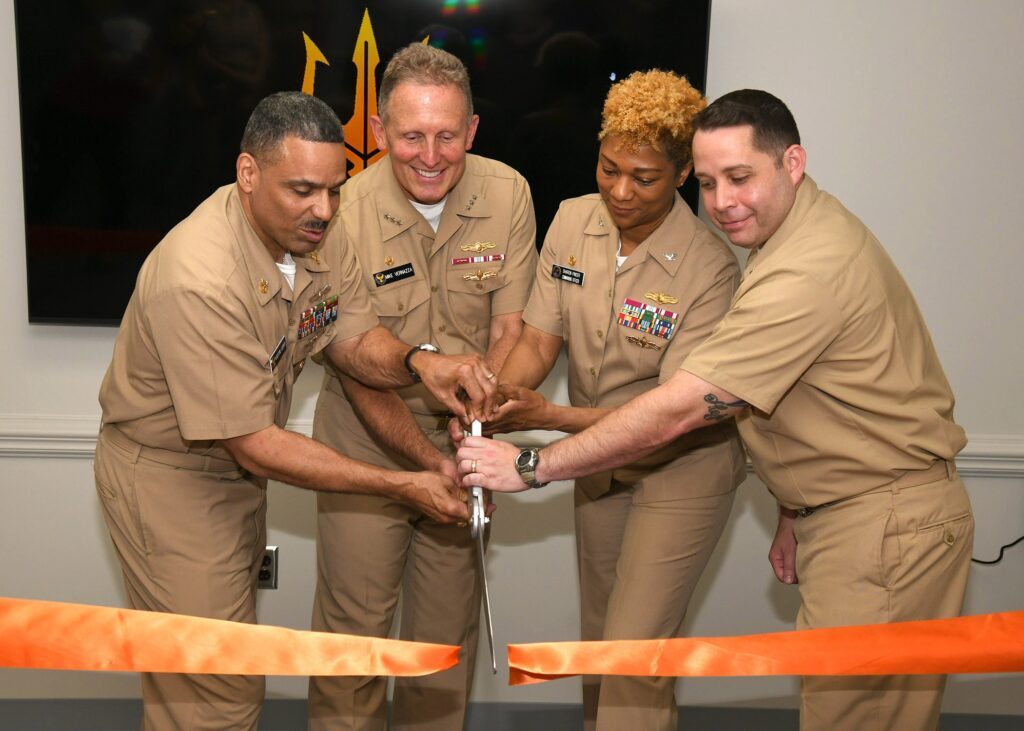
FORCM Augustine Cooper, Force Master Chief, Naval Information Forces, Vice Adm. Mike Vernazza, commander, Naval Information Forces, Capt. Sharon Pinder, Commanding Officer, Navy Cyber Defense Operations Command, and CMDCM(AW/SS) Jose M. Rivera, Command Master Chief, Navy Cyber Defense Operations Command, pose for a photo after a ribbon-cutting ceremony for the Navy Cyber Defense Operations Command’s TRIDENT Training Center on May 9. The 14,420 square foot center is specifically designed to support a wide range of activities, including individual and team-based scenarios, technical labs, demonstrations, mission rehearsals, cyber training, conferences, and professional development courses. (U.S. Navy Photo by Robert Fluegel / Released)

From NCDOC PAO Alexis Smith, May 27, 2025 

CHESAPEAKE, Va. - Navy Cyber Defense Operations Command (NCDOC) held a ribbon cutting ceremony on May 9, supported by Naval Information Forces (NAVIFOR) and Naval Network Warfare Command (NNWC) leaders to officially open TRIDENT – Technical Readiness in Defensive Cyber Operations {DCO} Education and Network Training – Center for NCDOC and NNWC personnel. 

Vice Adm. Mike Vernazza, commander, NAVIFOR and the Navy’s IBoss for Information Warfare, served as guest speaker. 
 
“This facility, in collaboration with our partners, provides hands on experience and training, real time sets and reps, and advanced mentorship from exceptional industry partners utilizing persistent access to lab and exercise environments with scenarios based on real world threats,” said Vernazza.  “As the Navy’s operational command for Defensive Cyberspace Operation, NCDOC’s mission is clear – to defend Navy networks and ensure warfighter readiness in cyberspace. This new training space directly aligns with that mission by enabling more dynamic, realistic, and collaborative cyber training, giving our teams the skills and agility that they will need to meet emerging threats.” 
 
The ribbon cutting ceremony is in honor of TRIDENT achieving a significant milestone, the successful execution of a remote Cyber Protection Team (CPT) mission and an operational recertification event. 
 
The 14,420 square foot center is specifically designed to support a wide range of activities, including individual and team-based scenarios, technical labs, demonstrations, mission rehearsals, cyber training, conferences, and professional development courses.  TRIDENT has actively supported the Cyber Competition Team, CPTs and Navy Red Team (NRT) through four Capture the Flag (CTF) events. 
 
These events allow the Sailors to practice and develop their skills in friendly competition against other teams across the DoD, U.S. Government, and the private sector.  The TRIDENT facility is also a space for Sailors, officers, and civilians to complete advanced cyber training ranging from vendor provided courses to internally developed training in support of NCDOC’s unique mission as DCO Task Force, sole Cyber Security Service Provider (CSSP) in the Navy, the Navy Cyber Defense Teams deployed afloat, and the Navy Hunt Team across enterprise networks. 
 
Additionally, NCDOC NRT, one of only 13 certified DoD Red Teams, can safely research, develop, and test various tools, exploits, and malware at TRIDENT, better preparing them to harden DoD Information Networks – Navy. 
 
TRIDENT has also been used to strengthen partnerships amongst the other stakeholders working to secure, operate, and defend Navy networks.  A Cyber Network Defense 5.2 training program between NCDOC and Naval Information Warfare Center Atlantic was hosted at the facility in April 2025. 
 
“NNWC Blue Team has also taken advantage of the facility to conduct enhanced capability establishing it as the nexus of training excellence for the Navy’s Secure, Operate, and Defend workforce.  The team received training from the National Security Agency representatives on their DarkEther network device data collection tool,” said Capt. Sharon Pinder, commanding officer, NCDOC. 
 
The TRIDENT ribbon cutting showcased a large orange ribbon, aligning the significance of the color orange in cybersecurity to the importance of the TRIDENT facility.  In industry, orange in cybersecurity represents teams who train and educate the frontline defenders against cyber threats. Cutting the orange ribbon represents TRIDENT’s role in fostering a culture of excellence in cybersecurity for the Navy and a conscious effort to provide ready, relevant learning to the warfighters charged with defending the networks to enable Assured Command and Control, Battlespace Awareness, Integrated Fires. 
 
NCDOC’s mission is to plan, coordinate, and conduct global DCO for the Navy’s largest warfighting ecosystem, the layered and interconnected networks and weapons systems linked across all warfighting domains through DoDIN-N.  Perform as Navy’s Cyber Security Service Provider (CSSP) in order to generate cyber intelligence, conduct proactive DCO on DoDIN-N to assure command and control, expand battlespace awareness, and facilitate integrated fires to win decisively in war. 
 
For more information on NCDOC, visit the command Facebook page at https://www.facebook.com/NavyCyberWarriors or the public web page at https://www.navifor.usff.navy.mil/ncdoc/. 


U.S. Coast Guard Cutter Stratton Commences Months-Long Indo-Pacific Patrol 

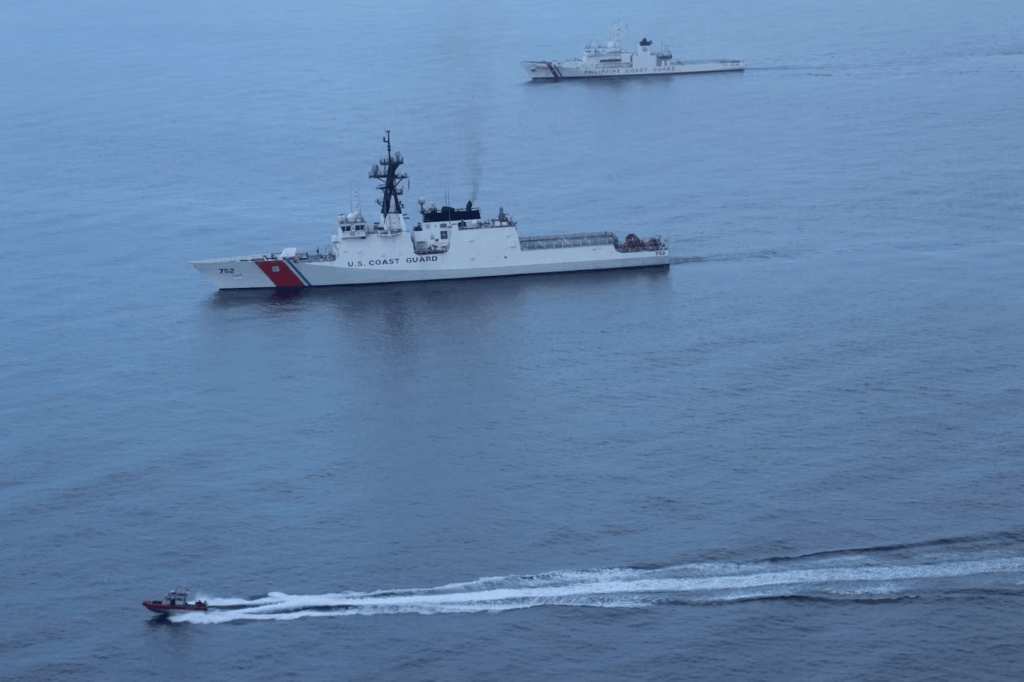
The Legend-class USCGC Stratton (WMSL 752) (background) sails alongside a Philippine Coast Guard vessel as Stratton arrives in Puerto Princesa, Philippines, May 16, 2025. (U.S. Coast Guard photo by Petty Officer 3rd Class William Kirk) 

From U.S. Coast Guard Pacific Area, May 24, 2025 

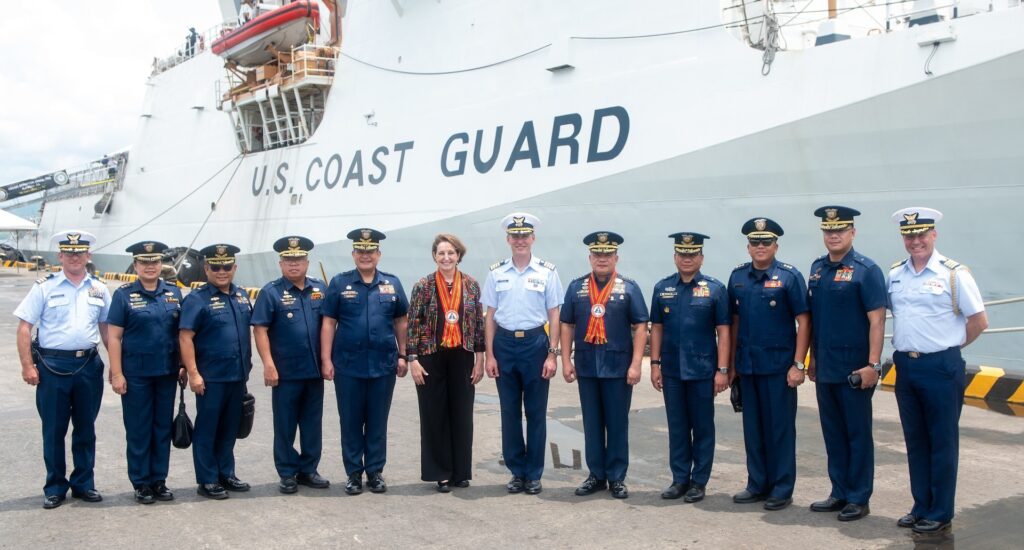
PUERTO PRINCESA, Philippines — The U.S. Coast Guard Cutter Stratton (WMSL 752) and its crew departed Puerto Princesa, Philippines, Monday, after in-port engagements and visits with the Philippine Coast Guard (PCG), the U.S. Ambassador to the Republic of the Philippines MaryKay Carlson, U.S. embassy staff, and PCG District Palawan senior leadership. 
 
Stratton’s visit to Puerto Princesa marked the first international port call of their months-long deployment to the Indo-Pacific region. 
 
Following their departure, Stratton’s crew conducted a bilateral Maritime Cooperative Activity (MCA) with the Armed Forces of the Philippines and the PCG within the Philippines’ exclusive economic zone. The MCA included exercises in maritime domain awareness, division tactics, maneuvering, and visit, board, search and seizure procedures. 
 
These engagements demonstrate the U.S. commitment to maritime governance that supports security, freedom and prosperity in the region. 
 
The U.S. Coast Guard serves as a unique instrument of national power, bridging defense, diplomacy and law enforcement to further national objectives and mutual interests with allies and partners like the Philippine Coast Guard. 
 
During the visit, Stratton’s commanding officer, Capt. Brian Krautler, welcomed Amb. Carlson, PCG Commandant Adm. Ronnie Gil Gavan, and senior PCG leaders aboard Stratton, highlighting U.S. Coast Guard interoperability with allies. 
 
“Our alliance with the Philippine Coast Guard has cultivated a close, collaborative maritime partnership—this is Stratton’s second deployment to the Philippines during my two years aboard as commanding officer,” Krautler said. “Our enduring partnership enables combined effects and cooperation across a broad spectrum of engagements and operations. Stratton’s deployment to the Indo-Pacific will further strengthen our relationships with allied coast guards and services throughout the region.” 
 
The U.S. Coast Guard works closely with regional allies to deliver a broad range of capabilities in support of a prosperous and secure Indo-Pacific. Multilateral operations like the at-sea MCA and in-port engagements enhance cooperation, improve interoperability and strengthen readiness. 
 
While moored, Krautler and Stratton’s leaders also met with the WESTCOM Commander PCG District Palawan for a pre-sail planning meeting to discuss bilateral search and rescue exercises (SAREX) to enhance cooperation. At-sea operations and exercises with the Philippine Coast Guard will strengthen the ability to execute coordinated maritime operations and enhance overall mission readiness.| 
 
The U.S. Coast Guard’s commitment to a prosperous and secure Indo-Pacific requires working closely with regional allies, allowing the service to improve its logistics flexibility to better deliver a broad range of capabilities. 
 
During the patrol, Stratton is scheduled to engage with regional partners and participate in joint operations aimed at enhancing maritime safety and security. Throughout its Indo-Pacific deployment, Stratton is assigned to Destroyer Squadron (DESRON) 15, the Navy’s largest DESRON and the U.S. 7th Fleet’s principal surface force. DESRON 15 regularly assumes tactical control of surface units operating in the area. 
 
Stratton’s port call to the Philippines marks the cutter’s third visit following stops in 2019 and 2023. Consistent U.S. Coast Guard national security cutter deployments to the region demonstrate the U.S. commitment to strong maritime governance that supports security, freedom and prosperity in the Western Pacific. 
 
Commissioned in 2012, Stratton is one of ten Legend-class national security cutters and one of four homeported in Alameda, California. National security cutters are 418 feet long, 54 feet wide and have a 4,600 long-ton displacement with a top speed of 28 knots, a range of 12,000 nautical miles and can hold a crew of up to 170. National security cutters routinely conduct operations throughout the Pacific, where their combination of range, speed and ability to operate in extreme weather provides mission flexibility. 
 
The namesake of U.S. Coast Guard Cutter Stratton is Capt. Dorothy Stratton, who led the service’s all-female reserve force during World War II. Dorothy Stratton was the first female commissioned officer in the Coast Guard and commanded more than 10,000 personnel. The ship’s motto is “We can’t afford not to.” 


NIWC Pacific Enhances India’s Maritime Security Capabilities

From Naval Information Warfare Center Pacific Public Affairs, May 22, 2025 

SAN DIEGO – The U.S. Navy is strengthening maritime security in the Indo-Pacific region through a $125 million initiative designed to enhance India’s maritime domain awareness. Naval Information Warfare Center (NIWC) Pacific is playing a central role in the Indo-Pacific Maritime Domain Awareness (IPMDA) program, a flagship effort under the U.S. Indo-Pacific Strategy. 

The IPMDA initiative aims to improve maritime awareness and regional coordination by providing partner nations with unclassified maritime situational awareness tools and data. A core component of the case is SeaVision, a U.S. Navy-managed platform that aggregates Automatic Identification System (AIS) and other vessel tracking data to enable secure, real-time maritime monitoring, according to Robert Lendvay, NIWC Pacific Foreign Military Sales Case Manager supporting the Navy’s International C4I Integration Program Office [PMW 740]. Lendvay has spearheaded the effort since January 2023. The initiative also integrates commercial satellite-based radio frequency (RF) detection capabilities from HawkEye 360, enabling partner nations to detect and monitor vessels operating without transponders. Together, these tools create a multi-layered operational picture that significantly enhances India’s ability to monitor its maritime domain and contribute to regional security objectives. 
  
The program’s inception began with a foundational meeting at NIWC Pacific in San Diego, where Lendvay, alongside the NIWC Pacific SeaVision Technical Assistance Field Team, hosted a high-level delegation from the Indian Navy and the Indian Ministry of External Affairs. This engagement was instrumental in defining the initial operational and technical requirements that laid the groundwork for the largest IPMDA-related case to date. 
  
Over the course of two years, Lendvay led detailed coordination efforts across the U.S. Department of State, the Defense Security Cooperation Agency, Navy International Programs Office, and other interagency partners to ensure the program met U.S. releasability standards and foreign disclosure policies. 
  
“These collaborative efforts ultimately resulted in the successful completion of the Congressional Notification process – a critical milestone,” said Lendvay. “This authorizes the U.S. Government to offer new and improved capabilities to India in support of IPMDA. This approval not only affirms the strategic trust placed in India as a key Indo-Pacific partner but also reflects the growing defense ties between members of the Quad alliance: the United States, Japan, Australia, and India.” 
  
“This initiative is a testament to the strong partnership between the U.S. and India and our shared commitment to a free and open Indo-Pacific,” said John Smith, a NIWC Pacific employee. “By providing India with advanced maritime domain awareness tools, we are enhancing their ability to monitor their maritime domain and contribute to regional security.” 
  
NIWC Pacific and PMW 740 have played a central role in managing the program’s development, working closely with commercial vendors and interagency stakeholders to define a technically sound and contractually executable acquisition strategy. The IPMDA initiative strengthens the region’s ability to detect and deter threats and reinforces collective maritime security objectives. 


Navy DDGs Successfully Engage SRBM and MRBM During Exercise Formidable Shield 2025 

ATLANTIC OCEAN – (May 20, 2025) Ensign Kayla Staknis, assigned to the Arleigh Burke-class guided-missile destroyer USS Bulkeley (DDG 84), observes the launch of a Standard Missile 3 to intercept a ballistic missile during At-Sea Demonstration (ASD) / Formidable Shield (FS) 2025. (U.S. Navy photo by Mass Communication Specialist 2nd Class Jonathan Nye)

From U.S. 6th Fleet Public Affairs, May 22, 2025 

NAPLES, Italy – U.S. 6th Fleet Arleigh Burke-class guided-missile destroyers USS Thomas Hudner (DDG 116) and USS Bulkeley (DDG 84) conducted two separate live-fire events as part of exercise At Sea Demonstration (ASD) / Formidable Shield (FS) 25. U.S. Navy destroyers are equipped with the Aegis weapons systems designed for ballistic missile defense. 

On May 15, 2025, Thomas Hudner successfully engaged a short-range ballistic missile (IAMD-T) target with an SM-6 missile. 

On May 20, 2025, Bulkeley and Thomas Hudner successfully engaged a medium-range ballistic missile target (ARAV-B) and a simulated target (EDTT) with an SM-3 missile. 

Throughout the exercise, Allied forces are participating in a series of live-fire events using NATO command and control reporting structures. 

The two destroyers’ successful missile intercepts demonstrated the lethality of U.S. Navy systems and the ability to operate seamlessly with Allied nations to maintain a stable security environment. It sends a strong message to any potential adversary by demonstrating combat credibility. 

ASD/FS 25 is the largest at-sea live-fire exercise in the European theater, hosted by U.S. 6th Fleet and executed by Naval Striking and Support Forces NATO. ASD/FS 25 includes a series of live-fire events against unmanned air and surface systems, subsonic, supersonic, and ballistic targets, incorporating multiple Allied ships, multi-nation/multi-service ground-based air defenses, and aviation forces working across battlespaces to deliver lethal effects, accomplish exercise objectives, and hone warfighting skills. 

The exercise commenced on May 3, 2025 and involves approximately 6,900 personnel from across the Alliance. 


New Unmanned Test System Accelerates UAS Development at NAWCAD 

The Tethered Unmanned Aerial Vehicle Experimentation Payload System (TULEPS) is a new test asset that enables rapid testing of unmanned aviation payloads without requiring flight clearances providing extended operational time, secure data transmission, and adaptability for ship- and vehicle-based applications at the Naval Air Warfare Center Aircraft Division. (U.S. Navy photo by Chuck Regner)

From Naval Air Warfare Center Aircraft Division, May 21, 2025 

ST. INIGIES, Md. — The Naval Air Warfare Center Aircraft Division (NAWCAD) is boosting its testing capabilities with a new UAS experimentation system showcased recently at a training event at Naval Air Station Patuxent River’s Webster Outlying Field. 

Designed to accelerate unmanned aviation development, the Tethered Unmanned Aerial Vehicle Experimentation Payload System (TULEPS) allows developers to test software and mission equipment on a generic unmanned platform. 

“When we test payloads on specific UAVs, it requires significant money, time and effort because of the limitations of the UAV – TULEPS is an innovative resource that allows us to focus first on the development of the actual payload technology,” said NAWCAD lead experimentation engineer James Tomasic.  “After we’ve worked through the technical issues and are comfortable with the payload, we can focus on implementing that technology on a specific UAV platform.” 

TULEPS streamlines testing by allowing equipment to be loaded on its UAV without requiring flight clearances. Its tether enables systems to fly in most weather conditions, powers payloads for extended periods of time, securely transmits data, and can be used on ships or trucks to give antennas and sensors a higher vantage point and longer reach. 

“If we want to test an electronic warfare pod, a new communication antenna or an electro-optical surveillance sensor, we can put it on the TULEPS system with very little paperwork,” said Chief Test Pilot Lt. Col. Jason Noll at NAWCAD’s unmanned Air Test and Evaluation Squadron (UX) 24. “The system is already approved, so we don’t have to obtain a new clearance – we can test on a shorter timeline with fewer manhours and save money as well.” 

NAWCAD’s Experimentation Office (NEO) worked with industry partner DPI UAV Systems to quickly stand up the new test capability, which culminated in a two-day TULEPS event that featured classroom and hands-on training for more than 10 UX-24 air vehicle operators who are the command’s first qualified TULEPS operators. 

“NEO is here to help solve problems and support all of NAWCAD,” said Tomasic. “We are constantly looking at game-changing technologies like TULEPS that bring new capabilities to the warfare center.” 

NAWCAD’s military, civilian, and contract personnel operate test ranges, laboratories, and aircraft in support of test, evaluation, research, development, and sustainment for all Navy and Marine Corps aviation platforms. Based in Patuxent River, Maryland, NAWCAD also has major sites in St. Inigoes, Maryland; Lakehurst, New Jersey; and Orlando, Florida. 


U.S. and Philippine Coast Guards Conduct Maritime Cooperative Activity 

The Legend-class USCGC Stratton (WMSL 752), middle, sails with Philippine Coast Guard Teresa Magbanua-class patrol vessel BRP Melchora Aquino (MRRV-9702), top, in the Sulu Sea, May 20, 2025. Stratton is deployed and assigned to Destroyer Squadron (DESRON) 15, the Navy’s largest DESRON and the U.S. 7th Fleet’s principal surface force. (Courtesy photo)

By Commander, Task Force 71/Destroyer Squadron 15, May 21, 2025 

SULU SEA  –  The Armed Forces of the Philippines, the Philippine Coast Guard, and the United States Coast Guard (USCG), demonstrating a collective commitment to strengthen regional and international cooperation in support of a free and open Indo-Pacific, conducted a bilateral Maritime Cooperative Activity (MCA) within the Philippines’ Exclusive Economic Zone, May 20. 
 
This iteration builds upon previous MCAs and our continuing operations together, which strengthen the interoperability of our defense/armed forces doctrines, tactics, techniques, and procedures. 
 
MCAs are conducted in a manner that is consistent with international law and with due regard to the safety and navigational rights and freedoms of all nations. 
 
Participating units included the Legend-class cutter USCGC Stratton (WMSL-752) and a P-8A Poseidon maritime patrol and reconnaissance aircraft from the U.S. Navy, as well as the Philippine Navy’s Gregorio del Pilar-class patrol ship BRP Ramon Alcaraz (PS16); Acero-class patrol gunboats BRP Gener Tinangag (PG903) and BRP Domingo Deluana (PG905); an AW109 naval helicopter; the Philippine Air Force’s Super Tucano and Sokol helicopters; and the Philippine Coast Guard’s Teresa Magbanua-class patrol vessel BRP Melchora Aquino (MRRV 9702). 
 
“Maritime Cooperative Activities help us continue to build strong military-to-military ties with our Philippine navy allies,” said Vice Adm. Fred Kacher, commander, U.S. 7th Fleet. “With each iteration, these operations further advance our collective efforts to preserve regional stability in this critical part of the world.” 
 
This iteration of the MCA included exercises in maritime domain awareness, division tactics, maneuvering, and Visit, Board, Search and Seizure. 
 
“The U.S. Coast Guard has a significant presence in the Indo-Pacific region,” said Capt. Brian Krautler, Stratton’s commanding officer. “On our Western Pacific deployments, we frequently engage with partner nations through professional exchanges and capacity building, as shown with this operation. This is an opportunity to reinforce vital links with our counterparts who mutually value the preservation of a free, secure and open maritime environment.” 
 
The U.S., along with our allies and partners, upholds the right to freedom of navigation and overflight and other internationally lawful uses of the sea related to those freedoms. 
 
USCGC Stratton is underway in the U.S. 7th Fleet area of operations in support of a secure and prosperous Indo-Pacific region. 
 
U.S. 7th Fleet is the U.S. Navy’s largest forward-deployed numbered fleet, and routinely interacts and operates with allies and partners in preserving a free and open Indo-Pacific region. 


Airbus Completes Second Aerial Logistics Connector Demo 

From Airbus U.S. Space & Defense, May 20, 2025 

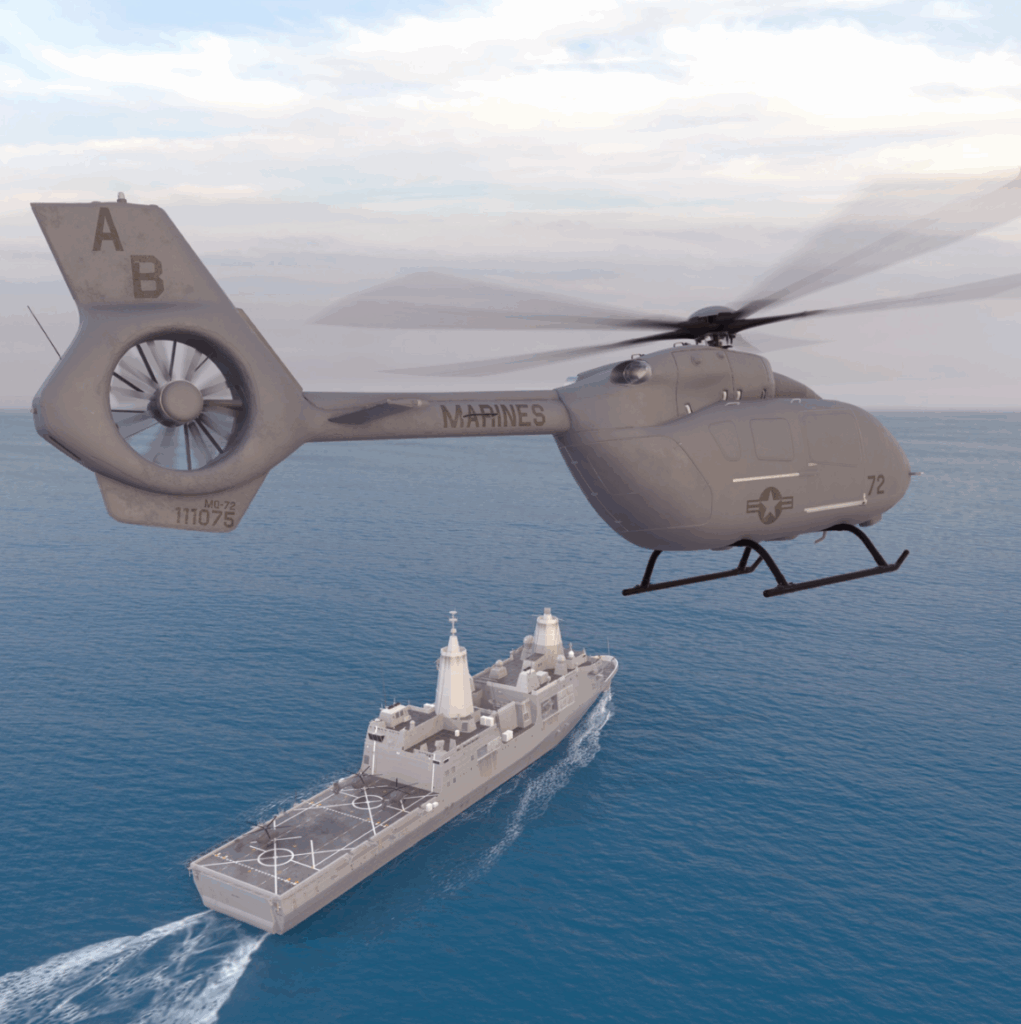
Airbus U.S. Space and Defense recently completed its second program demonstration in support of the U.S. Marine Corps Aerial Logistics Connector contract at Marine Corps Air Station Yuma. 

The demonstration evaluated the performance characteristics of the UH-72B Lakota platform, validated the aircraft’s ability to load and carry specialized cargo, and showcased how the aircraft can be modified to meet Marine Corps requirements for an Aerial Logistics Connector system that supports expeditionary advanced base operations. 

“This demonstration was another illustration of how our MQ-72C system can support a range of missions and payloads that Marines will need to perform operations in austere environments,” said Rob Geckle, Jr., Chairman and CEO of Airbus U.S. Space and Defense. “We believe this aircraft will redefine the future of Marine Corps aviation.”  


Airbus U.S. is entering the second year of the Aerial Logistics Connector Middle Tier of Acquisition (MTA) Rapid Prototyping Program, which aims to provide the service with aircraft prototypes to demonstrate capabilities to the warfighter through a series of operational demonstrations and experiments. 

Additional demonstrations will continue throughout the rest of 2025 that inform future acquisition decisions for the opportunity to build a prototype aircraft. 

In May 2024, Naval Air Systems Command (NAVAIR) awarded Airbus U.S. Space & Defense a Phase I Other Transactional Authority Agreement, through Naval Aviation Systems Consortium, based on its unmanned UH-72 Logistics Connector concept, a variant of the proven UH-72 Lakota platform. 

The Aerial Logistics Connector effort is one of several efforts across the Department of Defense to deliver logistical support in distributed environments during peer or near-peer conflicts. 

With over 1.7 million flight hours and over 490 aircraft delivered across the U.S. Army, U.S. Navy and foreign allies, the UH-72 Lakota provides unmatched range and versatility in support of missions that include search and rescue, disaster response, homeland security, drug interdiction, firefighting and MEDEVAC. 


USS Charleston Deploys to U.S. Northern Command Area of Responsibility 

From U.S. Fleet Forces Command Public Affairs. May 21, 2025 

NORFOLK, Va. – The Independence-variant littoral combat ship USS Charleston (LCS 18) departed Naval Base San Diego to support U.S. Northern Command (USNORTHCOM) southern border operations, May 20. 

Charleston takes over duties previously carried out by the Arleigh Burke-class guided-missile destroyer USS Stockdale (DDG 106) and will conduct similar operations in support of USNORTHCOM’s border security objectives. 
 
Charleston’s departure reinforces the Navy’s role in the Department of Defense’s coordinated effort in response to Presidential executive orders and directives. Charleston’s sea-going capacity contributes to USNORTHCOM’s ability to protect the United States’ territorial integrity, sovereignty, and security, through a coordinated, multi-domain strategy. 
 
Charleston will continue operations with an embarked U.S. Coast Guard Law Enforcement Detachment (LEDET). These Coast Guard teams bring specialized expertise in maritime interdiction, enabling the ship to address a range of challenges, from countering illegal activities to supporting humanitarian efforts and homeland security operations. 
 
Charleston is homeported in San Diego as part of Littoral Combat Ship Squadron 1. Littoral combat ships are fast, optimally-manned, mission-tailored surface platforms that operate in near-shore and open-ocean environments, winning against 21st-century threats. LCS integrate with joint, combined, manned and unmanned teams to support forward-presence, maritime security, sea control, and deterrence missions around the globe. 
 
Now, while operating in the USNORTHCOM area of responsibility, Charleston will respond to national priorities and a Presidential declaration emphasizing the military’s role in securing U.S. borders. As the DoD’s lead for implementing border-related executive orders, USNORTHCOM continues to support critical Department of Homeland Security capabilities gaps, with Charleston marking a vital contribution to these efforts. 
 
USFFC is responsible for manning, training, equipping and employing more than 125 ships, 1,000 aircraft, and 103,000 active-duty service members and government employees, and providing combat-ready forces forward to numbered fleets and combatant commanders around the globe in support of U.S. national interests. 
 
USFFC also serves as the Navy’s Service Component Commander to both USNORTHCOM and U.S. Strategic Command, providing naval forces in support of joint missions as Commander, Naval Forces Northern Command (NAVNORTH) and Commander, Naval Forces Strategic Command (NAVSTRAT). USFFC is the Strategic Command Joint Force Maritime Component Commander (JFMCC STRAT) and executes Task Force Atlantic in coordination with U.S. Naval Forces Europe. 


Noem Delivers USCG Academy Commencement Address, Announces New Coast Guard Leadership

From Headquarters, U.S. Coast Guard, May 21, 2025 

NEW LONDON, Conn. — Secretary of Homeland Security Kristi Noem announced Force Design 2028 (FD2028) Wednesday during the Coast Guard Academy commencement ceremony. 

This initiative provides a blueprint to transform the Coast Guard into a stronger, more ready and capable fighting force. 

Speaking at the ceremony, Noem expressed respect for the Service and committed to advocating for funding support. Noem’s FD2028 executive report outlines a vision for the Coast Guard’s future. 

“Now, more than ever, the American people need a strong and capable Coast Guard,” said Noem. “The Coast Guard must not simply evolve. It must revolutionize how it functions and operates to ensure decisive advantage over adversaries. This requires a fundamental change. Force Design 2028 is the bold blueprint needed to drive urgent action and win.” 

Noem also announced President Donald J. Trump’s nomination of Adm. Kevin E. Lunday to serve as the 28th commandant of the Coast Guard. Lunday will continue serving as acting commandant until confirmed by the U.S. Senate. 

The 28th commandant will lead the Coast Guard through a historic period of change. Under their leadership, we will establish the first Coast Guard service secretary and facilitate the implementation of FD2028. FD2028 will re-shape how the Coast Guard functions and operates to ensure decisive advantage over adversaries. 

“Now is the time for fundamental change,” said Lunday. ”Secretary Noem has said that we must reinvigorate the Coast Guard or risk strategic failure. I am honored to lead our Coast Guard men and women in this historic effort to renew the service for the future.” 

FD2028 outlines several key initiatives and campaign areas: 

  • Establish a service secretary: This initiative establishes a legislatively authorized, secretary of the Coast Guard nominated by the president and confirmed by the Senate. This secretary would report directly to the secretary of homeland security and provide civilian leadership, oversight, accountability and advocacy, with authorities comparable to secretaries of other military services. 

  • People: Recognizing that the workforce is at the core of the Service, FD2028 seeks to grow the Coast Guard’s military workforce by at least 15,000 members by the end of fiscal year 2028 to restore readiness and support a growing fleet and new capabilities. Initiatives include transforming the workforce by aligning with the president’s executive order on “Restoring America’s Fighting Force” and instituting a physical fitness test, modernizing enlisted accessions and investing in recruiting incentives, investing in officer leader growth through various programs, revitalizing the Coast Guard Reserve with a focus on mobilization readiness and streamlining policies and processes for the civilian workforce. 

  • Organizational Design: FD2028 will reform the Coast Guard’s organizational structure to become more effective, enabling a leaner, more agile and strategically focused Headquarters by streamlining processes and eliminating redundancies. Key initiatives include designing the future force to win by embracing strategic planning and establishing a futures development and integration function, creating program executive offices for a systems-focused approach to acquisitions and sustainment, establishing a Deployable Specialized Forces command for improved integration and interoperability, strengthening Coast Guard Cyber Command to address cyber and space threats, transferring operational and service-delivery functions out of Headquarters. 

  • Technology: FD2028 will position the Coast Guard to become a leader in the adoption and use of advanced technology, human-machine teaming and data. Initiatives include creating Coastal Sentinel, a next-generation integrated sensor network leveraging artificial intelligence for unprecedented threat identification, supporting a revitalized U.S. maritime industry by replacing antiquated systems for vessel registration and mariner credentials, supporting workforce growth with a modern human resources information technology system incorporating artificial intelligence, delivering an improved logistics system for conditions-based maintenance, and establishing a rapid response prototype team to quickly identify, adopt and deliver advanced technology capabilities. 

  • Contracting and acquisitions (C&A): This campaign aims to streamline C&A processes to better respond to emerging threats, strengthen industry coordination and prioritize speed and flexibility. The service will reform acquisition practices to deliver needed capabilities—including icebreakers and unmanned systems—while managing risk. Planned changes include establishing a disciplined requirements process, assigning senior acquisition authority to the secretary of the Coast Guard, creating a senior procurement executive role, outsourcing procurement activities for effectiveness and designating single points of accountability to empower program managers.  

FD2028 represents an opportunity at a critical moment in history to transform the Coast Guard. Within 30 days, the commandant will deliver an execution plan, followed by the commencement of a force posture and operational concepts campaign within 150 days, and the first of semiannual updates within 180 days. 

“Force Design 2028 is the Coast Guard’s way forward,” said Lunday. ”Under the leadership of Secretary Noem, we are moving out today to aggressively implement this transformational change.” 

Read the FD 2028 executive report here

The Coast Guard is America’s premier maritime law enforcement agency. It is part of the Department of Homeland Security and, at all times, a military service and part of the joint force defending the nation. For over 234 years, the American people have depended on its missions and the unique value the Coast Guard provides to assure our economic prosperity and national security. With its ships, aircraft, boats and nearly 55,000 military members and civilian employees, every day the Coast Guard: controls the U.S. border and maritime approaches; protects America’s ports and waterways; conducts military operations to defend the Nation; saves lives; enforces federal law; leads in national emergencies; and maintains the flow of maritime commerce to ensure America’s economic prosperity. 

More information about the U.S. Coast Guard can be found at www.uscg.mil. Follow @USCG on X and Instagram, like us on Facebook, subscribe on YouTube and follow LinkedIn — connect with us. 


U.S. Coast Guard Barque Eagle to Visit Los Angeles During Fleet Week 

CGC Eagle parades into Los Angeles Harbor under the watchful eye of a CG Dolphin helicopter and 41-foot Utility Boat. (Photo by Michael Brodey, USCG Aux.)

From U.S. Coast Guard Pacific Area, May 19, 2025 

LOS ANGELES — U.S. Coast Guard Barque Eagle (WIX 327) will participate in Los Angeles Fleet Week festivities during Memorial Day weekend, May 23 – 26. 

Eagle will be moored at Berth 50/51 in San Pedro’s Outer Harbor, where it will offer free public tours during the following dates and times: 

  • Friday, May 23 (10 a.m. to 3 p.m.) 

  • Saturday, May 24 (10 a.m. to 3 p.m.) 

  • Sunday, May 25 (10 a.m. to 3 p.m.) 

Visitors will need to join a digital queue and be assigned a time to get in line before their visit. They will then take a shuttle bus to the ship. For more information, go to the Los Angeles Fleet Week’s web page at: https://lafleetweek.com/events_schedule/ships/ 

At 295 feet in length, Eagle is the largest tall ship flying the stars and stripes and the only active square-rigger in United States government service. Constructed in 1936 by the Blohm and Voss Shipyard in Hamburg, Germany, and originally commissioned as the Horst Wessel by the German Navy, Eagle was a war reparation for the United States following World War II. Eagle is a three-masted barque with more than 22,300 square feet of sail and six miles of rigging.  Eagle has served as a classroom at sea to future Coast Guard officers since 1946, offering an at-sea leadership and professional development experience as part of the Coast Guard Academy. 

Los Angeles marks the third port call of Eagle’s 14-week journey along the West Coast. Many Coast Guard Academy practices are steeped in what the Academy mission refers to as “the sea and its lore,” traditions that date back to the golden age of sail, when vessels like Eagle made up the Navy and Revenue Cutter Service, the precursor of the modern United States Coast Guard. Eagle also serves as a goodwill ambassador for the United States and Coast Guard, making calls at foreign ports to foster relations with partner nations. 

For a continuous stream of information about Eagle, including port cities, tour schedules, current events, as well as cadet and active duty crewmember photographs, follow the United States Coast Guard Barque EAGLE Facebook page or on Instagram @barqueeagle.  All U.S. Coast Guard imagery is in the public domain and can be shared widely.