Readiness, Shipbuilding Top Priorities for Navy 

May 15, 2025 | By C. Todd Lopez, DoD News  

On Capitol Hill yesterday, Navy Secretary John Phelan told lawmakers that increasing shipbuilding to better outfit the Navy, developing an accountable and innovative warfighter culture and improving the welfare of the fighting force were his top priorities.  

Phelan, alongside Acting Chief of Naval Operations Adm. James W. Kilby, and Commandant of the Marine Corps Gen. Eric M. Smith, briefed the House Appropriations Committee’s defense subcommittee on current challenges and their plans to address them.  

“My North Star, or No. 1 priority as secretary, is the readiness of our sailors and Marines,” Phelan said, adding that the priorities he outlined will guide his decision-making as he leads the department.  

After Phelan was sworn in as the Navy secretary in late March, he visited troops and facilities in the Indo-Pacific region, the southern border, the USS Gravely, several military installations, as well as public and private shipyards. 

“Rebuilding our hollowed-out maritime industrial base is a national security imperative, as outlined in the Restoring America’s Maritime Dominance executive order signed by President [Donald J.] Trump,” he said. “Over the past month, I visited … eight shipyards across the nation’s East Coast and the Indo-Pacific. I spoke directly with shipyard leaders and the hard-working tradesmen essential to our maritime operations. I now have a clear picture of where our shipbuilding dollars have been going, and [I] am developing a plan to fix what’s broken.”  

Phelan told lawmakers that submarine building challenges include the complexity of the ship, workforce experience, supply chain issues and, in some cases, a lack of modernization at shipbuilding facilities. During his meetings with shipyard workers and industry leaders, he discussed the state of shipbuilding and identified ways to improve workflow.  

“It was very interesting in some of [the leaders’] assessments of what they did not perceive to be as problems,” Phelan said, adding that when he met with the workers, he received the opposite response.  

His visit to a shipyard in Japan showcased the difference in shipbuilding processes. There, he found workers get the same productivity in one shift that American shipyards might get in three shifts.  

“I believe that’s for two reasons,” Phelan said. “One, their average worker is 50 years old; it is a career … they’ve been in that shipyard a very long time. Two, when I spoke to the welders in Japan, they … spend zero time on paperwork. Our welders spend between 30% and 40% of their time filling out paperwork … that is a problem.”  

Phelan said he saw positive things at U.S. yards that might be implemented across the rest of the U.S. shipbuilding industry to speed up things like U.S. submarine production.  

“I do think we can get the calendar shifted left, but it’s going to take a lot of hard work and a lot of effort,” he said.  

Kilby told lawmakers the Navy faces three challenges, and it is working to solve them with congressional assistance.  

First, he said, is a shortage of approximately 23,000 sailors manning ships.  

“Thanks to process improvements and targeted investments, we are on plan to reduce that number significantly by the close of fiscal year 2026,” Kilby said. “We’re committed to attracting and developing Americans who can innovate, solve hard problems and dominate in combat.”  

The Navy missed recruiting goals in fiscal year 2023 but raised its goals in fiscal year 2024 and then exceeded its target when it recruited more than 40,000 new sailors.  

“[That’s] the most since 2003, and we are currently on pace to exceed our recruiting goal for fiscal year 2025,” he said.  

Kilby said a second issue involves strain on the munitions industrial base. Ordinance expenditures in the Red Sea against the Houthis have highlighted challenges with manufacturing replacement munitions.  

“The Navy is working with both our traditional [prime contractors] and new entrants to close this gap, developing kinetic and non-kinetic weapons at speed and at scale,” he said.  

In submitted testimony, Kilby said the Navy is investing in expanding capacity and adding new suppliers across its weapons portfolio, including rocket motors, warheads and engines.  

Finally, Kilby said, platform readiness is a priority for the Navy.  

“Our platforms are not as ready as they need to be,” he said. “We set an ambitious goal to make 80% of our ships, submarines and aircraft combat surge ready by Jan. 1, 2027. To do that, we are reducing maintenance delays. We are improving manning, training, modernization and sustainment. In all of these efforts, consistent and predictable funding is foundational. We appreciate the continued support of this committee.”  

Smith said as the commandant of the Marine Corps, his top priority is achieving a 3.0 amphibious ready group/marine expeditionary unit presence. He added that this would mean the Marines have one amphibious ready group constantly deployed off the East Coast, one deployed off the West Coast and one sporadically deployed out of the naval force in Japan.  

“The amphibious ready group with marine expeditionary unit embarked is the most versatile tool in our nation’s arsenal,” he said. “It is the Swiss Army knife of the joint force, and we’re working closely with our Navy partners to maximize this capability.”  

Smith said accelerating force design is another priority for the Marines, adding that the Marines are in the implementation phase — integrating new technology, refining organizational structure and strengthening the joint force.  

“Force design is our righteous journey to adapt to the changing character of war. The nature of war remains the same, but the character changes,” Smith said.   

Regarding quality of life, Smith said Marines want the basics. He told lawmakers, “Every Marine deserves a clean, safe place to lay their head at night. They don’t ask for much, but they do ask for that.”   

Smith called the Barracks 2030 program the most consequential infrastructure investment in Marine Corps history. He noted that it will provide every Marine with safe, modern living conditions.  

“And quality of life goes beyond our barracks,” he added. “We’re also investing in the well-being of Marine families, because retaining our Marines means supporting those who stand by them.” 


USS Normandy Returns from Deployment to 4th Fleet 

From U.S. 2nd Fleet, May 15, 2025 

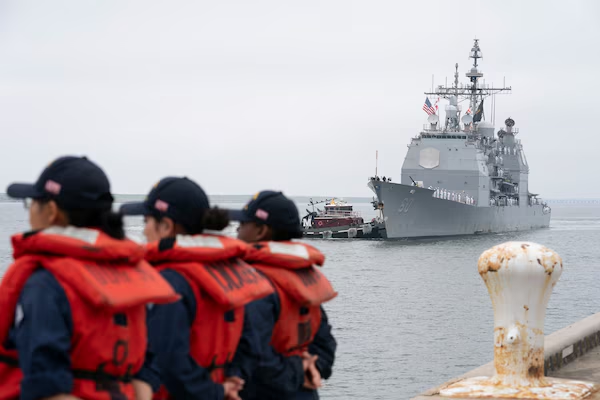
NORFOLK, Va. – The Ticonderoga-class guided-missile cruiser USS Normandy (CG 60) returned to Naval Station Norfolk May 15, concluding a nearly three-month deployment to the U.S. 4th Fleet area of responsibility. 
 

The crew departed Feb. 25, 2025 with their mission focused on strengthening maritime partnerships, enhancing regional security, and conducting multinational naval operations in the Caribbean and surrounding waters. 
 
“I could not be more proud of Normandy’s sailors and their relentless drive to execute the nation’s tasking,” said Capt. Nathan Diaz, commanding officer of USS Normandy. “While independently deployed, it was an honor for our crew to reinforce the maritime commons with partners like Colombia, France, Guyana, the Netherlands, Panama and the U.K.” 
 
During the deployment, Normandy engaged in several notable exercises to include the Trilateral Maritime Exercise March 3 and the Bilateral Exercise with Guyana March 27. The Trilateral Maritime Exercise was executed alongside the Royal Navy’s HMS Medway and the Royal Netherlands Navy’s HNLMS Groningen. This operation included coordinated maneuvers and aviation drills, featuring a Royal Netherlands NH-90 helicopter, aimed at enhancing interoperability among allied naval forces. 
 
The Bilateral Exercise with Guyana was conducted in partnership with the Guyana Defence Force patrol vessel GDFS Shahoud. Supported by Normandy’s embarked MH-60R Seahawk helicopter from Helicopter Maritime Strike Squadron 50, the exercise focused on formation maneuvers and communication drills to bolster regional maritime cooperation. 
 
Throughout its deployment, Normandy also participated in Theater Security Cooperation port visits and collaborative operations with regional partners, reinforcing the U.S. Navy’s commitment to unity, security, and stability in the Caribbean, Central, and South American maritime regions. 
 
“The crew of Normandy has exceeded all expectations while operating with partner and ally nations and strengthening maritime partnerships in the Caribbean,” said Rear Adm. Paul Lanzilotta, commander of Carrier Strike Group Twelve. “The successful completion of their third deployment in the last year and a half is a testament to the grit, determination, and selflessness of the Sailors and their families.” 
 
Normandy is a multi-mission Air Warfare, Undersea Warfare, Naval Surface Fire Support and Surface Warfare surface combatant capable of supporting carrier battle groups, amphibious forces or operating independently and as flagships of surface action groups. 
 
Normandy was commissioned in Dec. 1989 and was named after the World War II Battle of Normandy. 
 
U.S. 2nd Fleet, reestablished in 2018 in response to the changing global security environment, develops and employs maritime ready forces to fight across multiple domains in the Atlantic and Arctic in order to ensure access, deter aggression and defend U.S., allied, and partner interests. 
 
For more U.S. 2nd Fleet news and photos, visit www.facebook.com/US2ndFleet, https://www.c2f.usff.navy.mil/, X – @US2ndFleet, and https://www.linkedin.com/company/commander-u-s-2nd-fleet


FRCE inducts first CH-53K King Stallion for maintenance 

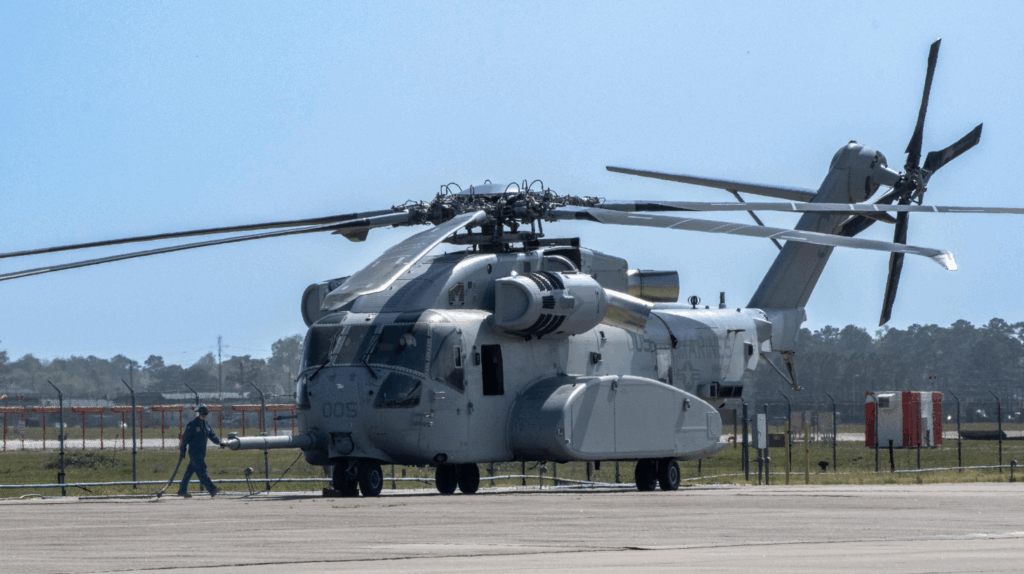
Marine Master Sgt. Richard Hughes, maintenance chief at Fleet Readiness Center East (FRCE), prepares to secure the rotor blades of a CH-53K King Stallion helicopter that arrived at the depot April 4 for routine maintenance. FRCE inducted the aircraft April 17 as the first of 14 planned for induction as part of the Age Exploration Program, Depot (AEPD); it is the first King Stallion ever inducted for depot-level maintenance. (U.S. Navy photo)

From FRCE, May 15, 2025 

MARINE CORPS AIR STATION CHERRY POINT, N.C. — Fleet Readiness Center East (FRCE) opened a new chapter in its support of naval aviation’s heavy lift mission with the induction of a CH-53K King Stallion April 17, marking the first time the platform has ever been inducted for depot-level maintenance. 

The aircraft arrived April 4 from Marine Heavy Helicopter Squadron 461 (HMH-461) onboard Marine Corps Air Station New River, and is the first of 14 CH-53K helicopters that will undergo routine maintenance at FRCE as part of the Age Exploration Program, Depot (AEPD). AEPD collects information regarding the aircraft’s condition through controlled testing and analysis and assists in the development of effective and efficient maintenance schedule for new aircraft. 

FRCE Commanding Officer Capt. Randy J. Berti said the induction of the CH-53K – also known as the “Kilo” – allows the command to continue its long history of supporting the H-53 community while expanding its role in sustaining the new heavy lift platform. 

“For many years, FRC East has provided the heavy lift community with world-class service in support of sustainment,” Berti said. “As aviation technology continues to evolve, we’re excited to add the CH-53K King Stallion to our portfolio. This first induction as part of the Age Exploration Program will allow us to learn more about the aircraft and refine the processes and procedures that will help us continue our critical role in driving flight line readiness for our nation’s warfighters.” 

The CH-53K King Stallion is the U.S. Marine Corps’ heavy-lift replacement for the venerated CH-53E Super Stallion. The King Stallion is the largest and most powerful helicopter in the U.S. Department of Defense and will expand the fleet’s ability to move more material, faster throughout the area of responsibility. The CH-53K is designed to carry 27,000 pounds at a mission radius of 110 nautical miles in U.S. Navy high/hot environments, which is almost triple the baseline of the CH-53E. Its maximum external lift capability is 36,000 pounds. It is also designed to have a smaller shipboard footprint, lower operating costs per aircraft, and fewer direct maintenance man hours per flight hour. 

The AEPD induction arrives following years of coordination between FRCE, the Fleet Support Team, the Naval Air Systems Command H-53 Heavy Lift Helicopters Program Office (PMA-261) and the Marines who fly the Kilo. 

“This first CH-53K induction into depot maintenance signifies the maturation of the platform and the readiness of our sustainment enterprise,” said PMA-261 Assistant Program Manager for Logistics Lt. Col. Matthew Russell. “The exceptional collaboration between PMA-261, FRC East, Marine Aircraft Group 29, and the Fleet Support Team, which began over three years ago, has established a foundation for long-term support of the King Stallion’s heavy-lift capability.” 

FRCE H-53 Branch Head Michael Paul said the arrival of the CH-53K, in many ways, represents a new horizon – both for the rotary-wing program at the depot and for the fleet. 

“Simply put, it’s our future. The legacy platform, the CH-53E, has been there for 40-plus years and it’s slowly being phased out,” he explained. “The MH-53E, the last few are in the plant right now – we have four left – and then that will be the end of our planned maintenance for the MH community, the Navy version of the aircraft. The CH variant flown by the Marine Corps is shrinking its footprint here, with just about five inductions per year. 

“And so the future, not only for FRC East but also for the fleet, is the K model program. It’s the newest generation helicopter out there, and so that means that this is the future for the next 20, 30 or 40 years, for the product team here.” 

Jeff Warren, CH-53K capability establishment lead at FRCE, said the Kilo’s arrival at the depot also represents the future of the platform’s sustainment schedule. The 14 inductions under AEPD will help determine the aircraft’s planned maintenance interval (PMI) schedule. A planned maintenance interval is a period of time prescribed for the execution of a maintenance event. 

“This aircraft’s induction corresponds with a specific number of flight hours, which has been set as a mark on the wall,” he said. “It will be inspected to see if there’s any major structural damage, along with the 13 more behind it. Their condition is going to dictate whether future aircraft PMI events need to happen at this number of flight hours or, if we’re not seeing any major structural issues or overall fatigue of the aircraft, whether the PMI event can be bumped out by an additional number of flight hours. It’s setting a precedent of what the future schedule will look like for depot-level maintenance.” 

Warren said the depot’s findings during AEPD will have implications that stretch down to all levels of maintenance, from the heavy maintenance, repair and overhaul at the depot level (D-level) to the maintenance performed at the organizational level (O-level) by the squadrons flying the aircraft, and the intermediate level (I-level) performed by the maintenance and logistics squadrons in between. 

“The squadron’s already doing those O-level maintenance actions, but during AEPD, we’re performing O-level and I-level maintenance in conjunction with the depot level. We’re verifying processes and procedures,” Warren said. “This allows us to critique and refine the O- and I-level technical data, to red-line it, effectively, and then develop the depot-level tech data to assist with future depot requirements, because FRC East is the first-ever to conduct depot-level maintenance on the CH-53K.” 

Paul said his team on the H-53 line will perform around 800 inspections on the aircraft in order to properly assess its condition, a process that will take almost half of the planned AEPD cycle time. 

“We developed a generic template for the inspect and repair phase using the CH-53E and MH-53 as a starting point, assuming the work on the Kilo will be like and similar,” Paul explained. “However, this is the first time any K model aircraft will be disassembled and inspected at this level, and there are differences. It’s computer-based, sensor-based, fly-by-wire, with more composite. 

“We have some ideas of what we’re going to find, but there are going to be some areas we’re looking into that nobody has inspected before. We are physically putting our eyes on everything: framing, composite, flight controls, every wiring harness, all the wiring … everything has to be looked at,” Paul continued. “We’re going to conduct these 800-plus inspections, gather the details of any discrepancies we find, correct those we know how to correct, and refer to engineering for solutions the ones we don’t have any knowledge of. Based on their solutions, we will implement those changes to correct those discrepancies, as well. There are a lot of unknowns going in, but it’s an exciting time for the group here.” 

Current labor estimates for the AEPD process are based on the PMI process for the CH-53E and MH-53E, and only include work on the airframe itself and not on components that will eventually get routed to back shops, once those capabilities are established. Until then, components will be removed from the aircraft, visually assessed, and exchanged for new components if replacement is required. 

According to Warren, the depot should stand up its first batch of CH-53K component capabilities this summer, with the first engines capability established in early fall. All told, FRCE plans to establish capability on about 150 components and dynamic components for the Kilo. The second CH-53K scheduled for AEPD induction should arrive at FRCE in late 2026, with the next two following within fiscal year 2027. FRCE will remain the only depot source of repair for the CH-53K until FRC Southwest, located on Naval Air Station North Island, California, establishes its King Stallion airframes capabilities, which should take place sometime in the early 2030s, he said.  

FRCE is North Carolina’s largest maintenance, repair, overhaul and technical services provider, with more than 4,000 civilian, military and contract workers. Its annual revenue exceeds $1 billion. The depot provides service to the fleet while functioning as an integral part of the greater U.S. Navy; Naval Air Systems Command; and Commander, Fleet Readiness Centers. 


New Systems Pending, but Coast Guard ‘Stretched Thin,’ Lunday Says

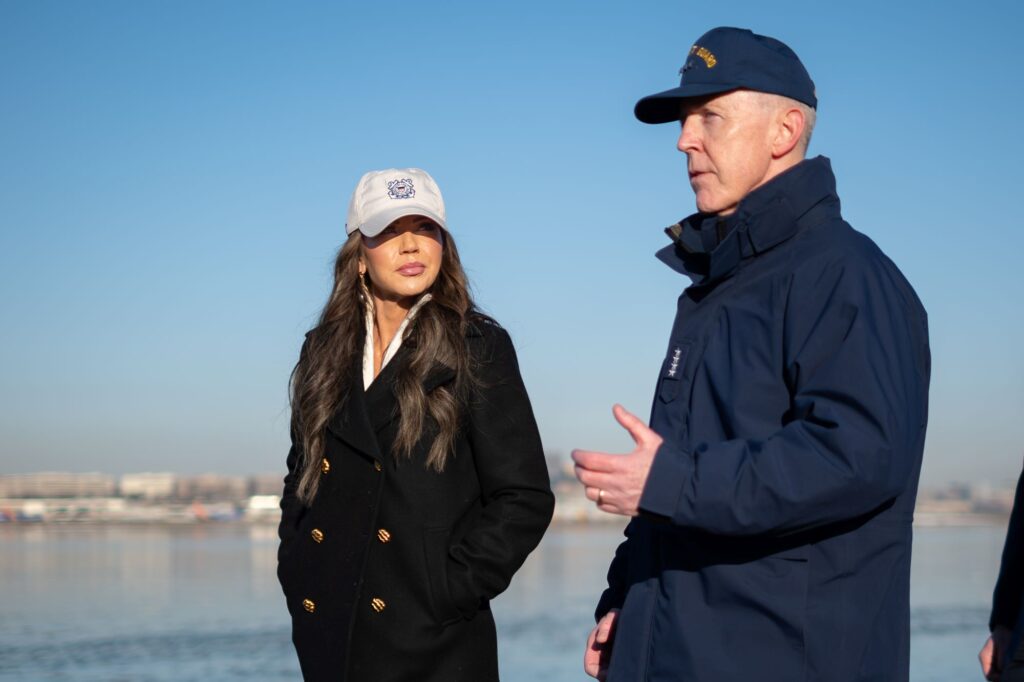
Secretary of Homeland Security Kristi Noem and Admiral Kevin Lunday, acting Commandant of the Coast Guard, shown here discussing response efforts in Washington D.C., January 30, after a helicopter and passenger jet collided. Photo credit: U.S Coast Guard | Petty Officer 1st Class Brandon Giles

Much-needed new ships are on the way for the U.S. Coast Guard, acting Commandant Admiral Kevin Lunday told members of a House Armed Services Committee panel on May 14 as Congress prepares to receive defense budget requests from the new administration.

Lunday noted the service quickly moved resources to the Southern U.S. border in the wake of the presidential election.

“In January of this year, under the leadership of Secretary [Kristi] Noem, I directed our operational commanders to immediately increase Coast Guard presence along the U.S. border and maritime approaches, starting with the southern border where the president has declared a national emergency,” Lunday told members of the committee’s Subcommittee on Homeland Security. “We surged forces, tripling the number of forward-deployed air and surface assets in that area.”

The service also moved to continue operations to control the northern border, including on the Great Lakes, to maritime approaches around Alaska, Hawaii and U.S. territories in the Pacific.

“Tasked with defending the nation’s maritime borders, countering threats like illegal migration and drug trafficking, safeguarding our ports and waterways, responding to maritime disasters, and saving lives, the service is now stretched thin, with significant workforce shortages and aging, underfunded assets and infrastructure nearing collapse,” he said. “The Coast Guard’s current organizational structure and reactive posture are no longer adequate to meet current and emerging challenges.”

Acquisitions

Last month, Lunday debuted a plan called Force Design 2028, aimed at addressing those issues. It will focus on four major areas: People, organization, acquisition and contracting and technology, including an effort to “Develop a high velocity acquisition and contracting system to rapidly deliver the assets the service needs to fulfill its commitment to the American people.”

Some much-needed assets are already in the works, Lunday told members of the panel, with new production milestones achieved.

The service’s top ship acquisition priority is the polar security cutter and Lunday said the first PSC received approval on April 30 for full production by Bollinger Shipyards. Functional design maturity has topped 95 percent, so “they already are construction 10 of the pre-fabrication assembly units, which are the bottom center sections of that new icebreaker,” he said.

Likewise, the service is moving ahead to replace its aging construction tenders and river tenders, which maintain aids to navigation, and some of which have been in service since the 1940s. The DHS has approved the construction of the first eight of the new water commerce cutter being built by Birdon America, with their homeports to be decided later.

New systems are needed in the air as well, Lunday said.

The recent termination of the C-27J missionization program and stalled growth in our HC-130J program place our readiness to conduct various missions in jeopardy, including long range surveillance, disaster response, and border security operations,” he said. “For our rotary wing fleet, it is imperative that we continue and accelerate transition of air stations from the short-range MH-65E to the medium-range MH-60 to ensure sustainability and increase our capability to serve our national priorities.”


Airbus U.S. Space & Defense, L3Harris Partner on Integration for Aerial Logistics Connector  

From Airbus U.S. Space & Defense and L3 Harris, May 14, 2025 

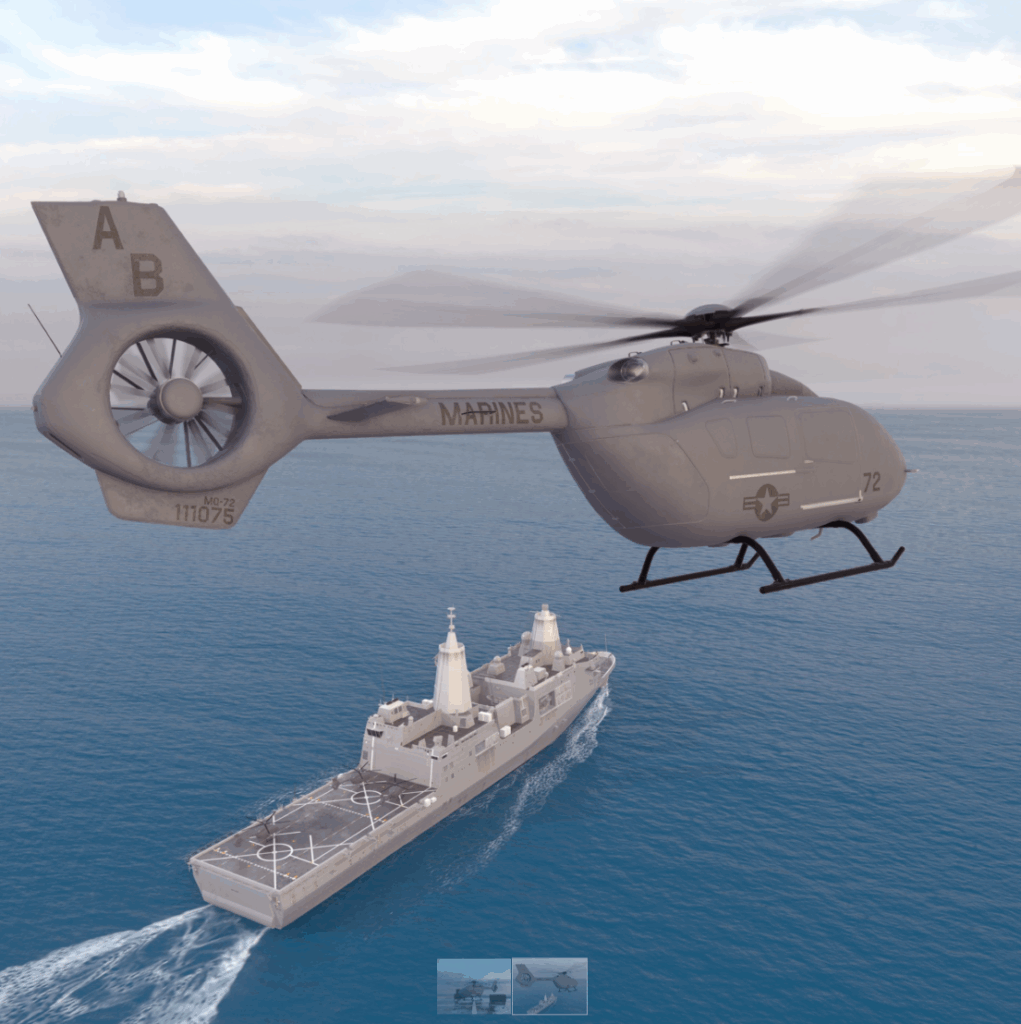
WASHINGTON (May 14, 2025) — Airbus U.S. Space & Defense and L3Harris Technologies (NYSE: LHX) announced a teaming agreement to incorporate L3Harris’ proven platform system integration capabilities on the Airbus MQ-72C Logistics Connector, an unmanned variant of the UH-72 Lakota helicopter.  

Airbus will utilize L3Harris’ robust digital backbone with integrated command and control nodes. Combined with their modular open systems approach, the infrastructure enables the U.S. Marines to rapidly integrate third-party, commercial off-the-shelf hardware that will enable maximum system versatility and mission adaptability. 

“Our MQ-72C platform is capable of supporting the warfighter on a range of unmanned operations that will support the future fight,” said Robert Geckle, Chairman and CEO, Airbus U.S. Space & Defense. “Partnering with a proven systems integrator opens the aperture on what our aircraft can do operationally in contested and austere environments.” 

This partnership will allow the Marines’ mission sets to evolve over the next several years and will enable more advanced levels of systems integration across the Marine Corps and broader joint force. 

“We are focused on accelerating development to get this capability into the hands of military personnel,” said Jason Lambert, President, Intelligence, Surveillance and Reconnaissance, L3Harris. “With more than 60 years of experience in aircraft systems integration, L3Harris brings proven expertise developing complex mission system design and integration to enhance operational effectiveness in contested environments.” 

The Airbus team is entering the second year of the Aerial Logistics Connector Middle Tier of Acquisition Rapid Prototyping Program, which aims to provide the service with aircraft prototypes to demonstrate capabilities to the warfighter through a series of operational demonstrations and experiments. 

The Aerial Logistics Connector effort is one of several across the Department of Defense to deliver logistical support in distributed environments during peer or near-peer conflicts. 


DOD Demonstrates Reusability of Hypersonic Test Vehicle 

May 14, 2025 | By DoD News  

The Defense Department conducted a second successful flight of a fully recoverable uncrewed hypersonic test vehicle in March 2025, with the first being in December 2024.   

This test campaign, led by DOD’s Test Resource Management Center, in partnership with Naval Surface Warfare Center, Crane Division, marks the nation’s first return to reusable hypersonic flight testing since the X-15 hypersonic research program ended in 1968.    

In both tests, the Talon-A hypersonic vehicle, powered by a liquid rocket engine and launched from a carrier aircraft, flew over the Pacific Ocean and achieved speeds greater than Mach 5, about 3,836 mph, before landing at Vandenberg Space Force Base, California. The landmark tests supported the TRMC’s Multi-Service Advanced Capability Hypersonics Test Bed project.   

The project accelerates delivery of advanced hypersonic capabilities to the warfighter by providing DOD, other federal agencies, industry and academia with the capability to affordably and rapidly conduct hypersonic experiments and test hypersonic system components, according to a DOD news release published earlier this month.  

George Rumford, the director of TRMC, said historically, a hypersonic development program would conduct the first flight test of a new aeroshell material, GPS unit, or other system component in a costly, full-system weapon test. Because of the high cost, a program may perform only one or two full-system weapon tests per year, so if a test fails, it may not be tested again for months.   

With such high stakes associated with each flight test, the program would often over-engineer the components and materials being tested to offset the risk of test failure. For instance, Rumford said the aeroshell material would have to be thicker and heavier, sacrificing range and maneuverability. The GPS would require redundancy, which would crowd out other equipment.   

In contrast, DOD’s MACH-TB project leverages commercial space launch services to test hypersonic system components and materials in-flight prior to a full-system weapon test.   

This approach allows developers to test components and materials under hypersonic conditions at relatively low cost, iterate and improve based on real data, and rapidly retest to ensure they are proven before being integrated into an “all-up-round” for a full-system weapon test.   

Rumford said the December and March flight tests represent another advancement in accelerating the pace of hypersonic experimentation and testing.   

“Demonstrating the reuse of fully recoverable hypersonic test vehicles is an important milestone for MACH-TB,” he explained. “Lessons learned from this test campaign will help us reduce vehicle turnaround time from months down to weeks.”  


Vatn Systems Unveils New AUV-Torpedo Product Line and Opens Manufacturing Facility 

The Skelmir S12 is a lightweight 12.75-inch diameter platform that enables AUV and torpedo missions representing a significant leap in underwater technology, offering unprecedented pricing, flexibility, and performance 

The company’s new manufacturing facility leverages patent-pending modular design and vertical integration techniques, enabling rapid production at a scale previously unseen in the underwater vehicle market 

From Vatn Systems, May 12, 2025 

PORTSMOUTH, R.I., May 12, 2025 /PRNewswire/ — Vatn Systems, a leading defense technology company building autonomous underwater vehicles (AUVs) for the US military and allies, along with commercial customers, today announced the launch of its new innovative AUV-torpedo product line, the Skelmir S12, and the opening of a state-of-the-art manufacturing facility, which is capable of producing up to 2,000 vehicles annually. 

New AUV-Torpedo Product Line Fills Gap in the Market 

The 12.75-inch diameter AUV represents a significant leap in underwater technology, offering unprecedented flexibility and performance with the ability to fulfill torpedo and AUV roles in various modular configurations. Uniquely designed to be agnostically deployed from submarines, surface vessels, and aircraft, the vehicle can serve multiple mission profiles including torpedo operations, sensor platforms, and electronic warfare capabilities. 

“With the Skelmir S12, we set out to fill a critical market void—creating a vessel that merges the capabilities of a traditional AUV with the agility and performance of a lightweight torpedo for a fraction of the cost,” said Nelson Mills, co-founder and CEO of Vatn Systems. “We’ve created a platform that delivers superior payload capacity, flexible deployment, and unmatched cost-effectiveness compared to existing solutions, and we’re excited to be able to produce these at scale in our new manufacturing facility to fill that gap in the market and meet customer demand starting this summer.” 

The Skelmir S12, in its AUV configuration, has successfully completed its first exercise and the first production run has already been sold to government customers, with deliveries expected this year. The torpedo variant will be manufactured and delivered next year. 

New Manufacturing Facility Scales Production to an Industry-Leading 2,000+ Vehicles Per Year 

The company’s new manufacturing facility leverages patent-pending modular design and vertical integration techniques, enabling rapid production at a scale previously unseen in the underwater vehicle market. 

“With current industry standards at about 200 vehicles per year, this facility will enable a strong competitive differentiation for us as we scale production capacity to 2,000+ vehicles annually to meet growing customer demand,” said Brendan Smith, Director of Manufacturing at Vatn Systems. Smith recently joined the team from Boston Dynamics, where he led the scaling of manufacturing operations for multiple robot hardware programs from early stage development to high rate production.  

“By leveraging modular design and vertically integrated production, we’re able to reduce lead times, minimize handoffs, and eliminate many of the inefficiencies common in traditional assembly processes,” Smith added. “This approach gives us tighter control over quality, faster iteration cycles, and the ability to rapidly scale output as demand increases.” 

Vatn recently announced a partnership with Palantir that enables the company to digitize its manufacturing process and provide AI-driven insights to accelerate the production of AUVs built in the new facility, which is expected to reach full production capability in July 2025. 


CNATRA’s Past Commanders Return to Assist Shaping the Future of Naval Aviation 

From Chief of Naval Air Training, May 9, 2025   

NAS CORPUS CHRISTI —The Chief of Naval Air Training (CNATRA), Rear Admiral Rich Brophy, hosted former CNATRA commanders onboard Naval Air Station (NAS) Corpus Christi and NAS Kingsville last week as part of the Graybeards conference, an event that brings together previous leaders of naval air training to share their experience and insight with the current training enterprise. The conference offered a unique opportunity for these distinguished former commanders to witness firsthand the evolution of flight training and contribute their perspective to the ongoing transformation of naval aviation. 
 
During their visit, the Graybeards toured Training Air Wing FOUR’s (TW-4) simulator facilities where they tested the virtual reality (VR) “sleds” used in primary flight training. These VR devices provide immersive and realistic instruction for Student Naval Aviators before they advance to the aircraft. The group also interacted with the new T-54 simulator, which is set to replace the T-44 Pegasus in multi-engine advanced training. The T-54 represents a significant step forward in-flight training modernization, offering improved systems integration and better alignment with fleet aircraft. 
 
Following the simulator tour, the group returned to CNATRA headquarters for a mission brief outlining the current and future state of the Naval Air Training Command. Discussions focused on efforts to increase training throughput and modernize the curriculum in line with naval strategic demands and fleet requirements. The day concluded with a visit to NAS Kingsville, where the Graybeards toured the advanced strike training facilities and received an overview on the successful Bird/Animal Aircraft Strike Hazard radar program, the planned Service Life Extension Program for the T-45 Goshawk, and the maintenance scheduling optimization program to increase jet training availability and efficiencies. 
 
“The Graybeards conference honors the legacy of leadership that continues to guide Naval Air Training today,” said Rear Adm. Rich Brophy. “These former CNATRAs laid the foundation for the work we do, and their insights continue to be vital as we train the future of naval aviation.” 


Continuing Promise 2025 Set to Begin 

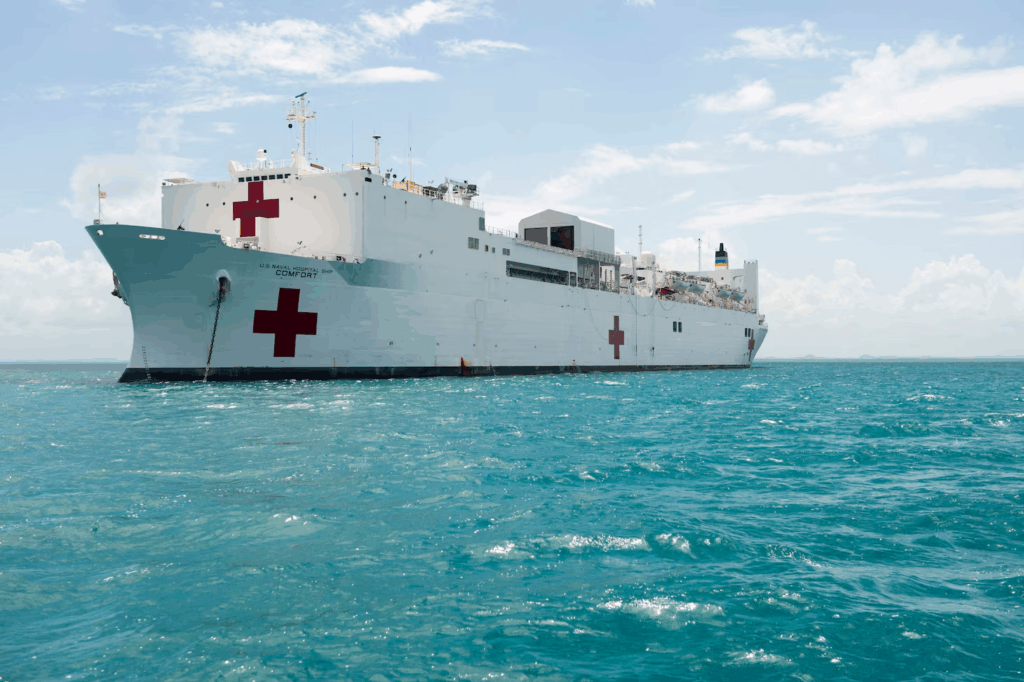
The Military Sealift Command hospital ship USNS Comfort (T-AH 20) sit at anchor during Continuing Promise 2015. (U.S. Navy photo by MC1 Gary Johnson) 

By U.S. Naval Forces Southern Command / U.S. 4th Fleet Public Affairs, May 13, 2025 

MAYPORT, Florida – The U.S. Navy Mercy-class hospital ship USNS Comfort (T-AH 20) will deploy this June-August to the U.S. Southern Command area of operations as part of U.S. Naval Forces Southern Command/U.S. 4th Fleet’s Continuing Promise 2025 mission. After several months of detailed planning, USNS Comfort is scheduled to visit Grenada, Panama, Colombia, Ecuador, Costa Rica and Dominican Republic during the nearly three month-long mission. 
  
Continuing Promise 2025 marks the 16th mission to the region since 2007 and the eighth aboard USNS Comfort. The mission will foster goodwill, strengthen existing partnerships with partner nations, and encourage the establishment of new partnerships among countries, non-federal entities, and international organizations. 
  
The focus during each mission stop will be working alongside partner nation medical personnel to provide direct patient care and technical expertise in community clinics to improve medical readiness, strengthen partnerships, and enhance the combined capabilities of the U.S. Navy and partner nations to respond to public health disasters and humanitarian crises. 
  
“The USNS Comfort’s deployment under Continuing Promise demonstrates the U.S. Navy’s enduring commitment to our allies and partners across the Caribbean, Central and South America,” said Rear Adm. Carlos Sardiello, Commander of U.S. Naval Forces Southern Command/U.S. 4th Fleet. “This mission will forge lasting partnerships and deliver impactful aid, leaving a legacy of goodwill throughout the region.” 
  
The Continuing Promise team also includes a U.S. Army veterinary element from the 248th Medical Detachment (Veterinary Service Support), which will collaborate with host nation colleagues to provide direct public health education and animal care at local veterinary organizations in-country. U.S. Navy Seabees from Navy Mobile Construction Battalion 11 will assist in host nation led community engineering projects. U.S. Navy experts will host seminars and training exercises with host nation civilian officials and military professionals covering disaster preparedness and response. These exchanges aim to support host nation facilities, improve readiness, and empower local and national officials with the knowledge and experience to act with confidence during emergencies. 
  
“Working with our partner nation and State Department teammates, each Continuing Promise stop has been meticulously planned to provide world-class medical care where it is needed most,” said Capt. Ryan Kendall, U.S. Navy, commodore Destroyer Squadron 40 and Continuing Promise mission commander. “Most notably, these engagements are only possible with the support of the various county teams and our military partners to make this mission an overwhelming success.” 
  
Continuing Promise will feature the U.S. Fleet Forces Band, “Uncharted Waters.” The band will embark on USNS Comfort to conduct classes at community schools, collaborate with military and civilian musical organizations in partner nations, and entertain local communities with concerts at each mission stop. This cultural exchange aims to strengthen community ties and foster goodwill. 
  
USNAVSOUTH/FOURTHFLT is the trusted maritime partner for Caribbean, Central and South America maritime forces leading to improved unity, security and stability. Learn more at https://www.fourthfleet.navy.mil, and follow at https://www.facebook.com/NAVSOUS4THFLT, https://x.com/navsous4thflt, and https://instagram.com/usnavysouth4thflt/


USCGC Kimball Returns Home After 84-Day Counter-Drug Patrol in the Eastern Pacific 

U.S. Coast Guard Cutter Kimball (WMSL 756) crew members, Tactical Law Enforcement Team South, U.S. Coast Guard Maritime Safety and Security Team Los Angeles/Long Beach, Navy, Helicopter Interdiction Tactical Squadron Jacksonville all stand at attention during an all hands event during a drug offload in San Diego April 24, 2025. (U.S. Coast Guard photo by Petty Officer 3rd Class Austin Wiley)

From U.S. Coast Guard Pacific Area, May 9, 2025 

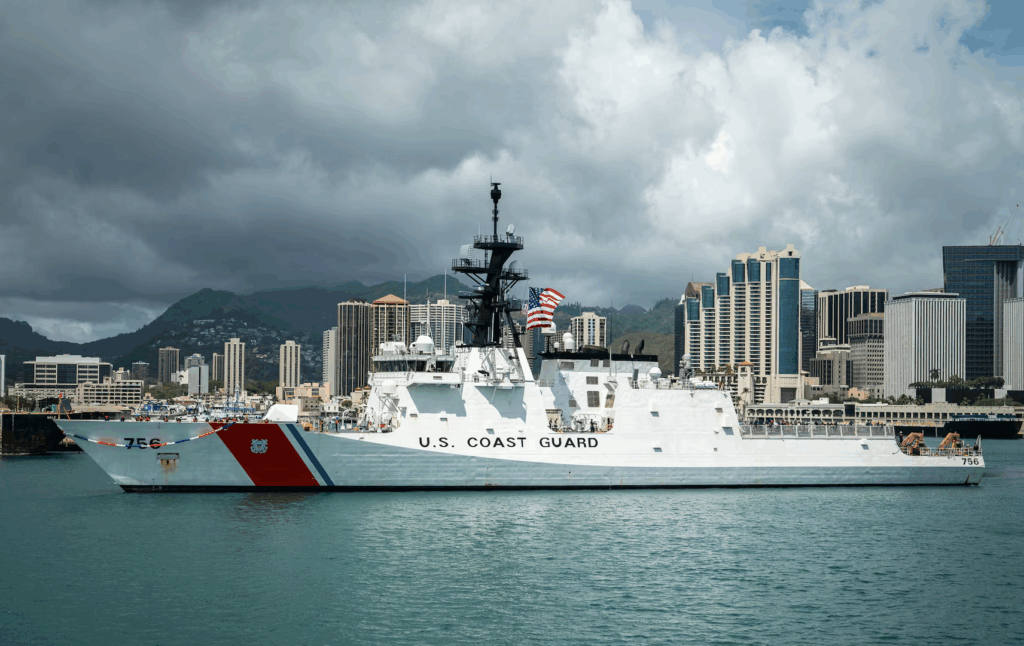
HONOLULU — The crew of Coast Guard Cutter Kimball (WMSL 756) returned to their Honolulu home port Monday after an 84-day deployment to the Eastern Pacific Ocean. 
 
While patrolling international waters off the Pacific coasts of Mexico, Central, and South America, Kimball’s crew interdicted five suspected drug smuggling vessels, seizing $191 million worth of cocaine and apprehending 18 suspected drug smugglers. 
 
The drugs were offloaded in San Diego on April 24 by the Kimball crew and multiagency partners. 
 
The Kimball deployed to the region under the tasking of Joint Interagency Task Force – South (JIATF-S) in support of Operation Martillo. 
 
During the deployment, Kimball’s crew conducted counter-drug missions in the Coast Guard’s Eleventh District area of responsibility countering transnational criminal organizations and preventing illegal narcotics from reaching the United States. They worked alongside other Coast Guard units, law enforcement personnel from Tactical Law Enforcement Team South (TACLET SOUTH), contractors operating small Unmanned Aerial Systems (sUAS), Helicopter Interdiction Tactical Squadron (HITRON) crews, Department of Defense assets, and Customs and Border Protection. 
 
Together, these partners supported the Kimball in controlling, securing, and defending the U.S. border and maritime approaches. 
 
“The pride I feel for this crew is immeasurable,” said Capt. Robert Kinsey, commanding officer of Kimball.  “Their professionalism, resilience, and dedication to serving our nation at sea is truly inspiring.  They are mothers, fathers, sons, and daughters who have answered the call to defend the nation as part of the joint fighting force as the pointy end of the spear that protects our shores and saves American lives.  We remain steadfast in our commitment to continually hardening and sustaining enhanced maritime security operations. We will continue to work tirelessly with our partners to disrupt these criminal enterprises and protect our nation.” 
 
These interdictions are part of the U.S. government’s ongoing effort to dismantle transnational criminal organizations and deny them resources to fund violent and illicit operations. 
 
The Kimball’s crew partnered with the Mexican Navy at-sea to promote regional maritime governance and assist in combating the international drug trade. For 54 days, two Mexican naval officers observed U.S. Coast Guard counter-drug operations firsthand, fostering enhanced collaboration between the two nations. 
 
While moored in Amador, Panama, the Kimball’s crew also hosted personnel from Panama’s Servicio Nacional Aeronaval (SENAN) for a subject matter expertise exchange. The event featured discussions and demonstrations of the Kimball’s capabilities, including sUAS drones, cutter small boats, and the embarked HITRON MH-65 Dolphin helicopter. Personnel from U.S. Coast Guard Tactical Law Enforcement Team South showcased their law enforcement kits and highlighted counter-drug boarding methods, furthering international cooperation in addressing maritime security challenges. While in Panama, the Kimball partnered with the USS Chosin (CG-65) to host Secretary of Defense Pete Hegseth, emphasizing DoD and DHS joint presence in the region. 
 
Several units and partners supported the Kimball’s counter-drug operations and interdictions. The U.S. Coast Guard HITRON from Jacksonville, Florida, provided aerial support in the forms of reconnaissance and aerial use of force. The U.S. Coast Guard TACLET SOUTH and U.S. Coast Guard Maritime Safety and Security Team Los Angeles / Long Beach (MSST LA/LB) assisted with surface pursuit and law enforcement boardings. The U.S. Coast Guard Eleventh District provided operational oversight and logistical support, ensuring the execution of mission objectives throughout the deployment. 
 
Along with partner nations, JIATF-S targets, detects, and monitors illicit drug trafficking within the joint operating area. The organization facilitates the interdiction and apprehension of illicit drug traffickers to dismantle transnational criminal organizations while reducing the flow of illegal drugs to the public. Once interdiction is imminent, the operation transitions into its law enforcement phase, with the U.S. Coast Guard assuming control throughout the interdiction and apprehension of the traffickers. 
 
The Kimball is one of two 418-foot, Legend-class national security cutters homeported in Honolulu. The cutter’s primary missions are counter-drug operations and defense readiness.