U.S. Naval Research Laboratory’s NIKE Laser-Target Facility Helps to Advance DoD Nuclear Mission

06 May 2025 

From U.S. Naval Research Laboratory Corporate Communications, May 6, 2025 

WASHINGTON, D.C. — The U.S. Naval Research Laboratory (NRL) has announced a new strategic direction for its NIKE laser-target facility to align its world-class capabilities with the Department of Defense’s (DoD) nuclear strategic priorities. 

The new strategic direction marks a shift from the facility’s historical focus on Department of Energy (DoE) missions, specifically those related to the National Nuclear Security Administration (NNSA). The initiative emphasizes NRL’s commitment to advancing national security through cutting-edge science and technology. 
  
Originally constructed in 1995 with support from the NNSA, the NIKE (pronounced nai-kee) laser was designed to explore the physics of direct-drive inertial confinement fusion in support of the Nation’s nuclear stockpile stewardship mission. 
  
“NIKE is the world’s most energetic krypton-fluoride excimer laser, delivering ultrasmooth pulsed beams at a wavelength of 248 nanometers with 2-3 kilojoules of energy,” said Jason Bates, Ph.D., head of NRL’s Laser Plasma Branch. “These unique capabilities enable researchers to generate strong, stable shock waves and create exceptionally clean experimental conditions for studying extreme physical states of matter.” 
  
For decades, the NIKE facility and its scientific team have contributed to NNSA’s flagship laser program at the National Ignition Facility (NIF), which recently achieved its landmark goal of ignition where the fusion of hydrogen nuclei produces more energy than the laser energy used to drive the reaction. 
  
Over the years, NRL researchers have pioneered several critical innovations that have transitioned to other NNSA programs including monochromatic x-ray radiography, the Virgil gold M-band spectrometer, and the flashlamp-pumped disk amplifiers for neodymium-doped glass (Nd:glass) lasers. Nd:glass is a material used in certain high-powered laser systems. 
  
Through the creative work of its research team, and a strategic partnership with the Air Force, NIKE’s capabilities are now being harnessed to address the central science and technology needs of the DoD nuclear deterrence mission. 
  
“This partnership between NRL and the Air Force Research Laboratory represents a vital leap forward in our ability to simulate and understand the extreme environments that nuclear assets must navigate,” Bates said. “NIKE’s unique laser and diagnostic capabilities are unmatched, enabling us to close critical gaps in assessing the survivability of our platforms.” 
  
With adversaries such as China and Russia racing to build similar excimer-laser technologies, maintaining and safeguarding the NIKE facility is essential. A recapitalization and reinvestment strategy is underway to secure NIKE’s future and support the revitalization of the Nation’s nuclear deterrence capability. 
  
“NRL’s NIKE facility is an important national asset with unique capabilities that allow it to serve a broad range of missions supporting stockpile stewardship, fusion energy research, directed energy, hypersonics, and fundamental studies of materials at extreme conditions. Its continued operation for the good of the Nation remains our goal through its new focus,” said Joe Peñano, Ph.D., superintendent of NRL’s Plasma Physics Division. 
  
The Plasma Physics Division conducts broad theoretical and experimental programs of basic and applied research in plasma physics, laboratory discharge, and space plasmas, intense electron and ion beams and photon sources, atomic physics, pulsed power sources, laser physics, advanced spectral diagnostics, and nonlinear systems.  
 
The effort of the Division is concentrated on closely coordinated theoretical and experimental programs in key areas. Considerable emphasis is placed on large-scale numerical simulations related to plasma dynamics; ionospheric, magnetospheric, and atmospheric dynamics; nuclear weapons effects; inertial confinement fusion; atomic physics; plasma processing; nonlinear dynamics and chaos; free electron lasers and other advanced radiation sources; advanced accelerator concepts; and atmospheric laser propagation. 
  
The NRL Laser Fusion Program traces its origins to the late 1960s, when laser-produced plasmas were first used to investigate the effects of high-altitude nuclear explosions. The program was formally established in 1972 by the Atomic Energy Commission, the predecessor to today’s NNSA. 
  
About the U.S. Naval Research Laboratory 
 

NRL is a scientific and engineering command dedicated to research that drives innovative advances for the U.S. Navy and Marine Corps from the seafloor to space and in the information domain. NRL, located in Washington, D.C. with major field sites in Stennis Space Center, Mississippi; Key West, Florida; Monterey, California, and employs approximately 3,000 civilian scientists, engineers and support personnel. 


Coast Guard Offloads More Than $14M In Illicit Drugs

The crew members from Coast Guard Cutter Venturous pose before preparing to offload a pallet of illegal narcotics at Coast Guard Base Miami Beach, May 2, 2025. (U.S. Coast Guard photo by Petty Officer 3rd Class Jessica Walker) 

From U.S. Coast Guard 7th District, May 2, 2025 

MIAMI – U.S. Coast Guard Cutter Venturous’ crew offloaded approximately 5,300 pounds of cocaine and marijuana worth an estimated $14.1 million, Friday, at Coast Guard Base Miami Beach.   

The seized contraband was the result of four interdictions in the Caribbean Sea by the crews of USCGC Diligence and HNLMS Groningen with an embarked Coast Guard law enforcement detachment.   

“Stopping harmful and illicit narcotics from reaching our shores and entering our communities is a team effort,” said Cmdr. Karen Kutkiewicz, Venturous’ commanding officer. “It takes the combined efforts of our joint force DoD, DHS, and international partners to combat transnational criminal organizations.”  

The following assets and crews were involved in the interdiction operations:   

  • U.S. Coast Guard Tactical Law Enforcement Team (TACLET) Pacific, LEDET 105  

  • Seventh Coast Guard District command center watchstanders  

Detecting and interdicting illicit drug traffickers on the high seas involves significant interagency and international coordination. Joint Interagency Task Force-South, in Key West, conducts the detection and monitoring of aerial and maritime transit of illegal drugs. Once an interdiction becomes imminent, the law enforcement phase of the operation begins, and control of the operation shifts to the U.S. Coast Guard for the interdiction and apprehension phases. Interdictions in the Caribbean Sea are performed by members of the U.S. Coast Guard under the authority and control of the Seventh Coast Guard District, headquartered in Miami.  

Read more about the Groningen crew’s interdictions: Royal Netherlands Navy intercepts 3 drug shipments in one week.  

USCGC Venturous is a 210-foot Reliance-class medium endurance cutter homeported in St. Petersburg under U.S. Coast Guard Atlantic Area Command.   

For breaking news, follow us on X (formerly Twitter). For additional information, find us on Facebook and follow us on Instagram.   

Make a difference on land, at sea or in the air with the Coast Guard. Visit GoCoastGuard.com to learn more about active duty and reserve, officer and enlisted opportunities. Information on how to apply to the U.S. Coast Guard Academy can be found here.  


Coast Guard Cutter Alert Returns Home After 55-Day Patrol

Coast Guard Cutter Alert (WMEC 630) approaches Naval Air Station Pensacola in Florida, March 28, 2025. Alert’s crew conducted a 55-day maritime border security patrol to counter illegal fishing in the Gulf of America. (Copyright-free photo courtesy of Shane Dye)

From the U.S. Coast Guard Atlantic Area, May 2, 2025 

CAPE CANAVERAL, Fla. — The crew of Coast Guard Cutter Alert (WMEC 630) returned to their home port in Cape Canaveral, Friday, following a 55-day deployment in the Gulf of America.  

Alert’s crew deployed under tactical command of the Eighth Coast Guard District to counter illegal, unreported and unregulated fishing in the region. During patrol, the crew enforced federal law at sea and defended the United States’ Exclusive Economic Zone (EEZ) by interdicting illegal fishing in U.S. territorial waters.   

While underway, crew members conducted law enforcement boardings, which ranged from routine safety inspections to federal fisheries enforcement in order to deter illicit activity such as illegal maritime migration, fishing and smuggling.  

On April 20, Alert’s crew coordinated with the Coast Guard Cutter Jacob Poroo (WPC 1125) and Coast Guard Station South Padre Island to interdict a lancha with three Mexican fishermen aboard. The fishermen were engaged in illegal fishing north of the U.S. maritime boundary line in the Gulf of America.   
  
Alert’s crew also detained four additional Mexican fishermen suspected of illegal fishing after they were transferred aboard the cutter from Jacob Poroo. All seven apprehended Mexican fisherman were later transferred to U.S. Customs and Border Protection for processing.   

“I am proud of our crew guarding America’s southeastern maritime border, a mission set maintained by the Coast Guard for over 200 years,” said Cmdr. Lee Crusius, commanding officer of Alert. “The protection of U.S. sovereign interests throughout the maritime domain has been the staple of our service and this patrol was no exception.”  
  
A lancha is a fishing boat used by Mexican fishermen that is approximately 20-30 feet long, with a slender profile, one outboard motor, and capable of traveling at speeds exceeding 30 mph. Lanchas are frequently used to illegally fish in the EEZ near the U.S. – Mexico border in the Gulf of America. The illegal harvest and trade of red snapper and other fish species is often a revenue stream for criminal organizations. Apart from their use for illegal seafood harvesting in U.S. waters, lanchas may also be used to move illicit drugs and aliens into the United States.  
  
Headquartered in New Orleans, the Eighth Coast Guard District is responsible for U.S. Coast Guard operations spanning 26 states, including the Gulf of America coastline from Florida to Mexico, the adjacent offshore waters and outer continental shelf, as well as the inland waterways of the Mississippi, Ohio, Missouri, Illinois and Tennessee River systems.  

 
Alert is a 210-foot, Reliance-class medium endurance cutter. The cutter’s primary missions are counter-drug operations, alien interdiction, enforcement of federal fishery laws, and search and rescue in support of U.S. Coast Guard operations throughout the Western Hemisphere.  

Alert falls under the command of U.S. Coast Guard Atlantic Area, which is based in Portsmouth, Virginia. U.S. Coast Guard Atlantic Area oversees all Coast Guard operations east of the Rocky Mountains to the Arabian Gulf. In addition to surge operations, they also allocate ships to deploy to the Caribbean and Eastern Pacific to combat transnational organized crime and illicit maritime activity.   

For information on how to join the U.S. Coast Guard, visit Go Coast Guard.com to learn about active duty and reserve, officer and enlisted opportunities. Information on how to apply to the U.S. Coast Guard Academy can be found here.  


Bollinger Shipyards to Commence Full Production on U.S. Coast Guard Polar Security Cutter 

From Bollinger Shipyards, May 1, 2025 

PASCAGOULA, Miss.—Bollinger Shipyards today announced it has received approval from the U.S. Coast Guard to begin full production activities on the U.S. Coast Guard Polar Security Cutter (PSC) program. This milestone builds upon Bollinger’s recent award of a $951.6 million Fixed-Price-Incentive-Firm Target (FPIF) contract modification, advancing the Detail Design and Construction phase of the PSC Program. The decision significantly enhances America’s strategic maritime capabilities, especially in the increasingly competitive Arctic regions. 

“Today’s announcement is a historic achievement not only for Bollinger Shipyards but also for American shipbuilding,” said Ben Bordelon, President and CEO of Bollinger Shipyards. “Securing the green light for full production underscores the confidence the U.S. Government places in Bollinger to deliver the nation’s first heavy polar icebreaker in nearly fifty years. Our team at Bollinger Mississippi Shipbuilding has worked tirelessly to put the PSC program on a solid path forward, ensuring this vital national security asset will be built by American hands.”  

The PSC program has already significantly contributed to regional economic growth and job creation. Since acquiring Singaporean-owned VT Halter in November 2022, Bollinger has invested over $76 million into its Mississippi facilities and increased its Mississippi workforce by over 61%. Production roles at Bollinger Mississippi Shipbuilding alone have risen by more than 178%, driven in part by Bollinger’s industry-leading Bootcamp workforce development programs. 

“Our investment in developing the next generation of skilled American workers not only strengthens our competitive edge in the shipbuilding industry but also underscores our commitment to fostering economic growth and American innovation,” added Bordelon. “We are committed to providing high-quality careers that positively impact the families and communities we support across America.” 

The Polar Security Cutter will substantially enhance U.S. operational capability in polar regions, critical for safeguarding national security, economic stability, and maritime interests. Completion of the first PSC is anticipated by May 2030, marking a new chapter in American maritime dominance.  


U.S. Navy Proves Sea-Based Hypersonic Launch Approach 

From the Department of Defense, May 2, 2025 

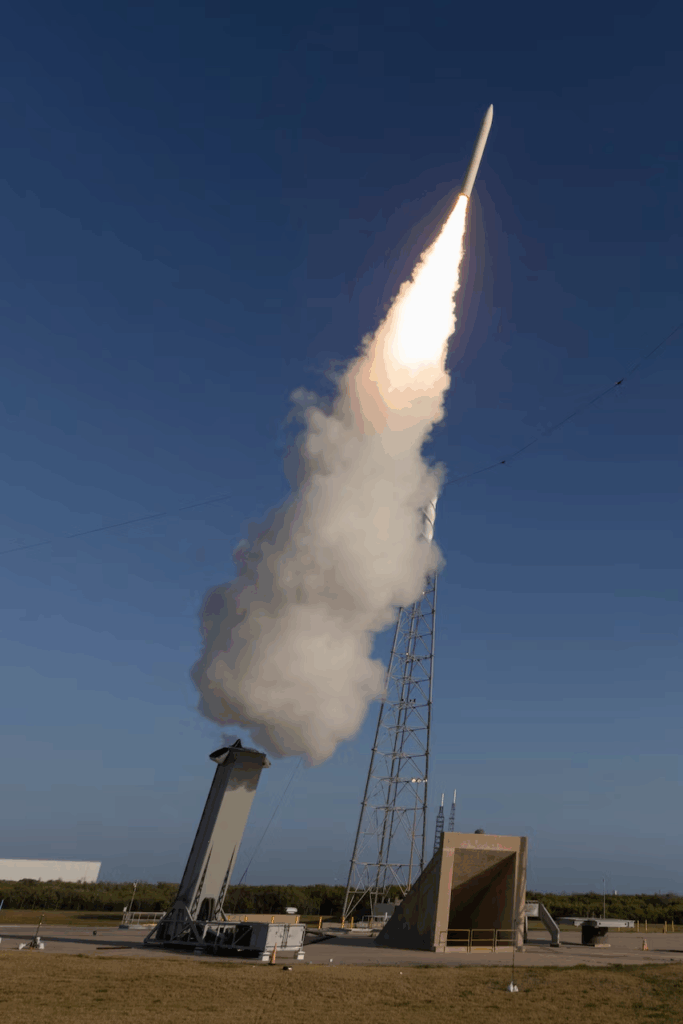
The U.S. Navy’s Strategic Systems Programs is continuing on the path toward the nation’s first sea-based hypersonic fielding with a successful end-to-end flight test of a conventional hypersonic missile from the Cape Canaveral Space Force Station, Florida. This test marked the first launch of the Conventional Prompt Strike (CPS) capability utilizing the Navy’s cold-gas launch approach that will be used in Navy sea-based platform fielding.

“The speed, range, and survivability of hypersonic weapons are key to integrated deterrence for America,” Secretary of the Navy John Phelan said. “When fielded, Conventional Prompt Strike will deliver unmatched capabilities to our warfighters.”This test was the next step in the Navy’s flight testing program of the common All Up Round (AUR) that is being developed in partnership with the Army’s Rapid Capabilities and Critical Technologies Office. In 2024, the programs completed two additional end-to-end flight tests of the AUR that will be fielded to both the Navy and Army. 

“The cold-gas approach allows the Navy to eject the missile from the platform and achieve a safe distance above the ship prior to first stage ignition. This technical achievement brings SSP one step closer to fulfilling our role of providing a safe and reliable hypersonic capability to our Navy,” said Vice Adm. Johnny R. Wolfe Jr, Director, Navy’s Strategic Systems Programs, which is the lead designer of the common hypersonic missile. 
 
The CPS Program has been diligently planning and executing engineering and test efforts to prepare for the first Navy fielding aboard the USS ZUMWALT. Utilizing an In-Air Launch test facility, the Program conducted an extensive test campaign to validate the launch approach prior to the completion of this flight test. Information gathered from this test will inform the continued development and production of the AUR and the first use of this cold-gas launch approach on a surface ship platform. 
 
The rapid development and demonstration of conventional sea-based hypersonic strike weapon systems supports the U.S.’s ability to deter, and if necessary, defeat potential strategic competitors. The range, accuracy, lethality, and survivability of hypersonics is a significant leap-ahead in U.S. conventional strike capabilities, complementing existing capabilities and enabling the U.S. to defeat adversary high-end capabilities. 


Heritage Experts: Increased Shipbuilding Critical for National Security  

May 2, 2025  


WASHINGTON — The Heritage Foundation today released the following statement from leading defense and economic experts praising congressional efforts to increase domestic shipbuilding capacity while calling for additional reforms to restore maritime strength.   


Heritage Senior Research Fellow for Naval Warfare and Advanced Technology Brent Sadler, Acting Director of the Hermann Center for the Federal Budget Richard Stern, and Policy Analyst for Economic Policy Miles Pollard responded the reintroduction of the Shipbuilding and Harbor Infrastructure for Prosperity and Security (SHIPS) for America Act:  


“The revised SHIPS for America Act is a strong down payment towards revitalizing America’s maritime capacity and holding entities of concern, like China, accountable for their non-market actions. We encourage Congress to go further in refining the legislation which would help revitalize our port cities, grow our industrial workforce, and strengthen the strategically important shipping and shipbuilding sectors of our economy.  


“Done well, the legislation would strengthen our maritime industry over time and thereby make it less reliant on Jones Act protections and subsidies. This requires nurturing an innovation-based American comparative advantage rather than an artificial advantage using tax credits, energy export limitations, and insurance gimmicks.   


“Given that many maritime sectors abroad operate in a non-profit tax environment, we would encourage replacing all federal taxation of this industry with a distributed profits tax that encourages capital investment by removing duplicative layers of taxation from investments to grow our domestic shipping and shipbuilding. Additionally, to build out and maintain the domestic capacity, we propose creating a grant formula to expand shipyards and pay for retained capacity.  


“In total, The Heritage Foundation finds this legislation commendable and looks forward to it rejuvenating our maritime industry.”  


Heritage previously praised the SHIPS for America Act as ‘step in the right direction.’ In March, Heritage released an extensive report analyzing the benefits of necessary shipbuilding reforms to combat and deter American adversaries, especially China.  


Secretary of Defense Pete Hegseth has identified the revitalization of the U.S. Navy as critical to the United States’ national security strategy.  


ZeroEyes Government Solutions and Picogrid  Announce Coastal Alert System for Waterside Security

From ZE Government Solutions, May 1 2025 

EL SEGUNDO, California/PHILADELPHIA, Pennsylvania – May 1, 2025 – ZeroEyes Government Solutions (ZEGS) and Picogrid announced the ZeroEyes Coastal Alert System (Z-CAS), an integrated waterside security solution that protects U.S. military bases and critical infrastructure from maritime threats. 

Z-CAS fuses ZeroEyes’ AI-powered threat detection with Picogrid’s advanced base defense capability to deliver real-time detection and tracking of vessels, unauthorized personnel, and firearms in coastal environments. The system has already undergone successful testing with both Air Force and Navy users. 

ZeroEyes Government Solutions, a wholly owned subsidiary of A.I.-based gun detection leader ZeroEyes, provides real-time threat analytics for defense and national security applications. Picogrid delivers the core infrastructure for Z-CAS, including the Legion software platform for sensor interoperability and the Lander and Helios hardware nodes for rapid deployment and sustained operations in austere environments. 

With over 280 DoD installations located near water, Z-CAS directly addresses the urgent demand for autonomous, low-overhead coastal defense—especially as unmanned surface vessels and maritime threats increase. Unlike traditional security approaches, Z-CAS operates with minimal operator burden while enhancing situational awareness and response time. 

“Z-CAS combines proven technology from both companies into a field-ready system that improves security of critical infrastructure without adding operator burden,” said Dustin Kisling, Executive Vice President at ZEGS. 

“Picogrid systems are already deployed globally to secure military sites,” said Martin Slosarik, Co-Founder and Head of Growth at Picogrid. “Integrating ZeroEyes’ AI into our existing architecture gives commanders new tools to defend critical infrastructure—without sacrificing the speed, mobility, or interoperability they demand.” 

Z-CAS offers a scalable, cost-effective solution for safeguarding personnel and high-value assets at ports, forward bases, special events, and mobile deployments. 


Virginia-Class SSN Team Awarded $12 Billion Contract Modification for Two Submarines

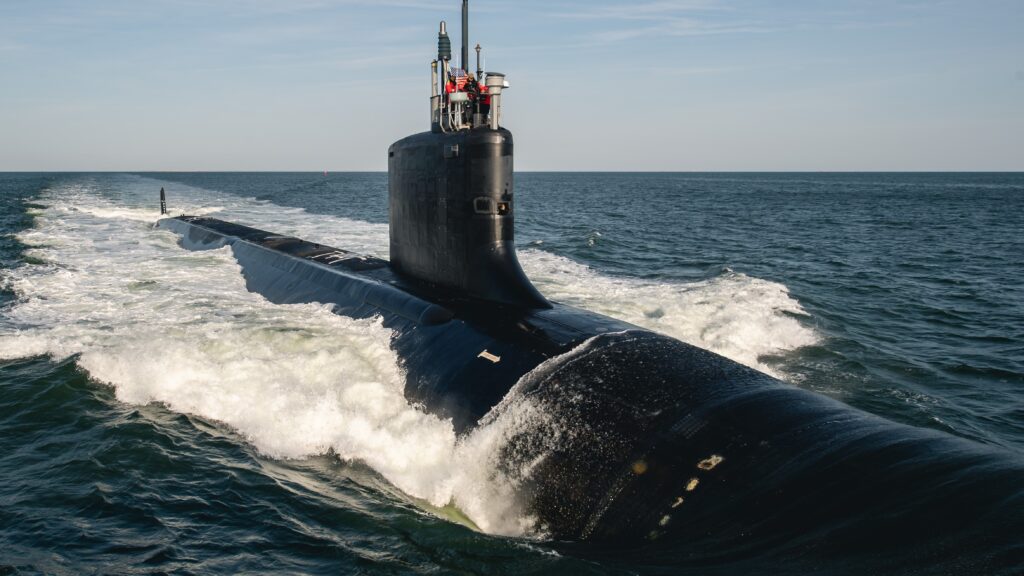
GROTON, Conn., and NEWPORT NEWS, Va.– General Dynamics Electric Boat, a business unit of General Dynamics, announced today it has been awarded a total of $12.4 billion in contract modifications for construction of two fiscal year 2024 Virginia-class Block V attack submarines (SSNs), the 11th and 12th of the block.  

Electric Boat is teamed with HII, whose Newport News Shipbuilding division is teamed to build the Virgina class. 

“Additionally, the award funds investments to improve productivity at the shipyards and workforce support as detailed in the Department of Defense contract award announcement (https://www.defense.gov/News/Contracts/Contract/Article/4170827/). This contract includes options which, if exercised, would bring the cumulative value to $17.2 billion,” the April 30 General Dynamics release said.  

“Over the past two years, we successfully worked with the Navy, Congress and the administration to secure funds that enable us to increase wages for the nuclear-powered vessel workforce and allow for significant additional investments in capacity, shipyard processes and systems,” said Mark Rayha, president of General Dynamics Electric Boat. “This contract modification validates the unique and important role submarines and submarine shipbuilders play in our national defense.” 

“We appreciate the teamwork that resulted in these critical national security assets being put under contract,” said Jason Ward, NNS vice president of submarine construction, in an April 30 release from HII. “We understand the advantage Virginia-class submarines bring to the sailors who operate them, and our shipbuilders are working with diligence to deliver them to the fleet.” 

Virginia-class submarines are designed from the keel up for the full range of 21st-century mission requirements, including anti-submarine and surface ship warfare and special operations support. General Dynamics Electric Boat is the prime contractor and lead design yard for the Virginia-class submarine series and constructs them in a teaming arrangement with HII’s Newport News Shipbuilding in Virginia. 

NNS and GDEB have built and delivered 24 Virginia-class submarines to date. 


Coast Guard to Begin Full Production Activities for PSC Hull 1, LRIP for WCC

From U.S. Coast Guard Headquarters, May 1, 2025 

WASHINGTON — The Department of Homeland Security approved full production of the first U.S. Coast Guard Polar Security Cutter (PSC), April 30, 2025. The Service also received approval for low-rate initial production of the the Waterways Commerce Cutter (WCC). This is a significant milestone for the Nation, as it brings the Coast Guard closer to renewing and enhancing operational capabilities in both the American heartland and the polar regions. 

Approval for full production enables the Coast Guard and U.S. Navy integrated program office to maintain production momentum, and for the shipbuilder to accelerate hiring to deliver this critical asset as quickly as possible to support national security initiatives. The PSC is the first heavy polar icebreaker to be built in the U.S. in nearly five decades. The Coast Guard is the sole federal agency responsible for icebreaking. Accordingly, the Service must replace, modernize, and grow its fleet of icebreakers to assure U.S. access and sovereignty in the polar regions. The U.S. Coast Guard is committed to working with the Administration and Congress to fulfill the President’s direction on icebreaker acquisition. 

The production decision for the WCC program entails the first eight hulls of the River Buoy Tender (WLR) and Inland Construction Tender (WLIC) – WCC variants that are being acquired under a single contract, due to significant design and systems commonality. The Coast Guard plans to acquire 16 WLRs and 11 WLICs to recapitalize the Service’s aging and increasingly obsolescent inland tender fleet, which supports the Nation’s Marine Transportation System, facilitating the safe movement of over $5.4 trillion in annual commerce and 30 million jobs. Deliveries of both the lead WLR and WLIC are planned to occur in fiscal year 2027. A third WCC variant, the inland buoy tender, will be acquired under a separate contract. 

For over 234 years, the American people have relied on the special authorities and unique capabilities of the Coast Guard to assure the safety, security and stability of America’s maritime zones and borders and to foster responsible maritime governance around the world. The PSC and WCC programs demonstrate the breadth of these commitments, and the enduring need for the Coast Guard to deliver vital services the Nation. 


Coast Guard Cutter Liberty, Final Island-Class Cutter, Decommissioned After Over 35 Years of Service 

From U.S. Coast Guard 17th District, April 30, 2025 

ANCHORAGE, Alaska — The Coast Guard decommissioned Coast Guard Cutter Liberty (WPB 1334) during a ceremony in Valdez, Tuesday.  

“This decommissioning marks the end of an era for the Coast Guard,” said Cmdr. Jordan Bogosian, a former Commanding Officer of Liberty and the ceremony’s presiding official. “I am proud of Coast Guard Cutter Liberty and her faithful service to our nation for more than three decades.”  

Commissioned on December 19, 1989, Liberty was the 34th Island-Class cutter to join the fleet and the final Island-Class cutter to be decommissioned from Coast Guard service.  

Liberty is a 110-foot, Island-Class patrol boat, a multi-mission platform that conducted operations to support search and rescue response, marine environmental protection, and national defense.  

The Coast Guard is replacing the aging Island-Class patrol boats with Sentinel-Class Fast Response Cutters (FRCs) which feature enhanced capability to meet service needs. There are currently four FRC’s homeported in Alaska, with two more scheduled for delivery in the near future.  

“It has been a profound honor to serve as the final commanding officer of USCGC Liberty,” said Lt. D. Toler Alexander, Commanding Officer of Liberty. “I am incredibly proud of this crew and all they have accomplished. LIBERTY leaves behind a legacy of over 35 years of exceptional service to the people of the United States and the great state of Alaska. I would like to extend my heartfelt gratitude to the communities of Valdez – and Auke Bay before it – for their unwavering support and for being such welcoming homeports to the cutter and her crew.”