USS New York, USS Oak Hill to Participate in Fleet Week New York 2025 
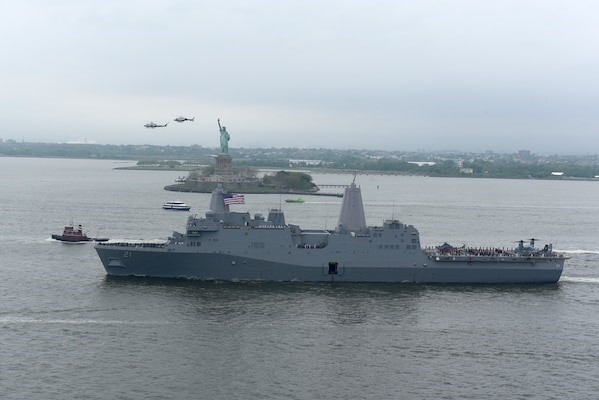
NEW YORK — USS New York (LPD 21) leaves New York Harbor at the conclusion of Fleet Week New York 2019. Fleet Week New York, now in its 31st year, is the city’s time-honored celebration of the sea services. It is an unparalleled opportunity for the citizens of New York and the surrounding tri-state area to meet Sailors, Marines and Coast Guardsmen, as well as witness firsthand the latest capabilities of today’s maritime services. (U.S. Navy photo by Chief Mass Communication Specialist Roger S. Duncan)

April 24, 2025 

NORFOLK, Va. – Fleet Week New York returns to New York City on May 21 – 27, 2025, with two U.S. Navy ships, two Coast Guard cutters, and five U.S. Navy Academy Yard Patrol boats (YPs). Additionally, our Canadian neighbor will join the week-long celebration.

Ships from the U.S. and Royal Canadian Navy will participate in the Parade of Ships on Wednesday, May 21.  
 
USS New York (LPD 21) and USCGC Calhoun (WMSL 759) will be available for public ship tours Friday and Saturday, May 23-24, from 9 a.m. to 4 p.m. Public ship tours in Staten Island will be available on May 22- 
26, from 9 a.m. to 4 p.m. 
 
The event has been held nearly every year since 1984. This year’s theme is “Honoring the Past, Defending the Future: 250 Years of Sea Service Excellence,” which celebrates the rich history of the sea services, honoring service members from the past, present, and future who play a crucial role in supporting the fleet while carrying out our maritime strategy and strategic objectives. 
 
“This year marks the 250th birthday of the Navy and Marine Corps, and as we continue to evolve as a fighting force, we are reminded that our greatest strength comes not only from our sea service members, but from the people we serve,” said Rear Adm. Carl Lahti, Commander, Navy Region Mid-Atlantic. “Fleet Week New York reminds us that behind every uniform is a story—of family, of sacrifice, and of service to something greater than self. As we celebrate 250 years of the Navy and Marine Corps, we are proud to return to a city whose strength and spirit mirror the very heart of our nation.” 
 
Ship and pier locations include: 
– Manhattan, Pier 88 South: (Ship public tours on Friday & Saturday, May 23-24, from 9 a.m. to 4 p.m.) 
• San Antonio-class amphibious transport dock, USS New York (LPD 21) from Norfolk, Virginia 
– Manhattan, Pier 90 North: (Ship public tours on Friday & Saturday, May 23-24, from 9 a.m. to 4 p.m.) 
• Legend-class cutter USCGC Calhoun (WMSL-759) from Charleston, South Carolina 
• Harry DeWolf-class offshore patrol vessel HMCS Frédérick Rolette (AOPV 434) from Halifax, 
Canada 
 
– Manhattan, Intrepid Museum, Pier 86: (Ship public tours on Thursday & Friday, May 22-23, from  
10 a.m. to 4 p.m.) 
• Five U.S. Naval Academy YPs from Annapolis, Maryland 
 
– Homeport Pier, Staten Island: (Ship public tours will be May 22 – 26 from 9 a.m. to 4 p.m.) 
• Whidbey Island-class dock landing ship USS Oak Hill (LSD 51) from Norfolk, Virginia 
• Bay-class cutter USCGC Sturgeon Bay (WTGB 109) from Bayonne, New Jersey 
2/2/2 
 
Please note: Canadian Navy Harry DeWolf-class offshore patrol vessel HMCS Frédérick Rolette (AOPV 434) will not be available for tours.  
 
The week-long event will include a variety of public military demonstrations. It is an unparalleled  
opportunity for the citizens of New York and the surrounding tri-state area to meet members of the sea  
services, as well as witness firsthand the latest capabilities of America’s maritime services. 


Marines Surpass 1,000 MQ-9A Flight Hours as Capabilities Expand 

From General Atomics Aeronautical Systems Inc. 

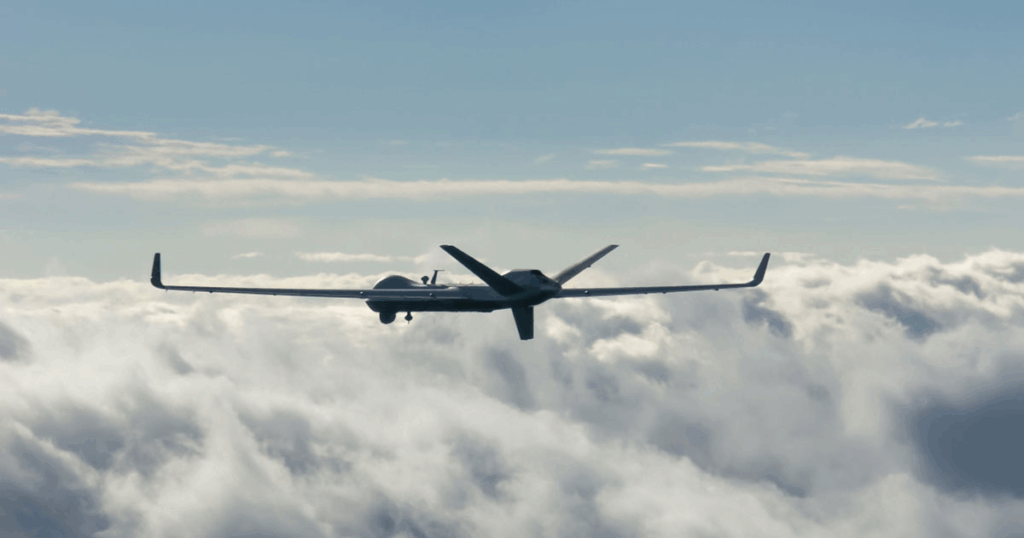
SAN DIEGO – 23 April 2025 – General Atomics Aeronautical Systems, Inc. is proud to announce that the U.S. Marine Corps has passed more than 1,000 flight hours with MQ-9A unmanned aircraft in support of service-level training exercises and weapons and tactics instructor courses. This accomplishment involved a combined aircrew of dedicated Marines and GA-ASI personnel, highlighting the seamless integration and operational effectiveness of the MQ-9A platform within the Marine Air-Ground Task Force (MAGTF) and the MAGTF Unmanned Expeditionary (MUX) Program. 

These demanding exercises showcased the advanced capabilities of the MQ-9A by integrating cutting-edge technologies such as the SkyTower networking support pod, Automatic Identification System, latest-generation Lynx® multi-mode radar and various other tactical networks and capabilities. The joint teams successfully conducted satellite launch and recovery activities operating out of a strategic expeditionary landing field near Marine Corps Air Ground Combat Center Twentynine Palms, Calif., further demonstrating the platform’s precision targeting and reconnaissance abilities in realistic training scenarios. 

Previously, an uncrewed aircraft required a crew positioned at the airfield where it was operating to fly it for takeoff via direct line-of-site radio link. Then a mission crew could take over the aircraft from anywhere via satellite. Today, satellite launch and recovery means the main Marine mission crew, which can be sited anywhere, flies the aircraft from takeoff via the satellite link. This capability, validated in the Marine Corps operations, enables huge flexibility and expands the locations from which units can operate. 

A key element of these exercises also included not only live-fire training but also comprehensive mission planning, networked communications, and multi-domain coordination. These events provided invaluable experience in integrating the MQ-9A into complex, distributed combat scenarios across the full range of Marine Air-Ground Task Force operations. From supporting maneuver elements with real-time intelligence, surveillance and reconnaissance to validating command and control networks, the MQ-9A consistently demonstrated its adaptability and operational value. This milestone underscores the platform’s critical role in enhancing situational awareness, mission execution, and overall effectiveness across the battlespace. 

“Reaching 1,000 flight hours for these rigorous training exercises alongside our Marine Corps and Air Force partners is a testament to the reliability and adaptability of the MQ-9A platform,” said GA-ASI President David R. Alexander. “This achievement highlights the power of collaboration and the critical role the MQ-9A can play in supporting the MAGTF’s mission readiness.” 

The successful integration of the MQ-9A platform across recent operations represents a major milestone in aligning capability with the MAGTF construct. These events showcased the MQ-9A’s ability to support distributed operations, extend sensor coverage, and provide persistent intelligence, surveillance and reconnaissance in support of dynamic mission sets. The coordinated efforts of Marines and GA-ASI personnel underscored the platform’s high degree of interoperability and its growing role in enabling expeditionary operations in contested environments. 

To date, GA-ASI has delivered 17 MQ-9A UAS to USMC. The USMC awaits delivery of three additional aircraft by the end of this year. 


T-54As Visit NAS Whidbey Island  

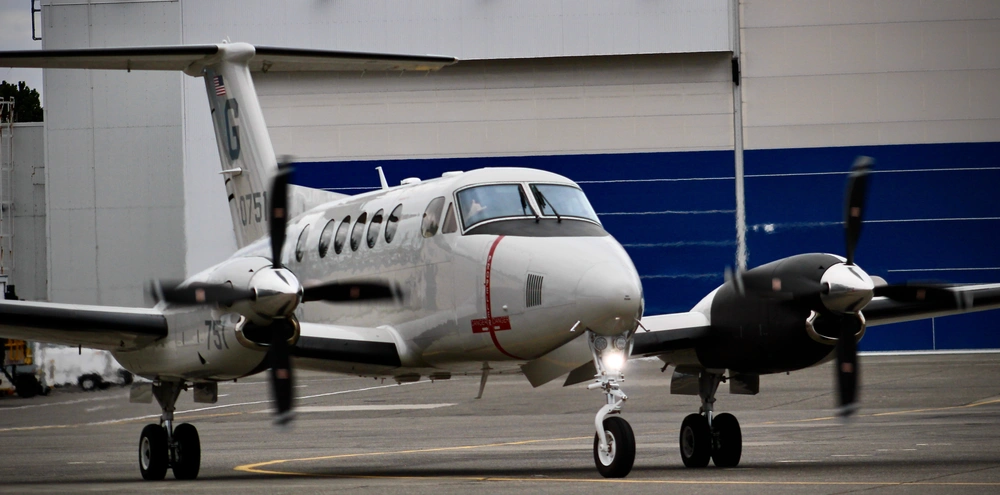
OAK HARBOR, Wash. (March 27, 2025) A T-54A Marlin, assigned to Training Wing Four, taxis while the pilot monitoring gives a shaka at Naval Air Station Whidbey Island, Wa. March 27 2025. A pair of T-54As arrived at NAS Whidbey Island Mar. 27 after completing their first cross-country flight to Washington State, showcasing the range capacity as the Navy’s newest multi-engine trainer. (U.S. Navy photo by Lt. Sara Wedemeyer) 

By Lt. Sara Wedemeyer, Chief of Naval Air Training, March 27, 2025   

WHIDBEY ISLAND, Wash – A pair of T-54As arrived at Naval Air Station (NAS) Whidbey Island Mar. 27 after completing their first cross-country flight to Washington State, showcasing the range capacity as the Navy’s newest multi-engine trainer. 
 
This cross country was used as training flights within the Flight Instructor Training Unit (FITU) Syllabus. The Instructors Under Training (IUTs), taught by FITU Instructor Pilots (IPs), will be the next generation of squadron IPs and the first to teach student naval aviators how to fly the T-54A. 
 
Lieutenant Hunter Jones, one of the visiting naval aviators, believes the T-54A will make a difference in the lives of student naval aviators at Training Wing Four, Naval Air Station Corpus Christi. 
 
“We are thrilled to begin training the next generation of pilots in the T-54A, a platform that will significantly enhance our ability to prepare naval aviators for the challenges ahead,” said Jones. “Flying the T-54A from Naval Air Station Corpus Christi to Naval Air Station Whidbey Island truly demonstrates its capabilities. Students are set to start training on the new plane in the next few weeks and this milestone would not have been possible without the exceptional leadership of Cdr. Michael “Textron” Brammer and the entire Multi Engine Training System (METS) FIT Team at Training Wing Four. Their dedication and expertise have been instrumental in ensuring the seamless transition to this aircraft.” 
 
The T-54A fleet is located at Naval Air Station (NAS) Corpus Christi as a member of Training Wing Four. The Navy’s newest generation of student naval aviators will use the T-54A to earn their wings of gold and go on to fly aircraft such as the P-8A Poseidon, E-2D Hawkeye, CMV-22 Osprey, E6-B Mercury, and the C-130 Hercules. 


Museum to Showcase Navy Military Medical Innovations 

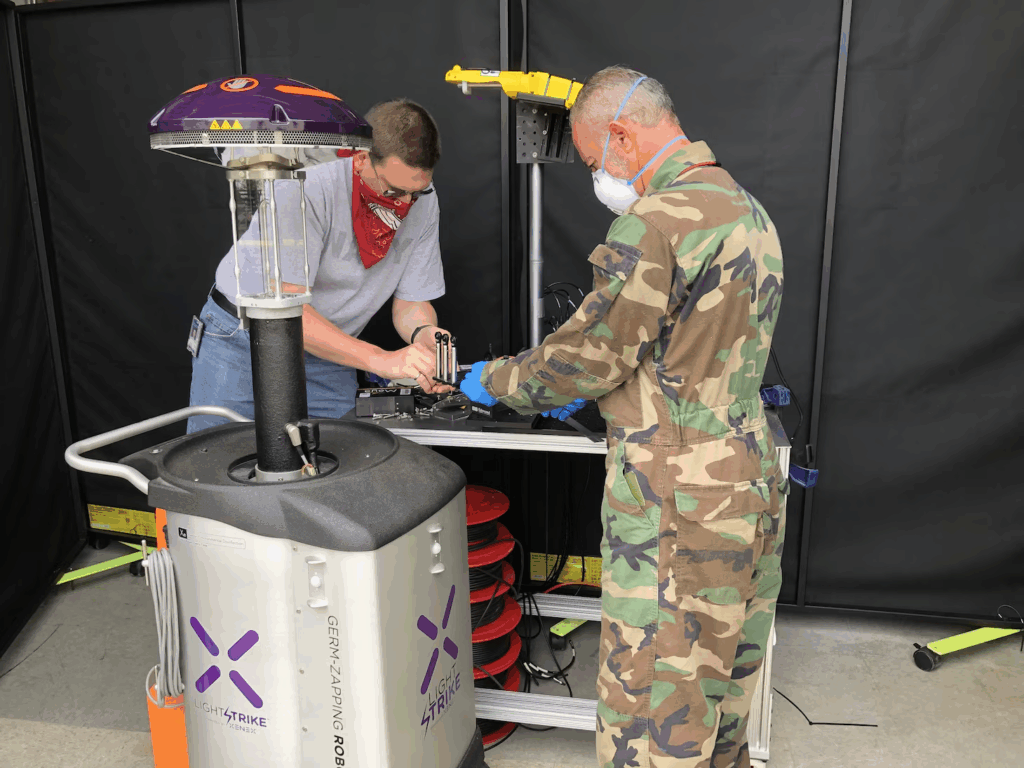
Principal Investigator of the U.S. Naval Research Laboratory (NRL) Navy Coronavirus Rapid Response Team (NCR2T) Team, Brett M. Huhman, Ph.D., P.E. from the Advanced Pulsed Systems Section and former NRL Engineering Technician Mike Jabari prepare a Xenon source for evaluation testing. Designed for whole-room disinfection, the team determined how effective the source would be from a light perspective, and Naval Surface Warfare Center Dahlgren Division followed up with a site visit to perform biological efficacy testing in the Ultraviolet Characterization Lab at NRL-DC Headquarters, May 2020. (U.S. Navy photo) 

By Nicholas E. M. Pasquini, U.S. Naval Research Laboratory Corporate Communications, April 22, 2025 

WASHINGTON, D.C.  –  The U.S. Naval Research Laboratory (NRL) recently transferred a number of historical artifacts related to the COVID-19 pandemic to the National Museum of Health and Medicine and is scheduled to exhibit military medical innovations to the public, Apr. 26. 
  
The Military Medical Innovation Family Event program takes place in the museum galleries where presenters from a variety of military activities conduct demonstrations and activities highlighting innovative products and research that benefit readiness, health, care, and rehabilitation of the warfighter. 
  
In April 2020, during the early stages of the COVID pandemic, the Naval COVID Rapid Response Team (NCR2T) was established by Naval Sea Systems Command (NAVSEA) after the USS Theodore Roosevelt (CVN 71) became the first ship in the U.S. Fleet to fight through a COVID-19 outbreak. The chief of naval operations then charged NAVSEA with evaluating technologies and developing processes and procedures to provide tools for Fleet commanders, type commanders, and ship commanders to ensure and promote mission readiness amidst the pandemic. 
  
NRL was tasked by NAVSEA with evaluating the efficacy of ultraviolet light sources procured by the NCR2T. The Plasma Physics Division leveraged experience across multiple disciplines to design a standardized measurement test stand, verify calibration of measurement equipment, and perform analysis of the devices.  
  
NRL researchers evaluated commercial ultraviolet (UV) sources for viral disinfection to combat COVID-19 on land and at sea and established a dedicated UV characterization lab in five days to ensure safe introduction and effective operation of UV sources across the Fleet. 
  
This work was done in close collaboration with the Naval Surface Warfare Center Dahlgren Division, which performed biological surrogate testing to evaluate the effectiveness of the UV sources for disinfection of COVID-19 on surfaces relevant to Navy applications. The devices range from small, hand-held UV sources to large devices meant to disinfect an entire room.  
  
The laboratory used an automated 3-axis motorized translation stage to measure the light emitted from ultraviolet light sources to measure both the intensity and quality of the light generated by the devices. Data was collected from this apparatus to create 2D “maps” of the light emitted from the sources to enable comparison of different technologies. 
  
In addition, NRL’s work helped identify situations where use of UV provides sufficient viral disinfection at a particular energy level and the development of standard operating procedures to ensure safe UV operation for the Fleet
 
“NRL’s commitment to performing leading-edge fundamental and applied research has enabled the Lab to be instrumental in numerous innovations that have significantly enhanced the capabilities of the U.S. Navy and nation as a whole,” said NRL Plasma Physics Division Superintendent Joe Peñano, Ph.D. “This legacy of innovation underscores NRL’s commitment to swiftly supporting Fleet operations as well as addressing emerging challenges.” 
 
The devices transferred were critical in the development of the Navy’s response to the COVID -19 pandemic. “These devices represent hundreds of hours of research by engineers and physicists in the Plasma Physics Division at NRL to provide evaluation criteria to the Fleet for immediate use,” said Principal Investigator of the NRL NCR2T Team, Brett M. Huhman, Ph.D., P.E. from the Plasma Physics Division. “We were able to respond rapidly to NAVSEA’s call for support, with a laboratory set up and ready to evaluate the devices within a week.” 
  
Military medical innovations are changing the way health care is delivered in the Military Health System. During this family-friendly event, visit with DOD experts as they showcase the latest in virtual reality, medical simulation, and much more. This is a great opportunity to speak with multi-disciplinary NRL subject matter experts to also learn more about other research programs and associated technologies on display: 
  
Buzz Off: Protection From the Small, But Deadly 
This station demonstrates recently developed NRL technology that defends from some of the most dangerous animals on the planet—bugs. In this demo, we will go over the historical impact of insects on military and civilians, current strategies to protect against these tiny assailants, and future polymer-based fiber and gel technologies to repel these bugs out of everyday life. 
  
From Sample to Sequence in the Field: A Closer Look at Bacteria and their DNA 
Bacteria live in nearly every environment on earth and are important to this planet’s ecosystems. Most serve a useful purpose, but some can cause disease in humans. Using strep throat as a case study, we will demonstrate some of the tools and latest technologies we use to identify and study bacteria, including uncovering the genetic sequence of these tiny organisms with a portable DNA sequencer. 
 
About the U.S. Naval Research Laboratory 
NRL is a scientific and engineering command dedicated to research that drives innovative advances for the U.S. Navy and Marine Corps from the seafloor to space and in the information domain. NRL is located in Washington, D.C. with major field sites in Stennis Space Center, Mississippi; Key West, Florida; Monterey, California, and employs approximately 3,000 civilian scientists, engineers and support personnel 


HII Hosts HD Hyundai Heavy Industries Leaders at Ingalls Shipbuilding 

From HII 
 

PASCAGOULA, Miss., April 22, 2025 (GLOBE NEWSWIRE) — HII (NYSE: HII) hosted HD Hyundai Heavy Industries leaders at the company’s Ingalls Shipbuilding division Tuesday, advancing joint goals of the memorandum of understanding signed by the two companies earlier this month. The visit focused on identifying near-term opportunities and exploring the implementation of new processes that could support the acceleration of ship production. 

“This visit is a continuation of the important dialogue taking place between HII and our international partners,” Ingalls Shipbuilding President Brian Blanchette said. “Today’s visit allowed us to showcase the great work our Ingalls shipbuilders do every day in support of national security and an opportunity to exchange ideas on best practices, while examining what we can begin working on right away.” 

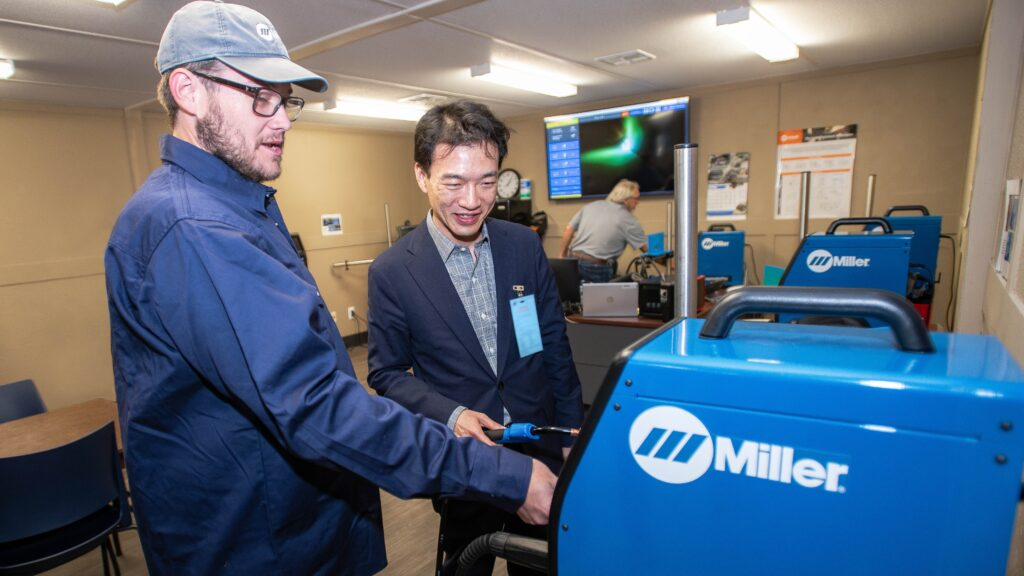
The visit included meetings with Ingalls leadership, a tour of the shipyard and a stop at the company’s new virtual welding lab, where the group experienced how this immersive, hands-on training environment is not only enhancing the skills of current and future shipbuilders, but also setting a new national benchmark for how technology can be leveraged to grow a highly proficient workforce in this essential trade. 

Photos accompanying this release are available at: https://hii.com/news/hii-hosts-hd-hyundai-heavy-industries-leaders-at-ingalls-shipbuilding/

“We appreciate the opportunity to visit our partners at HII and see how they are using technology to enhance efficiency and quality at Ingalls,” Chief Executive of the Naval & Special Ship at HHI Won-ho Joo said. “We look forward to building on the strong foundation set by our recent MOU announcement.” 

HII and HHI are two of the world’s leading shipbuilders across multiple classes of ships. By working with shipbuilding allies, this strategic partnership aims to leverage the combined expertise and resources of both companies to advance technological innovation, maximize production efficiency, and strengthen the global defense industry. 


Coast Guard Cutter Seneca returns home after 54-day maritime border security patrol in the Windward Passage 

Coast Guard Cutter Seneca (WMEC 906) patrols off coastal Haiti, March 1, 2025. The crew of Seneca conducted a 54-day maritime border security patrol in the Windward Passage. (U.S. Coast Guard photo by Seaman Solana Laughlin)

From U.S. Coast Guard Atlantic Area, April 22, 2025 

PORTSMOUTH, VA — The crew of Coast Guard Cutter Seneca (WMEC 906) returned to their home port in Portsmouth, April 11, following a 54-day maritime border security patrol in the Windward Passage. 
 
Seneca deployed in support of Homeland Security Task Force – Southeast (HSTF-SE) and Operation Vigilant Sentry (OVS) while underway in the Seventh Coast Guard District’s area of responsibility. Crew members directly contributed to safeguarding America by patrolling U.S. maritime borders and conducting alien interdiction operations. 

While underway in the Windward Passage, Seneca’s crew interdicted an unsafe and illegal voyage with 99 aliens on board. A U.S. Customs and Border Protection – Air and Marine Operations aircrew initially detected the  vessel. Seneca crew members launched a small boat, interdicting the voyage and transferring the aliens aboard Seneca before their repatriation to Haiti. 

During the deployment, Seneca’s crew worked with many partners to include Coast Guard Cutters James (WMSL 754), Vigilant (WMEC 617), Valiant (WMEC 621), Tampa (WMEC 902), the Coast Guard Helicopter Interdiction Tactical Squadron and the Royal Netherlands Navy. Their joint efforts included counter-drug operations and advanced shipborne helicopter training, increasing joint interoperability between interagency and international partners. 

“The integrity of our maritime borders is vital to national security, and I am proud of our crew’s hard work and determination throughout this deployment. Their dedicated commitment to deterrence of alien maritime migration saved lives from dangerous ventures at sea while safeguarding our borders,” said Cmdr. Lee Jones, commanding officer of Seneca. “Together with our partner agencies, we were able to effectively enforce United States customs and immigration laws against illegal entry.”  

The Coast Guard, along with its HSTF-SE partners, maintains a continual presence with air, land, and sea assets in the Florida Straits, the Windward Passage, the Mona Passage, and the Caribbean Sea in support of OVS. The HSTF-SE combined, multi-layered approach is designed to protect the safety of life at sea while preventing unlawful maritime entry to the United States and its territories.  

Seneca is a 270-foot, Famous-class medium-endurance cutter. The cutter’s primary missions are alien interdiction, counter-drug operations, enforcement of federal fishery laws, and search and rescue in support of U.S. Coast Guard operations throughout the Western Hemisphere. 


Shipboard Wi-Fi is coming to Military Sealift Command’s Fleet of Government Owned, Government Operated Ships 

Norfolk, Va. (April 16, 2025) – Miles Farver, Chief Mate, USNS Joshua Humphreys (T-AO 188), sends emails wirelessly from his personal phone thanks to the Starshield system installed aboard the ship, which provides 5G connectivity, April 16, 2025. (U.S. Navy photo by Ryan Carter)

by Bill Mesta, USN Military Sealift Command, April 21, 2025 

NORFOLK, VA – The Civil Service Mariners (CIVMAR) who crew Military Sealift Command’s 56 government owned/government operated (GO/GO) ships will soon be able to use a shipboard Wi-Fi for internet access to conduct both professional and personal tasks while aboard their assigned vessel, via the Civilian Mariner Wireless Network (CivMar WiN). 
 
The CivMar WiN project is a multi-year implementation effort to provide secure internet access for CIVMARs’ approved personal electronic devices such as mobile phones and computers. 
 
“Wi-Fi is a wireless technology that allows devices to connect to the internet using radio waves,” according to Eliot J. Skinner, Military Sealift Command, Deputy Director, C4 Systems (N6A). “Once installed, CIVMARs aboard MSC’s GO/GO ships will be able to register their approved personal electronic devices to the wireless network for seamless internet access.” 
 
“Providing internet access to support CIVMAR education, training, and quality of life is the goal of the CivMar WiN project,” Skinner added. 
 
The first installation of the CivMar WiN was completed aboard the fleet replenishment oiler USNS Harvey Milk (T-AO 206), Feb. 21. The second installation took place aboard the fleet replenishment oiler USNS Joshua Humphreys (T-AO 188) and was completed, April 16. With both ships having reported successful installation and verification, the rest of MSC’s GO/GO fleet will now begin to receive the Wi-Fi capability. 
 
“Once successfully installed [across MSC’s GO/GO fleet], all CIVMARs, licensed and unlicensed, will be provided accounts that allow them access to the CivMar WiN from their personal devices,” Skinner stated. “The intention of the CivMar WiN is to provide internet access for CIVMARs’ personal devices, while on ship and underway, in support of access to human resources, training, education and virtual pool capabilities such as Defense Travel System (DTS) and myPay, in addition to personal email, banking, insurance, e-commerce and more.” 
 
CivMar WiN will have some built in cybersecurity measures, but CIVMARs will be responsible for the protection of their personal devices, e.g. installation of antivirus software. Additionally, network activity will be monitored for operational security, cybersecurity, and legal purposes. 
 
“All legal internet activity will be allowed on the CivMar WiN,” Skinner added. “There will be activity tracking in place to provide a by-device and by-user record of activity on the network to deter illegal activity being conducted by an individual.” 
 
“Additionally, CivMar WiN will be subject to the same operational security (OPSEC) and emission control (EMCON) policies as the operational network as it can and will be shut down during periods of increased levels of OPSEC and EMCON,” Skinner said. 
 
Feedback from MSC’s CIVMARs has indicated that at-sea Wi-Fi access will improve crew morale and retention. 
 
“The crew [of USNS Joshua Humphreys] is ecstatic with the thought of Wi-Fi aboard ship,” Capt. P. Todd Christian, USNS Joshua Humphry’s Ship’s Master. “Parts’ research in support of repairs will now be much easier, computer-based training requirements will also be much easier to accomplish. This in addition to social media access opportunities and staying in touch with family and friends.” 
 
USNS Joshua Humphreys is crewed by 87 CIVMARs who will use the new shipboard Wi-Fi system. 
 
Supply Utilityman Brooklyn Hunter, a CIVMAR aboard USNS Joshua Humphreys added, “I now have the ability to finish my daily work aboard ship and complete online college courses during my off time.” 
Christian offered some advice for MSC ships who will receive the new shipboard Wi-Fi in the future. 
 
“Please remember the CivMar WiN system will be very good for CIVMARs, but OPSEC must be maintained, so be responsible,” Christian stated. “Also leave your cell phone in your stateroom during working hours. Having Wi-Fi in our stateroom means there is no longer a need to search for a signal throughout the ship.” 
 
MSC plans to install the CivMar WiN on 56 GO/GO MSC ships over the course of 24 months with completion anticipated in the first quarter of fiscal year 2027, pending ship availability. 


USS Minneapolis-Saint Paul Makes Multiple Drug Busts

250326-N-OZ224-3072

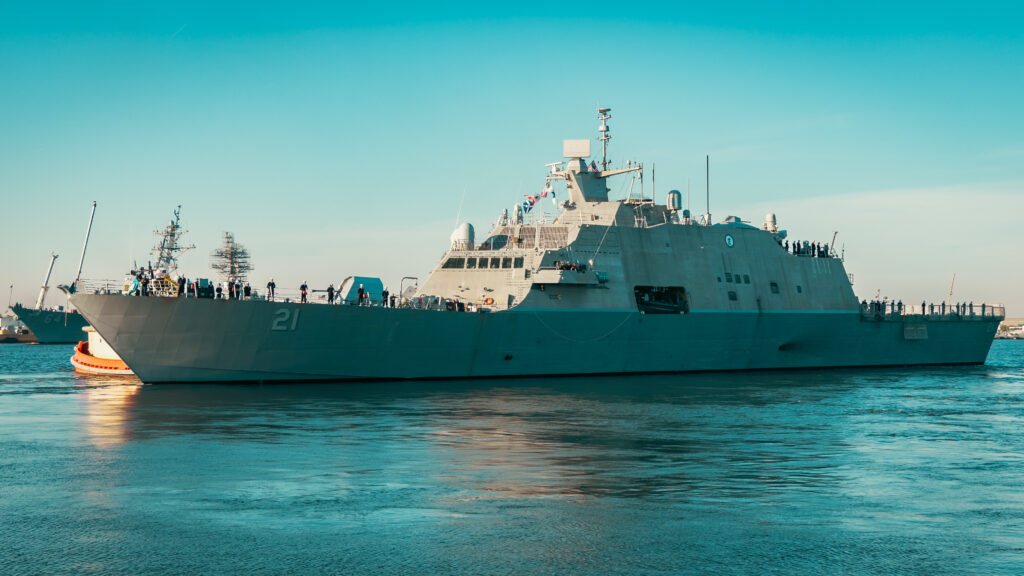
NAVAL STATION MAYPORT, Fla. (Mar. 26, 2025) – The Freedom-class littoral combat ship USS Minneapolis-Saint Paul (LCS 21) departs Naval Station Mayport for her maiden deployment, Mar. 26, 2025. LCS 21 is deploying to the U.S. 4th Fleet area of operations is support of counter-illicit drug trafficking operations. (U.S. Navy photo by Mass Communication Specialist 1st Class Brandon J. Vinson)

From USNAVSOUTH/4th Fleet Public Affairs, April 17, 2025 

CARIBBEAN SEA — The Freedom-variant littoral combat ship USS Minneapolis Saint-Paul (LCS 21), in coordination with joint partners, stopped two alleged drug smuggling operations in the Caribbean Sea within a 72-hour span. 

Minneapolis-Saint Paul, with an embarked U.S. Coast Guard (USCG) Law Enforcement Detachment (LEDET) and Helicopter Maritime Strike Squadron (HSM) 50, Detachment Three, made the two busts in the Caribbean, taking out vessels through a combination of air and surface operations. 
 
The busts resulted in the confiscation of 580 kilograms (1,278.9 lbs; $9,463,860) of cocaine and 2,480 pounds of marijuana. ($2,807,360). “The USS Minneapolis-Saint Paul executed their duties seamlessly in the combined effort to protect the homeland from illicit maritime trafficking.” said Rear Adm. Carlos Sardiello, commander of U.S. Naval Forces Southern Command/U.S. 4th Fleet. “Working in coordination with the Coast Guard and our joint partners, we look forward to seeing continued measurable impact delivered by the professional and talented crew of the USS Minneapolis-Saint Paul across the region.” 
 
“We train diligently and stand ready to execute interdiction missions at moment’s notice, saidMinneapolis-Saint Paul commanding officer Cmdr. Steven Fresse, “To be able to make an immediate impact so early on during our maiden deployment is a testament to the hard work and skills of the ship’s crew.” 
 
USS Minneapolis-Saint Paul is currently assigned to Commander, Task Force 45 (CTF 45). CTF-45 is the 4th Fleet surface task force charged with executing combined naval operations, building and strengthening Latin American, south of Mexico, and Caribbean maritime partnerships, and acting as a DoD ready service provider to Joint Interagency Task Force – South in support of counter illicit-drug trafficking operations in the Central and South American waters. 
 
The U.S. Coast Guard is simultaneously a military service and the United States’ lead federal maritime law enforcement agency with authority to enforce national and international laws on the high seas and waters within U.S. jurisdiction. Coast Guard LEDETs regularly deploy aboard U.S. Navy and foreign allied navy ships, and during these deployments the LEDETs, under U.S. law, board vessels, seize illegal drugs and apprehend suspects. These forces also work closely with other regional partner nation coast guards and naval forces to provide support to visit, board, search and seizure operations within partner nation territorial waters. Once an interdiction becomes imminent, the law enforcement phase of the operation begins, and control of the operation shifts to the U.S. Coast Guard for the interdiction and apprehension phases. Interdictions in the Caribbean Sea are performed by members of the U.S. Coast Guard under the authority and control of the Seventh Coast Guard District, headquartered in Miami.   
 
U.S. Naval Forces Southern Command/U.S. 4th Fleet supports U.S. Southern Command’s joint and combined military operations by employing maritime forces in cooperative maritime security operations to maintain access, enhance interoperability, and build enduring partnerships in order to enhance regional security and promote peace, stability and prosperity in the Caribbean, Central and South American region. 


First Royal Australian Navy Enlisted Students Graduate Nuclear Power Training

MOUNT PLEASANT, South Carolina (April 18, 2025) Royal Australian Navy sailors graduate the United States Nuclear Power Training Unit (NPTU) in the hangar bay of USS Yorktown (CV 10), April 18, 2025. (U.S. Navy photo by Mass Communication Specialist 1st Class Dart D. Delagarza)

From Kellie Randall, U.S. Naval Nuclear Propulsion Program, April 18, 2025 

PLEASANT, S.C. – The first eight enlisted sailors and five additional officers from the Royal Australian Navy graduated from the U.S. Navy’s Nuclear Power Training Unit (NPTU) Charleston as part of the Australia, United Kingdom, United States (AUKUS) trilateral security partnership. 

The graduates, who trained alongside U.S. Navy personnel, began the rigorous naval nuclear power training pipeline in October 2024. The curriculum encompassed a wide range of critical subjects, including mathematics, nuclear physics, reactor principles, and nuclear reactor technology. This achievement marks an important step in Australia’s development of a sovereign, conventionally armed, nuclear-powered submarine (SSN) fleet. 

“This graduation marks a significant step forward for our Navy,” said Royal Australian Navy Commodore Daniel Sutherland, Commander Submarine Force. “Having naval nuclear power-qualified officers, and now sailors, is critical in meeting our goal of operating conventionally armed, nuclear-powered submarines.” 

NPTU trains officers, enlisted Sailors and civilians for shipboard nuclear power plant operation and maintenance of surface ships and submarines in the U.S. Navy’s nuclear fleet. 

“I remain impressed with the quality of Australian submariners who come through the naval nuclear propulsion training pipeline,” said Capt. Robert Rose, Commander, NPTU Charleston. “Six officers previously completed prototype training, each performing exceptionally well. I fully expect these recent graduates, especially our first enlisted personnel, will excel in the fleet.” 

“The opportunity for our U.S. Navy students to train alongside their Australian counterparts is beneficial to both our countries’ Sailors,” said Master Chief Ed Jackson, Engineering Department Master Chief for Naval Reactors. “These Royal Australian Navy sailors will now transition to our submarines to continue their training and qualifications in operating naval nuclear propulsion plants.” 

The AUKUS partnership, initiated in September 2021 and formalized with the Optimal Pathway announcement in March 2023, is a strategic initiative to reestablish deterrence in the Indo-Pacific region. 

The U.S. Naval Nuclear Propulsion Program is a joint Department of Navy and Department of Energy organization overseeing all aspects of naval nuclear propulsion, from research and design to training and maintenance. Naval Reactors harnesses the atom to safely, reliably, and affordably power a global fleet that enables unrivaled responsiveness, endurance, stealth, and warfighting capability. Throughout the program’s 76-year history they have operated 273 reactors, accumulated more than 7,700 reactor-years of safe operations and maintained an unrivaled record of over 178 million miles safely steamed on nuclear power. Learn more at https://www.energy.gov/nnsa/missions/powering-navy. 


U.S. Transfers Two 34m Patrol Boats to Tunisia During Visit of USS Mount Whitney 

From U.S. 6th Fleet Public Affairs, April 18, 2025 

TUNIS, Tunisia – The Blue Ridge-class command and control ship, USS Mount Whitney (LCC 20), arrived in Tunis, Tunisia, for a scheduled port visit on April 17, to reinforce the enduring partnership between the United States and Tunisia. 

The Blue Ridge-class command and control ship, USS Mount Whitney (LCC 20), arrived in Tunis, Tunisia, for a scheduled port visit on April 17, to reinforce the enduring partnership between the United States and Tunisia.  

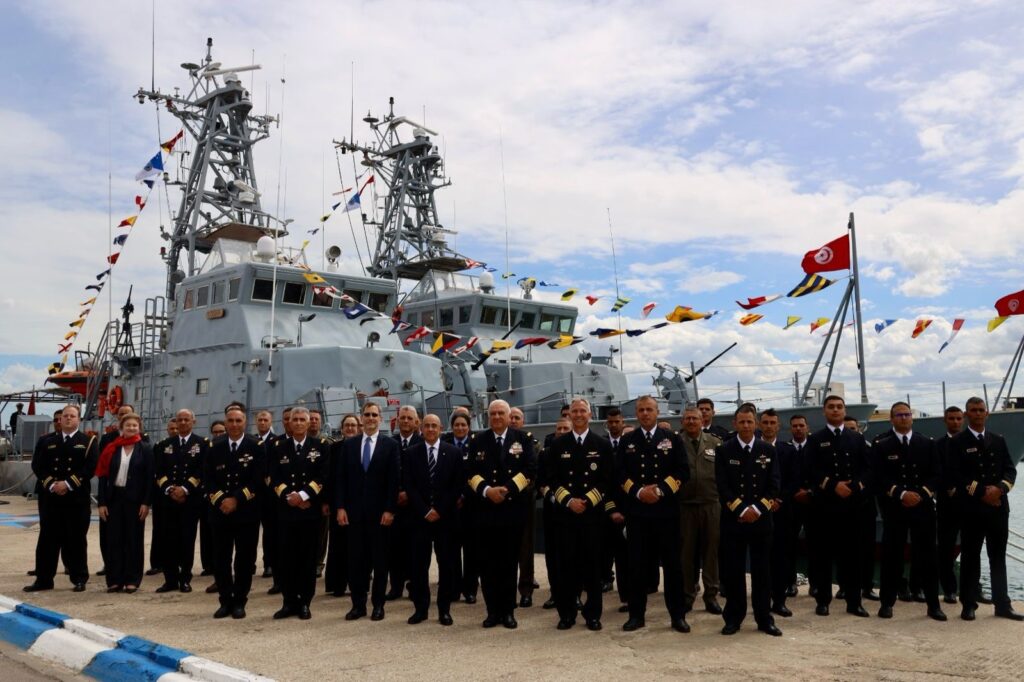
On the same occasion, the Tunisian Navy conducted a commissioning ceremony for two American 110-foot (34-meter) Island-class Patrol Boats, which the United States transferred to Tunisia, the latest in a series of U.S. equipment contributions that strengthen Tunisia’s capacity to secure its maritime borders and advance regional security.  

As the flagship of U.S. 6th Fleet, Mount Whitney plays a key role in maritime security and cooperation throughout the Mediterranean and African theaters.  The visit underscores the U.S. commitment to regional stability and its enduring strategic partnership with Tunisia, a U.S. major non-NATO Ally. 

“The USS Mount Whitney’s visit is especially meaningful because it falls during the 220th anniversary of the 1805 Battle of Derna, when, through the support and cooperation of Tunisia, the U.S. military defeated maritime terrorism to make a more stable and secure region for commerce and economic development,” U.S. Ambassador to the Republic of Tunisia Joey Hood said. 

During the visit, the ship hosted a reception, welcoming military, diplomatic, and civic leaders from Tunisia.  The event served as a platform to celebrate bilateral cooperation and discuss shared goals in maritime security, regional defense, and future engagements. 

The U.S. and Tunisia have worked closely for decades on military training, professional development, and counterterrorism efforts.  This visit by Mount Whitney adds another chapter to the strong legacy of collaboration between the two countries. 

“This visit underscores the vital role strong partnerships play in ensuring maritime security,” Commander, U.S. 6th Fleet Vice Adm. J. T. Anderson said. “We are grateful for the opportunity to engage with our Tunisian counterparts and reaffirm our commitment to working together for a more stable and secure Mediterranean.” 

Mount Whitney, forward deployed to Gaeta, Italy, operates with a combined crew of U.S. Sailors and Military Sealift Command civil service mariners in the U.S. 6th Fleet area of operations in support of U.S. national security interests in Europe and Africa. The U.S. 6th Fleet, headquartered in Naples, Italy, conducts the full spectrum of joint and naval operations, often in concert with allied and interagency partners to advance U.S. national interests, security and stability in Europe and Africa.