Secretary of the Navy John Phelan Visits PCU John F. Kennedy 
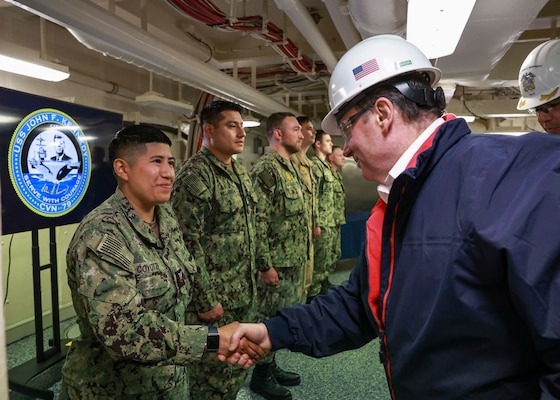
Secretary of the Navy John Phelan recognizes Aviation Ordnanceman 2nd Class Ariadna Coyotzi for her hard work aboard Pre-Commissioning Unit John F. Kennedy (CVN 79), April 16, 2025. (U.S. Navy photo by MC2 Brittney Camacho-Pietri) 

From PCU John F. Kennedy Public Affairs, April 17, 2025 

NEWPORT NEWS, Va. (April 16, 2025) – The Secretary of the Navy John Phelan visited Pre-Commissioning Unit (PCU) John F. Kennedy (CVN 79) at Newport News Shipbuilding (NNS), a division of Huntington Ingalls Industries (HII), April 16, 2025. 

Secretary of the Navy John Phelan recognizes Aviation Ordnanceman 2nd Class Ariadna Coyotzi for her hard work aboard Pre-Commissioning Unit John F. Kennedy (CVN 79), April 16, 2025. During the ship visit, Secretary Phelan saw firsthand how important the maritime industrial base workforce is for the construction of the world’s most technologically-advanced aircraft carrier. John F. Kennedy is the second Gerald R. Ford-class aircraft carrier and is under construction at HII’s Newport News Shipbuilding (NNS) division in Newport News, Virginia. (U.S. Navy photo by Mass Communication Specialist 2nd Class Brittney Camacho-Pietri) 

 
During the tour, the Secretary met with shipbuilders and Sailors assigned to PCU John F. Kennedy, observing first-hand the technological advancements and craftsmanship contributing to the construction of the second ship of the Gerald R. Ford-class aircraft carriers. 
 
“PCU John F. Kennedy is more than an aircraft carrier; it’s a symbol of American power,” said Phelan. “I have seen today that this power isn’t given but rather built by the sweat and skill of American workers.” 
 
The visit, coordinated by HII-NNS in partnership with the U.S. Navy, included an overview of the construction of the aircraft carrier and an engagement with the ship’s crew. 
 
“We are honored to welcome our Secretary of the Navy and showcase the tremendous efforts of our Sailors and our shipbuilding partners,” said Captain Doug Langenberg, commanding officer of PCU John F. Kennedy. “We are working hard every day to deliver a combat-ready aircraft carrier with a trained and certified crew, ready to meet every challenge, ready to fight and win.” 
 
PCU John F. Kennedy (CVN 79) is the second aircraft carrier in the Ford Class, the first new class in more than 40 years. 
 
At 1,092 feet in length and 100,000 tons, CVN 79 represents dramatic advances in propulsion, power generation, ordnance handling, and aircraft launch systems. These innovations will support a higher sortie generation rate at significant cost savings when compared to Nimitz-class carriers. The Gerald R. Ford class also offers a considerable reduction—approximately $4 billion per ship—in life cycle operations and support costs compared to the earlier Nimitz class. 
 
The new technology and warfighting capabilities that John F. Kennedy brings to the fleet will transform naval warfare, supporting a more capable and lethal forward-deployed U.S. naval presence. In an emerging era of great power competition, CVN 79 will serve as the most agile and lethal combat platform globally, with improved systems that enhance interoperability among other platforms in the carrier strike group and with the naval forces of regional allies and partners. 


HII Hosts Secretary of the Navy at Newport News Shipbuilding

From HII 

 
NEWPORT NEWS, Va., April 16, 2025 (GLOBE NEWSWIRE) — HII (NYSE: HII) hosted the secretary of the Navy at its Newport News Shipbuilding division Wednesday for a tour of the shipyard, meetings with company leadership, and direct interactions with shipbuilders and sailors. 

It was the first visit to NNS by Secretary of the Navy John Phelan since confirmation to the position in March. 

“The work being done in Newport News is essential to American seapower,” Phelan said. “These incredible workers are not just building ships, they’re building our future, securing our way of life, and ensuring peace through strength.” 

“We are honored to have Secretary Phelan in the shipyard and show him what our shipbuilders do,” NNS President Kari Wilkinson said. “Shipbuilding is complex and difficult work and requires a commitment to purpose. We appreciate Secretary Phelan’s leadership, perspective and insight as we work relentlessly to be strong partners in strengthening and expanding American shipbuilding.” 

Photos accompanying this release are available at: http://hii.com/news/hii-hosts-secretary-of-the-navy-at-newport-news-shipbuilding/

The tour covered the construction lifecycle for nuclear-powered submarines and aircraft carriers, including conversations with the shipbuilders who are building and delivering ships critical to the national defense. Phelan saw firsthand how NNS is leveraging technology and state-of-the-art facilities to execute serial-module-production for both Columbia– and Virginia-class submarines. The group was able to experience these submarines in various stages of construction, from early construction to final assembly and test. 

Phelan also toured construction progress on two aircraft carriers, including Enterprise (CVN 80) in the dry dock, as well as John F. Kennedy (CVN 79), undergoing final outfitting and testing at NNS. While on Kennedy, he met with sailors, toured the flight deck, and participated in topside testing of the electromagnetic aircraft launch system (EMALS). 

Virginia Gov. Glenn Youngkin, Congressman Bobby Scott, D-Va., Congressman Rob Wittman, R-Va., and Congressman John McGuire, R-Va., joined Phelan for a portion of the visit. 

With a workforce of more than 26,000 people, NNS is the largest industrial employer in Virginia. The shipyard is one of two shipyards capable of designing and building nuclear-powered submarines for the U.S. Navy and designs, builds, refuels and defuels nuclear-powered aircraft carriers. 


Austal USA Celebrates Keel Laying for the Future USNS Solomon Atkinson

Ship sponsor JoAnn Atkinson, wife of namesake Solomon Atkinson, authenticates the T-ATS 12 keel welding her initials into the keel plate with the help of Austal USA A-class welder Rufus Lord. (Austal USA) 

From Austal USA, April 16, 2025 

MOBILE, Ala. – Austal USA celebrated the official start of construction on the future USNS Solomon Atkinson (T-ATS 12), the Navy’s seventh Towing, Salvage and Rescue Ship, with a keel laying ceremony today at the company’s Mobile, Ala. ship manufacturing facility.  Ship sponsors JoAnn Atkinson, Solomon Atkinson’s widow, and daughters Michele Gunyah and Maria Hayward, authenticated the keel by welding their initials into a keel plate that will be welded to the hull of the ship.  They were assisted by Rufus Lord, a fifteen-year Austal USA veteran A-class welder. 

Keel laying is the formal recognition of the start of a ship’s construction.  The keel laying symbolically recognizes the ceremonial beginning of the construction of a ship. This ship milestone is being recognized just over two weeks after Austal USA celebrated the christening of the future USNS Billy Frank Jr. (T-ATS 11). 

“I am proud of the Austal USA T-ATS program team for providing us with the opportunity to celebrate two T-ATS milestones so close together,” said Dave Growden, vice president of new construction. “This ceremony is evidence of the hard work and dedication put forth by Austal USA and our Navy and supplier partners to keep the T-ATS program steadily moving forward.”  

Local community leaders, Austal USA employees, Navy personnel, and family and friends of ship namesake Solomon Atkinson attended the ceremony today.  

Solomon Atkinson, born in 1930 in Metlakatla, Alaska, worked as a commercial fisherman before enlisting in the U.S. Navy in 1952. A year later, Atkinson volunteered for the underwater demolition teams and became a frogman, the precursor to present day SEALs. In 1962, Atkinson became one of the first Navy SEALs and was a plank owner for SEAL Team 1. As a SEAL, he deployed to Korea and completed three combat tours in Vietnam. His Vietnam service-related awards include a Bronze Star, a Navy Commendation Medal with Combat “V,” and a Purple Heart. Atkinson also had the distinction of training numerous astronauts, including Neil Armstrong and Buzz Aldrin, in underwater weightless simulations at the Underwater Swimmers School in Key West, Florida. Atkinson retired from active naval service in 1973 as a Chief Warrant Officer 4 and returned to Metlakatla, where he continued to serve his people and state on the Indian Community Council and Board of Education, as founder and president of the first veterans’ organization on Annette Island, and as mayor of Metlakatla. 

T-ATS 12 will provide ocean-going towing, salvage and rescue capabilities to support fleet operations. T-ATS will be a multi-mission common hull platform capable of towing U.S. Navy ships and will have 6,000 square feet of deck space for embarked systems. The large, unobstructed deck allows for the embarkation of a variety of stand-alone and interchangeable systems. The T-ATS platform will combine the capabilities of the retiring Rescue and Salvage Ship (T-ARS 50) and Fleet Ocean Tug (T-ATF 166) platforms. T-ATS will be able to support current missions including towing, salvage, rescue, oil spill response, humanitarian assistance, and wide-area search and surveillance. The platform also enables future rapid capability initiatives such as supporting modular payloads with hotel services and appropriate interfaces. 


Destruction of Houthi Controlled Ras Isa Fuel Port

From U.S. Central Command, April 17, 2025 

The Houthis have continued to benefit economically and militarily from countries and companies that provide material support to a designated foreign terrorist organization. The Iran-backed Houthis use fuel to sustain their military operations, as a weapon of control, and to benefit economically from embezzling the profits from the import. This fuel should be legitimately supplied to the people of Yemen. Despite the Foreign Terrorist Designation that went into effect on 05 April, ships have continued to supply fuel via the port of Ras Isa. Profits from these illegal sales are directly funding and sustaining Houthi terrorist efforts. 

Today, US forces took action to eliminate this source of fuel for the Iran-backed Houthi terrorists and deprive them of illegal revenue that has funded Houthi efforts to terrorize the entire region for over 10 years. The objective of these strikes was to degrade the economic source of power of the Houthis, who continue to exploit and bring great pain upon their fellow countrymen. This strike was not intended to harm the people of Yemen, who rightly want to throw off the yoke of Houthi subjugation and live peacefully. 

The Houthis, their Iranian masters, and those who knowingly aid and abet their terrorist actions should be put on notice that the world will not accept illicit smuggling of fuel and war material to a terrorist organization. 


Coast Guard Cutter Mustang Decommissioned After Nearly 40 Years of Service 

The Coast Guard holds a decommissioning ceremony for Coast Guard Cutter Mustang (WPB 1310) in Seward, Alaska, April 15, 2025. Commissioned on August 29, 1986, Mustang was the 10th Island-Class cutter to join the fleet. (U.S. Coast Guard photo courtesy of USCGC Mustang) 

From U.S. Coast Guard 17th District, April 16, 2025 

ANCHORAGE, Alaska — The Coast Guard decommissioned Coast Guard Cutter Mustang (WPB 1310) during a ceremony in Seward, Tuesday. 

Capt. Christopher Culpepper, the commander of Coast Guard Sector Western Alaska & U.S. Arctic, presided over the ceremony honoring the nearly 40 years of service Mustang and its crews provided to the nation. 

Commissioned on August 29, 1986, Mustang was the 10th Island-Class cutter to join the fleet. 

Mustang has been stationed in Seward since it was commissioned, and its crews have since responded to over 200 search-and-rescue cases and completed over 2000 law enforcement sorties. 

Mustang is a 110-foot, Island-Class patrol boat, a multi-mission platform that conducted operations to support search and rescue response, marine environmental protection, and national defense. 

The Coast Guard is replacing the aging Island-Class patrol boats with Sentinel-Class Fast Response Cutters (FRCs) which feature enhanced capability to meet service needs. There are currently four FRC’s homeported in Alaska, with two more scheduled for delivery in the near future. 

“The decommissioning of Mustang is a bittersweet moment,” said Lt. Gabrielle Troise, Commanding Officer of Mustang. “It’s been my honor to be a member of the final crew, and I’m incredibly proud of the legacy we will leave behind within the community of Seward where Mustang has faithfully served since her commissioning.” 


PWD Souda Bay Delivers $5.2M Warehouse, Enhancing NAVSUP Mediterranean Mission

By Anthony Cage, April 15, 2025 

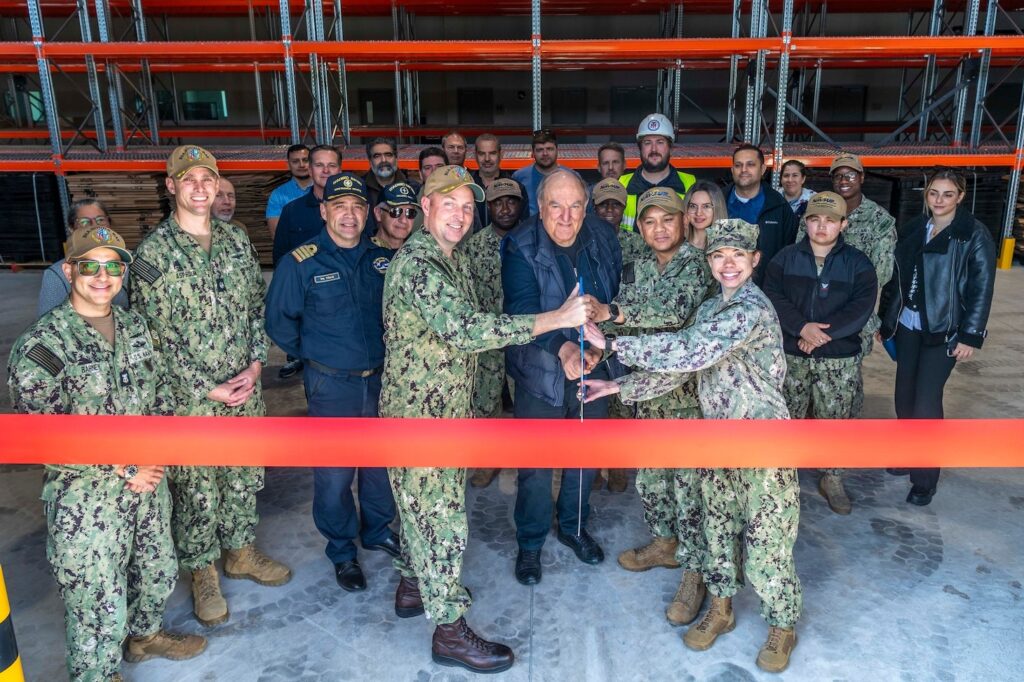
NAVAL SUPPORT ACTIVITY SOUDA BAY, Greece  –  Public Works Department Souda Bay, Greece joined with Naval Supply Systems Command (NAVSUP) Fleet Logistics Center Sigonella (FLCSI), Site Souda Bay and Naval Support Activity (NSA) Souda Bay leadership for a ribbon cutting ceremony, inaugurating the new Marathi Logistics Support Center at the NATO Marathi Pier Complex, April 3, 2025. 
 
The NATO Marathi Pier Complex is the only military deep-water pier facility in the Mediterranean with the capability to accommodate a U.S. Navy nuclear-powered aircraft carrier pier-side. 
 
“This project represents a significant investment in our ability to support the fleet and our allies here in Souda Bay,” said Capt. Stephen Steacy, commanding officer, NSA Souda Bay. “This facility, delivered through the outstanding collaboration of PWD Souda Bay, NAVSUP, and our partners, enhances our logistical capabilities, strengthens our operational readiness, and underscores our commitment to maintaining a robust presence in this strategically important region.” 
 
The $5.2 million, 14,000-square-foot, pre-engineered steel warehouse improves the installation’s logistical support capabilities, including critical storage, visiting ship cargo handling and office space. 
 
“This isn’t just about today’s mission. This new facility ensures NAVSUP can effectively support the fleet here in Souda Bay well into the future,” said Lt. Cmdr. Barry Ventura. “With added freezer and chill storage, along with expanded postal capacity, we can provide even more robust and reliable support well into the future. The upgraded water system is also crucial for maintaining uninterrupted service to our ships and allies.” 
 
The four-year project, funded by Commander, Navy Installations Command, also provides NAVSUP with essential hazardous material storage and an upgraded water supply system, including an above-ground tank and pump house. 
 
“This new facility at NSA Souda Bay, one of two opened by NAVFAC EURAFCENT this week, demonstrates our commitment to delivering critical infrastructure through effective partnerships,” said Lt. Katy Pekala, director, Facilities Engineering & Acquisition Division. “PWD Souda Bay’s expert oversight of construction management, engineering, and contracting, along with seamless communication with all stakeholders, was crucial to delivering this project on time and within budget.” 
 
The vital new facility at NSA Souda Bay is the latest example of NAVFAC EURAFCENT’s commitment to delivering impactful shore infrastructure projects across Europe, Africa, and Central Command. 
 
“PWD Souda Bay’s dedication and expertise were essential to the successful completion of this vital project,” said Lt. Cmdr. Ted Packowski, public works officer, NSA Souda Bay. “Working closely with stakeholders, including the end-users, to ensure the new warehouse met all requirements and exceeded expectations, in the end resulted in delivering a first-class facility that will significantly enhance the installation’s operational capabilities.” 
 
NAVSUP Fleet Logistics Center Sigonella supported by Navy Region NAVSUP FLC Sigonella mission is to plan, coordinate, integrate, synchronize, and provide logistic support to U.S. Naval, Joint, and allied forces operating in peace, crisis, and wartime within the EUCOM and AFRICOM areas of responsibility. 
 
NSA Souda Bay is an operational ashore installation which enables and supports U.S., Allied, Coalition, and partner nation forces to preserve security and stability in the European, African, and Central Command areas of responsibility. 
 
Naval Facilities Engineering Systems Command is the naval shore facilities, base operating support, and expeditionary engineering systems command delivering life-cycle technical and acquisition solutions aligned to fleet and Marine Corps priorities. NAVFAC EURAFCENT supports fleet commanders by providing engineering assessments and agile acquisition strategy, constructing and maintaining shore infrastructure, and maximizing force readiness to enhance warfighter capability. NAVFAC EURAFCENT serves as the engineering link between the shore and the Fleet in the European, African, and Central Command areas of responsibility. 


USS Stockdale Deploys to U.S. Northern Command Area of Responsibility 

From U.S. Fleet Forces Command, April 11, 2025 

NORFOLK, Va. – The Arleigh Burke-class guided-missile destroyer USS Stockdale (DDG 106) departed Naval Base San Diego to support U.S. Northern Command (USNORTHCOM) southern border operations in the USNORTHCOM area of responsibility, April 11. 
 
Stockdale takes over duties previously carried out by USS Spruance (DDG 111), which conducted similar operations in support of USNORTHCOM’s border security objectives. 
 
Stockdale’s departure reinforces the Navy’s role in the Department of Defense’s coordinated effort in response to the Presidential Executive Order. Stockdale’s sea-going capacity contributes to USNORTHCOM’s ability to protect the United States’ territorial integrity, sovereignty, and security, through a coordinated, multi-domain strategy. 
 
Stockdale will continue operations with an embarked U.S. Coast Guard Law Enforcement Detachment (LEDET). These Coast Guard teams bring specialized expertise in maritime interdiction, enabling the ship to address a range of challenges, from countering illegal activities to supporting humanitarian efforts and homeland security operations. 
 
In February of 2025, Stockdale returned to San Diego after a seven-month independent deployment to the U.S. 3rd, 5th and 7th Fleet areas of operation. Stockdale joined the Abraham Lincoln Carrier Strike Group (ABECSG) and remained in 5th Fleet following the departure of the ABECSG. 
 
While in 5th Fleet, Stockdale successfully repelled multiple Iranian-backed Houthi attacks during transits of the Bab el-Mandeb strait and escort operations of U.S.-flagged vessels in the Gulf of Aden. During these engagements, Stockdale engaged and defeated one-way attack uncrewed aerial-ship cruise missiles. Stockdale received no damage and no personnel were hurt. 
 
Now, while operating in the USNORTHCOM area of responsibility, Stockdale will respond to national priorities and a Presidential declaration emphasizing the military’s role in securing U.S. borders. As the DoD’s lead for implementing border-related executive orders, USNORTHCOM continues to support critical Department of Homeland Security capabilities gaps, with Stockdale marking a vital contribution to these efforts. 
 
USFFC is responsible for manning, training, equipping and employing more than 125 ships, 1,000 aircraft, and 103,000 active-duty service members and government employees, and providing combat-ready forces forward to numbered fleets and combatant commanders around the globe in support of U.S. national interests. 
 
USFFC also serves as the Navy’s Service Component Commander to both U.S. Northern Command and U.S. Strategic Command, and providing naval forces in support of joint missions as Commander, Naval Forces Northern Command (NAVNORTH) and Commander, Naval Forces Strategic Command (NAVSTRAT). USFFC is the Strategic Command Joint Force Maritime Component Commander (JFMCC STRAT) and executes Task Force Atlantic in coordination with U.S. N


UNITAS 2025 Mid Planning Conference Concludes 

NAVAL STATION MAYPORT, Florida – (Apr. 7, 2025) – Led by Rear Adm. Carlos Sardiello, Commander U.S. Naval Forces Southern Command/U.S. 4th Fleet, more than 100 Sailors, Marines, and civilians gathered onboard Naval Station Mayport in support of the UNITAS 2025 Mid-Planning Conference. (U.S. Navy illustration by MCC John Fischer) 

By USNAVSOUTH/4th Fleet Public Affairs, April 11, 2025 

NAVAL STATION MAYPORT, Fla. – U.S. Naval Forces Southern Command/U.S. 4th Fleet completed the UNITAS 2025 mid planning conference on board Naval Station Mayport in Jacksonville, Apr. 7-11. Held virtually and in-person, the conference brought together commands from the U.S. and partner nations to plan for UNITAS 2025, the 66th iteration of the world’s longest-running multinational maritime exercise. 
 
UNITAS 2025 will feature a range of maritime operations, including a live-fire sinking exercise (SINKEX) and amphibious landings. The exercise will take place Sept. 15-Oct. 6 off the East Coast of the United States, with shore-based events at Naval Station Mayport, Marine Corps Base Camp Lejeune, North Carolina, and Naval Station Norfolk, Virginia. 
 
“The level of participation and plans being developed are paramount to a successful exercise and are all oriented to expanding and strengthening our maritime partnerships,” said Rear Adm. Carlos Sardiello, commander of U.S. Naval Forces Southern Command/U.S. 4th Fleet. “Already steeped in a long history of success, UNITAS 2025 will continue to solidify a legacy of maritime partnerships. 
 
More than 250 representatives from 23 countries and all branches of the U.S. military participated in person and virtually, including Argentina, Belize, Brazil, Canada, Chile, Colombia, Dominican Republic, Ecuador, El Salvador, France, Germany, Greece, Guatemala, Honduras, Jamaica, Japan, Mexico, Panama, Paraguay, Peru, Singapore, Spain, and the United States. 
 
Participants refined the exercise scenario and objectives, the list of participating units and personnel, and logistics and communications plans. UNITAS is designed to strengthen relationships and foster interoperability among participating nations. 
 
UNITAS 2025 will showcase maritime technology, including unmanned and hybrid fleet systems, building on last years integration of unmanned undersea vehicles. The exercise will culminate in high-end warfighting events. 
 
“The combined efforts of all planners have shaped UNITAS 2025 to be the largest and most robust iteration of the exercise to date,” said Patrick Cooper, UNITAS 2025 lead planner. “The level of expertise and enthusiasm of every participant at the MPC has been truly astounding.” 
 
UNITAS 2025 will also help set the stage for events celebrating the U.S. Navy’s 250th anniversary, a monumental event. Planning efforts will continue until the Final Planning Conference (FPC) scheduled to be held in June. 
 
U.S. Naval Forces Southern Command/U.S. 4th Fleet is the maritime partner for Caribbean, Central and South American maritime forces, working to improve unity, security and stability. 


U.S. Navy Adds Persistent Systems to Family of Systems USV Contract  

Company’s mobile ad hoc network (MANET) technology to support Navy’s vision of integrating manned and unmanned formations  

From Persistent Systems 

NEW YORK, New York. – April 15, 2025 – Persistent Systems, LLC (“Persistent”), a leader in mobile ad hoc networking (MANET), announced today the U.S. Navy has selected the company as one of 88 participants for a $982.1 million, indefinite delivery/indefinite quantity (IDIQ) contract to support current and future data links for unmanned surface vessels (USVs).  

The USV Family of Systems (FoS) contract, first awarded in 2020, now includes 88 contractors supporting the Navy’s effort to integrate USVs into its fleet. Building on its experience working with the Unmanned Systems divisions of Naval Surface Warfare Centers and Naval Information Warfare Centers, Persistent Systems will supply its MANET solutions to Naval Sea Systems Command (NAVSEA) to enable secure, resilient data links for RDT&E efforts in support of the Navy’s USV program.  

“As a leading provider of MANET solutions for this contract, we will serve as the critical data link for maritime unmanned reconnaissance vehicles, supporting numerous mission sets, including maritime domain awareness, sea control/sea denial, and swarming operations,” said Ed Leopold, Director of Business Development at Persistent Systems. “This is essential for maintaining real-time situational awareness for expeditionary forces and supporting collaborative autonomy of unmanned systems.”  

The company’s MPU5 networking devices leverage their highly scalable Wave Relay® MANET to seamlessly connect users in a true peer-to-peer fashion, allowing for the high-throughput transfer of voice, video, text, sensor data, and GPS information without needing external infrastructure.  

“As the U.S. Navy emphasizes the need for manned and unmanned formations, we are seeing the shift from pilot programs and proof of concepts towards the implementation of validated USV upgrades as part of their Unmanned Maritime Autonomy Architecture (UMAA),” says Leopold.  

This IDIQ contract builds on Persistent’s ongoing work with the Navy. Over the past few months, the company has supported several naval efforts:  

• In July, the U.S. Naval Information Warfare Center Pacific awarded Persistent a contract to network USVs, individual operators, ships, and ground control stations;  

• Persistent Systems supported networking efforts during Valiant Shield, a joint exercise conducted every two years across the INDOPACOM Area of Responsibility and;  

• During the Paris Olympics, the French navy used Persistent’s MANET technology on vessels and shore infrastructure to secure a sailing competition.  

“We look forward to building on these relationships, and this selection reinforces our position as a trusted supplier for the U.S. Navy,” Leopold concluded.  


Naval Foundry and Propeller Center Delivers Final Propulsor Component for First Columbia-class Submarine 

Members of the Naval Foundry and Propeller Center (NFPC) celebrate the delivery of the final propulsor component for the Columbia-class lead ship, the future USS District of Columbia (SSBN 826). (U.S. Navy photo)

By Naval Foundry Propeller Center Public Affairs, April 11, 2025 

PHILADELPHIA – The U.S. Navy’s Naval Foundry and Propeller Center (NFPC) delivered the final major propulsor component for the first Columbia-class ballistic missile submarine (SSBN), the future USS District of Columbia (SSBN 826), to General Dynamics-Electric Boat (GDEB) Apr. 8. GDEB accepted the component in Philadelphia, and transported it to the shipyard in Groton, CT, where it arrived April 10. 

The delivery marks a historic milestone for NFPC, and the culmination of a years-long project. Well before the ship’s keel was laid in 2022, NFPC was working on patterns, molds and castings for the propulsor – with the first sub-component pour in 2019 and the final large component being cast in 2021. 

NFPC’s journey to produce the propulsor for the District of Columbia has pushed engineering innovation to new heights, resulting in multiple record-breaking pours for nonferrous castings in the U.S. The largest casting was over 260,000 pounds and is already at GDEB for installation. Collectively, NFPC poured nearly 1 million pounds of bronze and removed well over 200,000 pounds of machine chips on the lead ship project. 

Once completed, the District of Columbia will be the first ship of its kind, set to replace the Navy’s current Ohio-class SSBNs. The Columbia-class is the Nation’s future Sea Based Strategic Deterrent, the Navy’s number one acquisition priority, and will provide the most survivable leg of the Nation’s strategic triad. The class will ensure continuous sea-based strategic deterrence into the 2080s and will be the largest, most capable and most advanced submarine produced by our Nation. 

NFPC has produced four components for District of Columbia. Once completed at the foundry, the components are transported by truck or barge to GDEB shipyard, which is responsible for final assembly of all Columbia-class submarines.  

In addition to producing propulsors for the next three ships in the Columbia-class, NFPC continues work for the Navy’s Virginia-class fast attack submarines. 

NFPC has been manufacturing propellors and propulsors for the U.S. Navy for more than 100 years in Philadelphia. The current workforce benefits from a wide range of individual experience, with team members ranging from trade school graduates to seasoned engineers and mechanics with over 40 years of service. NFPC offers unique capabilities and capacity, achieving its mission to design, manufacture and deliver precision machined propulsor castings for undersea superiority.