Coast Guard Cutter Spencer returns home after Operation Vigilant Sentry patrol, service life extension upgrades 

Coast Guard Cutter Spencer (WMEC 905) crew member conduct small boat operations while patrolling the Florida Straits, March 21, 2025. (U.S. Coast Guard photo by Petty Officer 3rd Class Haylee Casey)

From U.S. Coast Guard Atlantic Area, April 14, 2025 

PORTSMOUTH, Va. — The crew of Coast Guard Cutter Spencer (WMEC 905) returned to their home port in Portsmouth, Friday, following a 92-day deployment in support of alien interdiction operations in the Florida Straits.   

Deployed in support of Homeland Security Task Force – Southeast (HSTF-SE) and Operation Vigilant Sentry (OVS) in the Seventh Coast Guard District’s area of responsibility, Spencer’s crew conducted search and rescue, and maritime border security operations to support the ongoing U.S. mission to protect the maritime borders of America.  
  
On April 6, Spencer’s crew rescued a mariner from a capsized vessel approximately 35 miles northeast of Boynton Beach, Florida. Coast Guard Cutter Margaret Norvell’s crew embarked the survivor who was transferred to the Royal Bahamas Defense Force in good condition.  

Prior to the patrol, Spencer was part of the service life extension program (SLEP) for two years getting upgrades at the Coast Guard Yard in Baltimore.                                                             

“Although our time in Baltimore was challenging, the officers and crew of Spencer were motivated to get the ship ready for operations and embark on our inaugural post-SLEP patrol,” said Cmdr. Justin Strock, commanding officer of Spencer. “In support Homeland Security Task Force – Southeast, we provided a clear visible deterrent to anyone considering illegal entry into the country.”   

Established in 2003, HSTF-SE is the DHS-led interagency task force charged with directing operational and tactical planning, command and control, and functions as a standing organization to deter, mitigate and respond to maritime mass migration in the Caribbean Sea and Florida Straits.    

OVS is the 2004 DHS plan that provides the structure for deploying joint air and surface assets and personnel to respond to irregular maritime migration in the Caribbean corridor of the United States. Its primary objectives are to prevent the unnecessary loss of life at sea while deterring and dissuading maritime mass migration alongside our federal, state and local partners.     

Spencer is a 270-foot, Famous-class medium endurance cutter. The cutter’s primary missions are alien interdiction, counter-drug operations, enforcement of federal fishery laws, and search and rescue in support of U.S. Coast Guard operations throughout the Western Hemisphere.   

For information on how to join the U.S. Coast Guard, visit Go Coast Guard.com to learn about active duty and reserve, officer and enlisted opportunities. Information on how to apply to the U.S. Coast Guard Academy can be found here.  


12th Marine Littoral Regiment Designed to Operate in Contested Maritime Zones

By Peter Ong 

Colonel Peter B. Eltringham, commanding officer of the 12th United States Marine Corps Littoral Regiment (12th MLR) based in Okinawa, Japan, provided media with a briefing and fielded questions on April 8, 2025 regarding 12th MLR’s status, functions, and missions.  

“The MLRs are specifically designed to operate in contested maritime zones. MLRs have approximately 2,000 Marines, smaller than a traditional infantry or artillery regiment, but more mobile and survivable in key maritime terrain,” said Eltringham, who also emphasized the importance working with allied partnerships. 12th MLR has a Littoral Combat Team consisting of infantry and anti-ship battalion, an anti-air battalion, and a logistics battalion. 

Colonel Eltringham said that 3rd MLR is based in Hawaii and works closely with the Philippine Armed Forces whereas 12th MLR works with the Japanese air, land, and sea defense forces. The 3rd MLR has received new systems such as Naval Strike Missiles on unmanned Joint Light Tactical Vehicles (JLTVs to form NMESIS) and Marine Air Defense Integrated System (MADIS, JLTVs with turret mounted 30mm, 7.62mm, and Stinger missiles) whereas the 12th MLR will field those systems in the coming months. 

Colonel Eltringham replied to a question asking how MLR exemplifies Distributed Maritime Operations and lethality. The baseline MLR formations are broken into small, dispersed networks that “provide command and control, sustainment, strike, and sensing assets for the right time and place of our choosing and integrate them with the U.S. Army, Navy, Air Force, and allies.” 

Colonel Eltringham replied to a question asking for examples of Artificial Intelligence and autonomous systems in the 12th MLR. He mentioned the Autonomous Low-Profile Vessel (ALPV) semisubmersible and NMESIS. Another question asked when does testing stop and buying begin in which Eltringham said “technology on the battlefield is moving so quickly. I want to make sure that we are continually experimenting with C2 [command and control] sustainment, strike, and sensing realm.” 

To a question asking how paying for Readiness might hinder modernization, “Readiness absolutely takes up funding…we’ve got to train…deploy…ammunition…all that stuff costs money,” said Eltringham, but NMESIS, MADIS, and ALPV are modernization funding efforts. 

Replying to a question asking for a “WOW!” factor in the MLR since many other nations have made huge breakthroughs in technological advances and drone usage, Colonel Eltringham said that 12th MLR has the ability for multidomain operations across air, land, sea, space, and cyber and brings it down to the colonel level in addition to sharing the information with allies through communications and connectivity. 

Replying to a question asking for the biggest challenge in working with Japan against China, the colonel said it’s being able to operate constantly. 

Another question asked how training NMESIS and MADIS differ, the colonel said that the training methodologies are the same, but the ordnance differs.  

Finally, Eltringham replied to a question on how MLR fights with contested logistics, saying “that involves working locally, working within the environment, having senses, and having jungle warfare training.” 


USS Minnesota Returns Home to Naval Base Guam 

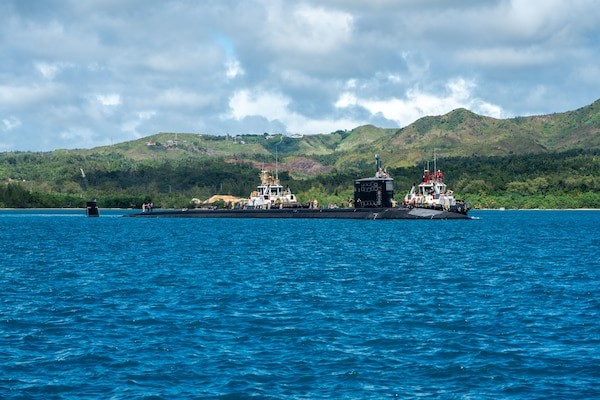
Cmdr. Jeffrey Cornielle, commanding officer of USS Minnesota (SSN 783), left, mans the conning tower as the boat transits Apra Harbor to Naval Base Guam. (Lt. James Caliva)

From Petty Officer 1st Class Nikita Custer, April 15, 2025 

NAVAL BASE GUAM (April 14, 2025) – The Virginia-class fast-attack submarine USS Minnesota (SSN 783) returned to its homeport of Naval Base Guam following its first operational tasking while forward-deployed in the Indo-Pacific region, April 14, 2025. 

“This first operational tasking following Minnesota’s recent homeport shift demonstrated the submarine’s operational readiness and the capabilities the Virginia-class brings to the Indo-Pacific region,” said Capt. Neil Steinhagen, commander, Submarine Squadron 15. “Their performance is a clear reflection of the high standards and strategic impact expected of our forward-deployed assets. Minnesota has proven itself ready to meet the sustained operational tempo of our Pacific Submarine Force—truly living up to its motto, From the North, Power!” 
 
Minnesota’s operations included a port visit to Western Australia, marking the first of two planned U.S. Virginia-class fast-attack submarine visits to HMAS Stirling in 2025. While in the region, the crew took part in at-sea operations as part of the Submarine Command Course and participated in Exercise Lungfish, a tactical development exercise between the U.S. Navy and Royal Australian Navy. The submarine also visited Darwin in Australia’s Northern Territory, supporting bilateral engagements and hosting tours for local officials. 
 
“These port visits were an outstanding opportunity to strengthen international partnerships and reinforce the Navy’s forward presence with our allies,” said Cmdr. Jeffrey Cornielle, commanding officer, USS Minnesota. “Working side-by-side with our Australian counterparts helped sharpen our undersea warfighting skills. That kind of tactical development is vital—not just for increasing our own readiness, but for enhancing interoperability with allied warfighters deployed shoulder-to-shoulder in support of a secure and prosperous Indo-Pacific.” 
 
Beyond operations at sea, the crew engaged in community outreach throughout Australia, delivering STEM presentations at local schools and volunteering with programs for at-risk youth. 
 
“The Sailors of Minnesota truly embodied what it means to serve, whether they were inspiring students with stories of life aboard a submarine or giving their time to support the local community,” said Master Chief Missile Technician Kevin Lewis, USS Minnesota, Chief of the Boat. “What they did went beyond the uniform. Every connection they made helped build trust, show our values in action, and strengthen the relationships that support our presence in the region.” 
 
Commissioned on Sept. 7, 2013, in Norfolk, Virginia, Minnesota is the 10th Virginia-class submarine to enter service. On Nov. 26, 2024, Minnesota became the first Virginia-class submarine to join the U.S. Navy’s only forward-deployed submarine squadron, along with four Los Angeles-class fast-attack submarines based in Guam. Assigned to Commander, Submarine Squadron 15 at Polaris Point, Naval Base Guam, Minnesota operates at the tip of the spear, reaffirming the submarine force’s forward-deployed presence and supporting the vision of peace through strength and a free and open Indo-Pacific. 


Navy Secretary Embarks Gerald R. Ford for First Carrier Visit 

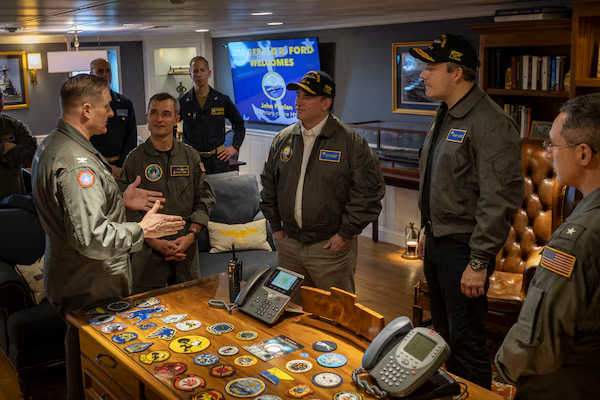
Capt. Rick Burgess, commanding officer of USS Gerald R. Ford (CVN 78), welcomes Secretary of the Navy John C. Phelan in the captain’s in-port cabin. (MC2 Jacob Mattingly)

15 April 2025 

ATLANTIC OCEAN – Secretary of the Navy John Phelan embarked USS Gerald R. Ford (CVN 78), the flagship of Carrier Strike Group (CSG) 12, to observe the strike group’s Composite Training Unit Exercise (COMPTUEX), Apr. 10-11. The visit was the Secretary’s first visit to an operational carrier strike group since becoming the 79th Secretary of the Navy on March 25, 2025. 

“There is nothing that compares to the strategic influence that the Gerald R. Ford Carrier Strike Group delivers to the Commander-in-Chief,” said Phelan. “All Americans should be proud of these men and women, whose grit and determination keeps our seas open and our nation safe.” 
 
The Secretary joined the strike group during Composite Training Unit Exercise (COMPTUEX). The training environment delivers opportunities for carrier strike group commanders to integrate highly-capable, multi-mission teams through live, virtual, and constructive presentations of threats. CSG-12 coordinates and directs the actions of USS Gerald R. Ford (CVN 78), USS Winston S. Churchill (DDG 81), Carrier Air Wing (CVW) 8 with its nine accompanying squadrons, and Destroyer Squadron (DESRON) 2 and its four guided-missile destroyers. 
 
“I can’t think of a better time, place, or team to introduce Secretary Phelan to strike group operations at sea,” said Rear Adm. Paul Lanzilotta. “It’s an honor and a privilege to lead this team, and I am grateful for the opportunity to highlight the team’s hard work, tactical acumen, and warfighting spirit to the Secretary.” 
 
COMPTUEX is the Joint Force’s most complex training event which underscores the Navy’s commitment to deliver naval task forces for sustained high-end Joint and combined combat. The visit was also an opportunity for the crew of USS Gerald R. Ford (CVN 78) to present the ship to senior leadership. 
 
“It is a great honor to host Secretary Phelan during his first trip to a ready aircraft carrier,” said Capt. Rick Burgess, commanding officer of Gerald R. Ford. “The crew demonstrated Ford’s ability to project power on demand anywhere across the globe.” 
 
Following its return from its maiden deployment in January 2024, Ford completed a maintenance and training cycle. 
 
“As the first aircraft carrier to deter aggression during the Israel-Hamas conflict, you stood tall in support of Israel’s right to defend itself, and you made America proud. But you didn’t just deter. You made a difference. and you showed the world what American naval power and strength looks like.” said Phelan. 
 
The Gerald R. Ford Carrier Strike Group delivers the Joint force and Commander-in-Chief the combat capability to deter, and if necessary, defeat America’s adversaries in support of national security and economic prosperity. The strike group is comprised of its flagship, the world’s largest and most capable aircraft carrier USS Gerald R. Ford (CVN 78), USS Winston S. Churchill (DDG 81), Carrier Air Wing (CVW) 8 with nine accompanying squadrons, and Destroyer Squadron (DESRON) 2 and its four guided-missile destroyers. 
 
For more information about the USS Gerald R. Ford (CVN 78), visit its official webpage at https://www.airlant.usff.navy.mil/cvn78/, or its Defense Visual Information Distribution site at www.dvids.net/CVN78. Follow the ship’s operations and upcoming deployment on Facebook at @USSGeraldRFord or on Instagram at @cvn78_grford. 


USCGC James Returns Home After Multi-Month Patrol, Seizing $510M in Narcotics 

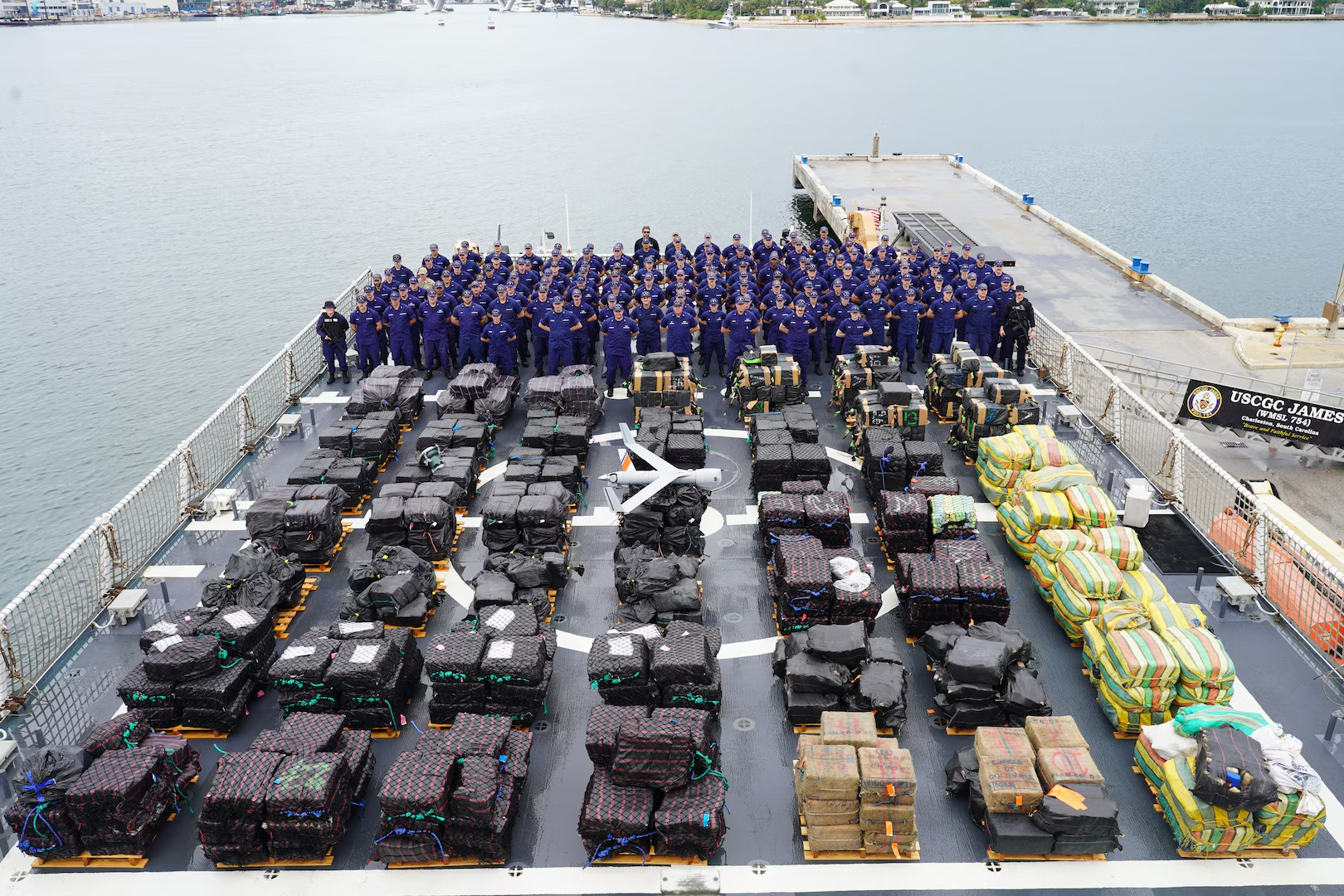
The crew of U.S. Coast Guard Cutter James (WMSL 754) poses for a photo on the cutter’s flight deck with contraband interdicted during their 112-day deployment, April 8, 2025. Crew members seized more than 44,550 pounds of cocaine and 3,880 pounds of marijuana valued at approximately $509.9 million intercepted in the international waters of the Eastern Pacific Ocean. Photo credit: U.S. Coast Guard | Lt. Weston Fortna

From U.S. Coast Guard Atlantic Area 

NORTH CHARLESTON, S.C. — The crew of Coast Guard Cutter James (WMSL 754) returned to their home port in North Charleston, Saturday, following a 112-day, multi-phase deployment, where crew members conducted counter-narcotic operations in the Eastern Pacific Ocean and participated in joint exercises with the U.S. Navy in the Atlantic Ocean.  

James’ crew spent their first two months underway in support of Joint Interagency Task Force – South (JIATF-S) while on patrol in the Coast Guard 11th District’s area of operations.   

Working alongside additional Coast Guard units and multiagency partners, the crew of James interdicted drug smuggling operations in the vast ocean off the Pacific Coast of Mexico, Central and South America. Crew member efforts significantly disrupted illegal narcotics trafficking with 11 interdictions at sea, seizing more than 48,000 pounds of illicit drugs valued at $510 million and apprehending 34 suspected drug smugglers.  

Of note, crew members interdicted three go-fast vessels in a single day, seizing more than 13,000 pounds of cocaine and capturing nine suspected narco-traffickers.   

On Wednesday, James’ crew and multiagency partners offloaded the drugs at Port Everglades in Fort Lauderdale, Florida. During a press conference, Attorney General Pamela Bondi and FBI Director Kash Patel delivered remarks alongside U.S. Coast Guard and U.S. Southern Command leadership to highlight the unprecedented collaboration between agencies and importance of preventing these drugs from reaching America.   

While deployed, the crew of James partnered with the Ecuadorian Coast Guard to promote regional maritime governance and assist in combatting the international drug trade. For 30 days, James embarked an Ecuadorian Coast Guard officer, underscoring the success of the two nations’ recent bilateral “Agreement Between the United States of America and the Republic of Ecuador Concerning Counter Illicit Transnational Maritime Activity Operations.” It was signed in 2023 and entered in force on Feb. 23, 2024. This shiprider provision of the agreement was enacted on four occasions, providing James with additional authorities and a strategic edge in countering suspected drug smugglers, efforts that greatly advanced regional maritime security.   

For the remainder of the patrol, James participated in the Carrier Strike Group 12, Gerald R. Ford Carrier Strike Group Composite Training Unit Exercise (COMPTUEX). COMPTUEX is the Joint Force’s most complex integrated training event and prepares naval task forces for sustained high-end Joint and combined combat.  

COMPTUEX was an all-hands, round-the-clock effort aboard James, especially the Combat Information Center team. Within the exercise, James operated in a contested maritime environment alongside the Navy to meet Fleet Commander requirements. The exercise also presented an opportunity for James to display the Coast Guard’s unique capabilities and authorities while operating alongside elements of the Gerald R. Ford Carrier Strike Group, including USS Gerald R. Ford (CVN 78), USS Winston S. Churchill (DDG 81), Carrier Air Wing (CVW-8), and Destroyer Squadron (DESRON) 2.  

“The Coast Guard’s integration in exercises like COMPTUEX is so important because it simulates realistic threat environments and high-stress situations, allowing members of the Carrier Strike Group to practice complex tactical maneuvers, communication and decision-making under pressure,” said Capt. Thomas Rodzewicz, commanding officer of James. “One of the Coast Guard’s statutory missions is Defense Readiness. With that comes supporting the National Military Strategy and Department of Defense movements and operations.”  

JIATF-S, in conjunction with partner nations, works to target, detect and monitor illicit drug trafficking within the joint operating area. The organization facilitates the interdiction and apprehension of illicit traffickers to dismantle transnational criminal organizations while reducing the flow of drugs to the public. Once interdiction becomes imminent, the law enforcement phase of the operation begins, and control of the operation shifts to the U.S. Coast Guard throughout the interdiction and apprehension. Interdictions in the Eastern Pacific Ocean are performed by members of the U.S. Coast Guard under the authority and control of the Coast Guard’s Eleventh District, headquartered in Alameda, California.    

James is one of four 418-foot, Legend-class national security cutters homeported in North Charleston, South Carolina. The cutter’s primary missions are counter-drug operations and defense readiness.  

James falls under the command of U.S. Coast Guard Atlantic Area, which is based in Portsmouth, Virginia. U.S. Coast Guard Atlantic Area oversees all Coast Guard operations east of the Rocky Mountains to the Arabian Gulf. In addition to surge operations, they also allocate ships to deploy to the Caribbean and Eastern Pacific to combat transnational organized crime and illicit maritime activity.   


USS Hershel “Woody” Williams Returns to Norfolk from Forward Deployment 

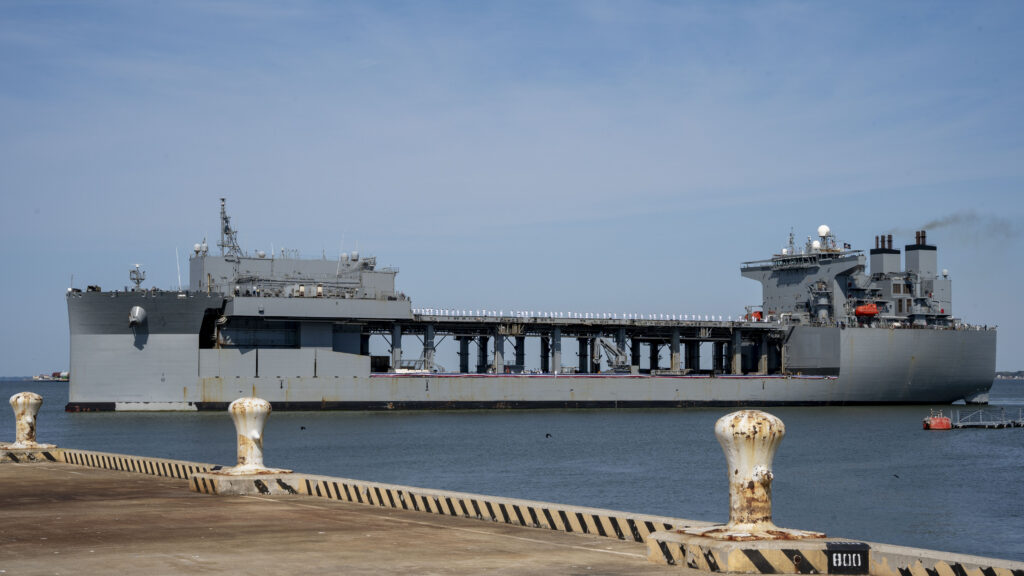
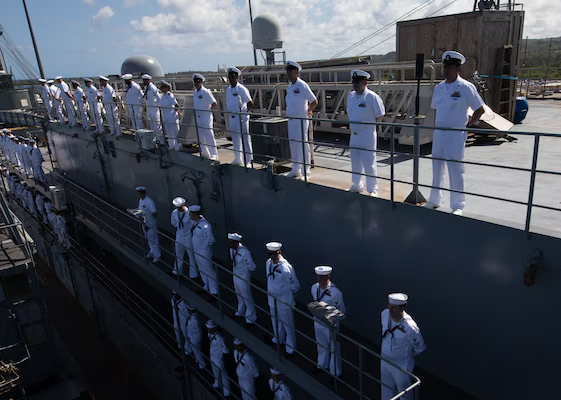
The Lewis B. Puller-class expeditionary mobile base USS Hershel “Woody” Williams (ESB 4) returns to Naval Station Norfolk, April 10, 2025. Photo credit: U.S. Navy | Mass Communication Specialist 2nd Class Derek Cole

NAVAL STATION NORFOLK, Va. – The U.S Navy expeditionary sea base USS Hershel “Woody” Williams (ESB 4) returns to Naval Station Norfolk, April 10, 2025, after operating forward deployed for almost five years, supporting U.S. Navy and allied efforts in the U.S. Naval Forces Europe and Africa / U.S. Sixth Fleet area of operations. 

Hershel “Woody” Williams returns to Norfolk’s waters with a hybrid-manned crew of 44 Military Sealift Command (MSC) civil service mariners who operated, navigated, and maintained the vessel and 85 U.S Navy Sailors, Blue and Gold crews, who alternated manning the vessel and allowing for continuous strategic deterrence patrols. 
 
“This is a unique opportunity to welcome home a hard-working ship from its historic tenure forward-deployed, and to welcome home its crew – its heart, soul and lifeblood – in classic Navy fashion,” said Rear Adm. Dave Walt, commander of Expeditionary Strike Group 2, who was on hand to welcome home the Hershel “Woody” Williams crew. 

“This crew has punched above its weight and impressed leadership with its hard work, resourcefulness, and dedication.” 
 
The evolution marks the completion of 59 months as a Forward Deployed Naval Force (FDNF) vessel homeported in Souda Bay, Crete, Greece, a journey that began in 2020. Hershel “Woody” Williams will spend a week at Naval Station Norfolk, offloading fuel before shifting to the East Coast Repair and Fabrication Shipyard in Newport News, Va., where the ship will be in lay berth awaiting its next tasking. 
 
Built as a highly flexible mobile platform, capable of operating across a broad range of military sea-based operations, Hershel “Woody” Williams had several noteworthy highlights throughout this deployment. 
 
In 2020, Hershel “Woody” Williams became the first U.S. Navy warship assigned to AFRICOM due to the ship’s ability to support maritime security and humanitarian operations. 
 
In 2021, during AFRICOM’s largest, premier, joint, annual exercise, known as African Lion, Hershel “Woody” Williams participated in a key leader engagement with Morocco Armed Forces, hosted by Morocco, Tunisia, and Senegal. 

“These engagements are critical as they allow Navy leaders to interact with partner nations to foster trust and build long-term partnerships,” said MSC’s ESB Project Officer William Revak. 
 
In 2022, Williams joined forces with partners and allies for Obangame Express 22, the largest multinational maritime exercise in Western Africa, to improve communication and information sharing and to increase partner nation capability to further advance maritime security and stability, said MSC’s Program Manager, Prepositioning Ships, Lora Caldwell. Additionally, the ESB-4 platform was used to conduct visit, board, search, and seizure (VBSS) drills with French soldiers. 

“VBSS training with partner nations contributes greatly to a more stable and secure global maritime environment,” Caldwell said. 
 
In 2023, Hershel “Woody” Williams conducted humanitarian and disaster relief operations, delivering 113 pallets of disaster relief supplies, totaling nearly 40,000 pounds, to The Ministry of Interior Disaster and Emergency Management Presidency in Mersin, Türkiye for those citizens impacted by the Feb. 6, earthquakes. 
 
In 2024, the Gold-military crew and MSC’s civilian mariners conducted community relation events in Tema, Ghana to continue building their mutual commitment to security and stability in the region which helps to enhance the Navy’s operational readiness. The Hershel “Woody” Williams crew also conducted a theater security cooperation mission during the ship’s visit to Luanda, Angola. Likewise, they managed regional cooperation operations (logistical and personnel support) while in Port Victoria, Seychelles. While there, the ship hosted U.S. Ambassador Henry Jardine and Brig. Gen. Michael Rosette, chief of the Seychelles Defense Forces. 

“We will continue to share information with the United States of America in the fight against illegal activities within the Indian Ocean,” Rosette stated in Seychelles Nation, dated Sept. 4, 2024. 
 
Throughout Williams 59-month deployment, MSC’s CVIMARS and the Navy’s Blue and Gold crews were instrumental in further enhancing Navy readiness, strengthening partnerships, and improving the combined capabilities of the U.S. Navy and partner nations’ responses to public crisis, Caldwell said. 
 
ESBs primarily support aviation mine countermeasures and expeditionary forces missions. Additional ship features include a large flight deck and hanger with four aviation operating spots capable of handling MH-535E equivalent helicopters and MV-22 Osprey tiltrotor aircraft, berthing and messing accommodations, workspaces and ordnance storage for embarked forces. 
 
ESB 4 is named in honor of Chief Warrant Officer Hershel “Woody” Williams, a decorated U.S. Marine who was awarded the Medal of Honor for his actions during the Battle of Iwo Jima during World War II. 


HII Recognizes Australian Firms at Sea Air Space 2025, Advancing AUKUS Industrial Integration

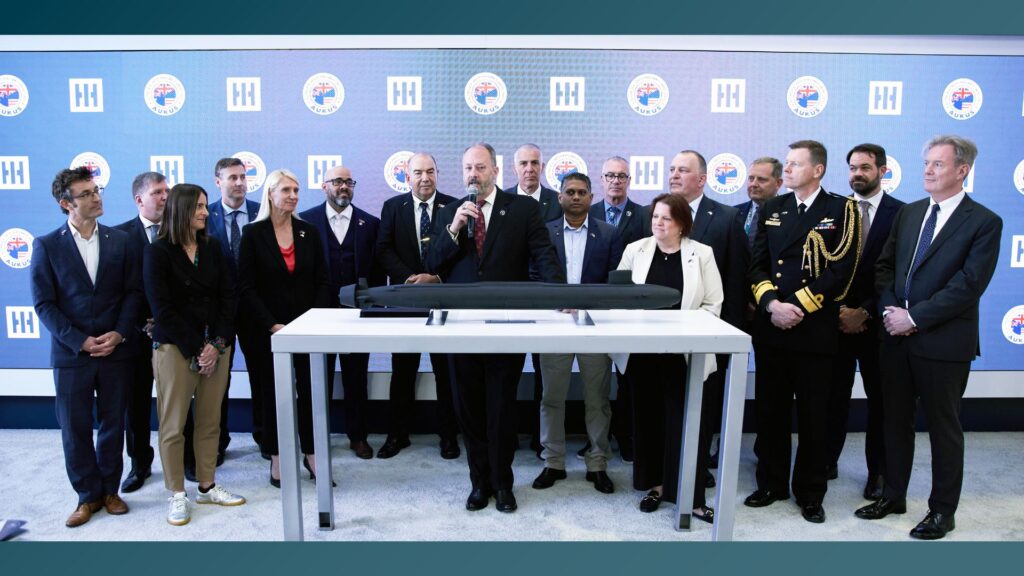
Representatives from five Australian companies were presented with certificates recognzing their participation in HII-led supplier development initiatives. Photo credit: HII

NATIONAL HARBOR, Md. — At the HII booth during the U.S. Navy League’s annual Sea Air Space 2025 Expo, representatives from five Australian companies were presented with certificates recognizing their successful participation in HII-led supplier development initiatives and received a Newport News Shipbuilding (NNS) supplier identification number. 

The supplier development initiatives include state-led Supplier Capability Uplift Programs, which will feed into the new Australian Submarine Supplier Qualification (AUSSQ) program, announced by Deputy Prime Minister Richard Marles on March 6, 2025. 

Eric Chewning, executive vice president of strategy & development for HII; Cullen Glass, vice president of supply chain management for HII’s Newport News Shipbuilding; and Michael Lempke, president of the global security group at HII’s Mission Technologies division, presented certificates to: 

  • Century Engineering (South Australia) 

  • MacTaggart Scott Australia (South Australia) 

  • Hofmann Engineering (Western Australia) 

  • Levett Engineering (South Australia) 

  • VEEM Ltd. (Western Australia) 

The supplier identification number signifies that, upon full certification through the AUSSQ process, these companies are qualified to participate in the NNS supply chain in support of nuclear-powered submarine construction. 

Also in attendance were Rear Adm. Ian Murray, Australian Defence attaché; Linda Dawson, deputy director general for industry, science and innovation, Western Australian Government; and Sir Nick Hine, executive director of H&B Defence and former second sea lord of the Royal Navy. 

This milestone reflects deepening industrial integration under the AUKUS trilateral security partnership between Australia, the United Kingdom and the United States. HII’s work, under contract with the Australian Government, supports the development of sovereign industrial capabilities and enables Australian companies to enter U.S. defense supply chains. 


Sea-Air-Space: Lockheed Martin Touts Readiness to Build ‘Golden Dome’ Missile Shield

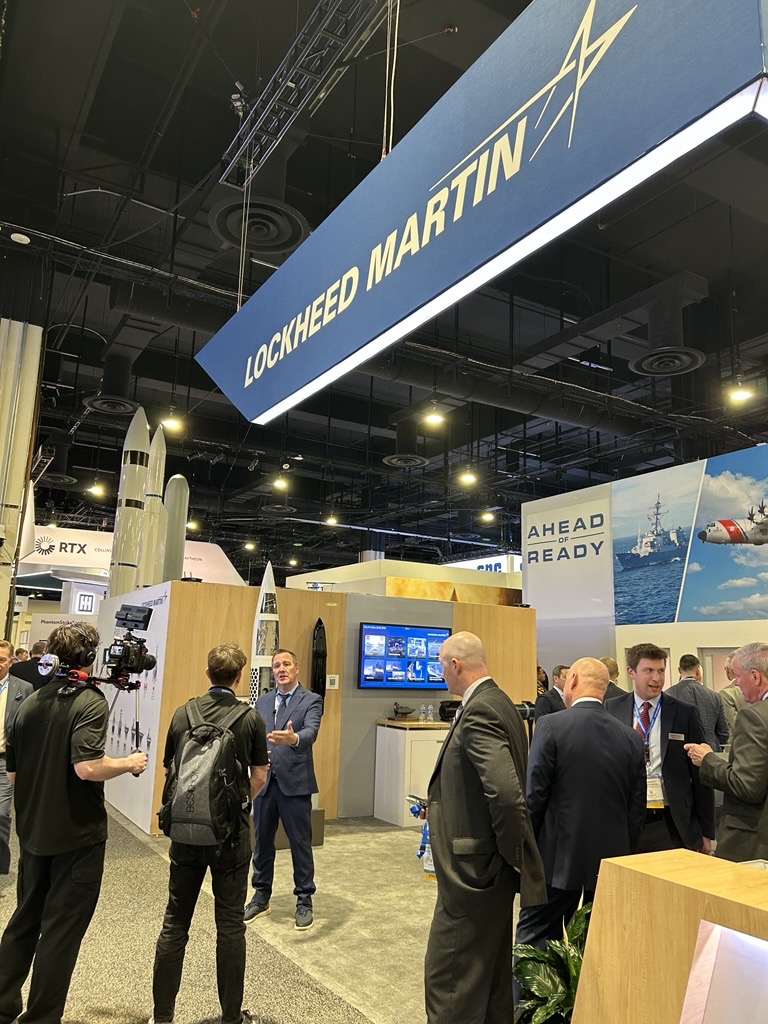
Lockheed Martin’s Dan Tenney speaks with reporters at Sea-Air-Space 2025. Photo credit: Lockheed Martin

A representative from Lockheed Martin said at Sea-Air-Space 2025 the firm is “ready now” to help the nation stand up the “Golden Dome” missile defense system, a new priority of the Trump administration that resurrects some aspects of the Reagan-era Strategic Defense Initiative.

“What does it mean to be ready now? I think it means we have systems that are fielded, they’re operational, they’re proven,” said Dan Tenney, vice president of Strategy and Business Development for Lockheed Martin’s Rotary and Mission Systems section. “They’re actually in operation today.”

A Jan. 27 White House executive order calling for America to develop its own version of Israel’s Iron Dome air defense system unleashed a flood of activity in the defense community. This comes as the government develops the fiscal 2026 defense budget request to Congress, which reportedly could approach $1 trillion, to jumpstart Golden Dome and to support the many other defense priorities.

A March 19 story published by DOD News confirmed the Pentagon is working to bring the Golden Dome from concept to reality.

“Consistent with protecting the homeland and per President Trump’s [executive order], we’re working with the industrial base and [through] supply chain challenges associated with standing up the Golden Dome,” said Steven J. Morani, acting undersecretary of defense for acquisition and sustainment, in the article. “This is like the monster systems engineering problem. This is the monster integration problem.”

This is also a costly proposition. So far, the United States has funneled around $3 billion to Israel — an 8,500-square-mile country roughly the size of New Jersey — for batteries, interceptors and other costs related to Iron Dome, which it stood up in 2011, according to a 2023 Congressional Research Service report.

Establishing a missile defense system covering the entire United States — with a land area of nearly 3.8 million square miles — is estimated to cost billions of dollars annually and present many more barriers to success.

Nevertheless, Tenney said Bethesda-based Lockheed Martin is well positioned to assist.

“We think the future is really going to be around this integration,” Tenney said. “We do operate from seabed to space,” he said, with deep experience developing systems in global positioning, missile warning and tracking, radar, missile defense, high-energy lasers and other capabilities.

“When I think about Golden Dome,” Tenney said, “in so many ways I think we’re going to use existing systems but bring them together.”


USS Emory S. Land returns to Guam

From Seaman Apprentice Mario Reyes Villatoro, April 9, 2025

NAVAL BASE GUAM – The submarine tender USS Emory S. Land (AS 39) returned to its homeport in Apra Harbor, Guam, April 9, 2025. Emory S. Land’s arrival marked the completion of its expeditionary submarine tender deployment, which began May 17, 2024.

Emory S. Land conducted 17 port calls in the Indo-Pacific region over 11 months, strengthening relations with many allies and partners such as Australia, Japan, Republic of Korea, and Singapore. During its deployment, Emory S. Land played a pivotal role supporting Pillar 1 of the AUKUS security partnership between Australia, the United Kingdom, and the United States.

In the first half of deployment, Emory S. Land conducted a Submarine Tendered Maintenance Period, or STMP, with the Virginia-class fast-attack submarine USS Hawaii (SSN 776) in HMAS Stirling, Western Australia, Australia, from Aug. 22 to Sept. 10, 2024. Royal Australian Navy Sailors who had been attached to the submarine tender since January 2024 took the lead on conducting repairs aboard Hawaii. The STMP was the first time Australians had ever performed maintenance on a nuclear-powered submarine in Australia. Emory S. Land Sailors also worked in conjunction with the Royal Australian Navy’s Fleet Support Unit-West, which provides repair and maintenance services to the Australian fleet.

“It is an honor and pleasure to return home to Guam. The entire crew, military personnel and civil service mariners, have performed exceptionally well over the last 11 months and have lived up to the ship’s motto “Tireless Worker of the Sea,” and are ready to come home and enjoy quality time back at home with family and friends,” said Capt. Kenneth Holland, the ship’s commanding officer. “This whole deployment has been an incredible journey, to be able to form closer ties with our allies and interact with the locals by hosting tours of our ship and taking part in community relation events. It’s all been a wonderful experience.”

Emory S. Land departed from its final port of the deployment, Darwin, Northern Territory, Australia, on April 2nd, 2025. While in port, Emory S. Land provided logistical support to the Virginia-class fast-attack submarine USS Minnesota (SSN 783).

“I was glad we returned to Darwin and got to enjoy Australia again, and it was a great to spearhead support for the nuclear submarine in Darwin for the first time in 27 years,” said Chief Gunner’s Mate Brett Peterman. “I can’t wait to enjoy some rest and relaxation, and to spend time with the family, before getting back into supporting Guam deployed submarines.”

During its deployment, Emory S. Land visited Darwin, Cairns, Sydney, Eden, Melbourne, Adelaide, and Perth in Australia; Sasebo and Okinawa in Japan; Palau, Busan, Brunei, Singapore, Thailand, and Subic Bay, Philippines. In each port, Emory S. Land Sailors conducted community relations events by assisting local school programs, participating in beach cleanups, sorting food at foodbanks, and much more.

“It was a unique opportunity to conduct so many community relations events across the region. Reflecting on our tour, I believe the real impact is learning about the difference we’ve made with our allies around the world during each event,” said Religious Program Specialist Seaman Hunter Stewart. “The local community members were always grateful for our team.”

Guam is home to the U.S. Navy’s only submarine tenders, USS Emory S. Land (AS 39) and USS Frank Cable (AS 40), as well as four Los Angeles-class attack and one Virginia-class attack submarines. The submarine tenders provide maintenance, hotel services and logistical support to submarines and surface ships in the U.S. 5th and 7th Fleet areas of operation. The submarines and tenders are maintained as part of the U.S. Navy’s forward-deployed submarine force and are readily capable of meeting global operational requirements.


Saildrone Announces European Expansion Based in Copenhagen

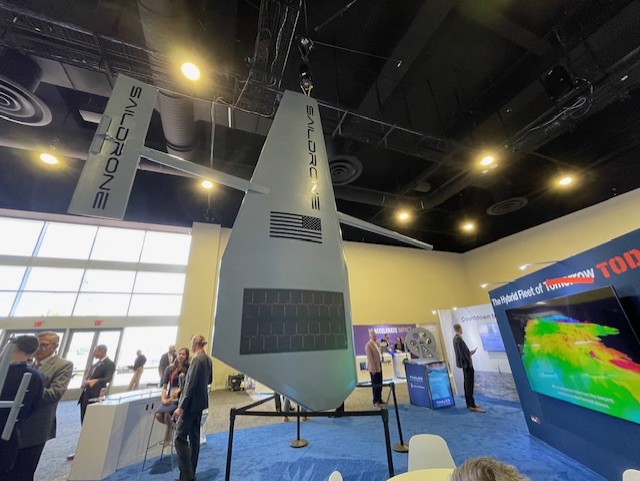
Saildrone’s booth at Sea-Air-Space 2025. Photo credit: Seapower magazine

WASHINGTON, D.C. — Saildrone announced it is establishing a European subsidiary in Denmark to address the urgent need for maritime domain awareness in European waters.

Announced at the Maritime Industry Symposium at the Danish Embassy in Washington, D.C., Saildrone Denmark will be a European entity, based in Copenhagen, Denmark. This strategic expansion reflects Saildrone’s commitment to supporting European allies in enhancing maritime situational awareness through advanced autonomous technologies.

“Given the recent sabotage of critical undersea infrastructure in the Baltic Sea, the need for permanent maritime domain awareness has never been greater,” said Richard Jenkins, Saildrone founder and CEO. “I am delighted to announce the establishment of Saildrone Denmark to facilitate our European operations and support allied nations, at this critical time for regional maritime security.”

With increasing geopolitical tensions and rising activity in the Baltic Sea, the need for persistent maritime intelligence is paramount. Saildrone unmanned surface vehicles (USVs) offer unmatched endurance and resilience, capable of operating autonomously for extended durations in the world’s harshest maritime environments. Equipped with a suite of advanced sensors, these systems deliver real-time ISR above and below the surface — enabling the detection of anomalous behavior, monitoring of vessel traffic and the protection of national interests in strategically sensitive waters.

In addition to surface surveillance, Saildrone vehicles will conduct detailed ocean floor mapping, delivering a critical advantage in monitoring and securing subsea infrastructure such as pipelines, communication cables, and offshore energy platforms. Pairing high-resolution seafloor imagery with proprietary machine learning algorithms enables early detection of potential threats or anomalies, enhancing Europe’s ability to safeguard its undersea assets against both conventional and hybrid threats.

Denmark is uniquely situated in the center of the European maritime environment, with coastlines on both the Baltic and North Seas. Saildrone Denmark will be the hub for all European operations, employing local staff to provide support, training, and mission planning capabilities to regional customers and partners.