USS Shiloh Returns to Home Port After Oceania Maritime Security Initiative 2025
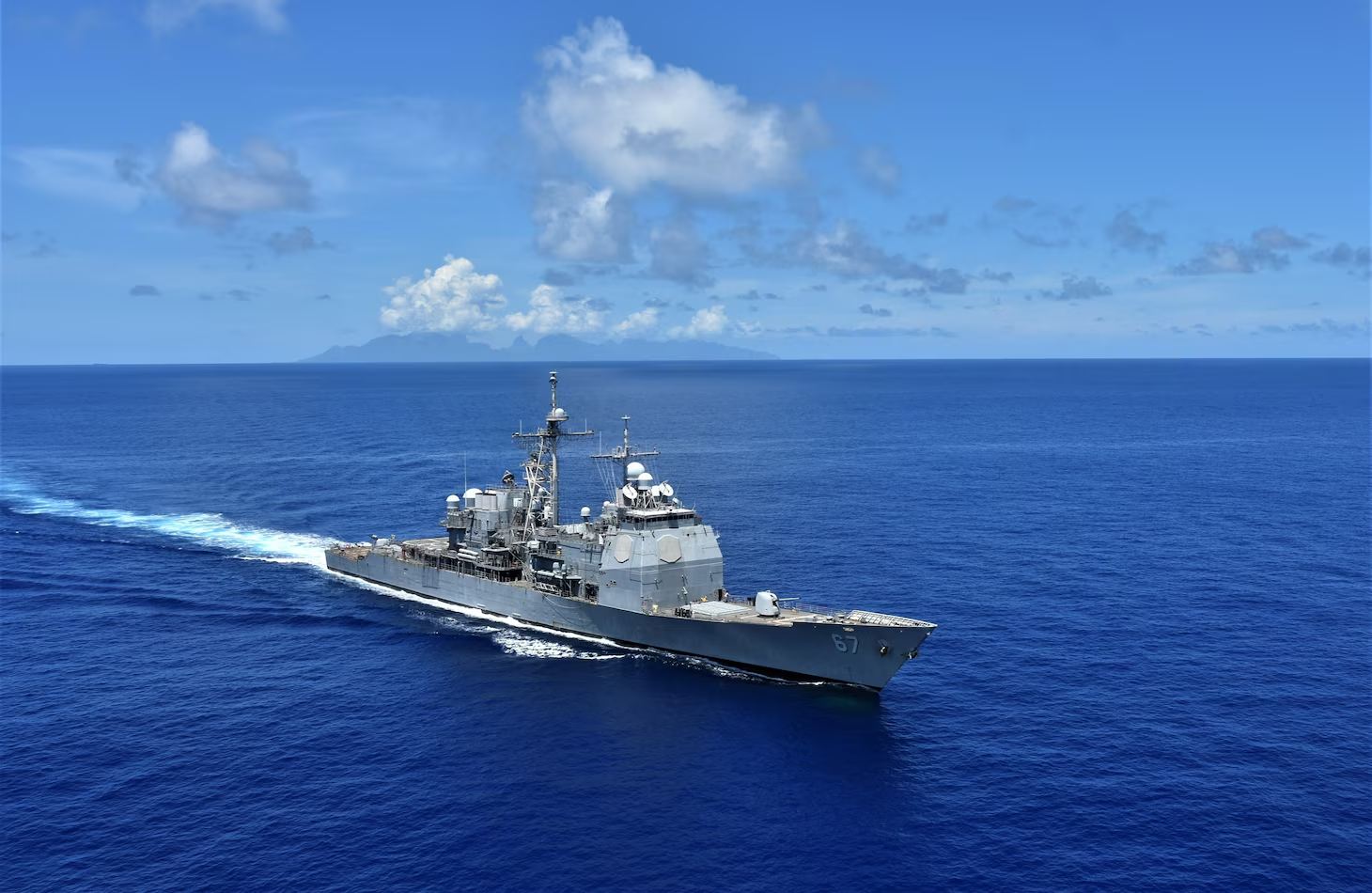
USS Shiloh (CG 67) patrolled, and conducted several boarding and intelligence gathering operations in the South Pacific region in support of Oceania Maritime Security Initiative 2025. Photo credit: U.S. Navy | Commander, U.S. 3rd Fleet.
From U.S. 3rd Fleet, April 7, 2025
PEARL HARBOR, Hawaii — The Ticonderoga-class guided-missile cruiser USS Shiloh (CG 67) returned to its home port, Joint Base Pearl Harbor-Hickam, April 4, 2025.
Shiloh, in partnership with an embarked Law Enforcement Detachment (LEDET) from USCG Pacific Tactical Law Enforcement Team, conducted several boarding and intelligence gathering operations in the South Pacific in support of Oceania Maritime Security Initiative (OMSI) 2025. OMSI is a Secretary of Defense program that leverages Department of Defense assets transiting the region to increase the USCG’s maritime domain awareness, ultimately supporting maritime law enforcement in Oceania.
From February 2025 to April 2025, Shiloh patrolled the South Pacific, strengthening relationship with partner nations and ensured maritime stability and security in the region. These actions were carried out through the enforcement of provisions of the Western and Central Pacific Fisheries Convention (WCPFC) and bilateral law enforcement agreements it has with specific countries in the region.
Captain Bryan E. Geisert is the commanding officer aboard Shiloh.
“I am proud of what our crew accomplished and the strong partnership with our Coast Guard Shipmates’. It is a critical and unique opportunity to assist in ensuring marine resources are protected through the enforcement of international laws to enhance regional stability.” said Capt. Geisert.
Shiloh is operating in the U.S. 3rd Fleet area of responsibility in support of the security and stability of the Indo-Pacific region. Shiloh is assigned to Commander, Naval Surface Group Middle Pacific, a combat-ready force that protects and defends the collective maritime interest of its allies and partners in the region.
Navy Commissions Attack Submarine USS Iowa
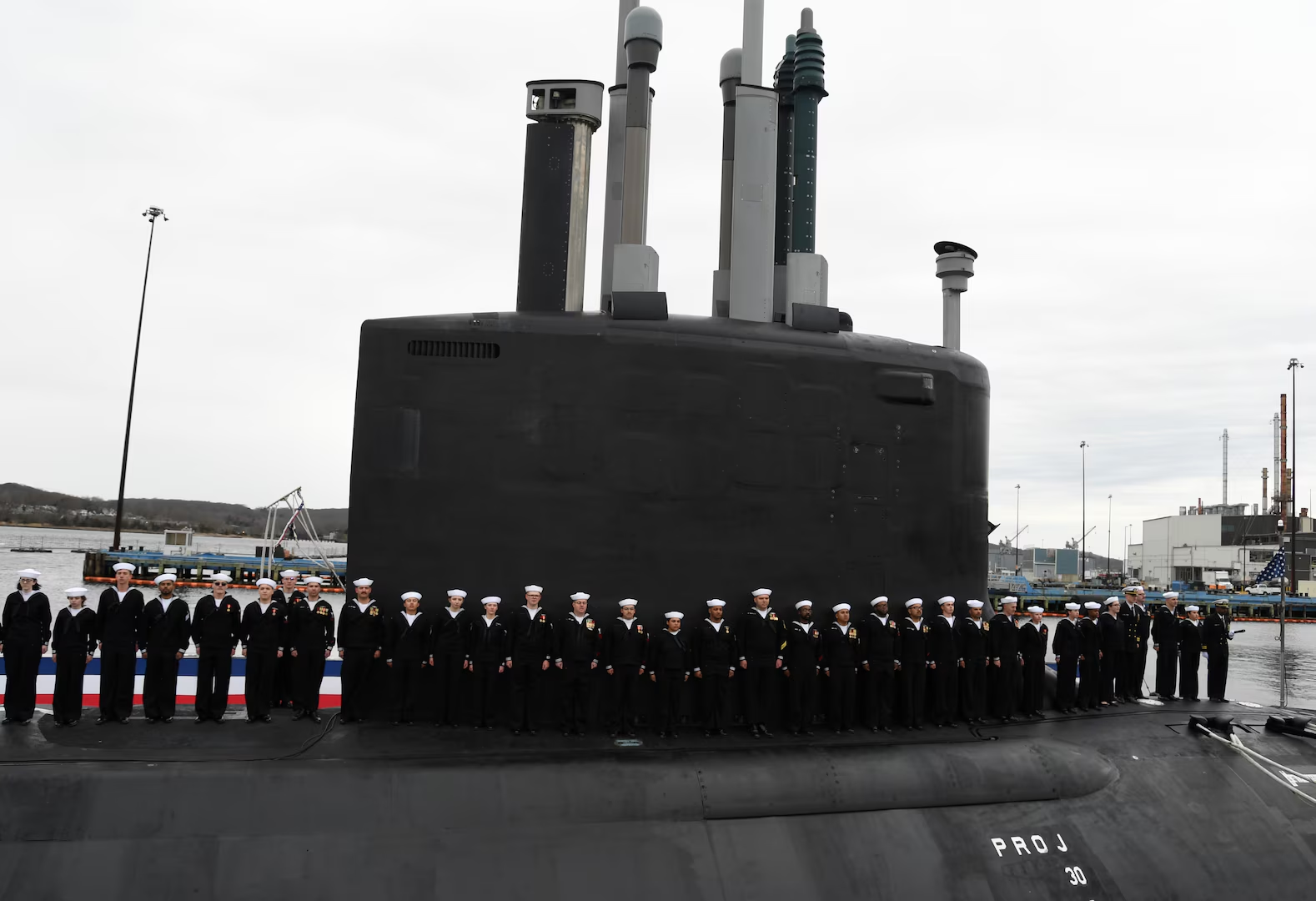
Sailors attached to the fast-attack submarine USS Iowa (SSN 797) man their newly commissioned submarine during a ceremony in Groton, Connecticut, April 5, 2025. Photo credit: U.S. Navy | Chief Petty Officer Joshua Karsten
By Joe Markowski, Submarine Readiness Squadron 32, April 7, 2025
GROTON, Conn. – Christie Vilsack, Iowa’s sponsor and former First Lady of Iowa, gave the crew the traditional order to “man our ship and bring her to life,” after which Iowa’s sailors responded “aye aye ma’am” before ceremonially running aboard the submarine.
The ceremony culminated a years-long process of commissioning SSN 797, the first submarine and third naval vessel named for the Hawkeye State. The most recent USS Iowa, the highly decorated WWII-era battleship BB 61 (1943-1990), saw action in World War II, the Korean War, and Gulf War. The first BB4 Iowa (1897-1919) saw action in the Spanish-American War and World War I.
Iowa’s commanding officer Cmdr. Gregory Coy, a Walnutport, Pennsylvania native and 2006 graduate of the U.S. Naval Academy, called the event “a historic milestone” during his speech, praising the crew, shipbuilders, and commissioning committee.
“This event is significant for both the life of a submarine and for the amazing people from the Hawkeye State,” Coy said. “To the plank owners, the shipbuilders, the commissioning committee, and our Navy and Submarine Force leaders, this is your submarine.”
Coy took command of Iowa in June 2024 and led the crew from the shipyard and through a series of sea trials, to today’s commissioning and subsequent underway operations.
“I am consistently humbled at what we have accomplished” Coy added. “Today, we become the ‘USS’ Iowa, and I intend to take her to the frontline, continuing the Navy’s overwhelming display of undersea dominance and lethality.”
Iowa’s youngest plankowner – an honor given to commissioning crewmembers – Seaman Lilly Runyon shared her excitement, saying “today’s a lot bigger than I thought it would be.”
“It’s kind of like I’m already used to this,” said Runyon of her sea trials as a PCU. “But now that we’re commissioned, it’s going to feel a little bit more official and I’m very excited for actual operations and figuring things out.”
Secretary of the Navy John Phelan praised the crew and the shipbuilders during his speech calling the ceremony an “opportunity to show Navy lethality and our unmatched undersea superiority.”
“It is an honor to commission the Navy’s newest nuclear-powered attack submarine, here at Groton, the submarine capital of the world,” Phelan said. “USS Iowa will make our fleet stronger and more lethal. As Iowa goes to sea, she does so with one mission: to ensure that America’s adversaries never doubt our resolve.”
Adm. Daryl Caudle, U.S. Fleet Forces commander and senior naval officer at the event, called his participation in the event a homecoming to the submarine capital of the world, a place he called “the nation’s center of gravity for the steely-eyed killers of the deep.”
“In this coming year, this crew of proud American sailors will put this warship to sea and carry the name ‘Iowa’ to the far-flung corners of the globe projecting combat power for decades to come,” Caudle said. “It is the fearless warriors before me that turn this piece of metal weighing almost 8,000 tons – with hundreds of miles of fiber, cable, and piping systems – into a combat ship, a warship designed to decisively win our nation’s battles. Your preparation and execution to get this ship to commissioning day is nothing short of amazing.”
Other platform guests at the commissioning ceremony included Iowa Governor Kim Reynolds; Vice Adm. Robert Gaucher, U.S. Submarine Force commander; representatives from General Dynamics Corp.’s Electric Boat shipyard, U.S. Sen. Richard Blumenthal and U.S. Rep. Joe Courtney of Connecticut. The master of ceremonies was Lt. Cmdr. Scott Carper, executive officer of the USS Iowa.
Capt. Jason Grizzle, commodore of Iowa’s parent Submarine Squadron (SUBRON) 4, likened the success of the crew to the “hard work and dedication that directly mirror people from the Hawkeye State.”
“Iowa’s motto states that ‘our liberties we prize and our rights we will maintain,’” Grizzle explained. “This crew lives by that creed, evidenced today by this fine ship – built, manned, and prepared – in record time, ready to get out to sea where she belongs.”
Iowa, whose keel was laid in August 2019 and christened in June 2023, was designed with stealth and surveillance capabilities, as well as special warfare enhancements, to meet the Navy’s multi-mission requirements. The submarine is 377 feet long, has a 34-foot beam, can dive to depths greater than 800 feet, and operate at speeds in excess of 25 knots. Iowa has a crew of approximately 135 Navy personnel. It is designed with a reactor plant that will not require refueling during the planned life of the ship, reducing lifecycle costs while increasing underway time. The submarine was built by General Dynamics Electric Boat shipyard facility in Groton, Connecticut.
Fast-attack submarines are multi-mission platforms enabling five of the six Navy maritime strategy core capabilities – sea control, power projection, forward presence, maritime security and deterrence. They are designed to excel in anti-submarine warfare, anti-ship warfare, strike warfare, special operations, intelligence, surveillance and reconnaissance, irregular warfare and mine warfare. Fast-attack submarines project power ashore with special operations forces and Tomahawk cruise missiles in the prevention or preparation of regional crises.
How Marines are 3D Printing Lethality Behind Enemy Lines
An AM Marine talks to a member of the Northern Territory Chamber of Commerce about local manufacturing capability at the Land Forces 2024 Symposium.
Logistics in a Contested Environment: A New Operational Reality
Although Washington’s military focus over the past three decades has centered on counterinsurgency operations in the Middle East, the 2018 National Defense Strategy (NDS) marked a critical shift, as revisionist powers reignited long-term strategic competition across regions and theaters of operation. Chief among them, China — America’s pacing threat — has moved with speed and intent, creating flashpoints in the Indo-Pacific, complicating U.S. posture in the Middle East, and reshaping the strategic calculus in Eastern Europe.
“The world is a dangerous place, as evidenced by Putin’s adventures in Ukraine, the war between Israel and Hamas, the aggressive behavior of China, and other threats from Iran and North Korea,” said Glenn Lamartin, an acquisition expert and adjunct professor at Georgetown’s McCourt School of Public Policy. “These actors share neither our values nor our interests, and their behavior contravenes them. Because of this, we have recognized that our acquisition architecture needs to be fast and agile to respond to — and be resilient in the face of — these challenges.”[i]
In this new era of great power competition, navigating logistics in a contested environment has become a critical challenge, with adversaries targeting supply chains to disrupt U.S. military capabilities. Ensuring rapid and resilient resupply is thus essential for combat effectiveness.
In response to this new reality, the Marine Corps — guided by Force Design’s vision for modernization — is undergoing significant transformation to enhance its agility and resilience, ensuring that it can effectively confront and neutralize these evolving threats across multiple domains and contested environments. By introducing additive and advanced manufacturing, or 3D printing capabilities, Marine Corps Systems Command (MCSC) is bolstering commands’ abilities to rapidly produce critical parts in the field, further strengthening operational flexibility and effectiveness in the First Island Chain today.
3D Printing Warfighter Lethality
Recognizing this new operational reality, MCSC’s Program Manager for Combat Support Systems (PM CSS) is actively integrating additive manufacturing capabilities to the warfighter’s toolkit in order to streamline supply chains and enable on-demand fabrication of critical capability components.
According to Terry Ritchie, product manager for Maintenance and Support Systems, “AM capabilities are revolutionizing the Marine Corps across the range of military operations by flattening the supply chain and enhancing the Marine Air Ground Task Force (MAGTF) ability to achieve truly distributed operations. As the Marine Corps conducts operations over greater distances, AM capabilities will enable expeditionary forces to shorten supply chains by streamlining the fabrication authorization and approval process.”[ii]
Such capabilities are especially critical in the context of Expeditionary Advanced Base Operations (EABO), where mobile, distributed forces must be highly self-reliant. PM CSS’s Tactical Fabrication (TACFAB) and Expeditionary Fabrication (XFAB) systems enable forward-deployed units to rapidly produce essential items like unmanned aerial system components and vehicle repair parts, supplementing traditional supply chains that may be vulnerable or overextended.
Building on these capabilities, the Corps envisions leveraging forward-deployed 3D printing even further. In advanced operational environments, acquisition experts see the potential to produce essential components on the spot. While metal parts might not be made behind enemy lines, they could be manufactured on ships, advanced naval bases, or EABs with logistics support missions. Ideally, pre-positioning ships would be equipped as floating production facilities, capable of fabricating critical parts for vehicles and radar systems. This approach ensures that essential items are available closer to the front lines, enhancing the resilience and survivability of our supply chain.
This vision is already being tested. During RIMPAC 2024, Marines and engineers from the Naval Post Graduate School’s Consortium for Advanced Manufacturing Research and Education (CAMRE) demonstrated the power of onboard 3D printing on the USS Somerset.[iii] Shortly after deploying a hybrid-metal printer, the team successfully printed a critical component for the ship’s reverse osmosis pump — vital for producing clean water — after the original part failed. This rapid response not only maintained the ship’s operational readiness but showcased the potential for Marines to use 3D printing to address urgent repair needs directly at sea. By operationalizing AM capabilities on ships alongside our Navy partners, the Navy-Marine Corps team is leading the charge in ensuring that essential repairs and parts production can happen closer to the front lines, enhancing the flexibility and resilience needed in contested environments.
Yet in a contested Indo-Pacific, ships equipped with printers and feedstock materials alone can’t shoulder the entire burden. To truly fortify supply chains and meet the demands of an EABO environment, the Corps will need to leverage partner nation resources and industrial bases.
While the Advanced Manufacturing Systems team fields containerized machine shops and 3D printing shelters, there is a whole category of fabrication machines that are not easily made expeditionary. These machines are readily available in U.S. industries, producing repair parts for our equipment. In a peer-competitor conflict, where logistics will be contested from the continental U.S. and across every mile of the Pacific Ocean, it makes sense to identify and utilize similar machines within allied economies. CSS is already taking steps in this direction, actively collaborating with Australian partners out of Darwin in the Northern Territory — just one example of the team’s efforts to explore host nations’ potential to adopt commercial additive manufacturing as together we prepare to bring the fight tonight.
There are additive and subtractive machines commonly found in the U.S. industrial base that manufactures parts for the Department of Defense. Current supply chains rely on this industrial base for large-scale production, only to ship small quantities of parts across the globe to support Marines in the Indo-Pacific. As these globe-spanning supply lines become increasingly contested, the Marine Corps is focused on leveraging local host-nation industrial capabilities for on-demand production of repair parts to reconstitute equipment. This approach aligns with the EABO concept of “modern battlefield foraging” — but for repair parts. PM CSS is essentially building distributed and resilient nodes, with both military partners and commercial vendors, throughout the Indo-PACOM area of operations to lower distribution risks.
Advanced manufacturing starts with a digital file and ends with a physical part. While Marine Corps programs of record provide essential deployable fabrication capabilities, some machinery simply doesn’t lend itself to expeditionary use. By leveraging local industry, the goal is to enable Marines to use pre-positioned design files to produce parts locally. If a machine shop is making scooter parts, there’s no reason it can’t produce a bracket for military equipment — so long as the design is readily available and adaptable.
But combatant commanders won’t have to rely on faraway capabilities in the future fight. The XFAB, with its deployable workshops equipped for 3D printing and scanning provides Marines with the ability to fabricate repair parts and develop customized solutions directly in the field, with metal printing capabilities planned for FY26. These initiatives, alongside the introduction of the Advanced Integrated Mobile Machine Shop (AIMMS), aim to enhance and extend existing logistics capabilities, ensuring that Marines can overcome supply chain challenges, sustain operational readiness, and meet the demands of contested environments.
To fully capitalize on this capability, CSS is developing a globally accessible digital repository that ensures technical data packages for part fabrication are available across all logistics levels and can be easily shared with joint and allied partners. Known as the Digital Manufacturing Data Vault, this capability stores advanced manufacturing technical data packages, mitigating supply chain disruptions while addressing the challenges of intellectual property rights and OEM collaboration. By leveraging an agile acquisition pathway through a production Other Transaction Authority (OTA) contract, the team has been able to adapt commercial software tools to meet Marine Corps requirements.
“If you look systemically, what AM is bringing to the issue of logistics for a contested environment and the tyranny of distance in the Pacific — or any contested space — is a supplemental source of supply,” said Maj. Matthew Audette, Advanced Manufacturing Systems Team lead. “It’s not about replacing the existing supply system or original equipment manufacturer (OEMs); it’s about providing another sourcing option to fill gaps — whether due to long lead times, obsolescence, or material shortages — especially in the isolated environments where Stand-in Forces operate. We’ve often seen it as a kind of magic button where things just appear, but it’s time to recognize it as a crucial supplement to our supply chain.”[v]
In short, advanced manufacturing revolutionizes logistics by transforming how we sustain operations in the field. No longer bound by the limitations of traditional supply lines, Marines can now produce essential components like vehicle parts and medical tools directly in the combat zone. When something breaks, there’s no more waiting or scrambling for what we didn’t bring — it’s as simple as sending the request, and within hours, the needed part is being made and sent back to the frontline.
AM vs. our Adversaries: Lessons from Ukraine
Ukraine’s use of additive manufacturing on the battlefield offers a glimpse into how logistics designed for contested environments will shape future conflicts. Under immense pressure, Ukrainian forces have demonstrated how 3D printing can provide rapid solutions to logistical challenges, sustaining combat readiness in ways that traditional supply chains cannot. Their decentralized acquisition model — cutting through red tape to directly engage with industry — has allowed them to field cutting-edge technology with speed and flexibility. This is a playbook worth studying.
In an interview conducted by proxy for this story, an unnamed Ukrainian intelligence official in Kyiv detailed how additive manufacturing is being embraced by military and industry, rapidly reshaping the country’s defense capabilities. He explained that Ukraine is leveraging 3D printing technology across various sectors to produce critical components, enhance supply chain efficiency, and meet battlefield demands. Partnerships between private industry and the military have enabled adaptive logistics and innovative solutions to sustain combat readiness, despite the challenges of operating in a contested environment.[vi]
But American industry partners are also on the ground in Ukraine, proving their capabilities against our stated adversaries on the 21st century battlefield.
KVG, a mission support company based in Gettysburg, Pennsylvania, deployed industrial 3D printers to Ukraine in 2022. According to John Boyer, company CEO, the use of company capabilities and workshop have been instrumental in designing, printing, testing, and refining emerging modifications and prototypes that are now being employed on the frontlines of the conflict. KVG’s team, including former U.S. Marines embedded in Ukraine, emphasizes the importance of additive manufacturing in the adaptation, innovation, and overcoming of logistical challenges in real time, ensuring readiness for the future fight.[vii]
After all, as one unnamed Ukrainian warfighter noted for this story, “Every single first-person-view drone strike relies on at least one 3D-printed component.”[viii]
But here, Ukraine’s success lies widely in its decentralized acquisition structure which allows it to move quickly to equip the warfighter — cutting through red-tape to engage directly with industry to field bleeding-edge technology at near-market speed.
The Way Forward/ Challenges
Although AM is proving to be the way forward in contested logistics environments, the state of the American industrial base and our adversaries’ proven intent to disrupt supply lines demand that we move quickly to incorporate AM into the warfighter’s toolkit.
To fully harness the potential of additive manufacturing for the future fight, the Corps must address several critical challenges. The post-COVID defense industrial base remains stressed, limiting the Department of Defense’s ability to tap into a broader network of suppliers. This issue is further complicated by the lack of access to technical data packages from OEMs, who are often reluctant or unequipped to sell or share proprietary designs. Securing and managing intellectual property effectively would enable the Corps to independently produce essential parts, ensuring operational readiness even when traditional supply lines are compromised.
The Digital Manufacturing Data Vault +must evolve to identify certain print files as “licensed” from OEMs, track the number of successful prints, and secure those files post-production. This technical advancement will be critical to shifting the OEM paradigm — moving from recouping investment in the sustainment phase of a program to incentivizing the sharing of technical data through adequate compensation and licensing.
While technical data remains a challenge for the DoD acquisition community to resolve, AM practitioners, thought leaders, and logistics experts across the Corps are working to standardize training and ensure that education keeps pace with the rapid advancements in technology. Once established, a certification program would ensure commonality in training and create a tiered, journeymen system from basic printer operation to advanced metal fabrication. In line with Talent Management 2030, this effort will help develop and retain the next generation of logistics experts, ensuring Marines are not only proficient but also adaptable in the face of rapidly evolving operational challenges.
After all, “When Marines are properly trained in additive manufacturing (AM), they can deliver solutions that greatly enhance readiness while saving taxpayer dollars,” Audette noted.
While significant progress has been made in the integration of additive manufacturing (AM) across the Marine Corps, challenges remain in gaining broader acceptance. Greater efforts are needed to highlight the innovative work being done and showcase how AM can be a powerful tool to enhance operational readiness.
There are pockets of excellence throughout the Fleet where AM units are stepping up to meet readiness requirements. However, since ingenuity is ingrained in the Marine Corps culture and expected, many of these accomplishments don’t receive widespread attention. Units complete the mission and move on to the next task – because that’s what Marines do.
Ultimately, additive manufacturing is the way forward for the Marine Corps, working with all elements of the joint force and partner nation forces. This technology is revolutionizing how we approach logistics, especially in contested environments, by enabling rapid, on-site production and reducing reliance on vulnerable supply lines. As we prepare to face multiple adversaries across diverse theaters, the Marine Corps is at the forefront of this critical innovation.
As the United States prepares to face our adversaries in the future fight, advanced manufacturing is more than just a capability — it’s an operational necessity ahead of tomorrow’s contested fight. Tomorrow’s battlefields won’t allow for the timelines of traditional supply chains or dependence on distant industrial bases; our adversaries are poised to exploit these vulnerabilities, and they’ve demonstrated their effectiveness in real life and simulated scenarios.[ix][x] with 3D printing as a critical logistics enabler, the Marine Corps ensures that the Joint Force — and our international partners — will have the flexibility and resilience to sustain operations wherever needed.
[i] Glen Lamartin, conversation with Johannes Schmidt, 25 October 2023.
[ii] Terry Ritchie, conversation with Johannes Schmidt, 6 June 2024.
[iii] Mass Communication Specialist 2nd Class Christian Corley, “3D Printer Solves Engineering Challenges Onboard USS Somerset,” Navy.mil, November 9, 2023
[iv] Lt. Cmdr. Chelsea Irish, “3D Printing Creates New Possibilities Onboard USS San Diego,” SurfPac, October 23, 2023
[v] Maj. Matt Audette, conversation with Johannes Schmidt, 18 November 2024.
[vi] Ukrainian intelligence official, interview by proxy, 3 December 2024.
[vii] John Boyer, email conversation with Johannes Schmidt, 21 December 2024.
[viii] Ukrainian warfighter, quote provided by KVG, 22 December 2024.
[ix] Brendan Cole, “Russia Threatens Ukraine’s Donetsk Supply Route with New Offensive,” Newsweek, October 9, 2023.
[x] Mark F. Cancian, Matthew Cancian, and Eric Heginbotham, The First Battle of the Next War: Wargaming a Chinese Invasion of Taiwan (Washington, DC: Center for Strategic and International Studies, 2023)
Sea-Air-Space: CMS Breakfast Panel Discusses How to Make Future Shipbuilding Shipshape
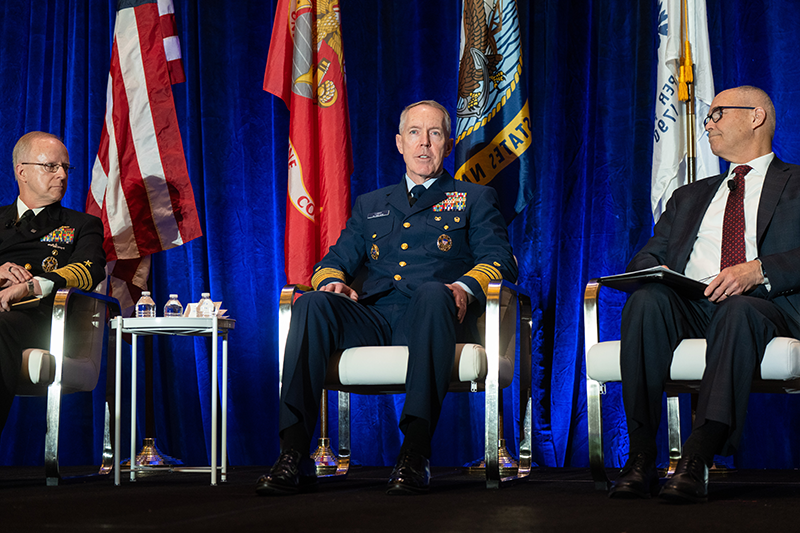
Navy, Coast Guard and industry officials discuss the rebuilding of the United States’ shipbuilding industry. Photo Credit: Dan Goodrich
During his March 4 joint address to Congress, President Donald Trump vowed to establish a new office of shipbuilding within the White House and “resurrect” America’s shipbuilding industry.
Implementing that vision poses both opportunities and challenges, said military and shipbuilding leaders during the April 8 Sea-Air-Space Center for Maritime Strategy Breakfast session, “Navigating Tomorrow: Forging a New Era in Innovation and Shipbuilding.”
U.S. Navy Admiral Daryl Caudle, commander of U.S. Fleet Forces Command, said one issue is there is a set of strategic assumptions regarding shipbuilding that most people take for granted, and those assumptions “limit intellectual honesty and our perspective about the size, scale and scope of our challenges.”
Caudle said the largest assumption has to do with combat shipbuilding capacity. He said it’s commonly thought the attack on Pearl Harbor awoke a sleeping shipbuilding giant, but “the only reason we were able to achieve that level of production was because of the groundwork of two years earlier.”
Caudle said there’s a tendency to focus on the decay of U.S. shipbuilding capacity since World War II, but before the war, the U.S. contributed a relatively small amount of global shipbuilding.
“I bring these up to show we have faced the odds before,” he said, adding he’s quite confident solutions are available as long as people are open and honest about the problems, the scale of those problems, and are proactive in solving them without having to undergo a crisis like Pearl Harbor and 9/11.
“Shipbuilding has taken on a prominence and importance we haven’t seen in a century. Coast Guard shipbuilding continues to move, but not move fast enough,” said U.S. Coast Guard Acting Commandant Admiral Kevin Lunday.
He said America is demanding more of its Coast Guard, “but we are less ready than in any time in our history since World War II.”
Admiral Daryl Caudle, left, Admiral Kevin Lunday and Rick Hunt share thoughts during the panel. Photo credit: Dan Goodrich
Lunday said Coast Guard fleet cutters and boats are at “significant decline,” and there’s a shift to almost complete corrective maintenance of the fleet. “No ship gets underway today without stripping another for parts,” he said. “The pace of modernization has not kept pace with the rate of change.”
However, there are positives on the horizon, Lunday said, citing the U.S. Coast Guard Force Design 2028’s transformative capabilities, along with significant government support. “I’ve not seen this level of support from [the Navy] secretary and the Office of Budget and Management certainly in my career, and maybe in our history,” he said.
Shipbuilding Perspective
A trio of shipbuilders closed out the panel presentations. Retired U.S. Navy Vice Admiral Rick Hunt, president of Fincantieri Marinette Marine, addressed shipbuilding from the perspective of the end user, including Sailors on a ship and operational commanders.
“I think the focus has to be on platforms that deliver top-level requirements, like combat systems, range, speed, durability and endurance,” he said. But there are challenges to achieving that. “Top of my list is readiness,” he said.
For instance, Hunt said maintenance is a key issue for surface warfare, and condition-based maintenance can be revolutionary. Cyber resilience is also important. “I think that’s where the next war starts and maybe the next war ends,” he said.
Hunt said he believes there needs to be continual engagement between the military and industry when it comes to shipbuilding.
“The primes, the subs and the suppliers — we need to bring all those guys in,” he said. “We can’t have a serial, time-consuming, somewhat bureaucratic process to identify things we need to change and understand the impacts of change. Remember, Sailors are the ultimate customers.”
Kari Wilkinson, executive vice president of HII and president of Newport News Shipbuilding, said she believes “now is the time to challenge what we think about the business. We do things in shipbuilding as we have since the beginning of time.”
But there is now the opportunity to use tools like algorithms and AI and integrate across portfolios, she said.
Mark Rayha, president of General Dynamics Electric Boat, said he’s heartened by the different attitude toward shipbuilding espoused by the current administration. “We talk a lot about the time we’re in — we need to do more; we need to deliver more,” he said.
Sea-Air-Space: Private Equity Floats Role in U.S. Military and Commercial Shipbuilding
A McKinsey & Company luncheon and a Navy-Coast Guard panel, shown here, at Sea-Air-Space both addressed the issue of investing to help spur the shipbuilding industry. Photo credit: Dan Goodrich
Could private equity investments and business practices jolt the United States’ shipbuilding industry, helping onshore military and commercial capacity to deliver more Navy ships “very fast, very soon,” as President Trump called for in his joint address to Congress last month?
In many ways, yes, argued Benjamin Plum and Christian Rodriguez, associate partners at McKinsey & Company’s Aerospace & Defense Practice, at a Sea-Air-Space 2025 luncheon April 7.
“In shipbuilding,” Plum said, “there’s more appetite for private capital than there has been before because of the stronger demand signals that we’re seeing, both [as] part of this administration but I think more broadly — right? This is a theme that’s continuing.”
Outstripping Capacity
Government, industry, associations and academia have in recent years agonized over ways to increase the speed and scale of shipbuilding — to meet Navy goals for building new ships; upgrading existing ships, submarines, and unmanned systems; and recruiting and training qualified Sailors and mariners. According to a report by the Congressional Budget Office, the 2025 Navy shipbuilding plan calls for 515 “naval platforms,” which includes 381 battle force ships (from 295 today) and 134 unmanned surface and undersea vessels. (The U.S. blue-water flag fleet for international commerce is less than 80 ships.)
“If fully implemented, the plan would eventually result in the fleet’s being larger than it has been at any time since 2001,” CBO said. “However, if the Navy is unable to reduce the maintenance delays that it has been experiencing for more than a decade, it would not be able to deploy as many ships as achieving its 381-ship goal would suggest.”
Speaking at a House Armed Services Committee’s Seapower and Projection Forces Subcommittee hearing last month, Brett A. Seidle, deputy assistant secretary of the Navy for research, development and acquisition, acknowledged the erosion of tier-one shipyards since the end of World War II. Contributing factors, he said in a March 11 DOD News article, include changing Navy requirements, acquisition red tape, worker shortages, and underinvestment and industry consolidation. “Cost and schedule performance remain challenging with deliveries approximately one to three years late and cost rising faster than overall inflation,” he said.
Renewed National Focus
To reduce delays and jumpstart the industry, the Trump administration is reportedly preparing an executive order to revamp the industry, including creating a White House office of shipbuilding focused on the issue. A bipartisan group of lawmakers late last year introduced the SHIPS for America Act, to oversee and provide consistent funding for U.S. maritime policy.
This situation could also present opportunities for private equity to step into the breach, Plum and Rodriguez said at the Sea-Air-Space event. “What we’re starting to see [in shipbuilding] is a desire for a more organized, tiered system like you would see in aerospace,” Plum said.
Risk-averse investors can look to the Navy shipbuilding plan and the federal budget for insights into opportunities in the naval shipbuilding market, Rodriguez said.
According to Plum and Rodriguez, private-capital investments can improve shipyard operations and combat the industry’s perennial problem of retaining skilled workers in the following ways:
Higher wage levels: “These are very, very difficult jobs that are done often outside in arduous conditions, and I think making sure the entry-level pay rate is right is very important,” Plum said.
Better quality of facilities: The industry needs climate-protected facilities that make the work doable and attractive.
Advanced technology: “We have to bring technology to shipbuilding in a way that other industries have done,” Plum said, including incorporating advanced manufacturing “to attract and retain new talent.”
More outsourcing: The shipbuilding industry is historically involved in every phase of ship construction. However, private companies can implement money-saving process efficiencies and develop modern, modular systems that improve ships, shipbuilding processes, and facilities.
Diversify the Industry
Navy and Coast Guard officials said at an afternoon Sea-Air-Space panel on priority defense investments that the government is doing more strategic outsourcing to spur shipbuilding.
The big yards can push component manufacturing to different locations to better produce on the timelines needed for a 30-year shipbuilding plan, said Gordon Jaquith, executive director of the Department of Navy Relations and vice president and director of the Systems, Tactics, and Force Development Division at CNA, a nonprofit research and analysis firm.
Yet big challenges remain. “The way to onshore an entire industry, meaning shipbuilding, back to the United States is not something we can do overnight,” said Rear Admiral Matt Lake, assistant commandant for resources and chief financial officer at the U.S. Coast Guard.
This requires addressing some of the root causes for stagnation in shipbuilding, he said, including barriers to entry for basic services in areas such as ship design, lack of an ecosystem of suppliers to feed parts into the industrial base, and federal domination that leads to monopolistic practices and undermines diversification.
“To solve that problem and bring shipbuilding back you absolutely have to look at the commercial sector as well,” Lake said.
Sea-Air-Space: Looking Ahead to a Modern Marine Corps
Major General Jason Woodworth makes a point during the panel on modernizing the Marine Corps. Photo credit: Dan Goodrich
Six years into its modernization initiative, the Marine Corps has a head start on some of its sister services. But there’s still more to be done, said panelists during the April 8 session “Modernizing the Marine Corps: Building an Agile, Lethal and Resilient Force.”
“It’s exciting and we need to go faster,” summed up Lieutenant General Eric Austin, deputy commandant for combat development and integration and commanding general of the Marine Corps Combat Development Command.
Austin emphasized the Marine campaign of learning and its influence on force design. “How we responsibly modernize the Marine Corps is how we execute force design,” he said.
Lieutenant General Benjamin Watson, commanding general, Training and Education Command, said the Corps has traditionally relied on brick-and-mortar training solutions, “but that’s not the world we’re in these days.”
He cited initiatives like Project Triumph’s emphasis on leveraging technology to be more efficient and effective, and Project Tripoli’s emphasis on a live, virtual and constructive training environment.
“We’re increasingly fielding more complicated and sophisticated systems that are tougher and more costly to train on. I think if you look at what we’re seeing in contemporary conflict, it’s not much of a stretch to say we will never fight again with what’s traditionally known as air superiority,” Watson said, citing the need for unmanned systems integration, data and artificial intelligence.
“It’s exciting, and we need to go faster,” said Lieutenant General Eric Austin. Photo credit: Dan Goodrich
“One of our mantras is the idea that any Marine using a precision weapon can kill someone who needs killing at 500 meters. But now that’s up to 15, 20 kilometers and beyond” through the use of technology like first-person view drones, he said.
Major General Jason Woodworth, commander, Marine Corps Installations Command, and assistant deputy commandant, Installations and Logistics, discussed the importance of Barracks 2030, noting that modernizing aging structures is one of the commandant’s top priorities.
“It’s where warrior and family readiness starts. If Marines are good at home, they’re better at work,” he said.
Brigadier General Robert Brodie, director, Expeditionary Warfare OPNAV N95, said he’s seeing good collaboration between the Marine Corps and industry on modernization initiatives. He said in terms of shipbuilding, the most successful companies have great relationships with other industry partners as well.
Brodie and the other panelists said to further facilitate Marine-industry partnerships, members of the Corps need to do a better job of defining exactly what they’re looking for from industry — including opportunities for industry to help them understand a problem, define the problem and shape solutions.
Air Force General Randall Reed, commander of U.S. Transportation Command, discussed the strength of the Navy-Merchant Marine connection on April 8. Photo credit: Dan Goodrich
Air Force General Randall Reed, commander of U.S. Transportation Command, walked attendees at the Navy League Luncheon on April 8 through a history lesson of national and international conflicts to show the importance of the team of the U.S. Navy and Merchant Marine.
As a boy growing up in the Hampton Roads, Virginia, area, he would ride his bicycle to the historic Fort Grove and watch commercial ships sail by, followed by gray Navy ships from Norfolk Naval Base.
“The inextricable link between Navy combatants and our commercial Merchant Marine, the combination of those two makes our country great and that is what also makes TRANSCOM great,” he said.
Throughout American history, the Navy, often at incredible odds, has made the waterways safe so merchant ships could carry supplies. Some of the historical issues are familiar to the audience at Sea-Air-Space, Reed said.
During this year’s conference, “We’ve talked about trouble with shipbuilding, we’ve talked about supply chains, we’ve talked about contested logistics, long distances. And the next fight we have coming up, there’s this thing about blockades we have to consider. We have very capable adversaries with very large fleets. There’s a need for shallow draft ships and we have to get the mission done for sustainment. If this isn’t enough to keep you up at night, then you probably miss the fact that I’m not talking about today. I’m actually talking about the challenges that we had during the Revolutionary War,” Reed said.
“And the message here, ladies and gentlemen, is we’ve been here before, and during that time we had just as much uncertainty.”
Lessons from other periods in history are also still relevant, Reed said, such as during the War of 1812, when the U.S. Navy swept away threats on the water, in this case Lake Eerie, so the Merchant Marine could supply the front lines from behind.
“So, in this case, once again, it’s the Navy being able to fight, set the conditions to get some kind of sea control, to allow the Merchant Marine to provide the sustainment that’s needed for the rest of the force.”
That carried on through two world wars, and especially World War II, when the Merchant Marine was called upon to perform sustainment heroics, at great cost to its ships and crews.
“And with that, we became the nation that the world needed us to be, to have great influence to partner with allies, partners and friends, in order to create a period of peace for the last 80 years that has delivered for all of us, I’m told, economic prosperity that the world has never seen,” Reed said. “And so with that, I want to take a moment to pause and say the combination of the Navy and the Merchant Marine at that time was really incredible and actually changed the world.”
Going forward, Reed said sustainment is still the “name of the game,” only now it’s contested by groups such as the Houthi rebels from Yemen who don’t have to have a lot in the way of resources.
The Merchant Marine needs newer ships and better equipment, Reed said, and he’s been telling that to supportive members of the U.S. House and Senate.
“I’m telling them that the ages of our ships right now are way too old, and we need to get younger ships and I’ll take them however I can get them. But the main thing is, it’s not necessarily for the ships and the platforms, it’s also for the proof force because we have a very capable proof force and they need the best in the biggest equipment that we can absolutely get for them.”
This was brought home to him during a recent visit to the Merchant Marine Academy in Kings Point, New York, Reed said. There, he witnessed 14 cadets receiving expeditionary medals from the secretary of transportation, a scene he said nearly brought him to tears.
“Think about that. Expeditionary medals on a cadet because as part of their education they take to sea, and these cadets have actually seen combat. They’ve actually been in harm’s way. They were actually telling us stories of what it’s like to sail past Yemen and watch things go over their head or to watch the Navy actually engage targets to protect them. And they were not afraid. In fact, they were ready to go back for more. And so, ladies and gentlemen, we need to do this for them.”
Medal of Honor winner Edward C. Byers Jr. was awarded the Admiral Arleigh Burke Leadership Award. Photo Credit: Dan Goodrich
Awards
Following the lunch, the annual Navy League Awards were presented:
The Admiral Vern Clark Individual Award went to Angelo Owens, the safety and occupational health division director at the Fleet Readiness Center East.
The Admiral Vern Clark Unit Safety Award went to Airborne Command & Control (VAW) 117 Wallbangers.
The General James L. Jones Individual Award went to Deputy Chief Ryan Tworek at Marine Corps Logistics Base Barstow, California.
The General James L. Jones Unit Safety Award went to Marine Corps Air Station Miramar, California.
The Albert A. Michelson Award went to Robert Taylor of Bardex Corp.
The Fleet Chester W. Nimitz Award went to Robert “Scott” Forney III of General Atomics Electromagnetic Systems.
The Admiral Arleigh Burke Leadership Award went to Master Chief Special Warfare Operator (SEAL) Edward C. Byers Jr., U.S. Navy, retired.
“I really do look out at this room and I see the fabric of America, the threads that hold our nation together during our most precious times” Byers said upon accepting the award.
Sea-Air-Space: Saildrone, Thales Australia Create Alternative to Traditional Surveillance Platforms
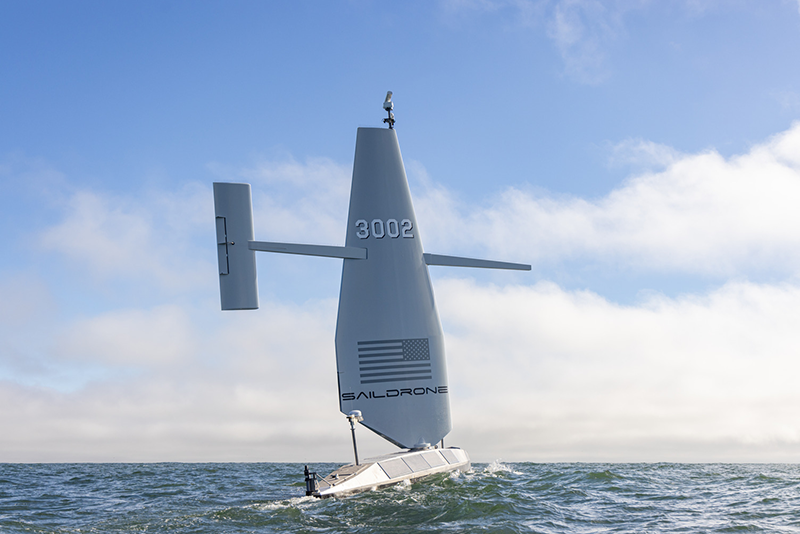
A Saildrone Surveyor SD-3002. Photo credit: Saildrone
Through a project funded by the Office of Naval Research, Saildrone (Booth 1905) has integrated its Surveyor with a BlueSentry thin-line towed array from Thales Australia (Booth 1247), creating a system for autonomous long-endurance undersea maritime domain awareness.
Extensive sea trials conducted off the coast of California have demonstrated this system can effectively detect and classify both underwater and surface threats and report this information to decision makers in real time. During the ONR trial, the Saildrone Surveyor and BlueSentry system operated continuously for 26 days and maintained uptime greater than 96%.
The trials showed that, under wind propulsion, the Surveyor provided a near-zero self-noise environment, significantly improving the detection capabilities of the BlueSentry sonar system.
Using Starlink and Iridium satellite communications, the system is capable of persistent, secure data transmission even in sensitive and remote locations that have significant operational challenges. The system is also designed to pave the way for greater naval interoperability between AUKUS partners and delivers on AUKUS Pillar 2 undersea warfare requirements.
Sea-Air-Space: Navy Spearheads Historic Investments in Shore Infrastructure
Representatives from government and industry discuss the need to update the nation’s aging shore infrastructure, including speeding ship construction through practical reforms. Photo credit: Erika Fitzpatrick
The U.S. Navy is modernizing the condition, configuration and affordability of its public shipyards and shore infrastructure, according to Rear Admiral Dean VanderLey, including by departing in some cases from traditional acquisition strategies.
“Our shore infrastructure on our Navy bases primarily [is] where we train our Sailors and maintain our ships and warfare platforms, and so is very critical to the ultimate readiness of our forces,” VanderLey, commander of Naval Facilities Engineering Systems Command, said April 8 in the panel discussion, “Revitalizing Shore Infrastructure: Meeting Modern Naval Demands.”
The Navy’s four public shipyards — Norfolk (Virginia) Naval Shipyard, Portsmouth (Maine) Naval Shipyard, Puget Sound (Washington) Naval Shipyard and Intermediate Maintenance Facility, and Pearl Harbor (Hawaii) Naval Shipyard and Intermediate Maintenance Facility — were first built in the 19th and 20th centuries.
“Now we’re using them to maintain nuclear-powered vessels,” VanderLey said. The youngest, Pearl Harbor, was founded in 1908 — the year the Ford Model T rolled off the assembly plant and was offered for sale at $850.
“After 100 years, it’s probably time to do something,” quipped panelist Mark Edelson, program executive officer for Industrial Infrastructure at the Department of the Navy. “Everything has gotten bigger and needs more power.”
Upgrading and Modernizing
Fortunately, Edelson said, the Navy has recognized the foundational element of naval installations to all the combat forces, and, in 2018, established the Navy’s Shipyard Infrastructure Optimization (SIOP) to upgrade shore infrastructure. Naval ports and bases face myriad issues, including aging facilities and equipment, insufficient utilities and information technology, lack of worker amenities, and rising waters in some places and diminishing sources of fresh water in others.
“We’re benefiting from historic investments in the shipyards to get after all of those things,” Edelson said.
SIOP, led by Program Executive Office, Industrial Infrastructure and supported by the Naval Facilities Engineering Systems Command, Naval Sea Systems Command and Commander, Navy Installations Command, to date has finished 44 facilities projects worth nearly $1.2 billion, according to the Navy. Another 48 projects are under contract for $6 billion in additional improvements, including construction of four dry docks and upgrades to shipyard utilities.
Some of these projects are hardly straightforward. A recent project to build a new Waterfront Production Facility at the Portsmouth Naval Shipyard required negotiating with the state historic preservation office to retain the building’s original architectural features while modernizing ship servicing capabilities and improving workflow.
“Now the light machine shop, the artisans, the engineers are all in the same building next to two dry docks to get the throughput that we need,” Edelson said.
Departing from Tradition
VanderLey said the Navy is making practical reforms to speed up infrastructure modernization by:
▪ Prioritizing resources. The Navy is first upgrading the most critical infrastructure, including dry dock improvements to support the “future force,” including USS Gerald R. Ford-class aircraft carriers, and future versions of the Virginia- and Columbia-class submarines.
▪ Reforming acquisition strategies.The Navy is in some cases departing from the traditional acquisition process, which typically involves firms bidding on Navy-defined requirements in design and construction. It’s now involving contractors earlier, to mold project design, VanderLey said. That’s helpful in complex infrastructure projects, he said, when cost and schedule are “less about what you’re building than about how you have to build it.”
The Navy is also awarding design-build-to-budget contracts, which allow flexibility and speed while controlling costs.
▪ Alternating construction methods. VanderLey said the Navy is capitalizing on the trend of “industrialized construction” or “off-site construction,” where certain parts or modules — child care centers, barracks, or dorms — are prefabricated off-site for later assembly into the overall build. “In Europe about 45% of their construction is done that way; in the United States, it’s about 5%,” he said.
“We see potential for savings in cost and schedule of roughly 30%,” VanderLey added. “So, we’re aggressively going after those types of approaches.”
Commercial shipbuilding faces similar challenges to the Navy in needing to upgrade its similarly aging infrastructure, in part to recruit and retain workers.
“People need infrastructure too,” said Roger Camp, senior director for Business Development, Naval Programs, at Hanwha Defense USA, a subsidiary of South Korean defense giant Hanwha Group, which purchased the Philly Shipyard last year for $100 million.
He said his firm is exploring ideas to make the maritime facility more attractive to workers, by locating parking closer to the plant, outfitting training areas with virtual reality tools, and expanding — not replacing — production resources through use of AI and robotics.
“We have to have technical infrastructure,” Camp said. “Not just piers not just buildings, but the actual facilities to be able to augment the humans that build our ships.”
Sea-Air-Space: U.S., Canada Support Investment to Maintain Arctic Security
Vice Admiral Angus Topshee, commander of the Canadian Navy, right, and Coast Guard Vice Admiral Tom Allan discuss polar security in a changing world. Photo credit: Seapower magazine
The U.S. Coast Guard was pleased to hear of President Trump’s interest in acquiring as many as 40 new icebreakers, said Coast Guard Vice Admiral Tom Allan, the acting deputy commandant for operations.
“Whenever your boss is interested in 40 icebreakers, you are very happy, right?” he said in response to a question during the April 7 panel on “Demanding Presence in the Poles: How a Good Arctic Strategy is Park of our National Security.”
“I mean, this has been something that we’ve been trying to do for a long time, I’ll tell you that,” Allan said.
They wouldn’t all need to be heavy icebreakers like the aging Polar Star, in service since the 1970s, he said, as studies have show the Coast Guard wouldn’t need more than eight or nine of those. There are smaller ships that could do icebreaking as part of their other functions, and some could be used on the Great Lakes.
Adding those in, “you get up to that 40 number pretty quick,” Allan said,” because that’s what we need … to make sure that domestic operations continue and that we are poised to have that presence in the high Arctic and Antarctic. So, I’ll just say it’s very exciting to see your boss point towards a vision that we’ve had for a long time.”
Blue Water and Commercial Activity
The United States and Canada must maintain a strong presence in the poles, especially as warming trends lead to more commercial activity, including shipping and mining, speakers from those nations said during the panel.
Operating in the region is challenging, the panelists said, not only because of ice but also from wind and fog, which can hamper aviation.
“So, having properly equipped vessels, training crews, and most importantly, [having] icebreakers is essential to giving the U.S. assured access to these critical areas,” Allan said.
“We must meet presence with presence, or even better, meet presence with strength. If we aren’t present, others will fill that void, nations whose interests may not align with ours or our allies. Russia controls nearly half of the Arctic, and we’re seeing increased cooperation between Russia and China in this space,” Allan said. “From resource shipments to military operations, we must lead the polar region … if we fail to act, we’ll be left on the sidelines, watching others shape the future of the region in ways that cannot serve our national interest.”
This is true for Canada as well, said Vice Admiral Angus Topshee, commander of the Canadian Navy.
Canada has made substantial investments in domain awareness in the region, from over-the-horizon radars to a network of subsurface sensors “designed to make sure we know what’s going on in that region,” he said, which includes adding six ice-breaking warships to its fleet.
The Arctic is remote to Canada as well, he noted. Going from Halifax, Nova Scotia, across the Atlantic and into the Mediterranean is a quicker trip than visiting the Arctic, he said.
“That’s a shorter trip than up into our Arctic. So, for us, it’s an expeditionary theater,” which means working closely with the territorial governments in the region to understand the security challenges they face.
Vice Admiral Doug Perry, commander of U.S. 2nd Fleet, said his fleet was stood up in 2018 “in recognition of there are some real threats that come from the Arctic and through the Arctic,” similar patterns of activity to the Cold War.
“We’re back to needing to be there with persistence today,” Perry said. That includes using space assets and radars for domain awareness and having ships in the region when needed.
“There’s less and less sea ice. There’ll be more and more blue water every day of the year going forward,” he said. “And so, that demands that if we value international freedom of the seas and international rules-based order, if you will, then we actually have to be there and be present and have persistent presence to demonstrate that we will enforce international law” even in some countries illegitimately claim to own particular sea routes.
Perry said seven of the eight Artic nations are members of NATO, “all of whom are thoroughly invested in Arctic security” and are making investments in their capabilities.