Sea-Air-Space: Mad Science, Marine Mammal Medicine Highlight 7th STEM Expo

A young attendee at STEM Expo is excited to learn about science. Photo credit: James Peterson

Hundreds of energetic students packed into the RiverView Ballroom at the Gaylord National Resort and Convention Center for the seventh year of the STEM Expo to kick off Sea-Air-Space 2025.

The event featured more than three dozen exhibits to help interest students in grades five through 12 to pursue a STEM career. It also threw in a little fun from presentations by Mad Science, which delivers innovative, educational science demonstrations aimed at children, and the National Marine Mammal Foundation, which showcased the Navy’s marine mammal program and let students get up close with an inflatable dolphin stand-in.

The STEM Expo drew not only students but high-level attendees from the sea service, including Chief of Naval Research Rear Admiral Kurt J. Rothenhaus.

“ONR is honored to be a part of this STEM event to get the word out to young folks around the country to think about a career in science, technology, engineering and mathematics,” Rothenhaus said. “I’m excited to see the many industry partners out this afternoon as well as our Naval Research Lab, all here to inspire the next generation to help build the future.”

The National Marine Mammal Foundation discussed how to keep Navy dolphins healthy. Photo credit: James Peterson

HII was the Champion Sponsor for the event and CACI sponsored the science stations.

Hands-on Fun

“In my section, we’re over there making a mess. We’re trying to teach them some buoyancy” by having students build small boats that carried weight, said HII’s William Abraira, a structural engineer at Newport News Shipbuilding, who works on submarine pressure hulls.

“We’re trying to explain water displacement to them but fun gets in the way and it quickly turns into a competition of who can hold the most marbles,” he said. “But it’s super important, it’s one of those basic principles in shipbuilding, and it just gets kids really excited.”

Perry Haymon, with HII’s Ingalls Shipbuilding, was helping hand out brightly colored plastic “hard hats” to students to emphasize the importance of safety.

“I work in research and development. So, I see the importance of those new things, those new technologies. To see young minds come in and get interested in what we do at the shipyard, as well as all of HII … is very important to us. We enjoy coming and seeing the faces of young people,” he said. “There’s a lot of energy here, from the people coming in, just getting hard hats, and also seeing the other events that we’ve got going on, from welding to virtual reality, and also building a boat to see how much weight you can actually carry.”

CACI had set up a booth where children could design their own hovercraft from common materials and test them in a wind tunnel. “It’s been such a fun experience getting to watch them do it,” said Sidney Finkenbinder, a media relations specialist at CACI. “Make one, test it out, see what they can change and make it better. That’s what it’s all about, getting to learn new things and try out new activities … getting to see their faces


Sea-Air-Space: Textron Offers the Tsunami USV Family for Multi-Purpose Navy Use

Tsunami, a small USV, is a joint effort by Textron Systems and Brunswick Corp. Photo credit: Textron Systems

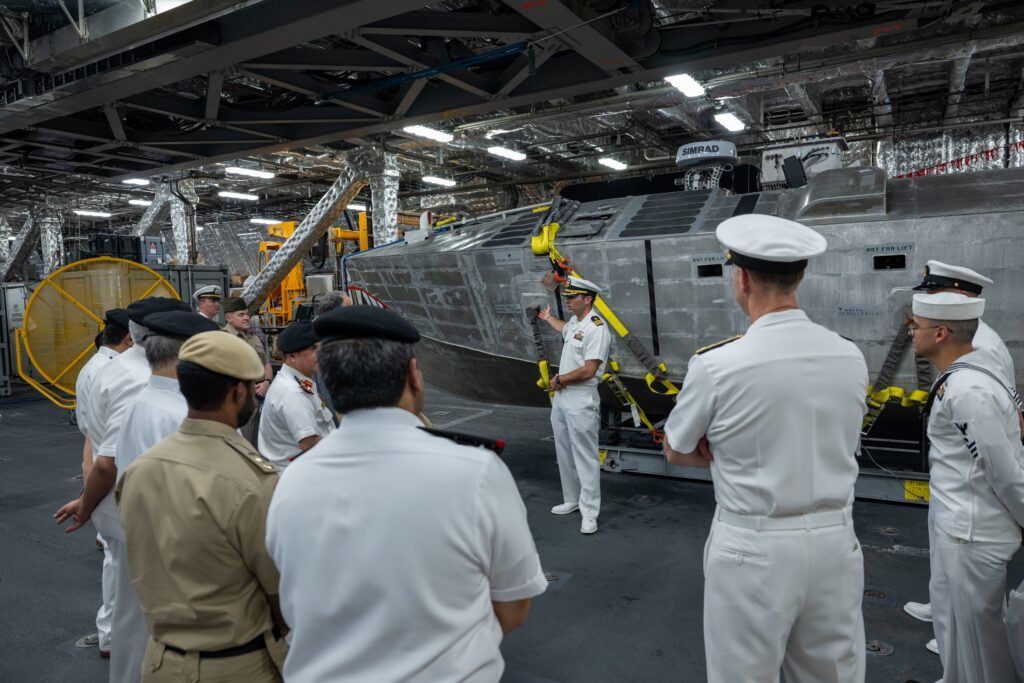
Textron Systems (Booth 1827, D1), originator of the Common Unmanned Surface Vehicle (CUSV) in U.S. Navy service, has developed a less expensive USV that could be used for a variety of missions and could even be considered attritable.

Textron is teamed with Brunswick Corp., a small craft manufacturer, to offer Tsunami, family of deployable, small, scalable, gasoline-powered outboard-engine craft, with hull lengths ranging from 14 to 42 feet long. Certain of the models have a payload capacity of 1,000 pounds, ranges between 600 and 1,000 nautical miles, and operable in Sea State 4.  

“We are the originator of the common uncrewed surface vehicle, the CUSV, for the Navy which was successfully adapted to become the Navy’s first unmanned surface vehicle program of record and which is being fielded to the littoral combat ship fleet now [for mine countermeasures],” said David A. Phillips, senior vice president, Air, Land & Sea Systems, Textron Systems, in a briefing to reporters. “Surface warfare that doesn’t necessarily require the power and the weight necessary in a mine countermeasure system.”

Phillips noted several mission sets that an inexpensive unmanned craft could take on, including port security, port surveillance, escort and training.   

“We have been in constant collaboration with Navy and commercial customers as to what a system like this might bring them in terms of operational flexibility [and] emerging mission sets,” he said. We continue discussion with the Navy — all elements of the Navy to include fleet as well as our particular programs in which we work. And we’ve been hearing an increased expression of interest in a small, rapidly deployable, unmanned surface vehicle that can support a variety of missions beyond mine countermeasures.”

Brunswick, builder of recreational watercraft of such product lines as Boston Whaler, Bayliner and Mercury Marine, has craft adaptable to Textron’s vision and has established supply lines.

“Brunswick’s portfolio of reliable high-performance vessels — their watercraft, propulsion systems, control systems — and manufacturing capacity and their global footprint along with our mature autonomy technology and systems integration capability was really the perfect combination to allow us to develop an accessible, rapidly deployable, and what I call a modular open systems architecture oriented family of vehicles or systems,” Phillips said.

“Brunswick’s technologies are already in mass commercial production and globally available. That allows us to reduce costs, risk, and production time when integrating and ultimately delivering these vessels. Their global footprint and mature resilience supply chain provides our customers with an unmatched support and aftermarket service.” 

Brunswick “has invested in and developed a built‑in drive-by-wire system for us to ramp our higher levels of operationally relevant autonomy that we’ve developed and delivered to the U.S. Navy and that we’ve proven through mine countermeasure unmanned surface vehicles and that we fielded operationally with the Navy and demonstrated through exercises like RIMPAC and FLEX,” he said.

Phillips said the Tsunami could be fielded rapidly.

“We recognize the need for a ready-now solution that harnesses the capability and capacity of the U.S. industrial base,” he said. “That’s important at being able to scale and being able to rapidly deploy systems when our customer wants them. … Speed. Speed to market. Speed to contract. Speed to delivery. Leveraging this mature production capability enables rapid production without the costs and risks of developing boutique manufacturing capability and scaling mass production. These watercraft are already in production.” 

The Tsunami craft is adaptable to swarming tactics, according to Textron.

“We’ve also done some testing in that realm,” Phillips said. “Although I’m not going to go into certain mission scenarios, the swarm is important and controlling multiple systems is important. We’ve done that for many years with our aircraft systems. We understand swarming of systems. We also understand the complexity associated with that. We have designed this system and we have demonstrated this system to operate multiple watercraft. I won’t get into how many.” 

The low cost of the Tsunami is key to the craft being attritable, Phillips said.

Asked by Seapower if the USVs used by Ukraine against the Russian navy were part of the inspiration for the Tsunami, Phillips replied that “it certainly informed us of that emergent need. … I am not presupposing what one of our customers might use our system for.”


Coast Guard Commissions USCGC John Witherspoon in Kodiak, Alaska

The Coast Guard Cutter John Witherspoon (WPC 1158) crew displays signal flags during the cutter’s commissioning ceremony at Coast Guard Base Kodiak, Alaska, April 3, 2025. The commissioning marked the first of three fast response cutters scheduled to homeport in Alaska and was presided over by Rear Adm. Megan Dean, commander of the Seventeenth Coast Guard District. (U.S. Coast Guard photo by Petty Officer 1st Class Shannon Kearney)

From U.S. Coast Guard 17th District Public Affairs, Apr. 3 2025 

KODIAK, Alaska — The Coast Guard commissioned its newest cutter, Coast Guard Cutter John Witherspoon (WPC 1158) for official entry into its service fleet during a ceremony held in Kodiak, Thursday.  

The ceremony was presided over by Rear Adm. Megan Dean, commander of the Seventeenth Coast Guard District. Members of the Witherspoon family were also in attendance, including the cutter’s sponsor, Regina Nash, the daughter of John Witherspoon.   

The Witherspoon is the 58th Fast Response Cutter (FRC) in the service and the first of three FRCs scheduled to be homeported at Coast Guard Base Kodiak. The crew of the Witherspoon will primarily serve in and around the Aleutian Islands, Bering Sea, Gulf of Alaska, and North Pacific Ocean. The cutter is designed for missions such as search and rescue; fishery patrols; drug and migrant interdiction; national defense; and ports, waterways, and coastal security.  

The namesake for the cutter, Capt. John G. Witherspoon, enlisted in the Coast Guard in 1963 and commissioned as an ensign in 1971. During his career, Witherspoon rose to the rank of captain and served as the commanding officer on Coast Guard Cutters Mallow (WLB 396), Valiant (WMEC 621), and Dependable (WMEC 626).   

During his tenure, Witherspoon became the first African American to command a medium endurance cutter and the first African American officer to command both afloat and ashore units. He earned both the Coast Guard Meritorious Service Medal and two Coast Guard Commendation Medals during his career.   

In honor of his dedication to mentorship amongst Coast Guard personnel, the Coast Guard established the Captain John G. Witherspoon Inspirational Leadership Award, which is given to one active duty officer and one reserve officer each year who demonstrate Witherspoon’s qualities of honor, respect, and devotion to duty.   

The Coast Guard has ordered a total of 65 FRCs to replace the 1980s-era Island-class 110-foot patrol boats. The FRCs feature advanced command, control, communications, computers, intelligence, surveillance and reconnaissance equipment; over-the-horizon cutter boat deployment to reach vessels of interest; and improved habitability and seakeeping.  

The commissioning ceremony is a traditional milestone in the life of a cutter that marks its entry into active service and represents the cutter’s readiness to conduct Coast Guard operations.  


Navy to Commission Submarine Iowa 

From the U.S. Navy Office of Information, Apr. 4, 2025 

GROTON, Conn. — The Navy will commission the 24th Virginia-class fast-attack submarine, the future USS Iowa (SSN 797), during a 10 a.m. EST ceremony Saturday, April 5, at Naval Submarine Base New London, Conn. 

Iowa Governor Kim Reynolds will deliver the principal address. Additional speakers are set to include Secretary of the Navy John Phelan; Adm. Daryl Caudle, Commander, Fleet Forces Command; the Honorable Richard Blumenthal, U.S. Senator from Connecticut; the Honorable Joe Courtney, U.S. Representative from Connecticut; and Mark Rayha, president, General Dynamics Electric Boat. 

The submarine’s sponsor is former Iowa first lady Christie Vilsack, an educator with a 50-year career in public service. She and her husband, the Honorable Tom Vilsack, former Secretary of Agriculture, live in rural Iowa and continue to support domestic and international education and agriculture programs. In keeping with Navy tradition, she will give the crew the order to “man our ship and bring her to life.” With the hoisting of the colors and commission pennant, Secretary Phelan will formally place the ship in active service. 

The future Iowa is the fifth naval vessel named for the state and, once commissioned, will be the third placed in service. Battleships named for the Hawkeye State include USS Iowa (BB 4), which commissioned in 1897 and saw action in the Spanish-American War and World War I, and the highly decorated USS Iowa (BB 61), which commissioned in 1943 and served in World War II and the Korean and Vietnam Wars. 

Each Virginia-class submarine is 7,800-tons and 377 feet in length, has a beam of 34 feet, and can operate at more than 25 knots submerged. It is designed with a reactor plant that will not require refueling during the planned life of the ship, reducing lifecycle costs while increasing underway time. Iowa is designed with stealth, surveillance capabilities and special warfare enhancements to meet the Navy’s multi-mission requirements. Its keel was authenticated on Aug. 20, 2019, and it was christened on June 17, 2023. 

The submarine was built under a unique teaming agreement between General Dynamics Electric Boat and HII-Newport News Shipbuilding; both companies build certain portions of each submarine and then alternate deliveries. SSN 797 is the 13th Virginia-class submarine delivered by GDEB. 

The commissioning of USS Iowa symbolizes the Navy’s 250-year commitment to innovation and maritime dominance. From seabed to space, the Navy delivers power for peace – always ready to fight and win. Iowa’s cutting-edge capabilities represent the Navy’s dedication to maintaining a powerful maritime force for the future. This ceremony celebrates not just the commissioning of the Navy’s newest warship, but the Navy’s enduring legacy and commitment to shaping the future of maritime power. 

The commissioning ceremony will be streamed live at: https://www.dvidshub.net/webcast/35621


Aircraft Carrier Suppliers Warn of Production Going Cold 

The world’s largest aircraft carrier, USS Gerald R. Ford (CVN 78), sails in formation with Japan Maritime Self Defense Force (JMSDF) Hatakaze-class guided missile destroyer JS Shimakaze (TV-3521) while conducting routine operations in the Atlantic Ocean, Sept. 23, 2024. (U.S. Navy photo by MC2 Jacob Mattingly)

By Richard R. Burgess, Senior Editor 

ARLINGTON, Va. — The coalition of industrial base suppliers for aircraft carrier production is warning that some suppliers’ production lines are going “cold” or soon will do so in there is further delay in starting procurement for the next Gerald R. Ford-class aircraft carrier, (CVN 82). 

The Aircraft Carrier Industrial Base Coalition (ACIBC) is looking for a $600 million commitment from the Congress in advance procurement toward the construction of CVN 82. Last week ACIBC leaders and members met with members of Congress to discuss carrier funding. 

“We’re asking for $600 million of advance procurement funding so that we can start long-lead material and get that ball rolling [for CVN 82],” said Lisa Papini, chair of the ACIBC. “We’re looking for a commitment to start CVN 82 no later than Fiscal Year 2029.” 

Papini said the situation is worse for suppliers this year than last. 

“Last year when we were here, we were warning that companies in our coalition without a new ship award would start to go cold, specifically, people that are doing continuous production lines would start to have those production lines go cold in the near future,” she said. “This year we have companies that are saying they have gone cold, or they will be cold — and by cold, I mean that that production line has ceased continuous operation.” 

According to an ACIBC fact sheet with the results of a survey of 219 suppliers, 73% of member critical or single-source material supply lines are cold or will go cold in 2026 without the advance funding. Those percentages would increase in 2027 and 2028 to 83% and 96%, respectively, without the advance funding. A majority of the suppliers also provide products and materials for submarine construction as well. 

To deal with the business delays, suppliers are reassigning workforce to other business or exploring other business outside of shipbuilding, the fact sheet said. 

Papini said that the worsening situation does not match with the nation’s demand for aircraft carriers around the world, noting that in recent years carrier deployments have been extended numerous times and that longer deployments result in more need for supplier support and maintenance.  

“The companies who support and who provide products to the new construction [carriers], so CVN 82, are the companies who provide the service and parts to sustain carriers and overhaul carriers as well, so as production lines start to go cold, the ability to support carriers in service and support overhauls decreases,” Papini said. “We’re at this inflexion point.” 

She stressed that the industrial base “has such a significant role in supporting the ships when they are in service, helping them achieve their actual service life, keeping them running. It’s the companies across the country who have supplied the equipment, the parts, the services when something needs repair.”  

The ACIBC would like to see Congress authorizing a two-carrier procurement, CVN 82 along with CVN 83. CVN 80 and CVN 81 were procured in such a manner. 

“We know that that’s the best way to procure ships, to specifically procure aircraft carriers — so a two-carrier buy with three years of advanced procurement funding for long-lead material and four-year centers,” Papini said.  

The Navy has stated that the optimum procurement profile for CVNs is two-ship procurement with at least three years of advance procurement and construction at four-year intervals. 


U.S. Northern Command Maritime Assets Support Southern Border Operations 

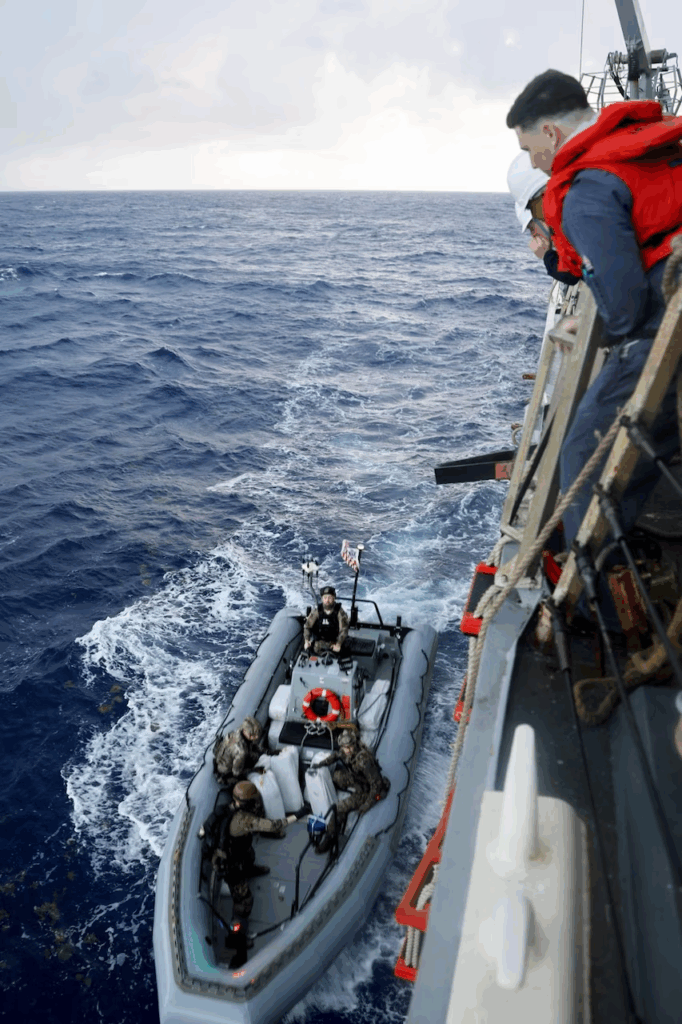
Members of a U.S. Coast Guard Law Enforcement Detachment and U.S. Navy Sailors assigned to the Arleigh Burke-class guided-missile destroyer USS Spruance (DDG 111) conduct small boat operations in the Pacific Ocean, March 26, 2025. (U.S. Navy photo by MCSN Joey Sitter) 

01 April 2025 

PETERSON SPACE FORCE BASE, Colo. – U.S. Northern Command (USNORTHCOM) maritime assets, including the Arleigh Burke-class guided-missile destroyers USS Spruance (DDG 111) and USS Gravely (DDG 107), are actively supporting southern border operations at sea in partnership with the U.S. Coast Guard. 

Spruance, deployed off the coast of Southern California, recently provided vectoring assistance to U.S. Coast Guard (USCG) Cutter Forrest Rednour (WPC-1129) and Customs and Border Protection Air and Marine Operations interceptor M857 in intercepting a suspect vessel, which resulted in 13 persons taken into custody. Spruance also recently rendered assistance to distressed people when a 35-foot panga was spotted taking on water in international waters, approximately 50 miles southwest of San Diego. Spruance launched a 7-meter rigid hull inflatable boat crew and rescued 18 individuals, including one U.S. citizen. Watchstanders from Coast Guard Sector San Diego launched a USCG MH-60 Jayhawk, which transported the persons from Spruance to Coast Guard Sector San Diego. 

“The US Navy and US Coast Guard partnership on display in the maritime domain highlights our commitment to national security priorities,” said Gen. Gregory Guillot, Commander, U.S. Northern Command. “USS Gravely is currently operating off the coast of Texas, while USS Spruance has been deployed to the coast of Southern California. Their capabilities and the dedication of their crews enable a robust response in combating illegal maritime activities into the Unites States such as drug and human trafficking. The message here is clear: our resolve to achieve operational control of the border is all-domain, coordinated, and absolute.”   

Spruance and Gravely are each accompanied by an embedded U.S. Coast Guard Law Enforcement Detachment (LEDET). Founded in 1982, Coast Guard LEDETs carry out a variety of maritime interdiction missions, including counter-piracy, military combat operations, alien migration interdiction, military force protection, counter terrorism, homeland security, and humanitarian response.  

Spruance, Gravely and their embedded USCG LEDETs bring maritime capabilities to the USNORTHCOM area of responsibility in response to Presidential executive orders and a national emergency declaration and clarification of the military’s role in protecting the territorial integrity of the United States. 

USNORTHCOM was named the DoD’s operational lead for the employment of U.S. military forces to carry out President Trump’s southern border Executive Orders. The combatant command continues to support critical DHS capabilities gaps. 


HRL Advances Quiet Undersea Propulsion Innovation 

HRL Laboratories proof-of-concept delivers quiet, reliable propulsion for marine applications similar to the fictional approach used in the 1990 film “The Hunt for Red October.” Designed for DARPA, the new propulsion system will have no moving parts and provide thrust using electromagnets and water. 

From HRL, April 2, 2025 

MALIBU, Calif. April 2, 2025— HRL Laboratories, LLC, has demonstrated proof-of-concept on a unique approach to achieve a silent pumping system that replaces traditional mechanical moving parts with an electric current and a magnetic field. This work is being performed under Defense Advanced Research Project Agency’s (DARPA) “Principles of Undersea Magnetohydrodynamic Pumps (PUMP)” program. 

HRL’s new device uses a recirculating electrochemical hydrogen cell which enables a prototype magnetohydrodynamic (MHD) pump that could be 70% efficient as well as highly reliable – with a lifespan of more than 5 years. Key design benefits: 

  • Nearly eliminates gas bubbles – producing 95% fewer bubbles than traditional electrolysis cells – to deliver quiet, gas-free pumping 

  • Produces no oxidative or corrosive elements (O2 or Cl2) which degrade electrode performance over time 

Magnetohydrodynamic (MHD) pumps: 

MHD pumps, which generate force from a magnetic field acting on an electric current flowing through seawater, require no rotating mechanical components. This approach significantly reduces noise while simultaneously increasing reliability in comparison to conventional propeller- or impeller-based systems. In a typical MHD pump, a DC electrical current is passed through a volume of seawater, which interacts with an applied magnetic field, resulting in a Lorentz force on the ions in the water. As the ions accelerate, they drag the water molecules and generate thrust. 

HRL’s concept includes uniquely tailored gas-diffusion electrodes in its MHD model. This innovation ensures that the hydrogen gas generated at the cathode does not form bubbles but instead diffuses-out to the back side of the electrode. The resulting H2 gas is then routed to the back side of the anode where it diffuses-in and is consumed. This completes the recirculation loop while preventing corrosive oxygen and chlorine bubbles from forming at the anode. 

“With the successful demonstration of a viable method to achieve an efficient, quiet and reliable MHD pump, we hope that HRL will next have the opportunity to build a complete prototype test system for the U.S. Navy for further testing,” said Jason Graetz, principal investigator at HRL Laboratories. 

History of magnetohydrodynamic (MHD) drive technology: 

Since the 1960s, academic, commercial and military researchers have attempted to realize a novel form of maritime propulsion involving no moving parts – no propeller, no drive shaft, no seals – just magnets and an electric current that silently propel a marine vessel through water. Developers have had some success over the decades demonstrating MHD drive technology on a small scale, but it has been inefficient and impractical for full-scale systems. HRL’s new approach to MHD offers a promising solution to overcoming some of these challenges. 

Notable partners: 

General Atomics will design and build the high-temperature superconducting (HTS) magnets required for the MHD pump. 

University of Illinois will provide experience in electrochemical and corrosion modeling to develop a modeling and simulation toolset that will guide the electrode design to meet the project’s specifications. 


BAE Systems Awarded $70M Contract for Future Virginia Payload Module Missile Tubes  

The company’s skilled manufacturing workforce will continue delivering firepower to the U.S. Navy’s submarine fleet 

From BAE Systems, April 2, 2025 

LOUISVILLE, Ky. – April 2, 2025 – BAE Systems received a $70 million contract award from General Dynamics Electric Boat for the production of Virginia Payload Module (VPM) missile tubes for Block VI Virginia-class submarines.  

“These missile tubes deliver critical firepower to the Virginia-class submarine fleet, a cornerstone to U.S. national security,” said Charles Lewis, director of Submarine Programs for Platforms & Services at BAE Systems. “Continuing to manufacture VPMs at our Louisville, Kentucky, facility maintains our strong support to the industrial base, while also ensuring Sailors receive the capability they need to protect our country.”   

VPM tubes add significant firepower and payload capacity to the Virginia-class submarine due to its ability to launch up to seven Tomahawks or future missile variants. These complex structures are built by the highly skilled and deeply experienced workforce at the Louisville facility.   

The facility also builds the propulsor for the Virginia-class submarine, as well as a heavy propulsor structure for the Columbia-class submarine. BAE Systems has the manufacturing capability and capacity to take on additional work building submarine structures to further support the U.S. Navy.  


Awarion AI Maritime Technology Enhances Naval Escort Safety in Crowded Harbor Environments 

From Charles River Analytics, April 1, 2025 

To ensure safe passage, high-value assets such as Navy aircraft carriers require escorts when entering or exiting crowded harbors. The Perception Autonomy for Vessel Escorts (PAVE) system from Charles River Analytics automates the process to reduce the number of people required and increase the speed for each mission. This Small Business Innovation Research (SBIR) Phase II contract is sponsored by the Naval Sea Systems Command and is worth up to $1.8M. 

While PAVE is not the first of its kind, current perception software for uncrewed surface vessels (USVs) are not able to conduct precise tracking of small vehicles or ones that move at relatively high speeds, particularly in crowded harbor environments. They’re also not able to characterize these potential threats effectively.  

PAVE builds on Awarion®, Charles River Analytics’ artificial intelligence (AI)–powered autonomous lookout system, which complements and supports human watchstanders and marine radar systems on the open seas. “Awarion detects, analyzes, and reports on the presence of whales, vessels, and other maritime objects in the open ocean, but we can adapt it to perform well in more crowded harbor scenarios,” says Ross Eaton, Principal Scientist, Director of Marine Systems, and Awarion product lead at Charles River.  

Such fine-tuning of Awarion means “with PAVE we can not only understand what and where something is, we can also make inferences about what that other boat might be doing so we can alert the appropriate personnel as needed,” adds Eaton. In addition, PAVE will be able to tell the distance of the various objects it detects.  

In a busy harbor, there is usually a lot happening in both the foreground and the background. While humans can easily distinguish between these various objects such as buildings and boats, the abundance of signals can confuse algorithms. Achieving humanlike perception in computer vision is a key challenge for PAVE to address. It is why, after successfully demonstrating the system’s feasibility in Phase I, Phase II will focus on supplying PAVE with a broader set of harbor-specific learning data, including new categories like piers and buildings. “We’re launching a more concerted effort to collect additional data that has more crowded backgrounds and congested scenes,” Eaton says.  

PAVE uses electro-optical (EO) and infrared (IR) detection technology to “see” objects during both day and night. “Instead of having different people on different boats with all of them having only a partial view of the world, we’re building a cohesive picture, which will alert and issue warnings when something deserves a closer look. It makes the response more coordinated and faster. We want to leverage the strength of the human and automation to make an overall system that is as efficient as possible,” Eaton says. 

Charles River expects the full-scope PAVE-enabled smart camera will have immediate benefits for the Maritime Expeditionary Security Force (MESF), as they continue to develop their uncrewed escort capabilities. 

“I’m especially excited about PAVE because it demonstrates that we can meet and address a specific customer need and we can provide it faster and more affordably than they otherwise might have been able to access,” Eaton says.  

There has been a lot of excitement for the product from the US Navy and in the private sector. Commercialization potential includes smaller USV platforms, embedded with PAVE, for a variety of harbor operations. 

To learn more about PAVE, Awarion, and Charles River’s other robotics and autonomy capabilities, visit cra.com


Marines, Air Force Fight as Joint Force for First Time in Navy’s Joint Simulation Environment

From Naval Air Warfare Center Aircraft Division, Apr. 1, 2025 

NAS PATUXENT RIVER, Md. — For the first time, U.S. Marine Corps F-35 and Air Force F-22 pilots trained as a joint fighting force in the Naval Air Warfare Center Aircraft Division‘s (NAWCAD) Joint Simulation Environment (JSE) at Naval Air Station Patuxent River, March 24-27. 

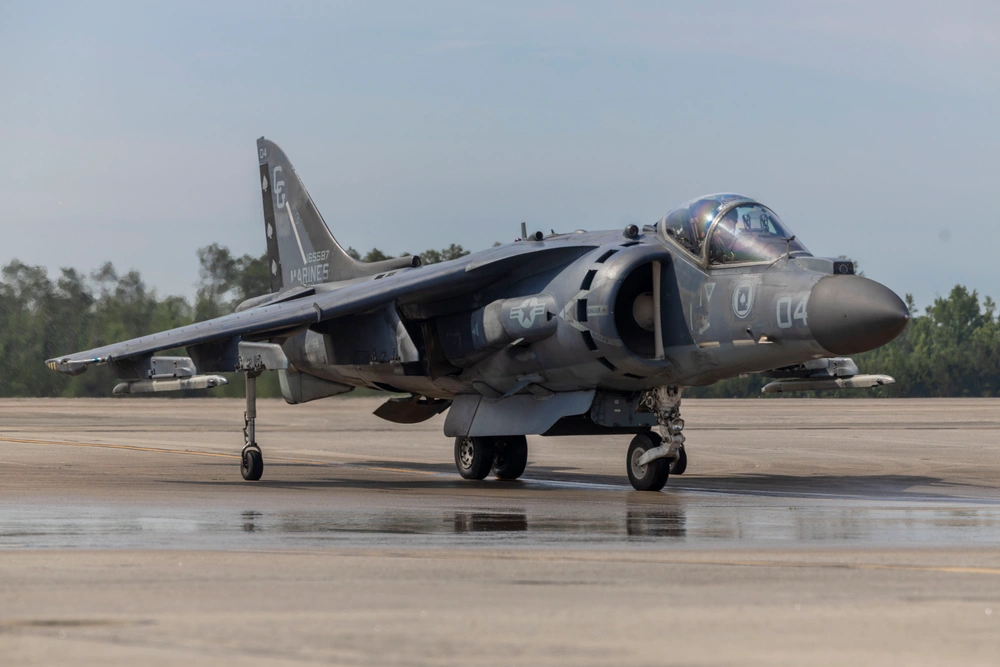
The training event brought eight U.S. Marine Corps F-35s to train alongside four Air Force F-22 Raptors in the DOD’s most advanced digital test and training range. 

“This milestone is a game-changer that ushers in a new era of interoperability for aviation’s combat community and served as a pivotal exercise getting NAWCAD ready to make this joint training standard for Navy and Air Force fighters starting this spring,” said NAWCAD Commander Rear Adm. John Dougherty IV. 

During the event, F-35B and F-35C pilots from Marine Fighter Attack Squadrons (VMFA) VMFA-122, VMFA-225, and VMFA-311 trained with several F-22 pilots from the Combat Air Forces and test community. Over two days, F-35 and F-22 pilots practiced fifth generation fighting together in 17 simulated combat missions against advanced enemy threats only available at JSE. After each mission, the pilots reviewed their performance using cockpit video and audio recordings. 

“The cross talk [while training in the JSE] is unparalleled in terms of being able to talk tactics [and] actually get in the same room with people,” said F-22 pilot Capt. Brett Myer. “It helps iron out a lot of the small details that really matter when it comes down to it.”   

Real world training on open-air ranges at this scale is expensive, difficult to coordinate, and lacks a realistic threat environment. The JSE solves this problem by providing defense aviation a secure simulated range that puts pilots in threat environments not replicable in real life. 

“At the end of the day, it’s going to be the people that win our nation’s wars,” said VMFA-225 pilot Maj. Patrick Hoffer. “Having those person-to-person connections between the Air Force, the Navy and the Marine Corps [in the JSE] is the most important part and biggest objective that we’re able to achieve.” 

Developed by NAWCAD engineers and industry partners, the JSE is a digital training and test facility that features realistic domed simulators with actual defense hardware, software, and adversary aircraft. The immersive environment enables pilots flying F-35 and F-22 to practice complex combat scenarios and receive instant feedback, accelerating the learning process and honing their skills. Tactical groups training in the JSE fly more sorties in one week than they fly over a year on open-air ranges. 

NAWCAD’s JSE is formally integrated into the Navy’s Strike Fighter Tactics Instructor Program —commonly known as TOPGUN — and efforts are underway to incorporate JSE training across additional warfighter programs. 

NAWCAD will expand JSE’s capabilities with the addition of a highly realistic E-2D Advanced Hawkeye this year, and the F/A-18 Super Hornet and EA-18G Growler next year. 

NAWCAD’s military, civilian, and contract personnel operate test ranges, laboratories, and aircraft in support of test, evaluation, research, development, and sustainment for all Navy and Marine Corps aviation platforms. Based in Patuxent River, Maryland, NAWCAD also has major sites in St. Inigoes, Maryland; Lakehurst, New Jersey; and Orlando, Florida.