U.S. Joins India to Launch Exercise Tiger TRIUMPH 2025

VISAKHAPATNAM, Andhra Pradesh, India (April 1, 2025) – Indian Navy (IN) Rear Adm. Susheel Menon, Flag Officer Commanding Eastern Fleet (FOCEF), front, Rear Adm. Greg Newkirk, Commander, Task Force (CTF) 70, second from right, and other leaders representing U.S. and India joint forces salute during the national anthem on the flight deck aboard the IN amphibious transport dock INS Jalashwa (L41) during the opening ceremony of Exercise Tiger Triumph 2025, at the Naval Dockyard, Visakhapatnam, Andhra Pradesh, India, April 1. (U.S. Navy photo by MC1  Caroline H. Lui) 

From Lt. Cmdr. Seth Koenig, Apr. 1, 2025 

VISAKHAPATNAM, India – Indian and U.S. armed forces held the opening ceremony to launch this year’s Exercise Tiger Triumph in Visakhapatnam, India, on April 1, 2025. 

U.S. Navy units including the landing ship dock USS Comstock (LSD 45), with embarked U.S. Marines, and Arleigh Burke-class guided-missile destroyer USS Ralph Johnson (DDG 114) are scheduled to participate in the exercise. 
 
“The operations and associated tactics and procedures that we will plan, execute and refine with our Indian partners will greatly expand our joint combined capacity to respond to any crisis,” said Rear Adm. Greg Newkirk, commander of the U.S. Navy’s Task Force 70 and the joint U.S. forces participating in the exercise. “Tiger Triumph 25 represents the joint forces of two strategic partners enhancing our shared multi-domain awareness and ability to operate more effectively in those commonly understood domains. This is essential to prepare for any contingency that could emerge.” 
 
This is the fourth time U.S. and Indian forces have come together for Tiger Triumph, a joint India-U.S. amphibious exercise. The exercise will involve approximately 3,000 personnel and at least four ships and seven aircraft from the two countries. 
 
Tiger Triumph 25, which is scheduled to take place over a two-week period, continues the joint and combined forces’ ongoing efforts to improve interoperability for humanitarian assistance and disaster relief (HADR) operations. 
 
“The longstanding strategic partnership between India and the United States is based on shared democratic values and convergence of ideas and interests on bilateral, regional and global issues,” said the Indian Navy’s Rear Adm. Susheel Manon, Flag Officer Commanding the Eastern Fleet. “Tiger Triumph 2025, the fourth edition of this joint exercise is an initiative aimed at furthering our common vision for the Indo-Pacific, specifically dealing with the aspect of humanitarian assistance and disaster relief. Exercise Tiger Triumph is an integrated and complex exercise, in terms of the number of assets and personnel involved, with a direct joint tri-services flavor.” 
 
Exercise events include subject matter expert exchanges, an amphibious beach landing, and establishment of an emergency medical treatment station at the site. Tiger Triumph 2025 will include the first-ever subject matter expert exchange with U.S. and Indian industry partners, government representatives, and operators focused on applying cutting-edge autonomous capabilities to address critical warfighter needs. This exchange will advance the new U.S.-India Autonomous Systems Industry Alliance (ASIA) announced in February by President Trump and Prime Minister Modi and lays the groundwork toward greater integration of autonomous systems into future U.S.-India exercises. 
 
Also new to Tiger Triumph in 2025 is the introduction of a space element to the exercise, with U.S. Space Force representatives working with Indian counterparts to incorporate satellite technology to enhance force awareness in operational planning and execution. 
 
Service members from U.S. and Indian armed forces will also take part in cultural and athletic events to build personal relationships and camaraderie. 
 
The Comstock and the Ralph Johnson are underway conducting routine operations as part of U.S. 7th Fleet in support of a safe and prosperous Indo-Pacific. Additional U.S. forces participating in the exercise include Navy P-8A Poseidon and Air Force C-130J aircraft, as well as an Army platoon, medical platoon, Civil-Military Operations Center and Multi-Domain Task Force Combined Information Effects Fusion Cell. 
 
U.S. 7th Fleet is the U.S. Navy’s largest forward-deployed numbered fleet and routinely interacts and operates with allies and partners in preserving a free and open Indo-Pacific region. 


HII Celebrates 2024 Graduates of The Newport News Shipbuilding Apprentice School

From HII, March 29, 2025 
 

NEWPORT NEWS, Va., March 29, 2025 (GLOBE NEWSWIRE) — HII (NYSE: HII) hosted commencement exercises today, celebrating 77 graduates of the company’s Newport News Shipbuilding Apprentice School. The ceremony was held at Liberty Live Church in Hampton. 

Virginia State Sen. Louise Lucas delivered the keynote commencement address. 

“The technical skills you acquired here will serve as a foundation upon which you build your career,” Lucas told the graduates. “The leadership lessons learned in The Apprentice School and in the shipyard will open doors to roads you might not have ever imagined.” 

NNS President Kari Wilkinson addressed the graduates as the shipyard’s newest leaders. 

“You have each signed up for an incredible, important mission,” Wilkinson said. “You literally build freedom for our nation, and I’m proud to stand beside you in doing so. You have honed your craft, demonstrated your dedication, and play a critical role in the stability of our nation. You are heroes, as well as teammates.” 

Founded in 1919, The Newport News Shipbuilding Apprentice School has been accredited since 1982 by the Council on Occupational Education. Certification to grant associate degrees and confer degrees on its own came in July 2020, after the school was approved by the State Council of Higher Education for Virginia to operate as a postsecondary institution. 

Photos accompanying this release are available at: http://hii.com/news/hii-celebrates-2024-graduates-of-the-newport-news-shipbuilding-apprentice-school/

A majority of this year’s class joined the Apprentice School in 2020, during the COVID-19 pandemic, when the school significantly reduced normal enrollment. 

Travis Johnson received the Homer L. Ferguson Award, which recognizes the apprentice graduating with the highest average in combined required academic and craft grades. 

Johnson joined NNS in 2018 as a pipefitter working in the new construction aircraft carrier program. In 2020, he was accepted into The Apprentice School. Today, he is a pipefitting instructor at the school, teaching students who are pursuing the same path he chose. 

During his address, Johnson asked graduates to reflect on the perseverance and dedication that defined their apprenticeships and that set them up for success as shipyard leaders. 

“Today is proof that we are strong, capable, and can accomplish anything if we refuse to give up,” Johnson shared. “But this isn’t the finish line; it’s actually just the beginning. So as you step into your next chapter — whatever that may be — remember what you’ve learned.” 

Replay coverage of the ceremony is available at: https://hii.com/events/nns-as-graduation/

The following is a profile of the graduating class: 

  • Twenty graduates completed an optional advanced program, earning an associate or bachelor’s degree. The program includes coursework in subjects and fields such as marine design, nuclear testing, production planning, supply chain, metrology and marine engineering. 

  • Thirty-six graduates earned honors, a combination of academic and craft grades that determine overall performance. 

  • Forty-one graduates earned an Associate of Applied Science degree in maritime technology. 

  • Thirty-seven graduates completed Frontline FAST, an accelerated skills training program for potential foremen. 

  • Twenty-four graduates were inducted into The National Society of Leadership Success. 

  • Eight graduates completed the World Class Shipbuilder Curriculum and advanced optional program with a perfect 4.0 grade point average. 

  • Six graduates are military veterans or are currently serving in the armed services as reservists and guardsmen. 

  • Thirteen graduates earned Gold Athletic Awards. 

  • Two graduates are former presidents of the Apprentice School Student Association. 

The Apprentice School accepts more than 200 apprentices per year. The school offers four- to eight-year, tuition-free apprenticeships in 19 trades and seven optional programs. Apprentices work a 40-hour week and are paid for all work, including time spent in academic classes. 

For more information about The Newport News Shipbuilding Apprentice School, please visit www.as.edu


SECNAV Phelan to Keynote 2025 Sea-Air-Space Breakfast

Newly confirmed Secretary of the Navy John C. Phelan will deliver a keynote address at Sea-Air-Space 2025 on Wednesday, April 9, at 7:30 a.m., marking one of his first public appearances since taking office.

Phelan, who was confirmed by the U.S. Senate on March 24 to serve as the 79th Secretary of the Navy, is expected to outline his top priorities for the Department of the Navy during the largest maritime exposition in the United States. His remarks will provide insight into his vision for strengthening the Navy and Marine Corps at a time of increasing global competition and threats.

Among the topics Phelan is expected to address are revitalizing U.S. shipbuilding, reinforcing a warfighting-focused culture, and improving recruitment to bring in the next generation of naval leaders. He has also previously said he plans to push for greater investment in uncrewed systems and enabling technologies, including autonomy, mission systems, and advanced communications capabilities. 

Phelan’s keynote is expected to be one of the most anticipated sessions of the conference. Attendees will have a rare early opportunity to hear directly from the new SECNAV as he outlines his priorities for the Navy and Marine Corps. The April 9 Sea-Air-Space Breakfast is a ticketed event and requires an additional fee to attend. Tickets purchased in advance are available for $105, with onsite tickets priced at $115.

To register, please click here


Coast Guard Increases Presence Near Southwest Border Between U.S., Mexico 

Maritime enforcement specialists from Tactical Law Enforcement Team South and U.S. Coast Guard Cutter Kimball (WMSL 756) crewmembers interdict a suspected drug smuggling vessel while patrolling the Eastern Pacific Ocean, March 4, 2025. (U.S. Coast Guard photo by Petty Officer 2nd Class Max Hanfland) 

U.S. Coast Guard Pacific Southwest, March 28, 2025 

ALAMEDA, Calif. – The Coast Guard has increased its operational presence near the southwest border between U.S. and Mexico to enhance border security, immigration enforcement and to protect the territorial integrity of the United States.   

Coast Guard District Eleven (D11) has expanded its posture from previous steady state counter-illicit-maritime-activities to gain full operational control of the Southwest Maritime Border.  

Since Jan. 21, D11 has tripled its forces operating on the southern border and coordinated Coast Guard surface and air presence with partners to detect, deter, and interdict alien and drug smuggling ventures. D11 diverted aircraft, cutters, small boats and crews under its operational control to the southern border, increasing the illegal alien apprehension rates by 75% with multiple smuggling attempts continuing to occur each night. The Coast Guard remains committed to a persistent operational presence to ensure border security and territorial integrity of the United States.   

Irregular maritime migration aboard unseaworthy or overloaded vessels is always dangerous, and often deadly. D11 remains steadfast in its commitment to saving lives and discouraging anyone from taking to the sea in ways that are unsafe and illegal.    

D11 has taken immediate actions to increase operational presence and focus to combat illegal fentanyl threatening the United States. In recent years, smuggling ventures across the southern border have been found to include bulk cocaine, methamphetamines, and fentanyl. This trafficking of illegal drugs poses an urgent threat to the American people, and the members of the Coast Guard do everything in their power to interdict drugs before they reach our shores and citizens. Accordingly, the Coast Guard has increased operations to interdict, seize, and disrupt the transshipment of cocaine and other bulk illicit drugs by sea. This includes operations in the Eastern Pacific and the Western Hemisphere Transit Zone, a major highway for illegal smuggling activity. Through sustained counter-narcotics operations, the Coast Guard has imposed billions of dollars of costs on the criminal networks, continuing the fight against corruption and violence fueled by narco-trafficking. Coast Guard law enforcement action and presence is critical to countering the destabilizing impacts of transnational organized crime. Since January 21, the Coast Guard has interdicted more than 68,800 lbs of cocaine and 4,200 lbs of marijuana totaling nearly $785 million in wholesale value.  

These trends may change due to an influx of Coast Guard assets coupled with Department of Defense (DoD) resources and U.S. Border Patrol in a coordinated effort to protect our southern borders and maritime approaches. U.S. Northern Command (NORTHCOM) recently deployed two U.S. Navy warships to the southern border to protect the territorial integrity of the United States and support Department of Homeland Security (DHS) and Coast Guard operations.  
  
These U.S. Navy warships will operate in direct support of the Coast Guard and carry Coast Guard law enforcement teams that will enable them to conduct border security operations under Coast Guard authorities. As the Coast Guard hardens and sustains its operational posture, including the arrival of these U.S. Navy warships, it is fully integrated with DHS and DoD through NORTHCOM and U.S. Southern Command.  

Additionally, D11 is assisting with the national transport of illegal aliens to designated locations in Texas and California, where DoD then transports the aliens internationally for repatriation. The Coast Guard continues to devote its forces from across the nation to support these flights. These combined surface and air operations demonstrate the Coast Guard’s continued dedication to control, defend, and secure U.S. borders, territorial integrity, and ensure sovereignty.   

D11 plays a crucial role in homeland security and economic prosperity by conducting border security and counter-drug operations to safeguard the integrity of the Southwest Border and its maritime approaches, effectively interdicting, seizing and disrupting drug and alien smuggling at sea.  


United States–Philippines Joint Statement on Secretary Hegseth’s Inaugural Visit to the Philippines 

From the U.S. Department of Defense, March 28, 2025 

United States Secretary of Defense Pete Hegseth made his inaugural visit to the Philippines as part of his first trip to the Indo-Pacific region to meet with President Ferdinand Marcos, Jr. and Secretary of National Defense Gilberto Teodoro, Jr. on March 27-28, 2025.  

The leaders underscored the enduring strength of the U.S.-Philippines alliance and reaffirmed its importance for upholding a free and open Indo-Pacific region. Secretary Hegseth and Secretary Teodoro reiterated both countries’ shared commitment to the 1951 U.S.-Philippines Mutual Defense Treaty (MDT) in an increasingly complex security environment. The Secretaries also reaffirmed that the MDT extends to armed attacks against either country’s armed forces, aircraft, and public vessels – including those of their coast guards – anywhere in the South China Sea. They also underscored that, in addition to the MDT, the 1998 Visiting Forces Agreement (VFA) and 2014 Enhanced Defense Cooperation Agreement (EDCA) are critical foundations for continued alliance coordination and interoperability. 

Secretary Hegseth and Secretary Teodoro agreed to take several bold steps and set a robust agenda for the U.S. Department of Defense (DoD) and the Philippine Department of National Defense (DND) to reestablish deterrence in the Indo-Pacific region and achieve Peace through Strength. These efforts will accelerate the defense partnership and ensure that the alliance is postured to address the most consequential challenges in the Indo-Pacific region.  

Key new initiatives include: 

  • Deploying more advanced U.S. capabilities in the Philippines, including the Navy-Marine Expeditionary Ship Interdiction System (NMESIS) and highly capable unmanned surface vessels. Exercising with the NMESIS – a mobile, ground-based anti-ship missile launcher – as part of Exercise BALIKATAN and other service-to-service activities will improve interoperability and strengthen deterrence by providing coverage of strategic sea lanes from coastal positions. Training and testing on NMESIS and unmanned surface vessels as part of realistic exercises in the Philippines will increase the interoperability and operational readiness of U.S. and Philippine forces to leverage cutting-edge military capabilities in Indo-Pacific operational environments. 

  • Conducting advanced bilateral Special Operations Forces training in the Batanes Islands. U.S. Special Operations Forces and Philippine Marines will train together on complex landing scenarios to enhance interoperability between U.S. forces and the Armed Forces of the Philippines and improve combined capability to conduct high-end operations in the Indo-Pacific region. 

  • Publishing a bilateral defense industrial cooperation vision statement. The United States and the Philippines continue to advance their alliance through closer defense industrial base cooperation. This is intended to promote more robust military and industry partnerships, build supply chain resilience, strengthen our readiness, and bolster both nations’ economies. The Secretaries announced the release of a defense industrial cooperation vision statement that identifies priority areas for near-term cooperation, including potential co-production of unmanned systems and more robust logistics support. The statement includes lines of effort that the United States and the Philippines will explore to advance these priority areas, namely seeking to: reduce barriers, collaborate on new technology, and identify discrete opportunities for collaboration. Both countries intend for this vision statement to serve as a basis to advance regional security, economic security, and Indo-Pacific prosperity.  

  • Launching a bilateral cybersecurity campaign. The DoD and DND will collaborate to reduce cyber vulnerabilities and enhance resilience across the alliance. This campaign intends to address three primary lines of effort: establishing a secure defense network, developing a capable cybersecurity workforce, and enabling advanced operational cooperation. Enhanced cyber capability and capacity will enable greater information and intelligence-sharing, improve our lethality, and facilitate increasingly advanced operational coordination.  


Department of Defense Completes Underway Recovery Test 12 with NASA 

From Expeditionary Strike Group 3, March 31, 2025 

SAN DIEGO — NASA’s Exploration Ground Systems Landing and Recovery team and the Department of Defense successfully completed the third recovery test for the crewed Artemis II mission aboard amphibious transport dock USS Somerset (LPD 25) off the coast of San Diego, March 31. 

The primary objectives for Underway Recovery Test 12 were to demonstrate and evaluate the processes, procedures, and hardware for recovery operations for the crewed Artemis II mission around the moon. 
 
“The U.S. Navy and NASA have a long history of partnering together to support the recovery of astronauts and equipment used for space exploration and research,” said Capt. Andrew Koy, commanding officer, USS Somerset. “The inherent capabilities of our amphibious transport dock ships are the perfect combination to ensuring the Artemis capsule and crew are safely recovered following their mission. The well deck, flight deck, medical facilities, and immense cargo carrying capacity crewed by highlight trained and proficient Sailors, continues the NASA and Department of Defense legacy.” 
 
Underway Recovery Test 12 allowed NASA and the Department of Defense to practice operational procedures for Artemis II, including timing of crew extraction from the capsule to the ship’s medical bay and day-and-night recovery procedures to support certification of personnel and processes for Artemis II mission. 
 
Artemis II astronaut U.S. Navy Capt. Victor Glover embarked the ship for Underway Recovery Test 12. 
 
“This puts my two loves together, space and the navy. I am really in my happy place here,” said Glover. “The partnership between NASA and the U.S. Navy is a testament to a fostered symbiotic relationship built on trust, where our needs are met by their unparalleled expertise and resources. Together, we’re not just working side by side; we’re one team! As we prepare to send the next group of explorers around the Moon and beyond, we’re pushing the boundaries of human achievement, all thanks to the strength of this incredible partnership.” 
 
Working in support of U.S. Space Command, additional U.S. Navy units included Expeditionary Strike Group 3, Helicopter Sea Combat Squadron 23, Explosive Ordnance Disposal Group 1, and Amphibious Construction Battalion 1, with support from U.S. Air Force’s First Air Force, Detachment 3, and U.S. Space Force’s 45th Space Launch Delta Weather Squadron. 
 
After the 2022 successful recovery of the Orion spacecraft from the Artemis I mission using amphibious transport dock USS Portland (LPD 27), and with the addition of crew for the Artemis II mission, the recovery teams modified their timelines and procedures to ensure the astronauts will be safely on the recovery ship within two hours after splashing down in the Pacific Ocean. 
 
After a 10-day mission, NASA astronauts Reid Wiseman, Victor Glover, and Christina Koch, and Canadian Space Agency astronaut Jeremy Hansen will reenter Earth’s atmosphere at 25,000 mph, landing approximately 60 miles off the coast of California, where one of the U.S. Navy’s amphibious transport dock ships will recover the capsule and crew with NASA and DoD personnel. 
 
Once the crew splashes down, a group of Navy divers will approach Orion and ensure it is safe for the astronauts to exit the spacecraft. The divers will then open the spacecraft hatch and help the astronauts exit one by one onto an inflatable “front porch.” This raft wraps around the capsule and allows for the crew to be picked up via helicopter and flown back to the recovery ship. Once the astronauts are on board the recovery ship, teams will secure Orion with a series of lines and tow it into the ship’s well-deck, just as they did during the Artemis I mission. 
 
During the test, the team practiced the Artemis II recovery procedures, including releasing and recovering the crew module test article, a full-scale mock-up of Orion. 
 
“As Navy Divers, we are proud members of the URT-12 team and look forward to a successful mission,” said Master Chief Navy Diver Ryan Crider, who leads the team of divers from Explosive Ordnance Disposal Group 1 assigned to Underway Recovery Test 12. “We are the Navy’s experts in mobile salvage and towing, so the unique task of recovering and transporting a space capsule from the ocean to a well deck is the perfect opportunity to put our skills to the test.” 
 
The recovery team will capture lessons learned and apply them to future underway tests to make sure they are ready to recover the Artemis II crew and bring them home safely. 
 
“Since 1959, First Air Force, Detachment 3 has collaborated with NASA and the US Navy, a partnership that has led to our critical role in preparing for Artemis,” said Lt. Col. Mahan, First Air Force, Detachment 3 Artemis Program director. “With US Space Command, backed by the U.S. Navy, spearheading DoD human spaceflight support, and Air Forces Space serving as deputy, URT-12 has built a cohesive team committed to mission success. This landmark joint effort is undoubtedly the pinnacle of our year!” 
 
As the Department of Defense’s Human Space Flight Support manager, U.S. Space Command is responsible for the terrestrial rescue and recovery of NASA-sponsored astronauts and spacecraft for the Artemis program. 
 
Expeditionary Strike Group 3 comprises three amphibious squadrons, 15 amphibious warships, and eight naval support elements including approximately 18,000 active-duty and reserve Sailors and Marines. As the deputy commander for amphibious and littoral warfare, U.S. 3rd Fleet, the Expeditionary Strike Group 3 commander also oversees the 17 littoral combat ships under Littoral Combat Ship Squadron 1. 
 
Expeditionary Strike Group 3 is postured in support of U.S. 3rd Fleet as a globally responsive and scalable naval command element, capable of generating, deploying, and employing naval forces and formations for crisis and contingency response, forward presence, and major combat operations focusing on amphibious operations, humanitarian and disaster relief and support to defense civil authorities, and expeditionary logistics. 
 
For more information on Underway Recovery Test 12, please visit: 
https://www.dvidshub.net/feature/URT12 


Shield AI Delivers First ViDAR Payloads to NAVAIR for U.S. Marine Corps Operations 

From Shield AI, March 28, 2025 

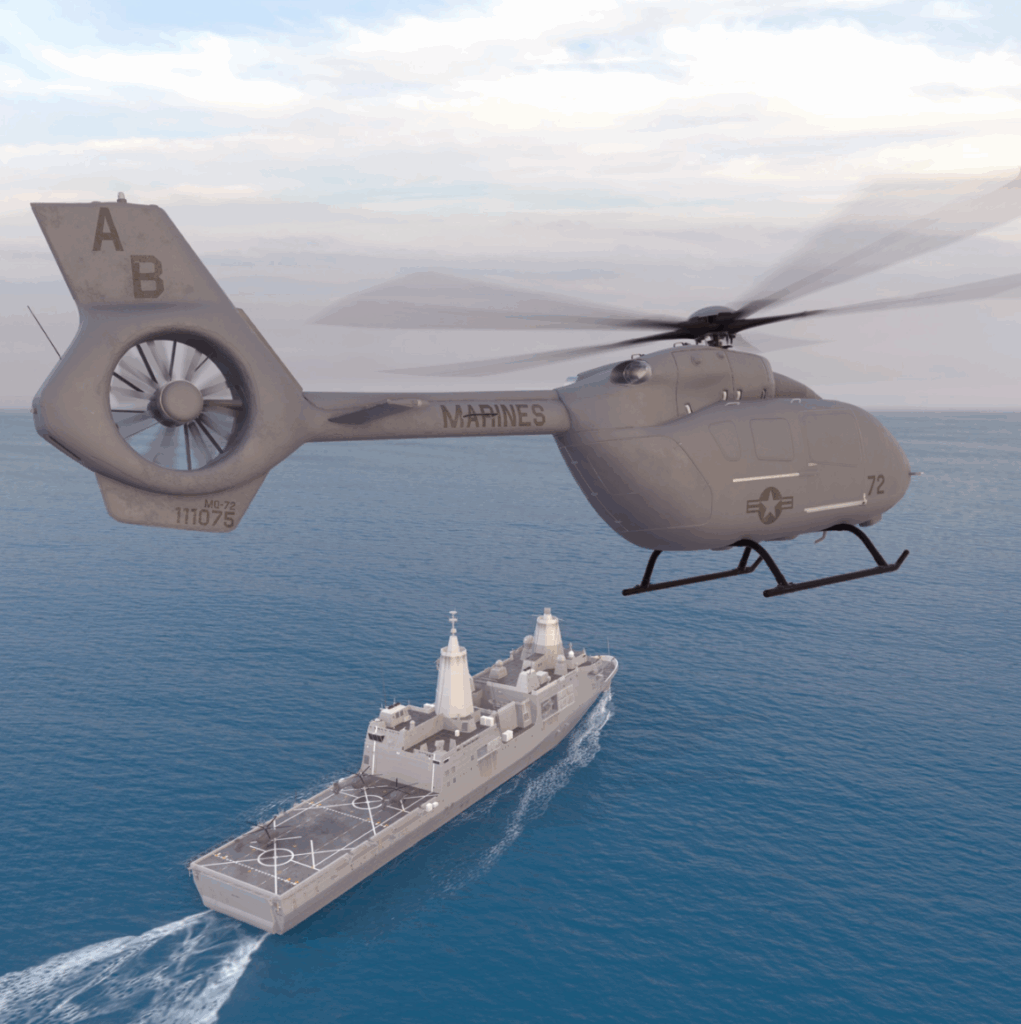
WASHINGTON (March 28, 2025) – Shield AI, the deep-tech company building state-of-the-art autonomy software products and defense aircraft, today announced the delivery of its first ViDAR (Visual Detection and Ranging) payloads to NAVAIR’s Program Office for the Navy and Marine Corps Small Tactical Unmanned Aircraft Systems (PMA-263), destined for operations with the U.S. Marine Corps (USMC). This milestone marks Shield AI’s first turn-key payload delivery and a major step forward in integrating AI-enabled edge solutions into frontline operations.  

ViDAR is an AI-enabled optical sensor that leverages edge computing to passively detect, identify, geolocate, and track objects with wide-area motion imagery. It has been deployed in intelligence, surveillance, and reconnaissance (ISR) missions as well as search-and-rescue operations, with proven effectiveness in challenging maritime environments, including up to Sea State 6. Delivering ViDAR as a turn-key payload to the USMC is a testament to its low SWaP (size, weight, and power) efficiency, adaptability, and ability to enhance situational awareness in contested environments.   

“As modern battlefields become more contested, platforms must detect, locate, classify, and track threats without relying on active emissions. ViDAR provides real-time, passive optical tracking across land and sea, delivering persistent surveillance at a fraction of the size, weight, and power—without emitting a signal—giving operators a critical advantage in covert operations,” said Christian Gutierrez, Vice President of Hivemind Solutions at Shield AI. “We look forward to seeing ViDAR fly in support of the Marine Corps, helping them gain a decisive edge in modern combat environments.”  

ViDAR’s operational deployment follows a rigorous Foreign Comparative Testing (FCT) project initiated by PMA-263 in 2022. The evaluation program included extensive ground and flight testing on unmanned aircraft systems (UAS), validating ViDAR’s performance for USMC-specific operations in wide-area maritime surveillance. The successful completion of the FCT project saw ViDAR transition to a program element within NAVAIR.  


MSC Fleet Replenishment Oiler USNS John Lewis Deploys in Support of Nimitz Carrier Strike Group

Military Sealift Command (MSC) fleet replenishment oiler USNS John Lewis (T-AO 205) departs San Diego for deployment with the U.S. Navy’s Nimitz Carrier Strike Group. The deployment is the first for the ship and the first for the class of John Lewis fleet replenishment oilers. While on deployment, John Lewis will provide logistics services to the ships of the strike group while operating in the Indo-Pacific. (U.S. Navy photo) 

MSC Fleet Replenishment Oiler USNS John Lewis Deploys in Support of Nimitz Carrier Strike Group 

From Sarah Cannon, March 27, 2025Shape 

Military Sealift Command (MSC) fleet replenishment oiler USNS John Lewis (T-AO 205) departed San Diego for deployment with the U.S. Navy’s Nimitz Carrier Strike Group. The deployment is the first for the ship and the first for the class of John Lewis fleet replenishment oilers. 
 
While on deployment, John Lewis will provide logistics services to the ships of the strike group while operating in the Indo-Pacific. 
 
The strike group’s deployment will focus on protecting security, freedom, and prosperity for the United States, our allies and partners, and demonstrating the U.S. Navy’s unwavering commitment to a secure and prosperous Indo-Pacific. 
 
“From the shipyard through final testing and training, it was a total team effort to introduce this ship to the fleet. USNS John Lewis will bring enhanced logistics capabilities to the fleet and is the first of several ships of this class that will be following in her wake,” said Capt. Micah Murphy, commander Military Sealift Command Pacific. “This ship is extremely well-led and is manned by some of the finest Mariners on the planet. I have no doubt she will have a very successful deployment and outsized impact on fleet operations.” 
 
MSC directs and supports operations for approximately 140 civilian-crewed ships that replenish U.S. Navy ships at sea, conduct specialized missions, preposition combat cargo at sea around the world, perform a variety of support services, and move military equipment and supplies to deployed U.S. forces. MSC exists to support the joint warfighter across the full spectrum of military operations, with a workforce that includes approximately 6,000 Civil Service Mariners and 1,100 contract mariners, supported by 1,500 shore staff and 1,400 active duty and reserve military personnel. 


Garbarino Leads Bipartisan Push to Modernize U.S. Merchant Marine Academy

From the office of Rep. Andrew R. Garbino, March 27, 2025 

WASHINGTON, D.C. – Congressman Andrew R. Garbarino (R-NY-02), a member of the United States Merchant Marine Academy (USMMA) Board of Visitors, today introduced bipartisan legislation to authorize more than $1 billion over 10 years for a full-scale campus modernization of the U.S. Merchant Marine Academy in Kings Point, New York. 

The bill is cosponsored by Representatives Laura Gillen (R-NY-04), Nick LaLota (R-NY-01), Tom Suozzi (D-NY-03), and Jen Kiggans (R-VA-02) underscoring a shared commitment to bolstering national security and maritime readiness through investment in one of the nation’s five federal service academies. 

“For generations, the U.S. Merchant Marine Academy has trained the men and women who keep our supply chains moving and our national defense strong,” said Rep. Garbarino. “But the infrastructure on campus must keep up with the rigorous demands placed on today’s Midshipmen. This bill ensures the Academy remains a world-class institution worthy of its mission.” 

The legislation authorizes $1.02 billion from FY2026 to FY2035 via the Maritime Security Trust Fund, beginning with $54 million for design and planning in the first year and annual construction funding of over $107 million thereafter. The bill calls for full operational continuity at the Academy throughout construction and recommends using design-build contracting to speed delivery and reduce costs. 

“For more than 80 years, the U.S. Merchant Marine Academy has been the pride of Long Island. As one of America’s five services academies, USMMA is a pathway for young Americans to serve our country and contribute to our maritime security. I’m proud to join Rep. Garbarino and my colleagues in working together for Long Island and leading this bipartisan bill to strengthen Long Island’s tradition of producing the best Midshipmen and mariners in the world,” said Rep. Gillen.  

“To ensure the Merchant Marine Academy continues to play a pivotal role in shaping the next generation of maritime and national security leaders, Congress must invest in its infrastructure, which has languished since the mid-20th century. Doing so is essential to providing Midshipmen, who will go on to serve America around the globe,  with the education and hands-on training they need to excel in critical industries like marine transportation and defense,” said Rep. LaLota. “Upgrading these facilities will strengthen the Academy’s ability to prepare top-tier officers and ensure it remains a premier institution for the nation’s future maritime leaders.” 

“The U.S. Merchant Marine Academy is a national treasure that has been neglected for decades. It is time to restore it to its former glory!” said Rep. Suozzi. 

Rep. Garbarino has served on the USMMA Board of Visitors since joining Congress and has been a leading advocate for modernizing the Academy’s campus and supporting the next generation of maritime leaders. 

The full text of the bill can be found here


Secretary of Defense Emphasizes Lethality, Deterrence on Guam

From Lt. Cmdr. Michelle Tucker, March 28, 2025 

ANDERSEN AIR FORCE BASE, Guam — Secretary of Defense Pete Hegseth arrived on Guam March 27 to meet with military and civilian leaders and speak with troops – his first visit to Guam since his January confirmation.

The visit was the second stop on Hegseth’s Pacific engagement tour, which began in Hawaii and will continue from Guam to the Philippines and Japan. Hegseth focused on strengthening alliances and bolstering warrior ethos among service members, further strengthening the United States’ deterrence posture in the region. 
 
More than 600 service members from military commands across Guam gathered for a troop call at Andersen Air Force Base to kick off the visit. Hegseth praised them for their mission contributions, noting Guam’s strategic location in the Indo-Pacific region, and charged them to increase lethality and readiness. 
 
“What unites us is who we are and our purpose as Americans,” Hegseth said. “We are in the business of warfighting. You are warfighters on behalf of our nation and we are [going to] make sure you have a military built and prepared for that fight … American leadership ensures the free world is protected – to advance American interests and the interests of our allies.” 
 
The visit fell one day after the 80th anniversary of end of the Battle of Iwo Jima that occurred just 750 miles north northwest of Guam. During the troop call, Hegseth recognized a group of seven Iwo Jima veterans who traveled to Guam to attend commemoration events. He thanked them for their courage and fortitude, and for paving the way for Americans in the Pacific. 
 
Commander, Joint Region Marianas Navy Rear Adm. Brent DeVore greeted Hegseth upon arrival along with other senior military leaders on island. 
 
“The Secretary’s visit underscored the Department of Defense’s commitment to the security of Guam and the Commonwealth of the Northern Mariana Islands, as well as the entire Micronesia region’s strategic importance to the Pacific,” DeVore said. “We highlighted our efforts and contributions to strategic deterrence, demonstrating U.S. strength and daily preparedness – and tangible examples of ongoing work in cyber security, missile defense, our construction projects throughout Guam, CNMI, and the COFA states, and infrastructure resilience.” 
 
“We all emphasized the interconnectedness between the Department of Defense efforts and our local communities, in all we do,” he added. 
 
During a military roundtable, Hegseth received briefs from installation commanders and key leaders throughout the region detailing capabilities and future growth on Guam. Commander, 36th Wing, Andersen Air Force Base Air Force Brig. Gen. Thomas Palenske stressed to Hegseth the importance of the work the team is doing on Guam. 
 
“Andersen Air Force Base is incredibly vital to the mission in the Indo-Pacific,” Palenske said. “Our strategic location and the exceptional readiness of our personnel reinforce our commitment to deterrence and combat readiness in the region. The capabilities showcased and discussed during this visit not only empower our forces but also strengthen our alliances and ensure we stand ready to respond to any challenge.” 
 
The “Island Knights” of Helicopter Sea Combat Squadron (HSC) 25 flew Hegseth in an MH-60S Sea Hawk helicopter for an aerial tour of the island. During the tour, Naval Facilities Engineering Command Marianas Commanding Officer Navy Capt. Troy Brown briefed Hegseth on current and future construction and resiliency improvements on Guam including the Glass Breakwater, which was damaged during Typhoon Mawar. The breakwater is critical to harbor protection and the supply chain for the entire island. 
 
Finally, Guam Gov. Lou Leon Guerrero, Commonwealth of the Northern Mariana Islands (CNMI) Gov. Arnold Palacios, and Guam Rep. James Moylan met with Hegseth to discuss military-civilian partnership from a local perspective. 
 
“Our goal is achieve peace through strength,” Hegseth said. “By putting America first, that means working with partners and allies throughout the region, reestablishing deterrence and building capabilities right here. These islands are the tip of America’s spear in the Pacific. 
 
“I want to be very clear to everyone in this room,” Hegseth continued. “… Any attack against these islands is an attack against the U.S. We recognize that, we understand that, and we are committed to that.”