Hegseth Says U.S. Attacks Intensify Under Epic Fury, While Iranian Responses Slow 

March 10, 2026 |  By C. Todd Lopez, DoW News 

The U.S. launched strikes on Iran last week to stop the terrorist-run state from its continued and ill-advised pursuit of nuclear weapons it hopes to use to threaten the American homeland. 

Nearly 11 days into Operation Epic Fury, Secretary of War Pete Hegseth says the U.S attacks continue to be strong while Iranian responses wane. 

“Today will be, yet again, our most intense day of strikes inside Iran,” Hegseth said during a press briefing today at the Pentagon. “The most fighters, the most bombers, the most strikes; intelligence more refined and better than ever. So, that’s on one hand. On the other hand, the last 24 hours have seen Iran fire the lowest number of missiles they’ve been capable of firing yet.” 

The secretary told journalists that much of what the Iranians are doing is lobbing missiles at their neighbors in the Middle East, making enemies of what may have once been bystanders, and launching those missiles from near their own schools and hospitals, putting innocent civilians at risk from retaliatory strikes. 

“The [Iranians] are desperate and scrambling. Like the terrorist cowards they are, they fire missiles from schools and hospitals … deliberately targeting innocents … because they know their military is being systematically degraded and annihilated,” Hegseth said. “Iran’s neighbors and in some cases former allies in the [Persian] Gulf — they’ve abandoned them.” 

Iranian proxy groups like Hezbollah, the Houthis and Hamas are also broken, ineffective, or on the sidelines now, Hegseth said. 

“Iran stands alone, and they are badly losing,” the secretary said. “On day 10 of Operation Epic Fury, we are winning with an overwhelming and unrelenting focus on our objectives.” 

The secretary said that, surprisingly, Iran’s response after the initial U.S. assault was to attack its neighbors. The result of that, he said, has not been good for Iran. 

“The big mistake by the Iranian regime was to start targeting its neighbors,” Hegseth said. “I think it was a demonstration of the desperation of that regime … that they still think their pathway out is to try to alienate their Arab partners even more.” 

Those neighbors, Hegseth said, have decided instead to side with the U.S. 

“[They have] instead decided to come to us and have been willing to go on the offense, have been giving us access, basing and overflight in a new partnership that will continue to remake the region,” Hegseth said. 

The U.S. has short-term, clearly defined goals in Iran. First, destroying Iranian missile stockpiles, missile launchers and their defense industrial base. Second, destroy the Iranian navy. And finally, permanently deny Iran the ability to have nuclear weapons. 

“It’s a laser-focused maximum authority mission delivered with overwhelming and unrelenting precision,” he said. 

Air Force Gen. Dan Caine, chairman of the Joint Chiefs of Staff, shared the latest tactical details of Operation Epic Fury. 

“To date, [U.S. Central Command has] struck more than 5,000 targets,” Caine said. “[U.S.] Strategic Command bombers recently dropped dozens of 2,000-pound GPS penetrating weapons on deeply buried missile launchers across the southern flank.” 

Also, Caine said, the U.S. struck several factories the Iranians use to make one-way attack drones. 

“Alongside our regional partners along the southern flank, [we] continue to execute intercepts against one-way attack drones, using fighters and attack helicopters,” he said. “Our strikes mean we’ve made significant progress in reducing the number of missile and drone attacks out of Iran. Ballistic missile attacks continue to trend downward, 90% from where they started. And one-way attack drone [attacks] have decreased 83% since the beginning of the operation — a testament to our air defenders and our air defense systems.” 

When it comes to taking out the Iranian navy, Caine said the joint force is making “substantial progress.” So far, he said, the joint force has taken out more than 50 Iranian naval ships using artillery, fighters, bombers and sea-launched missiles. 

“We struck and sank an Iranian drone carrier ship, and U.S. Centcom continues today to hunt and strike mine-laying vessels and mine storage facilities,” Caine said. “This work will continue.” 

The secretary and President Donald J. Trump have said Operation Epic Fury will not be a long-term, nation-building endeavor, and the secretary reiterated that today. 

“This is not [an] endless nation-building … quagmire — it’s not even close,” Hegseth said. “Our generation of soldiers will not let that happen again, and nor will this president — who very clearly ran against … never-ending, nebulously scoped missions; those days are dead. Instead, we’re winning decisively with brutal efficiency, total air dominance and an unbreakable will to accomplish the president’s objectives on our timeline.”  


Navy Kicks Off Operation Ice Camp 2026 in the Arctic Ocean

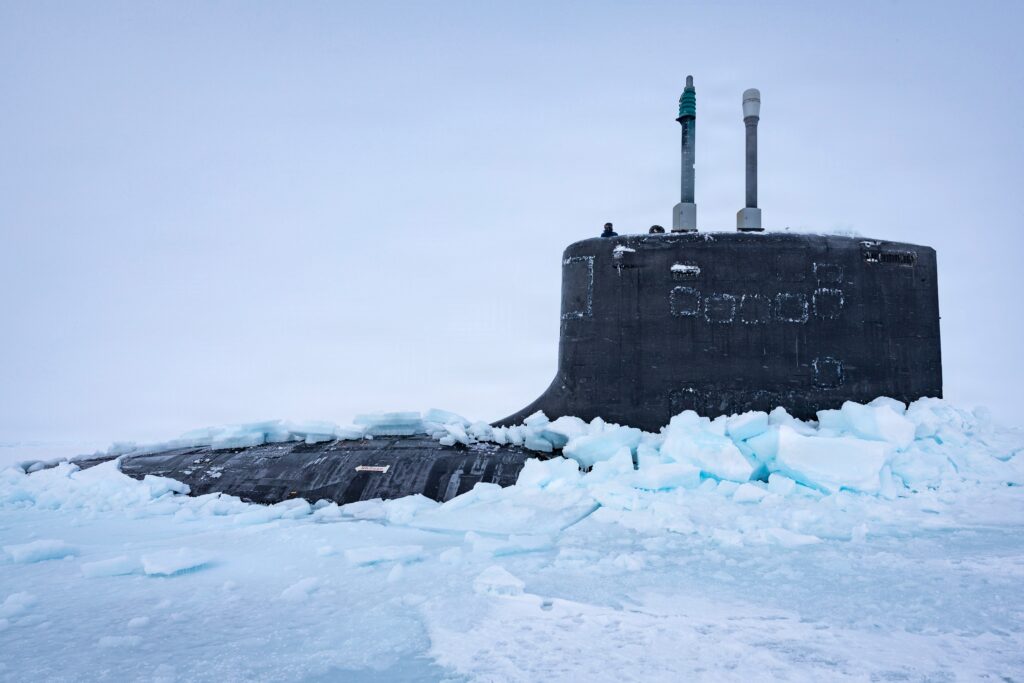
ARCTIC CIRCLE – Virginia-class fast-attack submarine USS Delaware (SSN 791) emerges from the ice after performing a vertical surfacing to kick off Operaetion ICE CAMP 2026, Mar. 7. ICE CAMP Boarfish is a three-week operation designed to research, test, and evaluate operational capabilities in the Arctic region (U.S. Navy Photo by MC1 Jacob D. Bergh) 

From U.S. Fleet Forces Command, March 9, 2026 

BARENTS SEA – Commander, Submarine Forces officially kicked off Operation Ice Camp (ICE CAMP) Boarfish in the Arctic Ocean on March 7, 2026, after the building of the camp and the arrival of two U.S. Navy fast attack submarines, USS Delaware (SSN 791) and USS Santa Fe (SSN 763).  

ICE CAMP Boarfish is a three-week operation designed to research, test, and evaluate operational capabilities in the Arctic region. In addition to U.S. Navy, U.S. Marine Corps, and Air National Guard participation, personnel from the Royal Australian Navy, Royal Canadian Navy, Royal Canadian Air Force, French Navy, Royal United Kingdom Navy, Norwegian Defence Research Institute, and the Japan Agency for Marine-Earth Science and Technology are also taking part. 

This operation, held biennially, partners with the Arctic Submarine Laboratory and was elevated from an exercise to an operation to better reflect the Navy’s strategic priorities in the Arctic. ICE CAMP provides the necessary training to maintain a working knowledge of a constantly changing region. 

“The Arctic is a critical region for national security and global stability. Our commitment to a sustained presence and operational readiness here is unwavering,” said Vice Adm. Richard Seif, Commander, Submarine Forces. “ICE CAMP Boarfish allows us to test and refine our capabilities, deepen our interoperability with key allies, and ensure our Submarine Force can project power and defend our nation’s interests in any environment, at any time. Our strength in the Arctic is a testament to the skill and resilience of our sailors and partners.” 

The Navy’s Arctic Submarine Laboratory, a detachment of the Undersea Warfighting Development Center, is the lead organization for planning and executing the operation. ASL serves as the “Center of Excellence” for Arctic matters for the U.S. Submarine Force. The Arctic is experiencing a trend of diminishing sea ice, which increases the likelihood of maritime activity in the region, including trans-oceanic shipping and resource extraction. 

The camp, named Ice Camp Boarfish, serves as a command center for conducting operations and research. Established on a drifting ice floe, the camp consists of shelters, a command center, and the necessary infrastructure to safely house and support the multi-national contingent of personnel throughout the operation. 

“Leading this multinational team in such a demanding environment is a privilege,” said Capt. David Nichols, Officer in Tactical Control of this year’s ICE CAMP. “The complexity of establishing a fully functional base on a moving sheet of ice cannot be overstated. The professionalism and dedication of every service member and civilian here is what makes this vital mission possible. We are focused on executing our objectives safely and effectively, further enhancing our collective readiness for Arctic operations.” 

The camp gets its namesake from the USSBoarfish(SS 327), aBalao-class submarine commissioned on September 23, 1944.During her service in World War II,Boarfishearned a battle star for sinking two Japanese vessels in the South China Sea. 

In 1947,Boarfishserved as the flagship for Operation Blue Nose, the first-ever exploration under the polar ice cap, where she tested new under-ice sonar technology. This historic mission demonstrated that extended under-ice navigation was practical and paved the way for future submarine operations in the Arctic. 

Submarines have conducted under-ice operations in the Arctic for more than 60 years. USS Nautilus (SSN 571) made the first transit in 1958, and USS Skate (SSN 578) was the first U.S. submarine to surface through Arctic ice at the North Pole in March 1959. Since those initial voyages, the U.S. Submarine Force has completed 99 such evolutions, with ICE CAMP Boarfish being the 100th. 

U.S. Submarine Forces execute the Department of the Navy’s mission in and from the undersea domain. In addition to lending added capacity to naval forces, Submarine Forces are expected to leverage those special advantages that come with undersea concealment to permit operational, deterrent, and combat effects that the Navy and the Nation could not otherwise achieve. 

U.S. Submarine Forces and supporting organizations constitute the primary undersea arm of the Navy. Submarines and their crews remain the tip of the undersea spear. 


From MRAP to MADIS: Legacy of Innovation Endures at NIWC Atlantic

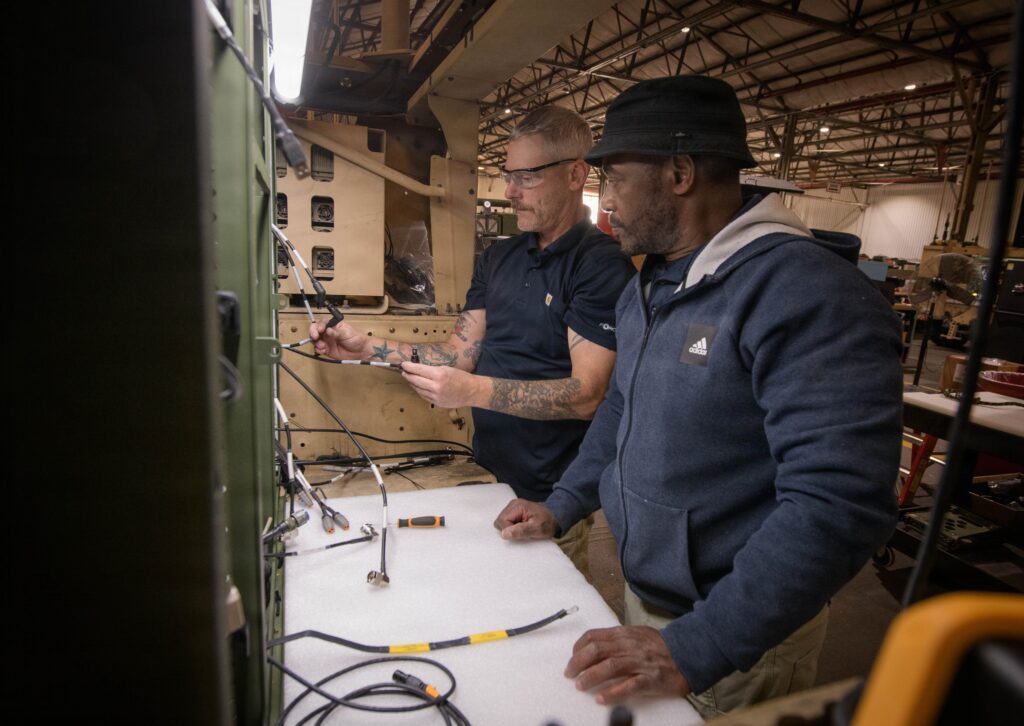
 NORTH CHARLESTON, S.C. (January 13, 2026) Naval Information Warfare Center (NIWC) Atlantic’s Expeditionary Warfare (ExW) Department personnel work on integrating Marine Air Defense Integrated System (MADIS) software, components and weapons onto Joint Light Tactical Vehicles (JLTVs) at the command’s Vehicle Integration Facility on Jan. 13, 2026. The engineers and computer scientists are part of the ExW Department’s Counter Threat Platforms team that for over a year now has been helping to field the drone-defeating MADIS capability to Marines at the 3rd Littoral Anti-Air Battalion and the Marine Corps Communication-Electronics School. (U.S. Navy photo by Joe Bullinger/Released) 

By Steve Ghiringhelli, NIWC Atlantic Public Affairs, March 10, 2026 

As one of the Navy’s top labs in systems integration, NIWC Atlantic engineering and ingrained innovation culture continue to deliver information warfare-dominant platforms that make the Naval and Joint Force more connected, resilient and lethal. 

CHARLESTON, S.C. — Throughout 2025, Naval Information Warfare Center (NIWC) Atlantic helped deliver the drone-defeating Marine Air Defense Integrated System (MADIS) to the Marine Corps, shepherding a critical breakthrough in air defense technology that significantly improves warfighter survivability and lethality. 
 
The MADIS system, which is mounted on two Joint Light Tactical Vehicles (JLTVs), detects aerial threats and defeats them with a 30mm cannon, Stinger missiles and electronic warfare capabilities. 
 
“As one of the Navy’s top labs in systems integration, NIWC Atlantic collaborates with industry partners to adopt the latest software and engineering innovations and quickly turn them into information-dominant platforms,” said Erick Fry, NIWC Atlantic acting executive director. “In the case of MADIS, our Expeditionary Warfare (ExW) Department very rapidly delivered a capability to U.S. Marines that defeats low-altitude threats and makes the Naval and Joint Force more connected, resilient and lethal.” 
 
The effort began in 2022, when ExW Department engineers used commercial off-the-shelf (COTS) components and leveraged the command’s On Demand Manufacturing Lab to outfit JLTVs with the necessary weapons, sensors, radar and other equipment to complete MADIS Increment 1.0 in less than one year’s time. The capability then matured through rigorous tests and trials before fielding to Marines at the 3rd Littoral Anti-Air Battalion and the Marine Corps Communication-Electronics School in late 2024 and throughout 2025. 
 
Fry said MADIS is one of many examples at NIWC Atlantic that builds upon the command’s historic successes in working with the Marine Corps and industry partners to rapidly innovate, prototype and integrate command, control, communications, computers, intelligence, surveillance and reconnaissance (C4ISR) components onto warfighting platforms like the JLTV. 
 
“NIWC Atlantic engineers modernize and streamline the complex work of systems integration each time they iterate,” Fry said. “I couldn’t be prouder of their accomplishments and continued advances on the innovation front.” 
 
‘Speed of MRAP’ 
 
A triumph still remembered today for its rapid warfighter response is NIWC Atlantic’s C4ISR integration of thousands of Mine Resistant Ambush Protected (MRAP) vehicles for Marines in Iraq and Afghanistan, an effort that began in 2008 and ended up blasting through slow bureaucratic processes to save countless lives. 
 
Last November, Secretary of War Peter Hegseth invoked the MRAP effort during a speech he delivered at the National War College announcing sweeping reforms in how the Department of War (DOW) will procure warfighting capabilities. With the current backdrop of a complex and ever-evolving threat environment, the Secretary stressed an urgency to move at “the speed of MRAP.” 
 
“Our objective is simple—transform the entire acquisition system to operate on a wartime footing,” he told the crowd. 
 
For a warfare center like NIWC Atlantic, rapidly integrating commercial products and information technologies onto mission-ready platforms is job No. 1. 
 
But speed and government are not often synonymous. 
 
Nevertheless, NIWC Atlantic has long been a driver for disrupting the status quo to gain greater flexibilities to navigate the complex world of military acquisitions. From MRAP to MADIS, NIWC Atlantic has rapidly delivered capabilities to provide warfighters speed, connectivity, lethality and survivability, despite the roadblocks. 
 
For example, when the JLTV first entered the U.S. military, the ExW Department overcame strict size, weight and power limitations to integrate components like sensors, jammers, advanced radio systems, battle-management software and communications equipment onto four distinct JLTV variants. Eventually, the department would field more than 5,000 of the high-tech vehicles to the Marine Corps and another 17,000 JLTVs to the Army, Navy and Air Force. 
 
Today, the JLTV and its advanced onboard suite of C4ISR services is considered by many a cornerstone platform of Marine Corps modernization in protected and expeditionary vehicles. 
 
More recently, the ExW Department began integrating the new Amphibious Combat Vehicle (ACV), the Marine Corps’ next-generation, amphibious transport that will replace the older Assault Amphibious Vehicles. 
 
“NIWC Atlantic is committed to delivering cutting-edge capabilities to the warfighter with speed and precision,” said ExW Department Head Ashlee Landreth. “By applying lessons learned from MRAP and embracing modularity, rapid prototyping, rigorous testing and warfighter feedback, we are accelerating the development and fielding of next-generation technologies that give the Naval and Joint Force a decisive edge on the battlefield.” 
 
Engineers who have worked at the command for decades say teams have refined and baked lessons learned into the systems-integration process, something that intricately includes COTS solutions, to build the systems for the platforms that Marines take to war. 
 
For example, NIWC Atlantic’s signature Networking on the Move (NOTM) technology was designed in 2012 in response to an urgent Marine Corps request by U.S. Central Command to expand the capability to vehicles beyond the MRAP. Once the JLTV emerged, the Marine Corps asked ExW Department to develop a transferrable variant for it. 
 
So the team engineered a way for NOTM to be integrated onto three separate JLTVs, operating as one system, providing Marines a sophisticated communications hub to transmit and receive vital information across the battlespace in seconds, allowing infantry troops to fight at high speeds while still maintaining critical command and control functions. 
 
More recently, the ExW Department also integrated long-term power supplies and a completely redesigned, state-of-the-art communications system onto the Ground/Air Task-Oriented Radar (G/ATOR), a 360-degree, 3D surveillance, air-defense and air-control radar system that has replaced five legacy systems for the Marine Corps. 
 
The department also outfitted the JLTV with the Navy-Marine Expeditionary Ship Interdiction System, or NMESIS, which is a cutting-edge, land-based, anti-ship missile capability tailored for the complex littoral environment. 
 
Jenny Bennett, who leads the ExW Department’s platform integration team that was responsible for fielding the JLTV, said every integration has to be meticulously managed through workflow processes that ensure the end-user, the warfighter, always gets into the identical JLTV variant—same look, same feel, same function. “We baseline every truck before turning it over to our MADIS, NOTM or NMESIS teams,” she said. 
 
Modularity & Speed 
 
As a result of MRAP lessons learned, the ExW Department eventually broke with tradition and began procuring technical data packages (TDPs) from industry. Owning the TDPs that are tied to a COTS solution ensured government could find alternative, competitive sources in the marketplace during times of supply chain instability. 
 
Peter Ward, ExW Department deputy, who was a young systems engineer just joining NIWC Atlantic 20 years ago, said the department continued to innovate. It bought and standardized data and focused heavily on incorporating a more vendor-neutral, “modular open systems approach,” or MOSA. 
 
“We have focused on modularity for a long time,” Ward said. “No matter which commercial solution is available, the MOSA framework specifically enables a collaborative environment for working with vendors and filling specific operational needs.” 
 
With TDPs and other sensitive data, Ward said MOSA concepts help ensure proprietary data does not later keep engineers from achieving interoperability. 
 
Recently, MOSA also enabled ExW Department engineers to tailor COTS software to build a secure, hardware-agnostic platform called the Common Hosting Environment (CHE). Using next generation technologies, CHE is the first container-hosting environment that can run apps for Marines in the field. 
 
Perhaps just as important as the unseen innovations in software, agile processes and engineering insights, the physical infrastructures stood up at NIWC Atlantic since the MRAP buildup is paying enormous dividends now 20 years later. 
 
In 2007, NIWC Atlantic first stood up Poseidon Park for radio frequency testing of vehicle-mounted antennas. Instead of shipping vehicles hundreds of miles away on rail, JLTVs, ACVs and other vehicles drive onto an automated vehicle turntable to be tested and validated under an overhead gantry through range checks, antenna cosite analysis and verifications of survivability. 
 
In 2011, the command unveiled the nearby Small Autonomous Unmanned Systems Research (SAUSR) Range to support drone swarming technologies, resilient communications, C4ISR test and evaluation, and other science and technology research. 
 
Last year, the SAUSR Range expanded its footprint and mission set to unveil a new laser range focused on advancing naval communications through the research and development of free-space optics. 
 
In addition to the two outdoor capabilities, NIWC Atlantic began building indoor systems integration labs, or SILs, enabling engineers to test and integrate new commercial solutions within physically constructed replicas of real-world platforms, such as one resembling the inside of a JLTV and another one the Marine Corps’ new advanced reconnaissance vehicle. 
 
“The systems integration process becomes a lot more agile and iterative when you are working in these controlled environments,” said Jeff Sims, who leads the Expeditionary Platform Integration Division at ExW Department. “SILs enhance continuous improvements and the rapid adaptation of solutions.” 
 
SILs have also institutionalized rapid prototyping practices, bringing together diverse vendors, industry partners and subject matter experts to optimize the integration of the latest innovations, from GPS technologies, radios, ruggedized laptops, sensors and cameras to data-fusing AI, advanced networking, driver-vision systems and electronic warfare. 
 
“The cool thing is how the SIL speeds us up, gives us more flexibility and gets us across the finish line through modeling and simulation,” Ward said. “Instead of requiring that everyone come together all at the same time to integrate, whenever a program discovers a new commercial product offering, we can just go in with all the other equipment, see how it configures, design it, integrate a new system and get it out the door.” 
 
Platforms successfully integrated inside of a SIL are then dispatched for environmental and operational testing at Poseidon Park, SAUSR Range and other labs on base. Before final warfighter acceptance, a field user evaluation is typically coordinated with Marine units. 
 
“All of these developments have helped us field equipment faster, because it’s not only about researching and finding products off the shelf,” Ward said. “When you procure them, you need to integrate them and modify them, so they work together and do no harm to one another, and then test them. Without these labs and ranges on site, where we can physically drive the vehicles to see which ones perform best, it would take forever.” 
 
At NIWC Atlantic, innovations in automation, engineering, modularity, systems integration and software-defined communications have made the command good stewards of their many MRAP lessons-learned. Rather than be cloistered in labs, teams are external-facing, working closely with pioneers in industry, constantly experimenting with the integration of systems, walking lockstep with their Marine sponsors and very appreciative of the multifaceted stakeholder relationships a Navy lab like NIWC Atlantic must continually foster and support in order to continue delivering worldclass information warfare solutions to the Fleet. 
 
“We know the Marine Corps requires information warfighting capabilities to create and exploit information advantages on all points of the competition continuum,” Landreth said. “This is why NIWC Atlantic—from MRAP to MADIS and beyond—plays such a critical role in the success of the modern-day Marine.” 
 
About NIWC Atlantic 
 
As a part of Naval Information Warfare Systems Command, NIWC Atlantic provides systems engineering and acquisition to deliver information warfare capabilities to the naval, joint and national warfighter through the acquisition, development, integration, production, test, deployment, and sustainment of interoperable command, control, communications, computer, intelligence, surveillance, and reconnaissance, cyber and information technology capabilities. 


USS Nimitz Conducts Milestone Departure from Naval Base Kitsap 

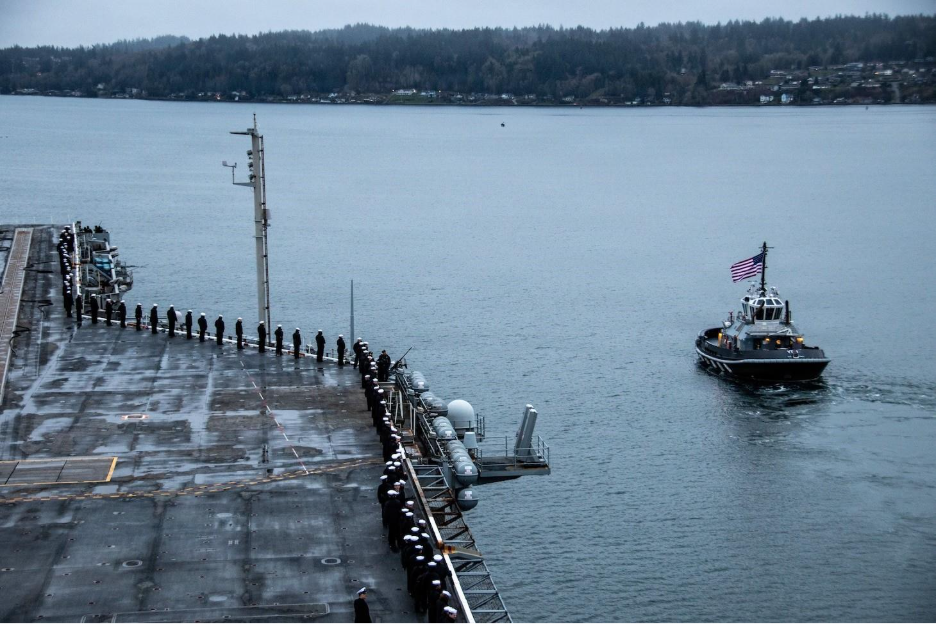
U.S. Sailors man the rails underway aboard Nimitz-class aircraft carrier USS Nimitz (CVN 68) during the ship’s final departure from Naval Base Kitsap-Bremerton, Washington, Mar. 7, 2026. Nimitz is underway in the U.S. 3rd Fleet area of operations as part of a scheduled homeport shift to Norfolk, Virginia. (U.S. Navy photo by Mass Communication Specialist 2nd Class Jaron Wills) 

by LT.J.G. Paul Fletcher, March 9, 2026 

The Nimitz-class aircraft carrier USS Nimitz (CVN 68) departed Naval Base Kitsap in Bremerton, Washington, for the last time in its 51-year service history, as part of a scheduled homeport shift to Naval Station Norfolk, Virginia, March 7. 

Nimitz has spent the majority of its five decades of service as the “Pacific Northwest’s Carrier,” deploying around the world to affirm the U.S. Navy’s commitment to forward presence, ensuring maritime security, deterring aggression, and protecting the American way of life. 

“This ship and her crew could not be more thankful to the people of Washington State for their decades of hospitality, friendship and trust,” said Capt. Joseph Furco, commanding officer of Nimitz. “It is in no small part due to the support of our local community that Nimitz Sailors have been able to successfully train, fight and win, exemplifying the ship’s motto; Teamwork, a Tradition.” 

Mostly recently, Nimitz returned to Bremerton in December after nine months underway in the U.S. 3rd, 5th, and 7th Fleets. As flagship of the Nimitz Carrier Strike Group (NIMCSG) during this period, the Nimitz and her crew completed more than 8,500 sorties and 17,000 flight hours, carried out 50 replenishments-at-sea aboard the carrier and sailed over 82,000 nautical miles combined. 

Additionally, the NIMCSG supported U.S. Africa Command operations by conducting strikes against ISIS targets in Somalia. 

The lead ship of her class, Nimitz was commissioned May 3, 1975, and named in honor of Fleet Admiral Chester W. Nimitz who achieved the highest rank in the United States Navy as Commander in Chief, Pacific Fleet during World War II. 

An integral part of U.S. Pacific Fleet, U.S. 3rd Fleet operates naval forces in the Indo-Pacific and provides the realistic and relevant training to ensure the readiness necessary to execute the U.S. Navy’s timeless role across the full spectrum of military operations. U.S. 3rd Fleet works together with our allies and partners to advance a shared vision of a free, open, and secure Indo-Pacific in which all nations are secure in their sovereignty and free from coercion. 


Steadicopter and flyAlchemy Partner to Support U.S. Operational Deployment of Rotary UAV Systems​     ​  

Agreement includes provision of Black Eagle 50E systems for ISR and specialized missions supporting U.S. government and DoW operational needs 

From Steadicopter Ltd. 

March 9, 2026 – Steadicopter Ltd., a developer and manufacturer of rotary unmanned aerial systems, announced the signing of a services agreement with U.S.-based flyAlchemy to support operational deployment and evaluation of its rotary UAV platforms in the United States. 

Under the agreement, Steadicopter will provide Black Eagle 50E rotary UAV systems for demonstration, ​customer ​​​evaluation​ programs​, and mission development activities ​supporting ​​     ​ ISR and specialized operational missions. The partnership will include flight demonstrations, regulatory alignment and preparation for future operational deployment for U.S. government and commercial customers. 

“Signing this agreement strengthens our operational footprint in the U.S. market and enables us to align our rotary UAV capabilities with real mission requirements,” said Noam Lidor, CEO of Steadicopter. “The Black Eagle 50E platform provides a flexible and modular ISR solution for a wide range of operational scenarios, and this collaboration creates a strong foundation for expanding our presence in the United States.” 

Initial activities will focus on demonstration flights, regulatory alignment, and payload integration, supporting ISR missions, disaster management, infrastructure monitoring, and specialized mission profiles. The partnership will also support certification pathways and training programs at flyAlchemy’s U.S. flight test locations.  

The partnership strengthens Steadicopter’s expansion into the U.S. market, combining the company’s advanced rotary UAV platforms with flyAlchemy’s operational experience supporting government missions, remote sensing operations, and advanced aerial data services. 

The companies intend to collaborate closely to align Steadicopter’s U.S. market expansion with flyAlchemy’ operational expertise and advanced payload capabilities, with the goal of establishing a long-term strategic presence for advanced rotary UAV capabilities in the United States. 

About the Black Eagle 50E 

The Black Eagle 50E (BE50E) is Steadicopter’s flagship rotary unmanned aerial system, delivering a cost-effective, high-quality real-time ISR capability across land and maritime domains. Its modular open architecture supports multiple payloads including EO/IR sensors, SAR, maritime patrol radar, SIGINT systems, AIS receivers, communications relay systems, and cargo delivery configurations. 

With a minimal logistical footprint and long-endurance hovering capability, the platform enables persistent surveillance and flexible mission configurations supporting military, homeland security, and civilian operational environments. 


Coast Guard Cutter Munro crew returns home after 119-day, multi-mission patrol; more than 20,000 pounds of cocaine seized 

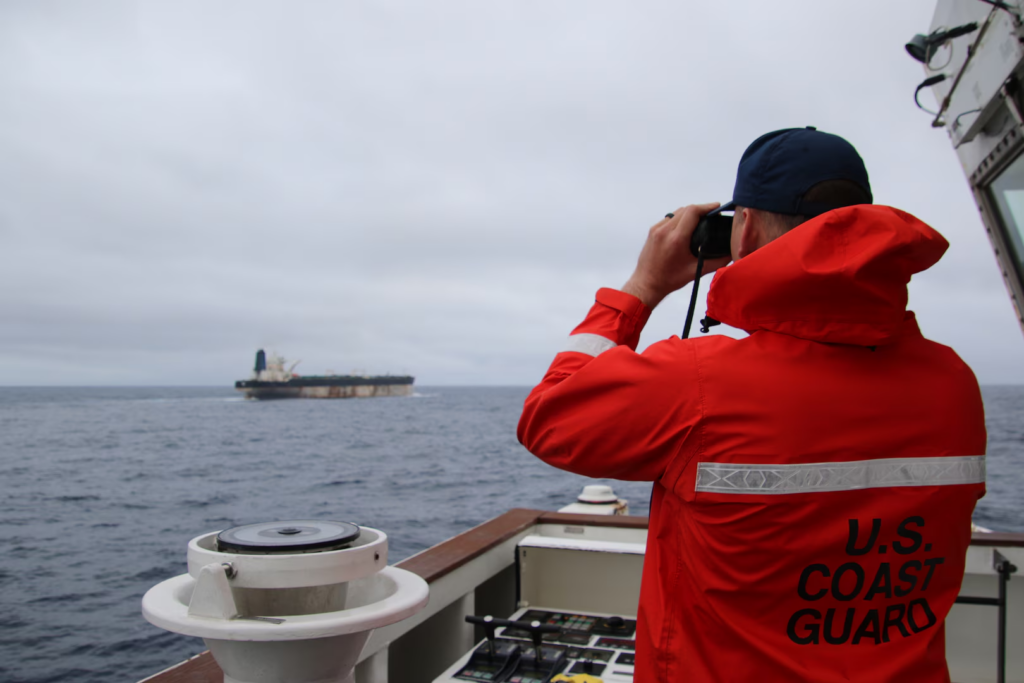
 A Coast Guard Cutter Munro (WMSL 755) crew member observes the oil tanker Bella 1 in the North Atlantic Ocean, Jan. 6, 2026. Munro’s crew monitored the vessel until it was seized by Coast Guard deployable specialized forces, with support from the Department of War, after Bella 1 violated U.S. sanctions and resisted initial boarding attempts off coastal Venezuela in late December. (U.S. Coast Guard photo)

From U.S. Coast Guard Pacific Area, March 6, 2026 

ALAMEDA, Calif. – The crew of U.S. Coast Guard Cutter Munro (WMSL 755) returned to their home port in Alameda, on Sunday, following a historic 119-day multi-mission deployment spanning more than 26,000 miles from the Eastern Pacific Ocean to the Northern Atlantic. 
 
Munro departed Alameda on November 3, 2025, to conduct training workups and participate in the Department of War’s exercise Resolute Hunter offshore of San Diego, before sailing into the Eastern Pacific to execute a counternarcotics patrol in support of the U.S. Coast Guard’s Operation Pacific Viper. Munro was diverted to the Atlantic Ocean in support of the Department of War’s Operation Southern Spear. 
 
While supporting U.S. Southern Command’s Joint Interagency Task Force South and Coast Guard Southwest District, Munro detected and identified a heavily laden go-fast vessel transiting along a known smuggling route in the Eastern Pacific. With the help of its two cutter pursuit boats, Scan Eagle short-range unmanned aerial system, and an embarked MH-65 aircraft from the Helicopter Interdiction Tactical Squadron (HITRON), Munro successfully found, tracked and interdicted the vessel using warning shots and disabling fire from the HITRON aircraft. Munro subsequently detained six suspected narco-terrorists and seized 22,052 pounds of cocaine valued at over $250 million – the single largest maritime drug seizure in 18 years, and the largest ever in HITRON’s history. This interdiction continued the Coast Guard’s historic counter-drug operations through Operation Pacific Viper, including the seizure of over 200,000 pounds of cocaine along maritime smuggling routes from South and Central America since early August. 
 
After transiting through the Panama Canal, Munro took station in the Caribbean Sea, ready to conduct new tasking in support of Operation Southern Spear. Munro located and identified the dark fleet Motor Tanker Bella 1, a U.S. sanctioned vessel determined to be without nationality and subject to U.S. jurisdiction. Munro’s crew continuously pursued the non-compliant vessel across the North Atlantic Ocean for 18-days and over 4,900-miles. The pursuit culminated with the boarding of Bella 1, where Munro worked in tandem with Department of War assets to seize control of the 333-meter crude oil carrier for further transfer to the U.S. Department of Justice and U.S. Department of Homeland Security for disposition. 
 
“The service, our nation and our families can be extremely proud of Munro,” said Capt. Jim O’Mara, Munro’s commanding officer. “This crew rose to every new challenge thrown at them with professionalism and persistence, and they achieved historic results. This was a one-of-a-kind deployment for us, but it is also just one part of a much broader campaign and U.S. national strategy.” 
 
“We could not have done this without support from partners, allies, and our families,” said O’Mara. “Our families had to adapt to each new twist, just like all military families do across the Armed Forces. It is tough on them. But when they hold strong at home that keeps us motivated and focused on our mission. Now, we reunite with our loved ones, proud of what we accomplished and already preparing for the next mission.” 
 
Commissioned in 2017, Munro is one of four U.S. Coast Guard Legend-class National Security Cutters homeported in Alameda, California. The cutter is named in honor of Signalman First Class Douglas A. Munro – the only Coast Guardsman awarded the Medal of Honor – for his heroic actions on September 27th, 1942, when he gallantly sacrificed himself in the defense, rescue, and evacuation of 500 stranded U.S. Marines from Point Cruz, Guadalcanal, in the Solomon Islands. 


FN Awarded $9.9 Million Contract from U.S. Army and Navy for Machine Guns 

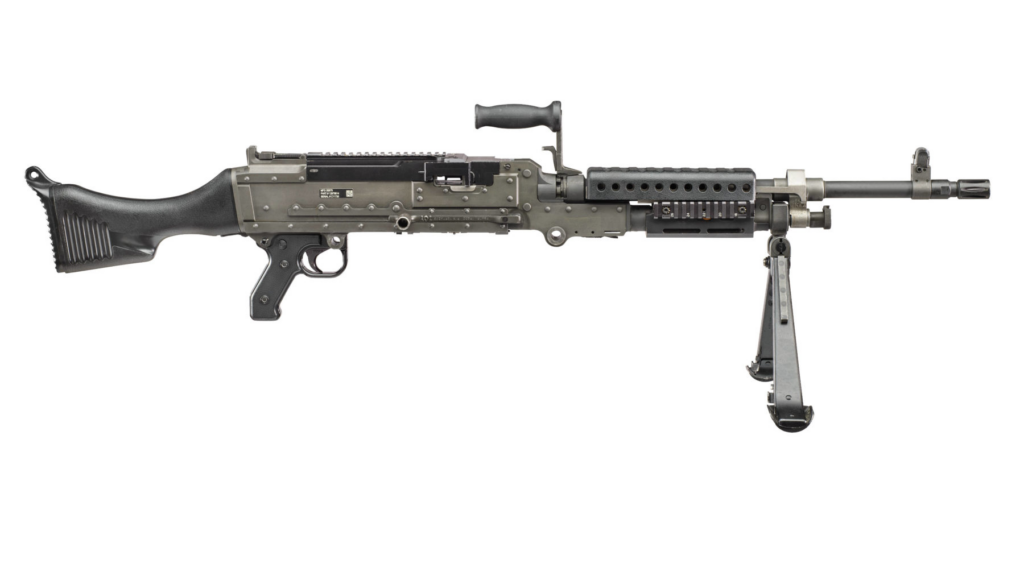
MCLEAN, Va., March 5, 2026 — FN America, LLC, is pleased to announce that it has been awarded a $9.9 million contract to supply the U.S. Army and U.S. Navy with FN® M240B machine guns, continuing the supply of FN America’s longest-standing military weapons platform. 

“This contract continues FN’s legacy of providing the most effective and advanced weapon systems for the warfighter,” said Jim Williams, Vice President, Military Programs for FN America, LLC. “The U.S. Army contract for the M240 machine gun was the first military contract FN was awarded and the first to be produced from our production facility in South Carolina. We’re incredibly honored to continue supporting the U.S. military with high-quality and reliable weapon systems for our servicemen and women.” 

The FN® M240B, built on the M240 platform that was adopted and has been in use by the U.S. military since the late 1970s, is the “go-to/can-do” medium machine gun for all branches of the U.S. military. It offers unmatched reliability, extended range and an exceptional service life. This weapon’s high volume of fire makes it the principal suppressive firearm for the infantry platoon and company. 

Chambered in 7.62x51mm NATO, the M240B’s cold hammer-forged MIL-SPEC barrel has a hard-chromed bore for longer life, improved accuracy and maximum range of 3,725 meters. The receiver is machined steel and is equipped with a top-mounted MIL-STD-1913 optical rail. The crossbolt safety and curved trigger help enhance operator control. 

“Since beginning our first production in 1981, FN has produced millions of firearms for the U.S. military at our Columbia, SC, manufacturing facility,” said Daryl Atkins, Director, Industrialized Weapons for FN America, LLC. “FN is extremely proud of the high-quality, reliable firearms we build for our military servicemen and women, and we look forward to continuing the tradition with this contract.” 

Throughout its history, FN has been one of the largest suppliers of small arms to the U.S. military and continues to develop innovative, future technology. In addition to the M240 platform, the company currently holds contracts for the FN® M249, MK 46, MK 48, MK 17 and MK 20 SSR for USSOCOM and various other contracts. 


General Dynamics NASSCO Christens the Sixth and Final Ship in the ESB Program for the U.S. Navy 

From General Dynamics NASSCO, March 7, 2026 

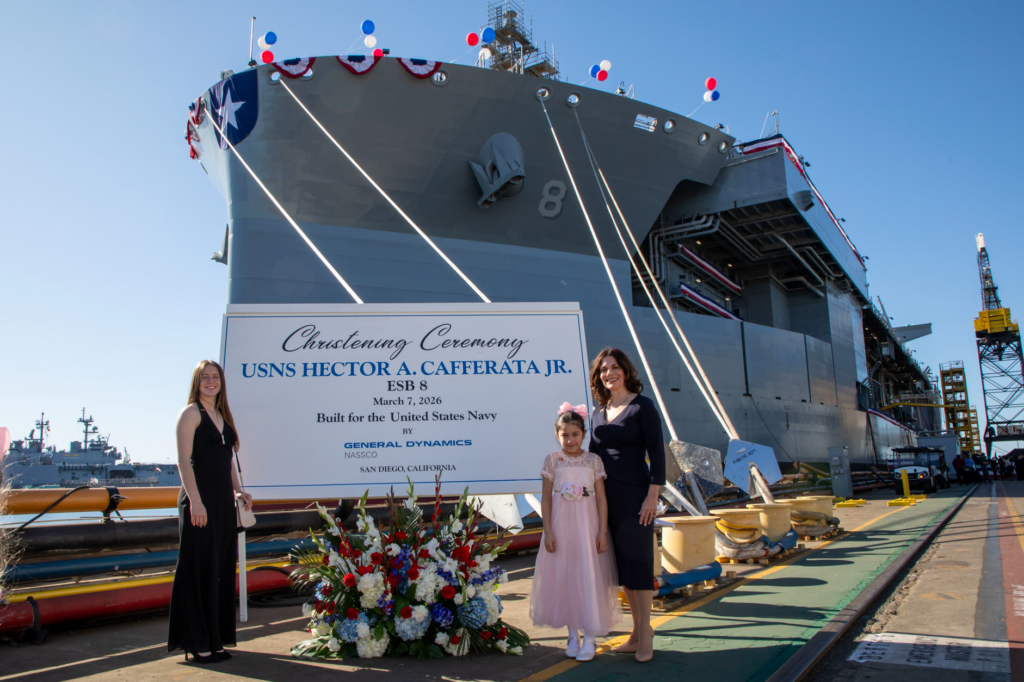
SAN DIEGO – Today, General Dynamics NASSCO christened the USNS Hector A. Cafferata Jr. (ESB 8), the sixth and final ship for the U.S. Navy’s Expeditionary Sea Base (ESB) program. Sergeant Major Carlos A. Ruiz served as the principal speaker at the ceremony, which also included remarks from NASSCO, U.S. Navy, and U.S. Marine Corps representatives. Following remarks, ship co-sponsors Heather Cafferata, daughter of the ship’s namesake, and Jessica Cafferata, granddaughter of the ship’s namesake, christened the ship with the traditional champagne bottle break alongside the hull. 

“Ships are not just steel and machinery—they carry legacies, and they connect past generations to future ones,” said David Carver, president of General Dynamics NASSCO. “The remarkable story of valor and sacrifice of Hector Cafferata Jr. will soon sail across the globe, carried by a ship that embodies his courage and dedication.” 

The ship is named for Private First Class Hector A. Cafferata Jr., who was awarded the Medal of Honor for his brave actions at the Battle of Chosin Reservoir during the Korean War. He single-handedly held off a regimental-strength enemy force and safeguarded wounded Marines by throwing a live grenade away from his position. The Medal of Honor was presented to him by President Harry Truman in a White House ceremony in 1952. 

The ESB ship class is a highly flexible platform designed to support multiple maritime-based missions. ESB ships are mobile sea-based assets and are a part of the critical access infrastructure that supports the deployment of forces, equipment, supplies, and warfighting capability. These 784-foot ships are configured with a 52,000 square-foot flight deck to support MH-53, MH-60, MV-22 tilt-rotor, and H1 aircraft operations. 

The first five ships in the ESB program – USS Lewis B. Puller (ESB 3), USS Hershel “Woody” Williams (ESB 4), USS Miguel Keith (ESB 5), USS John L. Canley (ESB 6), and USNS Robert E. Simanek (ESB 7) – have been delivered to the U.S. Navy. 


USS Cincinnati Returns to Homeport in San Diego 

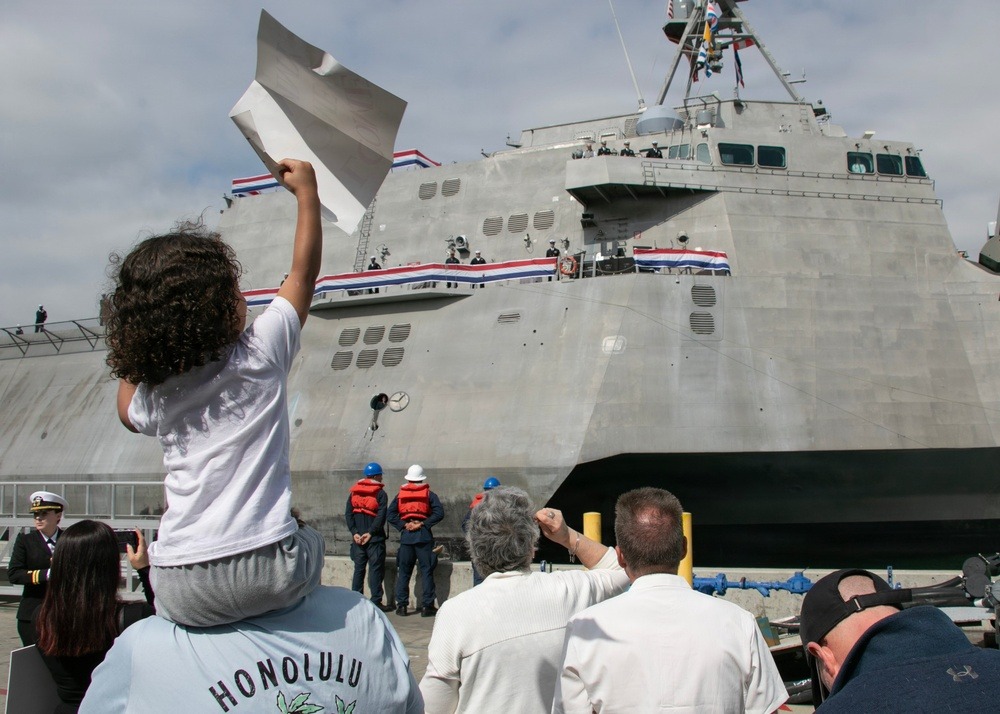
Families and friends welcome the Independence-variant littoral combat ship USS Cincinnati (LCS 20) as it returns to its homeport of Naval Base San Diego, March 4, 2026. The Cincinnati returned to its homeport of San Diego after eight months of sustained operations in the U.S. 3rd and 7th Fleet areas of operations. (U.S. Navy photo by MC1 Class Josh Coté)  

By Lt. Brinn HefronCommander, Littoral Combat Ship Squadron 1, March 4, 2026 

SAN DIEGO – Independence-variant littoral combat ship USS Cincinnati (LCS 20) arrived at its San Diego homeport following eight months of sustained operations at sea, March 4. 

Cincinnati conducted several multilateral exercises and port visits in the U.S. 3rd and 7th Fleet areas of operations throughout the Indo-Pacific, including Brunei, Cambodia, Indonesia, Malaysia, the Philippines, the Republic of the Marshall Islands, Singapore, enhancing regional maritime cooperation and interoperability. Cincinnati participated in Cooperation Afloat Readiness and Training (CARAT) exercises with members of the Association of South East Asian Nations (ASEAN) throughout the Pacific. 

“I am immensely proud of the crew for their exceptional performance during our sustained operations abroad,” said Cmdr. Andrew Recame, commanding officer of Cincinnati. “This was a significant milestone, not only for the ship and its crew, but for the entire LCS program. For eight months, Team Cincy operated boldly in the U.S. 7th Fleet area of operations, demonstrating the versatility and capability of the U.S. Navy wherever we went. The dedication and professionalism of our Sailors has been truly outstanding, and they have represented the best of America’s spirit on the high seas and foreign shores.” 

In July 2025, during a port visit to the Republic of Marshall Islands, Cincinnati hosted “Stand and Defend,” a special event to honor Marshallese U.S. military veterans for their service, sacrifice, and dedication; co-hosted an Independence Day Celebration at Delap Dock; and conducted ship tours for dignitaries including the ambassador to the Marshall Islands. 

In September 2025, Cincinnati transited to the Southern Hemisphere enroute to Timor-Leste. Upon crossing the equator, the crew took part in a “Crossing the Line” ceremony, a time-honored maritime tradition where “Pollywogs,” those who have never crossed the equator, are transformed into “Shellbacks.” Upon arrival in Dili, Timor-Leste, Cincinnati participated in CARAT Timor-Leste 2025, a comprehensive bilateral exercise designed to enhance maritime partnership and interoperability. The exercise encompassed a series of key diplomatic and military-to-military engagements, from the official opening and closing ceremonies to a formal U.S. Navy reception that strengthened strategic maritime ties. 

In October 2025, Cincinnati participated in multinational exercise Sama Sama 2025 alongside ships and aircraft from Canada, France, Japan, and the Philippines. “Sama Sama,” a Tagalog word that translates to “together,” consisted of a series of maritime exercises while circumnavigating the Philippine province of Palawan. Cincinnati’s crew, as part of a combined, international force, planned and conducted six days of underway communications exercises, live-fire exercises, tactical maneuvering drills, flight operations, and small boat operations. 

Cincinnati participated in CARAT Brunei 2025, reinforcing commitment to regional security and maritime partnerships. The exercise included subject matter expert exchanges in a variety of fields including legal, communications, cyber security, damage control, and medical. Cincinnati Sailors also participated in community relations events where they volunteered at Yayasan Kanser Kanak, a children’s cancer foundation; the Sejahtera Community Animal Shelter; and the Brunei Darussalam Paraplegic and Physically Disabled Association: Wheelchair Repair Facility/Disabled Training Center. CARAT Brunei concluded with the sea phase, where Cincinnati and a Royal Brunei Armed Forces offshore patrol vessel, a P-8A Poseidon from Commander, Task Force 72, and a U.S. Coast Guard visit, board, search, and seizure (VBSS) team conducted live-fire gunnery exercises, air defense exercises, and VBSS operations. 

In December 2025, Cincinnati participated in CARAT Malaysia 2025, marking another significant milestone in the long-standing defense partnership. During three days at sea, Cincinnati, alongside Royal Malaysian Navy Lekiu-class guided-missile frigate KD Lekiu (FFG 30), sailed in formation and conducted exercises such as communications drills, simulated air defense exercises, and deck landing qualifications within the Strait of Malacca. 

Cincinnati also co-hosted ASEAN-U.S. Maritime Exercise (AUMX) 2025 with the Indonesian Navy in Batam, Indonesia. The exercise brought together eight partner navies, including warships from Brunei, Indonesia, Malaysia, Myanmar, the Philippines, Singapore, and Vietnam, and culminated with two days of communication exercises, tactical maneuvering drills, air defense exercises, search and rescue, and medical evacuation drills. 

In January, Cincinnati was the first U.S. Navy warship to moor pierside at Ream Naval Base, Cambodia. This was only the second visit of a U.S. warship to the Kingdom of Cambodia in the last nine years, following Independence-variant littoral combat ship USS Savannah’s (LCS 28) visit in 2024. While in port, the crew welcomed Commander, U.S. Indo-Pacific Command Adm. Samuel Paparo, along with over 100 senior military and government officials for a hosted reception and ship tours. 

“It is a privilege to welcome home and recognize the safe return of the USS Cincinnati after a long and challenging deployment,” said Capt. James Hoey, commodore, Littoral Combat Ship Squadron 1. “This warship demonstrated a strong and steady presence in strategically vital waterways and operated seamlessly alongside our allies and partners across the Indo-Pacific region. Over the course of this deployment, this crew found common purpose in one another and in the mission: standing the watch, trusting each other, and serving something greater than themselves. I know the families, friends and shipmates here today are just as proud of their Sailors as I am. 

Cincinnati’s operations exemplify the Navy’s commitment to integrated deterrence, regional maritime security, and enduring alliances and partnerships throughout the Indo-Pacific. 

Littoral combat ships are fast, optimally manned, mission-tailored surface combatants that operate in near-shore and open-ocean environments, winning against 21st-century threats. LCS integrate with joint, combined, manned and unmanned teams to support forward-presence, maritime security, sea control, and deterrence missions around the globe. 

For more news from Commander, Littoral Combat Ship Squadron 1, visit https://www.surfpac.navy.mil/comlcsron1/ or follow on Facebook at www.facebook.com/COMLCSRONONE/ or on Instagram at https://www.instagram.com/littoralcombatshipsquadron1/. 


While Improving Quality of Life, Navy Remains Ready to Fight

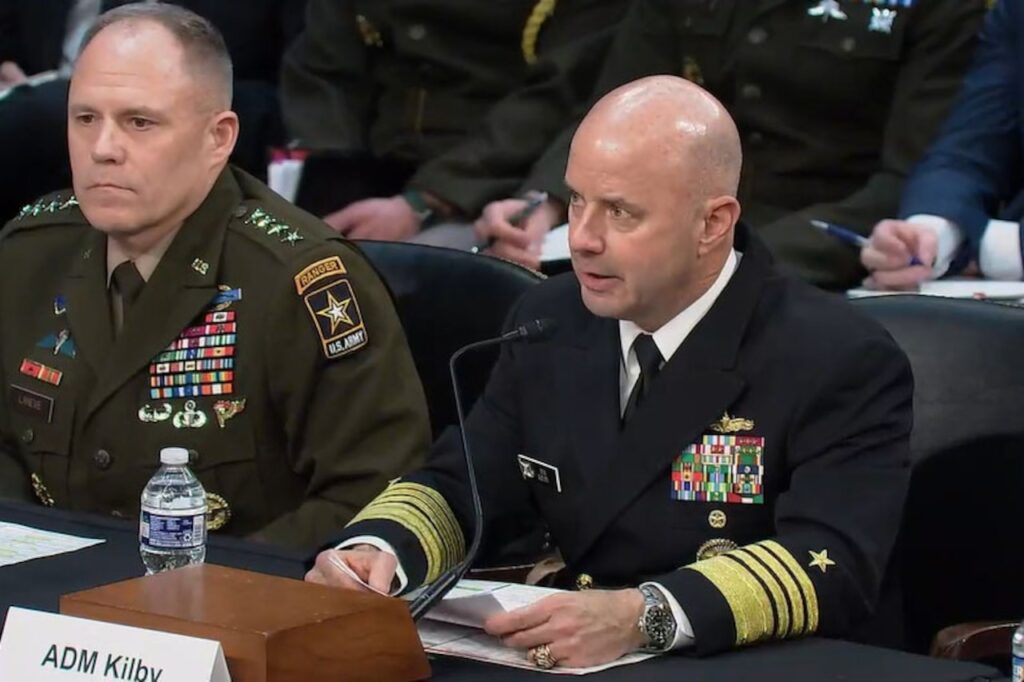
Navy Adm. James W. Kilby, vice chief of naval operations, testifies at a Senate Armed Services Committee hearing on joint force readiness in Washington, March 4, 2026. Credit:DOW screenshot

March 5, 2026 |  By David Vergun, DoW News  

The Navy is participating in exercises and operations worldwide, said Navy Adm. James W. Kilby, vice chief of naval operations, who, along with other service leaders, testified yesterday at a Senate Armed Services Committee hearing in Washington on joint force readiness. 

Last year in the Middle East, the Navy executed strikes against adversaries during Operations Rough Rider and Midnight Hammer, while defending regional allies and partners.  

This year, the Navy participated in Operation Absolute Resolve in the Atlantic, while sailors operate every day to deter China and build partnerships in the Pacific, Kilby said.  

Currently, the Navy is supporting Operation Epic Fury. On March 3, a Navy fast attack submarine sank an Iranian combatant ship with the Mark 48 torpedo.  

The Navy’s primary weapon system is its sailors, the admiral said, noting that the service exceeded its recruiting goals last year and is successfully working to increase retention.  

To further support sailors, the Navy is focused on improving quality of life through a new initiative that provides permanent shore-based housing so that no sailor is required to live aboard a ship while on shore duty, he said. Efforts also include expanding child care, improving fitness facilities and expanding meal selections with healthy options.  

Always looking for ways to improve, the service is increasing platform readiness by reducing maintenance delays, investing in shipyard infrastructure optimization and developing the civilian workforce. Advanced technologies such as conditions-based maintenance and advanced additive manufacturing are being used to optimize systems.  

“The Navy continues to drive toward our goal of 80% combat surge-ready ships, aircraft and submarines with urgency and accountability,” Kilby said, adding that he’s concerned with the material condition of amphibious ships and is working to improve that.